
Loading article…


The Polish Corridor (German: Polnischer Korridor; Polish: korytarz polski), also known as the Pomeranian Corridor, was a territory located in the region of Pomerelia (Pomeranian Voivodeship, Eastern Pomerania), which provided the Second Polish Republic with access to the Baltic Sea, thus dividing the bulk of Weimar Germany from the province of East Prussia. At its narrowest point, the Polish territory was just 30 km (19 mi) wide.[1] The Free City of Danzig (now the Polish cities of Gdańsk, Sopot and the surrounding areas), situated to the east of the corridor, was a semi-independent German speaking city-state forming part of neither Germany nor Poland, though united with the latter through an imposed union covering customs, mail, foreign policy, railways as well as defence.
After Poland lost Western Pomerania to Germany in the late 13th century, the area of Eastern Pomerania with the strategically important port of Gdańsk remained a narrow strip of land giving Poland access to the Baltic Sea and was also sometimes referred to as Pomeranian corridor.[2][3]
According to German historian Hartmut Boockmann the term corridor was first used by Polish politicians,[4] while Polish historian Grzegorz Lukomski writes that the word was coined by German nationalist propaganda of the 1920s.[5] Internationally the term was used in English as early as March 1919[6] and whatever its origins it became a widespread term in English.[7][8][9][10][11][12][13]
The equivalent German term is Polnischer Korridor. Polish names include korytarz polski ('Polish corridor') and korytarz gdański ('Gdańsk corridor'); however, reference to the region as a corridor came to be regarded as offensive by interwar Polish diplomats. Among the harshest critics of the term corridor was Polish Foreign Minister Józef Beck, who in his May 5, 1939 speech in the Sejm (Polish parliament) said: "I am insisting that the term Pomeranian Voivodeship should be used. The word corridor is an artificial idea, as this land has been Polish for centuries, with a small percentage of German settlers".[14] Poles commonly referred to the region as Pomorze Gdańskie ('Gdańsk Pomerania', Pomerelia") or simply Pomorze ('Pomerania'), or as województwo pomorskie ('Pomeranian Voivodeship'), which was the administrative name for the region.
In the 10th century, Pomerelia was settled by Slavic Pomeranians, ancestors of the Kashubians, who were subdued by Bolesław I of Poland. In the 11th century, they created an independent duchy.[15] In 1116/1121, Pomerania was again conquered by Poland. In 1138, following the death of Duke Bolesław III, Poland was fragmented into several semi-independent principalities. The Samborides, principes in Pomerelia, gradually evolved into independent dukes, who ruled the duchy until 1294. Before Pomerelia regained independence in 1227,[15][16] their dukes were vassals of Poland and Denmark. Since 1308–1309, following succession wars between Poland and Brandenburg, Pomerelia was subjugated by the Monastic state of the Teutonic Knights in Prussia. In 1466, with the second Peace of Thorn, Pomerelia became part of the Polish–Lithuanian Commonwealth as a part of autonomous Royal Prussia. After the First Partition of Poland in 1772 it was annexed by the Kingdom of Prussia and named West Prussia, and became a constituent part of the new German Empire in 1871. Thus the Polish Corridor was not an entirely new creation: the territory assigned to Poland had been an integral part of Poland prior to 1772, but with a large degree of autonomy.[17][18][19][20]
Perhaps the earliest census data on the ethnic and national structure of West Prussia (including areas which later made up the corridor) is from 1819.[21]
Karl Andree, in Polen: in geographischer, geschichtlicher und culturhistorischer Hinsicht (Leipzig 1831), gives the total population of West Prussia as 700,000 –including 50% Poles (350,000), 47% Germans (330,000) and 3% Jews (20,000).[22]
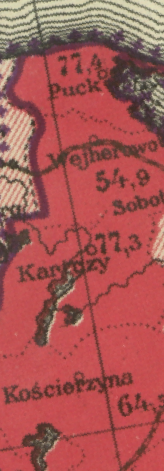
Data from the 19th century and early 20th century show the following ethnic changes in four main counties of the corridor (Puck and Wejherowo on the Baltic Sea coast; Kartuzy and Kościerzyna between the Province of Pomerania and Free City of Danzig):
During the First World War, both sides made bids for Polish support, and in turn Polish leaders were active in soliciting support from both sides. Roman Dmowski, a former deputy in the Russian State Duma and the leader of the Endecja movement was especially active in seeking support from the Allies. Dmowski argued that an independent Poland needed access to the sea on demographic, historical and economic grounds as he maintained that a Poland without access to the sea could never be truly independent. After the war Poland was to be re-established as an independent state. Since a Polish state had not existed since the Congress of Vienna, the future republic's territory had to be defined.
Giving Poland access to the sea was one of the guarantees proposed by United States PresidentWoodrow Wilson in his Fourteen Points of January 1918. The thirteenth of Wilson's points was:
An independent Polish state should be erected which should include the territories inhabited by indisputably Polish populations, which should be assured a free and secure access to the sea, and whose political and economic independence and territorial integrity should be guaranteed by international covenant.[32]
The following arguments were behind the creation of the corridor:


民族情勢は、この地域を復興ポーランドに返還する理由の一つであった。[ 33 ]この地域の住民の大多数はポーランド人であった。[ 34 ] 1919年3月12日に連合国最高評議会に提出されたポーランド委員会の報告書には、「最終的に、西プロイセンの60万人のポーランド人は、いかなる代替案の下でもドイツの支配下に留まるという事実を認識しなければならない」と記されている。[ 35 ]また、ウッドロー・ウィルソン大統領の専門家と学者のグループ(「調査委員会」として知られる)のデイビッド・ハンター・ミラーは、パリ講和会議の日記に、「ポーランドがこのようにして海へのアクセスを確保しなければ、西プロイセンの60万人のポーランド人はドイツの支配下に留まり、ポーランド本土の2000万人のポーランド人はおそらく、制約された不安定な商業的出口しか得られないだろう」と記している。[ 36 ] 1910年のプロイセン国勢調査によると、この地域には52万8000人のポーランド人(ドイツの選挙でポーランドの国民リストを支持した西スラヴ系カシューブ人を含む[ 37 ] [ 38 ] [ 39 ] [ 40 ])がおり、38万5000人のドイツ人(この地域に駐留する兵士や役人を含む)と比較していた。[ 41 ] [ 42 ]西プロイセン州全体では、1910年時点で民族的にポーランド人が36%から43%の間であった(低い方の数字は1910年のドイツの国勢調査の数字に直接基づいており、高い方の数字は公式の国勢調査でカトリックのドイツ人として数えられた人々の大部分が実際にはポーランド人であると認識していたという計算に基づいている)。[ 43 ]ポーランド人は、ポーランド国民がドイツ国家の支配下に留まることを望んでいなかった。[ 44 ]ドイツ国家は過去にポーランド国民や他の少数民族を二級市民として扱い[ 45 ] 、ドイツ化政策を推進していた。ルブリン県(ロシア帝国、旧ポーランド議会)でユダヤ人の両親のもとに生まれ、後にイギリス市民となったルイス・バーンスタイン・ナミエ教授(1888年~1960年)は、かつてポーランド議会の議員であった。 [ 46 ] 第一次世界大戦中、イギリス情報局[ 47 ]およびヴェルサイユ会議のイギリス代表団[ 48 ]に所属し、反ポーランド[ 49 ]および反ドイツ[ 50 ] [ 51 ]の姿勢で知られる人物は、 1933年11月7日付のマンチェスター・ガーディアン紙に次のように書いている。「ポーランド人はヴィスワ川の国民であり、彼らの居住地は川の源流から河口まで広がっている。...川流域の主張が海岸の主張に勝るのは当然である。」[ 52 ]
ポーランド人は、バルト海への直接アクセスがなければ、ポーランドの経済的独立は幻想に過ぎないという見解を持っていた。 [ 53 ]ポーランドの輸入貿易の約60.5%、輸出の約55.1%がこの地域を経由していた。[ 54 ]連合国最高評議会に提出されたポーランド委員会の報告書には次のように記されている。
東プロイセンの160万人のドイツ人は、回廊を越えた貿易の自由を確保することで十分に保護できるが、新しいポーランド国家の住民(2500万人)に十分な出口を与えることは、異国の、おそらく敵対的な勢力の領土を越えて保証しなければならないとしたら不可能だろう。[ 55 ]
英国は最終的にこの主張を受け入れた。[ 53 ]ポーランド回廊の抑圧は、ポーランドがドイツへの依存に抵抗する経済的能力を失わせることになるだろう。[ 56 ]マンチェスター大学の近代史教授であり、「伝説的なドイツへの憎悪」[ 50 ]とドイツ嫌悪[ 51 ]、そして彼が「攻撃的で反ユダヤ主義的で好戦的な帝国主義」と定義したポーランドの一部[57]に対する反ポーランド的態度[49]で知られるルイス・バーンスタイン・ナミエは、1933年の新聞記事で次のように書いている。
The whole of Poland's transport system ran towards the mouth of the Vistula. ... 90% of Polish exports came from her western provinces.[58] ... Cutting through of the Corridor has meant a minor amputation for Germany; its closing up would mean strangulation for Poland."[59]
By 1938, 77.7% of Polish exports left either through Gdańsk (31.6%) or the newly built port of Gdynia (46.1%)[60]
David Hunter Miller, in his diary from the Paris Peace Conference, noted that the problem of Polish access to the sea was very difficult because leaving the entirety of Pomerelia under German control meant cutting off millions of Poles from their commercial outlet and leaving several hundred thousand Poles under German rule, while granting such access meant cutting off East Prussia from the rest of Germany. The Inquiry recommended that both the Corridor and Danzig should have been ceded directly to Poland.
It is believed that the lesser of these evils is preferable, and that the Corridor and Danzig should [both] be ceded to Poland, as shown on map 6. East Prussia, though territorially cut off from the rest of Germany, could easily be assured railroad transit across the Polish corridor (a simple matter as compared with assuring port facilities to Poland), and has, in addition, excellent communication via Königsberg and the Baltic Sea. In either case a people is asked to entrust large interests to the League of Nations. In the case of Poland they are vital interests; in the case of Germany, aside from Prussian sentiment, they are quite secondary".[36]
In the end, The Inquiry's recommendations were only partially implemented: most of West Prussia was given to Poland, but Danzig became a Free City.
第一次世界大戦中、中央同盟国は1918年3月3日のブレスト=リトフスク条約で示されたように、ロシア帝国軍をポーランド立憲王国とガリツィアから追い出した。オーストリア=ハンガリー帝国の軍事的敗北後、オーストリアが休戦協定に署名したのと同じ1918年11月3日に、西ガリツィアでポーランド共和国の独立が宣言された。11月11日のコンピエーニュ休戦協定後のドイツ帝国西部戦線の崩壊と、それに続く残りの占領軍の撤退により、ロマン・ドモフスキとユゼフ・ピウスツキが率いる共和国は、旧ポーランド立憲王国の支配地域を掌握することができた。また11月には、ドイツ革命によりヴィルヘルム2世が退位し、ヴァイマル共和国が樹立された。 12月に始まったポーランド・ウクライナ戦争により、ポーランド共和国の領土はヴォルィーニ地方と東ガリツィアの一部を含むまでに拡大したが、同時にドイツのポーゼン州(ドイツが作成した1910年の国勢調査によると、人口の61.5%がポーランド人であった)は、大ポーランド蜂起によって分断され、1919年1月までに州の大部分がポーランドに併合された。これにより、ヴァイマル共和国のオットー・ランツベルクとルドルフ・ブライツシャイトは、ドイツに残された東部領土(その一部には、主に旧プロイセン分割領土に相当数のポーランド系少数民族が居住していた)を確保するための武装部隊を要請した。この要請に応じたのは国防大臣グスタフ・ノスケで、東プロイセン、シレジア、ネッツェ地区を確保するために義勇国境警備隊を編成し配備することへの支援を布告した。[ 61 ]
On 18 January, the Paris peace conference opened,[62] resulting in the draft of the Treaty of Versailles 28 June 1919. Articles 27 and 28 of the treaty[63] ruled on the territorial shape of the corridor, while articles 89 to 93 ruled on transit, citizenship and property issues.[64] Per the terms of the Versailles treaty, which was put into effect on 20 January 1920, the corridor was established as Poland's access to the Baltic Sea from 70% of the dissolved province of West Prussia,[65] consisting of a small part of Pomerania with around 140 km of coastline including the Hel Peninsula, and 69 km without it.[66]
The primarily German-speaking seaport of Danzig (Gdańsk), controlling the estuary of the main Polish waterway, the Vistula river, became the Free City of Danzig and was placed under the protection of the League of Nations without a plebiscite.[67] After the dock workers of Danzig harbour went on strike during the Polish–Soviet War, refusing to unload ammunition,[68] the Polish Government decided to build an ammunition depot at Westerplatte, and a seaport at Gdynia in the territory of the Corridor, connected to the Upper Silesian industrial centers by the newly constructed Polish Coal Trunk Line railways.

The German author Christian Raitz von Frentz writes that after First World War ended, the Polish government tried to reverse the systematic Germanization from former decades.[69]Frederick the Great (King in/of Prussia from 1740 to 1786) settled around 300,000 colonists in the eastern provinces of Prussia and aimed at a removal of the Polish nobility, which he treated with contempt. Frederick also described Poles as "slovenly Polish trash" and compared them to the Iroquois.[70][71] On the other hand, he encouraged administrators and teachers who could speak both German and Polish.[72] Prussia pursued a second colonization aimed at Germanization after 1832.[73] The Prussians passed laws aiming at Germanization of the provinces of Posen and West Prussia in the late 19th century. The Prussian Settlement Commission established a further 154,000 colonists, including locals, in the provinces of Posen and West Prussia before World War I. Military personnel were included in the population census. A number of German civil servants and merchants were introduced to the area, which influenced the population status.[74]
According to Richard Blanke, 421,029 Germans lived in the area in 1910, making up 42.5% of the population.[75] Blanke has been criticized by Christian Raitz von Frentz, who has classified his book as part of a series on the subject that has an anti-Polish bias; additionally Polish professor A. Cienciala has described Blanke's views as sympathetic to Germany.[76] In addition to the military personnel included in the population census, a number of German civil servants and merchants were introduced into the area, which influenced the population mix, according to Andrzej Chwalba.[74] By 1921 the proportion of Germans had dropped to 18.8% (175,771). Over the next decade, the German population decreased by another 70,000 to a share of 9.6%.[77]
German political scientist Stefan Wolff, Professor at the University of Birmingham, claims that the actions of Polish state officials after the corridor's establishment followed "a course of assimilation and oppression".[78] As a result, a large number of Germans left Poland after 1918: according to Wolff, 800,000 Germans had left Poland by 1923;[78] according to Gotthold Rhode, 575,000 left the former province of Posen and the corridor after the war;[79] according to Hermann Rauschning, 800,000 Germans had left between 1918 and 1926;[79] contemporary author Alfons Krysinski estimated 800,000 plus 100,000 from East Upper Silesia;[79] the contemporary German statistics say 592,000 Germans had left by 1921;[79] other Polish scholars say that up to a million Germans left.[79] Polish author Władysław Kulski says that a number of them were civil servants with no roots in the province and around 378,000, and this is to a lesser degree is confirmed by some German sources such as Hermann Rauschning.[80] Lewis Bernstein Namier raised the question of whether many of the Germans who left were actually settlers without roots in the area - Namier remarked in 1933, "a question must be raised how many of those Germans had originally been planted artificially in that country by the Prussian Government."[81]
The above-mentioned Richard Blanke, in his book Orphans of Versailles, gives several reasons for the exodus of the German population:
Blanke says that official encouragement by the Polish state played a secondary role in the German exodus.[80] Christian Raitz von Frentz notes "that many of the repressive measures were taken by local and regional Polish authorities in defiance of Acts of Parliament and government decrees, which more often than not conformed with the minorities treaty, the Geneva Convention and their interpretation by the League council –though it is also true that some of the central authorities tacitly tolerated local initiatives against the German population."[69] While there were demonstrations and protests and occasional violence against Germans, they were at a local level, and officials were quick to point out that they were a backlash against former discrimination against Poles.[80] There were other demonstrations when Germans showed disloyalty during the Polish–Soviet War[80] as the Red Army announced the return to the pre-war borders of 1914.[83] Despite popular pressure and occasional local actions, perhaps as many as 80% of Germans emigrated more or less voluntarily.[80]
Helmut Lippelt writes that Germany used the existence of the German minority in Poland for political ends and as part of its revisionist demands, which resulted in Polish countermeasures. Polish Prime Minister Władysław Sikorski stated in 1923 that the de-Germanization of these territories had to be ended by vigorous and quick liquidation of property and eviction of German "Optanten" (Germans who refused to accept Polish citizenship and per the Versailles Treaty were to leave Poland) so that German nationalists would realize that their view of the temporary nature of Poland's western border was wrong.[84][85] To Lippelt this was partially a reaction to the German claims and partially Polish nationalism, urging to exclude the German element. In turn, anti-Polish prejudice fueled German policy.[84]
In the period leading up to the East Prussian plebiscite in July 1920, the Polish authorities tried to prevent traffic through the Corridor, interrupting postal, telegraphic and telephone communication.[86] On March 10, 1920, the British representative on the Marienwerder Plebiscite Commission, H. D. Beaumont, wrote of numerous continuing difficulties being made by Polish officials and added "as a result, the ill-will between Polish and German nationalities and the irritation due to Polish intolerance towards the German inhabitants in the Corridor (now under their rule), far worse than any former German intolerance of the Poles, are growing to such an extent that it is impossible to believe the present settlement (borders) can have any chance of being permanent. ... It can confidently be asserted that not even the most attractive economic advantages would induce any German to vote Polish. If the frontier is unsatisfactory now, it will be far more so when it has to be drawn on this side (of the river) with no natural line to follow, cutting off Germany from the river bank and within a mile or so of Marienwerder, which is certain to vote German. I know of no similar frontier created by any treaty."[86]
The German Ministry for Transport established the Seedienst Ostpreußen ('Sea Service East Prussia') in 1922 to provide a ferry connection to East Prussia, now a German exclave, so that it would be less dependent on transit through Polish territory.
Connections by train were also possible by sealing the carriages (Korridorzug), i.e. passengers were not forced to apply for an official Polish visa in their passport; however, the rigorous inspections by the Polish authorities before and after the sealing were strongly feared by the passengers.[87]
In May 1925, a train passing through the corridor on its way to East Prussia crashed, because the spikes had been removed from the tracks for a short distance and the fishplates unbolted. 25 people including 12 women and 2 children were killed, while some 30 others were injured.[88]
ポーランドの歴史家アンジェイ・フヴァルバによれば、プロイセン王国とドイツ帝国の統治下では、ポーランド人の犠牲の上にドイツ人が所有する土地を増やすために様々な手段が用いられた。プロイセンでは、ポーランド貴族は分割後に領地を没収され、ドイツ貴族に引き渡された。[ 89 ]カトリック修道院も同様であった。[ 89 ]その後、ドイツ帝国は東部諸州のポーランド人居住地域でポーランド人が多数派となるのを阻止しようとして土地を買い上げた。[ 90 ]クリスティアン・ライツ・フォン・フレンツは、過去のドイツ化を覆すことを目的とした措置には、1908年の法律に基づいて戦争中にドイツ政府によって開拓された農場の清算が含まれていたと指摘している。[ 69 ]
1925年、ポーランド政府は地主の土地を収用することを目的とした土地改革プログラムを制定した。[ 91 ]回廊地帯の農地のわずか39%がドイツ人の所有であったが、[ 91 ]改革対象となる最初の年間リストには、32人のドイツ人地主の10,800ヘクタールと7人のポーランド人の950ヘクタールが含まれていた。[ 91 ]ポモジェ県知事のヴィクトル・ラモットは、「いわゆる回廊地帯が通るポモジェ地方は、大規模なドイツ人所有地を一掃しなければならない」と強調した。[ 91 ]沿岸地域は「民族意識の高いポーランド人住民で開拓されなければならない。…ドイツ人が所有する土地は、彼らが自発的に入植のために土地を明け渡すよう促すために、より重く課税されなければならない。国境の郡…特に幅10キロメートルの細長い土地は、ポーランド人で開拓されなければならない。ここに位置するドイツ人所有の土地は、その経済的価値や所有者の意見を考慮せずに縮小されなければならない。」[ 91 ]
著名な政治家やドイツ系少数民族のメンバーが、最初に土地改革リストに載せられ、財産を没収された。[ 91 ]

回廊の設置はドイツで大きな反発を招き、ヴァイマル共和国の戦間期のすべての政府はヴェルサイユで合意された東部国境を認めず、 1925年のロカルノ条約でドイツが西部国境を認めたのに倣って東部国境についても同様の宣言をすることを拒否した。[ 78 ]
Institutions in Weimar Germany supported and encouraged German minority organizations in Poland, in part radicalized by the Polish policy towards them, in filing close to 10,000 complaints about violations of minority rights to the League of Nations.[78]
Poland in 1931 declared her commitment to peace, but pointed out that any attempt to revise its borders would mean war. Additionally, in conversation with U.S. President Herbert Hoover, Polish delegate Filipowicz noted that any continued provocations by Germany could tempt the Polish side to invade, in order to settle the issue once and for all.[92]
アドルフ・ヒトラー率いるナチ党は1933年にドイツで政権を握った。ヒトラーは当初、ポーランドとの関係改善政策を大々的に推進し[ 93 ] 、1934年の10年間のポーランド・ドイツ不可侵条約で頂点に達した。その後、ドイツはポーランドや他のヨーロッパ列強と同様に再軍備を重視した[ 94 ] [ 95 ] 。しかし、ナチスは武力衝突を起こさずに当面の目標を達成することができた。まず、1938年3月にナチス・ドイツはオーストリアを併合し、9月下旬にはミュンヘン協定後にズデーテン地方を併合した。ポーランドもチェコスロバキアに侵攻し、トランスオルザを併合した(1938年10月1日) [ 96 ]。ドイツはポーランドを反コミンテルン協定に加盟させようとした。ポーランドは、同盟が急速に勢力を拡大するドイツの勢力圏になりつつあったため、これを拒否した。[ 97 ] 1938年10月24日、ドイツ外相ヨアヒム・フォン・リッベントロップは、ポーランド大使ユゼフ・リプスキに、ポーランドに反コミンテルン協定に署名するよう求めた。[ 98 ] 1938年10月27日と28日にローマを訪問した際、リッベントロップはイタリア外相ガレアッツォ・チアーノ伯爵に、反コミンテルン協定を軍事同盟にしたいと述べ、ポーランド、ユーゴスラビア、ハンガリー、ルーマニアに反コミンテルン協定に署名してもらい、「我々の全ての力を西側民主主義諸国に向けられる」ようにしたいと語った。[ 98 ] 1938年11月10日、200人のドイツ人ジャーナリストの前で行われた秘密演説で、ヒトラーは、ヴェルサイユ条約の平和的改正に基づく外交政策を強調する平和宣伝がドイツ国民にあまりにも成功しすぎたと不満を述べ、ドイツ国内の好戦的な気分を煽るための新たな宣伝キャンペーンを呼びかけました。[ 99 ]注目すべきは、ヒトラーがこの演説で念頭に置いていた敵はポーランドではなく、フランスとイギリスだったということです。[ 100 ]
ミュンヘン協定に関するヒトラーとの交渉後、イギリスのネヴィル・チェンバレン首相は、「ヒトラーは私に個人的に、そして昨晩は公にも、このズデーテン・ドイツ人問題が解決すれば、ヨーロッパにおけるドイツの領土要求は終わりだと繰り返した」と報告した。[ 101 ]しかし、協定締結後ほぼすぐに、ヒトラーは協定を反故にした。ナチスは、ドイツ系多数派の「保護」を理由に、ダンツィヒ自由都市のドイツへの編入要求を強めた。[ 102 ] 1938年11月、ダンツィヒの地区行政官アルベルト・フォルスターは国際連盟に、ヒトラーがポーランド人が「チェコ人のように理性的であれば」ポーランドの国境は保証されると述べたと報告した。ドイツ国務長官エルンスト・フォン・ヴァイツゼッカーは、1938年12月にこの保証を再確認した。[ 103 ] 1938年から1939年の冬、ドイツはポーランドとハンガリーに反コミンテルン協定への署名を迫る圧力を強めた。[ 104 ]
Initially, the main concern of German diplomacy was not Danzig or the Polish Corridor, but rather having Poland sign the Anti-Comintern Pact, which as the American historian Gerhard Weinberg noted was "... a formal gesture of political and diplomatic obeisance to Berlin, separating them from any other past or prospective international ties, and having nothing to do with the Soviet Union at all".[104] In late 1938–early 1939, Hitler had decided upon war with Britain and France, and having Poland sign the Anti-Comintern Pact was intended to protect Germany's eastern border while the Wehrmacht turned west.[104] In November 1938, Hitler ordered his Foreign Minister Ribbentrop to convert the Anti-Comintern Pact, which had been signed with the Empire of Japan in 1936 and joined by Fascist Italy in 1937 into an anti-British military alliance.[104] Starting in October 1938, the main focus on German military planning was for a war against Britain with Hitler ordering the Luftwaffe to start building a strategical bombing force capable of bombing British cities.[105] On 17 January 1939, Hitler approved of the famous Z Plan that called for a gigantic fleet to take on the Royal Navy and on 27 January 1939 he ordered that henceforward the Kriegsmarine was to have first priority for defence spending.[105]
The situation regarding the Free City and the Polish Corridor created a number of headaches for German and Polish customs.[106] The Germans requested the construction of an extra-territorialReichsautobahn freeway (to complete the Reichsautobahn Berlin-Königsberg) and railway through the Polish Corridor, effectively annexing Polish territory and connecting East Prussia to Danzig and Germany proper, while cutting off Poland from the sea and its main trade route. If Poland agreed, in return they would extend the non-aggression pact for 25 years.[107]
これは、ヒトラーがポーランドを衛星国にしようと計画していたことや、ポーランドが反コミンテルン協定を拒否したこと、そしてヒトラーがソ連を孤立させるか、あるいはソ連に対する支持を得ようとしていたことと矛盾しているように見えた。[ 107 ]ダンツィヒとナチス・ドイツのドイツ系新聞は、民族主義的な感情を煽る上で重要な役割を果たした。見出しでは、ポーランドがダンツィヒで経済権を濫用していることや、ドイツ系ダンツィヒ市民がポーランド国家の意向にますます従属させられていることが報じられた。[ 102 ]同時に、ヒトラーはポーランドに、リトアニア、メーメル地方、ソビエト・ウクライナ、チェコ領の一部などの併合の可能性といった追加の領土を誘引として提示した。[ 108 ] [ 109 ]しかし、ポーランドの指導者たちは、独立の喪失とチェコスロバキアのような運命を恐れ続けていた。[ 109 ]チェコスロバキアは1938年10月にズデーテン地方をドイツに割譲したが、1939年3月にはドイツに侵攻された。ダンツィヒ問題はポーランド回廊の問題と密接に結びついており、ダンツィヒに関するいかなる解決も、ポーランドの海へのアクセスを最終的に失う一歩になると考える者もいた。[ 102 ]チェコスロバキア占領後、ドイツ国外におけるヒトラーの信頼性は非常に低かったが、イギリスとフランスの政治家の中には、回廊の国境の平和的な見直しを支持する者もいた。[ 110 ]
1939年、ナチス・ドイツはダンツィヒの地位の再交渉を再び試みた。[ 103 ] [ 111 ] [ 112 ]ポーランド回廊を通るルートが建設される場合、ポーランドは港湾を永久に利用する権利を保持することになっていた。[ 111 ]しかし、ポーランド政府はヒトラーを信用せず、この計画をポーランドの主権に対する脅威とみなし、事実上ポーランドを枢軸国と反コミンテルン陣営に従属させ、貿易全体がドイツに依存することになるため、国をほぼ隷属状態に陥れるものだと考えていた。[ 113 ] [ 114 ] ベルリン駐在フランス大使ロベール・クーロンドルは、1939年4月30日付のジョルジュ・ボネ外相宛の書簡で、ヒトラーが「…ポーランドの外交政策に抵当権を設定しつつ、他国との政治協定締結を可能にする完全な行動の自由を自ら保持しようとしている。このような状況下で、ダンツィヒ問題と回廊通過問題を政治的な均衡問題と結びつけるドイツが提案した新たな解決策は、この抵当権を悪化させ、事実上ポーランドを枢軸国と反コミンテルン陣営に従属させるだけだろう。ワルシャワは独立を維持するためにこれを拒否した」と記した。[ 113 ]
ヒトラーは地位都市問題を口実にポーランドを攻撃したが、1939年5月のドイツ軍高官会議で、真の目的はドイツの生存圏を獲得し、ポーランド人を西側の同盟国から孤立させ、その後ポーランドを攻撃することで、西側諸国が介入したチェコスロバキアの状況の再発を避けることだと説明した。[ 115 ] [ 116 ] [ 117 ] [ 118 ] [ 119 ]
修正された、より不利な提案は、1939年9月1日にポーランド攻撃命令が出された後の8月下旬にナチスから最後通牒という形で提示された。しかし、8月29日深夜、フォン・リッベントロップは英国大使サー・ネヴィル・ヘンダーソンに、ポーランドとの平和を保証するとされる条件のリストを手渡した。ダンツィヒはドイツに返還され、ポーランド回廊で住民投票が行われることになっていた。1919年以降にそこで生まれた、あるいはそこに定住したポーランド人は投票権を持たないが、そこで生まれたがそこに住んでいないドイツ人は投票権を持つ。両国間で少数民族の交換が提案された。ポーランドがこれらの条件を受け入れれば、ドイツはソ連を含む国際保証という英国の申し出に同意することになっていた。全権を与えられたポーランド全権代表が翌日の正午までにベルリンに到着し、これらの条件を受け入れることになっていた。英国内閣は、ポーランド全権代表の要求を除いて、これらの条件を「妥当」とみなした。ポーランド全権代表の要求は、1939年3月中旬にチェコスロバキア大統領エミール・ハーハがヒトラーの条件を受け入れたのと同様のものと見なされた。
翌日の正午になってようやく、ポーランド大使ユゼフ・リプスキが外務省に現れ、リッベントロップとの面会を求めた。5時間後、彼は面会室に通されたが、ヒトラーが要求する交渉権限を持っていなかったため、リッベントロップは彼を「総統」に報告するとだけ伝え、簡単に退室させた。こうしてドイツとポーランドの関係は断絶した。[ 120 ]
1939年9月1日、ドイツはポーランドに侵攻した。ドイツ第4軍は、この地域の防衛を任されていたポーランドのポモジェ軍を破り、9月5日までにトゥホラの森の戦いで回廊を占領した。回廊はその後、終戦時に赤軍によって奪還されるまでドイツによって直接併合された。 [ 121 ]その他、ヴェステルプラッテ、ダンツィヒのポーランド郵便局、オクシヴィエ、ヘルでも注目すべき戦闘が行われた。
この地域の大部分はポーランド人、ドイツ人、カシューブ人が居住していた。1910年の国勢調査によると、この地域にはポーランド人(西スラヴ系カシューブ人を含む)が52万8000人、ドイツ人が38万5000人いた。[ 41 ]この国勢調査には、この地域に駐屯していたドイツ兵と、この地域を統治するために派遣された公務員も含まれていた。1886年以来、ドイツ人の入植を強制するためにプロイセンによって入植委員会が設置され[ 122 ]、同時にポーランド人、ユダヤ人、ドイツ人は東方脱出の際に西へ移住した。[ 123 ] 1921年、ポメラニア(回廊があった場所)のドイツ人の割合は18.8%(17万5771人)だった。次の10年間で、ドイツ人の人口はさらに7万人減少し、9.6%となった。[ 77 ]ユダヤ人の少数派も存在した。1905年、カシューブ人は約72,500人であった。[ 124 ]ナチス・ドイツによる占領後、1939年12月にドイツ当局によって国勢調査が行われた。71%の人々がポーランド人であると申告し、188,000人がカシューブ語を母語と申告し、そのうち100,000人がポーランド人であると申告した。[ 125 ]
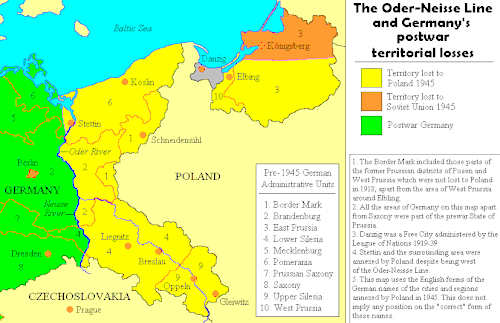
第二次世界大戦におけるドイツの敗戦後に行われた1945年のポツダム会談では、ポーランド全土を占領していたソ連の強い主張により、ポーランドの国境が再編成された。ダンツィヒを含むオーデル・ナイセ線以東の地域はポーランドの統治下に置かれた。会談では、戦前の西ポーランドの一部であった回廊地帯の将来については議論されなかった。これらの地域は1945年に自動的に新生ポーランドの一部となった。
1933年に出版された『来るべき世界の形』の中で、H・G・ウェルズは、この回廊が将来の第二次世界大戦の出発点となることを正確に予言した。彼は、戦争は1940年1月に始まり、民間人への激しい空爆を伴うものの、最終的にはポーランドとドイツの間で10年間にわたる塹壕戦のような膠着状態が続き、1950年代には世界的な社会崩壊に至ると描写した。
{{cite book}}: CS1メンテナンス: 場所の発行元が見つかりません (リンク)ナミエ。
ビスマルク時代に設立された植民地化委員会は20年間で東部領土に11,957家族しか移住させることができなかったが、フリードリヒは合計57,475家族を移住させた。これにより、君主国の州における人口のドイツ的性格が非常に大きく高まった。西プロイセンでは、ポーランド貴族を追い出し、彼らの広大な領地をできるだけ多くドイツ人の手に取り込もうとしていた。
[...] 1778年までに、ブロムベルク地方(現在のビドゴシュチュ)では277人のプロテスタント教師と58人のカトリック教師が雇用されており、母語であるドイツ語に加えてポーランド語を話せる者が強く優先されていた。フリードリヒが後継者にポーランド語の知識を習得するよう指示したのもこの時期である。
北緯54度21分、東経18度20分/北緯54.350度、東経18.333度/ 54.350; 18.333