
Loading article…
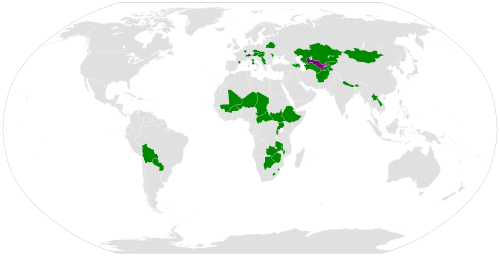
内陸国とは、世界の海洋に面していない国のことである。2026年現在内陸国は44カ国あり、そのうち2カ国は他の内陸国に囲まれているため二重内陸国(リヒテンシュタインとウズベキスタン)であり、南オセチア、コソボ、沿ドニエストル共和国の3カ国は事実上の内陸国である。カザフスタンは面積で世界最大の内陸国であり、キルギスはどの海からも最も遠い内陸国であり、エチオピアは世界で最も人口の多い内陸国である。[ 1 ] [ 2 ]
一般的に、内陸国であることは、国際水域へのアクセスがあれば回避できる政治的・経済的な不利をもたらす。そのため、歴史を通じて大小さまざまな国々が、莫大な富、流血、そして政治的資本を犠牲にしてでも、公海へのアクセスを獲得しようと戦ってきたのである。
内陸国であることによる経済的不利は、発展の度合い、周辺の貿易ルートと貿易の自由度、共通言語の有無、その他の要因によって軽減される場合もあれば、悪化する場合もある。ヨーロッパには、アンドラ、オーストリア、リヒテンシュタイン、ルクセンブルク、サンマリノ、スイス、バチカン市国など、裕福な内陸国も存在する。NATOの創設メンバーであるルクセンブルクを除けば、これらの国々は国際政治問題において中立の立場をとることが多い。
しかし、アフリカ、アジア、南米の国々を含む内陸国44カ国のうち32カ国は、国連によって内陸開発途上国(LLDC)に分類されている。[ 3 ]人間開発指数ランキングが最も低い12カ国のうち9カ国は内陸国である。[ 4 ]国連の持続可能な開発目標10のように、2030年までに不平等を大幅に削減することを目標とする国際的な取り組みは、このような問題から生じる不平等を削減することを目的としている。[ 5 ]
1990年当時、世界には内陸国はわずか30カ国しかなかった。しかし、ソビエト連邦とチェコスロバキアの崩壊、ユーゴスラビアの解体、南オセチア(事実上の国家)、エリトリア、モンテネグロ、南スーダン、ルハンスク人民共和国(事実上の国家)の独立住民投票、コソボ(事実上の国家)の一方的な独立宣言により、新たに15の内陸国と5つの内陸事実上の国家が誕生し、かつての内陸国チェコスロバキアは1993年1月1日に消滅した。[ 6 ]
2023年9月19日、アゼルバイジャンはアルツァフ共和国(事実上の国家)に対する新たな攻勢を開始し、決定的な勝利を収めた。 [ 7 ]アルツァフ政府は2024年1月1日に正式に解散した。その結果、アルツァフは内陸の事実上の国家としての存在を終え、ナゴルノ・カラバフ地域はアゼルバイジャンに再統合された。[ 8 ]
2024年4月1日現在、世界には44の内陸国と3つの内陸事実上の国家(コソボ、南オセチア、沿ドニエストル共和国)が存在する。
Historically, being landlocked has been disadvantageous to a country's development. It cuts a nation off from important sea resources such as fishing, and impedes or prevents direct access to maritime trade, a crucial component of economic and social advance. As such, coastal regions, or inland regions that have access to the World Ocean, tended to be wealthier and more heavily populated than inland regions that have no access to the World Ocean. Paul Collier in his book The Bottom Billion argues that being landlocked in a poor geographical neighbourhood is one of four major development "traps" by which a country can be held back. In general, he found that when a neighbouring country experiences better growth, it tends to spill over into favorable development for the country itself. For landlocked countries, the effect is particularly strong, as they are limited in their trading activity with the rest of the world. He states, "If you are coastal, you serve the world; if you are landlocked, you serve your neighbors."[9] Others have argued that being landlocked has an advantage as it creates a "natural tariff barrier" that protects the country from cheap imports. In some instances, this has led to more robust local food systems.[10][11]
Landlocked developing countries have significantly higher costs of international cargo transportation compared to coastal developing countries (in Asia the ratio is 3:1).[12]
Historically, traveling between a landlocked country and a country which did not border said country required the traveler to pass border controls twice or more. In recent times the advent of air travel has largely negated this impediment.
Countries have acted to overcome being landlocked by acquiring land that reaches the sea:
Countries can establish agreements to provide for free transport of goods through neighbouring countries:
Losing access to the sea is generally a great loss to a nation, politically, militarily, and economically. The following are examples of countries becoming landlocked.
The United Nations Convention on the Law of the Sea now gives a landlocked country a right of access to and from the sea without taxation of traffic through transit states. The United Nations has a programme of action to assist landlocked developing countries,[21] and the current responsible Undersecretary-General is Anwarul Karim Chowdhury.
Some countries have a long coastline, but much of it may not be readily usable for trade and commerce. For instance, in its early history, Russia's only ports were on the Arctic Ocean and frozen shut for much of the year. The wish to gain control of a warm-water port was a major motivator of Russian expansion towards the Baltic Sea, Black Sea, and Pacific Ocean. On the other hand, some landlocked countries can have access to the ocean along wide navigable rivers. For instance, Paraguay (and Bolivia to a lesser extent) have access to the ocean through the Paraguay and Paraná rivers.
Several countries have coastlines on landlocked bodies of water, such as the Caspian Sea and the Dead Sea. Since these seas are in effect lakes without access to wider seaborne trade, countries such as Kazakhstan are still considered landlocked. Although the Caspian Sea is connected to the Black Sea via the man-made Volga–Don Canal, large oceangoing ships are unable to traverse it.
Some countries or important parts of countries have coastlines or river ports reachable by oceangoing ships, but only through a strait or river part of the territory of another country. The other country can put restriction on passage. Between 1429 and 1857 Poland, Sweden, Russia and other Baltic countries were subjected to the Sound Dues, a toll needed to be paid to reach Western European waters. Sweden bypassed it by conquering Scania in 1658.
The landlocked nature of a country can also hinder its ability to enforce international treaties. For example, Mongolia did not enforce an International Criminal Court arrest warrant issued at Vladimir Putin during his state visit, despite its obligation to do so as an International Criminal Court state party; Mongolia is landlocked and only borders Russia and China (both of whom are not ICC parties and are important economic partners with the country), which would make the delivery of Putin to the ICC headquarters in The Hague after his hypothetical arrest extremely difficult.[22][23]
Landlocked countries may be bordered by a single country having direct access to the high seas, two or more such countries, or be surrounded by other landlocked countries, making a country doubly landlocked.
Three countries are landlocked by a single country (enclaved countries):
Seven landlocked countries are surrounded by only two mutually bordering neighbours (semi-enclaved countries):
To this group could be added three landlocked territories, two of them de factostates with limited or no international recognition:
A country is "doubly landlocked" or "double-landlocked" when it is surrounded entirely by landlocked countries (i.e. requiring the crossing of at least two national borders to reach a coastline).[28][29] There are two such countries:
神聖ローマ帝国の解体後、ヴュルテンベルク王国は、バイエルン、バーデン、スイス、ヘッセン大公国(ヴィンプフェン飛び地)、ホーエンツォレルン=ジグマリンゲン、ホーエンツォレルン=ヘヒンゲンと国境を接する二重内陸国となった。後者の2つは、互いに、ヴュルテンベルク、バーデンの間に挟まれた内陸国であった。1866年にプロイセンの飛び地となり、ヴュルテンベルクは沿岸国と国境を接するようになったが、海岸に出るには少なくとも2つの国境を越える必要があった。 1815年から1866年まで独立していたフランクフルト自由市は、ヘッセン選帝侯国、ヘッセン大公国、ヘッセン=ホンブルク、ナッサウと国境を接していたため、二重内陸国であった。ドイツ連邦には、内陸国や沿岸国の飛び地としか国境を接していない内陸国が他にもいくつかあった。ヘッセン大公国、ヘッセン=ホンブルク、ナッサウ(いずれも1866年まで)、ザクセン=コーブルク=ザールフェルト、ザクセン=ヒルトブルクハウゼン(いずれも1826年まで)、ロイス(長男系)(1871年まで)である。これらはすべてプロイセンと国境を接していたが、海に面した主要領土とは接していなかった。
1871年のドイツ統一から第一次世界大戦終結まで、内陸国は存在しなかった。リヒテンシュタインはアドリア海に面したオーストリア=ハンガリー帝国と国境を接しており、ウズベキスタンは当時、大西洋と海の両方に面したロシア帝国の一部であった。
1918年のオーストリア=ハンガリー帝国の解体と、内陸国である独立オーストリアの成立に伴い、リヒテンシュタインは1938年まで唯一の二重内陸国となった。同年、オーストリアはナチス・ドイツに併合され、バルト海と北海に面する領土を獲得した。第二次世界大戦後、オーストリアは独立を回復し、リヒテンシュタインは再び二重内陸国となった。
かつてロシア帝国、そしてソビエト連邦の一部であったウズベキスタンは、1991年のソビエト連邦の崩壊に伴い独立を果たし、二度目の二重内陸国となった。
However, Uzbekistan's doubly landlocked status depends on whether the Caspian Sea is considered a lake or a sea. In the latter case, Uzbekistan is not doubly landlocked, since its neighbors Turkmenistan and Kazakhstan have access to the Caspian Sea.[32]
North America and Oceania have no landlocked countries.
注記:
内陸国と事実上の国家は、以下のように隣接するグループに分類できます。 [ 33 ]
国連は、後発開発途上国、内陸開発途上国、小島嶼開発途上国向けの作業プログラムを実施するための専門作業グループ[ 38 ]を設立した[ 39 ] 。
注記:
内陸国の中で、他の内陸国と国境を接していない国は以下の12カ国です。
国連の地理区分(事実上の国家を除く)によれば、内陸国が最も多いのはアフリカで16カ国、次いでヨーロッパ(14カ国)、アジア(12カ国)、南アメリカ(2カ国)となっている。しかし、アルメニア、アゼルバイジャン、カザフスタン、南オセチア(事実上の国家)をヨーロッパの一部として数えると、内陸国が最も多いのはヨーロッパで20カ国(3つの内陸の事実上の国家すべてを含む)となる。これらの大陸横断的または文化的にヨーロッパの国々をアジアに含めると、アフリカとヨーロッパ(コソボと沿ドニエストルを含む)の両方が16カ国で最多となる。カザフスタンと南コーカサス諸国の地位によって、アジアには9~13カ国(南オセチアを含む)の内陸国がある。南アメリカにはボリビアとパラグアイの2カ国のみ内陸国がある。
オーストラリアと北アメリカには内陸国がなく、南極大陸には国が一つもありません。オセアニア(英語圏では通常、大陸ではなく地理的地域とみなされる)にも内陸国はありません。
All landlocked countries, except Bolivia and Paraguay, are located on the continental mainland of Afro-Eurasia.
ヨルダン川西岸は、中東のヨルダン川西岸にある内陸地域です。
ヨルダン川西岸は、西アジアの地中海沿岸に近い内陸地域である。
西岸地区は、地中海東岸近くの内陸地域である。
ヨルダン川西岸は、ヨルダンと国境を接する内陸地域である。