
Loading article…
ソリッドサウス(南部ブロック) | |
|---|---|
| 設立 | 1876 |
| 溶解した | 1964 |
| 先行 | 贖い主たち |
| イデオロギー | 人種隔離主義 白人至上主義 州の権利 保守主義 |
| 国籍 | 民主党 |
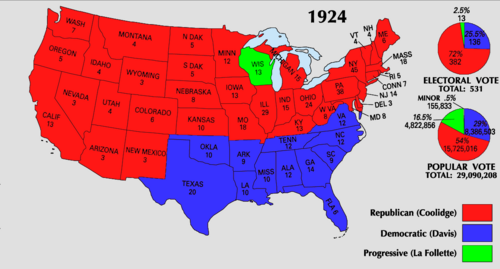

ソリッド・サウスは、1877年の復興期の終わりから1964年の公民権法までの間、アメリカ南部における民主党の選挙人団であった。[1] [2]この期間中、民主党は南部の州議会を支配し、南部の地方、州、連邦の公職者の大半は民主党員であった。19世紀後半から20世紀初頭にかけて、南部民主党は旧南部連合州のほぼすべての黒人の選挙権を剥奪した。その結果、民主党予備選挙での候補者の勝利が公職への当選に等しい一党独裁体制が生まれた。白人予備選挙は、黒人の投票を排除することで民主党が政治権力を強化するために使用したもう1つの手段であった。[3]
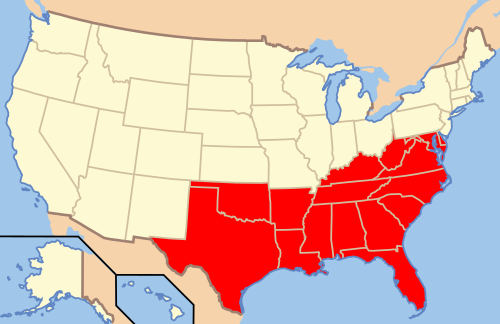
「ソリッド サウス」には、アラバマ、アーカンソー、フロリダ、ジョージア、ルイジアナ、ミシシッピ、ノースカロライナ、サウスカロライナ、テネシー、テキサス、バージニアの 11 の元南部連合州がすべて含まれていた。また、 1907 年に州となったオクラホマやケンタッキーも、それほどではないが含まれた。[4]メリーランドとデラウェアは、ソリッド サウスとはほとんど見なされなかった。ウェスト バージニア州は、 19 世紀最後の四半期に、南北戦争時代の共和党政権から「救済」され、ソリッド サウスと同盟を組んだ。 [5]ウェスト バージニア州は、元南部連合メンバーを州および連邦の役職に 選出した最初の州の 1 つであった。
ソリッド・サウスは、 1960年代から共和党が南部での選挙力を高めるために採用してきた「南部戦略」を指すこともある。共和党は2010年以来、南部の政治職をほぼ完全に掌握している。[6]この傾向の主な例外はバージニア州である。[7]
背景

南北戦争が始まったとき、アメリカ合衆国には34の州があり、そのうち15は奴隷州だった。奴隷制度はコロンビア特別区でも合法だった。これらの奴隷州のうち11州はアメリカ合衆国から脱退し、南部連合を形成した:サウスカロライナ州、ミシシッピ州、フロリダ州、アラバマ州、ジョージア州、ルイジアナ州、テキサス州、バージニア州、アーカンソー州、テネシー州、ノースカロライナ州。[8]
連邦に残った南部の奴隷州はメリーランド州、ミズーリ州、[a] デラウェア州、ケンタッキー州で、これらは境界州と呼ばれていた。ケンタッキー州とミズーリ州はどちらも、ケンタッキー州連合政府とミズーリ州連合政府という2つの競合する南部連合政府を持っていた。南部連合は戦争初期にはケンタッキー州の半分以上とミズーリ州南部を支配していたが、1862年以降は両州でほぼ支配力を失った。[10] 1863年にバージニア州の連邦派と南部連合派の郡から設立された ウェストバージニア州は、連邦議会と南部連合議会の両方に代表を送り、1863年の南軍選挙で民間人の投票権があった唯一の境界州だった。[11] [12]
1863年に奴隷解放宣言が出されたとき、テネシー州はすでに北軍の支配下にあった。したがって、この宣言は残りの10の南部連合州にのみ適用された。境界州のいくつかは南北戦争の終結前に奴隷制度を廃止した。メリーランド州は1864年、[13]ミズーリ州は1865年、[14]南部連合州の1つであるテネシー州は1865年、[15]ウェストバージニア州は1865年、[16]コロンビア特別区は1862年である。しかし、デラウェア州、[17]ケンタッキー州、[18]および11の元南部連合州のうち10州では奴隷制度が存続し、 1865年12月18日に合衆国憲法修正第13条によって全米で奴隷制度が廃止された。[19]
南部における民主党の優位は、南部の白人がレコンストラクション(1865-1877年)中およびその後に白人至上主義を復活させ、黒人の参政権を剥奪しようとした闘争に端を発する。共和党率いる米国政府は南部連合を倒し、奴隷制度を廃止し、黒人に参政権を与えた。いくつかの州では黒人有権者が多数派かそれに近い数だった。黒人に支持された共和党がこれらの州の州政府を支配した。こうして民主党は白人至上主義の「救世主」の媒介となった。[20]クー・クラックス・クランや、 1874年のホワイト・リーグやレッド・シャツなどの他の反乱民兵組織は、「民主党の軍事部門」として共和党の組織化を妨害し、黒人有権者を脅迫し抑圧した。[21]
歴史
1870年代から1910年代
1876 年までに、「救世主」民主党は南部のすべての州政府を掌握した。それ以降 1960 年代まで、南部の州政府と地方政府はほぼ完全に民主党によって独占されていた。民主党は少数の例外を除き、米国の下院議員と上院議員を選出し、民主党の大統領候補は 1880 年から 1944 年まで定期的にこの地域を席巻し、合計 187 州中 182 州で勝利した。民主党は、戦争中に共和党指導下の「ヤンキー侵略者」の手によって南部が苦しんだこと、および「失われた大義」における白人の先祖の崇高な奉仕を強調することで、白人有権者の忠誠心を強化した。このレトリックは多くの南部人に効果的であった。しかし、このプロパガンダは、テネシー州東部など、戦争中に連邦に忠誠を誓っていた地域ではまったく効果がなかった。東テネシー州の大半はアメリカ軍を解放者として歓迎し、ソリッド・サウス時代でも共和党に投票した。[22]

白人民主党が州議会の支配権を取り戻した後も、南部では黒人候補者が地方公職や州議会に選出された。黒人の米国下院議員は1890年代後半まで南部から選出されていたが、その多くは圧倒的に黒人の多い地域からだった。また1890年代には、民主党体制に憤慨する貧しい白人の間でポピュリストの支持者が南部に広がった。ポピュリストは共和党員(黒人共和党員を含む)と同盟を組み、民主党幹部に挑戦し、場合によっては彼らを破った。[23]
将来このような連合を防ぐため、そして選挙で黒人の投票を抑制することに伴う暴力を終わらせるために、南部民主党は黒人と貧しい白人の両方から選挙権を剥奪する行動をとった。[24] 1890年から1910年にかけて、ミシシッピ州を皮切りに、南部諸州は新たな憲法やその他の法律を制定し、有権者登録を制限するさまざまな手段を講じ、事実上すべての黒人と多くの貧しい白人住民から選挙権を剥奪した。[25]これらの手段はすべての市民に適用され、実際にはほとんどの黒人市民から選挙権を剥奪し、「教育水準が低く、組織化されておらず、より貧しい白人も [有権者登録名簿から] 削除され、20世紀のほとんどの期間、南部で民主党による一党支配が確実になった」。[26] [27]すべての南部州は、人頭税、居住期間の延長、主観的な識字能力テストなどの新たな要件を含む、有権者登録と参政権を制限する条項を制定した。また、祖父条項という手段を使って、特定の年(通常は黒人が投票できなかった南北戦争以前)までに祖父が投票していた有権者を免除する条項も使った。[28]
米国上院議員ベンジャミン・ティルマンは白人至上主義者の演説で、サウスカロライナ州でアフリカ系アメリカ人がいかにして選挙権を剥奪されているかを説明した。
私の州には、135,000人の黒人有権者、つまり投票年齢の黒人と、90,000人から95,000人の白人有権者がいました...。さて、私はあなた方に聞きたいのですが、自由な投票と公正な集計で、どうやって135,000人を95,000人で上回るつもりですか? どうやってやるのですか? あなたは私たちに不可能な課題を与えました。
私たちは1895年まで黒人の選挙権を剥奪しませんでした。その後、憲法制定会議が招集され、この問題を冷静に、慎重に、そして公然と取り上げ、第14修正条項と第15修正条項に基づいて、できるだけ多くの黒人の選挙権を剥奪する目的で開催されました。私たちは教育資格を、私たちに残された唯一の手段として採用し、今日サウスカロライナ州の黒人は、ポトマック川以南のどの州よりも満足し、繁栄し、十分に保護されています。彼は政治に干渉しているわけではない。なぜなら、干渉すればするほど、自分の立場が悪くなることを知ったからだ。彼の「権利」については、今は議論しない。我々南部は、黒人が白人を支配する権利を認めたことは一度もないし、これからも認めないだろう。……私は神に、黒人の最後の一人がアフリカに残って、我々の海岸に誰も連れてこられなかったことを願う。[29]
白人民主党員は、19世紀に農業中心の南部を犠牲にして北部の工業利益を優先すると見なされた高関税や金本位制などの共和党の経済政策にも反対した。しかし、彼らの抵抗の中心は政治権力を握ることだった。1876年から1944年まで、全国民主党は黒人の公民権を求めるいかなる呼びかけにも反対した。議会では、共和党がこの問題を標的にするたびに、南部民主党員がそのような取り組みを阻止した。[30] [31]
白人民主党は「ジム・クロウ」法を可決し、人種隔離を通じて白人至上主義を強化した。[32]合衆国憲法修正第14条は、州が人口の一部を選挙権剥奪した場合、議会における代表の配分を減らすことを規定した。しかし、この条項は黒人住民の選挙権を剥奪した南部の州には適用されなかった。世紀の変わり目から数十年にわたり、南部ではいかなる役職にも黒人候補者は選出されず、陪審員やその他の市民生活への参加からも排除された。[25]
選挙での優位性
1876年から1948年までのすべての大統領選挙で、民主党候補は大差で南部の州の大半で勝利した。ただし、 1928年だけは例外で、この年の民主党候補はカトリックのニューヨーク出身者であるアル・スミスだった。その選挙でさえ、分裂した南部はスミスに選挙人の4分の3近くの票をもたらした。学者のリチャード・バレリーは、ウッドロウ・ウィルソンの1912年の選挙が南部の黒人の選挙権剥奪の原因であるとし、議会にも広範囲にわたる影響があったと指摘し、民主党の南部は「1903年から1953年までの各10年間で議会で約25議席を獲得した」。[b] [25]ジャーナリストのマシュー・イグレシアスは次のように主張している。
ジム・クロウ法の奇妙な点は、税金、道徳観、国家安全保障について保守的な考えを持つ南部の白人が、自分たちの考えに賛同しない民主党の大統領候補に投票したことだ。彼らは南部の白人至上主義を維持するための戦略の一環としてそうしたのだ。[33]
ディープサウス(サウスカロライナ州、ジョージア州、アラバマ州、ミシシッピ州、ルイジアナ州)では民主党が圧倒的な優位を占め、民主党が常に80~90%の票を獲得し、州議会の議席や地方公職に就く共和党員はごく少数だった。 [34]ミシシッピ州とサウスカロライナ州は最も極端な例で、1900年から1944年の間、ミシシッピ州の沿岸部にあるパールリバー郡、ストーン郡、ジョージ郡の3郡がフーバーに投票した1928年のみ、民主党は大統領選挙でこれら2州の郡のうち1つでも敗北した。[35]
テキサス州のドイツ系アメリカ人の住む ギレスピー郡とケンドール郡、およびアラバマ州とジョージア州のアパラチア地方の多くの郡では、この時期の大統領選挙で共和党に投票した。 [36]アーカンソー州は1876年から1964年まで一貫して民主党に投票したが、民主党の得票率はディープサウスよりも低かった。[36] 1939年でさえ、フロリダ州は「まだ非常に大部分が空の州」と評され、第二次世界大戦後まで北フロリダのみが大部分が入植していた。[37]テネシー州、ノースカロライナ州、バージニア州では、共和党は主に遠隔地のアパラチア地方で大きな存在感を保ち、南北戦争中に北軍を支持し、時折米国下院議席を獲得し、大統領選挙で40%を超える得票率を獲得することが多かった。[38]
1900年、第56回議会が1900年の連邦国勢調査に従って45州に議席を配分する案を検討していたとき、エドガー・D・クランプカー下院議員(インディアナ州共和党)は、多数の有権者の選挙権を剥奪したため南部諸州から議席を剥奪すべきだという独立報告書を提出した。クランプカー下院議員は、これは人種を理由に参政権を制限した州から代表権を剥奪することを規定した合衆国憲法修正第14条第2項に規定されていると指摘した。1896年から1900年まで、共和党が多数を占める下院は、下院選挙委員会が「不正、暴力、脅迫により無投票者が排除された」と結論付けた南部諸州の選挙結果を30件以上無効とする措置を講じた。[39]しかし、1900年代初頭、民主党が多数派を獲得し、その中には民主党が固く支配する南部の代表団も含まれていたため、この運動は後退し始めた。しかし、南部民主党ブロックによる一致団結した反対が起こり、この運動は失敗した。[40]
1920年代以降
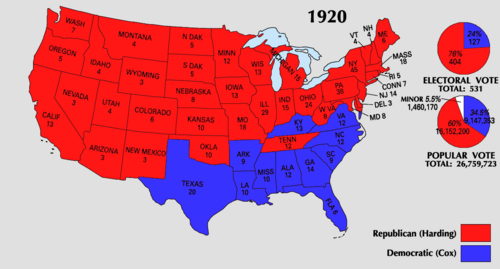
1920年代になると、南北戦争の記憶が薄れ、南部の強固な基盤に若干の亀裂が生じた。例えば、 1920年に共和党員がテキサス州から米国下院議員に選出され、1932年まで務めた。1920年と1928年の共和党の全国的な圧勝は、ある程度影響した。[41] 1920年の選挙では、テネシー州は共和党員の知事と共和党下院議員10人のうち5人を選出し、南北戦争後のアメリカ大統領選挙で共和党候補に投票した最初の旧南部連合州となった。[42]
1928年の大統領選挙では、アル・スミスはプロテスタントが大多数を占める南部でカトリック教徒として激しい反発を受けた。スミスは、副大統領候補のジョセフ・T・ロビンソンの出身州であるアーカンソー州とディープサウスしか保持できなかった。[43]しかし、1932年に民主党が全国で圧勝すると、南部は再び民主党が優勢になった。[44]
1930年代には、南部以外の黒人有権者の多くが民主党に乗り換え、[45]公民権に関心を持つ他のグループ(特にユダヤ教徒、カトリック教徒、学識者)が党内で勢力を拡大した。[46]フランクリン・D・ルーズベルト政権下で全国党が労働組合に友好的になったことに不満を抱いた南部の保守派民主党員は、 1937年に保守派共和党員と保守連合を結成し、ニューディール政策のさらなる立法を阻止した。[47]ルーズベルトは、1938年の選挙でジョージア州のウォルター・ジョージ上院議員やサウスカロライナ州のエリソン・スミス上院議員など、これらの保守派南部民主党員の一部を白人予備選挙で排除しようとしたが失敗した。一方、ニューヨーク州のジョン・J・オコナー下院議員で下院規則委員会の委員長を追放することには成功した。[48]
南部の人口構成も変化し始めた。[49] 1910年から1970年にかけて、約650万人の南部の黒人が大移動で国内の他の地域の都市部に移り、人口構成は他の形で南部諸州を変化させ始めた。[50]フロリダ州は急速に拡大し始め、中央および南フロリダの退職者やその他の移民が州人口の過半数を占めるようになった。これらの新しい住民の多くは共和党への投票習慣を持ち込み、共和党に対する南部の伝統的な敵意を薄めた。[51]
1944年、最高裁はスミス対オールライト事件で8対1で白人予備選挙制度に反対する判決を下し、南部のほとんどの州は人種差別的な予備選挙を廃止した。[52]これらの州は人頭税や識字テストなど、理論的にはすべての有権者に適用されたが、実際には白人当局者によって差別的な方法で実施された、その他の選挙権剥奪の手法を維持した。[53]共和党は、南部が工業化と都市化を遂げるにつれて、第二次世界大戦後に南部で勢力を伸ばし始めた。[54]
オクラホマ

オクラホマはソリッドサウスの一部と考えられていたが、1907年まで州にはならず、境界州と元南部連合州の両方の性格を共有していた。南北戦争中、オクラホマはインディアン準州に指定され、奴隷制が認められ、ほとんどの部族指導者は南部連合に同調した。[56]しかし、一部の部族と部族は北軍に味方し、その結果、準州では血なまぐさい紛争が発生し、すべての住民が厳しい苦難を強いられた。[57] [58]オクラホマ準州は、 1889年から1895年にかけての一連の土地争奪戦を通じて開拓され、共和党支持のグレートプレーンズからの入植者が多数含まれていた。[59]
オクラホマ州には、ヘンリー・ベルモンが1962年に選出されるまで共和党の知事はいなかった。[60]民主党は「リトル・ディキシー」として知られるオクラホマ州南東部で最も強かった。そこに住む白人入植者は、南北戦争後に新しい土地での生活を始めたい南部人だった。[61]オクラホマ州は、 1870年から1960年まで州人口の10%未満を占めていた黒人人口の選挙権を剥奪した。 [62]グイン対アメリカ合衆国(1915年)で、最高裁判所はオクラホマ州憲法の「老兵」および「祖父条項」による識字テスト免除を無効とした。オクラホマ州および他の州はすぐにこれに反応し、黒人や少数民族に不利な有権者登録に関する他の規則を制定する法律を可決した。[63]
しかし、オクラホマ州は、かつての南部連合諸州とは異なり、人頭税を制定しなかった。 [64]その結果、オクラホマ州は連邦レベルでは依然として競争力があり、1920年にはウォーレン・G・ハーディング、1928年にはハーバート・フーバーに投票した。同州は、共和党の牙城である隣接するカンザス州とつながりのある北西部オクラホマ州に共和党の存在があった。[65]同州はまた、1964年までに、ジョン・W・ハレルド(1921-1927)、ウィリアム・B・パイン(1925-1931)、エドワード・H・ムーア(1943-1949)の3人の共和党上院議員を選出した。[66]オクラホマ州は、より早く共和党の大統領候補を支持する方向に転換し、 1952年以降、 1964年の圧勝だったリンドン・B・ジョンソンを除き、すべての共和党候補に投票した。オクラホマ州は、 1976年の大統領選挙で共和党のジェラルド・フォードが勝利した南部の2州のうちの1つであり、もう1つはバージニア州であった。[67]
国境州

20世紀前半から3分の2にかけてほぼすべての黒人が選挙権を剥奪された11の旧南部連合州とは対照的に、1900年代の選挙権剥奪運動にもかかわらず、さまざまな理由から国境諸州では黒人は選挙権を保持していた。[68]ミズーリ州は国勢調査局によって中西部の州に分類されており、アフリカ系アメリカ人の選挙権を剥奪していないことに留意されたい。[69]
国境諸州はアッパーサウスの北部地域であり、工業化と都市化が進む 北東部や中西部と密接な関係があり、 1896年のアメリカ合衆国大統領選挙で再編を経験した。[70] [71]
1870年から1960年にかけて、アフリカ系アメリカ人が国境諸州の人口に占める割合は、旧南部連合諸州の割合よりもかなり低かった。ウェストバージニア州の人口の10%未満がアフリカ系アメリカ人だった。ケンタッキー州では、州人口の5-20%がアフリカ系アメリカ人だった。デラウェア州では、州人口の10-20%がアフリカ系アメリカ人だった。メリーランド州では、州人口の15-25%がアフリカ系アメリカ人だった。[72]
ウェストバージニア州
ウェストバージニア州にとって、「ある意味での復興は1861年に始まりました」。 [73]他の境界州とは異なり、ウェストバージニア州は兵士の大半を北軍に派遣しませんでした。[74]元南軍兵士が帰還する見通しがあったため、ウィーリング州政府は、彼らの参政権、弁護士業務および教授、司法制度へのアクセスを制限し、「戦争不法侵入」訴訟の対象とする法律を施行しました。[75] 1871年にこれらの制限が解除され、民主党のジョン・J・ジェイコブが知事に選出されました。また、これは戦時憲法の国民投票による否決と、サミュエル・プライス、アレン・T・ケイパートン、チャールズ・ジェームズ・フォークナーなどの元南軍兵士の指導の下で書かれた新しい憲法につながりました。1876年、州民主党の候補者8名全員が当選し、そのうち7名は南軍の退役軍人でした。[76]ほぼ一世代にわたって、ウェストバージニア州はソリッドサウスの一部でした。[77]
しかし、共和党は1896年に政権に返り咲き、その後9期のうち8期は知事を務め、1932年まで106人の下院議員のうち82人を選出した。 [78] 1932年、国が民主党に傾くと、ウェストバージニア州は再び民主党が優勢となった。ウェストバージニア州は、1932年から1996年の間、おそらく国内で最も民主党が優勢な州であり、その期間に共和党の大統領に投票した回数が3回と少ない2州のうちの1つである(ミネソタ州と並んで)。さらに、ミネソタ州(またはマサチューセッツ州やロードアイランド州など、ほぼ民主党が優勢な他の州)とは異なり、ウェストバージニア州の議会代表団は通常満場一致(またはほぼ満場一致)で、共和党員は2人しか知事に選出されなかった(ただし、2人の在任期間は合わせて20年)。[79]
ケンタッキー
ケンタッキー州は1877年から1964年までの大統領選挙では通常民主党に投票していたが、州レベルでも連邦レベルでも依然として競争の激しい州であった。[80]同州の民主党は1890年代半ばに銀の自由化と企業の役割をめぐって大きく分裂し、1895年に40年ぶりに知事の座を失った。[81] かつての南部連合諸州とは対照的に、ケンタッキー州はアッパーサウスに属し、オハイオ川を挟んで中西部の工業地帯と接しており、共和党を支持する都市労働者階級が相当数いた。[82] 1896年の大統領選挙では、同州は極めて接戦となり、マッキンリーがわずか277票、つまり0.06352%の差でケンタッキー州を制した初の共和党大統領候補となった。[ハ]
共和党は1924年と1928年の大統領選挙でケンタッキー州で勝利した。前者は1920年の大統領選挙でウォーレン・G・ハーディングが敗れた唯一の州であったが、1924年の大統領選挙ではクーリッジが勝利した。 [83] [84]ケンタッキー州ではこの時期にウィリアム・オコンネル・ブラッドリー(1895-1899)、オーガスタス・E・ウィルソン(1907-1911)、エドウィン・P・モロー(1919-1923)、フレム・D・サンプソン(1927-1931)、シメオン・ウィリス(1943-1947)など共和党の知事も選出された。[85]
メリーランド
メリーランド州は1868年から1892年まで民主党の大統領候補に投票していたが、1896年の大統領選挙はウェストバージニア州と同様に州内の再編となった。メリーランド州は1912年と1916年の民主党ウッドロウ・ウィルソンを除き、1896年から1928年まで共和党の大統領候補に投票していた。 [86]
かつての南部連合諸州とは対照的に、アフリカ系アメリカ人の人口のほぼ半数は南北戦争前に自由であり、一部は財産を蓄積していた。アフリカ系アメリカ人の識字率は高く、民主党が彼らを排除する手段を講じる中、選挙権運動は黒人に浸透し、抵抗する方法を教えるのに役立った。[87] 1896年、共和党の異人種連合によりロイド・ロウンズ・ジュニアが知事に選出された。[87]
民主党が多数を占める州議会は、1905年、1907年、1911年に選挙権剥奪法案を可決しようとしたが、そのたびに黒人の反対と勢力により拒否された。黒人男性は有権者の20%を占め、比較的安全ないくつかの都市に定住していた。さらに、移民男性は有権者の15%を占め、これらの措置に反対した。議会は、移民に不利益を与えない黒人に対する要件を考案するのに苦労した。[88] 1910年、議会は州憲法にディッグス修正案を提案した。これは、財産要件を使用して、多くのアフリカ系アメリカ人男性と多くの貧しい白人男性(新移民を含む)から事実上選挙権を剥奪するものである。メリーランド州議会は、オースティン・レーン・クローザース知事 が支持したこの法案を可決した。この措置が一般投票にかけられる前に、ディッグス修正案の要件を事実上法律として可決する法案が提案された。国民の広範な反対によりこの法案は否決され、修正案もメリーランド州の有権者によって否決された。[89]
全国的に見て、メリーランド州民は黒人の選挙権を剥奪する修正案の最も顕著な拒否を達成した。黒人男性の投票箱での力と経済力は、彼らがこれらの法案と選挙権剥奪の試みに抵抗するのを助けた。共和党のフィリップス・リー・ゴールドズボローがクロザーズの後を継ぎ、1912年から1916年まで知事を務めた。メリーランド州は1877年から1964年まで、ハリー・ナイス(1935年から1939年)とセオドア・マッケルディン(1951年から1959年)というさらに2人の共和党知事を選出した。[90]
デラウェア州
デラウェア州は北東部に近く、旧南部連合諸州と接していないため、13番目の修正条項が批准されるまで奴隷制を廃止しなかったにもかかわらず、 1876年から1964年までの大統領選挙の大半(23回中12回)で共和党に投票した。デラウェア州は1876年から1892年までは民主党の大統領候補に投票したが、その後は1896年から1932年までは一貫して共和党の大統領候補に投票した。ただし、共和党が分裂した1912年のウッドロウ・ウィルソンは例外である。 [91]デラウェア州は1932年に民主党のフランクリン・D・ルーズベルトが圧勝したにもかかわらず、共和党のハーバート・フーバーに投票した。 [92 ]
産業界が共和党に忠誠を誓ったおかげで、共和党は20世紀の大半を通じてデラウェア州知事の権限を握ることができた。共和党は黒人の全般的な支持を得て黒人の投票権を確保し、黒人の参政権に対する制限を撤廃した。[93]
大統領選挙
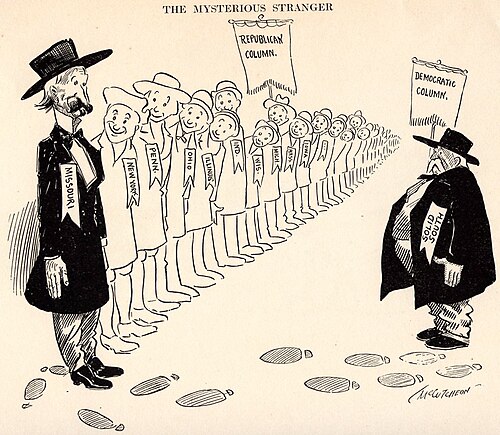
1896年の選挙は南部の強固な基盤に最初の亀裂をもたらした。フロリダ州の政治家マリオン・L・ドーソンは、ノース・アメリカン・レビュー誌に寄稿し、次のように述べている。「勝利した党は、共和党が多数派を占めると通常期待される州を従わせただけでなく、さらに重要なことに、強固な南部を侵略し、ウェスト・バージニア、メリーランド、ケンタッキーを奪い、ノース・カロライナを震え上がらせ、以下の州で民主党の多数派を減らした。アラバマ 39,000 人、アーカンソー 29,000 人、フロリダ 6,000 人、ジョージア 49,000 人、ルイジアナ 33,000 人、サウス・カロライナ 6,000 人、テキサス 29,000 人。これらの事実と、ミズーリ、テネシー、メリーランド、ケンタッキーを敵国に押し流した1894 年と 1895 年の大圧勝を合わせると、南部の政治家たちは、いわゆる強固な南部が今や、 「それは過去の歴史の産物である」 [94]。しかし、1920年代に短期間中断したものの、1960年代まで旧南部連合諸州はほぼ単一のブロックのままであった。
1904年の選挙では、ミズーリ州は共和党のセオドア・ルーズベルトを支持したが、メリーランド州はルーズベルトが51票差で勝利したにもかかわらず、民主党のアルトン・パーカーに選挙人を割り当てた。 [95]ミズーリ州は1904年から2004年まで指標州であり、 1956年を除くすべての大統領選挙で勝者に投票した。[96] 1916年の選挙までに、黒人と多くの貧しい白人の選挙権剥奪は完了し、南部の有権者名簿は劇的に減少した。共和党支持者を排除したことでウッドロウ・ウィルソンに弾みがつき、彼は南部全域(デラウェア州とウェストバージニア州を除く)の選挙人をすべて獲得した。共和党はアフリカ系アメリカ人の支持がなく抑圧されていた。[25]
1920年の大統領選挙はウィルソン大統領の国際連盟に関する国民投票だった。南部の孤立主義感情は共和党のウォーレン・G・ハーディングに有利に働き、彼はテネシー州、ミズーリ州、オクラホマ州、メリーランド州で勝利した。 1924年には共和党のカルビン・クーリッジがケンタッキー州、ミズーリ州、メリーランド州で勝利した。[97]
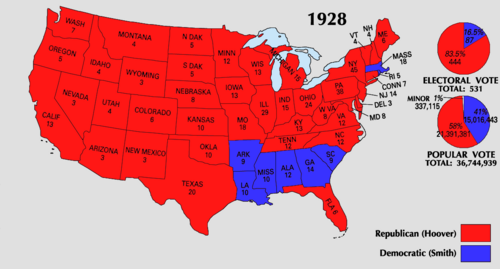
1928年、ハーバート・フーバーは、民主党の対立候補アル・スミス(カトリック教徒で禁酒法に反対)に対する偏見を利用して、[98]ハーディングやクーリッジが制した南部諸州(テネシー州、ケンタッキー州、ミズーリ州、オクラホマ州、メリーランド州)だけでなく、フロリダ、ノースカロライナ州、テキサス、バージニアでも勝利した。これらの州は、南北戦争後の復興期以降、共和党に投票したことのない州だった。さらにフーバーは、ディープサウスのアラバマ州でも3%差で勝利を収めた。ハーディング、クーリッジ、フーバーは、いずれも1916年にヒューズを支持した南部の2州、ウェストバージニアとデラウェア州を制した。アル・スミスは、1928年にプロテスタントが大多数を占める南部でカトリック教徒として激しい反発を受け、[99]スミスはアラバマ州で3%の差で敗北しそうになったが、フーバーが勝っていたら南部が物理的に分裂していただろう。[100]
フランクリン・D・ルーズベルトの政治的支配の時代には、南部は再び「安定」したように見えた。彼のニューディール政策による福祉計画と軍備増強により、南部にかなりの資金が投入され、ダストボウルの時を含め、多くの住民が恩恵を受けた。ルーズベルトは4回の大統領選挙で、旧南部連合の11州すべてとオクラホマ州で勝利した。[101]
第二次世界大戦後
民主党のハリー・S・トルーマン大統領の公民権運動への支持と、1948年の民主党綱領における公民権政策の採択が相まって、多くの南部人が民主党全国大会から退席し、ディキシークラット党を結成した。[102]この分派党は1948年の選挙 で重要な役割を果たし、ディキシークラット党の候補者ストロム・サーモンドはアラバマ、ルイジアナ、ミシシッピ、そして自身の出身地サウスカロライナの各州で勝利した。[34]それにもかかわらず、アメリカ史上最大の選挙の番狂わせの一つで、 [103] [104]現職の民主党大統領 ハリー・S・トルーマンは、圧倒的支持を得ていた共和党のニューヨーク州知事 トーマス・E・デューイを破った。[105]
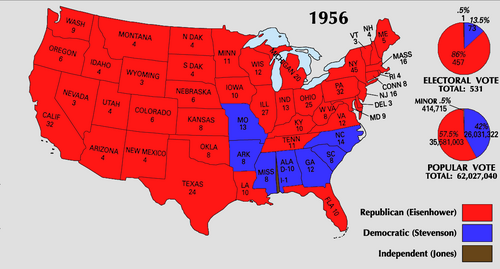
1952年と1956年の選挙では、第二次世界大戦中に連合軍の司令官を務めた共和党の人気の高いドワイト・D・アイゼンハワーが、特に新興郊外地域で強い支持を得て、いくつかの南部州を制した。 [106] [107]アイゼンハワーが制した南部の州のほとんどは、1920年代に共和党の勝利者の少なくとも1人に投票していたが、1956年にアイゼンハワーはルイジアナ州を制し、1876年のラザフォード・B・ヘイズ以来、同州で勝利した初の共和党員となった。ディープサウスの残りの地域では、民主党の対立候補であるアドレー・スティーブンソンに投票した。[108]
1960年の選挙では、民主党候補のジョン・F・ケネディは、副大統領候補に南部出身者を選ぶという党の伝統を引き継いだ(この場合はテキサス州のリンドン・B・ジョンソン上院議員)。[109]しかし、ケネディとジョンソンはともに公民権を支持していた。[110] 1960年10月、マーティン・ルーサー・キング・ジュニアがジョージア州アトランタで平和的な座り込み中に逮捕されたとき、ケネディはキングの妻コレッタ・スコット・キングに同情の電話をかけ、ケネディの兄弟ロバート・F・ケネディはキングの釈放を手助けした。キングはこれらの電話に感謝の意を表した。キングは支持を表明しなかったが、以前は共和党のリチャード・ニクソンを支持していた父親はケネディへの支持に切り替えた。[111]
1960年代半ばまでに、多くの南部の州で変化が起こった。サウスカロライナ州の元ディキシークラット上院議員ストロム・サーモンドは1964年に政党を変え、テキサス州は1961年に共和党上院議員を選出した。 [112]フロリダ州とアーカンソー州は1966年に共和党の知事を選出した。共和党が常に少数派であったアッパーサウスでは、共和党は下院と上院でいくつかの議席を獲得した。[46]
.png/500px-Senate_vote_on_final_passage_of_Civil_Rights_Act_of_1964_(HR_7152).png)
これらの出来事やその他の出来事により、民主党は南部の白人有権者の支持を失った。なぜなら、南部の大部分でかつては白人だけの民主党だったものに対する支配力を、同じ有権者がますます失っていったからである。 [113] 1960年の選挙は、共和党の大統領候補が全国的には負けているものの、旧南部連合から選挙人を獲得した初めての選挙であった。ニクソンはバージニア州、テネシー州、フロリダ州を制した。民主党はアラバマ州とミシシッピ州でも勝利したが、民主党の人種差別主義者を代表する無党派選挙人団は、これらの州の選挙人票をケネディではなくハリー・バードに与えた。[114]
1964年の選挙に向けて、各党の公民権に関する立場は変化し続けた。ケネディ暗殺後に大統領となった民主党候補のジョンソンは、強力な1964年公民権法の成立に全力を尽くした。この画期的な法案に署名した後、ジョンソンは側近のビル・モイヤーズに「南部は今後長い間共和党の手に渡ったと思う」と語った。[115]一方、ジョンソンの対立候補であるアリゾナ州のバリー・ゴールドウォーター上院議員は、公民権法が連邦政府の権限を強化し、ビジネスマンの私有財産権を侵害するとして反対票を投じた。[116]ゴールドウォーターは、公民権全般と普通選挙を支持し、1957年の公民権法に賛成票を投じた( 1960年の公民権法には投票しなかったが)。また、投票の要件として人頭税を禁止したアメリカ合衆国憲法修正第24条にも賛成票を投じた。これは、州がアフリカ系アメリカ人や貧困層の選挙権を剥奪するために使った手段の一つであった。[117] [118] [119]

In November 1964, Johnson won a landslide electoral victory, and the Republicans suffered significant losses in Congress. Goldwater, however, besides carrying his home state of Arizona, carried the Deep South: voters in Alabama, Georgia, Mississippi, and South Carolina had switched parties for the first time since Reconstruction.[120] Goldwater notably won only in Southern states that had voted against Republican Richard Nixon in 1960, while not winning a single Southern state which Nixon had carried. Previous Republican inroads in the South had been concentrated on high-growth suburban areas, often with many transplants, as well as on the periphery of the South.[121][1]
Harold D, Woodman summarizes the explanation that external forces caused the disintegration of the Jim Crow South from the 1920s to the 1970s:
- When a significant change finally occurred, its impetus came from outside the South. Depression-bred New Deal reforms, war-induced demand for labor in the North, perfection of cotton-picking machinery, and civil rights legislation and court decisions finally... destroyed the plantation system, undermined landlord or merchant hegemony, diversified agriculture and transformed it from a labor- to a capital-intensive industry, and ended the legal and extra-legal support for racism. The discontinuity that war, invasion, military occupation, the confiscation of slave property, and state and national legislation failed to bring in the mid-19th century, finally arrived in the second third of the 20th century. A "second reconstruction" created a real New South.[122]
Southern strategy

45% and above
40–44%
35–39%
30–34%
25–29%
24% and under
The "Southern strategy" was the long-term Republican Party electoral strategy to increase political support among white voters in the Southern United States since the 1960s. According to a quantitative analysis done by Ilyana Kuziemko and Ebonya Washington, racial backlash played a central role in the decline in relative white Southern Democratic identification.[124][125][126] Support for the civil rights movement in the 1960s by Democratic presidents John F. Kennedy and Lyndon B. Johnson solidified the Democrats' support within the African American community. African Americans have consistently voted between 85% and 95% Democratic since the 1960s.[127][128][129]
Although Richard Nixon carried 49 states in 1972, including every Southern state, the Republican Party remained quite weak at the local and state levels across the entire South for decades.[130] Republicans first won a majority of U.S. House seats in the South in the 1994 "Republican Revolution", and only began to dominate the South after the 2010 elections.[6] Many analysts believe the Southern Strategy that has been employed by Republicans since the 1960s is now virtually complete, with Republicans in dominant, almost total, control of political offices in the South since the 2010s.[131][132][133]
Scholars have debated the extent to which ideological "divisions over the size of government (including taxes, social programs, and regulation), national security, and moral issues such as abortion and gay rights, with racial issues only one of numerous areas about which liberals and conservatives disagree," were responsible for the realignment.[134][135][33] When looked at broadly, studies have shown that White Southerners tend to be more conservative, both fiscally and socially,[136][137] than most non-Southerners and African Americans.[138][139] Historically, Southern Democrats were generally more conservative than non-Southern Democrats, joining factions such as the conservative coalition and Boll weevils.[140][141]
1965 to 1980
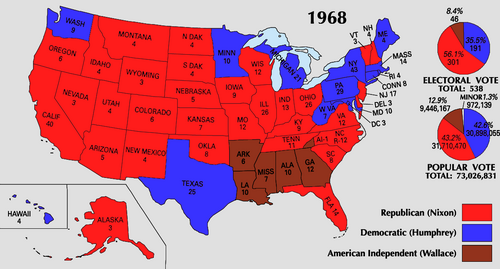
In the 1968 election, Richard Nixon saw the cracks in the Solid South as an opportunity to tap into a group of voters who had historically been beyond the reach of the Republican Party. With the aid of Harry Dent and South Carolina Senator Strom Thurmond, who had switched to the Republican Party in 1964, Nixon ran his 1968 campaign on states' rights and "law and order". As a key component of this strategy, he selected as his running mate Maryland Governor Spiro Agnew.[142] Liberal Northern Democrats accused Nixon of pandering to Southern whites, especially with regard to his "states' rights" and "law and order" positions, which were widely understood by black leaders to legitimize the status quo of Southern states' discrimination.[143] This tactic was described in 2007 by David Greenberg in Slate as "dog-whistle politics".[144] According to an article in The American Conservative, Nixon adviser and speechwriter Pat Buchanan disputed this characterization.[145][146]
The independent candidacy of George Wallace, former Democratic governor of Alabama, partially negated Nixon's Southern Strategy.[147] With a much more explicit attack on integration and black civil rights, Wallace won all but two of Goldwater's states (the exceptions being South Carolina and Arizona) as well as Arkansas and one of North Carolina's electoral votes. Nixon picked up Virginia, Tennessee, North Carolina, South Carolina, Florida, Oklahoma, Kentucky, Missouri, and Delaware. The Democrat, Hubert Humphrey, won Texas, heavily unionized West Virginia, and heavily urbanized Maryland. Writer Jeffrey Hart, who worked on the Nixon campaign as a speechwriter, said in 2006 that Nixon did not have a "Southern Strategy", but "Border State Strategy" as he said that the 1968 campaign ceded the Deep South to George Wallace. Hart suggested that the press called it a "Southern Strategy" as they are "very lazy".[148]
The 1968 election had been the first election in which both the Upper South and Deep South bolted from the Democratic party simultaneously. The Upper South had backed Eisenhower in 1952 and 1956, as well as Nixon in 1960.[149] The Deep South had backed Goldwater just four years prior. Despite the two regions of the South still backing different candidates, Wallace in the Deep South and Nixon in the Upper South, only Texas, Maryland, and West Virginia had held up against the majority Nixon-Wallace vote for Humphrey.[150] By 1972, Nixon had swept the South altogether, Upper and Deep South alike, marking the first time in American history a Republican won every Southern state.[151]
In the 1976 election, former Georgia governor Jimmy Carter gave Democrats a short-lived comeback in the South, winning every state in the old Confederacy except for Virginia, which was narrowly lost.[152] However, in his unsuccessful 1980 re-election bid, the only Southern states he won were his native state of Georgia, West Virginia, and Maryland. The year 1976 was the last year a Democratic presidential candidate won a majority of Southern electoral votes, or won Texas, Mississippi, Alabama, and South Carolina in a presidential election.[131] The Republicans took all the region's electoral votes in the 1984 election and every state except West Virginia in 1988.[153]
1980 to 1999

In the 1992 and 1996 elections, when the Democratic ticket consisted of two Southerners (Bill Clinton and Al Gore), the Democrats and Republicans split the region.[154][155] In both elections, Clinton won Arkansas, Louisiana, Kentucky, Tennessee, West Virginia, Missouri, Maryland, and Delaware, while the Republican won Texas, Mississippi, Alabama, North Carolina, South Carolina, Virginia, and Oklahoma.[156] Bill Clinton won Georgia in 1992, but lost it in 1996 to Bob Dole. Conversely, Clinton lost Florida in 1992 to George Bush, but won it in 1996.[157] The year 1996 was the last year a Democratic presidential candidate won Louisiana, Arkansas, Tennessee, Kentucky, and West Virginia.[131]
Throughout the 1970s and 1980s, the South was still overwhelmingly Democratic at the state level, with majorities in all state legislatures and most U.S. House delegations. Over the next 30 years, this gradually changed. Veteran Democratic officeholders retired or died, and older voters who were still rigidly Democratic died off.[130] Some former Southern Democrats became Republicans, such as Kent Hance (1985), Rick Perry (1989), and Ralph Hall (2004) from Texas; Billy Tauzin (1995) and Jimmy Hayes (1995) from Louisiana; Kay Ivey (2002) and Richard Shelby (1994) from Alabama; and Nathan Deal (1995) and Sonny Perdue (1998) from Georgia.[126]
As part of the Republican Revolution in the 1994 elections, Republicans captured a majority of the U.S. House's southern seats for the first time.[158] There were also increasing numbers of migrants from other areas, especially in Florida, Georgia, Texas, North Carolina, and Virginia.[159]
Northeast realignment

32% and above
28–31%
24–27%
20–23%
16–19%
15% and under
While the South was shifting from the Democrats to the Republicans, the Northeastern United States went the other way. The Northeastern United States is defined by the US Census Bureau as Pennsylvania, New Jersey, New York, and the New England States. Maryland and Delaware also are included in some definitions of the Northeast, being located in the Northeast megalopolis.[160][161][162] The argument that the South shifted to the Republicans in part by having higher ideological support for conservatism gains support from the Northeast having higher ideological support for liberalism and shifting to the Democrats.[163]
In Harry S. Truman's 1948 upset victory, he only won the Northeastern states of Massachusetts and Rhode Island.[164] Truman won every Southern electoral vote not won by Dixiecrat Strom Thurmond[102] except for the border states of Maryland and Delaware, which he narrowly lost to Republican Thomas E. Dewey.[165]
In his close 1976 presidential election victory, former governor of Georgia Jimmy Carter lost the Northeastern states of New Jersey, Connecticut, Vermont, New Hampshire, and Maine while winning every former Confederate state except Virginia. Well into the 1980s, much of the Northeast – in particular the heavily suburbanized states of New Jersey and Connecticut, and the rural states of northern New England – were strongholds of the Republican Party.[166] The Democratic Party made steady gains there, however, and from 1992 through 2012, all nine Northeastern states plus Maryland and Delaware voted Democratic, with the exception of New Hampshire's plurality for George W. Bush in 2000.[167]
21st century
In 2000, Al Gore received no electoral votes from the South, even from his home state of Tennessee, apart from heavily urbanized and uncontested Maryland and Delaware. The popular vote in Florida was extraordinarily close in awarding the state's electoral votes to George W. Bush.[168] This pattern continued in the 2004 election; the Democratic ticket of John Kerry and John Edwards received no electoral votes from the South apart from Maryland and Delaware, even though Edwards was from North Carolina, and was born in South Carolina.[169] The border states have split in the 21st century, with Maryland and Delaware being Democratic strongholds while Kentucky and West Virginia are Republican strongholds.[170]

West Virginia was perhaps the most reliably Democratic state in the nation between 1932 and 1996, being one of just two states (along with Minnesota) to vote for a Republican president as few as three times in that interval. Moreover, unlike Minnesota (or other nearly as reliably Democratic states like Massachusetts and Rhode Island), it usually had a unanimous (or nearly unanimous) congressional delegation and only elected two Republicans as governor (albeit for a combined 20 years between them).[171] West Virginian voters shifted toward the Republican Party from 2000 onward, as the Democratic Party became more strongly identified with environmental policies anathema to the state's coal industry and with socially liberal policies, and it can now be called a solidly red state. After the 2010 elections, West Virginia had a majority-Republican U.S. House delegation for the first time since 1949.[79]
In the 2008 election, as some areas in the South became more urbanized, liberal, and demographically diverse,[172] Barack Obama won the former Republican strongholds of Virginia and North Carolina as well as Florida.[173] Even after 2010, Democrats have still been competitive in some Southern swing states in presidential elections. Obama won Virginia and Florida again in 2012 and lost North Carolina by only 2.04 percent.[174] In 2016, Hillary Clinton won only Virginia while narrowly losing Florida and North Carolina.[175] In 2020, Joe Biden won Virginia, a growing stronghold for Democrats, and narrowly won Georgia, in large part due to the rapidly growing Atlanta metropolitan area, while narrowly losing Florida and North Carolina.[176]
The tendency of many Southern Whites to split their tickets, voting for Republican presidential candidates but Democrats for state offices, lasted until the 2010 United States elections. In the November 2008 elections, Democrats won 3 out of 4 U.S. House seats from Mississippi, 3 out of 4 in Arkansas, 5 out of 9 in Tennessee, and achieved near parity in the Georgia and Alabama delegations.[177] In 2016, Republican Donald Trump won Elliott County in Kentucky, which had previously never voted for a Republican presidential candidate since its creation in 1869.[178]
2010 to present
Although Republicans gradually began doing better in presidential elections in the South starting in 1952, Republicans did not finish taking over Southern politics at the nonpresidential level until the elections of November 2010.[6] On the eve of the 2010 elections, Democrats had a majority in the Alabama, North Carolina, Mississippi, Arkansas and Louisiana Legislatures, a majority in the Kentucky House of Representatives and Virginia Senate, a near majority of the Tennessee House of Representatives,[179] and a majority of the U.S. House delegations from Arkansas, North Carolina, Mississippi, Tennessee, Virginia, and West Virginia, as well as near-even splits of the Georgia and Alabama U.S. House delegations.[180]

However, during the 2010 midterm elections, Republicans swept the South, successfully reelecting every Senate incumbent, electing freshmen Marco Rubio in Florida and Rand Paul in Kentucky, and defeating Democratic incumbent Blanche Lincoln in Arkansas for a seat now held by John Boozman. In the House, Republicans reelected every incumbent except for Joseph Cao of New Orleans, defeated several Democratic incumbents, and gained a number of Democratic-held open seats. They won the majority in the congressional delegations of every Southern state.[6] Most Solid South states, with the exceptions of Arkansas, Kentucky, North Carolina, and West Virginia, also elected or reelected Republicans governors. Most significantly, Republicans took control of both houses of the Alabama and North Carolina State Legislatures for the first time since Reconstruction,[181] with Mississippi and Louisiana flipping a year later during their off-year elections.[182] Even in Arkansas, the GOP won three of six statewide down-ballot positions for which they had often not fielded candidates. They also went from eight to 15 out of 35 seats in the state senate and from 28 to 45 out of 100 in the State House of Representatives.[181] In 2012, the Republicans finally took control of the Arkansas State Legislature and the North Carolina Governorship.[183]
In 2014, both houses of the West Virginia legislature were finally taken by the GOP, and most other legislative chambers in the South up for election that year saw increased GOP gains.[184] Shelley Moore Capito also became the first Republican Senator from West Virginia in 2014 for the first time since 1956.[185] Arkansas' governorship finally flipped GOP in 2014 when incumbent Mike Beebe was term-limited, as did every other statewide office not previously held by the Republicans.[186] Georgia Representative John Barrow was defeated in 2014, being the last white Democratic Representative in a state that George Wallace won in 1968 (Arkansas, Louisiana, Mississippi, Alabama, and Georgia).[187]
Following the 2016 elections, when Republicans won the Kentucky House of Representatives, every state legislative chamber in the South had a Republican majority for the first time ever.[188] Republicans would control every state legislature in the former Confederate states until Democrats regained both Houses of the Virginia Legislature in 2019.[189]
Today, the South is considered a Republican stronghold at the state and federal levels. As of 2023, Republicans account for a majority of every Southern state's House delegation apart from Virginia, Maryland, and Delaware.[177] Republicans also control 10 of the 11 state legislatures in the former Confederacy, the sole exception being the Virginia General Assembly.[190]
Virginia

The biggest exception to Republican gains in the former Confederate states has been the state of Virginia. It got an earlier start in the trend towards the Republican Party than the rest of the region. It voted Republican for president in 13 of the 14 elections between 1952 and 2004, the exception being Lyndon B. Johnson's 1964 landslide, while no other former Confederate state did so more than 9 times (that state being Florida).[191] Moreover, it had a Republican Governor more often than not between 1970 and 2002, and Republicans held at least half the seats in the Virginia congressional delegation from 1968 to 1990 (although the Democrats had a narrow minority throughout the 1990s),[7] while with single-term exceptions (Alabama from 1965 to 1967, Tennessee from 1973 to 1975, and South Carolina from 1981 to 1983) and the exception of Florida (which had its delegation turn majority Republican in 1989), Democrats held at least half the seats in the delegations of the rest of the Southern states until the Republican Revolution of 1994.[177]
This is largely due to massive population growth in Northern Virginia, part of the strongly Democratic Washington metropolitan area, which is politically oriented towards the Northeast.[192] The Democratic Party has won most statewide races in Virginia since 2005, including consistently at the presidential level since 2008. In 2020 the party carried the state by a double digit margin for the first time since 1944.[193] As of June 2024, the Virginia General Assembly is the only state legislature Democrats control in the former Confederate States.[190]
Solid South in presidential elections
While Republicans occasionally won southern states in elections in which they won the presidency in the Solid South, it was not until 1960 that a Republican carried any of the 11 former Confederate states or Oklahoma while losing the election.[194] This table includes data for all 16 states considered part of the Southern United States by the Census Bureau.
Bold denotes candidates elected as president
Solid South in gubernatorial elections
Officials who acted as governor for less than ninety days are excluded from this chart. This chart is intended to be a visual exposition of party strength in the solid south and the dates listed are not exactly precise. Governors not elected in their own right are listed in italics.[197]
The parties are as follows: Democratic (D), Farmers' Alliance (FA), Prohibition (P), Readjuster (RA), Republican (R).
See also
Notes
- ^ Missouri is considered a Midwestern state by the Census Bureau.[9]
- ^ Despite the South's excessive representation relative to voting population, the Great Migration did cause Mississippi to lose Congressional districts following the 1930 and 1950 Censuses, whilst South Carolina and Alabama also lost Congressional seats after the former Census and Arkansas following the latter.
- ^ The closer ones, beginning with the closest, are Florida in 2000, Maryland in 1832, Maryland in 1904, California in 1912, California in 1892 and Hawaii in 1960.
- ^ a b c Electoral votes awarded by the Electoral Commission
- ^ Oklahoma was not a state until 1907 and did not vote in presidential elections until 1908
- ^ One of Tennessee's electoral votes went to Strom Thurmond.
- ^ One of Alabama's electoral votes went to Walter B. Jones.
- ^ Five of Alabama's electoral votes went to John F. Kennedy.
- ^ One of Oklahoma's electoral votes went to Harry F. Byrd.
- ^ One North Carolina Republican elector switched his vote to Wallace.
- ^ One Virginia Republican elector switched his vote to John Hospers.
- ^ One West Virginia Democratic elector switched her vote to Lloyd Bentsen.
- ^ One Texas Republican elector switched their vote to John Kasich, and another cast his vote for Ron Paul.
- ^ Since both the Governor and Lieutenant Governor had been impeached, the former resigning and the latter being removed from office, Stone, as president of the Senate, was next in line for the governorship. He filled the unexpired term and was later elected in his own right.
- ^ a b c d e f g h i j As lieutenant governor, filled unexpired term.
- ^ a b c d e f g h i j Died in office.
- ^ Resigned upon appointment as Assistant Secretary of the Treasury.
- ^ Did not run for re-election in 1888, but due to the election's being disputed, remained in office until February 6, 1890.
- ^ Elected in 1888 for a term beginning in 1891, an election dispute prevented Fleming from taking office until February 6, 1890
- ^ William S. Taylor (R) was sworn in and assumed office, but the state legislature challenged the validity of his election, claiming ballot fraud. William Goebel (D), his challenger in the election, was shot on January 30, 1900. The next day, the legislature named Goebel governor. However, Goebel died from his wounds three days later.
- ^ a b c d e f g h i j k l m n As lieutenant governor, he acted as governor for unexpired term and was subsequently elected in his own right.
- ^ As President of the state Senate, he filled the unexpired term and was subsequently elected in his own right.
- ^ Gubernatorial terms were increased from two to four years during Jelks' governorship; his first term was filling out Samford's two-year term, and he was elected in 1902 for a four-year term.
- ^ Resigned to take an elected seat in the United States Senate. March 21, 1905
- ^ As Speaker of the Senate, ascended to the governorship.
- ^ The elected governor, Hoke Smith, resigned to take his elected seat in the United States Senate. John M. Slaton, president of the senate, served as acting governor until Joseph M. Brown was elected governor in a special election.
- ^ The elected Governor, Joseph Taylor Robinson, resigned on March 8, 1913 to take an elected seat in the United States Senate. President of the state Senate William Kavanaugh Oldham acted as governor for six days before a new Senate President was elected. Junius Marion Futrell, as the new president of the senate, acted as governor until a special election.
- ^ Elected in a special election.
- ^ Resigned on the initiation of impeachment proceedings. Aug. 25, 1917.
- ^ a b c Resigned to take an elected seat in the United States Senate.
- ^ Impeached and removed from office. November 19, 1923
- ^ Died in his third term of office. October 2, 1927.
- ^ Resigned to be a judge on the United States District Court for the Eastern District of Arkansas.
- ^ Impeached and removed from office. March 21, 1929
- ^ As Speaker of the Senate, ascended to the governorship. Subsequently elected for two full terms.
- ^ Paul N. Cyr was lieutenant governor under Huey Long and stated that he would succeed Long when Long left for the Senate, but Long demanded Cyr forfeit his office. King, as president of the state Senate, was elevated to lieutenant governor and later governor.
- ^ Resigned to take an appointed seat in the United States Senate.
- ^ Resigned upon victory in the Democratic primary for the United States Senate, August 4, 1941.
- ^ Died in office. July 11, 1949
- ^ As President of the state Senate, filled unexpired term.
- ^ a b Resigned upon election to the Presidency of the United States.
- ^ Removed from office upon being convicted of illegally using campaign and inaugural funds to pay personal debts; he was later pardoned by the state parole board based on innocence.
- ^ Elected as a Democrat in 1987 but switched to Republican in 1991.
- ^ Resigned after being convicted of mail fraud in the Whitewater scandal.
- ^ Resigned to take an elected seat in the U.S. Senate. November 15, 2010
- ^ Elected as a Republican, Crist switched his registration to independent in April 2010.
- ^ Resigned April 10, 2017.
- ^ As president of the Senate, served as acting governor until he won a special election in 2011.
- ^ As Lieutenant Governor, succeeded to governorship upon resignation of Robert Bentley on April 10, 2017.
- ^ Elected as a Democrat, Justice switched his registration to Republican in August 2017.
References
- ^ a b Bullock, Charles S.; Hoffman, Donna R.; Gaddie, Ronald Keith (2006). "Regional Variations in the Realignment of American Politics, 1944–2004". Social Science Quarterly. 87 (3): 494–518. doi:10.1111/j.1540-6237.2006.00393.x. ISSN 0038-4941.
The events of 1964 laid open the divisions between the South and national Democrats and elicited distinctly different voter behavior in the two regions. The agitation for civil rights by southern blacks continued white violence toward the civil rights movement, and President Lyndon Johnson's aggressive leadership all facilitated passage of the 1964 Civil Rights Act. ... In the South, 1964 should be associated with GOP growth while in the Northeast this election contributed to the eradication of Republicans.
- ^ Stanley, Harold W. (1988). "Southern Partisan Changes: Dealignment, Realignment or Both?". The Journal of Politics. 50 (1): 64–88. doi:10.2307/2131041. ISSN 0022-3816. JSTOR 2131041. S2CID 154860857.
Events surrounding the presidential election of 1964 marked a watershed in terms of the parties and the South (Pomper, 1972). The Solid South was built around the identification of the Democratic party with the cause of white supremacy. Events before 1964 gave white southerners pause about the linkage between the Democratic Party and white supremacy, but the 1964 election, passage of the Civil Rights Act of 1964, and the Voting Rights Act of 1965 altered in the minds of most the positions of the national parties on racial issues.
- ^ Dewey W. Grantham, The Life and Death of the Solid South: A Political History (1992).
- ^ "US Census Region Map" (PDF).
- ^ Herbert, Herbert, Hilary A., Why The Solid South?, or, Reconstruction and Its Results, R.H. Woodward and Company, Baltimore, 1890, pgs. 258-284
- ^ a b c d "The long goodbye". The Economist. November 11, 2010. Retrieved February 20, 2023.
In 1981 Republicans took control of the Senate for the first time since 1953, but most Southern elected officials remained white Democrats. When Republicans took control of the House in 1995, white Democrats still comprised one-third of the South's tally. ... white Southern Democrats have met their Appomattox: they will account for just 24 of the South's 155 senators and congressmen in the 112th United States Congress.
- ^ a b Skelley, Geoffrey (July 13, 2017). "The New Dominion: Virginia's Ever-Changing Electoral Map". Rasmussen Reports. Retrieved July 30, 2020.
- ^ Tikkanen, Amy (June 17, 2020). "American Civil War". Encyclopedia Britannica. Retrieved June 28, 2020.
- ^ "History: Regions and Divisions". United States Census Bureau. Retrieved November 26, 2014.
- ^ Wilfred Buck Yearns (2010). The Confederate Congress. University of Georgia Press. pp. 42–43. ISBN 978-0820334769.
- ^ Foner, Eric, Reconstruction, America's Unfinished Revolution, 1863-1877, Harper Collins, 2011, pg. 39
- ^ Dubin, Michael J., United States Gubernatorial Elections, 1861–1911: The Official Results by State and County, McFarland, 2014, pgs. 585, 600
- ^ "Archives of Maryland Historical List: Constitutional Convention, 1864". November 1, 1864. Retrieved 2012-11-18.
- ^ "Missouri abolishes slavery". January 11, 1865. Archived from the original on April 25, 2012. Retrieved 2012-11-18.
- ^ "Tennessee State Convention: Slavery Declared Forever Abolished". NY Times. January 14, 1865. Retrieved 2012-11-18.
- ^ "On this day: 1865-FEB-03". Retrieved 2012-11-18.
- ^ "Slavery in Delaware". Retrieved 2012-11-18.
- ^ Lowell Hayes Harrison and James C. Klotter (1997). A new history of Kentucky. University Press of Kentucky. p. 180. ISBN 978-0813126210. In 1866, Kentucky refused to ratify the 13th Amendment. It did ratify it in 1976.
- ^ "National Museum of African American History & Culture". Archived from the original on 2023-10-15. Retrieved 2023-09-19.
- ^ Lemann, Nicholas (2007). Redemption: The Last Battle of the Civil War. New York: Farrar, Straus, and Giroux.
- ^ George C. Rable, But There Was No Peace: The Role of Violence in the Politics of Reconstruction (1984), p. 132
- ^ Gordon B. McKinney, Southern Mountain Republicans, 1865–1900: Politics and the Appalachian Community (1998)
- ^ C. Van Woodward, The Origins of the New South, 1877–1913 (1951) pp 235–90
- ^ 6 J. Morgan Kousser, The Shaping of Southern Politics: Suffrage Restriction and the Rise of the One-Party South, 1880–1910 (Yale UP, 1974).
- ^ a b c d Valelly, Richard M. (October 2, 2009). The Two Reconstructions: The Struggle for Black Enfranchisement. University of Chicago Press. ISBN 9780226845272 – via Google Books.
- ^ Richard H. Pildes, "Democracy, Anti-Democracy, and the Canon", Constitutional Commentary, Vol.17, 2000, p.10, Accessed 10 Mar 2008
- ^ Glenn Feldman, The Disenfranchisement Myth: Poor Whites and Suffrage Restriction in Alabama, Athens: University of Georgia Press, 2004, pp. 135–136
- ^ Michael Perman. Struggle for Mastery: Disenfranchisement (sic) in the South, 1888–1908 (2001), Introduction
- ^ Tillman, Benjamin (March 23, 1900). "Speech of Senator Benjamin R. Tillman". Congressional Record, 56th Congress, 1st Session. (Reprinted in Richard Purday, ed., Document Sets for the South in U. S. History [Lexington, MA.: D.C. Heath and Company, 1991], p. 147.). pp. 3223–3224.
- ^ Jeffery A. Jenkins, Justin Peck, and Vesla M. Weaver. "Between Reconstructions: Congressional Action on Civil Rights, 1891–1940." Studies in American Political Development 24#1 (2010): 57–89. online
- ^ Mickey, Robert (February 19, 2015). Paths Out of Dixie: The Democratization of Authoritarian Enclaves in America's Deep South, 1944–1972.
- ^ Connie Rice: Top 10 Election Myths to Get Rid Of : NPR The situation in Louisiana was an example—see John N. Pharr, Regular Democratic Organization#Reconstruction and aftermath, and the note to Murphy J. Foster (who served as governor of Louisiana from 1892 to 1900).
- ^ a b See Matthew Yglesias, "Why did the South turn Republican?", The Atlantic August 24, 2007.
- ^ a b Mickey, Robert (February 19, 2015). Paths Out of Dixie: The Democratization of Authoritarian Enclaves in America's Deep South, 1944–1972.
- ^ Presidential election of 1900 – Map by Counties (and subsequent years)
- ^ a b Sullivan, Robert David; ‘How the Red and Blue Map Evolved Over the Past Century’; America Magazine in The National Catholic Review; June 29, 2016
- ^ Federal Writers' Project (1939). Florida. A Guide to the Southernmost State. New York: Oxford University Press. p. 7.
- ^ Menendez, Albert J. (2005). The Geography of Presidential Elections in the United States, 1868-2004. Jefferson, North Carolina: McFarland & Company. pp. 149–153. ISBN 0786422173.
- ^ Sherman, Richard B. (1973). The Republican Party and Black America from McKinley to Hoover, 1896-1933. Charlottesville, University Press of Virginia. p. 18. ISBN 978-0-8139-0467-2. Retrieved 28 May 2022.
- ^ Valelly, Richard M. (2009). The Two Reconstructions: The Struggle for Black Enfranchisement. University of Chicago Press. pp. 146–14. ISBN 978-0-226-84527-2. Retrieved October 21, 2015.
- ^ The Presidential Vote, 1896–1932 – Google Books. Stanford University Press. 1934. ISBN 9780804716963. Retrieved August 12, 2014.
- ^ Grantham, Dewey W. (Fall 1995). "Tennessee and Twentieth-Century American Politics". Tennessee Historical Quarterly. 54 (3): 210–229.
- ^ Farris, Scott (2012). Almost President: The Men Who Lost The Race But Changed The Nation. Ottawa: Lyons Press. ISBN 9780762763788.
- ^ Richard J. Jensen, "The Last Party System: Decay of Consensus, 1932–1980", in The Evolution of American Electoral Systems (Paul Kleppner et al. eds.) (1981) pp. 219–225.
- ^ Topping, Simon (2008). Lincoln's Lost Legacy: The Republican Party and the African American Vote, 1928–1952. University Press of Florida. pp. 11, 14–16. ISBN 978-0813032283.
- ^ a b Everett Carll Ladd, Jr., with Charles D. Hadley. Transformations of the American Party System: Political Coalitions from the New Deal to the 1970s 2nd ed. (1978).
- ^ Patterson, James T. (1967). Congressional Conservatism and the New Deal. University Press of Kentucky. pp. vii–viii. ISBN 9780813164045.
- ^ Susan Dunn, Roosevelt's Purge: How FDR Fought to Change the Democratic Party (2010) passim, esp. p. 204.
- ^ Harold D, Woodman, "Economic Reconstruction and the Rise of the New South, 1865–1900" in John B. Boles, and Evelyn Thomas Nolen, eds., Interpreting Southern history: Historiographical essays in honor of Sanford W. Higginbotham (LSU Press, 1987) pp. 254–307, quoting pp 273–274.
- ^ "The Great Migration (1910–1970)". May 20, 2021. Archived from the original on September 27, 2022. Retrieved March 21, 2022.
- ^ Doherty, Herbert J. (junior); 'Liberal and Conservative Politics in Florida'; The Journal of Politics, vol. 14, no. 3 (August 1952), pp. 403-417
- ^ Smith v. Allwright, 321 U.S. 649 (1944)
- ^ Beyerlein, Kraig and Andrews, Kenneth T.; ‘Black Voting during the Civil Rights Movement: A Micro-Level Analysis’; Social Forces, volume 87, No. 1 (September 2008), pp. 65-93
- ^ Ralph C. Hon, "The South in a War Economy" Southern Economic Journal8#3 (1942), pp. 291–308 online Archived August 19, 2020, at the Wayback Machine
- ^ "1920 Presidential General Election Results – Oklahoma". Dave Leip's Atlas of U.S. Presidential Elections. Retrieved 2013-08-02.
- ^ Pollard, Bryan (November 23, 2020). "How the US Civil War Divided Indian Nations". History.com. Retrieved August 29, 2022.
- ^ Annie Heloise Abel, "The Indians in the Civil War", American Historical Review Vol. 15, No. 2 (Jan. 1910), pp. 281–296. JSTOR 1838335
- ^ John Spencer and Adam Hook, The American Civil War in Indian Territory (2006)
- ^ Debo, Angie; And Still the Waters Run: The Betrayal of the Five Civilized Tribes, pp. 318-319 ISBN 9780691005782
- ^ "1958-1966 results" (PDF). Oklahoma State Election Board. p. 35.
- ^ Bateman, David A.; Katznelson, Ira; Lapinski, John S. (2018). Southern Nation: Congress and White Supremacy After Reconstruction. Princeton University Press. p. 375. ISBN 978-0691126494.
- ^ Finkelman, Paul; African-Americans and the right to vote (Garland Publishing, 1992), pp. 418, 438
- ^ Richard M. Valelly, The Two Reconstructions: The Struggle for Black Enfranchisement, Chicago: University of Chicago Press, 2004, p.141
- ^ Finkelman, Paul; African-Americans and the right to vote (Garland Publishing, 1992), pp. 418, 438
- ^ Gaddie, Ronald Keith. Republican Party Archived 2011-09-03 at the Wayback Machine, Encyclopedia of Oklahoma History and Culture (accessed February 11, 2010).
- ^ Bateman, David A.; Katznelson, Ira; Lapinski, John S. (2018). Southern Nation: Congress and White Supremacy After Reconstruction. Princeton University Press. p. 375. ISBN 978-0691126494.
- ^ Sullivan, Robert David; ‘How the Red and Blue Map Evolved Over the Past Century’; America Magazine in The National Catholic Review; June 29, 2016.
- ^ Ranney, Joseph A.; In the Wake of Slavery: Civil War, Civil Rights, and the Reconstruction of Southern Law; p. 141 ISBN 0275989720
- ^ Lawrence O. Christensen and Gary R. Kremer, A History of Missouri: Volume IV, 1875 to 1919 (2004)
- ^ Diamond, William; ‘Urban and Rural Voting in 1896’; The American Historical Review, vol. 46, no. 2 (January 1941), pp. 281-305
- ^ R. Hal Williams, Realigning America: McKinley, Bryan and the Remarkable Election of 1896 (U Press of Kansas, 2010), pp. xi, 169–170.
- ^ "Population Division Working Paper No. 56" (PDF). Archived (PDF) from the original on 2018-09-30. Retrieved 2018-08-17.
- ^ Foner, Eric, Reconstruction: America's Unfinished Revolution, 1863–1877, Harper Collins, 2002, p. 38
- ^ Snell, Mark A., West Virginia and the Civil War. History Press, 2011, p. 28
- ^ Bastress, Robert M., The West Virginia State Constitution, Oxford Univ. Press, 2011, p. 21
- ^ Ambler, Charles Henry, A History of West Virginia, Prentice-Hall, 1937, p. 376.
- ^ Herbert, Hilary Abner Why the Solid South? Or, Reconstruction and Its Results, R. H. Woodward, 1890, pp. 258–284
- ^ Williams, John Alexander, West Virginia, a History, W. W. Norton, 1984, p. 94
- ^ a b Tumulty, Karen (26 October 2013). "A Blue State's Road to Red". The Washington Post. Retrieved 24 July 2016.
- ^ Phillips, Kevin P.; The Emerging Republican Majority, p. 350 ISBN 978-0-691-16324-6
- ^ Brown, Thomas J.; ‘’The Roots of Bluegrass Insurgency: An Analysis of the Populist Movement in Kentucky; The Register of the Kentucky Historical Society, Vol. 78, No. 3 (Summer 1980), pp. 219-242
- ^ Shannon, Jasper Berry and McQuown, Ruth; Presidential Politics in Kentucky, 1824-1948: A Compilation of Election Statistics and an Analysis of Political Behavior (1950), p. 96
- ^ Copeland, James E.; ‘Where Were the Kentucky Unionists and Secessionists’; The Register of the Kentucky Historical Society, volume 71, no. 4 (October 1973), pp. 344-363
- ^ See Bolin, Janes Duane; Bossism and Reform in a Southern City: Lexington, Kentucky, 1880-1940, pp. 82-83 ISBN 9780813121505
- ^ Harrison, Lowell Hayes; A New History of Kentucky, p. 352 ISBN 9780813176307
- ^ "Presidential General Election Results Comparison – Maryland". Dave Leip’s U.S. Election Atlas.
- ^ a b Tuck, Stephen (Spring 2013). "Democratization and the Disfranchisement of African Americans in the US South during the Late 19th Century" (PDF). Reading for "Challenges of Democratization". Archived from the original (PDF) on February 23, 2014. Retrieved February 11, 2014 – via Brandon Kendhammer, Ohio University.
- ^ Shufelt, Gordeon H.; 'Jim Crow among strangers: The growth of Baltimore's Little Italy and Maryland's disfranchisement campaigns'; Journal of American Ethnic History; vol. 19, issue 4 (Summer 2000), pp. 49-78
- ^ Valelly, Richard (2004). The Two Reconstructions: The Struggle for Black Enfranchisement. Chicago: The University of Chicago Press. pp. 123–124. ISBN 0-226-84530-3.
- ^ White, Jr., Frank F. (1970). The Governors of Maryland 1777-1970. Annapolis: The Hall of Records Commission. pp. 239–242. ISBN 978-0942370010. Retrieved 11 September 2018.
- ^ Munroe (2001). History of Delaware. pp. 165–169.
- ^ "1932 Presidential Election Statistics". Dave Leip’s Atlas of U.S. Presidential Elections. Retrieved 2018-03-05.
- ^ Munroe (2001). History of Delaware. pp. 180–181.
- ^ Dawson, Marion L.,Will the South Be Solid Again?, The North American Review, Volume 164, 1897, pp. 193–198 [1]
- ^ "Too Close to Call: Presidential Electors and Elections in Maryland featuring the Presidential Election of 1904". msa.maryland.gov.
- ^ Menendez, Albert J. (2005). The Geography of Presidential Elections in the United States, 1868-2004. McFarland. pp. 239–246. ISBN 0786422173.
- ^ The Presidential Vote, 1896–1932 – Google Books. Stanford University Press. 1934. ISBN 9780804716963. Retrieved August 12, 2014.
- ^ Allan J. Lichtman, Prejudice and the Old Politics: The Presidential Election of 1928 (1979)
- ^ reprinted 1977, John A. Ryan, "Religion in the Election of 1928," Current History, December 1928; reprinted in Ryan, Questions of the Day (Ayer Publishing, 1977) p.91
- ^ Neal R. Pierce, The Deep South States of America: People, Politics, and Power in the Seven States of the Deep South (1974), pp 123–61
- ^ Sean J. Savage, Roosevelt: The Party Leader, 1932–1945. (University Press of Kentucky), 2014.
- ^ a b Kari A. Frederickson, The Dixiecrat Revolt and the End of the Solid South, 1932–1968 (2001).
- ^ American Experience. "General Article: Presidential Politics". PBS. Archived from the original on February 21, 2017. Retrieved September 17, 2017.
- ^ Rosegrant, Susan (April 18, 2012). University of Michigan (ed.). "ISR and the Truman/Dewey upset". isr.umich.edu. Archived from the original on April 2, 2013.
- ^ Cosgrove, Ben (October 21, 2012). "Behind the Picture: 'DEWEY DEFEATS TRUMAN'". Time. Archived from the original on October 22, 2012.
- ^ "1952 Presidential General Election Data – National". Dave Leip's Atlas of U.S. Presidential Elections. Retrieved March 18, 2013.
- ^ Buchholz, Michael O., The South in Presidential Politics: The End of Democratic Hegemony. Master of Arts (Political Science), August, 1973, p. 43
- ^ "1956 Presidential General Election Data - National". Retrieved March 18, 2013.
- ^ Lawrence, W. H. (July 15, 1960). "Johnson is Nominated for Vice President; Kennedy Picks Him to Placate the South". New York Times. Retrieved 11 September 2016.
- ^ Middleton, Russell (March 1962). "The Civil Rights Issue And Presidential Voting Among Southern Negroes And Whites". Social Forces. 40 (3): 209–215. doi:10.2307/2573630. JSTOR 2573630.
- ^ Kuhn, Clifford (1997). ""There's a Footnote to History!" Memory and the History of Martin Luther King's October 1960 Arrest and Its Aftermath". The Journal of American History: 586.
- ^ "TX US Senate - Special". OurCampaigns.com. Retrieved April 4, 2020.
- ^ Farrington, Joshua D. (September 20, 2016). Black Republicans and the Transformation of the GOP. University of Pennsylvania Press. ISBN 978-0-8122-9326-5.
- ^ "1960 Presidential General Election Data – National". Retrieved March 18, 2013.
- ^ Second Thoughts: Reflections on the Great Society New Perspectives Quarterly, Winter 1987
- ^ "Goldwater's vote against Civil Rights Act of 1964 unfairly branded him a racist". July 19, 2014. Archived from the original on September 24, 2021. Retrieved September 24, 2021.
- ^ "Senate – August 7, 1957" (PDF). Congressional Record. 103 (10). U.S. Government Printing Office: 13900. Archived (PDF) from the original on October 8, 2021. Retrieved February 18, 2022.
- ^ "Senate – August 29, 1957" (PDF). Congressional Record. 103 (12). U.S. Government Printing Office: 16478. Archived (PDF) from the original on October 8, 2021. Retrieved February 18, 2022.
- ^ "Senate – March 27, 1962" (PDF). Congressional Record. 108 (4). U.S. Government Printing Office: 5105. Archived (PDF) from the original on January 31, 2022. Retrieved February 18, 2022.
- ^ Black, Earl; Black, Merle (September 30, 2003). The Rise of Southern Republicans. Harvard University Press. ISBN 9780674012486. Archived from the original on June 12, 2018. Retrieved June 9, 2018.
When the Republican party nominated Arizona Senator Barry Goldwater—one of the few senators who had opposed the Civil Rights Act—as their presidential candidate in 1964, the party attracted many southern whites but permanently alienated African-American voters. Beginning with the Goldwater-versus-Johnson campaign more southern whites voted Republican than Democratic, a pattern that has recurred in every subsequent presidential election. ... Before the 1964 presidential election the Republican party had not carried any Deep South state for eighty-eight years. Yet shortly after Congress passed the Civil Rights Act, hundreds of Deep South counties gave Barry Goldwater landslide majorities.
- ^ Stanley, Harold W. (1988). "Southern Partisan Changes: Dealignment, Realignment or Both?". The Journal of Politics. 50 (1): 64–88. doi:10.2307/2131041. ISSN 0022-3816. JSTOR 2131041. S2CID 154860857.
Events surrounding the presidential election of 1964 marked a watershed in terms of the parties and the South (Pomper, 1972). The Solid South was built around the identification of the Democratic party with the cause of white supremacy. Events before 1964 gave white southerners pause about the linkage between the Democratic Party and white supremacy, but the 1964 election, passage of the Civil Rights Act of 1964, and the Voting Rights Act of 1965 altered in the minds of most the positions of the national parties on racial issues.
- ^ Harold D, Woodman, "Economic Reconstruction and the Rise of the New South, 1865–1900" in John B. Boles, and Evelyn Thomas Nolen, eds., Interpreting Southern history: Historiographical essays in honor of Sanford W. Higginbotham (LSU Press, 1987) pp. 254–307, quoting pp 273–274.
- ^ a b Jones, Jeffrey M. (2019-02-22). "Conservatives Greatly Outnumber Liberals in 19 U.S. States". Gallup. Archived from the original on February 22, 2019. Retrieved 2021-12-27.
- ^ Kuziemko, Ilyana; Washington, Ebonya (November 1, 2015). "Why did the Democrats Lose the South? Bringing New Data to an Old Debate". National Bureau of Economic Research. Working Paper Series. doi:10.3386/w21703. Retrieved May 21, 2023.
- ^ Miller, Gary; Schofield, Norman (2008). "The Transformation of the Republican and Democratic Party Coalitions in the U.S.". Perspectives on Politics. 6 (3): 433–450. doi:10.1017/S1537592708081218. ISSN 1541-0986. S2CID 145321253.
1964 was the last presidential election in which the Democrats earned more than 50 percent of the white vote in the United States.
- ^ a b Miller, Gary; Schofield, Norman (2003). "Activists and Partisan Realignment in the United States". American Political Science Review. 97 (2): 245–260. doi:10.1017/S0003055403000650 (inactive 2024-08-27). ISSN 1537-5943. S2CID 12885628.
By 2000, however, the New Deal party alignment no longer captured patterns of partisan voting. In the intervening 40 years, the Civil Rights and Voting Rights Acts had triggered an increasingly race-driven distinction between the parties. ... Goldwater won the electoral votes of five states of the Deep South in 1964, four of them states that had voted Democratic for 84 years (Califano 1991, 55). He forged a new identification of the Republican party with racial conservatism, reversing a century-long association of the GOP with racial liberalism. This in turn opened the door for Nixon's "Southern strategy" and the Reagan victories of the eighties.
{{cite journal}}: CS1 maint: DOI inactive as of August 2024 (link) - ^ Jackson, Brooks (April 18, 2008). "Blacks and the Democratic Party". FactCheck.org. Archived from the original on November 3, 2011. Retrieved October 30, 2011.
- ^ Bositis, David. "Blacks and the 2012 Democratic National Convention; page 9, table 1: black votes in presidential elections, 1936 - 2008" (PDF). Joint Center for Political and Economic Studies.
- ^ "Partisanship by race, ethnicity and education". Pew Research Center. April 9, 2024. Retrieved April 26, 2024.
- ^ a b Feldman, Glenn (2011). Painting Dixie Red: When, Where, Why and How the South Became Republican. University Press of Florida. pp. 16, 80.
- ^ a b c Maxwell, Angie; Shields, Todd (2019). The Long Southern Strategy: How Chasing White Voters in the South Changed American Politics. Oxford, New York: Oxford University Press. ISBN 978-0190265960.
- ^ Parton, Heather Digby (November 12, 2014). "Bye-bye, blue dog "Democrats": What the end of conservative Dems means for America". Salon. Retrieved December 24, 2016.
- ^ "2017 State & Legislative Partisan Composition" (PDF). www.ncsl.org. National Conference of State Legislatures. August 4, 2017. Archived from the original (PDF) on January 2, 2022. Retrieved February 14, 2021.
- ^ Valentino NA; Sears DO (2005). "Old Times There Are Not Forgotten: Race and Partisan Realignment in the Contemporary South" (PDF). American Journal of Political Science. 49 (3): 672–88. doi:10.1111/j.1540-5907.2005.00136.x. Archived from the original (PDF) on 2012-09-05.
- ^ Chappell, David (March 2007). "Did Racists Create the Suburban Nation?". Reviews in American History. V 35 (1): 89–97. doi:10.1353/rah.2007.0004. JSTOR 30031671. S2CID 144202527.
In an original analysis of national politics, Lassiter carefully rejects "racereductionist narratives" (pp. 4, 303). Cliches like "white backlash" and "southern strategy" are inadequate to explain the conservative turn in post-1960s politics. ... Racism has not been overcome. One might say rather that it has become redundant. One of Lassiter's many fascinating demonstrations of racism's superfluousness is his recounting of the actual use of the "southern strategy." The strategy obviously failed the Dixiecrats in 1948 and the GOP in 1964. The only time Nixon seriously tried to appeal to southern racism, in the 1970 midterm elections, the South rejected his party and elected Democrats like Jimmy Carter and Dale Bumpers instead (pp. 264–74). To win a nationwide majority, Republicans and Democrats alike had to appeal to the broad middle-class privileges that most people believed they had earned. Lassiter suggests that the first step on the way out of hypersegregation and resegregation is to stop indulging in comforting narratives. The most comforting narratives attribute the whole problem to racists and the Republicans who appease them.
- ^ Lamis, Alexander P. (1999). Southern Politics in the 1990s. Louisiana State University Press. pp. 7–8, 26. ISBN 978-0-8071-2374-4.
- ^ Sunshine Hillygus, D.; Shields, Todd G. (2014). The Persuadable Voter. Princeton University Press. ISBN 978-1400831593.
- ^ Cooper, Christopher A.; Knotts, H. Gibbs (2010). "Declining Dixie: Regional Identification in the Modern American South". Social Forces. 88 (3): 1083–1101. doi:10.1353/sof.0.0284. S2CID 53573849.
- ^ Rice, Tom W.; McLean, William P.; Larsen, Amy J. (2002). "Southern Distinctiveness over Time: 1972–2000". American Review of Politics. 23: 193–220. doi:10.15763/issn.2374-7781.2002.23.0.193-220.
- ^ Ira Katznelson, Kim Geiger, and Daniel Kryder, Limiting Liberalism: The Southern Veto in Congress, 1933–1950. Political Science Quarterly 108 (1993): 283–306 online Archived 2020-04-11 at the Wayback Machine
- ^ Bartho, Jonathan (2020). "Reagan's Southern Comfort: The "Boll Weevil" Democrats in the "Reagan Revolution" of 1981". Journal of Policy History. 32 (2): 214–238. doi:10.1017/S0898030620000044. ISSN 0898-0306.
- ^ "Nation: Spiro Agnew: The King's Taster". Time. 1969-11-14. ISSN 0040-781X. Retrieved 2021-10-17.
- ^ Johnson, Thomas A. (August 13, 1968). "Negro Leaders See Bias in Call of Nixon for 'Law and Order'". The New York Times. p. 27. Retrieved 2008-08-02.(subscription required)
- ^ Greenberg, David (November 20, 2007). "Dog-Whistling Dixie: When Reagan said 'states' rights', he was talking about race". Slate. Archived from the original on January 12, 2012.
- ^ "Nixon in Dixie", The American Conservative magazine
- ^ Ted Van Dyk. "How the Election of 1968 Reshaped the Democratic Party", Wall Street Journal, 2008
- ^ Childs, Marquis (June 8, 1970). "Wallace's Victory Weakens Nixon's Southern Strategy". The Morning Record.
- ^ Hart, Jeffrey (2006-02-09). The Making of the American Conservative Mind (television). Hanover, New Hampshire: C-SPAN.
- ^ Black, Earl; Black, Merle (2002). The Rise of Southern Republicans. Harvard University Press. ISBN 067400728X.
- ^ Childs, Marquis (June 8, 1970). "Wallace's Victory Weakens Nixon's Southern Strategy". The Morning Record.
- ^ Black, Earl; Black, Merle (1992). The Vital South: How Presidents Are Elected. Harvard University Press. ISBN 0674941306.
- ^ "1976 Presidential General Election Data - National". Retrieved March 18, 2013.
- ^ Aistrup, Joseph A. (2015). The Southern Strategy Revisited: Republican Top-Down Advancement in the South. University Press of Kentucky. p. 48. ISBN 978-0-8131-4792-5.
- ^ "1992 Presidential General Election Data – National". Uselectionatlas.org. Retrieved February 11, 2012.
- ^ 1996 Presidential General Election Data - National, Uselectionatlas.org.
- ^ Lipset, Seymour Martin (1993). "The Significance of the 1992 Election". PS: Political Science and Politics. 26 (1): 7–16. doi:10.2307/419496. JSTOR 419496. S2CID 227288247.
- ^ "Clinton Rides Landslide First Democrat To Be Re-Elected Since Roosevelt". The Spokesman-Review. November 6, 1996. Retrieved August 14, 2021.
- ^ Peter Applebome (November 11, 1994). "THE 1994 ELECTIONS: THE SOUTH; The Rising G.O.P. Tide Overwhelms the Democratic Levees in the South". The New York Times. Retrieved September 22, 2014.
- ^ Mary E. Odem and Elaine Lacy, eds. Latino Immigrants and the Transformation of the U.S. South (U of Georgia Press, 2009).
- ^ John C. Hudson (2002). Across This Land: A Regional Geography of the United States and Canada. JHU Press. p. 81 ff. ISBN 0-8018-6567-0.
- ^ Thomas F. McIlwraith; Edward K. Muller (2001). North America: The Historical Geography of a Changing Continent. Rowman & Littlefield. p. 190. ISBN 0-7425-0019-5.
- ^ Shelley, Fred M., ed. (1996). Political Geography of the United States. Guilford Press. ISBN 1-57230-048-5.
- ^ Reiter, Howard L. & Jeffrey M. Stonecash (2011). Counter Realignment: Political Change in the Northeastern United States. Cambridge University Press. ISBN 978-1-139-49313-0.
- ^ Busch, Andrew E. (October 23, 2012). Truman's Triumphs: The 1948 Election and the Making of Postwar America. University Press of Kansas.
- ^ "1948 Presidential General Election Data – National". Retrieved April 8, 2013.
- ^ Susan Haigh (November 9, 2008). "G.O.P. a Dying Breed in New England". USA Today. Retrieved April 18, 2014.
- ^ Steinhauser, Paul (12 November 2012). "Holding Democratic 'blue wall' was crucial for Obama victory - CNNPolitics.com". CNN. Archived from the original on 31 October 2020. Retrieved 9 May 2017.
- ^ Perez-Pena, Richard (9 November 2000). "THE 2000 ELECTIONS: TENNESSEE; Loss in Home State Leaves Gore Depending on Florida". The New York Times.
- ^ 2004 Presidential General Election Data - National, Uselectionatlas.org.
- ^ "State of the States: Political Party Affiliation". January 28, 2009. Archived from the original on September 27, 2013. Retrieved September 25, 2013.
- ^ Woodruff, Betsy (October 29, 2014). "Goodbye West Virginia". Slate. Archived from the original on July 21, 2017.
- ^ Dennis, Michael (2009). The New Economy and the Modern South. Gainesville: University Press of Florida. ISBN 978-0-8130-3291-7.
- ^ Clerk of the U.S. House of Representatives. "Statistics of the Presidential and Congressional Election of November 4, 2008" (PDF). pp. 63 & 64.
- ^ "Federal Elections 2012" (PDF). Federal Election Commission. Washington, D.C. 2013. Retrieved January 20, 2021.
- ^ "Federal Elections 2016" (PDF). Federal Election Commission. Washington, D.C. 2013. Retrieved January 20, 2021.
- ^ "Federal Elections 2020" (PDF). Federal Election Commission. Washington, D.C. 2013. Retrieved January 20, 2021.
- ^ a b c "Election Statistics: 1920 to Present". United States House of Representatives. Retrieved July 22, 2023.
- ^ Simon, Jeff (December 9, 2016). "How Trump Ended Democrats' 144-Year Winning Streak in One County". CNN. Retrieved December 10, 2016.
- ^ "2009 State and Legislative Partisan Composition" (PDF). www.ncsl.org. National Conference of State Legislatures. January 26, 2009. Archived from the original (PDF) on May 22, 2022. Retrieved February 14, 2021.
- ^ Dan Balz, The GOP takeover in the states, Washington Post (November 13, 2010).
- ^ a b Map of Post 2010 Election Partisan Composition of State Legislatures: Republicans Make Historic Gains, National Conference of State Legislatures.
- ^ "State legislative elections, 2011". Ballotpedia. Retrieved December 26, 2022.
- ^ "State legislative elections, 2012". Balloptedia. Retrieved July 22, 2023.
- ^ "State legislative elections, 2014". Balloptedia. Retrieved July 22, 2023.
- ^ "Republican Shelley Moore Capito Wins Senate Seat in WV". ABC News. November 4, 2014.
- ^ "November 4, 2014 General election and nonpartisan runoff election Official results". Arkansas Secretary of State. Retrieved November 23, 2014.
- ^ Cahn, Emily (November 10, 2014). "How Republicans Caught Their White Whale: John Barrow". Roll Call. Retrieved June 21, 2024.
- ^ "Moving Ahead: What Election 2016 Meant for State Legislatures".
- ^ Kamp, Scott Calvert and Jon (November 6, 2019). "Election Results 2019: Democrats Take Control of Virginia Legislature". Wall Street Journal.
- ^ a b Kronzer, Jessica (November 7, 2023). "Democrats sweep Virginia elections to take control of General Assembly". WTOP. Retrieved November 8, 2023.
- ^ Sullivan, Robert David; ‘How the Red and Blue Map Evolved Over the Past Century’; America Magazine in The National Catholic Review; June 29, 2016
- ^ "Without Northern Virginia, Trump would have won the state". Inside Nova. Retrieved 17 November 2020.
- ^ Farnswoth, Stephen; Hanna, Stephen (16 November 2012). "Why Virginia's purple is starting to look rather blue". The Washington Post. Retrieved 24 July 2016.
- ^ "1960 Presidential General Election Data – National". Retrieved March 18, 2013.
- ^ "Dave Leip's Atlas of U.S. Presidential Elections". Retrieved July 23, 2024.
- ^ "1996 Presidential General Election Results - Mississippi".
- ^ "Former Governors". National Governors Association. Retrieved July 22, 2023.
Further reading
- Feldman, Glenn (2015). The Great Melding: War, the Dixiecrat Rebellion, and the Southern Model for America's New Conservatism. Tuscaloosa, AL: University of Alabama Press.
- Feldman, Glenn (2013). The Irony of the Solid South: Democrats, Republicans, and Race, 1864-1944. Tuscaloosa, AL: University of Alabama Press.
- フレデリックソン、カリ A. (2001)。『ディキシークラットの反乱と南部の終焉、1932-1968』ノースカロライナ州チャペルヒル:ノースカロライナ大学出版局。
- グランサム、デューイ W. (1992)。『堅固な南部の生と死』レキシントン、ケンタッキー州:ケンタッキー大学出版局。
- ハーバート、ヒラリー A.、他 (1890)。『なぜ南部は強固なのか? あるいは、復興とその結果』メリーランド州ボルチモア: RH ウッドワード & Co.
- サバト、ラリー(1977年)。『バージニア州の民主党予備選挙:もはや選挙に等しいものではない』バージニア州シャーロッツビル:バージニア大学出版局。