
Loading article…
The Balao class is a design of United States Navysubmarines that was used during World War II, and with 120[1] boats completed, the largest class of submarines in the United States Navy. An improvement on the earlier Gato class, the boats had slight internal differences. The most significant improvement was the use of thicker, higher yield-strength steel in the pressure hull skins and frames,[5] which increased their test depth to 400 feet (120 m). A Balao-class submarine, the USS Tang, actually exceeded her depth gauge's maximum reading of 612 ft (187 m) in 1944,[6][7] when taking on water in the forward torpedo room while evading a destroyer.[8]

The Balaos were similar to the Gatos, except they were modified to increase test depth from 300 ft (90 m) to 400 ft (120 m). In late 1941, two of the Navy's leading submarine designers, Captain Andrew McKee and Commander Armand Morgan, met to explore increasing diving depth in a redesigned Gato. A switch to a new high-tensile steel alloy, combined with an increase in hull thickness from 9⁄16 inch (14.3 mm) to 7⁄8 inch (22.2 mm), would result in a test depth of 450 ft (140 m) and a collapse depth of 900 ft (270 m). However, the limited capacity of the trim pump at deep depths, and lack of time to design a new pump, caused Rear Admiral E. L. Cochrane, chief of the Bureau of Ships, to limit test depth to 400 ft (120 m). Fortunately in 1944, a redesigned Gould centrifugal pump replaced the noisy early-war pump, and effective diving depth was increased.[9]
The Balao boats incorporated the fairwater, conning tower, and periscope shears reduction efforts that were being retrofitted to the Gatos and the preceding classes in the original design, refining the reductions and reducing the sail to the smallest practical size. By the time the boats began to be launched, lessons learned from patrol reports had been worked into the design and the bridge and sail proved to be efficiently laid out, well equipped, and well-liked by the crews.[10]
For the masts and periscope shears, the original arrangement for both the Government and Electric Boat designs had (forward to aft) the two tapered cone-shaped periscope support shears, followed by a thin mast for the SJ surface search radar, and then by a thin mast for the SD air search radar. Minor differences existed in how the periscopes were braced against vibration, but both designs were nearly identical. About halfway through their production run, Electric Boat altered their design, moving the SJ radar mast forward of the periscopes, then altered it again a few boats later by enlarging the SD radar mast. Late in the war, many Balaos built with the original design had the SD air search radar moved slightly aft onto a thickened and taller mast. These mast arrangements, along with the tremendous variation in the gun layout as the war progressed, account for the numerous exterior detail differences among the boats, to the point that at any given time, no two Balaos looked exactly alike.[11]
The propulsion of the Balao-class submarines was generally similar to that of the preceding Gato class. Like their predecessors, they were true diesel-electric submarines; their four diesel engines powered electrical generators, and electric motors drove the shafts. No direct connection was made between the main engines and the shafts.

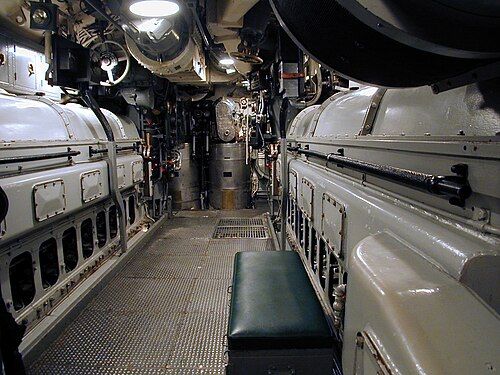
Balao-class submarines received main engines from one of two manufacturers. General MotorsCleveland Model 16-278A V-type diesels or Fairbanks-Morse38D 8-1/8 nine-cylinder opposed-piston engine. The General MotorsCleveland Model 16-248 V-type as original installations, while boats from Sand Lance onward received 10-cylinder engines. Earlier General Motors boats received Model 16-248 engines, but beginning with Perch Model 16-278A engines were used. In each case, the newer engines had greater displacement than the old, but were rated at the same power; they operated at lower mean effective pressure for greater reliability. [12] Both the Fairbanks-Morse and General Motors engines were two-stroke cycle types.[13]
Unicorn and Vendace were to receive Hooven-Owens-Rentschler diesels, which proved unreliable on previous classes, but both boats were cancelled.
Two manufacturers supplied electric motors for the Balao class. Elliott Company motors were fitted primarily to boats with Fairbanks-Morse engines. General Electric motors were fitted primarily to boats with General Motors engines, but some Fairbanks-Morse boats received General Electric motors. Allis-Chalmers motors were to be used in SS-530 through SS-536, but those seven boats were cancelled before even receiving names.[14]
バラオ級潜水艦のほとんどは、高速電動モーターを4基(シャフト1基につき2基)搭載しており、シャフトに適した速度まで出力を減速するために減速ギアを取り付ける必要があった。この減速ギアは非常に騒音が大きく、水中聴音器で潜水艦が探知されやすくなっていた。後期のバラオ級潜水艦19隻[ 15 ] [ 16 ] [ a ]は、シャフトを直接駆動し、はるかに静かな低速二重電機子モーターを搭載して建造され、この改良は後継のテンチ級潜水艦に一律に採用された。新しい直接駆動電動モーターは、ハイマン・G・リックオーバー大佐率いる造船局電気部門によって設計され、最初にシー・オウルに搭載された。[ 17 ]初期のバラオ級潜水艦の多くは、戦後のGUPPY計画中に新しいギアレスモーター方式に改修された。第二次世界大戦中にアメリカで建造された全ての船舶において、ディーゼルエンジンはシャフトに直接接続されていなかったため、常に電気モーターがシャフトを駆動していた。
第二次世界大戦の初め、アメリカ艦隊潜水艦の標準魚雷は21インチのマーク14魚雷だった。この魚雷の不足のため、より短いブリス・リービット・マーク9魚雷とマーク10魚雷、水上発射型のブリス・リービット・マーク8魚雷、マーク11魚雷、マーク12魚雷、マーク15魚雷など、いくつかの代替品が承認された。水上発射型魚雷にはわずかな改造が必要だった。マーク11、12、15魚雷は長すぎるため、後部魚雷発射管のみに限定された。[ 18 ] [ b ]魚雷の生産が本格化し、マーク14の不具合が解消されるにつれて、代替品はあまり一般的ではなくなった。戦争が進むにつれて、海軍は電気式無波魚雷マーク18とマーク23魚雷(マーク14の高速専用簡略版)を導入した。さらに、小型の19インチ水中音響ホーミング魚雷マーク27が護衛艦艇の防御用として艦隊艇の武装を補完した。戦争末期には、攻撃用音響ホーミング魚雷マーク28が導入された。戦争終結後まもなく、マーク37魚雷が導入された。[ 19 ]
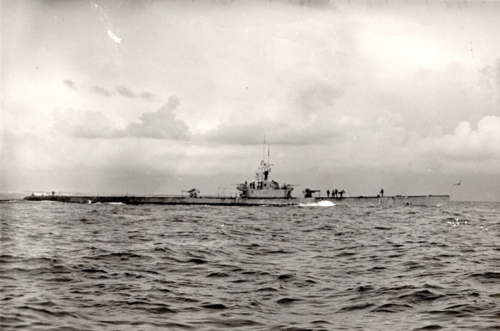


Many targets in the Pacific War were sampans or otherwise not worth a torpedo, so the deck gun was an important weapon. Early Balaos began their service with a 4-inch (102 mm)/50 caliber Mk. 9 gun. Due to war experience, most were rearmed with a 5-inch (127 mm)/25 caliber Mk. 17 gun, similar to mounts on battleships and cruisers, but built as a "wet" mount with corrosion-resistant materials, and with power-operated loading and aiming features removed. This conversion started in late 1943, and some boats had two of these weapons beginning in late 1944. Spadefish, commissioned in March 1944, was the first newly built submarine with the purpose-built 5-inch (130 mm)/25 submarine mount. Additional antiaircraft guns included single 40 mm Bofors and twin 20 mm Oerlikon mounts, usually one of each.[20][21]
Like the previous Tambor/Gar and Gato classes, the Balao class could substitute mines in place of torpedoes. For the Mk 10 and Mk 12 type mines used in World War II, each torpedo could be replaced by as many as two mines, giving the submarine a true maximum capacity of 48 mines. The doctrine, though, was to retain at least four torpedoes on mine-laying missions, which further limits the capacity to 40 mines, and this is often stated as the maximum in various publications. In practice during the war, submarines went out with at least eight torpedoes, and the largest minefields laid were 32 mines. After the war, the Mk 49 mine replaced the Mk 12, while the larger Mk 27 mine was also carried, which only allowed one mine replacing one torpedo. This mine could be set to travel 1000 to 5000 yards from the sub before deploying. (not to be confused with the Mk 27 homing torpedo) [22][23]
これは米国で最も数の多い潜水艦クラスであり、120隻が1943年2月から1948年9月までに就役し、12隻が戦後に就役した。第二次世界大戦で失われた52隻の米国潜水艦のうち9隻はこのクラスであり、戦後にも5隻が失われた。その中には、1953年にトルコ海軍で使用されていた1隻、 1982年のフォークランド紛争でアルゼンチン海軍で使用されていた1隻、1988年にペルー海軍で使用されていた1隻が含まれる。 [ 1 ] [ 24 ]また、ランセットフィッシュは1945年3月15日にボストン海軍造船所で艤装中に浸水して沈没した。引き揚げられたが修理されず、 1958年に除籍されるまで戦後予備艦隊に所属していた。このクラスの潜水艦の一部は1970年代半ばまで米国海軍で現役で使用され、1隻(旧タスクのハイパオ)は現在も台湾の中華民国海軍で現役である。
SS-361 から SS-364 は当初バラオ級として発注され、バラオ級の番号範囲の中央に位置する船体番号(SS-285 から SS-416 および 425-426) が割り当てられました。[ 25 ]そのため、一部の資料では、このクラスとして記載されています。[ 26 ]しかし、エレクトリック・ボート社によるバラオ級の図面の開発に避けられない遅延が生じたため、マニトウォック社によってガトー級として完成されました。マニトウォック社はエレクトリック・ボート社の後継造船所であり、設計と図面を同社に依存していました。[ 27 ] [ 1 ]また、バラオ級のUSSトランペットフィッシュ(SS-425)とUSSタスク(SS-426)は、船体番号がテンチ級の範囲内にあるため、一部の資料ではテンチ級として記載されています。 [ 28 ] [ 29 ]これらはポーツマス海軍工廠の付属造船所であるクランプ造船所で建造され、政府の計画を待っていた。
In total, 125 U.S. submarines were cancelled during World War II, all but three between 29 July 1944 and 12 August 1945. The exceptions were three Tench-class boats, cancelled 7 January 1946. References vary considerably as to how many of these were Balao and how many were Tench boats. Some references simply assume all submarines numbered after SS-416 were Tench class; however, Trumpetfish (SS-425) and Tusk (SS-426) were completed as Balaos.[30][31] This yields 10 cancelled Balao-class, SS-353-360 and 379–380. The Register of Ships of the U. S. Navy differs, considering every submarine not specifically ordered as a Tench to be a Balao, and further projecting SS-551-562 as a future class.[1] This yields 62 cancelled Balao class, 51 cancelled Tench class, and 12 cancelled future class. Two of the cancelled Balao-class submarines, Turbot (SS-427) and Ulua (SS-428), were launched incomplete and served for years as experimental hulks at Annapolis and Norfolk, Virginia. The cancelled hull numbers listed in sequential order here,, including those launched incomplete, were SS 353–360, 379–380, 427–434 (all Balao class), 436–437 (Tench class), 438–474 (Balao class), 491–521, 526–529 (Tench class), 530–536 (Balao class), 537–550 (Tench class), and 551–562 (future).[1]

The Balaos began to enter service in mid-1943, as the many problems with the Mark 14 torpedo were being solved. They were instrumental in the Submarine Force's near-destruction of the Japanese merchant fleet and significant attrition of the Imperial Japanese Navy. One of the class, Archerfish, brought down what remains the largest warship sunk by a submarine, the Shinano (59,000 tons). Tang, the highest-scoring of the class, sank 33 ships totaling 116,454 tons, as officially revised upward in 1980.[32]
Nine Balaos were lost in World War II, while two US boats were lost in postwar accidents. In foreign service, one in Turkish service was lost in a collision in 1953, one in Peruvian service was lost in a collision in 1988, and Catfish was sold to the Argentinian Navy. She was renamed the ARA Santa Fe (S-21) and was lost in the 1982 Falklands War after being damaged, when she sank while moored pierside. Santa Fe was refloated and disposed of a few years after the war by being taken out to deep water and scuttled.
Additionally, Lancetfish, commissioned but incomplete and still under construction, flooded and sank pierside at the Boston Navy Yard on 15 March 1945, after a yard worker mistakenly opened the inner door of an aft torpedo tube that already had the outer door open. No personnel were lost in the accident and she was raised, decommissioned, and never completed or repaired.[1][33][34] Her 42 days in commission is the record for the shortest commissioned service of any USN submarine. Postwar, she was laid up in the Reserve Fleet until stricken in 1958 and scrapped in 1959.
戦後、55隻のバラオ級潜水艦が艦隊シュノーケルおよび大型水中推進力(GUPPY)計画の下で近代化され、一部は1970年代初頭までアメリカ海軍で運用され続けた。アメリカ海軍で最後に運用されたバラオ級潜水艦はUSSクラマゴア(SS-343) で、1975年6月に退役した。[ 38 ] 7隻は誘導ミサイル潜水艦(SSG)や揚陸輸送潜水艦(SSP)など、さまざまな役割に改造された。46隻は外国海軍に移管され、さらに数年間運用され、一部は1990年代まで運用され、タスクは台湾の中華民国海軍で海宝として現役で運用されている。
Interested in maintaining a ready pool of trained reservists, the Navy assigned at least 58 submarines from 1946 to 1971 to various coastal and inland ports (even in Great Lakes ports like Cleveland, Chicago, and Detroit), where they served as training platforms during the Reservists' weekend drills. At least 20 Balao-class boats served in this capacity. In this role, the boats were rendered incapable of diving and had their propellers removed. They were used strictly as pierside trainers. These were in commission but classed as "in service in reserve", thus some were decommissioned and recommissioned on the same day to reflect the change in status.[39][40][41]
The large numbers of relatively modern, but surplus U.S. fleet submarines proved to be popular in sales, loans, or leases to allied foreign navies. 46 Balao-class submarines were transferred to foreign navies, some shortly after World War II, others after serving nearly 30 years in the US Navy. These included 17 to Turkey, 2 to Greece, 3 to Italy, 2 to the Netherlands, 5 to Spain, 2 to Venezuela, 4 to Argentina, 5 to Brazil, 2 to Chile, 2 to Peru, 1 to Canada and 1 to Taiwan.[41] One of the Venezuelan boats, ARV Carite (S-11) formerly USS Tilefish (SS-307), featured in the 1971 film Murphy's War with some cosmetic modification.
第二次世界大戦終結時、アメリカの潜水艦部隊は厄介な状況に陥っていた。もはや存在しない敵と戦うために設計された、残存する111隻のバラオ級潜水艦は、建造からわずか1~3年しか経っていないにもかかわらず、旧式化していた。大容量バッテリー、水中速度を最大化するための流線型設計、そしてシュノーケルを備えたドイツのXXI型Uボートが、当面の未来の潜水艦であった。バラオ級およびテンチ級潜水艦の一部にXXI型と同様の能力を与えるため、GUPPY(Greater Underwater Propulsion Power Program )改修計画が開発された。多数の潜水艦をGUPPY規格にアップグレードするコストが明らかになると、一部の潜水艦にシュノーケルと部分的な流線型設計を追加する簡素な「艦隊シュノーケル」改修が開発された。合計36隻のバラオ級潜水艦がGUPPY構成のいずれかに改修され、さらに19隻が艦隊シュノーケル改修を受けた。 GUPPY潜水艦2隻とFleet Snorkel潜水艦6隻は、外国海軍への移管直前に改造された。残りの47隻の改造潜水艦のほとんどは1970年代初頭まで現役で、その後多くが外国海軍に移管されてさらに運用され、その他は退役して処分された。[ 38 ]
GUPPY の改造プログラムには多少のばらつきがあったものの、一般的には、元の 2 基の Sargo バッテリーは、デッキ下のスペースを大幅に再利用し、通常は補助ディーゼルエンジンの撤去を含めて、よりコンパクトな 4 基の Guppy (GUPPY I および II のみ) バッテリーまたは Sargo II バッテリーに置き換えられた。これらのバッテリー設計はすべて鉛蓄電池タイプであった。これにより、バッテリーセルの総数は 252 個から 504 個に増加したが、欠点は、コンパクトなバッテリーは 5 年ごとではなく 18 か月ごとに交換する必要があったことである。Sargo II バッテリーは、高価な Guppy バッテリーの低コスト代替品として開発された。[ 42 ]すべての GUPPY には、流線型の帆と船首を備えたシュノーケルが装備された。また、電気モーターは、近代化された電気および空調システムとともに、直接駆動の二重アーマチュアタイプにアップグレードされた。外国への移送のための簡素な GUPPY IB 改造を除くすべてに、ソナー、射撃管制、および電子支援対策(ESM) のアップグレードが施された。[ 43 ]
艦隊シュノーケル計画はGUPPY近代化計画よりもはるかに簡素なものであったが、GUPPY時代に実施されたため、ここに含めている。GUPPY計画と艦隊シュノーケル計画は、GUPPY I、GUPPY II、GUPPY IA、艦隊シュノーケル、GUPPY IIA、GUPPY IB、GUPPY IIIの順に時系列で記載されている。
1947年、 2隻のテンチ級潜水艦がGUPPY計画の試作機として改造された。これらの潜水艦はシュノーケルを装備していなかったため、同様の改造を受けたバラオス級潜水艦はなかった。

これはGUPPYへの改造の最初の量産型であり、改造のほとんどは1947年から1949年にかけて行われた。バラオ級潜水艦13隻(キャットフィッシュ、クラマゴア、コブラー、コチーノ、コーポラル、クベラ、ディオドン、ドッグフィッシュ、グリーンフィッシュ、ハーフビーク、ティル、トランペットフィッシュ、タスク)がGUPPY IIにアップグレードされた。これはGUPPYバッテリーを搭載した唯一の量産型改造であった。

これはGUPPY IIよりも費用対効果の高い代替案として開発されました。 1951年から1952年にかけて、バラオ級ボート9隻(アトゥーレ、ベクーナ、ブラックフィン、ブレニー、カイマン、チボ、チョッパー、シーポッチャー、シーロビン)が改造されました。より安価なサルゴIIバッテリーが導入され、その他のコスト削減策も実施されました。

The Fleet Snorkel program was developed as an austere, cost-effective alternative to full GUPPY conversions, with significantly less improvement in submerged performance. Twenty-three Balao-class boats (Bergall, Besugo, Brill, Bugara, Carbonero, Carp, Charr, Chub, Cusk, Guitarro, Kraken, Lizardfish, Mapiro, Mero, Piper, Sabalo, Sablefish, Scabbardfish, Sea Cat, Sea Owl, Segundo, Sennet, and Sterlet) received this upgrade, six immediately prior to foreign transfer. Most Fleet Snorkel conversions occurred 1951–52. Unlike the GUPPY conversions, the original pair of Sargo batteries were not upgraded. Each boat received a streamlined sail with a snorkel, along with upgraded sonar, air conditioning, and ESM. The original bow was left in place, except on three boats (Piper, Sea Owl, and Sterlet) that received additional upper bow sonar equipment.[44] A few boats initially retained the 5"/25 deck gun, but this was removed in the early 1950s.
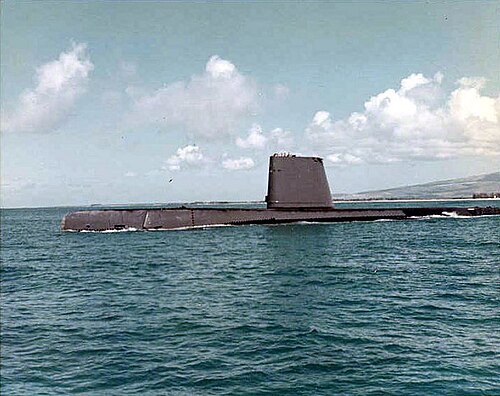
This was generally similar to GUPPY IA, except one of the forward diesel engines was removed to relieve machinery overcrowding. Thirteen Balao-class boats (Bang, Diodon, Entemedor, Hardhead, Jallao, Menhaden, Picuda, Pomfret, Razorback, Ronquil, Sea Fox, Stickleback, and Threadfin) received GUPPY IIA upgrades in 1952–54. One of these, Diodon, had previously been upgraded to GUPPY II.
This was developed as an austere upgrade for two Gato-class and two Balao-class boats (Hawkbill and Icefish) prior to transfer to foreign navies in 1953–55. They lacked the sonar and electronics upgrades of other GUPPY conversions.
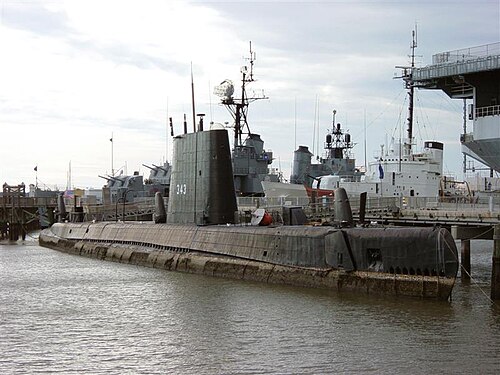
Nine submarines, six of them Balaos (Clamagore, Cobbler, Corporal, Greenfish, Tiru, and Trumpetfish), were upgraded from GUPPY II to GUPPY III in 1959-63 as part of the Fleet Rehabilitation and Modernization II (FRAM II) program. All except Tiru, the pilot conversion, were lengthened by 15 feet in the forward part of the control room to provide a new sonar space, berthing, electronics space, and storerooms. Tiru was lengthened only 12.5 feet, and both forward diesel engines were removed.[45] The other GUPPY IIIs retained all four engines. A taller "Northern" sail was included, to allow improved surfaced operations in rough seas; this was also backfitted to some other GUPPYs. The BQG-4 Passive Underwater Fire Control Feasibility Study (PUFFS) sonar system, with its three tall domes topside, was fitted. Additionally, fire control upgrades allowed the Mark 45 nuclear torpedo to be used.[46]
The advent of the kamikaze demonstrated the need for a long range radar umbrella around the fleet. Radar picket destroyers and destroyer escorts were put into service, but they proved vulnerable in this role as they could be attacked as well, leaving the fleet blind. A submarine, though, could dive and escape aerial attack. Four submarines including the Balao-class boat Threadfin prototyped the concept at the end of World War II but were not used in this role.[47] Ten fleet submarines were converted for this role 1946-53 and redesignated SSR as radar picket submarines. Burrfish was the only Balao-class SSR. Experiments on the first two SSR submarines under the appropriately named Project Migraine I showed that placement of the radars on the deck was inadequate and that more room was needed for electronics. Thus Burrfish was given the Migraine II (project SCB 12) conversion, which placed a Combat Information Center (CIC) in the space formerly occupied as the aft battery room. The after torpedo room was stripped and converted into berthing, and the boat lost two of her forward torpedo tubes to make room for additional berthing and electronics. The radars were raised up off the deck and put on masts, giving them a greater range and hopefully greater reliability.[43]
SSRは、レーダー自体が問題が多く信頼性に欠け、また潜水艦の水上速度が高速で移動する空母群を保護するには不十分であったため、中程度の成功しか収められなかった。1959年以降、レーダーは撤去され、潜水艦は汎用潜水艦に戻された。バーフィッシュは1956年に退役し、レーダー装置を撤去した後、1961年にHMCSグリルス(SS-71)としてカナダに移管された。 [ 48 ]

1950年代のレグルス核巡航ミサイル計画は、アメリカ海軍に初の戦略攻撃能力をもたらした。これに先立ち、第二次世界大戦末期からドイツのV-1飛行爆弾の派生型であるJB-2ルーンミサイルの実験が行われた。ルーンの潜水艦試験は1947年から1953年にかけて行われ、カスクとカルボネロはそれぞれ1947年と1948年に試験プラットフォームとして誘導ミサイル潜水艦に改造された。当初、ミサイルは無防備な状態で発射レールに搭載されていたため、潜水艦は発射後まで潜航できなかった。カスクは最終的にミサイル1発用の防水格納庫を装備し、SSGに再指定された。バルベロは短期間貨物潜水艦として運用された後、1955年にレグルス水上発射ミサイル2発を搭載するように改造され、SSGに再指定され、ガトー級潜水艦のタニーと共にこの役割を担った。彼女は1964年にポラリス計画に取って代わられるまでレグルスで戦略的な抑止哨戒を行った。[ 49 ]ルーン試験後、カスクやカルボネロを含む多数の艦隊艇が1953年から1964年にかけてレグルス誘導装置を装備した。

Sealion and Perch were converted to amphibious transport submarines in 1948 and redesignated as SSPs. Initially, they were equipped with a watertight hangar capable of housing a Landing Vehicle Tracked (LVT), and retained one 5-inch (130 mm)/25 caliber deck gun for shore bombardment. Both torpedo rooms and one engine room were gutted to provide space for embarked Special Operations Forces (SOF) and their equipment. Snorkels were fitted. Due to the extra personnel, to avoid excessive snorkeling they were equipped with a CO2 scrubber and extra oxygen storage. Initially, a squadron of 12 SSPs was considered, capable of landing a reinforced Marine battalion, but only two Balao-class SSPs (out of four overall) were actually converted. Perch landed British commandos on one raid in the Korean War, and operated in the Vietnam War from 1965 until assignment to Naval Reserve training in 1967 and decommissioning in 1971, followed by scrapping in 1973. Perch was replaced in the Pacific Fleet transport submarine role by Tunny in 1967 and Grayback in 1968. Sealion operated in the Atlantic, deploying for the Cuban Missile Crisis and numerous SOF-related exercises. She was decommissioned in 1970 and expended as a target in 1978. The LVT hangar and 5-inch (130 mm) gun were removed from both boats by the late 1950s. They went through several changes of designation in their careers: ASSP in 1950, APSS in 1956, and LPSS in 1968.[50][1]
Baya was redesignated as an auxiliary submarine (AGSS) in 1949 and converted to a sonar test submarine in 1958–59 to test a system known as LORAD. This included a 12-foot (3.7 m) extension aft of the forward torpedo room, with 40-foot (12 m) swing-out arrays near the bow. Later, three large domes were installed topside for a wide aperture array.[51]
バルベロは1948年に貨物潜水艦に改造され、 SSAに再指定されました。貨物スペースを確保するために、前部機関室、後部魚雷室、およびすべての再装填魚雷ラックが撤去されました。1948年10月から1950年3月まで、貨物輸送艦としての能力を評価するための実験プログラムに参加しました。実験は1950年初頭に終了し、1950年6月30日に予備役に編入されました。1955年にはレグルスミサイル潜水艦に改造され、SSGに再指定されました。 [ 52 ]
2007年時点で、バラオ級潜水艦タスクは、第二次世界大戦中に建造された世界で最後の2隻の現役潜水艦のうちの1隻だった。この潜水艦は1970年代初頭に台湾の中華民国海軍に移管された。もう1隻はテンチ級の旧カトラスである。台湾海軍ではそれぞれ海宝と海士と命名されている。[ 53 ] [ 54 ]
バラオ級潜水艦6隻は一般公開されている。これらの潜水艦は、運用維持と米海軍基準への適合のために、主に観光客からの収入に依存している。各潜水艦は毎年点検を受け、「成績表」が発行される。バットフィッシュやパンパニートといった一部の潜水艦は、青少年向けのイベントを積極的に開催し、ボランティアグループが乗組員の居住区で一夜を過ごすことを許可している。
以下は、バラオ級博物館船の完全なリストです。
USSクラマゴア(SS-343)は、 サウスカロライナ州チャールストンのパトリオッツ・ポイントで博物館船として運用されていましたが、2021年に閉鎖され、2年後に解体されました。また、USSリング(SS-297)は、かつてニュージャージー海軍博物館があったハッケンサック川に座礁しています。2025年現在、この艦の新たな保管場所を見つけるための努力は実を結んでいません。