
Loading article…
銃に関する法律や政策は、総称して銃器規制または銃規制と呼ばれ、民間人による小火器の製造、販売、譲渡、所持、改造、使用を規制しています。 [1]一部の国の法律では、民間人に武器を保有および携帯する権利が認められており、近隣の管轄区域よりも銃に関する法律が緩やかです。銃規制では通常、特定のカテゴリの銃器へのアクセスが制限され、銃器へのアクセスを許可される人のカテゴリが限定されます。[2]狩猟、スポーツ射撃、自己防衛、収集、隠し持ち運びにはそれぞれ異なる要件、特権、責任を伴う 個別の許可証がある場合があります。
銃規制法は通常、犯罪における小火器の使用を抑制しようとする立法府の意図によって正当化され、この目的のために、犯罪や銃撃事件で確認されている種類の武器、たとえば拳銃やその他の隠し持ち可能な銃器がしばしば規制の対象となる。軍用ライフルから派生した半自動小銃の設計は、口語的にはアサルトライフルと呼ばれることもあり、立法府による追加の精査を受けることが多い。銃器への法的アクセスが制限される人物には、一定の年齢未満または犯罪歴のある人物が含まれる場合がある。自分や他人を傷つけたり殺害したりするリスクが最も高いと定義された人物、家庭内暴力、アルコール使用障害または薬物使用障害、精神疾患、うつ病の履歴がある人物、または自殺未遂の経歴がある人物には、銃器の購入または所持許可証が発行されない場合がある。銃器許可証を申請する者は、銃の安全講習を修了して能力を証明したり、武器を安全に保管 できる場所の規定を示したりする必要がある場合がある。
小火器を規制する法律は、爆発物、クロスボウ、剣、電気ショック兵器、空気銃、催涙スプレーなどの他の武器も規制する可能性がある。また、銃器の付属品、特に大容量マガジン、消音装置、全自動射撃を可能にするオートシアなどの装置も規制する可能性がある。購入する弾薬の量や種類に制限があり、特定の種類は禁止されている可能性がある。この記事は世界規模で展開しているため、これらすべての事柄について詳細に取り上げることはできないが、その代わりに、各国の民間人による小火器の使用と所有に関する武器法について簡単にまとめることにする。
語彙と用語
銃器は各国で 同じように定義されているわけではありません。
いくつかの用語は、銃規制の文脈でいくつかの国で使用されています。これには次のものが含まれます。
- 発行義務: 必要なライセンスまたは許可の付与は、申請者が法律で定められた一定の基準を満たしていることのみを条件とします。付与機関にはライセンスの付与に関する裁量権はありません。
- 発行可能: 必要な許可証またはライセンスの付与は、部分的に地方自治体の裁量に委ねられています。管轄区域によっては、申請者が許可の拒否に対して異議を申し立てるための行政的および法的手段を提供しているところもありますが、提供していないところもあります。
- 発行なし: 必要な許可証またはライセンスの付与は禁止されているか、せいぜい特定の非常に限られた状況でのみ許可されます。
銃規制法は、いくつかの共通の特徴に従って国ごとに分類することができます。
- イエメンでは、全自動小火器を含むあらゆる種類の銃器の取得または販売に許可やライセンスは必要ありません。
- 米国のほとんどの州では、ほとんどの種類の銃器の取得や販売に許可やライセンスは不要です。つまり、銃器は店頭で販売されており、大量の銃器を購入するのにライセンスは必要ありません。国民(後者の場合、禁止されている人物を除く)は、ライセンスを受けた州公認のディーラーやサプライヤーから自由に銃器を購入できます。
- オーストリア、リヒテンシュタイン、フィリピン、スイスなど一部の国では部分的に認可されており、禁止されていない国民であれば誰でも認可された販売店から連発ライフルや中折れ式散弾銃を購入でき、拳銃と半自動小火器にのみ許可が必要である。
- 一部の国では、正当な理由がなくても、または理由を単に宣言するだけで銃器の所有が認められています。たとえば、オーストリアでは、法律により拳銃の免許を取得するには申請者に正当な理由が必要ですが、自宅での自己防衛は正当な理由として認められています。カナダとニュージーランドでは、拳銃などの規制された武器については申請者が取得するための正当な理由が必要ですが、ほとんどの種類の長銃については正当な理由を必要としません。
- 一部の国では、銃器所持許可証を取得するには正当な理由を示すことが申請者に求められます。ポーランドやマルタなど一部の国では、正当な理由と満たすべき条件のリストが法律に明示的に記載されています。ケニアやイギリスなど他の国では、何が正当な理由を構成するかを法律で明記しておらず、当局の裁量に委ねられていますが、銃器を取得する正当な理由または正当な理由は、狩猟、スポーツ射撃、収集、自己防衛です。
- 中国、日本、ベネズエラ、ミャンマーなどの国では、身体能力があり訓練を受け、厳しい条件を満たした人だけが銃器を所有することが認められており、発行される許可証もほとんどありません。
- カンボジア、エリトリア、ソロモン諸島など一部の国では、民間警備会社、民兵、準軍事組織を除き、民間人による銃器の所有は全面的に禁止されている。
銃器免許


銃器所持許可証(ガンライセンス、イギリス英語ではライセンスとも呼ばれる)は、管轄区域の政府機関(通常は警察)が発行する免許証または許可証であり、これにより免許者は銃器を購入、所有、所持、または携行することができるが、多くの場合、保管要件や銃器安全講習の修了、身元調査など、多くの条件や制限が課される。銃器所持許可証はすべての管轄区域で必要なわけではない。さらに、国や州によっては、拳銃や銃器を購入するために法律で「購入許可証」が必要になる場合がある。[3]弾薬を購入する場合にも免許証が必要になる場合がある。
許可証またはライセンスの範囲は、所有者が合法的に銃器を使用して行うことができる銃器または活動によって異なります。管轄区域によっては、銃器を所有したり、狩猟、標的射撃、収集に従事したり、銃器を隠し持ち運んだり、ビジネス(銃器販売業者や銃器職人など)を営んだりするのに銃器ライセンスが必要になる場合があります。管轄区域によっては、ライフル、ショットガン、ハンドガンに個別のライセンスが必要になる場合があります。
銃器の免許を取得する要件は、通常、銃器の登録要件に加えて必要となります。たとえば、オーストラリアの銃法では、銃器は銃器免許を保有する所有者に シリアル番号で登録することが義務付けられています。
比較
このセクションでは、米国の銃器規制システムに部分的に特有で定義されている 「shall issue」および「may issue」という表現を使用しています。
注記:
-地図には、禁止前に製造された銃器が現行法の適用除外の対象であるかどうかに関係なく、新しい銃器の入手に関する方針が説明されています。
アフリカ
小型武器および軽兵器の不法な拡散、流通、取引に関するアフリカ共通の立場に関するバマコ宣言は、 2000年12月1日にマリ共和国のバマコで、アフリカ統一機構(OAU)の加盟51カ国の代表によって採択された。[158]この宣言の条項は、署名国に対し、それぞれの国の国内法に基づいて小型武器および軽兵器の不法所持を刑事犯罪として定めることを勧告している。[159]
ボツワナ
ボツワナの法律では、散弾銃とライフル銃の所持のみが許可されている。政府は毎年発行される免許の数に制限を設けており、申請人数に関係なく50人しか免許を取得できないため、承認率は通常1%未満である。[160]
現在、登録されている銃器は34,550丁(100人あたり1.5丁)ある。[161]
中央アフリカ共和国
中央アフリカ共和国では公式には139人だけが銃器所持許可証を持っており、そのほとんどは国会議員である。彼らは12ゲージの散弾銃1丁と9mmの自動拳銃1丁を所持する権利がある。[162]いずれにしても、中央アフリカ共和国では銃器の違法所持と携帯が蔓延しており、その大部分はさまざまな武装グループの支配下にある。アンチバラカと元セレカの民兵は自家製の散弾銃、自動小銃、ロケットランチャーを所持し携帯している。[163]
チャド
1968年に可決された銃器に関する法律では、チャドで銃器を所有するには毎年更新しなければならない許可証が必要である。この法律では、銃器の種類に応じて500~3000CFAフランの印紙を支払う必要があることを除いて、許可証を取得するために満たすべき条件は規定されていない。[法律95] 2017年にチャド政府が銃器許可証の発行で500万フランを調達したことを考えると[164]、チャドには1,666~10,000の有効な銃器許可証があり、100人あたり0.01~0.06人ということになる。
ジブチ
ジブチでは、例外的な状況において国家元首から特別許可が与えられた場合を除き、銃器の所持は一般的に禁止されている。[165]
エリトリア
エリトリアでは例外なく民間人による銃器の使用は全面的に禁止されている。[166]
エスワティニ
エスワティニで許可されている銃器の種類は、散弾銃、リボルバー、ピストル、ライフルである。免許を取得するには、地方首長会議、地方警察署長、地方行政官、警察本部の犯罪部長、免許官/銃器登録官、免許委員会、そして最後に警察署長の承認を得る必要がある。要件には、地域社会における一般的な評判が含まれる。申請の承認率は、2002年時点で約57%である。[134][update]
ガンビア
現行法では、ガンビアでは銃器所持許可は特権であり、当局は許可の発行に関して完全な裁量権を持っていると規定されている。[167]
ガーナ
ガーナの銃器法では、散弾銃と拳銃(ピストルとリボルバー)の取得が認められている。銃器はすべて毎年再登録しなければならないと定められているが、これは広く無視されている。合法的に銃を購入した123万人のうち、毎年再登録しているのはわずか4万人だ。他のアフリカ諸国とは異なり、ガーナでは拳銃が人気だ。例えば、グレーター・アクラ州では、 2020年に合法的に銃を取得した人の74.4%がリボルバーを選択し、21%が散弾銃を選んだ。アシャンティ州では、 45.5%が散弾銃を選択し、21.5%がリボルバーを選んだ。[168]
ケニア
ケニアにおける銃規制は、ケニア銃器法(第114条)によって定められています。[169]この法律は次のように規定している。「12歳未満の者は、第2部が適用される銃器または弾薬を所持してはならず、14歳未満の者は、第2部が適用される銃器または弾薬(口径0.22以下のミニチュアライフルまたは口径が20ゲージ以下の散弾銃、およびそれに適した弾薬を除く)を所持してはならず、ただし、第7条の(8)項、(9)項、または(10)項に基づいて銃器証明書を持たずに所持する権利を有する場合は除く。また、12歳または14歳未満であることを知っている、または信じる理由がある人物に、そのような銃器または弾薬の所持を譲ってはならない。ただし、その他の人物が所持する権利を有する場合は除く。」
最高免許責任者(CLO)は、銃器免許の授与、拒否、または取り消しの裁量権を持っています。申請者は21歳以上で、[170]犯罪歴、精神衛生、家庭内暴力に関する厳格な身元調査に合格し、個人的に銃器を所有し携帯する必要がある正当な理由を述べなければなりません。調査は定期的に繰り返され、合格しなかった場合は免許が即座に取り消されます。銃器の所有許可を取得したら、隠し銃器を携帯するために追加の許可は必要ありません。
レソト
銃器所持の申請者は、村長または村長と首長から推薦状を取得する必要があります。[171]その後、推薦状は地元の警察署に送られて精査され、次に地区警察に送られて評価され、次に国家安全保障局または犯罪情報局に送られて申請者の審査が行われます。その後、申請書は地域警察長官に送られ、警察長官(銃器および爆発物ライセンス委員会)の承認を得るために警察本部に渡されます。[171]
リベリア
リベリアでは、狩猟目的での単発散弾銃と黒色火薬の長銃の所持のみが許可されている。民間警備会社は従業員に武器を持たせることを禁止されている。しかし、一部の犯罪者は自動小銃、特にAKスタイルのライフルを所持している。これらは、この国の10年に及ぶ断続的な内戦の名残だと考えられている。自動小銃は、ギニア、コートジボワール、シエラレオネとの国境の隙間からも入ってくる可能性が高い。これらの国では、銃の所有に関する法律がより自由である。[172] [173] [174]リベリアの隣国はすべて、過去20年間に何らかの形の武力紛争を経験しており、違法な自動小銃があふれている。リベリア国家警察内で唯一の武装部隊である緊急対応部隊(ERU)は、武装強盗などの武装事件に対応する。
2015年リベリア銃器弾薬規制法は、同国における小火器および小型武器の所持と使用を規制している。小火器および小型武器の違法所持は第一級軽犯罪に該当し、1年以下の懲役刑および違法所持した武器または弾薬の押収が科せられる。[175]
モザンビーク
モザンビークには認可された銃器販売業者がいない。そのため、銃器を入手したい人は、別の国(通常は南アフリカ)に渡航して銃器を購入し、帰国後、当局に銃器を預けて入手許可をもらう必要がある。[90]
ナミビア
ナミビアでは、許可証に基づく銃器の所有が認められており、許可証は随時発行される。2017年にナミビア警察は9,239件の申請から7,647件の銃器許可証を発行したため、承認率は約83%である。[176]ナミビアでは現在、全体で200,100丁の銃器が登録されており、100人中9丁である。民間人が所有する銃器で最も多いのは、ピストル(46%)、ライフル(34%)、ショットガン(24%)である。[177]公共の場で弾を込めていない銃器を隠し携帯することは許可されている。
ルワンダ
2019年、ルワンダは銃器所持に関する新しい法律を可決した。この法律では、当局は個人が銃器を所有できるかどうかを決定する際に完全な裁量権を持ち、たとえ誰かがすべての要件を満たしていたとしても理由なく申請を拒否できると規定されている。[118]
セネガル
セネガルには厳しい銃規制法がある。銃器免許の申請には理由を明記する必要はない。申請には身分証明書のコピー、犯罪歴、健康診断書、写真4枚、納税印紙、性格テストが必要となる。決定は数ヶ月後に下される予定である。[178]
銃の所有は非常にまれですが、その数は増加傾向にあります。2016年にセネガル警察は1,000件の免許証を発行し、250件を拒否しました(承認率80%)。これは2011年の456件と比較して増加しています。2017年には、警察が合計7,000件以上の免許証を発行したと推定されています(100人あたり0.04件)。
シエラレオネ
2012年、シエラレオネは16年間の全面禁止を経て銃の所有を合法化した。[179]この法律によれば、当局は個人が銃を所有する正当な理由があるかどうかを判断する裁量権を持つ。2021年武器法は2012年武器法を廃止したが、ライセンス手続きにはほとんど変更がない。[180]
ソマリア
1992年から2023年まで、国連の禁輸措置により、治安部隊を除き、ソマリアへの銃器の輸入は禁止されていた。[181] [182]
ソマリランド
2010 年の銃規制法によれば、ソマリランドの住民は生命と財産を守る目的で銃器を所持することが認められている。同法では拳銃と AK 自動小銃が許可されていると明記されているが、他の銃器も許可されるとしている。登録できるのは各タイプの武器 1 丁のみである。各タイプの武器を 2 丁以上所持するには正当な理由が必要であり、法人にのみ付与される。武器登録許可は犯罪歴のない 18 歳以上の人に与えられる。許可は毎年更新する必要がある。市民と住民の両方が銃器を登録でき、銃器は相続できる。銃器の販売は政府と認可ディーラーに限定されている。迫撃砲、爆弾、化学兵器、消音器などの戦争兵器は禁止されている。銃器を公然と携帯することは禁止されている。[法律 96]ソマリアに対する武器禁輸が解除されたため、ソマリランド政府はこの措置に反対した。[183]
南アフリカ
南アフリカで銃器免許を申請するには、申請する銃器の種類に関する技能試験と南アフリカの銃器法に関する試験に合格する必要がある。これらの試験に合格したら、技能証明書を申請する必要があり、南アフリカ警察が身元調査と銃器を保管する建物の検査を行う。両方の試験に合格し、それぞれの証明書が授与されると、自己防衛からプロの狩猟までさまざまなカテゴリーの銃器免許を申請できる。免許のカテゴリーによって制限が異なり、たとえば所有者が保持できる弾薬の量などがある。狩猟に銃を使用することは許可されている[184]。
アメリカ大陸
アルゼンチン
アルゼンチンでは銃器が制限されており、2015年10月からANMaC(アルゼンチン共和国銃器管理局)によって規制されています。この機関は、法務省人権省の下部組織であるRENAR(アルゼンチン共和国銃器登録局)に代わるものです。アルゼンチンで銃器を所有するには、合法的な使用者でなければなりません。申請者は、21歳以上であること、心身ともに健康であることを証明する医療証明書を提示すること、安全講習を修了すること、合法的な収入源があること、身元調査を受けて合格することが必要です。合格すると指紋が採取され、5年ごとに更新しなければならない許可証が発行されます。アルゼンチンでは、たとえその銃が他人の所有物であっても、合法的な使用者でない場合は銃器を合法的に発射することはできません。正当な使用者が銃器を購入したい場合、銃器を保管するための安全な場所を提供し、収集、射撃、狩猟、ビジネス、自宅での自己防衛など、銃器を希望する正当な理由を提示する必要があります。[185]
銃器は、ANMaC に登録された認可登録簿を通じて購入する必要がある。銃器を相続した場合は、再登録フォームを提出する必要がある。銃器が適切に保管されている限り、所有する銃器の数に制限はない。弾薬の販売は記録されるが、無制限である。[15]認可された拳銃所有者の携帯許可証の取得は極めて困難であり、ANMaC 委員会の前に出頭して主張する必要がある。携帯許可証は、その「明白かつ現在の」危険性を再検討するために毎年更新され、この危険性が取り除かれた場合、許可証は通常直ちに取り消される。金銭や貴重品を取り扱う人や民間警備員には、業務用携帯許可証が発行されることがある。[186]
.32口径以上の拳銃は条件付き使用。全自動拳銃は民間人には禁止。.22口径以上のボルトアクションライフル、.22口径以上のロングライフルとセミオートマチックライフル、取り外し不可能なマガジン付きのロングライフルは条件付き使用。.22口径以上のフルオートマチックライフルとセミオートマチックライフル、取り外し可能なマガジン付きのロングライフルは禁止。半自動散弾銃と銃身の長さが380~600 mm (15~24インチ) の散弾銃は条件付き使用。全自動散弾銃と銃身の長さが380 mm (15インチ) 未満の散弾銃は禁止。[187] [明確化が必要]
ベリーズ
ベリーズの永住者または市民は、身元調査を受けた後、銃を所有することが許可されている。最大口径は 9mm で、一度に所持できる弾数は 100 発までである。農家は、家畜の保護、狩猟、個人の護身用に散弾銃を所持するための許可証を取得できる。銃器の輸入は可能であるが、到着前に申告する必要がある。輸入された銃は警察に押収され、許可証が交付される前に登録される。[188]
ブラジル
ブラジルではすべての銃器の登録が義務付けられている。銃器の所有の最低年齢は25歳である。[189] 銃器の取得前および取得後10年ごとに適性および精神衛生の証明書の提出が義務付けられている。[190] 自宅、商店、農場の外に銃器を携帯することは一般的に違法である。[191] 2004年7月1日の 大統領令第5.123号[192]は、正当な理由なく所持されていない銃器を連邦警察が没収することを 認めている。 [193]
ブラジルの銃器の総数は1400万から1700万と推定されており[191] [194]、 そのうち900万丁は未登録であると推定されている。[189] 2005年の国民投票 では、ブラジル国民は民間人への銃器の販売を全面的に禁止するという政府の提案に反対票を投じた。[189] [195]
2019年1月、ボルソナロ大統領は、警察の銃所持許可申請を拒否する裁量権を剥奪することでブラジルの銃規制を緩和する大統領令に署名した。[196]
現在、民間人によって合法的に登録された銃は100万丁以上ある。[197]
9月5日、最高裁判所長官ルイス・エドソン・ファチンは、ボルソナロ大統領が署名したいくつかの法令を無効とした。これらの決定は、ADI 6119、ADI 6139、ADI 6466と名付けられている。[198]これらのADIの即時の措置は、国内の民間人による自宅防衛用の銃器の購入と弾薬の購入の禁止であった。これらのADIは、制限された口径の銃器の取得を禁止することで、射撃スポーツにもある程度影響を及ぼした。
カナダ
カナダの銃器法は銃器法に定められている。所持および取得許可証(PAL)はカナダ銃器プログラム( RCMP内で運営されているプログラム)によって配布され、銃器安全講習(非制限および制限分類用)の受講、筆記および実技試験(80%以上)の合格、強化された身元調査、配偶者および推薦者との面接が必要となる。非制限PALでは、最も一般的なスポーツ用ライフルとショットガンの購入が許可される。制限PAL(RPAL)には、制限銃器(主に拳銃)用の追加コースがあり、追加の保管および輸送要件と登録が必要である。[199] 銃器を所有する2つの主な理由は、標的射撃と狩猟である。狩猟に使用できるのは非制限銃器のみである。
人間の脅威に対する自己防衛のために銃器を携帯することは、許可証なしでは禁止されている。これらの許可証は通常、警察官と、装甲車の乗務員など貴重品の運搬を伴う職業に就く者にのみ発行される。RCMPはまた、人の生命が差し迫った危険にさらされており、警察の保護が不十分であるという理由で、民間人に携帯許可証を発行することができる。これらの許可証が発行されることはめったにない。1990年代、トロント市議会議員ノーム・ガードナーが強盗をしていた男性を射殺した際に、このような許可証を所持していたことが明らかになった。2018年10月現在、[update]国内で生命保護のための許可証が実際に発行されたのは2件のみである。[200]
野生動物からの保護のために携帯許可証を取得することができます。[201]しかし、これは免許を持ったプロの罠猟師、または遠隔地で危険な動物に遭遇する職業に就いている人にのみ発行されます。ただし、申請者はライフルやショットガンの携帯が不可能である理由を証明し、状況に適した銃器を選択する必要があります。[202]
カナダでは、銃器は3つのカテゴリーのいずれかに分類されます。[203]
- 非制限: 全長が 26 インチ (660 mm) を超えるロングライフルとショットガン、および銃身が 18.5 インチ (470 mm) を超えるセミオートマチック銃。これらは通常の PAL で所持でき、狩猟に使用できる唯一の銃器クラスです。
- 制限: これには、銃身の長さが 4.1 インチ (105 mm) を超える拳銃、および非制限の長さ要件を満たさないが禁止されていない長銃が含まれます。これらの銃にはATTと登録が必要であり、射撃場でのみ発射できます。
- 禁止されているもの: これらの武器は一般に民間人が所持できないもので、全自動小銃や多くの現代軍用火器、軍用アサルトライフル[204]、銃身の長さが4.1インチ(105 mm)以下の拳銃、および.25口径と.32口径の弾薬を使用するものが含まれる。通常、これらを所持できる唯一の方法は、継承または相続によるものである。センターファイア弾5発以上、または拳銃の場合は10発以上を装填できる半自動長銃のマガジンのほとんどは禁止されている。
制限および禁止されている銃器は、認可された射撃場でのみ使用でき、登録する必要があり、狩猟には使用できません。これらの分類に該当する銃器の輸送は輸送許可 (ATT) 許可証によって制限されており、認可された射撃場との間では鍵のかかったケースに入れてのみ輸送できます。
非市民は、税関職員から非居住者銃器申告書を取得し、制限のない銃器をカナダに持ち込むための60日間の一時的な許可を得ることができます。[199]
チリ
チリでは、憲法第103条で銃の所有は特別法に基づいて認められた特権であると定められている。[205]銃は警察によって規制されている。民間人の銃の所有は法律で認められているが、当局は推奨しておらず、銃所持の危険性を非難する報道声明やキャンペーンが定期的に行われている。
警察が発行する銃器許可証には、申請者が18歳以上であること、[206]精神科医が発行する精神衛生証明書を提出すること、家庭内暴力の容疑がなく犯罪歴がないこと、銃器の安全性と知識に関する筆記試験に合格することが条件となる。最終承認は地区警察の指揮官が行い、法律に規定されていない「正当な理由」がある場合には、指揮官は許可証を拒否することができる。許可証には5つの種類がある。
- 申告された住所に残しておかなければならない 2 丁の銃器の所有を許可する防衛許可証。
- 狩猟免許が必要で、銃器を 6 丁まで所持できる狩猟許可証。
- 登録された銃器クラブの会員であること、また銃器を6丁まで所持できることが条件となるスポーツ許可証。18歳未満でも取得可能です。
- 収集許可証では最大100丁の銃器の所有が許可されますが、弾薬の所持は許可されません。
これらの許可証にはそれぞれ、使用される銃器の種類に制限があり、警察が発行する許可証があれば、特定の銃砲店で指定数量の適切な弾薬を購入することができます。許可証所持者の自宅から指定の射撃場または狩猟場に銃器を持ち込むには輸送許可証が必要で、有効期間は 2 年間です。輸送される銃器は弾丸を抜いた状態で、銃器本体に取り付けてはなりません。
自己防衛許可証は、特定の人間の脅威から身を守るために銃器を携帯することを許可します。この許可証は1年間有効ですが、警察署長は理由を述べずに申請を拒否できるため、発行されることはほとんどありません。自動小銃は民間人の使用が禁止されています。[207]
キューバ
2008年にキューバで制定された銃規制法では、銃器の免許を6つのカテゴリーに分類している。[208]
- 第一自衛許可証は、拳銃またはリボルバーの所持と携帯を許可する。これは、警備の仕事で拳銃またはリボルバーを必要とする人、または内務省から許可された人に発行される。
- 第二の自己防衛許可証は、警備会社の従業員が職務中に拳銃、リボルバー、ショットガンを携帯することを許可する。
- 狩猟許可証があれば散弾銃の所持も可能
- スポーツ射撃許可証は、ライフル、ショットガン、ピストル、リボルバーの所持、携帯、および認可された場所での使用を許可します。
- 5番目の許可証は、法人による狩猟、スポーツ射撃、科学的目的のための銃器の所持、携帯、使用を許可します。
- 収集許可証は歴史的価値のある銃器の所持を許可します。
コロンビア
コロンビアの銃器法第3条では、民間人は管轄当局の裁量で発行された許可証を通じてのみ銃器を所持できると規定されている。[44]
1993年、コロンビアは銃の所有を法律で定め、事実上、政府による銃器の独占権を確立した。2016年、コロンビアのフアン・マヌエル・サントス大統領は、警備、狩猟、私的防衛、収集など一部の例外を除き、民間人の銃器所持を禁止する大統領令に署名した。この命令は2018年に新大統領イバン・ドゥケによって延長されたが、新たに選出された大統領によって「緊急事態または安全上の理由により、その他の要因、各申請の特定の状況を考慮して」という条件が追加された。この変更に対する法的異議申し立てが準備されている。[209]
コスタリカ
コスタリカ国民および永住者のみが銃器の所持を許可されており、拳銃(3丁まで)、ライフル(スポーツ用として3丁まで。コスタリカでは狩猟は違法)、口径5.6~18.5ミリの半自動小銃が所持可能です。
銃器をコスタリカに持ち込みたい外国人は、公安省に申請し、到着時に税関に申告しなければならない。税関は登録手続きが完了するまで銃器を保管する。銃器は認可を受けた銃砲店または個人から購入できる。銃器の所有者はコスタリカで犯罪歴がなく、心理テストに合格しなければならない。[210]
エルサルバドル
エルサルバドルの法律は、民間人の銃器所持を許可し、規制することを目的としている。銃器所持許可証を取得するには、犯罪歴がなく、21歳以上(携帯許可証の場合は24歳以上)で、税印紙を支払い、筆記試験を受ける必要がある。 [ 212] 2017年、エルサルバドルでは344,587丁の銃器が登録されており、人口100人あたり5.6丁に相当。
グリーンランド
グリーンランドでは、ほとんどの長銃の所持は許可なしで許可されているが、半自動式および全自動式の銃器と拳銃には許可が必要である。2018年に提案された銃器法の改正により、銃を購入できる最低年齢が16歳に引き上げられる予定である。[213]
ハイチ
ハイチ憲法は国民に、自宅で銃器を所持する憲法上の権利を与えている。ライフル銃を所持できるのは警察と軍隊のみである。拳銃は、ハイチ国家警察が発行する銃器のシリアル番号と銃器の責任者の個人または組織名を記した適切な許可証があれば、オープンまたは隠して携帯することが許可されている。[214] [215]
ホンジュラス
ホンジュラスの銃規制法は、2000年の銃器、弾薬、爆発物およびその他の関連物質の規制に関する法律に定められている。[216] 2002年4月、国家武器登録制度が設立され、国民全員が国防省に銃器を登録することが義務付けられた。[217]
2003年には、特定の「アサルトライフル」の禁止が可決され、AK-47やM-16などの軍用ライフルの所持が制限された。[218] 2007年には、追加の法令により、公共の場で銃器を公然と携帯したり、隠し携帯したりする権利が停止され、個人が所有できる銃器の数も制限された。[219]
ジャマイカ
ジャマイカの銃に関する法律は銃器法に定められており、銃器免許局によって規制されている。[220] 申請者は、散弾銃、拳銃、ライフルの銃器免許を取得するために、警察の身元調査に合格し、認定手続きを完了しなければならない。狩猟やスポーツ射撃用の散弾銃とライフルは、拳銃よりも入手しやすい。全自動の武器は禁止されている。拳銃は、リボルバーの場合は .45 口径以下、ピストルの場合は 10 mm 以下に限られる。弾薬の購入は、散弾銃の場合は年間 250 発、拳銃の場合は 50 発に制限されており、追加の弾薬の申請は通常、狩猟シーズン中に許可される。すべての銃器と弾薬を保管するには、銃器保管庫が必要である。 [ 221]免許を取得したら、銃器の携帯が法律の第 22 条に基づいて一時的に禁止されていない限り、銃器をオープンまたは隠して携帯するための追加の許可証は不要である。[222]
メキシコ
メキシコ憲法第10条に基づき、国民および合法的居住者は武器を所有し携帯する権利を有するが、警察規則、すなわち「火器および爆発物に関する連邦武器法」第32条に従ってのみ携帯することができる。[223] 申請者は、犯罪歴がなく、収入および居住地が証明されており(ホームレスではいけない)、義務的な兵役を経験しており、健康診断で問題がないこと(薬物検査を含む)、武器の使用が正当であり、雇用されている必要がある。[224] 新しい銃器は国防省を通じて購入される。禁止されている武器には、大口径の拳銃、銃身が25インチ(640 mm)未満または口径が12ゲージを超える散弾銃、全自動または大口径のライフル銃などがある。自宅防衛用に拳銃1丁は許可されているが、購入後30日以内に登録しなければならない。[225]狩猟やスポーツ射撃では、最大9丁の長銃と1丁の拳銃が許可されており、狩猟クラブまたは射撃クラブの会員である必要があります。コレクターは、追加の禁止された武器を所持することが許可される場合があります。[226] 携帯許可証は民間警備会社に雇用されている人に発行される場合があり、特定の武器は軍隊専用です。[227]許可証は2年ごとに更新する必要があります。[228]
パナマ
パナマで銃器を取得するには、銃器所持証明書(FPC)が必要であり、これには犯罪歴の調査、薬物検査、心理テスト、銃器の訓練が必要である。[229]銃器を所有できる最低年齢は18歳である。FPCにより、所有者は銃器を弾を抜いた状態で収納した状態で射撃場に持ち込むことができる。少なくとも年間6時間の射撃場での練習が義務付けられている。銃器の口径や弾倉容量の制限はなく、あらゆる種類の半自動小銃の民間人の所有が認められている。自動小銃は国のみが所有できる。弾薬は種類によって制限されている。曳光弾、焼夷弾、徹甲弾、爆発弾は民間人には禁止されている。FPCの有効期間は10年である。
銃器の隠し携行は、銃器携行許可証 (FCL) によって許可されます。FCL の要件は FPC と同じですが、携行者は 21 歳以上である必要があります。隠し携行が許可されるのはピストルやリボルバーなどのハンドガンのみですが、同時に装填したハンドガンを 2 丁まで携行できます。FCL の有効期間は 4 年間です。
公安省は銃器に関するすべての問題を扱っています。合法的に所有されている銃器はすべて所有者に登録され、許可証に記載されていなければなりません。銃器を直接または個人的に譲渡することは禁止されています。購入者は公安省に申請書を提出する必要があり、承認された場合、更新された許可証と銃器が所有者に直接届けられます。個人所有者は銃器をディーラーから直接持ち出すことはできません。すべての許可証には許可証発行ポリシーが適用され、申請者がすべての要件を満たしている場合、州は許可証を発行する必要があります。銃器の申請は 30 営業日以内に解決する必要があります。
銃器の輸入は、認可された現地ディーラーにのみ許可されています。他国から移住する個人は、個人的に銃器を輸入することはできません。銃器は、スポーツイベントや修理のために一時的に国外に持ち出すことができます。
銃器は1972年のパナマ憲法第312条および銃器、弾薬および関連物資に関する一般法(2011年法律第57号)によって規制されている。 [230]
パラグアイ
銃器所持許可証を取得するには、犯罪歴がなく、22歳以上で、銃器の安全な取り扱いに関する証明書を取得している必要がある。携帯許可証には正当な理由が必要である。自動小銃は禁止されている。[231] 2014年現在、[update]登録された銃器は392,000丁あり、民間人に発行された携帯許可証は1,961件である。[232]
アメリカ合衆国

許可は不要
許可が必要

許可やライセンスは不要で合法です
許可やライセンスは不要で合法ですが、地域によって制限がある場合があります
許可証/ライセンスがあれば合法
違法
アメリカ合衆国では、銃器は連邦法と各州法の両方によって規制されている。連邦の銃器法は、アルコール・タバコ・火器及び爆発物取締局(ATF)によって執行されている。州および地方の銃器法は大きく異なり、州および地方当局によって執行されている。武器を保有し携帯する権利は1791年以来、憲法修正第2条によって保護されており、 [233]米国最高裁判所は、District of Columbia v. Heller(2008年)およびNew York State Rifle & Pistol Association, Inc. v. Bruen(2022年)において、民兵への従軍とは関係なく、家庭内および公共の場での自己防衛など、伝統的に合法的な目的で武器を保有し携帯する個人の権利は、この条項によって保護されると判決を下した。最高裁判所は、マクドナルド対シカゴ市(2010 年)において、憲法修正第 2 条は憲法修正第 14 条の適正手続き条項に組み込まれており、連邦法だけでなく州法や地方法にも適用されることを確認しました。ほとんどの州憲法でもこの権利が保証されていますが、銃器の所持と所有権には連邦法と州法の両方が適用されるため、国によって多少の違いがあります。
アメリカ合衆国における銃器の所有は権利であり、免許や必要性の証明は必要としない。連邦法では、拳銃を所持するには最低年齢が18歳であるが、長銃には最低年齢の規定はない。[234]認可された販売店から購入するには、長銃の場合は18歳、拳銃の場合は21歳以上でなければならない。[235]それぞれの年齢要件は、販売店、小売店、またはオンラインで弾薬を購入する場合に適用される。
連邦法では、新しい銃器は、フォーム 4473 と身元調査を受けた連邦認可ディーラー (FFL) によって譲渡される必要があります。州間で譲渡される中古銃器も、FFL を経由する必要があります。州内の個人間売買では、連邦法では FFL を使用する必要はありませんが、多くの州では、個人間の譲渡を行うために FFL を必要としています。
連邦法では、民間人が保有できる銃器の数や弾薬および再装填用品の量に制限を設けていません。
空気銃、アンティーク点火式(前装式)銃、および 1899 年以前に製造された銃は、米国の法律では銃器ではありませんが、依然として致命的な武器と見なされています。
連邦法では、米国では銃器を 2 つのクラスに分類しています。
タイトル I、GCA 銃器: これには、すべてのハンドガン、銃身が少なくとも 16 インチ、全長が 26 インチのライフル、銃身が少なくとも 18 インチ、全長が 26 インチのショットガン、ハンドガンでもロングガンでもない全長が 26 インチ以上のその他の銃器が含まれます。.50 口径を超えるスポーツ用銃器はタイトル I です。.50 口径を超える非スポーツ用銃器は、以下のタイトル II カテゴリに分類されます。
タイトル II、NFA 銃器。NFA 銃器には次のものが含まれます。
- 機関銃(全自動銃器、引き金を一度引くだけで複数発の弾を発射できるもの)
- 短銃身ライフル(ライフル銃身<16インチまたは全長<26インチ)
- 短銃身ショットガン(滑腔銃身<18インチまたは全長<26インチ)
- 破壊装置(0.50口径以上の非スポーツ用武器、1/4オンス以上の爆発物を含むもの)
- その他の武器(一般的に、銃器に見えない銃器、または全長が短すぎることを除けば滑腔銃器の「その他の銃器」となる銃器)
- サイレンサー(サプレッサー、銃声の音を減らすために設計または再設計された装置)。非銃器(空気銃、前装式銃など)に恒久的に取り付けられた消音器は銃器用サイレンサーとはみなされず、規制されません。
21 歳以上の非禁止者は、ほとんどの州で NFA 銃器を所有できますが、一部の州ではこのクラスの一部またはすべてを禁止しています。NFA 銃器は、個人が武器を製造または所有する前に、登録され、ATF による製造または譲渡の承認を受ける必要があります。このプロセスには数か月、場合によっては数年かかることがあります。指紋採取、写真付き身分証明書、および申請 1 件 (武器 1 個あたり) につき 200 ドルの税金が必要です。
全自動小銃(機関銃)は厳しく制限されており、1986年5月18日以前に製造され登録された場合にのみ民間人が所有できる。ただし、個人がFFL「連邦銃器免許」保持者としてSOT「特別職業納税者」のステータスを取得する場合は除く。SOTステータスのない民間人は1986年以前に製造された機関銃しか所有できないため、供給量が限られているため、1986年以前の譲渡可能な自動小銃の市場価値は半自動小銃の20~50倍となっている(2022年の例:基本的なAR-15で500~800ドル、M-16で20,000~25,000ドル)[236]
法律は、その範囲と範囲の両方において州ごとに大きく異なります。[237]
18 USC § 922 – 違法行為に基づき 、以下の場合、銃器または弾薬の所持は禁止される。[238]
- 重罪、または1年以上の懲役刑に処せられる可能性のあるその他の犯罪で有罪判決を受けたことがある、またはそのような罪で起訴されている。
- 彼らは正義から逃亡した者だ
- 彼らは家庭内暴力の軽犯罪で有罪判決を受けた。
- 違法な規制薬物を不法に使用、または依存している
- 彼らは精神障害があると判断された
- 彼らは不名誉な条件で軍隊から除隊された
- 彼らは米国国籍を放棄した
武器の携帯は、公然と、あるいは隠してのいずれの場合でも、州によって規制されており、これらの法律は 20 世紀後半から急速に変化してきました。州によっては、住民が許可証なしで携帯できる場合もありますが、他の州では、許可証またはライセンスの発行を受けた場合にのみ、公の場での銃器の携帯が許可されています。法執行官安全法に基づき、現職および元法執行官は、所属機関が発行した写真付き身分証明書を携帯し、その機関による年次研修を完了している限り、どこにでも銃器を携帯できます (所有者の規則に従う私有地や、学校などの銃器が禁止されている公共の場所を除く)。
連邦法は、出発地や目的地よりも銃規制が厳しい州を通過する可能性のある旅行者を保護します。武器がFOPAに従って輸送され、武器が合法的に所有されており、出発地または目的地で禁止されていない限り、旅行者は訴追を免れます。
銃器の輸入、銃器の取引、銃器の鍛冶、武器の製造などの事業に従事するには、米国での免許が必要です。事業の性質に応じて複数の免許タイプがあり、一部の免許には国防貿易管理局への登録など、追加の要件があります。
米国の民間人は、政府の承認や Title I GCA 銃器の登録なしに、個人使用のために武器を製造することができます (NFA の規則は自家製武器にも適用されます)。配布目的の場合、ライセンスなしで製造することは違法となります。
米国連邦政府は法律により銃器所有者の登録を維持することを禁じられていますが、この禁止以前に存在していた NFA 登録は免除されています。一部の州では登録を行っています。
ウルグアイ
ウルグアイの法律では、銃器の所持は義務発行制で認められています。これらの銃器は、口径が .50 BMG 未満でなければなりません。携帯許可証は任意発行制で発行されますが、民間警備員として働く人を除いて、実際には発行されません。警察官と軍人は、非番時には許可証を必要とせずに銃器を携帯できます。銃器の合法的な携帯は常に隠して行う必要があり、オープン キャリーは許可されていません。最近、与党連合の政治家は、民間人への隠しての携帯許可証の発行を許可する意向を表明しました。ウルグアイは、100 人あたり約 35 丁の民間銃器を所有しており、世界で 8 番目に武装が進んでおり、ラテン アメリカでは最も武装が進んでいます。
ベネズエラ
フアン・ビセンテ・ゴメスの独裁政権下の1914年、連邦管区で軍縮令が発布され、その後1919年には軍縮法が発布され、すべての武器所有者は当局に武器を引き渡すよう命じられた。唯一の例外はマチェーテと狩猟用散弾銃だった。公式の正当化理由は犯罪を減らすことだったが、この法律は最終的に国民の武装解除と暴動の防止に利用された。[239]歴史家マヌエル・カバジェロは、ゴメスの最終的な意図は敵が武器を入手するのを防ぐことだったが、この法律はその後1世紀にわたってベネズエラで内戦を回避するのに貢献したと主張した。[240]
2012年、ベネズエラは犯罪率を下げることを期待して、銃器と弾薬の個人売買を禁止した。軍隊、警察、政府に信頼されている特定のグループ(コレクティボス)は禁止から免除され、国営メーカーから銃器を購入することができる。[241] 2013年、ベネズエラは新しい銃器ライセンスの発行を停止した。[242] 2017年、政府は公共の場での銃器の携帯を禁止した。[243]
アジア
アフガニスタン
アフガニスタンでは、自動小銃は政府軍と警備会社に限定されています。拳銃は許可されていますが、ほとんどが要人向けに支給されています。非自動小銃はスポーツや狩猟用に入手できます。散弾銃やアンティーク銃に関する規則は、正当な理由を必要とせず、最も寛容です。ポンプアクション式散弾銃を含む散弾銃は、一部の地域では護身用武器として人気があります。
バングラデシュ
バングラデシュの銃規制は非常に厳しい。25歳以上(拳銃の場合は30歳以上)かつ60歳未満で納税者のみが銃器所持許可を申請できる。認められる理由は自己防衛のみで、生命に対する危険を証明する必要がある。合法的な所有者は長銃(ショットガンまたはライフル)1丁と拳銃(ピストルまたはリボルバー)1丁のみを所有できる。[244]警備員として働くことはできない。
ブルネイ
銃器は国民には禁止されている。軍人や警察関係者は、スポーツ射撃や銃の収集など正当な理由を証明すれば、私的銃器所持許可を申請することができる。[245]
カンボジア
1999年以降、例外なく民間人の銃器の使用は全面的に禁止されている。[37]
中国
中華人民共和国(PRC)における銃の所有は法律で規制されている。一般的に、民間人は銃を所有できない。民間人の銃の所有は、スポーツ団体、認可された狩猟保護区、野生生物保護、管理、研究団体など、認可された非個人団体に大きく制限されている。個人の銃器所有の一般的な禁止に対する主な例外は、狩猟目的である。[246] [247] 銃器の違法所持または販売は、最低3年の懲役刑に処せられる可能性があり、[248]「戦時中に敵に武器や弾薬、その他の軍事物資を密輸」した場合の刑罰には終身刑が含まれる。[249]
香港とマカオ
香港とマカオでは銃の所有は厳しく管理されており、銃の所持は主に法執行機関、軍隊、民間警備会社(宝石商や銀行の警備を担当)が行っている。香港銃器弾薬条例第238章第13条に基づき、制限のない銃器と弾薬には免許が必要である。[250]免許は、犯罪歴や精神病歴を確認する厳格な手続きを経て発行される。免許所持者はその他の銃器を自宅の鍵付き箱に保管できるが、弾薬は別の場所に保管しなければならない。[251]禁止されているのは全自動銃器のみのようで、免許なしで所持しているのが見つかった場合、標準スケールのレベル6の罰金[252](「最高罰金10万香港ドル」)が科せられ、最長14年の懲役刑に処せられる可能性がある。[253]
東ティモール
東ティモールの法律では、いくつかの例外を除いて、軍隊と警察のみが銃器を所有、携帯、使用することが認められている。[254]
2008年6月下旬、シャナナ・グスマン首相は、予定されていた予算審議を延期し、議会に銃規制法案を「緊急審議」として提出した。民間人の銃所持を認めるこの新法は、東ティモール議会で白熱した議論を引き起こした。同国に平和維持軍を派遣している国連も、この新法に懸念を表明した。この法案は議会で否決された。[255]
インド
インドでは銃は法律で規制されている。1959年の武器法と1962年の武器規則は、取得が難しいライセンスがない限り、銃器と弾薬の販売、製造、所持、取得、輸入、輸出、輸送を禁止している。インド政府は、限られた数の製造と輸入が認められている後装式滑腔式散弾銃を除き、銃器の製造と販売を独占している。[256]武器法は、銃器を禁止口径(PB)と非禁止口径(NPB)の2つのカテゴリーに分類しており、半自動式および全自動式の銃器はすべて禁止口径のカテゴリーに分類される。 1962年の武器法では、口径が.303、7.62 mm、.410、.380、.455、.45リムレス、または9 mmの弾薬を装填して発射できる銃器が禁止銃器カテゴリーに追加されました。銃身が20インチ(508 mm)未満の滑腔銃も禁止銃器として指定されています。[257]
1987年以前は、PB銃器とNPB銃器の両方の取得と所持の許可証は州政府または地区知事によって発行されていました。その年以降、PB銃器の許可証の発行は中央政府の責任となりました。許可証は5年間有効で、期間終了後に更新することができます。銃器の販売には、販売者と購入者の両方が許可証を所持している必要があります。[258]
NPBの銃器許可証の発行時に考慮される基準は、申請者が生命の脅威に直面しているかどうかである。PBの銃器基準はより厳しく、差し迫った危険や脅威に直面している政府職員、公然と脅威や危険を伴う職業に就いている人、およびその近親者に対して適用されることが多い。PBライセンスは、国家安全保障上の理由で資格のある人が頻繁に拒否されるようになった2014年以降、厳格化された。[259] [260] [261] [262] [263] [264]国防省の規則によりライセンスなしで銃器を所持することが許可されている国防将校と、少数のプロの射撃手は例外とされている。
銃器許可証は随時発行され、申請の約半数が受理される。例えば、2015年4月から2016年3月の間に、ムンバイ当局は342件の銃器申請のうち169件を却下した。[265]
インドネシア
インドネシアでは、銃所持許可証は、政治家やビジネスマンを除き、軍隊や法執行機関など銃器を使用する職業に就く民間人にのみ発行される。
銃器所持許可証を取得するには、申請者は21歳以上で、身元調査と精神鑑定を受けなければならない。また、狩猟、射撃、収集、警備、自己防衛など、銃器を所有したい正当な理由を述べなければならない。銃器はすべて登録しなければならない。銃器所持許可証は5年間有効で、更新することができる。[266] 1951年非常事態法第12号の規定により、違法な銃器所持は、最高20年の懲役から終身刑および死刑まで罰せられる可能性がある。 [267]
民間人は軍用武器を所持することはできないが、長銃の所持は認められている。拳銃はスポーツ射撃と狩猟にのみ使用できる。しかし、2012年には警察が一般市民に許可証を発行していたと主張された。[268]
イラン
ノマドには20万丁のライフルが登録されている。[269] イランの法律は2021年から2022年にかけて変更され、軍、治安部隊、警察は銃器にアクセスし、先制的に使用する許可を得た。[270] [271]エアガン、エアソフトガン、狩猟用ライフルは2023年9月に犯罪化された。[272]
イラク
2012年、イラクは銃規制を緩和した。地元の警察署で簡単な登録をすれば、「1世帯につき1丁のライフル銃またはピストルの所持」が許可された。[273]
2017年に法律は再び緩和され、自衛、狩猟、スポーツ射撃の目的での拳銃、半自動式および全自動式の銃器およびその他の武器の所持と携帯が許可されました。銃器のライセンスには公式の許可と身分証明書が必要です。[274] [70]
イスラエル
イスラエルの銃規制は、兵士が勤務中または勤務外に軍用武器を携帯することが許可されているにもかかわらず、包括的である。民間人が銃器や弾薬を合法的に取得、所持、販売、譲渡するには、銃器免許を取得する必要がある。2018年、イスラエルは銃器規制を緩和し、戦闘訓練を受け、上級歩兵訓練(「ライフルマン "07"」)の資格を取得したすべての国民が、個人用拳銃免許を申請できるようにした。[275]
2018年以前は、銃器免許を取得できるのは、退役軍人、警察官、刑務所の看守、占領下のヨルダン川西岸地区に住むイスラエル人、またはそこで頻繁に働くイスラエル人、免許を持ったハンターや動物管理官といったごく一部の人だけだった。年齢要件はさまざまで、兵役または公務員に相当する職歴を終えた人は21歳、そうでない場合は27歳、外国人は45歳となっている。銃器免許の申請者は、イスラエルに少なくとも3年間連続して居住し、身元調査(犯罪歴、健康歴、精神歴)に合格し、銃器を所持するいわゆる「正当な理由」(自己防衛、狩猟、スポーツなど)を証明し、武器訓練コースに合格する必要がある。[276]銃器許可申請の最大40%が却下された。[277]
銃器所持許可証の所有者は、3年ごとに更新し、射撃コースに合格しなければならない。警備員は、雇用主所有の銃器を所持する許可証を更新するために、この試験に合格しなければならない。[278]申請者は、自宅に銃器を保管するための金庫があることを証明しなければならない。許可証は個人使用にのみ発行され、自己防衛目的の所有者は拳銃1丁のみを所有でき、年間50発の弾薬を購入できる(ただし、射撃場で使用した弾丸を交換するためにそれ以上購入することはできる)。[279]
拳銃所持許可を持つほとんどの個人は、拳銃を公共の場で隠して、または公然と携帯することができます。[276]
2005年には、銃器所持許可を持つ民間人は237,000人、警備員は154,000人いた。さらに34,000人のイスラエル人が銃器所持許可を更新しなかったために違法に銃を所持している。[280] [ 281 ] 2007年には、民間人が所持する許可を受けた小火器は500,000丁と推定され、さらに軍が1,757,500丁、警察が26,040丁所持していた。[282] [283]
2023年イスラエル・ハマス戦争
2023年10月7日のイスラエル・ハマス戦争勃発後、イスラエルはほぼ即座に銃規制の緩和を支持し、イスラエルの民間人が自分自身とコミュニティを守るために銃器をより自由に所有できるように強く反応した。イスラエル政府はまた、ガザから開始された攻撃を考慮して、武装する方法を見つけた民間人に対し、団結して保護グループを結成するよう呼びかけた。[284] タイムズ・オブ・イスラエルは、「この改革は、テロ攻撃への対応としてより多くのイスラエル人が武装することを許可するよう求めてきたギラッド・エルダン公安大臣によって発表された」と報じた。 [285]左派政党メレツは変更に反対し、党員タマル・ザンドバーグは声明で「...[銃]は死の機械であり、民間人による使用は可能な限り削減される必要がある...」と述べた。一方、エルダンは「公の場で銃を携帯する資格のある市民は安心感に貢献し、『ローンウルフ』攻撃に対する重要な防衛線となり、公共の安全を強化する」と主張し、「多くの市民がテロ攻撃の際に命を救ってきた。そして、『ローンウルフ』攻撃の時代には、銃を携帯する資格のある市民が多ければ多いほど、犠牲者を出さずにテロ攻撃を阻止し、犠牲者数を減らす可能性が高くなる」と主張した。[285]
フォックスニュースの報道によると、 国家安全保障大臣イタマール・ベン・グヴィル氏は次のように述べた。
民間人が銃を持っていれば、自らを守ることができる。[286]
ベン=グヴィルは攻撃後、イスラエル民間人に対する銃規制をいくつかの方法で緩和する緊急指令を出したが、ソーシャルメディアサイトX(旧Twitter)のコメント欄には、これは「遅すぎる」という意見が多かったと伝えられている。[286]
アメリカや海外のメディアは、奇襲攻撃が展開されるなか、多くの場合イスラエル人を無防備にし、潜在的に危険にさらすことになるイスラエルの歴史的に厳格な銃規制法に大々的に批判的だった[287] 。 [288] BBCの報道によると、攻撃前に武装していたイスラエル民間人はわずか2%で、アメリカの民間人では30%に過ぎなかった(ただし、正確に報告しない銃所有者がいるため、その数字ははるかに高い可能性がある)。[289]
イスラエルのラビ、ラズ・ブリゾフスキーは次のように語ったと伝えられている。
(攻撃後)人々の意見は変わり、今では意識も高まっています。私は何年もこの問題(民間人に対する銃規制の緩和)について議論してきた団体に関わってきました。平穏な時には、人々は何もしません。[286]
イスラエル国民も数万人規模で政府に請願書を提出した[286]。以前の法律ではイスラエル国民が銃を入手し、自衛手段を持つことが非常に困難であったため、イスラエルとユダヤ人の民間人に対する銃規制をさらに緩和するよう求めた。 [286]ある請願書では、イスラエルの民間人が銃を購入し、携帯することに対する規制を緩和することを求めて、24時間以内に2万2千もの署名が集まった。[290] [286]
日本
日本の銃砲刀剣類取締法は「銃砲、銃刀、刀剣類を所持してはならない」と規定しており、例外はほとんど認められていない。[291] 国民は狩猟やスポーツ射撃のために銃砲を所持することが認められているが、長い許可手続きを経た後に限られる。[292]手続きの一環として、射撃場でのテストに「95%以上の得点」で合格しなければならない。[293]病院で行われる精神衛生評価や、家族や友人にインタビューする徹底的な身元調査も手続きの一部である。[294]
銃の所持許可証は3年で期限切れとなり、その後は再度の許可証試験を受けなければならない。[295]散弾銃を所有してから10年後、許可証所持者はライフル銃の取得を申請することができる。[296]
日本は1685年に「おそらく史上初の銃の買い戻し運動」を起こした国と言われており、世界で初めて銃規制法を施行した国でもある。[294]そのため、銃の所有は非常に稀で、2007年には100人あたり0.6丁だった。大量殺人事件が発生すると、銃ではなくナイフなどの武器を持った犯人によって行われることが多い[297]。2014年には、日本では6人の銃による死亡者が出た。[293]
国内の各都道府県は合計3軒の銃砲店を運営できる。新しい弾薬は、使用済みの弾薬を引き渡さないと購入できない。[295]一方、新しい弾倉は、古い弾倉を下取りに出すことでしか購入できない。銃の所有者が死亡した場合、遺族は銃器を引き渡さなければならない。[295]警察官は、銃器を持たずに容疑者を制圧するために柔道に熟達していることが求められる。 [295]警察官は武装していることが多いが、職務中に銃器を発砲することはめったになく[298]、勤務時間外に銃器を携帯することは許可されていない。[294]
ヨルダン
1952年に制定されたヨルダンの銃規制法によれば、ヨルダンの住民は許可を得れば、自衛に必要な量の弾薬を積んだライフルや拳銃を自宅に保管することが認められている。21歳未満および犯罪歴のある人には許可は与えられない。自動小銃の所持および携帯には特別な許可が必要である。
2019年にヨルダンで半自動式および全自動式の銃器を禁止する法案が提案された。[299]
クウェート
銃器の所持許可は、25歳以上で武器の取り扱いに十分な能力があり、犯罪歴がなく、容疑者や警察の監視下になく、収入源のある国民(または内務大臣が推薦した外国人)に与えられる。[300] 狩猟用散弾銃が最も一般的に許可されている武器である。.22口径のライフルも一般的だが、狩猟用ライフルは入手が困難である。拳銃はVIPのみに許可されている。機関銃は民間人の所持は法的に認められていない。[301]
レバノン
レバノン共和国では、拳銃、狩猟用武器、骨董品以外の銃器の所有は違法であり、後者2つのみが所有者の自宅から持ち出すことが許可されている。この法律は無視されている。レバノンは公式には銃器所持の権利を認めていないが、それは同国でしっかりと守られている文化的信念である。銃器所持許可は特定の個人に与えられるが、試験は一般公開されておらず、特別な必要性を証明する必要がある。[302]
レバノンでは、銃の入手と使用に関する歴史的背景、国の多くの地域に対する中央政府の効果的な統制や権限の欠如、そしてこの地域の混乱した性質により、銃規制はほとんど成功していない。この地域ではかつて銃器製造が盛んであったが、1930年代半ば以降はほぼ停止している。しかし、許可証があれば合法である。レバノンは中東最大の武器市場の一つとなっている。[303]
レバノンは国民一人当たりの銃器所有数で世界第58位である。[302]
マレーシア
マレーシアでは銃器の所有は厳しく制限されている。武器法(1960年)[304]では、マレーシア国民は銃器の製造、輸入、輸出、修理、所有の許可証を取得する必要がある。銃器の許可証は、州の警察長官によってのみ交付される。恐喝、強盗、逮捕抵抗、住居侵入などの犯罪で銃器を発砲すると死刑に処せられる。規定された犯罪のいずれかで銃器を(発砲せずに)見せびらかすと、終身刑および6回以上の鞭打ち刑が科せられる。違法な銃器の所持は、最高14年の懲役および鞭打ち刑が科せられる。[305]
モンゴル
モンゴルでは現在、2001年に可決された銃器に関する法律を遵守しており、誰でも銃器所持許可証を申請することができ、21日後に発行される可能性がある。
モンゴルには46,982丁(100人あたり1.6丁)の銃器が登録されており、狩猟用が44,306丁、警備や病棟用が1,598丁、スポーツ訓練用が619丁、芸術用銃器が260丁、コレクション用が199丁となっている。[306]
ミャンマー
銃器所有の権利は、主に1878年の武器法により規定されており、ミャンマーでは一般的に制限されている。[307]この法律は数回改正されており、一般的に国民に自衛のための銃器所有の権利を与えている。[307] 1962年のビルマクーデター以来、歴代の軍事政権は、軍の退役軍人を含む政権と密接な関係にある個人にのみ合法的な銃器所有を制限してきた。[307] 1962年のクーデター後、政府は国民所有の銃器をすべて没収し、ビルマ社会主義計画党員、退職した公務員、軍の退役軍人に再分配した。 [307]
2021年のミャンマークーデターとそれに続くミャンマー内戦(2021年~現在)の後、軍事政権は民主化勢力と戦う取り組みの一環として、既存の銃規制法を見直した。2023年1月31日、内務省は、民間人、公務員、軍人など、「国家に忠実」とみなされる組織や国民が銃器のライセンスと許可を取得できるようにする指令を出した。[308] [309]この指令では、銃器の申請者は18歳以上で、「個人の安全」のために銃器が必要であることを証明しなければならないと規定されている。[309]この規制の変更により、軍事政権は、軍の募集が衰退し、全国の複数の戦場で同時に活動することの難しさを踏まえ、ピューサウティ民兵のような政権支持の準軍事組織に武器を与え、国内の民主化勢力を抑圧することが可能になった。[310] [307]
ネパール
ネパールでは、申請者が狩猟や自己防衛など十分な理由を示せば銃器の所有が認められます。
ネパールには34,315丁(100人あたり0.1丁)の銃器が登録されており、その中には散弾銃13,892丁、拳銃312丁、リボルバー118丁が含まれている。[311]
北朝鮮
2009年の法律によれば、北朝鮮では民間人の銃器所持は禁止されている。[312]
パキスタン
パキスタンは南アジアの他の国々に比べて銃器に関する法律が緩く、民間の銃所有数は世界で6番目に多い。ほとんどの都市部では、公共の場での銃の携帯が法律で規制されている。教育機関、ホステル、下宿屋、見本市、政治的、宗教的、儀式的、または宗派的な性格を持つ集会や行進、裁判所や官公庁の敷地内では、個人の銃の所持は禁止されている。[313]パキスタンの法律では、銃の所持許可を拒否または取り消すかどうかは規定されておらず、許可があれば、あらゆるサイズの拳銃や全自動小銃など、任意の数の武器の所持が許可される。北西部の農村部では、銃器は伝統的に重要な部分であり、RPGや全自動小銃を合法的に所持している人を見かけることは珍しくない。[要出典]
フィリピン
フィリピンの現行の銃規制法は、2013年に署名された共和国法10591号または「包括的銃器および弾薬規制法」に概説されています。銃器を所有するには、国民は銃器所有・所持許可証(LTOPF)を取得する必要があります。申請者は以下の要件を満たす必要があります。(a) 道徳的堕落を伴う犯罪で有罪判決を受けていないこと。(b) PNP認定の心理学者または精神科医が実施する精神検査に合格していること。(c) 認定および認可された薬物検査研究所またはクリニックが実施する薬物検査に合格していること。(d) PNPまたは登録および認可されたガンクラブが実施する銃の安全セミナーに合格していること。(e) 登録済みの銃器を所有するための申請書を書面で提出しており、申請者の個人的状況を記載すること。(f) 市または自治体の警察署が発行した警察の身元証明書を提示すること。 (g)2年以上の懲役刑に処せられる犯罪で有罪判決を受けたことがなく、また現在も刑事事件で被告人となっていないこと。[314]
免許所持者は、別途、居住地外での銃器携行許可証(PTCFOR)を取得することで、公共の場で拳銃を隠し携帯することができる。この許可証は、随時交付される。[315]一般的に、申請者は、PTCFORの発行を受けるために、差し迫った危険の脅威を証明し、警察から脅威評価証明書を取得しなければならない。この要件が免除されるのは、全国弁護士会のメンバー(弁護士、検察官、裁判官)、会計士、公認メディア従事者、出納係、銀行出納係、聖職者(司祭、牧師、ラビ、イマーム)、医師、看護師、エンジニア、ハイリスクビジネスマン、選出された現職および元公務員、現役および退役軍人、法執行機関の職員である。彼らは、職業、職種、または事業の性質上、差し迫った危険にさらされているとみなされるためである。[314]
多くのフィリピン人は自己防衛や射撃のために銃を所有しているが、これには免許が必要であり、1億人中約200万人が登録済みの銃を所有している。[316]
シンガポール
シンガポール国民は、銃器や弾薬を合法的に所持するためにはライセンスを取得しなければならない。申請者はライセンスの正当性を示す必要があるが、ライセンスは軍、警察、民間警備会社に限定されることが多い。射撃ライセンスは、承認され保護された射撃場で安全に保管され、特別な許可なしに射撃場から持ち出されないことを条件に、銃の所有を許可される。政府に正当化できる「差し迫った生命の脅威」がない限り、自己防衛の許可は許可されない。ライセンス取得後に所有できる小火器の種類に制限はない。違法な銃器および銃器関連の犯罪は、シンガポールでは死刑の根拠となる。[317] [318] [319]
義務的な国家奉仕活動により、民間人のほぼ半数が銃器、特にM16とSAR 21の操作経験と十分な訓練を受けている。[320]シンガポールは銃による死亡者数が世界で最も少ない。[321]
韓国
シンガポールと同様に、韓国の男性の大多数は兵役義務により銃器の使用について十分な訓練を受けている。[322]韓国社会では軍隊以外では銃がほとんど存在せず、銃の所有率や銃による死亡率は世界でも最低水準にある。[323] [324]
韓国では銃規制が厳しい。狩猟やスポーツの許可証は発行されるが、こうした状況で使用される銃器は地元の警察署に保管しなければならない。空気銃も警察署に保管しなければならない。クロスボウや電気ショック装置も銃器に分類されるが、個人での保管は許可されている。テーザー銃は禁止されており、オレンジ色の先端のないおもちゃの銃の所持は厳しく禁止されている。銃器法に違反すると、18,000ドルの罰金と最高10年の懲役が科せられる可能性がある。[322]
シリア
2001年の法律によれば、シリア国民と外国人アラブ人は、ビジネス保護などの正当な理由を証明できる人に発行される許可証に基づいて、リボルバー1丁とショットガン2丁を所有することができる。[325] [326]
イドリブ
反政府勢力支配下のイドリブ地区では、拳銃、ライフル、手榴弾などあらゆる種類の銃器が、主に民兵グループが経営する店で無許可で販売されていると報じられている。[327] 2020年10月、イドリブの救国政府は銃器のライセンス発行を開始すると発表したと報じられている。 [328]他の多くの反政府勢力はこれに反対を表明し、イドリブで銃器を登録できるかどうか疑問視する者もいた。[329]
台湾
台湾は島内の全ての人々に対して極めて厳しい銃規制を行っているが、かつては台湾原住民に対して例外が設けられていた。この厳格な政策は、本土が中国本土による侵略を受ける危険をはらんでいると主張する者もいる。[330]台湾の銃規制制度の珍しい特徴は、原住民に対して特別な規定を設け、狩猟用の黒色火薬入りのマスケット銃型単発ライフルを許可したことであるが、完全な銃規制政策を追求する中で、2021年現在、台湾の原住民はこれらの銃の使用と所有の権利さえも失っている。 [331] [332]台湾では銃の所有に対して絶対的な「ゼロトレランス政策」がとられている。しかし、絶対的な銃規制政策の例外を認められた原住民は、狩猟やその他の目的での銃の所有と使用という台湾原住民の自然権を制限する外国の占領者と見なされる主に漢民族に対してますます敵対的になっている。 [333]
タイ
タイの銃器許可証は、自己防衛、財産保護、狩猟、またはスポーツの目的でのみ発行されます。[334] [335]銃器許可証の申請者は、少なくとも20歳(民商法典に基づく成年年齢)であり、行儀がよく、職業を持ち、収入があり、タイに永住権を持ち、その名前が「許可証を申請する地域の住宅登録簿に少なくとも6か月間記載されている」必要があります。犯罪歴のある人や精神的に不安定な人には許可証を発行できません。ほとんどの銃器許可証の申請料は、許可証またはユニットごとに1,000バーツです。空気銃の所持と使用の許可証は、許可証/ユニットごとに200バーツです。携帯許可証も許可証ごとに1,000バーツです。2017年10月以降、銃器の購入と使用には国籍が必要です。[336]また、追加の隠し携帯許可証なしに銃を携帯することも許可されていません。[337]全自動銃器および爆発装置は禁止されています。[338]
2017年に改正された法律は、武器の消音装置、電気ダーツ、バンファイ(地元製のロケット)やタライ(「円形の翼を持つロケットのような花火」)などの新しいタイプの花火を対象としている。改正法ではさらに、爆弾騒ぎを起こした者は、最高3年の懲役および/または6万バーツの罰金の対象となる可能性があると規定されている。もう1つの重要な変更点は、当局に銃を登録できるのはタイ人のみとなることだ。以前は、タイに居住する外国人も武器の許可を申請できた。この法律では、地元の登録官から許可を得た者を除き、銃器や弾薬の製造、購入、所有、使用、注文、輸入をすでに禁止している。この規定に違反した場合、1年から10年の懲役および/または2,000バーツから20,000バーツの罰金を含む有罪判決が下される。[336]
七面鳥
トルコは銃規制法に関してやや制限的である。[339]トルコの民間人が銃器を所有し使用するには警察または憲兵隊から許可証を取得する必要があり、この許可証の有効期間は5年である。許可証は散弾銃(半自動式を含む)、ライフル(ボルトアクション、レバーアクション、一部の半自動式)、拳銃に対して取得できる。許可証を取得するには、次の条件を満たしている必要がある。• 21歳以上であること。• トルコ国民または永住者であること。• 医師団の署名入りの有効な診断書を持っていること。• 前科がなく、税金の未払いがないこと。• 必要な料金を支払うこと。
2024 年現在、全自動式および短銃身のショットガンは禁止されています。ハンドガンのマガジン サイズ、口径、光学機器に制限はありません。一部の半自動式ライフルはライフル許可証があれば所有できますが、市場ではあまり見かけません。半自動式ライフルは通常、.22LR または 9mm 口径で、マガジンには最大 15 発の弾丸が装填されます。非常にまれな例外を除き、全自動式ライフルは民間人には許可されていません。
散弾銃の許可証には、散弾銃の携行または輸送の許可証が自動的に含まれていますが、弾丸を抜いてカバーを付ける必要があります。拳銃の隠し携行許可証とライフルの携行許可証は取得がより困難で、個人防衛や狩猟などの正当な理由が必要です。申請者は、生命の脅威(知事が承認)や次のような特定の職業に就いているなどの理由の証拠を提示する必要があります。 • 会社の取締役/取締役(特定の基準あり) • 宝石商、ガソリンスタンド経営者、銀行マネージャー • 弁護士、商業パイロット、船長 • 牧畜業者、射撃場経営者、外国為替局の所有者 • 公証人、請負業者/開発者、爆発物取り扱い業者 • 養蜂家、認可ジャーナリスト、または地方の土地所有者。
拳銃の隠し携帯許可証の取得には費用がかかり、銃器ごとに個別の携帯許可証が必要です。拳銃の携帯許可証は法的に無制限ですが、複数の許可証を取得することはまれです。ライフルは狩猟許可証を持って狩猟目的でのみ携帯できます。半自動ライフルでの狩猟は許可されていません。携帯許可証は通常 5 年ごとに更新する必要があります。
高性能で戦術的な半自動小銃は、ほとんど例外なく民間人の使用が禁止されている。これらの武器のスペアパーツ、特に銃身は入手が困難で、交換も難しい。[340]
トルコでは、ほとんどの射撃場は屋内にあり、拳銃のみが許可されています。所持許可証を持つ人は、射撃場に行くたびに地元警察から輸送許可証を取得する必要があります。ただし、隠し携帯許可証を持つ人には、そのような許可証は必要ありません。
散弾銃とライフル(携帯許可証所持者)は、市街地や住宅地の外で標的射撃に使用できます。これは、住宅から少なくとも 500 メートル離れた場所で、土地所有者の許可を得て行う必要があります。散弾銃やライフルで狩猟するには、狩猟許可証が必要です。
貴重な資産、VIP、重要なインフラ、空港、銀行、または危険度の高いイベントを警備するなど、認可を受けた武装警備員は、任務中のみ、サブマシンガンを含む半自動式および全自動式の武器を携帯できます。
地方では、テロリストや略奪者から身を守るために、5万人以上の民間人が「警備員」または「村の警備員」として任命されています。この役割により、彼らはこの特定の目的のために選択射撃銃器を携帯することが許可されています。これらの武器や装備は通常、軍によって提供され、政府の所有物のままです。
警察官、軍人、裁判官、検察官、上級政治家などの公務員は、生涯にわたって無料の拳銃およびライフルの携帯許可証を申請する権利を有する。これらの許可証は保証されて発行される。[341] [342] 警察官は全員、携帯許可証があれば拳銃とライフルを無制限に携帯できる。軍人は拳銃5丁とライフル2丁まで所持が許可されているが、将軍にはこれらの規則による制限はない。市長、副市長、大臣、大統領は、手数料を支払うことなく自動的に生涯携帯許可証を受け取る。森林監視員、村長、税関職員、裁判官、検察官などの他の政府職員も、生涯携帯許可証を持っている。民間人とは異なり、公務員(現役または退職)は5年ごとに健康診断書を更新する必要がない。
トルコには大規模な散弾銃産業があり、散弾銃は広く入手可能で購入しやすい。散弾銃の免許の取得は、拳銃やライフルの免許に比べて簡単で安価である。健康状態が良好で、犯罪歴がなく、未払いの税金がないことが必要である。1つの散弾銃免許で最大5丁の散弾銃を所有できる。スペアパーツは広く入手可能で、銃身の交換は簡単かつ合法である。[343]散弾銃は、政府が管理する独占企業MKEK を通じてのみ販売されるライフル銃や拳銃とは異なり、オープンな市場条件と多数の国内外のブランド間の競争により、はるかに手頃な価格である。
アラブ首長国連邦
2019年、アラブ首長国連邦政府は銃規制を緩和した。銃器所持の最低年齢は25歳から21歳に引き下げられ、合法的な所有者は銃を3丁まで所有できるようになった。他国の人は免許を申請できない。銃器を所有する最も一般的な目的は、狩猟とトラップ射撃である。
武器は、アディヘックスと呼ばれる毎年開催される銃器ショーで購入できる。2018年には1,764丁以上の合法的な武器が販売された。[344]
銃器の許可証は関係当局に申請してから60日後に発行される。返答がない場合は許可証が拒否されたことを意味する。[345]
ウズベキスタン
2019年、ウズベキスタン大統領は新たな銃器法に署名した。この法律により、国民は狩猟やスポーツ射撃の目的で滑腔銃やライフル銃を所有できるようになった。公共の場での携帯は禁止されており、最低年齢は21歳である。自己防衛目的で使用できるのはガス銃と電気銃のみである。マガジンの最大装弾数は10発である。[150]
ベトナム
ベトナムでは銃器は軍隊と法執行機関に限定されており、民間人の銃器所持は禁止されている。[346]主な例外は狩猟やスポーツ目的の場合で、使用者は免許を取得するために義務的な身元調査を受ける必要がある。
イエメン
イエメンは銃規制が緩く、銃の所有に許可証は不要である。1992年の「銃器および弾薬の携帯と取引の規制に関する法律」は、合法的な防衛目的で銃器(ライフル、機関銃、リボルバー、狩猟用ライフル)を所有する権利を確立した。都市部で銃器を携帯するには許可証が必要であり、許可証は都市によって制限が異なるが、発行は都度行われる。地方ではオープンキャリーや隠しキャリーは制限されていない。[153] 2011年の内戦勃発以来、国家による銃規制はほとんどなく、フルオートライフル/アサルトライフル、対戦車誘導ミサイル、装甲車は、購入を希望するさまざまな民兵や個人が店頭で購入できる。[347]
2018年の小火器調査「世界の民間人保有銃器数の推定」によると、イエメンにはおよそ1,490万丁の民間人保有銃器があり(住民100人あたり52.8丁)、イエメンはアメリカに次いで世界で2番目に武装が進んだ国となっている。[348]
ヨーロッパ
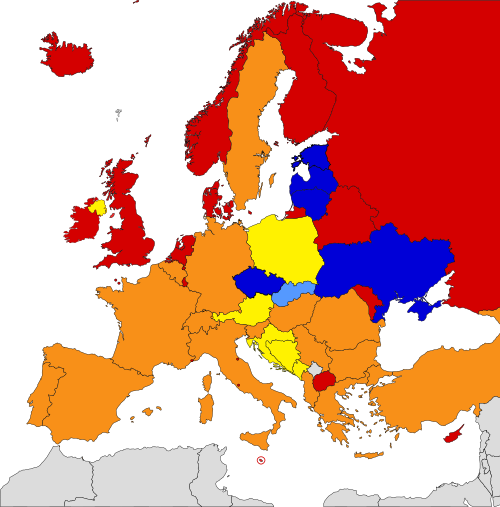
発行する
許可を発行する可能性がある
5月発行
発行可能制限(実際には発行不可)
問題なし
データなし
ボスニア・ヘルツェゴビナ
ボスニア・ヘルツェゴビナでは、ボスニア・ヘルツェゴビナ連邦とスルプスカ共和国という2つの自治領が、ヨーロッパの他の国々に比べて比較的厳しい武器法を施行している。武器は武器弾薬法によって規制されている。[28] 21歳以上の人は許可を申請できる。犯罪歴、精神障害、アルコールや薬物使用歴のある人は許可が下りない。また、徹底した身元調査、近隣住民や家族へのインタビュー、そして申請者はコースを修了し、多肢選択式試験に合格しなければならない。この件に関して最終決定権を持つのは警察であり、警察署長に上訴することもできる。銃器は住居内の「安全な場所」に保管しなければならず、所有者が「無責任」であると判断された場合は警察が没収することがある。許可があれば隠し持ちが認められる。警察に登録すれば、女性は催涙スプレーを携帯できる。[要出典]
欧州連合

欧州連合における銃規制は国によって大きく異なる。しかし、2つの大きな流れが認められる。EU加盟国のほとんどは銃を主にスポーツ用具として扱っているが、一部の国では銃を主に個人または集団の安全のための道具とみなしている(スイス、オーストリア、チェコ共和国、ポーランド、バルト諸国、フィンランドなど)。銃の主な目的に関する基本的な理解の違いが、各国の法律における扱いの違いにつながっている。[349]
すべての EU およびEFTA諸国は、指令 (EU) 2021/555 を自国の法制度に導入する 義務があります。この指令では、各国が遵守しなければならない特定の銃規制基準が定められていますが、同時に、各国の立法者はより厳格な規則を採用することもできます。
この指令では、銃器とは、可燃性推進剤の作用によって弾丸、弾丸、または発射体を発射するか、発射するように設計されているか、または発射するように改造できる携帯可能な銃身付き武器と定義されている。[350]
2017 年の EU 指令改正以降、武器は 3 つの EU カテゴリに分類されています。
- カテゴリーA – 禁止されている銃器:爆発性の軍用ミサイルや発射装置、自動小銃、他の物体に偽装した銃器、貫通性、爆発性、焼夷性の発射体を備えた弾薬、およびそのような弾薬用の発射体、または半自動小銃などが含まれます。
- カテゴリーB – 認可の対象となる銃器。例えば、さまざまな種類の連発式および半自動式の長銃器が含まれますが、カテゴリーAに属するものは除きます。
- カテゴリーC – 申告対象となる銃器および武器。カテゴリーAまたはBに属する各種の長銃器を含むが、カテゴリーAまたはBに属するものは除く[351]
指令第5条に基づき:
第3条に影響を与えることなく、加盟国は、正当な理由があり、かつ以下の条件を満たす者のみに銃器の取得および所持を許可するものとする。
- (a) 18歳以上であること、(...)
- (b)自分自身や他人、公共の秩序や公共の安全に対して危険となる可能性がない。暴力的な意図的な犯罪で有罪判決を受けたという事実は、そのような危険を示すものとみなされる。
(...)
オーストリア
オーストリアは、欧州連合の中で銃器の認可が部分的にしか行われていない唯一の国である。武器法( Waffengesetz)は、銃器を含むすべての種類の武器の法的用語を規定している。[352]法律の第1条は、武器を、人々が攻撃したり身を守ったりする能力を直接的に排除または低下させるように設計された物体(ナイフ、催涙スプレー、ガスピストルなど)、または狩猟やスポーツ射撃中に発射物を発射するように設計された物体(クロスボウ、弓など)と定義している。第2条はさらに、銃器を、砲身から所定の方向に発射物を発射できる武器と定義している。最も一般的な銃器と他のいくつかの武器は、異なる制限を伴う3つの異なるカテゴリに分類されます。
カテゴリー A は、「軍需品」と「制限武器」の 2 つのサブカテゴリーに分かれています。「軍需品」には、たとえば戦車、全自動武器、徹甲武器が含まれます。「制限武器」には、他の物体に偽装した武器、狩猟やスポーツのために通常よりも速く分解できる銃器、全長が 90 cm (35 インチ) 未満または銃身の長さが 45 cm (18 インチ) 未満の散弾銃、ポンプアクション式散弾銃、サプレッサーおよびサプレッサー付き銃器、ナックルダスター、ブラックジャック、スチールロッドが含まれます。カテゴリー B には、カテゴリー A 以外のすべてのハンドガン、連発式散弾銃、半自動式武器 (ピストル、リボルバー、半自動式ライフル、半自動式散弾銃など) が含まれます。カテゴリー C には、カテゴリー A または B 以外のほとんどの銃器が含まれます (例: 連発式ライフル、回転式ライフル、中折れ式ライフル、中折れ式ショットガン)。
All firearms of category A, B, and C are registered in the central weapon register (Zentrales Waffenregister, or short ZWR). Firearms of category C are the least restricted; all citizens over 18 may purchase them at licensed sellers, even without a firearms licence (barring a 3-day waiting period to check for a weapon ban on the buyer). Category B weapons have further restrictions; buyers must have a firearms license or a carry permit, and be 21, unless granted an exception for the age of 18. Category A weapons typically require further exceptions to be granted for holders, except in the case of suppressors and suppressed weapons, which may be held by those with valid hunting licences without an additional permit. "War material" requires a further special federal permit, which is in practice only granted to approved collectors and experts.[353] In general, ammunition sales are unrestricted, though handgun ammunition and some rifle ammunition requires a permit. Antique firearms made before 1871, many black powder firearms and some other "less effective weapons" also require no licence or registration.
In addition, § 11a defines further restrictions on the purchase, possession and carrying of all weapons and ammunition for asylum seekers and many third-country nationals. Owning weapons without a permit for them is strictly prohibited and controlled by the police.[354]
Carrying firearms in public generally requires a carry permit (or "Waffenpass"). Carry permits are issued by the authorities on a shall issue or may issue basis, depending on reason and applicant. Austrian law makes no distinction between concealed or open carry; with a carry permit, the holder may carry their weapon(s) freely throughout the whole country and even in certain "weapon free zones".[355][356] However, holders must carry their weapons in a way that does not constitute a public nuisance; for example, openly displaying a handgun in one's belt at the cinema while wearing civil clothing would be considered unusual and could be considered a public nuisance if the police were called.[357]
Belgium
Possessing or carrying firearms is generally illegal in Belgium with very limited exemptions. Gun laws in Belgium are among the strictest in the world. An exception is made for people who have a valid firearms licence. Since 2006, after a shooting incident in Antwerp, there are very strict conditions and rules for gun owners to obtain such a licence.
However, the laws and regulations concerning the carrying and possession of firearms for hunters, sport shooters, collectors and also for the import and export of guns, differs from area to area in Belgium; a valid licence is almost always required. Blank guns, airsoft guns, paintball guns, and deactivated guns do not need a permit or licence and are free to purchase.
Gun laws in Belgium does not apply (or at least applies differently) for the military and law enforcement services such as the police, customs and some private security units (only handguns). Until its abolition in 2019, the security units of Belgian courts and prison transport (Corps de securité Justice/Veiligheidskorps Justitie) were also permitted to carry handguns.
Croatia
Croatia issues firearms permits for self-defense, hunting, sport shooting:
- Hunting permits require a certificate indicating successfully passing the hunting exam;
- Sporting permits require a certificate issued by a target shooting organization on active membership;
- Self-defense permits require a proof of danger to life.
Every permit also requires an applicant to be at least 18 years old, not be convicted of crimes, there being no other circumstances indicating that the weapon may be abused (for example by a history of alcoholism) and passing medical examinations.
As of October 2020[update] there 99,829 legal gun owners in Croatia. 14,711 people can own and carry firearms for the purpose of personal safety.[358]
Cyprus
The Republic of Cyprus has strict gun control. Private citizens are completely forbidden from owning handguns and rifles in any calibre, including .22 rimfire ammunition. Shotguns limited to two rounds are allowed with a license, issued by provincial police. Shotguns must be for hunting purposes, and a licensed citizen may own up to ten shotguns, typically double-barrelled. A firearm license is required to buy ammunition, of up to 250 shells per purchase, with sales being recorded. Cyprus also controls airguns, and airgun owners require a license. Even though purchasing automatic weapons is illegal, the military issues their reserves an automatic weapon, therefore the majority of the male population has one due to military conscription.[359]
Czech Republic
Gun safes for visitors at a Czech courthouse
Gun laws in the Czech Republic adhere to the European Firearms Directive.[360] Legal accessibility is comparable to those EU countries which consider firearms to be primarily tools of individual or collective safety (i.e. Switzerland, Austria, Poland, Baltic states, Finland) and not just sporting instruments (see Gun laws in the European Union).[361][362]
Right to keep and bear arms is considered to be an attribute of liberty in the country.[363] It is explicitly recognized in the first Article of the Firearms Act. At the constitutional level, the Charter of Fundamental Rights and Freedoms protects the "right to defend one's own life or life of another person also with arms under conditions stipulated by law" (see Self-defence law in the Czech Republic).
Firearms are available to any resident subject to acquiring a firearms license. Firearm licenses may be obtained in a way similar to a driving license; by passing a proficiency exam (in Czech language only), medical examination and having no criminal record. Unlike in most other European countries, Czech firearms legislation also permits citizens to carry concealed weapons for self-defense; 260,027 out of 316,859 gun license holders have a concealed carry license (31 December 2023).[364] The most common reason for firearm possession by Czech gun owners is protection, with hunting and sport shooting being less common.[365] Additionally, people can join government endorsed advanced shooting training courses with their privately owned firearms and become members of the militia-style Designated Reserves.[366]
The beginnings of Czech civilian firearms possession date back to 1421, with the first use of firearms as the primary weapons of Hussite militia (see History of Czech civilian firearms possession). Firearms became indispensable tools for the mostly-commoner militia in a war for religious freedom and political independence. Firearms possession became common throughout and after the Hussite wars. The universal right to keep arms for "all people of all standing" was formally affirmed in the 1517 St. Wenceslaus Agreement. Throughout its 600-year history, Czech firearms legislation remained permissive, with the exception of the periods of German Nazi occupation and of the Communist regime.
The English term pistol originated in 15th-century Czech language.[367] Mariánská skála in Ústí nad Labem is Europe's oldest continually-open shooting range, established in 1617.[368][369]
Denmark
Civilians in Denmark aged 16 and above can acquire gun licenses for hunting or sport shooting. This requires passing a written multiple-choice test and a practical test, after which a certified hunting license instructor determines if the applicant is suitable to own a weapon. A license is usually provided if the applicant has no or only minor marks on their criminal record.
A hunting license permits the over-the-counter-purchase and ownership of an unlimited number of shotguns of up to 12 gauge and two-round capacity. From there, the police has to be notified of new weapon purchases through an online form. Bolt-action rifles can also be bought over-the-counter, although they require a rifle license which is obtained through the police. The allowed calibers range from the smallest possible, up to .50 BMG, with .50 BMG not included. Semi-automatic rifles are allowed if the rifle is limited to two rounds (hunting in Denmark), or without limitation on capacity (hunting outside of Denmark). Currently, only larger calibers (.308, 6.5 × 55, .300wm etc.) are issued as semi-auto rifles for hunting abroad. .223/5.56 × 45 and similar caliber rifles are generally not approved. The hunter must pass a shotgun or rifle shooting test before being allowed to hunt.
For sport-shooting purposes, shotguns can also be used, as can bolt-action rifles of almost any caliber (.50 BMG as one of the exceptions). Sporting rifles are often chambered in .22 LR and 6.5 × 55 mm. Semi-automatic rifles are not allowed for sports shooting.
Handguns: After two years of active membership in a shooting club, one can apply for a handgun permit which is then subject to background checks and approval by the police, and one has to be 21 years old. Approved calibers: All calibers under 9mm (9 × 19, .38 special, .357 magnum, .32 ACP, etc.), plus a limited number of larger calibers; .40 S&W, .45 ACP, .44 special. The maximum number of handguns are six in .22 caliber. When applying for a third gun, a special permit from the department of justice is required. Large caliber guns, i.e. bigger than .22 caliber, are restricted to a maximum of two in the same caliber. Therefore, one can only own two handguns in 9 mm at any given time. However, it is legal to own an additional two handguns in 9 mm, if these are revolvers. For all handguns, the overall length must be at least 210 millimetres (8.3 in), regardless of caliber, measured without orthopedic grips or removal parts.
A weapon permit for sporting purposes (both long and short firearms) has to be renewed every five years. Rifle permits for hunting rifles have to be renewed every 10 years. Shotguns are not held on individual permits; holders are allowed to own these as long as they have a valid hunting license – and they can keep it for up to 10 years after the hunting license expires – albeit they are not allowed to keep ammunition without a valid license.
Carrying a firearm in public is strictly prohibited, however, a notion of proportional self-defense exists. This means that if someone is attacked with a firearm, they are legally allowed to defend themselves proportionally – e.g. with a firearm of their own.
Fully automatic weapons are prohibited for civilian use, unless a special permit is issued by the Ministry of Justice. These permits are extremely rare, and are normally only issued to people or companies working for, or supplying the police or military.
Illegal possession of a firearm may be punished with imprisonment of no less than one year. Civilians may keep privately owned weapons including pistols, revolvers, shotguns and rifles at their residences.[370] These, together with its ammunition have to be stored in an approved gun cabinet (EN1143-1 grade 0 or better).[371] The police may inspect a shooting club's weapons at their discretion, but require a court order to inspect privately held firearms.[372]
Estonia
Estonia is a shall-issue nation. Background checks, doctor's approval, written and practical exam and a firearms course are required. The courses are only offered by private parties (not law enforcement) and must be performed in Estonian as must be the national exam given by law enforcement.[373] Earlier, a translator was permitted, but it was changed as a consequence of the 2022 Russian invasion of Ukraine due to the large number of ethnic Russians applying for licenses.[374] After the national exam is passed, the taking of which already requires passing the previous requisites, a license must be issued on request with law enforcement having no final say afterwards unless a later cause (like committing a felony) invalidates a license.[373]
Finland
The ownership and use of firearms in Finland is regulated by the country's Firearms Act of 1998. Weapons are individually licensed by local police, with no limit on the number of licenses an individual may hold. Licenses are granted for recreational uses, exhibition or (under certain circumstances) professional use. No type of weapon is explicitly prohibited, but licenses are granted only for a reason. Self-defense is not accepted as a valid reason for licensing. In general, this excludes all but hunting and sports guns from non-professional use. Fully automatic weapons are generally not permitted. With the exception of law enforcement, only specially trained security guards may carry loaded weapons in public.
In 2007, Finland had the third largest gun-ownership rate globally (behind the US and Yemen),[375] and the first in Europe.[376] Finns practices hunting, and as of 2007,[update] there were 1.6 million registered weapons and 650,000 people with firearm permits in the country, i.e. 12% of the population. In November that year, Finland updated their gun laws after two school shootings that left 20 people dead,[377] and to comply with an EU directive by removing the ability of 15-18-year-olds to have their own permit. The possibility of creating a dual-license for an already licensed weapon with permission of the license holder was allowed (e.g. parental permission). In 2011, a constitutional law committee concluded that people over the age of 20 can receive a permit for semi-automatic handguns; individuals must demonstrate continuous activity in handgun sporting group for two years prior.[378]
France
In 1563, Charles IX of France had an address to the Rouen parliament about forbidding firearms in which he made the following statement:
In France, a hunting license or a sport-shooting license is needed to purchase any smokeless powder firearm. In September 2015, firearms were divided into four categories that determine the regulations that apply to their possession and use.[380] Category D arms include black powder firearms designed before 1900 and compressed air arms developing between 2 and 20 joules, they can be purchased by any citizen over the age of 18. Category C firearms can be obtained with a hunting license, or sport-shooting license with a medical certificate. Category C includes mainly single-shot-per-barrel shotguns and single-shot or manual repeating rifles (including centre-fire rifles, for hunting or target shooting). Once legally purchased these category C arms may be kept, without using them, even when no longer licensed for hunting or sport-shooting.
Category B firearms are only available to sport-shooters licensed for at least 6 months, with a medical certificate, without any felony convictions, and additionally requires at least three shooting sessions with an instructor each separated by 2 months. Specific authorisations for purchase and possession may then be sought from a local police administration, are valid for 5 years, and are renewable. Such weapons may then only be used for sport-shooting at shooting ranges, never for hunting. Category B includes all assault type rifles, such as AK-47/AKM, AK-74 or AR-15/M16/M4, and any look-alike weapons even when chambered for rimfire cartridges (.22 LR). These must be semi-automatic only. All handguns, including those using rimfire ammunition, are classed as category B. It is illegal to possess these category B weapons after expiry of a non-renewed specific authorisation: the arms must be disposed of (sold to a gun shop or else destroyed, for example). Authorisations can also be revoked at any time by any of the parties involved in the authorisations delivery (Government, Prefecture, Police).
Air-guns including pistols are freely available to adults, as category D arms, provided that their energy level does not exceed 20 J (previously 10 J).[clarification needed] Typical energy levels are 6 J for a target pistol and 7.5 J for a target rifle. A scoped Field Target rifle might produce 15 or 16 J (maximum authorised in FT competition). Air-soft arms, firing non-metallic pellets and not exceeding 2 J energy, are considered to be toys, rather than weapons, and so are excluded from firearm regulations.
Also freely available are category D defensive pepper sprays up to a maximum 75 g capacity. Bigger capacity sprays are considered offensive weapons, not defensive, and so are classed in category B, and require specific authorisation.
A person cannot own more than 12 centerfire firearms, and cannot own more than 10 magazines and 1,000 rounds of ammunition per firearm. A one-year carry license may be issued for persons "exposed to exceptional risks to their life" allowing them to carry a handgun with a maximum of 50 rounds. Such authorizations are extremely rare, however, as the state would normally insist on providing police protection in such cases. Since November 2015, police officers are authorised to carry their service weapons whilst off-duty.
Germany
Gun ownership in Germany is restrictive, being regulated by the Federal Weapons Act (German: Waffengesetz) of 1972.[381] The laws apply to weapons with a fire energy exceeding 7.5 J. A firearms license may be granted to those over the age of 18 who have no criminal convictions or mental disability, who are deemed reliable and can justify a reason for owning a firearm. A separate license is required for each firearm owned. Target-shooters must have been a member of a shooting club with 18 recorded visits in the previous 12 months. A firearms carry permit is a second-tier license which allows concealed carrying in public, and is only issued to those with a particular need.
Several weapons and special ammunitions are completely prohibited, such as automatic firearms. Buying, possessing, lending, using, carrying, crafting, altering and the trading of these weapons is illegal and punishable by up to five years imprisonment, confiscation of the weapon and a fine of up to €10,000. Using an illegal weapon for crimes of any kind is punishable by 1–10 years imprisonment.
Germany's National Gun Registry, introduced at the end of 2012, counted 5.5 million firearms legally owned by 1.4 million people.[382]
Greece
Greece has gun regulations in place. Shotguns (limited to a 3-round capacity), rifles and handguns require a license issued by Police Headquarters. A license may be issued to a Greek citizen over the age of 18 if: a) there are serious fears about his or her personal security along with a positive recommendation by the Prosecutor and b) it is required for the safety of shops, banks, other financial institutions, etc. To purchase handguns and rifles, citizens must either have a concealed-carry permit or a target-shooting permit (for rifles and pistols). Semi auto rifles are not prohibited since the beginning of 2023. Hunters can own up to 10 shotguns and rifles (with no gun barrel rifling) and sport shooters can own up to 8 guns. There is no license-check or record kept for ammunition purchases for shotguns but target shooters can only own 1000 rounds per weapon but 3500 in total tops.[383]
Hungary
Gun laws in Hungary are relatively strict, regulated by Code 24/2004,[384] governmental decision 253/2004. (VIII. 31.) and directive of the Minister of Internal Affairs 49/2004. The law defines a firearm as having muzzle energy that exceeds 7.5 joules (5.5 ft⋅lbf). A firearms license may be granted to those over the age of 18 who have no criminal convictions or mental disability, and have passed a basic firearms theory/practical examination. Three categories of firearms ownership are allowed: Hunting (Firearms restricted to bolt action rifles and double barrel shotguns), Sports shooting (only restriction is no fully automatic firearms), Self defense (special permission from the Police, very rarely granted in special cases e.g. gun shop owners). Sports shooting has in recent years gained popularity with the number of sports category licenses being issued steadily climbing. Government initiatives to popularize shooting sports such as building shooting ranges and introducing shooting as a sport in the schooling system has slowly begun. It is generally expected that obtaining (and keeping) a firearms permit is a slow and somewhat costly process, but once a permit is granted and the necessary yearly memberships are paid, yearly doctors certificates are obtained and the mandatory 2–3 sporting events are attended (for sports shooter) ownership is fairly liberal as to the type of firearm one can own.
In 2010, there were 129,000 registered gun owners (1.3% of the population) in Hungary with 235,000 firearms. The majority of these were hunting rifles. Gun violence is very rare in Hungary. Crime with firearms are very rare and this statistic usually includes crimes committed with non-lethal "pepper spray" guns. Police use lethal force with a firearm less than 10 times per year, on average.[385]
Ireland
Gun laws in Ireland are strict, requiring all firearms to be licensed individually through the Gardaí (police). Applicants must be 16 years of age and have a good reason for ownership, a secure location to store firearms, proof of competency with the firearm or arrangements to achieve such, provide access to medical records and two character references, and be of sound mind and temperate habits. Applicants convicted of certain specified offenses will be denied a firearms certificate. Personal protection is not a valid reason for ownership.
Irish firearms law is based on the Firearms Act 1925,[386] which was amended by several following acts in 1964,[387] 1968,[388] 1971,[389] 1990,[390] 1998[391] and 2000.[392] The cumulative effect of these modifications, along with modifications in other acts and confusion over which amendments applied, resulted in a 2006 Irish Law Reform Commission recommendation that all extant legislation be restated (written in a single document with all prior Acts repealed).[393] However, the Criminal Justice Act 2006,[394] contained a rewriting almost 80% of the Firearms Act. It was quickly followed by amendments in 2007[395] and further major amendments in 2009,[396] exacerbating the legislative confusion. As of 2014,[update] the Law Reform Commission recommendation has not as yet been fully enacted; the Firearms Act consists of the initial 1925 Act amended by approximately twenty separate Acts and is well understood by only a handful of those directly involved in its drafting, amendment or usage. Extensive complaints have arisen over the application of the legislation, with several hundred judicial review cases won in the High Court and Supreme Court by firearms owners, all relating to licensing decisions which had not adhered to the Firearms Act.
Italy
In Italy, national police issue gun licenses to those over the age of 18 without criminal records, who are not mentally ill or known to use illicit substances, and who can prove competence with firearm safety. A shooting sports license permits transporting unloaded firearms and firing them in designated shooting ranges. A hunting license allows holders to engage in hunting with firearms. A concealed carry license permits a person to carry a loaded firearm in public, and requires proving a "valid reason" to do so (e.g. a security guard or a jeweller at risk of robbery). All weapons must be registered within 72 hours from the moment of purchase. The number of firearms an individual may own and retain at the place declared during registration is limited to:
- Unlimited weapons suitable for hunting. These are defined as smoothbore or rifled firearms having a barrel length of at least 30 centimetres and a total length of at least 60 centimetres. In the case of smoothbores the caliber must not be greater than 12 gauge, while in the case of rifles it must not be smaller than 5.6 millimetres measured between the lands, with a casing length no shorter than 40 millimetres if the caliber is exactly equal to 5.6 millimetres.[law 97]
- Twelve long or short firearms classified as suited for shooting sports by the Italian national proof house at the request of a sport association federated with the Italian Olympic Committee (CONI).
- Three weapons whose characteristics do not make them suitable for hunting and that have not been classified as suitable for sporting.
- Eight antiques firearms (manufactured before 1890).
- An unlimited quantity of single shot muzzle-loading functioning replicas of firearms built before 1890.
- Unlimited quantity of Moderate Offensive Capacity (<7,5 Joule) air guns.
The last two can be purchased in an authorized firearm shop by anyone who can prove to be at least 18 years old, without the need for a license. The carrying of such weapons is forbidden without a licence and no registration is required (Art. 7 c.4 DM 362/2001).[397] These limits can be exceeded with a collector license.
Ammunition: any licence allows the owner to keep 200 rounds of handgun and 1500 rounds of hunting ammunition or up to 5 kg of gunpowder (smokeless or black) to handload cartridges. Registration is required within 72 hours form acquisition for all ammunition and powder. Registration is not to be repeated if ammunition and powder are used and then bought again, unless the original quantity registered is being exceeded with the new purchase. Smoothbore cartridges not loaded with slugs but instead with shot (regardless of its size) can be owned without registration if the number possessed is inferior to one thousand.
Lithuania
Luxembourg
In Luxembourg, anyone wishing to purchase, possess or use a firearm must hold a permit issued by the Minister of Justice in person.[398]
The most common reasons for applying for a permit are hunting, recreational shooting, weapons collecting, and inheriting a firearm. Anyone who inherits a firearm must have a permit even if they have no intention to ever touch or use the gun.[398]
Self-defence is not a valid reason for owning a firearm. However, the Ministry of Justice is concerned that some permit holders falsely cite another reason (such as recreational shooting) as a justification for acquiring their permit when their sole actual motivation is self-defence.[399]
Malta
Firearms are allowed in Malta for sport shooting, collection and hunting purposes. To get firearm license one must join a shooting or collectors club for training, which will issue a recommendation letter for the police, after which applicant must pass knowledge of firearm safety and the Arms Act. After successfully completing every step one will get license.
There are 102,610 registered firearms (or 22 per 100 people), including 56,000 shotguns, 10,553 pistols, 7,856 rifles, 5,369 revolvers, 501 machine guns, 477 sub-machine guns, 633 combat shotguns, 22 cannons, 7 humane killers and 2 rocket launchers.
Law allow carrying firearms while hunting, with 10,544 licensed to do so on land and 247 on sea.[85] Carrying loaded firearms outside of hunting grounds or shooting range is illegal. Automatic firearms are allowed only if they were produced before 1946.
Netherlands
In the Netherlands, gun ownership is restricted to hunters, collectors and target shooters.[400] A hunting license requires passing a hunters safety course and an exam. To own a gun for target shooting, the applicant must have been a member of a shooting club for a year.[citation needed] People with felonies, drug addictions, and mental illnesses may not possess firearms.[401] To be a collector one has to limit oneself to a specific area of expertise and demonstrate a serious and thorough knowledge of that area, for instance through publications or lectures.
Once obtained, firearms must be stored in a safe and are annually inspected by police (every 3 years when over 25). Legally owned firearms may only be used in self-defense as a last resort.[402][403] Fully automatic firearms are only allowed on a special permit (usually issued to collectors), but there are otherwise few restrictions: semi-automatics, handguns, and magazines of all sizes[citation needed] are legal, as are all types of non-armourpiercing, non-incendiary or non-explosive ammunition. Silencers require special permission. A licensed target shooter may only have five firearms registered to his or her license at one time (hunters seven, collectors unlimited) but exceptions are possible. Antique firearms (not replicas or center fire cartridge revolvers) are free to own when originally designed and produced for black powder and not at any time officially proofed and stamped for nitro powder.[citation needed]
Poland
Gun ownership in Poland is regulated by the Weapons and Munitions Act of 1999 as further amended.[404] A permit is required to own or possess firearms. Permits are granted for specific purposes, such as self-defense, sport, hunting, collecting etc. and are shall issue except the ones for self-defense, which are may issue. Institutional permits allow for firearm ownership by private security companies, shooting ranges, sport clubs etc.
Permits are issued to permanent residents over 21, not addicted to alcohol or other substances, having no criminal record, being in good physical and mental health, who passed an exam before sporting association, hunting association or the Police. Permits specify the purposes, categories and quantities of allowed guns; categories depend on permit purpose while quantities are assigned at the discretion of the Police, based on documentation provided. Quantities can be increased when one uses up all available slots.
Carrying loaded guns is allowed on all types of permits except permits for collecting and memorial purposes. Hunters can carry loaded only on hunting grounds. Guns shall be carried concealed in a holster close to the body.[405] Carrying in public transport is limited only to self-defense permit holders.[406] It is prohibited to carry while intoxicated, and when attending public gatherings or mass events.
Everyone, including foreigners, is allowed to use legal guns at registered shooting ranges, regardless of actual gun's ownership, e.g. rented from the range or shared by a legal owner present. Discharging a firearm for training or leisure out of a registered shooting range (even on a large private property) is prohibited.
Full-auto or select-fire firearms are permitted only on institutional and training permits. Since 2020 the Police can issue permits for firearms with suppressors for hunting, but only to be used for sanitary shootings, see main article for details. Armor-piercing, incendiary, tracer and other special ammunition is banned. Only valid permit holders are allowed to buy or possess live ammunition, and only of the types exactly matching the guns they legally own. The quantity of matching ammunition in possession is not limited. Hunters, collectors and sport shooters are allowed to manufacture (reload) ammunition, but strictly for their own use. There are further limits regarding allowed types and calibers depending on the purpose of the permit – see main article for details. There are no limits of magazine capacity, except when hunting.
Replicas of cartridgeless black powder firearms designed before 1885 require no permit to own. However, a separate bill of law allows businesses to sell black powder to licensed customers only.[407] This is often circumvented by obtaining a European Firearms Pass for a black powder firearm, asking a licensed colleague (there are no restrictions of private sale or just giving out of black powder) or by buying powder in neighboring countries, mostly the Czech Republic.
Air guns up to 17 Joules of muzzle energy are unregulated. Air guns above that limit are considered pneumatic weapons, no permit is required but the owner has to be 18 and has to pass medical and psychological evaluation as for firearms permit; guns must be registered with the Police and may be used only on registered shooting ranges. Use of pneumatic weapons outside of shooting range is considered the same kind of offense as using firearms.
Some other weapons are restricted and require a permit, such as electroshock weapons with mean current greater than 10 mA, large pepper spray dispensers, crossbows, specific kinds of batons, brass knuckles and nunchakus, however ban on nuchakus is not enforced.
Romania
Gun ownership in Romania is regulated by Law 295/2004. Romania has one of the toughest gun ownership laws in the world.[408] In order for citizens to obtain a weapon, they must obtain a permit from the police, and must register their weapon once they purchase it. There are several categories of permits, with different requirements and rights, including hunting permits, self-defense permits, sports shooting permits and collectors permits. The only categories of people who are legally entitled to carry a weapon are owners of self-defense permits, magistrates, MPs, military forces and certain categories of diplomats. A psychological evaluation is required beforehand in all cases.
Furthermore, knives and daggers may in certain conditions (blade longer than 15 cm and at least 0.4 cm in width, double edge along the whole blade, etc.) be considered weapons and have a similar regime to those of firearms.
In order for a hunter to obtain a hunting/gun ownership license, he must spend a certain "practice time" with a professional hunter. To obtain a self-defense permit, one must be under witness protection. Sporting and collectors licenses require membership in a sport shooting club or collectors' association, respectively.
The amount of ammunition that can be owned is regulated by permit type. Sporting permits allow the ownership of 1,000 matching cartridges per gun; hunting permits allow 300 matching cartridges per gun; self-defense permits allow 50 bullet cartridges and 50 blanks per gun; Collectors permits do not allow for private ownership of ammunition.[409]
Explosive weapons and ammunitions, fully automatic weapons, weapons camouflaged in the shape of another object, armor-piercing ammunition and lethal weapons that do not fit in any category defined by the law are prohibited.
The type of gun is also regulated by permit. Below is a shortened version of the table detailing the restrictions by type of lethal weapon and permit, for civilian owners. Note that for collectors, short weapons designed after 1945 are forbidden, while only non-lethal weapons are allowed for self-defense permits.[410]
It is illegal to use or carry weapons with a muzzle velocity of over 10 kJ if "the barrel is fitted with devices conceived or adapted to reduce recoil"[411]
- Note that there are other restrictions for obtaining weapons under a sports-shooting license.
- Minors (14 and older) may also use a weapon, provided that they are under the supervision of someone who has a gun license. However, they cannot own or carry one until the age of 18.[412]
- The use of guns for self-defense is only allowed if the gun is a last resort option.[413]
Slovakia
Gun ownership in Slovakia is regulated principally by law 190/2003 (law of weapons and ammunition).[414] A firearms license may be issued to an applicant at least 21 years of age (18 years for category D if they own a valid hunting permit, 15 years for state representative in sport-shooting), with no criminal history, and of sound health and mind, who has a valid reason for owning a gun, passes an oral exam covering aspects of gun law, safe handling, and first aid.[415]
Licenses are issued in 6 categories:
- Category A: Concealed carry for self-defense
- Category B: Home self-defense
- Category C: Possession for work purposes
- Category D: Long guns for hunting
- Category E: Possession for sport shooting
- Category F: Collecting
A concealed carry license is only issued if the police deem a sufficient justification. Because of that issue of this license is may-issue in practice, and vary across Slovakia by stance of individual police department issuing licence. It is kind of similar to California, some department is almost shall-issue, another need true sufficient reason (like a constant more than average threat, previous assaults on applicant, transports of money, former service in army or law enforcement, legal awareness of applicant, clientelism). Only about 2% of the adult population holds this license.[416][417][418]
There is an exception for non-repeating muzzle-loaded firearms, which may be purchased without a license.
Slovenia
Gun ownership in Slovenia is regulated under the "Weapons Law" (Zakon o orožju) which is harmonised with the directives of the EU. Gun permits are issued to applicants at least 18 years old, reliable, without criminal history and who has not been a conscientious objector, who passes a medical exam and a test on firearm safety. A specific reason must be given for gun ownership: for hunting or target shooting, the applicant must provide proof of membership in a hunting or sports shooting organization; for collection, the applicant must arrange safe storage with a level of security dependent on the type of weapons; for self-defense, the applicant must prove a risk to personal safety to such an extent that a weapon is needed.
As in most EU member states, the ownership of Category A firearms is prohibited; however these can be owned by weapon collectors, providing that requirements are met. Suppressors are legal and unregulated since 2021. Firearms must be stored in a locked cabinet with ammunition stored separately. Concealed carry is allowed in special circumstances. A gun permit is also required for airguns with muzzle velocity greater than 200 m/s (660 ft/s) or energy of 20 joules (15 ft⋅lbf).[419]
Spain
Firearm regulation in Spain is restrictive, enacted in Citizen Security Protection Organic Act of 2015 and the Weapons Regulation (Royal Decree 137/1993). Both laws are covered by article 149.1.26.ª of the Spanish Constitution, which attributes to the State the exclusive competence in terms of the "regime of production, trade, possession and use of weapons and explosives".
A firearm license may be obtained from the Guardia Civil after passing a police background check, a physiological and medical test, and a practical and theoretical exam. Shotgun, rifle and sporting licenses must be renewed after 5 years, subject to firearm inspection. Sporting licence requires to present proof of sporting activity of at least one competition each year. A minimum score may be required for some categories. Police may inspect firearms at any time. A self-defense and concealed carry license must be renewed every year, and is only available under special conditions.
A license-holder may own up to 6 shotguns, and unlimited rifles. With a sporting license, valid for 5 years, 1 to 10 handguns may be owned, depending on sports-shooting level. Magazine capacity for semi-automatic centerfire rifles and semi-automatic shotguns is limited to 10 rounds for sports shooting and 2 rounds for hunting. Handgun magazines are limited to 20 round capacity. Rimfire rifles, regardless of type have no magazine limit. Rifles chambered for certain cartridges with military origins are prohibited, such as .223/5.56 NATO and .50 BMG. The .308 Winchester and 7.62x39 mm (AK round) cartridges are only permitted in bolt-action, repetition or single-shot firearms. Proof of ownership of an approved safe is required for all centerfire rifles and handguns, and the owner is responsible for firearm thefts. Ammunition must be stored separately. Rifle and handgun ammunition may only be possessed for legally owned firearms, and purchases and possession is limited to 200 rounds rifle and 100 rounds for handguns. In addition, there are yearly limits in quantity (1000 for rifles,100 for handguns); however additional quantities can be petitioned, mainly for sporting use. For shotgun Ammunition, adults with a valid ID can purchase/possess up to 5,000 shells and there are no yearly limits in quantity. License-holders are only allowed to transport their unloaded firearms from their residence to the shooting range or hunting field and back, with no detours. Firearms may only be discharged at approved shooting ranges or hunting grounds (in season).
There are firearm license for private security for handguns and rifles. These cannot be used outside of work and must be stored in the workplace premises (with approved safe).
In addition there are handgun license for self-defense in concealed carry. However, this is granted on a "may issue" basis with several standards of necessity to be met and very few are granted. This license must be renewed annually and is not automatic.
Members of police forces and officers and non-commissioned officers of the armed forces have a special firearms license which encompasses all of the others. There are additional licenses for collectors and muzzle-loading firearms.[126][127][420]
Sweden
Gun ownership in Sweden is regulated by Vapenlagen 1996:67 (literally, The Weapon Law),[421] modified by weapon decree Vapenförordningen 1996:70[422] and FAP 551-3 / RPSFS 2009:13.[423] The police issue licenses to persons older than 18 years in good standing on the "need to have" basis, which generally implies either hunting or sport shooting. Passing a hunting examination or membership in an approved sport shooting club for six months is required. Sport shooting licenses must be renewed every 5 years, whereas hunting licenses are valid for the lifetime of the holder. License-holders may lend a weapon to a person at least 15 years of age for supervised use.
A separate license is required for each particular firearm or caliber conversion kit. There's no codified limit on the number of licenses a person can hold, but in practice a license-holder may own up to six hunting rifles, ten handguns, or a mix of eight rifles and handguns. Firearms must be stored in an approved safe. A firearm registered for hunting may be used for sport shooting, but not vice versa. In 2023, previous restrictions on hunting licenses for semi-automatic firearms based on appearance or military origin were lifted, and as a result the only remaining restrictions specific to hunting are a minimum total weapon length exceeding 60 cm and magazine size on semi-automatic rifles and magazine-fed shotguns.[424] Licenses for fully automatic weapons are not generally issued, with limited exceptions for collection and sport shooting using the WWII era m/45 submachine gun.
Starting 1 July 2022, suppressors no longer require a separate license and can be freely acquired by anyone with a valid gun license and can be legally used both for hunting and target shooting.[425]
Self-defense with firearms, as well as carry, is generally prohibited. Carry permits can be issued by the police under very special circumstances like an immediate and demonstrable threat to life. Transportation of unloaded firearms is allowed to and from approved shooting ranges or hunting grounds. Sweden is notorious for having even pepper spray and other nonlethal self-defence methods under its weapons law with similar legal punishments for misuse.[426]
Firearm collectors must have a clearly stated demarcation of their interest in collecting (e.g.: pre-World War II British handguns). The police may demand security measures on keeping the collection. Collectors may request a time-limited permit to discharge their weapons. Firearms manufactured before 1890 and not using sealed cartridges are exempt from the weapon law.[427]
Georgia
In Georgia, civilians above 18 years of age may obtain a firearm permit from the Ministry of Internal Affairs, allowing them to purchase and keep firearms for hunting and sports (pump-action shotguns, hunting rifles, carbines, combined hunting firearms), self-defense (handguns, air guns, sprays, electric tranquilizers) or collections. Permits are denied to persons who are mentally ill, use illicit substances or alcohol recreationally, and those who have criminal records.[428]
Iceland
In Iceland, a license is required to own or possess firearms. A national government safety course must be passed before applying for a license. A special license is required to own a handgun, which may only be used for target shooting at a licensed range. Semi-automatic firearms have caliber restrictions, while fully automatic firearms are only permitted for collectors.
Applicants must sit through a mandatory four-hour lecture on the "history and physics of the firearm".[429] Paperwork must be filed in the police, magistrate, and the Environment Agency of Iceland. Applicants need to prove clean criminal records, need to be evaluated by a doctor to prove they "are of sound mind" and have "good enough eyesight". Two books referring to guns must be bought and read, a three-day course must be attended, and the applicant should score at least 75% on exams concerning gun safety, management, "what animals are allowed to be hunted and when. Finally, a practical exam must be taken. After Icelanders have their license, they need to own a gun safe to store the weapons in, plus a separate place to store the ammunition".[430]
Approximately one gun is owned for every three people in the country, being used mostly for hunting and competitive shooting.[429] From January to July 2019, 394 shotguns, 785 rifles, and 208 handguns were registered in Iceland. In total, police counts for guns in Iceland include about 40,000 shotguns, 25,000 rifles, and 3,600 handguns as of July that year.[430]
Monaco
Law in Monaco divides firearms into two categories:[431]
- Category "A" weapons including hand guns, semi-automatic firearms and those firing centerfire ammunition require membership in the Monaco Rifle Club, a certificate of aptitude and handling for the requested weapon, and no past history of treatment in a psychiatric unit;
- Category "B" weapons are hunting weapons that do not require licensing unless they are imported.
North Macedonia
To obtain a firearm license in North Macedonia one must be at least 18 years old, able-bodied, healthy, not representing danger to public order, have permanent residency, possess technical knowledge of weapons and regulations related to them and have a justified reason for acquiring the weapon. Justified reasons include:
- Proving one's life or property is in danger;
- Being an active member of hunting or archery associations and passing a specific hunting exam;
- Being a weapons collector;
- Legally inheriting a weapon;
- Weapons having been granted as awards by the state or during archery competitions.
Fully automatic firearms are prohibited. Carrying firearms in public places is prohibited.
North Macedonia has its own defense industry with ATS Group,[432] Eurokompozit Prilep
Norway
Firearm ownership in Norway is controlled by laws passed by the Norwegian Parlament,[433] with further regulations passed by the Ministry of Justice and Public Security.[434] The National Police Directorate can issue government circulars with further in depth definition of how the firearm regulations should be interpreted (by the police).
The Norwegian police can issue firearms licenses to those with a hunting license or members of a sports shooting club. They can also issue licenses to Norwegian historical weapons society collectors,[435] museums, international ship and port facility security and more.
Hunters can own up to 8 firearms, and sports shooters can own up to two firearms per approved shooting disciplines as defined by The National Police Directorate.[436] The purchase of ammunition is restricted to those with a valid firearms license for any given calibre.
Long guns must have a minimum barrel length of 40 centimetres and an overall length of 84 centimetres when operable. Rifles are restricted to 10-round magazines, shotguns to 5 rounds, and pistols to 20 rounds per default. Detachable box magazines for semi-automatic shotguns are prohibited.
Hunters can own semi-automatic and manually loaded rifles and shotguns. Semi-automatic rifles for hunting shall only accept detachable 10-round magazines or smaller ones. They must also have the visual appearance of a "hunting rifle" (i.e. no detachable pistol-grip, or handguard that covers the top half of the barrel).
Sports shooters can own semi-automatic and manually loaded rifles, shotguns and pistols. Sports shooters can apply for unrestricted magazine capacity for each firearm used in an approved sports shooting discipline. However, in practice, it is only approved for rifles and pistols.
Civilians are not permitted to transport/carry firearms loaded or in a manner that allows for easy access in public places, effectively prohibiting any form of concealed or open-carrying of firearms. Moreover, self-defence is not a valid reason for having a firearms licence issued. Firearms licences are only issued for hunting and sporting (or other speciality purposes not generally applicable to ordinary civilians).
Russia
Russian citizens over 21 years of age can obtain a firearms license after attending gun safety classes and passing a federal test and background check. Firearms may be acquired for self-defense, hunting, or sports activities. Carry permits may be issued for hunting firearms licensed for hunting purposes. Initially, purchases are limited to long smooth-bore firearms and pneumatic weapons with a muzzle energy of up to 25 joules (18 ft⋅lbf). After five years of shotgun ownership, rifles may be purchased. Handguns are generally not allowed (except traumatic handguns which are allowed for self-defense but can fire only cartridges with rubber bullets[437]), but with the growing popularity of practical shooting events and competitions in Russia in recent years (e.g. IPSC), handgun ownership has now been allowed and the handguns have to be stored at a shooting club. Rifles and shotguns with barrels shorter than 500 mm (20 in) are prohibited, as are firearms which shoot in bursts or have more than a 10-cartridge capacity. Suppressors are prohibited.[438]
Serbia
Serbia has weapon laws and ranks third in guns per capita with a strong gun culture, especially in rural areas, with about one million guns in legal circulation. Weapons are regulated by the Weapons and Ammunition Law (Zakon o oružju i municiji).[439]
People over age 18 may own firearms with a permit, which is denied to those with a criminal history, mental disorder, or history of alcohol or illegal substance use. There is a thorough background check with police having the final decision. Firearms must be stored in a designated gun cabinet, and may be confiscated by police if the owner is found irresponsible.
Rifles, shotguns and handguns may be owned with an appropriate permit. Having a permit to own a firearm does not itself allow the bearer to carry the firearm anywhere outside the home, regardless of whether it is concealed or not. The owner may transport their firearms at any time provided they are unloaded. Concealed carry permits for handguns require proving an imminent threat, with the police making a final decision. Therefore, concealed carry permits are hard to obtain. There is no limit on the number of firearms one may own, though every gun transaction is recorded by the police. There is no caliber restriction. Fully automatic firearms and suppressors are prohibited for civilians. Automatic long firearms are allowed to be obtained and used by legal entities under special circumstances. People over 18 years of age can buy and carry stun guns and electric tranquilizers with no permit needed. People over 16 can carry OC sprays.[440] There is no restriction regarding the number of rounds that may be purchased. Ammunition may be bought only for the caliber in which an owned firearm is chambered. Reloading is allowed only to those who have passed an exam in handling explosive materials. Old firearms (produced before 1900), historically significant firearms, as well as black powder firearms (all category C items) may be bought without any permit.
Serbia has its own civilian gun and ammunition industry: Zastava Arms,[441] Prvi Partizan,[442] and Krušik.[443]
Switzerland
Firearm regulations in Switzerland are comparatively liberal.[444] Swiss gun laws are primarily about the acquisition of arms, and not ownership. As such a license is not required to own a gun by itself, but a shall-issue permit is required to purchase most types of firearms. Bolt-action rifles do not require an acquisition permit, and can be acquired with just a background check.[445]
The Swiss have male conscription for military service.[446] A 2011 referendum to force military weapons to be kept at military sites was defeated.[447] Weapons may voluntarily be kept in the local armory and there is no longer an obligation to keep the weapon at home.
The Swiss "Federal Law on Arms, Arms Accessories and Ammunitions" (WG, LArm) of 20 June 1997 has as its objectives (Article 1) to combat the wrongful use of arms, their accessories, parts and ammunition. It governs the acquisition of arms, their introduction into Swiss territory, export, storage, possession, carrying, transport, and brokerage. It regulates the manufacture and trade in arms, and seeks to prevent the wrongful carrying of ammunition and dangerous objects. Article 3 states that "The right to acquire, possess and carry arms is guaranteed in the framework of this law".[448][449]
Ukraine
As of 27 February 2022[update] there are no restrictions on ownership of any types of weapons, in fact the Ukrainian government has given out thousands of military grade weapons to its populace. This is due to the ongoing Russo-Ukrainian war.
Ukraine is the only European country without firearms legislation. Regulation is by executive fiat; specifically, Order No. 622 of the Ministry of Internal Affairs. A firearm license may be issued to citizens who meet an age requirement (21 for shotguns, 18 for shotguns for hunting purposes, and 25 for rifles), have no criminal record or history of domestic violence or mental illness and have a specific reason such as target shooting, hunting or collecting. Handguns of .22, 9 mm, .357 magnum and .38 caliber are permitted only for target shooting and those who can prove a threat against their lives (who are typically also given concealed carry permits).[450] All firearms must be stored unloaded in a safe.
Citizens wishing to purchase weapons must complete courses on the fundamentals of Ukrainian legislation on weapons, their technical design and rules for the safe handling of weapons, as well as practical shooting. The organization of relevant courses is assigned to the internal affairs bodies. In order to obtain a weapon permit, citizens submit an application in the prescribed form, a certificate of completion of relevant courses, undergo a medical examination, an inspection of the internal affairs agencies and pass a test on the fundamentals of current legislation and rules for handling weapons and their application skills.[451]
Article 263 of the Ukrainian Criminal Code says that for illegal carrying, storing and selling firearms, explosives and ammunition a person faces from 3 to 7 years in prison.[452]
Weapon permits are not issued, and issued ones are canceled if there are:[453]
- Certificates (conclusions) of the medical institution that a person cannot own a weapon for health reasons;
- The court's decision to declare him incompetent, partially capable, or to lead missing;
- Information about the systematic violations by the person of the rules of arms trafficking, public order, being registered and treated for alcohol use disorder, use of narcotic drugs or psychotropic substances without a doctor's prescription;
- Court verdict on conviction of a person to imprisonment;
- Outstanding or not removed in the prescribed manner of conviction for serious crimes, as well as crimes committed with the use of weapons or explosive devices;
- Court rulings on the direction to serve deprivation of liberty, conditionally convicted with a delay in the execution of the sentence, or a court ruling on the replacement of the unmerited term of correctional labor with a sentence of imprisonment.
The list of diseases and physical defects, in the presence of which a weapon permit is not issued, is approved by the Cabinet of Ministers of Ukraine.
Foreigners have the right to purchase civilian weapons of ammunition and ammunition for permits issued by the internal affairs bodies on the basis of petitions from diplomatic missions or consular offices of the states of which they are citizens, as well as ministries and other central executive authorities of Ukraine, subject to the export of such weapons from Ukraine later than 5 days after purchase. Foreigners who have received certificates of permanent residence in Ukraine have the right to purchase weapons in the manner established for citizens of Ukraine. Hunting and sporting weapons can be imported by foreigners into Ukraine with the appropriate permission of the internal affairs bodies and hunting agreements made with hunting farms or inviting ministries and other central executive authorities to participate in sports competitions.[453]
United Kingdom (Except Northern Ireland)
The UK increased firearm regulation through several Firearms Acts,[454] leading to an outright ban on automatic firearms and many semi-automatic firearms. Breech-loading handguns are also tightly controlled.[455] There are three main types of firearm that require different licences:
- Section 1 firearms require a firearms certificate (FAC), and includes any article that can be defined as a firearm but which is not covered under some other section. Section 1 most commonly includes bolt-action rifles, semi-automatic rifles in rimfire only, long-barrelled pistols, and all shotguns that do not conform to section 2 requirements. There are additional requirements for both sections, such as length and ammunition type, and some accessories such as suppressors are also subject to licensing restrictions.
- Section 2 firearms are shotguns with a maximum magazine capacity of two cartridges, excluding those in the chamber, and require a Shotgun Certificate (SGC); unlike the other licences, the onus is on the police to find good reason not to grant applicants a licence.
- Section 5 firearms are generally prohibited from private ownership. A S.5 permit may be obtained under certain circumstances, but from the Home Office, rather than local Police.[456] Section 5 firearms include fully automatic firearms; semi-automatic rifles in centre-fire calibres; "short firearms" (most handguns); rocket launchers and mortars (other than for line throwing or pyrotechnic use); firearms disguised as another object; ammunition designed to explode on impact.[457]
- Section 7(3) permits bona-fide collectors to obtain Section 5 firearms "of particular rarity, aesthetic quality or technical interest" or "of historical importance" on the authority of local Police, rather than with Home Office.[458] Section 7(3) permits are typically granted only to those with a demonstrable academic background in firearm or military history, such as members of the Historical Breechloading Smallarms Association (HBSA) or institutions such as the Royal Armouries Museum or Imperial War Museum. Section 7(3) firearms are subject to enhanced conditions of storage, being kept at Designated Sites.[459]
An SGC allows the holder to purchase and own any number of shotguns, so long as they can be securely stored, and does not restrict purchase or storage of ammunition; additionally they may legally give shotgun ammunition to non-licence holders. Section 1 and 5 firearms require individual permission for each firearm or accessory, and there are restrictions as to the type and quantity of ammunition held.[456][460] Aside from Northern Ireland, private ownership of most handguns was banned in 1997, with exception for section 5 firearms licences, which are only generally issued to maritime security personnel, and those under police protection. In the run up to the 2012 Olympic Games, British Shooting reached agreement with the Home Office to nominate a small number of elite athletes who could keep and train with Section 5 pistols in the UK at designated ranges.
There are several factors that may disqualify applicants. A custodial sentence of between three months and three years disqualifies applicants for five years from release; three years or greater disqualifies applicants for life. "Intemperate habits", such as substance use, may disqualify applicants. Being of "unsound mind", meaning a history of mental illness, or other relevant medical conditions may disqualify applicants, however there are no conditions that "make them automatically unsuitable to possess a firearm", and police will contact the applicant's general practitioner, who place a flag on the records of all licence holders.[456] Applicants must also have suitable measures for storing firearms and ammunition, such as a gun safe. The FAC additionally requires demonstrating a good reason for each firearm the applicant wishes to own (such as hunting, pest control, collecting, or target shooting). Self-defence is only accepted as a good reason in Northern Ireland.
Oceania
Firearms are completely prohibited for civilian use without exceptions in Nauru, Palau and Marshall Islands. Fiji suspended all firearm licenses in 2000, Cook Islands and Solomon Islands did the same respectively in 1999 and 1992. Papua New Guinea does not issue new licenses since 2000, but former are still valid. Kiribati effectively made it impossible to obtain new firearms by banning import of them.[55]
Australia
Gun laws in Australia are under the jurisdiction of the state governments, with the importation of guns regulated by the federal government. Gun laws were largely aligned in 1996 by the National Firearms Agreement. In two federally funded gun buybacks and voluntary surrenders and state governments' gun amnesties before and after the Port Arthur Massacre, more than a million firearms were collected and destroyed, possibly one third of the national stock.[461]
A person must have a firearm licence to possess or use a firearm. Licence holders must demonstrate a "genuine reason" (which does not include self-defence) for holding a firearm licence and must not be a "prohibited person".[462] All firearms must be registered by serial number to the owner, who must also hold a firearms licence.[463]
New Zealand
New Zealand's gun laws focus mainly on vetting firearm owners. A firearms licence may be issued by police to applicants who attend a safety lecture, pass a written test on safety and the Arms Code, and have secure storage for firearms and ammunition; the police will also interview the applicant and two references to be certain the applicant is "fit and proper" to own a firearm. Having criminal associations, a history of domestic violence, mental instability, or alcohol or drug use almost always result in the application being denied. Misbehavior involving firearms commonly leads to a firearms licence being revoked by police. Even when licensed, a person may only be in possession of a firearm for a particular lawful, proper and sufficient purpose,[464] for which the NZ Police policy is to exclude self-defense, however this is not written in the Arms Act or supporting regulations.[465]
Machine carbines, sub-machine guns, and firearms capable of full automatic fire are all classified as restricted weapons, requiring a special procurement permit issued by the Police.[466] Additionally, pistols intended for use outside of Commissioner-approved shooting ranges are subject to specific regulations and may require special permits beyond those for shooting club use.[465]
After the Christchurch mosque shootings in 2019, legislation to restrict semi-automatic firearms and magazines with a capacity of more than 10 rounds, and provide an amnesty and buyback of such weapons was introduced and passed by the New Zealand parliament.
See also
- Arms Trade Treaty
- Concealed carry
- Defensive gun use
- Estimated number of civilian guns per capita by country
- Global gun cultures
- Glossary of firearms terms
- Gun control
- Gun ownership
- Gun violence
- Index of gun politics articles
- Laws on crossbows
- List of countries by firearm-related death rate
- Percent of households with guns by country
- Right to arms
Notes
- ^ a b c d e f g h i j k l m P – pistol, S – shotgun, R – rifle, CF – centerfire, RF – rimfire, SA – semi-automatic, LG – long guns e.g: SACFR: semi-automatic centerfire rifle
- ^ a b c d e f g h i j k l m n o p While there is no explicit ban on concealed carry, ban on handguns makes it prohibited in practice.
- ^ a b c d e f g h i j k l m n o p q r s t u v w x y z aa ab ac ad ae af Law requires good reason without stipulating what constitutes a good reason
- ^ a b c d e f g h i j k l m n o p q r s t u v w x y z aa ab ac ad ae While law does not specifically address open carry it may be not allowed in practice and prosecuted under other laws such as causing panic in public
- ^ Around 95% of firearm applications granted.[18]
- ^ Category A and B licences - Depends on the state or territory for rifles and shotguns, except for lever-action shotguns, which are limited to a five round capacity.
Category C licences - Rifles are limited to a ten round capacity and shotguns are limited to a five round capacity.
Category D licences - None
Category H licences - The genuine reason of sport/target shooting is limited to a ten round capacity, otherwise there is no limit. - ^ Up to life imprisonment if caught using it for murder.
- ^ In practice only granted to approved collectors, authorized experts, special licensed gunsmiths or similar persons, otherwise rarely issued
- ^ Must be carried in a way without public nuisance,
unusual in civil clothing - ^ General population - must prove existence of genuine threat, wide discretion of deciding authority, restricted may issue
Security personnel (police personal, military police personal or prison guard personal, even after retirement) - shall issue;
Private Security (armored car drivers, bodyguards or similar security staff, private investigators, supervisory hunters and similar persons) - permissive may issue
Taxi drivers - permissive or restrictive may issue depending on region - ^ 0.7% of firearms applications accepted
- ^ No new licenses are issued but licenses issued before ban are still valid
- ^ 99.7% of firearm license applications granted[35]
- ^ limited to 100 rounds of each registered firearm. Hunting and sports licenses limited to 2000 rounds, 3000 for those with a transport license for each registered firearm. All ammunition sales must be registered.
- ^ Around 93% of firearm license applications granted
- ^ Due to reserve military, many people have G3A3/G3A4.
- ^ Subject to may issue police permit ("exemption") – private citizens only for collecting purposes, rarely issued
- ^ Otherwise forbidden magazines with higher capacity are subject to shall issue police permit ("exemption") – for variety of reasons incl. self defense, sport, etc.
- ^ All "Category D" weapons as defined by Act No. 119/2002 Coll. are not registered
- ^ Special cases specified by penal code, include committing the crime of illicit firearm possession as part of organized group, in "large extent" (many firearms) or during state of war or other emergency
- ^ 98% of firearm license applications granted[56]
- ^ Special permit required, for collection, museum display, filming or other specified reason at discretion of authorities (section 44.)
- ^ a b c d e f g h i j k l While law does not specify "good reason" those are accepted in practice
- ^ Around 50% of firearm license applications granted
- ^ Around 60% of firearm license applications granted
- ^ 89% of firearm license applications granted (2011-2013)[75]
- ^ However they cannot be discharged, even at shooting ranges
- ^ 83% of firearm license applications granted
- ^ 99.6% of firearm license applications granted[96]
- ^ 98.3% of firearm license application granted (2017)[103]
- ^ Public display of weapons banned in 2000, ban mostly not enforced
- ^ Training purpose and institutional permits. Blank-firing automatic firearms may be obtained for historical reenactment purpose.
- ^ Automatic firearms may be obtained by collectors.[110]
- ^ Rifle magazines with a capacity of over 10 cartridges and Pistol magazines with a capacity of over 20 cartridges may be acquired by sport shooters.[111]
- ^ 93% of firearm applications granted[116]
- ^ a b c d Law does not require good reason for firearm license but it gives authorities power to reject applications at their will
- ^ a b Handguns only
- ^ Around 50% of firearm license applications granted (2011).[124]
- ^ South Sudan's penal code only prohibits possession of fully and semi-automatic firearms (except handguns). No penalties are provided for other types of firearms. In 2016 draft law was enacted that would regulated possession of any kind of firearms. As of November 2020 it has not been passed by the parliament. ([1])
- ^ People eligible for shotgun license include employees with salary higher than 400,000 pounds a year, dealers who paid more than 500,000 pounds in taxes and farmers who paid more than 200,000 pounds in taxes over three years
- ^ Limit for standard shall-issue permit. No limit for shall-issue permit for sport shooters and may-issue exceptional permit
- ^ Around 57% of firearm license applications granted
- ^ Golden badge in sport shooting organization for at least three years required : source. Golden badge requires outstanding accomplishments in sport shooting competitions: source
- ^ Allowed recently
- ^ Issued only to Members of Parliament, judges and state attorneys
- ^ 98% of firearm and 97% of shotgun applications granted[145]
- ^ Shall issue section 2 shotguns, which are limited to 3 rounds (2+1). Shotguns that fall under may issue section 1 are not limited
- ^ 5 years minimum and up to 10 years maximum for section 5 prohibited firearms. No minimum and up to 5 years maximum for any other non-prohibited but unlicensed firearms
- ^ De jure part of Palestinian Authority, de facto self-governing territory under control of Hamas. While Palestinian law prohibits possession of firearms without license it has not been implemented in Gaza Strip.
- ^ In October 2020 Idlib-held Syrian Salvation Government announced plan to start licensing firearms however no date has been provided for start of this and some other rebel groups rejected this decision
References
- ^ LaFrance, Adrienne (11 January 2016). "How 'Gun Control' Became a Taboo Phrase". The Atlantic. Archived from the original on 17 January 2017. Retrieved 29 March 2016.
- ^ Alpers, Philip; Wilson, Marcus (9 June 2020). "Guns in the United Nations: Firearm Regulation - Guiding Policy". Sydney School of Public Health, The University of Sydney. Archived from the original on 18 April 2021. Retrieved 27 August 2016 – via GunPolicy.org.
- ^ "What works to reduce gun deaths". The Economist. Archived from the original on 15 May 2018. Retrieved 21 May 2018.
- ^ Civilian Gun Registration, GunPolicy.org Archived 5 July 2023 at the Wayback Machine
- ^ Penalty for Illicit Firearm Possession, GunPolicy.org Archived 5 July 2023 at the Wayback Machine
- ^ Genuine Reason Required for Firearm Possession, GunPolicy.org Archived 5 July 2023 at the Wayback Machine
- ^ Gun Ownership and Possession, GunPolicy.org Archived 5 July 2023 at the Wayback Machine
- ^ Regulation of Handguns, GunPolicy.org Archived 5 July 2023 at the Wayback Machine
- ^ Regulation of Automatic Weapons Archived 5 July 2023 at the Wayback Machine
- ^ Carrying Guns Openly in Public, GunPolicy.org Archived 5 July 2023 at the Wayback Machine
- ^ Carrying Hidden Handguns in Public Archived 5 July 2023 at the Wayback Machine
- ^ Vining, Miles (14 August 2018). "Running Guns in Kabul". RECOILweb. Archived from the original on 25 September 2023. Retrieved 20 October 2023.
- ^ "الجزائريون يعشقون السلاح رغم التشدد في منح تراخيصه .. أنواع بنادق الصيد في الجزائر" [Algerians love to arms despite strict licensing ... Types of hunting firearms in Algeria] (in Arabic). 20 July 2018. Archived from the original on 20 February 2020.
- ^ "Angola compra armas para empresas de segurança por 2,5 milhões". 29 November 2018. Archived from the original on 5 July 2023. Retrieved 20 October 2023.
- ^ a b "Explainer: Gun Laws in Latin America's Six Largest Economies". AS/COA. Archived from the original on 12 August 2014. Retrieved 28 January 2015.
- ^ "Ley 25.886". InfoLEG. 14 April 2004. Archived from the original on 2 October 2016. Retrieved 27 September 2016.
- ^ "Firearms-Control Legislation and Policy: Australia". Loc.gov. Archived from the original on 7 January 2015. Retrieved 28 January 2015.
- ^ "Annual Report 2018–2019" (PDF). Archived (PDF) from the original on 5 July 2023. Retrieved 20 October 2023.
- ^ Firearms Act 1996 VictoriaArchived 15 December 2023 at the Wayback Machine
- ^ "RIS - Waffengesetz 1996 § 35 - Bundesrecht konsolidiert, tagesaktuelle Fassung". Archived from the original on 13 May 2019. Retrieved 18 April 2019.
- ^ "RIS – Gesamte Rechtsvorschrift für Waffengesetz 1996 – Bundesrecht konsolidiert, Fassung vom 28.01.2015". Ris.bka.gv.at. 13 September 1991. Archived from the original on 24 December 2014. Retrieved 28 January 2015.
- ^ Shahbazov, Ingilab (21 September 2020). "An explorative analysis of the perception of guns and gun laws in Azerbaijan using a mixed-methods approach". Caucasus Survey. 8 (3): 219–238. doi:10.1080/23761199.2020.1809808. ISSN 2376-1199. S2CID 224914185. Archived from the original on 7 October 2020. Retrieved 20 October 2023.
- ^ "Rules for obtaining and using weapons licenses" (in Bengali). 22 October 2020.
- ^ a b c "MEASURES TO REGULATE FIREARMS. Report of the Secretary-General" (PDF). Gunpolicy.org. 16 April 1996. Archived from the original (PDF) on 12 November 2020. Retrieved 12 November 2020.
- ^ Art. 27.3Archived 5 July 2023 at the Wayback Machine
- ^ "Are guns really a must for a Bhutanese?". thebhutanese.bt. 11 February 2012. Archived from the original on 4 November 2012.
Between 2011 and this year till date, eight people were granted import license for the arms however only one had imported gun.
- ^ "Exigen un test psicológico para poder portar armas" (in Spanish). 17 March 2019.
According to data from the REAFUC office in Sucre, last year there was no application for a weapons license for personal defense, except for those pending procedures for an exemption that closed in 2018
- ^ a b "Zakon O Nabavljanju Drzanju I Nosenju Oruzja I Municije" (PDF). Parlamentfbih.gov.ba. Archived (PDF) from the original on 7 November 2014. Retrieved 18 February 2015.
- ^ "Firearms-Control Legislation and Policy: Brazil | Law Library of Congress". Loc.gov. Archived from the original on 29 March 2015. Retrieved 28 January 2015.
- ^ "DECREE No. 11.615, OF JULY 21, 2023". Archived from the original on 20 October 2023. Retrieved 20 October 2023.
- ^ "PORTARIA Nº 150, DE 5 DE DEZEMBRO DE 2019". Archived from the original on 8 October 2022. Retrieved 20 October 2023.
- ^ "Brazil Gun Control". Planalto.gov.br. Archived from the original on 25 November 2017. Retrieved 24 November 2017.
- ^ Контрол на оръжията - как да си изкараме разрешително за оръжие за самоотбрана Archived 5 July 2023 at the Wayback Machine – Weapons control - how to get a permit for a weapon for self-defense
- ^ "Burkina : les ventes d'armes à feux aux civils sont suspendues" (in French). 29 February 2020. Archived from the original on 5 July 2023. Retrieved 20 October 2023.
- ^ "Court File No. T-577-20" (PDF). Archived (PDF) from the original on 13 February 2023. Retrieved 20 October 2023.
- ^ a b "Gun Law and Policy: Firearms and armed violence, country by country". Gunpolicy.org. Archived from the original on 1 April 2021. Retrieved 28 January 2015.
- ^ a b "Guns in Cambodia – Firearms, gun law and gun control". Gunpolicy.org. 21 July 2001. Archived from the original on 21 September 2023. Retrieved 26 April 2019.
- ^ "Évaluation sur les armes légères pour les États du Sahel et les pays limitrophes: RÉPUBLIQUE DU CAMEROUN" (in French). 13 September 2024.
Decree [...] does not specify that the applicant must show a reason particular to acquire a weapon or ammunition. [...] In practice, the assessment of the validity of the reason is left entirely at the discretion of the authorities.
- ^ "Cameroon bans the sale of arms and ammunition in six regions". 6 April 2018. Archived from the original on 13 July 2023. Retrieved 20 October 2023.
- ^ Cape Verde: Law n.º 31/VIII/2013 Archived 15 December 2023 at the Wayback Machine (in Portuguese)
- ^ a b Biblioteca del Congreso de Chile (4 March 2015). "Control de Armas - Ley Fácil". Biblioteca del Congreso de Chile. Archived from the original on 17 August 2017. Retrieved 17 August 2017.
- ^ Although private ownership is prohibited and Govt.-issued firearms are allocated to those in genuine need, it is possible to acquire a gun, for example, for hunting
- ^ "Criminal Law of the People's Republic of China". Foreign Ministry of People's Republic of China. Archived from the original on 6 April 2018. Retrieved 28 March 2018.
- ^ a b "Colombia's National Law of Firearms and Explosives" (PDF). May 2011. Archived (PDF) from the original on 2 April 2019. Retrieved 20 October 2023.
- ^ "Comoros: Missing guns delay demobilization process". 31 January 2011. Archived from the original on 13 February 2023. Retrieved 20 October 2023.
The National Disarmament, Demobilization and Reintegration Programme (PNDDR)[...] estimated there were about 400 small arms on the island, some belonging to the state military and others thought to have entered the island illegally.
- ^ Timothée, Bahellany (2016). "FABRICATION ET DETENTION D'ARMES LEGERES ET DE PETITS CALIBRES EN RDC : l'impératif d'une reforme législative". Kas African Law Study Library - Librairie Africaine d'Études Juridiques (in French). 3: 36–47. doi:10.5771/2363-6262-2016-1-36. S2CID 159860006.
- ^ Gómez, Dolfi (14 January 2014). "Comercio de armas de fuego en República Dominicana: ¿Cuál es su impacto en la economía?" (in Spanish). Archived from the original on 13 July 2023. Retrieved 20 October 2023.
- ^ "Ecuador Gun Laws & Arms that are Legal to Carry and/or Own in Ecuador". 18 December 2019. Archived from the original on 3 December 2023. Retrieved 20 October 2023.
- ^ "PM gunning for a law change". 3 July 2008. Archived from the original on 22 October 2008.
- ^ "Firearms-Control Legislation and Policy: Egypt | Law Library of Congress". Loc.gov. Archived from the original on 30 December 2014. Retrieved 28 January 2015.
- ^ "Ethiopia to Begin Registration of Privately-Held Firearms". 4 May 2020. Archived from the original on 1 October 2023. Retrieved 20 October 2023.
Adanech said no party in Ethiopia has been licensed to transfer or sell rifles and hence those firearms transactions that have been taking place in different parts of the country were illegal, she said
- ^ Riigi Infosüsteemi Amet. "Weapons and weapon's permits". eesti.ee (in Estonian). Archived from the original on 5 February 2016. Retrieved 29 January 2015.
- ^ "Defence League wants more guns in homes". 4 February 2015. Archived from the original on 20 November 2020. Retrieved 9 September 2019.
- ^ "Ley De Tasas Fiscales" [Tax Rates Law] (PDF) (in Spanish). p. 205. Archived (PDF) from the original on 13 November 2023. Retrieved 20 October 2023.
- ^ a b c d e f g h i j k l "Small Arms in the Pacific" (PDF). 2003. p. 61. Archived (PDF) from the original on 5 August 2020. Retrieved 1 August 2019.
- ^ "Small Arms in Finland". p. 3. Archived from the original on 13 February 2023. Retrieved 20 October 2023.
- ^ "Armes à feu : L'urgence d'une réglementation" (in French). 16 October 2016. Archived from the original on 1 September 2023. Retrieved 20 October 2023.
However, very few applications for firearms licenses have been registered in recent years
- ^ "The Gambia 2019 Crime & Safety Report". Archived from the original on 5 July 2023. Retrieved 20 October 2023.
The Gambia has strict laws regarding the use and possession of dangerous weapons. "Military style" firearms are illegal. The police can license hunting weapons.
- ^ "Central Firearm Registry". Archived from the original on 5 July 2023. Retrieved 20 October 2023.
- ^ "Arms Monitoring in Guinea" (PDF). Small Arms Survey. April 2020. p. 4. Archived from the original (PDF) on 28 July 2021. Retrieved 20 October 2023.
[...]licences for hunting rifles. These licences are valid for a year and can be renewed; only 35 such licences were issued in 2018
- ^ "NATIONAL REPORT ON IMPLEMENTATION OF THE UNITED NATIONS Programme of Action to Prevent, Combat and Eradicate the Illicit Trade in Small Arms and Light Weapons in All Its Aspects: Guinea Bissau" (PDF). Archived from the original (PDF) on 21 May 2021. Retrieved 20 October 2023.
The homemade manufacture was simply prohibited because the Portuguese feared any transaction of such weapons to the Independentist Fighters. [...] in the first years after independence, the Guinean state published the Law 1 / 73, BO of 04/01/75, which maintains, in the following terms, the same Portuguese colonial law
- ^ "Securing Haiti's Transition" (PDF). October 2005. Archived from the original (PDF) on 30 June 2021. Retrieved 20 October 2023.
- ^ "U.S. salvage crew jailed in Honduras for carrying guns – Professional Mariner – October/November 2014". Professional Mariner. 3 October 2014. Archived from the original on 24 December 2014. Retrieved 29 January 2015.
- ^ Allowed only for people in approved professions.
- ^ "Hungarian Weapons Law". Davekopel.com. Archived from the original on 25 December 2014. Retrieved 29 January 2015.
- ^ "Indonesia's Police Won't Stop Issuing Civilian Gun Permits – The Jakarta Globe". Thejakartaglobe.beritasatu.com. 7 May 2012. Archived from the original on 18 February 2015. Retrieved 18 February 2015.
- ^ "Indonesia's Police Won't Stop Issuing Civilian Gun Permits – The Jakarta Globe". Thejakartaglobe.beritasatu.com. 7 May 2012. Archived from the original on 18 February 2015. Retrieved 18 February 2015.
- ^ Among those allowed to legally pack heat in Indonesia are doctors, public officials, lawmakers, members of the military and police and corporate heads
- ^ 20 years or death penalty (source Archived 1 April 2021 at the Wayback Machine)
- ^ a b "Iraqi Official Gazette" (PDF) (in Arabic). 20 March 2017. Archived (PDF) from the original on 20 November 2019.
- ^ "Gun Restrictions in Iran: What can Citizens Own?". 6 July 2014.
- ^ "Revised Acts". Archived from the original on 5 July 2023. Retrieved 20 October 2023.
- ^ "Firearms-Control Legislation and Policy: Israel | Law Library of Congress". Loc.gov. Archived from the original on 18 February 2015. Retrieved 18 February 2015.
- ^ Art. 697 c.p.
- ^ More Legal Guns On The Road - Thousands Of Firearm Licences Approved In Last Two Years
- ^ "Firearms-Control Legislation and Policy: Japan | Law Library of Congress". Library of Congress. Archived from the original on 30 December 2017. Retrieved 18 February 2015.
- ^ "Japan: Gun Control and People Control". Davekopel.com. Archived from the original on 18 February 2015. Retrieved 18 February 2015.
- ^ "Registration of weapons in Kazakhstan". Archived from the original on 12 May 2023. Retrieved 20 October 2023.
- ^ "Small Arm Legislation in Lesotho" (PDF). 2003. Archived (PDF) from the original on 13 February 2023. Retrieved 20 October 2023.
- ^ "Lithuania allows members of Riflemen's Union to keep automatic guns at home". 24 March 2022. Archived from the original on 17 January 2024. Retrieved 20 October 2023.
- ^ https://www.gunpolicy.org/firearms/citation/quotes/3904 Archived 5 July 2023 at the Wayback Machine
- ^ https://www.gunpolicy.org/firearms/citation/quotes/12323 Archived 5 July 2023 at the Wayback Machine
- ^ "200 permis accordés" [200 permits granted] (in French). 16 January 2019. Archived from the original on 5 July 2023. Retrieved 20 October 2023.
- ^ "Communique du gouvernement de la République du Mali". 16 April 2018. Archived from the original on 5 July 2023. Retrieved 20 October 2023.
- ^ a b "Over 100,000 weapons - and one rocket-launcher - in private hands". 12 January 2017. Archived from the original on 2 August 2019. Retrieved 2 August 2019.
- ^ "Firearms-Control Legislation and Policy: Mexico | Law Library of Congress". Loc.gov. Archived from the original on 29 March 2015. Retrieved 18 February 2015.
- ^ Moldova Archived 13 November 2023 at the Wayback Machine, saferworld.org.uk
- ^ "How to request a licence to keep or acquire firearms". 26 October 2012. Archived from the original on 10 November 2020. Retrieved 16 September 2019.
- ^ Carrying of weapons: Halal for hunting, haram for "civilians" Archived 5 July 2023 at the Wayback Machine (in French)
- ^ a b "Mozambique. Country profile" (PDF). Archived from the original (PDF) on 16 June 2019.
- ^ Nauru: Crimes Act Archived 29 November 2020 at the Wayback Machine, 2016 (Article 212)
- ^ the maximum penalty for unlawful possession of a firearm is no more than 5 years in prison or a fine (source Archive)
- ^ "Gun laws in the Netherlands | RNW". Rnw.nl. 9 April 2011. Archived from the original on 3 January 2015. Retrieved 18 February 2015.
- ^ the maximum penalty for unlawful possession of a firearm is no more than 9 months in prison or a fine (source Archive)
- ^ "Firearms-Control Legislation and Policy: New Zealand | Law Library of Congress". Loc.gov. Archived from the original on 24 March 2015. Retrieved 18 February 2015.
- ^ "New Zealand firearm licence applications had a 99.6 percent pass rate in 2017". Radio New Zealand. 18 March 2019. Archived from the original on 5 July 2023. Retrieved 20 October 2023.
- ^ "Pistol target shooting: Conditions". New Zealand Firearms Safety Authority. Retrieved 21 July 2024.
- ^ "10 de cada 100 personas no son aptas para portar armas" (in Spanish). 21 October 2012. Archived from the original on 9 October 2019. Retrieved 20 October 2023.
- ^ "Évaluation sur les armes légères pour les États du Sahel et les pays limitrophes: RÉPUBLIQUE DU NIGER" (in French). 13 September 2024.
The other category of people who hold arms are traders who can afford to buy them and are able to carry out the administrative procedures for obtaining a permit to carry weapons
[permanent dead link] - ^ Ojudu, Babafemi. "Gun Smuggling in the Niger Delta". World Press Review. Archived from the original on 10 May 2023. Retrieved 20 October 2023.
- ^ North Macedonia: Law on Weapons Archived 28 March 2023 at the Wayback Machine, 2010
- ^ "Firearms-Control Legislation and Policy: Norway | Law Library of Congress". Loc.gov. Archived from the original on 18 February 2015. Retrieved 18 February 2015.
- ^ "Revisjonsrapport for 2017 om politiets behandling av våpensaker" (PDF). p. 14. Archived (PDF) from the original on 16 January 2024. Retrieved 20 October 2023.
- ^ Norway set to ban semi-automatic guns from 2021, 10 years after Utoya shooting Archived 9 November 2020 at the Wayback Machine, 27 February 2018
- ^ Annette Kora: Minister declares moratorium on new gun licenses Archived 16 December 2023 at the Wayback Machine, 4 October 2017
- ^ "Solicitar licencia para porte y uso de arma de fuego" (in Spanish). 29 October 2023. Archived from the original on 5 July 2023. Retrieved 20 October 2023.
- ^ "Mniej uznaniowości w pozwoleniach na broń". Tvn24 (in Polish). Archived from the original on 15 April 2019. Retrieved 11 January 2019.
- ^ "Korzystajcie z prawa noszenia broni palnej rozdzielnego ładowania, wytworzonej przed rokiem 1885 oraz replik tej broni". Andrzej Turczyn - Trybun Broni Palnej (in Polish). 28 May 2018. Archived from the original on 31 May 2018. Retrieved 30 May 2018.
- ^ "Policja potwierdza: noszenie broni czarnoprochowej legalne". Wykop.pl (in Polish). 25 April 2013. Archived from the original on 31 March 2016. Retrieved 30 May 2018.
- ^ "Lei n.º 50/2019, de 24 de julho". Archived from the original on 22 April 2023. Retrieved 20 October 2023.
Sem prejuízo do disposto no número anterior, mediante autorização especial do diretor nacional da PSP, podem ser autorizadas a venda, a aquisição, a cedência, a detenção, a utilização, a importação, a exportação e a transferência de armas, munições e acessórios da classe A destinados a colecionadores, museus públicos ou privados, coleções visitáveis, investigação científica ou industrial e utilizações em realizações teatrais, cinematográficas ou outros espetáculos de natureza artística, de reconhecido interesse cultural e histórico, com exceção de bens e tecnologias militares cuja autorização é da competência do membro do Governo responsável pela área da defesa nacional..
- ^ "Lei n.º 50/2019, de 24 de julho". Archived from the original on 22 April 2023. Retrieved 20 October 2023.
Aos atiradores de tiro desportivo pode ser autorizada a aquisição, a detenção, o uso e porte de armas e acessórios previstos nas alíneas ad), af), ag), ah) e ai) do n.º 2 do artigo 3.º.
- ^ "Qatar 2020 Crime & Safety Report". Archived from the original on 5 July 2023. Retrieved 20 October 2023.
Only vetted Qatari citizens may request permission from the Interior Ministry to purchase and obtain a shotgun or air gun for hunting purposes.
- ^ "قانونيون: تراخيص الأسلحة النارية وفق اشتراطات دقيقة" [Law: Firearms licenses are subject to strict requirements]. 23 April 2014. Archived from the original on 5 July 2023. Retrieved 20 October 2023.
- ^ "Romanian Criminal Code art. 342". Archived from the original on 29 November 2018. Retrieved 22 February 2018.
- ^ "Firearms-Control Legislation and Policy: Russian Federation | Law Library of Congress". Loc.gov. Archived from the original on 25 February 2015. Retrieved 18 February 2015.
- ^ "How many Russians are armed? And does this affect the number of crimes committed?" (in Russian). 11 June 2017. Archived from the original on 3 October 2023. Retrieved 20 October 2023.
- ^ "Можно ли в России теперь носить оружие?" [Can you now carry weapons in Russia]. 2014. Archived from the original on 8 March 2021. Retrieved 10 September 2019.
- ^ a b "Rwanda passes new gun acquisition law, citizens express reservations". AfricaNews. 30 May 2018. Archived from the original on 8 June 2019. Retrieved 12 September 2019.
- ^ "Tráfico de armas entre São Tomé e Príncipe e Cabo Verde" (in Portuguese). 19 January 2011. Archived from the original on 13 February 2023. Retrieved 20 October 2023.
[...] had two pistols in his luggage that by law can only be used by military forces.
- ^ "Seychelles" (PDF). www.saferworld.org.uk. Archived (PDF) from the original on 13 February 2023. Retrieved 20 October 2023.
There is no civilian possession of firearms with the police and the military being the only bodies that are permitted to keep firearms. In 1977 President René issued a Presidential Decree to withdraw all civilian firearms licences and not to issue any further licences.
- ^ "Slovensko: Údery zbrklých novel – LEX – sdružení na ochranu práv majitelů zbraní". Gunlex.cz. Archived from the original on 10 January 2015. Retrieved 18 February 2015.
- ^ Collection purposes only
- ^ "Firearms-Control Legislation and Policy: South Africa | Law Library of Congress". Loc.gov. Archived from the original on 29 March 2015. Retrieved 18 February 2015.
- ^ "Gun licences - most applicants denied". Archived from the original on 13 July 2023. Retrieved 20 October 2023.
- ^ "US may learn from Korea's gun control". The Korea Times. 25 January 2013. Archived from the original on 8 December 2023. Retrieved 18 February 2015.
- ^ a b "Firearms-Real Decreto 137/1993, de 29 de enero, por el que se aprueba el Reglamento de Armas". Gobierno de España B.O.E. (in Spanish). Archived from the original on 17 May 2016. Retrieved 15 May 2016.
- ^ a b "Firearms-Control Legislation and Policy: Spain". Law Library of Congress. 21 January 2015. Archived from the original on 18 April 2015. Retrieved 20 April 2015. English summary from the U.S. Law Library of Congress
- ^ "The Explosive Act- NO 1133/13 Wednesday, May 2000 (The Gazette of Sri Lanka)". defence.lk. Archived from the original on 30 September 2023. Retrieved 20 October 2023.
- ^ "Strengthening small arms controls: An audit of small arms control legislation in the Great Lakes region and the Horn of Africa: Sudan". 19 January 2013. Archived from the original on 5 July 2023. Retrieved 20 October 2023.
- ^ "Suriname 2019 Crime & Safety Report". Archived from the original on 5 July 2023. Retrieved 20 October 2023.
Handgun permits are very difficult to obtain, but many criminals have handguns anyway. Shotguns, the only firearms normally owned by civilians, are also frequently used in the commission of crimes.
- ^ "Guns in Liechtenstein – Firearms, gun law and gun control". Gunpolicy.org. 21 July 2001. Archived from the original on 3 July 2019. Retrieved 2 August 2019.
- ^ "Legitimate grounds are in particular: Professional requirements, in particular with regard to carrying out protection duties, such as protecting persons, critical infrastructure or the transport of valuables; recreational target shooting; collecting; National defence requirements; Educational, cultural, research or historical purposes". Archived from the original on 22 October 2023. Retrieved 20 October 2023.
- ^ "Weapons Act". Archived from the original on 3 December 2023. Retrieved 20 October 2023.
Misdemeanours and felonies
- ^ a b "Hide and Seek: Taking Account of Small Arms in Southern Africa" (PDF). Archived from the original (PDF) on 25 September 2018. Retrieved 10 September 2019.
- ^ "National report of the Syrian Arab Republic on the implementation of the Programme of Action to Prevent, Combat and Eradicate the Illicit Trade in Small Arms and Light Weapons in All Its Aspects" (PDF). 14 April 2007. Archived (PDF) from the original on 5 July 2023. Retrieved 20 October 2023.
- ^ "Guns in Thailand Must Be Surrendered, Legal or Illegal, Coup Command Orders". Phuket Wan. Archived from the original on 4 January 2015. Retrieved 18 February 2015.
- ^ "Togo: what procedure should a citizen follow to own a weapon?" (in French). 16 August 2019. Archived from the original on 17 December 2023. Retrieved 20 October 2023.
- ^ "تونسيون يطالبون برخص للصيد البري" [Tunisians are demanding licenses for wild hunting] (in Arabic). 28 August 2017. Archived from the original on 10 May 2023. Retrieved 20 October 2023.
- ^ "Gun laws in Turkey" (PDF). Mevzuat.gov.tr. Archived (PDF) from the original on 20 September 2016. Retrieved 28 August 2016.
- ^ "Turkmenistan 2020 Crime & Safety Report". www.osac.gov. Archived from the original on 5 July 2023. Retrieved 28 August 2016.
- ^ "Gun applicants to undergo one month training". 3 October 2019. Archived from the original on 5 July 2023. Retrieved 20 October 2023.
- ^ "Ukrainian Gun Owners Association: People Have The Unconditional Right to Bear Arms – Katie Pavlich". Townhall.com. 24 February 2014. Archived from the original on 4 January 2015. Retrieved 18 February 2015.
- ^ "Gun Sales Spike In Ukraine, Gun Owners Move For New Laws". Vocativ. 6 March 2014. Archived from the original on 4 January 2015. Retrieved 18 February 2015.
- ^ "Firearms-Control Legislation and Policy: Great Britain | Law Library of Congress". Loc.gov. Archived from the original on 18 February 2015. Retrieved 18 February 2015.
- ^ "Statistics on firearm and shotgun certificates" (PDF). Archived (PDF) from the original on 7 November 2020. Retrieved 20 October 2023.
- ^ "Permitted semi-automatic firearms". Archived from the original on 4 August 2023. Retrieved 8 August 2023.
- ^ "What does the law say about carrying a shotgun in public?". 28 March 2022. Archived from the original on 5 July 2023. Retrieved 20 October 2023.
- ^ "Permitted semi-automatic firearms". Archived from the original on 24 August 2023. Retrieved 20 October 2023.
- ^ [2] Archived 19 March 2015 at the Wayback Machine
- ^ a b "Law on weapons in detail". Kun.uz. Archived from the original on 10 November 2020. Retrieved 7 September 2019.
- ^ According to Small Arms Survey there are no civilian firearms in Vatican: Civilian Firearms Holdings, 2017 Archived 29 June 2018 at the Wayback Machine
- ^ thuvienphapluat.vn. "Luật Quản lý sử dụng vũ khí vật liệu nổ công cụ hỗ trợ 2017" [Law on Management and use of Weapons, Explosives and Combat gears]. THƯ VIỆN PHÁP LUẬT. Archived from the original on 29 May 2018. Retrieved 13 January 2024.
- ^ a b "Fault lines. Tracking armed violence in Yemen" (PDF). SmallArmsSurvey. Archived from the original (PDF) on 9 October 2018. Retrieved 16 January 2019.
- ^ Legal, illegal guns in Cayman Archived 10 May 2023 at the Wayback Machine, 26 May 2011
- ^ a b "Why Hamas can't control arms proliferation in Gaza". 2 October 2020. Archived from the original on 18 February 2021. Retrieved 20 October 2023.
The Palestinian Firearms and Ammunition Law [...] prohibits the possession, acquisition and carrying of firearms or parts thereof or bullets without a license. [...] This law is not applied in the Gaza Strip.
- ^ "Firearms Possession and Domestic Violence in the Western Balkans" (PDF). p. 21. Archived (PDF) from the original on 11 October 2019. Retrieved 20 October 2023.
In Kosovo the UNMIK Head of Police has a discretionary right to reject a licence application.
- ^ "Puerto Rico Enacts Pro-gun Overhaul of Firearms Laws". 23 December 2019.
- ^ Juma, Monica Kathina, ed. (2006). Compendium of Key Documents Relating to Peace and Security in Africa. Series on peace and conflict in Africa. Pretoria: Pretoria University Law Press. p. 39. ISBN 9780958509732.
- ^ Parker, Sarah (2011). "Balancing Acts: Regulation of Civilian Firearm Possession". In Berman, Eric G.; et al. (eds.). Small Arms Survey 2011: States of Security. Cambridge: Cambridge University Press. p. 4. ISBN 9780521146869. Archived from the original (PDF) on 11 July 2011.
- ^ "Botswana: Fifty Win First Stage of Firearm Permit". 10 May 2018. Archived from the original on 3 August 2019. Retrieved 3 August 2019.
- ^ "Over 34,000 registered guns in Botswana". 6 November 2014. Archived from the original on 9 March 2021. Retrieved 3 August 2019.
- ^ "Bangui : autorisation d'achat et de port d'armes" (in French). 29 October 2018. Archived from the original on 21 May 2021. Retrieved 3 December 2020.
- ^ "Central African Republic: Muslims Forced to Flee". 12 February 2014. Archived from the original on 26 October 2020. Retrieved 3 December 2020.
- ^ "PROJET DE LOT DE FINANCES RECTIFICATIVE 2017" (PDF) (in French). p. 15. Archived (PDF) from the original on 21 May 2021.
- ^ Djibouti — Gun Facts, Figures and the Law Archived 26 December 2023 at the Wayback Machine Alpers, Philip and Marcus Wilson. 2023. Djibouti — Gun Facts, Figures and the Law. Sydney School of Public Health, The University of Sydney. GunPolicy.org, 22 January. Accessed 26 December 2023.
- ^ Eritrea— Gun Facts, Figures and the Law Archived 26 December 2023 at the Wayback Machine Alpers, Philip and Marcus Wilson. 2023. Eritrea— Gun Facts, Figures and the Law. Sydney School of Public Health, The University of Sydney. GunPolicy.org, 22 January. Accessed 26 December 2023.
- ^ Gambia— Gun Facts, Figures and the Law Archived 26 December 2023 at the Wayback Machine Alpers, Philip and Marcus Wilson. 2023. Gambia— Gun Facts, Figures and the Law. Sydney School of Public Health, The University of Sydney. GunPolicy.org, 22 January. Accessed 26 December 2023.
- ^ "Demand for firearms increasing". Graphic Online. 14 October 2020. Archived from the original on 21 October 2020. Retrieved 1 December 2020.
- ^ "CAP. 114". kenyalaw.org. Archived from the original on 18 August 2017. Retrieved 4 October 2017.
- ^ Mutsoli, Vivian (16 August 2021). "How to get a gun license in Kenya 2021: Step-by-step guide". Tuko.co.ke - Kenya news. Archived from the original on 4 July 2022. Retrieved 28 April 2022.
- ^ a b Lesotho— Gun Facts, Figures and the Law Archived 26 December 2023 at the Wayback Machine Alpers, Philip and Marcus Wilson. 2023. Lesotho— Gun Facts, Figures and the Law. Sydney School of Public Health, The University of Sydney. GunPolicy.org, 22 January. Accessed 26 December 2023.
- ^ Guinea— Gun Facts, Figures and the Law Alpers, Philip and Marcus Wilson. 2023. Guinea— Gun Facts, Figures and the Law. Sydney School of Public Health, The University of Sydney. GunPolicy.org, 22 January. Accessed 26 December 2023. Archived 26 December 2023 at the Wayback Machine
- ^ Côte d'Ivoire — Gun Facts, Figures and the Law Archived 26 August 2021 at the Wayback Machine Alpers, Philip and Marcus Wilson. 2023. Côte d'Ivoire — Gun Facts, Figures and the Law— Gun Facts, Figures and the Law. Sydney School of Public Health, The University of Sydney. GunPolicy.org, 22 January. Accessed 26 December 2023.
- ^ Sierra Leone — Gun Facts, Figures and the Law Archived 26 December 2023 at the Wayback Machine Alpers, Philip and Marcus Wilson. 2023. Sierra Leone— Gun Facts, Figures and the Law— Gun Facts, Figures and the Law. Sydney School of Public Health, The University of Sydney. GunPolicy.org, 22 January. Accessed 26 December 2023.
- ^ Liberia - Firearms and Ammunition Control Act, 2015 Archived 26 December 2023 at the Wayback Machine International Humanitarian Law Databases. ICRC
- ^ "NamPol approved over 7 000 gun license applications in 2017 …rejected over 1000 others". 30 January 2018. Archived from the original on 1 August 2019. Retrieved 1 August 2019.
- ^ "Massive private gun-ownership raises eyebrows". 13 November 2017. Archived from the original on 1 August 2019. Retrieved 1 August 2019.
- ^ "Senegal- Gun Facts, Figures, and the Law". Gunpolicy.org. Archived from the original on 28 April 2023. Retrieved 28 April 2023.
- ^ "The Arms and Ammunition Act, 2012" (PDF). Archived (PDF) from the original on 15 January 2024. Retrieved 26 December 2023.
- ^ "The Arms and Ammunition Act, 2021" (PDF). Archived (PDF) from the original on 29 February 2024. Retrieved 26 December 2023.
- ^ "UN arms embargo on Somalia". 20 December 2019. Archived from the original on 12 November 2020. Retrieved 8 December 2020.
- ^ "UN Security Council lifts arms embargo on Somalia government". Reuters. Archived from the original on 27 February 2024. Retrieved 8 December 2023.
- ^ PRESS RELEASE ; Somaliland Opposes Lifting of Arms Embargo on Somalia 2 December 2023
- ^ "About Us | SAPS (South African Police Service)". Archived from the original on 30 October 2020. Retrieved 15 August 2018.
- ^ "ANMaC". ANMaC. Archived from the original on 27 June 2018. Retrieved 25 September 2017.
- ^ "ANMaC permits". ANMaC. Archived from the original on 7 May 2018. Retrieved 26 September 2017.
- ^ "Classification of firearms". ANMaC. Archived from the original on 10 July 2017. Retrieved 15 September 2017.
- ^ "Gun Ownership In Belize". belize.com.
- ^ a b c "Brazilians reject gun sales ban". BBCNEWS. 24 October 2005. Archived from the original on 26 July 2008. Retrieved 17 June 2008.
- ^ "Decreto n° 9845, de 25 de Junho de 2019". www.planalto.gov.br. Archived from the original on 15 February 2020. Retrieved 18 February 2020.
- ^ a b Hearn, Kelly (5 October 2005). "The NRA Takes on Gun Control– in Brazil". Alternet. Archived from the original on 13 October 2008. Retrieved 17 June 2008.
- ^ "D5123". www.planalto.gov.br. Archived from the original on 6 November 2019. Retrieved 31 January 2016.
- ^ "Negativa à compra de arma de fogo: ilegalidade da discricionariedade da Polícia Federal". jus.com.br – Jus Navigandi. Archived from the original on 20 February 2020. Retrieved 31 January 2016.
- ^ "Brazil – Gun Facts, Figures and the Law". GunPolicy.org. Archived from the original on 20 December 2012. Retrieved 21 December 2012.
- ^ "Analysis (in Portuguese) about gun control, Legislative Chamber". camara.leg.br. Archived from the original on 21 May 2021. Retrieved 29 October 2020.
- ^ Darlington, Shasta (2019). "Bolsonaro Signs Decree Making It Easier for Brazilians to Buy Guns". The New York Times. Archived from the original on 2 January 2022.
- ^ "Mais de 1 milhão de armas estão em poder de civis". Poder360. 31 January 2021. Archived from the original on 24 February 2021. Retrieved 1 March 2021.
- ^ STF mantém suspensão de decretos que flexibilizam compra e porte de armas Archived 13 February 2023 at the Wayback Machine
- ^ a b RCMP (26 February 2004). "Licensing: Canadian Firearms Program". Government of Canada. Archived from the original on 10 February 2010. Retrieved 21 September 2009.
- ^ "Two Canadians Have 'Authorization To Carry' Guns, Filing Shows | TheGunBlog.ca". 8 November 2018. Archived from the original on 22 September 2020. Retrieved 8 August 2020.
- ^ "Using a Firearm for Wilderness Protection". Royal Canadian Mounted Police, Canadian Firearms Program. www.rcmp-grc.gc.ca. Government of Canada. 25 February 2002. Archived from the original on 21 November 2019. Retrieved 25 October 2016.
- ^ Branch, Legislative Services (22 March 2006). "Consolidated federal laws of canada, Authorizations to Carry Restricted Firearms and Certain Handguns Regulations". laws-lois.justice.gc.ca. Archived from the original on 5 May 2020. Retrieved 8 August 2020.
- ^ RCMP. "List of Non-Restricted, Restricted, and Prohibited Firearms". Government of Canada. Archived from the original on 11 February 2010. Retrieved 22 September 2009.
- ^ Aiello, Rachel (1 May 2020). "PM Trudeau announces federal ban on assault-style firearms in Canada". CTVNews. Archived from the original on 1 May 2020. Retrieved 1 May 2020.
- ^ PRESIDENCIA, MINISTERIO SECRETARÍA GENERAL DE LA (22 September 2005). "DTO-100 22-SEP-2005 MINISTERIO SECRETARÍA GENERAL DE LA PRESIDENCIA". Ley Chile – Biblioteca del Congreso Nacional (in Spanish). Archived from the original on 25 July 2019. Retrieved 5 August 2019.
- ^ "Explainer: Gun Laws in Latin America's Six Largest Economies". AS/COA. Archived from the original on 4 March 2021. Retrieved 30 March 2021.
- ^ "Guía legal sobre: Control de Armas". Biblioteca del Congreso Nacional de Chile. 27 November 2014. Archived from the original on 12 November 2019. Retrieved 22 September 2019.
- ^ Cuba — Gun Facts, Figures and the Law Archived 26 December 2023 at the Wayback Machine Alpers, Philip and Marcus Wilson. 2022. Cuba — Gun Facts, Figures and the Law. Sydney School of Public Health, The University of Sydney. GunPolicy.org, 7 December. Accessed 26 December 2023.
- ^ "On Guns, Politics, and Peace in Colombia". The Globe Post. 4 January 2019.
- ^ "New Gun Control Law in Costa Rica". 31 May 2019.
- ^ El Salvador — Gun Facts, Figures and the Law Archived 26 December 2023 at the Wayback Machine Alpers, Philip and Marcus Wilson. 2022. El Salvador — Gun Facts, Figures and the Law. Sydney School of Public Health, The University of Sydney. GunPolicy.org, 7 December. Accessed 26 December 2023.
- ^ "En El Salvador se registra un arma de fuego cada hora". 7 August 2017.
- ^ "Aldersgrænse for våben på vej". 12 December 2018. Archived from the original on 4 September 2023.
- ^ Constitution de 1987: Titre XI : De la force publique (27) Archived 7 October 2010 at the Wayback Machine
- ^ Haiti — Gun Facts, Figures and the Law Archived 26 December 2023 at the Wayback Machine Alpers, Philip and Marcus Wilson. 2022. Haiti — Gun Facts, Figures and the Law. Sydney School of Public Health, The University of Sydney. GunPolicy.org, 7 December. Accessed 26 December 2023.
- ^ Honduras National Congress (October 2004). "Act on the Control of Firearms, Ammunition, Explosives and Other Related Material" (PDF). Junta Técnica de Normas de Contabilidad y Auditoria. Archived from the original (PDF) on 25 March 2012. Retrieved 21 November 2011.
- ^ Honduras National Congress (28 April 2004). "National Arms Registry". GunPolicy.org. Retrieved 21 November 2011.
- ^ Honduras National Congress (28 August 2003). "DECRETO No. 101-2003" (PDF). Centro Electrónico de Documentación e Información Judicial. Archived (PDF) from the original on 3 July 2007. Retrieved 21 November 2011.
- ^ Honduras National Congress (29 August 2007). "DECRETO No. 69-2007" (PDF). Poder Judicial de Honduras. Archived (PDF) from the original on 4 October 2011. Retrieved 21 November 2011.
- ^ "Firearm Licensing Authority". firearmlicensingauthority.com.
- ^ "Guns from America fuel Jamaica's gang wars". My Sinchew. 22 June 2009. Retrieved 17 March 2010.
- ^ "Firearms Act" (PDF). 16 March 1967. Archived (PDF) from the original on 17 August 2014. Retrieved 11 January 2018.
- ^ Congress of Mexico (18 December 1916). "Summary of Article 10 text and purpose" (PDF). Public Health National Institute. Archived (PDF) from the original on 19 November 2015. Retrieved 18 October 2012.
- ^ SEDENA (16 July 2012). "Instructions for requesting special permit to purchase firearms and cartridges by civilians". SEDENA. Retrieved 22 December 2012.
- ^ Gregg Lee Carter (2012). Guns in American Society: An Encyclopedia of History, Politics, Culture, and the Law. ABC-CLIO. pp. 568–. ISBN 978-0-313-38670-1.
- ^ SEDENA (19 July 2012). "What amount of firearms can be registered?". SEDENA. Retrieved 22 December 2012.
- ^ "Expedición de una licencia particular colectiva de portación de armas de fuego para empresas de seguridad privada". Dirección General del Registro Federal de Armas de Fuego y Control de Explosivos. Gobierno de Mexico. Retrieved 12 October 2019.
- ^ Guzman, Andrea (10 February 2019). "Cómo obtener un permiso para portar armas". CC News. Retrieved 12 October 2019.
- ^ "Panama Firearm permit requirements (in Spanish)" (PDF). Asociación Panameña de Propietarios de Armas (APPA). Archived (PDF) from the original on 26 February 2019.
- ^ "Ley Nº 57 general de armas de fuego, municiones y materiales relacionados" (PDF) (in Spanish). Archived (PDF) from the original on 19 September 2015.
- ^ "Ley Nº 4036 / DE ARMAS DE FUEGO, SUS PIEZAS Y COMPONENTES, MUNICIONES, EXPLOSIVOS, ACCESORIOS Y AFINES". www.bacn.gov.py.
- ^ "Sepa quiénes pueden portar armas en Paraguay". 22 September 2014. Archived from the original on 12 November 2020. Retrieved 12 November 2020.
- ^ "America's Founding Documents". 30 October 2015.
- ^
- ^
- ^ "Who Can Own a Full-Auto Machine Gun?". RocketFFL. 2 January 2021.
- ^ "Gun laws in the US: seven things you need to know about the data". The Guardian. 16 January 2013.
- ^ "Firearms Transaction Record" (PDF). www.atf.gov. Archived from the original (PDF) on 15 February 2015.
- ^ "1914 - Cronología de historia de Venezuela". Fundación Polar (in Spanish). Retrieved 11 June 2021.
- ^ Manuel, Caballero (2007). La peste militar: escritos polémicos 1992-2007 (in Spanish). Caracas: Alfa. p. 180. ISBN 9789803542344.
- ^ "Venezuela bans private gun ownership". 1 June 2012.
- ^ "Gun control: Can Venezuela regulate the flow of arms?". Christian Science Monitor. 7 August 2013.
- ^ "Venezuelan government bans carrying firearms for 180 days". 2 May 2017. Archived from the original on 13 October 2019. Retrieved 13 October 2019.
- ^ "The Arms Act, 1878". bdlaws.minlaw.gov.bd.
- ^ "Guns in Brunei Darussalam". GunPolicy.org. Minister of the People's Power for Interior Relations and Justice. Archived from the original on 15 June 2023. Retrieved 14 June 2023.
- ^ "中华人民共和国枪支管理法 (Firearm Administration Law of the People's Republic of China)". Sd.xinhuanet.com. Archived from the original on 1 May 2017. Retrieved 18 February 2015.
- ^ "中华人民共和国猎枪弹具管理办法 (Hunting Firearm, Ammunition and Equipment Administration Regulation of the People's Republic of China)". Nre.cn. Archived from the original on 4 March 2016. Retrieved 18 February 2015.
- ^ "China Reiterates Stance on Gun Control". Chinadaily.com.cn. Retrieved 18 February 2015.
- ^ "Criminal Law of the People's Republic of China" (PDF). fmprc.gov.cn. Archived from the original (PDF) on 28 December 2022. Retrieved 13 October 2019.
arms and ammunition or other military materials to an enemy during war time
- ^ "Hong Kong Police Force – Advice for Tourists". Police.gov.hk. Retrieved 19 April 2014.
- ^ "CAP 238 FIREARMS AND AMMUNITION ORDINANCE s 13 Possession of arms or ammunition without license". Hklii.org. Retrieved 19 April 2014.
- ^ "Editorial Record (E.R. 6 nof 2019) – e-Legislation Public Ordinance (Cap. 614)". elegislation.gov.hk. Retrieved 2 May 2020.
- ^ "Safe Use of Air Guns". Hong Kong Police Force. Retrieved 13 October 2019.
- ^ Timor-Leste — Gun Facts, Figures and the Law Archived 26 December 2023 at the Wayback Machine Alpers, Philip and Marcus Wilson. 2022. Timor-Leste — Gun Facts, Figures and the Law. Sydney School of Public Health, The University of Sydney. GunPolicy.org, 7 December. Accessed 26 December 2023.
- ^ "New gun laws in East Timor defeated in Parliament". 27 June 2008.
- ^ Lakshmi, Rama (1 February 2010). "New groups mobilize as Indians embrace the right to bear arms". The Washington Post. Retrieved 17 March 2010.
- ^ "The arms Rules, 1962" (PDF). Delhipolicelicensing.gov.in. Archived (PDF) from the original on 1 September 2013. Retrieved 18 February 2015.
- ^ "Ministry of Law and justice - mha.gov.in/THE ARMS (AMENDMENT) ACT, 2019" (PDF). MINISTRY OF HOME AFFAIRS. GOVERNMENT OF INDIA MINISTRY OF HOME AFFAIRS. 13 December 2020. Archived from the original (PDF) on 23 November 2021. Retrieved 22 November 2021.
- ^ "UNODC and Nutrisystem Can Unite In A Battle Against Addiction". www.uncjin.org. Archived from the original on 8 February 2009.
- ^ "IANSA Regions: South and Central Asia". www.iansa.org. Archived from the original on 23 November 2010.
- ^ "Small arms and light weapons". disarmament.un.org. Archived from the original on 4 June 2003.
- ^ Graduate Institute of International Studies, Small Arms Survey 2003: Development Denied, Oxford: Oxford University Press, 2003, pp. 59–60; 112. Williams James Arputharaj, Chamila Thushani Hemmathagama and Saradha Nanayakkara, A Comparative Study of Small Arms Legislation in Bangladesh, India, Nepal, Pakistan and Sri Lanka, Colombo, Sri Lanka: South Asia Partnership (SAP) International, July 2003.
- ^ Niobe Thompson and Devashish Krishnan, "Small Arms in India and the Human Costs of Lingering Conflicts", in Abdel-Fatau Musah and Niobe Thompson, eds., Over a Barrel: Light Weapons and Human Rights in the Commonwealth, London and New Delhi: Commonwealth Human Rights Initiative (CHRI), November 1999, pp. 35–64.
- ^ Abhijeet Singh (22 February 1999). "Indian Legal Forms". Abhijeet Singh. Archived from the original on 16 October 2012. Retrieved 19 April 2014.
- ^ "Gun culture spreads in Dombivli: Legal arms used to settle scores". 12 June 2017.
- ^ "Guns in Indonesia – Firearms, gun law and gun control". Gunpolicy.org. 21 July 2001. Archived from the original on 13 July 2023. Retrieved 29 January 2016.
- ^ WebAdm_LK2FHUI (2 October 2013). "Pembatasan Kepemilikan Senjata Api oleh Masyarakat Sipil dalam Perspektif Hukum dan Sanksi Pidana atas Penyalahgunaannya". LK2 FHUI (in Indonesian). Retrieved 16 May 2024.
{{cite web}}: CS1 maint: numeric names: authors list (link) - ^ "Indonesia's Police Won't Stop Issuing Civilian Gun Permits | Jakarta Globe". Jakartaglobe.beritasatu.com. 7 May 2012. Archived from the original on 4 October 2015. Retrieved 29 January 2016.
- ^ "ساماندهی ۲۰۰ هزار قبضه سلاح عشایر کشور". 29 September 2016.
- ^ "تغییر در قانون اسلحه در ایران؛ "هر ماموری که مجوز سلاح دارد مجاز به استفاده از آن میشود"". BBC News (in Persian). Retrieved 17 June 2022.
- ^ تغییر قانون استفاده از سلاح؛ سرکوبگر راحتتر شلیک کند؟ (in Persian), 12 June 2022, retrieved 17 June 2022
- ^ دارندگان این سلاحهای جنگی و شکاری مجرم شناخته میشوند Archived 22 October 2023 at the Wayback Machine
- ^ Mohammed, Abeer. "Shock at Iraq Gun Law". iwpr.net. Retrieved 13 October 2019.
- ^ "Baghdad gun shops thrive after Iraqi rethink on arms control". Reuters. 19 August 2018.
- ^ Israel significantly relaxes gun license regulations Tzvi Lev, 08/07/18 15:57, Arutz 7
- ^ a b Philip Alpers. "Guns in Israel – Firearms, gun law and gun control". Archived from the original on 25 August 2020. Retrieved 3 May 2015.
- ^ Fisher, Max (28 December 2012). "Israeli gun laws are much stricter than some U.S. gun advocates suggest". The Washington Post. Retrieved 7 July 2017.
- ^ Harkov, Lahav (23 July 2014). "Knesset tightens gun control with no opposition". The Jerusalem Post. Retrieved 7 July 2017.
- ^ Hartman, Ben (18 December 2012). "Israeli gun control regulations 'opposite of US'". The Jerusalem Post. Retrieved 7 July 2017.
- ^ Sheffer, Doron (28 August 2005). "Quarter of a million Israelis own firearms". Ynetnews. Ynetnews.com. Retrieved 19 April 2014.
- ^ Levy, Yael (20 June 1995). "Number of gun applications doubles". Ynetnews. Ynetnews.com. Retrieved 19 April 2014.
- ^ Karp, Aaron. 1 July 2006. "Trickle and Torrent: State stockpiles". Small Arms Survey 2006: Unfinished Business; Chapter 2 (Appendix I), p. 61. Oxford: Oxford University Press.
- ^ Karp, Aaron. 27 August 2007. "Completing the Count: Civilian firearms – Annexe online". Small Arms Survey 2007: Guns and the City; Chapter 2 (Annexe 4), p. 67 refers. Cambridge: Cambridge University Press.
- ^ Erb, Jordan Parker. "Israeli officials are calling on armed civilians to stand guard following Hamas attacks". Business Insider. Retrieved 15 October 2023.
- ^ a b Bachner, Michael (20 August 2018). "Hundreds of thousands more Israelis okayed to carry guns under new rules". The Times of Israel. Retrieved 15 October 2023.
- ^ a b c d e f Halon, Yael (11 October 2023). "Israelis pressure government to loosen restrictive gun laws amid Hamas war: It's a 'pity' it came to this". Fox News. Retrieved 15 October 2023.
- ^ Fung, Katherine (9 October 2023). "Israel festival-goers "defenseless" after gun ban". Newsweek. Retrieved 15 October 2023.
- ^ Tuccille, J. D. (13 October 2023). "Israel eases guns restrictions amidst security failures". Reason.com. Retrieved 15 October 2023.
- ^ "Israeli gun ownership rising as violence surges". BBC News. 30 March 2023. Retrieved 15 October 2023.
- ^ Fiske, Gavriel (9 October 2023). "As Hamas war rages, personal firearm activists see surge in interest". The Times of Israel. Retrieved 15 October 2023.
- ^ "Law Controlling Possession, Etc. of Fire-Arms and Swords" (1978), Law No 6, Art 3, EHS Law Bulletin Series, No 3920.
- ^ D Bayley, Forces of Order: Police Behavior in Japan and the United States (Berkeley: University of California Press, 1976), Art 4, 23.
- ^ a b Low, Harry (6 January 2017). "How Japan has almost eradicated gun crime". BBC News. Retrieved 13 October 2019.
- ^ a b c Weller, Chris (7 November 2017). "Japan has almost completely eliminated gun deaths – here's how". Business Insider. Archived from the original on 30 January 2019. Retrieved 13 October 2019.
- ^ a b c d "How Japan has almost eradicated gun crime". BBC News. 6 January 2017.
- ^ Umeda, Sayuri. "Firearms-Control Legislation and Policy: Japan | Law Library of Congress". www.loc.gov. Retrieved 8 February 2021.
- ^ Kennedy, Merrit (18 July 2019). "Suspected Arson At Anime Studio In Japan Kills At Least 33 People". NPR.
- ^ "Japan's tight gun laws add to shock over Abe's assassination". Associated Press. 8 July 2022.
- ^ "Jordan Pushes Bill to Limit Firearm Ownership". 3 July 2019.
- ^ "You are being redirected..." www.moi.gov.kw. Retrieved 29 May 2018.
- ^ "Guns in Kuwait – Firearms, gun law and gun control". www.gunpolicy.org. Archived from the original on 20 January 2021. Retrieved 11 January 2021.
- ^ a b "Guns in Lebanon – Firearms, gun law and gun control". Gunpolicy.org. 21 July 2001. Archived from the original on 5 February 2016. Retrieved 29 January 2016.
- ^ "Lebanon's Illegal Arms Dealers". YouTube. 24 February 2014. Archived from the original on 11 December 2021. Retrieved 29 January 2016.
- ^ "Arms Act 1960" (PDF). Malaysia Ministry of Defense Website. Archived from the original (PDF) on 3 February 2017. Retrieved 14 June 2016.
- ^ "What you need to know about Malaysia's gun laws". Poskod Malaysia. 20 August 2013. Archived from the original on 12 June 2016. Retrieved 14 June 2016.
- ^ Oyundari, E. "Law on firearms to be amended". The UB Post. Archived from the original on 24 January 2021. Retrieved 13 October 2019.
- ^ a b c d e Htoon, Kyaw Lin (2 August 2018). "Firearms and the law in Myanmar". Frontier Myanmar. Retrieved 16 March 2023.
- ^ Aung Zay (17 February 2023). "Hundreds apply for firearms licenses days after introduction of new policy". Myanmar NOW. Retrieved 16 March 2023.
- ^ a b Tin Htet Paing (13 February 2023). "Myanmar regime issues right to arms policy enabling easier weapons access for pro-junta individuals and militias". Myanmar NOW. Retrieved 16 March 2023.
- ^ "Leaked document confirms Myanmar junta is arming anti-resistance militias". Myanmar NOW. Retrieved 16 March 2023.
- ^ "Over 34,000 licensed firearms possessed by public". MyRepublica. 25 March 2017.
- ^ Oh, Grace (6 August 2012). "N. Korea enacts rules on regulating firearms". Yonhap News Agency. Retrieved 9 August 2013.
- ^ "The Punjab Arms Ordinance 1965". Punjablaws.gov.pk. Retrieved 28 January 2015.
- ^ a b "Republic Act No. 10591 | Official Gazette of the Republic of the Philippines". 29 May 2013.
- ^ Calica, Aurea (2 June 2013). "New law gets strict on gun ownership | Headlines, News, The Philippine Star". philstar.com. Retrieved 18 February 2015.
- ^ "Philippines – Number of Registered Firearms". www.gunpolicy.org. Archived from the original on 8 March 2021. Retrieved 7 March 2020.
- ^ "Small Arms in Singapore: Facts, Figures and Firearm Law". Gunpolicy.org. Archived from the original on 30 April 2015. Retrieved 14 November 2011.
- ^ "Singapore Statutes Arms Of– fences Act". Statutes.agc.gov.sg. Archived from the original on 29 March 2014. Retrieved 19 April 2014.
- ^ "Singapore Statutes Online Arms – Offences Act". Statutes.agc.gov.sg. Archived from the original on 29 March 2014. Retrieved 19 April 2014.
- ^ "Factsheet - Singapore Assault Rifle 21". Singaporean Ministry of Defence (MINDEF). Archived from the original on 25 December 2012. Retrieved 24 July 2010.
- ^ "Gun Deaths By Country 2021". worldpopulationreview.com. Retrieved 23 July 2021.
- ^ a b Cho, Johee. "Strict Gun Control Laws in South Korea". ABC. Archived from the original on 19 December 2012. Retrieved 9 August 2013.
- ^ Na, Jeong Ju. "Korea Times US may learn from Korea's gun control". The Korea Times. Retrieved 23 July 2015.
- ^ "WBEZ Examining South Korea's shockingly low rates of gun ownership". WBEZ. Archived from the original on 5 December 2015. Retrieved 23 July 2015.
- ^ "Syria — Gun Facts, Figures and the Law". Gunpolicy.org. Archived from the original on 15 June 2023. Retrieved 14 June 2023.
Guiding gun control legislation in Syria includes the... Legislative Decree No. 51 of 23 September 2001
- ^ "Syria: Questions About the Capacity of Act 14 to Control the Spread of Arms Among "Legalized Armed Militias"". Syrians for Truth and Justice. 27 April 2022. Archived from the original on 2 December 2022.
On 15 February 2022, Faisal Jammoul, a Syrian delegate, member of the National Security Committee, and the Syrian Parliament's Constitutional Committee, gave a live interview on "Al Madina FM" about upcoming amendments to Syrian Arms and Ammunitions Law. During the interview, Jammoul confirmed that a draft of the law had been discussed in detail and would soon be proposed to the Syrian Parliament. He said: "The proposed amendment to the Arms and Ammunitions Law is in fact an amendment to Law No. 51of 2001 and is an urgent response to mitigate the chaotic spread of arms around Syria."
- ^ "Indiscriminate proliferation of weapons in Syria's Idlib widespread". 15 October 2020.
- ^ "Jawlani courts the West with decision to control carrying of weapons in Idlib". 18 October 2020. Archived from the original on 29 October 2020. Retrieved 16 November 2020.
- ^ ""حكومة الإنقاذ" تبدأ بترخيص السلاح الفردي.. الغايات والإمكانيات" (in Arabic). 20 October 2020.
- ^ "Mainland China's grip on Taiwan's arsenal seen in 'incredible' security blunder". South China Morning Post. 14 January 2023. Retrieved 14 August 2023.
- ^ "Taiwan's indigenous groups lose court fight for hunting rights". BBC News. 7 May 2021. Archived from the original on 14 August 2023. Retrieved 14 August 2023.
- ^ "Controlling Guns, Ammunition and Knives Act". Retrieved 31 July 2020.
- ^ Winn, Patrick (18 May 2021). "Taiwan's gun control debate". The World.
- ^ Chaninat & Leeds. "Gun Law of Thailand". Thailand Law Forum. Archived from the original on 5 July 2023. Retrieved 20 February 2016.
- ^ Domínguez, Gabriel (19 February 2016). "A look at Thailand's fervent gun culture". Deutsche Welle. Deutsche Welle. Archived from the original on 15 June 2023. Retrieved 20 February 2016.
- ^ a b "Thailand: Amendments to Firearms Law | Global Legal Monitor". www.loc.gov. 23 October 2017.
- ^ "Firearms, Ammunition, Explosives, Fireworks, and the Equivalent of Firearms Act B.E.2490 (1947), page 1 of 22" (PDF). Vertic.org. Archived (PDF) from the original on 13 December 2013. Retrieved 18 February 2015.
- ^ Alpers, Philip; Wilson, Marcus (2016). "Thailand – Gun Facts, Figures and the Law". GunPolicy.org. Sydney School of Public Health, The University of Sydney. Archived from the original on 4 March 2016. Retrieved 20 February 2016.
- ^ "Guns in Turkey". gunpolicy.org. Archived from the original on 2 July 2016. Retrieved 29 June 2016.
- ^ ATEŞLİ SİLAHLAR VE BIÇAKLAR İLE DİĞER ALETLER HAKKINDA KANUN 10 July 1952
- ^ How to Get a Gun License in Turkey Archived 26 December 2023 at the Wayback Machine 26 February 2023. Husan Arms.
- ^ Turkey — Gun Facts, Figures and the Law Archived 13 July 2023 at the Wayback Machine Alpers, Philip and Marcus Wilson. 2022. Turkey — Gun Facts, Figures and the Law. Sydney School of Public Health, The University of Sydney. GunPolicy.org, 12 December. Accessed 26 December 2023.
- ^ SAYILI AVDA VE SPORDA KULLANILAN TÜFEKLER, NİŞAN TABANCALARI VE AV BIÇAKLARININ YAPIMI, ALIMI, SATIMI VE BULUNDURULMASINA DAİR KANUNUN UYGULANMASINA İLİŞKİN YÖNETMELİK
- ^ "UAE gun rule changes boost sales at Abu Dhabi's Adihex". The National. 29 August 2019.
- ^ "Abu Dhabi shooting: rare gun incident puts spotlight on strict licensing laws". The National. 3 January 2019.
- ^ thuvienphapluat.vn. "Luật Quản lý sử dụng vũ khí vật liệu nổ công cụ hỗ trợ 2017". thuvienphapluat.vn. Retrieved 29 May 2018.
- ^ "Yemen: A Dangerous Regional Arms Bazaar". Jamestown. 16 June 2017.
- ^ Karp, Aaron (June 2018). "Estimating Global Civilian-Held Firearms Numbers" (PDF). Small Arms Survey. Department of Foreign Affairs and Trade. Archived from the original (PDF) on 20 June 2018. Retrieved 23 June 2020.
- ^ Gawron, Tomáš (15 January 2024). "Srovnání české zbraňové legislativy s jinými evropskými zeměmi [Comparison of Czech Gun Laws with other European Countries]". zbrojnice.com (in Czech). Retrieved 7 November 2024.
- ^ European Parliament and the Council (21 May 2008), Directive 2008/51/EC of the European Parliament and of the Council of 21 May 2008 amending Council Directive 91/477/EEC on control of the acquisition and possession of weapons, recital.
- ^ "EUR-Lex – 01991L0477-20170613". eur-lex.europa.eu.
- ^ "RIS – 1000601 Gesamte Rechtsvorschrift für Waffengesetz 1996 – Bundesrecht konsolidiert, Fassung vom 01.03.2021". www.ris.bka.gv.at. Archived from the original on 21 May 2021. Retrieved 1 March 2021.
- ^ "RIS – Waffengesetz 1996 § 18 – Bundesrecht konsolidiert, Fassung vom 14.02.2019". www.ris.bka.gv.at.
- ^ "Totales Waffenverbot für Ausländer in Österreich". Heute.at. 21 November 2018.
- ^ "Waffen in Wien: 10.235 Personen dürfen eine Pistole tragen". meinbezirk.at. 24 March 2016.
- ^ "Parlament Österreich".
- ^ "Bewaffneter Beamter löste Großeinsatz in Kino aus". nachrichten.at.
- ^ "Pola milijuna nelegalnih pištolja i pušaka još uvijek se krije po kućama? U zadnjih 13 godina građani su dobrovoljno predali čak 343.000 komada oružja". 22 October 2020.
- ^ Grupp, Larry (2011). The Worldwide Gun Owner's Guide. Scottsdale, Arizona: Bloomfield Press, 365pp.
- ^ Gawron, Tomáš (23 October 2020). "Od směrnice k implementaci: co přináší a co znamená Poslaneckou sněmovnou PČR schválená novela zákona o zbraních". Advokátní Deník (in Czech). Archived from the original on 28 March 2023. Retrieved 22 December 2023.
- ^ Sanlaville, Tanguy (22 December 2023). "Examens, contrôles des antécédents : après l'attaque de Prague, au coeur de la loi tchèque sur les armes à feu". marianne.net (in French). Archived from the original on 24 December 2023. Retrieved 26 December 2023.
- ^ Gawron, Tomáš (15 January 2024). "Srovnání české zbraňové legislativy s jinými evropskými zeměmi [Comparison of Czech Gun Laws with other European Countries]". zbrojnice.com (in Czech). Retrieved 7 November 2024.
- ^ Cite error: The named reference
roundtablewas invoked but never defined (see the help page). - ^ Gawron, Tomáš (8 January 2024). "Zbraňové statistiky 2023: Růst počtu držitelů zbrojních průkazů zpomalil, setrvalý nárůst registrovaných zbraní [Firearms statistics 2023: Increase of number of license holders slowed down, gradual increase of registered firearms]". zbrojnice.com (in Czech). Retrieved 8 January 2024.
- ^ Eurobarometer, Directorate General for Communication (2013), Flash Barometer 383: Firearms in the European Union – Report (PDF), Brusselss, archived (PDF) from the original on 21 March 2017, retrieved 26 March 2017
{{citation}}: CS1 maint: location missing publisher (link) - ^ "Ozbrojení civilisté a budoucí bezpečnostní krize".
- ^ Titz, Karel (1922). Ohlasy husitského válečnictví v Evropě. Československý vědecký ústav vojenský.
- ^ Kindlová, Veronika (2015), Nejstarší střelnici v Evropě najdete na Mariánské skále v Ústí nad Labem, archived from the original on 1 October 2017, retrieved 1 October 2017
- ^ Rudoplh, Richard L. (2008). Banking and Industrialization in Austria-Hungary: The Role of Banks in the Industrialization of the Czech Crownlands, 1873–1914. Cambridge University Press. p. 39. ISBN 978-0-521-08847-3. Archived from the original on 5 November 2021. Retrieved 6 January 2019.
- ^ "www.politi.dk - Blankvåben mv". Archived from the original on 3 February 2017.
- ^ https://www.retsinformation.dk/Forms/R0710.aspx?id=158805 §22 Archived 5 July 2023 at the Wayback Machine
- ^ "Ministry of Justice – Weapons". Archived from the original on 13 May 2019. Retrieved 3 February 2017.
- ^ a b "Relvaseadus–Riigi Teataja". Weapon's law.
- ^ "Relvaeksam". Weapon's exam.
- ^ Allen, Nick (24 September 2008). "Finland school shooting: Gunman planned massacre for six years". The Telegraph. Archived from the original on 12 January 2022. Retrieved 16 November 2019.
- ^ "Vote to tighten Europe gun laws". BBC. 29 November 2007. Retrieved 16 November 2019.
- ^ Byron, Katy; Pleitgen, Frederik; Schmidt, Nadine; Watson, Ivan; Magnay, Diana. "German rampage victims mostly female". CNN. Archived from the original on 16 November 2019. Retrieved 16 November 2019.
- ^ Tsai, Michelle (31 December 2009). "Packing Heat in Helsinki". Slate. Retrieved 16 November 2019.
- ^ Charles IX (1550-1574; roi de France) (1 March 1563). La déclaration faicte par le Roy, de sa majorité, tenant son lict de justice en sa cour de parlement de Roüen : et ordonnance par luy faicte pour le bien & repos public de son royaume : et ce qu'il dict en ladicte cour avant la publication de ladicte ordonnance. Publiée en la cour de parlement à Paris, le vingthuictième jour de septembre, 1563 – via gallica.bnf.fr.
- ^ "Armes" [Arms] (in French). Direction de l'information légale et administrative. Retrieved 6 September 2016.
- ^ "Germany – Gun Facts, Figures and the Law". International Firearms Injury Prevention & Policy. 27 June 2012. Archived from the original on 5 July 2013. Retrieved 26 February 2013.
- ^ "New German firearms registry shows 5.5 millions guns legally owned in country". Associated Press/Fox News. 28 December 2012. Retrieved 28 December 2012.
- ^ "Νόμος 3944/2011 - ΦΕΚ 67/Α/5-4-2011". e-nomothesia.gr | Τράπεζα Πληροφοριών Νομοθεσίας. 18 September 2018.
- ^ Complex Kiadó Kft. "Hungarian gun law, 24/2004 (Hungarian)". Complex.hu. Retrieved 19 April 2014.
- ^ Független Hírügynökség (17 April 2011). "Fegyverbe magyar?". Index.hu. Retrieved 19 April 2014.
- ^ "Firearms Act, 1925". Irish Statute Book. Office of the Attorney General of Ireland.
- ^ "Firearms Act, 1964". Irish Statute Book. Office of the Attorney General of Ireland.
- ^ "Firearms (Proofing) Act, 1968". Irish Statute Book. Office of the Attorney General of Ireland.
- ^ "Firearms Act, 1971". Irish Statute Book. Office of the Attorney General of Ireland.
- ^ "Firearms and Offensive Weapons Act, 1990". Irish Statute Book. Office of the Attorney General of Ireland.
- ^ "Firearms (temporary Provisions) Act, 1998". Irish Statute Book. Office of the Attorney General of Ireland.
- ^ "Firearms (Firearm Certificates for Non-Residents) Act, 2000". Irish Statute Book. Office of the Attorney General of Ireland.
- ^ "Report on Legislation Directory and Consultation Paper on Classified List of Legislation in Ireland". Law Reform Commission of Ireland. 14 January 2011. Archived from the original on 7 February 2011.
- ^ "Criminal Justice Act 2006". Irish Statute Book. Office of the Attorney General of Ireland.
- ^ "Criminal Justice Act 2007". Irish Statute Book. Office of the Attorney General of Ireland.
- ^ "Criminal Justice (Miscellaneous Provisions) Act 2009". Irish Statute Book. Office of the Attorney General of Ireland.
- ^ "Gazzetta Ufficiale". www.gazzettaufficiale.it.
- ^ a b "Applying for a weapons licence". Arms and Security Service, Ministry of Justice. guichet.public.lu. Government of Luxembourg. Retrieved 23 April 2019.
- ^ "87,322 registered guns in Luxembourg". luxtimes.lu. 11 December 2017. Retrieved 23 April 2019.
- ^ Licence for weapons and ammunition
- ^ Stoker, Elsbeth; Thijssen, Wil (8 December 2014). "De wapenvergunning die er niet had mogen komen". de Volkskrant (in Dutch). Retrieved 24 August 2022.
- ^ Personal Safety in Maastricht
- ^ Soldier Self-Defense Symposium: Netherlands Views on Self-Defence for Military Personnel Hans Boddens Hosang and Terry Gill. 29 April 2019. Amsterdam Center for International Law
- ^ Ustawa z dnia 21 maja 1999 r. o broni i amunicji (tekst jednolity) [Weapons and Munitions Act of 21 May 1999 (full text with amendments)] (PDF) (Act) (in Polish). Sejm (published 7 December 2022). 20 October 2022. Retrieved 14 June 2023 – via Sejm (isap.sejm.gov.pl).
- ^ Rozporządzenie Ministra Spraw Wewnętrznych z dnia 26 sierpnia 2014 r. w sprawie przechowywania, noszenia oraz ewidencjonowania broni i amunicji [Regulation of the Minister of Internal Affairs and Administration of 26 August 2014 regarding storage, carrying and filing of firearms and ammunition] (PDF) (Regulation) (in Polish) (published 16 September 2014). 26 August 2014. Retrieved 11 February 2022 – via Sejm (isap.sejm.gov.pl).
- ^ Rozporządzenie Ministrów Transportu i Gospodarki Morskiej oraz Spraw Wewnętrznych i Administracji z dnia 10 kwietnia 2000 r. w sprawie przewożenia broni i amunicji środkami transportu publicznego [Regulation of the Ministers of Transport and Maritime Economy and of Internal Affairs and Administration of 10 April 2000 regarding transporting firearms and ammunition in public transport] (PDF) (Regulation) (in Polish) (published 21 April 2000). 10 April 2000. Retrieved 3 March 2022 – via Sejm (isap.sejm.gov.pl).
- ^ Ustawa z dnia 13 czerwca 2019 r. o wykonywaniu działalności gospodarczej w zakresie wytwarzania i obrotu materiałami wybuchowymi, bronią, amunicją oraz wyrobami i technologią o przeznaczeniu wojskowym lub policyjnym [An Act on Conducting Business in Production and Trade of Explosives, Firearms, Ammunition and Goods and Technology of Military and Police Purposes] (PDF) (Act) (in Polish). Sejm (published 1 July 2019). 13 June 2019. Retrieved 4 January 2022 – via Sejm (isap.sejm.gov.pl).
- ^ de Andrei Luca POPESCU (23 April 2012). "EXCLUSIV. 20.000 de români s-au înarmat în 2011. Fostul şef de la Arme din Poliţie: "Ştii cât e valabil avizul psihologic? Până ieşi pe uşa cabinetului!"". Gandul.info. Retrieved 19 April 2014.
- ^ "Legea 319 din 2015". Legeaz.net. 15 December 2015. Retrieved 26 October 2016.
- ^ "Legea 295 din 2004". lege5.ro. 30 December 2004. Archived from the original on 21 March 2019. Retrieved 26 October 2016.
- ^ "Norme de Aplicare a Legii 295 din 2004" (PDF). juridice.ro. 24 February 2005. Archived (PDF) from the original on 16 October 2017. Retrieved 16 October 2017.
- ^ "Legea 407 din 2006 a vânătorii, actualizată în 2011". Legeaz.net. 22 November 2006. Retrieved 19 April 2014.
- ^ "LEGE PRIVIND CODUL PENAL". Just.ro. Archived from the original on 16 September 2011. Retrieved 18 February 2015.
- ^ "Platné zákony a nariadenia". Legistelum.sk. Retrieved 19 April 2014.
- ^ "Vydanie zbrojného preukazu". Ministry of Interior. Retrieved 31 August 2018.
- ^ "Data" (PDF). Minv.sk. Archived (PDF) from the original on 2 February 2015. Retrieved 18 February 2015.
- ^ Miloslav Brunn. "Slovensko: Údery zbrklých novel". Gunlex.cz. Retrieved 31 August 2018.
- ^ "Postup získania ZP skupiny A". Legistelum.sk. Retrieved 31 August 2018.
- ^ "Uradni list Republike Slovenije". Uradni-list.si. Retrieved 19 April 2014.
- ^ "El control de las armas" (in Spanish).
- ^ "Svensk författningssamling 1996:67 Vapenlag (1996:67)". riksdagen.se. Retrieved 19 April 2014.
- ^ "Svensk författningssamling 1996:70 Vapenförordning (1996:70)". riksdagen.se. Retrieved 19 April 2014.
- ^ "Rikspolisstyrelsens forfattnings-samling" (PDF). Polisen.se. Archived (PDF) from the original on 7 August 2009. Retrieved 18 February 2015.
- ^ "Nu är AR-vapen tillåtna för jakt". Jakt & Jägare. 7 December 2023.
- ^ "Från och med den 1 juli 2022 gäller nya regler för ljuddämpare". polisen.se. Retrieved 10 July 2022.
- ^ "PEPPER SPRAY LAWS". mace-europe.com. Archived from the original on 27 May 2022. Retrieved 26 May 2022.
- ^ "Svensk författningssamling 1996:67 Vapenlag (1996:67)". riksdagen.se. Retrieved 19 April 2014.
- ^ Law of Georgia: About Weapons
- ^ a b Smith, Alexander; Banic, Vladimir (28 May 2018). "Iceland is a gun-loving country with no shooting murders since 2007". NBC News. Retrieved 28 October 2019.
- ^ a b Fontaine, Andie (17 September 2019). "Firearms in Iceland". The Reykjavik Grapevine. Retrieved 28 October 2019.
- ^ Monaco — Gun Facts, Figures and the Law Archived 26 December 2023 at the Wayback Machine Alpers, Philip and Marcus Wilson. 2022. Monaco — Gun Facts, Figures and the Law. Sydney School of Public Health, The University of Sydney. GunPolicy.org, 7 December. Accessed 26 December 2023.
- ^ "MACEDONIA'S LEADING DEFENSE INDUSTRY COMPANY – ATS GROUP – AMONG THE BIGGEST EXHIBITORS AT IDEX 2023". www.ats.com.mk. ATS Group. 23 February 2023.
- ^ "Lov om våpen, skytevåpen, våpendelar og ammunisjon (våpenlova) - Lovdata". lovdata.no. 20 April 2018. Retrieved 26 June 2023.
- ^ "Forskrift om våpen, skytevåpen, våpendelar og ammunisjon (våpenforskrifta) - Lovdata". lovdata.no. 11 May 2021. Retrieved 26 June 2023.
- ^ "Norsk Våpenhistorisk Selskap |" (in Norwegian Bokmål). Retrieved 26 June 2023.
- ^ "Lover og regler om våpen". Politiet (in Norwegian Bokmål). Retrieved 26 June 2023.
- ^ Федеральный закон от 13.12.1996 N 150-ФЗ (ред. от 08.12.2020) "Об оружии", статья 13
- ^ "Firearms-Control Legislation and Policy: Russian Federation". Law.gov. Retrieved 15 August 2013.
- ^ "Zakon o Oruzju i Municiji" (PDF). Serbian Interior Ministry. Archived from the original (PDF) on 4 March 2016. Retrieved 7 November 2015.
- ^ "ЗАКОН О ОРУЖЈУ И МУНИЦИЈИ | Закони - Независни синдикат полиције". Archived from the original on 18 March 2018. Retrieved 26 August 2017.
- ^ "ZASTAVA ARMS Kragujevac | English". www.zastava-arms.rs. Archived from the original on 12 July 2012.
- ^ "Prvi Partizan Ammunition". Prvipartizan.com. Retrieved 19 April 2014.
- ^ "flm". Krusik-flm.co.rs. Archived from the original on 28 May 2012. Retrieved 19 April 2014.
- ^ Calamur, Krishnadev (16 February 2018). "The Swiss Have Liberal Gun Laws, Too". The Atlantic.
- ^ Police, Federal Office of. "Acquiring a weapon as a private individual". www.fedpol.admin.ch.
- ^ Imboden, Durant. "Swiss Army – Switzerland for Visitors". Europeforvisitors.com. Retrieved 18 February 2015.
- ^ "Switzerland rejects tighter gun controls". BBC News Online. 13 February 2011. Retrieved 18 February 2015.
- ^ "Federal Law on Arms, Arms Accessories and Ammunitions of 20 June 1997 (Status as on 1 January 2013); Chapter 1 (Section 1). Geneva: Federal Assembly of the Swiss Confederation / Translation for the Small Arms Survey, the Graduate Institute of International and Development Studies". gunpolicy.org. University of Sydney. Retrieved 17 August 2015.
- ^ "SR 514.54 Bundesgesetz über Waffen, Waffenzubehör und Munition (Waffengesetz WG)" (in German, Italian, and French). Berne, Switzerland: The Swiss Federal Council. 1 January 2013. Retrieved 17 August 2015.
- ^ "Guns in Ukraine: Firearms, armed violence and gun law". Gunpolicy.org. 7 May 2001. Archived from the original on 4 May 2014. Retrieved 19 April 2014.
- ^ "Про затвердження Інструкції про порядок виготовлення, придбання, зберігання, обліку, перевезення та використання вогнепальної, пневматичної, холодної і охолощеної зброї, пристроїв вітчизняного виробництва для відстрілу патронів, споряджених гумовими чи аналогічними за своїми властивостями метальними снарядами несмертельної дії, та патронів до них, а також боєприпасів до зброї, основних частин зброї та вибухових матеріалів". Офіційний вебпортал парламенту України.
- ^ Голомах-Меир, Кристина (9 February 2018). "Оружие в Украине: кто и как может получить разрешение". podrobnosti.
- ^ a b "Закон Украины об оружии: применение, ношение и перевозка оружия". www.guns.ua. Archived from the original on 23 November 2019. Retrieved 20 November 2018.
- ^ "Firearms (Amendment) Act 1997". Opsi.gov.uk. Retrieved 18 February 2015.
- ^ "Article 3" (PDF). Nio.gov.uk. p. 75. Archived from the original (PDF) on 13 March 2012. Retrieved 6 January 2009.
- ^ a b c Home Office (1 April 2016). "Guide on Firearms Licensing Law" (PDF). Gov.UK. Archived (PDF) from the original on 14 April 2018. Retrieved 6 April 2020.
- ^ "Firearms Act 1968 - Section 5". legislation.gov.uk. Archived from the original on 4 August 2023. Retrieved 8 August 2023.
- ^ "Firearms (Amendment) Act 1997 - Section 7". legislation.gov.uk. Archived from the original on 1 January 2011. Retrieved 8 August 2023.
- ^ "Heritage Pistol (Section 7.1 & 7.3)". Historical Breechloading Smallarms Association. Archived from the original on 20 October 2021. Retrieved 8 August 2023.
- ^ "SC&O19 Firearms Licensing – Metropolitan Police Service". Met.police.uk. Archived from the original on 18 June 2012. Retrieved 18 February 2015.
- ^ Alpers, Philip (16 December 2012). "Gun control: Change is possible – and fast". CNN. Retrieved 30 January 2020.
- ^ "Frequently Asked Questions – Licences – NSW Police Public Site". www.police.nsw.gov.au. Retrieved 30 January 2020.
- ^ corporateName=Department of Industry, Innovation and Science (13 September 2017). "ABLIS". ablis.business.gov.au. Retrieved 30 January 2020.
- ^ "Arms Code Section 5: Your duties and legal requirements" Archived 3 February 2017 at the Wayback Machine, NZ Police
- ^ a b "The law does not permit the possession of firearms 'in anticipation' that a firearm may need to be used in self-defence." Archived 29 October 2015 at the Wayback Machine NZ Police
- ^ "Arms (Restricted Weapons and Specially Dangerous Airguns) Order 1984". New Zealand Legislation. Retrieved 27 March 2024.
Relevant legislation
- ^ Afghanistan: Law on Firearms, Ammunitions and Explosives Archived 21 May 2021 at the Wayback Machine, 2005
- ^ Albania: Law on Weapons, 2014
- ^ Andorra: Decree on Possession of Firearms Archived 27 March 2023 at the Wayback Machine, 1989 (in Catalan)
- ^ Antigua and Barbuda: Firearms Act Archived 30 June 2021 at the Wayback Machine, 1973
- ^ Armenia: Law on Weapons, 1998 (in Armenian)
- ^ Austria: "Waffengesetz, 1996" (in German). 2019. Archived from the original on 25 October 2013. Retrieved 20 October 2023.
- ^ Bahrain: Firearms, Weapons and Ammunition Law Archived 18 July 2023 at the Wayback Machine, 1976 (in Arabic)
- ^ Barbados: Firearms Act Archived 2 July 2021 at the Wayback Machine, 1998
- ^ Bahamas: Firearms Act Archived 13 October 2023 at the Wayback Machine, 2001
- ^ Belaurs: Law on Weapons Archived 11 December 2023 at the Wayback Machine (in Russian)
- ^ Belgium: Law on Weapons Archived 10 May 2023 at the Wayback Machine, 2006 (in Dutch)
- ^ Belize: Firearms Act Archived 10 May 2023 at the Wayback Machine, 2000
- ^ Benin: Law on Firearms Archived 5 July 2023 at the Wayback Machine (in French). – Article 18
- ^ Bhutan: Firearms and Ammunition Act Archived 5 July 2023 at the Wayback Machine, 1990
- ^ Bolivia: Law on Control of firearms, ammunition, explosives and other related materials Archived 16 November 2023 at the Wayback Machine, 2013 (in Spanish)
- ^ Botswana: Arms and Ammunition Act Archived 12 February 2024 at the Wayback Machine
- ^ Bulgaria: Law on Weapons Archived 15 October 2023 at the Wayback Machine, 2010 (in Bulgarian)
- ^ Canada: Firearms Act Archived 21 September 2023 at the Wayback Machine, 1995
- ^ Storage, Display, Transportation and Handling of Firearms by Individuals Regulations § 10
- ^ Colombia: DECRETO 2535 Archived 15 December 2023 at the Wayback Machine, 1993 (in Spanish)
- ^ Costa Rica: Weapons and Explosives Law Archived 5 July 2023 at the Wayback Machine
- ^ Croatia: "Law on Procurement and Possession of Weapons by Citizens". zakon.hr (in Croatian). 2020. Archived from the original on 6 December 2023. Retrieved 12 November 2020.
- ^ Cuba: Law on Arms and Ammunition Archived 19 February 2021 at the Wayback Machine, 2008 (in Spanish)
- ^ Cyprus: Law on Firearms and Other Weapons Archived 20 November 2023 at the Wayback Machine, 2004 (in Greek)
- ^ Czech Republic: Act No. 119/2002 Coll., on Firearms and Ammunition Archived 14 January 2024 at the Wayback Machine, 2001 (in Czech)
- ^ Congo: Ordinance No. 62/24 Archived 5 July 2023 at the Wayback Machine, 1962 (in French)
- ^ Dominica: Firearms Act Archived 30 June 2021 at the Wayback Machine, 2011
- ^ Ethiopia: "Firearm Administration and Control Proclamation" (PDF). 2020. Archived (PDF) from the original on 17 January 2024. Retrieved 20 October 2023.
- ^ Estonia: "Weapons Act". Riigiteataja.ee. Archived from the original on 4 December 2023. Retrieved 29 January 2015. (in Estonian)
- ^ Finland: Weapons Act Archived 13 February 2023 at the Wayback Machine, 1998
- ^ Gabon: Decree no 00186/PR Archived 13 February 2023 at the Wayback Machine, 2017
- ^ Gambia: "Arms and Ammunition Act, Gambia" (PDF). 1990. Archived (PDF) from the original on 10 November 2020. Retrieved 20 October 2023.
- ^ Germany: Waffengesetz Archived 24 January 2021 at the Wayback Machine, 2002 (in German)
- ^ Grenada: Firearms Act Archived 30 June 2021 at the Wayback Machine, 1968
- ^ Arms and Ammunition Act 7 Archived 3 June 2021 at the Wayback Machine, 1996
- ^ Guatemala: Law on Arms and Ammunition Archived 24 October 2020 at the Wayback Machine, 2009 (in Spanish)
- ^ India: Arms Act, 1959
- ^ Ireland: Firearms Act Archived 4 December 2023 at the Wayback Machine, 1925
- ^ Jamaica: Firearms Act Archived 9 July 2022 at the Wayback Machine, 1967
- ^ Ivory Coast: Regulation of Weapons and Ammunition Archived 28 November 2020 at the Wayback Machine, 1999 (in French)
- ^ Jordan: Firearms and Ammunition Act, 1952 (in Arabic)
- ^ Kenya: Firearms Act Archived 28 November 2020 at the Wayback Machine, 2015
- ^ Kyrgyzstan: Law on Weapons Archived 5 July 2023 at the Wayback Machine, 1991 (in Kyrgyz)
- ^ Latvia: Law on The Handling of Weapons Archived 5 July 2023 at the Wayback Machine, 2002 (outdated, as of 2019)
- ^ Lesotho: Arms and Ammunition Act Archived 14 January 2024 at the Wayback Machine, 1996
- ^ Liberia: Firearms and Ammunition Control Act Archived 11 July 2022 at the Wayback Machine, 2015
- ^ Libya: Law on arms, ammunition and explosives law Archived 24 January 2021 at the Wayback Machine, 1967
- ^ Lithuania: Law on the control of arms and ammunition Archived 13 November 2023 at the Wayback Machine, 2002
- ^ Malawi: Firearms Act Archived 28 November 2020 at the Wayback Machine, 1997
- ^ Malaysia: Arms Act Archived 18 August 2019 at the Wayback Machine, 1960
- ^ Malta: Arms Act Archived 5 July 2023 at the Wayback Machine, 2005
- ^ Mauritius: Firearms Act Archived 28 November 2020 at the Wayback Machine, 2007
- ^ Moldova: On the regime of firearms and ammunition for civilian use Archived 15 January 2024 at the Wayback Machine, 2012
- ^ Montenegro: Law on Weapons Archived 13 February 2023 at the Wayback Machine
- ^ Namibia: Arms and Ammunition Act 7 Archived 3 June 2021 at the Wayback Machine, 1997
- ^ Nepal: Arms and Ammunition Act Archived 7 December 2023 at the Wayback Machine, 2019
- ^ New Zealand: Arms Act Archived 2 November 2019 at the Wayback Machine, 1983
- ^ Nigeria: Firearms Act Archived 30 September 2022 at the Wayback Machine
- ^ Norway: Act Relating to Firearms and Ammunition, 1961
- ^ Oman: Weapons and Munitions Law Archived 13 February 2023 at the Wayback Machine
- ^ Pakistan: "Issuance of Prohibited/Non-Prohibited Arms Policy". Archived from the original on 23 July 2023. Retrieved 20 October 2023., 2012
- ^ Paraguay: Act No. 4,036 on Firearms, their Parts and Components, Ammunition, Explosives, Accessories and Similar Items Archived 28 November 2020 at the Wayback Machine, 2010 (in Spanish)
- ^ Philippines: Republic Act No. 10591 Archived 26 May 2022 at the Wayback Machine, 2013
- ^ Poland: Weapons and Munitions Act Archived 26 October 2023 at the Wayback Machine, 1996 (in Polish)
- ^ Portugal: Lei n.º 50/2019 Archived 22 April 2023 at the Wayback Machine, 2019 (in Portuguese)
- ^ Saint Kitts and Nevis: Firearms Act Archived 30 June 2021 at the Wayback Machine, 2002
- ^ Saint Lucia: Firearms Act Archived 14 January 2024 at the Wayback Machine, 2003
- ^ Saint Vincent and Grenadines: Firearms Act Archived 30 June 2021 at the Wayback Machine, 1995
- ^ Samoa: Arms Ordinance Archived 13 November 2023 at the Wayback Machine, 1960
- ^ San Marino: ACT IN THE MATTER OF WEAPONS AND EXPLOSIVES Archived 5 July 2023 at the Wayback Machine, 2012
- ^ São Tomé and Príncipe: Law on Hunting Archived 13 February 2023 at the Wayback Machine (in Portuguese), Article 22 "Permitted weapons"
- ^ Saudi Arabia: Weapons and Ammunition System Archived 5 July 2023 at the Wayback Machine (in Arabic)
- ^ Serbia: "Decree n Proclamation of the Law on Weapons and Ammunition" (PDF). Archived (PDF) from the original on 14 December 2023. Retrieved 20 October 2023., 2015
- ^ Sierra Leone: The Arms and Ammunition Act, 2007
- ^ South Sudan: Penal Code Archived 1 May 2021 at the Wayback Machine, 2008. Section 72: Possession of Dangerous Weapons
- ^ Suriname: Firearms Bill Archived 30 June 2021 at the Wayback Machine, 1930
- ^ Switzerland: Weapons Act Archived 30 November 2020 at the Wayback Machine, 1997 (in German)
- ^ Sweden: Arms Act Archived 17 April 2023 at the Wayback Machine, 1997 (in Swedish)
- ^ Tajikistan: Law on Weapons Archived 18 July 2023 at the Wayback Machine, 2013 (in Tajik)
- ^ Tanzania: The Firearms and Ammunition Control Act Archived 5 July 2023 at the Wayback Machine, 2015
- ^ Thailand: FIREARMS, AMMUNITION, EXPLOSIVES, FIREWORKS AND IMITATION FIREARMS ACT Archived 10 May 2023 at the Wayback Machine, 1947
- ^ Tonga: Arms and Ammunition Act Archived 10 May 2023 at the Wayback Machine
- ^ Trinidad and Tobago: Firearms Act Archived 13 November 2023 at the Wayback Machine, 2016
- ^ Uganda: Firearms Act Archived 29 November 2020 at the Wayback Machine, 1970
- ^ United Arab Emirates: Federal Law No. 3 on Weapons, Ammunition and Explosives Archived 10 May 2023 at the Wayback Machine, 2009
- ^ United Kingdom: Firearms Act Archived 10 September 2023 at the Wayback Machine, 1997
- ^ Northern Ireland: THE FIREARMS (NORTHERN IRELAND) ORDER 2004 Archived 24 October 2023 at the Wayback Machine
- ^ Uruguay: Decreto N° 377/016 Archived 5 July 2023 at the Wayback Machine, 2014 (in Spanish)
- ^ Vietnam: Law on management and use of weapons, explosives and combat gears Archived 13 January 2024 at the Wayback Machine(in Vietnamese)
- ^ Zambia: Firearms Act Archived 13 July 2023 at the Wayback Machine
- ^ Zimbabwe: Firearms Act Archived 5 July 2023 at the Wayback Machine, 1957
- ^ Greenland: Act on control and registration of firearms in Greenland, 1992
- ^ Hong Kong: Firearms and Ammunition Ordinance Archived 5 July 2023 at the Wayback Machine, 2019
- ^ Puerto Rico: Weapons Act, 2020
- ^ Chad: Ordinance No 26/PG-INT Regulating Import, Transport, Sale, and Possession of Firearms and Ammunition, 1968 Archived 5 July 2023 at the Wayback Machine
- ^ Somaliland: Arms Control Act Archived 9 May 2021 at the Wayback Machine, 2010 (in Somali). Translated: [3] Archived 7 May 2021 at the Wayback Machine
- ^ "Gazzetta Ufficiale".
External links
- GunPolicy.org – University of Sydney hosted database on armed violence, firearm law and gun control Archived 10 December 2023 at the Wayback Machine
- Small Arms Survey with 2007 survey of 178 countries
- New York handgun law Archived 29 June 2022 at the Wayback Machine The Aware News. Retrieved 24 June 2022
- Missing Pieces: A Guide for Reducing Gun Violence through parliamentary action Centre for Humanitarian Dialogue, Inter-Parliamentary Union, 2007
- Questionnaire for the Seventh United Nations Survey of Crime Trends and Operations of Criminal Justice Systems, covering the period 1998––2000