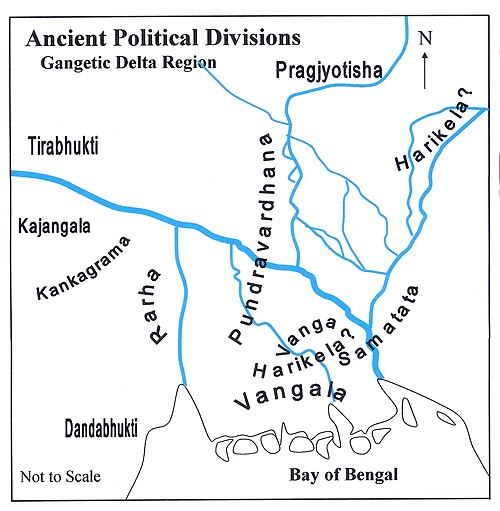
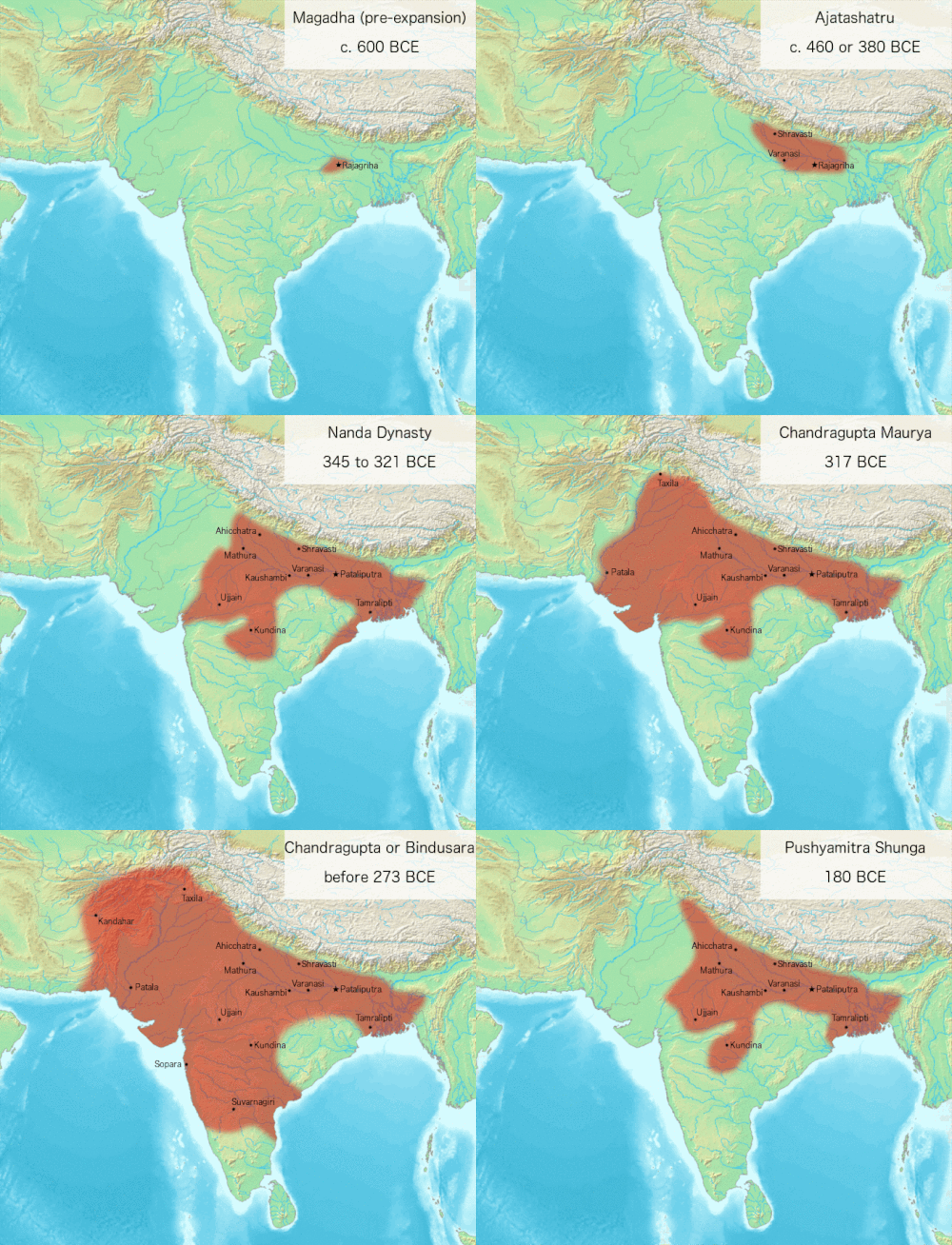
By section 56 of the Government of India Act 1833 (3 & 4 Will. 4. c. lxxxv), it was enacted "that the Executive Government of each of the several Presidencies of Fort William in Bengal, Fort St. George, Bombay, and Agra shall be administered by a Governor and three Councilors, to be styled the Governor-in-Council of the said Presidencies of Fort William in Bengal, Fort St. George, Bombay, and Agra respectively, and that the Governor General of India for the time being shall be Governor of the Presidency of Fort William in Bengal." From this time the governors-general of India held also the separate office of Governor of Bengal, until the year 1854.[49] Under the Charter Act 1853 (16 & 17 Vict. c. 95) the Governor General of India was relieved of his concurrent duties as Governor of Bengal and empowered to appoint a lieutenant-governor from 1854.
1912–1935 – Governors of the Presidency of Fort William in Bengal
Lieutenant-Governors of the Bengal Division of the Presidency of Fort William in Bengal (1854–1912)
Under the Government of India Act 1853 (16 & 17 Vict. c. 95) the Governor-General of India was relieved of his concurrent duties as Governor of the Presidency of Fort William in Bengal and a separate Governor was decided to be appointed. Until then a Lieutenant Governor was to be appointed. F. J. Halliday became the first Lieutenant-Governor of Bengal. William Duke served as the last lieutenant governor after which the office was superseded by the restored office of the Governor of the Presidency of Fort William in Bengal in 1912.
Lieutenant-Governors of the North-Western Provinces of the Presidency of Fort William in Bengal (1835–1878)
↑This refers to the 90-member rump legislature that emerged following partition, representing the West Bengali constituencies of the erstwhile Bengal Legislative Assembly. It was constituted under the Government of India Act 1935, not the Indian Constitution, which was still in the process of being drafted.[54]
↑A number in parentheses indicates that the incumbent has previously held office.
↑While the tenures have been primarily sourced to a list on the West Bengal Legislative Assembly website,[53] obvious errors (mainly around the 1969–71 period) have been corrected with the help of a historical essay from the same website.[54]
↑Until March 1952, Roy did not represent any constituency. For his last three months in office, during the Third Assembly, Roy represented Chowringhee constituency.
↑Following the promulgation of the Constitution of India, the provincial assembly carried on as the legislative assembly of West Bengal until fresh elections could be organised in 1952.[54]
↑According to some sources, Sen also acted as interim chief minister during 2–8 July 1962.[56]
12345Under Article 356 of the Constitution of India, President's rule may be imposed when the "government in a state is not able to function as per the Constitution", which often happens because no party or coalition has a majority in the assembly. When President's rule is in force in a state, its council of ministers stands dissolved. The office of chief minister thus lies vacant, and the administration is taken over by the governor, who functions on behalf of the central government. At times, the legislative assembly also stands dissolved.[57]
↑For the first 16 months Mamata Banerjee headed a coalition government that included ministers from Trinamool and the INC. After Trinamool quit the United Progressive Alliance on 22 September 2012, INC members resigned from her ministry, which has consisted of only Trinamool members ever since.[58]
↑Immediately after Sheikh Mujibur Rahman’s assassination, Major Dalim announced over Radio Bangladesh that Martial Law had been declared and that Khandaker Mostaq Ahmad was President. This was the first declaration of Martial Law in Bangladesh. However, it was more of a coup proclamation than a formally structured martial law order. Courts, Parliament, and the Constitution were not abolished.
↑Also Chief Martial Law Administrator (29 November 1976 – 6 April 1979).
↑Served as Chief Martial Law Administrator until 30 March 1984.
↑By the proclamation of Martial Law by Hussain Muhammad Ershad in 24 March 1982, President of the head of state and CMLA was the head of government declaring "the President would not exercise any power… without the advice or approval of the CMLA" & "The Chief Martial Law Administrator shall be the Chief Executive and head of the Government"
↑Although never formally holding the office of Chief Adviser or Prime Minister, General Moeen U Ahmed exercised practical control over Bangladesh’s caretaker government during 2007–2008. He was instrumental in persuading President Iajuddin Ahmed to declare a state of emergency on 11 January 2007 and influenced key appointments, including the installation of Fakhruddin Ahmed as Chief Adviser. Under his military-backed oversight, the government extended beyond its constitutionally mandated three-month tenure, pursued political reforms, and oversaw the 29 December 2008 general election, effectively making him the de facto head of government during this period.
↑"Gangaridai". Banglapedia. Archived from the original on 28 February 2022. Retrieved 28 February 2022.
↑"Sena Dynasty". Banglapedia. Retrieved 8 January 2025.
↑"Deva Dynasty". Banglapedia. Archived from the original on 8 July 2023. Retrieved 8 January 2025.
↑"Bakhtiyar Khalji". Banglapedia. Retrieved 8 January 2025.
↑Majumdar, R. C. (1973). History of Mediaeval Bengal. Calcutta: G. Bharadwaj & Co. pp.1–2. OCLC1031074. Tradition gives him credit for the conquest of Bengal but as a matter of fact he could not subjugate the greater part of Bengal ... All that Bakhtyār can justly take credit for is that by his conquest of Western and a part of Northern Bengal he laid the foundation of the Muslim State in Bengal. The historians of the 13th century never attributed the conquest of the whole of Bengal to Bakhtyār.
↑Arnold, Thomas Walker (1913) [First published 1896]. The Preaching of Islam: A History of the Propagation of the Muslim Faith (2nded.). London: Constable & Company. p.227.
↑Sen, Sailendra (2013). A Textbook of Medieval Indian History. Primus Books. pp.68–102. ISBN978-9-38060-734-4.
12"History". Banglapedia.org. Archived from the original on 29 December 2024. Retrieved 8 January 2025.
↑Nanda, J. N (2005). Bengal: the unique state. Concept Publishing Company. p. 10. 2005. ISBN978-81-8069-149-2. Bengal [...] was rich in the production and export of grain, salt, fruit, liquors and wines, precious metals, and ornaments besides the output of its handlooms in silk and cotton. Europe referred to Bengal as the richest country to trade with.
↑"Iliyas Shah". Banglapedia. Archived from the original on 6 January 2022. Retrieved 8 January 2025.
↑"Husain Shah". Banglapedia. Archived from the original on 22 June 2024. Retrieved 8 January 2025.
↑"The Mahabharata of Krishna-Dwaipayana Vyasa" Translated into English Prose, Bharata Press, Calcutta (1883–1896)
↑"West Bengal | History, Culture, Map, Capital, & Population | Britannica". Encyclopedia Britannica. Archived from the original on 17 April 2021. Retrieved 17 April 2021.
↑Hossain, Md. Mosharraf (2006). Mahasthan: Anecdote to History. Dibyaprakash. pp.69, 73. ISBN984-483-245-4.
↑Ghosh, Suchandra. "Pundravardhana". Banglapedia. Asiatic Society of Bangladesh. Archived from the original on 23 June 2017. Retrieved 10 November 2007.
↑Klidsa; Mallinatha. Sajvan; Kle, M. R. (Moreshvar Ramchandra) (1922). The Raghuvamsa of Kalidasa: with the commentary (the Samjivani) of Mallinatha; Cantos I-X; edited with a literal English translation, copious notes in Sanskrit and English, and various readings &c. &c. by M.R. Kale. Robarts - University of Toronto. Bombay: P.S. Rege.
↑Jha, M. (1997). "Hindu Kingdoms at contextual level". Anthropology of Ancient Hindu Kingdoms: A Study in Civilizational Perspective. New Delhi: M.D. Publications Pvt. Ltd. pp.27–42. ISBN9788175330344.
↑Kamal Kant Jha; Pt. Sri ganeshrai Vidyabhushan; Dhanakar Thakur. "A Brief History of Mithila State Bihar Articles". Archived from the original on 1 March 2012. Retrieved 10 January 2008.
↑Encyclopaedia of Hinduism. Nagendra Kumar Singh, p. 3239.
↑Raychaudhuri, Hemchandra (1972), Political History of Ancient India, University of Calcutta, Calcutta, pp. 106–113, 186–90
↑"History". Banglapedia. Archived from the original on 29 September 2017. Retrieved 23 September 2017. Shah-i-Bangalah, Shah-i-Bangaliyan and Sultan-i-Bangalah
↑Wicks, Robert S. (1995). Money, Markets, and Trade in Early Southeast Asia: The Development of Indigenous Monetary Systems to AD 1400. Cornell University Press. p.87. ISBN978-1-5017-1947-9. Archived from the original on 25 December 2023. Retrieved 12 October 2021.
↑Johnston, E. H. (1944). "Some Sanskrit Inscriptions of Arakan". Bulletin of the School of Oriental and African Studies, University of London. 11 (2): 357–385. doi:10.1017/S0041977X00072529. ISSN0041-977X. JSTOR609320. S2CID191758063.
↑Laloo, Betty (20 July 2016). "III: Early Jaintia State Formation"(PDF). Reconstructing the early Jaintia state through oral traditions (PhD). North-Eastern Hill University. Archived(PDF) from the original on 25 December 2023. Retrieved 13 October 2021.
↑"Jaintia Hills-Land of Myths and Legends". Mesmerizing Meghalaya. Archived from the original on 12 August 2020.
↑Mallik, Abhaya Pada (1921). History of Bishnupur-Raj: An Ancient Kingdom of West Bengal. Abhaya Pada Mallik. pp.128–130. Archived from the original on 25 December 2023. Retrieved 11 March 2016.
↑Dilip Kumar Ganguly (1994). Ancient India, History and Archaeology. Abhinav. pp.33–41. ISBN978-81-7017-304-5. Archived from the original on 2 February 2023. Retrieved 26 May 2022.
↑Susan L. Huntington (1984). The "Påala-Sena" Schools of Sculpture. Brill Archive. pp.32–39. ISBN90-04-06856-2. Archived from the original on 25 December 2023. Retrieved 26 May 2022.
↑Ahmed, ABM Shamsuddin (2012). "Iltutmish". In Islam, Sirajul; Jamal, Ahmed A. (eds.). Banglapedia: National Encyclopedia of Bangladesh (Seconded.). Asiatic Society of Bangladesh. Archived from the original on 3 July 2015. Retrieved 26 October 2015.
↑Nasir, Noman. “Nasir Al-Din Muhammad - A New Sultan of Bengal.” Journal of the Oriental Numismatic Society, 2010
↑Nasir N, Islam MS (2014) Siraj al-Din ‘Sikandar’ (?) Shah – a new ruler of the Bengal Sultanate. J Orient Numismat Soc 220:39–40
↑Nasir N, Islam MS (2014) Siraj al-Din ‘Sikandar’ (?) Shah – a new ruler of the Bengal Sultanate. J Orient Numismat Soc 220:39–40
↑Encyclopedia Of Bangladesh (Set Of 30 Vols.) By Nagendra Kr. Singh
↑Karim, Abdul (2012). "Muhammad Azam, Prince". In Islam, Sirajul; Jamal, Ahmed A. (eds.). Banglapedia: National Encyclopedia of Bangladesh (Seconded.). Asiatic Society of Bangladesh. Archived from the original on 13 January 2016. Retrieved 26 October 2015.
↑"Princess Daisy of Pless: The Happy Years. An exhibition at Castle Pless". www.rvondeh.dircon.co.uk. Archived from the original on 25 April 2009. Retrieved 13 October 2021.
↑Rāẏa, Suprakāśa (1999). Peasant Revolts And Democratic Struggles In India. ICBS (Delhi). p.24. ISBN978-81-85971-61-2. Retrieved 29 October 2015.
↑Sharma, Virendra Nath (1995), Sawai Jai Singh and His Astronomy, Motilal Banarsidass Publ., pp.8–9, ISBN978-81-208-1256-7
↑Paul, Gautam. "Murshidabad History – Hassan Ali". murshidabad.net. Archived from the original on 1 September 2016. Retrieved 9 October 2016.
↑East India Company (1807). Papers Presented to the House of Commons Concerning the Late Nabob of the Carnatic. p.118. Archived from the original on 20 October 2022. Retrieved 24 September 2021.
↑Paul, Gautam. "Murshidabad History – Waresh Ali". murshidabad.net. Archived from the original on 22 March 2017. Retrieved 9 October 2016.
12Mahato, Sukumar (20 August 2014). "Murshidabad gets a Nawab again, but fight for assets ahead". The Times of India. Archived from the original on 26 April 2015. Retrieved 14 June 2015.
12"Portrait of an accidental Nawab". The Times of India. 22 August 2014. Archived from the original on 23 August 2014. Retrieved 14 June 2015.
↑George VI retained the title "Emperor of India" until 22 June 1948.
↑Vickers, Hugo (2006), Elizabeth: The Queen Mother, Arrow Books/Random House, p.175, ISBN978-0-09-947662-7
↑"frederick - THE BANGABHABAN: The President House of Bangladesh". web.archive.org. 9 April 2013. Retrieved 21 February 2025.
↑Appendix to the Journal of the House of the Representatives. p.51. [25th June, 1912] WHEREAS His Majesty has been pleased to appoint a Governor of the Presidency of Fort William in Bengal as delimited by a Proclamation made by the Governor - General in Council, and dated the twenty second day of ...
↑"Senior Advocate Jagdeep Dhankhar Made West Bengal Governor". www.livelaw.in. 20 July 2019. Archived from the original on 20 July 2019. Retrieved 24 December 2019.
12345The Legislature in West Bengal—Its Origin and GrowthArchived 11 December 2024 at the Wayback Machine. West Bengal Legislative Assembly. Retrieved on 14 August 2024.
↑Brief Information on Previous Assemblies. West Bengal Legislative Assembly. Archive link from 12 March 2016.
↑List of Chief Ministers of West Bengal. Panchayat & Rural Development Department, Hooghly. Retrieved on 27 July 2018. Archived on 27 July 2018.
↑Amberish K. Diwanji. "A dummy's guide to President's rule". Rediff.com. 15 March 2005. Archived on 16 August 2017.
↑"Six Congress ministers resign from Mamata government in Bengal". 22 September 2012. Archived from the original on 7 August 2024. Retrieved 10 August 2024.
↑Schottli, Jivanta; Mitra, Subrata K.; Wolf, Siegried (2015). A Political and Economic Dictionary of South Asia. Routledge. ISBN978-1-135-35576-0. Archived from the original on 27 February 2022. Retrieved 6 November 2015.
12১৯৭১ সাল থেকে ০৭-০১-২০১৯ গণপ্রজাতন্ত্রী বাংলাদেশের রাষ্ট্রপতি, উপ-রাষ্ট্রপতি, প্রধানমন্ত্রী ও মন্ত্রিপরিষদের সদস্যবৃন্দ. Cabinet Division. Archived from the original on 12 August 2024. Retrieved 12 August 2024.
↑Schottli, Jivanta; Mitra, Subrata K.; Wolf, Siegried (2015). A Political and Economic Dictionary of South Asia. Routledge. ISBN978-1-135-35576-0. Retrieved 6 November 2015.
↑Kolbert, Elizabeth (6 October 1985). "Abdus Sattar, Ex-Leader of Bangladesh, Dies". The New York Times. Bangladesh. Archived from the original on 3 April 2019. Retrieved 6 November 2015.
↑Ahmed, Salahuddin (2004). Bangladesh: Past and Present. APH. ISBN978-81-7648-469-5. Archived from the original on 27 February 2022. Retrieved 6 November 2015.
↑"Mohammadullah, Mohammad". Banglapedia. Archived from the original on 29 March 2019. Retrieved 6 November 2015.
↑"Vice President Named By Bangladesh Leader". The New York Times. Bangladesh. Reuters. 1 December 1986. Archived from the original on 17 November 2015. Retrieved 6 November 2015.
↑"প্রধানমন্ত্রী শেখ হাসিনার নেতৃত্বাধীন মন্ত্রিসভা - ১২-০১-২০১৪ থেকে ০৭-০১-২০১৯ পর্যন্ত"[The cabinet led by Prime Minister Sheikh Hasina - From 12-01-2014 to 07-01-2019](PDF). www.cabinet.gov.bd. Archived from the original(PDF) on 18 February 2022. Retrieved 1 July 2026.
12Bari, Dr. M. Ershadul (1989). "THE IMPOSITION OF MARTIAL LAW IN BANGLADESH, 1975: A LEGAL STUDY". The Dhaka University Studies. Archived from the original on 31 August 2024.
↑Sayem, Abusadat Mohammad (1988). At Bangabhaban: Last Phase. Hakkani Publishers. p.40. ISBN984-410-088-7.
↑"Who Is Waker-Uz-Zaman, Army General To Take Bangladesh Charge". NDTV.com. Archived from the original on 17 September 2024. Retrieved 21 September 2025.
Sources
Dasgupta, Gautam Kumar; Biswas, Samira; Mallik, Rabiranjan (2009). Heritage Tourism: An Anthropological Journey to Bishnupur. A Mittal Publication. p.21. ISBN978-8183242943.