

数学では、 0.999... (0.9、0とも表記されます。)、または0.(9) )は、数列(0.9、0.99、0.999、...)のどの数よりも大きい最小の数を表します。この数が1であることが証明できます。つまり、

よくある誤解にもかかわらず、0.999... は「ほぼ 1」でも「非常に 1 に近いが、完全に 1 ではない」でもありません。むしろ、0.999... と「1」はまったく同じ数値です。
以下に、初等算術と、1/10 nより小さい正の実数は存在しないという事実のみを使用する基本的な証明を示します。ここでnは自然数であり、この性質は実数のアルキメデスの性質から直接生じます。
この等式を示す方法は、直感的な議論から数学的に厳密な 証明まで、他にもたくさんあります。直感的な議論は一般に、証明なしに無限小数に拡張される有限小数の特性に基づいています。証明は一般に、実数の基本的な特性と、級数や極限などの微積分法に基づいています。数学教育で研究されている問題は、なぜ一部の人々がこの等式を否定するのかということです。
他の数値システムでは、0.999... は同じ意味、異なる定義、または未定義になることがあります。ゼロ以外のすべての末尾の小数には、2 つの等しい表現があります (たとえば、8.32000... と 8.31999...)。複数の表現を持つ値を持つことは、実数を表す すべての位置数値システムの特徴です。
基本的な証明

級数や極限などのより高度なトピックを参照することなく、 (有限)小数の比較と加算という数学的ツールだけを使用して、方程式0.999... = 1を証明することができます。以下に示す証明は、数直線上に 0.9、0.99、0.999 などを描くと、それらと 1 の間には数字を置く余地がないという直感的な事実を直接形式化したものです。表記 0.999... の意味は、数直線上で 0.9、0.99、0.999 などのすべての数字の右側にある最小の点です。最終的には 1 とこれらの数字の間には余地がないため、点 1 がこの最小の点である必要があり、したがって0.999 ... = 1となります。
直感的な説明
数直線上に 0.9、0.99、0.999 などを置くと、これらの点はすべて 1 の左側にあり、1 にどんどん近づいていることがすぐにわかります。1未満の任意の数について、0.9、0.99、0.999 などの数列は最終的に よりも大きな数に達します。したがって、0.999... を 1 未満の任意の数と同一視することは意味がありません。一方、1 より大きいすべての数は、有限個の 9 に対して 0.999...9 という形式の任意の小数よりも大きくなります。したがって、0.999... は 1 より大きい任意の数と同一視することもできません。0.999... は 1 より大きくも小さくもならないため、実数であるためには 1 に等しくなければなりません。[1] [2]

厳密な証明
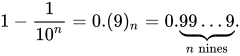
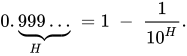
0.(9) nで小数点以下の9を持つ数0.999...9を表します。したがって、 0.(9) 1 = 0.9、0 . (9) 2 = 0.99、0 . (9) 3 = 0.999、などとなります。1 − 0.(9) 1 = 0.1 = 、1 − 0.(9) 2 = 0.01 = 、などとなります。つまり、すべての自然数 に対して1 − 0.(9) n = となります。


を1以下かつ0.9、0.99、0.999などより大きい数とします。つまり、すべての に対して、0 . ( 9 ) n < ≤ 1となります。これらの不等式を1から引くと、 0 ≤ 1 − < となります。

証明の最後では、すべての に対してより小さい正の数は存在しないことが求められます。これは、実数に対して真であるアルキメデスの性質の1つのバージョンです。 [3] [4]
この特性は、上記の左不等式が厳密ではないことを意味します。つまり、= 1であり、1 は 0.9、0.99、0.999 などのすべてより大きい最小の数値です。つまり、1 = 0.999...です。
この証明は、有理数と実数のアルキメデスの性質に依存しています。実数は、無限に小さい数(無限小)と無限に大きな数(無限数)を含む超実数などの数体系に拡張できます。[5] [6]このようなシステムを使用する場合、すべての0.999...という表記は一般に使用されません。これは、0.(9) nより大きい数の中で最小の数が存在しないためです。[a]
最小上限と完全性
この議論が示していることの一部は、数列 0.9、0.99、0.999 などに最小の上限が存在するということです。これは、数列のすべての項よりも大きい最小の数値です。実数系の公理の1 つに完全性公理があり、これはすべての有界数列には最小の上限が存在すると述べています。[7] [8] この最小の上限は、無限小数展開を定義する 1 つの方法です。無限小数で表される実数は、その有限切り捨ての最小の上限です。[9] ここでの議論では、完全性が有効であると仮定する必要はありません。なぜなら、この特定の有理数数列には最小の上限があり、この最小の上限は 1 に等しいことを示しているからです。
代数的議論
1 = 0.999... であることを示唆する代数的議論が数多く提示されています。これらは通常、有限小数の加算と乗算の規則が無限小数にまで拡張されるという仮定に基づいているため、な数学的証明ではありません。これらの規則を無限小数に拡張することは直感的で正しいですが、正当化が必要です。
等式の単純な代数的説明は、教育上の議論や批評の対象です。Byers (2007) は、小学校では= 0.333...と教えられるため、重要な微妙な点をすべて無視して、この等式に 3 を「掛ける」と、1 = 0.999...になるという議論について論じています。さらに、等号の意味に関する曖昧さが解決されていないため、この議論は説得力がないと述べています。生徒は、「数字 1 が、表記法 0.999... によって意味される数字と同一であることを意味しているわけではないことは確かだ」と考えるかもしれません[10]リッチマン (1999) は、「この議論は、ほとんどの人が最初の方程式を何も考えずに受け入れるように教え込まれているという事実からその力を得ている」と論じているが、この議論によって懐疑論者がこの仮定に疑問を抱くようになる可能性もあると示唆している。[11]

バイアーズ氏は次のような議論も展開している。
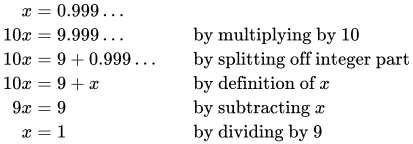
最初の議論を受け入れなかった学生が2番目の議論を受け入れることもあるが、Byersの意見では、まだ曖昧さは解決されておらず、したがって無限小数の表現を理解していない。Peressini & Peressini (2007) も同じ議論を提示し、それが等式を説明できないとも述べており、そのような説明には無限と完全性の概念が含まれる可能性が高いことを示している。[12] Baldwin & Norton (2012) は、Katz & Katz (2010a) を引用して、このような議論に基づく、極限という正式な概念のない恒等式の扱いは時期尚早であると結論付けている。[13] Cheng (2023) もこれに同意し、小数点をずらすことで 0.999... を 10 倍にできることを知っているということは、0.999... という式にそもそも意味を与える方法というより深い疑問に対する答えを前提としていると主張している。[14]
同じ議論はリッチマン(1999)によってもなされており、懐疑論者はがキャンセル可能かどうか 、つまり両辺から減算することに意味があるかどうか疑問に思うかもしれないと指摘している。[11]
解析的証明
実解析は、実数列や実数級数の挙動を含む微積分の論理的基礎を研究する学問です。 [15]このセクションの証明では、実解析でよく知られている手法を使用して、0.999... = 1 を証明します。
無限級数とシーケンス
小数展開の一般的な展開は、それを無限級数の和として定義することです。一般的には、

0.999...については、幾何級数に関する収束定理を適用して、 < 1ならば次のようになると述べることができる: [16]


0.999...は と公比となるため、この定理は次のような疑問を簡単に解決します。 この証明は、1770年にレオンハルト・オイラーの『代数学原論』 にすでに登場しています。[17]



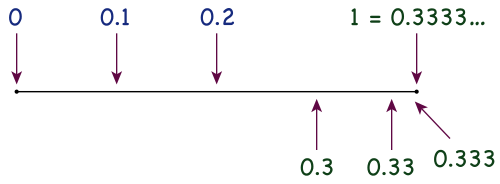
等比級数の和自体はオイラーよりも古い結果である。18世紀の典型的な導出では、上記の代数的証明に似た項ごとの操作が使用され、1811年になっても、ボニーキャッスルの教科書「代数入門」では、0.999... に対する同じ操作を正当化するために、等比級数に対するそのような議論が使用されていた。[18] 19世紀には、このような自由な加算方法に対する反発から、今日でも支配的な定義が生まれた。級数の和は、その部分和のシーケンスの極限として定義される。この定理の対応する証明では、そのシーケンスを明示的に計算する。これは、証明に基づく微積分学や解析学の入門書ならどこでも見つけることができる。[19]
数列( 、、、...)は 、距離が増加するにつれて任意に小さくなる場合、その値を極限とします。0.999... = 1というステートメント自体は、極限として解釈および証明できます。[b] 最初の 2 つの等式は、記号の省略定義として解釈できます。残りの等式は証明できます。 が無限大 ( )に近づくにつれて 10 n が0 に近づくという最後のステップは、実数のアルキメデスの性質によって正当化されることがよくあります。 0.999... に対するこの極限に基づく態度は、より刺激的であるが正確ではない言葉で表現されることがよくあります。たとえば、1846 年の教科書The University Arithmeticでは、「.999 + を無限大まで続けると = 1 になります。9 が追加されるたびに、値が 1 に近づくためです」と説明されています。 1895年の『学校算数』には、「9を大量に取ると、1と.99999...の差は考えられないほど小さくなる」と書かれている。[20]このような経験則は、学生によって、0.999...自体が1より小さいと誤って解釈されることが多い。[21]




ネストされた区間と最小上限
上記の級数定義は、小数展開によって名前が付けられた実数を定義します。相補的なアプローチは、反対のプロセスに合わせて調整されます。つまり、与えられた実数に対して、その名前の小数展開を定義します。
実数が閉区間[0, 10]内にあることが分かっている場合(つまり、0 以上 10 以下)、その区間を、端点のみで重なり合う 10 個の部分に分割することが考えられます。[0, 1]、[1, 2]、[2, 3]など[9, 10]までです。その数はこれらのいずれかに属している必要があります。 [2, 3]に属している場合は、数字「2」を記録し、その区間を[2, 2.1]、[2.1, 2.2]、...、[2.8, 2.9]、[2.9, 3]に細分化します。このプロセスを続けると、無限の数字のシーケンス 、 、 、... でラベル付けされた、ネストされた区間の無限シーケンスが生成され、次のように書きます。


この形式主義では、恒等式1 = 0.999...および1 = 1.000...は、それぞれ 1 が[0, 1]と[1, 2]の両方に存在するという事実を反映しているため、その桁を見つけるときにどちらかの部分区間を選択できます。この表記法で "=" 記号が乱用されないようにするには、各小数に対して一意の実数を再構築する方法が必要です。これは極限で行うことができますが、他の構成は順序付けのテーマを継続します。[22]
1 つの簡単な選択肢は、入れ子区間定理です。これは、長さが任意に小さくなる入れ子になった閉区間のシーケンスが与えられた場合、区間の交差にちょうど 1 つの実数が含まれることを保証します。したがって、、、、 ... は、 [ 、+ 1]、[ 、+ 0.1]などのすべての区間内に含まれる一意の数として定義されます。したがって、 0.999... は、すべての有限の 9 の文字列に対して、すべての区間[0, 1]、[0.9, 1]、[0.99, 1]、[0.99...9, 1]に含まれる一意の実数です。1 はこれらの各区間の要素であるため、0.999... = 1です。[23]


ネストされた区間定理は、通常、実数のより基本的な特性、すなわち最小上限または上限の存在に基づいています。これらのオブジェクトを直接利用するには、 ... を近似値の集合 , , , ... の最小上限として定義します。[24]次に、この定義 (またはネストされた区間の定義) が細分化手順と一致していることを示すことができ、0.999... = 1 が再び示されます。トム・アポストルは、「実数が 2 つの異なる 10 進表現を持つ可能性があるという事実は、2 つの異なる実数集合が同じ上限を持つ可能性があるという事実を反映しているにすぎない」と結論付けています。[25]


実数の構成からの証明
いくつかのアプローチでは、公理的集合論を用いて、実数を有理数の上に構築された特定の構造として明示的に定義しています。自然数{0, 1, 2, 3, ...}は0 から始まり、すべての数に後続の数が存在するように上向きに続きます。自然数を負の数で拡張するとすべての整数が得られ、さらに比に拡張すると有理数が得られます。これらの数体系には、加算、減算、乗算、除算の算術が伴います。[26] [27]より微妙なことに、これらには順序付けが含まれており、ある数を別の数と比較し、別の数より小さい、大きい、または等しいことを検出できます。[28]
有理数から実数へのステップは大きな拡張である。このステップを達成するには、少なくとも 2 つの一般的な方法があり、どちらも 1872 年に発表された。デデキント切断とコーシー数列である。これらの構成を直接使用する0.999... = 1の証明は、実解析の教科書には記載されていない。実解析では、ここ数十年の傾向として、公理的解析を使用するようになっている。構成が提示された場合でも、通常は実数の公理を証明するために適用され、それが上記の証明を裏付ける。しかし、複数の著者は、構成から始める方が論理的に適切であり、結果として得られる証明はより自己完結的であるという考えを示している。[c]
デデキントカット
デデキントカットのアプローチでは、各実数は 未満のすべての有理数の無限集合として定義されます。[d]特に、実数 1 は 1 未満のすべての有理数の集合です。[e]すべての正の小数展開は、デデキントカット、つまり展開のある段階よりも小さい有理数の集合を簡単に決定します。したがって、実数 0.999... は、< 0、または< 0.9、または< 0.99、または次の形式の他の数よりも小さい有理数の集合です[29]

0.999...のすべての要素は1未満なので、実数1の要素です。逆に、1のすべての要素は有理数であり、 および で表すことができます。これは 、およびを 意味します。


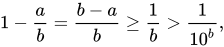
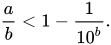
上記の定義により 、1 のすべての要素は 0.999... の要素でもあり、0.999... のすべての要素は 1 の要素でもあるという上記の証明と組み合わせると、集合 0.999... と 1 は同じ有理数を含み、したがって同じ集合、つまり0.999... = 1になります。

実数をデデキント切断として定義することは、1872年にリチャード・デデキントによって初めて発表されました。[30] 上記の各小数展開に実数を割り当てるアプローチは、数学雑誌に掲載されたフレッド・リッチマンの「 0.999 ... = 1か?」という解説論文によるものです。[11]リッチマンは、有理数の任意の稠密な部分集合でデデキント切断を行っても同じ結果が得られると指摘しています。特に、彼は証明がより直接的な小数を使用しています。彼はまた、定義によっては通常、 { | < 1} は切断できますが、{ | ≤ 1}は切断できません(またはその逆) と指摘しています。[31]この手順をさらに変更すると、2つが等しくない異なる構造になります。これは一貫していますが、小数算術の一般的な規則の多くは適用されなくなります。たとえば、分数には表現がありません。以下の§ 代替数体系を参照してください。
コーシー列
もう一つのアプローチは、実数を有理数のコーシー列の極限として定義することです。この実数の構成では、有理数の順序付けをあまり直接的には使用しません。まず、との距離は絶対値 として定義されます。ここで、絶対値はと の最大値として定義されるため、負になることはありません。次に、実数は、この距離を使用してコーシー列の性質を持つ有理数の列として定義されます。つまり、自然数から有理数へのマッピングである列 , , , ... において、任意の正の有理数に対して、すべての に対してとなるようなが存在し、項間の距離は任意の正の有理数よりも小さくなります。[32]


と が2 つのコーシー数列である場合、数列の極限が 0 であれば、それらは実数として等しいと定義されます。小数 ... を切り捨てると、コーシーである有理数列が生成されます。これは、数の実数値を定義するために使われます。[33]したがって、この形式では、有理数列に 極限 0 があることを示すことが課題となります 。数列の 番目の項、 を考慮すると、次のことが示されなければなりません 。これは、極限の定義 によって証明できます。したがって、0.999... = 1です。[34]


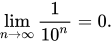
実数をコーシー列として定義することは、 1872年にエドゥアルト・ハイネとゲオルク・カントールによって別々に初めて発表されました。 [30] 0.999... = 1の証明を含む上記の小数展開のアプローチは、グリフィスとヒルトンの1970年の著書「古典数学の包括的な教科書:現代的な解釈」に密接に従っています。[35]
無限小数表現
中等学校の数学教育では、実数は整数とそれに続く小数点、および任意の実数の小数部を表す文字列として書き出された無限列を使用して数を定義することによって構築されるのが一般的です。この構築では、整数と小数点(または 10 進法以外のシステムでは小数点)の後の数字の任意の組み合わせの集合が実数の集合です。この構築は、1 = eq 0.999...を定義する集合に対して同値関係を定義した後、すべての実数公理を満たすことが厳密に示されます。また、末尾に 9 が付くバージョンの小数文字列に有限個の非ゼロ項のみを持つ他の非ゼロ小数に対しても同値関係を定義します。[36]この実数の構築により、「 1 = 0.999 ...」というステートメントのすべての証明は、実数に対して任意の演算を実行するときに暗黙的に等式を仮定していると見なすことができます。
密な順序
この問題を解決できる概念の 1 つは、実数が密に順序付けられている必要があるという要件です。密に順序付けられているとは、集合の 2 つの要素の間に新しい要素が厳密に存在しない場合、2 つの要素は等しいと見なされることを意味します。したがって、0.99999... が 1 と異なる場合、その間に別の実数が存在する必要がありますが、そのような実数は存在しません。つまり、2 つのうちの 1 桁を変更しても、そのような数を得ることはできません。[37]
一般化
0.999... = 1という結果は、2つの方法で簡単に一般化できます。まず、有限の10進数表記(つまり、末尾に無限に続く0)を持つすべての非ゼロ数には、末尾に9が続く対応する数があります。たとえば、0.24999...は、検討した特別なケースとまったく同じように、0.25に等しくなります。これらの数はまさに10進小数であり、密です。[38] [9]
第二に、各基数または基数において同等の定理が適用される。例えば、基数 2 ( 2進数記数法) では 0.111... は 1 に等しく、基数 3 ( 3進数記数法) では 0.222... は 1 に等しい。一般に、任意の終端基数式には、末尾の数字が繰り返され、それが− 1に等しい対応する式が存在する。実解析の教科書では、0.999... の例を省略し、これらの一般化の1つまたは両方を最初から提示する傾向がある。[39]

1 の代替表現は、非整数基数でも発生します。たとえば、黄金比基数では、2 つの標準的な表現は 1.000... と 0.101010... であり、隣接する 1 を含む表現は無限に多く存在します。一般に、 1 と 2 の間のほぼすべてについて、1 の 基数展開は無数に存在します。対照的に、1 より大きいすべての自然数を含む は依然として無数に存在し、それらに対しては、自明な 1.000... を除いて、1 の基数展開は 1 つしかありません。この結果は、1990 年頃にPaul Erdős、Miklos Horváth、István Joó初めて得られました。1998年に Vilmos Komornik とPaola Loreti は、そのような最小の基数であるKomornik–Loreti 定数= 1.787231650... を決定しましたこの基数では、1 = 0.11010011001011010010110011010011...であり、数字はThue-Morse数列で表され、繰り返されない。[40]

より広範囲な一般化は、最も一般的な位取り記数法を扱うものである。それらにも複数の表現法があり、ある意味では困難さはさらに深刻である。例えば:[41]
- バランスのとれた3元システムでは、= 0.111... = 1. 111 ... です。
- 逆階乗法(小数点以下の桁に 2!、3!、4!、... を使用する)では、 1 = 1.000... = 0.1234... となります。

ペトコフシェク(1990)は、すべての実数に名前を付ける任意の位置システムについて、複数の表現を持つ実数の集合は常に稠密であることを証明した。彼はその証明を「基本的な点集合位相の有益な演習」と呼んでいる。それは、位置値の集合をストーン空間として見て、それらの実数表現が連続関数によって与えられることに気づくことを含む。[42]
アプリケーション
0.999...を1の表現として応用した例の一つは、初等整数論である。1802年、H.グッドウィンは、分母が特定の素数である分数の循環小数表現に9が現れるという観察を発表した。 [ 43]例としては、次のものがある。
- = 0. 142857であり、142 + 857 = 999です。
- = 0. 01369863であり、0136 + 9863 = 9999 です。


E. ミディは、現在ミディの定理と呼ばれている、そのような分数に関する一般的な結果を1836年に証明しました。この出版物は不明瞭で、彼の証明が直接 0.999... に関係していたかどうかは不明ですが、ウィリアム G. リーヴィットによる少なくとも1つの現代の証明では関係しています。 ... という形式の小数が正の整数であることが証明できれば、それは 0.999... でなければならないことが証明され、それが定理の 9 の源となります。[44]この方向の研究は、最大公約数、モジュラー算術、フェルマー素数、群の要素の順序、および二次の相互性などの概念の動機付けになります。[45]


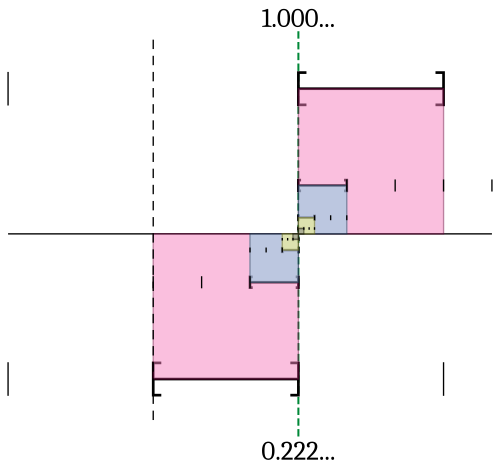
実解析に戻ると、3 を底とする類似物0.222... = 1 は、最も単純なフラクタルの 1 つである中間 3 分の1 カントール集合の特徴付けにおいて重要な役割を果たします。単位区間内の点は、数字 0 と 2 のみを使用して 3 進法で表すことができる場合にのみ、カントール集合内にあります。
表現の 番目の数字は、構築の 番目の段階における点の位置を反映しています。たとえば、その点は最初の削除の右側にあり、その後のすべての削除の左側にあるため、通常の表現では 0.2 または 0.2000... となります。その点は、最初の削除の左側にあり、その後のすべての削除の右側にあるため、0.1 ではなく 0.0222... と表現されます。[46]

9 の繰り返しは、ゲオルク・カントールの別の著作にも登場する。1891年の対角線論法を10 進展開に適用して単位区間の非可算性の有効な証明を構築するには、これらを考慮する必要がある。このような証明では、10 進展開に基づいて特定の実数のペアが異なることを宣言できる必要があるため、0.2 と 0.1999 のようなペアは避ける必要がある... 簡単な方法では、すべての数を非終端展開で表す。反対の方法で、9 の繰り返しは排除される。[f]カントールの元の議論に近いかもしれない変種では、基数 2 を使用し、基数 3 の展開を基数 2 の展開に変換することで、カントール集合の非可算性も証明できる。[47]
教育に対する懐疑論
数学の学生は、0.999... と 1 が等しいことをしばしば否定します。その理由は、それらの見た目の相違から、極限の概念に対する深い疑念、無限小の性質に関する意見の不一致まで多岐にわたります。混乱を引き起こす共通の要因は多数あります。
- 学生はしばしば「数字は小数でただ 1 つの方法でしか表せないという考えを心に留めている」。明らかに異なる 2 つの小数が同じ数字を表すのを見ると、矛盾が生じ、一見よく理解されている数字 1 の出現によってそれが増幅される。[g]
- 学生の中には、「0.999...」(または同様の表記)を、おそらく可変で不特定の長さを持つ、大きいが有限の9の列と解釈する人もいます。彼らが9の無限の列を受け入れたとしても、彼らは最後の9が「無限大」にあると予想するかもしれません。[48]
- 直感とあいまいな教え方によって、生徒は数列の限界を固定値ではなく、一種の無限過程と考えるようになる。数列は必ずしも限界に達する必要はないからである。生徒が数列とその限界の違いを受け入れると、「0.999...」を数列の限界ではなく、数列そのものを意味するものとして読むかもしれない。[49]
これらの考え方は、標準的な実数の文脈では誤りですが、一般的な数学的有用性のために考案されたか、0.999...をよりよく理解するための教育的な反例として、他の数値システムでは有効なものもあります。以下の§ 代替数値システム を参照してください。
これらの説明の多くは、大学の学生たちと遭遇した誤解につながる教育と認知の特性を研究してきたデイビッド・トールによって発見された。大多数の学生が最初にこの等式を拒否した理由を突き止めるために学生たちにインタビューしたところ、「学生たちは0.999を、固定値ではなく、1にどんどん近づいていく数字の列として考え続けた。なぜなら、『何桁あるか指定していない』、または『1より小さい最も近い小数である』からだ」ということが判明した。[21]
0.333... =に 3を掛けるという基本的な議論は、気が進まない生徒に 0.999... = 1 であると信じ込ませることができます。それでも、最初の式に対する信念と 2 番目の式に対する不信感の矛盾に直面すると、一部の生徒は最初の式を信じなくなるか、単にイライラし始めます。[50]また、より洗練された方法が絶対確実というわけではありません。厳密な定義を適用する能力を十分に備えている生徒でも、0.999... などの高度な数学の結果に驚いたときに、直感的なイメージに頼る場合がありますたとえば、ある実解析の生徒は、上限定義を使用して0.333... =であることを証明できましたが、その後、長除法の以前の理解に基づいて、0.999... < 1 であると主張しました。[51]他の生徒は、 = 0.333...であることを証明できますが、分数の証明に直面すると、「論理」が数学的計算に優先すると主張します。
マズール(2005)は、彼の優秀な微積分の生徒が「授業で私が言ったことのほとんどすべてに異議を唱えたが、計算機に疑問を呈したことは一度もなかった」という話をしており、23の平方根の計算を含め、数学を行うには9桁の数字だけが必要だと信じるようになった。その生徒は、9.99... = 10という限定的な議論に不快感を覚え、「大胆に想像された無限増加プロセス」と呼んだ。[52]
数学学習のAPOS 理論の一部として、Dubinsky ら (2005) は、0.999... を 1 から無限に小さい距離を持つ有限で不確定な文字列として捉える生徒は、「無限小数の完全なプロセス概念をまだ構築していない」と提案しています。0.999... の完全なプロセス概念を持つ他の生徒は、1 のオブジェクト概念のように、そのプロセスを「オブジェクト概念」に「カプセル化」できない可能性があり、そのため、プロセス 0.999... とオブジェクト 1 は互換性がないと見なします。彼らはまた、カプセル化のこの精神的能力を、それ自体の権利として数として見ることと、自然数の集合全体を取り扱うことに結び付けています。[53]
文化現象
インターネットの普及により、0.999... についての議論はニュースグループや掲示板で一般的に行われるようになったが、その多くは数学とはほとんど関係のないものである。ニュースグループsci.mathでは、0.999... についての議論は「人気のあるスポーツ」と表現されており、 FAQで回答されている質問の 1 つとなっている。[54] [55] FAQでは、 、10 の乗算、極限について簡単に説明されており、コーシー数列についても触れている。

2003年版の一般紙コラム「The Straight Dope」では、0.999...の誤解について述べ、その限界について論じている。
私たちの中にある下等霊長類は、それでも抵抗してこう言います。「.999~ は実際には数字ではなく、プロセスを表しています。数字を見つけるにはプロセスを停止する必要がありますが、その時点で .999~ = 1 は崩壊します。ナンセンスです。」[56]
Slateの記事によると、0.999... という概念は「World of Warcraft の掲示板からAyn Rand のフォーラムに至るまで、さまざまな Web サイトで激しく議論されている」とのことです。[57]同様に、0.999... という問題は、Blizzard EntertainmentのBattle.netフォーラムの最初の 7 年間で非常に人気の高い話題となり、同社は2004 年のエイプリル フールに「プレス リリース」を発行して、1 であると発表しました。
私たちは、この問題に決着をつけることができてとてもうれしく思っています。私たちは、.999~ が 1 に等しいかどうかという心痛と懸念を目の当たりにしてきましたが、以下の証明が最終的に、そして決定的に、この問題をお客様のために解決したことを誇りに思います。[58]
次に、限界と 10 倍に基づく 2 つの証明が提示されます。
0.999...は次のような数学ジョークにも登場する。[59]
Q:電球をねじ込むには何人の数学者が必要ですか?
A: 0.999999....
代替の記数法では
実数は非常に便利な数値体系を形成しますが、「0.999...」という表記を実数の名前として解釈するという決定は、結局のところ慣習であり、Timothy Gowers は『数学: 非常に短い入門』の中で、結果として得られる恒等式0.999... = 1 も慣習であると主張しています。
しかし、それは決して恣意的な慣習ではありません。なぜなら、それを採用しないと、奇妙な新しいオブジェクトを発明するか、よく知られた算数のルールのいくつかを放棄するかのいずれかを強いられるからです。[60]
無限小
Some proofs that 0.999... = 1 rely on the Archimedean property of the real numbers: that there are no nonzero infinitesimals. Specifically, the difference 1 − 0.999... must be smaller than any positive rational number, so it must be an infinitesimal; but since the reals do not contain nonzero infinitesimals, the difference is zero, and therefore the two values are the same.
However, there are mathematically coherent ordered algebraic structures, including various alternatives to the real numbers, which are non-Archimedean. Non-standard analysis provides a number system with a full array of infinitesimals (and their inverses).[h] A. H. Lightstone developed a decimal expansion for hyperreal numbers in (0, 1)∗. Lightstone shows how to associate each number with a sequence of digits, indexed by the hypernatural numbers. While he does not directly discuss 0.999..., he shows the real number is represented by 0.333...;...333..., which is a consequence of the transfer principle. As a consequence the number 0.999...;...999... = 1. With this type of decimal representation, not every expansion represents a number. In particular "0.333...;...000..." and "0.999...;...000..." do not correspond to any number.[61]

The standard definition of the number 0.999... is the limit of the sequence 0.9, 0.99, 0.999, .... A different definition involves an ultralimit, i.e., the equivalence class [(0.9, 0.99, 0.999, ...)] of this sequence in the ultrapower construction, which is a number that falls short of 1 by an infinitesimal amount.[62] More generally, the hyperreal number = 0.999...;...999000..., with last digit 9 at infinite hypernatural rank , satisfies a strict inequality . Accordingly, an alternative interpretation for "zero followed by infinitely many 9s" could be[63] All such interpretations of "0.999..." are infinitely close to 1. Ian Stewart characterizes this interpretation as an "entirely reasonable" way to rigorously justify the intuition that "there's a little bit missing" from 1 in 0.999....[i] Along with Katz & Katz (2010b), Ely (2010) also questions the assumption that students' ideas about 0.999... < 1 are erroneous intuitions about the real numbers, interpreting them rather as nonstandard intuitions that could be valuable in the learning of calculus.[64]


Hackenbush
Combinatorial game theory provides a generalized concept of number that encompasses the real numbers and much more besides.[65] For example, in 1974, Elwyn Berlekamp described a correspondence between strings of red and blue segments in Hackenbush and binary expansions of real numbers, motivated by the idea of data compression. For example, the value of the Hackenbush string LRRLRLRL... is 0.010101...2 = . However, the value of LRLLL... (corresponding to 0.111...2 is infinitesimally less than 1. The difference between the two is the surreal number , where is the first infinite ordinal; the relevant game is LRRRR... or 0.000...2.[j]


This is true of the binary expansions of many rational numbers, where the values of the numbers are equal but the corresponding binary tree paths are different. For example, 0.10111...2 = 0.11000...2, which are both equal to , but the first representation corresponds to the binary tree path LRLRLLL..., while the second corresponds to the different path LRLLRRR....

Revisiting subtraction
Another manner in which the proofs might be undermined is if 1 − 0.999... simply does not exist because subtraction is not always possible. Mathematical structures with an addition operation but not a subtraction operation include commutative semigroups, commutative monoids, and semirings. Richman (1999) considers two such systems, designed so that 0.999... < 1.[11]
First, Richman (1999) defines a nonnegative decimal number to be a literal decimal expansion. He defines the lexicographical order and an addition operation, noting that 0.999... < 1 simply because 0 < 1 in the ones place, but for any nonterminating , one has 0.999... + = 1 + . So one peculiarity of the decimal numbers is that addition cannot always be canceled; another is that no decimal number corresponds to . After defining multiplication, the decimal numbers form a positive, totally ordered, commutative semiring.[66]
In the process of defining multiplication, Richman also defines another system he calls "cut ", which is the set of Dedekind cuts of decimal fractions. Ordinarily, this definition leads to the real numbers, but for a decimal fraction he allows both the cut (, ) and the "principal cut" (, ]. The result is that the real numbers are "living uneasily together with" the decimal fractions. Again 0.999... < 1. There are no positive infinitesimals in cut , but there is "a sort of negative infinitesimal", 0−, which has no decimal expansion. He concludes that 0.999... = 1 + 0−, while the equation "0.999... + = 1" has no solution.[k]


p-adic numbers
When asked about 0.999..., novices often believe there should be a "final 9", believing 1 − 0.999... to be a positive number which they write as "0.000...1". Whether or not that makes sense, the intuitive goal is clear: adding a 1 to the final 9 in 0.999... would carry all the 9s into 0s and leave a 1 in the ones place. Among other reasons, this idea fails because there is no "final 9" in 0.999....[67] However, there is a system that contains an infinite string of 9s including a last 9.
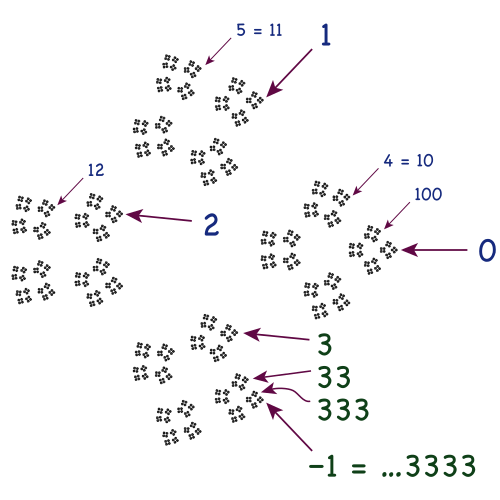
The -adic numbers are an alternative number system of interest in number theory. Like the real numbers, the -adic numbers can be built from the rational numbers via Cauchy sequences; the construction uses a different metric in which 0 is closer to , and much closer to , than it is to 1.[68] The -adic numbers form a field for prime and a ring for other , including 10. So arithmetic can be performed in the -adics, and there are no infinitesimals.


In the 10-adic numbers, the analogues of decimal expansions run to the left. The 10-adic expansion ...999 does have a last 9, and it does not have a first 9. One can add 1 to the ones place, and it leaves behind only 0s after carrying through: 1 + ...999 = ...000 = 0, and so ...999 = −1.[69] Another derivation uses a geometric series. The infinite series implied by "...999" does not converge in the real numbers, but it converges in the 10-adics, and so one can re-use the familiar formula:[70]

Compare with the series in the section above. A third derivation was invented by a seventh-grader who was doubtful over her teacher's limiting argument that 0.999... = 1 but was inspired to take the multiply-by-10 proof above in the opposite direction: if = ...999, then 10 = ...990, so 10 = − 9, hence = −1 again.[69]
As a final extension, since 0.999... = 1 (in the reals) and ...999 = −1 (in the 10-adics), then by "blind faith and unabashed juggling of symbols"[71] one may add the two equations and arrive at ...999.999... = 0. This equation does not make sense either as a 10-adic expansion or an ordinary decimal expansion, but it turns out to be meaningful and true in the doubly infinite decimal expansion of the 10-adic solenoid, with eventually repeating left ends to represent the real numbers and eventually repeating right ends to represent the 10-adic numbers.[72]
Related questions
Zeno's paradoxes, particularly the paradox of the runner, are reminiscent of the apparent paradox that 0.999... and 1 are equal. The runner paradox can be mathematically modeled and then, like 0.999..., resolved using a geometric series. However, it is not clear whether this mathematical treatment addresses the underlying metaphysical issues Zeno was exploring.[73]
Negative zero is another redundant feature of many ways of writing numbers. In number systems, such as real numbers, where "0" denotes the additive identity and is neither positive nor negative, the usual interpretation of "−0" is that it should denote the additive inverse of 0, which forces −0 = 0.[74] Nonetheless, some scientific applications use separate positive and negative zeroes, as do some computing binary number systems (for example integers stored in the sign and magnitude or ones' complement formats, or floating point numbers as specified by the IEEE floating-point standard).[75]
See also
Notes
- ^ For example, one can show this as follows: if x is any number such that 0.(9)n ≤ x < 1, then 0.(9)n−1 ≤ 10x − 9 < x < 1. Thus if x has this property for all n, the smaller number 10x − 9 does, as well.
- ^ The limit follows, for example, from Rudin (1976), p. 57, Theorem 3.20e. For a more direct approach, see also Finney, Weir & Giordano (2001), section 8.1, example 2(a), example 6(b).
- ^ The historical synthesis is claimed by Griffiths & Hilton (1970), p. xiv and again by Pugh (2002), p. 10; both actually prefer Dedekind cuts to axioms. For the use of cuts in textbooks, see Pugh (2002), p. 17 or Rudin (1976), p. 17. For viewpoints on logic, see Pugh (2002), p. 10, Rudin (1976), p.ix, or Munkres (2000), p. 30.
- ^ Enderton (1977), p. 113 qualifies this description: "The idea behind Dedekind cuts is that a real number x can be named by giving an infinite set of rationals, namely all the rationals less than x. We will in effect define x to be the set of rationals smaller than x. To avoid circularity in the definition, we must be able to characterize the sets of rationals obtainable in this way ..."
- ^ Rudin (1976), pp. 17–20, Richman (1999), p. 399, or Enderton (1977), p. 119. To be precise, Rudin, Richman, and Enderton call this cut 1∗, 1−, and 1R, respectively; all three identify it with the traditional real number 1. Note that what Rudin and Enderton call a Dedekind cut, Richman calls a "non-principal Dedekind cut".
- ^ Maor (1987), p. 60 and Mankiewicz (2000), p. 151 review the former method; Mankiewicz attributes it to Cantor, but the primary source is unclear. Munkres (2000), p. 50 mentions the latter method.
- ^ Bunch (1982), p. 119; Tall & Schwarzenberger (1978), p. 6. The last suggestion is due to Burrell (1998), p. 28: "Perhaps the most reassuring of all numbers is 1 ... So it is particularly unsettling when someone tries to pass off 0.9~ as 1."
- ^ For a full treatment of non-standard numbers, see Robinson (1996).
- ^ Stewart (2009), p. 175; the full discussion of 0.999... is spread through pp. 172–175.
- ^ Berlekamp, Conway & Guy (1982), pp. 79–80, 307–311 discuss 1 and 1/3 and touch on 1/ω. The game for 0.111...2 follows directly from Berlekamp's Rule.
- ^ Richman (1999), pp. 398–400. Rudin (1976), p. 23 assigns this alternative construction (but over the rationals) as the last exercise of Chapter 1.
References
- ^ Cheng (2023), p. 141.
- ^ Diamond (1955).
- ^ Baldwin & Norton (2012).
- ^ Meier & Smith (2017), §8.2.
- ^ Stewart (2009), p. 175.
- ^ Propp (2023).
- ^ Stillwell (1994), p. 42.
- ^ Earl & Nicholson (2021), "bound".
- ^ a b Rosenlicht (1985), p. 27.
- ^ Byers (2007), p. 39.
- ^ a b c d Richman (1999).
- ^ Peressini & Peressini (2007), p. 186.
- ^ Baldwin & Norton (2012); Katz & Katz (2010a).
- ^ Cheng (2023), p. 136.
- ^ Tao (2003).
- ^ Rudin (1976), p. 61, Theorem 3.26; Stewart (1999), p. 706.
- ^ Euler (1822), p. 170.
- ^ Grattan-Guinness (1970), p. 69; Bonnycastle (1806), p. 177.
- ^ Stewart (1999), p. 706; Rudin (1976), p. 61; Protter & Morrey (1991), p. 213; Pugh (2002), p. 180; Conway (1978), p. 31.
- ^ Davies (1846), p. 175; Smith & Harrington (1895), p. 115.
- ^ a b Tall (2000), p. 221.
- ^ Beals (2004), p. 22; Stewart (2009), p. 34.
- ^ Bartle & Sherbert (1982), pp. 60–62; Pedrick (1994), p. 29; Sohrab (2003), p. 46.
- ^ Apostol (1974), pp. 9, 11–12; Beals (2004), p. 22; Rosenlicht (1985), p. 27.
- ^ Apostol (1974), p. 12.
- ^ Cheng (2023), pp. 153–156.
- ^ Conway (2001), pp. 25–27.
- ^ Rudin (1976), pp. 3, 8.
- ^ Richman (1999), p. 399.
- ^ a b O'Connor & Robertson (2005).
- ^ Richman (1999), p. 398–399. "Why do that? Precisely to rule out the existence of distinct numbers 0.9 and 1. [...] So we see that in the traditional definition of the real numbers, the equation 0.9 = 1 is built in at the beginning."
- ^ Griffiths & Hilton (1970), p. 386, §24.2 "Sequences".
- ^ Griffiths & Hilton (1970), pp. 388, 393.
- ^ Griffiths & Hilton (1970), p. 395.
- ^ Griffiths & Hilton (1970), pp. viii, 395.
- ^ Li (2011).
- ^ Artigue (2002), p. 212, "... the ordering of the real numbers is recognized as a dense order. However, depending on the context, students can reconcile this property with the existence of numbers just before or after a given number (0.999... is thus often seen as the predecessor of 1).".
- ^ Petkovšek (1990), p. 408.
- ^ Protter & Morrey (1991), p. 503; Bartle & Sherbert (1982), p. 61.
- ^ Komornik & Loreti (1998), p. 636.
- ^ Kempner (1936), p. 611; Petkovšek (1990), p. 409.
- ^ Petkovšek (1990), pp. 410–411.
- ^ Goodwyn (1802); Dickson (1919), pp. 161.
- ^ Leavitt (1984), p. 301.
- ^ Ginsberg (2004), pp. 26–30; Lewittes (2006), pp. 1–3; Leavitt (1967), pp. 669, 673; Shrader-Frechette (1978), pp. 96–98.
- ^ Pugh (2002), p. 97; Alligood, Sauer & Yorke (1996), pp. 150–152; Protter & Morrey (1991), p. 507; Pedrick (1994), p. 29.
- ^ Rudin (1976), p. 50; Pugh (2002), p. 98.
- ^ Tall & Schwarzenberger (1978), pp. 6–7; Tall (2000), p. 221.
- ^ Tall & Schwarzenberger (1978), p. 6; Tall (2000), p. 221.
- ^ Tall (1976), pp. 10–14.
- ^ Pinto & Tall (2001), p. 5; Edwards & Ward (2004), pp. 416–417.
- ^ Mazur (2005), pp. 137–141.
- ^ Dubinsky et al. (2005), pp. 261–262.
- ^ Richman (1999), p. 396.
- ^ de Vreught (1994).
- ^ Adams (2003).
- ^ Ellenberg, Jordan (6 June 2014). "Does 0.999... = 1? And Are Divergent Series the Invention of the Devil?". Slate. Archived from the original on 8 August 2023.
- ^ "Blizzard Entertainment Announces .999~ (Repeating) = 1" (Press release). Blizzard Entertainment. 1 April 2004. Archived from the original on 4 November 2009. Retrieved 16 November 2009.
- ^ Renteln & Dundes (2005), p. 27.
- ^ Gowers (2002), p. 60.
- ^ Lightstone (1972), pp. 245–247.
- ^ Tao (2012), pp. 156–180.
- ^ Katz & Katz (2010a).
- ^ Katz & Katz (2010b); Ely (2010).
- ^ Conway (2001), pp. 3–5, 12–13, 24–27.
- ^ Richman (1999), pp. 397–399.
- ^ Gardiner (2003), p. 98; Gowers (2002), p. 60.
- ^ Mascari & Miola (1988), p. 83–84.
- ^ a b Fjelstad (1995), p. 11.
- ^ Fjelstad (1995), pp. 14–15.
- ^ DeSua (1960), p. 901.
- ^ DeSua (1960), p. 902–903.
- ^ Wallace (2003), p. 51; Maor (1987), p. 17.
- ^ Munkres (2000), p. 34, Exercise 1(c).
- ^ Kroemer & Kittel (1980), p. 462. "Floating point types". MSDN C# Language Specification. Archived from the original on 24 August 2006. Retrieved 29 August 2006.
Sources
- Adams, Cecil (11 July 2003). "An infinite question: Why doesn't .999~ = 1?". The Straight Dope. Chicago Reader. Archived from the original on 15 August 2006. Retrieved 6 September 2006.
- Alligood, K. T.; Sauer, T. D.; Yorke, J. A. (1996). "4.1 Cantor Sets". Chaos: An introduction to dynamical systems. Springer. ISBN 978-0-387-94677-1.
- This introductory textbook on dynamical systems is aimed at undergraduate and beginning graduate students. (p. ix)
- Apostol, Tom M. (1974). Mathematical Analysis (2e ed.). Addison-Wesley. ISBN 978-0-201-00288-1.
- A transition from calculus to advanced analysis, Mathematical analysis is intended to be "honest, rigorous, up to date, and, at the same time, not too pedantic". (pref.) Apostol's development of the real numbers uses the least upper bound axiom and introduces infinite decimals two pages later. (pp. 9–11)
- Artigue, Michèle (2002). Holton, Derek; Artigue, Michèle; Kirchgräber, Urs; Hillel, Joel; Niss, Mogens; Schoenfeld, Alan (eds.). The Teaching and Learning of Mathematics at University Level. New ICMI Study Series. Vol. 7. Springer, Dordrecht. doi:10.1007/0-306-47231-7. ISBN 978-0-306-47231-2.
- Baldwin, Michael; Norton, Anderson (2012). "Does 0.999... Really Equal 1?". The Mathematics Educator. 21 (2): 58–67.
- Bartle, R. G.; Sherbert, D. R. (1982). Introduction to Real Analysis. Wiley. ISBN 978-0-471-05944-8.
- This text aims to be "an accessible, reasonably paced textbook that deals with the fundamental concepts and techniques of real analysis". Its development of the real numbers relies on the supremum axiom. (pp. vii–viii)
- Beals, Richard (2004). Analysis: An Introduction. Cambridge University Press. ISBN 978-0-521-60047-7.
- Berlekamp, E. R.; Conway, J. H.; Guy, R. K. (1982). Winning Ways for your Mathematical Plays. Academic Press. ISBN 978-0-12-091101-1.
- Bonnycastle, John (1806). An introduction to algebra; with notes and observations: designed for the use of schools and places of public education (First American ed.). Philadelphia. hdl:2027/mdp.39015063620382.
- Bunch, Bryan H. (1982). Mathematical Fallacies and Paradoxes. Van Nostrand Reinhold. ISBN 978-0-442-24905-2.
- This book presents an analysis of paradoxes and fallacies as a tool for exploring its central topic, "the rather tenuous relationship between mathematical reality and physical reality". It assumes first-year high-school algebra; further mathematics is developed in the book, including geometric series in Chapter 2. Although 0.999... is not one of the paradoxes to be fully treated, it is briefly mentioned during a development of Cantor's diagonal method. (pp. ix-xi, 119)
- Burrell, Brian (1998). Merriam-Webster's Guide to Everyday Math: A Home and Business Reference. Merriam-Webster. ISBN 978-0-87779-621-3.
- Byers, William (2007). How Mathematicians Think: Using Ambiguity, Contradiction, and Paradox to Create Mathematics. Princeton University Press. ISBN 978-0-691-12738-5.
- Cheng, Eugenia (2023). Is Math Real? How Simple Questions Lead Us To Mathematics' Deepest Truths. Basic Books. ISBN 978-1-541-6-01826.
- Conway, John B. (1978) [1973]. Functions of One Complex Variable I (2e ed.). Springer-Verlag. ISBN 978-0-387-90328-6.
- Conway, John H. (2001). On Numbers and Games (2nd ed.). A K Peters. ISBN 1-56881-127-6.
- Davies, Charles (1846). The University Arithmetic: Embracing the Science of Numbers, and Their Numerous Applications. A.S. Barnes. p. 175. Retrieved 4 July 2011.
- de Vreught, Hans (1994). "sci.math FAQ: Why is 0.9999... = 1?". Archived from the original on 29 September 2007. Retrieved 29 June 2006.
- DeSua, Frank C. (November 1960). "A System Isomorphic to the Reals". The American Mathematical Monthly. 67 (9): 900–903. doi:10.2307/2309468. JSTOR 2309468.
- Diamond, Louis E. (1955). "Irrational Numbers". Mathematics Magazine. 29 (2). Mathematical Association of America: 89–99. doi:10.2307/3029588. JSTOR 3029588.
- Dickson, Leonard Eugene (1919). History of the Theory of Numbers. Vol. 1. Carnegie Institution of Washington.
- Dubinsky, Ed; Weller, Kirk; McDonald, Michael; Brown, Anne (2005). "Some historical issues and paradoxes regarding the concept of infinity: an APOS analysis: part 2". Educational Studies in Mathematics. 60 (2): 253–266. doi:10.1007/s10649-005-0473-0. S2CID 45937062.
- Earl, Richard; Nicholson, James (2021). The Concise Oxford Dictionary of Mathematics (6th ed.). Oxford University Press. ISBN 978-0-192-58405-2.
- Edwards, Barbara; Ward, Michael (May 2004). "Surprises from mathematics education research: Student (mis)use of mathematical definitions" (PDF). The American Mathematical Monthly. 111 (5): 411–425. CiteSeerX 10.1.1.453.7466. doi:10.2307/4145268. JSTOR 4145268. Archived from the original (PDF) on 22 July 2011. Retrieved 4 July 2011.
- Ely, Robert (2010). "Nonstandard student conceptions about infinitesimals". Journal for Research in Mathematics Education. 41 (2): 117–146. doi:10.5951/jresematheduc.41.2.0117.
- This article is a field study involving a student who developed a Leibnizian-style theory of infinitesimals to help her understand calculus, and in particular to account for 0.999... falling short of 1 by an infinitesimal 0.000...1.
- Enderton, Herbert B. (1977). Elements of Set Theory. Elsevier. ISBN 978-0-12-238440-0.
- An introductory undergraduate textbook in set theory that "presupposes no specific background". It is written to accommodate a course focusing on axiomatic set theory or on the construction of number systems; the axiomatic material is marked such that it may be de-emphasized. (pp. xi–xii)
- Euler, Leonhard (1822) [1770]. Elements of Algebra. John Hewlett and Francis Horner, English translators (3rd English ed.). Orme Longman. p. 170. ISBN 978-0-387-96014-2. Retrieved 4 July 2011.
- Finney, Ross L.; Weir, Maurice D.; Giordano, Frank R. (2001). Thomas' Calculus: Early Transcendentals (10th ed.). New York: Addison-Wesley.
- Fjelstad, Paul (January 1995). "The Repeating Integer Paradox". The College Mathematics Journal. 26 (1): 11–15. doi:10.2307/2687285. JSTOR 2687285.
- Gardiner, Anthony (2003) [1982]. Understanding Infinity: The Mathematics of Infinite Processes. Dover. ISBN 978-0-486-42538-2.
- Ginsberg, Brian (2004). "Midy's (nearly) secret theorem – an extension after 165 years". The College Mathematics Journal. 35 (1): 26–30. doi:10.1080/07468342.2004.11922047.
- Goodwyn, H. (1802). "Curious properties of prime Numbers, taken as the Divisors of unity. By a Correspondent". Journal of Natural Philosophy, Chemistry, and the Arts. New Series. 1: 314–316.
- Gowers, Timothy (2002). Mathematics: A Very Short Introduction. Oxford University Press. ISBN 978-0-19-285361-5.
- Grattan-Guinness, Ivor (1970). The Development of the Foundations of Mathematical Analysis from Euler to Riemann. MIT Press. ISBN 978-0-262-07034-8.
- Griffiths, H. B.; Hilton, P. J. (1970). A Comprehensive Textbook of Classical Mathematics: A Contemporary Interpretation. London: Van Nostrand Reinhold. ISBN 978-0-442-02863-3. LCC QA37.2 G75.
- This book grew out of a course for Birmingham-area grammar school mathematics teachers. The course was intended to convey a university-level perspective on school mathematics, and the book is aimed at students "who have reached roughly the level of completing one year of specialist mathematical study at a university". The real numbers are constructed in Chapter 24, "perhaps the most difficult chapter in the entire book", although the authors ascribe much of the difficulty to their use of ideal theory, which is not reproduced here. (pp. vii, xiv)
- Katz, Karin Usadi; Katz, Mikhail G. (2010a). "When is .999... less than 1?". The Montana Mathematics Enthusiast. 7 (1): 3–30. arXiv:1007.3018. Bibcode:2010arXiv1007.3018U. doi:10.54870/1551-3440.1381. S2CID 11544878. Archived from the original on 20 July 2011. Retrieved 4 July 2011.
- Katz, Karin Usadi; Katz, Mikhail G. (2010b). "Zooming in on infinitesimal 1 − .9.. in a post-triumvirate era". Educational Studies in Mathematics. 74 (3): 259. arXiv:1003.1501. Bibcode:2010arXiv1003.1501K. doi:10.1007/s10649-010-9239-4. S2CID 115168622.
- Kempner, Aubrey J. (December 1936). "Anormal Systems of Numeration". The American Mathematical Monthly. 43 (10): 610–617. doi:10.2307/2300532. JSTOR 2300532.
- Komornik, Vilmos; Loreti, Paola (1998). "Unique Developments in Non-Integer Bases". The American Mathematical Monthly. 105 (7): 636–639. doi:10.2307/2589246. JSTOR 2589246.
- Kroemer, Herbert; Kittel, Charles (1980). Thermal Physics (2e ed.). W. H. Freeman. p. 462. ISBN 978-0-7167-1088-2.
- Li, Liangpan (March 2011). "A new approach to the real numbers". arXiv:1101.1800 [math.CA].
- Leavitt, William G. (1967). "A Theorem on Repeating Decimals". The American Mathematical Monthly. 74 (6): 669–673. doi:10.2307/2314251. JSTOR 2314251.
- Leavitt, William G. (September 1984). "Repeating Decimals". The College Mathematics Journal. 15 (4): 299–308. doi:10.2307/2686394. JSTOR 2686394.
- Lewittes, Joseph (2006). "Midy's Theorem for Periodic Decimals". arXiv:math.NT/0605182.
- Lightstone, Albert H. (March 1972). "Infinitesimals". The American Mathematical Monthly. 79 (3): 242–251. doi:10.2307/2316619. JSTOR 2316619.
- Mankiewicz, Richard (2000). The Story of Mathematics. Cassell. ISBN 978-0-304-35473-3.
- Mankiewicz seeks to represent "the history of mathematics in an accessible style" by combining visual and qualitative aspects of mathematics, mathematicians' writings, and historical sketches. (p. 8)
- Mascari, Gianfranco; Miola, Alfonso (1988). "On the integration of numeric and algebraic computations". In Beth, Thomas; Clausen, Michael (eds.). Applicable Algebra, Error-Correcting Codes, Combinatorics and Computer Algebra. doi:10.1007/BFb0039172. ISBN 978-3-540-39133-3.
- Maor, Eli (1987). To Infinity and Beyond: A Cultural History of the Infinite. Birkhäuser. ISBN 978-3-7643-3325-6.
- A topical rather than chronological review of infinity, this book is "intended for the general reader" but "told from the point of view of a mathematician". On the dilemma of rigor versus readable language, Maor comments, "I hope I have succeeded in properly addressing this problem." (pp. x-xiii)
- Mazur, Joseph (2005). Euclid in the Rainforest: Discovering Universal Truths in Logic and Math. Pearson: Pi Press. ISBN 978-0-13-147994-4.
- Meier, John; Smith, Derek (2017). Exploring Mathematics: An Engaging Introduction to Proof. Cambridge University Press. ISBN 978-1-107-12898-9.
- Munkres, James R. (2000) [1975]. Topology (2e ed.). Prentice-Hall. ISBN 978-0-13-181629-9.
- Intended as an introduction "at the senior or first-year graduate level" with no formal prerequisites: "I do not even assume the reader knows much set theory." (p. xi) Munkres's treatment of the reals is axiomatic; he claims of bare-hands constructions, "This way of approaching the subject takes a good deal of time and effort and is of greater logical than mathematical interest." (p. 30)
- Navarro, Maria Angeles; Carreras, Pedro Pérez (2010). "A Socratic methodological proposal for the study of the equality 0.999...=1" (PDF). The Teaching of Mathematics. 13 (1): 17–34. Retrieved 4 July 2011.
- O'Connor, John J.; Robertson, Edmund F. (October 2005), "The real numbers: Stevin to Hilbert", MacTutor History of Mathematics Archive, University of St Andrews
- Pedrick, George (1994). A First Course in Analysis. Springer. ISBN 978-0-387-94108-0.
- Peressini, Anthony; Peressini, Dominic (2007). "Philosophy of Mathematics and Mathematics Education". In van Kerkhove, Bart; van Bendegem, Jean Paul (eds.). Perspectives on Mathematical Practices. Logic, Epistemology, and the Unity of Science. Vol. 5. Springer. ISBN 978-1-4020-5033-6.
- Petkovšek, Marko (May 1990). "Ambiguous Numbers are Dense". American Mathematical Monthly. 97 (5): 408–411. doi:10.2307/2324393. JSTOR 2324393.
- Pinto, Márcia; Tall, David O. (2001). PME25: Following students' development in a traditional university analysis course (PDF). pp. v4: 57–64. Archived from the original (PDF) on 30 May 2009. Retrieved 3 May 2009.
- Propp, James (17 September 2015). "The One About .999..." Mathematical Enchantments. Retrieved 24 May 2024.
- Propp, James (17 January 2023). "Denominators and Doppelgängers". Mathematical Enchantments. Retrieved 16 April 2024.
- Protter, Murray H.; Morrey, Charles B. Jr. (1991). A First Course in Real Analysis (2e ed.). Springer. ISBN 978-0-387-97437-8.
- This book aims to "present a theoretical foundation of analysis that is suitable for students who have completed a standard course in calculus". (p. vii) At the end of Chapter 2, the authors assume as an axiom for the real numbers that bounded, nondecreasing sequences converge, later proving the nested intervals theorem and the least upper bound property. (pp. 56–64) Decimal expansions appear in Appendix 3, "Expansions of real numbers in any base". (pp. 503–507)
- Pugh, Charles Chapman (2002). Real Mathematical Analysis. Springer-Verlag. ISBN 978-0-387-95297-0.
- While assuming familiarity with the rational numbers, Pugh introduces Dedekind cuts as soon as possible, saying of the axiomatic treatment, "This is something of a fraud, considering that the entire structure of analysis is built on the real number system." (p. 10) After proving the least upper bound property and some allied facts, cuts are not used in the rest of the book.
- Renteln, Paul; Dundes, Alan (January 2005). "Foolproof: A Sampling of Mathematical Folk Humor" (PDF). Notices of the AMS. 52 (1): 24–34. Archived from the original (PDF) on 25 February 2009. Retrieved 3 May 2009.
- Richman, Fred (December 1999). "Is 0.999... = 1?". Mathematics Magazine. 72 (5): 396–400. doi:10.2307/2690798. JSTOR 2690798. Free HTML preprint: Richman, Fred (June 1999). "Is 0.999... = 1?". Archived from the original on 2 September 2006. Retrieved 23 August 2006. Note: the journal article contains material and wording not found in the preprint.
- Robinson, Abraham (1996). Non-standard Analysis (Revised ed.). Princeton University Press. ISBN 978-0-691-04490-3. JSTOR j.ctt1cx3vb6.
- Rosenlicht, Maxwell (1985). Introduction to Analysis. Dover. ISBN 978-0-486-65038-8. This book gives a "careful rigorous" introduction to real analysis. It gives the axioms of the real numbers and then constructs them (pp. 27–31) as infinite decimals with 0.999... = 1 as part of the definition.
- Rudin, Walter (1976) [1953]. Principles of Mathematical Analysis (3e ed.). McGraw-Hill. ISBN 978-0-07-054235-8.
- A textbook for an advanced undergraduate course. "Experience has convinced me that it is pedagogically unsound (though logically correct) to start off with the construction of the real numbers from the rational ones. At the beginning, most students simply fail to appreciate the need for doing this. Accordingly, the real number system is introduced as an ordered field with the least-upper-bound property, and a few interesting applications of this property are quickly made. However, Dedekind's construction is not omitted. It is now in an Appendix to Chapter 1, where it may be studied and enjoyed whenever the time is ripe." (p. ix)
- Shrader-Frechette, Maurice (March 1978). "Complementary Rational Numbers". Mathematics Magazine. 51 (2): 90–98. doi:10.2307/2690144. JSTOR 2690144.
- Smith, Charles; Harrington, Charles (1895). Arithmetic for Schools. Macmillan. p. 115. ISBN 978-0-665-54808-6. Retrieved 4 July 2011.
- Sohrab, Houshang (2003). Basic Real Analysis. Birkhäuser. ISBN 978-0-8176-4211-2.
- Stewart, Ian (2009). Professor Stewart's Hoard of Mathematical Treasures. Profile Books. ISBN 978-1-84668-292-6.
- Stewart, James (1999). Calculus: Early transcendentals (4e ed.). Brooks/Cole. ISBN 978-0-534-36298-0.
- This book aims to "assist students in discovering calculus" and "to foster conceptual understanding". (p. v) It omits proofs of the foundations of calculus.
- Stillwell, John (1994), Elements of Algebra: Geometry, Numbers, Equations, Springer, ISBN 9783540942900
- Tall, David; Schwarzenberger, R. L. E. (1978). "Conflicts in the Learning of Real Numbers and Limits" (PDF). Mathematics Teaching. 82: 44–49. Archived from the original (PDF) on 30 May 2009. Retrieved 3 May 2009.
- Tall, David O. (1976). "Conflicts and Catastrophes in the Learning of Mathematics" (PDF). Mathematical Education for Teaching. 2 (4): 2–18. Archived from the original (PDF) on 26 March 2009. Retrieved 3 May 2009.
- Tall, David (2000). "Cognitive Development in Advanced Mathematics Using Technology" (PDF). Mathematics Education Research Journal. 12 (3): 210–230. Bibcode:2000MEdRJ..12..196T. doi:10.1007/BF03217085. S2CID 143438975. Archived from the original (PDF) on 30 May 2009. Retrieved 3 May 2009.
- Tao, Terence (2012). Higher order Fourier analysis (PDF). American Mathematical Society.
- Tao, Terence (2003). "Math 131AH: Week 1" (PDF). Honors Analysis. UCLA Mathematics. Retrieved 23 May 2024.
- Wallace, David Foster (2003). Everything and more: a compact history of infinity. Norton. ISBN 978-0-393-00338-3.
Further reading
- Beswick, Kim (2004). "Why Does 0.999... = 1?: A Perennial Question and Number Sense". Australian Mathematics Teacher. 60 (4): 7–9.
- Burkov, S. E. (1987). "One-dimensional model of the quasicrystalline alloy". Journal of Statistical Physics. 47 (3/4): 409–438. Bibcode:1987JSP....47..409B. doi:10.1007/BF01007518. S2CID 120281766.
- Burn, Bob (March 1997). "81.15 A Case of Conflict". The Mathematical Gazette. 81 (490): 109–112. doi:10.2307/3618786. JSTOR 3618786. S2CID 187823601.
- Calvert, J. B.; Tuttle, E. R.; Martin, Michael S.; Warren, Peter (February 1981). "The Age of Newton: An Intensive Interdisciplinary Course". The History Teacher. 14 (2): 167–190. doi:10.2307/493261. JSTOR 493261.
- Choi, Younggi; Do, Jonghoon (November 2005). "Equality Involved in 0.999... and (-8)1/3". For the Learning of Mathematics. 25 (3): 13–15, 36. JSTOR 40248503.
- Choong, K. Y.; Daykin, D. E.; Rathbone, C. R. (April 1971). "Rational Approximations to π". Mathematics of Computation. 25 (114): 387–392. doi:10.2307/2004936. JSTOR 2004936.
- Edwards, B. (1997). "An undergraduate student's understanding and use of mathematical definitions in real analysis". In Dossey, J.; Swafford, J.O.; Parmentier, M.; Dossey, A.E. (eds.). Proceedings of the 19th Annual Meeting of the North American Chapter of the International Group for the Psychology of Mathematics Education. Vol. 1. Columbus, OH: ERIC Clearinghouse for Science, Mathematics and Environmental Education. pp. 17–22.
- Eisenmann, Petr (2008). "Why is it not true that 0.999... < 1?" (PDF). The Teaching of Mathematics. 11 (1): 35–40. Retrieved 4 July 2011.
- Ferrini-Mundy, J.; Graham, K. (1994). Kaput, J.; Dubinsky, E. (eds.). "Research in calculus learning: Understanding of limits, derivatives and integrals". MAA Notes: Research Issues in Undergraduate Mathematics Learning. 33: 31–45.
- Gardiner, Tony (June 1985). "Infinite processes in elementary mathematics: How much should we tell the children?". The Mathematical Gazette. 69 (448): 77–87. doi:10.2307/3616921. JSTOR 3616921. S2CID 125222118.
- Monaghan, John (December 1988). "Real Mathematics: One Aspect of the Future of A-Level". The Mathematical Gazette. 72 (462): 276–281. doi:10.2307/3619940. JSTOR 3619940. S2CID 125825964.
- Núñez, Rafael (2006). "Do Real Numbers Really Move? Language, Thought, and Gesture: The Embodied Cognitive Foundations of Mathematics". 18 Unconventional Essays on the Nature of Mathematics. Springer. pp. 160–181. ISBN 978-0-387-25717-4. Archived from the original on 18 July 2011. Retrieved 4 July 2011.
- Przenioslo, Malgorzata (March 2004). "Images of the limit of function formed in the course of mathematical studies at the university". Educational Studies in Mathematics. 55 (1–3): 103–132. doi:10.1023/B:EDUC.0000017667.70982.05. S2CID 120453706.
- Sandefur, James T. (February 1996). "Using Self-Similarity to Find Length, Area, and Dimension". The American Mathematical Monthly. 103 (2): 107–120. doi:10.2307/2975103. JSTOR 2975103.
- Sierpińska, Anna (November 1987). "Humanities students and epistemological obstacles related to limits". Educational Studies in Mathematics. 18 (4): 371–396. doi:10.1007/BF00240986. JSTOR 3482354. S2CID 144880659.
- Starbird, Michael; Starbird, Thomas (March 1992). "Required Redundancy in the Representation of Reals". Proceedings of the American Mathematical Society. 114 (3): 769–774. doi:10.1090/S0002-9939-1992-1086343-5. JSTOR 2159403.
- Szydlik, Jennifer Earles (May 2000). "Mathematical Beliefs and Conceptual Understanding of the Limit of a Function". Journal for Research in Mathematics Education. 31 (3): 258–276. doi:10.2307/749807. JSTOR 749807.
- Tall, David O. (2009). "Dynamic mathematics and the blending of knowledge structures in the calculus". ZDM Mathematics Education. 41 (4): 481–492. doi:10.1007/s11858-009-0192-6. S2CID 14289039.
- Tall, David O. (May 1981). "Intuitions of infinity". Mathematics in School. 10 (3): 30–33. JSTOR 30214290.
External links


- .999999... = 1? Cut-the-Knotより
- なぜ 0.9999... = 1 になるのでしょうか?
- Math Central による算術に基づく等式の証明
- デイビッド・トールの数学認知に関する研究
- 実数を無限小数として考えることに何が問題があるのでしょうか?
- Metamathの定理 0.999...
