
Loading article…

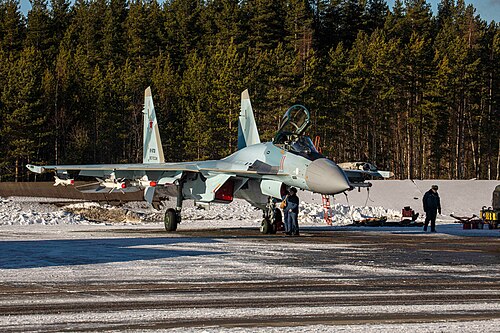
The Sukhoi Su-35 (Russian: Сухой Су-35; NATO reporting name: Flanker-E/M, occasionally nicknamed "Super Flanker"[7]) is the designation for two improved derivatives of the Russian Su-27 air superiority fighter. They are single-seat, twin-engine, supermaneuverable, 4.5 generation air superiority fighters, designed by the Sukhoi Design Bureau and built by Sukhoi.
The type was originally developed by the Soviet Union from the Su-27 and was known as the Su-27M. It incorporated canards and a multi-function radar giving it multi-role capabilities. The first prototype made its maiden flight in June 1988. Following the dissolution of the Soviet Union, Sukhoi relabeled it Su-35 in hopes of attracting export orders. Fourteen aircraft were produced and used for tests and demonstrations; one example had thrust-vectoring engines and was in turn redesignated the Su-37. A sole Su-35UB two-seat trainer was also built in the late 1990s that resembled the Su-30MK family.
In 2003, Sukhoi embarked on a second "deep" modernization of the Su-27 to serve as an interim export aircraft awaiting the development of the Sukhoi PAK FA (Su-57) program. Also known as the Su-35, this version incorporates technology from the PAK FA program and has a redesigned cockpit and weapons-control system and features thrust-vectoring engines in place of the canards.[8] The type made its first flight in February 2008. Although it was designed for export, the Russian Air Force became the launch customer in 2009, with the production version designated Su-35S. China's People's Liberation Army Air Force has also placed orders.
The first aircraft design to receive the Su-35 designation had its origins in the early 1980s, at a time when the Su-27 was being introduced into service with the Soviet Armed Forces. The definitive production version of the Su-27, which had the factory code of T-10S, started mass ("serial") production with the Komsomolsk-on-Amur Aircraft Production Association (KnAAPO) in 1983. The following year, this Su-27 version reached initial operational readiness with the Soviet Air Defence Forces.[9] Having begun work on an upgraded Su-27 variant in 1982,[10] the Sukhoi Design Bureau was instructed in December 1983 by the Soviet Council of Ministers to use the Su-27 as the basis for the development of the Su-27M (T-10M).[11] Nikolay Nikitin would lead the design effort throughout much of the project's existence, under the oversight of General DirectorMikhail Simonov, who had been the chief designer of the Su-27[12] along with Mikhail Pogosyan.
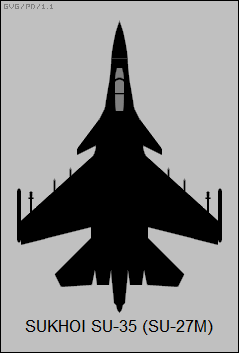
While sharing broadly the blended wing-body design of the Su-27, the Su-27M is visibly distinguished from the basic version by the addition of canards, which are small lifting surfaces, ahead of the wings. First tested in 1985 using an experimental aircraft,[9] the canards, in complement with the reshaped wing leading-edge extension, redirected the airflow in such a way so as to eliminate buffeting at high angles of attack and allowed the airframe to sustain 10-g manoeuvres (as opposed to 9 g on the Su-27) without additional structural reinforcement.[13] More importantly, when working with the relaxed-stability design and the accompanying fly-by-wireflight-control system, the aerodynamic layout improved the aircraft's manoeuvrability and enabled it to briefly fly with its nose past the vertical while maintaining forward momentum. Because of this, theoretically, during combat the pilot could pitch the Su-27M up 120 degrees in under two seconds and fire missiles at the target.[14] Other notable visible changes compared to the T-10S design included taller vertical tails, provisions for in-flight refuelling and the use of two-wheel nose undercarriage to support the heavier airframe.[15][16]
Besides the increase in manoeuvrability, another feature that distinguished the Su-27M from the original design was the new weapons-control system. The centrepiece of this system was the multi-function N011 Bars (literally "Leopard") phased-array radar with pulse-Doppler tracking that allowed it to detect targets below the horizon. First installed on the third prototype, the radar transformed the Su-27M from simply being an air-defence fighter into a multi-role aircraft capable of attacking ground targets.[9][17] Compared to the N001 Myech ("Sword") radar of the Su-27, which could track 10 targets and only direct two missiles towards one target at a time, the new radar could track fifteen targets and direct missiles towards six of them simultaneously.[9] The extra weight of the N011 radar at the front of the aircraft necessitated the addition of the canards; engineers would only later discover the aerodynamic advantages of these devices.[1][10] In addition, an N012 self-defence radar was housed in the rearward-projecting tail boom, making the aircraft the first in the world to have such a radar.[17] Other changes to the aircraft included the use of uprated turbofan engines, as well as the increased use of lightweight composites and aluminium-lithium alloys in the aircraft's structure.[15][18]
1987年、スホーイはモスクワの実験工場でT-10Sの機体から最初の試作機(T10M-1と命名)の改造を開始した。最初の試作機はカナード翼を備えていたものの、その後の数機と同様に、新設計の多くの物理的な変更はなかった。 [ 19 ]改造後、1988年6月28日にオレグ・ツォイの操縦で初飛行を行い、続いて1989年1月に2番目の試作機が飛行した。[ 20 ] 2機のSu-27M試作機の改造後、実際の航空機の生産は同国の極東に移管され、KnAAPOによって行われた。 3機目(T10M-3)は、新造のSu-27Mとしては初めて、またKnAAPOが製造した最初の機体として、1992年4月に初飛行を行った。[ 20 ] その頃にはソビエト連邦は崩壊しており、1990年代を通じてロシアで発生した経済危機により、1996年から2005年の間に量産するという当初の計画は放棄され、[ 9 ]この機体はカナード、飛行制御システム、推力偏向技術を検証するための実験用テストベッドとして使用されることになった。[ 15 ]合計で、1995年までに2機の試作機、9機の飛行可能な量産前機、3機の量産機が製造された。[ 1 ] [ 21 ]量産機は1996年にロシア空軍に兵器試験のために納入された。[ 22 ]
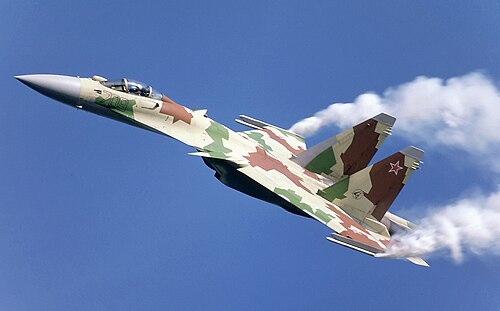
By the time of the disintegration of the Soviet Union, Sukhoi had been demonstrating the Su-27M to senior defence and government officials. With its debut to a Western audience at the 1992 Farnborough Airshow, the company redesignated the aircraft as Su-35.[23] The aircraft subsequently made flying demonstrations overseas in an effort to attract export orders, starting in November 1993 with Dubai, where Viktor Pugachev flew it in a mock aerial engagement with an Su-30MK in front of spectators.[24][25] The aircraft then flew in Berlin and Paris, and would be a regular feature at Moscow's MAKS Air Show.[25] The Russian government cleared the aircraft for export during Sukhoi's unsuccessful sales campaign in South Korea during the late 1990s and early 2000s;[26] the company also marketed the aircraft to Brazil, China and the United Arab Emirates.[27]
As the flight-test programme of the Su-27M proceeded, engineers discovered that the pilot failed to maintain active control of the aircraft during certain manoeuvres, such as the Pugachev's Cobra. The eleventh Su-27M (T10M-11) was therefore equipped with thrust-vectoring engine nozzles in 1995, and the resultant Su-37technology demonstrator made its first flight on 2 April 1996.[28][29] It also tested the enhanced N011M radar, as did the twelfth developmental Su-27M.[27] The Su-37's ability to maintain a high angle of attack while flying at close to zero airspeed attracted considerable press attention.[30] It later received different engines and updated fly-by-wire controls and cockpit systems for evaluation.[27]
Apart from the single-seat design, a two-seat aircraft was also constructed. Working in cooperation with Sukhoi, KnAAPO's own engineers designed the Su-35UB so as to combine thrust-vectoring engines with features of the Su-27M. Modified from an Su-30MKK airframe, the aircraft made its first flight on 7 August 2000, and afterwards served as an avionics test-bed.[31] While the original Su-27M never entered mass production due to a lack of funding,[32] Sukhoi refined the Su-27M's use of canards and the Su-37's thrust-vectoring technology and later applied them to the Su-30MKI two-seat fighter for the Indian Air Force.[33] The tenth Su-27M (T10M-10) also served as a test-bed for the Saturn AL-41F1 engine that is intended for the Sukhoi Su-57 (previously known under the acronym "PAK FA") jet fighter.[34]

With the need to update Russia's ageing fleet of Su-27 aircraft, Sukhoi and KnAAPO in 2002 started integrating glass cockpits and improved weapons-control systems (to accommodate a greater variety of weapons) to air force aircraft. The Su-27SM, as the modified aircraft is called, made its first flight in December 2002.[35] The success of this project led Sukhoi in December 2003 to proceed with a follow-up "deep" modernization programme. Known internally as T-10BM,[1] the programme was aimed at a more thorough redesign of the airframe to narrow the qualitative gap between Russian aircraft and foreign fourth-generation aircraft. The resultant design, also designated Su-35, would serve as an interim solution pending the introduction of the PAK FAfifth-generation fighter (which eventually became the Su-57), many features of which the aircraft would incorporate.[1][36][37] The aircraft was primarily aimed at the export market, being offered by KnAAPO as a single-seat alternative to the two-seat Su-30MK variants built by Irkutsk Aviation Plant (IAP).[38][39]
In many respects, the T-10BM design resembles the Su-27 more than the Su-27M. During tests of the thrust-vectoring engines and the Su-27M's aerodynamic layout, Sukhoi had concluded that the loss of manoeuvrability due to the removal of the canards – the addition of which imposed a weight penalty on the airframe – could be compensated for by the addition of thrust-vectoring nozzles.[N 1] Industry progress in the fields of avionics and radars has also reduced the weight and size of such components, which shifts the centre of gravity of an aircraft rearward.[41] Accordingly we saw SW, designers removed the canards (and the dorsal air brake) found on the Su-27M; the size of the vertical tails, aft-cockpit hump and tail boom were also reduced.[41] With such changes, as well as the increased use of aluminium and titanium alloys and composites, designers had reduced the empty weight of the aircraft, while maintaining a similar maximum take-off weight to the Su-27M.[42][43]

While the Su-27M design had the avionics to give the aircraft the nominal designation as a multi-role fighter, flight tests with the Russian Air Force revealed difficulties in deploying the aircraft's armament efficiently. According to Aviation Week & Space Technology, air force pilots described weapons trials with the aircraft in Akhtubinsk and Lipetsk as a "negative experience", with a particular emphasis on the layout of the cockpit and its adverse impact on the workload of the single pilot.[40] Designers, test pilots and avionics software specialists therefore worked together to redesign the cockpit and its attendant systems and improve the human-machine interface. The information management system of aircraft's avionics suite had been changed so that it now has two digital computers which process information from the flight- and weapons-control systems. The information is then displayed on two 9 in × 12 in (23 cm × 30 cm) multi-function liquid crystal displays,[44] which replaced the smaller multi-function cathode-ray tube displays found on the Su-27M.[40] The pilot can also view critical flight information on the head-up display,[45] and is equipped with Hands On Throttle-And-Stick (HOTAS) controls.[44]
The Su-35 employs the N035 Irbis-E ("Snow Leopard") passive electronically scanned array (PESA) radar, which is a further development of the N011M radar that had been evaluated on Su-27M test-beds and constitutes the core of the Su-35's weapons-control system. It is capable of detecting an aerial target up to 400 km (250 mi; 220 nmi) away, and can track thirty airborne targets and engage eight of them simultaneously; in addition, the multi-function radar is capable of providing high-resolution images of the ground using synthetic aperture mode.[46] The aircraft is equipped with an OLS-35 optoelectronic targeting system ahead of the cockpit to provide other forms of tracking including infra-red search and track; other electro-optical systems include the OAR missile approach warning system and T-220 targeting pod.[46] For defences against enemy tracking, the Su-35 is equipped with the L175M Khibiny-Melectronic countermeasure system,[47] while engineers have applied radar-absorbent materials to the engine inlets and front stages of the engine compressor to halve the Su-35's frontal radar cross-section and minimize the detection range of enemy radars.[48] The radar cross section of the Su-35 is reportedly 1 to 3 square meters.[49] The N035 and Khibiny-M systems are integrated into the aircraft's Sh135 weapons control complex. The multi-role Su-35 can deploy air-to-air missiles of up to 300-kilometre (190 mi) range, and can carry the heavy Oniksanti-shipcruise missile, as well as a multitude of air-to-ground weaponry.[50][51]
Su-35は、以前はizdeliye(製品)117Sとして知られていたSaturn AL-41F1Sターボファンエンジン2基を搭載しています。AL-31Fの高度に改良されたAL-41F1Sは、Su-57のSaturn AL-41F1(izdeliye 117)と密接に関連しており、主にエンジン制御システムが異なります。[ 53 ] [ 54 ]エンジンには、回転軸が角度をつけて傾けられた推力偏向ノズルが装備されています。ノズルはピッチに対しては1つの平面で動作しますが、傾斜により、各エンジンノズルを異なる方向に偏向させることで、航空機はロールとヨーの両方を生成できます。この構成はSu-30MKIで初めて実装され、Su-57でも使用されています。[ 55 ] Su-35の推力偏向システムと統合された飛行・推進制御システムにより、この航空機は9Gの機動と「超機動性」を達成でき、低速での失速後機動を実行できます。これは、戦闘機の運動エネルギーの維持を重視する西側の航空戦闘ドクトリンとは異なります。[ 52 ]エンジンにより、Su-35はアフターバーナーを使用せずにマッハ1.1を超える超音速を維持する限定的な能力、いわゆる「スーパークルーズ」を実現しています。[ 42 ]

設計作業の完了後、KnAAPOは最初の試作機を製作し、2007年半ばに完成させた。試作機Su-35-1は、初飛行の準備のため、ジュコフスキー飛行場のグロモフ飛行研究所に移送された。 [ 56 ] [ 57 ] 2008年2月19日、セルゲイ・ボグダンはジュコフスキーから55分間の初飛行のために機体を離陸させた。[ 56 ] [ 58 ]ボグダンはその後、10月2日にKnAAPOのジョムギ空港から2番目の試作機を操縦して初飛行を行った。[ 59 ]飛行試験プログラムには3機の飛行試作機が参加する予定だったが、予定されていた初飛行の前日である2009年4月26日、4機目のSu-35(静態試験機がある)がジョムギ空港での地上走行中に墜落した。航空機は滑走路の端にある障壁に衝突し、炎上して破壊された。パイロットは脱出し、火傷を負った。[ 60 ] [ 61 ]事故の原因はエンジン管理システムの故障であり、その結果アフターバーナーがオフにならなかった。[ 62 ] [ 63 ] [ 64 ]
Su-35プロジェクトは主に輸出市場を対象としていたが、48機のSu-35S航空機の実際の発注は、 2009年のMAKS航空ショーでロシア国防省によって行われた(64機の戦闘機に対する25億米ドルの大規模契約の一部として )。[ 7 ] [ 65 ] [ 38 ]飛行試験プログラムの初期段階で、スホーイは、特にラテンアメリカ、東南アジア、中東に重点を置き、160機の航空機の市場があると推定した。候補国の中には、アルジェリア、マレーシア、インドなど、すでにSu-30MKファミリーを運用している国もあった。この航空機は2010年から輸出可能になる予定だったため、[ 66 ] 2013年のパリ航空ショーでのこの機種の国際デビューの際、スホーイの親会社であるユナイテッド・エアクラフト・コーポレーションのミハイル・ポゴシャン社長は、国内市場と輸出市場で均等に分かれる推定200機の需要があると述べた。[ 67 ]中国との最初の輸出契約が締結されたのは2015年末になってからで、その時点でロシア政府は50機の追加発注を行っていた。[ 68 ]
Apart from the launch order at the 2009 MAKS Air Show, the Russian government and the state-owned Vnesheconombankdevelopment bank agreed to provide Sukhoi with capital for the aircraft's production. In November 2009, KnAAPO (which was renamed KnAAZ in 2013 after it became part of the Sukhoi Company) started manufacturing the first production aircraft,[69] the general assembly of which was completed in October 2010;[70] by then, pilots and engineers had successfully completed preliminary tests of the aircraft's systems.[71] The first Su-35S took its maiden flight in May 2011, and would be delivered (along with other aircraft) to Akhtubinsk to start state joint tests with the Defence Ministry to prepare the aircraft for service. Because production of the Su-35S occurred alongside trials, some early-production aircraft were later modified as a result of such tests.[72] In December 2018, United Aircraft Corporation has reported 100th serial Su-35S was produced at the Komsomolsk-on-Amur Aircraft Plant.[73]
In 1996, three production Su-27Ms were delivered to the air force's 929th State Flight Test Centre named for V. P. Chkalov (GLITs) at Vladimirovka air base, Akhtubinsk, to perform weapons trials.[22] In 2001, the air force decided to transfer several Su-27Ms to re-equip the Russian Knightsaerobaticsteam, and so the team's pilots took familiarization flights with the aircraft.[74] The three production and two other pre-production Su-27Ms arrived at the team's Kubinka air base near Moscow in 2003. However, they were used as a source of spare parts for other aircraft in the demonstration fleet.[75]

Initially, one static and three flyable prototypes (bort no. 901, 902, 904) were built between 2007 and 2009.[59] The third one (bort no. 904) was later destroyed when it crashed into a barrier during its taxi runs.[60]
The first contract for 48 production aircraft was signed at the 2009 MAKS Air show in Moscow. In May 2011, Sukhoi delivered the first Su-35S to Akhtubinsk to conduct state joint tests with the Defence Ministry to prepare for operational service.[76] The first of two stages of the trials commenced in August 2011. By March 2012, the two prototypes and four production aircraft were conducting flights to test the type's technical characteristics,[76] which were assessed by the end of that year to have generally complied with requirements. A batch of six production aircraft was handed over in December 2012.[77] In February 2013, five of these at the Gromov Flight Research Institute in Zhukovsky started the second stage of the trials, focusing on the Su-35's weapons and combat manoeuvrability.[78]
Twelve production Su-35Ss were delivered in December 2013,[79] followed by another twelve production aircraft in February 2014, ten of which were handed over to the 23rd Fighter Aviation Regiment stationed in the Far East with the remaining two tasked with carrying out the final phase of state joint tests.[72] The handover marked its official entry into operational service.[80] Several Su-35Ss were later transferred to Lipetsk to further develop combat tactics and to train service personnel.[81] The Russia's Su-35Ss are also permanently based at Besovets air base near the Finnish border,[82] and at Centralnaya Uglovaya air base near Vladivostok.[83]

The introduction of the Su-35S into the service with the Russian Aerospace Forces is a part of the Russia's state armament programme for 2011–2020 that was formulated following the Russo-Georgian War with an aim to significantly increase the number of modern military equipment in the Russian Armed Forces.[84] The aircraft is delivered alongside the Su-30M2 and Su-30SM and the heavier Su-34strike aircraft.[85] The first two are domestic variants of KnAAPO's Su-30MK2 and Irkut's Su-30MKI two-seat export aircraft. According to reports, the simultaneous acquisition of three fighter derivatives of the original Su-27 was to support the two aircraft manufacturers amidst a slump in export orders.[80] The Su-30M2 serves as a trainer aircraft for the Su-35.[85]
The Su-35S attained full operational capability (FOC) in late 2018.[86][87][88]
In July 2020, the Russian Knights aerobatic team received eight new Su-35Ss as an addition to its previously acquired Su-30SM aircraft.[89]
The 185th Combat Training and Combat Application Center, also known as an aggressor squadron of the Russian Aerospace Forces, has received three new Su-35S on 9 September 2022.[90]
In January 2016, Russia made the first combat deployment of the Su-35S when it sent four aircraft to Syria. This occurred following the increased tensions between Russia and Turkey as result of reported incursions by Russian aircraft into the Turkish airspace and the shooting down of a Russian Su-24 bomber by a Turkish F-16 fighter in November 2015.[91][92] Its combat deployment to Syria helped to find and subsequently resolve number of problems, for example with the aircraft avionics.[93] Su-35s in Syria have been seen carrying unguided bombs, with Russian sources claiming that the Su-35 has carried out strikes against ground targets using guided weapons.[91]
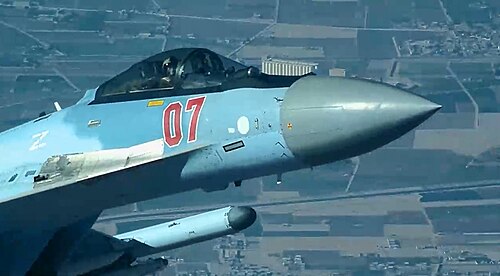
On 20 August 2019, two Russian Aerospace Forces Su-35Ss, operating from the Khmeimim Air Base, intercepted two Turkish Air Force F-16s over the southern Idlib and forced them to leave the Syrian airspace.[94] Russian Su-35Ss again intercepted several Israeli aircraft over southern Syria on 10 September 2019 and prevented them from carrying out airstrikes.[95] Another interception allegedly occurred on 19 September 2019, when two Russian Su-35Ss intercepted Israeli aircraft preparing to attack suburbs of Damascus.[96] On 15 October 2019, a Turkish F-16 fighter was intercepted by Russian Su-35Ss and forced to retreat as it was attempting to bomb the Syrian Democratic Forces's headquarters in Manbij.[97] On 12 November 2019, Russian Su-35Ss intercepted an Israeli fighter during airstrikes on Damascus.[98] On 7 December 2019, several Israeli aircraft were intercepted by Russian Su-35Ss and forced to retreat during an attempt to bomb the T-4 Airbase.[99]
Russian Su-30SM, MiG-31 and Su-35S fighters were used for air superiority missions during the war. By September 2022, at least seven air-to-air victories were confirmed over Ukrainian fighters[100] and one over a Ukrainian Naval Aviation Mil Mi-14.[101]
On 3 April 2022, a Russian Su-35S was shot down by Ukrainian forces, with the pilot ejecting and being captured; the pilot stated that his Su-35S was shot down near Izyum while battling Ukrainian air defences.[102][103]
On 19 July 2022, the Ukrainian Air Force command claimed that a Su-35 was shot down by Ukrainian air defences near Kakhovka, but at the time there were no photos confirming the loss.[104][105] In early February 2023, photos of the crash site emerged, confirming the crashed plane was an Su-35S.[106]
On 14 May 2023, a Ukrainian MIM-104 Patriot missile shot down a Su-35 fighter over Bryansk region.[107] On 22 May 2023, another Ukrainian MIM-104 Patriot missile shot down a Su-35 over Bryansk region.[108]
2023年9月28日、ロシアのS-300地対空ミサイルがトクマク地域付近で友軍のSu-35を撃墜した。予備報告によると、S-300ミサイルの射撃管制レーダーが敵味方を識別できず、友軍誤射によりSu-35が撃墜されたという。[ 109 ] [ 110 ]
ウクライナ国防省は、ウクライナの防空部隊が2024年2月にSu-35を2機撃墜したと主張した。[ 111 ]彼らによれば、これは「2022年10月にSu-34を10機、 A-50を1機撃墜したと主張して以来、ロシアのジェット機を撃墜した最大の成果」だという。[ 111 ]
2023年5月の国際戦略研究所によると、ロシアはウクライナ戦争の開始以来、味方の誤射、墜落[ 112 ]、または西側諸国から供与された防空システムを使用してウクライナ軍が撃墜[ 113 ]したことにより、5機以上のSu-35戦闘機を失っている。 [ 114 ] [ 115 ]
2025年6月7日、クルスク方面で燃えているロシアのSu-35の残骸の映像が公開され、ウクライナ空軍はウクライナ軍によって撃墜されたと発表した。[ 116 ] [ 117 ]
2026年7月8日、ウクライナ空軍は、ルハンスクのモストキー近郊で、前線から約42キロメートル(26マイル)離れた地点でSu-35を撃墜したと発表した[ 118 ] [ 119 ]。複数の情報源によると、撃墜の原因は国境付近に配備されたMIM-104パトリオット防空システムだったという[ 120 ] 。同月後半、米空軍のダン・ケイン将軍が、ウクライナのF-16がロシアの戦闘機を撃墜し、初の空対空撃墜を達成したと述べた後、一部の観察者は、彼がウクライナの7月8日の主張を指していたのではないかと推測したが、それは明らかではない[ 121 ] 。
1990年代初頭、Su-27Mの販売に関する取り決めが中国と協議された。1995年、スホーイ社の関係者は、北京が120機を購入することに同意することを条件とした共同生産案を発表した。[ 122 ]しかし、ロシア外務省は、Su-27派生型の中国での生産に関する取り決めへの懸念から、 Su-27MとツポレフTu-22M爆撃機の販売を阻止したとされている。[ 123 ]
In November 2015, China became the Su-35's first export customer when the Russian and Chinese governments signed a contract worth $2 billion to buy 24 aircraft for the People's Liberation Army Air Force.[124][125] This deal drew international commentaries due to its significance. David Ochmanek of RAND Corporation said the deal "serves both countries", as Russia relied on foreign sales to maintain its military production capacity, while China sought to enhance its military capabilities through the advanced weapon platforms such as the Su-35.[126] However, the low number of purchases also signified that the deal was symbolic in nature, as the two countries are still competing over influence in Central Asia, according to Moritz Rudolf of Mercator Institute for China Studies.[126] Ben Moores of IHS believed the Su-35 deal would be the last major order from China, as the Sino-Russian military cooperation saw "very little action or real substance. China doesn't need Russia as much as Russia needs China."[126]
Chinese officials had reportedly first shown interest in the Su-35 in 2006,[127] it was not until Zhuhai Airshow 2010 that Alexander Mikheyev of the Rosoboronexport, the Russian state agency responsible for the export and import of defence products, signified that Russia was ready to start talks with China over the Su-35.[128][129] Russian officials publicly confirmed that talks had been going on in 2012, when a protocol agreement on the purchase was signed.[130] There were subsequent reports of the two countries signing a contract and of imminent deliveries,[131][132] but negotiations would not actually conclude until 2015.
Sales discussions were protracted due to intellectual property rights concerns. China had reverse engineered the Su-27SK and Su-33 to create the J-11B and J-15, respectively,[133] there were fears of China copying the airframe and offer the copied design on the export market. At one stage, Rosoboronexport demanded that China issue a legally binding guarantee against copying.[133] Chinese industry was reportedly interested in the AL-41F1S engine and Irbis-E radar.[130][134] According to The Diplomat, China held a specific interest in the Su-35's engine, and was already test-flying the J-11D, which reportedly has less range, payload, and manoeuvrability than the Su-35 but has an active electronically scanned array radar instead of the less advanced PESA radar of the Su-35.[135] Rosoboronexport insisted on China purchasing a minimum of 48 aircraft to offset risks of copying; after the Kremlin intervened in 2012, the minimum quantity was lowered to 24.[136] Another problem was China's insistence that the Su-35 include Chinese-made components and avionics. The Kremlin again intervened and conceded to this demand, allowed the deal to proceed; it was viewed as a major concession since the sales of such components are reportedly lucrative.[130] The contract did not include any technology transfer.[127]
中国軍は2016年12月に最初の4機を受領した。[ 137 ] [ 138 ]最初の納入に続いて、人民解放軍のウェブサイトは、J-20の就役により、ロシアはSu-35が「近い将来中国市場での価値を失うことを理解している…我々はSu-35が中国が輸入する最後の(戦闘)機になることを強く望んでいる」と意見を述べた。[ 139 ]中国は2017年に2回目の10機を受領し、[ 140 ] 2018年にさらに10機を受領した。 [ 3 ] Su-35Sは2018年4月に人民解放軍空軍に就役し、[ 141 ]中国南東部の広東省に配備されている。[ 138 ] 2019年6月、ロシアは中国にSu-35の2回目のバッチを提案した。[ 142 ] Asia Timesによると、中国の情報筋は、Su-35の追加購入は実現不可能だと述べている。ロシアのジェット機は中国のJ-16に比べて価値がほとんどなく、J-16の方がレーダー、アビオニクス、その他の装備が優れているためである。[ 143 ]
2018年9月20日、米国は、中国の装備開発部とその部長である李尚福に対し、ロソボロンエクスポルトとの「重要な取引」に関与したとして制裁を課した。具体的には、中国が2017年にSu-35を10機購入したこと、および2018年にS-400地対空ミサイルシステム関連機器を購入したことが挙げられている。[ 144 ]
コメルサント紙によると、アルジェリア軍は2016年2月にSu-35の試験を要請し、同国は戦闘機の飛行特性に満足したため、モスクワは正式な申請を待っているとのことである。[ 145 ] 2019年12月27日、アルジェリアは、スホーイSu-34およびSu-57戦闘機の購入も含む大規模な軍事取引の一環として、14機の航空機の契約に署名したと報じられた。[ 146 ]しかし、当時、ロシア政府もアルジェリア政府も、そのような取引が存在することを確認していなかった。
2025年、アルジェリアは、当初エジプトとの契約履行のために計画されていたものの、エジプトに対する制裁と圧力のために納入されなかったSu-35戦闘機(計画されていた約24機のうち)を受け取った。 2025年3月2日、 An -124輸送機がコムソモリスク・ナ・アムールからSu-35を積み込み、アルジェリアのアイム・エル/ウム・エル・ブガビ空軍基地に着陸するのが確認され、少なくとも2機が飛行しているのが目撃され、少なくとも4機の旧エジプト空軍発注のSu-35には新たにアルジェリア空軍の国籍マークが塗装されているのが確認された。[ 147 ] [ 148 ]これらは第20多用途航空団の下、アイン・ベダ空軍基地に配備されていると考えられている。 [ 149 ]
ロシアがウクライナ侵攻中にイラン製の自爆ドローンを購入したことを受け、イラン・イスラム共和国空軍(IRIAF)は、ロシア軍への弾薬、ドローン、弾道ミサイルの追加供給と引き換えに、スホーイSu-35の調達を検討していると、米当局者が伝えている。また、イラン人パイロットの訓練が2022年春に開始され、同機は2023年に納入される可能性があるとも伝えられている。この取引には、もともとエジプト向けに製造された24機のSu-35が含まれる可能性があるが、これまでのところ納入に関する公式報告は出ていない。[ 150 ] [ 151 ]この取引は、2022年12月28日にイラン国営メディアのタスニム通信社によって、また2023年1月15日にイランの国会議員によって確認された。同議員は、春に供給が開始されると述べ、イランはロシアから防空システム、ミサイルシステム、ヘリコプターも発注したと述べた。[ 152 ]
However, in July 2023, the Iranian Defense Minister, Mohammad-Reza Gharaei Ashtiani, made vague statements alluding that Iran is reconsidering the acquisition of the Su-35 due to increasing investment towards indigenous fighter building capabilities, leading to some sources to declare that the deal has collapsed.[153] Despite this, the Iranian Air Force has received deliveries of the Yak-130 advanced jet trainer, which are used to train aspiring cadets before they graduate to actual fighter aircraft, such as the Su-35. The trainers have received Islamic Republic of Iran Air Force (IRIAF) livery and serial numbers. On 28 November 2023, Iran's deputy defence minister announced that Iran had finalized a deal for the purchase of Su-35 aircraft from Russia, although further details on the quantity or timeline were not shared.[154] An order for 24 Su-35s was reported in April 2024,[155] but these reports were denied by Iran's SNN media agency.[156] In January 2025, Ali Shadmani, a senior commander in the Islamic Revolutionary Guards Corps, said that Su-35s had been purchased by Iran, without precising how many were procured and whether deliveries had started.[157] An Iranian lawmaker said on 23 September 2025 that Su-35s are "on the way".[158]
Leaked documents from ROSTEC reveal that Ethiopia - a long time user of the Su-27 and the first to use them in combat - placed an order for six Su-35s as part of a modernization program. This follows on their orders for four to six Su-30Ks earlier in the decade, but thus far, no deliveries of Su-35s have been confirmed.[159]
The New York Times alleges that Vietnam has been quietly pursuing Su-35 procurement, featuring sanctions evasion and indirect payments.[160][145][161][162]
Following the deployment to Syria of several new Russian military systems, various countries had reportedly expressed interest in the Su-35. These countries included Kazakhstan,[163] North Korea,[164] and Sudan (during the Sudanese president Omar Hassan al-Bashir's visitation of Moscow in November 2017).[165]
In the mid-1990s, Brazilian and Russian authorities conducted talks on the possible acquisition of the Su-27M.[166] In 2001, the Brazilian government launched the F-X tender, the objective of which was to procure at least 12 aircraft to replace the Brazilian Air Force's ageing aircraft, primarily the Mirage IIIs.[167][168] Since the Brazilian government was also looking to develop the country's aerospace and defence industries, Sukhoi partnered with the Brazilian defence contractor Avibras during the tender. The two companies submitted the Su-27M to the US$700-million tender, and included an offset agreement wherein the Brazilian industry would have participated in the manufacturing of certain aircraft equipment.[169] The tender was suspended in 2003 because of domestic political issues and then scrapped in 2005, pending the availability of new fighters.[167] The Su-27M was preferred over the next favourite, the Mirage 2000BR;[168] had the aircraft been purchased, it would have been the first heavy fighter delivered to Latin America.[166]
With the tender relaunched in 2007 as the F-X2 competition, the Brazilian Defence Ministry looked to purchase at least 36 aircraft – with a potential for 84 additional aircraft – to replace the country's A-1Ms, F-5BRs and Mirage IIIs. Among the participants were the F/A-18E/F Super Hornet, F-16BR, JAS Gripen NG, Dassault Rafale, Eurofighter Typhoon and the modernized Su-35. Although the Brazilian government eliminated the Su-35 in 2008,[170] Rosoboronexport subsequently offered to sell the country 120 aircraft with full technology transfer,[171] as well as participation in the PAK FA programme.[172] In December 2013, the Gripen NG light fighter was selected because of its low cost and the transfer of technology to the Brazilian industry.[173]
In March 2019, it was reported that Egypt would procure "over two dozen" Su-35s from Russia in a deal valued about $US2 billion, finalized in late 2018. Deliveries were expected to begin as early as 2020 or 2021.[174][175] Deputy head of the Rosoboronexport Sergei Kornev denied the signing of any contract to supply Su-35s to Egypt.[176] US Secretary of State Mike Pompeo warned Egypt against buying Su-35s, saying "if those systems were to be purchased, the CAATSA statute would require sanctions on the regime."[177]
On 19 May 2020, Russia began Su-35 production for Egypt,[178] and first five production aircraft took off from the KnAAZ plant on 28 July 2020.[179] By June 2021, in total 17 aircraft were produced for Egypt.[4][180] Egyptian newspaper Arabo reported on 5 January 2022, Egypt, Algeria and Indonesia announced that they would cancel their Su-35 orders with Russia. In March 2022, an agreement with the US to sell variants of F-15Es to the Egyptian Air Force was announced which confirms that Egypt either abandoned or cancelled the Su-35 deal and the planes originally produced for Egypt will be delivered to Iran instead.[181][182][183] A contract needs to be finalized after price and delivery date are determined.[184]
India has been reluctant to order the Sukhoi/HAL FGFA due to high cost, and it has been reported that India and Russia are studying an upgrade to the Su-35 with stealth technology (similar to the F-15 Silent Eagle) as a more affordable alternative to the FGFA (Su-57).[185] The aircraft is competing with 7 other aircraft in a fresh tender which is referred as MMRCA 2.0 in the Indian media, for the procurement of 114 multi-role combat aircraft.[186] As of May 2026, the Indian Government has opted to procure more Dassault Rafales instead, with a total order of 114 being discussed and negotiated with the French side.[187]
2014年、ロシアはインドネシアのノースロップF-5E後継機選定競争にSu-35を提案した。[ 188 ] 2015年、インドネシア空軍がSu-27SKとSu-30MK2に精通していることを理由にSu-35が選定された。他の競合機はユーロファイター・タイフーン、ダッソー・ラファール、F-16、サーブJAS 39グリペンであった。[ 189 ] [ 190 ] 2018年2月に11機の契約が締結された。[ 191 ] 11億4000万米ドルの価格の半分は商品で支払われることになっていた。[ 191 ]最初の2機は10月に納入される予定だった。[ 191 ]
2024年5月現在、航空機は納入されていない。2020年3月、ブルームバーグは、購入はアメリカの圧力によりキャンセルされたと報じた。[ 192 ]インドネシア[ 193 ]とロシアはキャンセルを否定した。[ 194 ] 2021年12月、インドネシア空軍参謀総長ファジャール・プラセティオ空軍大将は、予算上の理由で購入がキャンセルされると述べた。[ 195 ] 2023年6月、インドネシア国防省は、CAATSAとOFACによるアメリカの制裁の脅威により購入が妨げられたと報告した。[ 196 ] 2024年5月、ホセ・タバレス駐ロシア・インドネシア大使は、契約は有効のままだと述べた。[ 197 ]
2019年7月、ロシアは、米国がS-400ミサイルシステムを購入したためトルコがF-35計画から除外された後、トルコにSu-35を提供した。 [ 198 ]ロステックのCEOセルゲイ・チェメゾフは、「トルコの同僚が希望を表明すれば、我々はSu-35戦闘機の納入に取り組む準備ができている」と述べた。[ 199 ] 2019年5月、セルゲイ・チェメゾフは、ロシアはトルコとSu-57の輸出と現地生産で協力する準備ができていると述べていた。[ 200 ] 2019年10月、トルコのフルシ・アカル国防相は、フランカーを取得する計画を否定し、トルコは依然としてF-35計画のメンバーであり、単に自分たちの権利が尊重されることを望んでいるだけだと改めて述べた。[ 201 ]トルコはその後ユーロファイター タイフーンを調達し[ 202 ] [ 203 ] 、 TAI TF Kaanプロジェクトの下で国産の第 5 世代ステルス戦闘機の開発に取り組んでいる。[ 204 ]
1996年、ロシアは韓国のFX計画にSu-27MとSu-37を提出した。この計画は、韓国空軍のF-4D/E、RF-4C、F-5E/Fの後継機40機を調達することを目的としていた。ロシアの2つの設計は、ダッソー・ラファール、ユーロファイター・タイフーン、F-15Kスラムイーグルと競合した。[ 205 ]スホーイは、フェーズドグリッドレーダーと推力偏向エンジンを特徴とする設計を提案し、完全な技術移転と韓国での最終組み立てを申し出た。50億ドルの 契約は、ロシアが韓国に負っている債務の減免協定によって部分的に資金調達される予定だった。[ 206 ] [ 207 ]しかし、Su-27Mは競争の初期段階で脱落し、F-15Kが勝利した。[ 208 ]
近代化されたSu-35の初期の輸出先として有力視されていた国の一つがベネズエラだった。ウゴ・チャベス政権下のベネズエラ政府は2006年7月、米国の武器禁輸措置の対象となったF-16戦闘機を置き換えるため、Su-30MK2を24機発注した。[ 209 ]これらの機体は2006年から2008年にかけてベネズエラ空軍に納入された。同国は同型機の2回目の発注を行うか、Su-35を購入すると予想されていた。[ 210 ]その後、ベネズエラ政府が同機に関心を示し、Su-35を発注したとの報道があったにもかかわらず。[ 211 ]
1990年代半ば、アラブ首長国連邦はSu-27Mを評価したが[ 212 ]、後にフランスとの緊密な関係からミラージュ2000を取得した[ 27 ] 。 2017年2月、同国はSu-35の購入に関する予備協定に署名し、またロシアの先進工業製品の開発を担当する国営企業ロステックとMiG-29をベースにした第5世代航空機を開発する協定にも署名した[ 213 ]。
パキスタンは2010年代半ばに少なくとも10機のSu-35を取得しようとしていたと報じられているが、ロシア当局はこれを否定している。[ 214 ] [ 215 ]パキスタン空軍は最近、単発エンジンのJ-10戦闘機を取得している。[ 216 ]
リビアは、他のロシア製兵器とともに12~15機のSu-35の初期輸出顧客となることが期待されていたが、リビア内戦とそれに伴う軍事介入により、そのような計画は中止された。[ 217 ]ロシアは、近代化されたSu-35をマレーシアとギリシャ( NATO加盟国)にも提案したが[ 218 ]、マレーシアは別の戦闘機プロジェクトに携わっており、近代化されたSu-35を調達する可能性は低いことから、正式な契約は実現していない。[ 39 ]

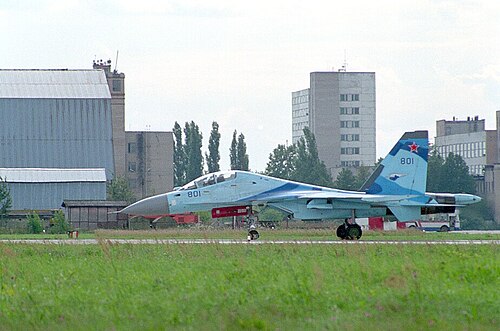
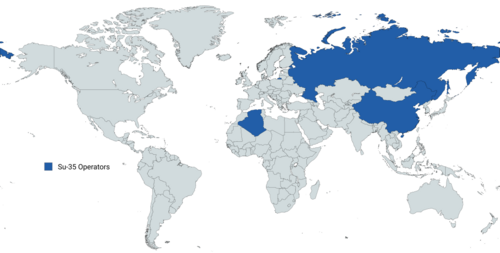
 Algeria
 People's Republic of China
 Russia
The fourth Su-35BM prototype was destroyed in a high-speed taxi run on 26 April 2009 due to brake failure. The aircraft crashed into the barrier at the end of the runway and was destroyed. The pilot ejected and sustained burn injuries.[60]
On 31 July 2021, a Su-35S fighter crashed after suffering an engine failure during a routine training mission in the Khabarovsk Territory in Russia, according to statement from the Russian Defence Ministry.[259] According to a preliminary investigation reported by the Russian newspaper Top War, the Su-35 suffered technical malfunctions in the environment control systems that indicate heating and cooling functions.
On 28 March 2024, a Su-35 crashed into the sea off Sevastopol. The pilot is reported to have safely ejected.[260]


Data from KnAAPO,[45][261] Jane's All The World's Aircraft 2013[262]
General characteristics
Performance
Armament
Avionics
Related development
Aircraft of comparable role, configuration, and era
Related lists
Also referred to as the Su-35S 'Super Flanker' (and sometimes the Su-35C), the Sukhoi was originally conceived purely for export sales, with China and Venezuela expressing interest.
L-39 jet trainer...MiG-29 of 40th TAB piloted by Lt. Col. Yerko Vaycheslav Vladimirvoich...MiG-29 of 40th TAB piloted by Vladimir Kokhansky...Su-27 lost on February 28 on a defensive mission over Koprivnitsky battling Russian fighters...MiG-29 of Maj. Oleksandr Brynzhal, KIA after shot down over Kyiv Oblast in duel...MiG-29 on March 13 downed over Chernihiv...MiG-29 on March 23 piloted by Maj. Dmitry Chumachenko
an Su-35 was recorded attempting to gun down a Ukrainian Mi-14 utility helicopter over Odessa Bay, only to miss. Subsequently, it downed the chopper with a missile, killing a high-ranking naval officer.
{{cite web}}: CS1 maint: url-status (link)Previously unreported, the air-defense orders suggested to analysts — who confirmed that the documents offered a credible glimpse of Vietnam's plans — that a deal for Su-35s and other aircraft was probably already done. One of several Vietnamese officials who confirmed large orders from Russia said the country purchased 40 new Su-35 and Su-30 fighter jets, as part of a deal worth $8 billion...
{{cite web}}: CS1 maint: deprecated archival service (link)