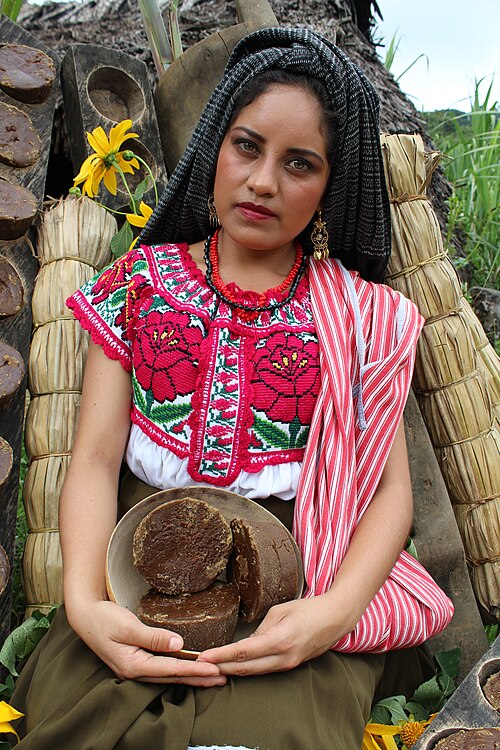
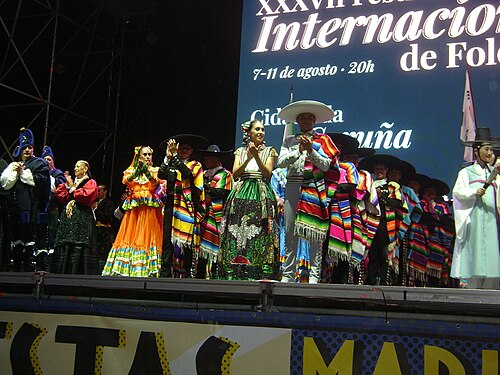
メキシコ政府が行った調査では、先住民の言語を話す人、先住民の言語を話さず先住民のコミュニティに住んでいないが先住民であると自認する人は、すべて先住民としてカウントされます。これらの基準によると、先住民開発国家委員会(Comisión Nacional para el Desarrollo de los Pueblos Indígenas、スペイン語ではCDI)とINEGI(メキシコ国立統計地理情報院)は、メキシコにはさまざまな民族グループに属する1570万人の先住民がおり[ 147 ] 、これは国内人口の14.9%を占め[ 148 ] 、 1.2%はスペイン語が流暢ではないと述べています。[ 149 ] [ 150 ]アメリカ先住民の言語を話す人、またはアメリカ先住民であると自認する人の割合が最も高い州は、ユカタン州(59%)、オアハカ州(48%)、キンタナ・ロー州(39%)、チアパス州(28%)、カンペチェ州(27 %) 、イダルゴ州(24%)、プエブラ州(19%)、ゲレーロ州(17%)、サン・ルイス・ポトシ州(15%) 、ベラクルス州(15%) です。オアハカ州は、国内で最も多くの異なる先住民族と言語が存在する州です。
Since the end of the Mexican Revolution, the official identity promoted by the government for non-indigenous Mexicans has been the Mestizo one (a mix of European and indigenous culture and heritage),[116] established with the original intent of eliminating divisions and creating a unified identity that would allow Mexico to modernize and integrate with the international community.[182] Even though nowadays the large majority of the country's population consider themselves Mexicans, differences on physical features and appearance continue playing an important role on everyday social interactions,[183][120] taking this into account, on recent time Mexico's government has begun conducting ethnic investigations to quantify the different ethnic groups that inhabit the country with the aim of reducing social inequalities between them. According to these recent investigations, 19.4% of Mexico's population self-identify as Indigenous[184] and 2.04% self-identify as Afro-Mexican,[184][185] there is no definitive census that quantifies White Mexicans, with estimates from the Mexican government and other contemporary sources reporting results that estimate them at about one-third of the country's population,[186][187][188][189] with this figure being based on phenotypical traits, rather than genetic ancestry or self-identified ancestry.
Generally speaking ethnic relations can be arranged on an axis between the two extremes of European and Amerindian cultural heritage, this is a remnant of the Spanish caste system which categorized individuals according to their perceived level of biological mixture between the two groups although in practice the classificatory system has become fluid, mixing socio-cultural traits with phenotypical traits allowing individuals to move between categories and define their ethnic and racial identities situationally,[190] the presence of considerable portions of the population with African and Asian heritage makes the situation more complex.[127][191] Even though there is a large variation in phenotypes among Mexicans, European looks are still strongly preferred in Mexican society, with lighter skin receiving more positive attention, as it is associated with higher social class, power, money, and modernity.[182][120] In contrast, Indigenous ancestry is often associated with having an inferior social class, as well as lower levels of education.[116][192] These distinctions are strongest in Mexico City, where the most powerful of the country's elite are located.[182]
Luis Miguel, always referred to as The Sun of Mexico.
Despite Mexico's government not using racial terms related to European or white people officially for almost a century (resuming using such terms after 2010), the concepts of "white people" (known as güeros or blancos in Mexican Spanish) and of "being white" did not disappear [193] and are still present in everyday Mexican culture: different idioms of race are used in Mexico's society that serve as mediating terms between racial groups. It is not strange to see street vendors calling a potential customer Güero or güerito, sometimes even when the person is not light-skinned. In this instance it is used to initiate a kind of familiarity, but in cases where social/racial tensions are relatively high, it can have the opposite effect.[182] The lack of a clear dividing line between white and mixed race Mexicans means that the concept of race is fluid and subjective.[116][182] Contemporary sociologists and historians agree that the concept of "race" has a psychological foundation rather than a biological one.[183]
Spanish is the de facto official language in Mexico, being spoken by 98.3% of the population.[194]Mexican Spanish is spoken in a variety of dialects, accents and variations in different regions across the country. Some indigenous languages are still being spoken by around 5% of Mexicans according to the latest census. In 2003, the General Law of Linguistic Rights of the Indigenous Peoples recognized 68 indigenous languages as "national languages", with the "same validity" in all territories and contexts where they are spoken. The indigenous language with the greatest number of speakers is Nahuatl (1,586,884 speakers in 2010 or 1.5% of the nation's population), followed by Yucatec Maya (796,405 speakers in 2010 0.8%) spoken Yucatán Peninsula, Mixtecas languages (494,454), Tzeltal (474,298), Zapotecas languages (460,683), Tzotzil (429,168), Otomí (288,052), Totonaca (250,252) Mazateco (230,124), Chol (222,051) and 1,462,857 speakers of other languages. After half a century of rural-to-urban migration, in Mexico City and other major cities large districts and sections use both written and spoken Amerindian languages. Approximately 7,364,645 Mexicans (6.1% of the population) speak an indigenous language according to the 2020 Mexican Census.[143]
During the first half of the 20th century the government promoted a policy of castellanización, that is, promoting the use of Spanish as a way to integrate indigenous peoples into Mexican society. Later, this policy changed, and since the 1980s the government has sponsored bilingual and intercultural education in all indigenous communities. This policy has mainly been successful in large communities with a significant number of speakers. While some languages, with less than 1,000 speakers, are still facing extinction.
The second most spoken language in Mexico, however, is English. It is used extensively at border areas, tourist centers and large metropolitan areas, a phenomenon arguably caused by the economic integration of North American under the North American Free Trade Agreement (NAFTA) and the immigration phenomenon and the return of workers and their families from the United States.[195] In border cities, American TV and radio waves in English (and Spanish) are received as much as Spanish-speaking radio and TV stations from Mexico on the US side of the border, thus a bilingual cross-cultural exchange is at work. Among the languages brought to the country by immigrants are the Venetian of Chipilo, and Mennonite Low German spoken in Durango and Chihuahua.
The Constitution of Mexico grants Mexican nationality based on birth and naturalization. Mexican laws regarding nationality by birth are very open. Mexican nationality by birth is granted to:[196]
all those individuals born in Mexican territory,
all those individuals born outside Mexico, whose father or mother is Mexican by birth,
all those individuals born outside Mexico, whose father or mother is Mexican by naturalization,
all those individuals born aboard Mexican aircraft or sea vessels, whether warships or commercial vessels.
Mexican nationality by naturalization is granted to:[196]
foreign citizens granted Mexican nationality by the Secretariat of Government (Ministry of the Interior);
foreign citizens married to a Mexican national, whether by birth or naturalization.
The Mexican population is predominantly Catholic (78% of the population aged five and older, according to the 2020 census),[197] although the percentage representing those who attend church on a weekly basis is lower (46%).[198] About 7.6% of the population was classified as Protestant or Evangelical, 2.5% were classified as "Non-Evangelical Biblical" (a classification that groups Adventists, Mormons and Jehovah's Witnesses), 0.05% as practicing Jews, and 4.6% without a religion.[199] The largest group of Protestants are Pentecostals and Charismatics (classified as Neo-Pentecostals).
The states with the highest percentage of professing Catholics are central states, namely Guanajuato (96.4%), Aguascalientes (95.6%) and Jalisco (95.4%), whereas southeastern states have the lowest percentage of Catholics, namely Chiapas (63.8%), Tabasco (70.4%) and Campeche (71.3%).[199] The percentage of professing Catholics has been on the decrease over the last four decades, from over 98% in 1950 to 78% in 2020.[197]
The average annual growth of Catholic believers from 1990 to 2000 was 1.7% whereas that of non-Catholics was 3.7%.[200] Given that the average annual population increase over the same time period was 1.8%,[201] the percentage of Catholics in relation to the total population continues to be in overall decline.
Since 1857 with the La Reforma laws, the Mexican Constitution drastically separates Church and State, unlike some other countries in Latin America or Ibero-America. The State does not support or provide any economic resource to the Church (as is the case in Spain and Argentina),[202] and the Church cannot participate in public education (no public school can be operated by a Catholic order, although they can participate in private education). Moreover, the government nationalized all the Church's properties (some of which were given back in the 1990s), and priests lost the right to vote or to be voted for (although in the 1990s they regained the right to vote).
12345678910111213"North America:: MEXICO". CIA The World Factbook. Archived from the original on January 26, 2021. Retrieved August 29, 2017.
12"Encuesta Nacional de la Dinámica Demográfica (ENADID) 2023". INEGI. Retrieved July 5, 2024.
↑Cite error: The named reference enadid_2024 was invoked but never defined (see the help page).
↑"International Migrant Stock 2024". United Nations Population Division. Retrieved June 12, 2026.
↑"Presentación de resultados. Estados Unidos Mexicanos - Inegi", Mexico, retrieved on August 18, 2024.
↑"The World Factbook, CIA"Archived January 26, 2021, at the Wayback Machine Retrieved on November 23, 2022.
↑Statistics on the total population in MexicoArchived July 13, 2018, at the Wayback Machine, International Monetary Fund. October 2012. Retrieved June 25, 2017.
1234"Censo de Población y Vivienda 2020 - SCITEL" (in Spanish). INEGI. Retrieved January 27, 2021.
12"Metropolis de México 2020" Retrieved September 7, 2024.
12"Programa Nacional de Ordenamiento Territorial y Urbano" page 27, retrieved in August 28, 2024.
↑The Native population of the Americas in 1492, de William M. Denevan, Univ. de Wisconsin Press, 1992, pp. 28
↑Andrés Lira and Luis Muro: "El siglo de la Integración ", p. 10
↑La división territorial del Segundo Imperio Mexicano, 1865.Archived August 1, 2020, at the Wayback Machine Estudios de Historia Moderna y Contemporánea de México, UNAM
↑W.Borah, New Spain's Century of depression, Berkeley, 1951
↑https://web.archiveArchived July 27, 2013, at the Wayback Machine. org/web/20180930115440/https://www.history.com/topics/ancient-americas/aztecsArchived September 30, 2018, at the Wayback Machine
↑"From Traitors to Heroes: 100 Years of Mexican Migration Policies". Migrationinformation.org. March 1, 2004. Archived from the original on May 5, 2011. Retrieved August 29, 2017.
↑Hufbauer GC and Schott, JJ, NAFTA Revisited, Institute for International Economics, Washington, D.C. 2005
↑"Mexican Immigration to the U.S.: The Latest Estimates". Migrationinformation.org. March 1, 2004. Archived from the original on December 31, 2013. Retrieved August 29, 2017.
↑"Census Bureau Summary File"(PDF). Census.gov. Archived(PDF) from the original on August 10, 2017. Retrieved August 29, 2017.
↑"Población total por grupos quinquenales de edad según sexo, 1950 a 2005". Inegi.org.mx. Archived from the original on December 5, 2020. Retrieved August 29, 2017.
↑"Tasa global de fecundidad, 1976 a 2006". Archived from the original on December 15, 2018. Retrieved October 19, 2005.
1234567"Censo Población y Vivienda 2020". INEGI. Archived from the original on February 14, 2022. Retrieved January 26, 2021.
↑"In coronavirus-hit Mexico, many women are 'determined to not have babies'". The Washington Post. Archived from the original on January 4, 2022. Retrieved January 4, 2022.
↑"Proyecciones de la Población de México 2005–2050". Archived from the original on October 12, 2007.
↑"Censo de Población y Vivienda 2020 - SCITEL" (in Spanish). Retrieved January 26, 2021.
↑"Tasa de crecimiento media anual de la población por entidad federativa, 1990 a 2005". Inegi.org.mx. Archived from the original on October 22, 2014. Retrieved August 29, 2017.
↑"Tasas de inmigración, emigración y migración neta por entidad federativa, 1995–2000". Inegi.org.mx. Archived from the original on October 22, 2014. Retrieved August 29, 2017.
12"World Population Prospects – Population Division – United Nations". population.un.org. Archived from the original on May 6, 2011.
↑"UNSD — Demographic and Social Statistics". Archived from the original on April 14, 2022. Retrieved April 17, 2023.
↑"UNSD — Demographic and Social Statistics". Archived from the original on November 11, 2023. Retrieved April 17, 2023.
↑"Instituto Nacional de Estadística y Geografía (INEGI)". Archived from the original on May 28, 2012. Retrieved May 27, 2012.
↑"Instituto Nacional de Estadística y Geografía – Temas estadísticos". 3.inegi.org.mx. January 2015. Archived from the original on September 17, 2019. Retrieved May 6, 2020.
↑"Demographic Yearbook System". unstats.un.org. Archived from the original on February 12, 2018. Retrieved June 26, 2023.
↑"Children born per woman, 1900 to 2016". Our world in data. Archived from the original on January 4, 2021. Retrieved May 20, 2025.
↑"National Survey of Demographic Dynamics (ENADID) 2023". INEGI.
↑"Estadísticas de Defunciones Registradas enero a junio de 2025 (preliminar)"(PDF). INEGI. Retrieved January 22, 2026.
↑"Página no encontrada". 3.inegi.org.mx. Archived from the original on March 4, 2016. Retrieved August 29, 2017.
↑"Página no encontrada". 3.inegi.org.mx. Archived from the original on November 9, 2020. Retrieved August 29, 2017.
↑"Página no encontrada". 3.inegi.org.mx. Archived from the original on November 9, 2020. Retrieved August 29, 2017.
1234Our World in Data. "Children born per woman". Archived from the original on June 30, 2018. Retrieved May 28, 2026.
1234"Life expectancy". Our World in Data. Archived from the original on August 29, 2018. Retrieved August 28, 2018.
↑https://www.inegi.org.mx/programas/ccpv/2020/default.html#TabuladoArchived January 26, 2021, at the Wayback Machine Censo de Población y Vivienda 2020
12Palma Mora, Mónica (December 2005). "Asociaciones de inmigrantes extranjeros en la ciudad de México: Una mirada a fines del siglo XX"[Associations of foreign immigrants in Mexico City: A look at the end of the 20th century]. Migraciones Internacionales (in Spanish). 3 (2): 29–57. Archived from the original on December 6, 2020. Retrieved November 17, 2020.
123Ita, Rosa E. Garcia (December 2005). "Los árabes de México: Asimilación y herencia cultural"[The Arabs of Mexico. Assimilation and cultural heritage]. CONfines de relaciones internacionales y ciencia política (in Spanish). 1 (2): 107–109. Archived from the original on December 6, 2020. Retrieved November 17, 2020.
↑Conmemoran 100 años de inmigración coreanaArchived January 22, 2010, at the Wayback Machine
↑"Migrantes, votos, remesas"(PDF). Ime.gob.mx. Archived from the original(PDF) on July 29, 2016. Retrieved August 29, 2017.
↑"Argentinos en México".{{cite web}}: CS1 maint: deprecated archival service (link)
↑"As Spain's Economy Worsens, Young Adults Flock to Mexico for Jobs – New America Media". newamericamedia.org. Archived from the original on December 3, 2013. Retrieved November 23, 2013.
↑Flannery, Nathaniel Parish (April 30, 2013). "As Spain Falters, Spaniards Look to Latin America". Forbes. Archived from the original on March 4, 2016. Retrieved December 26, 2015.
↑American Citizens AbroadArchived February 25, 2011, at the Wayback Machine
↑Retiring Americans, Go south, old manArchived June 26, 2006, at the Wayback Machine by The Economist
12"Población nacida en otro país residente en México por entidad federativa según sexo, 2000". Inegi.org.mx. Archived from the original on February 4, 2019. Retrieved August 29, 2017.
↑"Mexican-Born Population Over Time, 1850–Present". Migration Policy Institute. August 14, 2013.
↑"Mexico – Net migration rate – Historical Data Graphs per year". IndexMundi. Archived from the original on December 6, 2020. Retrieved February 1, 2019.
12Martin, Philip (2005). "Mexico-US Migration". In Hufbauer, Gary Clyde; Schott, Jeffrey J. (eds.). NAFTA Revisited: Achievements and Challenges. Columbia University Press. pp.441–466. ISBN978-0-88132-447-1.
↑Martin, Philip. "Nafta Revisited: Mexico-US Migration"(PDF). International Institute of Economics. p.441. Archived from the original(PDF) on March 3, 2016. Retrieved February 1, 2019. The United States unilaterally ended both war-time bracero programs, in part because US labor and civil rights groups argued that the presence of Mexican migrants depressed wages and increased unemployment for similar US workers.
↑The Hispanic PopulationArchived July 26, 2017, at the Wayback Machine in the United States
↑Indicadores seleccionados de la población nacida en México residente en Estados Unidos de América, 1970 a 2000Archived February 14, 2007, at the Wayback Machine.
↑Lizette Alvarez (December 20, 2006). "A Growing Stream of Illegal Immigrants Choose to Remain Despite the Risks". The New York Times. Archived from the original on July 19, 2016. Retrieved January 15, 2013.
↑Población emigrante a Estados Unidos de América por entidad federativa según sexo, 2000Archived February 14, 2007, at the Wayback Machine.
↑Distribución porcentual de la población emigrante a Estados Unidos de América por tamaño de la localidad de residencia para cada sexo, 1990 a 1995 y 1995 a 2000Archived February 14, 2007, at the Wayback Machine.
↑"Población migrante de retorno de Estados Unidos de América por entidad federativa según sexo, 2000". Inegi.org.mx. Archived from the original on January 9, 2015. Retrieved August 29, 2017.
↑"MEXICAN MIGRATION APPEARS TO BE IN REVERSE | UTSanDiego.com". Archived from the original on May 1, 2015. Retrieved April 19, 2016.
↑"Navarrette: The Mexican reverse migration". Newsday. Archived from the original on April 28, 2016. Retrieved August 29, 2017.
↑"Mexicans feeling persecuted flee U.S." CNN. November 27, 2012. Archived from the original on March 5, 2016. Retrieved January 16, 2013.
↑"L.A. Now". Los Angeles Times. October 23, 2012. Archived from the original on March 6, 2016. Retrieved January 16, 2013.
↑Preston, Julia (July 31, 2008). "Decline Seen in Numbers of People Here Illegally". The New York Times. Archived from the original on April 24, 2015. Retrieved May 5, 2010.
↑Passel, Jeffrey S.; Cohn, D'Vera; Gonzalez-Barrera, Ana (April 23, 2012). "Net Migration from Mexico Falls to Zero—and Perhaps Less". Pewhispanic.org. Archived from the original on April 21, 2016. Retrieved August 29, 2017.
12"Census Profile, 2021 Census of Population - 28% sample data". Canada 2021 Census. Statistics Canada. 2021. Archived from the original on November 20, 2022. Retrieved November 20, 2022.
↑Batalova, Jeanne; Israel, Emma (November 5, 2020). "Mexican Immigrants in the United States". migrationpolicy.org. Archived from the original on January 18, 2021. Retrieved April 4, 2021.
↑"In 1637 the military force maintained in the islands consisted of one thousand seven hundred and two Spaniards and one hundred and forty Indians." ~Memorial de D. Juan Grau y Monfalcon, Procurador General de las Islas Filipinas, Docs. Inéditos del Archivo de Indias, vi, p. 425. "In 1787 the garrison at Manila consisted of one regiment of Mexicans comprising one thousand three hundred men, two artillery companies of eighty men each, three cavalry companies of fifty men each." La Pérouse, ii, p. 368.
↑"Pew Research; How the US Hispanic Population is Changing". pewresearch.org. September 18, 2017. Archived from the original on November 19, 2020. Retrieved November 5, 2018.
↑"Estadística del Padrón Continuo. Datos provisionales a 1 de enero de 2020". Instituto Nacional de Estadística. Archived from the original on January 30, 2021. Retrieved March 21, 2021.
↑"|N|M%C9XICO". Archived from the original on February 21, 2025. Retrieved October 29, 2009.
↑Bolivia – Censo de Población y Vivienda 2001Archived October 14, 2008, at the Wayback Machine
↑"Statische Bundesamt Deutschland". Archived from the original on November 16, 2010.
↑"Página/12". Pagina12.com.ar. Archived from the original on December 24, 2019. Retrieved August 29, 2017.
↑"Relaciones Exteriores". Instituto de los Mexicanos en el Exterior (IME). Archived from the original on March 27, 2022. Retrieved October 7, 2024.
↑"SBS Australia". SBS. Archived from the original on March 22, 2019. Retrieved September 10, 2019.
↑"Archived copy". Archived from the original on May 1, 2020. Retrieved October 29, 2009.{{cite web}}: CS1 maint: archived copy as title (link)
↑"Investigación de la Migración Internacional en Israel"(PDF). 1.cbs.gov.il. Archived from the original(PDF) on 15 October 2013. Retrieved 29 August 2017.
12"Statistiche demografiche ISTAT". Demo.istat.it. Archived from the original on May 20, 2017. Retrieved August 29, 2017.
↑"INE". Archived from the original on September 27, 2011.
↑"Raza Cósmica". Razacosmica.blogspot.com. Archived from the original on December 6, 2020. Retrieved August 29, 2017.
↑"Redatam::CELADE, ECLAC – United Nations". Celade.cepal.org. June 28, 2012. Retrieved August 29, 2017.
↑"Redatam::CELADE, ECLAC – United Nations". Celade.cepal.org. June 30, 2012. Retrieved August 29, 2017.
↑"Censo de Población y Vivienda 2000 – Jerarquía Censal". Celade.cepal.org. Archived from the original on March 6, 2010. Retrieved August 29, 2017.
↑Colombia – Sistema de Consulta Información Censal (Censo 2005)Archived June 16, 2013, at the Wayback Machine
↑"R+::CEPAL/CELADE – R+SP WebServer". Espino.ine.cl. June 28, 2012. Retrieved August 29, 2017.
↑"Redatam::CELADE, ECLAC – United Nations". Celade.cepal.org. Archived from the original on 26 October 2007. Retrieved 29 August 2017.
↑"Proyecto para dotar de conectividad a una región marginada en México"Archived September 8, 2024, at the Wayback Machine page 4, retrieved on September 7, 2024.
↑"Mexico en cifras" INEGI, retrieved in September 1, 2024.
12CONAPO Áreas MetropolitanasArchived May 1, 2011, at the Wayback Machine
↑"Síntesis de resultados 2005". Inegi.org.mx. Archived from the original on March 3, 2016. Retrieved August 29, 2017.
↑Wang, Sijia; Ray, Nicolas; Rojas, Winston; Parra, Maria V.; Bedoya, Gabriel; etal. (March 21, 2008). "Geographic Patterns of Genome Admixture in Latin American Mestizos". PLOS Genetics. 4 (3) e1000037. doi:10.1371/journal.pgen.1000037. PMC2265669. PMID18369456.
12Ruiz-Linares, Andrés; Adhikari, Kaustubh; Acuña-Alonzo, Victor; Quinto-Sanchez, Mirsha; Jaramillo, Claudia; etal. (September 25, 2014). "Admixture in Latin America: Geographic Structure, Phenotypic Diversity and Self-Perception of Ancestry Based on 7,342 Individuals". PLOS Genetics. 10 (9) e1004572. Bibcode:2014PLOSG..10.4572R. doi:10.1371/journal.pgen.1004572. PMC4177621. PMID25254375.
↑"World Factbook CENTRAL AMERICA: Mexico", The World Factbook, 2022, archived from the original on January 26, 2021, retrieved January 24, 2021
↑"Resultados del Modulo de Movilidad Social Intergeneracional"Archived July 9, 2018, at the Wayback Machine, INEGI, June 16, 2017, Retrieved on April 30, 2018.
↑Wimmer, Andreas, 2002. Nationalist Exclusion and Ethnic Conflict: Shadows of Modernity, Cambridge University Press page 115
↑Knight, Alan (1990). "4. Racism, Revolution and indigenismo: Mexico 1910–1940". In Graham, Richard (ed.). The Idea of Race in Latin America, 1870–1940. pp.78–85.
↑Hall Steckel, Richard; R. Haines, Michael (2000). A population history of North America. Cambridge University Press. p.621. ISBN978-0-521-49666-7. Archived from the original on January 8, 2024. Retrieved June 19, 2022.
↑"John P. Schmal, SomosPrimos.com". somosprimos.com. Archived from the original on September 20, 2008. Retrieved June 19, 2022.
↑"Genoma destapa diferencias de mexicanos". Expansión (in Spanish). June 6, 2009. Archived from the original on February 4, 2020. Retrieved May 9, 2020.
↑García, María Teresa Cabrero (1989). Civilización en el norte de México, Vol. 1. ISBN978-968-36-1092-8.
↑Pla Brugat, Dolores (2011). "Más desindianización que mestizaje. Una relectura de los censos generales de población"[More deindianization than miscegenation. A rereading of the general population censuses]. Dimensión Antropológica (in Spanish). 53 (September–December). Mexico City: Instituto Nacional de Antropología e Historia: 69–91. Archived from the original on December 6, 2020. Retrieved June 4, 2020.
1234"México sin mestizaje: una reinterpretación de nuestra historia", UNAM, 2016. Retrieved March 13, 2019.
↑"Al respecto no debe olvidarse que en estos países buena parte de las personas consideradas biológicamente blancas son mestizas en el aspecto cultural, el que aquí nos interesa (p. 196)"(PDF). Redalyc.org. March 16, 2005. Archived from the original(PDF) on October 22, 2013. Retrieved June 27, 2013.
12Bartolomé, Miguel Alberto. (1996) "Pluralismo cultural y redefinicion del estado en México". in Coloquio sobre derechos indígenas, Oaxaca, IOC.Archived June 16, 2010, at the Wayback Machine p. 2
↑Lara, Fernando Luiz; Hernández, Felipe (October 19, 2021). Spatial Concepts for Decolonizing the Americas. Cambridge Scholars. p.141. ISBN978-1-5275-7653-7.
12345Navarrete, Federico. "El mestizaje y las culturas"[Mixed race and cultures]. México Multicultural (in Spanish). Mexico: UNAM. Archived from the original on August 23, 2013. Retrieved July 19, 2011.
↑Sherburne Friend Cook; Woodrow Borah (1998). Ensayos sobre historia de la población. México y el Caribe 2. Siglo XXI. p.223. ISBN978-968-23-0106-3. Archived from the original on September 27, 2023. Retrieved September 12, 2017.
↑Hardin, Monica Leagans (2006). Household and Family in Guadalajara, Mexico, 1811 1842: The Process of Short Term Mobility and Persistence (Thesis). p.62. Archived from the original on December 6, 2020. Retrieved November 17, 2020.
↑San Miguel, G. (November 2000). "Ser mestizo en la nueva España a fines del siglo XVIII: Acatzingo, 1792"[To be 'mestizo' in New Spain at the end of the XVIIIth century. Acatzingo, 1792]. Cuadernos de la Facultad de Humanidades y Ciencias Sociales. Universidad Nacional de Jujuy (in Spanish) (13): 325–342. Archived from the original on October 23, 2020. Retrieved September 26, 2018.
123Lizcano Fernández, Francisco (August 2005). "Composición Étnica de las Tres Áreas Culturales del Continente Americano al Comienzo del Siglo XXI"[Ethnic Composition of the Three Cultural Areas of the American Continent at the Beginning of the XXI Century]. Convergencia (in Spanish). 12 (38): 185–232. Archived from the original on September 22, 2022. Retrieved November 17, 2020.
↑Bartolomé, Miguel Alberto (1996). Pluralismo cultural y redefinicioń del estado en México[Cultural pluralism and redefinition of the state in Mexico] (in Spanish). Departamento de Antropologia, Universidade de Brasilia. p.2. OCLC605212355. En primer lugar cabe destacar que en México la pertenencia racial no es un indicador relevante ni suficiente para denotar una adscripción étnica específica. [...] Por lo tanto es relativamente factible realizar el llamado tránsito étnico, es decir que un indígena puede llegar a incorporarse al sector mestizo a través de la renuncia a su cultura tradicional y si sus condiciones materiales se lo permiten.
↑Knight, Alan (September 1, 2010). Richard Graham (ed.). The Idea of Race in Latin America: 1870–1940. University of Texas Press. p.73. ISBN978-0-292-78888-6. Retrieved July 17, 2013.
↑Schaefer, Richard T., ed. (2008). Encyclopedia of Race, Ethnicity and Society. Sage. p.900. ISBN978-1-4129-2694-2. In New Spain, there was no strict idea of race (something that continued in Mexico). The Indians that had lost their connections with their communities and had adopted different cultural elements could "pass" and be considered mestizos. The same applied to Blacks and castas.
↑Wade, Peter (May 20, 1997). Race And Ethnicity In Latin America. Pluto Press. ISBN978-0-7453-0987-3. Retrieved July 17, 2013.
↑Schwartz-Marín, Ernesto; Silva-Zolezzi, Irma (December 2010). ""The Map of the Mexican's Genome": overlapping national identity, and population genomics". Identity in the Information Society. 3 (3): 489–514. doi:10.1007/s12394-010-0074-7. hdl:10871/33766. S2CID144786737.
↑R. Martínez & C. De La Torre (2008): "Racial Appearance And Income In Contemporary Mexico, pag 9 note 1"Archived August 6, 2021, at the Wayback Machine, Journal of Diversity Management, 2008. Retrieved April 1, 2021.
↑Navarrete Linares, Federico. "El mestizaje en Mexico"[The miscegenation in Mexico](PDF) (in Spanish). Archived from the original(PDF) on August 1, 2017. Retrieved July 31, 2017.
↑Gonzalo Aguirre-Beltran (1972). La población negra de México: estudio etnohistórico. Fondo de Cultura Económica. p.267. ISBN978-968-16-0912-2. Retrieved March 13, 2019.
↑Michael Werner (2001). Concise Encyclopedia of Mexico. Routledge. p.117. ISBN978-1-135-97377-3. Retrieved March 13, 2019.
12"Racismo, falso mestizaje y desigualdad social en México", Revista Cuadrivio, 2016. Retrieved March 13, 2019.
↑Sherburne Friend Cook; Woodrow Borah (1998). Ensayos sobre historia de la población. México y el Caribe 2. Siglo XXI. p.188. ISBN978-968-23-0106-3. Retrieved March 13, 2019.
↑Sherburne Friend Cook; Woodrow Borah (1998). Ensayos sobre historia de la población. México y el Caribe 2. Siglo XXI. p.197. ISBN978-968-23-0106-3. Retrieved March 13, 2019.
↑David A. Branding; Woodrow Borah (1975). Mineros y comerciantes en el México borbónico (1763–1810). Fondo de Cultura Económica. p.156. ISBN978-968-16-1340-2. Retrieved January 27, 2018.
↑Gloria M. Delgado de Cantú (2004). Historia de Mexico, Legado Historico Y Pasado Reciente. Pearson Educación. p.99. ISBN970-26-0523-7. Retrieved March 13, 2019.
↑"Ley General de Derechos Lingüísticos de los Pueblos Indígenas". Archived 11 June 2008 at the Wayback Machine
↑"Comisión Nacional para el Desarrollo de los Pueblos Indígenas – México". National Commission for the Development of Indigenous Peoples. Archived from the original on September 26, 2007. Retrieved January 14, 2018.
↑"Comisión Nacional para el Desarrollo de los Pueblos Indígenas – México". Archived from the original on September 26, 2007.
12"Encuesta Intercensal 2015"Archived April 22, 2017, at the Wayback Machine, "INEGI", Mexico, December 2015. Retrieved April 28, 2017.
↑"Informeanual sobre la situación de pobreza y rezago social 2022"[Annual report on the situation of poverty and social backwardness 2022](PDF). Secretariat of Welfare. Archived(PDF) from the original on January 18, 2024. Retrieved October 7, 2024.
123"Censo Población y Vivienda 2020". inegi.org.mx. INEGI. Archived from the original on February 14, 2022. Retrieved January 26, 2021.
↑"Indicadores seleccionados sobre la población hablante de lengua indígena, 1950 a 2005". Inegi.gob.mx. Archived from the original on January 18, 2012. Retrieved December 10, 2011.
↑"Síntesis de Resultados"(PDF). Comisión Nacional para el Desarrollo de los Pueblos Indígenas. 2006. Archived from the original(PDF) on March 4, 2016. Retrieved December 22, 2010.
↑Defined as persons who live in a household where an indigenous language is spoken by one of the adult family members, and or people who self identified as indigenous ("Criteria del hogar: De esta manera, se establece, que los hogares indígenas son aquellos en donde el jefe y/o el cónyuge y/o padre o madre del jefe y/o suegro o suegra del jefe hablan una lengua indígena y también aquellos que declararon pertenecer a un grupo indígena."Archived December 25, 2019, at the Wayback Machine)AND persons who speak an indigenous language but who do not live in such a household (Por lo antes mencionado, la Comisión Nacional Para el Desarrollo de los Pueblos Indígenas de México (CDI) considera población indígena (PI) a todas las personas que forman parte de un hogar indígena, donde el jefe(a) del hogar, su cónyuge y/o alguno de los ascendientes (madre o padre, madrastra o padrastro, abuelo(a), bisabuelo(a), tatarabuelo(a), suegro(a)) declaro ser hablante de lengua indígena. Además, también incluye a personas que declararon hablar alguna lengua indígena y que no forman parte de estos hogares Archived May 1, 2011, at the Wayback Machine)
↑"Población De 5 Años Y Más Por Entidad Federativa, Sexo Y Grupos Lengua Indígena Quinquenales De Edad, Y Su Distribución Según Condición De Habla Indígena Y Habla Española"(PDF). INEGI, México. Archived from the original(PDF) on January 2, 2008. Retrieved December 13, 2007.
↑"Comision Nacional Para el Desarrollo de los Pueblos Indigenas – México". Cdi.gob.mx. Archived from the original on January 17, 2013. Retrieved August 29, 2017.
↑Source: CDI (2000) Archived September 15, 2019, at the Wayback Machine
↑"The World Factbook: North America: Mexico: People and Society". The World Factbook, Central Intelligence Agency (CIA). Archived from the original on January 26, 2021. Retrieved August 23, 2017. mestizo (Amerindian-Spanish) 62%, predominantly Amerindian 21%, Amerindian 7%, other 10% (mostly European)
↑"History TV Schedule – History". Historyenespanol.com. Archived from the original on March 15, 2009. Retrieved August 29, 2017.
↑Durán-Merk, Alma J. (July 2012). European migrants as 'ambassadors of modernization'? The case of the Germans in Yucatán during the henequen boom. 54th International Congress of Americanists. Archived from the original on September 27, 2023. Retrieved April 2, 2021.
12Enciso, Fernando S. Alanís (1996). "Los extranjeros en México, la inmigración y el gobierno: ¿tolerncia o intolerancia religiosa?, 1821–1830" [Foreigners in Mexico, immigration, and the government: religious tolerance or intolerance?, 1821–1830]. Historia Mexicana (in Spanish). 45 (3): 539–566. JSTOR25139003.
↑Gitlitz, David (1998). "Nexos entre los cripto-judíos coloniales y contemporáneos" [Nexus between colonial and contemporary crypto-Jews]. Revista de humanidades: Tecnológico de Monterrey (in Spanish). 5: 187–212.
↑"Los Menones de Chihuahua". Puro Chihuahua (in Spanish). Archived from the original on June 6, 2004.
↑Montagner, Eduardo. "El dialecto veneto de Chipilo". Orbilat.com. Archived from the original on June 6, 2011. Retrieved April 3, 2007.
↑Vincent, Theodore G (2001). The Legacy of Vicente Guerrero, Mexico's First Black Indian President. University Press of Florida. ISBN978-0-8130-2422-6.
↑Menchaca, Martha. Recovering History, Constructing Race: The Indian, Black, and White Roots of Mexican Americans. Austin: University of Texas Press 2001.
↑Henderson, Timothy J. A glorious defeat: Mexico and its war with the United States. New York: Macmillan 2007.
↑"Afro-Mexicans in Mexico - Minority Rights Group".
↑"Panorama sociodemográfico de México"(PDF). INEGI. 2015. Archived from the original(PDF) on March 4, 2016.
↑Rivera, D.; Johnson, D.; Delgadillo, J.; Carrillo, M. H.; Obón, C.; Krueger, R.; Alcaraz, F.; Ríos, S.; Carreño, E. (2012). "Historical evidence of the Spanish introduction of date palm (Phoenix dactylifera L., Arecaceae) into the Americas". Genetic Resources and Crop Evolution. 60 (4): 1437–1439, 1444–1445. doi:10.1007/s10722-012-9932-5. S2CID24146736. Archived from the original on June 16, 2022. Retrieved May 8, 2022.
↑"Arab Influence in Yucatecan Cuisine – Mexico Culture – Arab Influence in Yucatecan Cuisine, Culture". Discoverymexico.com. March 16, 2008. Archived from the original on March 16, 2008. Retrieved August 29, 2017.
↑Velcamp, Theresa Alfaro (2005). "Review of Arab Immigration in Mexico in the Nineteenth and Twentieth Centuries: Assimilation and Arab Heritage: A Century of Palestinian Immigration into Central America: A Study of Their Economic and Cultural Contributions, Roberto Marín-Guzmán". International Journal of Middle East Studies. 37 (2): 266–269. doi:10.1017/S0020743805232063. ISSN0020-7438. JSTOR3879733.
↑"Find Local Contractors – Home Remodeling Contractors on Ecnext". goliath.ecnext.com. Archived from the original on May 16, 2011. Retrieved July 3, 2017.
↑Tatiana Seijas (2014). Asian Slaves in Colonial Mexico: From Chinos to Indian. Cambridge University Press. p.21. ISBN978-1-107-06312-9.
↑Leslie Bethell (1984). Leslie Bethell (ed.). The Cambridge History of Latin America. Vol.2 of The Cambridge History of Latin America: Colonial Latin America. I-II (illustrated, reprinted.). Cambridge University Press. p.21. ISBN978-0-521-24516-6.
↑Ignacio López-Calvo (2013). The Affinity of the Eye: Writing Nikkei in Peru. Fernando Iwasaki. University of Arizona Press. p.134. ISBN978-0-8165-9987-5.
↑Dirk Hoerder (2002). Cultures in Contact: World Migrations in the Second Millennium. Andrew Gordon, Alexander Keyssar, Daniel James. Duke University Press. p.200. ISBN978-0-8223-8407-6. Archived from the original on February 25, 2024. Retrieved October 4, 2020.
↑Buchenau, Jürgen (2001). "Small Numbers, Great Impact: Mexico and Its Immigrants, 1821–1973". Journal of American Ethnic History. 20 (3): 23–49. doi:10.2307/27502710. JSTOR27502710. PMID17605190. S2CID29111441.
↑"Romani Heritage: A Glimpse Into Mexico's Misunderstood Gypsy Community". February 21, 2018. Archived from the original on September 9, 2021. Retrieved September 9, 2021.
↑Project, Joshua. "Romani, Vlax in Mexico". joshuaproject.net. Archived from the original on July 8, 2019. Retrieved July 8, 2019.
↑"censo General de la Republica Mexicana 1895"Archived August 10, 2017, at the Wayback Machine, "INEGI", Mexico. Retrieved July 24, 2017.
↑Lerner, Victoria (1968). "Consideraciones sobre la población de la Nueva España (1793–1810): Según Humboldt y Navarro y Noriega" [Considerations on the population of New Spain (1793–1810): According to Humboldt and Navarro and Noriega]. Historia Mexicana (in Spanish). 17 (3): 327–348. JSTOR25134694.
↑Historical Dictionary of Argentina. London: Scarecrow Press, 1978. pp.239–40.
↑"American Indians in the Federal Decennial Census"Archived November 20, 2020, at the Wayback Machine. Retrieved July 25, 2017.
↑"El mestizaje es un mito, la identidad cultural sí importa"Istmo, Mexico. Retrieved July 25, 2017.
↑"Más desindianización que mestizaje. Una relectura de los censos generales de población"Archived July 31, 2017, at the Wayback MachineINAH, Mexico. Retrieved July 25, 2017.
↑DEPARTAMENTO DE LA ESTADISTICA NACIONALArchived March 4, 2016, at the Wayback Machine CENSO GENERAL DE HABITANTES 1921 Census (Page: 62)
12345Alejandra M. Leal Martínez (2011). For The Enjoyment of All:" Cosmopolitan Aspirations, Urban Encounters and Class Boundaries in Mexico City (PhD thesis). Columbia University Graduate School of Arts and Sciences 3453017.
12"El mestizaje en Mexico"(PDF). Archived from the original(PDF) on August 1, 2017. Retrieved June 23, 2017.
12"Población indígena autoadscrita nacional y por entidad federativa-Muestra censal 2020". Instituto Nacional de los Pueblos Indígenas. Retrieved May 17, 2024.
↑"Infografía | Afrodescendientes en México". www.wilsoncenter.org. July 25, 2022. Retrieved October 25, 2023.
↑About one third"Mexico: Ethnic groups". Encyclopædia Britannica. Retrieved March 8, 2024.
↑"Encuesta Nacional sobre Discriminación 2017"(PDF). CNDH. August 6, 2018. Archived(PDF) from the original on August 10, 2018. Retrieved August 10, 2018.
↑"21 de Marzo: Día Internacional de la Eliminación de la Discriminación Racial"[21 March: International Day for the Elimination of Racial Discrimination](PDF) (in Spanish). Mexico: CONAPRED. 2017. p.7. Archived(PDF) from the original on May 25, 2017. Retrieved August 23, 2017.
↑"Encuesta Nacional Sobre Discriminación en Mexico"(PDF). CONAPRED. Mexico. June 2011. Archived(PDF) from the original on November 8, 2012. Retrieved April 28, 2017.
↑Frudakis, Tony Nick (2008). Molecular photofitting: predicting ancestry and phenotype using DNA. Elsevier. p.348. ISBN978-0-12-088492-6.
↑Fortes de Leff, Jacqueline (December 2002). "Racism in Mexico: Cultural Roots and Clinical Interventions1". Family Process. 41 (4): 619–623. doi:10.1111/j.1545-5300.2002.00619.x. PMID12613120.
↑Nutini, Hugo; Barry Isaac (2009). Social Stratification in central Mexico 1500 - 2000. University of Texas Press, p. 55.
↑"Encuesta Intercensal 2015"(PDF). INEGI, México. Archived(PDF) from the original on December 10, 2015. Retrieved December 17, 2015.
↑Delacroix, Jacques; Nikiforov, Sergey (2009). "If Mexicans and Americans Could Cross the Border Freely". The Independent Review. 14 (1): 101–133. ISSN1086-1653. JSTOR24562214.
12Artículo 30Archived January 3, 2008, at the Wayback Machine. Constitución Política de los Estados Unidos Mexicanos.
12"Censo de Población y Vivienda 2020 – Cuestionario básico". INEGI. January 2010. Archived from the original on December 19, 2023. Retrieved May 18, 2022.
↑"Church attendance in Latin America". Archived from the original on September 1, 2006. Retrieved July 26, 2017.
12Población de 5 años y más por entidad federativa, sexo y religión y su distribución según grupos quinquenales de edadArchived September 25, 2007, at the Wayback Machine.
↑"Tasa de crecimiento media anual de la población según credo religioso para cada período decenal, 1950 a 2000". Inegi.org.mx. Archived from the original on August 27, 2018. Retrieved August 29, 2017.
↑"Tasa de crecimiento media anual de la población, 1950 a 2005". Inegi.org.mx. Archived from the original on August 27, 2018. Retrieved August 29, 2017.
↑"Argentina: Constitución de 1994". pdba.georgetown.edu. Archived from the original on July 1, 2020. Retrieved July 13, 2007.
Further reading
Merrill, Tim and Ramón Miró. Mexico: a country study (Library of Congress. Federal Research Division, 1996) US government document; not copyright online free
External links
UN: Fertility in Mexico: Trends and ForecastsArchived July 9, 2017, at the Wayback Machine
(in Spanish)Mexico population bureau CONAPOArchived December 27, 2015, at the Wayback Machine
(in Spanish)Institute of Statistics, Geography and Informatics, INEGI
Map of Fecundity in MexicoArchived March 6, 2019, at the Wayback Machine
Category:
Demographics of Mexico
Hidden categories:
Articles with short description
Short description is different from Wikidata
Use American English from January 2023
All Wikipedia articles written in American English
Use mdy dates from January 2023
Wikipedia articles in need of updating from December 2025
All Wikipedia articles in need of updating
Webarchive template wayback links
CS1 Spanish-language sources (es)
Pages using the Chart extension
CS1 maint: deprecated archival service
CS1: unfit URL
Articles containing potentially dated statements from 2017
All articles containing potentially dated statements
All articles lacking reliable references
Articles lacking reliable references from May 2019
All articles containing circular references
CS1 maint: archived copy as title
All articles with dead external links
Articles with dead external links from October 2017
Articles with dead external links from September 2018
Pages using largest cities with class
All articles with unsourced statements
Articles with unsourced statements from May 2026
All pages needing factual verification
Wikipedia articles needing factual verification from May 2026