
Loading article…
| カトリーヌ・ド・メディシス | |||||
|---|---|---|---|---|---|
 肖像画、 1560年頃 | |||||
| フランス王妃 | |||||
| 在職期間 | 1547年3月31日 – 1559年7月10日 | ||||
| 戴冠式 | 1549年6月10日 | ||||
| フランス女王摂政 | |||||
| 摂政 | 1560年12月5日 – 1563年8月17日 | ||||
| 君主 | シャルル9世 | ||||
| 生まれる | 1519年4月13日 フィレンツェ、フィレンツェ共和国 | ||||
| 死亡 | 1589年1月5日(69歳)フランス王国、 ブロワ城 | ||||
| 埋葬 | 1589年2月4日 | ||||
| 配偶者 | |||||
| さらに問題 ... | |||||
| |||||
| 家 | メディチ | ||||
| 父親 | ロレンツォ・デ・メディチ、ウルビーノ公 | ||||
| 母親 | マドレーヌ ドゥ ラ トゥール ドーヴェルニュ | ||||
| 宗教 | カトリック | ||||
| サイン |  | ||||
カトリーヌ・ド・メディシス(イタリア語:Caterina de' Medici、発音は [kateˈriːna de ˈmɛːditʃi]、フランス語:Catherine de Médicis、発音は[katʁin də medisis]、1519年4月13日 - 1589年1月5日)は、イタリア(フィレンツェ)の貴族の女性で、メディチ家に生まれた。彼女は1547年から1559年までアンリ2世との結婚によりフランス王妃となり、フランス王フランソワ2世、シャルル9世、アンリ3世の母となった。彼女の息子たちが統治した時代は、彼女がフランスの政治生活に広範囲に、時には変化しながらも影響を与えたため、「カトリーヌ・ド・メディシスの時代」と呼ばれている。[2]
カトリーヌはフィレンツェで、ウルビーノ公ロレンツォ・デ・メディチとマドレーヌ・ド・ラ・トゥール・ドーヴェルニュの娘として生まれた。1533年、14歳のとき、カトリーヌはフランソワ1世とクロード・ド・フランス王妃の次男で、1536年に兄フランソワが死去するとフランス王太子となるアンリと結婚した。カトリーヌの結婚は、彼女の従兄弟である教皇クレメンス7世によって取り決められた。アンリは治世中、カトリーヌを国事から排除し、代わりに彼に大きな影響力を持っていた主席愛妾のディアーヌ・ド・ポワチエに寵愛を与えた。1559年、アンリが突然事故死すると、カトリーヌは15歳の虚弱なフランソワ2世の母として政界に躍り出た。 1560年にフランソワ2世が死去すると、彼女は10歳の息子シャルル9世に代わって摂政となり、広範な権力を獲得した。1574年にシャルルが死去した後、カトリーヌは3番目の息子アンリ3世の治世で重要な役割を果たした。アンリ3世は彼女の人生の最後の数か月間だけ彼女の助言を無視したが、彼女よりわずか7か月長生きした。
カトリーヌの3人の息子は、フランスでほぼ絶え間なく続く内戦と宗教戦争の時代に君臨した。王政が直面した問題は複雑で困難なものだった。しかし、カトリーヌは最小限ではあったものの、王政と国家機関の機能を維持した。最初、カトリーヌはユグノーとして知られる反乱を起こしたカルヴァン派 プロテスタントに妥協し、譲歩した。しかし、彼女は彼らの運動の原動力となった神学的問題を十分に理解していなかった。後に彼女は、フラストレーションと怒りから彼らに対して強硬な政策に訴えた。[3]その見返りとして、彼女は息子たちの統治下で行われた迫害、特にフランスで何千人ものユグノーが殺害された1572年の聖バルテルミの虐殺の責任を負わされた。
歴史家の中には、王室の最悪の決断に対する責任をカトリーヌに押し付けない者もいるが、彼女の冷酷さの証拠は彼女の手紙の中に見ることができる。[4]実際には、彼女の権力は内戦の影響で制限されており、夫である国王が生きて責任を負ったり国を安定させたりしていたらどうなっていたかと比べると、彼女の権力は苦しんでいる。したがって、彼女の政策は、どんな犠牲を払ってでもヴァロワ家を王位に留めようとする必死の手段であり、芸術の支援は、威信が急速に低下していた王政を称揚する試みであったと見ることができる。[5]カトリーヌがいなければ、彼女の息子たちが権力を維持できた可能性は低い。[6]カトリーヌは、16世紀に「ヨーロッパで最も重要な女性」と呼ばれた。[7]
誕生と生い立ち

カトリーヌ・ド・メディシスは、カテリーナ・マリア・ロムラ・デ・メディシス[8]として、 1519年4月13日にフィレンツェ共和国フィレンツェで、ウルビーノ公ロレンツォ・デ・メディシスとその妻でブローニュ伯爵夫人マドレーヌ・ド・ラ・トゥール・ドーヴェルニュの一人娘として生まれた。この若い夫婦は、フランス王フランソワ1世とロレンツォの叔父である教皇レオ10世の神聖ローマ皇帝マクシミリアン1世に対する同盟の一環として、その前年にアンボワーズで結婚していた。同時代の年代記作者によると、カトリーヌが生まれたとき、両親は「男の子が生まれたときのように喜んだ」という。
カトリーヌが生まれて1ヶ月も経たないうちに、両親は二人とも亡くなった。マドレーヌは4月28日に産褥熱で、ロレンツォは5月4日に亡くなった。[9]フランソワ1世はカトリーヌをフランス宮廷で育てることを望んだが、教皇レオ1世はイッポリト・デ・メディチとの結婚を望んでいるとしてこれを拒否した。[10]レオ1世はカトリーヌをウルビーノ公爵夫人に任命したが、ウルビーノ公国の大部分を教皇領に併合し、フィレンツェにはサン・レオ要塞のみを残すことを許可した。1521年にレオ1世が死去した後、後継者のハドリアヌス6世は公国を正当な所有者であるフランチェスコ・マリア1世デッラ・ローヴェレに返還した。[11]
カトリーヌは最初、父方の祖母アルフォンシーナ・オルシーニに育てられた。アルフォンシーナが1520年に死去した後、カトリーヌは従兄弟たちと合流し、叔母のクラリーチェ・デ・メディチに育てられた。1521年に教皇レオが死去したことでメディチ家の権力は一時的に中断されたが、 1523年にジュリオ・デ・メディチ枢機卿が教皇クレメンス7世に選出された。クレメンスはカトリーヌをフィレンツェのメディチ・リッカルディ宮殿に住まわせ、そこで彼女は荘厳な生活を送っていた。フィレンツェの人々は、カトリーヌがウルビーノ公爵領を公認されていなかったことに敬意を表して、彼女をドゥケッシーナ(「小さな公爵夫人」)と呼んだ。[12]
1527年、メディチ家はフィレンツェでクレメンス1世の代理人シルヴィオ・パッセリーニ枢機卿の体制に反対する派閥によって打倒され、カトリーヌは人質に取られていくつかの修道院に入れられた。[13]最後の修道院であるサンティッシマ・アンヌツィアータ・デッレ・ムラーテは彼女が3年間過ごした場所だった。マーク・ストラージはこの年月を「生涯で最も幸福な年」と表現している。[14]クレメンス1世は、街の奪還に協力してくれた見返りとして、オーストリアのカール1世を神聖ローマ皇帝に即位させるしかなかった。 [15] 1529年10月、カール1世の軍隊はフィレンツェを包囲した。包囲が長引くにつれ、カトリーヌを殺して裸にさらし、城壁に鎖でつなぐよう求める声が上がった。彼女を軍隊に引き渡して強姦すべきだと提案する者さえいた。[16] 1530年8月12日、ついにローマは降伏した。クレメンス1世はカトリーヌを彼女の愛する修道院からローマに呼び寄せ、両手を広げて目に涙を浮かべて彼女を迎えた。そして、彼女の夫探しに取り掛かった。[17]
結婚

ローマを訪れたヴェネツィアの特使は、カトリーヌを「背が低く、痩せていて、優美な顔立ちではないが、メディチ家特有の突き出た目をしている」と評した。[18]しかし、求婚者たちは彼女と結婚するために列をなした。その中には、1530年4月と11月に結婚を成立させるためにオールバニ公をクレメント1世に派遣したスコットランド王ジェームズ5世もいた。 [19] 1533年初頭、フランス王フランソワ1世が次男オルレアン公アンリを求婚したとき、クレメント1世はその申し出に飛びついた。カトリーヌは裕福ではあったが庶民の出身であり、アンリはカトリーヌにとって魅力的な獲物だった。
結婚式は、派手な演出と贈り物の贈呈で飾られた盛大な行事で、[20] 1533年10月28日にマルセイユのサン・フェレオル・レ・オーギュスタン教会で行われました。 [21]アンリ王子はカトリーヌのために踊り、馬上槍試合をしました。14歳のカップルは、結婚の義務を果たすために真夜中に結婚舞踏会を去りました。アンリはフランソワ王とともに寝室に到着し、フランソワ王は結婚が完了するまでそこにいたと言われています。彼は「それぞれが馬上槍試合で勇敢さを示した」と述べました。[20]クレメンスは翌朝、新婚夫婦をベッドに訪ね、その夜の儀式に祝福を加えました。
結婚1年目、カトリーヌは夫とほとんど会わなかったが、宮廷の女性たちは彼女の知性と機嫌を取ることに熱心な態度に感銘を受け、カトリーヌを丁重に扱った。しかし、1534年9月25日に叔父のクレメンスが亡くなったことで、フランス宮廷におけるカトリーヌの地位は低下した。次の教皇、アレッサンドロ・ファルネーゼは10月13日に選出され、パウロ3世の称号を得た。ファルネーゼ家出身の彼はクレメンスとの約束を守る義務を感じず、フランシスとの同盟を破棄し、カトリーヌに多額の持参金を払い続けることを拒否した。[22]フランシス王は「娘は裸で私のところに来た」と嘆いた。[23]
ヘンリー王子はキャサリンを妻として受け入れることに全く興味を示さず、むしろ公然と愛人を作っていた。結婚後10年間、この王室の夫婦は子供を授からなかった。1537年、ヘンリー王子はフィリッパ・ドゥーチと短い関係を持ち、フィリッパは娘を出産し、ヘンリー王子はその娘を公に認めた。[24]このことはヘンリー王子が多産であることを証明し、キャサリンに子供を産ませるようプレッシャーをかけることになった。
ドーフィン

1536年、ヘンリー8世の兄フランソワはテニスの試合後に風邪をひき、高熱を出して間もなく亡くなり、ヘンリー8世が後継者となった。カトリーヌから皇帝カール5世に至るまで、毒殺の疑いが広まった。 [25] セバスティアーノ・デ・モンテクッコリは拷問を受けて王太子を毒殺したことを自白した。[25]
ドーフィンとして、カトリーヌは将来の王位継承者を生むことが期待されていた。[25]宮廷年代記作者ブラントームによれば、「フランスの家系を継続させる必要があるため、多くの人が国王とドーフィンに彼女を拒絶するよう勧めた」という。 [26]離婚が議論された。絶望の中で、カトリーヌは「生命の源」に牛糞と挽いた鹿の角を載せたり、ラバの尿を飲んだりするなど、妊娠するために知られているあらゆる方法を試した。1544年1月19日、彼女はついにフランソワ王にちなんで名付けられた 息子を出産した。
一度妊娠した後、カトリーヌは再び妊娠するのに苦労しなかった。彼女の運命が変わったのは医師のジャン・フェルネルのおかげかもしれない。フェルネルは夫婦の性器にわずかな異常があることに気づき、その解決策を助言したのかもしれない。しかし、フェルネルはそのような助言をしたことはないと否定した。[27]カトリーヌはすぐに再び妊娠し、1545年4月2日に娘エリザベートを出産した。彼女はアンリとの間にさらに8人の子供を産み、そのうち7人が幼児期を生き延びた。その中には後のシャルル9世(1550年6月27日生まれ)、後のアンリ3世(1551年9月19日生まれ)、アンジュー公フランソワ(1555年3月18日生まれ)、クロード(1547年11月12日生まれ)、マルグリット(1553年5月14日生まれ)が含まれている。14世紀からフランスを統治してきたヴァロワ朝の長期的な未来は保証されているように思われた。
しかし、カトリーヌの出産能力は結婚生活を改善することにはつながらなかった。1538年頃、19歳のアンリは38歳のディアーヌ・ド・ポワチエを愛妾にし[28]、アンリは生涯彼女を敬愛した。それでも、アンリはカトリーヌの配偶者としての地位を尊重した。1547年3月31日にフランソワ1世が死去すると、カトリーヌはフランス王妃となった。彼女は1549年6月10日にサン=ドニ大聖堂 で戴冠した。
フランス女王

アンリは、王妃としてのカトリーヌにほとんど政治的影響力を与えなかった。[29]カトリーヌはアンリがフランスを留守にしている間、摂政を務めることもあったが、正式な権限はあくまで名目上のものだった。[30]カトリーヌが欲しがっていたシュノンソー城をアンリは愛妾のディアーヌ・ド・ポワチエに与え、ディアーヌが権力の中枢に就き、後援や恩恵を受けた。皇帝大使は、客人がいるときはアンリがディアーヌの膝の上に座ってギターを弾いたり、政治についておしゃべりしたり、胸を愛撫したりしていたと報告している。[31]ディアーヌはカトリーヌを脅威とみなしたことはなかった。彼女は国王にカトリーヌともっと時間を過ごし、もっと子供を産むように勧めた。[32]

1556年、カトリーヌはジャンヌとヴィクトワールという双子の娘を出産する際に危うく死にそうになった。ジャンヌの両足を骨折した外科医がジャンヌの命を救ったが、ジャンヌは子宮の中で亡くなった。[33]生き残った娘のヴィクトワールも7週間後に亡くなった。出産でカトリーヌが危うく命を落としそうになったため、王の医師は王にこれ以上子供を作らないようにと助言した。そのため、アンリ 2世は妻の寝室に行くのをやめ、長年の愛人であるディアーヌ・ド・ポワチエとばかり過ごした。カトリーヌにはこれ以上子供がいなかった。[要出典]
ヘンリー8世の治世はギーズ兄弟の台頭を促した。カール1世は枢機卿となり、ヘンリー8世の幼なじみのフランソワ1世はギーズ公となった。彼らの姉妹であるメアリー・オブ・ギーズは1538年にスコットランド王ジェームズ5世と結婚し、スコットランド女王メアリーの母となった。メアリーは5歳半でフランス宮廷に連れてこられ、王太子フランソワ1世と婚約した。[34]キャサリンはメアリーを自分の子供たちと共にフランス宮廷で育て、その間メアリー・オブ・ギーズは娘の摂政としてスコットランドを統治した。[35]

1559年4月3日から4日にかけて、アンリは神聖ローマ帝国およびイングランドとカトー=カンブレジ条約を締結し、長きにわたるイタリア戦争に終止符を打った。この条約は、カトリーヌの13歳の娘エリザベートとスペイン国王フェリペ2世の婚約によって締結された。[36]彼らの代理結婚式は1559年6月22日にパリで挙行された。祝賀行事の一環として、 1559年6月30日に馬上槍試合トーナメントが開催された。[37]
ヘンリー王はディアーヌの白黒の旗を掲げて馬上槍試合に参加した。ギーズ公爵とヌムール公爵を破ったが、若きモンゴメリー伯爵ガブリエルに馬から半分落ちた。ヘンリーは再びモンゴメリーと戦うことを主張し、今度はモンゴメリーの槍が王の顔に砕け散った。[38]ヘンリーは顔から血を流し、目と頭からは「かなり大きな」破片が突き出ていた。カトリーヌ、ディアーヌ、フランソワ王子は全員気絶した。ヘンリーはトゥルネル城に運ばれ、頭から5つの木の破片が取り除かれた。そのうちの1つは目と脳を貫いていた。カトリーヌはヘンリーのベッドサイドにいたが、ディアーヌは「女王に追放されるのを恐れて」近寄らなかった。その後10日間、ヘンリーの容態は不安定だった。時には手紙を口述したり音楽を聴いたりできるほど回復した。しかし徐々に視力、言語能力、理性を失い、1559年7月10日に40歳で亡くなった。その日から、キャサリンは折れた槍を紋章として使い、そこに「私の涙と痛みはここから来る」という言葉を刻み、ヘンリーを偲んで黒い喪服を着た。 [39]
女王の母
フランソワ2世の治世
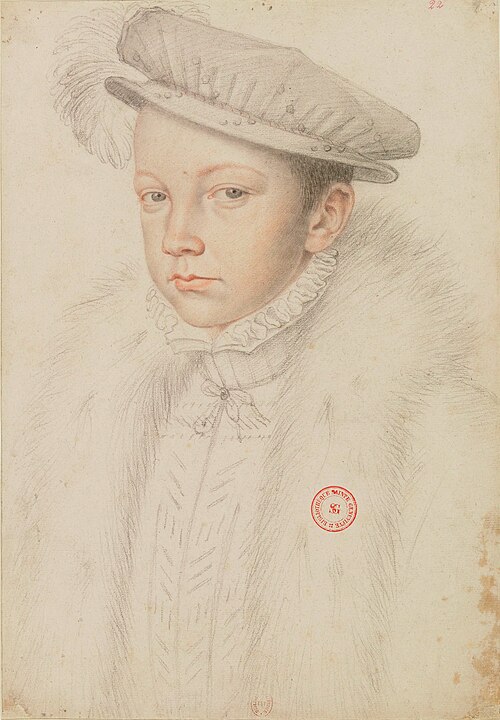
フランソワ2世は15歳で国王となった。クーデターと呼ばれるこの出来事で、ロレーヌ枢機卿とギーズ公爵(ギーズ公爵の姪であるスコットランド女王メアリーは前年にフランソワ2世と結婚していた)はヘンリー2世の死の翌日に権力を掌握し、若い夫婦とともに急いでルーブル宮殿 に移った。 [41]数日後、イギリス大使は「ギーズ家はフランス王のすべてを統治し、行動している」と報告した。[42]当面、カトリーヌは必要に迫られてギーズ家と協力した。フランソワは自分で統治できる年齢に達していたため、カトリーヌは厳密にはフランソワの政府で役割を果たす資格はなかった。[43]にもかかわらず、フランソワの公式の行動はすべて、「これは女王の意向であり、母上、そして私も彼女の意見に賛成しているので、私は満足し、命令する…」という言葉で始まっていた。カトリーヌは新しい権力を利用することに躊躇しなかった。彼女の最初の行動の一つは、ディアーヌ・ド・ポワチエに王冠の宝石類を手渡させ、シュノンソー城を王室に返還させることだった。その後、彼女はディアーヌの建築工事を抹消するか、それを上回るように全力を尽くした。
ギーズ兄弟は熱心にプロテスタントを迫害し始めた。カトリーヌは穏健な姿勢を取り、ギーズ家の迫害に反対したが、ユグノーに対しては特に同情はせず、彼らの信仰を共有したことはなかった。プロテスタントは最初、ナバラ王アントワーヌ・ド・ブルボン、第一血統公に指導を求め、次いでその弟ルイ・ド・ブルボン、コンデ公に指導者を求めたが、ルイはギーズ家を武力で打倒する陰謀を支持し、より成功した。[44]ギーズ家はその陰謀を聞くと、[45]宮廷を要塞化されたアンボワーズ城に移した。ギーズ公は城の周りの森に攻撃を開始した。ギーズ公の軍隊は反乱軍を奇襲し、指揮官のラ・ルノディを含む多くをその場で殺害した。[46]他の人々は川で溺死させられたり、キャサリンと宮廷が見守る中、城壁の周りに吊るされたりした。[47]
1560年6月、ミシェル・ド・ロピタルがフランス首相に任命された。彼はフランスの憲法機関の支援を求め、拡大する無政府状態に直面して法を守るためにカトリーヌと緊密に協力した。[48]どちらも、密かに礼拝し武器を取らないプロテスタントを処罰する必要性を感じなかった。1560年8月20日、カトリーヌと首相はフォンテーヌブローの名士会議でこの政策を提唱した。歴史家たちはこの出来事をカトリーヌの政治手腕の初期の例とみなしている。一方、コンデ公は軍を起こし、1560年秋に南部の町を攻撃し始めた。カトリーヌはコンデ公に宮廷に出廷するよう命じ、到着するとすぐに投獄した。彼は11月に裁判にかけられ、国王に対する罪で有罪となり死刑を宣告された。彼の命は、耳の感染症か膿瘍が原因で国王が病気になり死亡したことで救われた。 [49]
カトリーヌはフランソワが死にそうだと悟ると、アントワーヌ・ド・ブルボンと協定を結び、フランソワが将来の国王シャルル9世の摂政の権利を放棄する代わりに、弟のコンデ公を釈放した。[50]その結果、1560年12月5日にフランソワが死去すると、枢密院はカトリーヌをフランス総督 ( gouvernante de France ) に任命し、広範な権限を与えた。彼女は娘のエリザベートに次のように書き送った。「私の第一の目的は、すべてのことにおいて神の栄誉を念頭に置き、自分のためではなく、この王国の保全とあなたの兄弟全員の利益のために権威を維持することです」。[51]
シャルル9世の治世

シャルル9世は、即位式の際に10歳で、その際に涙を流した。当初、カトリーヌは彼を非常に身近に感じ、彼の部屋で眠ることさえあった。彼女は彼の評議会を主宰し、政策を決定し、国事と後援を管理した。しかし、彼女は内戦の瀬戸際にあった国全体を統制する立場には決してなかった。フランスの多くの地域では、王室よりも貴族の統治が優勢だった。カトリーヌが直面した課題は複雑で、外国人である彼女には理解しにくいものもあった。[52]
彼女は双方の教会指導者を召集し、教義上の相違点を解決しようとした。彼女の楽観的な考えにもかかわらず、結果として生じたポワシー会議は1561年10月13日に彼女の許可なく解散し、失敗に終わった。[53]カトリーヌが失敗したのは、宗教的分裂を政治的な観点からしか捉えていなかったためである。歴史家RJクネヒトの言葉によれば、「彼女は宗教的信念の強さを過小評価し、党首たちの同意さえ得られればすべてうまくいくと考えていた」。[54] 1562年1月、カトリーヌはプロテスタントとの橋渡しをさらに試み、寛容なサンジェルマン勅令を発布した。 [ 55]しかし、1562年3月1日、ヴァシーの虐殺として知られる事件で、ギーズ公とその部下はヴァシーの納屋で礼拝していたユグノー教徒を襲撃し、74人を殺害、104人を負傷させた。 [56]虐殺を「残念な事故」と呼んだギーズ公は、パリの路上で英雄として喝采を浴び、ユグノー教徒は復讐を求めた。この虐殺はフランス宗教戦争の火種となった。その後30年間、フランスは内戦か武力停戦かの状態にあった。[57]
1か月以内にコンデ公ルイ・ド・ブルボンとガスパール・ド・コリニー提督は1,800人の軍隊を召集した。彼らはイングランドと同盟を結び、フランスの町を次々と占領した。カトリーヌはコリニーと会ったが、彼は引き下がろうとはしなかった。そこで彼女は彼に「あなたが軍隊に頼っているのなら、私たちの軍隊を見せてあげましょう」と言った。[58]国王軍は素早く反撃し、ユグノーが支配するルーアンを包囲した。カトリーヌは火縄銃の射撃で致命傷を負ったナバラ王アントワーヌ・ド・ブルボンの臨終の床を見舞った。カトリーヌは自ら戦場を訪れることを主張し、危険を警告されると「私の勇気はあなたの勇気に匹敵します」と笑った。[59]カトリック軍はルーアンを占領したが、その勝利は長くは続かなかった。 1563年2月18日、オルレアン包囲戦で、ポルトロ・ド・メレというスパイがギーズ公の背中に火縄銃を発射した。この殺人事件は貴族間の血の抗争を引き起こし、その後何年にもわたってフランス内戦を複雑化させた。[60]しかし、カトリーヌは味方の死を喜んだ。「ギーズ公がもっと早く死んでいたら、和平はもっと早く達成されていたでしょう」と彼女はヴェネツィア大使に語った。[61] 1563年3月19日、アンボワーズ勅令、別名平定勅令により戦争は終結した。カトリーヌはユグノーとカトリックの両軍を結集し、ル・アーヴルをイギリス軍から 奪還した。
ユグノー
1563年8月17日、ルーアン高等法院でシャルル9世は成人を宣言されたが、独力で統治することはできず、政治にもほとんど関心を示さなかった。[5]カトリーヌはアンボワーズ勅令を施行し、王室への忠誠心を復活させる運動を始めることを決意した。この目的のため、彼女はシャルルおよび宮廷とともにフランス各地を行脚し、1564年1月から1565年5月まで続いた。 [62]カトリーヌはマコンとネラックでナバラ王妃ジャンヌ・ダルブレ(アントワーヌ・ド・ブルボンの妻)と会談した。また、スペイン国境に近いバイヨンヌでは、宮廷の華やかな祝賀行事の最中に娘エリザベートとも会った。フィリップ2世はこの場を離れ、アルバ公を派遣してカトリーヌにアンボワーズ勅令を廃止し、異端問題に対する懲罰的解決策を見つけるよう伝えさせた。[63]
1566年、オスマン帝国大使ギヨーム・ド・グランシャン・ド・グラントリーを通じて、また長年にわたるフランスとオスマン帝国の同盟のおかげで、シャルル2世とカトリーヌ2世はオスマン帝国の宮廷に、オスマン帝国支配下のモルダヴィアにフランスのユグノーとフランスおよびドイツのルター派を再定住させ、軍事植民地とハプスブルク家に対する緩衝地帯を作る計画を提案した。この計画にはフランスからユグノーを追い出すという利点もあったが、オスマン帝国の関心を引かなかった。[64]
1567年9月27日、モーの奇襲として知られる一撃で、ユグノー軍は国王を待ち伏せしようとし、新たな内戦を引き起こした。[65]不意を突かれた宮廷は混乱の中パリへ逃亡した。[66]戦争は1568年3月22日〜23日のロンジュモーの和約で終結したが、内乱と流血は続いた。[67]モーの奇襲は、カトリーヌのユグノー政策の転換点となった。このときから、彼女は妥協を放棄し、抑圧政策をとった。[68]彼女は1568年6月にヴェネツィア大使に、ユグノーから期待できるのは欺瞞だけであると語り、カルヴァン派と反逆者が何千人も処刑された ネーデルラントにおけるアルバ公の恐怖政治を称賛した。

ユグノーは西海岸の要塞化されたラ・ロシェルに撤退し、そこでジャンヌ・ダルブレと15歳の息子アンリ・ド・ブルボンが彼らに加わった。[70]「私たちは全員、神と宗教を捨てるよりは死ぬ決心をしました」とジャンヌはカトリーヌに書いた。[71]カトリーヌは、反乱の決断がヴァロワ家にとって王朝の脅威となったジャンヌを「世界で最も恥知らずな女性」と呼んだ。しかし、 1570年8月8日に王軍の資金が尽きたために調印されたサンジェルマンアンレーの和約は、ユグノーに対してかつてないほど寛容な態度を示した。[72]
カトリーヌは、大王朝の結婚によってヴァロワ家の利益をさらに拡大しようとした。1570年、シャルル9世は神聖ローマ皇帝マクシミリアン2世の娘、オーストリアのエリザベートと結婚した。カトリーヌはまた、末の息子のうちの1人とイングランドのエリザベス1世との縁談を熱望していた。[73]カトリーヌの娘エリザベートが1568年に出産中に亡くなった後、彼女は末の娘マーガレットをスペイン王フェリペ2世の花嫁として売り込んだ。今度は、ヴァロワ家とブルボン家の利益を統合するため、マーガレットとジャンヌの息子ナバラ王アンリ3世との結婚を模索した。しかし、マーガレットは、故ギーズ公の息子アンリ・ド・ギーズと密かに関係を持っていた。カトリーヌはこれを知り、娘をベッドから連れ出させた。カトリーヌと国王は、寝巻きを引き裂き、髪の毛を一掴み引き抜くなど、マーガレットを殴打した。[74]
カトリーヌはジャンヌ・ダルブレに宮廷に来るよう強く迫った。ジャンヌの子供たちに会いたいと書いて、子供たちに危害を加えないことを約束した。ジャンヌはこう返事した。「これを読んで笑いたくなったらごめんなさい。あなたは私が感じたことのない恐怖から私を解放したいのですから。よく言われるように、あなたが小さな子供たちを食べるなんて、私は一度も考えたことがありません。」[75]ジャンヌが宮廷に来た時、カトリーヌは彼女に強く圧力をかけ、[76]愛する息子に対するジャンヌの希望を利用した。ジャンヌは最終的に、ヘンリーがユグノーのままでいられる限り、息子とマルグリットの結婚に同意した。ジャンヌが結婚式の衣装を買うためにパリに到着したとき、彼女は病気になり、1572年6月9日に43歳で亡くなった。ユグノーの著述家たちは後に、カトリーヌが毒入りの手袋で彼女を殺害したと非難した。[77]結婚式は1572年8月18日にパリのノートルダムで行われた。
聖バルトロメオの虐殺
3日後、コリニー提督がルーブルから自室へ歩いて戻る途中、ある家から銃声が鳴り響き、手と腕を負傷した。[78]窓に火縄銃の煙が上がっているのが発見されたが、犯人は建物の裏から馬に乗って逃げていた。[79]コリニー提督はベティジー邸の宿舎に運ばれ、外科医のアンブロワーズ・パレが肘から銃弾を取り除き、傷ついた指をハサミで切断した。無感情に知らせを受けたと言われているカトリーヌは、涙ながらにコリニーを訪ね、犯人を罰すると約束した。多くの歴史家は、コリニー襲撃の責任はカトリーヌにあるとしている。他の歴史家は、ギーズ家や、国王に対するコリニーの影響力を終わらせようとするスペインと教皇の陰謀を指摘している。[80]真実が何であれ、その後に続いた流血事件は、すぐにカトリーヌや他の指導者の手に負えないものとなった。[81]
2日後に始まった聖バルトロメオの虐殺は、それ以来カトリーヌの評判を汚した。[38] 8月23日にシャルル9世が「全員殺せ!全員殺せ!」と命令したと言われているが、その決定にカトリーヌが加担していたと信じる理由がある。 [82]歴史家は、カトリーヌと彼女の顧問は、コリニーへの攻撃に対する復讐としてユグノーの反乱が起こることを予想していたと示唆している。そのため、彼らは結婚式の後、まだパリにいるユグノーの指導者たちを先制攻撃して一掃することを選んだ。[83]
パリでの虐殺はほぼ一週間続いた。虐殺はフランス各地に広がり、秋まで続いた。歴史家ジュール・ミシュレの言葉によれば、「聖バルトロマイは一日ではなく、季節だった」。[84] 9月29日、ナバラが殺されるのを避けるために改宗したローマカトリック教徒として祭壇の前にひざまずいたとき、カトリーヌは大使たちに向かって笑った。このときから、邪悪なイタリア女王の伝説が始まった。ユグノーの作家たちは、カトリーヌをマキャベリの原則に従って一撃ですべての敵を殺した陰謀家イタリア人だとした。[85]
ヘンリー3世の治世

2年後、カトリーヌはシャルル9世が23歳で死去したという新たな危機に直面した。シャルル9世の死に際の言葉は「ああ、母上…」だった。死の前日、シャルル9世は兄で後継者のアンジュー公アンリが前年に国王に選出されたポーランド・リトアニア共和国にいたため、カトリーヌを摂政に任命した。しかし、ヴァヴェル大聖堂での戴冠式の3か月後、アンリはその王位を放棄し、フランス王になるためにフランスに戻った。カトリーヌはシャルル9世の死去のアンリに次のように書いた。「このような光景と、彼が最後に私に示した愛情を目の当たりにし、私は悲しみに打ちひしがれています…私の唯一の慰めは、あなたの王国が要求するように、あなたがすぐに元気な姿でここに来てくれることです。もしあなたを失ったら、私もあなたと一緒に生き埋めにされてしまうでしょうから。」[86]
ヘンリーはキャサリンのお気に入りの息子だった。兄たちと違い、成人してから王位についた。肺が弱く、常に疲労感があったものの、兄たちよりは健康だった。しかし、政治活動への関心は不安定だった。キャサリンの生涯の最後の数週間まで、ヘンリーはキャサリンと彼女の秘書チームに頼っていた。ヘンリーはしばしば国事から身を隠し、巡礼や鞭打ちなどの敬虔な行為に没頭していた。[87]
アンリは戴冠式の2日後の1575年2月にルイーズ・ド・ロレーヌ=ヴォーデモントと結婚した。彼の選択は、外国の王女との政略結婚というカトリーヌの計画を挫折させた。アンリは子供を産めないという噂は、その頃には広く流布していた。教皇特使 サルヴィアーティは「子供ができると想像するのは困難だ...医師や彼をよく知る人々は、彼は極度に虚弱体質で長くは生きられないと言っている」と述べた。時が経ち、結婚から子供が生まれる可能性が薄れると、カトリーヌの末息子、アランソン公フランソワ、通称「ムッシュー」は、王位継承者としての役割を巧みに利用し、宗教だけでなく貴族の権力闘争も絡んでいた内戦の無秩序を何度も利用した。[88]カトリーヌはフランソワを復帰させるために全力を尽くした。 1578年3月のある時、彼女は彼の危険な破壊的行動について6時間にわたって説教した。[89]
1576年、フランソワはアンリの王位を危険にさらす動きで、王室に対抗するためにプロテスタントの諸侯と同盟を結んだ。[90] 1576年5月6日、カトリーヌはボーリュー勅令でユグノーの要求をほぼすべて受け入れた。この条約はフランソワが王室に押し付けたと考えられたため、ムッシューの和約として知られるようになった。 [91]フランソワは1584年6月、ネーデルラントへの介入で彼の軍隊が虐殺された悲惨な結果となり、結核で亡くなった。 [92]カトリーヌは翌日、「神の意志に従わなければならないこと、神がすべてを所有していること、そして神が私たちに与えた子供たちを神が望む限り、神が私たちに貸し与えてくれることを私は理解しているが、私より先に多くの人々が死ぬのを見るほど長く生きているのは実に惨めだ」と書いた。[93]末息子の死は、キャサリンの王朝建国の夢にとって災難であった。サリカ法では男子のみが王位に就くことができたため、ユグノーのアンリ・ド・ナバラがフランス王位の推定相続人となった。[38]

カトリーヌは、少なくとも末娘のマルグリットをナバラに嫁がせるという予防策を講じていた。しかし、マルグリットはフランソワとほぼ同程度にカトリーヌの悩みの種となり、1582年に夫を伴わずにフランス宮廷に戻った。カトリーヌが愛人を作ったと怒鳴っているのが聞こえた。カトリーヌはポンポンヌ・ド・ベリエーヴルをナバラに派遣し、マルグリットの帰国を手配させた。1585年、マルグリットは再びナバラから逃亡した。彼女はアジャンの自分の土地に引きこもり、母親に金を乞うた。カトリーヌは「食卓に食べ物を並べる」程度の金しか送らなかった。カルラの要塞に移ったマルグリットは、ドービアックという愛人を作った。カトリーヌは、マルグリットが再び自分たちの恥をかかせる前に行動を起こすようヘンリーに頼んだ。そのため、1586年10月、ヘンリーはマルグリットをウッソン城に閉じ込めた。ドービアックは処刑されたが、キャサリンの希望に反してマーガレットの前では処刑されなかった。[94]キャサリンは遺言からマーガレットを排除し、二度と彼女に会うことはなかった。
Catherine was unable to control Henry in the way she had Francis and Charles.[95] Her role in his government became that of chief executive and roving diplomat. She travelled widely across the kingdom, enforcing his authority and trying to head off war. In 1578, she took on the task of pacifying the south. At the age of fifty-nine, she embarked on an eighteen-month journey around the south of France to meet Huguenot leaders face to face. Her efforts won Catherine new respect from the French people.[96] On her return to Paris in 1579, she was greeted outside the city by the Parlement and crowds. The Venetian ambassador, Gerolamo Lipomanno, wrote: "She is an indefatigable princess, born to tame and govern a people as unruly as the French: they now recognize her merits, her concern for unity and are sorry not to have appreciated her sooner."[97] She was under no illusions, however. On 25 November 1579, she wrote to the king, "You are on the eve of a general revolt. Anyone who tells you differently is a liar."[98]
Catholic League
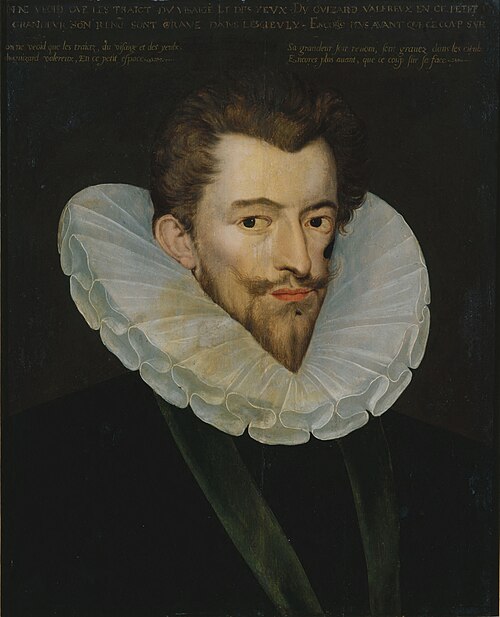
Many leading Roman Catholics were appalled by Catherine's attempts to appease the Huguenots. After the Edict of Beaulieu, they had started forming local leagues to protect their religion.[99] The death of the heir to the throne in 1584 prompted the Duke of Guise to assume the leadership of the Catholic League. He planned to block Henry of Navarre's succession and place Henry's Catholic uncle Cardinal Charles de Bourbon on the throne instead. In this cause, he recruited the great Catholic princes, nobles and prelates, signed the treaty of Joinville with Spain, and prepared to make war on the "heretics".[100] By 1585, Henry III had no choice but to go to war against the League.[101] As Catherine put it, "peace is carried on a stick" (bâton porte paix).[102] "Take care", she wrote to the king, "especially about your person. There is so much treachery about that I die of fear."[103]
Henry was unable to fight the Catholics and the Protestants at once, both of whom had stronger armies than his own. In the Treaty of Nemours, signed on 7 July 1585, he was forced to give in to all the League's demands, even that he pay its troops.[104] He went into hiding to fast and pray, surrounded by a bodyguard known as "the Forty-five", and left Catherine to sort out the mess.[105] The monarchy had lost control of the country, and was in no position to assist England in the face of the coming Spanish attack. The Spanish ambassador told Philip II that the abscess was about to burst.[106]
By 1587, the Catholic backlash against the Protestants had become a campaign across Europe. Elizabeth I of England's execution of Mary, Queen of Scots, on 8 February 1587 outraged the Catholic world.[107] Philip II of Spain prepared for an invasion of England. The League took control of much of northern France to secure French ports for his armada.
Last months and death

Henry hired Swiss troops to help him defend himself in Paris. The Parisians, however, claimed the right to defend the city themselves. On 12 May 1588, they set up barricades in the streets and refused to take orders from anyone except the Duke of Guise.[108] When Catherine tried to go to Mass, she found her way barred, though she was allowed through the barricades. The chronicler L'Estoile reported that she cried all through her lunch that day. She wrote to Bellièvre, "Never have I seen myself in such trouble or with so little light by which to escape."[109] As usual, Catherine advised the king, who had fled the city in the nick of time, to compromise and live to fight another day. On 15 June 1588, Henry duly signed the Act of Union, which gave in to all the League's latest demands.
On 8 September 1588 at Blois, where the court had assembled for a meeting of the Estates, Henry dismissed all his ministers without warning. Catherine, in bed with a lung infection, had been kept in the dark.[110] The king's actions effectively ended her days of power.
At the meeting of the Estates, Henry thanked Catherine for all she had done. He called her not only the mother of the king but the mother of the state.[111] Henry did not tell Catherine of his plan for a solution to his problems.[112] On 23 December 1588, he asked the Duke of Guise to call on him at the Château de Blois. As Guise entered the king's chamber, the Forty-five plunged their blades into his body, and he died at the foot of the king's bed. At the same moment, eight members of the Guise family were rounded up, including the Duke of Guise's brother, Louis II, Cardinal of Guise, whom Henry's men hacked to death the next day in the palace dungeons.[113] Immediately after the murder of Guise, Henry entered Catherine's bedroom on the floor below and announced, "Please forgive me. Monsieur de Guise is dead. He will not be spoken of again. I have had him killed. I have done to him what he was going to do to me."[114] Catherine's immediate reaction is not known; but on Christmas Day, she told a friar, "Oh, wretched man! What has he done? ... Pray for him ... I see him rushing towards his ruin."[115] She visited her old friend Cardinal de Bourbon on 1 January 1589 to tell him she was sure he would soon be freed. He shouted at her, "Your words, Madam, have led us all to this butchery."[115] She left in tears.

On 5 January 1589, Catherine died at the age of sixty-nine, probably from pleurisy. L'Estoile wrote: "those close to her believed that her life had been shortened by displeasure over her son's deed."[116] He added that she had no sooner died than she was treated with as much consideration as a dead goat. Because Paris was held by enemies of the crown, Catherine had to be buried provisionally at Blois. Eight months later, Jacques Clément stabbed Henry III to death. At the time, Henry was besieging Paris with the King of Navarre, who would succeed him as Henry IV of France. Henry III's assassination ended nearly three centuries of Valois rule and brought the Bourbon dynasty into power. Years later, Diane, daughter of Henry II and Philippa Duci, had Catherine's remains reinterred in the Saint-Denis basilica in Paris. In 1793, a revolutionary mob tossed her bones into a mass grave with those of the other kings and queens.[117]
Henry IV was later reported to have said of Catherine:
I ask you, what could a woman do, left by the death of her husband with five little children on her arms, and two families of France who were thinking of grasping the crown—our own [the Bourbons] and the Guises? Was she not compelled to play strange parts to deceive first one and then the other, in order to guard, as she did, her sons, who successively reigned through the wise conduct of that shrewd woman? I am surprised that she never did worse.[118]
Patron of the arts

Catherine believed in the humanist ideal of the learned Renaissance prince whose authority depended on letters as well as arms.[119] She was inspired by the example of her father-in-law, King Francis I of France, who had hosted the leading artists of Europe at his court, and by her Medici ancestors. In an age of civil war and declining respect for the monarchy, she sought to bolster royal prestige through lavish cultural display. Once in control of the royal purse, she launched a programme of artistic patronage that lasted for three decades. During this time, she presided over a distinctive late French Renaissance culture in all branches of the arts.[120]
An inventory drawn up at the Hôtel de la Reine after Catherine's death shows her to have been a keen collector. Listed works of art included tapestries, hand-drawn maps, sculptures, rich fabrics, ebony furniture inlaid with ivory, sets of china, and Limoges pottery.[121] There were also hundreds of portraits, for which a vogue had developed during Catherine's lifetime. Many portraits in her collection were by Jean Clouet (1480–1541) and his son François Clouet (c. 1510–1572). François Clouet drew and painted portraits of all Catherine's family and of many members of the court.[122] After Catherine's death, a decline in the quality of French portraiture set in. By 1610, the school patronised by the late Valois court and brought to its pinnacle by François Clouet had all but died out.[123]
Beyond portraiture, little is known about the painting at Catherine de' Medici's court.[124] In the last two decades of her life, only two painters stand out as recognisable personalities: Jean Cousin the Younger (c. 1522 – c. 1594), few of whose works survive, and Antoine Caron (c. 1521–1599), who became Catherine's official painter after working at Fontainebleau under Primaticcio. Caron's vivid Mannerism, with its love of ceremonial and its preoccupation with massacres, reflects the neurotic atmosphere of the French court during the Wars of Religion.[125]
Many of Caron's paintings, such as those of the Triumphs of the Seasons, are of allegorical subjects that echo the festivities for which Catherine's court was famous. His designs for the Valois Tapestries celebrate the fêtes, picnics, and mock battles of the "magnificent" entertainments hosted by Catherine. They depict events held at Fontainebleau in 1564; at Bayonne in 1565 for the summit meeting with the Spanish court; and at the Tuileries in 1573 for the visit of the Polish ambassadors who presented the Polish crown to Catherine's son Henry of Anjou.[124]
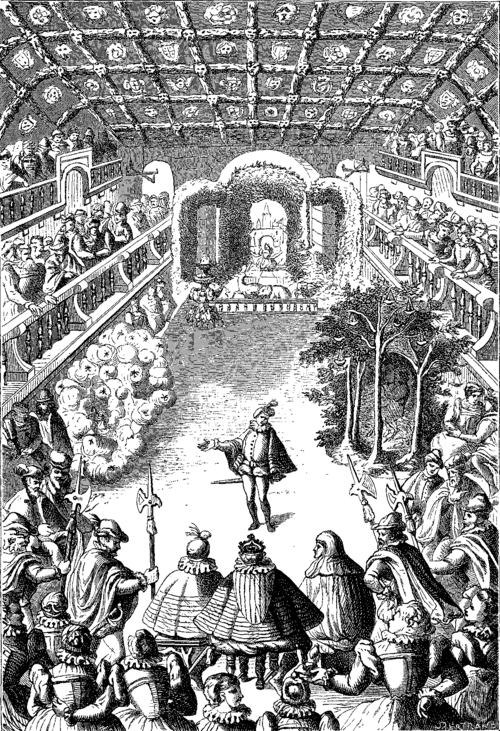
The musical shows in particular allowed Catherine to express her creative gifts. They were usually dedicated to the ideal of peace in the realm and based on mythological themes. To create the necessary dramas, music, and scenic effects for these events, Catherine employed the leading artists and architects of the day. Historian Frances Yates has called her "a great creative artist in festivals."[126] Catherine gradually introduced changes to the traditional entertainments: for example, she increased the prominence of dance in the shows that climaxed each series of entertainments. A distinctive new art form, the ballet de cour, emerged from these creative advances.[127] Owing to its synthesis of dance, music, verse, and setting, the production of the Ballet Comique de la Reine in 1581 is regarded by scholars as the first authentic ballet.[128]
Catherine de' Medici's great love among the arts was architecture. "As the daughter of the Medici," suggests French art historian Jean-Pierre Babelon, "she was driven by a passion to build and a desire to leave great achievements behind her when she died."[129] After Henry II's death, Catherine set out to immortalise her husband's memory and to enhance the grandeur of the Valois monarchy through a series of costly building projects.[130] These included work on the Château de Montceaux, Château de Saint-Maur, and Chenonceau. Catherine built two new palaces in Paris: the Tuileries and the Hôtel de la Reine. She was closely involved in the planning and supervising of all her architectural schemes.[131]
Catherine had emblems of her love and grief carved into the stonework of her buildings.[132] Poets lauded her as the new Artemisia, after Artemisia II of Caria, who built the Mausoleum at Halicarnassus as a tomb for her dead husband.[133] As the centrepiece of an ambitious new chapel, she commissioned a magnificent tomb for Henry at the basilica of Saint Denis. It was designed by Francesco Primaticcio (1504–1570), with sculpture by Germain Pilon (1528–1590). Art historian Henri Zerner has called this monument "the last and most brilliant of the royal tombs of the Renaissance."[134] Catherine also commissioned Germain Pilon to carve the marble sculpture that contains Henry II's heart. A poem by Ronsard, engraved on its base, tells the reader not to wonder that so small a vase can hold so large a heart, since Henry's real heart resides in Catherine's breast.[135]
Although Catherine spent ruinous sums on the arts,[136] most of her patronage left no permanent legacy.[137] The end of the Valois dynasty so soon after her death brought a change in priorities.
Culinary legend

The legend that de' Medici introduced a long list of foods, techniques and utensils from Italy to France is discredited by food historians.[138] Barbara Ketcham Wheaton and Stephen Mennell provided the definitive arguments against these claims.[139][140] They point out that Catherine's father-in-law, King Francis I, and the flower of the French aristocracy had dined at some of Italy's most élite tables during the king's Italian campaigns (and that an earlier generation had done so during King Charles VIII's invasion of 1494); that a vast Italian entourage had visited France for the wedding of Catherine de' Medici's father to her French-born mother; and that she had little influence at court until her husband's death because he was so besotted by his mistress, Diane de Poitiers. In fact, a large population of Italians—bankers, silk-weavers, philosophers, musicians, and artists, including Leonardo da Vinci—had emigrated to France to promote the burgeoning Renaissance. Nevertheless, popular culture frequently attributes Italian culinary influence and forks in France to Catherine.[141]
The earliest known reference to Catherine as the popularizer of Italian culinary innovation is the entry for "cuisine" in Diderot and d'Alembert's Encyclopédie published in 1754, which describes haute cuisine as decadent and effeminate and explains that fussy sauces and fancy fricassees arrived in France via "that crowd of corrupt Italians who served at the court of Catherine de' Medici."[139][142]
Links to the occult
Catherine de' Medici has been labelled by Wiccan Gerald Gardner a "sinister Queen ... noted for her interest in the occult arts".[143] Catherine and Henry's inability to produce an heir for the first ten years of their marriage gave rise to suspicion of witchcraft. Labouvie suggested that women's power was believed to be the ability to create and sustain life, whilst witches were believed to have the opposite power; that of attacking health, life and fertility.[144] An infertile woman, and in particular an infertile queen, was therefore regarded as 'unnatural' and a small step from supernatural. Essentially, however, there exists no concrete proof that she took part in the occult, and it is now believed that Catherine's trouble in providing an heir was in fact due to Henry II's penile deformity.[145]
Catherine herself had been educated by Cosimo Ruggeri in astrology and astronomy, which were closely linked in her day[146] and were an academic rather than a Satanic activity,[147] although his general background and favourite status suggests there was more to it than that. It has been suggested that Catherine educated her son, Henry III, in the dark arts,[148] and that "the two devoted themselves to sorceries that were scandals of the age".[149] As a result, some (more extreme) authors[150] believe Catherine to be the creator of the Black Mass, a Satanic inversion of the traditional Catholic Mass, although there is little to prove this aside from Jean Bodin's account in his book De la démonomanie des sorciers.[151] Nevertheless, Catherine was never formally accused or prosecuted despite the fact that her reign experienced the greatest number of prosecutions for witchcraft in Italy. This lends some weight to the suggestion that people were labelled 'witches' simply because they did not act the way a woman would have been expected to act, or simply to suit personal or political agendas.[144] This may be particularly true for Catherine as an Italian woman ruling in France; several historians argue that she was disliked by her French subjects, who labelled her "the Italian woman".[152] In any event, the rumours have made a mark on Catherine's reputation over time, and there are now many dramaticised works about her involvement in the occult.
Issue

Catherine de' Medici married Henry, Duke of Orléans, the future Henry II of France, in Marseille on 28 October 1533. She gave birth to ten children, of whom four sons and three daughters survived to marriageable age. Three of her sons became kings of France, while two of her daughters married kings and one married a duke. Catherine outlived all her children except Henry III, who died seven months after her, and Margaret, who inherited her robust health. Victoire and Jeanne were twin daughters born in 1556; Jeanne was stillborn due to surgeons breaking her legs to save her mother's life;[b] Victoire survived, dying less than two months later. According to the diplomat Simon Renard, the birth nearly killed Catherine,[153] and the royal couple were advised by the King's physician to have no further children.

- Francis II, King of France (19 January 1544 – 5 December 1560). Married Mary, Queen of Scots, in 1558.
- Elisabeth (2 April 1545 – 3 October 1568). Married Philip II, King of Spain, in 1559.
- Claude (12 November 1547– 21 February 1575). Married Charles III, Duke of Lorraine, in 1559.
- Louis, Duke of Orléans (3 February 1549 – 24 October 1550). Died in infancy.
- Charles IX, King of France (27 June 1550 – 30 May 1574). Married Elizabeth of Austria in 1570.
- Henry III, King of France (19 September 1551 – 2 August 1589). Married Louise of Lorraine in 1575.
- Margaret (14 May 1553 – 27 March 1615). Married Henry, King of Navarre, the future Henry IV of France, in 1572.
- Hercules, Duke of Anjou (18 March 1555 – 19 June 1584), renamed Francis when he was confirmed.
- Victoire (24 June 1556 – 17 August 1556). Died in infancy.
- Jeanne (24 June 1556). Stillborn[154]
Ancestry
Notes
- ^ Though an Italian nation state had yet to be established, the Latin equivalent of the term Italian (italus) had been in use for natives of the region since antiquity.[1]
- ^ Some sources claim that Victoire was the one who was stillborn.
References
- ^ Pliny the Elder, Letters 9.23.
- ^ Thomson, 98; Sutherland, Ancien Régime, 3; Neale, The Age of Catherine de Medici.
- ^ Knecht, Catherine de' Medici, 272.
- ^ Knecht, 272. For a summary of the fluctuations in Catherine's historical reputation, see the preface to R. J. Knecht's Catherine de' Medici, 1998: xi–xiv.
- ^ a b Sutherland, Ancien Régime, 20.
- ^ Sutherland, Ancien Régime, 26.
- ^ Strage, Mark (1976). Women of Power: The Life and Times of Catherine de' Medici. London and New York: Harcourt, Brace & Jovanovich. Prologue, p. xi.
- ^ Frieda, Leonie, Catherine de Medici: Renaissance Queen of France, p. 14 ("the baby received the names Caterina, a Medici family name, Maria, since it was the day of the Holy Virgin, and Romula, after the founder of Fiesole").
- ^ Knecht 1998, p. 8 (dates of death); Héritier 1963, p. 15 (cause of Madeleine's death).
- ^ Knecht, Catherine de' Medici, 8.
- ^ Frieda 2003, p. 22 (New York edition).
- ^ Young, The Medici: Volume II, 15.
- ^ Knecht, Catherine de' Medici, p. 11.
- ^ Strage, pp. 13, 15
- ^ Knecht, Catherine de' Medici, 10–11.
- ^ Strage, p.15
- ^ Knecht, Catherine de' Medici, 12.
- ^ Knecht, Catherine de' Medici, p. 14.
- ^ Hay, Denys, ed., The Letters of James V, HMSO (1954), p. 173, 180–182, 189,
- ^ a b Knecht, Catherine de' Medici, 16.
- ^ "Eglise Saint-Ferréol les Augustins | Marseille 13". www.marseille13.fr. Archived from the original on 5 December 2022. Retrieved 5 December 2022.
- ^ Frieda 2003, p. 47 (NY edition). Knecht 1998, p. 28, gives likely incorrect dates of 25 September 1533 for the death of Pope Clement VII and 12 October for the election of Pope Paul III.
- ^ Frieda 2003, p. 48 (NY edition): "J'ai reçu la fille toute nue." Knecht 1998, p. 28, gives the English translation ""The girl has been given to me stark naked." He cites Cloulas (Catherine de Médicis, 1979, p. 57), who gives the French as "J'ai eu la fille toute nue", without citing a source.
- ^ Knecht, Catherine de' Medici, 29–30. Henry legitimised the child under the name Diane de France; he also produced at least two sons by other women (Knecht, p. 38).
- ^ a b c Knecht, Catherine de' Medici, 29.
- ^ Knecht, 29.
- ^ de Costa, Carloine (Spring 2010). "The long barren years of Catherine de Medicis: A gynaecologist's view of history". O&G Magazine. 12 (3). Retrieved 24 November 2021.
- ^ Knecht, Catherine de' Medici, p. 30. Another source (Héritier 1963, p. 36) dates the beginning of their sexual relationship to late 1536 or early 1537.
- ^ Morris, 247
- ^ Knecht, Catherine de' Medici, 42–43.
- ^ Knecht, Catherine de' Medici, 38.
- ^ Wellman, Kathleen Anne (2013). Queens and mistresses of Renaissance France. New Haven: Yale University Press. p. 200. ISBN 978-0-300-17885-2.
- ^ Knecht, Catherine de' Medici, 34.
- ^ Guy, 46.
- ^ Guy, 41.
- ^ Knecht, Catherine de' Medici, 55.
- ^ Kamen, Henry (1997). Philip of Spain. Yale University Press. p. 74. ISBN 9780300070811. Retrieved 8 June 2024.
- ^ a b c Pettegree, 154.
- ^ Knecht, Catherine de' Medici, 56–58.
- ^ Guy, 102–103.
- ^ Knecht, Catherine de' Medici, 59.
- ^ Knecht, Catherine de' Medici, 60.
- ^ Morris, 248.
- ^ Holt, 38–39.
- ^ Knecht, Catherine de' Medici, 64; Holt, 44. The incident was known later as the "tumult" or conspiracy of Amboise.
- ^ Knecht, Renaissance France, 282.
- ^ Knecht, Catherine de' Medici, 65–66.
- ^ Sutherland, Ancien Régime, 32.
- ^ Knecht, 72; Guy, 119.
- ^ Pettegree, 154; Hoogvliet, 105. The regency was traditionally the preserve of the princes of the blood.
- ^ Knecht, Catherine de' Medici, 73.
- ^ Sutherland, Ancien Régime, 28.
- ^ Manetsch, 22.
- ^ Knecht, Catherine de' Medici, 80.
- ^ Knecht, Renaissance France, 311; Sutherland, Ancien Régime, 11–12. The edict, also known as the Edict of Toleration and the Edict of January, was significant for effectively recognising the existence of Protestant churches and permitting their worship outside city walls.
- ^ Knecht, Catherine de' Medici, 87.
- ^ Sutherland, Secretaries of State, 140.
- ^ Knecht, Catherine de' Medici, 89.
- ^ Knecht, Catherine de' Medici, 90.
- ^ Knecht, Catherine de' Medici, 91; Carroll, 126; Sutherland, Ancien Régime, 17.
- ^ Knecht, Catherine de' Medici, 91–92.
- ^ Sutherland, Ancien Régime, 15.
- ^ Knecht, Catherine de' Medici, 104, 107–108.
- ^ Faroqhi, Suraiya (2006). The Ottoman Empire and the World Around it. Bloomsbury Academic. p. 37. ISBN 978-1845111229 – via Google Books.
- ^ Wood, 17.
- ^ Sutherland, Secretaries of State, 147.
- ^ Knecht, Catherine de' Medici, 118.
- ^ Knecht, Catherine de' Medici, 120.
- ^ Quoted by Knecht, Catherine de' Medici, 149.
- ^ Bryson, 204.
- ^ Knecht, Catherine de' Medici, 132.
- ^ Wood, 28.
- ^ Holt, 77.
- ^ Knecht, Catherine de' Medici, 135.
- ^ Bryson, 282.
- ^ Jeanne d'Albret wrote to her son, Henry: "I am not free to talk with either the King or Madame, only the Queen Mother, who goads me [me traite á la fourche] ... You have doubtless realized that their main object, my son, is to separate you from God, and from me." Quoted by Knecht, Catherine de' Medici, 148–149.
- ^ Knecht, Catherine de' Medici, 151. An autopsy revealed tuberculosis and an abscess.
- ^ Sutherland, Massacre of St Bartholomew, 313.
- ^ Holt, 83. The investigators traced the house and horse to the Guises and claimed to have found evidence that the would-be killer was Charles de Louviers de Maurevert.
- ^ Knecht, Catherine de' Medici, 154–157. Coligny was lobbying the king to intervene against the empire in the Netherlands.
• The Duke of Anjou was later reported as saying that he and Catherine had planned the assassination with Anne d'Este, who longed to avenge her husband, Francis, Duke of Guise.
• For an overview of historians' various interpretations, see Holt, 83–84. - ^ Pettegree, 159–160.
- ^ Holt, 84.
• The memoirs of Marshal Tavannes, edited by his son and published around 1620 (Knecht, Catherine de' Medici, 122, 158), state that Catherine had summoned a war council in the Tuileries Gardens (so as not to be overheard) to plan the next move: "Because the attempt on the Admiral would cause a war, she, and the rest of us, agreed that it would be advisable to bring battle in Paris". It is almost certain, however, that when Charles gave the order "Kill them all!", he meant those drawn up on a list by Catherine, and not, as has often been claimed, all Huguenots. - ^ Holt, 84.
- ^ Quoted by Morris, 252.
- ^ Knecht, Catherine de' Medici, 163–164; Heller, 117; Manetsch, 60–61. The misogyny and anti-Italianism in Huguenot "histories" proved seductive not only to Protestants but to Catholics seeking a scapegoat for France's woes.
- ^ Knecht, Catherine de' Medici, 172.
- ^ Sutherland, Secretaries of State, 232, 240, 247.
- ^ Sutherland, Ancien Régime, 22.
- ^ Sutherland, Secretaries of State, 205.
- ^ Holt, 104.
- ^ Holt, 105–106; Knecht, Catherine de' Medici, 186.
- ^ Knecht, Catherine de' Medici, 212–213.
- ^ Knecht, Catherine de' Medici, 217.
- ^ Knecht, Catherine de' Medici, 254–255.
- ^ Knecht, Catherine de' Medici, 189.
- ^ Sutherland, Secretaries of State, 209.
- ^ Knecht, Catherine de' Medici, 200.
- ^ Knecht, Catherine de' Medici, 201.
- ^ Knecht, Catherine de' Medici, 185.
- ^ Pettegree, 164.
- ^ Sutherland, Secretaries of State, 255.
- ^ Knecht, Catherine de' Medici, 249.
- ^ Knecht, Catherine de' Medici, 251.
- ^ Knecht, Renaissance France, 440.
- ^ Knecht, Catherine de' Medici, 253.
- ^ Sutherland, Secretaries of State, 287.
- ^ Knecht, Catherine de' Medici, 257.
- ^ "The Day of the Barricades", as the revolt became known, "reduced the authority and prestige of the monarchy to its lowest ebb for a century and a half." Morris, 260.
- ^ Knecht, Catherine de' Medici, 263.
- ^ Henry wrote a note to Villeroy, which began: "Villeroy, I remain very well contented with your service; do not fail however to go away to your house where you will stay until I send for you; do not seek the reason for this my letter, but obey me." Sutherland, Secretaries of State, 300–303.
- ^ Knecht, Catherine de' Medici, 264–265.
- ^ Yet on 22 December 1588, Guise spent the night with his current mistress Charlotte de Sauve, the most accomplished and notorious member of Catherine de' Medici's group of female spies known as the "Flying Squadron", making it unlikely Catherine was kept 'in the dark'. Emmanuel le Roy Ladurie France 1460–1610.
- ^ Pettegree, 165.
- ^ Knecht, Catherine de' Medici, 266. The words were reported to the government of Florence by Catherine's doctor, Filippo Cavriana, who acted as their informant.
- ^ a b Knecht, Catherine de' Medici, 267.
- ^ Knecht, Catherine de' Medici, 268–269.
- ^ Knecht, Catherine de' Medici, 269.
- ^ Brantôme, p. 88.
- ^ Hoogvliet, 109.
- ^ Knecht, 220.
- ^ Knecht, 240–241.
- ^ Dimier, 205–206.
- ^ Dimier, 308–319; Jollet, 17–18.
- ^ a b Blunt, 98.
- ^ Blunt calls Caron's style "perhaps the purest known type of Mannerism in its elegant form, appropriate to an exquisite but neurotic society." Blunt, 98, 100.
- ^ Yates, 68.
- ^ Yates, 51; Strong, 102, 121–122.
- ^ Lee, 44.
- ^ Babelon, 263.
- ^ Sutherland, Ancien Régime, 6.
- ^ Knecht, 228.
- ^ Knecht, 223.
- ^ Hoogvliet, 108.
- ^ Zerner, 379.
- ^ Hoogvliet, 111. Ronsard may be referring to Artemisia, who drank the ashes of her dead husband, which became part of her own body.
- ^ Thomson, 168.
- ^ Knecht, Catherine de' Medici, 244.
- ^ Alan Davidson (2014). The Oxford Companion to Food (2nd ed.). Oxford University Press. p. 232. ISBN 978-0199677337.
- ^ a b Barbara Ketcham Wheaton (2011). Savoring the Past: The French Kitchen and Table from 1300 to 1789. Simon and Schuster. pp. 43–51. ISBN 978-1439143735.
- ^ Stephen Mennell (1996). All Manners of Food: Eating and Taste in England and France from the Middle Ages to the Present (2nd ed.). University of Illinois Press. pp. 65–66, 69–71. ISBN 978-0252064906.
- ^ Antonella Campanini, "The Illusive Story Of Catherine de' Medici: A Gastronomic Myth", The New Gastronome [1], summarizing Antonella Campanini, Loïc Bienassis, "La reine à la fourchette et autres histoires. Ce que la table française emprunta à l'Italie: analyse critique d'un mythe" in Florent Quellier, Pascal Briost, La Table de la Renaissance: Le mythe italien, 2018, ISBN 978-2753574069
- ^ Diderot, Denis; le Rond d'Alembert, Jean (1754). Encyclopédie, ou dictionnaire raisonné des sciences, des arts et des métiers. Paris: Briasson, David, Le Breton and Durand. p. vol. IV, p. 538.
- ^ Gardner, Gerald B. The Meaning of Witchcraft. p. 91.
- ^ a b See Rowlands, Alison (2013). Witchcraft and Gender in Early Modern Europe. Oxford. p. 9.
- ^ Gordetsky, Rabinowitz and O'Brien (2009). "The "infertility" of Catherine de Medici and its influence on 16th century France" (PDF). The Canadian Journal of Urology. 16 (2): 4584–4588. PMID 19364432.
- ^ William E. Burns, Astrology through History: Interpreting the Stars from Ancient Mesopotamia, xxii.
- ^ Kocku Von Stuckrad, Locations of Knowledge in Medieval and Early Modern Europe: Esoteric Discourse and Western Identities, 142–145.
- ^ Gardner, Gerald. The Meaning of Witchcraft. p. 91.
- ^ Grillot de Givry, Émile-Jules. Witchcraft, Magic & Alchemy. p. 121.
- ^ Farley, Peter R. Where Were You Before The Tree of Life? Volume 6. p. 218.
- ^ Jean Bodin, De la demonomanie des sorciers, 71 verso.
- ^ Gortner, C. W. "History's Black Widow: The Legend of Catherine de Medici". Wonders and Marvels. Archived from the original on 5 March 2016. Retrieved 20 February 2016.
- ^ Somervill, Barbara A. (2006). Catherine de Medici. Compass Point Books. p. 51. ISBN 978-0756515812. Retrieved 12 June 2022.
- ^ Heritier, 48, has the twins' deaths the other way round.
- ^ a b c d Whale, 65
- ^ a b Tomas, 20
Bibliography
- Babelon, Jean-Pierre. "The Louvre: Royal Residence and Temple of the Arts". Realms of Memory: The Construction of the French Past. Vol. III: Symbols. Edited by Pierre Nora. English language edition translated by Arthur Goldhammer, edited by Lawrence D. Kritzman. New York: Columbia University Press, 1998. ISBN 0231109261.
- Blunt, Anthony. Art and Architecture in France: 1500–1700. New Haven, Connecticut: Yale University Press, 1999. ISBN 0300077483.
- Brantôme, Pierre de Bourdeille. Illustrious Dames of the Court of the Valois Kings. Translated by Katharine Prescott Wormeley. New York: Lamb, 1912. OCLC 347527
- Bryson, David M. Queen Jeanne and the Promised Land: Dynasty, Homeland, Religion and Violence in Sixteenth-century France. Leiden and Boston, Massachusetts: Brill Academic, 1999. ISBN 9004113789.
- Carroll, Stuart. Noble Power During the French Wars of Religion: The Guise Affinity and the Catholic Cause in Normandy. Cambridge: Cambridge University Press, 2005. ISBN 0521023874.
- Cloulas, Ivan (1979). Catherine de Médicis: Le destin d'une reine. Paris: Fayard, 1979, ISBN 978-2213007380. Digital edition: Paris: Tallandier, 2015, ISBN 979-1021014787.
- Dimier, L. French Painting in the XVI Century. Translated by Harold Child. London: Duckworth, 1904. OCLC 86065266
- Frieda, Leonie (2003). Catherine de Medici: Renaissance Queen of France. New York: HarperCollins, ISBN 0060744928. London: Weidenfeld & Nicolson, ISBN 184212725X. Paperback edition: London: Phoenix, 2005, ISBN 0753820390. [Pagination differs in different editions.]
- Goldstone, Nancy (2015). The Rival Queens: Catherine de' Medici, Her Daughter Marguerite de Valois, and the Betrayal That Ignited a Kingdom (Paperback). London: Weidenfeld & Nicolson. ISBN 978-1780224770.
- Guy, John. My Heart Is My Own: The Life of Mary Queen of Scots. London: Fourth Estate, 2004. ISBN 184115752X.
- Hearn, Karen, ed. Dynasties: Painting in Tudor and Jacobean England, 1530–1630. New York: Rizzoli, 1995. ISBN 084781940X.
- Heller, Henry. Anti-Italianism in Sixteenth-Century France. Toronto: University of Toronto Press, 2003. ISBN 0802036899.
- Heritier, Jean. Catherine de' Medici. Translated by Charlotte Haldane. London: George Allen and Unwin, 1963. OCLC 1678642
- Holt, Mack P. The French Wars of Religion, 1562–1629. Cambridge: Cambridge University Press, 2005. ISBN 0521547504.
- Hoogvliet, Margriet. "Princely Culture and Catherine de Médicis". In Princes and Princely Culture, 1450–1650. Edited by Martin Gosman, Alasdair A. MacDonald, and Arie Johan Vanderjagt. Leiden and Boston, Massachusetts: Brill Academic, 2003. ISBN 9004135723.
- Jollet, Etienne. Jean et François Clouet. Translated by Deke Dusinberre. Paris: Lagune, 1997. ISBN 0500974659.
- Knecht, R. J. Catherine de' Medici. London and New York: Longman, 1998. ISBN 0582082412.
- Knecht, R. J. The Rise and Fall of Renaissance France, 1483–1610. Oxford: Blackwell, 2001. ISBN 0631227296.
- Lee, Carol. Ballet in Western Culture: A History of Its Origins and Evolution. London: Routledge, 2002. ISBN 041594256X.
- Manetsch, Scott Michael. Theodore Beza and the Quest for Peace in France, 1572–1598. Leiden and Boston, Massachusetts : Brill Academic, 2000. ISBN 9004111018.
- Morris, T. A. Europe and England in the Sixteenth Century. London and New York: Routledge, 1998. ISBN 041515040X.
- Neale, J. E. The Age of Catherine de Medici. London: Jonathan Cape, 1943. OCLC 39949296
- Paranque, Estelle. Blood, Fire & Gold: The Story of Elizabeth I & Catherine de Medici. London: Edbury Press, 2022; New York: Hatchette Books, 2022. ISBN 9780306830518.
- Pettegree, Andrew. Europe in the Sixteenth Century. Oxford: Blackwell, 2002. ISBN 063120704X.
- Somervill, Barbara A. Catherine de Medici: The Power Behind the French Throne. Compass Point Books, 2005. ISBN 0756515815
- Strage, Mark. Women of Power: The Life and Times of Catherine de' Medici. New York and London: Harcourt, Brace Jovanovich, 1976. ISBN 0151983704
- Sutherland, N. M. Catherine de Medici and the Ancien Régime. London: Historical Association, 1966. OCLC 1018933
- Sutherland, N. M. The French Secretaries of State in the Age of Catherine de Medici. London: Athlone Press, 1962. OCLC 1367811
- Sutherland, N. M. The Massacre of St Bartholomew and the European Conflict, 1559–1572. London: Macmillan, 1973. ISBN 0333136292.
- Sutherland, N. M. Princes, Politics and Religion: 1547–1589. London: Hambledon Press, 1984. ISBN 0907628443.
- Strong, Roy. Art and Power: Renaissance Festivals, 1450–1650. Woodbridge, UK: Boydell Press, 1984. ISBN 0851152473.
- Thomson, David. Renaissance Paris: Architecture and Growth, 1475–1600. Berkeley: University of California Press, 1984. ISBN 0520053478. Retrieved 21 March 2008.
- Tomas, Natalie R. The Medici Women: Gender and Power in Renaissance Florence. Aldershot, UK: Ashgate, 2003. ISBN 0754607771.
- Whale, Winifred Stephens (1914). The La Trémoille family. Boston: Houghton Mifflin.
- Wilson, Ian. Nostradamus: The Evidence. London: Orion, 2003. ISBN 075284279X.
- Wood, James B. The King's Army: Warfare, Soldiers and Society during the Wars of Religion in France, 1562–76. Cambridge: Cambridge University Press, 1996. ISBN 0521550033.
- Yates, Frances. The Valois Tapestries. 1959. London: Routledge & Kegan Paul, 1999. ISBN 0415220432.
- Zerner, Henri. Renaissance Art in France. The Invention of Classicism. Translated by Deke Dusinberre, Scott Wilson, and Rachel Zerner. Paris: Flammarion, 2003. ISBN 2080111442.
- (in French) Zvereva, Alexandra. Les Clouet de Catherine de Médicis. Paris: Somogy, Éditions d'Art; Musée Condé, Château de Chantilly, 2002. ISBN 2850565709.
- Young, G.F. The Medici: Volume II. 1920. London: John Murray. OCLC 288522172
External links

Wikimedia Commons has media related to Catherine de' Medici.
- Catherine de Medici history
- Portraits of Catherine de' Medici (in French)
- Memoirs of Marguerite de Valois Full text at Gutenberg. Retrieved 27 March 2007.
- . Encyclopædia Britannica. Vol. 5 (11th ed.). 1911. pp. 528–529.
- . New International Encyclopedia. 1905.