
Loading article…


車両登録プレート(ドイツ語: Kraftfahrzeug-Kennzeichen、より口語的にはNummernschilder)は、ドイツで登録された車両の登録番号を表示するために使用される義務的な英数字プレートです。ドイツでは1906年から存在しており、現在のシステムは1956年から使用されています。ドイツの登録プレートは、地区当局によって公式に発行される標準化された形式の英数字プレートです。[ 1 ] [ 2 ]
公共の道路交通に参加するすべての動力付き車両は、走行中か停車中かを問わず、割り当てられたナンバープレートを前後の適切な位置に表示しなければなりません。また、ナンバープレートに押された公式の印章は、その有効性を示すものであり、付属の書類によっても証明できます。オートバイとトレーラーは、後部のみにナンバープレートを取り付けます。
ドイツの車両登録プレートの重要な特徴は、登録された地区を示す市外局番です。ドイツでは、旅行中に「あの車はどこから来たのか」を推測することが広く習慣化しており、子供の遊びにもなっています。[ 3 ] [ 4 ]

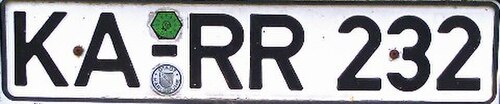
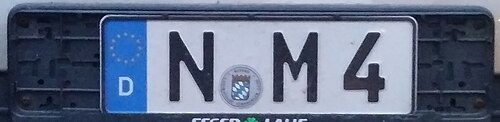


これらのナンバープレートの法的要件は、Verordnung über die Zulassung von Fahrzeugen zum Straßenverkehr (道路交通のための車両の通行許可に関する条例) という連邦法、または古い法律の一部を置き換えた短縮版Fahrzeug-Zulassungs-Verordnung, FZV [ 5 ]で規定されています。法律では、文字と数字の特定の組み合わせを意味する Kennzeichen と、物理的なナンバー プレートであるKennzeichenschilderが区別されています。 [ 5 ] : §12日常言語では、これらの用語は無関心にNummernschildに置き換えられることが多く、 NummerまたはSchildの使用が制限されて違いが強調されることはほとんどありません。
ドイツのナンバープレートは長方形で、乗用車、トラック、バス、およびそれらのトレーラーの標準寸法は520 mm × 110 mm ( 20 + 1 ⁄ 2 in × 4 + 3 ⁄ 8 in)です。文字数の少ないプレートは長さを短くすることができますが、文字のサイズと形状は維持する必要があります。上記タイプの車両[ g ]の 2 行のプレートは340 mm × 200 mm ( 13 + 3 ⁄ 8 in × 7 + 7 ⁄ 8 in)です。オートバイにも2行のナンバープレートがありますが、寸法が異なります。2011年までに発行された「大型オートバイ」(エンジン排気量が125cc以上、または出力が11kW (15bhp )以上)のプレートは、 280mm × 200mm (11インチ× 7 + 7 / 8インチ)のサイズで、文字のサイズは自動車のプレートと同じサイズですが、2011年以降に発行されたものは文字のサイズが小さく、180mm × 200mm (7 + 1 / 8インチ× 7 + 7 / 8インチ)または220mm × 200mm (8 + 5 / 8インチ× 7 + 7 / 8インチ)のいずれかのサイズです。 「軽バイク」(Leichtkrafträder 、125cc以下、11kW (15bhp )以下)用のナンバープレートは、 255mm × 130mm (10インチ× 5 + 1 / 8インチ)のサイズで、文字サイズが小さくなっています。この最小サイズのナンバープレートは、最高速度40km /h(25mph)の農業用トラクターとそのトレーラーにも使用され、また、通常のサイズのナンバープレートを取り付けられない場合に、特定の輸入車に対して例外的に発行されることもあります。
ナンバープレートの文字とそれを囲む細い縁は、白地に黒で表示されます。[ 5 ]: §12(1)標準サイズでは、高さ75 mm(3インチ) 、文字の場合は幅47.5 mm(1 + 7 ⁄ 8インチ) 、数字の場合は幅44.5 mm(1 + 3 ⁄ 4インチ)です。小型プレートの文字の高さは49 mm(1 + 7 ⁄ 8インチ) 、幅はそれぞれ31 mmまたは29 mm(1 + 1 ⁄ 4インチまたは1 + 1 ⁄ 8インチ)です。[ 5 ]:付録4 1956年に導入された現行システムでは、1、2、または3文字の地域コードに続いて、1文字または2文字の識別子シーケンスと1~4桁の数字が続きます。プレート上の文字の総数は8文字を超えてはなりません。 1文字と1桁または2桁の数字で構成される識別番号は、特に2011年にナンバープレートのサイズが180 × 200mmと220 × 200mmに縮小される前は、これらの車両にはプレート用のスペースが少ないため、オートバイ用に予約されていることが多い。 [ 6 ]
現代のドイツのナンバープレートには、FE-Schrift(fälschungserschwerende Schrift、改ざん防止書体)と呼ばれる書体が使用されています。この書体は、文字PをRと全く同じように書き換えたり、その逆を行ったりできないように設計されています。また、 FやLをEのように偽造することもできません。さらに、すべての文字の幅が均一であることも特徴の一つで、1956年に現行制度が導入されて以来使用されてきた旧DIN 1451書体とは異なります。FE-Schriftは、DIN 1451よりもOCRソフトウェアによる自動ナンバープレート認識が容易です。
現在のデザインは1994年に導入され、2000年に義務化されたため、旧デザインのナンバープレートは非常に希少になっています。欧州連合加盟国の多くのナンバープレートと同様に、左側の青い帯には、白い文字で短縮された国コード( DはDeutschland=ドイツを表す)と欧州旗(青い背景に12個の金色の星が円状に配置されている)が表示されています。
伝統的に、ドイツのナンバープレートはアルミニウム板で作られており、背景レベルより浮き上がったエンボス加工の文字が特徴です。しかし、長年にわたり、さまざまな他の素材が使用されてきましたが、その割合はごくわずかです。2013年からは、プラスチック製の新しいタイプのプレートが許可されています。[ 7 ]これらは機械的損傷に弱く、製造時のCO2排出量も少ないと言われていますが、価格は高くなります。[ 8 ]
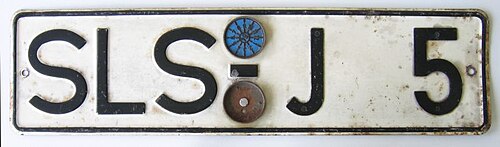
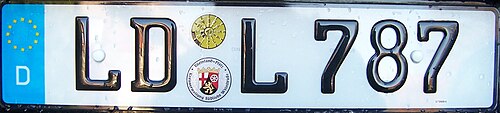


ナンバープレートは再帰反射性であるが、鏡面反射したり、隠したり、汚したりしてはならず、ガラス、ホイル、または同様の層で覆ってはならない。[ 5 ]: §12(2)時々、お気に入りのサッカークラブのバッジでナンバープレートを飾るドライバーは罰金を科され、元の状態に戻すよう命じられる。[ 9 ] [ 10 ]

最初の部分、またはUnterscheidungszeichenは、ベルリンを表すBやホーホザウアーラントクライスを表すHSKなど、車両が登録された地区を表す1文字、2文字、または3文字で構成されます。これらの文字は基本的にドイツの地区を表していますが、法律の変更により、もはや明確ではなくなりました。現在のシステムが導入された当初は、各地区に正確に1つの略語が割り当てられていました。地区が他の地区と合併したり、名称が変更されたりするたびに、その地区の地域コードが再定義されました。既存の登録は有効なままですが、それ以降に登録される車両には、現在のコードのみが発行されます。[例1 ]都市地区と周辺の非都市地区が同じ文字コードを共有する場合もあります。通常、これらは異なる文字/数字のパターンで区別されます。 [例2 ]各コードと組み合わせの割り当ては、中央車両登録局(ZFZR)に登録されます。[ 11 ] : §34
しかし、2013 年以降、長らく廃止されていた市外局番が再導入され、[ 12 ] [ 13 ]曖昧さのない規則が撤廃されました。その結果、多くの地区で複数のコードが使用されるようになり、[例 3 ]一方、特定のコードは 1 つの地区のみに割り当てられるわけではありません。[例 4 ]同様に、周辺の農村地区とコードを共有するいくつかの都市では、区別なく両方の地区で使用可能なコードを使用するようになりました。たとえば、レーゲンスブルク市と周辺のレーゲンスブルク農村地区は、2007年までコードRのみで異なるシステムを使用していました。
ドイツでは、一部のコードの文字に発音記号が含まれています。つまり、Ä、[ 14 ] Ö、Ü、[ i ]ですが、ẞ は含まれていません。[ j ]長い間、ドイツのコードは、ウムラウト付きのコードは、対応する空白母音を持つ別のコードを禁止するという規則を守っていました。たとえば、コードFÜがすでにFürthで使用されていたため、地区コードFUは存在できませんでした。この規則は 1996 年に無視され、ボーフムにBO が存在するにもかかわらず、BördekreisにBÖが導入されました。しかし、Bördekreis は 2007 年に BK を取得しました。おそらく海外での混乱や罰金などのためでしょう。[ k ]
市外局番が導入された当初は、主に警察官がスピード違反者やその他の交通違反者を識別するための手段として意図されていました。しかし、すぐに人々の居住地域の日常的な略語として発展し、愛されたり嫌われたりしました。時には、隣接する地区のコードが嘲笑や悪意のある意味を与えられたこともありました。[例5 ]地区が合併し、そのうちの1つのコードしか継続できない場合、どのコードを継続するかをめぐって激しい争いが起こることもありました。[ 15 ]

1968年以来、スイス領土に完全に囲まれたドイツの飛び地であるビュージンゲン・アム・ホーホライン市には、特殊な規則が適用されています。ビュージンゲンはドイツのコンスタンツ地区に属していますが、スイスの税関区域の一部です。そのため、ビュージンゲン市民が登録した車両には、コンスタンツを示すKNではなく、スイスの税関職員に国内車両であることを示すBÜSが付けられています。この地域コードを持つ車は約700台あり、ビュージンゲンはドイツで最も小さく人口の少ない登録区域となっています。[ 16 ]
Registration plates become valid with the official seal of registration.[5]:§12(3) This is a sticker of 45 mm (1+3⁄4 in) diameter, following the area code and bearing, in colours, the seal of the respective German Bundesland with the name of the state and the issuing district authority added in print. Older stickers were monochrome, black on silver or white, and smaller (35 mm; 1+3⁄8 in), depicting the seal of either the Bundesland or the city district. Vehicles used by federal institutions, such as Bundespolizei, carry the German Bundesadler instead of a Bundesland seal.
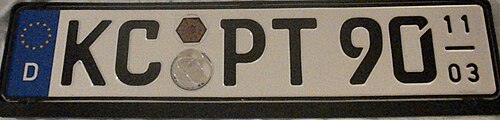
The rear plate bears, above the official seal, the vehicle safety test sticker. This test is obligatory three years after the first registration, and every two years after that. (This time scheme differs for certain vehicles, such as buses, trucks, taxis, etc.) The expiration date can be seen at one glance, as the sticker is attached with the month of expiration pointing upwards. The black mark framing the sectors on either side of 12 thus makes it easy for the police to read the expiration month from a distance. Like the hand on a clock, the marking shows the position of a number on the face of a clock. The year when the next safety test is due is printed in the centre of the sticker and also indicated by the colour of the sticker which is repeated every six years.
Whereas the technical inspection was introduced in 1951, it was not before 1961 that a decal on the rear plate indicated when it was due.[22] The inspection generally had to be performed every two years, only later brand new cars were granted an extra year before their first technical inspection. Consequently, there were not so many different colours needed, and the pattern was different then.
Between 1985 and 2010, a similar yet hexagonal sticker was applied to the front plate, certifying the emission test which had to be performed separately since March 1985. With a change of laws effective in 2010, the emission test was incorporated into the safety test, so the emission sticker became obsolete.[23]


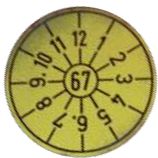
All these stickers are specially treated to be easily transferred onto the licence plates, but hard to be removed without damaging the plate itself, making them relatively counterfeit-proof.
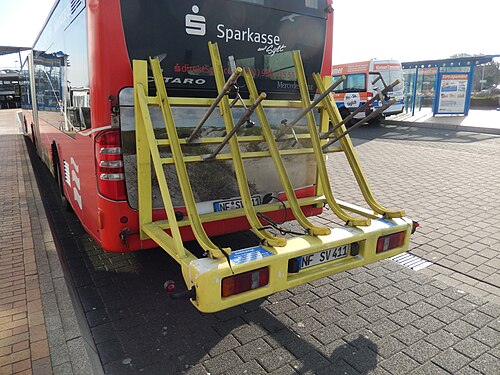
The only licence plates which do not need to carry either seal are repeaters. These are obligatory when the original rear plate is covered, in part or whole, by cargo or attached parts, such as bicycle carriers.[5]:§12(10)
The final identifier or Erkennungsnummer of the licence plate consists of one or two letters, followed by a number of up to four digits. Thus, basically any combination from A1 to ZZ9999 is possible, yet restricted by the maximum length of eight characters, including the area code. All 26 letters of the Latin alphabet may be used, yet this was not always so. In order to avoid confusion between B and 8, F and E, G and 6, I and 1, O and Q and 0, those six letters were excluded from the middle part of registration plates. In 1992, the letters B, F and G were permitted, and in 2000 the alphabet was completed as I, O and Q have been allowed. In the very first months of the numbering system, between July and November 1956, the letter I was used but J was not. This was soon reversed, but single vintage cars kept sporting their letter I between 1956 and 2000 when it was re-introduced.
Identifiers are categorized into five groups, according to the number of letters and numbers:[5]:Appendix 1
Not every group is issued by every authority and group e cannot be combined with three-letter area codes.

In the style used until 1994, a hyphen following the area code was used to separate the two groups of letters. This no longer appears in the new format but is often retained, as the space between the geographic identifier and serial letters is a significant character and must be considered when writing down or transmitting a number. For example, F ST 683 is different from FS T 683. The risk of confusion can be avoided by writing a hyphen after the city code, like F-ST 683. For this reason, the police will usually radio the location name and spell out the next letters, using the German spelling alphabet. Thus, F ST 683 would be radioed as Frankfurt, Siegfried, Theodor, sechs-acht-drei and FS T 683 as Freising, Theodor, sechs-acht-drei. If the officer should not know the meaning of the area code, he would spell it out too, as Friedrich, Siegfried, Trennung (separation), Theodor, etc.
While the number is issued by each district authority separately, a probable split between two or more districts sharing the same area code has to be considered.[example 6] Further restrictions are caused by "prohibited" combinations (see below).[n]

For an extra charge of €10.20, vehicle owners can register a personalised identifier, keeping to the above rules. In most cases of personalised plates, owners choose their initials and a number reflecting their date of birth. In this fashion, fictional Mrs Ulrike Mustermann, born 2 May 1965 and living in Essen, might choose E-UM 2565 for her car. By combining area code and random letters, further possibilities arise, such as a man from Oldenburg named Olaf, born on Christmas Eve, could choose OL-AF 2412. A resident of the town of Pirna might choose PIR-AT 77, Pirat meaning "pirate" in German. Kiel and Kleve are two examples of places where the number plate can spell out all of the city name.
These vanity plates can only be made up of the available prefixes and numbers, within the general rules. A James Bond fan from Hamburg would not be allowed the plate HH-JB 007 because leading digits 0 (or even double-0) are not possible; however, he might strive for HH-J 8007 or HH-OO 7, imitating digits by letters or vice versa. The owner of a Volkswagen Polo can certainly show VW in the middle section, but neither PO-LO 1995 nor VW-P0 L01 would be possible, as these prefixes are not issued nor may letters and digits be mixed at will. Nonetheless, a notable variety of personalised number plates can be spotted on German roads.

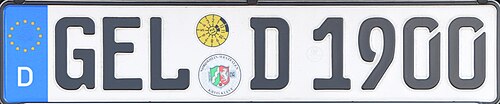

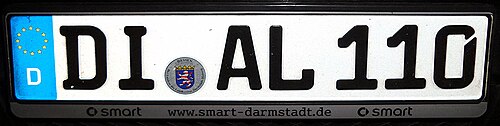


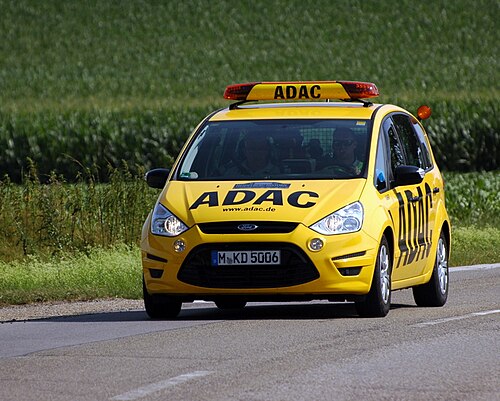
Whereas private persons are required to register their vehicle with the district authority of their residence, commercial enterprises can choose to establish branch offices from where to register at will – either for financial reasons, as insurance fees are dependent on the address of registration, or to obtain an interesting licence plate. On the other hand, other enterprises show their origin proudly nationwide. One of these is ADAC, the German automobile association, based in Munich. All their assistance cars, operating from the Alps to the North Sea, bear an M plate.
Deutsche Bahn, after being corporatised and relinquishing their Behördenkennzeichen (authority plate) DB, prefers this logo as their middle letters, e. g. F-DB for the Frankfurt office. Deutsche Telekom, the largest telecommuncations company, often uses BN plates, as their headquarters remained in Bonn, where the company originated out of a governmental post & telephone agency. Yet wherever the respective branch office may be, the middle letters DT are preferred.
The Kone company registers their German vehicles in Koblenz, with middle letters NE, thus displaying their trademark on their plates. BMW, owner of Mini, registers all Mini press/marketing cars in the district of Minden-Lübbecke which holds the code MI, to get "MI-NI" number plates for the cars. BMW itself is based in Munich, yet M-INI plates are not possible to issue, as three letters after the district code are not permitted.
From 1970s up to 1994, Essen city buses owned by city transport company EVAG (Essener Verkehrs-AG) were registered with E-AT number plates. This may be regarded a pun, as eat translates into German as Essen.[25][26]


Combinations that are regarded as a Verstoß gegen die guten Sitten, which means "offence to moral and customs", are disallowed or otherwise avoided.[5]:§9(1) This refers mostly to abbreviations relating to Nazi Germany, such as NS (National Socialism), KZ (Konzentrationslager, concentration camp), HJ (Hitlerjugend, Hitler Youth), SS (Schutzstaffel) and SA (Sturmabteilung). Therefore, these two-letter combinations are generally not issued in any district, nor do the city districts of Hanover, Nuremberg, Cologne and Stuttgart issue one-letter plates which would result in the combinations H-J, N-S, K-Z, S-A, S-D and S-S.[27][28][29]

Those prefixes must not be issued as middle letters now, yet the list of forbidden codes appears to have developed over the decades. In the 1960s, the renowned ADAC had no qualms with the middle letters SA, as seen on an archive photo. Although the "infamous" combinations were generally excluded from the list of possible area codes with the introduction of the current system, the French occupation force had between 1945 and 1949 used the combination SA followed by the double-digit numbers 01 to 08 for the then seven rural districts in the Saar Protectorate and its capital Saarbrücken. By 1990, however, codes like these were not taken into consideration for newly formed districts in former GDR: The district Sächsische Schweiz used the name of its capital, Pirna, in its code PIR, to avoid the use of SS. When the districts of Torgau, Delitzsch and Oschatz merged into Nordsachsen, they combined their initials into TDO, instead of abbreviating Northern Saxony as NS.[o]

On the other hand, the area codes HH and AH were chosen for Hansestadt Hamburg and former district Ahaus, although they could be interpreted as Heil Hitler and Adolf Hitler, respectively. In everyday German, the letters AH are not regarded as an obvious abbreviation for that name,[p] even less so in the 1950s when the lists were created.[q] Nonetheless, these two-letter codes and the respective numerals 18 and 88, signifying the first and eighth letter of the alphabet, obviously have developed into Nazi symbols. They are therefore generally avoided in the serial part of licence plates, although they may be found sometimes.[30] Generally, the decision whether or not a certain combination is permitted lies with the respective district authority. In Brandenburg, any plates that are related to Hitler, the Hitler salute, etc. cannot be issued, especially if they would be bearing digits 1888, 8818, 8888 or ending in 88, 888, 188. Nor can the combinations AH 18 and HH 18 be issued to new owners.[31] Some districts however allow these combinations if they are the owner's initials (for example, Norbert Schmidt might be able to get XX-NS 1234).
In 2004 in Nuremberg, a car owner was refused a number plate beginning N-PD because of the connection to the political party NPD.[32] After the terror group National Socialist Underground was uncovered in 2011, the city of Nuremberg refused number plates beginning with N-SU and even abolished the respective plates on their own vehicles of Stadtentwässerung und Umweltanalytik (sewage and environmental department).[33] In the 2010s, some districts started banning licence plates with the middle letters IS which resembled the Islamic State.[34] The Herford district registration office ceased issuing registration plates with the combination HF-Z in April 2022 to avoid connotations with the use of the letter "Z" as a symbol for the 2022 Russian invasion of Ukraine.[35]
The combinations STA-SI, S-ED[29]/SE-D,[36]HE-IL/HEI-L, IZ-AN and WAF-FE are also forbidden or discouraged, to avoid association with Stasi, the Sozialistische Einheitspartei of the GDR, the Nazi salute, NAZI backwards and the German word for weapon respectively. Other combinations affected are BUL-LE (German derogative for police, roughly comparable to pig),[37]MO-RD (German word for murder),[38]TO-D (German word for death), KI-LL (kill) and SU-FF (boozing).[39][40]

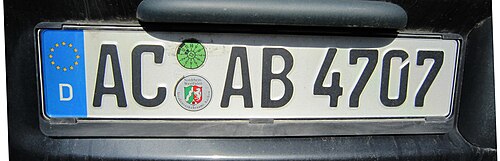
On the other hand, plates that would seem offensive in other circumstances have been allowed, such as the infamous acronym AC-AB. Since the 1950s, morals and customs have certainly changed, and combinations which may have appeared indecent then do not raise an eyebrow now. Therefore, it is not a problem to get a licence plate with S-EX,[29] SE-X or SE-XY,[36] for example.

For quite different reasons, some districts hold certain letter combinations reserved. The Saxon capital Dresden issues all DD-Q plates to the state police vehicles. Likewise, Erfurt uses EF-LP for the police in Thuringia. Munich and other Bavarian cities reserve certain combinations with P for the police units within their authorities, such as M-PM, N-PP or RO-P.[41] Cologne issues K-TX to taxis and K-LN to the city's own vehicles.[28] In various districts, firefighter vehicles will be issued the middle letters FW standing for Feuerwehr.[42] The combinations B-FA and BN-AA with any 4-digit numbers are issued by Berlin and Bonn, respectively, to embassy domestic staff without diplomatic status.[43]

Sometimes, such as in films or television series, it may be necessary to show licence plates which do not really belong to any vehicle. The easiest way would be to create a fictional area code, such as NN-XY 555. In the 1980s TV series Der Fahnder,[44] the area code G was used for a fictional "large city" (German: Großstadt) in the Ruhrgebiet area. However, if the plot is supposed to take place in a defined town or region, the audience would expect cars to show codes of that area on their number plates. When James Bond was driving through Hamburg in Tomorrow Never Dies, the obviously fake Berlin licence plates on his BMW were soon pointed out.[45]
Prior to 2000, it was also possible to use number plates with bogus identifiers containing the letters B, F, G, I, O and Q, which at that time were not issued in the middle group. However, any of these letters can appear on a real licence plate. In order to demonstrate clearly that the plate shown is a fictitious one, the crew could use an impossible identifier, such as an umlaut in this middle section.

Vehicles must be registered with their owner's name and current address. On proof of identity, vehicle documentation and liability insurance, the registration will take place in the district authority competent for the respective address.[5]:§6 An alphanumeric combination, which can be reserved according to personal wishes, will be issued to the vehicle. The physical plates, however, have to be acquired separately, either at a local store or online.[46] Both the dimensions of the plates and the typeface of letters and numbers are standardized. After purchasing the number plate, the official stamps must be applied, back at the registration office.[5]:§12(3) A fee is payable for the registration, in addition to the expenses for the plates.
Any registration or change of it will be registered both within the district authority and nationwide. The latter task is carried out by the Central Vehicle Register (Zentrales Fahrzeugregister, ZFZR) which is controlled by the Federal Motor Transport Authority (Kraftfahrt-Bundesamt, KBA).[11]:§31 The data which are stored there refer to the vehicle, the owner and the insurance.[11]:§33[47] Inquiries from foreign authorities can be addressed to ZFZR which will then direct them to the correct district.[11]:§37[48]
Changes, such as a vehicle being sold or its owner moving residence, must be registered to keep the vehicle documentation up to date.[5]:§15 If the vehicle remains within the district, the licence plates may be retained. A vehicle being relocated outside of the district has to be registered at the authority now competent. Whilst it was mandatory to have the plates altered, according to the current address, this obligation was reduced in 2015 and has meanwhile been abolished. Since then, it is generally not possible any more to tell the owner's district of residence from the area code on the plates, as they may have registered it at a former residence e.g. in Hamburg yet moved to Frankfurt meanwhile.[49]
When owners choose to deregister their vehicle, the officer at the local authority will want to see the licence plates with defaced seals on them as proof that the plate can no longer be used in public. For this purpose, scratching tools are available for use at the registration office. Once defaced, the plates may only be used legally on public roads for one return journey to the owner's residence. If a vehicle is to be deregistered and a new one registered to the same owner, it is possible to swap the licence plate from old to new within the same process. Documentation and fees are necessary nonetheless, and neither vehicle should be used to reach the authority, as the assignment of the number changes by the minute.
It is general practice for owners to deregister their vehicles when selling them, typically when a sale is agreed. A sales contract is highly recommended, and various forms are available online for free.[50] A seller may hand over their vehicle with valid licence plates and papers still in their name to the new owner, and the owner will complete the registration transfer to their name. In a scenario without a proper sales contract, the seller may become liable when the buyer commits traffic violations or even criminal acts related to the car or plates. It is generally not recommended to sell used cars with licence plates.
A car whose owner has not paid their insurance premium and is reported to the police by the insurance company may get entstempelt, unstamped when found in a public place. The police will remove the official seal using a scratching tool like a screwdriver, leaving the plate without a valid seal. This renders the vehicle illegal to be used, or to be left in a public place, unless the insurance premium is paid and plates are fitted with a new official seal. A one-time journey to the relevant registration authorities is permitted to have the seal reinstated, once insurance is restored.
As of 2020, the average registration fee is €26.00[51] whilst further fees may apply for choosing an individual identifier or for reservation of such. Whereas some of these amounts are ordained by federal laws, others vary slightly from one district to the next.[52] The prices for number plates, on the other hand, are subject to the free market and range from less than €10 up to around €40 per piece. Generally, it is cheaper to have the plates ordered online, but faster to walk across the street and have them made on the spot.
Further costs arise for motor vehicle tax (€194 on average[53] yet very much depending on engine and emissions) and mandatory liability insurance (€260 on average, in 2019;[54] depending on the model of the vehicle, age and residence of the owner, etc.). Comprehensive insurance is recommended but voluntary.
Besides the most common way of registering a vehicle for everyday, all-year use indefinitely, it is possible to register for several months of each year, or for a few days in order to export the vehicle abroad. As well it is allowed, under certain restrictions, to register two vehicles (such as a car and a motorhome) under one number, with the same main licence plate. These variations may save expenses in tax and insurance. Further ways of saving apply to vintage cars and to electrically powered vehicles. Each of these special registrations are represented in the respective licence plate.
Certain types of vehicle bear special codes.[5]:App. 3[r]
In deviating from the system described above, vehicles registered to federal, state or communal owners can bear licence plates not showing the district and sometimes omitting the middle letters.

The President uses the licence plate 0-1, the Chancellor uses 0-2, the Foreign Minister uses 0-3 and the First State Secretary of the Foreign Office (i.e. the deputy Foreign Minister) uses 0-4. The President of the Parliament uses 1-1. This reflects the fact that the Parliament's president is not part of the executive branch but still ranks higher in (symbolic) importance than the Chancellor. These vehicles are tax-exempt and need not to be insured since the German government acts as insurer.

Instead of a city code (which would mostly mean B for Berlin) the federal government uses an exclusive abbreviation of their own. The code BD(Bundesrepublik Deutschland) applies to the federal government, ministries, parliament, presidential office, etc. which are identified by their initial number.
Some branches and institutions of the federal government use their special prefix (often an abbreviation of their name) instead of a city code.


In a similar way as the federal government, the state governments and diets can use their respective codes. This difference is not made in the Stadtstaaten Berlin, Hamburg and Bremen, as they fulfil both district and state function in addition to their municipality's. In some Bundesländer, such as North Rhine-Westphalia, the state code is also used by the police.[example 7]

Before the legal reforms of 2006, official vehicles such as police, fire fighting and municipal administration did not carry a letter after the sticker, but only the district prefix and a number, such as M-1234. These included:
This style of plate is no longer issued in most states, but many official vehicles which were registered before 2006 still carry this type of plate.


A similar style is issued by some districts to consular or diplomatic vehicles in the form Aaa-9NNn (example: D-921). Unlike the other style of diplomatic/consular plates issued in Berlin and Bonn (see below), this plate does not indicate the nationality of the mission.
Plates of cars covered by diplomatic immunity bear the digit 0 (Zero), followed by a two- or three-digit number which indicates the specific diplomatic mission, a hyphen and another number counting within this mission. Traditionally, a digit 1 in this final place denotes the ambassador or chef de mission. Lower-ranking embassy or consular staff without full diplomatic status are issued plates with the regular city code (mostly B for the capital, Berlin, or BN for the former capital, Bonn); the following numerals are analogous to the "0-plates", e.g. B 19–256. Further holders of diplomatic plates are certain international organizations, such as the UNHCR or the European Central Bank.[43]


Very rarely, German licence plates bear characters in different colours than black. These exceptions are:

Vehicles which are exempt from vehicle taxes (for example ambulances, tractors, agricultural trailers, trailers for boats or trailers for gliders) have green print on a white background plate.[5]:§10(2) Regular trailers for lorries can be exempted from tax if the owner agrees to pay an increased tax on the vehicle which tows the trailer.
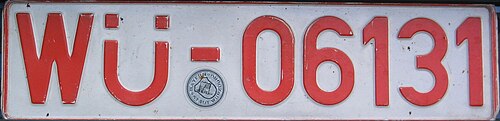
Car dealers' plates are in red print on a white background, and the code begins with 06.[5]:§41 Red plates may be attached to cars which are changing hands, such as the test run of unregistered cars, and the liability insurance is connected to the plate, not a specific car.
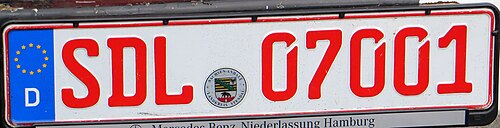
Red plates starting with the number 07 are reserved for collectors of vintage vehicles.[5]:§43 Originally, vintage vehicles had a required minimum age of 20 years from first registering. Since April 2007, the required minimum age has been 30 years. Plates issued under the old 20 years rule remained valid after this date. The collectors must get an official certificate of approval (such as no criminal records). They are allowed to use one set of plates on any of their vehicles under the condition that they keep a strict record of use. No day-to-day use of the vehicles is allowed. A valid official technical inspection is not mandatory but the vehicles have to be technically fit for use on public roads.

Classic vehicles (known in German by the pseudo-English expression Oldtimer) can get an H (historisch, historic) at the end of the plate, such as K-AA 100H in order to preserve the so-called "vehicle of cultural value" (kraftfahrtechnisches Kulturgut).[5]:§10(1) This also implies a flat tax of around €190 per year. It is popular to choose the digits so that they indicate the car's year of manufacture. The requirements for a vehicle to receive an H-Plate are:

The 2015 Electric Mobility Act authorised issuing special licence plates for plug-in electric vehicles to allow proper identification to avoid abuses of these privileges.[5]:§11[58][59] The special licence plate adds the letter E at the end of the licence number. Owners of all-electric cars and plug-in hybrids with a minimum all-electric range of 40 km (25 mi) can apply for the special licence. The minimum range for eligible plug-in hybrids was increased from 30 km (19 mi) from 1 January 2018.[60][61]
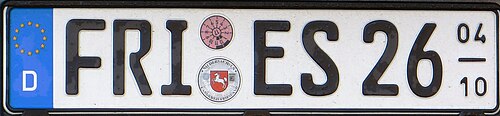
Seasonal number plates are popular for motorbikes or convertibles in the summertime, or for "winter cars" substituting them, yet these plates are available for any vehicle.[5]:§10(3) They bear two 2-digit numbers at the end of the plate indicating the months between which they are registered to drive, with the licence being valid from the start of the upper month until the end of the lower month. This results in lower car taxes, as well as lower insurance premiums.

Two vehicles of the same class (two cars, two motorbikes or light vehicles, two trailers) may be registered with an alternating licence plate.[5]:§9(2) In this case, only the last digit varies – e.g. B-KJ 414|5 and B-KJ 414|6 – and is printed on an extra plate which remains on either vehicle, whereas the main part of the plate has to be attached to the vehicle in use. The main part carries the registration seal and a small letter W for Wechselkennzeichen, the individual part carries the technical inspection seal and below, in very small letters, the associated main number. Both vehicles have to pay full tax, yet the insurance premium may be discounted.[62]

Used vehicles which are not currently registered to any person or company – or have been deregistered by their current owner, temporarily or permanently – can be driven on public roads using short-term plates, valid for five days only.[5]:§42 These are known as "temporary number plates" or "yellow number plates", due to the yellow stripe. The first letter(s) indicate the issuing authority, as in regular German registrations. The numeric code starts with the numbers 04, e.g. DD-04321, and the plate has a yellow stripe on the right showing when they are valid. The date is listed numerically, on three lines, reading day, month, year, with two digits each. The vehicle need not have a valid technical inspection, however it must be technically fit to be operated in public. Typically they are used to drive to/from a technical inspection, or to move storage location of the vehicle. Insurance premiums are quite high, appr. €100 for the above-mentioned 5 days. Most insurance companies credit this premium if the car is registered as a normal car with the same insurance company after these 5 days. These temporary plates are only valid within Germany, and cannot be used to export the vehicle to a foreign country nor for transit. They can only be obtained by a resident of Germany.
Ausfuhrkennzeichen (export plates) are used for exporting vehicles abroad.[5]:§45 The owner does not have to be a German resident to register the car, but must provide identification such as a passport or ID card. The date on the red stripe on the right hand side shows the expiration date of the plate, as it indicates for how long the vehicle insurance and tax are paid. After this date, the vehicle must have left Germany, and is automatically deregistered from the German vehicle registration system. Use of the vehicle within Germany is permitted until the export date.


The first German licence plates that had a lettering plan were issued from 1906 onwards. The various states and realms which made up the German Empire used different prefixes, such as Roman numerals (I representing Prussia, II Bavaria, III Württemberg, etc.) or plain letters (HH for Hansestadt Hamburg, e.g.). Larger states added further identifiers for their provinces or regions. Saxony did not use any statewide numeral and only used Roman numerals for its provinces.[63][64]


During World War I the German Army was assigned the combination MK for Militärkraftwagen des Deutschen Heeres, military vehicle of the German Army. After the war, during the Weimar Republic, the German Army used RW for Reichswehr. Beyond this, there were no significant changes after the overthrow of the German monarchy.

During the Nazi regime (1933–1945), the system of licence plates was basically continued. New combinations were issued for nationwide institutions or organisations, such as DR (Deutsche Reichsbahn) for the railway authority, WH Wehrmacht Heer, WL Wehrmacht Luftwaffe, WM Wehrmacht Kriegsmarine and WT Wehrmacht Straßentransportdienst for the military, or POL for the police.
While the Nazi state expanded and waged war, their bureaucrats applied their systems, including licence plates, to occupied countries or territories. Thus, plates of similar style were introduced in Austria, on Czech and Polish territory, in Alsace and Lorraine, and beyond.

After 1945, however, the victorious allied forces abolished the system of German licence plates and instead assigned new lettering combinations in their respective occupation zones. Although each nation implemented their own ideas initially, a system for all four zones was introduced by 1949.[65] At first, the different zones were distinguishable by the first letter prefix A, B, F or S standing for the American, British, French or Soviet occupation zone, respectively. A second letter below indicated the area or country in question, such as AB stood for American zone/Bavaria. This area code was followed by a two-digit number signifying the district and another number counting within that area. When the numbers became scarce after some years, another zone prefix (e. g. without the first letter) would be introduced additionally.
The city of Berlin had a special status and, consequentially, special plates. Having abolished the old I A number plates in 1945, the Soviet occupation forces issued plates with Cyrillic characters at first. Motorcycles were issued БM (=BM, 1945–1946) and ГM (GM, 1945–1947). Cars, lorries and buses received ГФ (=GF, 1945–1946) and БГ (=BG, 1945–1947).[66] These were replaced on the insistence of the western powers, first to KB for Kommandatura Berlin and, in the Eastern part of the city, to GB in 1948.


The British Army of the Rhine (BAOR), initially occupation forces, later NATO elements, issued servicemen with plates carrying white letters and numerals on a black background for their personal vehicles. These cars stood out in comparison to the black on white German plates, and following the terrorist murder of a British serviceman, identified when returning to his car with BAOR licence plates, servicemen had to opt for their cars to carry either UK plates (generally right-hand drive vehicles) or German plates (generally left-hand drive vehicles). During the time that Belgian forces were stationed in West Germany, white on black plates similar to the BAOR plates were used.

The American Forces have tried to "blend in" their servicepersons′ private vehicles in another way. Starting in 2000, they adopted a type of license plates which closely resembled the German plates yet bore area codes which were at that time not assigned to any district, i.e. AD, AF and HK,[v] later also IF and QQ. These codes still stood out, especially as they bore the NATO symbol instead of the EU's circle of stars and the registration seal candidly read Streitkräfte der Vereinigten Staaten von Amerika instead of, e.g. Bayern, Landratsamt Neustadt a.d. Waldnaab. Since 2006, the vehicles in question bear license plates with regular German area codes, generally referring to the district of their official stationing.
The German Democratic Republic issued their own style of licence plates beginning in 1953. The first letter would indicate the Bezirk (administrative district[w]) where the vehicle was registered. These initials, however, did not refer to the name of the Bezirk but were distributed almost alphabetically from North to South.


After German reunification in 1990, the DDR plates were soon abolished and the West German system introduced, starting in 1991 and completed in 1993. Even before this transition phase, it could be observed that licence plates in GDR scheme were produced with West German typeface on the respective machinery.
In July 1956 the current system was introduced in then West Germany, replacing the post-war system.[67] The occupation zones were no longer referred to, instead the new system based on the districts of Germany. Each of these was assigned an alphabetic code which had its origin in the name of the district, i.e. of the city or of the capital of the rural district. Quite often, a "district-free" city was surrounded by, or adjacent to a rural district of the same name. In this case, they would both share the code as well as the name, yet devise a way how to split the possible alphanumerical combinations.
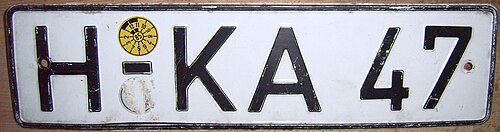
The number of letters in the area code hints at the size of the district. The basic idea was to even out the number of characters on all licence plates, because the most populous districts would have more cars and, consequently, more digits after the prefix. The largest German cities generally only have one-letter codes, such as B=Berlin, M=Munich (München), K=Cologne (Köln), F=Frankfurt, S=Stuttgart, H=Hannover. Therefore, cities or districts with fewer letters are generally assumed to be bigger and more important whereas three-letter codes tend to be regarded as rural and dull. Reflecting that, most districts aimed for a combination with fewer letters for their prefix code.
The most significant exception of the one-letter code is Germany's second largest city Hamburg which bears HH for Hansestadt Hamburg, because of its historical membership in the Hanseatic League, reflected already in its prefix used between 1906 and 1945. A similar principle applies to Bremen and Bremerhaven, forming the state Free Hanseatic City of Bremen and sharing the common prefix HB (1906–1947, and again since 1956). Likewise, HansestadtLübeck received its former prefix HL, already used between 1906 and 1937 when its statehood was abolished.
The first drafts, however, had to be altered in a few cases. The district of Wittlich rejected the code WC, understandably, and received WIL instead. The code KZ, initially projected for Konstanz, was withdrawn fast, due to recent history, and replaced by KN. Neither were SA, SS or HJ considered to be issued. The code SD was projected for Stade and was finally altered into STD after protests from that district who did not want to bear the abbreviation of the Sicherheitsdienst.
When originally planned, the system included codes for districts in Eastern Germany which were to be reserved until reunification. That included the territory of the GDR as well as the territories annexed to Poland and the Soviet Union after World War II, which West Germany's government still claimed in that era until about 1970. When reunification came in 1990, the reserved codes (e.g. P for Potsdam) were indeed issued to East German districts in January 1991, often as originally planned and as they existed at that time.
Starting in the early 1970s, West German districts were extensively rearranged.[68] In order to reduce their number and so simplify governance, different steps could be taken:
In each of these cases, the new districts had to be endowed with an area code. Again, various solutions were possible:
In any case, the adamant rule was that one area code per district was valid and would be issued to any vehicle registered henceforth. Existing registrations would remain valid until the vehicle was removed from this district to be either relocated or permanently deregistered. Another rule, however, was abolished. Whereas rural districts had generally been named after their capital town, it was now possible to create new names, applying to geographical[example 15] or historical features.[example 16] As well it was possible to combine the names of the districts that had merged, either keeping one of their codes[example 17] or creating a new one.[example 18]

When the GDR ceased to exist and Germany was reunited in its present size on 3 October 1990, new area codes were issued to the East German districts. In many cases they could be taken from the old lists that had been prepared before 1956: P stood for Potsdam, EF for Erfurt, SON for Sonneberg. Yet, a considerable number of codes was altered, either because a code which had been reserved for a district in today's Poland or Russia had become available,[example 19] or because the projected code had meanwhile been issued to a West German district.[example 20]
A prominent example of a reserved code being reused before reunification was one-letter L which was originally planned for Leipzig, by far the largest German city starting with L. However this code was given to the newly formed Hessian city of Lahn and the district Lahn-Dill-Kreis in 1977, as hopes for reunification faded away. After the rather unexpected reunification (and Lahn city having split up again and thus abolished in 1979), the L was returned to the city of Leipzig and Lahn-Dill-Kreis was issued LDK instead.
The letter G was first reserved for the East German city of Görlitz and later awarded to the city of Gera, although both are smaller than the West German Gelsenkirchen (GE). The area code ZK had been reserved, in the 1950s, for the city of Zwickau but was rejected as ZK had become the abbreviation of the loathed Zentralkomitee of the former Communist party SED.
In analogy to the three northwestern Hansestädte Hamburg, Bremen and Lübeck, but without historical examples of formerly issued prefixes, four northeastern Hanseatic cities, Greifswald, Rostock, Stralsund and Wismar, chose the prefixes HGW, HRO, HST and HWI. There were no suitable two-letter codes available since HG, HR, HS and HW were already taken by West German districts.[y]
Beginning in the mid-1990s, however, districts in East Germany were rearranged again, similar to the West two decades before. Thus many of these codes issued before were now outdated, but could still be seen alongside the new code.[example 21] This rearrangement was continued in a second step after 2000, which created large districts with a remarkable variety of possible area codes registered. Still, only one of these was the current one which would be issued to vehicles registered at the moment.
After the reorganization of districts, from the 1970s onward, many area codes expired and new ones were created at that time. However, number plates issued before these rearrangements remain valid, providing the vehicle is still in use and has not been reregistered since. So it was still possible, if rare, to see a classic car with registration codes of administrative units that have not existed for over 30 years.[example 22]

A study conducted in 2010–12 produced the result that 72% of the German population would welcome the possibility to use again these abolished area codes whereas only 13% opposed the idea.[12][69] It was regarded as remarkable that even young people who had never driven a car with such an "old" prefix favoured the idea of this so-called Kennzeichenliberalisierung (licence plate liberalization).[70] For one, their chances at receiving a personalized license plate would improve if the aspired combination was available not once but several times within their district. Yet the main reason mentioned was a pride in their home town and their own roots, in times of globalization.[71]
The police, however, warned against introducing further codes, as it had turned out that observant citizens would easily notice a car with a number plate from a distant district, thus assisting the police in solving crimes. Plates from the vicinity, on the other hand, would be easier to remember in full, and this would also help to find offenders. More opposition came from local politicians who maintained they had at last succeeded in unifying their merged districts and healed the wounds of those inhabitants who had to give up "their" prefix. If that prefix was available again, they feared, it might lead to old feuds within districts flaming up anew[72] – or, as the district of Westerwaldkreis put it, "reopen the old trenches between former Oberwesterwaldkreis (WEB) and former Unterwesterwaldkreis (MT)."[73]
Nonetheless, the Federal Ministry of Transport complied with the majority of citizens. Beginning in November 2012 in some districts, and meanwhile nationwide, most of these expired prefix codes have been reintroduced, e.g. in the district of Wesel, it has again become possible to register vehicles with MO as used for the former district of Moers and DIN as used for the former district of Dinslaken, additionally to the standard WES which had been the only code issued since 1975. As of September 2024, the liberalization has led to 328 previously abolished codes being reintroduced.[12]
In 2024, the same college which had initiated this movement suggested a second step. Every town above 20,000 inhabitants should be able to apply for their own code, even if they had never had one and were subordinate municipalities of a district.[74] The reactions by the political bodies responsible for an implementation of this idea were restrained but varied.[75][76]
Furthermore, it has become possible to "take one's number along", i.e. to keep a licence plate issued at the previous address after moving away from that district.[77] For that reason, the area code and the respective state seal on a licence plate do not necessarily mean that the vehicle's owner really lives there.
In 2023, the city of Munich applied for a second code, as the remaining free combinations with M, which the city has to share with the district of Munich, were becoming scarce. The code MUC, which is also the IATA code for Munich Airport, was granted by the Federal government on 21 September.[78]

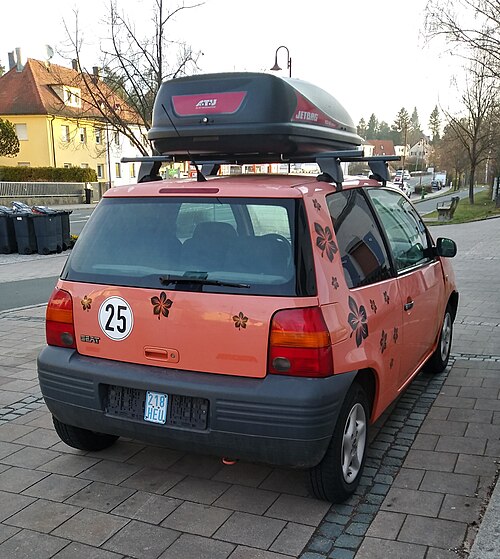

Light motorised vehicles such as mopeds, motorized wheelchairs and other small, low-power vehicles (such as vehicles for the physically handicapped, with a maximum speed of 50 km/h (31 mph)) are required to have a registration plate of a different kind. This Versicherungskennzeichen (insurance plate) uses a system of three digits on the top and three letters beneath.[5]:§52 Both numbers and letters are chosen randomly so personalising the plates is not possible. Plates are much smaller[aa] than the plates for normal cars and are only valid for one year from 1 March until the end of February the following year.[79] Those plates are sold by insurance companies, so the fee includes both the registration and the cost of one year's insurance for the vehicle. There are four colours used: black, blue, green for normal plates, and red for temporary use, such as testing (very rare). The first three colours alternate annually in order to make it easy to see whether the vehicle has the correct plate and insurance.
Cross-border prosecution of traffic violations
{{cite news}}: CS1 maint: deprecated archival service (link) Media related to License plates of Germany at Wikimedia Commons

