
Loading article…
.jpg/500px-American_soldier_training_Senegalese_peacekeepers_(Thi%C3%A8s,_Senegal).jpg)
対外内部防衛(FID)は、米国、フランス、英国を含むいくつかの国の軍隊が、外国で実際に起こっている、または脅かされている反乱と戦うための統合的または複数国によるアプローチを表すために使用する用語です。この外国は、米国(および一般に受け入れられているNATO )の教義ではホストネーション(HN)として知られています。対反乱という用語は、一般的にFIDに対して使用されます。
FID には、対反乱専門家の軍事展開が含まれる。米国の教義マニュアル、統合出版物 3-22: 対外国内防衛 (FID)によると、これらの専門家は実際の戦闘に関与することがある。[1] この教義では、外交、情報、諜報、軍事、経済、その他の専門分野を含む安全保障専門家とホスト国の政府との緊密な協力関係が求められている。成功した FID 活動は、実際の暴力の鎮圧につながるものである。戦闘作戦が必要な場合は、ホスト国の治安部隊が主導する。FID は、必要に応じて外部からの支援と訓練を行う。[1]
意味
正式には、FIDは「政府の民間および軍事機関が、他の政府または他の指定された組織が社会を破壊、無法、反乱から解放し保護するために実施する行動計画に参加すること」と定義されています。[2]
国家権力の手段
FIDは多国籍かつ機関間の取り組みであり、国家権力の多くの異なる派閥の統合と同期を必要とする。[1]
FID活動を構成する統合部隊は、ホスト国の安全保障上の利益を保護し強化するために、他の国家権力手段(外交、情報/諜報、経済など)[3]も支援します。これらの行動には以下が含まれます。[1]
国家援助
この軍事作戦の範囲内で、国家支援(NA) とは、米国と当該国の間で相互に締結された協定に基づき、平時、危機、緊急事態、または戦争中に、米国軍がその国の領土内で当該国に提供する民間または軍事支援 (対外人道支援[FHA] を除く) です。国家支援作戦は、持続可能な開発と対応力のある機関の成長を促進することで HN をサポートします。その目標は、長期的な地域の安定を促進することです。国家支援プログラムには次のものが含まれます。
- 安全保障援助(SA)、
- 人道的
- 市民援助(HCA)、および
- 対外内部防衛(FID)。
内部防衛開発(IDAD)プログラム
米国の FID の取り組みを、それが支持する米国の教義の文脈の中で組み立て、それが HN の国内防衛開発 (IDAD) プログラムにどのように適合するかを理解することが重要です。FID に対する米国の軍事支援は、HN が脅威または潜在的な脅威を予測、排除、および対抗し、不安定性の根本原因に対処するのを支援することに重点を置く必要があります。したがって、米国の FID 活動に対する軍事支援を組織、計画、および実行する際に、国内開発プログラムと国内防衛プログラムを重視することが不可欠です。FID の活動は軍事的関与、安全保障協力、および抑止と見なされますが、FID には HN の IDAD 戦略をサポートするために、さまざまな軍事作戦の作戦が含まれるか、またはサポートされる場合があります。したがって、FID をサポートする米国の軍事作戦は、IDAD プログラムを実行する現地部隊に訓練、資材、助言、または支援を提供します。「HN のために IDAD 軍事任務を遂行する米国軍ではなく」。国内の脅威とは、国際的に認められた国家の境界内で現れる脅威を意味します。これらの脅威は、破壊活動、反乱活動(反乱活動への支援を含む)、および/または犯罪行為から発生する可能性がありますが、これらに限定されません。
- b. 米国の FID 活動の焦点は、HN の国内防衛および開発 (IDAD) を支援することです。IDAD は、国家が成長を促進し、破壊活動、無法、反乱、テロリズム、その他の安全保障上の脅威から自国を守るために講じるあらゆる措置です。社会のニーズに応える実行可能な機関の構築に重点を置いています。FID および IDAD は、この出版物全体で定義された用語として使用されていますが、国防総省 (DOD) 以外では一般的に使用されている用語ではありません。ここで FID および IDAD と呼ばれるものを包括するために、他の用語を使用することもできます。
- c. FID 期間中の軍事関与は、軍事作戦の範囲にわたるさまざまな活動を通じて、国家権力の他の手段をサポートします。場合によっては、安全な環境を提供するために直接的な軍事支援が必要になることがあります。「表面的には、FID [対外国内防衛] は比較的単純な概念のように見えますが、その外見は誤解を招きます。FID は、その定義が最初に示唆するよりもはるかに微妙で複雑な作戦です。FID は、実際にははるかに多くのことを含むにもかかわらず、外国軍の訓練と混同されたり、同等視されたりすることがよくあります。」ジョン・マルベリー中佐 ARSOF [陸軍特殊作戦部隊]、一般 [通常] 目的部隊および FID 特殊戦、2008 年 1 月 - 2 月 第 I 章 I-2 JP 3-22 IDAD の取り組みが有効になるための安全な環境を提供するために、直接的な軍事支援が必要になる場合があります。ただし、大統領または国防長官(SecDef) からの指示がない限り、NA に従事する米軍は、自衛以外の戦闘作戦に従事することは禁止されています。
- d. 米国の観点から見ると、FID とは、米国の国家安全保障上の目的と政策に沿って、破壊活動、無法行為、反乱、テロ、その他の安全保障上の脅威から保護するために設計された HN IDAD 戦略を支援する米国の活動を指します。
これは米国の対反乱作戦の教義の主要分野であるが、フランスやイギリスなどの他の国々もFIDミッションを実施している。FM 3-24 対反乱作戦[4]では、対反乱作戦を次のように定義している。
反乱とその戦術は、戦争そのものと同じくらい古い。統合ドクトリンでは、反乱とは、破壊活動や武力衝突を利用して既存の政府を打倒することを目的とした組織化された運動と定義している。[2]言い換えれば、反乱とは、反乱軍の支配力を高めながら、既存の政府、占領国、またはその他の政治権力の制御と正当性を弱めることを目的とした、組織的で長期にわたる政治軍事闘争である。反乱鎮圧とは、反乱軍を倒すために政府が講じる軍事的、準軍事的、政治的、経済的、心理的、市民的行動である。[2]これらの定義は良い出発点だが、重要なパラドックスを適切に強調していない。反乱と反乱軍は、革命戦争または内戦と呼ばれてきた現象の2つの側面ではあるものの、明確に異なるタイプの作戦である。さらに、反乱と反乱軍は、非正規戦争として知られる紛争の広いカテゴリーに含まれます。 [原文ではイタリック体]
多くの点で、これは米国のゲリラ戦の教義とよく似ており、米国特殊作戦では非正規戦と呼ばれています。
軍事作戦および準軍事作戦で、通常は長期間にわたり、主に外部からさまざまな程度で組織、訓練、装備、支援、指揮を受けている現地部隊または代理部隊によって遂行される。これには、ゲリラ戦やその他の直接攻撃、目立たない、秘密裏に行われる作戦、および破壊活動、妨害工作、情報収集、逃亡や隠蔽などの間接的な活動が含まれる。[2] 1960年代初頭にアメリカの顧問団がラオスと南ベトナムに派遣されたとき、主な問題はゲリラ部隊を編成することではなく、既存のラオスとベトナムのゲリラ部隊と戦うことだった。ゲリラとして訓練された兵士はゲリラとの戦い方を深く理解しているはずだと考えるのが理にかなっていると思われ、特殊部隊にその任務が与えられた。ラオスでのホワイトスター作戦は当初秘密裏に行われ、特殊部隊と中央情報局の管理下にある他の人員が使用された。任務が対ゲリラ、対反乱、または外国国内防衛のいずれと呼ばれても、それは友好的な政府(FID の「外国」)が国境内で活動するゲリラから身を守るのを支援することを含む。FID には、将来の国内ゲリラの脅威に対処するために外国政府を訓練することが含まれる場合もある。上記の「外部ソース」の使用によく注意すること。外国国内防衛には、国境を越えて侵入する侵入者、または通常の軍隊からの防衛も含まれる場合がある。しかし、FID は主に、国境内で大規模な紛争が発生する状況に焦点を当てている。非正規戦は歴史的に、次の 2 つの方法のいずれかで使用されてきた。[5]
- ノルマンディー上陸作戦前に行われた第二次世界大戦のレジスタンス作戦のような、より大規模な通常作戦の環境を支援または形成するため
- 一般的に秘密裏に行われる一方的な取り組みとしては、 1980年代のソ連に対するアフガニスタンでの取り組みや、2001年9月11日の攻撃後のアフガニスタンでの取り組みなどがある。
効果的なFIDとパートナーシップ
FIDはホスト国(HN)の国内防衛と開発(IDAD)の文脈内でのみ存在し、[2] [6]対反乱作戦に携わる地域司令官にとって戦力増強要因となり得る。今日の反乱は過去よりも国境を越える傾向にある。
反乱軍と反乱鎮圧軍の中心的な問題は政治権力である。それぞれの陣営は、人民に自らの統治や権威を正当であると認めさせることを目標としている。反乱軍は、政治的(外交を含む)、情報的(宗教的、民族的、またはイデオロギー的信念への訴えを含む)、軍事的、経済的など、あらゆる利用可能な手段を使って既存の権威を打倒する。この権威は、既存の政府または暫定統治機関である可能性がある。反乱鎮圧軍は、国家権力のあらゆる手段を使って、既存の政府または新興政府を維持し、新たな危機が発生する可能性を減らす。[4]
成功するFIDプログラムは真のパートナーシップであるというのが基本的な原則です。コーデスマンによれば、そのようなパートナーシップを確立するための一連のルールは次のとおりです。[7]
- 二国間および地域レベルでの真の安全保障対話とは、傾聴と個人的な関係を維持することを意味します。
- 安全保障協力は、政治や社会の改革ではなく、安全と安定に焦点を当てるべきである。そのような取り組みは、異なる価値観の正当性を認識し、個別の対話の主題となるべきである。
- 友人や同盟者の安全を明確に求めることで信頼を築きます。
- 存在や依存ではなく、地域の自衛と抑止力の構築に重点を置きます。
- 友人や同盟国が独自の方法で軍隊を編成するのを手伝ってください。「鏡像」にしないでください。
- 他の国々が脅威と同盟国を米国とは異なる方法で定義しているという現実を認識する
- 武器の販売は売り手だけでなく買い手にも明らかに利益をもたらすものでなければならない。
- 持続可能性、独自の方法で独自の力を運用する能力を確保する。
- 応答性が高く、時間に敏感な支援、展開、販売、および転送。
特に、HN 政府、反乱軍、FID 部隊が異なる文化から来ている場合、各当事者がルールをどのように認識するか、また合意内容を互いにどのように伝えるかについて、慎重に検討する必要があります。米国陸軍戦略研究所の スティーブン・メッツ氏は次のように述べています。
第二次世界大戦後、米国は当初、反乱を冷戦の観点から捉えていたが、最も成功した反乱はますます「国家的」になり、より広い領土を支配し、より大規模な作戦を遂行できるほど軍事力を拡大した。反乱は、別々の指導者、戦闘員、政治幹部、補助部隊、大衆基盤を持つ組織的専門化と複雑化を発展させた。米国の考え方は、反乱軍が国家の内部形式と差別化を求めるとする毛沢東主義[8]の反乱戦略「人民戦争」に傾倒する傾向があった。言い換えれば、反乱は非対称的な紛争として始まったが、進行するにつれて非対称性が薄れていった。米国の反乱鎮圧の概念は、歴史を通じて使用されてきた残忍な「手榴弾」アプローチ(例えば、トリンキエの現代戦争[9])を拒否し、民主主義に適した方法を採用した。これは、イギリス、フランス、アメリカの「小規模戦争」の経験から生まれたもので、武装反乱軍を無力化または壊滅させ、反乱軍を「国民」から分離し、政治経済改革に着手するという同時行動を強調した。アメリカのアプローチは、パートナー政府を支援し、強化し、改革を奨励することだった。対外国内防衛... [その中で] ... アメリカの関与は低レベルから始まり、パートナー国が自立し、政治経済改革を制度化するまでエスカレートし、反乱軍が敗北し政府が領土を掌握すると、撤退した。[10]
メッツ氏はパラダイムが変化した可能性があると警告している。
反乱が今日問題となるのは、それが国際テロリズムという現象と結びついているからだ。反乱分子は長い間、テロリズムを作戦上の意味で利用し、政府を支持する人々を抑止し、暴力と不安の環境を作り出して政権に対する国民の信頼を損なってきた。しかし今やテロリズムは戦略的な役割も果たしている。反乱分子は、自分たちが戦っている政府を支持する部外者に対する長期的な力の投射の一形態としてテロリズムを利用できる。これは外部からの支援を抑止したり、終わらせたりすることさえできる。例えば、イラクの反乱分子が米国で攻撃を開始した場合、イラクへの米国の関与に対するすでに脆弱な支持がさらに弱まることは容易に想像できる。さらに重要なのは、国家を掌握できる反乱分子運動は国際テロリストを支援する可能性があることだ。反乱分子は暴力と過激主義への親和性を示しており、それが政権を握れば彼らの政策に影響するだろうというのがその考え方である。
彼は、国際テロリズムはイスラム教特有のものだという考えを否定している。
反乱軍の勝利の可能性が国際テロリズムに好都合な環境を作り出すというよりは、国内の統制と抑制を打ち砕く内部紛争が長引くことの方が大きい。反乱軍が活動している間、反乱軍と政府は互いに集中し、必然的に国の一部は最低限の安全と統制しか残らない。国際テロリストはこれを利用する。そして、反乱軍が長引くと、法と秩序が一般に無視されるようになる。組織犯罪と汚職が蔓延する。国民の多くは暴力に対する自然な嫌悪感を失う。したがって、反乱軍が長引くことで残忍で傷ついた社会は、紛争が終わった後もずっと暴力的な個人を世界に吐き出し、さまざまな悪を生み出す可能性が高くなる。
FIDプログラムの参加者
国民がホスト・ネーション(HN)政府を正当とみなさない限り、いかなる外部勢力も反乱軍に対する成功を保証することはできない。限られた外部支援がラモン・マグサイサイがフィリピンのフクバラハップ反乱軍を倒すのに役立ったが、その支援の最も重要な部分の一つは航空輸送が利用可能であったことで、遠隔地でも彼が目視できたことである。[6] ベトナム戦争は、超大国であっても、反応が鈍く腐敗した政府を反乱軍に打ち負かすことはできないことを示した。特に超大国が内部の意思決定に大きな対立を抱えている場合はそうである。[11]効果のないホスト・ネーション政府は、反乱鎮圧の失敗を保証する。
この議論の最初の部分では、「マコーミック マジック ダイヤモンド」の用語の 2 つの部分、「対反乱軍」(つまり、主に HN 政府と密接に連携した FID ユニット) と「国際社会」(つまり、非政府組織 (NGO) と他の国民国家) について説明します。
外交
ほとんどの場合、他のさまざまな参加者がおり、その中には友好的な近隣諸国、連合国、非政府組織などが含まれます。政府間レベルでは、HN外務省または国務省の外交官の間で最高決定が下され、FID を提供する国の大使が主要な役割を担います。外交レベルでは、最高政策が設定されます。
一般的に強力な国家であっても、明確に定義された問題、特に時間をかけて獲得できるスキルやリソースが不足している問題については、FID の支援が必要になる場合があります。たとえば、ASEAN はシンガポールなどの非常に有能な国を含む東南アジアの地域同盟です。それでも、港湾検査から海上監視、高度な情報収集に至るまで、追加リソースの開発が必要になる場合があります。
非政府組織
安定化作戦や支援作戦を必要とする状況、つまり広範囲にわたる人々の苦しみ、人口移動、飢餓、人権侵害、内戦は、非政府組織[12] (NGO) や民間ボランティア組織(PVO) のサービスを引き付ける状況でもあります。PVO は NGO のサブセットであり、専門知識と民間資金を活用して海外の開発課題に対処する非課税の非営利団体です。[13]彼らと効果的に協力するために、HN と FID の職員は、各組織または機関が異なる任務、一連の能力、組織設計、および文化的方向性を持っていることを理解する必要があります。軍事組織、または特定の他の NGO や国の職員と一緒に働くことを好まない人もいるかもしれません。
NGO や PVO (および連合パートナー) は、戦闘支援(CSS) 部隊からのサービスを必要とする場合があります。支援は、組織が作戦地域に到着する前に交渉されている場合もあれば、状況によって突然の要求が発生する場合もあります。責任には、連合メンバーや NGO の代表者へのサポートも含まれる場合があります。
例えば、最近の米軍が関与する多国籍作戦には、展開した部隊を十分に支援できない国の代表者も参加している。連合軍が米国に支援を要請する理由は、支援が提供できないからというよりも、米国の優れた能力(医療など)を利用したいという願望による場合が多い。都市部での作戦では連合軍同士が接近する。そのため、そのような緊急事態では要請の数は増える可能性が高い。作戦即応性や連合軍の政治力により、結果として米軍CSS部隊に負担がかかっても要請が認められる可能性がある。米海兵隊は、2002年にアフガニスタンのカンダハルとその周辺で作戦を展開した際、メディア関係者にさまざまな支援を提供した。当初の予想を超える要求をすでに課されていたが、希少な資源は、さまざまな商業組織のメンバー50人を支援しなければならなくなったことでさらに逼迫した。[14]
軍隊

西側諸国の特殊作戦部隊は、FIDやUWなどの中核任務を担う戦略的資産とみなされている。彼らは地雷除去など、特定の状況に関連する他の能力も持っている可能性がある。アメリカ陸軍特殊部隊は最も多才な組織の1つだが、特定のFID状況でその能力のすべてが必要になるわけではない。例えば、最も緊急に必要とされるのは公衆衛生の専門家や飛行場建設作業員かもしれないが、これらは米特殊部隊の医療や工学の専門家をはるかに超えるレベルで活動している。しかし、公衆衛生や建設組織は自衛能力が限られているか全くなく、安全でない地域では保護が必要になるだろう。[15]
FIDモデル
国民国家の強さと安定性については、特に反乱の文脈において詳細に説明されている複数のモデルがあります。反乱を鎮圧するためにすべての国家が援助を必要とするわけではありませんが、外部からの援助が得られない場合もあります。後者は、反乱が現地住民によって植民地国家に向けられた場合によく見られました。
対外国内防衛 (FID) ミッションの重要な部分は、その目標が、国民を養い、世界の他の国々と建設的に交流する国家の領域に、国家とその機関が移行できるようにすることです。2 つの大まかなカテゴリの国が、少なくともいくつかの側面で FID 支援を必要としています。明らかなカテゴリは弱小国家と破綻国家ですが、テロ、海賊行為、違法薬物などの特定の問題に直面している、一般的に強力な国家にもニーズがあります。
このセクションには、反乱の前提条件が存在する場合や、反乱軍がHNに対してどのように活動しているかを認識するのに役立ついくつかのモデルが含まれています。さまざまなモデルを通じて、住民の安全の必要性が最も頻繁に言及されています。安全がなければ、公衆衛生や経済など、不安定さを引き起こす他の問題に対処することは困難または不可能です。
FID パラダイムは本質的に協力的であり、少なくとも 1 つの国が国家の強化を支援します。FID は、外部からの侵略に対する防衛や大規模な内戦の解決とは異なるアプローチです。FID は決して迅速なプロセスではありません。大国は非軍事的および軍事的手段を使用して、ホスト国 (HN) の反乱抵抗能力を高めます。FID には、ホスト国の経済安定化が含まれます。
神話と誤解
「テロとの世界戦争」という言葉は批判されてきたが、戦争をテロ戦術に特化してではなく、1つ以上の潜在的に協力的な反乱軍について検討することには有用性があるかもしれない。「反乱軍/反乱鎮圧の概念的枠組みを使用してテロとの戦いを分析することの有用性。さらに、戦争を反乱軍として扱うことが政治的に実行不可能であっても、推奨事項は戦略的キャンペーンに適用できる。」[16]コーデスマンは、テロを世界的に捉えようとする試みにおけるいくつかの神話を指摘している。[7]
- 協力は信頼と共通の価値観に基づいて行われます。ある人にとってのテロリストは、別の人にとってのテロリストです。
- 誰もが受け入れられるテロリズムの定義は存在する。
- 情報は自由に共有できます。
- 他の国々も情報を安全に保ち、相互の利益のためにそれを使用することが期待できます。
- 国際機関は安全で信頼できます。
- 国内の不安定性や安全保障上の問題は、国家レベルでの区分化や秘密保持を必要としません。
- 「テロとの戦い」は共通の優先事項と行動の必要性を生み出します。
- 世界的および地域的な協力は、国際行動の自然な基盤です。
- 法制度は協力できるほど十分に互換性がある。
- 人権や法の支配の違いは協力を制限するものではありません。
- ほとんどのニーズは同じです。
- 協力は、財政的なニーズやリソースとは切り離すことができます。
毛沢東から始まるとすれば、社会科学者、兵士、そして変革の担い手たちは、ほぼ1世紀にわたって反乱をモデル化してきた。[8]反乱鎮圧モデルは、互いに排他的ではなく、キルカレン、マコーミック、バーネット、アイゼンスタットによるものである。反乱を誘発する要因を扱った資料については、反乱を参照のこと。
キルカレンの「3つの柱」
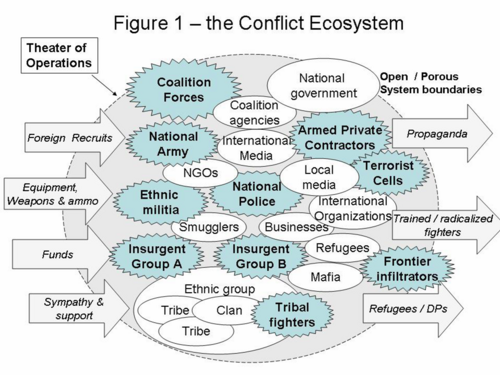
キルカレンは、反乱と反乱鎮圧[17]のモデルにおけるアクターの視覚的な概要をわかりやすく示しており、これは一般的に、地理的、民族的、経済的、社会的、文化的、宗教的特徴によって定義された箱として家庭を表すモデルと一致している。箱の中には、政府、反乱鎮圧部隊、反乱指導者、反乱軍、そして3つのグループで構成される一般住民がいる。
- 反乱軍に加わった者
- 反乱鎮圧に尽力した人々
- ただ自分の人生を続けたいと願う人々。
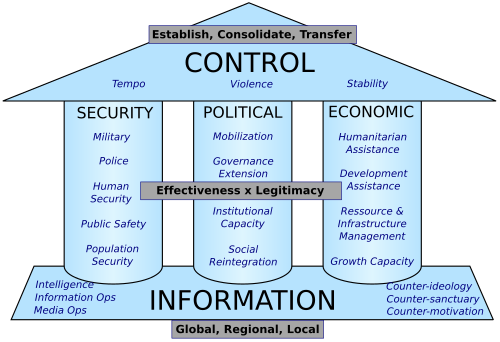
3本の柱のモデルは、反乱を終わらせるために埋めるべきギャップの一部として、後に繰り返される。「明らかに、自分がコントロールしていないものを指揮することはできない。したがって、この環境では、(機関間または政府と非政府主体間の)指揮の統一はほとんど意味を持たない。」指揮の統一は、軍事ドクトリンの公理の1つである[18]群集の使用によって変化する。[19]
エドワーズの群集モデルでは、キルカレンのモデルと同様に、指揮の統一は「最善の場合でも努力の統一、少なくとも協力または衝突の回避」となる。[17]
スウォーミングと同様に、キルカレン氏は「指揮統制階層の共有よりも、問題の診断の共有(つまり、スウォームの分散知識)、コラボレーション、情報共有、衝突回避のプラットフォームに大きく依存しています。各プレイヤーは、他のプレイヤーの長所、短所、能力、目的を理解する必要があり、機関間のチームは、汎用性(さまざまなタスクを実行する能力)と敏捷性(タスク間を迅速かつスムーズに移行できる能力)を考慮して構成する必要があります。」
マコーミックの「マジックダイヤモンド」
マコーミックの「マジック ダイヤモンド」モデル[20]は反乱鎮圧のツールとして設計されていますが、反乱軍と反乱軍の両方が成功するために必要な行動について対称的な見方を展開しています。このように、反乱鎮圧モデルは反乱軍と反乱軍の両方がどのように成功または失敗するかを示すことができます。モデルの戦略と原則は両方の部隊に適用されるため、部隊がモデルに従う度合いは、反乱軍または反乱軍の成功または失敗に直接相関するはずです。
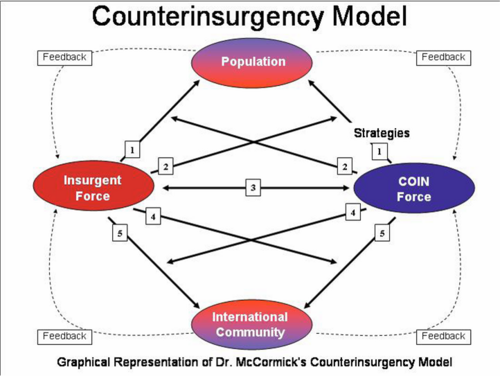
このモデルは、4 つの主要な要素またはプレーヤーを表します。
- 反乱軍
- 反乱鎮圧部隊(政府)
- 人口
- 国際社会
これらすべてが相互作用し、さまざまな要素が一連のアクションで最適なオプションを評価する必要があります。
- 国民の支持を得る
- 敵対勢力の人口統制を妨害する
- 相手に対する直接行動
- 敵対国と国際社会との関係を混乱させる
- 国際社会との関係を構築する
バーネットの「核心への接続」
トーマス・バーネットのパラダイム[21]では、 世界は組織や個人の間で高度なコミュニケーションを享受している「接続された中核」国家と、内部的にも外部的にも分断された国家に分かれている。彼は、比較的平和な状況では、しばしば多国籍である「システム管理者」部隊が、一部の人が「国家建設」と呼ぶものを行うが、最も重要なのは、国家を中核に結び付け、原住民がコミュニケーションできるようにすることであると述べている。このコミュニケーションは、群れの調整に例えることができる。国家が占領されているか、内戦状態にある場合、別のパラダイムが作用するが、これは通常、FIDの範囲外である。それは、反政府軍の正規軍を倒す第一世界の軍隊であるリヴァイアサンである。リヴァイアサンは、地元の反乱軍と戦うためにではなく、主要軍と戦うために構成されている。リヴァイアサンは、戦術レベルで大規模な群れを使用する可能性があるが、その派遣は、一方的に、またはNATOやASEANなどの中核の確立されたグループによって行われる戦略的決定である。
FID は、「システム管理者」の機能から生まれる。それは、単一の支配国 (チャドにおけるフランスなど) の場合もあれば、シエラレオネにおける西アフリカ諸国経済共同体(ECOWAS)の軍事部門であるECOMOGなどの多国籍グループの場合もある。シエラレオネの状況では、主なリヴァイアサンはイギリスであり、特別偵察、直接行動、人質救出を含むバラス作戦を実行した。
アイゼンスタットとギャップの解消
スチュアート・E・アイゼンスタットは、 FIDの広い見方には「ギャップ」を埋めることが含まれると述べている。 [22]その一部は軍事顧問や戦闘支援によっても実行できるが、より広い意味では、ホスト国(HN)が対応可能であると見られるよう支援することである。国家が存続するためには、3つの「ギャップ」を埋めることができなければならないが、そのうち最初のギャップが最も重要である。
- 安全保障: 「内外の脅威からの保護、領土に対する主権の維持。政府が安全を確保できない場合、ハイチ、ネパール、ソマリアのように、反乱武装グループや非国家犯罪者が暴力を使ってこの安全保障上のギャップを利用する可能性があります。」
- 能力: 最も基本的なものは、水、電力、食料、公衆衛生といった生存に必要なものであり、それに次いで教育、通信、機能する経済システムが続く。[6]「これらができないと能力ギャップが生じ、国民の信頼を失い、ひいては政治的混乱を招く可能性がある。ほとんどの環境では、能力ギャップは安全保障ギャップと共存し、あるいは安全保障ギャップから拡大することもある。例えばアフガニスタンやコンゴ民主共和国では、風土病のような不安定さのため、国民の一部が政府から切り離されている。また、紛争後のイラクでは、国が比較的豊かで戦略的に重要な国であるにもかかわらず、重大な能力ギャップが存在する。」
- 正当性: 正当性のギャップを埋めるには、「民主主義」や「選挙」を唱えるだけでは不十分で、統治される人々の同意によって存在していると認識され、腐敗が最小限で、人権を執行する機能的な法執行機関と司法制度を備えた政府が必要です。
アイゼンスタットのギャップとキルカレンの3つの柱の類似性に注目してください。[17]
コーズマンと警備員
短期間の「リヴァイアサン」の排除以外では、安全保障の構築は、より発展した国や同盟国(ASEAN、NATOなど)からの兵站およびその他の技術的支援を受けて、地域的に行う必要があるようです。安全保障ギャップを埋めるための非戦闘軍事支援は、時には諜報などの専門分野での訓練から始まります。より直接的ではあるが、やはり非戦闘的な支援には、諜報、計画、兵站、通信が含まれます。
アンソニー・コーデスマンは、安全保障上の要件は地域や州によって異なると指摘している。中東に関する著作の中で、コーデスマンは特定の地域における安全保障上のニーズの違いと、それらの地域における米国の安全保障への関心を指摘した。[7]
- 北アフリカでは、米国は地域の安定とテロ対策の達成に向けた安全保障協力に重点を置くべきだ。
- レバントにおいては、米国はイスラエルとの安全保障協力と、エジプト、ヨルダン、レバノンなどの友好的なアラブ諸国との協力を大きく区分する必要があるが、これらすべての国々との安全保障協力を改善することは可能である。
- 湾岸地域では、米国は、石油と増大する天然ガスの輸出が世界経済の重要な要素を支えている地域の戦略的重要性に対処しなければならない。
コーズマンが言うように、対テロリズムとはテロに対してテロリズムを使うことではなく、敵対するテロ組織を混乱させるための非暴力的および暴力的な活動全般を指すことを理解しておくべきである。フランスの将軍ジョセフ・ガリエニは、1898年に植民地行政官を務めていたとき、次のように述べた。
軍事作戦によって国民が壊滅し、全員が恐怖に震え上がったとしても、その国は征服され平定されたわけではない。民衆の中に反乱の感情が芽生え、暴力による残忍な行為によって蓄積された恨みが再び反乱を生むのだ[23]
キルカレン氏とアイゼンスタット氏はどちらも、コーデスマン氏よりも抽象的な目標を定義しています。キルカレン氏のセキュリティの柱は、アイゼンスタット氏のセキュリティのギャップとほぼ同等です。
- 軍事安全保障(ゲリラ、盗賊、テロリスト、その他の武装集団による攻撃や脅迫から住民を守る)
- 警察の治安(地域警察、警察情報部または「特別部隊」の活動、準軍事警察の野戦部隊)。
- 人間の安全保障、人権、民間制度と個人の保護、公共の安全(消防、救急、衛生、民間防衛)および住民の安全の枠組みの構築。
この柱は軍司令官の関心を最も引き付けるが、もちろん軍事手段は安全保障分野だけでなくモデル全体に適用され、一方で民間の活動も安全保障の柱において極めて重要である。…これら3つの柱は、効果的な情報キャンペーンにしっかりと基づきながら、並行して発展し、バランスを保たなければならない。[17]
アンソニー・コーデスマンは、イラクの特定の状況について語りながら、混乱状態にある他の国々にも一般化できる点をいくつか指摘している。[24]コーデスマンは、サミュエル・P・ハンチントンの文明の衝突という概念 におけるグループ分けに一定の価値を認めているが、[25]むしろ、文明が衝突しなければならないと仮定すると、これらの文明は単に多国籍世界のアクターとして認識されるだけである。イラクの場合、問題となっている国が属する文明は、西洋文明が匹敵することを望むことのできない文化的および言語的背景を持っているという理由だけでも、負担はイスラム文明にかかっており、西洋だけが負担を負うわけではないとコーデスマンは指摘している。
国家の問題と国境を越えた波及効果
先進国や安定国が反乱軍の対処を支援するのには、独自の理由がある。反乱軍は、直接的(テロ、伝染病など)または間接的(麻薬取引、資源の経済的不安定など)に、これらの国々に影響を与える可能性があるからだ。イデオロギー的または宗教的テロが最も頻繁に言及されるが、それは決して、FIDが国家レベルから取り組む唯一の多国間問題ではない。これらの問題のいずれかが国家に存在する場合、それは国境を越えた「波及効果」を引き起こす可能性が高い。[26]
問題には以下が含まれます:
HN だけでなく、地域紛争も格差を広げる恐れがある。「アフガニスタン、チェチェン、ダルフール、イラク、パレスチナ、スリランカの紛争を他人事だとか、自然に解決するかのように装うのは解決策ではない。一部の国、特に ASEAN 諸国は、かなり強大な力を持っているが、海賊行為、テロ、麻薬密売の問題を抱えている。この地域では、各国間で情報共有協定が数多く存在し、米国の FID 支援ニーズには、他の地域の経済的に強い国も含まれる可能性がある。ナイジェリアは、米国への原油輸出国トップ 10 に数えられる。… 石油資源の豊富なニジェール デルタの反乱軍指導者が「ナイジェリア国家に対する全面戦争」を開始すると誓ったとき、不安定さが世界の原油価格を 1 バレル 50 ドル以上に押し上げた。[22]
血のダイヤモンド
国際犯罪ネットワークは、ダイヤモンドなどの高価値で少量の商品の聖域として弱い国を利用する可能性があります[27] FID部隊は、テロ資金に使われる可能性のある違法な「血のダイヤモンド」の特定に参加する場合があります。麻薬よりもコンパクトで偽装が容易な宝石の密輸は、国家または地域レベルの監視によって検出される可能性のある航空輸送に適しています。
違法薬物取引
麻薬はまた、高価値で少量である。ある国の正当な政府がその麻薬取引インフラに比べて弱い場合、FIDの一部はそのインフラを打倒するか、少なくとも政府機関を腐敗させたり破壊したりする能力を低下させる可能性がある。[28] FID部隊の役割には、情報共有、兵站と通信、作戦計画の支援、HN部隊の訓練と装備が含まれる。適切に訓練され装備された警察と軍隊は、安全保障のギャップを埋めるのに役立つ。世界保健機関や地域の保健グループと協力して、能力のギャップを埋める。麻薬密売人を阻止し、研究所を破壊し、麻薬を押収する地域のHN作戦は、地方当局への賄賂を減らすことで正当性のギャップを埋めるのに役立つ。
米国のポッセ・コミタトゥス法など、民間の法執行を行う軍事組織に対する制限に従い、国土安全保障省およびFID職員は、違法薬物の米国への輸送および/または譲渡を阻止するための麻薬対策(CD)活動においてパートナー諸国(PN)と協力することができる。麻薬対策(CD)は、国防総省の機能と責任が法定権限に基づいている、優先度の高い国家安全保障および国際協力ミッションである。米国軍は、パートナー諸国(PN)のCD活動を支援します。違法薬物取引、あらゆる種類の密輸、およびテロリストの地域的および世界的な動きは、財政的、政治的、および作戦上のつながりによって密接に結びついています。[29]
米軍の資源は、FID プログラムの麻薬対策 (CD) コンポーネントの一部として使用できます。これらはほとんどの場合、供給に重点が置かれていますが、麻薬の輸送を妨害するためにも使用できます。米国防総省は、米国への違法薬物の航空輸送と海上輸送の検出と監視 (DM) に関する米国政府の主導的な政府機関であるため、HN への付随的な利益の可能性にかかわらず、DM ミッションは定期的に割り当てられた資金で実行されます。このような活動には、情報または通信目的での非対立的な傍受、固定および移動監視資産や特定の情報共有など、さまざまな情報源からの戦術情報の収集と処理が含まれます。[30] CD サポートの役割において (国の政策と立法ガイダンスに従って)、国防総省は HN CD 要員に特定の直接サポートを提供し、HN で活動している可能性のある米国の民間法執行機関と米国国務省の国際麻薬取締局に特定の強化サポートを提供できます。
国防長官からの明確な指示がない限り、CD 活動に従事する米軍は、直接的な法執行活動に従事することはできません。逮捕、捜索、押収、その他の同様の活動に直接参加することはできません。国防総省職員は、実際の CD 現場活動で HN 部隊に同行したり、敵対行為が発生する可能性のある活動に参加したりすることは許可されていません。FID の CD 側面に参加している他の国は、より寛容な交戦規則の下で活動することができます。
海賊行為
ソマリアのような弱小国家や破綻国家の国際水域では、海賊行為が現実に発生しています。FID要員は海賊の居場所に関する情報を収集し、海賊船を迎撃できる軍艦にその情報を送信することができます。 [31]海賊が活動している場合、輸送船が武装しているか護衛船団を組んで航行していない限り、水路からFID物資を供給することは現実的ではありません。
海賊行為は港での治安違反や、テロリストが人員や物資を輸送する手段にもなりうる。[32]経済協力開発機構(OECD)の 船舶の所有権と管理に関する調査では、匿名の所有権は例外ではなく、むしろ一般的であると報告されている。[33] 15隻の貨物船がアルカイダと関係があるとの報告もある。[34]
病気
健康状態の悪化は、特に国内紛争により国境を越えて避難する難民が発生するなど、非常に現実的な問題です。特にアフリカではHIVが最も顕著ですが、唯一の大きな懸念事項ではありません。[35]
軍の医療専門家は、特殊作戦部隊とは異なり、多大な影響力を持つことができる。医療・教育施設の訓練と装備は、FID の主要な機能である。特殊部隊の医療要員は診療所サービスを提供し、現地の労働者を訓練することができるが、FID を使用して公衆衛生を向上させる方法は多岐にわたる。一例として、米国海軍の第 3 医療研究ユニット[36]は、第二次世界大戦以来エジプトで活動している。中東最古かつ最大の熱病専門病院であるアッバシア熱病病院の隣に位置しており、アフリカと南西アジア全域でエジプト人職員や臨床科学者とともに研究を行っている。エジプト保健人口省、米国国立衛生研究所、世界保健機関、米国国際開発庁、米国疾病対策予防センターと緊密に連携している。NAMRU-3 は、WHO の HIV および新興感染症に関する協力センターである。
テロ
組織化された国際テロリストは、弱い国家で活躍する可能性があります。テロ手法を使用する世界志向のグループは、地元の反乱軍と共存したり、隣国で国境を越える反乱軍に避難所を提供している国で共存したりする可能性があります。先進国のテロ対策プログラムは、人権と法の支配に十分配慮しながら、弱い国家を強化することで、FID から恩恵を受けることができます。FID は、これらの要因を軽減することで、世界的なテロとの戦いを補完することができます。反テロ (AT) の防御対策と攻撃的な対テロ活動は、HN 向けに開発された FID プログラムの一部となる可能性があります。
米国では、各国に世界的なテロ集団に対抗する動機を与えるのは、主に国務省の責任である。しかし、効果的なFIDプログラムは、HNとFID資源を提供する国の両方に対する国民の認識を改善し、テロと戦うためのより積極的なHN政策を促進することができる。軍同士の接触は、HN関係者がテロリストの能力に対抗する潜在的な作戦を主張するのに役立つ可能性がある。[30]
多くの場合、国家のテロ対策能力を高める措置は、全体的な IDAD プログラムも強化します。これらの措置には、次のものが含まれます。
- HN の能力を開発して、違法な金融取引を追跡し、犯罪組織や反乱組織の資金源を断ち切り、そのメンバーを訴追する。これには、規制対象の金融機関の開発における USHN の協力の強化が含まれる可能性があります。金融情報(FININT)を参照してください。
- HN セキュリティ担当者が、テロ対策活動のすべての段階を実施するために適切な装備とトレーニングを利用できることを保証します。
- 国際テロ組織が使用している個人や物資を特定し逮捕するために、出入国地点(空港、港、国境検問所を含む)の職員を訓練する。[32]
- テロ活動に関する情報を共有できる国際ネットワークにHNの安全保障・諜報機関が参加できるよう支援する。
- 効果的な司法制度を整備し、HN職員に対する汚職や脅迫を最小限に抑える。[37]
民族浄化
情報作戦における FID の専門家は、民族紛争の激化を緩和するのに役立ちます。彼らは、すべての側に有利な状況を提示することから、扇動的なプロパガンダの媒体を閉鎖することまで、さまざまな手法を持っています。
ギャップを埋めるための非軍事的行動
通常、FID の軍事的要素に焦点が当てられるが、米国の FID 共同教義マニュアル[30]では、FID はホスト政府の業務範囲のあらゆる部分と調整されなければならないと明確にされている。教義上、全体的なプログラムは米国国務省の管轄下、または他国の FID プログラムの場合はそれに相当する外務省の管轄下に置かれるべきである。1960 年代には、大統領が任命した大使、別名首席公使 (COM) が大使館を率いた。[38] しかし、長年にわたり複数の米国機関が大使館内に移転したため、COM の権限は実際に低下した。多くの陸軍将校は、COM には軍事的な意味でのスタッフがほとんどいないかまったくいないことを認識していない。COM は、大使館内の他の機関を通じて移動する資金をほとんど監視しておらず、計画能力もほとんどないかまったくないため、時には国内の米軍との文化的衝突につながることがある。さらに心配なのは、現在の規則では、COM は地域戦闘司令部計画スタッフや出入りする軍事チームに圧倒され、自国での軍事作戦についてほとんど発言権がないことである。ジョン F. ケネディ大統領の時代、COM は大使の「国別チーム」の一部である軍事援助諮問グループ(MAAG)に対して明確な権限を持っていた。その権限は何年もの間に消えてしまった... [引用が必要]
対反乱作戦の権威は皆、脅威にさらされている地域での指揮系統の統一の必要性と、軍事よりも政治計画の優先性を強調している。しかし、米国の政府内対立に関係するさまざまな理由から、米国の政策は、反乱地域および反乱前地域での指揮系統の競合と、軍と政治指導者間の競争を永続させている。[38]イラクでは、イラク多国籍軍は大使ではなく米国中央軍に報告している。脅威にさらされている地域でバランスの取れた国別チームと強力なCOMを再確立するために、国務省の能力を再構築するために多くのことを行わなければならない。これほどの規模の戦略的転換は一夜にして起こるものではない。…大使館の人員配置と外交官の専門能力開発の全面的な再考を開始する必要がある。幸いなことに、国務省は課題を認識しており、これまでのところ成功と失敗は混在しているものの、問題に取り組んでいる。
米国では、政府が提供するこれらの機能の多くは、米国国際開発庁(USAID) の責任であり、その主な任務は次のように分類されます。
- グローバル開発同盟
- 経済成長、農業、貿易
- グローバルヘルス
- 民主主義、紛争、そして人道支援。
経済
経済開発には、少なくとも 2 つの要素、つまり債務救済と新規開発があります。債務救済活動のほとんどは、おそらく時折の監査を除いて、非軍人によって行われます。ただし、新規開発には、エンジニアリングやその他の関連する軍事スキルが関係する可能性があります。
すべてのモデルが経済を重要なギャップとみなしているわけではない。しかし、世界銀行は「低所得国は経済協力開発機構(OECD)加盟国よりも約15倍も内部紛争に陥りやすい」と指摘している。[22]貧困国が経済を安定させ多様化できるように支援し、貧困と闘い、国民の期待に応えられるようにすることは、国家崩壊を回避するための先進国と発展途上国の取り組みの重要な側面でなければならない。貿易の役割は、新興経済部門の保護の問題とともに、真の課題である。「農業貿易紛争は、行き詰まったドーハ・ラウンドの重要な問題であった。同時に、米国はアフリカ成長機会法などの取り組みを通じて、貧困国に自国の市場へのアクセスを一方的に与えなければならない。」
「主要開発途上国の政府は、新たな戦略の立案と実行に大きな役割を果たさなければならない。その証拠として、地元で開始されたアフリカ開発のための新パートナーシップ(NEPAD)(受け入れられた)とブッシュ政権のグレーター・ミドル・イースト・イニシアティブ(受け入れられなかった)に対する国際社会の反応が根本的に異なっていたことを見るだけで十分だ。」[22]再編されたG20(すなわち、G8のメンバーとブラジル、インド、インドネシア、サウジアラビア、南アフリカなどの主要新興市場国)は、幅広い解決困難な政治および安全保障問題に関する合意形成の仲介役として重要な役割を果たすことができる。G20はすでに世界経済政策における主要な発言力としての地位を確立しており、その地位を高めれば、政治および安全保障問題にも対処できるだろう。
債務救済
特に貧しい国々は膨大な債務を抱えており、世界銀行や国際通貨基金などの国際機関は、適切に管理された経済枠組みの中で、これらの国々が債務返済から開発活動に資金を再配分できるように債務救済に取り組んできた。 [39]このIMFプログラムの下で、22か国が十分な開発の進展を示し、貸し手が融資を免除することに同意した「完了点」を通過した。
発達
キルカレンの経済的支柱には以下が含まれます。
- 緊急人道支援の短期的な要素
- 農業、工業、商業活動の幅広い分野にわたる開発援助のための長期プログラム
- 効果的な資源とインフラの管理の支援
- 主要インフラシステムの構築
これらすべての要素は、HNの支出吸収能力に合わせて調整する必要があり、吸収能力を高める努力は、他の開発活動の基盤となる。[17]「米軍が緊急事態への対応に成功している根本的な理由の1つは、ほぼ無制限の緊急資金供給である。米国の開発機関にはこれに匹敵する能力はない。議会は大統領に「移行期国」基金を与え、予期せぬ復興や平和維持活動に資金を提供するべきである... [世界は] まとまった即応部隊、つまり、法の支配、統治、経済改革といった国家建設に関する省庁間の専門家の集中プールを必要としている。彼らは協力して働くよう訓練され、官僚主義の惰性に邪魔されることなく、危機の現場に迅速に展開できる。」言語と文化の知識のギャップだけでも、これが米国の単独作戦ではあり得ないことを意味している。[22]
軍事援助
経済支援には、安全保障援助の一環としての外国軍事資金の提供が含まれる。[30]しかし、軍事装備の提供は、反政府勢力がプロパガンダに利用して、政府を支援する国や国々を「死の商人」などと呼ぶことができないような方法で行われなければならない。
健康
特殊作戦要員は全員、基本的な応急処置以上の医療訓練を受けており、米陸軍特殊部隊の医療専門家は救急救命士または医師助手レベルに近い。エンジニアリング専門家は、井戸や灌漑システムを建設できることが多い。
歴史的に、保健サービスの追加展開は、FIDプログラムを支援するための価値ある低リスク資産であることが証明されています。[40]これらは通常、議論の余地がなく、費用対効果が高いです。このようなイニシアチブの焦点は治療ではなく、HNが持続可能な長期的な開発プログラムです。これらの活動は、他の米国機関や民間の健康イニシアチブと連携して、HN軍が直面している健康問題を対象としています。
地元の診療所に医療用品を提供することは完全に適切である場合もありますが、地元の職員が一部の医療用品を反乱軍に流用したり、反乱軍が医療用品を没収したりするケースもあります。FID または HN の医療専門家は、定期的に医療用品の在庫を監査し、医療記録と比較し、使用が記録と一致しているかどうかを確認する必要があります。記録と医療用品が異なるのは、単に管理上の理由による場合があり、医療記録の教育の機会となる可能性があります。
大規模予防接種プログラムがFIDの保健サービスの一部である場合、反乱軍が予防接種を受けられないようにするための極端な手段は避けるのが賢明です。[41]反乱軍が終結した場合、特に国民全体の免疫力を高めることは国全体に利益をもたらします。災害時には、他の状況ほど厳密に身元確認を行わないことで長期的な利益が得られることもあります。
長い内戦や地雷の遺産を残した紛争を抱える国では、残念ながら義肢装具サービスが必要になる可能性があり、長期的な友情を残すことになる。[42]
農業と栄養
偶然に得られた教訓は、ベトナムの海兵隊混成行動小隊から得られたものである。そこでは、4-Hクラブの農業競技会から来た若い海兵隊員が、畜産の専門家であることが判明した。FIDの状況によっては、持続可能な農業の専門家や、改良された種畜など、地元住民が自主的に使用できるリソースを導入することで、適切な食事による健康と経済発展の両方にとって非常に大きな利益が得られる可能性がある。 [43]発展途上国では、農業生産性を向上させるアプローチの中には、短期的には利益があっても長期的な問題が生じるものがある。動物の成長刺激剤としての抗生物質の不適切な使用は、地元経済を外部の製薬会社に依存させるだけでなく、治療に対する細菌の耐性を高める可能性もある。自発的に繁殖しない遺伝子組み換え種子も、農業経済部門を無期限の外部援助に依存させる。
公衆衛生、研究、高度な治療
特別オペレーターは、地域保健について十分な訓練を受けているかもしれませんが、プロの疫学者ではありません。多くの感染症が増加しており(予測についてはCIAの国際保健および経済活動を参照)、積極的な予防措置を講じなければ、発展途上国の経済を破壊する可能性があります。FIDの重要な役割は、適切な専門家を必要な場所に連れて行き、彼らに物理的な安全を与えることかもしれません。
公衆衛生の世界的な主要目標は、感染症の根絶です。根絶とは、病気が自然界では絶滅しているが、実験室では存在するかどうかわからないことを意味する専門用語です。天然痘という病気は根絶されましたが、それには 200 年近くかかりました。しかし、他の病気の根絶はより近づいており、FID の一環としての集団予防接種プログラムが主要な手段となる可能性があります。訓練を受けた FID および HN の職員は、散発的な症例を特定して隔離することもできます。
たとえば、ポリオは天然痘に次いで根絶に近づいている2番目の病気です。ポリオはアフガニスタン、ナイジェリア、パキスタンの3カ国で流行していますが、ヨーロッパ、アメリカ、西太平洋(中国を含む)、インド、オーストラリアでは根絶されています。どうやらナイジェリア株がスーダンに侵入し、ケニアの避難民キャンプで発生したようです。
FID操作
HNと協力して、FID組織は、時間の経過とともにニーズが変化することを認めながら、初期の作戦セットを定義する必要があります。単一の作戦計画がすべてのHN環境に適合するわけではありません。さまざまな反乱鎮圧モデルを検討し、提案された計画が、特定されたギャップ、弱点、断絶を埋めるのに機能するかどうかを確認することが賢明です。
FID力の代表的な手順[5]は次の通りである。
- 治安作戦 - 「反乱に直面している政府にとって、最優先事項は安全な環境を確立することです。」 FID 部隊の役割はここで変わります。HN 政府は、人権を尊重しながらこれらの作戦を独自に実行できる場合に最も信頼を得られます。
- 国民の支持を得る – 「国民が重心であるため、国民の支持を得て維持することが全体的な目標であり、勝利への道です。したがって、国民が政府を正当なものと見なすことが長期的な成功には不可欠です。米国の取り組みが正当なものと見られることと、占領者や傀儡政府を支援していると見なされることは、同じくらい重要です。」
- 国際的な支援を得る – 「政府の国内防衛努力が国際社会によって正当化され、受け入れられ、支援されることも重要です。」軍事および非軍事の FID 組織が多国籍であればあるほど、この支援を得るのは容易になります。
- 反乱軍の撃破 - 「正しく実行されれば、最初の 3 つのラインは反乱軍の正当性を失わせ、彼らの永続的な敗北につながるはずです。このラインは筋金入りの反乱軍を攻撃します。恩赦の申し出に屈する者もいるかもしれませんが、大部分は攻撃作戦によって殺害または捕獲される必要があります。」 繰り返しますが、HN の人員がこれを行うのが最も望ましいです。
- ホスト国の国内治安の整備 - 地方警察や国家警察、主要施設保護部隊、外交官の警備要員、沿岸警備隊、犯罪捜査、反乱鎮圧のための準軍事組織、地方および国家レベルの特殊兵器や戦術能力などの国内治安部隊は、法執行問題として国内の脅威を打破するために必要となる。連合軍の戦闘部隊が使用された場合、「国内治安部隊が訓練されるにつれ、実際の国家軍が訓練され、装備され、単独作戦を遂行できるようになるまで、連合軍は国を外部の脅威から守ることのみに移行する。」
最終的な状態は、国民が信頼し、内外の脅威を検知して打ち負かすことができる正当な政府です。
コーズマンは、軍事力を過剰に使用することは、反乱軍とまったく交戦しないよりも長期的な状況にとって悪影響となる可能性があると指摘している。砲弾が大砲の砲身から発射されると、その影響は物理的なもの以上のものになる可能性があり、「リアルタイムの政治的およびメディア的次元」に爆発する可能性がある。「効果に基づく戦争」は、軍事的効果だけでなく政治的効果にも左右される。政治的、イデオロギー的、情報的、およびメディア的優位性がなければ、戦術的勝利は無意味になり得る。
特に人口密度の高い地域では、民間人の死傷者、付随的な財産被害、および「友軍の誤射」による負傷が、多大な政治的影響を及ぼす可能性があります。民間地域での作戦は、ますます政治的かつ繊細なものになっています。作戦計画には、尋問、拘留者、囚人に対する政治的および文化的に適切な解決策を含める必要があります。
都市でも田舎でも、HN部隊がFID部隊と同じ保護を受け、同じリスクを負うのであれば、HN部隊はより緊密な同盟者となるだろう。FID隊員が戦闘作戦を禁じられている場合、これは困難をもたらす可能性があるが、実弾射撃訓練と戦闘の間には非常に微妙な境界線がある。[7] もう一つの重要な士気の問題は、HNがFID隊員が自分たちとリスクを共有しており、両者とも同等の部隊保護と任務におけるリスクを負っていると感じていることである。
企画スタッフ
HN は、プロの軍事スタッフとしての経験の程度が大きく異なります。反乱軍もよく訓練されたスタッフを抱えている場合があります。
参謀の重要な役割の 1 つは、ミッション クリープ (使命の拡大)を回避することです。トップ リーダーは望ましい結果のビジョンを持っているかもしれませんが、参謀の責任の 1 つはそのビジョンの実現可能性を検討することです。参謀は、将来のビジョンを、その将来の目標を達成するための現実的に段階的な計画に変換できる場合があります。
ミッション クリープは、FID ユニットの外部または内部から不適切な計画が出されるなど、さまざまな形で発生する可能性があります。[4] HN または FID 部隊のいずれかが、大きな人的被害を目にし、その救済を望む場合があります。行動を急ぐと、「公平性が損なわれるだけでなく、長期計画が損なわれる可能性があります。」 1 つのタイプは、ユニットが訓練も装備も受けていないミッションを受け取ったときに発生します。たとえば、ソマリアでは、当初の国連軍は人道支援と限定的な平和維持活動のために設立されました。現場の指揮官とスタッフが必要と判断した追加のリソースを取得せずに、彼らは平和執行ミッションを引き受けました。
最善の意図を持っていても、部隊は現在の任務とミッションで許可されている以上のことを引き受けることがある。「例えば、指揮官が権限外の民間活動プロジェクトの実行を指示した場合などである。構造物の再建、現地住民の訓練、その他の活動は現地住民にとって良いことかもしれないが、任務とミッションの範囲外である可能性がある。[4]同時に、FID および HN の指揮官は、重要なリソースが不足している場合や、急速に展開する状況に対して交戦規則が不十分な場合を認識する必要がある。ルワンダの現場の国連指揮官、ロメオ・ダレール将軍が国連本部に行動の自由を求めたが、国連決議の解釈により拒否された。後知恵は常に容易だが、ボスニアの初期に行われたように、扇動的なプロパガンダに使用された放送施設の無効化または破壊を含む特定の行動をダレールが実行できていれば、起こった大惨事は回避できたかもしれない。[44]
インフラストラクチャー
HN および FID 組織の能力の範囲外の事柄について詳細な計画を立てても無駄です。たとえば、道路からアクセスできない場所や道路が安全でない場所に部隊を配置する計画は、部隊が空路または水路で目的地に到達できない限り、現実的ではありません。
空路または水路による移動が必要な場合、航空機または船舶、およびそれらを維持するための人員と設備が必要です。経路上または目的地に航行補助装置が必要になる場合があり、または最初に必要なことの 1 つは、それらの設置を計画することです。特に航空輸送の場合、経路沿いまたは目的地で航空機に燃料を補給する手段が必要です。目的地に燃料補給設備がない場合、航空機は帰路に十分な燃料を積めるように貨物積載量を削減する必要があります。これは、ナイジェリアのラゴスからスーダンのダルフールにあるエルファシャー空港への輸送便にとって重大な制限となります。
正当性と政府
ギャップモデルでは、正当性のギャップを埋めることが建設的なHN活動の枠組みを提供します。[22]キルカレンはこのギャップを政治的柱と呼んでいます。[17]
「法の支配が財産と公衆の権利を保護することを保証する際に、いかなる正当性があっても、中道的、穏健な政治的多元主義の形態へと移行する。正当な政府は、3つのギャップをすべて埋めなければならない。終身の指導者、世襲大統領、一党制、政党に拘束されるか政党のない君主制はすべて、過激主義を生み出す一因となる」。ギャップが広がると過激主義が蔓延する。
キルカレン氏は、この分野での成功を、「政府を支持する利害関係者」によって目に見える形で動員され、法の外で反対派を[疎外し]、法の支配を推進する支援の量で測っている。重要な要素は、政府機関と非政府民間機関のすべての機関における組織能力の構築と、戦闘員の武装解除、動員解除、社会復帰(DDR)などの社会復帰の取り組みである。」
武装解除、動員解除、社会復帰:最終段階
武装解除は、北アイルランドの独立国際武装解除委員会のように、非常に大きな象徴性を持つ可能性がある。反乱軍が政府に武器を引き渡さず、第三者に武器がもはや脅威ではないと確認させるなど、体面を保つための措置を受け入れる状況も十分にあり得る。再統合は、暴力に関与したとみなされた人々が依然として政治プロセスに復帰できることを意味するかもしれない。
軍隊にとっての安全保障の柱と同様に、政治の柱は外交と民間統治の支援活動の主な舞台であるが、やはり民間機関も安全保障と経済の柱において重要な役割を果たしている。[17]
発展途上国の政府の意思決定、予算の配分、法の支配の運営における透明性も促進されなければならない。[22]透明性の認識と汚職の削減は、フィリピンで実行可能な政府を樹立したラモン・マグサイサイの成功の鍵であった。エルサルバドルとニカラグアが自由貿易協定を交渉していることも成功の証である。
介入の限界
このセクションには、タウンゼント・フープスの最も有名な本のタイトルが付けられています。2004 年、イスラム教徒の学生グループを米国に招いたセミナーで、フープスは次のように述べました。「ここで重要な点は、近代化の現実 (技術的、社会的、政治的) は避けられないということです。現実は消え去ることはできません。つまり、伝統的な社会は、調整するか、順応するか、着実に衰退し、最終的には消滅するリスクを冒すかという重大な選択に直面しているのです。この困難なパラダイムを考えると、21 人のイスラム教徒のゲストが示した米国に対する真の熱意は、心強い兆候でした。彼らは、人間の自由と個人の機会に対する米国の国家的な取り組みの深さ、および政府と民間の両方の機関の安定性に感銘を受けたようでした。何人かは、米国に触れたことで、自国で社会変革のために働く決意が強まったと述べました。2 人のパキスタン人女性 (どちらも法学部生) は、自国で女性の権利拡大のために闘うことに人生を捧げるつもりだと述べました。1 人の若者は、自国の首相になることが自分の野望だと述べました。
彼らは進歩的な穏健派で、テロリズムに断固反対していた。同時に、彼らは現在の米国の外交政策、特に中東政策を公然と批判し、それがイスラム過激派の思うつぼになっていると考えていた。ブッシュ・ドクトリンは彼らには過度に軍事化され、歴史的現実やこの地域の真の不満に鈍感であるように思われる。今日の世界で最も深刻な危機は、西洋とイスラム全体との破壊的な対立をいかに防ぐかという問題にかかっている。答えがあるとすれば、それはイスラム教徒の大多数(合計約20億人)を説得して近代性と穏健主義を選択し、少数派のニヒリストが提示する袋小路を拒否することにある。この文脈では、南アジアの将来の指導者にアメリカ民主主義の基本原則と約束を説明することを目的とした20万ドルの国務省のプログラムは、4000億ドルの防衛予算よりも費用対効果が高いように見える。[45]
リヴァイアサンがどれだけ強く望んでも、「地元のエリートとの交渉を単純に避けたり、望まなかったりすることはできない。なぜなら、最終的には、外部勢力の行動ではなく、彼らの行動が制度を強化したり弱体化させたりするからだ。金銭、特に外部の敵に対する支援のために政府に与えられる金銭で正当性を買うことはできない」。冷戦の真っ只中、米国の対外援助は共産主義との戦いには役立つとみなされた独裁者には提供されたが、広範な開発の促進にはほとんど役立たなかった。
第三に、複雑な危機を解決するために短期的な対策を講じる場合、外部勢力は状況を不注意に悪化させたり、新たな問題を生み出したりしないように注意する必要があります。
アフガニスタンにおける反ソ連活動は、内戦状態を招いた。フランスやその他の国々が1955 年のベトナム国家に関する国民投票に疑問を呈さなかったため、南部政府は広く正当性を認められず、北部政府は独裁政治ではあるものの国民から一定の支持を得た。「血なまぐさい内戦がアフガニスタンを蝕み、タリバンとアルカイダが政権を握る道が開かれた... 外国の紛争を迅速に終わらせようとする際、政策立案者は将来の不安定化の種をまかないようにしなければならない...先進国の政策立案者は、国家建設事業の長期的性質について率直でなければならない。これは政治的に受け入れがたいように思えるかもしれないが、政治的および経済的混乱に陥った国々に限定的な関与を開始する言い訳にはならない。米国 [または他の外部勢力] が関与を維持できない場合は、介入しない方がよいだろう。
ラテンアメリカの麻薬や西アフリカのダイヤモンドなど、問題が経済に関係する場合、他の国家や文明は、HN にその経済の不可欠な部分となっている可能性のあるものを破壊するよう要求するのではなく、需要側で取り組む必要があります。
正当性は文化的に定義される
孤立や甘やかしだけでは、エリート層の姿勢に意味のある影響を与えることはできない。エリート層に責任を受け入れさせ、文化的に適切な市民参加モデルを増やすには、エリート層に対する「厳しい愛」が必要になるかもしれない。弱小国家の世界のエリート層は、持続可能な市民社会の構築に貢献しなければ生き残れないことを認識しなければならない。その長期的な影響はまだ不明だが、「市民社会を目指すアフガニスタン人」[46]は、潜在的に関連のある原則をいくつか示している。その焦点は「コミュニティのエンパワーメントと市民がアフガニスタンの運命を決定する上でより大きな役割を果たすこと」である。ACSは、民主主義の構築、政策策定、独立メディアを通じて、意思決定プロセスへの市民参加を増やすことに尽力している。ACSは、首都カブールではなく、タリバンが支配していたときの拠点カンダハルに本部を置いて いる。
コーズマンは、アイゼンスタットの正当性のギャップとほぼ同じ議論を展開し、「アルジェリア、エジプト、シリアはすでに、この根拠に基づいて戦われた『長期戦争』は、脅威を部分的に制御することはできても、それを打ち負かすことはできないことを示している。米国があまりにも強く、あまりにも急激に、そして時には間違った方向に押し進めたとしたら、改革を阻止または遅らせたり、イスラム過激派に譲歩したりすることでイスラム過激派を倒そうとするイスラム指導者は、自らの信仰と国に自ら傷を負わせる罪を犯している。これは西側諸国のいかなる失敗よりもはるかにひどい失敗だ」と述べている。[24]
社会がテロに見舞われた場合、責任を外部のグループに転嫁するのではなく、自らの責任を認識する必要がある。これは決してグループがテロ行為を犯すことを免除するものではないが、FIDパラダイムは、完了したテロ行為が安全保障上のギャップを広げることを認識している。マルクス主義ゲリラ理論家カルロス・マリゲラは特に安全保障上のギャップを狙っていた。[47] FIDは、テロ行為を防止および緩和するための直接的な対策を開発する上でHNを支援することを目的としているが、同時に、行為が国民の一般的な利益に反することを示す情報作戦をHNが実行する必要があることも認識している。 「このようなメッセージの信頼性を確保するには、HN政府だけでなく、聖職者、教育者、政治家、メディアなどの政策に影響力を持つ人々が、不満を認識しつつも行為を非難する必要がある...最終的には、国内治安部隊や対テロ作戦よりも重要になるだろう。 」 [24]テロ対策は、反乱軍に対してテロリストの手段を使用することである対テロとは異なることに注意する必要がある。「対テロの役割はあるか?」を参照。
バーネットは問題国家は中核から切り離されていると述べているが、破綻国家でさえ電子通信にいくらかアクセスできるため、HN は攻撃に関するメッセージや犯行声明に迅速に対応する必要がある...「国民のニーズと目標を満たすための着実な進歩も同様に重要である。こうした進歩は遅い場合が多く、変化は通常、漸進的である必要がある。しかし、リーダーが推進していると見られるのは、継続的で公的に信頼できる追求でなければならない。過激派は、経済、政治、経済状況、つまり公共サービスの着実な衰退、腐敗、所得の狭い分配に対する「街頭」の不満を利用してきた。[24]
西洋はまた、西洋の制度は、それが定義されていない社会状況に移植することはできないことを理解しなければならない。また、西洋の観察者は、選出された政府が格差を埋めることができなければ、公正な選挙でさえ意味がないことを理解しなければならない。したがって、エリートたちは、自分たちの文化で機能する正当性の形態を思い描く必要がある。たとえば、多くのアジア社会は、西洋の個人主義よりも共通の社会的目標に関心がある。問題が過激なイスラム教である場合、西洋は、宗教的イスラム主義者よりも世俗的イスラム主義者を支援したり、外部から改革を推進したり、イスラム諸国のイスラム的性格を変えようとしたりすることで、国内の改革努力を強化し、国の内政に干渉していると見られることを避けなければならない。
テロリズムを戦術として完全に排除することは決してできないが、アルカイダのような組織を動かすイデオロギーを信用を失墜させ孤立させることはできる。弱小国家では過激主義への支持は依然として極めて少数派である。罪のない民間人を殺害するテロリストは、彼らのより広い文明のイメージを汚し、イラクやアフガニスタンのような国の生活を破壊した。世論調査が次から次へと示しているのは、イスラム世界の人々は、彼らの政治、宗教、知識人の指導者が実際にそれを提供するならば、現状に代わる穏健な代替案を望んでいるということだ。ヒズボラのようなグループが、HN政府にはできないメッセージで社会サービスを提供しているのは偶然ではない。[16]
テロ対策の役割
政府が正当性を認めようとする場合の課題の 1 つは、テロ対策としてよく使われる選択的暗殺をどの程度まで実行できるかである。これは、第二次世界大戦のラインハルト ハイドリヒや山本五十六の例のように、白か黒かの選択ではない。両者とも軍服を着ていて識別可能だったが、山本は軍人であり、ハイドリヒは政府職員だった。リンは「正義に基づく正当性を求める闘いにおいて、政府は裁判なしで反対者を処刑できるだろうか。エルサルバドルやベトナムでの反乱指導者の暗殺はまさにそれに相当する」と疑問を呈している。[48]
In a counterinsurgency situation, the perception of the government (i.e., McCormick's CF[20]) violating the human rights of the population causes Eisenstat's legitimacy gap to widen. The Phoenix program in South Vietnam was criticized for a lack of precision in its targeting, and caused a further loss in legitimacy of the government, regardless of the damage done to the Viet Cong infrastructure. Marighella recommended that urban guerillas deliberately provoke the government into overreaction, as a means of reducing its legitimacy;[47] the doctrine of having FID trainers counsel respect for human rights has pure military, not just humanitarian, justification.[30]
With strong intelligence, there may be a justification for targeted killing of clearly identified leaders and key specialists. When governments go farther into terror and torture, however, experience has shown that its effect rebounds both on their legitimacy and onto their personnel.[9][49]
Population and Resource Control
One important element of a legitimate government is to gain control over the population and resources of the country. The US Special Forces Counterinsurgency Manual states that US Special Forces can advise and assist the host nation using the following control measures:[citation needed]
- Security Forces (see Direct Combat Role).
- Restrictions – "Rights on the legality of detention or imprisonment of personnel (for example, habeas corpus) may be temporarily suspended. This measure must be taken as a last resort, since it may provide the insurgents with an effective propaganda theme."
- Legal considerations – "In countries where government authorities do not have wide latitude in controlling the population ... emergency legislation may include a form of martial law permitting government forces to search without warrant, to detain without bringing formal charges, and to execute other similar actions."
The US SF Counterinsurgency Manual also heavily references psychological operations (PSYOP) as a means to make FID acceptable to the general population of the host nation "by relating the necessity of controls to their safety and well-being." The aim of PSYOP during FID operations is to increase the perceived legitimacy of the foreign presence and of the host government.
Indirect military support operations
Indirect support operations emphasize the principle of HN self-sufficiency. "Indirect support focuses on building strong national infrastructures through economic and military capabilities that contribute to self-sufficiency. FID personnel contribute to indirect support through security cooperation guidance, delivering through security assistance (SA), supplemented by multinational exercises, exchange programs, and selected joint exercises.[30]
Troop equipping and training
FID personnel need to be prepared to deliver training to a wide range of HN personnel, from graduates of first world staff and war colleges, to highly trained special operations forces (SOF) to those totally untrained in the specific area where the FID program is located. Training delivery can include institutional training (including exchanges among national military colleges), on-the-job training, and unit-conducted individual and collective training will be required.
Those who deliver training must exemplify both military skills and cultural sensitivity. While one's own country might consider searching after-action reviews a recognized learning experience, such techniques are counterproductive in countries where even one-on-one direct criticism is insulting, and even more so if criticism is delivered in front of third parties. Especially in intelligence and psychological operations, the FID and HN personnel should recognize they can learn from one another.[30]
Logistics
In the absence of specific enabling legislation or orders, logistic support operations are limited by US law and usually consist of transportation or limited maintenance support.[30] Other nations will have their own policies, but any FID force needs to avoid making the HN dependent on it for logistical services that the HN could do. Some HNs are sufficiently wealthy to be able to hire foreign contractors, but this practice also should be avoided.
Highly skilled contractors may be useful as trainers, but their long-term use does not encourage the HN building its own set of skills. Third-country nationals also may present a security problem.
There can be times, however, where the country or countries providing FID resources can make an enormous difference at a key time, as, for example, with heavy airlift or sealift. For example, while US troops are not on the ground in Darfur, African Union peacekeepers are being flown from Kigali, Rwanda and Abuja, Nigeria by US transport aircraft.[50]
Information operations
There is a strong emphasis on guiding the HN to do psychological operations, not simply to keep the noncombat role of the foreign force, but also the reality that HN personnel will understand language and cultural nuances far better than foreigners. For example, a very effective leaflet during Operation Desert Storm was distasteful and even offensive to many Americans, because they showed men walking while holding hands "The Arabs loved them as they showed the solidarity of the soldiers, hand in hand." To have Arab men hold hands symbolizes friendship, not any sexual message that Americans perceived.[51]
For propaganda used in FID, there are multiple audiences, often with different perspectives. The wrong leaflet or broadcast sent to the wrong group can be counterproductive. In US FID doctrine,[52] targets are identified as:
- Insurgents – "Create dissension, disorganization, low morale, subversion, and defection within insurgent forces, as well as help discredit them." A leaflet intended to strengthen the resolve of HN military forces might be perceived as demonstrating weakness of the latter vis-a-vis the insurgents.
- Civilian populace – "Gain, preserve, and strengthen civilian support for the HN government and its counterinsurgency programs." Too strong a military emphasis, regarding actions of either side, can be frightening.
- Military forces – Strengthen military support, with emphasis on building and maintaining the morale of the HN forces. "Avoid anything that can be turned against HN forces by insurgents."
- Neutral elements – "Gain the support of uncommitted groups inside and outside the HN."
- External hostile powers – "Convince hostile foreign [groups] the insurgency will fail."
Direct military support not involving combat operations
External military forces assigned to FID can provide direct support not involving combat operations. Where security assistance is funded from outside the military, such direct support is funded by the FID-providing nation's military budget, generally do not involve providing equipment, and may not involve direct training of the host country's forces by the nation providing FID assistance. The external nation may train internal trainers, and work with the host nation in civil-military operations.
Civil-military operations, under the FID model, include providing services to the local population. Jointly providing such services indirectly trains the local military in skills including logistics, preventive and reactive medicine, communications, and intelligence operations. Realistically, the FID force will retain some self-defense capability, although geopolitical considerations may make that quite low-profile.
Direct support (not involving combat operations) involve the use of US forces providing direct assistance to the HN civilian populace or military. They differ from SA in that they are joint- or Service-funded, do not usually involve the transfer of arms and equipment, and do not usually but may include training local military forces.
Direct support operations are normally conducted when the HN has not attained self-sufficiency and is faced with social, economic, or military threats beyond its capability to handle. Assistance will normally focus on civil-military operations (primarily, the provision of services to the local populace), psychological operations, communications and intelligence sharing, and logistic support. The decision to conduct US combat operations in FID operations is the President's and serves only as a temporary solution until HN forces are able to stabilize the situation and provide security for the populace. In all cases, US combat operations support the HN IDAD program and remain strategically defensive in nature.
Communications
Some countries have essentially no communications infrastructure, and may need basic fixed-station to fixed-station radio, all the way up to secure mobile communications. In many situations, by adding communications security features to the military sites, a new or upgraded telephone system, including cellular telephony, can meet many non-combat military requirements.
Portable, robust communications are needed for military ground operations. There will also be needs for air to ground and air-to-air communications. When operating with multinational coalitions, or with foreign nation intelligence systems, the appropriate HN personnel will need communications interoperable with those systems.
Intelligence
The goal of intelligence sharing is to make the HN independent. Clearly, not every HN can afford space-based systems and other advanced, expensive technology. Advanced technologies, for security reasons, may not be appropriate to make available, in raw form, to third countries. Decisions on what can be shared and should be shared will involve the HN, the FID nation(s) country teams, the relevant combatant command, and the intelligence community.[30]
When sensitive intelligence is provided, appropriate security needs to be in place, involving counterintelligence, other relevant security, and police organizations of all the relevant nations. Counterintelligence elements can provide this support with HN military counterintelligence elements, security service, and police forces when deployed in support of FID operations.
Early in the relationship, FID personnel, including appropriate specialists, will evaluate the HN intelligence capability, including appropriate secure communications, and recommend an architecture and implementation plan. Training in planning and executing intelligence operations can be provided.
Urban intelligence issues
Marighella speaks of the urban environment as being as or more concealing than the jungle.[47] Walls, roofs, and other structural features interrupt line-of-sight (LOS) and make overhead imagery of less value in urban areas than in others. Such barriers preclude penetration by many sensors.[14] There may be a limited capability provided by advanced thermal sensors, and, if available, penetrating radar, typically from airborne or spaceborne senseors that are not readily available.
What is in the open or under visible camouflage nets elsewhere is completely hidden within structures during urban contingencies (i.e., defeating conventional imagery intelligence IMINT) Further, movement of units is less frequently evident. Well-trained organizations minimize exterior activities; their soldiers remain within buildings to the maximum extent possible to reduce detection. Vehicles leave few signs of their passage on asphalt and concrete, unlike in other areas where their tracks can be seen in dirt or compressed foliage. The same LOS obstacles that interfere with friendly force communications block signal-collection efforts. The city foe will in some in stances employ local telephone systems, cellular networks, or other communications systems for which friendly force military SIGINT capabilities were not designed. Such challenges mean that intelligence analysis during urban contingencies relies more on human intelligence (HUMINT) than is the norm.[14]
Combat service support (CSS) units are among the most dispersed and omnipresent in any area of operations, their soldiers are potentially valuable HUMINT collectors. Guards assigned to specific posts will quickly become very familiar with the area around their posts and the routines associated with that terrain. CSS drivers, men and women manning water purification sites, and others with frequent noncombatant contact should all receive training as intelligence collectors. They need to know their intelligence reporting responsibilities and have, consistent with security, a good idea of their command's intelligence requirements. These may be new ideas for even the combat service support troops of major powers, but it may be essential to teach the HN's personnel as well. Such training will consume resources, but is necessary, as is training CSS headquarters personnel when to pass information to the intelligence staff.
Reports will have to be monitored, compiled, consolidated, and disseminated to not only intelligence nodes but also operational units with an immediate need to see specific items. The inordinate reliance on HUMINT magnifies the role of the CSS soldier as intelligence collector during urban operations. Neither the benefits nor the costs have heretofore been fully recognized[14]
Human rights and HUMINT
When the intelligence support involves HUMINT, human rights education must be given, and FID personnel are required to report abuses.
Intelligence sharing
Where drugs or other materials are shipped by air, radar systems, both ground- and air-based, while powerful, are relatively straightforward to provide.[53] The actual radar need not be operated by the HN or even in their country; the radar can send its information to a remote intelligence center.[28]
More difficult are situations where the countries asking for support, such as ASEAN and allies both can offer sensitive HUMINT, but want to exchange for SIGINT from the US or allies such as Australia. These exchanges can be immensely valuable, but both sides may feel the need to sanitize detailed sources.[54]
Aviation support
One of the more challenging FID roles is that of aviation, given that the US Air Force has long emphasized strategic attack and the de-emphasis of airpower's supporting functions have contributed to a doctrinal void regarding airpower's role in counterinsurgency.[6] Four airpower functions define the broad scope of airpower's role in fighting insurgents and terrorists, three of which can be noncombat:
- air mobility – Often extremely valuable, but on the edge of combat operations when HN personnel are flown to a combat zone.
- intelligence, surveillance, and reconnaissance (ISR)
- information operations (IO) – Not just broadcasts and leaflet drops, but air transport of government officials to remote areas can be used to improve HN information dissemination efforts and to provide a strong symbol of government legitimacy and resolve. For instance, the Philippine secretary of defense during the Huk rebellion, Ramon Magsaysay, frequently traveled by air to visit remote barrios and frontline units to boost morale and inform the public of new government reform policies. Air mobility can transport specialists and technicians to remote areas in order to provide on-site training and assistance in areas such as public services management, medical care, sanitation and hygiene, agriculture, and school administration. Furthermore, air mobility can be used to transport construction equipment, supplies, and personnel to remote areas in support of public works programs such as housing construction, power generation, and transportation infrastructure improvements. In addition, air mobility can address political alienation and disenfranchisement by extending the electoral process to outlying areas.
- counterland – close air support would fall into the combat operations category.
Direct combat role
Deciding to extend FID to direct combat against an internal foe is made at the highest level of government of the country providing the FID personnel, and in keeping with that country's laws. The first levels of such a role could still be limited to logistics, intelligence, communications, and other combat support and combat service support roles that free the host nation forces to do the actual fighting.
Combat operations may be authorized that are limited to force protection, advising or leading combat operations as on-the-job training, and, very selectively, independent operations. Within the scope of independent operations may be low-intensity operations such as special reconnaissance. Direct action might be authorized to stop immediate terrorist threats, possibly to the country providing FID, or to neutralize WMD.
Depending on the potential infiltration of the HN forces, the FID force might keep control of heavy weapons, combat aircraft, and other sensitive, potent hardware.
Historically, one of the first missions for special operations forces was unconventional warfare (UW), or training and leading guerrillas in occupied countries. In WWII, this was a mission of the UK-US-French Jedburgh teams in occupied Europe. Shortly after the end of the war, US and UK advisors worked with Greek and Turkish forces. After the war, and the organization of US Army Special Forces, the first deployments went to Europe to operate guerrillas when the expected Warsaw Pact invasion overran Europe.
See History below for French, British, and US developments after World War II.
Fire support
If FID forces take part in combat, one of their first activities tends to be teaching HN personnel how to call for close air support and artillery fires. The actual fire may come from HN or FID resources, or a combination. One of the reasons that fire direction is a priority is that experienced FID personnel will avoid firing at unknown targets, or firing at insurgents using civilian shields. Free-fire zones, such as used in Vietnam, can produce new insurgents faster than killing old ones.
Air interdiction and precision strikes
There is little place for air interdiction in fighting a local insurgency, in the most common sense of interrupting lines of supply. Only when the insurgents are being supplied from across a border, or at least from a remote area of sanctuary in the country, does this make sense. In the case, for example, of the Ho Chi Minh trail, any useful level of interdiction required either high-risk direct observation by special reconnaissance troops,[55] or, in some cases, airborne sensors, such as the Vietnam-Era "Black Crow", which detected the "static" produced by the ignition system of trucks on the Ho Chi Minh trail, from distances up to 10 miles.[56]
The coordination of human reconnaissance or unmanned remote sensors, with strike aircraft, missiles, or artillery, and avoiding collateral damage, requires advanced military skills. Such skills may not be within the repertoire of a weak nation, and the difficult political decision becomes whether the FID nation should undertake such strikes. Stronger states, especially when the insurgency is largely external, may be able to carry out such operations, but they, too, face a political problem: the potential "blowback" if the attack the territory of another nation.
With the advent of precision guided munitions that can be directed onto a specific target, it may be reasonable to use air attack against isolated command posts or other high-value facilities away from civilian areas. The combination of highly accurate, small weapons such as the Small Diameter Bomb, or even bombs without explosive filler, may be a wise way to attack specific, well-identified and difficult to reach targets. The skills necessary for identifying the target and guiding weapons to it, however, may not be something HN personnel have the experience to do.
Special reconnaissance
While special reconnaissance always runs the danger of coming into combat situations, there may be situations, in an FID situation, where intelligence on some key adversary installation is essential, but the necessary ground observations can be made only by specialists. Perhaps the HN can carry out a conventional amphibious landing, but do not have people trained or equipped for beach mapping, evaluating defenses, etc., by night. In such cases, when less risky alternatives such as air or space reconnaissance have been exhausted, the FID nation might lead a team in such a mission. When the HN has qualified people, perhaps who have trained in the FID home country, but not the equipment, they can join in such an operation.
It may be highly desirable, while a sensitive operation is in progress, to have the HN conduct distracting operations. The knowledge of the sensitive operation must be tightly held, and most of the troops carrying out the distraction—which ideally has a result more than mere distraction—will not know why they are taking a particular action.
Another example is where HN personnel guide a successful rescue effort in denied area, as Nguyen Van Kiet did with a United States Navy SEAL companion, Thomas R. Norris behind enemy lines. Norris received the US Medal of Honor for his part of the mission.
Direct action and unconventional warfare
When the FID force takes direct action, or leads UW forces, it needs a clear reason to do so.[5] Jones cites some examples as:
- Operations against Rogue, Hostile Regimes or State Sponsors of Terrorism—a proven operational concept having been used twice since 11 September in Afghanistan and Iraq. These operations will either be the decisive or shaping operation depending on the political sensitivity of the target country.
- Operations against what will be referred to in this study as al Qa'ida states (AQ States) in which al Qa'ida is able to overthrow one or more of the regimes within the boundary of the 7th century caliphate. Unconventional warfare would be used to overthrow these regimes.
- Operations in failed states when there is no effective government, but an element within the population, such as a tribe or ethnic group, is the State for all intents and purposes. In this case unconventional warfare will be used to overthrow this State.[5]
Conventional ground operations
This category does not include defense against external invasion by nation-state forces. It can, however, include operations against rebel conventional forces, guerillas in large strength, and insurgent bases.
Naval surveillance and patrol
A FID force can patrol international and coastal waters, perhaps using sensors not available to the HN. The surveillance vessels, aircraft, UAVs, etc. can guide the HN action without violating their own rules of engagement and participating in unauthorized direct combat.
History
Rather than the formal definition, it is more understandable with some historical context. The British generally seemed to be most consistent between theory and practice, although the minimum-effort theory, which worked in Malaya, did not seem to apply to Northern Ireland. French doctrine at the turn of the 20th century, involving working with locals, did not seem to be the heart of doctrine in Algeria and Indochina. France does seem to manage cooperation with former colonies, now clients.
US doctrine for Special Forces stayed consistent at the tactical level, but frequently failed at higher levels by dealing with unpopular governments; the Philippines were the greatest success.
United Kingdom
The UK tends to see the FID mission more as a capability of regular forces than special operations forces, at the lowest level of intensity possible.[23] In 1934, Sir Charles W. Gwynn described the goal as "the restoration of order through the use of minimum force." Sir Robert Thompson, who successfully defeated the Malayan insurgency, "stressed tough administration, population control, and adherence to law. Decried use of high intensity military force or dirty tricks."
Sir Frank Kitson, former commander of UK land forces, said practical counterinsurgency had nothing "special" about it, but was mainstream British Army.[23] Of course, there was significant use of the Special Air Service and other specialist units such as 14 Intelligence Company in Northern Ireland. According to McClintock, the basis of UK doctrine was:
- Population control through strong civil and military administrative structures.
- Strong foundation in law enforcement as tool and source of legitimacy.
- Emphasis upon the primacy of intelligence.
- Only limited role for elite commando-style strike force.
During the Malayan emergency, for example, the British Royal Air Force made extensive use of helicopters and fixed-wing transports to insert light infantry and Special Air Service units deep into the jungle, keeping them supplied by air for extended periods. These "deep-penetration" patrols were a key factor in defeating the Malayan insurgent forces in the more remote areas of the country[6]
United States
Post WWII to Vietnam
US Army Special Forces' original mission was to train and lead guerrillas in a nation occupied by another: "[US Special Forces provided] advisory personnel and mobile training teams to advise, train and provide operational assistance for paramilitary forces."[57] The most likely case, at the time Special Forces were created, would be to lead resistance groups in European countries overrun by the expected Soviet Bloc attack. Over time, the term guerrilla warfare, especially led by Americans, fell into disfavor, and unconventional warfare took its place.
A November 1947 United States Department of the Army memorandum entitled A Study of Special and Subversive Operations was an early assessment of the lessons learned from World War II in the context of Cold War imperatives. In the only point in the memorandum concerning counter-guerrilla operations, the authors point to the German example:
The means of counteracting resistance movements and activities demand special consideration. Our forces have had little experience in combating an active underground enemy. The problems which faced the Germans and the measures employed by them in counteracting partisan warfare should be studied. It is quite possible that a future war will find us occupying a hostile country in which exists an active underground. Or we might find ourselves in a friendly country, possibly the United States, facing an enemy while at the same time a hostile partisan force operates in our rear.[58]
In the early 1950s, the Department of the Army's Military History Division published a number of studies, the "German Report Series", which were devised to glean lessons from the German World War II experience. Some studies in the series were written by former German generals and general staff officers.[59] The publications among other issues also analyzed the German response to the threat of guerrilla warfare. Indeed, the Wehrmacht had attempted a systematic approach to the threat of partisan warfare during Operation Barbarossa (the Russian campaign) in 1941, and later in the Balkans.[60][61]
Developed by the Wehrmacht, tactics against Soviet partisans would play a part in the development of a postwar doctrine for fighting communist guerrillas was perhaps a natural product of the Cold War hysteria of the 1950s. The army's 1956 book-length study Soviet Partisans was the last and most comprehensive of the "German Report Series" on anti-partisan warfare.[62] Michael McClintock writes that, "The disturbing similarity between the Nazi's view of the world and the American stance in the Cold War apparently went by the board."[63]
Related activities, just after WWII, included a Military Assistance Advisory Group (MAAG), first in Greece.[38] Another MAAG went to French Indochina in 1950. The U.S. really had no formal organization for providing foreign internal defense (FID) assistance, before the creation of the United States special operations forces. MAAG activities were intended to be largely advisory (i.e., noncombat), while the Special Forces was designed from the beginning for training and leading guerrillas of the host nation against an occupier.
Vietnam
As U.S. involvement increased in Southeast Asia, Special Forces personnel were assigned to FID missions with South Vietnamese troops. The MAAG converted to Military Assistance Command Vietnam (MACV), the theater-level military command, in 1962, as a MAAG was not organized to command combat units. The first initiatives involved a CIA-sponsored program, operated by the Army Special Forces, to work with Vietnamese Civilian Irregular Defense Groups (CIDG) and Nung mercenaries to establish village defense. Subsequently, many members of these paramilitary units joined the Vietnamese Rangers, South Vietnam's National Police Special Units or special paramilitary forces, such as Counter-Terror Teams and Provincial Reconnaissance Units (PRU). They all later became a critical component of the military and civilian pacification and rural security programs in South Vietnam in the 1960s.
Starting from 1965, while they were not as properly trained for working with host nation personnel, the US Marine Corps Combined Action Program (CAP) also took on a role of reinforcing and training local village militias in the South Vietnam.[64]
By 1967, the counterinsurgency military and civilian efforts in the South Vietnam were consolidated under the Civil Operations and Revolutionary Development Support (CORDS) command, which was shared between Saigon government, U.S. MACV and the CIA. Among CORDS multiple activities, the controversial Phoenix Program aimed at neutralizing the cadres of the Viet Cong Infrastructure (VCI) in South Vietnam, who created and executed a shadow system of government in the rural areas, stands out.[65] In 1965–1972, the Phoenix Program "had eliminated upwards of 80,000 VCI through defection, detention, or death".[66]
The Viet Cong insurgency in South Vietnam brought to life the "single largest and most comprehensive military counterinsurgency assessment apparatus in the history of warfare". It was run by the Office of the Secretary of Defense, MACV, and the Central Intelligence Agency. "Hundreds of thousands of military personnel, civilians, Vietnamese nationals, intelligence experts, and analysts" collected and assessed the insurgency related information from 44 provinces, 257 districts, 2,464 villages, and 11,729 hamlets in South Vietnam to aid in decision making and charting the counterinsurgency strategy and tactics. The data was organized through catalogs and computer databases, such as, the Hamlet Evaluation System, the Terrorist Incident Reporting System, the Territorial Forces Effectiveness System, the Pacification Attitude Analysis System, the Situation Reports Army File, among others. Input metric varied from bars of soap distributed among the villagers to the "body counts" as a measure of the primary progress.[67]
Vietnam to 9/11
According to Steven Metz, the United States had lost much of its counterinsurgency capabilities after the Vietnam War.[68][69] Metz claims that the U.S. partly rebuilt their counterinsurgency abilities when the Soviet Union again began to sponsor insurgencies in third world countries such as El Salvador,[69] but with the end of the cold war in the 1990s, he claims the U.S. again purged its counterinsurgency knowledge and capabilities, “assuming it was a legacy of the Cold War that would fade to irrelevance with the demise of the Soviet Union."[69] During Operation Desert Storm, the swift and devastating use of technology in this conflict led many to believe that information warfare was the future face of combat.[70]
Post 9/11
Counterinsurgency in Iraq and Afghanistan
In a 1997 interview with CNN, Osama bin Laden, then leader of Al Qaeda, said in reference to the US withdrawal in Somalia, "After a little resistance, the American troops left after achieving nothing... They left after some resistance from powerless, poor, unarmed people whose only weapon is the belief in Allah the Almighty,".[71] On September 11, 2001 bin Laden orchestrated the deadliest terrorist attack ever carried out on United States soil.[72]

Shortly after the September 11th attacks, the United States deployed forces to Afghanistan to overthrow the Taliban government which was harboring bin Laden.[73] United States forces once again deployed superior technology, firepower, and tactics to defeat Taliban forces in a relatively short period. However, Afghanistan's history of a weak centralized government coupled with neighboring countries providing safe haven for Taliban leaders made the construction of a stable new government difficult. In 2006, there was a resurgence in Taliban insurgency in Afghanistan.[73]
The invasion of Iraq during Operation Iraqi Freedom saw many parallels to the invasion of Afghanistan during Operation Enduring Freedom. United States ground troops entered Iraq in March 2001. The initial invasion of Iraq was characterized by “shock and awe”.[74] Shock and awe was a tactic designed to demonstrate the overwhelming power of the United States to the Iraqi people through a display of unmatched artillery and air power.[74] This tactic resulted in US forces occupying the capital of Iraq, Baghdad, within two weeks of the invasion.
However, U.S forces encountered pockets of Sunni resistance in Baghdad and surrounding cities. This resistance marked the beginnings of the insurgency that has plagued US forces during its occupation of Iraq.[75][74] Several factors including a failure to restore public utilities, the disbanding of the Iraqi military, and violence between US troops and Iraqi civilians led to increased resistance and the formation of insurgent groups. The United States' postwar plan did not adequately prepare the U.S. for an insurgency scenario.[75]

The doctrine of shock and awe proved ineffective against eliminating small pockets of insurgent fighters. U.S. forces began to shift away from the shock and awe strategy to “hearts and minds”.[74] Hearts and minds shifted away from displays of massive firepower and attempted to persuade to local population to support the new government through more peaceful means[76] The United States has sent millions of dollars of humanitarian aid to the people of Iraq and Afghanistan and U.S. forces have worked closely with other humanitarian groups such as the red cross to ensure that humanitarian aid is distributed throughout these areas.[76]
In addition to winning the "hearts and minds" of the people, the United States vastly improved its intelligence gathering techniques in an effort to dismantle insurgency networks. In 2005, the NSA worked closely with the CIA to deploy airborne cameras and intercept cell phone signals around Iraq. This gave United States forces the ability to watch the country with what General McChrystal termed an "unblinking eye".[77] This level of surveillance created a flow of intelligence that gave Special Forces teams the ability to conduct almost nightly raids against key targets in order to dismantle insurgency networks more effectively.[77]
Another tactic used by the United States in both Iraq and Afghanistan is and effort to shift the responsibility of providing security for specific areas to the local populations by setting up local police forces. The Afghan Local Police (ALP) program assisted the US in raiding insurgent compounds and providing security for areas that US forces have cleared out of active insurgent groups. The ALP encountered difficulties recruiting individuals willing to defy the Taliban for fear of retaliation and a lack of funding from the local government.[78]
US forces also focused on stemming the flow of heroin out of Afghanistan.[citation needed] It is estimated that 90% of the world's heroin supply was being exported out of Afghanistan.[citation needed] The sale of heroin was used at least in part to fund insurgent activities in the country and cutting of the flow of cash became a top priority for the United States.[73]
In 2018, journalist and former US Army Ranger Marty Skovlund Jr. documented a team from the United States Army Special Forces performing a FID mission to combat ISIS in Afghanistan.[79]
Counterinsurgency in Colombia
In an effort to reducing the export of heroin from Afghanistan,[dubious – discuss] the United States committed a large number of resources to the Colombian government to combat the Fuerzas Armadas Revolucionarias Colombianas (FARC) insurgency in Colombia.[citation needed] The FARC was identified as a key component in the heroin supply chain.[citation needed] Instead of deploying forces to Colombia to conduct counterinsurgency operations, the United States maintained a minimal presence. Instead, the United States focused on providing resources and training to the Colombian military and police force to conduct their own Counterinsurgency operations. By 2011, the FARC had been marginalized and Columbia had established a strong central government.[73]
Preemptive counterinsurgency in Africa
The United States has maintained a presence in Africa in order to decrease the risk of an insurgency. In 2013, the U.S. had 5000 troops in Africa that “carried out 55 operations, 10 exercises and 481 security cooperation activities.”[80] The U.S. strategy in Africa is a three pronged approach that includes military support and training, highly advertised humanitarian projects, and intelligence gathering.[80] When gathering intelligence, the United States has focused its efforts on cultural intelligence to support “Africom strategic movements on the continent.”[80] The end goal of the U.S. is to gather “...socio-cultural and political knowledge of the potential enemy before s/he becomes an enemy.”[80]
Human rights violations
Unfortunately, human rights violations tend to be common during insurgencies and counterinsurgency efforts.[citation needed] Western powers conducting multiple foreign internal defense (FID) operations are coming under increasing pressure to provide human rights and Geneva Conventions training to host nation personnel, although the results vary.[citation needed] Part of the challenge arrives when host nation personnel get involved in combat without FID advisers, who are supposed to monitor their conduct and prevent abuses.[citation needed] The 1980-1992 Salvadoran Civil War, where human rights violations were documented on both sides, can be cited as an example.[according to whom?]
The U.S. aid allowed the Salvadoran military to defeat the Farabundo Martí National Liberation Front (FMLN).[5] In one particular case which occurred in December 1981, the US-trained Salvadoran army's elite counter-insurgency unit, the Atlácatl Battalion, commanded by Lt. Col. Domingo Monterrosa, willingly committed retaliation killings at El Mozote, Morazan province, just two days after returning home from the US where they had trained in counter insurgency warfare.[citation needed] The result was more than 800 civilians, including 131 children under the age of 12, murdered during search-and-destroy offensive.[81] The plans to unleash terror against civilians became known to at least one U.S. Special Forces military adviser, which was revealed by Greg Walker, a former U.S. Army Special Forces Staff Sergeant, who served in El Salvador from 1982 to 1985.[82] Apparently, no formal U.S. government investigation of that particular adviser's failure to deter the massacre has ever been carried out.[citation needed] Moreover,
during the Reagan years in particular, not only did the United States fail to press for improvements ... but in an effort to maintain backing for U.S. policy, it misrepresented the record of the Salvadoran government and smeared critics who challenged that record. In so doing, the administration needlessly polarized the debate in the United States and did a grave injustice to the thousands of civilian victims of government terror in El Salvador.[83]
Returning to the El Mozote massacre, it was duly reported to the American public by Ray Bonner from The New York Times and Anna Guillermoprieto from The Washington Post, however, the U.S. State Department denied the participation of the Salvadoran army in mass murder.[84]
References
- ^ a b c d Joint Publication 3-22: Foreign Internal Defense (FID), US Department of Defense, 12 July 2010
- ^ a b c d e US Department of Defense (8 November 2010). "Joint Publication 1-02: Department of Defense Dictionary of Military and Associated Terms (As Amended Through 15 February 2016)" (PDF). JP 1-02. Archived from the original (PDF) on March 10, 2010. Retrieved 2016-09-24.
- ^ "National Security Strategy of the United States" (PDF). Office of the President of the United States of America. February 2015. p. 4. Archived from the original (PDF) on 6 October 2016. Retrieved 24 September 2016.
- ^ a b c d Nagl, John A.; Petraeus, David H.; Amos, James F. (December 2006). FM 3-24 Counterinsurgency (PDF). US Department of the Army. Retrieved 2008-02-03.
- ^ a b c d e Jones, D. (16 June 2006). Ending the debate: unconventional warfare, foreign internal defense and why words matter (Master of Military Art and Science [MMAS] thesis). Fort Leavenworth, Kansas: US Army Command and General Staff College [CGSC]. S2CID 128863134. ATZL-SWD-GD, DTIC_ADA451259, ark:/13960/t5p91427s. Retrieved 2024-04-16 – via Ike Skelton Combined Arms Research Library Digital Library.
Approved for public release; Distribution is unlimited. The opinions and conclusions expressed herein are those of the student-authors and do not necessarily represent the views of the U.S. Army Command and General Staff College or any other governmental agency. (References to these studies should include the foregoing statement.)
- ^ a b c d e Sagraves, Robert D (April 2005). The Indirect Approach: the role of Aviation Foreign Internal Defense in Combating Terrorism in Weak and Failing States (PDF). Air Command and Staff College. Archived from the original (PDF) on 2008-04-14.
- ^ a b c d Cordesman, Anthony H. (29 October 2007). Security Cooperation in the Middle East. Center for Strategic and International Studies.
- ^ a b Mao Tse-tung (1967). "On Protracted War". Selected Works of Mao Tse-tung. Foreign Languages Press.
- ^ a b Trinquier, Roger (1964) [1961]. "Modern Warfare: A French View of Counterinsurgency". English translation by Daniel Lee with an Introduction by Bernard B. Fall. Archived from the original on 2008-01-12.
- ^ Metz, Steven (June 2007). Rethinking Insurgency. US Army Professional Writing Collection. Archived from the original on 2007-08-15.
- ^ McMaster, H. R. (1998). Dereliction of Duty: Johnson, McNamara, the Joint Chiefs of Staff, and the Lies That Led to Vietnam. Harper.
- ^ "DEFINITION OF NGOS". www.ngo.org. Retrieved 2016-09-24.
- ^ "Private Voluntary Organization (PVO) Registration". www.usaid.gov. Retrieved 2016-09-24.
- ^ a b c d Glenn, Russell W.; Hartman, Steven L.; Gerwehr, Scott (2003). Urban Combat Service Support Operations: the Shoulders of Atlas (PDF). RAND Corporation.
- ^ "U.S. Army Special Forces Command (A): Missions". United States Army Special Forces Command. Archived from the original on 2007-03-05. Retrieved 2007-05-04.
- ^ a b Canonico, Peter J. (December 2004). An Alternate Military Strategy for the War on Terrorism (PDF) (Master of Science). US Naval Postgraduate School. Archived from the original (PDF) on 2008-04-14.
- ^ a b c d e f g h Kilcullen, David J. (2006-09-28). "Three Pillars of Counterinsurgency" (PDF). Archived from the original (PDF) on April 14, 2008.
- ^ Headquarters, Department of the Army (22 February 2011) [27 February 2008]. FM 3–0, Operations (with included Change 1) (PDF). Washington, DC: GPO. Retrieved 31 August 2013.
- ^ Edwards, Sean J.A. (September 2004). Swarming and the Future of War. PhD thesis. Pardee RAND Graduate School.
- ^ a b McCormick, Gordon (1987). "The Shining Path and Peruvian terrorism". RAND Corporation. Document Number: P-7297.
{{cite journal}}: Cite journal requires|journal=(help) often called Magic Diamond - ^ Barnett, Thomas P. M. (2005). The Pentagon's New Map: The Pentagon's New Map: War and Peace in the Twenty-first Century. Berkley Trade. ISBN 978-0-425-20239-5. Barnett-2005.
- ^ a b c d e f g Eizenstat, Stuart E.; John Edward Porter; Jeremy M. Weinstein (January–February 2006). "Rebuilding Weak States" (PDF). Foreign Affairs. 84 (1).
- ^ a b c McClintock-2005
- ^ a b c d Cordesman, Anthony H. (2006-08-01). "The Importance of Building Local Capabilities: Lessons from the Counterinsurgency in Iraq" (PDF). Center for Strategic and International Studies. Archived from the original (PDF) on 2011-02-11. Retrieved 2015-06-25.
- ^ Huntington, Samuel P. (1996). The Clash of Civilizations and the Remaking of World Order. Simon & Schuster. ISBN 978-0-684-81164-2.
- ^ Weinstein, Jeremy M; John Edward Porter; Stuart E. Eizenstat (May 2004). "On the Brink, Weak States and US National Security" (PDF). Center for Global Development.
- ^ "Conflict Diamonds". United Nations Department of Public Information. 2001-03-21. Archived from the original on 2000-10-20.
- ^ a b Comodeca, Thomas J. (7 April 2003). The Need for Special Operations Forces in the Andean Region's Counter Drug Efforts (PDF). US Army War College. Archived from the original (PDF) on 2009-03-27. Retrieved 2007-12-15.
- ^ Joint Publication JP3-07.4: Joint Counterdrug Operations (PDF). US Joint Chiefs of Staff. 13 June 2007.
- ^ a b c d e f g h i US Department of Defense (2010-07-22). "Joint Publication 3-22: Foreign Internal Defense (FID)" (PDF). Archived from the original (PDF) on 2016-10-06. Retrieved 2016-09-24.
JP 3-22 cancelled, renumbered, and revised JP 3-07.1, Foreign Internal Defense (FID), dated 30 APRIL 2004.
- ^ Winter, Peter J. (15 March 2006). The Role of the U.S. Navy in Support of the National Strategy for Marine Security (PDF). US Army War College. Archived from the original (PDF) on 28 May 2008. Retrieved 16 December 2007.
- ^ a b Frittelli, John F. (2005-05-27). "Port and Maritime Security: Background and Issues for Congress" (PDF). Congressional Research Service.
- ^ OECD Maritime Transport Committee (March 2003). "Ownership and Control of Ships" (PDF). Organisation for Economic Co-operation and Development. Archived from the original (PDF) on 2004-07-28.
- ^ Robinson, Colin (2003-08-20). "Al Qaeda's 'Navy' - How Much of a Threat?". Center for Defense Information. Archived from the original on July 14, 2007.
- ^ "National Intelligence Estimate 99-17D: The Global Infectious Disease Threat and Its Implications for the United States". January 2000.
- ^ Naval Medical Research Center. "US Naval Medical Research Unit No.3 (NAMRU-3)". Archived from the original on 2007-12-26. Retrieved 2007-12-15.
- ^ Afghanistan: Judicial Reform and Transitional Justice (PDF). Vol. ICG Asia Report N°45. International Crisis Group. 28 January 2003. Archived from the original (PDF) on 28 May 2008. Retrieved 6 February 2008.
- ^ a b c Killebrew, Robert B. (August 2007). "The Army and the Changing American Strategy". Army. 57 (8). Association of the United States Army: 25–34. ISSN 0004-2455. EBSCOhost 26153993, ProQuest 237085386.
- ^ IMF External Relations Department (October 2007). "Debt Relief Under the Heavily Indebted Poor Countries (HIPC) Initiative". International Monetary Fund.
- ^ Hanhart, N (30 April 2007). "Stability operations and the implications for military health services support" (PDF). J R Army Med Corps. 153 (1): 18–21. doi:10.1136/jramc-153-01-06. PMID 17575872. S2CID 24313083. Archived from the original (PDF) on March 27, 2009.
- ^ Ugalde, Antonio; Selva-Sutter, Ernesto; Castillo, Carolina; Paz, Paz; Cañas, Sergio (15 July 2000). "The health costs of war: can they be measured? Lessons from El Salvador". British Medical Journal. 321 (7254): 169–172. doi:10.1136/bmj.321.7254.169. PMC 1118168. PMID 10894700.
- ^ Grau, Lester W.; Jorgensen, William A. (October–December 1998). "Guerilla Warfare and Land Mine Casualties remain Inseparable". US Army Medical Department Journal. Archived from the original on 2007-08-01.
- ^ Confesor, Nieves R. (21 November 2005). "The Philippines: In Search of a 'Transformed' Society—Building Peaceful Social Relations—by, for, and with the People" (PDF). Archived from the original (PDF) on August 14, 2006.
- ^ Tulak, Arthur N. (1999-03-15). "Physical Attack Information Operations in Bosnia: Counterinformation in a Peace Enforcement Environment". Air & Space Power Journal — Chronicles Online Journal. Archived from the original on April 22, 2006. Retrieved 2007-11-24.
- ^ Hoopes, Townsend (Winter 2003–04). "Lessons in Democracy". Washington College Magazine. Washington College. Archived from the original on 2006-09-01.
- ^ Afghans for Civil Society. "Creating a Democratic Alternative".
- ^ a b c Marighella, Carlos. "Minimanual of the Urban Guerrilla".
- ^ Lynn, John (July–August 2005). "Patterns of Insurgency and Counterinsurgency" (PDF). Military Review: 23–27. Archived from the original (PDF) on 2009-03-27.
- ^ A year after Trinquier, Chalmers Ashby Johnson agreed that "counter-terror" theory was based on an erroneous premise — that guerrillas achieve support through acts of terrorism — and stated that theorists cannot produce "a single case in which the principle of counter-terrorization has been effective in ending a guerrilla war. In fact, Such counter-measures can easily be shown to have quite the opposite result." The American Connection, Vol. 1, State Terror and Popular Resistance in El Salvador (1985) Archived June 14, 2011, at the Wayback Machine
- ^ Lovett, Jenny (28 October 2004). "U.S. Air Forces in Europe airlift Nigerian troops to Sudan's Darfur region". Archived from the original on January 9, 2008.
- ^ Friedman, Herbert A. "Leaflets of Operation Desert Shield and Desert Storm".
- ^ Joint Publication 3-53: Doctrine for Joint Psychological Operations. US Joint Chiefs of Staff. 5 September 2003. Archived from the original on January 22, 2008.
- ^ Farrar, Jonathan D.; Braun, Michael A.; Hathaway, Jeffrey J.; Barrera, Guillermo E.; Burton, Dan; Menendez, Robert (November 9, 2005). Illicit Drug Transit Zone in Central America. Hearing and Briefing Before the Subcommittee on the Western Hemisphere of the Committee on International Relations, House of Representatives, One Hundred Ninth Congress, First Session. Washington, DC: U.S. Government Printing Office. Serial No. 109-139; 24-517PDF. News Release.
{{cite conference}}: External link in|postscript= - ^ Simon, Sheldon W. (June 2003). "U.S. Policy and Terrorism in Southeast Asia" (PDF). Woodrow Wilson International Center for Scholars. Archived from the original (PDF) on August 21, 2004. Retrieved 2007-10-16.
- ^ Rosenau, William (2000). Special Operations Forces and Elusive Enemy Ground Targets: Lessons from Vietnam and the Persian Gulf War. U.S. Air Ground Operations Against the Ho Chi Minh Trail, 1966-1972 (PDF). RAND Corporation. Retrieved 2007-11-11.
- ^ Correll, John T. (November 2004). "Igloo White". Air Force Magazine Online. 87 (11). IglooWhite. Archived from the original on September 30, 2007. Retrieved 2007-10-03.
- ^ US Army Counterinsurgency Forces, FM 31-22, 1963. Cited in America's Other War by Doug Stokes (2005)
- ^ US Department of the Army, Organization and Training Division, A Study of Special and Subversive Operations (Washington, D.C.: 25 November 1947, Secret). P&O 091.412. TS thru WSEG.TS, Army Operations, General Administrative files 1949-1952, "Hot File," Box 10, National Archive RG 319 (Records of the Army Staff) cited in Instruments of Statecraft by Michael McClintock (1992)
- ^ German Defense Tactics Against Russian Breakthroughs Archived 2015-04-02 at the Wayback Machine, Historical Study, Department of the Army, Washington, D.C., Pamphlet 20-233 (German Report Series).
- ^ The German Campaign In Russia: Planning And Operations (1940-1942), Historical Study, Department of the Army, Washington, D.C., Pamphlet 20-261a (German Report Series). Archived June 1, 2014, at the Wayback Machine
- ^ German campaigns in the Balkans (Spring 1941) (Report). German Report Series. Washington, D. C.: Department of the Army. 17 November 1953. Department of the Army Pamphlet (DAPAM) 20-260 – via Ike Skelton Combined Arms Research Library Digital Library.
- ^ The Soviet Partisan Movement, 1941-1944, Historical Study, Department of the Army, Washington, D.C., Pamphlet 20-244 (German Report Series).
- ^ Instruments of Statecraft by Michael McClintock (1992)
- ^ "US Marines Combined Action Platoons (CAC/CAP) Web Site: Vietnam 1965-1971". Archived from the original on 2007-12-19. Retrieved 2007-11-26.
- ^ Douglas Pike. Viet Cong: The Organization and Technique of the National Liberation Front of South Vietnam. Cambridge, MA: MIT Press, 1966.
- ^ Andrew R. Finlayson. A Retrospective on Counterinsurgency Operations: The Tay Ninh Provincial Reconnaissance Unit and Its Role in the Phoenix Program, 1969-70, CIA Historical Document, 12 June 2007.
- ^ FM 3-24/MCWP 3-33.5 Insurgencies and Countering Insurgencies, Headquarters, Department of the Army, 14 May 2014. (Approved for public release; distribution is unlimited.)
- ^ FM 3-24 - Combined Arms Center. 2006, usacac.army.mil/cac2/Repository/Materials/COIN-FM3-24.pdf.
- ^ a b c Metz, Steven (Autumn 2017). "Abandoning Counterinsurgency: Reviving Antiterrorism Strategy". Carlisle Barracks. 47: 13–23 – via ProQuest.
- ^ Mann, Edward (Winter 1994). "Desert storm: The first information war?". Airpower Journal. 8: issue 4.
- ^ Freedman, Lawrence (2018-10-04). Future of war: a history. Penguin Books. ISBN 9780141975603. OCLC 1056974310.
- ^ Boot, Max (2013). "The Evolution of Irregular War". Foreign Affairs. 92 (2): 100–114.
- ^ a b c d Berger, Mark T; Reese, Justin Y (September 2010). "From nation-states in conflict to conflict in nation-states: The United States of America and nation building from South Vietnam to Afghanistan". International Politics. 47 (5): 451–471. doi:10.1057/ip.2010.21. ISSN 1384-5748. S2CID 144729082.
- ^ a b c d Sepp, Kalev (2007). "From 'Shock and Awe' to 'Hearts and Minds': the fall and rise of US counterinsurgency capability in Iraq". Third World Quarterly. 28 (2): 217–229. doi:10.1080/01436590601153606. S2CID 154057729 – via EBSCO.
- ^ a b Hashim, Ahmed S (2006). Insurgency and Counterinsurgency in Iraq. United Kingdom: C. Hurst & Co. ISBN 978-1-85065-795-8.
- ^ a b Williamson, Jamie (2011). "Using humanitarian aid to 'win hearts and minds': a costly failure?". International Review of the Red Cross. 93 (884): 1035–1061. doi:10.1017/S1816383112000380. S2CID 55332269.
- ^ a b Warrick, Joby (2015). Black Flags: The Rise of ISIS. New York: Doubleday. pp. 191, 247. ISBN 978-0-385-53822-0.
- ^ Hakimi, Aziz (2013). "Getting savages to fight barbarians: counterinsurgency and the remaking of Afghanistan". Central Asian Survey. 32 (3): 388–405. doi:10.1080/02634937.2013.843300. S2CID 145614033 – via EBSCO.
- ^ Skovlund Jr., Marty (31 July 2018). "The Valley Boys: How a Lone Special Forces Team is Fighting ISIS in the Remote Mountains of Afghanistan". Coffee or Die Magazine. Retrieved 3 November 2021.
- ^ a b c d Campbell, Horace (2014). "Culture-centric pre-emptive counterinsurgency and US Africa Command: assessing the role of the US social sciences in US military engagements in Africa". Third World Quarterly. 35 (8): 1457–1475. doi:10.1080/01436597.2014.946262. S2CID 144076059 – via EBSCO.
- ^ レオグランデ、ウィリアム・M. 『私たちの裏庭:中央アメリカにおける米国、1977-1992』ノースカロライナ州チャペルヒル:ノースカロライナ大学出版局、1998年、155ページ。
- ^ シャフィール、ガーション、エヴァラード・ミード、ウィリアム・J・アセベス。『対テロ戦争の教訓と遺産:道徳的パニックから永続的な戦争へ』ロンドン:ラウトレッジ、2013年。
- ^ アメリカズ・ウォッチ(1991年)。エルサルバドルのテロの10年:ヒューマン・ライツ・ウォッチの書籍。イェール大学出版局。119ページ。
- ^ リトル、マイケル・R.情報戦争:エルサルバドルに対する米国の公的および私的外交政策の対立、1979-1992年。メリーランド州ランハム:アメリカ大学出版局、1994年。
外部リンク

ウィキメディア・コモンズには、外国の国内防衛に関連するメディアがあります。
- マイケル・オブライエン曹長。「イラクにおける対外国内防衛」、 Special Warfare 2012年1月~3月号