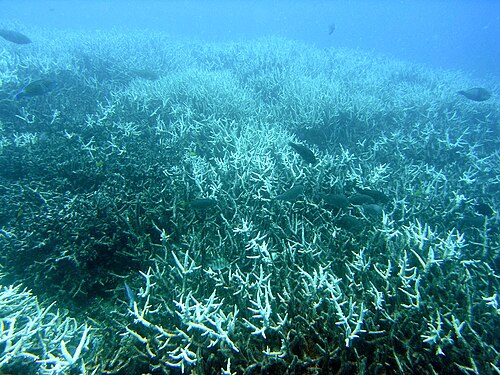
「生態系の破壊は現代の問題だと考えがちですが、その影響は何千年も前に遡り、人類が狩猟採集民として暮らしていた時代にまでさかのぼります。野生動物との関係は、常にゼロサムゲームでした。つまり、絶滅するまで狩り尽くすか、農地で生息地を破壊するかのどちらかだったのです。」 –ハンナ・リッチー( Our World in Dataより)[ 146 ]
人類世という用語の妥当性については依然として議論の余地があるものの、その根底にある前提、すなわち人類が地質学的力、あるいは地球の気候を形作る支配的な力になったという考え方は、学者や一般の人々の間で支持を集めている。ロドルフォ・ディルゾ、ジェラルド・セバロス、ポール・R・エーリックは、Philosophical Transactions of the Royal Society B の意見記事で、この用語は「学術的な社会領域だけでなく、より一般的な社会の語彙にもますます浸透しつつある」と述べており、現在ではオックスフォード英語辞典の項目として含まれている。[ 147 ]また、別の例として、ケンブリッジ大学は人類世研究の学位を提供している。[ 148 ]公共の場では、人類世という用語は、活動家、評論家、政治家の言説においてますます普及している。人新世という用語に批判的な人の中には、「多くの問題点はあるものの、この用語には力がある」と認める人もいる。 [ 149 ]この言葉の人気と普及度から、学者たちはこの用語を「カリスマ的なメタカテゴリー」[ 150 ]または「カリスマ的なメガコンセプト」[ 151 ]と呼ぶようになった。いずれにせよ、この用語は社会科学者、哲学者、先住民の学者などからさまざまな批判を受けてきた。
↑ Leconte, Joseph (1877). "地球史における臨界期とその進化との関係について; 第四紀[ sic ]をそのような時期として" . The American Naturalist . 11 (9): 540– 557. Bibcode : 1877ANat...11..540L . doi : 10.1086/271947 . ISSN 0003-0147 . JSTOR 2448188 .
↑Petersen-Rockney, Margiana; Baur, Patrick; Guzman, Aidee; Bender, S. Franz; Calo, Adam; Castillo, Federico; De Master, Kathryn; Dumont, Antoinette; Esquivel, Kenzo; Kremen, Claire; LaChance, James; Mooshammer, Maria; Ory, Joanna; Price, Mindy J.; Socolar, Yvonne (15 March 2021). "Narrow and Brittle or Broad and Nimble? Comparing Adaptive Capacity in Simplifying and Diversifying Farming Systems". Frontiers in Sustainable Food Systems. 5 564900. Bibcode:2021FrSFS...564900P. doi:10.3389/fsufs.2021.564900. ISSN2571-581X.
↑Ogden, M. (29 February 2016). "'The Anthropocene' viewed from Vernadsky's Noosphere". Promethean Pac. LaRouche PAC.
↑Doklady: Biological sciences sections, Volumes 132–135. Akademii͡a nauk SSSR.
↑Revkin, Andrew C. (11 May 2011). "Confronting the 'Anthropocene'". The New York Times. Retrieved 25 March 2014.
↑Badri, Adarsh (5 February 2024). "Feeling for the Anthropocene: affective relations and ecological activism in the global South". International Affairs. 100 (2): 731–749. doi:10.1093/ia/iiae010. ISSN0020-5850.
↑Crutzen, Paul J.; Stoermer, Eugene F. "The "Anthropocene"". IGBP Newsletter. pp.17–18.
↑Pearce, Fred (2007). With Speed and Violence: Why Scientists fear tipping points in Climate Change. Boston, Massachusetts: Beacon Press. ISBN978-0-8070-8576-9. Retrieved 5 September 2016.
↑"Paul Crutzen died on January 28th". The Economist. 13 February 2021. ISSN0013-0613. Retrieved 21 February 2021.
↑Steiner, Achim (15 December 2020). "The Next Frontier: Human Development and the Anthropocene (Foreword)"(PDF). UNDP. Retrieved 16 December 2020.
↑Ehlers, Eckart; Moss, C.; Krafft, Thomas (2006). Earth System Science in the Anthropocene: Emerging issues and problems. Springer Science+Business Media. ISBN978-3-540-26590-0.
↑ Gibbard, Philip L.、Bauer, Andrew M.、Edgeworth, Matthew、Ruddiman, William F.、Gill, Jacquelyn L.、Merritts, Dorothy J.、Finney, Stanley C.、Edwards, Lucy E.、Walker, Michael JC、Maslin, Mark、Ellis、Erle C. (2021) 「実用的な解決策:人新世は正式な時代区分ではなく、地質学的出来事である」。Episodes Journal of International Geoscience。45 ( 4 ): 349–357。Bibcode : 2021Episo..45..349G。doi : 10.18814/epiiugs/ 2021 / 021029。S2CID 244165877。
↑ Bauer, Andrew M.; Edgeworth, Matthew; Edwards, Lucy E.; Ellis, Erle C.; Gibbard, Philip; Merritts, Dorothy J. (2021年9月16日). "人新世:出来事か時代か?" . Nature . 597 (7876): 332. Bibcode : 2021Natur.597..332B . doi : 10.1038/d41586-021-02448- z . ISSN 0028-0836 . PMID 34522014. S2CID 237515330 .
↑ Gibbard, Philip; Walker, Michael; Bauer, Andrew; Edgeworth, Matthew; Edwards, Lucy; Ellis, Erle; Finney, Stanley; Gill, Jacquelyn L.; Maslin, Mark; Merritts, Dorothy; Ruddiman, William (2022). "The Anthropocene as an Event, not an Epoch" . Journal of Quaternary Science . 37 (3): 395–399 . Bibcode : 2022JQS....37..395G . doi : 10.1002/jqs.3416 . ISSN 0267-8179 . S2CID 247378724 .
↑ Crutzen, Paul J. (2002). "人類の地質学" . Nature . 415 (6867): 23. Bibcode : 2002Natur.415...23C . doi : 10.1038/415023a . ISSN 1476-4687 . PMID 11780095 . S2CID 9743349 .
↑ Douglas, I.; Hodgson, R. & Lawson, N. (2002). "Industry, environment and health through 200 years in Manchester". Ecological Economics . 41 (2): 235– 255. Bibcode : 2002EcoEc..41..235D . doi : 10.1016/S0921-8009(02)00029-0 .
1 2 Bradshaw, Corey JA; Ehrlich, Paul R.; Beattie, Andrew; Ceballos, Gerardo; Crist, Eileen; Diamond, Joan; Dirzo, Rodolfo; Ehrlich, Anne H.; Harte, John; Harte, Mary Ellen; Pyke, Graham; Raven, Peter H.; Ripple, William J.; Saltré, Frédérik; Turnbull, Christine; Wackernagel, Mathis; Blumstein, Daniel T. (2021). "恐ろしい未来を避けるための課題を過小評価する" . Frontiers in Conservation Science . 1 615419. Bibcode : 2021FrCS....1.5419B . doi : 10.3389/fcosc.2020.615419 .
12IPBES (2019). S. Díaz; J. Settele; E. S. Brondízio; H. T. Ngo; M. Guèze; J. Agard; A. Arneth; P. Balvanera; K. A. Brauman; S. H. M. Butchart; K. M. A. Chan; L. A. Garibaldi; K. Ichii J. Liu; S. M. Subramanian; G. F. Midgley; P. Miloslavich; Z. Molnár; D. Obura; A. Pfaff; S. Polasky; A. Purvis; J. Razzaque; B. Reyers; R. Roy Chowdhury; Y. J. Shin; I. J. Visseren-Hamakers; K. J. Willis; C. N. Zayas (eds.). Summary for policymakers of the global assessment report on biodiversity and ecosystem services (Report). doi:10.5281/zenodo.3553579.
↑Bongaarts, John (2019). "IPBES, 2019. Summary for policymakers of the global assessment report on biodiversity and ecosystem services of the Intergovernmental Science-Policy Platform on Biodiversity and Ecosystem Services". Population and Development Review. 45 (3): 680–681. doi:10.1111/padr.12283. ISSN0098-7921.
↑Ripple WJ, Wolf C, Newsome TM, Galetti M, Alamgir M, Crist E, Mahmoud MI, Laurance WF (13 November 2017). "World Scientists' Warning to Humanity: A Second Notice". BioScience. 67 (12): 1026–1028. doi:10.1093/biosci/bix125. hdl:11336/71342. Moreover, we have unleashed a mass extinction event, the sixth in roughly 540 million years, wherein many current life forms could be annihilated or at least committed to extinction by the end of this century.
↑Cowie RH, Bouchet P, Fontaine B (April 2022). "The Sixth Mass Extinction: fact, fiction or speculation?". Biological Reviews of the Cambridge Philosophical Society. 97 (2): 640–663. doi:10.1111/brv.12816. PMC9786292. PMID35014169. S2CID245889833.
12"Global Biodiversity Outlook 3". Convention on Biological Diversity. 2010. Archived from the original on 19 May 2022. Retrieved 24 January 2017.
↑Stokstad, Erik (6 May 2019). "Landmark analysis documents the alarming global decline of nature". Science. doi:10.1126/science.aax9287. For the first time at a global scale, the report has ranked the causes of damage. Topping the list, changes in land use—principally agriculture—that have destroyed habitat. Second, hunting and other kinds of exploitation. These are followed by climate change, pollution, and invasive species, which are being spread by trade and other activities. Climate change will likely overtake the other threats in the next decades, the authors note. Driving these threats are the growing human population, which has doubled since 1970 to 7.6 billion, and consumption. (Per capita of use of materials is up 15% over the past 5 decades.)
↑Pimm SL, Jenkins CN, Abell R, Brooks TM, Gittleman JL, Joppa LN, Raven PH, Roberts CM, Sexton JO (May 2014). "The biodiversity of species and their rates of extinction, distribution, and protection". Science. 344 (6187) 1246752. doi:10.1126/science.1246752. PMID24876501. S2CID206552746. The overarching driver of species extinction is human population growth and increasing per capita consumption.
↑Cafaro, Philip; Hansson, Pernilla; Götmark, Frank (August 2022). "Overpopulation is a major cause of biodiversity loss and smaller human populations are necessary to preserve what is left"(PDF). Biological Conservation. 272 109646. Bibcode:2022BCons.27209646C. doi:10.1016/j.biocon.2022.109646. ISSN0006-3207. S2CID250185617. Archived(PDF) from the original on 8 December 2023. Retrieved 25 December 2022. Conservation biologists standardly list five main direct drivers of biodiversity loss: habitat loss, overexploitation of species, pollution, invasive species, and climate change. The Global Assessment Report on Biodiversity and Ecosystem Services found that in recent decades habitat loss was the leading cause of terrestrial biodiversity loss, while overexploitation (overfishing) was the most important cause of marine losses (IPBES, 2019). All five direct drivers are important, on land and at sea, and all are made worse by larger and denser human populations.
↑Crist, Eileen; Mora, Camilo; Engelman, Robert (21 April 2017). "The interaction of human population, food production, and biodiversity protection". Science. 356 (6335): 260–264. Bibcode:2017Sci...356..260C. doi:10.1126/science.aal2011. PMID28428391. S2CID12770178. Retrieved 2 January 2023. Research suggests that the scale of human population and the current pace of its growth contribute substantially to the loss of biological diversity. Although technological change and unequal consumption inextricably mingle with demographic impacts on the environment, the needs of all human beings—especially for food—imply that projected population growth will undermine protection of the natural world.
↑Ceballos, Gerardo; Ehrlich, Paul R. (2023). "Mutilation of the tree of life via mass extinction of animal genera". Proceedings of the National Academy of Sciences of the United States of America. 120 (39) e2306987120. Bibcode:2023PNAS..12006987C. doi:10.1073/pnas.2306987120. PMC10523489. PMID37722053. Current generic extinction rates will likely greatly accelerate in the next few decades due to drivers accompanying the growth and consumption of the human enterprise such as habitat destruction, illegal trade, and climate disruption.
↑Hughes, Alice C.; Tougeron, Kévin; Martin, Dominic A.; Menga, Filippo; Rosado, Bruno H. P.; Villasante, Sebastian; Madgulkar, Shweta; Gonçalves, Fernando; Geneletti, Davide; Diele-Viegas, Luisa Maria; Berger, Sebastian; Colla, Sheila R.; de Andrade Kamimura, Vitor; Caggiano, Holly; Melo, Felipe (1 January 2023). "Smaller human populations are neither a necessary nor sufficient condition for biodiversity conservation". Biological Conservation. 277 109841. Bibcode:2023BCons.27709841H. doi:10.1016/j.biocon.2022.109841. ISSN0006-3207. Through examining the drivers of biodiversity loss in highly biodiverse countries, we show that it is not population driving the loss of habitats, but rather the growth of commodities for export, particularly soybean and oil-palm, primarily for livestock feed or biofuel consumption in higher income economies.
↑ Campbell, Bruce; Beare, Douglas; Bennett, Elena; Hall-Spencer, Jason; Ingram, John; Jaramillo, Fernando; Ortiz, Rodomiro; Ramankutty, Navin; Sayer, Jeffrey; Shindell, Drew (2017年10月12日). "Ecology and Society: 地球システムが惑星の限界を超える主な要因としての農業生産" . Ecology and Society . 22 (4). doi : 10.5751/ES-09595-220408 . ISSN 1708-3087 .
↑ケッチャム、クリストファー(2022年12月3日)「気候変動への対策は『地球を救う』ことにはならない」". The Intercept. Archived from the original on 18 February 2024. Retrieved 8 December 2022.
↑Caro, Tim; Rowe, Zeke (2022). "An inconvenient misconception: Climate change is not the principal driver of biodiversity loss". Conservation Letters. 15 (3) e12868. Bibcode:2022ConL...15E2868C. doi:10.1111/conl.12868. S2CID246172852.
↑Bank, European Investment (8 December 2022). Forests at the heart of sustainable development: Investing in forests to meet biodiversity and climate goals. European Investment Bank. ISBN978-92-861-5403-4. Archived from the original on 21 March 2023. Retrieved 9 March 2023.
↑Finch, Deborah M.; Butler, Jack L.; Runyon, Justin B.; Fettig, Christopher J.; Kilkenny, Francis F.; Jose, Shibu; Frankel, Susan J.; Cushman, Samuel A.; Cobb, Richard C. (2021). "Effects of Climate Change on Invasive Species". In Poland, Therese M.; Patel-Weynand, Toral; Finch, Deborah M.; Miniat, Chelcy Ford (eds.). Invasive Species in Forests and Rangelands of the United States: A Comprehensive Science Synthesis for the United States Forest Sector. Cham: Springer International Publishing. pp.57–83. doi:10.1007/978-3-030-45367-1_4. ISBN978-3-030-45367-1. S2CID234260720.
↑Bender, Eric (21 March 2022). "Urban evolution: How species adapt to survive in cities". Knowable Magazine. Annual Reviews. doi:10.1146/knowable-031822-1. Retrieved 31 March 2022.
↑Diamond, Sarah E.; Martin, Ryan A. (2 November 2021). "Evolution in Cities". Annual Review of Ecology, Evolution, and Systematics. 52 (1): 519–540. doi:10.1146/annurev-ecolsys-012021-021402. ISSN1543-592X. S2CID239646134. Archived from the original on 31 March 2022. Retrieved 1 April 2022.
1 2 Gaynor, Kaitlyn M.; et al. (2018). "The influence of human disturbance on wildlife nocturnality" . Science . 360 (6394): 1232– 1235. Bibcode : 2018Sci...360.1232G . doi : 10.1126/science.aar7121 . PMID 29903973 .
↑ Doney, Scott C.; Busch, D. Shallin; Cooley, Sarah R.; Kroeker, Kristy J. (2020年10月17日). 「海洋酸性化が海洋生態系とそれに依存する人間社会に与える影響」 . Annual Review of Environment and Resources . 45 (1): 83– 112. doi : 10.1146/annurev-environ-012320-083019 . ISSN 1543-5938 . S2CID 225741986 .
↑ Dixon, Simon J.; Viles, Heather A.; Garrett, Bradley L. (2018). "Ozymandias in the Anthropocene: The city as an emerging landform" . Area . 50 (1): 117– 125. Bibcode : 2018Area...50..117D . doi : 10.1111/area.12358 . ISSN 1475-4762 .
↑ Achmon, Yigal; Achmon, Moshe; Dowdy, F. Ryan; Spiegel, Orr; Claypool, Joshua T.; Toniato, Juliano; Simmons, Christopher W. (2018). "Understanding the Anthropocene through the lens of landfill microbiomes". Frontiers in Ecology and the Environment . 16 (6): 354–360 . Bibcode : 2018FrEE...16..354A . doi : 10.1002/fee.1819 . ISSN 1540-9309 . S2CID 89937817 .
↑ Cecil, L. DeWayne; David L. Naftz; Paul F. Schuster; David D. Susong; Jaromy R. Green (2010).中緯度高山氷河に保存された古環境記録 – 中央アジアおよび米国における米国地質調査所の経験の概要(PDF) (報告書). 米国地質調査所. 2022年5月14日取得.
↑Turney, Chris S.M.; Palmer, Jonathan; Maslin, Mark A.; Hogg, Alan; Fogwill, Christopher J.; Southon, John; etal. (2018). "Global peak in atmospheric radiocarbon provides a potential definition for the onset of the Anthropocene Epoch in 1965". Scientific Reports. 8 (1): 3293. Bibcode:2018NatSR...8.3293T. doi:10.1038/s41598-018-20970-5. PMC5818508. PMID29459648.
↑Zalasiewicz, J.; Williams, M.; Steffen, W. & Crutzen, P.J. (2010). "Response to 'The Anthropocene forces us to reconsider adaptationist models of human-environment interactions'". Environmental Science & Technology. 44 (16): 6008. Bibcode:2010EnST...44.6008Z. doi:10.1021/es102062w.
↑Zalasiewicz, J.; etal. (2011). "Stratigraphy of the Anthropocene". Philosophical Transactions of the Royal Society A. 369 (1938): 1036–1055. Bibcode:2011RSPTA.369.1036Z. doi:10.1098/rsta.2010.0315. PMID21282159.
↑Giaimo, Cara (13 January 2016). "Stone Age, Bronze Age... Plastic Age? The Race to Define Our Epoch". Atlas Obscura. Retrieved 4 May 2025.
↑Richter, D. deB. (2007). "Humanity's transformation of Earth's soil: Pedology's new frontier". Soil Science. 172 (12): 957–967. Bibcode:2007SoilS.172..957R. doi:10.1097/ss.0b013e3181586bb7. S2CID15921701.
↑Amundson, R. & Jenny, H. (1991). "The place of humans in the state factor theory of ecosystems and their soils". Soil Science. 151 (1): 99–109. Bibcode:1991SoilS.151...99A. doi:10.1097/00010694-199101000-00012. S2CID95061311.
↑ Certini, G. & Scalenghe, R. (2011). "Anthropogenic soils are the golden spikes for the Anthropocene". The Holocene . 21 (8): 1269– 1274. Bibcode : 2011Holoc..21.1269C . doi : 10.1177/0959683611408454 . S2CID 128818837 .
↑Elhacham, Emily; Ben-Uri, Liad; etal. (2020). "Global human-made mass exceeds all living biomass". Nature. 588 (7838): 442–444. Bibcode:2020Natur.588..442E. doi:10.1038/s41586-020-3010-5. PMID33299177. S2CID228077506.
↑Ritchie, Hannah (20 April 2021). "Wild mammals have declined by 85% since the rise of humans, but there is a possible future where they flourish". Our World in Data. Retrieved 18 April 2023.
↑Dirzo, Rodolfo; Ceballos, Gerardo; Ehrlich, Paul R. (2022). "Circling the drain: the extinction crisis and the future of humanity". Philosophical Transactions of the Royal Society B. 377 (1857) 20210378. doi:10.1098/rstb.2021.0378. PMC9237743. PMID35757873.
↑Sutoris, Peter (20 October 2021). "The term 'Anthropocene' isn't perfect – but it shows us the scale of the environmental crisis we've caused". The Conversation. Archived from the original on 20 October 2021.
↑Reddy, Elizabeth (8 April 2014). "What Does it Mean to do Anthropology in the Anthropocene?". Platypus. Archived from the original on 31 May 2014.
↑Davis, Heather; Turpin, Etienne (2014). Art in the Anthropocene: Encounters Among Aesthetics, Politics, Environments and Epistemologies. Open Humanities Press. pp.3–30. ISBN978-1-78542-008-5.
↑Hartigan, John (12 December 2014). "Multispecies vs Anthropocene". Somatosphere. Archived from the original on 21 September 2020.
↑Haraway, Donna (2014). Davis, Heather; Turpin, Etienne (eds.). Art in the Anthropocene: Encounters Among Aesthetics, Politics, Environments and Epistemologies. Open Humanities Press. pp.255–270. ISBN978-1-78542-008-5.
↑Moore, Jason W., ed. (2016). Anthropocene or Capitalocene? Nature, history, and the crisis of capitalism. Oakland, CA: PM Press. ISBN978-1-62963-148-6.
↑ヒッケル、ジェイソン(2021)。『Less is More: How Degrowth Will Save the World』 。ウィンドミル・ブックス。39-40頁。ISBN978-1-78609-121-5地球規模で物事のバランスが崩れ始めたのは、ここ数百年の資本主義の台頭と、1950年代以降の驚異的な工業化の加速によるものだった。
↑ Davis, Janae; Moulton, Alex A.; Sant, Levi Van; Williams, Brian (2019). "Anthropocene, Capitalocene, ... Plantationocene?: A Manifesto for Ecological Justice in an Age of Global Crises" . Geography Compass . 13 (5) e12438. Bibcode : 2019GComp..13E2438D . doi : 10.1111/gec3.12438 . ISSN 1749-8198 . S2CID 155374232 .
↑Whyte, Kyle P. (1 March 2018). "Indigenous science (fiction) for the Anthropocene: Ancestral dystopias and fantasies of climate change crises". Environment and Planning E: Nature and Space. 1 (1–2): 224–242. Bibcode:2018EnPlE...1..224W. doi:10.1177/2514848618777621. ISSN2514-8486. S2CID158298529.
↑Todd, Zoe (2014). Davis, Heather; Turpin, Etienne (eds.). Art in the Anthropocene: Encounters Among Aesthetics, Politics, Environments and Epistemologies. Open Humanities Press. pp.241–254. ISBN978-1-78542-008-5.
↑Hacıgüzeller, Piraye (December 2021). "On critical hope and the anthropos of non-anthropocentric discourses. Some thoughts on archaeology in the Anthropocene". Archaeological Dialogues. 28 (2): 163–170. doi:10.1017/S1380203821000192. hdl:10067/1836770151162165141. S2CID244775395.
↑Milstein, Tema; Castro-Sotomayor, José, eds. (1 May 2020). Routledge Handbook of Ecocultural Identity (1ed.). Abingdon, England and New York, NY: Routledge. doi:10.4324/9781351068840. ISBN978-1-351-06884-0.
↑Certini, Giacomo; Scalenghe, Riccardo (April 2015). "Is the Anthropocene really worthy of a formal geologic definition?". The Anthropocene Review. 2 (1): 77–80. Bibcode:2015AntRv...2...77C. doi:10.1177/2053019614563840. ISSN2053-0196. S2CID130059700.
↑Ellis, Erle; Goldewijk, Kees Klein; Gaillard, Marie-José; Kaplan, Jed O.; Thornton, Alexa; Powell, Jeremy; etal. (30 August 2019). "Archaeological assessment reveals Earth's early transformation through land use". Science. 365 (6456): 897–902. Bibcode:2019Sci...365..897S. doi:10.1126/science.aax1192. hdl:10150/634688. ISSN0036-8075. PMID31467217. S2CID201674203.
↑ Ruddiman, William F. (2003). "The anthropogenic greenhouse era began thousands of years ago" (PDF) . Climatic Change . 61 (3): 261– 293. Bibcode : 2003ClCh...61..261R . CiteSeerX 10.1.1.651.2119 . doi : 10.1023/B:CLIM.0000004577.17928.fa . S2CID 2501894 . 2014年4月16日にオリジナル(PDF)からアーカイブ済み。
↑ Broecker, Wallace S.; Stocker, Thomas F. (2006). "完新世のCO2上昇:人為的か自然か? . Eos, Transactions American Geophysical Union . 87 (3): 27. Bibcode : 2006EOSTr..87...27B . doi : 10.1029/2006EO030002 . ISSN 2324-9250 .
↑"Cattle Decapitation – To Release 'The Anthropocene Extinction' This August Via Metal Blade Records" (Press release). Metal Blade Records. 20 May 2015. Retrieved 20 October 2020.
↑"The 25 Best Pop Albums of 2020: Staff Picks". Billboard. 15 November 2019. Retrieved 5 May 2024.
External links
The Anthropocene epoch: have we entered a new phase of planetary history?, The Guardian, 2019
Drawing A Line In The Mud: Scientists Debate When 'Age Of Humans' Began. NPR. 17 March 2021.
"The Anthropocene: Where on Earth are we Going? [Full]". YouTube. The Royal Society of Victoria. 15 April 2021. (lecture given by Professor Will Steffen in Melbourne, Australia)
8 billion humans: How population growth and climate change are connected as the 'Anthropocene engine' transforms the planet. The Conversation. 3 November 2022.
Categories:
Holocene
Human impact on the environment
Human ecology
1960s neologisms
Events in the geological history of Earth
Anthropocene
Hidden categories:
Articles with short description
Short description is different from Wikidata
Use dmy dates from January 2026
Accuracy disputes from March 2026
All accuracy disputes
Pages using gadget WikiMiniAtlas
Coordinates on Wikidata
Pages using sidebar with the child parameter
All articles with incomplete citations
Articles with incomplete citations from June 2018
Articles to be expanded from July 2026
All articles to be expanded
Articles containing Ancient Greek (to 1453)-language text
CS1: unfit URL
Articles with excerpts
Pages using multiple image with auto scaled images
Articles with specifically marked weasel-worded phrases from January 2021
CS1: long volume value
Pages displaying short descriptions of redirect targets via Module:Annotated link





 テキストと画像は、クリエイティブ・コモンズ表示4.0国際ライセンスの下で利用可能です。