A white bishop developed to c4 or a black bishop developed to c5. A bishop so developed is characteristic of the Italian Game. In the Giuoco Piano both players have Italian bishops. The Italian bishop stands in contrast to the Spanish bishop on b5 characteristic of the Ruy Lopez. "Italian" may be used as an adjective for an opening where one or both players have Italian bishops.[232]
J
j'adoube
(from French, "I adjust", pronounced[ʒa.dub]) The international signal of the intention to adjust the position of a piece on the board. When playing with the touch-move rule, a player must say this in order to be able to touch a piece without being subject to the touched piece rule. The verb adouber, literally "to dub" (raise to the knighthood), is rarely used in contemporary French outside of this context. A local language equivalent, e.g. "I am adjusting", is generally also acceptable.[5]
K
K
Symbol used for the king when recording chess moves in English.[22]
2.In pawn endings, a square whose occupation by one side's king guarantees the achievement of a certain goal, such as the promotion of a pawn or the win of a pawn.[228] Also called critical square.
As a spectator, making comments on a chess game that can be heard by the players. Kibitzing on a serious game while it is in progress (rather than during a post-mortem) is a serious breach of chess etiquette.[233]
kick
Attacking a piece, often a knight, with a pawn, so that it will move. Kicking a piece may lead to gaining a tempo, or may force the opponent to concede control of key squares.[233]
The most important piece in chess. It may move to any adjacent square, and it may castle. A king threatened with capture is in check; a player cannot end their move with their king in check. If a player's king is in check and there is no escape, then the king is in checkmate, and the player loses. If the player whose turn it is has no legal moves and their king is not in check, then it is stalemate, and the game is drawn.
king bishop
Or king's bishop. The bishop that is on the kingside at the start of the game. Sometimes abbreviated "KB".[85]
A sustained attack on the enemy king that results in the king being driven a far distance from its initial position, typically resulting in its checkmate. Some of the most famous games featuring king hunts are Edward Lasker–Thomas, Polugaevsky–Nezhmetdinov, and Kasparov–Topalov.[234] Also called king chase.
king knight
Or king's knight. The knight that is on the kingside at the start of the game. Sometimes abbreviated "KN".[85]
king pawn
Or king's pawn. A pawn on the king's file, i.e. the e-file. Sometimes abbreviated "KP". Also king bishop pawn (KBP), king knight pawn (KNP), and king rook pawn (KRP) for a pawn on the f-, g-, or h-file, respectively.[85]
Or king's pawn opening. An opening that begins 1.e4.
king rook
Or king's rook. The rook that is on the kingside at the start of the game. Sometimes abbreviated "KR".[85]
kingside
Or king's side. The side of the board (half-board) the kings are on at the start of the game (the e- through h-file), as opposed to the queenside.[37] Also called king's wing.
king walk
A consecutive series of king moves designed to bring the king to a safer square. For example, if a player has castled kingside but the opponent has sacrificed a piece to destroy the kingside pawn cover, they may choose to walk the king over to the queenside to shelter behind the queenside pawns.[235]
A piece that may move to any nearest square not on a rank, file, or diagonal on which it stands. In other words, it may move two squares horizontally or vertically and then one square perpendicular to that (forming an L shape), jumping over any pieces in the way.
knight pawn
Or knight's pawn. A pawn on the knight's file, i.e. the b-file or g-file. Sometimes abbreviated "NP".[85]
A puzzle that challenges a person to set a knight on an empty chessboard, and make the piece move around (as it moves in a chess game), but to visit every square only once. The knight's tour is the best known of a variety of tours and puzzles based on chess pieces. A closed tour (also known as a re-entrant tour) ends on the same square on which it began and needs 64 moves. An open tour ends on a different square and needs only 63 moves.[236]
This phenomenon, described by Alexander Kotov in his 1971 book Think Like a Grandmaster, can occur when a player does not find a good plan after thinking long and hard on a position. The player, under time pressure, then suddenly decides to make a move that they have hardly thought about at all, and it may not be a good move for that reason.[237]
[from German, "war game"] Kriegspiel is a chess variant played by two opponents who can see only their own board, and one monitoring umpire who makes the moves of both players on a neutral board. It requires three chess sets and boards. The players make their moves based on limited information from the umpire. It was introduced in 1898. It is sometimes referred to as blind chess, not to be confused with blindfold chess.[238]
Kt
The symbol sometimes used for the knight when recording chess moves in descriptive notation, mainly in older literature. An N is used instead in algebraic notation and in later descriptive notation to avoid confusion with K, the symbol for the king.[22]
A well-known rook and pawn versus rook endgame position in which the player with the extra pawn can force a win by cutting off the opponent's king and placing a rook on the 4th rank in order to block the opponent's rook checks, thereby allowing the pawn to queen.[57]
[from German, "air"] Space made for a castled king to give it a flight square to prevent a back-rank mate. Usually luft is made by moving a pawn on the second rank in front of the king.[246]
A larger number of pawns on one flank opposed by a smaller number of the opponent's; often a player with a majority on one flank has a minority on the other.[248] A central pawn majority is a larger number of pawns on the center files.
major piece
A queen or rook, also known as a heavy piece.[249] The primary distinction of major pieces versus minor pieces is that major pieces are capable of checkmate with only their own king for support, as the enemy king is unable to step across the ranks and files they control. On an otherwise empty board, a major piece can move from any square to any other square in at most two moves.
man
A piece or a pawn, when the term "piece" is used as exclusive of pawns.[250]
A bind on the light squares in the center, particularly d5, obtained by White by placing pawns on c4 and e4. Named for Géza Maróczy, it originally referred to formations arising in some variations of the Sicilian Defense, but the name is now also applied to similar setups in the English Opening and the Queen's Indian Defense. It was once greatly feared by Black but means of countering it have been developed since the 1980s and earlier.[251]
master
Loosely, a strong chess player who would be expected to beat most amateurs. It may also refer to a formal title such as International Master or National Master. Standards vary, but a master will usually have an Elo rating of over 2200.[252]
match
The term "match" does not refer to an individual game of chess, but to either a competition between two teams or a series of games between two individuals. A match may be the entire competition, or it may be a round in a knockout tournament or team tournament. A match between individuals usually consists of several games, continuing until one of the players has achieved either a set score or a set number of wins.[252]
A player's pieces and pawns on the board. The player with pieces and pawns of total greater value is said to have a material advantage. Gaining a material advantage is called winning material.[254] See Chess piece relative value.
materialism
Playstyle characterized by a willingness to win material at the expense of positional considerations. Chess engines historically were often materialistic.[255]
The part of a chess game that follows the opening and comes before the endgame, beginning after the pieces are developed in the opening. This is usually roughly moves 20 through 40.[254]
miniature
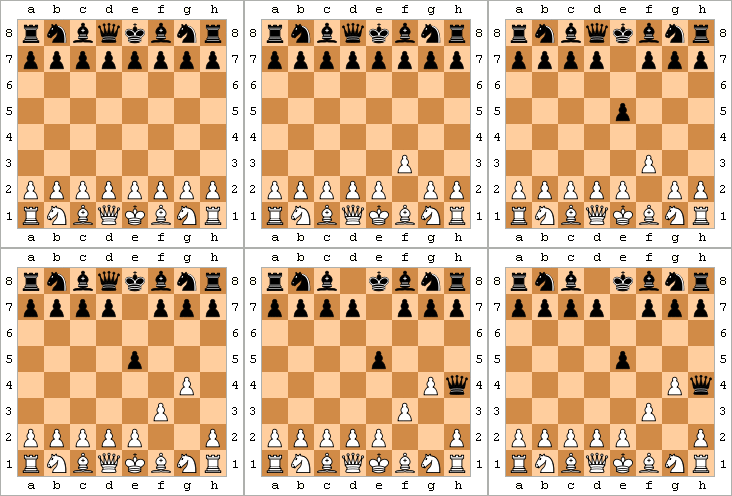
A short game (usually no more than 20 to 25 moves), for example: 1.e3 e5 2.Qf3 d5 3.Nc3 e4 4.Qf4?? Bd6! and White resigned in Spiel–Künzel, Europe 1900,[257] because the queen is trapped. However, some authors include games up to 30 moves.[258] Usually only decisive games (not draws) are considered miniatures. Ideally, a miniature should not be spoiled by an obvious blunder by the losing side. A miniature may also qualify as a brilliancy. The Opera Game is a famous example. Sometimes called a brevity [chiefly British].[54]
A smaller number of pawns on one flank opposed by a larger number of the opponent's; often a player with a minority on one flank has a majority on the other.[248]
White might initiate a minority attack by advancing the a- and b-pawns.
An advance of pawns on the side of the board where one has fewer pawns than the opponent, an attack strategy usually carried out to provoke a weakness.[254]
minor piece
A bishop or knight.[254] Unlike major pieces, minor pieces are unable to contain the enemy king or block his advance alone, as he can simply pass through the holes in their line of attack. Compared to major pieces, minor pieces also find it difficult to navigate the entire board; a knight may require four moves to reach a square two squares away, while a bishop can only ever control half of all squares.
The ability of a piece(s) to move around the board. Having space.[254]
move
1.A turn taken by one of the players, moving a piece to a new square (sometimes with the capture of an opponent's piece or the promotion of a pawn) or castling.[261]
2.A turn by both players, White and Black: for example, in the context of the 50-move rule, or when referring to the duration or stage of a game (as in "the position after move 15" or "the game ended after 27 moves"). A turn by either White or Black may then be called a half-move, or (in computer contexts) one ply.[261]
move order
The sequence of moves one chooses to play an opening or execute a plan. Different move orders often have different advantages and disadvantages. A plan that uses certain moves can sometimes be improved by making the identical moves but in a different sequence.[262]
mysterious rook move
Coined by Nimzowitsch to refer to the placing of a rook on a closed file in anticipation that the opponent is going to open the file. This move may either achieve a position with a rook on an open file, or it may alternatively hinder the opponent's intentions (prophylaxis). The meaning of the word has since expanded to refer to any rook move that appears to have a hidden purpose.[263][264]
N
N
1.Symbol used for the knight when recording chess moves in English.
An abbreviation for Nunn's Chess Openings, a chess openings reference.Cf.ECO and MCO.
NN
Traditionally used in game scores to indicate a player whose name is not known, or whose name the editor chooses not to publish (usually the loser). The origin is uncertain. It may be an abbreviation of the Latin nomina ("names"), or it may be short for the Latin phrase nomen nescio ("name unknown").[265] Sometimes N.N.
A step toward earning a chess title, such as Grandmaster or International Master. To qualify for the award of norms, a tournament must be rated by FIDE, must be sufficiently strong, must include a mix of nationalities, must include a specified number of titled players, and must meet certain other requirements regarding time control and playing conditions. The score necessary to qualify for a norm depends on the strength of the tournament. In practice, three norms are usually required for a title, though regulations have varied over the years.[62][266]
Any method of recording chess moves, allowing games to be later published, replayed and analyzed. The most common notation today is algebraic notation, which is used internationally. Formerly descriptive notation was standard in English language publications. There are also systems of notation for recording chess positions without the use of diagrams, the most common of which is Forsyth–Edwards Notation (FEN).[267]Cf.annotation.
Occupation of a rank or file means a rook or queen controls it; occupation of a square means a piece or pawn sits on it.[268]
octopus
A strongly positioned knight in enemy territory. A knight not near the edge reaches out in eight directions, like the eight tentacles of an octopus.[269]
This refers to the stronger player giving the weaker player some sort of advantage in order to make the game more competitive. It may be an advantage in material, in extra moves, in time on the clock, or some combination of those elements. Since the advent of the chess clock, time odds have become more common than material odds.[270]
Any opening that begins with the moves 1.e4 e5. Examples of Open Games include the Ruy Lopez, the Giuoco Piano, the Danish Gambit, and many others. The Open Game is also referred to as a Double King's Pawn Opening or Double King's Pawn Game.Cf.Closed Game.
The beginning phase of the game, roughly the first dozen moves, but it can extend much farther. In the opening players set up their pawn structures, develop their pieces, and usually castle. The opening precedes the middlegame.[271]
Home study and analysis of openings and defenses that one expects to play, or meet, in later tournament or match games. In high-level play, an important part of this is the search for theoretical novelties that improve upon previous play or previously published analysis.[272]
opening repertoire
The set of openings played by a particular player. The breadth of different players' repertoires varies from very narrow to very broad.[273]
opening system
An opening that is defined by a series of moves by one player, where the moves can be made independently (to some extent) of the moves chosen by the opponent, and are usually not required to be made in a fixed move order, with the goal of reaching a certain type of middlegame position.[274] One example is the Colle System,[274] characterized by an early e3 from White, intending to place the queen's bishop on b2; the London System is another frequently played opening system. Openings for Black can also be described as opening systems, such as the King's Indian Defense.[274]
A position in which two kings stand on the same rank, file, or diagonal with one empty square between them. The player to move may be forced to move the king to a less advantageous square. Opposition is a particularly important concept in endgames.[276] One orthogonal square separation is direct opposition; one diagonal square is diagonal opposition; multiple squares separation is distant opposition.Cf.corresponding squares.
optimal play
See Best response. Both sides playing their best move at each turn, or one of equally good alternatives. One side tries to win as quickly as possible while the other side tries to delay it as long as possible, or optimal play may result in a draw.Cf.Solved game#Perfect play
An outpost is a square protected by a pawn that is in or near the enemy's stronghold. Outposts are a favorable position from which one can launch an attack, particularly using a knight.[278]
A passed pawn near the edge of the board and not in the path of threats from the opponent's pawns. In the endgame, such a pawn can constitute a strong advantage, because it threatens to promote, and it also diverts the opponent's forces to restrain its advance.[279]
overextended
An overextended position results when a player has advanced pawns too far into the opponent's side without sufficient support. The premature advance can leave weaknesses in the player's camp or the advanced pawns themselves may be weak ("overextended pawns").[280][281]
A piece that has too many defensive duties. An overloaded piece can sometimes be deflected, or required to abandon one of its defensive duties.[282]
overprotection
The strategy of protecting an important pawn or square more than is apparently necessary. This serves to dissuade the opponent from attacking that point, and the latent power of the "over protectors" assembled around an important point is a significant threat that can bear fruit at a small tactical change in the position. Aron Nimzowitsch coined the term and was a proponent of overprotection.[283]
over the board
1.An over-the-board game is played face to face with the opponent, as opposed to a remote opponent as in online chess or correspondence chess.
2.Analysis carried out during a game in real time (not necessarily a face-to-face game) as opposed to during preparation. Finding accurate moves over the board is harder than finding them with computer assistance in one's own time. "I looked up the gambit Smith played and there's a line that refutes it, but I couldn't find it over the board."[277]
Symbol used for the pawn when recording chess positions in English; a lowercase p is typically used for a Black pawn. Also used for the pawn when recording chess moves in descriptive notation, e.g. P-K4.
[from Italian, "to dodge the fight"] The former rule that a pawn could evade capture by an opposing pawn by its initial two-square advance, in contrast to the en passant rule. Passar battaglia remained the practice in several parts of Europe long after en passant was introduced, and it was not completely abandoned until 1880 when Italy adopted the en passant rule.[286]
White with a passed pawn on b7. Black has a passed pawn on g6. The black pawn on f7 is not passed because the white pawn on e4 is adjacent and can threaten it.
Describes a piece or pawn that is inactive and able to move to or control relatively few squares, or a position without possibilities for attack or counterplay.[283]Antonym: active.
passive sacrifice
The sacrifice of a piece, by moving a different piece, leaving the sacrificed piece under attack.
A part of chess thinking that involves remembering and recognizing certain recurring positional aspects large and small, visual and dynamic. It is a kind of thinking that gives an advantage to a player with great experience. It is distinct from the intellectual activity of calculation. It uses intuitive thinking that is familiar to humans, but is foreign to computers. It can be developed by studying chess puzzles. It has been studied by Adriaan de Groot, and other scientists, who have attempted to discover how chess players think.[288][289]
patzer
A weak chess player (from German: patzen, "to bungle").[290]
A piece that can move one square directly forward, or on its first move, can move two squares directly forward. It can also move one square diagonally forward when capturing. It may capture en passant. Upon reaching its eighth rank, it is promoted to a same-colored queen, rook, bishop, or knight.
A type of odds game, common in the 18th and 19th centuries, in which the superior player plays Black and begins the game with one of their pawns, usually the king bishop pawn, removed from the board; plus White gets an extra move at the start.[291]
pawn break
A pawn move that attacks an enemy pawn in order to open up lines or challenge the opponent's pawn structure.
pawn center
Or pawn centre. A player's pawns in the center of the board. Pawns on the squares adjacent to the center may also be considered part of the pawn center. Having a strong pawn center was considered absolutely essential until the hypermodernist school introduced some new ideas.[292] Often shortened to center. See King's Indian Defense, Four Pawns Attack for an example of an opening leading to an extended pawn center.
pawn chain
Two or more pawns of the same color diagonally linked. A pawn chain's weakest point is the base because it is not protected by another pawn.[283]
Black has three pawn islands and White has two. The pawn on e5 is not isolated because it is adjacent to a file that has a white pawn. Lichtenhein vs. Morphy, 1857
pawn island
A group of pawns of one color on consecutive files with no other pawns of the same color on an adjacent file. A pawn island consisting of one pawn is an isolated pawn.[293]
The placement of the pawns during the course of a game. As pawns are the least mobile of the pieces and the only pieces unable to move backwards, the position of the pawns greatly influences the character of the game.[295] Also called pawn skeleton.
An abbreviation for Professional Chess Association.
PCO
An abbreviation for Practical Chess Openings, the 1948 openings reference book by Reuben Fine.[296] In 2025, another openings reference book of the same name, written by Martyn Kravtsiv, was published.[297]Cf.ECO and MCO.
A number reflecting the approximate rating level at which a player performed in a particular tournament or match. It is often calculated by adding together the player's performances in each individual game, using the opponent's rating for a draw, adding 400 points to the opponent's rating for a win, and subtracting 400 points from the opponent's rating for a loss, then dividing by the total number of games. For example, a player who beat a 2400-rated player, lost to a 2600, drew a 2500, and beat a 2300, would have a performance rating of 2550 (i.e. 2800 + 2200 + 2500 + 2700, divided by 4).[298]
Often shortened to perpetual. When a player puts the opponent in check and the check could be repeated endlessly, the game will be declared a draw by repetition. This tactic can be resorted to as a form of insurance in a losing position.[299]
Usually refers to an important chess endgame that illustrates a drawing technique when the defender has a king and rook versus a king, rook, and pawn. It is also known as the third rank defense, because of the importance of the rook on the third rank cutting off the opposing king. It was analyzed by Philidor in 1777.[301]
1.One of the chessmen or figures used to play the game – that is, a king, queen, rook, bishop, knight or pawn. Each piece type has its own rules of movement on the board and of capturing enemy pieces. This is the definition used in the context of rules of chess – for example, the touched piece rule.
2.When annotating or discussing chess games, the term "piece" usually excludes pawns. It may be used collectively for all "non-pawns" – for example, "White's pieces are well-posted." In some contexts, it may refer specifically to a minor piece – for example, "White is up two pieces for a rook."[303]
When a piece is attacked but cannot legally move, because doing so would expose the player's own king to the attack ("absolute pin"); or when a piece is attacked and can legally move out of the line of attack, but such a move would expose a more valuable piece (or an unprotected piece) to capture ("relative pin").[261]
playable
Said of an opening, a position, or move that affords the person playing it a tenable position.[304]
play by hand
To make a move intuitively and without analyzing the move.[305]
This is a popular computer-processible ASCII format for recording chess games (both the moves and related data).[300] There are import and export versions: the import version is lax, while the export version is not.
position
"The disposition of pieces and pawns, of one or both colours, at any stage of the game or as set in a composition."[307] If one side has an overall advantage in strength, that side is said to have "the better position". If neither side has an overall advantage, the position might be called level or equal or balanced. The position of chessmen at the beginning of a game is called an array.[308]
positional play
Play based on strategy, on gaining and exploiting small advantages, and on analyzing the larger position, rather than calculating the more immediate tactics.[293]Cf.antipositional.
A sacrifice in which the lost material is not regained via a combination, but instead gains positional compensation. These typically require deep positional understanding and are often overlooked by computers. Also known as a true sacrifice, as opposed to a pseudo sacrifice or sham sacrifice.
Analysis of a game after it has concluded, typically by one or both players and sometimes with spectators (kibitzers) contributing as well. A player who has just lost the game thanks to a dubious move has the chance to "win the post-mortem" by finding a better one.[293]
In online chess, a move input that is made during the opponent's turn, to take effect only after the opponent has moved. Premoving, the act of making premoves, is a popular way of saving time in blitz and bullet formats.[309]
A well-analyzed novelty in the opening that is not published but first used against an opponent in competitive play.[310]
Principle of two weaknesses
A technique of increasing one's advantage by causing the opponent, who has one weakness, to have a second weakness. Even if both weaknesses are minor, the fact of having two, in practice, becomes a major weakness.[311]
Advancing a pawn to the eighth rank, converting it to a queen, rook, bishop, or knight. Promotion to a piece other than a queen is called underpromotion.[261]
A piece is protected when another friendly piece controls its square. This somewhat protects the first piece from capture, as there is the option to recapture. This is especially effective if the attacking piece is of greater value than the threatened piece.
pruning
Chess engines usually include an algorithm to eliminate certain moves from consideration, assuming that they are blunders and therefore irrelevant to the final move selection. Forward pruning runs the risk of overlooking the best move; this risk may be slight to moderate depending on how aggressively the pruning algorithm is set. Alpha–beta pruning is considered a form of backward pruning, which does not risk overlooking the best move.
Or queen's knight. The knight that is on the queenside at the start of the game. Sometimes abbreviated "QN".[85]
queen pawn
Or queen's pawn. A pawn on the queen's file, i.e. the d-file. Sometimes abbreviated "QP". Also queen rook pawn (QRP), queen knight pawn (QNP), and queen bishop pawn (QBP) for a pawn on the a-, b-, or c-file, respectively.[85]
Or queen's pawn opening. An opening that begins 1.d4.
queen rook
Or queen's rook. The rook that is on the queenside at the start of the game. Sometimes abbreviated "QR".[85]
queenside
Or queen's side. The side of the board (board-half) the queens are on at the start of the game (the a- through d-file), as opposed to the kingside.[37] Also called queen's wing.
question
Usually in the form "put the question to [a piece]", to force the opponent to commit to a strategic decision regarding the future of a piece. Most commonly used to refer to a one-square advance of a rook's pawn to attack a bishop that is pinning or pressuring a knight, forcing the opponent to decide whether to retreat the bishop or exchange it for the knight. "Putting the question to the bishop" may resolve the pin, but can also weaken the player's pawn structure. This usage originates in Aron Nimzowitsch's My System (1925).[318]
A move that does not attack or capture an enemy piece.[320]
R
R
Symbol used for the rook when recording chess moves in English.[22]
Rabar Classification
A system of opening classification codes introduced by Braslav Rabar for Chess Informant. The system was used by Informant publications from 1966 to 1981 but has since been replaced by ECO codes.[321]
"A form of unorthodox chess designed to discount knowledge of the openings. The pawns are placed as in the array and behind them the pieces are placed in unorthodox fashion."[323]
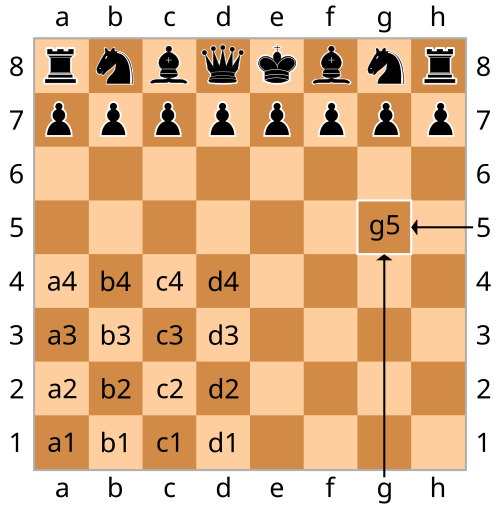
White's ranks are indicated on the left (a-file); Black's relative reference to ranks are indicated on the right (h-file).
rank
A row of squares of the chessboard. In algebraic notation, ranks are numbered 1–8 starting from White's side of the board; however, players customarily refer to ranks from their own perspectives. For example: White's king and other pieces start on their first (or "back" or "home") rank, whereas Black calls the same rank the "eighth" (or last) rank; White's seventh rank is Black's second; and so on. If neither perspective is given, White's view is assumed. This relative reference to ranks was formalized in the older descriptive notation.[324]
The capture of an opponent's piece that previously made a capture, and usually played immediately following the opponent's capture move. The capture and recapture occur on the same square, and usually the pieces captured and recaptured have the same value.
refute
To demonstrate that a strategy, move, or opening is not as good as previously thought (often, that it leads to a loss), or that previously published analysis is unsound. A refutation is sometimes colloquially referred to as a bust. A refutation in the context of chess problems or endgame studies is often called a cook.[326]
A pin where it is legal to move the pinned piece out of the line of attack. The piece is not pinned therefore to the king, but instead to some other piece. Contrast with absolute pin where the pinned piece is not permitted to move, because the piece it is pinned to is the king.
remis
[from French] A draw. It literally means "reset" and is somewhat archaic (the usual word for a draw in modern French is nulle), but is internationally understood and may be used between players without a common language.
A move a player has available. Such a move may not be crucial to the position on the board, but being able to force the opponent to move by making a reserve move can on occasion result in a significant advantage.[327]
To concede loss of the game. A resignation is usually indicated by stopping the clocks, sometimes by offering a handshake, or by saying "I resign". A traditional way to resign is by tipping over one's king. It is common for a game to be resigned, rather than for it to end with checkmate, because experienced players can foresee the checkmate.[328][329] However, under FIDE Laws, a player's resignation results in a draw if there is no sequence of legal moves that could lead to their opponent checkmating them.[330]
resign on time
A player who intentionally runs out of time to avoid having to resign in a hopeless position can be said to have resigned on time. This is usually performed in a more subtle manner than that of Curt von Bardeleben walking out of the tournament hall against Wilhelm Steinitz. A player low on time and in a losing position may simply "forget" to pay any attention to the clock. Resigning on time when a considerable amount of time was left beforehand is called "stalling" and is considered bad sportsmanship.
A piece that may move along ranks and files without jumping.
rook lift
A maneuver that places a rook in front of its own pawns, often on the third or fourth rank. This can allow the rook to treat a half-open file as if it were an open file, or a closed file as if it were half-open.[332]
rook pawn
Or rook's pawn. A pawn on the rook's file, i.e. the a-file or h-file. Sometimes abbreviated "RP".[85]
This is a tournament in which each participant plays every other participant an equal number of times. In a double round-robin tournament the participants play each other exactly twice, once with white and once with black. A round robin tournament is commonly used if the number of participants is relatively small.[333]
royal fork
A fork threatening the king and queen, typically performed with a knight.[334]
royal piece
A king or queen.[85] In chess variants, the term refers to any piece that must be protected from capture; under this definition, only the king is royal in orthodox chess.
S
S
[from German: Springer, "jumper"] Alternative notation for the knight. Used rather than K, which means king.
A move or capture that voluntarily gives up material in return for an advantage such as space, development, or an attack. A sacrifice in the opening is called a gambit, especially when applied to a pawn.[328]
2.A player's score in a match or tournament, which is almost always 1 point for each win and ½ point for each draw. See Chess scoring.
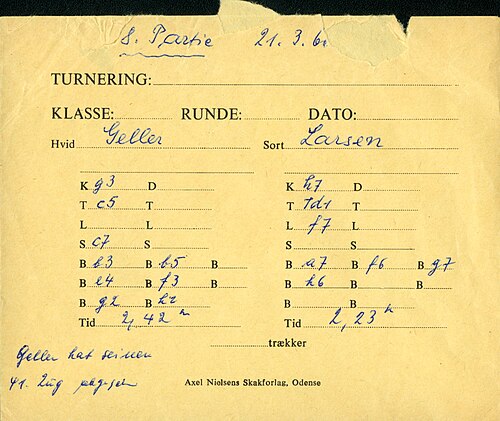
A score sheet
score sheet
The sheet of paper used to record a game in progress. During formal games, it is usual for both players to record the game using a score sheet. A completed score sheet contains the game score.[201]
sealed move
To prevent unfair advantage when an OTB game is adjourned, the player whose turn it is to move is required to write down their next move and put it in a sealed envelope. Upon resumption, the arbiter opens the sealed envelope, makes the move and the game continues. The player may be disqualified if the sealed move is illegal, ambiguous or unclear. Adjournments and sealed moves are no longer standard practice.
second
An assistant hired to help a player in preparation for and during a major match or tournament. The second assists in areas such as opening preparation. The second also used to assist with adjournment analysis before the practice of adjournments was largely abandoned in the 1990s.[335]
second player
The expression "the second player" is sometimes used to refer to Black.
The game is drawn if no capture or pawn move has occurred in the last seventy-five moves by either side. The fifty-move rule operates on a similar principle but is invoked at a player's discretion instead of automatically.[339]
An offer of material that is made at no risk, as acceptance would lead to the gain of equal or greater material or checkmate. This is in contrast to a true sacrifice in which the compensation is less tangible. Also called pseudo sacrifice.[340]
sharp
Highly tactical, risky, double-edged, few available accurate moves. Sharp can be used to describe moves, maneuvers, positions, opening lines, and styles of play.[341]
Colloquial for an unexpected or sharp move that typically makes a tactical threat or technical challenge for the opponent.
silent move
A move that has a dynamic tactical effect on a position, but that does not capture or attack an enemy piece.[342][343]
simplification
A strategy of exchanging pieces, often with one of the following goals: as a defensive measure to reduce the size of an attacking force; when having the advantage to reduce the opponent's counterplay; to try to obtain a draw; or as an attempt to gain an advantage by players who are strong in endgame play with simplified positions.[344][328] Also called liquidation.
An attack on a valuable piece, compelling it to move to avoid capture and thus expose a less valuable piece which can then be taken.[347][348]
skittles
A casual or "pickup" game, usually played without a chess clock. At chess tournaments, a skittles room is where one goes to play for fun while waiting for the next formal game.[345]
slow
Describes a strategy that requires too many tempi to complete, allowing the opponent time to consolidate.
In the tournament played by Sofia rules, players are not allowed to draw by agreement. They could have draws by stalemate, threefold repetition, fifty-move rule, or insufficient material. Other draws are allowed only if the arbiter declares the game reached a drawn position.[350]
solid
An adjective used to describe a move, opening, or manner of play that is characterized by minimal risk-taking and emphasis on quietpositional play rather than wild tactics.
sortie
A queen development in front of its own pawns, often early in the opening, usually for the purpose of exploiting an advantage in space or punishing an error by the opponent. So called because the queen is usually developed behind its own pawns for its protection.
A tactic by which a queen, rook, or king progresses along a diagonal by making a series of lateral steps using a series of checks or alternating with pins and checks. Also called staircase movement.[353]
A position in which the player whose turn it is to move has no legal move and their king is not in check. A stalemate results in an immediate draw.[81]
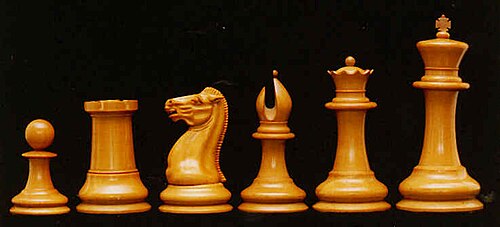
The standard design of chess pieces, required for use in competition.[354]
stem game
A stem game is the chess game featuring the first use of a particular openingvariation. Sometimes, the player or the venue of the stem game is then used to refer to that opening.
strategic crush
Win characterized by gradual accumulation of advantages and complete prevention of counterplay.
The basis of a player's moves. The evaluation of positions and ways to achieve goals. Strategy is often contrasted with tactics, which are the calculations of more immediate plans and combinations.[355]
strong
An effective and well-placed piece or pawn; a potential outpost; a forceful or good move; a position having good winning chances; a highly rated player or one successful in tournaments; or a tournament having a sizable number of strong players competing, such as grandmasters. A "strong showing" refers to a player's high win ratio in a tournament.Antonym: weak, e.g. a weak square.
1.A "strongpoint defense" means an opening that defends and retains a central pawn (White: e4 or d4; Black: e5 or d5), as opposed to exchanging the pawn and relinquishing occupation of that central square.
2.More generically, a strongpoint can be any square heavily defended.
strong square
A square on a player's 4th or greater rank on which the player can post a piece that cannot or will not be driven away by enemy pawns.[357]Cf.weak square.
sudden death
The most straightforward time control for a chess game: each player has a fixed amount of time available to make all moves.
support point
A square that cannot be attacked by a pawn, and that can be occupied as a home base for a piece, usually a knight.[355]
A system used in tournaments to determine pairings. In every round each player is paired with an opponent with the same or similar score.[358]
Example of symmetry: 1.e4 e6 2.d4 d5 3.exd5 exd5 4.Bd3 Bd6 5.Nf3 Nf6 6.0-0 0-0 7.Bg5 Bg4 8.Re1 Nbd7 9.Nbd2 c6 10.c3 Qc7 11.Qc2 Rfe8 12.Bh4 Bh5 13.Bg3 Bxg3 14.hxg3 Bg6 15.Rxe8+ Rxe8 16.Bxg6 hxg6 17.Re1 (diagram). The game continued 17...Rxe1+ 18.Nxe1 Ne8 19.Nd3 Nd6 20.Qb3 a6 21.Kf1 ½–½Capablanca vs. Maróczy, 1926.[359]
symmetry
A symmetrical position on the chessboard means the positions of one's pieces are exactly mirrored by the opponent's pieces. This most often occurs when Black mimics White's opening moves. Black is said to break symmetry when making a move that no longer imitates White's move.[355]
[from Arabic: طبيعة ṭabīʕa, "essence"] Also tabiya. In chess openings a tabia is a key point. It may be a well-known "point of departure" where variations branch off, it may be a position that is reached so often that the real game begins after this initial series of book moves.[360][361]
Combinations, traps, and threats. Play characterized by short-term attacks, requiring calculation by the players, as distinguished from positional play.[355]
takeback
Used in casual games whereby both players agree to undo one or more moves.
tall pawn
[colloq.] An ineffective bishop, usually a bad bishop hemmed in by its own pawns.
The general principle that rooks usually should be placed behind passed pawns, either one's own or one's opponent's. Named after Siegbert Tarrasch.[362]
A unit of time considered as one move. A player may gain a tempo in the opening when the opponent moves the same piece twice. In the endgame, one may wish to lose a tempo by triangulation in order to gain the opposition.[355] Plural: tempos or tempi.
This Scotch Opening position contains tension due to the knights on c6 and d4. Both knights are currently adequately defended, so neither player is forced to release the tension.
tension
A position in which one or more exchanges are possible, such as a pair of pawns facing each other on a diagonal where either can capture the other, is said to contain tension. Such a situation differs from a threat in that it does not need to be immediately resolved – for example, if both pawns are defended. The consequences of resolving the tension must be constantly considered by both players, in case there is a possibility of winning or losing material. This makes calculating the best move more complicated, and so there is a natural temptation to "release the tension" by making a like-for-like exchange (see simplification) or by moving the attacked piece. To "keep the tension" is to avoid resolving it, which can be good advice depending on the position.
text move
This term is used in written analysis of chess games to refer to a move actually played in the game as opposed to other possible moves. Often shortened to text, for example "The text is inferior as it allows...f5." Text moves are usually in bold whereas analysis moves are not.
thematic
Suited to the demands of the position. The term "thematic move" is often applied to the key move of a thematic plan.[363]
theme tournament
A chess tournament in which every game must begin with a particular opening specified by the organizers, for example the Budapest Gambit (1.d4 Nf6 2.c4 e5).
A draw may be claimed if the same position occurs three times with the same player to move and with each player having the choice of the same set of moves each time, including the right to capture en passant and the right to castle.[366] For the same position occurring five times, see fivefold repetition.
1.The amount of time each player has to think and calculate as measured by a chess clock.
2.The number of moves to complete an objective; for example, if a king is racing to stop a pawn from queening, and the king has too few moves, that may be referred to as "not enough time".[355]
The allowed time to play a game, usually measured by a chess clock. A time control can require either a certain number of moves be made per time period (e.g. 40 moves in 2+1⁄2 hours) or it can limit the length of the entire game (e.g. five minutes per game for blitz). Hybrid schemes are used, and time delay controls have become popular since the widespread use of digital clocks.[90]
time delay
A time control that makes it possible for a player to avoid having an ever-decreasing amount of time remaining (as is the case with sudden death). The most important time delays in chess are Bronstein delay and Fischer delay.
time pressure
Or time trouble. Having very little time on one's clock (especially less than five minutes) to complete one's remaining moves. Also called zeitnot.
Or touched piece rule. The rule that requires a player who touches a piece to move that piece unless the piece has no legal moves. If a player moves a piece to a particular square and takes their hand off it, the move must be to that square if it is a legal move. Castling must be initiated by moving the king first, so a player who touches their rook may be required to move the rook, without castling. The rule also requires a player who touches an opponent's piece to capture it if possible. In order to adjust the position of a piece within its square without being required to move it, the player should say "J'adoube" or "I adjust".[365]
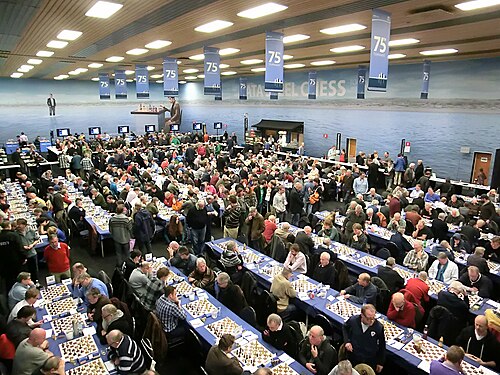
A competition involving more than two players or teams, generally played at a single venue (or series of venues) in a relatively short period of time. A tournament is divided into rounds, with each round consisting either of individual games or matches in the case of knockout tournaments and team tournaments. The assignment of opponents is called pairing, with the most popular systems being round-robin and Swiss. A tournament is usually referred to by the city in which it was played and the year, such as "London 1851", although there are well-known exceptions, such as "AVRO 1938".
tournament book
A book recording the scores of all the games in a tournament, usually with analysis of the best or most important games and some background on the event and its participants. One well-known example is Bronstein'sZurich International Chess Tournament 1953. The less comprehensive tournament bulletin is usually issued between the rounds of a prestigious event, giving the players and world media an instant record of the games of the previous round. Individual copies may be bundled together at the conclusion of the event to provide an inexpensive alternative to the tournament book.[367]
tournament director ("TD")
Also tournament controller [chiefly British]. Organizer and arbiter of a tournament, responsible for enforcing the tournament rules and the laws of chess.
Arriving at a position using a different sequence of moves than usual.[174]
With 4...Nbd7 Black sets a trap in the QGD (1.d4 d5 2.c4 e6 3.Nc3 Nf6 4.Bg5). White cannot win the pawn on d5 due to the Elephant Trap.
trap
A move that may tempt the opponent to play a losing move.[368]
trapped piece
A piece is said to be "trapped" when it is en prise and cannot escape its capture in any way (i.e by capturing a piece, moving the piece, or blocking the attacking piece). Any piece—including the queen—can become "trapped" if a player is careless. A trapped king is said to be checkmated.
Trébuchet: whoever has the move loses. 1.Kg4 Kxe4 2.Kg3 Ke3 3.Kg2 Ke2 4.Kg3 e4 5.Kf4 e3 6.Ke4 Kf2 and the black pawn will queen.
trébuchet
[from French, a type of siege engine] A theoretical position of mutual zugzwang in which either player would lose if it were their turn to move.[369]
A technique of moving a king along the vertices of a triangle to renter the same position but inverting the player to move, often used in king and pawn endgames (less commonly seen with other pieces) to lose a tempo and gain the opposition.[370]
Also Troitzky line. Endgame analysis by Alexey Troitsky of two knights versus a pawn found certain pawn positions that result in win, draw or loss. The resulting pawn positions on each file form what is known as the Troitsky line or Troitsky position.[372]
A tactic (also known as "removal of the guard") in which a defensive piece is captured, leaving one of the opponent's pieces undefended or underdefended.[375]
White to move should underpromote the c7-pawn to a rook; promoting to a queen gives stalemate.
Promoting a pawn to a rook, bishop, or knight instead of a queen. Rarely seen unless the knight can deliver a crucial check, or when promotion to a rook or a bishop instead of a queen is necessary to avoid stalemate.[261]
1.A sequence of moves or an alternative line of play, often applied to the opening. A variation does not have to have been played in a game; it may also be a possibility that occurs only in analysis.[368] Also called continuation.
2.The word "Variation" is also used to name specific sequences of moves within an opening. For an example, the Dragon Variation is part of the Sicilian Defense.[86]
A move whose sole purpose is to oblige the opponent to move. A waiting move is effective when the opponent has nothing but bad moves available (i.e. is in zugzwang).[377]
A pawn or square that can be attacked and is hard to defend.[379]
weak square
A square that cannot be easily defended from attack by an opponent. Often a weak square is unable to be defended by pawns (a hole) and can be theoretically occupied by a piece. Exchange or loss of a bishop may make all squares of that bishop's color weak resulting in a "weak square complex" on the light squares or the dark squares.[380]
The light-colored squares on the chessboard are often referred to as "the white squares" even though they often are some other light color. Similarly, "the white pieces" are sometimes actually some other (usually light) color.[39]
The designation for the player who moves first, even though the corresponding pieces, referred to as "the white pieces", are sometimes actually some other (usually light) color.
A victory for one of the two players in a game, which may occur due to checkmate, resignation by the other player, the other player exceeding the time control, or the other player being forfeited by the tournament director. Chess being a zero-sum game, this results in a loss for the other player. In a tournament a bye may be scored as a win.[383]
A combination in which two pieces work together to deliver an alternating series of checks and discovered checks in such a way that the opposing king is required to move on each turn. It is a potent technique, since, on every other move, the discovered check may allow the non-checking piece to capture an enemy piece without losing a tempo. The most famous example is Torre–Lasker, Moscow 1925.[384] Also called seesaw.
wing
The queenside a-, b-, and c-files; or the kingside f-, g-, and h-files.[385] Also called flank.
The name given to variations of several openings in which one player gambits a wing pawn, usually the b-pawn.[386]
winning percentage
A number calculated by adding together the number of games won and half of the number of games drawn (i.e. ignoring the losses), then dividing that total by the total number of games that were played. Another way of calculating the winning percentage is by taking the percentage of games won by a player plus half the percentage of drawn games. Thus, if out of 100 games a player wins 40 percent, draws 32 percent, and loses 28 percent, the winning percentage is 40 plus half of 32, i.e. 56 percent.[387]
winning position
A position is said to be a winning one if one specified side, with correct play, can eventually force a checkmate against any defense (i.e. perfect defense).[388] Also called won game.
When the power of a piece, either to attack or to defend, seems to pass through an intervening enemy piece. An X-ray attack, also known as a skewer, occurs when two pieces of the same color are caught in the same line of attack along a diagonal, rank, or file. The attacking piece forces the first and more valuable piece to move out of the way, which allows the second piece to be captured. An X-ray defense occurs when one piece is defended by another piece through an attacking enemy piece standing between the two.[392]
Z
zeitnot
[from German, "time need"] Having very little time on the clock to complete the remaining moves of a timed game.[393] Also called time pressure and time trouble.
[from German, "compulsion to move"] When a player is put at a disadvantage by having to make a move; where any legal move weakens the position. Zugzwang usually occurs in the endgame, and rarely in the middlegame.[395]
zwischenschach
[from German, "in-between check"] Playing a surprising check that the opponent did not consider when plotting a sequence of moves; a zwischenzug that is a check.[396]
[from German, "in-between move"] An "in-between" move, or an intermezzo, played before an expected reply. Often, but not always, this involves responding to a threat by posing an even greater threat, forcing the opponent to respond to the threat first.[397]
123"FIDE Handbook". B. Permanent Commissions / 01. International Title Regulations (Qualification Commission) / FIDE Title Regulations effective from 1 January 2024 / Article 0 Introduction / Section 0.6: "The Award of Titles". Retrieved 26 September 2025– via International Chess Federation.
↑Aronow, Isaac (2022-06-13). "The Words You Need to Know to Play Chess". The New York Times. ISSN0362-4331. Retrieved 2026-02-10.
↑Staunton, Howard (1876). Chess: Theory and Practice. pp.48–49. When the King is directly attacked by an adverse man, the move is called simply check; when the Piece or Pawn moved does not itself attack the King, but unmasks another which does, it is called a discovered check; and when both the man moved and the one unmasked attack the King, they are said to give double check.
↑Reinfeld 2014, p.74, Discovered check is really a kind of discovered attack, with this important difference: the 'discovering' piece moves away to allow its colleague to give check along the vacated line.
↑Reinfeld 2014, p.151, The X-ray attack, or skewer attack, is the opposite of the pin. In the X-ray attack, a piece attacks a hostile piece which is situated on a line with another piece of lesser value. When the attacked piece moves off the line, it exposes the second piece to capture.
12345Goichberg, Bill; Jarecki, Carol; Riddle, Ira Lee (1993). U.S. Chess Federation's Official Rules of Chess. David McKay Chess Library. p.329. ISBN9780812922172.
Agdestein, Simen (2013). How Magnus Carlsen Became the Youngest Chess Grandmaster in the World: The Story and the Games. New In Chess. ISBN9789056914424.
Alburt, Lev; Parr, Larry (2003). The Secrets of the Russian Chess Masters: Fundamentals of the Game. W. W. Norton & Company. ISBN9780393324525.
Ashley, Maurice (2007). Chess for Success: Using an Old Game to Build New Strengths in Children and Teens. Harmony/Rodale. ISBN9780307418883.
Avni, Amatzia (2014). Devious Chess: How to Bend the Rules and Win. Pavilion Books. ISBN9781849941822.
Barden, Leonard (20 January 2017). "Wesley So at top of Wijk standings going into weekend rounds". The Guardian.
Benjamin, Joel (2015). Liquidation on the Chess Board: Mastering the Transition into the Pawn Ending. New In Chess. ISBN9789056915544.
Borders, Mark (2007). The Self-Improvement of Chess. Lulu. ISBN9781430327646.
Brace, Edward R. (1977). An Illustrated Dictionary of Chess. Hamlyn. ISBN0-600-32920-8. (1989 reprint by Chartwell Books, ISBN978-1555213947)
Bronstein, David (2013). Zurich International Chess Tournament, 1953. Courier. ISBN9780486319063.
Brown, Isaac M. (2012). The British Chess Magazine, Volume 15. Nabu Press. ISBN9781276679046.
Burgess, Graham (2000). The Mammoth Book of Chess. Carroll & Graf. ISBN0-7867-0725-9.
Capablanca, Jose R. (2002). A Primer of Chess. Houghton Mifflin Harcourt. ISBN9780156028073.
Clarke, P. H. (2000) [1963]. 100 Soviet Chess Miniatures. Courier. ISBN9780486408446.
Cranston, Adam. (2017). "Heatwave Chess". Hammersmith Chess Club Newsletter.
David, Omid E.; Netanyahu, Nathan S.; Wolf, Lior (2016). DeepChess: End-to-End Deep Neural Network for Automatic Learning in Chess. International Conference on Artificial Neural Networks (ICANN) Vol. 9887. Springer. ISBN9783319447810.
de Groot, Adriaan D. (2008). Thought and Choice in Chess. Amsterdam University Press. ISBN9789053569986.
de la Villa, Jesús (2014). 100 Endgames You Must Know: Vital Lessons for Every Chess Player Improved and Expanded. New In Chess. ISBN9789056914547.
Desjarlais, Robert R. (2011). Counterplay: An Anthropologist at the Chessboard. University of California Press. ISBN9780520948204.
Dunne, Alex (1991). Complete Guide to Correspondence Chess. Thinkers' Press. ISBN9780938650522.
Dvoretsky, Mark (2006). Dvoretsky's Endgame Manual (2nded.). Russell Enterprises. ISBN1-888690-28-3.
Edwards, Jon (2007). Teach Yourself VISUALLY Chess. John Wiley & Sons. ISBN9780470121320.
Euwe, Max; Meiden, Walter (2013). Chess Master vs. Chess Amateur. Courier. ISBN9780486319896.
Evans, Larry (1967). New Ideas in Chess (Dover 1984ed.). Cornerstone Library. ISBN0-486-28305-4.
Evans, Larry; Silman, Jeremy; Roberts, Betty (1991). How to Get Better at Chess: Chess Masters on Their Art. Summit. ISBN9780945806059.
Evans, Larry (2009). This Crazy World of Chess. Cardoza. ISBN9781580422376.
"FIDE Handbook". E. MISCELLANEOUS / 01. Laws of Chess / FIDE Laws of Chess taking effect from 1 January 2023. Retrieved 26 September 2025– via International Chess Federation.
Fine, Gary Alan (2015). Players and Pawns: How Chess Builds Community and Culture. University of Chicago Press. ISBN9780226265032.
Fine, Reuben (1948). Practical Chess Openings. David McKay. ISBN9780812901696.{{cite book}}: ISBN / Date incompatibility (help)
Fine, Reuben (1976). The World's Great Chess Games. Courier. ISBN9780486245126.
Fischer, Bobby; Margulies, Stuart; Mosenfelder, Donn (1982). Bobby Fischer Teaches Chess. Random House. ISBN9780553263152.
Galperin, Misha (2012). Reimagining Leadership in Jewish Organizations: Ten Practical Lessons to Help You Implement Change and Achieve Your Goals. Jewish Lights. ISBN9781580234924.
Giddins, Steve (2017). The New In Chess Book of Chess Improvement: Lessons From the Best Players in the World's Leading Chess Magazine. New In Chess. ISBN9789056916954.
Golombek, Harry, ed. (1977). Golombek's Encyclopedia of Chess. Batsford. ISBN0-517-53146-1.
Grooten, Herman (2017). Chess Strategy for Club Players: The Road to Positional Advantage. Siles Press. ISBN9789056916947.
Hallman, J.C. (2013). The Chess Artist: Genius, Obsession, and the World's Oldest Game. Macmillan. ISBN9781466852235.
Harding, Tim (2015). Joseph Henry Blackburne: A Chess Biography. McFarland. ISBN9781476620282.
Hendriks, Willy (2014). Move First, Think Later: Sense and Nonsense in Improving Your Chess. New In Chess. ISBN9789056915407.
Hertan, Charles (2013). Power Chess for Kids: Learn How to Think Ahead and Become One of the Best Players in Your School. New In Chess. ISBN9789056914448.
Hertan, Charles (2014). Forcing Chess Moves: The Key to Better Calculation. New In Chess. ISBN9789056914653.
Hertan, Charles (2016). Start Playing Chess!: Learn the Rules of the Royal Game. New In Chess. ISBN9789056916879.
Hilbert, John S. (2013). Emil Kemeny: A Life in Chess. McFarland. ISBN9780786473595.
Kvanvig, Jonathan (2008). Oxford Studies in Philosophy of Religion, Volume 1 =Oxford University Press. Oxford University Press Oxford. ISBN9780191562204.
Lawrence, Al; Alburt, Lev (2010). Knack Chess for Everyone: A Step-by-Step Guide to Rules, Moves & Winning Strategies. Rowman & Littlefield. ISBN9780762762712.
Lawson, Kristan (1992). The Rules of Speed Chess. Jolly Roger Press. ISBN9780963420572.
Lee, Newton (2016). Google It: Total Information Awareness. Springer. ISBN9781493964154.
Newborn, Monty (2013). Deep Blue: An Artificial Intelligence Milestone. Springer Science & Business Media. ISBN9780387217901.
Nimzowitsch, Aron (2014). Aron Nimzowitsch 1928-1935: Annotated Games & Essays. New In Chess. ISBN9789056915162.
Nimzowitsch, Aron (2016). My System & Chess Praxis: His Landmark Classics in One Edition. New In Chess. ISBN9789056916602.
Nunn, John (1999). 101 Brilliant Chess Miniatures. Gambit. ISBN1-901983-16-1.
Nunn, John (1998). Secrets of Practical Chess. B H B Distribution. ISBN1901983013.
Ólafsson, Helgi (2014). Bobby Fischer Comes Home: The Final Years in Iceland, a Saga of Friendship and Lost Illusions. New In Chess. ISBN9789056914363.
Pandolfini, Bruce (1988). Pandolfini's Endgame Course: Basic Endgame Concepts Explained. Simon and Schuster. ISBN9780671656881.
Pandolfini, Bruce (1989). Chess Openings: Traps And Zaps. Touchstone. ISBN978-0671656904.
Pandolfini, Bruce (1992). Pandolfini's Chess Complete: The Most Comprehensive Guide to the Game, from History to Strategy. Simon and Schuster. ISBN9780671701864.
Pandolfini, Bruce (1993). Beginning Chess: Over 300 Elementary Problems for Players New to the Game. Simon and Schuster. ISBN9780671795016.
Pandolfini, Bruce (1995). Chess Thinking: The Visual Dictionary of Chess Moves, Rules, Strategies and Concepts (Fireside Chess Library). Everyman Chess. ISBN9780671795023.
Pandolfini, Bruce (2008). Pandolfini's Ultimate Guide to Chess. Simon and Schuster. ISBN9780743260985.
Pandolfini, Bruce (2009). Pandolfini's Endgame Course. Simon and Schuster. ISBN9780671656881.
Pandolfini, Bruce (2013). Weapons of Chess: An Omnibus of Chess Strategies. Simon and Schuster. ISBN9781476739700.
Pritchard, David (2012). The Right Way to Play Chess. Little, Brown. ISBN9780716023326.
Reinfeld, Fred (2014) [1955]. 1001 Winning Chess Sacrifices and Combinations. Wilshire Book Company. ISBN978-0-87980-111-3.
Reinfeld, Fred (2016). The Complete Chess Course. Russell Enterprises. ISBN9781941270240.
Renaud, Georges; Kahn, Victor (2015). The Art of Checkmate. Batsford. ISBN978-1849942706.
Schiller, Eric (2003). Encyclopedia of Chess Wisdom. Simon and Schuster. ISBN9781580420884.
Seirawan, Yasser; Stefanovic, George (1992). No Regrets • Fischer–Spassky 1992. International Chess Enterprises. ISBN1-879479-09-5.
Seirawan, Yasser; Silman, Jeremy (1994). Winning Chess Strategies: Proven Principles from One of the U.S.A.'s Top Chess Players. Microsoft Press. ISBN9781556156632.
Silman, Jeremy (1998). The Complete Book of Chess Strategy: Grandmaster Techniques from A to Z. Siles Press. ISBN9781890085018.
Silman, Jeremy (1999). The Amateur's Mind: Turning Chess Misconceptions Into Chess Mastery. Siles Press. ISBN978-1890085025.
Silver, Nate (2012). The Signal and the Noise: Why So Many Predictions Fail-but Some Don't. Penguin. ISBN9781101595954.
Snyder, Robert M. (2007). Winning Chess Traps: Opening Tactics for the Advanced Beginner and Intermediate Player. iUniverse. ISBN9780595453450.
Soltis, Andrew (2002). Chess Lists, 2d ed. McFarland. ISBN9780786412969.
Soltis, Andrew (2008). The Wisest Things Ever Said About Chess. Pavilion Books. ISBN9781849941020.
Soltis, Andrew (2012). What It Takes to Become a Chess Master. Pavilion Books. ISBN9781849940887.
Soltis, Andrew (2013). 100 Chess Master Trade Secrets: From Sacrifices to Endgames. Pavilion Books. ISBN9781849941556.
Soltis, Andrew (2014). New Art of Defence in Chess: chess defence tactics classic. Batsford. ISBN978-1849941600.
Souleidis, Georgios (2017). Winning with the Slow (but Venomous!) Italian: An Easy-to-Grasp Chess Opening for White. New In Chess. ISBN9789056916756.
Staunton, Howard (1875). The Chess-Player's Companion: comprising a new Treatise on Odds, and a Collection of Games. George Bell and Sons.
Staunton, Howard (2009). Staunton's Chess-Player's Handbook. Siles Press. ISBN9784871878210.
Staunton, Howard (2014). Chess: theory & practice; containing the laws & history of the game, together with an analysis of the openings, & a treatise of end games. Nabu Press. ISBN978-1294776635.
Steingass, Francis Joseph (1884). The Student's Arabic–English Dictionary. Crosby Lockwood and Son.
Suba, Mihai (2014). Dynamic Chess Strategy: Extended & Updated Edition. New In Chess. ISBN9789056914592.
Timman, Jan (2014). On The Attack: The Art of Attacking Chess According to the Modern Masters. MIT Press. ISBN9789056914905.
United States Chess Federation (2003). United States Chess Federation's Official Rules of Chess, Fifth Edition. Random House Puzzles & Games. ISBN9780812935592.
van de Oudeweetering, Arthur (2014). Improve Your Chess Pattern Recognition: Key Moves and Motifs in the Middlegame. New In Chess. ISBN9789056915421.
Waitzkin, Josh; Waitzkin, Fred (1995). Attacking Chess: Aggressive Strategies and Inside Moves from the U.S. Junior Chess Champion. Simon and Schuster. ISBN9780684802503.
Watson, John L. (1998). Secrets of Modern Chess Strategy: Advances Since Nimzowitsch. Gambit. ISBN9781901983074.
Webb, Simon (2006). Chess for Tigers. Batsford. ISBN978-0713489880.
Williams, Gareth (1997). Introduction to Chess: Learn to Play the World's Most Popular Game of Skill. Barnes & Noble Books. ISBN9780760705339.
Wilkinson, Sinclair L. (2008). Chess!: A Fun Game to Learn and Play. Xlibris. ISBN9781453550397.
Wilson, Fred (1994). 101 Questions on How to Play Chess. Dover. ISBN9780486282732.
Young, Franklin Knowles; Howell, Edwin C. (1894). The Minor Tactics of Chess: A Treatise on the Deployment of the Forces in Obedience to the Strategic Principle. Roberts brothers.