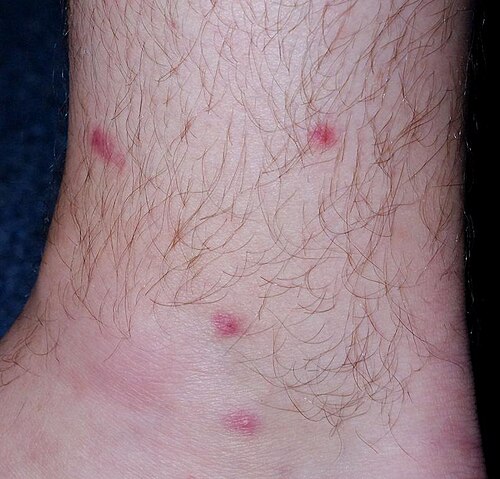
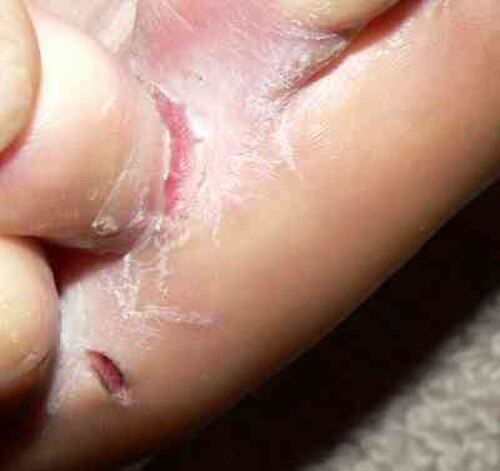
An itch (also known as pruritus) is a sensation that causes a strong desire or reflex to scratch.[1] Itches have many similarities to pain, and while both are unpleasant sensory experiences, their behavioral response patterns are different. Pain creates a withdrawal reflex, whereas itches lead to a scratch reflex.[2]
Unmyelinated nerve fibers for itches and pain both originate in the skin. Information for them is conveyed centrally in two distinct systems that both use the same nerve bundle and spinothalamic tract.[3]
Classification
Most commonly, an itch is felt in one place. If it is felt all over the body, then it is called generalized itch or generalized pruritus.[4] Generalized itch is infrequently a symptom of a serious underlying condition, such as cholestatic liver disease.
If the sensation of itching persists for six weeks or longer, then it is called chronic itch or chronic pruritus.[4][5]Chronic idiopathic pruritus or chronic pruritus of unknown origin is a form of itch that persists for longer than six weeks, and for which no clear cause can be identified.[6][7]
Signs and symptoms
Pain and itch have different mechanisms of onset and different behavioral responses. Pain elicits a withdrawal reflex, which leads to retraction, and therefore a reaction trying to protect an endangered part of the body. By contrast, an itch creates a scratch reflex, which draws one to the affected skin site. Itch generates stimulus of a foreign object underneath or upon the skin, and also the urge to remove it. For example, responding to a local itch sensation is an effective way to remove insects from one's skin.
Scratching has traditionally been regarded as a way to relieve oneself by reducing the annoying itch sensation. However, there are hedonic aspects to scratching, as one would find noxious scratching highly pleasurable.[2] This can be problematic with chronic itch patients, such as ones with atopic dermatitis, who may scratch affected spots until they no longer produce a pleasant or painful sensation, instead of when the itch sensation disappears.[8] These aspects might contribute to the compulsive nature of itch and scratching.[2]
Contagious itch
Events of "contagious itch" are common occurrences and may be more than a localized phenomenon in the place one scratches.
Itches due to specific stimuli
In polycythemia vera itching is particularly caused by skin contact with warm water, such as in bath or shower.
Itch inhibition due to pain
Studies done in the last decade have shown that itch can be inhibited by many other forms of painful stimuli, such as noxious heat,[9] physical rubbing or scratching, noxious chemicals, and electric shock.[10]
Xerosis, dry skin, frequently seen in the winter and also associated with older age, frequent bathing in hot showers or baths, and high-temperature and low-humidity environments.
Other diseases
Diabetes mellitus, a group of metabolic diseases in which a person has high blood sugar
Hyperparathyroidism, overactivity of the parathyroid glands resulting in excess production of parathyroid hormone (PTH)[15]
Polycythemia, which can cause generalized itching due to increased histamines. In polycythemia vera itching is particularly caused by skin contact with warm water, such as in bath or shower.
Itch originating in the skin is known as pruritoceptive, and can be induced by a variety of stimuli, including mechanical, chemical, thermal, and electrical stimulation, or infection. The primary afferent neurons responsible for histamine-induced itch are unmyelinatedC-fibres.[1]
Nociceptors. Two major classes of human C-fibrenociceptors exist: mechano-responsive nociceptors and mechano-insensitive nociceptors. Mechano-responsive nociceptors have been shown in studies to respond to mostly pain, and mechano-insensitive receptors respond mostly to itch induced by histamine. However, it does not explain mechanically induced itch or itch produced without a flare reaction that involves no histamine.[1] Therefore, it is possible that pruritoceptive nerve fibres have different classes of fibres, which is unclear in current research.[2]
Histology and skin layers. Sensitivity to pruritic stimuli is evenly distributed across the skin and has a clear spot distribution with similar density to that of pain. The different substances that elicit itch upon intracutaneous injection (injection within the skin) elicit only pain when injected subcutaneously (beneath the skin).
Molecular basis
Itch is often classified as that which is histamine mediated (histaminergic) and nonhistaminergic.
Itch is readily abolished in skin areas treated with nociceptor excitotoxincapsaicin but remains unchanged in skin areas rendered touch insensitive by pretreatment with anti-inflammatorysaponins. Although experimentally induced itch can still be perceived under a complete A-fiber conduction block, it is significantly diminished. Overall, itch sensation is mediated by A-delta and C nociceptors located in the uppermost layer of the skin.[26]
Gene expression. Using single-cell mRNA sequencing, clusters of genes expressed in itch-related tissues were identified, e.g. NP1-3, transmitting itch information; where NP3 expresses neuropeptides Nppb and Sst as well as genes involved in inflammatory itch (Il31ra, Osmr andCrystrl2). The histamine receptor gene Hrh1 was found in NP2 and NP3, suggesting that histaminergic itch is transmitted by both these pruriceptive sub clusters.[27]
Infection. Staphylococcus aureus, a bacterial pathogen associated with itchy skin diseases, directly activates pruriceptor sensory neurons to drive itch. Skin exposure to S. aureus causes robust itch and scratch-induced damage.[28]
Spinal itch pathway
After the pruriceptive primary afferent has been activated, the signal is transmitted from the skin into the spinal dorsal horn. In this area, a number of interneurons will either be inhibited or activated to promote activation of projection neurons, mediating the pruriceptive signal to the brain. The GRP-GRPR interneuron system has been found to be important for mediating both histaminergic and non-histaminergic itch, where the GRP neurons activate GRPR neurons to promote itch.[29][30]
Neurogenic itch, which is itch induced centrally but with no neural damage, is mostly associated with increased accumulation of exogenous opioids and possibly synthetic opioids.[24]
Inflammatory mediators—such as bradykinin, serotonin (5-HT) and prostaglandins—released during a painful or pruritic inflammatory condition not only activate pruriceptors but also cause acute sensitization of the nociceptors. In addition, expression of neuro growth factors (NGF) can cause structural changes in nociceptors, such as sprouting. NGF is high in injured or inflamed tissue. Increased NGF is also found in atopic dermatitis, a hereditary and non-contagious skin disease with chronicinflammation.[32] NGF is known to up-regulate neuropeptides, especially substance P. Substance P has been found to have an important role in inducing pain; however, there is no confirmation that substance P directly causes acute sensitization. Instead, substance P may contribute to itch by increasing neuronal sensitization and may affect release of mast cells, which contain many granules rich in histamine, during long-term interaction.[2]
Central sensitization
Noxious input to the spinal cord is known to produce central sensitization, which consists of allodynia, exaggeration of pain, and punctuate hyperalgesia, extreme sensitivity to pain. Two types of mechanical hyperalgesia can occur: 1) touch that is normally painless in the uninjured surroundings of a cut or tear can trigger painful sensations (touch-evoked hyperalgesia), and 2) a slightly painful pin prick stimulation is perceived as more painful around a focused area of inflammation (punctuate hyperalgesia). Touch-evoked hyperalgesia requires continuous firing of primary afferent nociceptors, and punctuate hyperalgesia does not require continuous firing which means it can persist for hours after a trauma and can be stronger than normally experienced. In addition, it was found that patients with neuropathic pain, histamine ionophoresis resulted in a sensation of burning pain rather than itch, which would be induced in normal healthy patients. This shows that there is spinal hypersensitivity to C-fiber input in chronic pain.[2]
Treatment
A variety of over-the-counter and prescription anti-itch drugs are available. Some plant products have been found to be effective anti-pruritics, others not. Non-chemical remedies include cooling, warming, soft stimulation.
Crotamiton (trade name Eurax) is an antipruritic agent available as a cream or lotion, often used to treat scabies. Its mechanism of action remains unknown.
Sometimes scratching relieves isolated itches, hence the existence of devices such as the back scratcher. Often, however, scratching only offers temporary relief and can intensify itching, even causing further damage to the skin, dubbed the "itch-scratch cycle".[36]
The mainstay of therapy for dry skin is maintaining adequate skin moisture and topical emollients.
No studies have been conducted to investigate the effectiveness of emollient creams, cooling lotions, topical corticosteroids, topical antidepressants, systemic antihistamines, systemic antidepressants, systemic anticonvulsants, and phototherapy on chronic pruritus of unknown origin.[33] However, there are clinical trials currently underway with dupilumab which is thought to alleviate itch by acting on the IL-4 receptor on sensory neurons.[37][38] The effectiveness of therapeutic options for people who are terminally ill with malignant cancer is not known.[22]
Epidemiology
Approximately 280million people globally, 4% of the population, have difficulty with itchiness.[39] This is comparable to the 2–3% of the population who have psoriasis.
History
In 1660, German physician Samuel Hafenreffer introduced the definition of pruritus (itch).[40]
See also
Feeling, a perceptual state of conscious experience.
Formication, a sensation that resembles that of small insects crawling on or under the skin
Pruritus ani (also known as anusitis), irritation of skin at the exit of the rectum (anus), causing the desire to scratch
Referred itch, a phenomenon in which a stimulus applied in one region of the body is felt as an itch or irritation in a different part of the body
Itching powder, a powder or powder-like substance that induces itching when applied onto human skin.
References
123Andersen HH, Elberling J, Arendt-Nielsen L (September 2015). "Human surrogate models of histaminergic and non-histaminergic itch". Acta Dermato-Venereologica. 95 (7): 771–777. doi:10.2340/00015555-2146. PMID26015312.
123456Ikoma A, Steinhoff M, Ständer S, etal. (July 2006). "The neurobiology of itch". Nature Reviews. Neuroscience. 7 (7): 535–547. doi:10.1038/nrn1950. PMID16791143. S2CID9373105.
↑Greaves MW, Khalifa N (October 2004). "Itch: more than skin deep". International Archives of Allergy and Immunology. 135 (2): 166–172. doi:10.1159/000080898. PMID15375326. S2CID13376216.
12Molkara S, Sabourirad S, Molooghi K (July 2019). "Infectious differential diagnosis of chronic generalized pruritus without primary cutaneous lesions: a review of the literature". International Journal of Dermatology. 59 (1): 30–36. doi:10.1111/ijd.14587. PMID31364165. S2CID198998956.
↑Harrison IP, Spada F (July 2019). "Breaking the Itch-Scratch Cycle: Topical Options for the Management of Chronic Cutaneous Itch in Atopic Dermatitis". Medicines. 6 (3): 76. doi:10.3390/medicines6030076. PMC6789602. PMID31323753.
↑Erickson S, Nahmias Z, Rosman IS, Kim BS (July 2018). "Immunomodulating Agents as Antipruritics". Dermatologic Clinics. 36 (3): 325–334. doi:10.1016/j.det.2018.02.014. PMID29929604. S2CID49336771.
↑Hinkle JL, Cheever KH (30 August 2018). Brunner and Suddarth's Textbook of Medical-Surgical Nursing. Wolters kluwer india Pvt Ltd. p.1269. ISBN978-93-87963-72-6. Archived from the original on 23 September 2023. Retrieved 2 July 2022.
↑Karsak M, Gaffal E, Date R, etal. (June 2007). "Attenuation of allergic contact dermatitis through the endocannabinoid system". Science. 316 (5830): 1494–1497. Bibcode:2007Sci...316.1494K. doi:10.1126/science.1142265. PMID17556587. S2CID37611370.
↑Yosipovitch G, Fast K, Bernhard JD (December 2005). "Noxious heat and scratching decrease histamine-induced itch and skin blood flow". The Journal of Investigative Dermatology. 125 (6): 1268–1272. doi:10.1111/j.0022-202X.2005.23942.x. PMID16354198.
↑Ward L, Wright E, McMahon SB (January 1996). "A comparison of the effects of noxious and innocuous counterstimuli on experimentally induced itch and pain". Pain. 64 (1): 129–138. doi:10.1016/0304-3959(95)00080-1. PMID8867255. S2CID25772165.
↑Pfützner W, Thomas P, Niedermeier A, etal. (20 February 2003). "Systemic contact dermatitis elicited by oral intake of Balsam of Peru". Acta Dermato-Venereologica. 83 (4): 294–295. doi:10.1080/00015550310016599. PMID12926805.
↑Usatine RP, Riojas M (August 2010). "Diagnosis and management of contact dermatitis". American Family Physician. 82 (3). Aafp.org: 249–255. PMID20672788. Archived from the original on 9 April 2014. Retrieved 9 April 2014.
↑Byers JP (2006). Metalworking Fluids (Seconded.). CRC Press. ISBN1-4200-1773-X. Archived from the original on 12 January 2023. Retrieved 5 March 2016.
↑Feingold BF (1973). Byers JP (ed.). Introduction to clinical allergy. the University of Michigan. ISBN0-398-02797-8. Archived from the original on 12 January 2023. Retrieved 24 June 2020.
↑LaBagnara, James. eMedicine–HyperparathyroidismArchived 2008-12-02 at the Wayback Machine. emedicine.com
↑Jovičić, Sanja; Balaban, Jagoda; Gajanin, Vesna (24 June 2023). "Association of systemic diseases with chronic pruritus". Scripta Medica. 54 (2): 163–167. doi:10.5937/scriptamed54-43882. ISSN2490-3329.
↑Valent P, Akin C, Nedoszytko B, etal. (27 November 2020). "Diagnosis, Classification and Management of Mast Cell Activation Syndromes (MCAS) in the Era of Personalized Medicine". International Journal of Molecular Sciences. 21 (23): 3 f. doi:10.3390/ijms21239030. PMC7731385. PMID33261124.
↑Shah, Serena M.; Golpanian, Rachel S.; Hashimoto, Takashi; Rosen, Jordan D.; Nattkemper, Leigh; Albornoz, Christian; Chan, Yiong H.; Yosipovitch, Gil (2020). "Itch intensity and characteristics in fibromyalgia patients in an outpatient rheumatology clinic". Itch. 5 (2) e33. doi:10.1097/itx.0000000000000033.
↑Karaosmanoğlu, N.; Cetinkaya, P. O.; Mülkoğlu, C. (2024). "Investigating the relationship between chronic pruritus and fibromyalgia: An evaluation of 200 patients". Archives of Dermatological Research. 316 (8): 545. doi:10.1007/s00403-024-03291-8. PMID39162842.
12Boehlke, Christopher; Joos, Lisa; Coune, Bettina; Becker, Carola; Meerpohl, Joerg J.; Buroh, Sabine; Hercz, Daniel; Schwarzer, Guido; Becker, Gerhild (14 April 2023). "Pharmacological interventions for pruritus in adult palliative care patients". The Cochrane Database of Systematic Reviews. 4 (2023) CD008320. doi:10.1002/14651858.CD008320.pub4. ISSN1469-493X. PMC11339634. PMID37314034.
1234Twycross R, Greaves MW, Handwerker H, etal. (January 2003). "Itch: scratching more than the surface". QJM. 96 (1): 7–26. doi:10.1093/qjmed/hcg002. PMID12509645.
↑"Essential pruritus". Archived from the original on 6 August 2020. Retrieved 25 July 2019.
↑Schmelz M, Schmidt R, Bickel A, etal. (October 1997). "Specific C-receptors for itch in human skin". The Journal of Neuroscience. 17 (20): 8003–8008. doi:10.1523/JNEUROSCI.17-20-08003.1997. PMC6793906. PMID9315918.
↑Usoskin D, Furlan A, Islam S, etal. (January 2015). "Unbiased classification of sensory neuron types by large-scale single-cell RNA sequencing". Nature Neuroscience. 18 (1): 145–153. doi:10.1038/nn.3881. PMID25420068. S2CID205437148.
↑Deng, Liwen; Costa, Flavia; Blake, Kimbria J.; etal. (2023). "S. aureus drives itch and scratch-induced skin damage through a V8 protease-PAR1 axis". Cell. 186 (24): 5375–5393.e25. doi:10.1016/j.cell.2023.10.019. PMC10669764. PMID37995657.
↑Han L, Ma C, Liu Q, etal. (February 2013). "A subpopulation of nociceptors specifically linked to itch". Nature Neuroscience. 16 (2): 174–182. doi:10.1038/nn.3289. PMC3557753. PMID23263443.
↑Sun YG, Chen ZF (August 2007). "A gastrin-releasing peptide receptor mediates the itch sensation in the spinal cord". Nature. 448 (7154): 700–703. Bibcode:2007Natur.448..700S. doi:10.1038/nature06029. PMID17653196. S2CID4407979.
↑Bernhard JD (2005). "Itch and pruritus: what are they, and how should itches be classified?". Dermatologic Therapy. 18 (4): 288–291. doi:10.1111/j.1529-8019.2005.00040.x. PMID16296999. S2CID7107271.
↑Rukwied R, Lischetzki G, McGlone F, etal. (June 2000). "Mast cell mediators other than histamine induce pruritus in atopic dermatitis patients: a dermal microdialysis study". The British Journal of Dermatology. 142 (6): 1114–1120. doi:10.1046/j.1365-2133.2000.03535.x. PMID10848733. S2CID23996950.
12Andrade A, Kuah CY, Martin-Lopez JE, etal. (Cochrane Skin Group) (January 2020). "Interventions for chronic pruritus of unknown origin". The Cochrane Database of Systematic Reviews. 1 (1) CD013128. doi:10.1002/14651858.CD013128.pub2. PMC6984650. PMID31981369.
↑El Mulla KF, Khalifa DE, Gawish RI, Eldeeb ME (2023). "Phototherapy versus pregabalin in treatment of chronic kidney disease associated pruritus: randomized controlled study". Journal of the Egyptian Women's Dermatologic Society. 20 (2): 81. doi:10.4103/jewd.jewd_50_22. ISSN1687-1537.
↑Rinaldi G (April 2019). "The Itch-Scratch Cycle: A Review of the Mechanisms". Dermatology Practical & Conceptual. 9 (2): 90–97. doi:10.5826/dpc.0902a03. PMC6502296. PMID31106010.
↑"Efficacy and Safety of Subcutaneous Dupilumab for the Treatment of Adult Participants With Chronic Pruritus of Unknown Origin (CPUO) (LIBERTY-CPUO-CHIC)". ClinicalTrials.gov. NCT05263206. Archived from the original on 14 January 2023. Retrieved 14 January 2023.
↑Vos T, Flaxman AD, Naghavi M, etal. (Global Burden of Disease Study Collaborators) (December 2012). "Years lived with disability (YLDs) for 1160 sequelae of 289 diseases and injuries 1990-2010: a systematic analysis for the Global Burden of Disease Study 2010". Lancet. 380 (9859): 2163–2196. doi:10.1016/S0140-6736(12)61729-2. PMC6350784. PMID23245607.
↑Jean Bolognia; Joseph L. Jorizzo; Ronald P. Rapini (2008). Dermatology (2nded.). St. Louis, Mo.: Mosby/Elsevier. ISBN978-1-4160-2999-1. OCLC212399895.
Further reading
Han L, Dong X (6 May 2014). "Itch mechanisms and circuits". Annual Review of Biophysics. 43 (1): 331–355. doi:10.1146/annurev-biophys-051013-022826. PMC4081479. PMID24819620.
Andrew D, Craig AD (January 2001). "Spinothalamic lamina I neurons selectively sensitive to histamine: a central neural pathway for itch". Nature Neuroscience. 4 (1): 72–77. doi:10.1038/82924. PMID11135647. S2CID28727869.
"Pruritus". National Cancer Institute. 2003. Archived from the original on 25 December 2005. Retrieved 22 August 2005.
Category:
Pruritic skin conditions
Hidden categories:
Articles with short description
Short description is different from Wikidata
Use American English from October 2025
All Wikipedia articles written in American English
Use dmy dates from October 2025
All articles with unsourced statements
Articles with unsourced statements from October 2025
Webarchive template wayback links
Articles with unsourced statements from October 2021