Loading article…
| セミッシラ島のダイアナ妃 ワンダーウーマン | |
|---|---|
.png/500px-Wonder_Woman_(circa_2020).png) ワンダーウーマン #750 (2020 年 1 月) のワンダーウーマン。アート: ヘスス・メリノ (鉛筆)、ビセンテ・シフエンテス (インク)、ロムロ・ファハルド (色彩) | |
| 出版情報 | |
| 出版社 | DCコミックス |
| 初登場 | オールスターコミックス #8 (1941年10月) [a] [b] |
| 作成者 |
|
| ストーリー内情報 | |
| 分身 | ダイアナ妃(アマゾンのアイデンティティ) ダイアナ・プリンス(民間人のアイデンティティ) |
| 種 | |
| 原産地 | セミッシラ |
| チーム所属 | |
| パートナーシップ | |
| 能力 | リストを見る
|
ワンダーウーマンは、アメリカの心理学者で作家のウィリアム・モールトン・マーストン(ペンネーム:チャールズ・モールトン)[2]とアーティストのハリー・G・ピーターによって1941年にDCコミックスのために創作されたスーパーヒロインである。マーストンの妻エリザベスと彼らのパートナーであるオリーブ・バーン[3]が、このキャラクターの外見のインスピレーションの元になったとされている。[2] [4] [5] [6] [7]
ワンダーウーマンはDCコミックスが発行するアメリカンコミックに登場する。[8]このキャラクターはジャスティスリーグの創設メンバーである。このキャラクターは1941年10月21日に発行されたオールスターコミックス#8で初めて登場し[9] 、1942年1月のセンセーションコミックス#1で初めてフィーチャーされた。ワンダーウーマンのタイトルはそれ以来ほぼ継続的にDCコミックスによって出版されている。[10]彼女の故郷である島国セミッシラでは、彼女の正式な称号はセミッシラのダイアナ妃である。彼女は故郷以外の社会に溶け込むとき、民間人としてのアイデンティティであるダイアナ・プリンスを採用することがある。[11]
ワンダーウーマンのオリジンストーリー(黄金時代から青銅器時代まで)では、彼女は母親であるヒッポリタ女王によって粘土で彫刻され、アマゾンとしての人生を与えられ、ギリシャの神々から超人的な力を授かったとされている。2011年にDCは彼女の背景を変更し、彼女はゼウスとヒッポリタの実の娘であり、母親と叔母のアンティオペとメナリッペによって共同で育てられたという後付け設定を加えた。このキャラクターは数十年にわたって描写が変化しており、1960年代後半には一時的に完全に力を失った。1980年代までには、アーティストのジョージ・ペレスが彼女に運動選手のような外見を与え、アマゾンの血統を強調した。[12] [13]彼女は真実の投げ縄、壊れないブレスレット、発射物として機能するティアラ、そして古い物語ではアマゾンの技術に基づいたさまざまな装置など、魔法 のアイテムを多数所有している。
ワンダーウーマンのキャラクターは第二次世界大戦中に作られた。物語の中では当初、このキャラクターは枢軸軍や様々なスーパーヴィランと戦っている姿で描かれていたが、時が経つにつれて彼女の物語はギリシャ神話のキャラクター、神々、モンスターに重点を置くようになった。多くの物語ではワンダーウーマンが束縛から解放される様子が描かれており、これは1940年代のコミックで一般的だった「窮地に陥った乙女」という比喩と対照的だった。 [14] [15]デビュー以来数十年の間に、ワンダーウーマンは彼女を破滅させようとする敵のキャストを獲得しており、その中にはチーター、アレス、キルケー、ドクター・ポイズン、ギガンタ、ブルー・スノーマン、ドクター・サイバーなどの古典的な悪役や、ベロニカ・ケイルやファースト・ボーンなどの最近の敵も含まれる。ワンダーウーマンは、スーパーヒーローチーム「ジャスティス・ソサエティ」(1941年)や「ジャスティス・リーグ」(1960年)をフィーチャーしたコミックにも定期的に登場している。[16]
このキャラクターは、テレビ、映画、アニメ、商品、玩具に幅広く採用されていることもあって、世界中で認知されている大衆文化の典型的な人物である。10月21日はワンダーウーマンの日であり、オールスターコミックス#8での彼女の初登場を記念している[17] (2017年は同名映画の公開に合わせて6月3日となった)。[18]
ワンダーウーマンはラジオからテレビ、映画まで様々なメディアで取り上げられており、アパレル、玩具、人形、宝石、ビデオゲームなど世界中で販売されている商品に登場しています。シャノン・ファーノン、スーザン・アイゼンバーグ、マギー・Q、ルーシー・ローレス、ケリー・ラッセル、ロザリオ・ドーソン、コビー・スマルダーズ、レイチェル・キムジー、スタナ・カティックなどがアニメ化作品でこのキャラクターの声を担当しています。ワンダーウーマンは映画やテレビではリンダ・ハリソン、キャシー・リー・クロスビー、リンダ・カーター、ミーガン・ゲイル、エイドリアンヌ・パリッキが演じ、DCエクステンデッド・ユニバースの映画ではガル・ガドットが演じています。
出版履歴
.jpg/500px-Wonder_Woman_Concept_Art_(Golden_Age).jpg)
創造
1940年10月の『ファミリー・サークル』誌のインタビューで、ウィリアム・モールトン・マーストンは漫画本の未実現の可能性について語った。[19]この記事は漫画出版者のマックス・ゲインズの目に留まり、ゲインズはマーストンをナショナル・ピリオディカルズとオール・アメリカン・パブリケーションズの教育コンサルタントとして雇った。この2社は後に合併してDCコミックスとなった。[20]当時、マーストンは独自の新しいスーパーヒーローを創りたいと考えており、妻で同僚の心理学者エリザベスは女性にすべきだと提案した。[21]
ポリグラフの発明ですでに有名だった心理学者ウィリアム・モールトン・マーストンは、拳や火力ではなく愛で勝利する新しいタイプのスーパーヒーローのアイデアを思いついた。「いいわ」とエリザベスは言った。「でも、女性にしてください」
マーストンはゲインズにそのアイデアを紹介した。ゴーサインが下りると、マーストンはワンダーウーマンを生み出した。彼はワンダーウーマンを、その時代の型破りで解放された女性の典型だと考えた。マーストンはまた、このカップルとポリアモリーの関係にあったオリーブ・バーンが身に着けていたブレスレットからもインスピレーションを得た。 [ 22]ワンダーウーマンは、マーストンが脚本を書いたオールスター・コミックス第8号(表紙は1941年12月/1942年1月、発売は1941年10月)でデビューした。マーストンは収縮期血圧測定装置の考案者であり、これはポリグラフ(嘘発見器)の開発に不可欠だった。マーストンはポリグラフでの経験から、女性は特定の状況においては男性よりも正直で、より効率的に働けると確信した。[24]
マーストンはワンダーウーマンを、社会を率いるべきと彼が信じる理想の愛のリーダーの寓話としてデザインした。「率直に言って、ワンダーウーマンは、私が信じる世界を支配するべき新しいタイプの女性に対する心理的プロパガンダです」とマーストンは書いている。[25]
1943年のアメリカン・スカラー誌でマーストンはこう書いている。[26]
女性の原型に力強さや強さ、権力が欠けている限り、少女ですら少女でいたいとは思わない。少女になりたくないから、善良な女性のように優しく従順で平和を愛する女性になりたくないのだ。女性の強い性質は、その弱さゆえに軽蔑されてきた。明らかな解決策は、スーパーマンの強さと善良で美しい女性の魅力をすべて兼ね備えた女性キャラクターを創造することだ。
— ウィリアム・モールトン・マーストン
マーストンは、率直なフェミニスト、ポリアモリストであり、女性の優位性を固く信じていた。[27] [28]彼は、束縛と服従を「尊敬に値する高貴な習慣」と表現した。マーストンは、ワンダーウーマンに対する弱点を書いたが、それは「アフロディーテの法則」と名付けた架空の規定に付随しており、男性が彼女の「服従のブレスレット」を鎖でつなぐと、彼女のアマゾンの超人的な力が失われるというものだった。[29]
平和への唯一の希望は、元気と束縛されない力にあふれた人々に束縛されることを楽しむことを教えることです...人間関係において、束縛されない自己主張よりも他人による自己制御の方が楽しい場合にのみ、安定した平和な人間社会を期待することができます。
— ウィリアム・モールトン・マーストン
黄金時代
当初、ワンダーウーマンは、アマゾンのチャンピオンであり、 アマゾンの孤島の故郷に飛行機が墜落したアメリカの諜報員であるスティーブ・トレバーを「人間の世界」に戻し、犯罪やナチスの悪と戦う権利を獲得した。[30]
この時期、ワンダーウーマンはジャスティス・ソサエティ・オブ・アメリカにチームの秘書として参加した。[31] [32]
シルバーエイジ
1960年代のシルバーエイジの間、作家ロバート・カニガーのもとで、ワンダーウーマンの起源は他のキャラクターと共に改訂された[33] 。新しい起源の物語は、キャラクターのギリシャ神話的ルーツを増やした。ベビーベッドで各神の祝福を受け、ダイアナは「アフロディーテのように美しく、アテナのように賢く、ヘラクレスのように強く、ヘルメスのように素早い」ものになる運命にある[34]。
1960年代の終わりに、マイク・セコウスキーの指導の下、ワンダーウーマンは、仲間のアマゾンたちと一緒に別の次元に行くのではなく、人間の世界に残るためにパワーを手放した。ワンダーウーマンは常にダイアナ・プリンスであり、モッズ・ブティックをオープンした。彼女は、ダイアナに武術と武器のスキルを教える、易経という中国人の師匠を得た。ダイアナは、パワーの代わりに戦闘スキルを使って、スパイ活動から神話まで、さまざまなジャンルを網羅する冒険に参加した。[35] [36]彼女の物語のこの段階は、イギリスのスパイ・スリラー映画「アベンジャーズ」と、ダイアナ・リグのエマ・ピールの描写に直接影響を受けた。[37]
青銅器時代
1970年代初頭、このキャラクターはジャスティス・リーグ・オブ・アメリカでスーパーヒーローとしてのルーツに戻り、自身のタイトルでは第二次世界大戦時代を舞台にしました。 [38]しかし、これは最終的には当時のテレビシリーズの人気によるもので、そのテレビシリーズでもワンダーウーマンが第二次世界大戦時代を舞台にしていたため、テレビ番組でも同じことが行われたため、ワンダーウーマンの時代設定も1970年代に戻されました。
新たな10年が到来し、DC社長のジェネット・カーンはワンダーウーマンの外見を一新するよう命じた。DCが1977年に採用した「弾丸」ロゴもデザインしたアーティストのミルトン・グレイザーは、彼女の胴着の鷲を想起させてそれに代わる様式化された「WW」エンブレムを制作し、1982年にデビューした。[39]このエンブレムはスタジオのレタラー、トッド・クラインによって月刊誌のロゴに取り入れられ、1年半続いた後グレイザーのスタジオのバージョンに置き換えられた。[40]このシリーズはジェリー・コンウェイが執筆したスティーブ・トレバーとワンダーウーマンの結婚を描いた第329号(1986年2月)で打ち切られた。
近代
1985年のクライシス・オン・インフィニット・アース・シリーズに続いて、ジョージ・ペレス、レン・ウェイン、グレッグ・ポッターはキャラクターの起源の物語を書き直し、ワンダーウーマンをセミッシラからパトリアークの世界への使者および大使として描き、外の世界に平和をもたらす使命を負った。ペレスはワンダーウーマンの物語と起源にギリシャ神話のさまざまな神々や概念を取り入れた。彼のキャラクターの表現は、ダイアナが粘土から生まれたという広く受け入れられている起源を拡張し、現代のワンダーウーマンの物語の基礎となった。この再発売は批評的にも商業的にも成功した。[41]
21世紀
2010年代
2010年8月(第600号)、J・マイケル・ストラジンスキーがシリーズの執筆を引き継ぎ、ワンダーウーマンを神々によって作られた別のタイムラインに登場させました。そのタイムラインでは、パラダイス島は破壊され、アマゾンは世界中に散らばっていました。[42]このタイムラインでは、ダイアナはニューヨークで育った孤児です。世界中がワンダーウーマンの存在を忘れており、このシリーズの主なストーリーは、ダイアナが現実を取り戻そうとするが、彼女自身はそれを正確に覚えていないというものでした。モリガンと呼ばれる3人の死の女神がワンダーウーマンの主な敵として登場しました。[43] [44]このシリーズでは、ワンダーウーマンはジム・リーがデザインした新しい衣装を着ています。[45]ストラジンスキーはプロットを決定し、ワンダーウーマン#605まで執筆を続けました。その後、ライターのフィル・ヘスターが執筆を続け、最終的にはワンダーウーマン#614で終了しました。[46]

2011年の『The New 52』では、DCコミックスは新世代の読者を引き付けるために出版物の全ラインをリニューアルし、ワンダーウーマンのコミックブック第4巻をリリースした。ブライアン・アザレロとクリフ・チャンがそれぞれ執筆と美術を担当し、キャラクターの歴史を大幅に刷新した。この新しいシリーズでは、ワンダーウーマンはオリジナルのマーストンのコスチュームに似たコスチュームを着用し(クラシックな赤青金ではなく赤黒銀の配色)、剣と盾を使用し、完全に新しい起源を持っている。もはや神々の魔法によって命を吹き込まれた粘土人形ではなく、半女神であり、ヒッポリタとゼウスの生まれながらの娘である。アザレロとチャンによるキャラクターの刷新は批評家から絶賛されたが、キャラクターの長年のファンの間では非常に賛否両論だった。[47] [48] [49] [50]
2016年、DCコミックスは「 DCリバース」シリーズの一環として再びすべての出版物をリニューアルし、グレッグ・ルッカの手によるワンダーウーマンの第5巻が隔月で発売された。このワンダーウーマンの第5巻は、リバース後に確立された現在のシリーズである「DCユニバース」の一部である。当初、新シリーズでは各号間に存在する通常のストーリーラインは使用されず、代わりに2つの別々のストーリーラインが本を共有し、1つのストーリーが1号おきに公開され、もう1つのストーリーラインはその合間に公開された。この慣行は、奇数号のストーリーライン「The Lies」と偶数号の「Year One」から始まった。これらの号で提示された新しいストーリーラインは、以前のNew 52シリーズのイベントを事実上後付けしたものである。 「嘘」[51]のストーリーでは、ダイアナがアマゾンの女王や戦争の神になった以前のワンダーウーマンシリーズの多くの出来事が、実は謎の悪役が作り出した幻影であり、彼女はセミッシラを去って以来一度も戻っておらず、戻ることもできないことが明らかにされている。「イヤーワン」のストーリーは、ダイアナのまったく新しいオリジンストーリーとして提示されており、[52]彼女がオリンポスの神々から力を得た方法を明らかにしており、[53]彼女を古典的なDCのルーツに戻すことを意図していた。ワンダーウーマンは、赤いマントとプテルゲスやすね当てなどの軽い鎧の装備を含む古代ギリシャのモチーフで改訂された外観でDCリバースに登場します。投げ縄とブレスレットに加えて、彼女は現在、剣と盾を定期的に使用しています。ワンダーウーマン:リバースのアーティスト、リアム・シャープは、新しい鎧は彼女がより自由に動けるようにする実用的なピースであると説明しました。[54]
2018年、DCコミックスはG・ウィロー・ウィルソンをワンダーウーマン連載の新作家として発表した。ウィルソンは11月に「正義の戦争」と題された最初のストーリーアークで執筆を開始した。[55]
2020年代
2020年にスティーブ・オーランドがウィルソンの後任となり、年内にマリコ・タマキが引き継いだ。2020年にはDCのドゥームズデイ・クロックイベントにより現在のシリーズがオリジナルの黄金時代と1つの連続したシリーズとして統合されたため、ワンダーウーマンのコミックスの号の番号順序が再編された。これは、前の号が#83であったにもかかわらず、次の号が#750であったことを意味した。これを記念して、この号は長くなり、ワンダーウーマンのキャラクターを讃える様々な短編小説を収集し、フィル・ヒメネス、ゲイル・シモーン、グレッグ・ルッカなどの以前の作家が復帰した。[56] 2021年初頭、ベッキー・クルーナンとマイケル・コンラッドがインフィニット・フロンティアの一部として第770号からワンダーウーマンの作家を務め、トラヴィス・ムーアが最初のアーティストを務めることが発表された。 [57]彼らの連載は2023年6月の第800号まで続き、そこでシリーズはDCの夜明けの再開の一環として新しい第1号を受け取ることが発表されました。トム・キングが作家を務め、ダニエル・サンペールがアートを提供し、第1号は2023年9月6日に発売され、第800号にはダイアナの将来の娘リジー/トリニティを紹介するシリーズの準備となる短編小説が掲載されます。[58] [59]
特徴づけ
ダイアナ・プリンス

ダイアナ・プリンスはワンダーウーマンの民間人としてのアイデンティティであり、1942年1月のセンセーション・コミックス#1で初めて登場しました。このカバーアイデンティティにより、ワンダーウーマンは人間社会で気付かれずに活動することができます。コミックの黄金時代に、ダイアナ・プリンスは第二次世界大戦中に米軍の看護師でした。ワンダーウーマンは、南米で婚約者と合流するためにお金を必要としていた本物のダイアナ・プリンスと出会った後、このアイデンティティを採用しました。資金と引き換えに、ワンダーウーマンは彼女の資格を受け取りました。ダイアナ・プリンスとして、彼女は当初軍の秘書として働いており、特に恋愛対象であったスティーブ・トレバー少佐の秘書を務めていました。この役割により、彼女は本当の身元を明かすことなくトレバーの近くにいて、彼の任務を助けることができました。
コミックのシルバー・エイジとブロンズ・エイジでは、ダイアナ・プリンスのペルソナが再定義された。実在のダイアナ・プリンスからアイデンティティを獲得するという以前の話は省略され、代わりにダイアナ・プリンスは軍事情報部に勤務する人物として描かれた。この期間中、ワンダーウーマンはスーパーパワーを失い、熟練しているが超人ではないキャラクターであるダイアナ・プリンスとしてのみ機能する段階を経験した。彼女のキャリアは時とともに進化し、軍事情報部から宇宙飛行士、国連職員までの役割が多岐にわたる。この時代、ダイアナ・プリンスはモデスティ・ブレイズなどのキャラクターに似た大冒険に従事した。
クライシス・オン・インフィニット・アースのストーリーラインの後、ワンダーウーマンとダイアナ・プリンスの歴史はリブートされました。ダイアナ・プリンスのアイデンティティは当初復活せず、ワンダーウーマンは単にダイアナ・オブ・セミッシラとして知られていました。しかし、潜入捜査では、彼女は時折ダイアン・プリンスの別名を使用していました。物議を醸した行動による追放期間の後、ワンダーウーマンは再びダイアナ・プリンスのアイデンティティを完全に採用し、メタヒューマン事務局のエージェントとして働きました。この役割は、彼女が人類と再びつながるのを助け、彼女のスーパーヒーロー活動の隠れ蓑となりました。
人格
ついに、男たちの憎しみと戦争で引き裂かれた世界に、男たちの問題や偉業など子供の遊びに過ぎない女性が現れた。その女性の素性は誰にも知られていないが、目まぐるしく変化する世界でそのセンセーショナルな偉業は傑出している。
彼女は誠実さと人間性の象徴として機能し、男性の世界がアマゾンであることの意味を知るようになります。最高の男性アスリートや最強のレスラーの 100 倍の敏捷性と強さを備えた彼女は、不正を復讐し、間違いを正すためにどこからともなく現れます。
アフロディーテのように愛らしく、アテナのように賢く、マーキュリーのスピードとヘラクレスの強さを兼ね備えた彼女は、ワンダーウーマンとしてのみ知られています。
—ナレーター - オールスターコミックス #8 (ワンダーウーマン紹介) - ウィリアム・モールトン・マーストン著
多くの作家がダイアナを様々な性格や口調で描いてきた。その両極端の間を行き来する人物として、世俗的な戦士として、非常に慈悲深く穏やかな大使として、また時には素朴で無邪気な人物として、作家によって描かれてきた。変わらず存在し続け、このキャラクターの柱となっているのは、彼女の支配的な力の側面と、愛、共感、慈悲、そして強い良心に対する彼女の圧倒的な信念である、育む人間性の二分性である。後者の側面は、彼女がスターサファイアに入団した理由であった。[60] [61]
脚本家のゲイル・シモーンは、シリーズ執筆中にワンダーウーマンを演じたことで称賛され、IGNの漫画評論家ダン・フィリップスは「彼女はダイアナを非常に親しみやすく同情的なキャラクターに作り上げた」と評した。[62]
黄金時代、ワンダーウーマンはアマゾンの規範に従い、困っている人なら誰でも、女性蔑視の人でも助け、誰かを救っても報酬を受け取らなかった。[63]一方、現代版のワンダーウーマンは他に選択肢がないときには致命的な行動を取ることが示されており、スーパーマンの命を救うためにマクスウェル・ロードを殺害したのがその例である。[64] [65]
ブライアン・アザレロはインタビューで、ニュー52版のキャラクターは「自信に満ち」、「衝動的」、「心の優しい」キャラクターとして書かれていると述べた。彼は、彼女の思いやりの気持ちを彼女の強みと弱みの両方として言及した。[66]
彼女の特徴的な性格描写は、一連の神話的な感嘆詞である。「偉大なるアフロディーテ!」に始まり、「偉大なるヘラ!」[67] 、 「慈悲深きミネルヴァ!」、そして「苦悩するサッポー!」と続き、その一部はエリザベス・ホロウェイ・マーストンによって提供された。[68] [3]
その他
ダイアナは死後、忠実な忠誠心を称えられ、神々から真実の女神としての神格を授けられた。[69]オリンポスの神であった短い期間に、ダイアナは母であるヒッポリタ女王にワンダーウーマンの役割を交代させられた。[70]ダイアナが名誉をもってワンダーウーマンの称号を授かったのとは異なり、ヒッポリタがワンダーウーマンとしての役割を担ったのは、アルテミスの死における裏切りと、意図せず自分の娘を殺したことに対する罰として意図されていた。[71]
ヒッポリタを最初のワンダーウーマンとして構想した作家ジョン・バーンは、自身の掲示板への投稿でその意図を次のように説明している。
ジョージがワンダーウーマンをリブートした際の唯一の「ミス」は、パラダイス島を去ったときの彼女をたった25歳にしたことだと私は思う。私はダイアナが何千歳かというアイデアの方がよかった(私の記憶が正しければ、彼女はテレビシリーズではそうだった)。その観点からすると、ダイアナが第二次世界大戦でワンダーウーマンとして活躍し、リブートで私たちの世界に戻ってくるのを見たかった。[72] その選択肢がなかったので、私は次善策を取り、ヒッポリタにその役を担わせた。[72]
ワンダーウーマンとして、ヒッポリタ女王はすぐにジェイ・ギャリックと共に1940年代へのタイムトラベルミッションに参加した。[73]このミッションの後、彼女はジャスティス・ソサエティ・オブ・アメリカに入会することを選び、8年間その時代に留まり、チームメイトからは「ポリー」というあだ名で呼ばれた。その間、彼女はテッド・グラントと関係を持っていた。[74]ヒッポリタはまた、ヒッポリタの弟子である黄金時代のフューリー、ヘレナの娘である名付け子のリタに会うために過去を訪れた。これらの訪問は若いリタの視点から毎年行われ、ヒッポリタがJSA/JLAチームアップに参加する理由にもなった。過去から戻ったとき、ヒッポリタはJLAでもダイアナの代わりを務めた。[75] [76]
『インフィニット・フロンティア』でワンダーウーマンが天国に昇り、生き返った後、彼女は母親のヒッポリタとアマゾンの妹ヌビアにワンダーウーマンの称号を共有することを正式に祝福した。つまり、現在のシリーズではワンダーウーマンは3人いるということだ。[77] [78]
架空の人物の伝記
20世紀
起源
オールスターコミックス#8でデビューしたダイアナは 、広大な海の真ん中にある隔離された島、パラダイス島出身のアマゾネスと呼ばれる女性の部族の一員でした。スティーブ・トレバー船長の飛行機が島に墜落し、ダイアナと仲間のアマゾネスで友人のマラが、生きているものの意識を失っている彼を発見します。ダイアナは彼を看病して健康を取り戻させ、彼に恋をします。ダイアナの母であるアマゾネスの女王ヒッポリタは、すべてのアマゾネスの中で誰が最もふさわしいかを決めるために競争を催します。ヒッポリタは優勝者に、スティーブ・トレバー船長を人間の世界に連れ戻し、正義のために戦う責任を課します。ヒッポリタはダイアナが競争に参加することを禁じますが、彼女はそれにもかかわらず、正体を隠すためにマスクを着けて参加します。彼女は競争に勝ち、正体を明かします。ヒッポリタを驚かせるヒッポリタは、最終的に人間の世界に行きたいというダイアナの願いを受け入れ、屈服することになります。その後、彼女はワンダーウーマンとしての新しい役割のために母親が作った特別なユニフォームを授与され、スティーブ・トレバーを無事に母国に連れ戻した。[79] [80]
黄金時代
初めてアメリカに来たワンダーウーマンは、自分と瓜二つな軍人看護師に出会う。看護師の容態を尋ねると、看護師は婚約者と南米に出発したかったが、金欠のためそれができなかったことが分かる。ワンダーウーマンはスティーブ(同じ陸軍病院に入院していた)の世話をするために仕事と有効な身分証明書が必要だったため、資格証明書と引き換えに、婚約者のところに行くために以前稼いだお金をスティーブに渡す。看護師はダイアナ・プリンスという名前を明かし、こうしてワンダーウーマンの秘密の身元が作られ、彼女は軍で看護師として働き始めた。[81] [82]
ワンダーウーマンはその後、主にトレバーと並んで様々な冒険に参加した。この時期の彼女の最も一般的な敵は、ドイツ人男爵夫人パウラ・フォン・グンターが率いるナチス軍、時にはマーズやデューク・オブ・デセプションなどの邪悪な神々/半神、そしてヒプノタ、ドクター・サイコ、チーターなどのカラフルな悪役であった。[83]
シルバーエイジ
シルバーエイジでは、ワンダーウーマンの歴史にいくつかの変化が起きた。第二次世界大戦と深い関わりがあった彼女の初期の起源は変更され、彼女の力は「アフロディーテのように美しく、アテナのように賢く、ヘラクレスよりも強く、ヘルメスよりも素早い」という彼女の称号に相応しい神々の祝福の産物であることが示された。[34] [84]ワンダーガールとワンダートットの概念もこの時期に導入された。[85]
ワンダーウーマン#179(1969年11月)では、ワンダーウーマンが人間の世界に留まるために、自分の力を放棄し、コスチュームと称号を母親に返す様子が描かれている。その理由は、すべてのアマゾンが別の次元に移行していたが、ダイアナは誤って有罪判決を受けたスティーブを助けるために残る必要があったため、彼らに同行することができなかったためである。[86]そのため、彼女はもはやワンダーウーマンの称号を保持しておらず、盲目の武術の師匠であるイーチンと出会い、その下で訓練を受けた後、ダイアナは無力なダイアナ・プリンスとして犯罪との戦いを再開した。彼女はモッズブティックをビジネスとして経営し、犯罪と戦う際には一連のジャンプスーツを着ていた。[36] [87] [88] [89] [90]
青銅器時代
ワンダーウーマン#204では、ダイアナの魔法の力と衣装が彼女に戻り、彼女は再びワンダーウーマンとして復帰した。[90]同じ号で、易経は狂気のスナイパーに殺された。[91]その後、ダイアナはヒッポリタの娘で黒い粘土で作られた妹のヌビアと出会う(そのためヌビアの肌は黒い)。[92] [93]ヌビアは「浮島のワンダーウーマン」を自称し、ダイアナに決闘を挑むが引き分けに終わった。[93]家に戻ったヌビアは、ダイアナを巻き込んださらなる冒険に出ることになる。[92]
第1巻の最終号では、ダイアナとスティーブ・トレバーがお互いへの愛とその後の結婚を発表した。[94] [95]
近代

無限地球の危機
クライシス・オン・インフィニット・アースの出来事は、 DCユニバースの歴史を大きく変えました。ワンダーウーマンの歴史と起源は、この出来事によって大幅に刷新されました。ワンダーウーマンは、今やセミッシラ(パラダイス島の新しい名前)からパトリアークス・ワールドへの使者および大使であり、外の世界に平和をもたらすという使命を負っています。ギリシャ神話のさまざまな神々と概念が融合され、ワンダーウーマンの物語と起源に組み込まれています。ダイアナは、子供を望んだヒッポリタによってセミッシラ海岸の粘土から作られ、その粘土像はギリシャの神々によって命を吹き込まれました。その後、神々は彼女に祝福を与え、ユニークな力と能力を与えました。アフロディーテからは美しさ、デメテルからは強さ、アテナからは知恵、ヘルメスからはスピードと飛行、アルテミスからは狩人の目と野獣との団結、ヘスティアからは火との姉妹愛と真実を見極める能力です。[96]リブートにより、ダイアナの行動方法はスーパーマンやバットマンとは区別され、必要と判断すれば致命的な力を使うこともいとわないようになった。さらに、彼女の過去の経歴やスティーブ・トレバーとの結婚は消去された。トレバーはダイアナよりもずっと年上の男性として登場し、後にエタ・キャンディと結婚することになる。[97]
神々の戦争
ワンダーウーマン(第2巻)#51から、ワンダーウーマン(第2巻)#50で世界にその存在を明らかにしたアマゾネスは、一連の殺人とさまざまな遺物の盗難の罪を負わされる。その後、アマゾネスは拘留され、ヒッポリタ女王はどこにも見つからず、スティーブ・トレバーはイェジニアク将軍によってセミッシラを攻撃するよう強制される。これらの出来事は「神々の戦争」の勃発につながる。殺人、盗難、アマゾネスへの罪の犯人は魔女キルケーであることが明らかになり、キルケーはダイアナの姿を彼女が生まれた土に戻すことで「殺す」。その後、ワンダーウーマンは生き返り、ドナ・トロイと共にキルケーと戦い、最終的に彼女を倒す。[98] [99] [100] [101]
ヒッポリタと他のアマゾン族が悪魔の次元に閉じ込められたとき、彼女はワンダーウーマンの死についてのビジョンを受け取り始めました。[102]娘の死を恐れたヒッポリタは、ダイアナはワンダーウーマンとしての役割を続ける価値がないという偽りの主張を作り、誰が新しいワンダーウーマンになるかを決めるコンテストを手配し、ダイアナを彼女の想定された運命から守りました。[103]最終ラウンドの参加者はダイアナとアルテミスであり、ヒッポリタの神秘的な操作の助けを借りて、アルテミスがコンテストに勝ちました。[104]そのため、ダイアナはタイトルと衣装をアルテミスに引き渡さざるを得なくなり、アルテミスは新しいワンダーウーマンになり、ダイアナは別の衣装で犯罪と戦い始めました。[105]アルテミスは後にホワイトマジシャンとの戦いで死亡しました 。したがって、ヒッポリタの死にゆくワンダーウーマンのビジョンは、ダイアナがワンダーウーマンになったわけではないものの、現実になりました。[106]
悪魔のネロンはダイアナと戦い、彼女を殺すことに成功した。オリンポスの神々はダイアナに神性と真実の女神の役割を与え、ダイアナはオリンポスに住み始めた。その後、母のヒッポリタがワンダーウーマンの役割を引き継ぎ、彼女自身の別の化身の衣装を着た。ワンダーウーマン(第2巻)#136では、ダイアナは地上の問題に干渉したためにオリンポスから追放された(ダイアナは地球上の人々の悲惨さをただ見守ることができなかった)。彼女はすぐにワンダーウーマンとしての職務に戻ったが、ヒッポリタはアメリカでの生活に慣れているようだったため、自分の本当の場所と役割について母親と衝突した。ヒッポリタが銀河間戦争で死亡したため、彼女たちの戦いは未解決のままだった。セミッシラ島は戦争中に破壊されたが、浮島の集まりとして修復され、再形成された。[107]キルケーは後にワンダーウーマン(第3巻)#8でヒッポリタを復活させた。[108]
OMAC プロジェクト
「インフィニット・クライシス」のストーリーラインにつながった出来事の1つは、ワンダーウーマン(第2巻)#219でワンダーウーマンが悪役のマクスウェル・ロードを殺したことだった。マクスウェル・ロードはスーパーマンをマインドコントロールしており、その結果、スーパーマンはバットマンを殺そうとしていた。ワンダーウーマンはスーパーマンを止めようとしたが、ロード(彼女をマインドコントロールできなかった)はスーパーマンに、彼女をロイス・レーンを殺そうとしている敵のドゥームズデイと見なさせた。するとスーパーマンがワンダーウーマンを攻撃し、激しい戦いが始まった。ティアラでスーパーマンの喉を切り裂いて時間を稼いだワンダーウーマンは、真実の投げ縄でロードを捕らえ、スーパーマンに対する彼の支配を止める方法を知りたがった。投げ縄は着用者に真実だけを話すよう強制するため、ロードは彼を止める唯一の方法は彼を殺すことだと彼女に告げた。選択の余地がなくなったワンダーウーマンはロードの首を折り、スーパーマンに対する彼の支配を終わらせた。[109]彼女は知らなかったが、このシーンの一部始終はブラザーアイによって世界中のあらゆるチャンネルで生中継されていた。視聴者は状況全体を把握しておらず、ワンダーウーマンがジャスティスリーグの仲間を殺害する様子だけを見ていた。ワンダーウーマンの行動はバットマンやスーパーマンと対立することになった。彼らはワンダーウーマンが命を救ったにもかかわらず、彼女を冷血な殺人者と見なしていたのだ。[110]
1年後
インフィニット・クライシスの終わりに、ワンダーウーマンは一時的にコスチューム姿のアイデンティティを引退する。ダイアナは再びダイアナ・プリンスという偽名を使い、メタヒューマン事務局に加わる。ドナ・トロイが新しいワンダーウーマンとなり、ダイアナの敵に捕らえられる。その後、ダイアナは妹を救出する任務に就き、キルケーとヘラクレスと戦う。ダイアナは悪者を倒してドナを解放し、再びワンダーウーマンの役割を引き受ける。キルケーはダイアナに呪文をかけ、ダイアナはダイアナ・プリンスの役割を担っているときは普通の無力な人間になってしまう。彼女の力はワンダーウーマンの役割を担っているときだけ発揮される。[111] [112] [113] [114] [115]
サークル
ストーリーライン「サークル」は、ダイアナが赤ん坊のときに4人のはぐれアマゾンがダイアナを暗殺しようとして失敗した事実が明らかになるところに焦点を当てていた。[116]これらのアマゾン、ミルト、カリス、フィロメラ、アルキオネは、まとめてサークルと呼ばれ 、ヒッポリタの護衛であり、彼女に非常に忠実で献身的だった。[117]しかし、ヒッポリタが娘を育てることに決めたとき、サークルは恐れ、その赤ん坊は不運で、彼らの種族全体を破滅させるだろうと考えた。[118]そのため、ダイアナが粘土で彫られ、命を吹き込まれた後、サークルは赤ん坊を暗殺することを決めた。しかし、彼らの試みは失敗し、4人のアマゾンは投獄された。[119]数年後、サークルはキャプテン・ナチの助けを借りて監獄から脱出し、以前に失敗した任務を果たし、ダイアナを殺害することを決意した。ダイアナはミルト、カリス、フィロメラを倒し、アルキオネに近づいたが、アルキオネは逃げ出し、海に落ちて死亡した。他の3人のアマゾンは牢獄に戻った。[119] [120]
第600号では、神々によって創造された、セミッシラが破壊され、アマゾン族が世界中に散らばった別のタイムラインにワンダーウーマンが紹介されました。[42]このタイムラインでは、ダイアナはニューヨークで育った孤児で、自分の力に対処する方法を学んでいます。世界中がワンダーウーマンの存在を忘れており、このシリーズの主なストーリーは、ダイアナが自分自身で正確に思い出せないにもかかわらず、現実を取り戻そうとするものでした。[121]ダイアナはワンダーウーマンとしての以前の冒険の記憶がなく、冒険の進行中に断片的に記憶を思い出し、さまざまな能力とリソース(飛行能力や投げ縄など)を受け取ります。モリガンと呼ばれる3人の死の女神がワンダーウーマンの主な敵として行動しました。[122]ダイアナは最終的に邪悪な女神を倒し、すべてを元に戻します。[123]
21世紀
ニュー52

この新しいタイムラインでは、ワンダーウーマンはヒッポリタ女王とゼウスの娘で半神である。彼女の本来の起源は、ダイアナの誕生をヘラの怒りから守るための手段として説明するためのカバーストーリーとして明かされている。現在、ダイアナは新しい「戦争の神」としての役割と称号を担っている。[124] [125]
ギリシャの使者神ヘルメスは、ゼウスの子を身籠った若い女性ゾラを、嫉妬に燃えて子供を殺そうとするヘラから守るようワンダーウーマンに託す。[126] [127]物語は、ワンダーウーマンがハデスからゾラを救出する旅に焦点を当てている。ハデスはシリーズの第6号の終わりに彼女を誘拐し地獄へ連れ去った。[128] [129]アマゾンの男の子たちが紹介され、ダイアナは「兄弟」の誕生について知る。
ワンダーウーマンはハデスからゾラを救った後、彼女をアポロからさらに守ろうとする。ゼウスの子供の一人が彼の没落をもたらすと予言されており、アポロンはその子供をゾラの子供だと考えているからである。[130] [ 131]ワンダーウーマンはヘルメスの羽の1つが太ももを突き刺すことで飛行能力を獲得し、最後にゾラの赤ん坊はヘルメスに盗まれ、デメテルに渡される。[132] [133]
9月に発売された単独の#0号では、ダイアナの幼少期と、現在では単に「ウォー」として知られている戦争の神アレスによる指導について描かれている。[134]この号の主な筋書きは、ダイアナがウォーの下で訓練を受けるというものだった。ウォーはダイアナを計り知れない可能性を秘めた並外れた少女だと考えていた。
ワンダーウーマンは、ジェフ・ジョーンズが執筆し、ジム・リーが描いたジャスティス・リーグの主要キャラクターの一人として登場し、2011年にニュー52の一部として発売された。[135] 2012年8月、彼女とスーパーマンはジャスティス・リーグ(第2巻)#12でキスをし、それが恋愛関係に発展した。[136] [137] [138] DCは2013年後半にデビューしたスーパーマン/ワンダーウーマンシリーズを立ち上げ、2人が共に直面する脅威と「パワーカップル」としてのロマンスの両方に焦点を当てた。[139] [140]
地球2
New 52版のEarth 2はEarth 2 #1 (2012)で登場した。その号では、Earth 2のワンダーウーマンが回想で登場する。彼女はスーパーマンやバットマンと共に、 5年前にアポコリプスの勢力との戦いで死んでいく姿が描かれている。 [141]このワンダーウーマンはギリシャ神話ではなくローマ神話の神々を崇拝していたが、ローマの神々は戦いの結果滅びる。アポコリプス侵攻前のEarth 2のワンダーウーマンの初期のバージョンは、コミック本バットマン/スーパーマンでペガサスに乗っている姿で登場する。[要出典]
アース2 #8(2013)では、ワンダーウーマンの成人した娘、フューリーが登場する。彼女はアポコリプスのステッペンウルフに忠実である。[142]
DCリバース
2016年、DCコミックスはDCリバースを実施しました。これは2011年のThe New 52以来2度目のリニューアルであり、The New 52によって行われた連続性の変更の一部をリセットしました。
ダークサイド戦争の出来事の後、ワンダーウーマンは瀕死のミリナ・ブラックから、ダイアナの誕生の夜、ヒッポリタが彼女の後に生まれた双子の兄弟を産んだと聞かされる。この子は男の子で、ジェイソンと呼ばれ、信じられないほど強力だと言われている。ワンダーウーマンは彼を見つけることを使命とする。[143]
「嘘」のストーリーはダイアナの捜索と並行して展開され、その探索が展開される。ダイアナはオリンポス山に入ることができなくなり、助けを求めてチーターのバーバラ・アン・ミネルバを追跡する。[144] [145]
『ウォッチメン』の続編『ドゥームズデイ・クロック』では、ドクター・ポイズンがリドラーが開いた会議に出席し、ワンダーウーマンが仲間のアマゾンによって無理やりセミッシラに引きずり戻されたという噂について言及した。[146]ワンダーウーマンは隠れ場所から出て国連で演説し、メタヒューマン軍拡競争を鎮めようとした。しかし、サミットはブラックアダム、クリーパー、ギガンタによって妨害され、彼らは地球のスーパーヒーローのほとんどが不在であることを利用し、スーパーヒーローたちが火星でドクター・マンハッタンと対峙しているときに国連を攻撃した。[147]
ワンダーウーマン ヒストリア: アマゾン
ダイアナはアマゾンであるにもかかわらず、ワンダーウーマンヒストリア:アマゾンズでは脇役に過ぎない。[148]ジョージ・ペレスの1980年代のリメイクに触発され、ケリー・スー・デコニックはDCコミックスのスーパーヒロイン80周年を記念して3号限定シリーズを執筆し、フィル・ヒメネス、ジーン・ハ、ニコラ・スコットがイラストを担当した。
『ワンダーウーマン ヒストリア:アマゾン』は、ヘスティア、アルテミス、デメテル、ヘカテ、アフロディーテ、アテナ、ヘラの7人のギリシャの女神が、女性を虐待したすべての男性が罰せられるよう要求するところから始まるが、女たらしのゼウスは要求を却下する。アマゾンはヘラ自身のアイデアであるにもかかわらず、魂の井戸(この再話では失われた井戸と呼ばれている)で再会した他の女神たちには加わらず、各女神は殺害された女性の魂から5人の女性戦士を作り出す。それぞれが女王と守護女神を持つ6つの部族で構成される30人のアマゾンは、自警行為で殺害した男性の人身売買業者から女性を救出するために古代世界を旅する。しかし、アマゾンはアルテミスが見守ることができる夜間のみ任務に出、昼間は男性の神々、特にゼウスから存在を秘密にするために身を隠している。このバージョンでは、ヒッポリタはアマゾンの創設メンバーではなく、助産師の未亡人助手として始まります。望まれない新生児の女の子を捨てるよう命じられた後、ヒッポリタは考えを変え、赤ちゃんを救うために自然と戦い、人身売買業者から彼女を救出する際にアマゾンと遭遇します。
ヘラが捨てられた赤ん坊の魂を鳥に変えてアマゾン族をスパイする間、ヒッポリタはアルテミスと取引してアマゾン族の一員となる。ヒッポリタはその後、自分のアマゾン族の女王となる。この部族は、女戦士たちが救出して秘密の隠れ家に連れ帰り、自分たちの生き方を訓練し、6人の創造神すべてを守護神とする女性たちで構成されている。しかしある日、太陽が昇ると、ある若いアマゾン族が、アポロに祈る人身売買業者の息子を殺害し、女戦士たちの存在を男神たちに暴露した。男神たちは、男だけの軍隊を派遣してアマゾン族を全滅させる。
アマゾン族が神々とその兵士たちと戦う中、ヒッポリタは唯一の女王として彼らを率いています。しかし、アマゾン族が多くの損失を被ると、ヒッポリタはオリンポスに行き、ゼウスと取引をします。それは、自由と引き換えに姉妹たちの命を差し出すというものでした。アポロンの神殿で少年を殺した者を除いて、すべてのアマゾン族は、生死を問わず長い命を与えられながらも、セミッシラ島に永遠に閉じ込められ、太陽神の監視下で好きなことをすることが許されます。月に一度、アルテミスは、自分が創造を手伝った戦士たちの一時的な保護者になることが許されます。姉妹たちから自由を奪ったことを悲しんだヒッポリタは、粘土で女の赤ちゃんを作ります。7人の女神は、その赤ちゃんに贈り物を与え、アマゾンの女王が捨てるよう命じられたまさにその子の魂から生まれ変わらせます。月の女神にちなんで名付けられたダイアナは、成長してワンダーウーマンとなり、母親と姉妹のアマゾン族と共に女性の正義のために戦い続けます。
その他のバージョン
ワンダーウーマン(アースツー)
パラダイス島のダイアナ妃は、アース2のワンダーウーマンであり、オールスター中隊のメンバーであり、ジャスティス・ソサエティ・オブ・アメリカの書記官(後にメンバー)でした。ダイアナ・プリンスとして、彼女はアメリカ陸軍省で諜報員スティーブ・トレバーのアシスタントとして働いていました。数十年後、彼女とトレバーは結婚し、娘のリタ(別名フューリー)が生まれました。ダイアナはクライシス・オン・インフィニット・アースとオールスター・スクワッドロン#60で存在が後から変更されましたが、 [149]後に現在に復活しました。[150]
初期の歴史
アース2のアマゾネスの王女ダイアナは、ワンダーウーマンとして知られるようになる数百年前[要出典]に神秘的なパラダイス島で生まれました。人間の残酷さと腐敗から隔離されたアマゾネスは、平和に暮らし、働き、アフロディーテとアテナの意志に従っていました。自分の子供を切望していたヒッポリタ(アマゾネスの女王)は、神々に願いを聞き入れ、粘土の像を本物の女の子に変えてくれるよう懇願しました。同情したアフロディーテは心を和らげ、像に命を与えました。女の子は台座から飛び降りて母親の腕の中に飛び込みました。ヒッポリタは月の女神ダイアナ(彼女の名付け親になった)にちなんで、彼女にダイアナという名前を付けました。
ヒッポリタは娘をアマゾンとして育て、王族の特権を与えました。ダイアナはゆっくりと成長し、成人すると老化が止まりました (他のアマゾンも同様です)。彼女はスキルと知性においてほとんどのアマゾンの姉妹を上回り、5 歳で鹿よりも速く走り、3 歳で木を簡単に根こそぎ引き抜きました。
ダイアナは、キャプテンスティーブ トレバーがパラダイス島に不時着するまでは、満足したアマゾンでした。ダイアナは男性を見たことがなかったにもかかわらず、彼に惹かれました (怪我をしていたにもかかわらず)。ダイアナは、部外者を受け入れることを禁じる島の規則に違反して、意識を失ったトレバーをアマゾンに連れ戻し、彼の命を救おうとしました。彼女の懇願に応えて、ヒッポリタは治癒効果のあるパープル レイをトレバーに使用し、彼の命を救いました。
外の世界が戦争状態にあることを知ったダイアナは、それを止めるのに協力したいと思った。ヒッポリタは、部外者の道に巻き込まれるべきではないと言って断った。しかし、女神アフロディーテとアテナがヒッポリタの前に現れ、アマゾンが「人間の世界」に旅してナチスと戦う時が来たと告げた。アレスは自分が世界を支配していると感じ、アフロディーテはアメリカが民主主義の最後の砦であると主張し、アメリカの勝利を助けたいと思った。アマゾンのチャンピオンを決めるトーナメントが開催され、ヒッポリタから参加を禁じられたが、ダイアナ妃はマスクで正体を隠した。すべてのコンテストで優勝した後、ダイアナは母親に正体を明かしたが、母親は娘に二度と会えないのではないかと恐れていた。
しかし、ヒッポリタは娘がワンダーウーマンに扮して外の世界を旅することを許可した。ダイアナはスティーブ・トレバーをアメリカに連れ戻し、アメリカ陸軍の看護師(ダイアナ・プリンス)の身分を奪ってトレバーの回復を助け、日本のエージェントと戦う手助けをした。[151]
ダイアナはワンダーウーマンとして公の場に姿を現し始めた。アース2のダイアナ・プリンスとして、彼女はアメリカ海軍に中尉として入隊し、ダーネル大佐の秘書となった。[152]実際の黄金時代のコミックでは、このキャラクターはアメリカ陸軍に入隊し、ある時看護師に戻った。 [153]本物のダイアナ・プリンスは後に戻ってきて、ダイアナの役割を引き継ごうとした。ダイアナの発明家の夫が軍に武器を売るのに経済的に苦労していたためである。ワンダーウーマンは、武器を盗もうとする日本のエージェントに誘拐されたダイアナを救った。それが成功すると、ダイアナ・プリンスは結婚後の姓を使い始め、ワンダーウーマンのアイデンティティはそのままにした。
ダイアナはジャスティス・ソサエティ・オブ・アメリカ(アース2)で最初の女性メンバーとして犯罪と戦い続けたが、ジャスティス・ソサエティの秘書業務に追いやられた(彼女のスーパーパワーにもかかわらず)。 [154]ワンダーウーマンとして、彼女は口述筆記をしたりチームの議事録を入力したりしているところが描かれている。ダイアナはチームが再編され拡大したときに(オールスター中隊として)チームに復帰した。[155]彼女は戦後も犯罪と戦い続け、パラダイス島への呼び戻しに抵抗し、独立よりも不死性を放棄することを選んだ。[156]
結婚
1985年のミニシリーズ『アメリカVSジャスティス・ソサエティ』では、ダイアナが1950年代に犯罪と戦い続ける様子が描かれている。連邦政府に正体を明かすよう強制される他の多くのマスクヒーローとは異なり、彼女は秘密の正体を認めず、自分がアマゾンであることを認めている。しかし、彼女はダイアナ・プリンスという偽名を使い続けている。[156]
この時期、ダイアナは長年の犯罪撲滅のパートナーであるスティーブ・トレバーに恋愛感情を抱くようになる。ダイアナは彼に自分がワンダーウーマンであることを明かす。最初は驚いたものの、トレバーは彼女と結婚する。ダイアナは後に海軍の現役を退役し、主婦となり、娘のヒッポリタ・「リタ」・トレバー(ダイアナの母親にちなんで名付けられた)を育てた。[157]
その後の冒険
ダイアナは1960年代に(改組された)ジャスティス・ソサエティ・オブ・アメリカに再加入した。彼女はジャスティス・ソサエティの悪役ヴァンダル・サベージによって仮死状態にされたJSAメンバーの1人であり、バリー・アレンによって解放された。[158]しかし、彼女は家で娘を育てることを好んだ。この間、アース2のダイアナはアース1の年下の相手と出会った。[159] [160]彼女は後に、獣人アトランティスのカルが長老たち(マーベル・ファミリーに力を与えた)を捕らえた後、3つの地球すべての人類を滅ぼそうとしたときに、神マーキュリー(アース2、アース1、アースSの他のヒーローたちと共に)によって召喚された。彼女は、スクワッドロン・オブ・ジャスティスに関わる物語の中で、彼の手下の1人であるクイーン・クレアがアース2のアトランティスを乗っ取るのを阻止するのを手伝った。ワンダーウーマンは良い友達になった。[157]
ダイアナは、地球のスーパーマン(ウルトラヒューマニトの支配下)に待ち伏せされ、悪の川コエハハで溺死したジャスティス・ソサエティのメンバーの一人だった。彼女、スーパーマン、ホークマン、グリーンランタン、ロビン、アトムは、自分たちの最も深い欲望を行動に移そうとしながら数々の犯罪を犯し、その過程で自分たちの子供や弟子たち(新しく設立されたインフィニティ社)と戦った。ダイアナは娘と最後まで戦い、博物館を強盗しようとしてホークマンの息子、シルバースカラベを殺しかけた。彼女の目的は、永遠の命を与えると言われる珍しいハーブを手に入れ、それを夫に渡すことだった。そうすれば、スティーブが自分より先に死ぬのは避けられないとしても、何十年も独りで過ごさなくて済む。彼女は戦いの中でスティーブを誤って負傷させ、治療のためにパラダイス島に連れて行った。最終的に、ダイアナとチームメイトは水の影響から解放され、回復しつつあるスティーブとともに引退生活に戻った。
無限地球の危機
ダイアナは、無限地球の危機がアースツーに到来し、その存在が消滅するまで、スーパーヒーローコミュニティの長老としての役割を続けました。彼女はよく戦い、危機の終わりに夫とともにオリンポス山に登ることで消滅から守られました。二人とも、新しいプライマリーアースの歴史の中で忘れ去られましたが、娘[161](ヘレナ・コスマトス:第二次世界大戦の怒りの娘として新しい宇宙に再フォーマットされました)を除いて。
無限の危機
危機後の新しいワンダーウーマンがボストンで暴動を鎮圧したとき、彼女は母親だと思っていた女性(ヒッポリタ女王)に邪魔された。ヒッポリタは彼女のシリーズではタイムトラベルで黄金時代のワンダーウーマンにやってきた。侵入者は自分はアース2のワンダーウーマン、ダイアナ・プリンスだと名乗り、ダイアナを導くためにオリンポス山を去った。彼女は危機後の自分の片割れに「長い間あなたがなっていない唯一のもの...人間」になるように助言した。[150]彼女はダイアナに、スーパーマンとその片割れであるカル・Lの戦いに介入するよう促した。オリンポス山を去った後、神の祝福はなくなり、ダイアナ・プリンスは消えていった。
ワンダーウーマン(アースワン)
第1巻
半神ヘラクレスはヒッポリタ女王と他の数人のアマゾネスを捕らえ、臣下の前で女王を辱めました。ヒッポリタはアフロディーテに助けを懇願し、アフロディーテは、ヘラクレスの攻撃から身を守るためにヒッポリタが帯を取り戻さなければならないことを明かします。ヒッポリタはその通りにし、ヘラクレスを誘惑して自分の鎖で彼の首を折ります。その後、仲間のアマゾネスを解放し、ヘラクレスの兵士団を倒します。女王は再びアフロディーテにアマゾネスを人間の世界から追い出すよう祈ります。
3,000年後、ワンダーウーマンはパラダイス島に戻り、「男の世界」で交際した罪で逮捕される。裁判には運命の女神たちと、ヌビアを含むアマゾン族の群衆が立ち会う。ダイアナの物語は、紫の光線の番人であるアルテアとのひとときを回想することから始まる。ダイアナは紫の光線を使って、傷ついた鹿のディンドラを癒す。アルテアは、ダイアナが女神ダイアナを称えるゲームに参加するか尋ねるが、ダイアナは、自分の力で不当な優位に立つことになるため、母親のヒッポリタが望んでいないと答える。祭りの最中、ダイアナはヘラクレスのライオンの頭飾りをかぶって現れ、他の者たちが追いかける中、走り去る。ダイアナは岸に行き、そこで地面に倒れている男性を見つける。
現在、ヒッポリタは証言するためにアルシアを呼び出します。アルシアは、研究室で異音の原因を突き止めに行ったが、戻ってきたときには紫色の光線が消えていたため、ダイアナが盗んだものだと説明します。ダイアナは、スティーブ・トレバーという男を癒すために光線を盗んだと明かします。彼女は後にチャンピオンのマラに戦いを挑みます。ダイアナは勝利し、マラの白鳥の飛行機を手に入れます。その後、ヒッポリタはダイアナの行動を叱責します。彼女はダイアナから見覚えのある香りを嗅ぎ、それが男性に違いないと気づきます。ダイアナが去った後、彼女はアマゾン族にパラダイス島を捜索してその男性を見つけるよう命じます。
一方、ダイアナはスティーブを白鳥の飛行機に連れて行くが、マラと他の数人に待ち伏せされる。マラはその後、現代で証言するよう呼び出される。彼女はダイアナが伝統を破ったと怒って主張する。マラはダイアナの飛行機を追いかけるが、ダイアナは逃げる。マラはヒッポリタのところに戻り、ヒッポリタは冥界から メデューサを仲間にするつもりだ。
ダイアナはスティーブをアメリカに飛行機で連れて帰り、病院に連れて行く。病院にいる間、ダイアナは死にそうな老女たちを何人も見つけ、パニックに陥る。彼女は逃げようとするが、数人の兵士に遭遇する。彼女は彼らを撃退し、立ち去ることを決める。現在、ベスと呼ばれるエタ・キャンディが証言に召喚される。彼女はダイアナとの最初の出会いを思い出す。彼女とホリデー ガールズを乗せたバスが衝突し、崖から落ちるが、ダイアナが彼らを救った。ベスはヒッポリタの娘への扱いを叱責する。
その後、スティーブは当局の尋問を受け、ダイアナとホリデー ガールズが現れます。スティーブはアマゾンを「ワンダー ウーマン」と名付けます。ベスはワンダー ウーマンのコスチュームをベスのために作ったことを思い出します。その後すぐに、メデューサが彼らが滞在していたホテルを襲撃し、スティーブを石に変えます。アマゾンはダイアナと対峙し、一緒に来るように命じます。ダイアナは裁判を受けると約束して従います。
現代では、スティーブの石の体が出現します。ダイアナは、紫の光線が男性に影響を及ぼすように自分が研究していたことを明かし、スティーブの石化を治します。ダイアナはヒポリタを呼び出し、証言させ、彼女がヘラクレスの種から生まれたことを知ります。ダイアナはヒポリタの嘘を許し、彼女を抱きしめ、ワンダーウーマンとしての旅を完了するためにアメリカに戻ります。
キングダムカム
キングダムカム ワンダーウーマン: マーク・ウェイドとアレックス・ロスによるキングダムカムのストーリーでは、ワンダーウーマンは正義の手段においてより攻撃的になった強靭な戦士として描かれています。彼女はクラシックなコスチュームの黒バージョンを着て剣を持ち、より暗く、より妥協のないキャラクターを反映しています。
引火点
フラッシュポイント ワンダーウーマン: フラッシュポイントの世界では、ワンダーウーマンの起源は大幅に変更されています。彼女はアマゾン族の残忍な女王として描かれ、アクアマンのアトランティス人との戦争に彼らを導きます。このバージョンのダイアナはより冷酷で、目的を達成するためには極端な手段に訴えることをいといません。
レッドサン
レッドサン ワンダーウーマン: DC エルスワールド ストーリー「スーパーマン: レッドサン」では、ワンダーウーマンはソ連の同盟国であり冷戦の参加者として再考されています。彼女のキャラクターはソ連のイデオロギーを体現し、アメリカのスーパーヒーロー、スーパーマンと戦います。
地球11
アース 11 ワンダーウーマン: アース 11 は「性別が逆転した地球」としても知られ、DC スーパーヒーローのほとんどが異性です。ワンダーウーマンは、アマゾンの戦士でありジャスティス ギルドのメンバーであるワンダーマンとして描かれています。
力と能力
力と訓練

ダイアナは、アマゾンの格闘技を含む、古代および現代の多くの武装および非武装の戦闘の訓練と経験を積んだ、優れたアスリート、アクロバット、ファイター、戦略家として描かれています。計り知れない超人的な力、ほぼ無敵、スピード、飛行、高速治癒、半不死といった神のような能力により、ダイアナの戦闘能力は強化されています。いくつかのバージョンでは、ワンダーガールとして、母親がワンダーウーマンとしての将来のキャリアのために彼女を訓練しました。最初から、彼女はアマゾンのブレスレットを使用して弾丸を止め、金色の投げ縄を扱う高度なスキルを持つように描かれています。[162]バットマンはかつて彼女を「世界最高の近接戦闘員」と呼びました。[163]このキャラクターの現代版は、必要と判断したときに致命的な力を使用することで知られています。[64]ニュー52シリーズでは、彼女の優れた戦闘スキルはアマゾンの訓練の結果であり、幼少期から戦争の神アレス自身からさらなる訓練を受けていた。[134]黄金時代のワンダーウーマンは、アマゾンの姉妹たちと同様に、心理学、感情、感情知能だけでなく、高度な芸術や科学の教育も受けていた。[164] [165]
事前危機
黄金時代の ワンダーウーマンは、黄金時代のスーパーマンに匹敵する強さを持っていた。ワンダーウーマンはブレスレットを受け取る前からすでに15,000ポンドのベンチプレスができたし、後には50,000ポンドの巨石を頭上に持ち上げて、試練に立ち向かうアマゾンたちを鼓舞した。[166]彼女の超人的な力が一時的に無効化されたときでさえ、彼女には刑務所の扉を破壊してスティーブ・トレバーを救うのに十分なアマゾンの人間の強さがあった。[167]彼女の最も初期の登場の1つでは、彼女は時速60マイル(97キロ)で楽々と走っているところが示され、後に建物から飛び降りて(説明が必要)、つま先で着地している。[168]
もし彼女が自分のブレスレットを男性に縛られたり鎖でつながれたりすることを許した場合、「アフロディーテの法則」に従って彼女の力は失われるだろう。[169]
彼女はまた、マーストンの超心理学と形而上学への関心に対応するように、一連の精神的および超能力を持っていました。そのような能力には、ESP、幽体離脱、テレパシー(メンタルラジオの有無にかかわらず)、体内の電気に対する精神的制御、脳のエネルギーを筋力に変えるアマゾンの能力などが含まれていました。 [170]ワンダーウーマンは、サイコ博士のエレクトロアトマイザーによって精神が原子から剥ぎ取られた後、初めて電気ショックの影響を受けなくなりました。また、彼女は肉体なしでは精神的な無線メッセージを送信できないことも発見されました。[171]
ワンダーウーマン#105では、ダイアナはアマゾンの女王によって粘土から作られ、ギリシャとローマの4人の神(別名オリンピアの神々)から命と力を授かったことが明らかになりました。彼女の有名な称号「アフロディーテのように美しく、アテナのように賢く、ヘルメスよりも速く、ヘラクレスよりも強い」に相応しく、彼女はアマゾンの中で最強です。[34]ワンダーウーマンのアマゾンの訓練により、彼女は限定的なテレパシー、深い科学的知識、[34]そしてあらゆる言語を話す能力を得ました。原始人[34]と火星の言語[172]さえも。
1966年から1967年にかけて、スーパーブレスなどの新しいパワーが追加されました。[173]
コミックのシルバー・エイジとブロンズ・エイジでは、ワンダーウーマンはさらに力を高めることができた。非常に必要な時には、ブレスレットを外すことで一時的に力が10倍になるが、その過程で彼女は凶暴になってしまう。 [174] [175]
役職-危機
ポストクライシスの世界では、ワンダーウーマンはシルバーエイジ版と同じようにオリンポスの神々からの祝福としてスーパーパワーを受け取りますが、彼女のパワーの一部は変更されています。 [176]彼女はDCマルチバースで最も強力な存在の1人であると考えられています。[177]
- 農業と豊穣の女神デメテルは、大地の精霊ガイアから得た力をダイアナに授けた。ヘラクレスよりも強く、彼女はDCユニバースで最も肉体的に強いヒーローの一人であり、 DCユニバースで最も強い女性ヒーローの一人となった。この力により、彼女はスーパーマンやスーパーガールとも戦うことができた。彼女はダークサイドとも互角に戦った。しかし、ダイアナはギリシャの神々の王ゼウスの娘であるため、彼女の力と強さのどれだけが彼女の神聖な遺産の直接的な結果であるかは不明である。[178]彼女は地球とつながっているため、惑星と接触している限り、加速して治癒することができる。彼女が重傷を負ったまれなケースでは、ダイアナは物理的に地球と融合する能力を示し、体からどんな怪我や毒も排出した。そのような行為は神聖であると考えられており、極端な場合にのみ使用できる。[179]
- 知恵と戦争の女神パラス・アテナはダイアナに偉大な知恵、知性、軍事的才能を与えた。アテナの賜物により、ダイアナは12以上の言語(異星起源のものを含む)、複数の複雑な工芸、科学、哲学、さらにはリーダーシップ、軍事戦略、武装戦闘と非武装戦闘を習得することができた。最近では、アテナは自身の視力をダイアナの視力と結び付け、ダイアナの共感力を高めた。 [180]
- 狩猟、動物、月の女神アルテミスは、ダイアナにハンターの目と獣との一体化を授けました。つまり、ダイアナは恐竜を含むすべての動物とコミュニケーションをとることができるのです。ハンターの目の能力は、ダイアナに望遠視や超聴覚を含む、あらゆる強化感覚を与えます。
- 炉と家庭の女神ヘスティアは、ダイアナに火の姉妹関係を与えた。この力は、ダイアナが投げ縄で操る「真実の火」を制御することが示されており、これによって縛られた者は嘘をつくことができない。[181]この能力は、彼女に通常の火と超自然的な火の両方に対する耐性も与える。
- スピードの使者神ヘルメスはダイアナに超人的なスピードと飛行能力を与えた。[181]彼女は光速の半分に近いスピードで飛行することができる。[179]彼女は弾丸、レーザー、その他の発射物を、事実上貫通不可能なブレスレットで素早く反応することができる。2011年のキャラクターのリニューアル後、ワンダーウーマンは生来飛行能力を持っていない。ヘルメスが投げた羽に当たると飛行能力を得る。[182] [183] [より良い情報源が必要]
- 愛の女神アフロディーテは、ダイアナに素晴らしい美しさと優しい心を授けました。
彼女は完全に無敵ではないが、大きな衝撃や極端な温度に対して高い耐性を持っている。しかし、刃物や十分な力で発射された弾丸は彼女の皮膚を突き刺す可能性がある。[179] [184]
彼女はアストラル界で様々な神話の世界に自分自身を投影することができる。彼女の肉体は神話のアストラル界で起こるあらゆる出来事に反応し、心と体が再び一つになると、身体は切り傷や打撲傷を負ったり、時には強化されたりする。彼女は瞑想を通して惑星を離れることができるようで、地獄にいたアルテミスを救出するために一度これを行った。[185]
ニュー52
2011 年のNew 52 のリニューアル後、ダイアナは新たな力を手に入れました。これらの新たな能力には、すでに超人的な強さ、超人的なスピード、耐久性、不死、加速治癒、さらには飛行まで含まれていましたが、これは以前から彼女の能力とされていたオリンピアンとアマゾンの力を合わせた能力に加えてのものでした。さらに、ダイアナのブレスレットは、彼女が互いにぶつけ合うと、雷鳴のような爆発を起こしたり、稲妻を放出したりできるようになりましたが、ブレスレットが彼女の力の源ではなく、ダイアナの力なのです。他のアマゾン ユーザーにとって、ガントレットには攻撃能力はありません。ダイアナは稲妻を操り、稲妻から武器を作ることもできます。これらの新たな能力は、ヒッポリタとゼウスの娘であることに起因しています。彼女の半神としての力を抑える服従のブレスレットがなければ、彼女の力は今やほぼ測定不可能であると考えられています。彼女はこれらの力を女神アルテミスとの戦いで使い、注意深く配置された一連の反撃で、彼女を素早く簡単に意識不明にさせます。彼女が神の力を使うと、彼女の衣装と装飾品が光り、彼女の目は父親のように輝きました。[183] [186] [より良い情報源が必要] [187]
ワンダーウーマンのページで戦争の神になった後、ダイアナはアレスの神聖な能力を受け継いだ。ダイアナは戦争としての完全な力を発揮していないが、スーパーマン/ワンダーウーマン#8では兵士とテレパシーで簡単に親密になり、「私は戦争だ。私は兵士全員を知っているし、彼らも私を知っている」と説明している。[188]
DCユニバース
DCコミックスは2017年12月にリバースブランドを終了し、すべてをより大きなDCユニバースブランドに含めることを選択しました。リバースによって確立された連続性は、ワンダーウーマンの第5巻を含むDCのコミックタイトル全体で継続されています。[189] [190]

武器とその他の能力
事前危機衣装
デビュー当時、ワンダーウーマンは金色の鷲の紋章が付いた赤いトップス、白いベルト、青い星条旗の付いた下腿帯、そして赤と金色のゴーゴーブーツを身につけていた。彼女はもともとスカートを履いていたが、エリザベス・マーストンによると「描くのが難しすぎて、ほとんどの場合頭の上にかぶっていただろう」とのことである。[186]この衣装は完全にアメリカ国旗に基づいている。なぜなら、ワンダーウーマンは第二次世界大戦中にデビューしたため、純粋にアメリカのアイコンだったからである。[191] 1942年後半、ワンダーウーマンの衣装は若干変更され、キュロットが完全に肌にぴったり合うショートパンツに変更され、サンダルを履くようになった。[191]以前は背中の大部分が露出していたが、 1950年代半ばにコミックス・コード・オーソリティが施行された際に、オーソリティの最小限の露出という規則に従うために、ワンダーウーマンの衣装は背中をかなり覆うように修正された。[191] 1960年代後半のマイク・セコウスキーの作品では、ダイアナは自分の能力を放棄し、犯罪と戦うために自分のスキルを使い始めました。彼女は衣装として一連のジャンプスーツを着ていましたが、その中で最も人気があったのは白いものでした。[191]
1970年代初頭にセコウスキーの連載が終了した後、ダイアナのルーツは古い神話的なものに戻され、彼女は「水着」衣装の前身となるオリジナルの衣装のより現代化されたバージョンを着用しました。[191]その後、1976年に、彼女の光る白いベルトは黄色のものに変更されました。[191]シリーズ3では、アーティストのテリー・ドッドソンが彼女の衣装をストラップレスの水着として描き直しました。[192]
ワンダーウーマンのコスチュームの変化の回顧録は、1974年4月から5月にかけての表紙となった第211号の52ページに掲載されており、コスチュームの変化が詳細に記されている。1) 当初はごく短期間しか着用されなかったキュロット、あるいはもっと正確に言えばスコートだったが、2) 黄金時代の残りの時期と1950年代の大半に使用された「ホットパンツ」スタイルのコスチューム、3) 1950年代後半から1960年代半ばのサンダル姿、4) ワンダーウーマンがスーパーパワーを失っていた1968年後半から1972年末にかけての期間に着ていた私服の民間人風のコスチューム、5) 1973年にスーパーパワーが回復した際に再び着用した、黄金時代のコスチュームからわずかに変更されたコスチュームである。[193]

青銅器時代の衣装
しかし、青銅器時代の終わりごろ、ワンダーウーマンのコスチュームの図像学においておそらく最も重要な変化が起こった。さまざまな情報源が「DCコミックス初の女性出版者であるジェネット・カーンのリーダーシップの下」[194] 、 「このキャラクターに何か特別なことが起こった。このスーパーヒロインには独自のロゴが与えられ、それが際立った特徴となった。ロゴは簡単に識別できた」[195]、「象徴的な胸のエンブレムとなり、彼女を仲間のバットマンやスーパーマンと同等の存在にした」[194] 。ロゴは「1941年以来使われていた様式化された鷲が、積み重ねられた二重のWに置き換えられた」[196]、「積み重ねられた『WW』ロゴのバリエーションは、それ以来すべてのコスチュームの中心となっている」[197] 。
DCコミックス・プレゼンツ第41号(1982年1月)のワンダーウーマン特別付録の7ページで、前ページで「リズ」と特定されたキャラクターが、ワンダーウーマン財団という組織の代表であると述べ、「あなたの名前を使わせてもらえれば、世界中の女性の平等を推進するための完全な財政支援を約束されています...そして、今後は古いトップスではなく、この魅力的なトップスを着ていただければ!」と説明しています。[198]

Liz then gives Wonder Woman the new breastplate on which a 'double-W' design replaces the eagle design on the previous breastplate, the first time the breastplate's design had changed in the 40 years of the character's existence. Later on page 14, Queen Hippolyta advises her to "Wear the new halter for a time, at least, for the good it will do." Wonder Woman agrees by saying, "Wait! I just realized...you're right! The cause will make the 'W' stand not just for 'Wonder Woman'...but for women everywhere".[199]
Post-Crisis outfit
After Crisis on Infinite Earths, George Pérez rebooted the character in 1987. She wore an outfit similar to her 1970s one, but now with a larger glowing golden belt.[191] This outfit continued until William Messner-Loebs' run, which had Diana pass on the role of Wonder Woman to Artemis.[191] No longer Wonder Woman, Diana sported a new black biker-girl outfit designed by artist Mike Deodato Jr.[191] After John Byrne took over writing and art duties, he redesigned the Wonder Woman outfit (Diana was reinstated as Wonder Woman at the end of Loebs' run) and joined the emblem and belt together.[191]
Her outfit was not given any prominent change until after the 2005–2006 "Infinite Crisis" storyline. Similar to her chestplate, her glowing belt was also shaped into a "W".[191] This outfit continued until issue #600 – J. Michael Straczynski's run of Wonder Woman's altered timeline changed her outfit drastically. Her outfit was redesigned by Jim Lee and included a redesigned emblem, a golden and red top, black pants, and a later discontinued blue-black jacket.[191]
The New 52 outfit
Another major outfit change for Wonder Woman came about as part of DC Comics' 2011 relaunch of its entire line of publications, The New 52. The character's original one-piece outfit was restored, although the color combination of red and blue was changed to dark red and blue-black. Her chest-plate, belt and tiara were also changed from gold to a platinum or sterling silver color. Along with her sword, she now also utilizes a shield. She wears many accessories such as arm and neck jewelry styled as the "WW" motif. Her outfit is no longer made of fabric, as it now resembles a type of light, flexible body armor. Her boots are now a very dark blue rather than red. The design previously included black trousers, but they were removed and the one-piece look was restored during the time of publication.[200]

Wonder Woman (2017 film) outfit
Her tiara's signature star symbol is now an eight-pointed starburst. According to designer Lindy Hemming and director Patty Jenkins, every design decision made for Themyscira came down to the same question: "How would I want to live that's badass?"[201] "To me, they shouldn't be dressed in armor like men. It should be different. It should be authentic and real ... and appealing to women." When asked about the decision to give the Amazons heeled sandals, Jenkins explained that they also have flats for fighting, adding "It's total wish-fulfillment ... I, as a woman, want Wonder Woman to be sexy, hot as hell, fight badass, and look great at the same time ... the same way men want Superman to have ridiculously huge pecs and an impractically big body. That makes them feel like the hero they want to be. And my hero, in my head, has really long legs."[202]
Invisible Plane
The Golden, Silver, and Bronze Age portrayals of Wonder Woman showed her using a silent and invisible plane that could be controlled by mental command[203] and fly at speeds up to 3,000 mph (4,800 km/h).[204] Its appearance has varied over time; originally it had a propeller, while later it was drawn as a jet aircraft resembling a stealth aircraft.[205]
Shortly thereafter, Wonder Woman is shown being able to summon it with her tiara, have it hover by the War Department, and extend from it a rope ladder with which she could board it. She uses the plane to fly into outer space, and frequently transports Etta Candy and the Holliday Girls, Steve Trevor, and others. During the 1950s, the plane becomes a jet, and is often shown swooping over Lt. Prince's office; she strips out of her uniform at super speed and bounds to the plane. Though the plane was depicted as semi-transparent for the reader's convenience, in-story dialogue indicated that it actually was completely invisible, or at least able to become so as the need arose.[206] Wonder Woman continued to use the Invisible Plane for super speed, outer space, and multi-dimensional transport up until the unpowered era of Diana Prince. When Wonder Woman resumed superpowered, costumed operations in 1973, she continued to use the jet as before, but did glide on air currents for short distances. At one point, Aphrodite granted the plane the power to fly faster than the speed of light for any interstellar voyages her champion might undertake.[207]
Thanks to tinkering by gremlins, the Plane even developed intelligence and the power to talk.[208]
Bracelets of Submission
My strength is gone... it is Aphrodite's Law! When an Amazon permits a man to chain her Bracelets of Submission together, she becomes weak as other women in a man-ruled world!
– Wonder Woman[209]
Diana's bulletproof bracelets were formed from the remnants of Athena's legendary shield, the Aegis, to be awarded to her champion. The shield was made from the indestructible hide of the great she-goat, Amalthea, who suckled Zeus as an infant. These forearm guards have thus far proven nigh-indestructible (the Omega Beams of Grail have proven able to shatter them), and are able to absorb the impact of incoming attacks, allowing Wonder Woman to deflect automatic weapon fire and energy blasts.[210] Diana can slam the bracelets together to create a wave of concussive force capable of making strong beings like Superman's ears bleed.[64] Recently, she gained the ability to channel Zeus's lightning through her bracelets as well. Zeus explained to her that this power had been contained within the bracelets since their creation, because they were once part of the Aegis, and that he had only recently unlocked it for her use.[211] After the 2011 relaunch of the character, it was revealed that Diana was the daughter of Zeus and Hippolyta[212] and that the bracelets are able to keep the powers she had inherited from Zeus in check.[186] In addition, Hephaestus has modified the bracelets to allow Wonder Woman the sorcerous ability to manifest a sword of grayish metal from each bracelet. Each sword, marked with a red star, takes shape from a flash of lightning, and when Wonder Woman is done with them, the swords disappear, supposedly, back into her bracelets. As such, she has produced other weapons from the bracelets in this way such as a bow that fires explosive arrows, spears and energy bolts among others.[213]
The inspiration to give Diana bracelets came from the pair of bracelets worn by Olive Byrne, creator William Moulton Marston's research assistant and lover.[3] "Wonder Woman and her sister Amazons have to wear heavy bracelets to remind them of what happens to a girl when she lets a man conquer her," quoted Marston in a 1942 interview. "The Amazons once surrendered to the charm of some handsom Greeks and what a mess they got themselves into. The Greeks put them in chains of the Hitler type, beat them, and made them work like horses in the fields. Aphrodite, goddess of love, finally freed these unhappy girls. But she laid down the rule ("Aphrodite's Law") that they must never surrender to a man for any reason. I know of no better advice to give modern day women than this rule that Aphrodite gave the Amazon girls."[214]
Lasso of Truth
The Lasso of Truth, or Lasso of Hestia, was forged by Hephaestus from the golden girdle of Gaea.[181] The original form of the Lasso in the Golden Age was called the Magic Lasso of Aphrodite. It compels all beings who come into contact with it to tell the absolute truth and is virtually indestructible;[181] in Identity Crisis, Green Arrow mistakenly describes it as "the only lie detector designed by Zeus." The only times it has been broken were when Wonder Woman herself refused to accept the truth revealed by the lasso, such as when she confronted Rama Khan of Jarhanpur,[215] and by Bizarro in Matt Wagner's non-canonical Batman/Superman/Wonder Woman: Trinity.[216] During the Golden Age, the original form of the Lasso had the power to force anyone caught to obey any command given them, even overriding the mind control of others; this was effective enough to defeat strong-willed beings like Captain Marvel.[217]
Other items
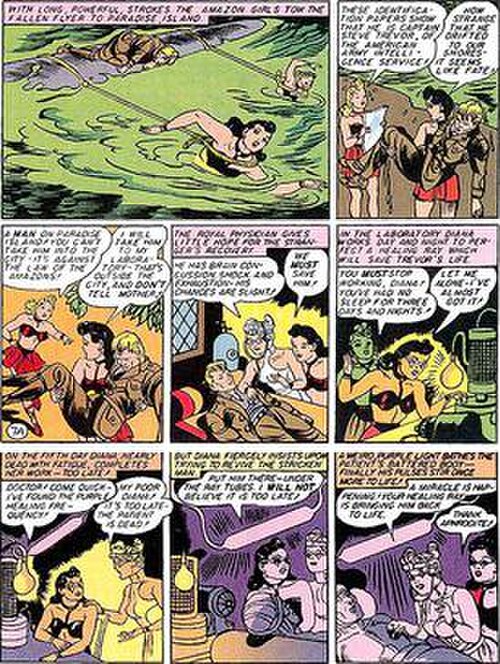
During the Golden Age, Wonder Woman possessed a Purple Ray capable of healing even a fatal gunshot wound to the brain.[218] She invented the ray herself in order to heal Steve Trevor from injuries he sustained when his plane was shot down and he was left adrift in the sea for days.[218]
Diana occasionally uses additional weaponry in formal battle, such as ceremonial golden armour with golden wings, pteruges, chestplate, and golden helmet in the shape of an eagle's head. She possesses a magical sword forged by Hephaestus that is sharp enough to cut the electrons off an atom.[181] As early as the 1950s,[219] Wonder Woman's tiara has also been used as a razor-edged throwing weapon, returning to her like a boomerang.[181] The tiara allows Wonder Woman to be invulnerable from telepathic attacks, as well as allowing her to telepathically contact people such as the Amazons back on Themyscira using the power of the red star ruby in its center.[64] As a temporary inductee into the Star Sapphires, Wonder Woman gained access to the violet power ring of love. This ring allowed her to alter her costume at will, create solid-light energy constructs, and reveal a person's true love to them. She was able to combine the energy with her lasso to enhance its ability.[citation needed] She also possessed a Mental Radio that could let her receive messages from those in need.[203]
Cultural impact
Critical reception
Although created to be a positive role-model and a strong female character for girls and boys,[220] in the controversial Seduction of the Innocent, psychiatrist Fredric Wertham claimed, as a point of criticism, that Wonder Woman's strength and independence made her a lesbian.[221]
Wonder Woman was named the 20th greatest comic book character by Empire film magazine.[222] She was ranked sixth in Comics Buyer's Guide's "100 Sexiest Women in Comics" list.[223] In May 2011, Wonder Woman placed fifth on IGN's Top 100 Comic Book Heroes of All Time.[224]
Under current US copyright law, Wonder Woman is due to enter the public domain in 2036.[225][c] However, this will only apply (at first) to the character as she is depicted in All Star Comics #8, which was published in 1941. Versions of her with later developments and some related characters, may persist under copyright until the works they were introduced in enter the public domain themselves.
Feminist icon
Feminist icon Gloria Steinem, founder of Ms. magazine, was responsible for the return of Wonder Woman's original abilities. Offended that the most famous female superhero had been depowered into a boyfriend-obsessed damsel in distress, Steinem placed Wonder Woman (in costume) on the cover of the first issue of Ms. (1972) – Warner Communications, DC Comics' owner, was an investor – which also contained an appreciative essay about the character.[226] Wonder Woman's powers and traditional costume were restored in issue #204 (January–February 1973).[226]
In 1972, just months after the groundbreaking US Supreme Court decision Roe v. Wade, science fiction author Samuel R. Delany had planned a story for Ms. that culminated in a plainclothes Wonder Woman protecting an abortion clinic. However, Steinem disapproved of Wonder Woman being out of costume, and the controversial story line never happened.[227]
The original significance of Wonder Woman had the intentions of influencing many women of all ages, displaying the physical and mental strengths, values, and ethical attributes that not only men acquire. "Wonder Woman symbolizes many of the values of the women's culture that feminists are now trying to introduce into the mainstream: strength and self-reliance for women; sisterhood and mutual support among women; peacefulness and esteem for human life; a diminishment both of 'masculine' aggression and of the belief that violence is the only way of solving conflicts," Steinem wrote at the time.[228]
Carolyn Cocca has stated that Wonder Woman possesses a "duality of character" due to the character possessing both feminine and masculine qualities in her physical abilities and attitude, which Cocca felt made her more appealing to a wide audience.[229] Wonder Woman's first female editor, Karen Berger, claimed that, "Wonder Woman [is] a great role model to young women, but also contains many elements that appeal to males as well. Wonder Woman crosses the gender line.".[229] Berger worked with George Pérez on the new issues of Wonder Woman starting in 1987, and the new Diana "works with friends and allies to teach lessons of peace and equality."[230]
The origin of Wonder Woman and the psychological reasoning behind why William Morton Marston created her in the way he did illustrated Marston's educational, ethical, and moral values.[231]
Marc DiPaolo introduces us to Wonder Woman's creator and history and he demonstrates how she is a "WWII veteran, a feminist icon, and a sex symbol" all throughout her "career". Wonder Woman stars in multiple films and is most commonly known for her red, white and blue one piece, and her tall, sexy assertiveness. What many people do not know is that she is a big part of history in the comic and superhero world because of how her character influences real life people of all ages, sexes, ethnicities, and races. "Marston created the comic book character Wonder Woman to be both strong and sexy, as a means of encouraging woman to emulate her unapologetic assertiveness."[232] Charlotte Howell notes in her essay titled "'Tricky' Connotations: Wonder Woman as DC's Brand Disruptor" that Wonder Woman is "inherently disruptive to masculine superhero franchise branding because, according to her creator William Moulton Marston, she was intended to be 'psychological propaganda for the new type of woman who, [he] believe[d], should rule the world.'"[233]
In 2015, Wonder Woman became the first superhero to officiate a same-sex wedding in a comic series.[234][235]
On October 21, 2016, the 75th anniversary of the first appearance of the character, the United Nations named Wonder Woman a UN Honorary Ambassador for the Empowerment of Women and Girls in a ceremony attended by Wonder Woman actresses Gal Gadot and Lynda Carter, DC Entertainment President Diane Nelson, Wonder Woman feature film director Patty Jenkins, and U.N. Under-Secretary General Cristina Gallach appeared at the United Nations, to mark the character's designation by the United Nations as its "Honorary Ambassador for the Empowerment of Women and Girls".[236][237][238][239] The gesture was intended to raise awareness of UN Sustainable Development Goal No. 5, which seeks to achieve gender equality and empower all women and girls by 2030.[238][239][240] The decision was met with protests from UN staff members who stated in their petition to UN Secretary-General Ban Ki-moon that the character is "not culturally encompassing or sensitive" and served to objectify women.[240] The petition also stated that it was "alarming that the United Nations would consider using a character with an overtly sexualized image".[241] As a result, the character was stripped of the designation, and the project ended on December 16.[240]
After the release of the 2017 film Wonder Woman, critics examined the character's status as a feminist figure in the film. Zoe Williams for The Guardian said, "Yes, she is sort of naked a lot of the time, but this isn't objectification so much as a cultural reset: having thighs, actual thighs you can kick things with, not thighs that look like arms, is a feminist act. The whole Diana myth, women safeguarding the world from male violence not with nurture but with better violence, is a feminist act. Casting Robin Wright as Wonder Woman's aunt, re-imagining the battle-axe as a battler with an axe, is a feminist act. A female German chemist trying to destroy humans (in the shape of Dr Poison, a proto-Mengele before Nazism existed) might be the most feminist act of all."[242] Alyssa Rosenberg for The Washington Post said, "... None of these experiences crushed me, of course, but I do wonder what it might have been like if they hadn't happened. The power of Wonder Woman, and one of the things that gives Jenkins's adaptation of the character such a lift, is in the answer to that question. Diana Prince (Gal Gadot) doesn't have any idea what women and men are — or aren't — supposed to do. Even when she does encounter other people's ideas about gender roles, she doesn't automatically accept them, and she never lets anyone stop her. And the movie goes a step further and argues that it's not merely little girls all over the world who stand to gain if they can grow up free of the distorting influence of misogyny: a world like that would be liberating and wonderful for men in lots of ways, too."[243] Emma Gray for HuffPost said, "When it comes to pop culture, we speak often about representation; the simple yet often unfulfilled idea that it matters to see someone like you fill a variety of imagined roles on screen. After awhile, these conversations almost begin to feel obvious. We know that it's good to see women and people of color and disabled people and trans people and queer people in the same numbers and variety of roles that white, cisgender, straight men have long been afforded. But what these discussions often lose is the emotional impact of finally seeing something you may have never even realized you were missing. For many women viewers, "Wonder Woman" filled a hole they didn't know they had."[244]
Pacifist icon
Gloria Steinem, editor for Ms. magazine and a major supporter of Wonder Woman, stated "... [Marston] had invented Wonder Woman as a heroine for little girls, and also as a conscious alternative to the violence of comic books for boys."[245] Badower described a near-international incident (involving an unnamed Russian general rolling dozens of tanks and munitions through a shady mountain pass) as an outstanding example for standing up to bullies. "She ends up deflecting a bullet back and disarming the general," he says, adding that "she doesn't actually do anything violent in the story. I just think that Wonder Woman is smarter than that."[246]
Nick Pumphrey stated that Wonder Woman stands as a non-violent beacon of hope and inspiration for women and men.[247][248] Grant Morrison stated "I sat down and I thought, 'I don't want to do this warrior woman thing.' I can understand why they're doing it, I get all that, but that's not what [Wonder Woman creator] William Marston wanted, that's not what he wanted at all! His original concept for Wonder Woman was an answer to comics that he thought were filled with images of blood-curdling masculinity, and you see the latest shots of Gal Gadot in the costume, and it's all sword and shield and her snarling at the camera. Marston's Diana was a doctor, a healer, a scientist."[249][250][251][252][253] The 2018 journal article "Casting a Wider Lasso: An Analysis of the Cultural Dismissal of Wonder Woman Through Her 1975-1979 Television Series" argued that the Lynda Carter show strongly adapted Wonder Woman's ideals but "was suppressed, undone, and discredited" by American culture as part of a larger legacy suppressing the character.[254]
Paquette detailed the changes he made to Wonder Woman's costume, stating that he removed the iconic American flag theme and instead incorporated a Greek influence: "The animal associated to Aphrodite is a dove so instead of an eagle on [Wonder Woman's] breastplate, it will be more of a dove. It's not the American eagle, it's the Aphrodite dove. Stuff that creates [the letter] W is by accident, so it's not like she already has a letter of the alphabet on her [costume]. In the end I've created a structure so it feels inevitable for Wonder Woman to look the way she does."[255]
LGBT icon
William Marston's earliest works were notorious for containing subversive "bondage and sapphic-undertones" subtext. Among Wonder Woman's famous catchphrases, "Suffering Sappho", was a direct reference to lesbianism. Fredric Wertham's Seduction of the Innocent referred to her as the "lesbian counterpart to Batman" (whom he also identified as a homosexual). After Marston's death in 1947, DC Comics downplayed her sexuality and feminist origin. Wonder Woman, without Marston's creative direction, become more "traditional" superhero fare; the lesbian relationships and sexual imagery disappeared from the "Wonder Woman" comic, along with Wonder Woman's super powers. During the Comics Code Authority-decades since, Wonder Woman's subversiveness had been gradually stripped away; subsequent comic book writers and artists either did not know what do with her or barely hinted at Wonder Woman's erotic legacy.[256]
But under the new 1987 re-boot of the title, under the editorship of Karen Berger, and with the writing and art of George Perez at the helm of the book, the same-sex appreciation by Wonder Woman and the Amazons was more than hinted-at and this was established quickly in the new run of the title. Upon her first sight of supporting character Vanessa Kapatelis (in issue #3), she is shown smiling upwards at Kapatelis, thinking to herself "I've never seen another woman quite like her...she's so young...so vulnerable...so beautiful..."[257] Three years later, in the first issue (#38) of a new decade, there is a story-line presenting a cultural exchange between appointed leaders from 'Man's World', who are the first mortals to visit Themyscira in this continuity, and the Amazons of Themyscira, in Themyscira, itself. The guest Unitarian minister, Reverend Cantwell, asks the Amazon Mnemosyne "..."Don't you miss the sharing God intended for the sexes?" to which Mnemosyne replied "Some do. They have sworn themselves to Artemis, the virgin hunter, and Athena, the chaste warrior. Others choose the way of Narcissus. But most of us find satisfaction in each other -- three thousand years can be a long time, reverend.".[258] Probably more than at any other time in the then nearly fifty-year history of the character, the Amazons were explicitly and unequivocally defined, in general, as lesbian. Additionally, Kevin Mayer, brother of the major supporting character Myndi Mayer, was openly gay and this was treated sympathetically.[259] By this time, DC Comics was a Warner Brothers-owned company, and had been for over 20 years.
Wonder Woman is suggested as being queer[260] or bisexual, as she and another Amazon, Io, had reciprocal feelings for each other.[261] Grant Morrison's 2016 comic Wonder Woman: Earth One, which exists parallel to the current DC comics Rebirth canon, Diana is depicted being kissed on her right cheek by a blonde woman who has put her left arm around Diana.[262]
In 2016, "Issue #48" of Sensation Comics, featured Wonder Woman officiating a same-sex wedding, drawn by Australian illustrator Jason Badower. "My country is all women. To us, it's not 'gay' marriage. It's just marriage", she states to Superman. Inspired by the 2015 June Supreme Court ruling that established same-sex marriage in all 50 United States, Badower says DC Comics was "fantastic" about his idea for the issue. In an interview with The Sydney Morning Herald, he said his editor "Was like 'great, I love it! Let's do it.' It was almost anticlimactic."[263] "Diana's mother, the queen, at the very least authorized or in some cases officiated these weddings," Badower says. "It just seems more like a royal duty Diana would take on, that she would do for people that would appreciate it."[246]
Wonder Woman actress Gal Gadot reacted positively to Diana's rebooted orientation, and agreed her sexuality was impacted by growing up in the women-only Themyscira. Gadot stated that Wonder Woman feels she need not be "labelled sexually", and is "just herself". "She's a woman who loves people for who they are. She can be bisexual. She loves people for their hearts."[264][265] Coming from a society that was only populated by women, "'lesbian' in [the world's] eyes may have been 'straight' for them."[266] "Her culture is completely free from the shackles of heteronormativity in the first place so she wouldn't even have any 'concept' of gender roles in sex."[267]
Wonder Woman's advocacy for women rights and gay rights was taken a step further in September 2016, when comic book writer Greg Rucka announced that she is canonically bisexual, according to her rebooted "Rebirth" origin.[268][269] Rucka stated, "... nobody at DC Comics has ever said, [Wonder Woman] gotta be straight. Nobody. Ever. They've never blinked at this."[266] Rucka stated that in his opinion, she "has to be" queer and has "obviously" had same-sex relationships on an island surrounded by beautiful women.[266][270] This follows the way Wonder Woman was written in the alternate continuity or non-canon Earth One by Grant Morrison,[271] and fellow Wonder Woman writer Gail Simone staunchly supported Rucka's statement.[272] Surprised at the amount of backlash from her fanbase, Rucka responded to "haters" that consensual sex with women is just as important to Wonder Woman as the Truth is to Superman.[273]
Sexual empowerment icon
Wonder Woman's signature weapon is her Lasso of Truth; consequently, much of her crime-fighting powers came from bondage, and her only exploitable weakness was, essentially, bondage. Grant Morrison and Yanick Paquette had teamed up to work on Wonder Woman: Earth One.[255]
Wonder Woman's sexual and bondage themes in her earliest days were not without purpose, however. Her creator, William Moulton Marston, theorized that human relationships could be broken down into dominance, submission, inducement and compliance roles which were embedded into our psyche. Because males were, more often than not, dominant in societies, Marston believed that "Women as a sex, are many times better equipped to assume emotional leadership than are males."[274] Marston wanted to convey his progressive ideals, through his use of bondage imagery, that women are not only capable of leadership roles, but should be in charge of society. Although Marston had good intentions with these themes, in Wonder Woman's early appearances, the bondage elements were controversial, as they were often seen to overly fetishize women in power rather than promote such women. Noah Berlatsky criticized this imagery in Wonder Woman's earliest days noting that "the comics take sensual pleasure in women's disempowerment."[275] Despite having the mixed messages of this imagery, Marston fiercely believed that women would soon rule the earth and meant to showcase his predictions through sexual themes in his stories. He was an open feminist while studying at Harvard where he once said "Girls are also human beings, a point often overlooked!"[276]
In other media
Since her comic book debut in October 1941, Wonder Woman has appeared in a number of adaptations. These formats include films, television shows, and video games.
In the fine arts, and starting with the Pop Art period and on a continuing basis since the 1960s, the character has been "appropriated" by multiple visual artists and incorporated into contemporary artwork, most notably by Andy Warhol, Roy Lichtenstein, Mel Ramos, Dulce Pinzon, Houben R.T. and others.[277][278][279][280]
Television
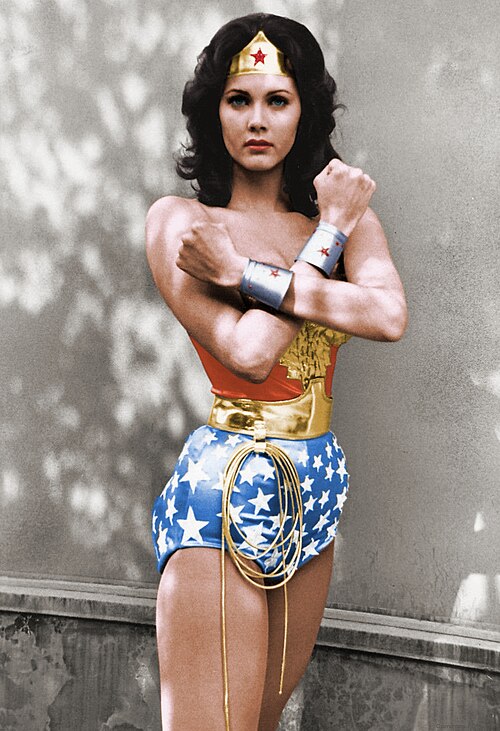
Wonder Woman has made multiple appearances in television, spanning across many decades, including the made-for-television film Wonder Woman (1974), and most famously the live action Wonder Woman TV Show (1975–1979) which Starred Lynda Carter, including Hanna-Barbera's long-running animated series Super Friends (1973–1986) where she appeared alongside many other Justice League members, usually facing off members of the Legion of Doom, and most notably the Justice League animated series (2001–2004) and its sequel Justice League Unlimited (2004–2006).
A pilot was filmed in 2011 starring Adrianne Palicki but the show never aired.[281]
In the show DC Super Hero Girls (2019–2021), Wonder Woman is shown as a teenage student at Metropolis High School. Here, she is friends with many other DC characters such as Batgirl, Killer Frost, Hawkgirl, Big Barda, Miss Martian, Beast Boy, Supergirl, Harley Quinn, Poison Ivy, Katana, and is the best friend of Bumblebee. She also has enemies at this school, some of them being Cheetah, Lena Luthor, and Giganta.
In the Max show titled Peacemaker (2022–present), starring DC comic superhero Peacemaker, she makes an indirect appearance at the end of the first season, appearing alongside The Flash, Aquaman, and Superman, the latter superhero appearing with her only as silhouettes.[282]
Film
.jpg/500px-Gal_Gadot_at_the_2018_Comic-Con_International_13_(cropped).jpg)
Wonder Woman has been featured in an abundance of direct-to-video animated films that are a part of DC's animated film universe (DCAMU) some of which include Justice League: The Flashpoint Paradox (2013), Justice League: Throne of Atlantis (2015) and Justice League Dark: Apokolips War (2020). There are also other direct-to-video films the character appears in that are not a part of the DCAMU including Injustice (2021), Justice League: Gods and Monsters (2015), and Justice League: The New Frontier (2008), along with a few CGI theatrical releases such as The Lego Movie (2014) and The Lego Batman Movie (2017).
Within the live-action DC Extended Universe (DCEU) films, Wonder Woman debuted in Batman v Superman: Dawn of Justice (2016), portrayed by Gal Gadot, and reappeared in Wonder Woman (2017) and its sequel Wonder Woman 1984 (2020), as well as Justice League (2017) and its director's cut (2021), and had cameo appearances in Shazam! Fury of the Gods and The Flash (both 2023).
The 2017 film Professor Marston and the Wonder Women tells the story of the polyamorous relationship between William Moulton Marston, his wife and fellow psychologist Elizabeth Holloway Marston, and their lover Olive Byrne, the invention of the lie detector test, and how they inspired the creation of the Wonder Woman comic.[283]
Literature
Video games
The character of Wonder Woman has appeared in a plethora of different videos games, both DC orchestrated and not. Most games that she appears in are fighting based and include Diana as a playable character, while in others she is an NPC. Below one can find may of the aforementioned games that she is included in.
- Justice League Task Force (1995), based on the Justice League animated series as a playable character.
- Justice League: Injustice for All (2002), based on the Justice League animated series as a playable character.
- Justice League: Chronicles (2003), based on the Justice League animated series as a playable character.
- Justice League Heroes (2006), as a playable character ― voiced by Courtenay Taylor.[284]
- Justice League Heroes: The Flash (2006), as an NPC.
- Mortal Kombat vs. DC Universe (2008), as a playable character — voiced by Tara Platt.[284]
- DC Universe Online (2011), as a playable character originally voiced by Gina Torres, currently voiced by Susan Eisenberg.[285]
- LittleBigPlanet 2 (2011), as an NPC — voiced by Jules de Jongh.[284]
- Scribblenauts Unmasked (2012), as an NPC.
- Infinite Crisis (2015), as a playable character — voiced by Vanessa Marshall.
- Arena of Valor (2016), as a playable character.
- Fortnite (2017), as a cosmetic outfit.[286]
- DC Unchained (2018), as a playable character.
- DC Super Hero Girls: Teen Power (2021), as a playable character — voiced by Grey DeLisle-Griffin
- MultiVersus (2022), as a playable character — voiced by Abby Trott.[287]
- Suicide Squad: Kill the Justice League (2024), as an NPC.
- Wonder Woman is currently getting a single-player open world game developed by Monolith in which she will star in. The game was announced at the 2021 Game Awards.
Lego
- Lego Batman 2: DC Super Heroes (2012), as a playable character — voiced by Laura Bailey.[288]
- Lego Batman 3: Beyond Gotham (2014), as a playable character — voiced by Laura Bailey reprising her role. If the player chooses to activate her flying ability, the theme song from the Wonder Woman television series will play until she lands.
- Lego Dimensions (2015), as a playable character — voiced by Laura Bailey.
- Lego DC Super-Villains (2018), as a playable character — with Susan Eisenberg reprising her role from the Justice League animated series.[289]
- The Lego Movie 2 Videogame (2019), as a playable character — voiced by Danielle Bisutti.
Injustice
- Injustice: Gods Among Us (2013), as a playable character — voiced by Susan Eisenberg.[290] The storyline sees Wonder Woman travelling to an alternate reality with the rest of the Justice League where they must defeat most of their evil counterparts. Wonder Woman's counterpart supports the tyrannical Superman's regime and is in a relationship with him (though it is evidently one-sided, as he still loves his deceased wife Lois). In the game, she has alternate costumes based on her appearances in Flashpoint, Red Son, the New 52, Ame-Comi girls, and issue #600 of the Wonder Woman comics.
- Injustice 2 (2017), as a playable character — voiced again by Susan Eisenberg.[291] This version is still allied with the Regime and Superman, and tries to convince Supergirl (who assisted her in breaking out of prison) to join their cause, but fails after Supergirl learns that the Regime shows no mercy towards criminals. In her single player ending, Wonder Woman takes Brainiac's head, gaining the public favor needed to restore the Regime to power. She plans to make Batman and his comrades pay for toppling the Regime, then take her revenge on the Themyscirans for betraying her. An alternate version of her Flashpoint counterpart appears in Green Arrow's ending as a member of the Multiverse Justice League. She has a gear set in the game based on the 2017 Wonder Woman film.
See also

Wikiquote has quotations related to Wonder Woman.
Notes
- ^ All Star Comics #8 was cover-dated December–January 1941–1942, but published October 21, 1941.[1]
- ^ All Star Comics #8 was cover-dated December–January 1941–1942, but published October 21, 1941.[1]
- ^ See USC Title 17, Chapter 3, § 304(b)
References
- ^ a b "Mike's Amazing World of Comics". Archived from the original on September 7, 2017. Retrieved May 9, 2017.
{{cite web}}: CS1 maint: bot: original URL status unknown (link) - ^ a b c Garner, Dwight (October 23, 2014). "Books – Her Past Unchained 'The Secret History of Wonder Woman,' by Jill Lepore". The New York Times. Archived from the original on October 24, 2014. Retrieved October 23, 2014.
- ^ a b c Lepore, Jill, The Secret History of Wonder Woman, New York: Alfred A. Knopf, 2014. ISBN 9780385354042
- ^ Moon, Michael (March 12, 2012). Darger's Resources. Duke University Press. ISBN 978-0822351566.
- ^ Catherine Bennett. "The Secret History of Wonder Woman review – is this what a feminist looks like? | Books". The Guardian. Archived from the original on December 14, 2016. Retrieved December 14, 2016.
- ^ "Wonder Woman's Kinky Feminist Roots". The Atlantic. Archived from the original on January 17, 2017. Retrieved December 14, 2016.
- ^ Caplan, Rebecca. "Wonder Woman's Secret Past". The New Yorker. Archived from the original on December 16, 2016. Retrieved December 14, 2016.
- ^ Gustines, George Gene (December 29, 2020). "Wonder Woman and Her Evolving Look - She remained steadfast in her decades-long fight for justice, but her costumes ranged from a golden-eagle emblem and skirt to a W logo breastplate and leggings". The New York Times. Retrieved December 29, 2020.
- ^ All Star Comics #8 was cover-dated December/January 1941/1942, but published October 21, 1941. (See Library of Congress. Archived September 7, 2017, at the Wayback Machine)
- ^ Hendrix, Grady (December 11, 2007). "Out for Justice". The New York Sun.
- ^ "75 years of world-saving: Everything you need to know about 'Wonder Woman'". Los Angeles Times. June 2, 2017.
- ^ Beedle, Tim (December 25, 2013). "Ten Moments that Mattered: Wonder Woman Becomes War | DC". Dccomics.com. Archived from the original on November 8, 2016. Retrieved December 14, 2016.
- ^ Rogers, Vaneta (August 28, 2013). "Wonder Woman Kills...Who? Is the New GOD of What? AZZARELLO Explains (Spoilers)". Newsarama. Archived from the original on November 8, 2016. Retrieved December 14, 2016.
- ^ "Superdames!: Photo".
- ^ "Wonder woman -- you saved my life! Why?". Tumblr. Retrieved June 25, 2021.
- ^ Crawford, Philip. "The Legacy of Wonder Woman". School Library Journal. Archived from the original on May 2, 2007. Retrieved March 1, 2007.
- ^ "Day of Wonder: Celebrate Wonder Woman This Sunday, October 21". October 19, 2018. Archived from the original on September 25, 2019. Retrieved September 25, 2019.
- ^ "Celebrate Wonder Woman Day on June 3rd!". DC. May 24, 2017. Archived from the original on September 11, 2017. Retrieved May 30, 2018.
- ^ Lyons, Charles (August 23, 2006). "Suffering Sappho! A Look at the Creator & Creation of Wonder Woman". Comic Book Resources. Archived from the original on April 20, 2008. Retrieved August 23, 2006.
In October 1940, the popular women's magazine "Family Circle" published an interview with Marston entitled "Don't Laugh at the Comics," in which the psychologist discussed the unfulfilled potential of the medium.
{{cite web}}: CS1 maint: bot: original URL status unknown (link) - ^ Lyons, Charles (August 23, 2006). "Suffering Sappho! A Look at the Creator & Creation of Wonder Woman". Comic Book Resources. Archived from the original on April 20, 2008. Retrieved August 23, 2006.
Maxwell Charles Gaines, then publisher of All-American Comics, saw the interview and offered Marston a job as an educational consultant to All-American and sister company DC Comics.
{{cite web}}: CS1 maint: bot: original URL status unknown (link) - ^ Lamb, Marguerite (Fall 2001). "Who Was Wonder Woman?". Bostonia. Archived from the original on December 8, 2007.
- ^ Daniels, Les (April 6, 2004). Wonder Woman: The Complete History. Chronicle Books. pp. 28–30. ISBN 978-0-8118-4233-4.
- ^ Library of Congress. "All-Star Comics #8". dcindexes.com. Mike's Amazing World. Archived from the original on September 7, 2017. Retrieved May 19, 2017.
- ^ Bunn, Geoffrey C. (1997). "The lie detector, Wonder Woman, and liberty: The life and work of William Moulton Marston". History of the Human Sciences. 10 (1). London: Routledge: 91–119. doi:10.1177/095269519701000105. ISSN 0952-6951. S2CID 143152325.
- ^ Hendrix, Grady (December 11, 2007). "Out for Justice". The New York Sun.
- ^ Tartakovsky, Margarita (May 17, 2011). "A Psychologist and A Superhero". Psych Central. Archived from the original on May 19, 2012. Retrieved November 16, 2017.
- ^ "William Moulton Marston". Lambiek Comiclopedia. Retrieved June 25, 2021.
- ^ "LGBT Superheroes: Why 'Wonder Woman' Could Never Have Been the Lesbian Avenger We Still Need". June 7, 2017. Archived from the original on July 25, 2018. Retrieved July 25, 2018.
- ^ "Wonder Woman's Bracelets (Object)". Comicvine.gamespot.com. Archived from the original on November 9, 2016. Retrieved December 14, 2016.
In the golden age if Diana's bracelets (or those of any Amazon) were bound by a man it made her lose all her powers.
- ^ All Star Comics #8 (October 1941)
- ^ Hanley, Tim (June 25, 2012). "Wonder Woman: Secretary Of The Justice Society Of America". Straitened Circumstances. Archived from the original on June 7, 2013. Retrieved June 25, 2012.
- ^ All Star Comics #12 (August/September 1942)
- ^ Wonder Woman #98 (May 1958)
- ^ a b c d e Wonder Woman #105 (April 1959)
- ^ Wonder Woman #179 (1968)
- ^ a b Reed, Bill (March 5, 2007). "365 Reasons to Love Comics". Comic Book Resources. Archived from the original on March 12, 2007. Retrieved March 5, 2007.
- ^ "We were all in love with Diana Rigg and that show she was on." Mike Sekowsky, quoted in Les Daniels, Wonder Woman: The Complete History (Chronicle, 2004), p. 129.
- ^ Wonder Woman #204
- ^ Keith Dallas, Jason Sacks, Jim Beard, Dave Dykema, Paul Brian McCoy (2013). American Comic Book Chronicles: The 1980s. TwoMorrows Publishing. pp. 47–8. ISBN 978-1605490465.
{{cite book}}: CS1 maint: multiple names: authors list (link) - ^ Klein, Todd (January 18, 2008). "Logo Study: Wonder Woman part 3". Klein Letters. Archived from the original on August 14, 2016. Retrieved April 21, 2017.
- ^ Mangels, Andy (January 1, 1989). "Triple Threat The George Pérez Interview". Amazing Heroes (#156). Fantagraphics Books: 30.
Wonder Woman's sales are some of the best the Amazing Amazon has ever experienced, and the book is a critical and popular success with its weaving of Greek mythology into a feminist and humanistic atmosphere.
- ^ a b "Who destroyed Paradise Island?". DC Comics. April 15, 2010. Archived from the original on September 22, 2012. Retrieved May 23, 2012.
- ^ Rogers, Vaneta (June 29, 2010). "JMS Talks Wonder Woman's New Look and New Direction". Newsarama. Archived from the original on February 1, 2012. Retrieved May 23, 2012.
- ^ George, Richard (July 7, 2010). "Wonder Woman's New Era". IGN. Archived from the original on June 15, 2011. Retrieved May 23, 2012.
- ^ Gustines, George Gene (June 29, 2010). "Makeover for Wonder Woman at 69". The New York Times. Archived from the original on June 18, 2022. Retrieved May 23, 2012.
- ^ Ching, Albert (November 10, 2010). "JMS Leaving Superman and Wonder Woman for Earth One Sequel". Newsarama. Archived from the original on September 30, 2012. Retrieved May 23, 2012.
- ^ Esposito, Joey (December 14, 2011). "The Best of DC Comics in 2011". IGN. Archived from the original on October 7, 2012. Retrieved December 14, 2011.
- ^ Renaud, Jeffrey (August 22, 2012). "Azzarello Lowers the Boom(Tube) on Wonder Woman". Comic Book Resources. Archived from the original on August 24, 2012. Retrieved August 22, 2012.
- ^ Garcia, Joe. "The Best & Worst of DC Comics' New 52, One Year Later". Front Towards Gamer. Archived from the original on September 10, 2012. Retrieved September 5, 2012.
Despite being one part of the Justice League's "Holy Trinity", Wonder Woman never seems to get the recognition that she deserves. While she might not be invincible, her strength is second only to Superman and she is arguably a better fighter. Her solo outings, however, were rarely very interesting. The New 52 put an end to that injustice, with Brian Azzarello and Cliff Chiang spearheading one of the best books DC is putting out. Azzarello currently has Wonder Woman tearing through the ranks of Greek mythology, and Chiang's art manages to be intense despite his use of softer lines. If you're not reading Wonder Woman, go rectify that.
{{cite web}}: CS1 maint: unfit URL (link) - ^ Hughes, Mark (September 29, 2011). "Top Ten Best Comics in DC's 'New 52' – UPDATED". Forbes. Archived from the original on October 1, 2011. Retrieved September 29, 2011.
- ^ "Wonder Woman: The Story Keeps Changing". March 3, 2017. Archived from the original on October 14, 2017. Retrieved November 16, 2017.
- ^ "Wonder Woman: Rebirth Begins Diana's REAL Origin Story". Screen Rant. June 9, 2016. Archived from the original on October 15, 2017. Retrieved November 16, 2017.
- ^ "Wonder Woman: Rebirth Reveals How Diana Got Her Powers". Screen Rant. September 16, 2016. Archived from the original on September 21, 2017. Retrieved November 16, 2017.
- ^ Christian Holub (March 3, 2017). "DC Rebirth: How Wonder Woman went back to her roots". Entertainment Weekly. Archived from the original on October 23, 2017. Retrieved November 16, 2017.
- ^ "G. Willow Wilson Announced as New Wonder Woman Writer". July 11, 2018. Archived from the original on July 13, 2018. Retrieved July 12, 2018.
- ^ "WONDER WOMAN #750". DC. Retrieved May 14, 2023.
- ^ Comments, Rich Johnston | Last updated | (December 5, 2020). "Becky Cloonan, Michael Conrad, Travis Moore Join Wonder Woman #770". bleedingcool.com. Retrieved May 15, 2023.
- ^ "The Dawn of DC Continues with Oversized Special Issues and New Talent Teams". DC. Retrieved May 15, 2023.
- ^ Schedeen, Jesse (May 12, 2023). "Wonder Woman #800 Will Introduce Diana's Daughter, Trinity". IGN. Retrieved May 15, 2023.
- ^ Blackest Night #6 (2010)
- ^ WonderAli. "Welcome to the Star Sapphires". WonderAli. Archived from the original on May 29, 2013. Retrieved January 11, 2010.
- ^ Phillips, Dan (January 24, 2008). "Wonder Woman #16 review". IGN. Archived from the original on October 8, 2013. Retrieved October 1, 2012.
- ^ Charles Moulton (w), Harry G. Peter (a). Wonder Woman, no. 38, p. 5 (1949). All American Comics.
- ^ a b c d Wonder Woman (vol. 2) #219 (September 2005)
- ^ Goldstein, Hilary (August 2005). "Defending Wonder Woman". IGN. Archived from the original on October 23, 2012. Retrieved August 1, 2005.
- ^ Azzarello, Brian (2012). NYCC 2012; Wonder Woman 101. New York Comic Con: DC Comics. Archived from the original on November 21, 2012.
Wonder Woman's greatest strength is her compassion; her greatest weakness is her compassion
- ^ Cronin, Brian (June 18, 2012). "When We First Met – When Did Wonder Woman First Fly Her Invisible Jet?". Comic Book Resources. Archived from the original on November 29, 2014. Retrieved November 26, 2014.
In Wonder Woman #6, she says "Great Hera," which soon became one of her top phrases...
- ^ Pollitt, Katha (October 14, 2014). "Wonder Woman's Kinky Feminist Roots". Atlantic Monthly. Archived from the original on January 17, 2017. Retrieved December 14, 2016.
- ^ Wonder Woman (vol. 2) #127 (November 1997)
- ^ Wonder Woman (vol. 2) #128 (December 1997)
- ^ Wonder Woman (vol. 2) #129 (January 1998)
- ^ a b "Wonder Woman revisited". Byrne Robotics. Archived from the original on May 18, 2011. Retrieved January 16, 2011.
- ^ Wonder Woman (vol. 2) #130–133 (February–May 1998). DC Comics.
- ^ Wonder Woman (vol. 2) #185 (November 2002). DC Comics.
- ^ JLA #18–23 (May–October 1998)
- ^ JLA #30 (June 1999). DC Comics.
- ^ Wonder Woman #780 (2021). DC Comics.
- ^ Superman: Son of Kal-El #4 (2021). DC Comics.
- ^ Charles Moulton (w), Harry G. Peter (a). "Introducing Wonder Woman" All Star Comics, vol. 1, no. 8 (January 1942). DC Comics.
- ^ Eddie138. "Wonder Woman: A History". webtv.net. Archived from the original on February 22, 2013.
{{cite web}}: CS1 maint: numeric names: authors list (link) - ^ Gutierrez, Jon (March 30, 2011). "The 6 Worst Jobs Wonder Woman Ever Had". Topless Robot. Archived from the original on April 1, 2011. Retrieved March 30, 2011.
- ^ Charles Moulton (w), Harry G. Peter (a). Sensation Comics, no. 1, p. 8 (1942). All American Comics.
- ^ Cronin, Brian. "When We First Met – Wonder Woman's Golden Age Rogues". Comic Book Resources. Archived from the original on November 1, 2012. Retrieved October 28, 2012.
- ^ "The complicated origin of Wonder Woman". Dance of the Puppets. September 28, 2005. Archived from the original on August 21, 2013. Retrieved September 28, 2005.
- ^ Hanley, Tim (January 10, 2011). "A Book Look: Kanigher's Giant Birds". Straitened Circumstances. Archived from the original on January 12, 2011. Retrieved January 10, 2011.
- ^ Denny O'Neil (w), Mike Sekowsky (p), Dick Giordano (i). "Wonder Woman's Last Battle" Wonder Woman, no. 179 (November 1968).
- ^ Hanley, Tim (November 19, 2010). "A Book Look: Ads vs. Audience". Straitened Circumstances. Archived from the original on December 18, 2013. Retrieved November 19, 2010.
- ^ "Diana's Memory Album". Dial B for Blog. Archived from the original on May 8, 2013. Retrieved November 11, 2012.
- ^ Mr. Morrow (January 5, 2010). "Wonder what I did on my Christmas vacation?". TwoMorrows Publishing. Archived from the original on January 17, 2010. Retrieved January 5, 2010.
- ^ a b Guion, Richard. "Introducing the NEW Wonder Woman". Giant Size Geek. Archived from the original on June 2, 2013. Retrieved March 21, 2011.
- ^ Cronin, Brian. "Diana Prince – Forgotten Classic". Snark Free Waters. Archived from the original on August 10, 2014. Retrieved April 23, 2005.
Sadly, though, in the last issue of the run, I-Ching was murdered and Wonder Woman was given amnesia. When the Amazons returned her memories (and her powers), they left out her memories of her experiences as just plain "Diana Prince."
- ^ a b Jones, Robert Jr. "Wonder of Wonders". Comic Book Resources. Archived from the original on January 16, 2010. Retrieved December 31, 2009.
- ^ a b Strickland, Carol. "The Illustrated Nubia Index". Carol A. Strickland. Archived from the original on January 6, 2009. Retrieved January 26, 2009.
- ^ Gerry Conway (w), Don Heck (a). "Of Gods And Men" Wonder Woman, no. 329 (February 1986). DC Comics.
- ^ Mozzocco, J. Caleb. "The Many Loves of Wonder Woman: A Brief History Of The Amazing Amazon's Love Life". ComicsAlliance. Archived from the original on August 30, 2012. Retrieved August 28, 2012.
- ^ Colluccio, Ali (April 10, 2012). "Top 5: Wonder Woman Reboots". iFanboy. Archived from the original on April 12, 2012. Retrieved April 10, 2012.
After she was "erased" from existence in the final pages of Crisis on Infinite Earths, George Perez, Len Wein and Greg Potter brought the Amazon Princess back to the DC Universe. While the basics of the story remained the same, Wonder Woman;s powers were adjusted to include Beauty from Aphrodite, Strength from Demeter, Wisdom from Athena, Speed and Flight from Hermes, Eyes of the Hunter from Artemis, and Truth from Hestia. This run established Paradise Island as the mythical Amazon capital, Themyscira. Perez's Diana is not only strong and smart, but graceful and kind – the iconic Wonder Woman.
- ^ Mozzocco, J. Caleb. "The Many Loves of Wonder Woman: A Brief History Of The Amazing Amazon's Love Life". ComicsAlliance. Archived from the original on August 30, 2012. Retrieved August 28, 2012.
When the next volume of Wonder Woman would start, Trevor was sidelined as Diana's love interest. He still appeared in the series, but as an older man, one who would ultimately marry the post-Crisis version of Wondy's Golden Age sidekick, Etta Candy.
- ^ George Pérez (w), George Pérez, Cynthia Martin (p), Cynthia Martin (i). "War of the Gods, Chapter One: Hellfire's Web" War of the Gods, vol. 1, no. 1 (September 1991). DC Comics.
- ^ George Pérez (w), George Pérez, Cynthia Martin (p), Cynthia Martin (i). "The Holy Wars" War of the Gods, no. 2 (October 1991). DC Comics.
- ^ George Pérez (w), George Pérez, Cynthia Martin (p), Cynthia Martin (i). "Casualties of War" War of the Gods, no. 3 (November 1991). DC Comics.
- ^ George Pérez (w), George Pérez (p). "In the Beginning... There Was the End" War of the Gods, no. 4 (December 1991). DC Comics.
- ^ "Superhero Makeovers: Wonder Woman, part two". The Screamsheet. Archived from the original on January 7, 2012. Retrieved February 10, 2011.
Hippolyta received a vision where Wonder Woman died.
- ^ "Superhero Makeovers: Wonder Woman, part two". The Screamsheet. Archived from the original on January 7, 2012. Retrieved February 10, 2011.
Desperate to save her daughter, she claimed that Diana had failed in her role as an ambassador to Man's World and called for a do-over on the contest that had determined Diana fit to carry the Wonder Woman mantle in the first place.
- ^ "Superhero Makeovers: Wonder Woman, part two". The Screamsheet. Archived from the original on January 7, 2012. Retrieved February 10, 2011.
Due to Hippolyta secretly meddling so her daughter would lose the contest, Diana lost to one of the Bana named Artemis, who became the new Wonder Woman.
- ^ "Superhero Makeovers: Wonder Woman, part two". The Screamsheet. Archived from the original on January 7, 2012. Retrieved February 10, 2011.
Meanwhile, Diana herself wore the costume equivalent of black lingerie and a jacket and continued to fight crime.
- ^ "Superhero Makeovers: Wonder Woman, part two". The Screamsheet. Archived from the original on January 7, 2012. Retrieved February 10, 2011.
Artemis was killed off, resulting in the death of Wonder Woman that Hippolyta had foreseen, and Diana returned as Wonder Woman.
- ^ "Wonder Woman & Hippolyta – As All Great Heroes Do..." Cosmic Teams. Archived from the original on December 27, 2012. Retrieved November 19, 2012.
- ^ Jodi Picoult (w), Terry Dodson (p), Rachel Dodson (i). "Love and Murder, Part 3" Wonder Woman, vol. 3, no. 8 (June 2007). DC Comics.
- ^ Goldstein, Hilary (March 23, 2005). "Infinite Crisis Guide". IGN. Archived from the original on April 29, 2014. Retrieved March 23, 2005.
- ^ Goldstein, Hilary (August 2005). "Defending Wonder Woman – Why the Amazonian princess should be spared punishment from DC's heroes". IGN. Archived from the original on October 23, 2012. Retrieved August 1, 2005.
- ^ Allan Heinberg (w), Terry Dodson (p), Rachel Dodson (i). "Who is Wonder Woman?: Part One" Wonder Woman, vol. 3, no. 1 (August 2006). DC Comics.
- ^ Allan Heinberg (w), Terry Dodson (p), Rachel Dodson (i). "Who is Wonder Woman?: Part Two" Wonder Woman, vol. 3, no. 2 (September 2006). DC Comics.
- ^ Allan Heinberg (w), Terry Dodson (p), Rachel Dodson (i). "Who is Wonder Woman?: Part Three" Wonder Woman, vol. 3, no. 3 (October 2006). DC Comics.
- ^ Allan Heinberg (w), Terry Dodson (p), Rachel Dodson (i). "Who is Wonder Woman?: Part Four" Wonder Woman, vol. 3, no. 4 (February 2007). DC Comics.
- ^ Allan Heinberg (w), Terry Dodson (p), Rachel Dodson (i). "Who is Wonder Woman?: Part Five" Wonder Woman Annual, vol. 3, no. 1 (November 2007). DC Comics.
- ^ Gail Simone (w), Terry Dodson (p), Rachel Dodson (i). "The Circle Part One of Four: What You Do Not Know Yet" Wonder Woman, vol. 3, no. 14 (January 2008). DC Comics.
- ^ Gail Simone (w), Terry Dodson (p), Rachel Dodson (i). "The Circle Part Two of Four: Dead Heat" Wonder Woman, vol. 3, no. 15 (February 2008). DC Comics.
- ^ Gail Simone (w), Terry Dodson (p), Rachel Dodson (i). "The Circle Part Three of Four: The Wellspring of all Vengeance" Wonder Woman, vol. 3, no. 16 (March 2008). DC Comics.
- ^ a b Gail Simone (w), Terry Dodson (p), Rachel Dodson (i). "The Circle Conclusion: A Time of Reckoning" Wonder Woman, vol. 3, no. 17 (April 2008). DC Comics.
- ^ Raou. "Wonder Woman: The Circle". Trade Talks. Archived from the original on December 11, 2013. Retrieved May 29, 2009.
- ^ George, Richard. "Wonder Woman's New Era". IGN. Archived from the original on February 22, 2014. Retrieved June 29, 2010.
- ^ "SS/OM: All New Wonder Woman Review Part 3: The Morrigan". That Guy With the Glasses. Archived from the original on October 20, 2011. Retrieved October 17, 2011.
- ^ Phil Hester (w), Don Kramer, Lee Garbett (p). "The Odyssey Part Fourteen: The Return" Wonder Woman, no. 614 (October 2011). DC Comics.
- ^ Ching, Albert. "Wonder Woman Gets a New 52 Origin, Parent in November". Newsarama. Archived from the original on October 11, 2011. Retrieved October 10, 2011.
- ^ Gregorian, Dareh. "Zeus your daddy, Diana!". New York Post. Retrieved October 10, 2011.
- ^ Azzarello, Brian (w), Chiang, Cliff (p), Chiang, Cliff (i). "The Visitation" Wonder Woman, vol. 4, no. 1 (November 2011).
- ^ Azzarello, Brian (w), Chiang, Cliff (a). "Home" Wonder Woman, vol. 4, no. 2 (December 2011).
- ^ Azzarello, Brian (w), Chiang, Cliff (p), Chiang, Cliff (i). "Il Gangster dell'amore" Wonder Woman, vol. 4, no. 7 (May 2012).
- ^ Azzarello, Brian (w), Chiang, Cliff (p), Chiang, Cliff (i). "Casting Shadows" Wonder Woman, vol. 4, no. 8 (June 2012).
- ^ Azzarello, Brian (w), Chiang, Cliff (p), Chiang, Cliff (i). "Son Rise" Wonder Woman, vol. 4, no. 11 (September 2012).
- ^ Azzarello, Brian (w), Chiang, Cliff (p), Chiang, Cliff (i). "Birth Right" Wonder Woman, vol. 4, no. 12 (October 2012).
- ^ Rogers, Vaneta. "BRIAN AZZARELLO on Ending WONDER WOMAN #12 With a 'BOOM'". Newsarama. Archived from the original on August 20, 2012. Retrieved August 17, 2012.
- ^ Johnston, Rich (August 15, 2012). "The End of Wonder Woman #12 That You Really Might Not Have Expected". Bleeding Cool. Archived from the original on August 17, 2012. Retrieved August 15, 2012.
- ^ a b Azzarello, Brian (w), Chiang, Cliff (a). "The Lair of the Minotaur!" Wonder Woman, vol. 4, no. 0 (November 2012).
- ^ Johns, Geoff (w), Lee, Jim (p), Williams, Scott (i). "Justice League Part Three" Justice League, vol. 2, no. 3 (January 2012).
- ^ "Superman and Wonder Woman kiss with powerful consequences". USA Today. August 27, 2012. Archived from the original on September 21, 2012. Retrieved September 21, 2012.
- ^ "Superman-Wonder Woman Romance rocks DC Comics". MSNBC. Archived from the original on August 24, 2012. Retrieved September 21, 2012.
- ^ "Superman-and-Wonder Woman become the world's newest power couple". DCcomics.com. August 28, 2012. Archived from the original on September 3, 2012. Retrieved September 21, 2012.
- ^ "Charles Soule And Tony Daniel Discuss Superman and Wonder Woman Comic". Newsarama. Archived from the original on June 23, 2013. Retrieved August 7, 2013.
- ^ "Soule and Daniel Join Forces for Superman-Wonder Woman". Comic Book Resources. Archived from the original on October 17, 2013. Retrieved August 7, 2013.
- ^ "Who's Who on Earth 2". Newsarama. Archived from the original on November 19, 2012. Retrieved January 9, 2013.
- ^ "Look's Like Earth 2's Wonder Woman Left a Certain Something Behind... (Spoilers)". Bleeding Cool. January 9, 2013. Archived from the original on January 12, 2013. Retrieved January 9, 2013.
- ^ Justice League (vol. 2) #50 (2016). DC Comics.
- ^ Wonder Woman: Rebirth #1 (2016). DC Comics.
- ^ Wonder Woman (vol. 5) #1 (2016). DC Comics.
- ^ Doomsday Clock #6. DC Comics.
- ^ Doomsday Clock #9. DC Comics.
- ^ DeConnick, Kelly Sue (June 6, 2023). "Wonder Woman Historia: The Amazons". DC Comics.
- ^ Thomas, Roy (w), Clark, Mike; Jones, Arvell (p), Colletta, Vince; DeZuniga, Tony (i). "The End of the Beginning!" All-Star Squadron, no. 60 (August 1986).
- ^ a b Infinite Crisis #5 (April 2006)
- ^ Sensation Comics #1 (January 1942)
- ^ Sensation Comics #3 (March 1942)
- ^ All-Star Comics #11 (June–July 1942)
- ^ All Star Comics #12 (1942)
- ^ All-Star Squadron #1
- ^ a b America vs. The Justice Society #1-4
- ^ a b Wonder Woman #300
- ^ The Flash #137 (1963)
- ^ Justice League #100-101
- ^ Wonder Woman #228
- ^ Infinity, Inc. #27
- ^ Ambush Bug: Year None #4 (December 2008)
- ^ Justice League of America (vol. 2) #13 (November 2007)
- ^ "Diana!". Retrieved June 25, 2021.
- ^ "Uh-Uh. Leave Me Out". Retrieved June 25, 2021.
- ^ Charles Moulton (w), Harry G. Peter (a). Wonder Woman, no. 13, pp. 3–5 (1945). All American Comics.
- ^ Sensation Comics #6 (June 1942)
- ^ Charles Moulton (w), Harry G. Peter (a). Sensation Comics, no. 1, pp. 5–7 (1942). All American Comics.
- ^ Joyce, Nick (December 2008). "Wonder Woman: A psychologist's creation". Monitor on Psychology. 39 (11). Washington, D.C.: American Psychological Association. Archived from the original on November 8, 2020. Retrieved November 20, 2020.
- ^ Charles Moulton (w), Harry G. Peter (a). Sensation Comics, no. 46, p. 6 (1945). J.R. Publishing Co.
- ^ Charles Moulton (w), Harry G. Peter (a). Wonder Woman, no. 5, pp. 14–15 (1943). J.R. Publishing Co.
- ^ Wonder Woman #115 (July 1960)
- ^ Fleisher, Michael L. (September 1976). The Encyclopedia of Comic Book Heroes, Volume 2: Wonder Woman. Macmillan Publishers. ISBN 978-0-02-080080-4.
- ^ "Amazon Archives". Amazon Archives. Archived from the original on January 12, 2017. Retrieved December 14, 2016.
- ^ "Amazon Archives". Amazon Archives. Archived from the original on January 26, 2017. Retrieved December 14, 2016.
- ^ Wonder Woman (vol. 2) #1 (February 1987)
- ^ Imgur. "imgur.com". Imgur. Retrieved July 5, 2021.
- ^ "And the New Wonder Woman Is..." Time. December 4, 2013. Archived from the original on February 7, 2014. Retrieved February 5, 2014.
- ^ a b c Dougall, Alastair, ed. (2008). The DC Comics Encyclopedia. Dorling Kindersley. ISBN 978-0-7566-4119-1. OCLC 213309017.
- ^ Johns, Geoff (February 2006). Wonder Woman: Land of the Dead. Tandem Library. ISBN 978-1-4177-5102-0.
- ^ a b c d e f Beatty, Scott (November 2003). Wonder Woman: The Ultimate Guide to the Amazon Princess. Dorling Kindersley. ISBN 978-0-7894-9616-4.
- ^ Wonder Woman (vol. 4) #12 (September 2012)
- ^ a b Hanley, Tim (August 16, 2012). "Wonder Woman #12 Review OR I Really Didn't See That Coming at All!!". Straitened Circumstances. Archived from the original on August 19, 2012. Retrieved August 16, 2012.
- ^ Jimenez, Phil et al. The Essential Wonder Woman Encyclopedia. Published by Random House Digital, Inc. 2010, pp. 271, 116, 244 & 165.
- ^ Wonder Woman (vol. 2) #56, 75, 77, 97 (July 1991 – May 1995); Wonder Woman Special #1 (May 1992); Artemis: Requiem #1 (June 1996)
- ^ a b c Steinem, Gloria; Chesler, Phyllis; Feitler, Bea (1972). "Origins preface". Wonder Woman. Holt, Rinehart and Winston. ISBN 0-03-005376-5.
- ^ "Wonder Woman's Movie Powers and Abilities Explained". Archived from the original on June 19, 2017.
- ^ Superman/Wonder Woman #8. DC Comics.
- ^ Johnston, Rich (October 6, 2017). "The End of DC Rebirth Announced at New York Comic-Con". bleedingcool. Archived from the original on March 12, 2018. Retrieved March 11, 2018.
- ^ Bonthuys, Darryn (December 1, 2017). "The Rebirth era is over, as a new direction begins in DC Universe". criticalhit. Archived from the original on March 12, 2018. Retrieved March 11, 2018.
- ^ a b c d e f g h i j k l Cronin, Brian (July 2010). "Wonder Woman Throughout The Years". ComicBookResources.com. Archived from the original on September 27, 2013. Retrieved September 17, 2012.
- ^ "Wonder Woman Costume". carolastrickland.com. Archived from the original on June 12, 2017.
- ^ Wonder Woman #211, page 52, (April–May 1974)
- ^ a b Holub, Christian (February 11, 2020). "The evolution of Wonder Woman's costumes through the years". Entertainment Weekly. Retrieved July 2, 2021.
- ^ "The Costume Evolution of Wonder Woman". wondercostumes.com. Retrieved July 2, 2021.
- ^ Plummer, Jessica (January 6, 2021). "In Your Satin Tights, Fighting for Your Rights: A History of Wonder Woman's Costumes". bookriot.com. Retrieved July 2, 2021.
- ^ Grauso, Alisha (March 22, 2016). "The History Of Wonder Woman's Costume Evolution As An Infographic". Forbes. Retrieved July 2, 2020.
- ^ DC Comics Presents #41, special Wonder Woman insert, page 7, (January 1982). DC Comics.
- ^ DC Comics Presents #41, special Wonder Woman insert, page 14, (January 1982). DC Comics.
- ^ Polo, Susana (July 13, 2011). "DC Inexplicably, Quietly Changes Wonder Woman's outfit... Again". The Mary Sue. Archived from the original on July 15, 2011. Retrieved July 13, 2011.
- ^ "New Wonder Woman Image; Patty Jenkins on Costumes". The Mary Sue. March 24, 2016. Archived from the original on January 26, 2017. Retrieved December 14, 2016.
- ^ Sperling, Nicole (March 23, 2016). "Wonder Woman: Gal Gadot, Robin Wright, Connie Nielsen first look". Entertainment Weekly. Archived from the original on November 27, 2016. Retrieved December 14, 2016.
- ^ a b Charles Moulton (w), Harry G. Peter (a). Sensation Comics #1, p. 10 (1942). All American Comics.
- ^ Charles Moulton (w), Harry G. Peter (a). Sensation Comics, no. 81, p. 5 (1947). All American Comics.
- ^ Strickland, Carol A. "The Invisible Plane/Jet!". Carol A. Strickland. Archived from the original on July 10, 2012. Retrieved December 20, 2012.
- ^ DC Comics Presents... #41. DC Comics.
- ^ Wonder Woman #261. DC Comics.
- ^ Wonder Woman #312. DC Comics.
- ^ "But it wasn't the strength." Retrieved June 25, 2021.
- ^ Wallace, Dan (2008). "Wonder Woman's Magical Weapons". In Dougall, Alastair (ed.). The DC Comics Encyclopedia. New York City: Dorling Kindersley. p. 93. ISBN 978-0-7566-4119-1. OCLC 213309017.
- ^ Wonder Woman (vol. 3) #39 (February 2010)
- ^ Azzarello, Brian (w), Chiang, Cliff (p), Chiang, Cliff (i). "Clay" Wonder Woman, vol. 4, no. 3 (January 2012).
- ^ Azzarello, Brian (w), Chiang, Cliff (p), Chiang, Cliff (i). Wonder Woman (vol. 4) #15. DC Comics.
- ^ "Wonder Woman 1942 interview w/ William Moulton Marston". April 7, 2009.
- ^ JLA #62 (March 2002)
- ^ Wagner, Matt (July 1, 2005). Batman/Superman/Wonder Woman: Trinity. DC Comics. ISBN 978-1-4012-0187-6.
- ^ War of the Gods #1 (September 1991). DC Comics.
- ^ a b Charles Moulton (w), Harry G. Peter (a). Sensation Comics, no. 50, p. 3 (1942). All American Comics.
- ^ Kanigher, Robert (August 22, 2007). Showcase Presents: Wonder Woman, Vol. 1. DC Comics. ISBN 978-1-4012-1373-2.
- ^ "Superdames!: Photo". superdames.org.
- ^ Wertham, Fredric (1954), Seduction of the Innocent, Rinehart & Company, Inc., pp. 192, 234–235
- ^ "The 50 Greatest Comic Book Characters – Wonder Woman". Empire. Archived from the original on October 3, 2015. Retrieved November 16, 2017.
- ^ Frankenhoff, Brent (2011). Comics Buyer's Guide Presents: 100 Sexiest Women in Comics. Krause Publications. p. 14. ISBN 978-1-4402-2988-6.
- ^ "Wonder Woman – #5 Top Comic Book Heroes". IGN. Archived from the original on December 22, 2011. Retrieved January 19, 2012.
- ^ Sergi, Joe (2015). The Law for Comic Book Creators: Essential Concepts and Applications. Jefferson, North Carolina: McFarland & Company. p. 214. ISBN 978-1-4766-1733-6. OCLC 903489229.
- ^ a b McAvennie, Michael; Dolan, Hannah, eds. (2010). "1970s". DC Comics Year By Year A Visual Chronicle. Dorling Kindersley. p. 154. ISBN 978-0-7566-6742-9.
After nearly five years of Diana Prince's non-powered super-heroics, writer-editor Robert Kanigher and artist Don Heck restored Wonder Woman's... well, wonder.
- ^ Matsuuchi, Ann (2012). "Wonder Woman Wears Pants: Wonder Woman, Feminism and the 1972 'Women's Lib' Issue" (PDF). Colloquy: Text Theory Critique (24). Monash University. Archived from the original (PDF) on June 26, 2015.
- ^ "Wonder Woman at 75: How the superhero icon inspired a generation of feminists". SBS Movies. Archived from the original on April 13, 2017. Retrieved April 12, 2017.
- ^ a b Cocca, Carolyn (2014). "Negotiating the Third Wave of Feminism in "Wonder Woman"". PS: Political Science and Politics. 47 (1): 98–103. doi:10.1017/S1049096513001662 (inactive August 28, 2024). JSTOR 43284491. S2CID 154760203.
{{cite journal}}: CS1 maint: DOI inactive as of August 2024 (link) - ^ Perez, Wein (1988). Wonder Woman Vol 2. pp. Issue 17.
- ^ Knight, Gladys (2010). Female Action Heroes : A Guide to Women in Comics, Video Games, Film, and Television. Santa Barbara United States. p. 1.
{{cite book}}: CS1 maint: location missing publisher (link) - ^ DiPaola, Marc (2011). Wonder Woman as A World War II Veteran, Feminist Icon, and Sex Symbol. Jefferson, North Carolina, and London: McFarland & Company, Inc., Publishers. p. 70. ISBN 978-0-7864-4718-3.
- ^ Howell, Charlotte (Fall 2015). ""Tricky" Connotations: Wonder Woman as DC's Brand Disruptor". Cinema Journal. 55: 141–149. doi:10.1353/cj.2015.0072. S2CID 193211754.
- ^ "Wonder Woman: Equality Archive". Equality Archive. May 9, 2016. Archived from the original on March 8, 2017. Retrieved March 7, 2017.
- ^ Groetzinger, Kate. "Suffering Sappho: Wonder Woman Endorses Marriage Equality". The Atlantic. Archived from the original on March 8, 2017. Retrieved March 7, 2017.
- ^ Cave, Rob (October 10, 2016). "United Nations to Name Wonder Woman Honorary Ambassador". Comic Book Resources. Archived from the original on October 22, 2016. Retrieved October 21, 2016.
- ^ Alexander, Erik (October 21, 2016). "Wonder Woman named UN ambassador in controversial move". CNN. Archived from the original on October 22, 2016. Retrieved October 21, 2016.
- ^ a b Serrao, Nivea (October 13, 2016). "Wonder Woman named UN Honorary Ambassador for empowerment of women and girls". Entertainment Weekly. Archived from the original on December 29, 2020.
- ^ a b "Wonder Woman Named the United Nations' Honorary Ambassador for the Empowerment of Women and Girls". Business Wire (Press release). October 21, 2016. Archived from the original on December 29, 2020.
- ^ a b c Roberts, Elizabeth (December 13, 2016). "UN drops Wonder Woman as honorary ambassador". CNN. Archived from the original on December 29, 2020.
- ^ "Wonder Woman dropped from UN role for being too sexy". RTE. December 13, 2016. Archived from the original on December 14, 2016. Retrieved December 13, 2016.
- ^ Williams, Zoe (June 5, 2017). "Why Wonder Woman is a masterpiece of subversive feminism". The Guardian. ISSN 0261-3077. Retrieved December 6, 2018.
- ^ Rosenberg, Alyssa. "'Wonder Woman' is a beautiful reminder of what feminism has to offer women — and men". The Washington Post. Retrieved December 6, 2018.
- ^ Gray, Emma (June 5, 2017). "'Wonder Woman' And The Power Of Watching A Woman Save The World". HuffPost. Retrieved December 6, 2018.
- ^ Gloria Steinem, "Wonder Woman", in Gilbert H. Muller, ed., The McGraw-Hill Reader : Issues Across the Disciplines (McGraw-Hill Education, 2005), 455 – 462, p. 458.
- ^ a b Melissa Leon (August 19, 2015). "See Wonder Woman Officiate a Gay Wedding and Avert a Crisis in Crimea". The Daily Beast. Archived from the original on November 12, 2016. Retrieved December 14, 2016.
- ^ "The girls broke laws because they no longer..." tumblr. Retrieved June 25, 2021.
- ^ "Later--the governor inspects the model prison". Tumblr. Retrieved June 25, 2021.
- ^ Romano, Aja (August 9, 2015). "The pacifist past and war-torn future of Wonder Woman". Kernelmag.dailydot.com. Archived from the original on November 25, 2016. Retrieved December 14, 2016.
- ^ Pumphrey, Nick (March 27, 2012). "The Legacy of Original Intentions: The Non Violence of Wonder Woman". Feminism and Religion. Archived from the original on December 6, 2016. Retrieved December 14, 2016.
- ^ "The True Nature of Pacificism – Wonder Woman". Comic Vine. August 10, 2011. Archived from the original on January 26, 2017. Retrieved December 14, 2016.
- ^ "...but this kind of misses the point that their comics equivalent were based more on feminist utopian fiction - a sci-fi sapphic paradise". Tumbler. Retrieved June 25, 2021.
- ^ "This special peace medal is awarded..." Tumbler. Retrieved June 25, 2021.
- ^ Boucher, Ian (2018). "Casting a Wider Lasso: An Analysis of the Cultural Dismissal of Wonder Woman Through Her 1975-1979 Television Series". Popular Culture Review. 29 (2): 151–191. doi:10.1002/j.2831-865X.2018.tb00237.x.
- ^ a b "Wonder Woman, Sex and Comic Book Double Standards (Editorial)". June 21, 2013.
- ^ Professor Marston and the Wonder Women
- ^ Wonder Woman (vol. 2) #3, page 18, panel 5 (April 1987)
- ^ Wonder Woman (vol. 2) #38, page 7, panel 6 (January 1990)
- ^ Wonder Woman (vol. 2) Annual #1, pages 39-40 (January 1990)
- ^ McMillan, Grame (November 10, 2016). "Cape Watch: Wonder Woman Would Like a Girlfriend, Please". Wired. Archived from the original on December 21, 2016. Retrieved December 14, 2016.
the comic book Wonder Woman was confirmed to be queer last month
- ^ Spastic Man (2008). "Lesbian interpretation? – Wonder Woman". Comic Vine. Archived from the original on December 6, 2016. Retrieved December 14, 2016.
It may be that Wonder Woman may also be bisexual, as she and another Amazon, Io, harbored reciprocal feelings for each other.
- ^ "e2zvaxuicmjwogxcwo9t Image" (PNG). I-kinga-img.com. Archived from the original on January 26, 2017. Retrieved December 14, 2016.
- ^ Browning, Bil (August 20, 2015). "Wonder Woman Performs Same-Sex Wedding in New Comic". Advocate.com. Archived from the original on January 26, 2017. Retrieved December 14, 2016.
- ^ "Thousands of fans sign petition to 'Make Wonder Woman Bisexual'". Independent.co.uk. September 27, 2017. Archived from the original on February 3, 2018. Retrieved July 25, 2018.
- ^ "DC Comics Writer Outs Wonder Woman". Newser.com. October 2016. Archived from the original on October 13, 2016. Retrieved October 14, 2016.
- ^ a b c "Exclusive Interview: Greg Rucka on Queer Narrative and Wonder Woman". September 28, 2016. Archived from the original on October 3, 2016. Retrieved October 3, 2016.
- ^ "Wonder Woman has sex with women. Get over it". Revelist. September 28, 2016. Archived from the original on November 13, 2016. Retrieved December 14, 2016.
- ^ "Wonder Woman is Officially Queer". HuffPost. September 29, 2016. Archived from the original on February 28, 2018. Retrieved July 25, 2018.
- ^ Lyn, Nicole (September 30, 2016). "Wonder Woman is bisexual – 'obviously' says DC Comics". New York Daily News. Archived from the original on January 26, 2017. Retrieved December 14, 2016.
- ^ "Comic Book Hero Wonder Woman is Bisexual". October 1, 2016. Archived from the original on October 5, 2016. Retrieved October 1, 2016.
- ^ Yehl, Joshua (April 6, 2016). "Grant Morrison on Wonder Woman: Earth One's Birth, Race, and Sexuality Changes". IGN. Archived from the original on December 6, 2016. Retrieved December 14, 2016.
- ^ Beth Elderkin (October 4, 2016). "Gail Simone, Longtime 'Wonder Woman' Writer, Says Cut Out Queer Fear". Inverse. Archived from the original on January 12, 2017. Retrieved December 14, 2016.
- ^ "Wonder Woman Writer Says Haters Need to 'Get Over It' About Diana's New Canon Bisexuality". Io9.gizmodo.com. October 7, 2016. Archived from the original on December 16, 2016. Retrieved December 14, 2016.
- ^ Hanley, Tim (April 2014). Wonder Woman Unbound : the Curious History of the World's Most Famous Heroine. Chicago Review Press. ISBN 9781613749098. OCLC 859187727.
- ^ Berlatsky, Noah. Wonder Woman: New Edition with Full Color Illustrations. OCLC 1078908120.
- ^ Lepore, Jill (2015). The secret history of wonder woman. Vintage. ISBN 9780804173407. OCLC 941724731.
- ^ Art, Jim Kempner Fine. "Ramos, Mel". Jim Kempner Fine Art. Archived from the original on July 13, 2020. Retrieved July 13, 2020.
- ^ Feiden, Douglas (November 11, 2012). "Photographer Dulce Pinzon portrays immigrants as superheroes, showing off their successes with flying colors". New York Daily News. Retrieved July 13, 2020.
- ^ Heartney, Eleanor (April 14, 2015). "POW! SOK! Wonder Woman's Back". ARTnews.com. Retrieved July 13, 2020.
- ^ Allison Latzko (March 6, 2014). "Toonseum Celebrates Wonder Woman". The Pitt News. Retrieved July 13, 2020.
- ^ Booth, Kaitlyn (December 26, 2020). "Pedro Pascal Talks Appearing in the Failed 2011 Wonder Woman TV Pilot". Bleeding Cool News. Retrieved June 25, 2021.
- ^ Milheim, Russ (February 18, 2022). "Gal Gadot's Replacement Actress Celebrates Wonder Woman Cameo (Photos)". The Direct. Retrieved November 23, 2022.
- ^ Holub, Christian (June 5, 2017). "Wonder Woman creator biopic gets mysterious first teaser". Entertainment Weekly. Archived from the original on June 18, 2017. Retrieved June 20, 2017.
- ^ a b c "Behind The Voice Actors - Voice Of Wonder Woman". Behind The Voice Actors. Archived from the original on December 30, 2020. Retrieved February 9, 2014. Check marks indicates role has been confirmed using screenshots of closing credits and other reliable sources
{{cite web}}: CS1 maint: postscript (link) - ^ Norris, Erik (July 21, 2010). "DCU Online Cast is Stacked, Beta Registration Inside!". CraveOnline. Retrieved September 7, 2012.
- ^ Goslin, Austen (August 16, 2021). "Wonder Woman is getting her own Fortnite skin". Polygon. Retrieved August 19, 2021.
- ^ Purslow, Matt (November 18, 2021). "WB's MultiVersus Officially Announced, Features Batman, Arya Stark, and More". IGN. Retrieved November 19, 2021.
- ^ "DC Heroes Come to Lego Batman's Rescue". Co Optimus. Archived from the original on December 30, 2020. Retrieved April 5, 2012.
- ^ "Lego DC Super-Villains Screens Reveal New Details". GAMING.
- ^ Webb, Charles (May 31, 2012). "NetherRealm Developing New DC Comics Fighting Game, "Injustice: Gods Among Us"". MTV Multiplayer. Archived from the original on December 30, 2020. Retrieved September 7, 2012.
- ^ "A Wondrous Anniversary: WB and DC Entertainment Celebrate 75 Years of Wonder Woman". DC Comics. June 15, 2016. Archived from the original on December 30, 2020. Retrieved June 16, 2016.
Further reading
- Bunn, Geoffrey C. (1997). "The Lie Detector, Wonder Woman and Liberty: The Life and Work of William Moulton Marston". History of the Human Sciences. 10 (1): 91–119. doi:10.1177/095269519701000105. S2CID 143152325. Archived from the original on August 2, 2020. Retrieved November 20, 2020.
- Daniels, Les; Kidd, Chip (2000). Wonder Woman: A Complete History. Chronicle Books. ISBN 0811831213.
- Held, Jacob M., ed. (2017). Wonder Woman and Philosophy: The Amazonian Mystique. Wiley-Blackwell. ISBN 978-1119280750.
- Rosenberg, Robin S. (July 7, 2010). "Wonder Woman As Émigré - Why would Wonder Woman leave her idyllic existence on Paradise Island?". Psychology Today. Archived from the original on November 20, 2020. Retrieved November 20, 2020.
- Lepore, Jill: The Secret History of Wonder Woman, Scribe Publications, Carlton North, Australia, 2014, ISBN 1925106322
External links

Wikimedia Commons has media related to Wonder Woman and her cast.
- Official website
- Gravett, Paul (October 2015). "The Secret History of Wonder Woman: An Interview With Jill Lepore". Comic Heroes Magazine. No. 25. Archived from the original on September 16, 2020 – via Paul Gravett official website.
- Amazon Archives








.svg/500px-Bisexuality_symbol_(bold,_color).svg.png)

_burning_after_the_Japanese_attack_on_Pearl_Harbor_-_NARA_195617_-_Edit.jpg/500px-The_USS_Arizona_(BB-39)_burning_after_the_Japanese_attack_on_Pearl_Harbor_-_NARA_195617_-_Edit.jpg)