
Loading article…
In mathematics, an associative algebraA over a commutative ring (often a field) K is a ringA together with a ring homomorphism from K into the center of A. This is thus an algebraic structure with an addition, a multiplication, and a scalar multiplication (the multiplication by the image of the ring homomorphism of an element of K). The addition and multiplication operations together give A the structure of a ring; the addition and scalar multiplication operations together give A the structure of a module or vector space over K. In this article we will also use the term K-algebra to mean an associative algebra over K. A standard first example of a K-algebra is a ring of square matrices over a commutative ring K, with the usual matrix multiplication.
A commutative algebra is an associative algebra for which the multiplication is commutative, or, equivalently, an associative algebra that is also a commutative ring.
In this article associative algebras are assumed to have a multiplicative identity, denoted 1; they are sometimes called unital associative algebras for clarification. In some areas of mathematics this assumption is not made, and we will call such structures non-unital associative algebras. We will also assume that all rings are unital, and all ring homomorphisms are unital.
Every ring is an associative algebra over its center and over the integers.
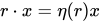
Let R be a commutative ring (so R could be a field). An associative R-algebra A (or more simply, an R-algebra A) is a ringA that is also an R-module in such a way that the two additions (the ring addition and the module addition) are the same operation, and scalar multiplication satisfies
for all r in R and x, y in the algebra. (This definition implies that the algebra, being a ring, is unital, since rings are supposed to have a multiplicative identity.)
Equivalently, an associative algebra A is a ring together with a ring homomorphism from R to the center of A. If f is such a homomorphism, the scalar multiplication is (r, x) ↦ f(r)x (here the multiplication is the ring multiplication); if the scalar multiplication is given, the ring homomorphism is given by r ↦ r ⋅ 1A. (See also § From ring homomorphisms below).
Every ring is an associative Z-algebra, where Z denotes the ring of the integers.
A commutative algebra is an associative algebra that is also a commutative ring.
The definition is equivalent to saying that a unital associative R-algebra is a monoid object in R-Mod (the monoidal category of R-modules). By definition, a ring is a monoid object in the category of abelian groups; thus, the notion of an associative algebra is obtained by replacing the category of abelian groups with the category of modules.
Pushing this idea further, some authors have introduced a "generalized ring" as a monoid object in some other category that behaves like the category of modules. Indeed, this reinterpretation allows one to avoid making an explicit reference to elements of an algebra A. For example, the associativity can be expressed as follows. By the universal property of a tensor product of modules, the multiplication (the R-bilinear map) corresponds to a unique R-linear map
The associativity then refers to the identity:
An associative algebra amounts to a ring homomorphism whose image lies in the center. Indeed, starting with a ring A and a ring homomorphism η : R → A whose image lies in the center of A, we can make A an R-algebra by defining
for all r ∈ R and x ∈ A. If A is an R-algebra, taking x = 1, the same formula in turn defines a ring homomorphism η : R → A whose image lies in the center.
If a ring is commutative then it equals its center, so that a commutative R-algebra can be defined simply as a commutative ring A together with a commutative ring homomorphism η : R → A.
The ring homomorphism η appearing in the above is often called a structure map. In the commutative case, one can consider the category whose objects are ring homomorphisms R → A for a fixed R, i.e., commutative R-algebras, and whose morphisms are ring homomorphisms A → A′ that are under R; i.e., R → A → A′ is R → A′ (i.e., the coslice category of the category of commutative rings under R.) The prime spectrum functor Spec then determines an anti-equivalence of this category to the category of affine schemes over Spec R.
How to weaken the commutativity assumption is a subject matter of noncommutative algebraic geometry and, more recently, of derived algebraic geometry. See also: Generic matrix ring.
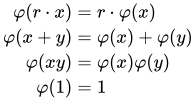
A homomorphism between two R-algebras is an R-linearring homomorphism. Explicitly, φ : A1 → A2 is an associative algebra homomorphism if
The class of all R-algebras together with algebra homomorphisms between them form a category, sometimes denoted R-Alg.
The subcategory of commutative R-algebras can be characterized as the coslice categoryR/CRing where CRing is the category of commutative rings.
The most basic example is a ring itself; it is an algebra over its center or any subring lying in the center. In particular, any commutative ring is an algebra over any of its subrings. Other examples abound both from algebra and other fields of mathematics.
Let A be an associative algebra over a commutative ring R. Since A is in particular a module, we can take the dual module A* of A. A priori, the dual A* need not have a structure of an associative algebra. However, A may come with an extra structure (namely, that of a Hopf algebra) so that the dual is also an associative algebra.
For example, take A to be the ring of continuous functions on a compact group G. Then, not only A is an associative algebra, but it also comes with the co-multiplication Δ(f)(g, h) = f(gh) and co-unit ε(f) = f(1).[1] The "co-" refers to the fact that they satisfy the dual of the usual multiplication and unit in the algebra axiom. Hence, the dual A* is an associative algebra. The co-multiplication and co-unit are also important in order to form a tensor product of representations of associative algebras (see § Representations below).
可換環R上の結合代数Aが与えられたとき、Aの包絡代数A eは、著者によってA ⊗ R A opまたはA op ⊗ R Aとなる。 [ 2 ]
A上の双加群は、 A上の左加群eと全く同じであることに注意してください。
A を可換環R上の代数とする。このとき、代数Aは、作用x ⋅ ( a ⊗ b ) = axb を持つA e := A op ⊗ R A上の右[ a ]加群である。定義により、乗法写像A ⊗ R A → A : x ⊗ y ↦ xyがA e線形写像として分割される場合、 Aは分離可能であると言われる。 [ 3 ]ここで、A ⊗ Aは( x ⊗ y ) ⋅ ( a ⊗ b ) = ax ⊗ ybによってA e加群となる。同様に、[ b ] AがA e上の射影加群である場合、A は分離可能である。したがって、AのA e射影次元( Aの双次元と呼ばれることもある)は、分離可能性の失敗を測定する。
Kを体とする有限次元代数をAとする。このとき、Aはアルティン環である。
Aはアルティン環であるため、可換であれば、それは基底体k上の代数である剰余体を持つアルティン局所環の有限積である。さて、縮約アルティン局所環は体であるため、以下は同値である[ 4 ] 。
させて、kの有限ガロア拡大のプロ有限群。するとこれは、有限次元の分離可能なk代数の圏と連続な有限集合の圏との間の反同値である。-アクション。[ 5 ]
単純アルティン環は除算環上の(完全)行列環であるため、Aが単純代数であれば、Aはk上の除算代数D上の(完全)行列代数になります。つまり、A = M n ( D )です。より一般的には、A が半単純代数であれば、それは(さまざまな除算k代数上の)行列代数の有限積になります。この事実は、アルティン・ウェダーバーン定理として知られています。
Aがアルティン環であるという事実は、ヤコブソン根基の概念を単純化します。アルティン環の場合、Aのヤコブソン根基は、すべての(両側)極大イデアルの共通部分です(これに対し、一般に、ヤコブソン根基は、すべての左極大イデアルの共通部分、またはすべての右極大イデアルの共通部分です)。
ウェダーバーン主定理は次のように述べている。[ 6 ]冪零イデアルIを持つ有限次元代数Aに対して、包絡代数( A / I ) e上の加群としてのA / Iの射影次元が最大で 1 であるならば、自然な全射p : A → A / I は分裂する。すなわち、A は部分代数Bを含み、p | B : B ~ → A / Iは同型である。I をヤコブソン根基とすると、この定理は特にヤコブソン根基が半単純代数によって補完されることを述べている。この定理は、リー代数に対するレヴィの定理の類似物である。
R を分数体Kを持つネーター整域とする(例えば、分数はZやQなど)。有限次元Kベクトル空間V内の格子Lは、 Vを張る有限生成R部分加群である。言い換えれば、L ⊗ R K = Vである。
A Kを有限次元のK代数とする。A Kにおける順序とは、束であるR部分代数のことである。一般に、束よりも順序の数の方がはるかに少ない。例えば、1 / 2 ZはQにおける束であるが、順序ではない(代数ではないため)。[ 7 ]
最大順序とは、すべての順序の中で最大の順序のことである。
K上の結合代数は、 2 つの入力 (乗数と被乗数) と 1 つの出力 (積)を持つ双線形写像A × A → Aと、乗法単位元のスカラー倍を識別する射K → Aを備えた K ベクトル空間 A によって与えられます。双線形写像A × A → A を(テンソル積の普遍性により)線形写像 (つまり、Kベクトル空間のカテゴリにおける射) A ⊗ A → Aとして再解釈すると、K上の結合代数は、代数の公理に帰着する特定の条件を満たす 2 つの射 (1 つはA ⊗ A → Aの形式、もう 1 つはK → Aの形式) を備えたKベクトル空間Aとして見ることができます。これらの2つの射は、代数公理を記述する可換図式のすべての矢印を反転させることにより、圏論的双対性を用いて双対化することができる。これにより、余代数の構造が定義される。
代数Aの表現は、 Aから何らかのベクトル空間 (またはモジュール) Vの自己準同型代数への代数準同型ρ : A → End( V )である。ρ が代数準同型であるという性質は、 ρが乗法演算を保存すること (つまり、Aのすべてのxとyに対してρ ( xy ) = ρ ( x ) ρ ( y )であること)、およびρ がAの単位元を End( V )の単位元(つまり、Vの恒等自己準同型) に写すことを意味する。
AとB が2 つの代数であり、ρ : A → End( V )とτ : B → End( W )が 2 つの表現である場合、ベクトル空間V ⊗ W上にテンソル積代数A ⊗ Bの(標準的な) 表現A ⊗ B → End( V ⊗ W )が存在します。しかし、何らかの追加条件を課さない限り、単一の結合代数の 2 つの表現のテンソル積を、結果が依然としてその代数 (それ自身とのテンソル積ではない) の表現となるように定義する自然な方法はありません。ここで、表現のテンソル積とは、通常の意味、つまり、結果が積ベクトル空間上の同じ代数の線形表現であることを意味します。このような追加構造を課すと、以下に示すように、ホップ代数またはリー代数の概念につながります。
例えば、2つの表現σ : A → End( V )とτ : A → End( W )を考えてみましょう。積ベクトル空間上でどのように作用するかによって、テンソル積表現ρ : x ↦ σ ( x ) ⊗ τ ( x )を形成しようとすると、
しかし、そのような地図は線形ではない。なぜなら、
k ∈ Kの場合。この試みを救済し、線形性を回復するには、代数準同型Δ : A → A ⊗ Aを定義し、テンソル積表現を次のように定義することで、追加の構造を課すことができます。
このような準同型写像 Δ は、特定の公理を満たす場合、余乗法と呼ばれます。結果として得られる構造は双代数と呼ばれます。結合代数の定義と整合するためには、余代数は余結合的でなければならず、代数が単位的であれば、余代数も余単位的でなければなりません。ホップ代数は、追加の構造(いわゆる対蹠点)を持つ双代数であり、2 つの表現のテンソル積だけでなく、2 つの表現の Hom 加群も定義できます(これもまた、群の表現論で行われるのと同様です)。
テンソル積の定義をより巧妙に試みることもできる。例えば、
したがって、テンソル積空間上の作用は次のように与えられる。
この写像は明らかにxに関して線形であるため、以前の定義にあった問題はない。しかし、乗算を保持しない。
しかし、一般的には、これは等しくない
これは、このテンソル積の定義があまりにも単純すぎることを示しています。明らかな解決策は、反対称となるように定義し、真ん中の2つの項が相殺されるようにすることです。これにより、リー代数の概念が導き出されます。
一部の著者は、「結合代数」という用語を、必ずしも乗法単位元を持たない構造を指すために使用しており、したがって、必ずしも単位元を持たない準同型写像を考察している。
非単位的結合代数の一例として、 xが無限大に近づくときの極限がゼロとなるすべての関数f : R → Rの集合が挙げられる。
別の例としては、連続周期関数のベクトル空間と畳み込み積が挙げられます。
{{citation}}ISBN /日付の不一致(ヘルプ)





![{\displaystyle {\mathfrak {a}}[\![u]\!]}](https://wikimedia.org/api/rest_v1/media/math/render/svg/721385db637a0372f1164e85dffc9c33c07d3228)











