
Loading article…

鍛冶屋は、主に錬鉄や鋼鉄、時には他の金属から、ハンマー、曲げ、切断などの道具を使って金属を鍛造して物を作る金属細工師です(ブリキ細工師を参照)。鍛冶屋は、門、格子、手すり、照明器具、家具、彫刻、道具、農具、装飾品や宗教用品、調理器具、武器などの物を作ります。歴史的には、鍛冶屋の重労働と、通常金、銀、ピューター、または上質な鋼の仕上げ工程で作業する白金細工師のより繊細な作業との間に区別がありました。 [ 1 ]鍛冶屋が働く場所は、鍛冶場、鍛冶屋、または鍛冶屋の店などと呼ばれます。
蹄鉄工、車大工、甲冑師など、金属を扱う職業は数多く存在するが、かつて鍛冶屋は、最も複雑な武器や鎧から、釘や鎖といった単純なものまで、多くのものの製造や修理に関する幅広い知識を持っていた。

「鍛冶屋」の「黒」は、加熱中に金属の表面に形成される酸化物の層である黒色の火砕物を指します。smith の語源は、古英語のsmiðで「鍛冶屋」を意味し、これはゲルマン祖語の*smiþazで「熟練した職人」を意味します。[ 2 ]

鍛冶屋は、錬鉄や鋼鉄の塊を加熱し、ハンマー、金床、鑿などの手工具で成形できるほど柔らかくなるまで加熱します。加熱は通常、プロパン、天然ガス、石炭、木炭、コークス、または石油を燃料とする炉で行われます。
現代の鍛冶屋の中には、より局所的な加熱のために、酸素アセチレンバーナーやそれに類するバーナーを使用する者もいる。誘導加熱方式は、現代の鍛冶屋の間で人気が高まっている。
金属の温度と加工性を判断する上で、色は重要です。鉄は高温になると、まず赤く光り、次にオレンジ、黄色、そして最後に白く光ります。ほとんどの鍛造作業において理想的な温度は、鍛造に適した明るい黄橙色です。鍛冶屋は金属の光る色を見極める必要があるため、薄暗い場所で作業する人もいますが、ほとんどの人は明るい場所で作業します。重要なのは、明るすぎない、一定の明るさの照明を確保することです。直射日光は色を覆い隠してしまうからです。
鍛冶の技術は、大きく分けて鍛造(「彫刻」とも呼ばれる)、溶接、熱処理、仕上げの4つに分類できる。
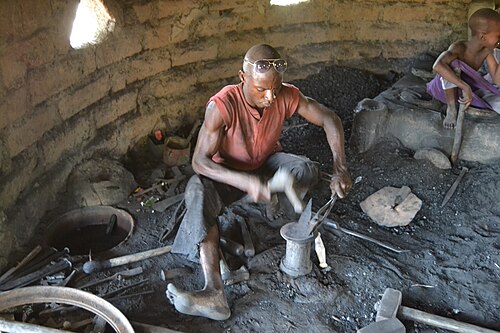
鍛造とは、鍛冶屋がハンマーで金属を叩いて形作る工程であり、切削加工とは異なり、材料を削り取ることはありません。鍛冶屋は鉄をハンマーで叩いて形を整えます。鍛冶屋による穴あけや切断作業(不要な部分を削り取る場合を除く)でも、通常は穴の周りの金属を再配置するだけで、削り屑として金属を削り取ることはありません。
鍛造には、7つの基本的な工程または技術が用いられます。
これらの作業には通常、少なくともハンマーと金床が必要ですが、鍛冶屋は変わった大きさの作業や繰り返し作業に対応するために、他の道具や技術も使用します。
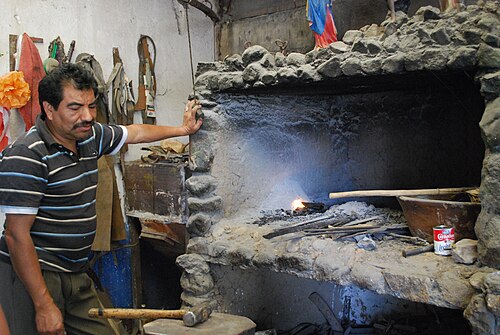
絞り加工とは、金属の寸法のうち一方または両方を小さくすることで、金属を長くする加工方法です。深さを小さくしたり、幅を狭くしたりすると、金属片は長く、つまり「引き伸ばされる」ことになります。
製図の一例として、鑿を作る鍛冶屋は、四角い鋼棒を平らにすることで、金属を長くし、厚みを薄くしながらも幅は一定に保つだろう。
描画は均一である必要はありません。楔や木工用ノミの刃を作る場合のように、テーパーが生じることもあります。2次元的にテーパーをつけると、先端が尖った形状になります。
描画は様々な道具や方法で行うことができます。ハンマーと金床だけを使った代表的な方法としては、金床の角をハンマーで叩く方法と、ハンマーの横打ちで金床の表面をハンマーで叩く方法があります。
金属板を薄く伸ばすもう一つの方法は、フラーと呼ばれる工具、またはハンマーの鋏面を使って、厚い金属板を素早く伸ばすことです。(この技法は、工具の名前からフラーリングと呼ばれます。)フラーリングとは、伸ばす金属板の長い部分に垂直に、対応する隆起部を持つ一連の凹みをハンマーで叩くことです。その結果、金属板の上部に波のような模様ができます。次に、鍛冶屋はハンマーを裏返し、平らな面を使って隆起部の上部を凹みの底と同じ高さまで叩きます。こうすることで、ハンマーの平らな面で叩くだけの場合よりも、金属が長さ(そして放置すれば幅)にずっと速く伸びていきます。

鉄を「鍛造温度」まで加熱すると、銅や銀のような柔らかく延性のある金属のように曲げることができる。
曲げ加工は、金床の角や縁にハンマーを当てて行うか、金床上部の四角い穴(ハーディホール)に曲げフォークを差し込み、フォークの歯の間に加工物を挟んで、材料を目的の角度に曲げることで行うことができます。曲げた部分は、金床の適切な形状の部分にハンマーを当てて叩くことで、形を整えたり、締めたり、広げたりすることができます。
金属の中には「熱収縮性」を持つものがあり、加熱すると引張強度を失います。まるで粘土のように、握ることで形を整えることはできますが、曲げたりねじったりして伸ばそうとすると、ひび割れて壊れてしまう可能性が高くなります。これは、刃物を作る鋼材にとって問題となります。刃物を作る鋼材は、将来的に破損の原因となる隠れたひび割れが発生しないよう、慎重に加工する必要があるからです。チタンは手作業で加工されることは稀ですが、特に熱収縮性が高い金属です。棒状の金属を装飾的にねじるといった一般的な鍛造工程でさえ、チタンでは不可能です。
据え込み加工とは、金属を一方の方向に短くすることで、もう一方の方向に厚みを増す加工法である。一つの方法として、棒の端を加熱し、釘を打つようにハンマーで叩く方法がある。こうすることで棒は短くなり、加熱された部分が太くなる。加熱した端をハンマーで叩く代わりに、加熱した端を金床に置き、冷たい端をハンマーで叩く方法もある。

打ち抜き加工は、装飾的な模様を作るため、あるいは穴を開けるために行われます。例えば、ハンマーの頭を作る準備として、鍛冶屋はハンマーの柄を通すための穴を太い棒やロッドに打ち抜きます。打ち抜き加工は、くぼみや穴を開けることだけにとどまりません。ノミを使って行う切断、スリット加工、ドリフト加工なども含まれます。
The five basic forging processes are often combined to produce and refine the shapes necessary for finished products. For example, to fashion a cross-peen hammer head, a smith would start with a bar roughly the diameter of the hammer face: the handle hole would be punched and drifted (widened by inserting or passing a larger tool through it), the head would be cut (punched, but with a wedge), the peen would be drawn to a wedge, and the face would be dressed by upsetting.
As with making a chisel, since it is lengthened by drawing it would also tend to spread in width. A smith would therefore frequently turn the chisel-to-be on its side and hammer it back down—upsetting it—to check the spread and keep the metal at the correct width.
Or, if a smith needed to put a 90-degree bend in a bar and wanted a sharp corner on the outside of the bend, they would begin by hammering an unsupported end to make the curved bend. Then, to "fatten up" the outside radius of the bend, one or both arms of the bend would need to be pushed back to fill the outer radius of the curve. So they would hammer the ends of the stock down into the bend, 'upsetting' it at the point of the bend. They would then dress the bend by drawing the sides of the bend to keep the correct thickness. The hammering would continue—upsetting and then drawing—until the curve had been properly shaped. In the primary operation was the bend, but the drawing and upsetting are done to refine the shape.
Welding is the joining of the same or similar kind of metal.
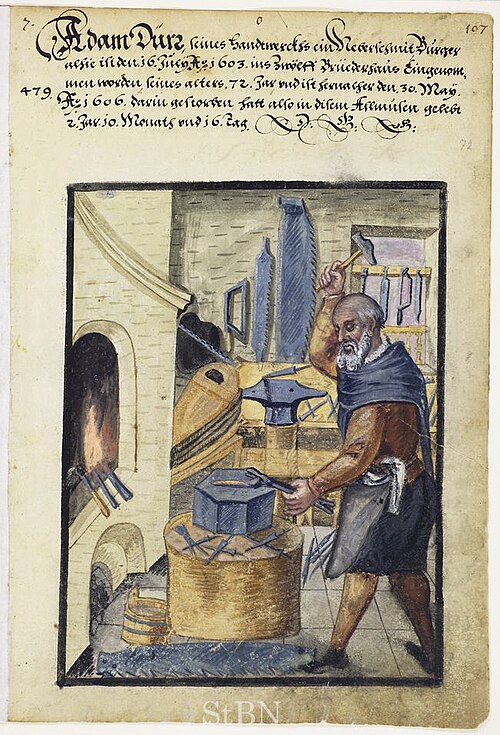
A modern blacksmith has a range of options and tools to accomplish this. The basic types of welding commonly employed in a modern workshop include traditional forge welding as well as modern methods, including oxyacetylene and arc welding.
In forge welding, the pieces to join are heated to what is generally referred to as welding heat. For mild steel most smiths judge this temperature by color: the metal glows an intense yellow or white. At this temperature the steel is near molten.
Any foreign material in the weld, such as the oxides or "scale" that typically form in the fire, can weaken it and cause it to fail. Thus the mating surfaces to be joined must be kept clean. To this end a smith makes sure the fire is a reducing fire: a fire where, at the heart, there is a great deal of heat and very little oxygen. The smith also carefully shapes mating faces so that as they come together foreign material squeezes out as the metal is joined. To clean the faces, protect them from oxidation, and provide a medium to carry foreign material out of the weld, the smith sometimes uses flux—typically powdered borax, silica sand, or both.
The smith first cleans parts to be joined with a wire brush, then puts them in the fire to heat. With a mix of drawing and upsetting the smith shapes the faces so that when finally brought together, the center of the weld connects first and the connection spreads outward under the hammer blows, pushing out the flux (if used) and foreign material.

The dressed metal goes back in the fire, is brought near to welding heat, removed from the fire, and brushed. Flux is sometimes applied, which prevents oxygen from reaching and burning the metal during forging, and it is returned to the fire. The smith now watches carefully to avoid overheating the metal. There is some challenge to this because, to see the color of the metal, the smith must remove it from the fire—exposing it to air, which can rapidly oxidize it. So the smith might probe into the fire with a bit of steel wire, prodding lightly at the mating faces. When the end of the wire sticks on to the metal, it is at the right temperature (a small weld forms where the wire touches the mating face, so it sticks). The smith commonly places the metal in the fire so he can see it without letting surrounding air contact the surface. (Note that smiths don't always use flux, especially in the UK.) Now the smith moves with rapid purpose, quickly taking the metal from the fire to the anvil and bringing the mating faces together. A few light hammer taps bring the mating faces into complete contact and squeeze out the flux—and finally, the smith returns the work to the fire. The weld begins with the taps, but often the joint is weak and incomplete, so the smith reheats the joint to welding temperature and works the weld with light blows to "set" the weld and finally to dress it to the shape.
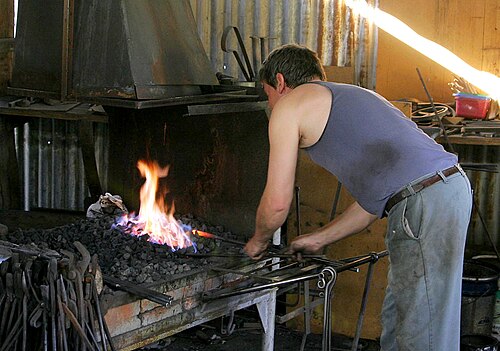
Depending on the intended use of the piece, a blacksmith may finish it in a number of ways:
A range of treatments and finishes can inhibit oxidation and enhance or change the appearance of the piece. An experienced smith selects the finish based on the metal and on the intended use of the item. Finishes include (among others): paint, varnish, bluing, browning, oil, and wax.

鍛冶屋の打撃係は、鍛冶屋の指示に従って重鍛造作業で大きな大槌を振り回す助手(多くの場合、見習い)です。実際には、鍛冶屋は片手で熱した鉄を金床に挟み(トングを使用)、もう一方の手で小さなハンマーで鉄を軽く叩いて叩く場所を示します。打撃係は、その指示された場所に大槌で強く叩きます。20世紀から21世紀にかけて、この役割はトリップハンマーや往復式パワーハンマーの使用により、ますます不要になり、自動化されていきました。
鉄鉱石を精錬して使用可能な金属にする場合、通常、一定量の炭素が鉄に合金化されます。(木炭はほぼ純粋な炭素です。)炭素の量は金属の特性に大きく影響します。炭素含有量が2%を超えると、比較的融点が低く鋳造しやすいため、鋳鉄と呼ばれます。しかし、非常に脆く、鍛造できないため、鍛冶には使用されません。炭素含有量が0.25%から2%の間であれば、工具鋼が得られ、前述のように熱処理することができます。炭素含有量が0.25%未満の場合、金属は「錬鉄(錬鉄は精錬されず、このプロセスでは得られません)」または「軟鋼」のいずれかです。これらの用語は決して互換性がありません。産業革命以前の時代には、鍛冶屋が好んで使用していた材料は錬鉄でした。この鉄は炭素含有量が非常に低く、また、非常に細い多数の筋状のガラス質のケイ酸鉄スラグが最大5%含まれていました。このスラグ含有量により、鉄は非常に丈夫になり、錆びにくくなり、鍛接が容易になりました。鍛接とは、鍛冶屋が2つの鉄片、または鉄片と鋼片を白熱に近い温度まで加熱してハンマーで叩き合わせることで永久的に接合する工程です。現代の軟鋼は溶接温度範囲が狭いため、鍛接はより困難です。錬鉄の繊維状の性質上、応力がかかる工具を適切に成形するには知識と技術が必要でした。現代の鋼は、高炉またはアーク炉を使用して生産されます。錬鉄はパドル法と呼ばれる労働集約的な工程で生産されていたため、この材料は現在では入手困難な特殊製品となっています。現代の鍛冶屋は、伝統的に錬鉄で作られていたものを作る際に、一般的に軟鋼を使用します。時には、電解製法の純鉄を使用することもあります。
多くの鍛冶屋は、青銅、銅、真鍮などの素材を芸術作品に取り入れています。アルミニウムやチタンも鍛造によって加工することができます。青銅は銅と錫の合金であり、真鍮は銅と亜鉛の合金です。それぞれの素材はハンマーで叩いた時の反応が異なるため、鍛冶屋は個別に研究する必要があります。
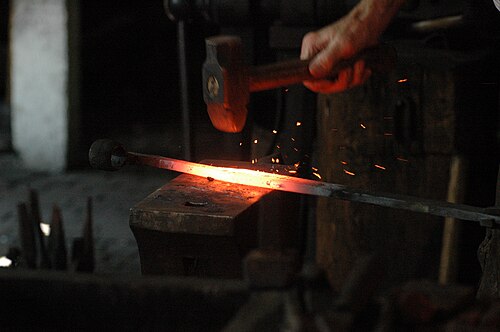
炭素含有量が0.6%未満の鋼は、単純な熱処理では十分な硬度が得られず、実用的な焼き入れ鋼工具を作ることはできません。したがって、以下では、錬鉄、低炭素鋼、その他の軟らかく焼き入れできない鉄類を区別なく単に「鉄」と呼びます。

ヒンドゥー教の神話において、ヴィシュヴァカルマとしても知られるトヴァスターは、デーヴァ神族の鍛冶屋である。トヴァスターに関する最も古い記述はリグ・ヴェーダに見られる。
ヘパイストス(ラテン語:ウルカヌス)は、ギリシャ神話とローマ神話に登場する神々の鍛冶屋である。火山を鍛冶場とする卓越した職人であり、神々の武器のほとんどを製作したほか、鍛冶場で働く美しい助手たちや、驚くほど精巧な金属製の漁網も作った。彼は金属加工、火、そして職人の神であった。
ケルト神話では、鍛冶屋の役割は、その名前が「鍛冶屋」を意味する同名の人物 、すなわちゴイブニウ (アイルランド神話のトゥアハ・デ・ダナーン物語)やゴファノン(ウェールズ神話/マビノギオン)が担っています。アイルランドの女神ブリギッドまたはブリジットは、鍛冶屋の守護神として描かれることもあります。[ 4 ]
コーカサスのナルト神話では、オセチア人にはクルダレゴン、チェルケス人にはトレプシュとして知られる英雄は、鍛冶屋であり熟練した職人で、その功績はシャーマニズム的な特徴を示し、時にはスカンジナビアの神オーディンの功績と比較される。彼の最も偉大な功績の1つは、英雄ザミクの男性助産婦のような役割を果たすことである。ザミクは、死にゆく妻で水の精霊イスプによって息子バトラズの胎児を宿すようにされ、イスプはそれをザミクの肩甲骨の間に吐き出し、そこで子宮のような嚢胞を形成する。クルダレゴンはザミクのために焼き入れ用の浴槽の上に塔または足場のようなものを用意し、時が来ると嚢胞を突き刺して、生まれたばかりの白熱した鋼鉄の赤子である英雄バトラズを解放し、クルダレゴンは新しく鍛えられた剣のように彼を焼き入れる。[ 5 ]

アングロサクソン人のウェイランド・スミス(古ノルド語ではヴォルンドル)は、ゲルマン神話に登場する英雄的な鍛冶屋である。詩のエッダによれば、彼は素晴らしい宝石をはめ込んだ美しい金の指輪を鍛造した。彼はニーズーズ王に捕らえられ、残酷にも足の腱を切断され、島に幽閉された。ヴォルンドルは最終的にニーズーズ王の息子たちを殺害し、彼らの頭蓋骨からゴブレット、目から宝石、歯からブローチを作ることで復讐を果たした。その後、彼は王女に強いビールを飲ませて酔わせ、強姦し、自作の翼で笑いながら逃走し、彼女との間に子供をもうけたと自慢した。

カレワラに登場する永遠のハンマー職人、鍛冶屋、発明家であるセッポ・イルマリネンは、フィンランド神話における典型的な職人である。 [ 8 ]
トーラーの創世記には、トゥバル・カインが最初の鍛冶屋として記されている。
鍛冶屋、戦士、狩人、その他鉄を扱う人々の神であるオグンは、西アフリカのヨルバ族が伝統的に崇拝してきたオリシャの神々の一柱である。
金、銀、銅はすべて、自然界に比較的純度の高い金属として産出する。おそらく人類はこれらの金属を最初に加工したのだろう。これらの金属はどれも非常に展延性に優れており、人類が最初に開発したハンマー加工技術は間違いなくこれらの金属に適用されたと考えられる。
銅器時代と青銅器時代の間、中東の人々は銅と青銅を精錬、溶解、鋳造、リベット留め、そして(限定的ではあるが)鍛造する方法を学んだ。青銅は銅と約10~20%の錫の合金である。青銅は銅単体よりも硬く、耐腐食性に優れ、融点が低い(そのため溶解や鋳造に必要な燃料が少なくて済む)ため、銅よりも優れている。地中海世界で使用された銅の多くはキプロス島から産出された。錫のほとんどはイギリスのコーンウォール地方から産出され、海上を航行するフェニキア人やギリシャ人の商人によって運ばれた。
銅や青銅は熱処理では硬化せず、冷間加工によってのみ硬化させることができます。冷間加工では、青銅片を長時間にわたって軽く叩きます。局所的な応力サイクルによって金属の結晶の大きさや形状が変化し、加工硬化が起こります。硬化した青銅は研磨して刃物を作ることができます。
19世紀頃まで、時計職人は真鍮製の歯車やラチェットの歯を硬化させるために加工硬化技術を用いていた。歯だけを叩くことで歯が硬くなり、耐摩耗性が向上した。一方、歯車の残りの部分はより柔らかく丈夫な状態のまま残され、ひび割れに対する耐性が高まった。
青銅は耐腐食性に優れているため、青銅製の遺物は数千年もの間、比較的無傷で保存されることがあります。そのため、博物館では、はるかに新しい鉄器時代の遺物よりも、青銅器時代の金属工芸品の方が多く保存されていることがよくあります。地中に埋もれた鉄器は、100年も経たないうちに完全に錆びてしまう可能性があります。古代の鉄器が現存している例は、まさに例外中の例外と言えるでしょう。
鉄器時代にアルファベット文字が出現したのと同時期に、人類は鉄という金属の存在を認識するようになった。しかし、それ以前の時代には、青銅とは対照的に、鉄の特性は一般には理解されていなかった。隕鉄からなる鉄製品は、最大40%のニッケルを含む化学組成を持つ。この鉄の供給源は極めて稀で偶然の産物であるため、鉄特有の鍛造技術が発展することはほとんどなかったと考えられる。現在でも隕鉄製の遺物が残っているのは、気候の変動と、ニッケルの存在によって鉄にもたらされる耐腐食性の向上によるものと考えられる。
20世紀初頭の(北)極地探検の際、グリーンランド北部のイヌイット族が、特に大きな2つのニッケル鉄隕石から鉄製のナイフを作っているのが発見された。[ 9 ]これらの隕石のうち1つはワシントンDCに運ばれ、スミソニアン協会の管理下に置かれた。
The Hittites of Anatolia first discovered or developed the smelting of iron ores around 1500 BC. They seem to have maintained a near monopoly on the knowledge of iron production for several hundred years, but when their empire collapsed during the Eastern Mediterranean upheavals around 1200 BC, the knowledge seems to have escaped in all directions.
In the Iliad of Homer (describing the Trojan War and Bronze Age Greek and Trojan warriors), most of the armor and weapons (swords and spears) are stated to have been of bronze. Iron is not unknown, however, as arrowheads are described as iron, and a "ball of iron" is listed as a prize awarded for winning a competition. The events described probably occurred around 1200 BC, but Homer is thought to have composed this epic poem around 700 BC; so exactitude must remain suspect.

The historical record during the Late Bronze Age Collapse is very inconsistent. Very few iron artifacts remain from the early Iron Age, due to loss from corrosion and re-use of iron as a valuable commodity. However, all of the basic operations of blacksmithing were in use by the time the Iron Age reached a particular locality. The scarcity of records and artifacts, and the rapidity of the transition from Bronze Age to Iron Age, is a reason to use evidence of bronze smithing to infer about the early development of blacksmithing.
It is uncertain when Iron weapons replaced Bronze weapons because the earliest Iron swords did not significantly improve on the qualities of existing bronze artifacts. Unalloyed iron is soft, does not hold an edge as well as a properly constructed bronze blade and needs more maintenance. Iron ores are more widely available than the necessary materials to create bronze however, which made iron weapons more economical than comparable bronze weapons. Small amounts of steel are often formed during several of the earliest refining practices, and when the properties of this alloy were discovered and exploited, steel edged weapons greatly outclassed bronze.
Iron is different from most other materials (including bronze), in that it does not immediately go from a solid to a liquid at its melting point. H2O is a solid (ice) at −1 C (31 F), and a liquid (water) at +1 C (33 F). Iron, by contrast, is definitely a solid at 800 °F (427 °C), but over the next 1,500 °F (820 °C) it becomes increasingly plastic and more "taffy-like" as its temperature increases. This extreme temperature range of variable solidity is the fundamental material property upon which blacksmithing practice depends.
Another major difference between bronze and iron fabrication techniques is that bronze can be melted. The melting point of iron is much higher than that of bronze. In the western (Europe & the Mideast) tradition, the technology to make fires hot enough to melt iron did not arise until the 16th century, when smelting operations grew large enough to require overly large bellows. These produced blast-furnace temperatures high enough to melt partially refined ores, resulting in cast iron. Thus cast-iron frying pans and cookware did not become possible in Europe until 3000 years after the introduction of iron smelting. China, in a separate developmental tradition, was producing cast iron at least 1000 years before this.
Although iron is quite abundant, good quality steel remained rare and expensive until the industrial developments of Bessemer processet al. in the 1850s. Close examination of blacksmith-made antique tools clearly shows where small pieces of steel were forge-welded into iron to provide the hardened steel cutting edges of tools (notably in axes, adzes, chisels, etc.). The re-use of quality steel is another reason for the lack of artifacts.
The Romans (who ensured that their own weapons were made with good steel) noted (in the 4th century BC) that the Celts of the Po River Valley had iron, but not good steel. The Romans record that during battle, their Celtic opponents could only swing their swords two or three times before having to step on their swords to straighten them.
On the Indian subcontinent, Wootz steel was, and continues to be, produced in small quantities.
In southern Asia and western Africa, blacksmiths form endogenous castes that sometimes speak distinct languages.
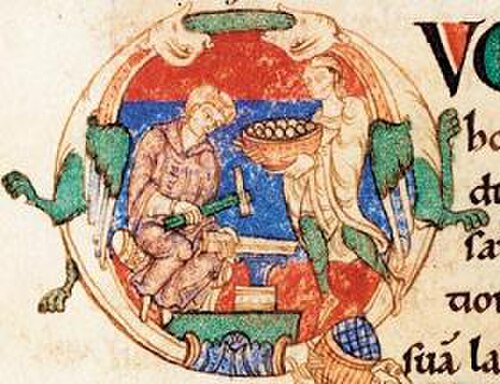

中世においては、鍛冶は七つの機械技術の一つと考えられていた。
産業革命以前は、「村の鍛冶屋」はどの町にも欠かせない存在だった。工場と大量生産の普及により、鍛冶屋が作る道具や金物に対する需要は減少した。
鍛冶屋は通常、村や町の中心部にある小さな工房で働いていた。[ 10 ]工房には通常、炉、金床、その他さまざまな道具が備えられていた。中世の鍛冶屋の仕事は肉体的にきつく、しばしば危険を伴った。鍛冶屋は重い金属片を持ち上げて移動させる必要があり、熱い炉で火傷しないように注意しなければならなかった。
困難はあったものの、鍛冶屋は中世社会において尊敬される職業であった。鍛冶屋は熟練した職人とみなされ、彼らの仕事は中世社会の機能にとって不可欠であった。
中世のイギリスで名前が挙げられた鍛冶屋の大多数は男性でしたが、女性も鍛冶屋として働いていました。[ 11 ]例えば、1346年にキャサリン・ル・フェーブルはエドワード3世によって「ロンドン塔内の王の鍛冶場を維持し、その仕事を続け、その職務に付随する賃金を受け取る」よう任命されました。[ 11 ]もう一つの例は、チープサイドで甲冑店を経営し甲冑師として働いていたアリス・ラ・オーベルジェール(鎖帷子製造者)です。[ 11 ] 1403年にヨークでアグネス・ヘッチェは父親の遺言で鎖帷子製造設備を譲り受け、兄弟とともに家業を引き継ぎました。[ 11 ]その他には、鐘鋳造者のジョアンナ・ヒル、刃物職人のアグネス・コティラー、ユースタキア・ラルムラーなどがいました。[ 11 ]
中世の鍛冶屋は、金属製品を作るためにさまざまな技術を使用していました。最も一般的な技術の1つは鍛造です。鍛造とは、金属をハンマーと金床で形を整えられるほど柔らかくなるまで加熱するプロセスです。[ 12 ]
もう一つの一般的な技術は溶接でした。溶接とは、2つの金属片を加熱して溶かし、ハンマーで叩き合わせて接合する工程です。
鍛冶屋は鋳造、切断、やすり掛けなど、他にもさまざまな技術を用いていた。
The original fuel for forge fires was charcoal. Coal did not begin to replace charcoal until the forests of first Britain (during the AD 17th century), and then the eastern United States of America (during the 19th century) were largely depleted. Coal can be an inferior fuel for blacksmithing, because much of the world's coal is contaminated with sulfur. Sulfur contamination of iron and steel make them "red short", so that at red heat they become "crumbly" instead of "plastic". Coal sold and purchased for blacksmithing should be largely free of sulfur.
European blacksmiths before and through the medieval era spent a great deal of time heating and hammering iron before forging it into finished articles. Although they were unaware of the chemical basis, they were aware that the quality of the iron was thus improved. From a scientific point of view, the reducing atmosphere of the forge was both removing oxygen (rust), and soaking more carbon into the iron, thereby developing increasingly higher grades of steel as the process was continued.
During the eighteenth century, agents for the Sheffield cutlery industry scoured the British country-side, offering new carriage springs for old. Springs must be made of hardened steel. At this time, the processes for making steel produced an extremely variable product—quality was not ensured at the initial point of sale. Springs that had survived cracking through hard use over the rough roads of the time, had proven to be of a better quality steel. Much of the fame of Sheffield cutlery (knives, shears, etc.) was due to the extreme lengths the companies took to ensure they used high-grade steel.

During the first half of the nineteenth century, the US government included in their treaties with many Native American tribes, that the US would employ blacksmiths and strikers at Armyforts, with the expressed purpose of providing Native Americans with iron tools and repair services.
During the early to mid-nineteenth century, both European armies[13] as well as both the U.S. Federal and Confederate armies employed blacksmiths to shoe horses and repair equipment such as wagons, horse tack, and artillery equipment. These smiths primarily worked at a traveling forge that when combined with a limber, comprised wagons specifically designed and constructed as blacksmith shops on wheels to carry the essential equipment necessary for their work.[14][15][16]
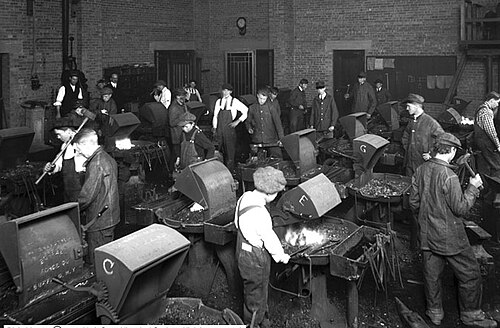
Lathes, patterned largely on their woodturning counterparts, had been used by some blacksmiths[17] since the middle-ages. During the 1790s Henry Maudslay created the first screw-cutting lathe, a watershed event that signaled the start of blacksmiths being replaced by machinists in factories for the hardware needs of the populace.
Samuel Colt neither invented nor perfected interchangeable parts, but his insistence (and other industrialists at this time) that his firearms be manufactured with this property, was another step towards the obsolescence of metal-working artisans and blacksmiths. (See also Eli Whitney).
As demand for their products declined, many more blacksmiths augmented their incomes by taking in work shoeing horses. A shoer-of-horses was historically known as a farrier in English. With the introduction of automobiles, the number of blacksmiths continued to decrease, many former blacksmiths becoming the initial generation of automobile Mechanics. The nadir of blacksmithing in the United States was reached during the 1960s, when most of the former blacksmiths had left the trade, and few if any new people were entering the trade. By this time, most of the working blacksmiths were those performing farrier work, so the term blacksmith was effectively co-opted by the farrier trade.
In the final part of the 18th century, forged ironwork continued to decline due to the aforementioned industrial revolution, shapes of the elements in the designs of window grilles and other decorative functional items continued to contradict natural forms, surfaces begin to be covered in paint, cast iron elements are incorporated into the forged designs.
新古典主義の鉄細工(ルイ16世様式やアンピール様式とも呼ばれる)の主な特徴は、滑らかな直線状の棒、装飾的な幾何学的要素、二重または楕円形の渦巻き模様、そして古典古代の要素(メアンダー(美術)、花輪など)の使用である。
この種の鉄細工の特徴は、鉄細工が白く塗装され、金(金メッキ)の要素が施されていることである。[ 18 ]


20世紀には、さまざまなガス(天然ガス、アセチレンなど)も鍛冶の燃料として使用されるようになりました。これらは鉄の鍛造には適していますが、鋼の鍛造に使用する場合は特別な注意が必要です。鋼片を加熱するたびに、炭素が鋼から抜け落ちる傾向があります(脱炭)。これにより、鋼片の表面に硬化しない鉄の層が残ることがあります。伝統的な木炭または石炭の鍛造炉では、燃料は実際には炭素だけです。適切に制御された木炭/石炭の火では、火の中および火のすぐ周囲の空気は還元雰囲気である必要があります。この場合、高温では、気化した炭素が鋼や鉄に浸透し、脱炭傾向を打ち消したり、無効にしたりする傾向があります。これは、表面硬化の準備として鉄片に鋼の層が形成されるプロセスと似ています。

鍛冶への関心が再び高まったのは、1970年代に起こった「自分でやる」や「自給自足」のトレンドの一環でした。現在、鍛冶について一般の人々に教育するために活動している書籍、団体、個人は数多くあり、クラブを結成した地元の鍛冶職人のグループも含まれ、その鍛冶職人の中には、史跡や歴史再現イベントで実演を行う者もいます。装飾的な金属細工を制作する現代の鍛冶職人の中には、自らをアーティスト鍛冶職人と呼ぶ者もいます。1973年に北米アーティスト鍛冶職人協会が27人の会員で設立され、2013年には会員数が4000人近くに達しました。同様に、英国アーティスト鍛冶職人協会は1978年に30人の創設メンバーで設立され、2013年には約600人の会員を擁し[ 19 ]、会員向けに季刊誌を発行しています。
先進国では鍛冶屋の衰退と再興が見られた一方で、多くの発展途上国では、鍛冶屋は地域の人々のために鉄や鋼の道具や金物を作り、修理し続けていた。

