
Loading article…
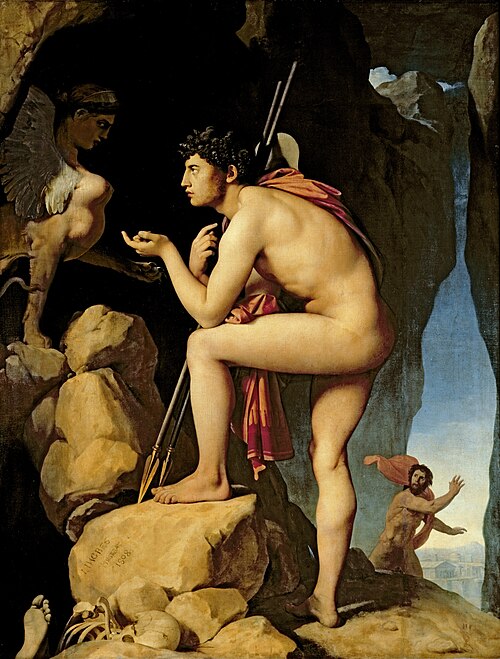
In classical psychoanalytic theory, the Oedipus complex is a son's sexual attitude towards his mother and concomitant hostility toward his father, first formed during the phallic stage of psychosexual development. A daughter's attitude of desire for her father and hostility toward her mother is referred to as the feminine (or female) Oedipus complex.[1] The general concept was considered by Sigmund Freud in The Interpretation of Dreams (1899), although the term itself was introduced in his paper "A Special Type of Choice of Object Made by Men" (1910).[2][3]
Freud's ideas of castration anxiety and penis envy refer to the differences of the sexes in their experience of the Oedipus complex.[4] The complex is thought to persist into adulthood as an unconscious psychic structure which can assist in social adaptation but also be the cause of neurosis. According to sexual difference, a positive Oedipus complex refers to the child's sexual desire for the opposite-sex parent and aversion to the same-sex parent, while a negative Oedipus complex refers to the desire for the same-sex parent and aversion to the opposite-sex parent.[3][5][6] Freud considered that the child's identification with the same-sex parent is the socially acceptable outcome of the complex. Failure to move on from the compulsion to satisfy a basic desire and to reconcile with the same-sex parent leads to neurosis.
The theory is named after the mythological figure of Oedipus, an ancient Theban king who discovers he has unknowingly murdered his father and married his mother, whose depiction in Sophocles' Oedipus Rex had a profound influence on Freud. Freud rejected the Electra complex,[7] introduced by Carl Jung in 1913[8] as a proposed equivalent complex among young girls.[7]
批評家の中には、フロイトが以前の誘惑理論(神経症の原因を児童性的虐待に帰する理論)を放棄し、エディプス・コンプレックス理論に置き換えたことで、児童性的虐待の隠蔽を招いたと主張する者もいる。また、学者や心理学者の中には、この理論は同性カップルの親には適用できず、近親相姦に対する広範な嫌悪感と相容れないとして批判する者もいる。

オイディプスとは、紀元前5世紀のギリシャ神話に登場する人物で、知らず知らずのうちに父ライオスを殺害し、母イオカステと結婚するオイディプス王のことである。この神話を基にした戯曲『オイディプス王』は、紀元前429年頃にソフォクレスによって書かれた。
ソフォクレスの戯曲の現代版は19世紀にパリとウィーンで上演され、1880年代と1890年代には驚異的な成功を収めた。オーストリアの神経学者ジークムント・フロイト(1856年~1939年)はこれらの公演を観劇した。1899年に初版が出版された著書『夢判断』の中で、彼はエディプスコンプレックスは人間に生まれつき備わっている普遍的な心理現象であり、多くの無意識の罪悪感の原因であると提唱している。
フロイトは、エディプス感情は人類が猿から進化するのに要した数百万年の間に受け継がれてきたものだと信じていた。[ 10 ]彼のその普遍性に関する見解は、神経症の子供や正常な子供の臨床観察、彼自身の『オイディプス王』への反応の分析、そしてこの劇が古代と現代の両方の観客に効果的であったという事実に基づいていた。フロイトは、オイディプス神話の時代を超えた魅力を次のように説明している。
彼の運命が私たちを感動させるのは、それが私たちの運命でもあったかもしれないからに他ならない。神託は、彼と同じように、生まれる前に私たちにも同じ呪いをかけたのだ。おそらく、私たち全員の運命は、最初の性的衝動を母親に向け、最初の憎しみと最初の殺意を父親に向けることなのだろう。私たちの夢は、それが真実であることを確信させてくれる。[ 11 ]
フロイトはまた、ハムレット という戯曲は「オイディプス王と同じ土壌に根ざしている」と主張し、両戯曲の違いは次のようなことを明らかにしている。
In [Oedipus Rex] the child's wishful fantasy that underlies it is brought into the open and realized as it would be in a dream. In Hamlet it remains repressed; and—just as in the case of a neurosis—we only learn of its existence from its inhibiting consequences.[12][13]
However, in The Interpretation of Dreams, Freud makes it clear that the "primordial urges and fears" that are his concern and the basis of the Oedipal complex are inherent in the myths the play is based on, not primarily in the play itself, which Freud refers to as a "further modification of the legend" that originates in a "misconceived secondary revision of the material, which has sought to exploit it for theological purposes".[14][15][16]
Before the idea of the Oedipus complex, Freud believed that childhood sexual trauma was the cause of neurosis. This idea, sometimes called Freud's seduction theory, was deemphasized in favor of the Oedipus complex around 1897.[17]
Freud's original examples of the Oedipus complex are applied only to boys or men; he never fully clarified his views on the nature of the complex in girls.[20] He described the complex as a young boy's hatred or desire to eliminate his father and to have sex with his mother.
フロイトは1910年の論文「男性による特別な対象選択」の中で「エディプス・コンプレックス」という用語を導入した。[ 20 ] [ 2 ]この論文では、少年が初めて売春を認識した後の出来事を説明するセクションにこの用語が登場する。
その後、両親が性行為の普遍的で忌まわしい規範の例外であるという疑念を維持できなくなった彼は、母親と娼婦の違いは結局それほど大きくない、基本的に同じことをしているのだから、と冷笑的な論理で自分に言い聞かせる。彼が受けた啓蒙的な情報は、実際には彼の幼少期の印象と願望の記憶痕跡を呼び覚まし、それが彼の中に特定の精神的衝動の再活性化をもたらした。彼は最近知った意味で母親自身を欲し始め、この願望の邪魔をするライバルとして父親を再び憎むようになる。彼は、いわゆるエディプス・コンプレックスの支配下に入る。彼は、母親が自分ではなく父親に性交の恩恵を与えたことを許さず、それを不貞行為とみなす。[ 21 ]
フロイトらは最終的にこの考えを発展させ、より大きな理論体系の中に組み込んだ。

古典的な精神分析理論では、エディプスコンプレックスは精神性発達の男根期(3~6歳)に発生するが、より早い年齢で現れることもある。[ 22 ] [ 23 ]
男根期において、男の子の決定的な心理性的経験はエディプス・コンプレックス、すなわち母親をめぐる父子間の競争です。この心理性的発達の第3段階において、子供の性器は主要な性感帯となります。そのため、子供たちは自分の体、他の子供の体、そして両親の体を意識するようになると、服を脱いで自分自身や互いの体、そして性器を探索することで身体的な好奇心を満たし、男性と女性の解剖学的差異や男の子と女の子の性差を学んでいきます。
母親は主に子供の欲求を満たす親であるにもかかわらず、子供は「男の子」「女の子」といった明確な性的アイデンティティを形成し始め、親子関係の力学が変化します。親は幼児期の性的欲求の対象となります。男の子は母親に性的欲求(精神エネルギー)を向け、父親には嫉妬と感情的な競争心を向けます。母親への欲求は、父親の死への欲求、さらには父親の死を誘発しようとする衝動と結びついています。これらの欲求は快楽原則に支配されるイドの領域で顕現しますが、現実原則に支配される実用的自我は、父親が克服不可能なライバルであることを知っており、その衝動は抑圧されます。父親の家族内での立場に対する男の子の両価性は、肉体的に優位な父親による去勢への恐怖として現れます。この恐怖は、幼児期のイドの非合理的で無意識的な顕現です。[ 24 ]
男女ともに、防衛機制はイドの衝動と自我の衝動の間の葛藤を一時的に解決する。抑圧、つまり受け入れがたい考えや衝動を意識から遮断することは第一の防衛機制だが、その作用はイドと自我の葛藤を解決するものではなく、単に衝動を無意識に閉じ込めるだけであり、無意識の中で衝動は意識の方向へ圧力をかけ続ける。第二の防衛機制は同一化であり、子どもは同性の親の性格特性を(超)自我に取り込むことで適応する。男の子の場合、父親に似ていることで、父親との競争の結果から守られるため、去勢不安が軽減される。女の子の場合、母親との同一化によって不安が軽減される。母親は、どちらもペニスを持っておらず、したがって敵対者ではないことを理解しているからである。[ 25 ]
エディプス・コンプレックスの満足のいく解決は、男性の幼児期の超自我の発達において重要であると考えられている。父親と同一化することで、少年は社会道徳を内面化し、罰への恐怖から反射的に従うのではなく、社会規範を自発的に、自己規制的に遵守するようになる可能性がある。母親の心理的性的所有をめぐる息子と父親の未解決の競争は、男根期の固着につながり、少年が攻撃的で、野心過剰で、虚栄心の強い男になる可能性がある。[ 26 ]
5歳男児の恐怖症の分析(1909年)では、馬恐怖症の少年「リトル・ハンス」の症例研究において、フロイトは、ハンスの馬と父親に対する恐怖の関係は、外的要因である妹の誕生と、内的要因である幼児の母親の伴侶として父親に取って代わろうとする欲求、そして同年代の少年によくある自慰行為を楽しむことへの罪悪感から生じていると主張した。リトル・ハンス自身は、馬への恐怖と父親への恐怖を結びつけることができなかった。治療を担当した精神分析医として、フロイトは「ハンスは自分で言えないことをたくさん教えられなければならなかった」こと、そして「これまで彼が持っている兆候を全く示していなかった考えを提示されなければならなかった」ことを指摘した。[ 27 ]
フロイトは、少年少女の精神性発達にエディプス・コンプレックスを適用したが、後にその理論の女性的側面を「女性的エディプス態度」および「否定的エディプス・コンプレックス」として修正した。 [ 28 ]彼の弟子であり協力者であったカール・ユングは、1913年の著書『精神分析の理論』の中で、父親の精神性的な所有をめぐる娘と母親の競争を説明するためにエレクトラ・コンプレックスを提唱した。 [ 8 ] [ 29 ]
男根期において、女性的なエディプス態度は、少女が明確な性的アイデンティティ(自我)を形成する上で決定的な精神力動的経験となる。少年は去勢不安を抱くのに対し、少女はペニス羨望を抱く。なぜなら、少女は以前に去勢された(そしてペニスを失った)と認識し、同類を劣等な存在として恨みを抱き、同時に自分の男児を産むことで父親のペニスを取り戻そうと努力するからである。さらに、男根期の後、少女の精神性発達には、主要な性感帯を幼児期の陰核から成人期の膣へと移行することが含まれる。[ 30 ]
フロイトは、少女のネガティブなエディプス・コンプレックスは少年のそれよりも感情的に強烈であり、従順で不安な性格の女性になる可能性があると考えた。[ 31 ]

フロイトが提唱したエディプス・コンプレックスは、当初は少年が母親への欲望と父親に対する嫉妬深い競争を経験することに重点を置いていたが、これに対し、弟子であり協力者であったカール・ユングは、少女は父親への欲望と母親への攻撃性を経験すると提唱し、それをエレクトラ・コンプレックスと呼んだ。[ 8 ]エレクトラはギリシャ神話の人物で、兄のオレステスと共に、父親アガメムノンの殺害に対する復讐として、母親クリュタイムネストラと継父アイギストスに復讐を企てた。エディプスと同様、この人物は紀元前5世紀のソフォクレスの戯曲(エレクトラ)の題材となっている。 [ 32 ] [ 33 ] [ 34 ]正統派ユング心理学では、「エディプス・コンプレックス」という用語は、少年の精神性発達を示すためにのみ使用される。フロイト自身もこの等価性を否定し、この発達段階では、片方の親への愛情ともう片方の親への競争的な憎悪を同時に経験するのは男性だけだと主張した。フロイトにとって、エレクトラ・コンプレックスの概念は、同性および異性の親との関係において、少年と少女の間に実際には存在しない類似の関係を前提としている。フロイトによれば、エレクトラ・コンプレックスは、去勢コンプレックスの異なる影響と、両性における男根の重要性を考慮に入れておらず、少女の母親に対するエディプス前期の愛着を見落としている。[ 35 ]

古典的なフロイト心理学では、超自我、すなわち「エディプス・コンプレックスの継承者」は、幼児の男の子が父親の家庭のルールを内面化する過程で形成される。これに対し、1920年代初頭、オットー・ランクは「前エディプス期」という用語を用いて、正常な精神性発達の過程において、男の子の力強い母親が超自我の源泉であると提唱した。ランクはフロイトとの理論的な対立により、フロイト派の内輪から排除されたが、後に1925年に精神力動的な対象関係論を発展させた。
フロイトは、父親(父方のファルス)が幼児期および成人期の精神性発達の中心であると提唱したが、メラニー・クラインは初期の母子関係に焦点を当て、エディプス的兆候は生後1年目の口唇期に現れると提唱した。彼女の提唱は、英国精神分析協会での「論争の的となった議論」(1942~44年)の一部であった。クライン派の心理学者たちは、「フロイトが説明したエディプス・コンプレックスの根底には、エディプス夫婦とのより原始的な関係のより初期の層が存在する」と提唱した。[ 36 ]彼女は、子供の投影空想についての議論の中で、「危険な破壊的傾向は父親だけでなく母親にも存在する」と指摘した。[ 37 ]クラインの抑うつポジションの概念は、乳児の母親に対する両価性から生じるものであり、精神性発達におけるエディプスコンプレックスの中心的な重要性を低下させた。[ 38 ] [ 39 ]
「クライン以降のビオンにとって、オイディプスの神話は性差ではなく、探求心、すなわち知識の探求に関わるものであり、オイディプス劇のもう一人の主要人物はテイレシアス(新しい理論に対する不安に対抗するために立てられた誤った仮説)となる」 [ 40 ] 。その結果、「ビオンは、オイディプスの中心的な罪は、どんな犠牲を払ってでも真実を知ろうとする彼の固執にあると考えた」[ 41 ] 。
ジャック・ラカンは、エディプス・コンプレックスを精神性発達経験の中心から取り除くことに反対した。彼にとって、エディプス・コンプレックスは「私たちがそれを意味作用によって経験の全領域を覆い尽くすものとして認識し続ける限り、私たちの学問分野が主観性に割り当てている限界を示すものと言える」[ 42 ] 。それは、文化の王国を個人に重ね合わせ、その個人を象徴秩序へと導くものである[ 43 ]。
このように、「子どもはエディプス・コンプレックスを経験する中で、自分自身とは独立した力とは何かを学び、自分自身とは独立した象徴体系の存在に出会う」のです。 [ 44 ]さらに、ラカンの「エディプス・コンプレックスの三項関係」が息子と母親の関係という「二重関係の囚人」を解放するという提案は、後の精神分析家にとって有用であることが証明されました。[ 45 ]したがって、ボラスにとって、エディプス・コンプレックスの「達成」とは、「子どもが自分の心を持つことの奇妙さについて何かを理解し、視点の多様性を発見する」ことです。[ 46 ]同様に、ロナルド・ブリットンにとって、「愛と憎しみの中で認識される両親の間のつながりが子どもの心の中で許容できるならば、これは私たちに他者との相互作用の中で私たちを見る能力を与え、そして私たち自身でありながら自分自身を振り返る能力を与える」のです。[ 47 ]そのため、マイケル・パーソンズは『帰ってくる鳩、消える鳩』(2000年)の中で、そのような視点によって「エディプス・コンプレックスを生涯にわたる発達上の課題として捉え、後年の人生に特有の新たなエディプス的形態を想定する」ことができると提唱した。[ 48 ]
In 1920, Sigmund Freud wrote that "with the progress of psychoanalytic studies the importance of the Oedipus complex has become, more and more, clearly evident; its recognition has become the shibboleth that distinguishes the adherents of psychoanalysis from its opponents";[49] thereby it remained a theoretic cornerstone of psychoanalysis until about 1930, when psychoanalysts began investigating the pre-Oedipal son–mother relationship within the theory of psychosexual development.[50][51] Janet Malcolm reports that by the late 20th century, to the object relations psychology "avant-garde, the events of the Oedipal period are pallid and inconsequential, in comparison with the cliff-hanging psychodramas of infancy. ... For Kohut, as for Winnicott and Balint, the Oedipus complex is an irrelevance in the treatment of severe pathology".[52] Nonetheless, ego psychology continued to maintain that "the Oedipal period—roughly three-and-a-half to six years—is like Lorenz standing in front of the chick, it is the most formative, significant, moulding experience of human life ... If you take a person's adult life—his love, his work, his hobbies, his ambitions—they all point back to the Oedipus complex".[53]
Studies conducted of children's attitudes to parents at the oedipal stage do not demonstrate the shifts in positive feelings that are predicted by the theory.[54] Case studies that Freud relied upon, such as the case of Little Hans, could not be verified through research or experimentation on a larger population.[55]Adolf Grünbaum argues that the type of evidence Freud and his followers used, the clinical productions of patients during analytic treatment, by their nature cannot provide cogent observational support for Freud's core hypotheses.[56]
Evolutionary psychologists Martin Daly and Margo Wilson, in their 1988 book Homicide, argue that the Oedipus complex theory yields few testable predictions. They find no evidence of the Oedipus complex in people. There is evidence of parent–child conflict but it is not for sexual possession of the opposite sex-parent.[57]
According to psychiatrist Jeffrey Lieberman, Freud and his followers resisted subjecting his theories, including the Oedipus theory, to scientific testing and verification.[58] Lieberman claims that investigations based in cognitive psychology either contradict or fail to support Freud's ideas.[58]
In the 1970s, social worker Florence Rush wrote that Freud's seduction theory, which came early in his career, correctly attributed his patients' memories of childhood trauma to the patient's family, often the father, implying that widespread sexual abuse of children by parents was common in his society. According to Rush, the discovery of this abuse made Freud uncomfortable, so he abandoned the theory and invented the Oedipus complex to replace it. The Oedipus complex allowed him to attribute stories of childhood sexual abuse to the children themselves. Freud came to the conclusion that the stories were fantasies of hidden desires, rather than factual descriptions of trauma. Thus, Rush argues, Freud covered up illegal and immoral sexual abuse by undermining the perceptions of his patients, particularly his female patients.[59] Rush's theory became known as The Freudian Coverup.
A director of the Sigmund Freud Archives, Jeffrey Moussaieff Masson, adopted the view that Freud's work was a cover-up of sexual abuse of children after reading Freud's unpublished letters. In his book The Assault on Truth, Masson argues that Freud misattributed accounts of sexual abuse to fabrications and fantasies of children because, for personal reasons, he was unable to accept that the accounts were real. According to Masson, among Freud's reasons to suppress the abuse was that he did not want to be confronted by the father of a patient who was accused of committing abuse. Late in his career Freud sought to prevent colleague Sandor Ferenczi from delivering a paper that reasserted the seduction theory. Freud had hoped that his former student would abandon the theory as he himself had done, but Ferenczi delivered the paper in 1932.[60] Masson writes that, because the theory of the Oedipus complex became widely popular, psychoanalysts continue to do damage to their patients by doubting the reality of the patient's early memories of trauma.
Other Freud scholars argue that Masson and Rush have misrepresented the reasons and intention behind Freud's abandonment of the seduction theory and adoption of the theory of the Oedipus complex. According to Dr. Kurt R. Eissler, who replaced Masson as director of the Freud Archives, Freud did not in any sense reject the reality of childhood sexual trauma, but realized that actual abuse was not the universal cause of neurosis he had thought it to be.[60] New York psychiatrist Dr. Frank R. Hartmann said that "Freud realized he made a mistake in attributing all neurosis to repressed memories of actual abuse. He discovered a much broader theory which explained much more."[60] The historian Peter Gay, author of Freud: A Life for Our Time (1988), emphasizes that Freud continued to believe that some patients were sexually abused, but realized that there can be a difficulty in distinguishing between truth and fiction. Therefore, according to Gay, there was no sinister motive in changing his theory; Freud was a scientist seeking the facts and was entitled to change his views if new evidence was presented to him.[61]
Many scholars and psychologists observe that, because the theory of the Oedipus complex assigns distinct roles to a mother and father, it is a poor fit for families that do not use traditional gender roles.
As of January 2025same-sex marriage is legal in 37 nations.[62] Same-sex couples start families through adoption or surrogacy. The pillars of the family structure are diversifying to include parents who are single or of the same sex as their partner along with the traditional heterosexual, married parents. These new family structures pose new questions for the psychoanalytic theories such as the Oedipus complex that require the presence of the mother and the father in the successful development of a child.[37]
証拠によれば、同性の親に育てられた子供は、伝統的な家族構造で育てられた子供とそれほど違いはない。[ 37 ]ドレッシャーの研究によると、エディプス・コンプレックスの古典的な理論は、同性の親に対する「否定的な意味合い」が批判され、今日の社会では支持を失っている。[ 37 ]チョドロウやコーベットなどの多くの精神分析思想家は、エディプス・コンプレックスを「性別、ジェンダー、およびこれらのカテゴリーから派生するステレオタイプな心理機能の間の自動的な関連付け」を排除し、今日の現代社会に適用できるようにするために、エディプス・コンプレックスの変更に取り組んでいる。[ 37 ]フロイトの概念以来、精神分析とその理論は常に、自らを展開するために伝統的なジェンダー役割に依存してきた。
1950年代、心理学者は母親と父親の育児における役割を区別した。母親には主要な養育者の役割が割り当てられ、母性愛は無条件であると考えられた。一方、父親には二次的な養育者の役割が割り当てられ、父性愛は条件付きであり、子供の具体的な成果に応じて変化する。[ 37 ]エディプス・コンプレックスは、男性性と女性性の概念の存在を必要とするため、現代の家族構造の文脈では損なわれている。[ 63 ]父親がいない場合、少年が去勢不安を抱く理由がなく、したがってコンプレックスを解消する理由もない。[ 37 ]精神分析では、非異性愛規範的な関係は、自然な出来事ではなく、一種の倒錯またはフェティシズムとして提示される。[ 63 ]一部の心理学者にとって、このジェンダー規範への強調は、同性愛者の患者の治療の妨げになる可能性がある。[ 63 ]
ディディエ・エリボンによれば、ジル・ドゥルーズとフェリックス・ガタリによる1972年の著書『アンチ・オイディプス』は「精神分析的規範性とオイディプスに対する批判」である。[ 64 ]エリボンは、フロイトやラカンが記述したオイディプス・コンプレックスを「同性愛の劣等化過程」である「あり得ないイデオロギー的構築物」として批判している。[ 65 ]心理学者ゲバ・シェンクマンによれば、「オイディプス・コンプレックスや原初場面といった概念を男性同性カップルに適用することを検討するには、まず性別、ジェンダー、そしてこれらのカテゴリーに基づくステレオタイプ的な心理機能との間の自動的な関連付けを排除しなければならない。」[ 37 ]
現代における精神分析の再構築を目指すポストモダン精神分析理論は、このコンプレックスが新しい家族構造を説明していないため、修正または破棄することを提案している。シェンクマンは、子供が性別や性自認に関係なく親から性的満足を求めるという、エディプス・コンプレックスの緩やかな解釈が役立つだろうと示唆している。「この観点からすると、親の権威、あるいは制度は、コンプレックスを生み出すタブーを表している可能性がある」。精神分析医メラニー・クラインは、性別の固定観念を打ち破りながらも、伝統的な父母の家族構造を維持した理論を提唱した。彼女は、子供の投影空想についての議論の中で、「危険な破壊的傾向は父親だけでなく母親にもある」と指摘した。[ 37 ]
アヌーシュカ・グロースは、エディプス・コンプレックスを「人間が社会化され、失望に対処することを学ぶ方法」と理解している。[ 66 ]彼女はこのコンプレックスを「主要な養育者にとってすべてであろうとするのをやめ、世界の他の人にとって何かになることに専念しなければならない」と要約している。[ 67 ]このラカン以降のコンプレックスの解釈は、19世紀の記述とは大きく異なっている。エリボンは、この解釈は「エディプス・コンプレックスをフロイトのものとはほとんど似ていないところまで拡張している」と書いている。[ 65 ]
親子や兄弟姉妹間の近親相姦は、ほぼ普遍的に禁じられている。[ 68 ]この近親相姦のタブーの説明としては、本能的な性的欲求というよりは、これらの関係に対する本能的な性的嫌悪感があるということが挙げられる(ウェスターマーク効果を参照)。スティーブン・ピンカーは、「少年が母親と寝たいと思うという考えは、ほとんどの男性にとって、これまで聞いた中で最もばかげたことのように思える。明らかに、フロイトにはそうは思えなかったようで、少年時代に母親が着替えているのを見て性的反応を示したことがあると書いている。注目すべきは、アマリア・ナタンゾーン・フロイトはフロイトの幼少期には比較的若く、生殖年齢であったこと、そしてフロイトには乳母がいたため、フロイト夫人が自分の母親であると知覚システムに気づかせるような初期の親密さを経験していなかった可能性があるということである。」と書いている。[ 69 ]
In Esquisse pour une autoanalyse, Pierre Bourdieu argues that the success of the concept of Oedipus is inseparable from the prestige associated with ancient Greek culture and the relations of domination that are reinforced in the use of this myth. In other words, if Oedipus was Bantu or Baoulé, his story would probably not be viewed as a human universal. This remark recalls the historically and socially situated character of the founder of psychoanalysis.[70]
Sex and Repression in Savage Society is considered "a famous critique of psychoanalysis, arguing that the 'Oedipus complex' described by Freud is not universal."[71]
Feminist views on the Oedipus complex include criticism of the phallocentrism of the theory by philosopher Luce Irigaray among others. Irigaray charges that Freud's work assumes a masculine perspective, epitomized by the centrality of the penis (or lack of a penis for girls) in the Oedipus complex. She thinks that Freud's desire for a neat, symmetrical theory leads him to a contrived understanding of women as inverse men. She charges that he does not explore mother–daughter relationships and that he dogmatically assumes female sexuality will be a perfect mirror of male sexuality.[72]
{{cite journal}}:ジャーナルを引用するには|journal=(ヘルプ)