
Loading article…
この用語集は、複数の菌類の糸の間に共生する藻類やシアノバクテリアから生じる複合生物である地衣類の説明に使用される用語の概要を提供します。[1] [2]

「地衣類学の父」として知られるエリック・アカリウスは、18世紀初頭に、現在でも使用されている地衣類の専門用語を数多く考案した。それ以前には、地衣類に特有の用語は数個しか提案されていなかった。ヨハン・ディレニウスは1742年にクラドニア属に関連するカップ状の構造を説明するためにscyphus を導入し、1794年にはミシェル・アダンソンがグラフィス属の溝のある子実体をlirella と使用した。アカリウスは、アポテシウム、セファロジウム、キフェラ、ポデティウム、固有縁、ソレディウム、およびタラスなど、地衣類の構造を説明するために多数の用語を導入した。 1825年、フリードリヒ・ヴァルロートは、多巻からなる著書「地衣類の自然史」の最初の巻を出版し、主にギリシャ語の語源に基づいた別の用語を提案した。ヴァルロートはアカリウス(ヴァルロートはヴァルロートを批判していた)の代案として発表したが、あまり受け入れられず、ヴァルロートが提案した用語で広く受け入れられたのは、上生と下生、異生と同生、ゴニジウムのみで、ゴニジウムは1960年代まで使われ続けた。[3] 1850年頃まで、地衣類の体形を表す用語は21あり、現在も使用されている。[3]
地衣類の識別と特徴づけの補助として光学顕微鏡がますます利用しやすくなり、それまでは視覚化するには小さすぎた構造を説明する新しい用語が作られるようになった。貢献者は、ユリウス・フォン・フロトウ(例:エピテシウム)、エドモンド・トゥラスネ(例:ピクニディウム)、ウィリアム・ニールンダー(例:擬似シフェラ、テシウム)である。地衣類の分類学における特徴として胞子構造を用いることを初期から提唱したグスタフ・ヴィルヘルム・ケルバーは、アンフィテシウム、ムリフォーム、そして「ポラリ・ディブラスタエ」という用語を導入した。これは後に「ポラリ・バイロキュラー」と英語化され、さらに短縮されてポラリロキュラーとなった。[4]その後の50年間で、顕微鏡検査によって地衣類の解剖学と生理学への理解が深まった結果、地衣類用語のレパートリーに他の多くの用語が追加されていった。理由はともかく、1906年から1945年にかけてグスタフ・アイナー・デュ・リーツがepi-とhypotheciumをepi-とsubhymeniumに置き換えることを提案して以来、新しい用語(現在も使われている)は導入されておらず、4つの用語すべてが現在も使われている。[4]菌類と藻類の関係の性質に対する理解が深まるにつれて用語が変更され、古い用語が使われなくなったケースもある。例えば、グンナー・デゲリウスが藻類のパートナーとしてゴニディアを使用することに反対した後、ジョージ・スコットは地衣類の成分としてmycobiontとphycobiontを使用することを提案し、この提案は地衣類学者に広く受け入れられた。[5]
この用語集には、地衣類の複合的な性質に特有の特徴を定義する用語が含まれています。たとえば、地衣類の 2 つの主要成分 (菌生および光生)、地衣類の生理学における特殊な構造、地衣類の種類の記述子、胞子やその他の地衣類の構造を説明するために使用される 2 次元および 3 次元の形状、位置と形状の用語、地衣類の用語を作成するために一般的に使用される接頭辞と接尾辞、地衣類の化学的識別方法で使用される用語、22 の標準的な不溶性地衣類色素とそれに関連する参照種の名前、地衣類学で特殊な意味を持つ「日常的な」言葉などです。このリストには、すでに置き換えられた、または現在では使われていないと見なされている歴史的な用語もいくつか含まれています。これらの用語に精通していると、この分野の古い文献を理解するのに役立ちます。
- a-
- an-とも。「持っていない」または「なしで」を意味する接頭辞。[6]
- アブ-
- 「離れて位置する」という意味の接頭辞。[6]
- 失敗に終わった
- 地衣類の発達過程において、胞子や生殖器官などの特定の構造が完全に発達または成熟せず、その結果、生存不能または奇形構造が生じることが多いことを指す。[7]
- 擦り切れた
- 葉状体の表面が摩耗または侵食されている。[8]
- 付属物質
- 地衣類の産物で、種によって存在する場合と存在しない場合がある。文献では、これらは通常±記号で示され、例:±ウスニン酸。[9]
- -アセア科
- 科の分類上の順位を示す接尾辞。[10]
- -亜麻色の
- 何かとの関係や類似性を示すために使われる接尾辞。[10]
- 無胞化する
- 受け皿のような形をしている。[11]
- 針状の
- 針状とも呼ばれる。長くて細く、両端が細くなっている。通常は胞子の形を表すのに使われる。[12]
- アクロ
- acr-とも呼ばれる。何かが端や上部に位置することを示す接頭辞。[13]
- 先端の
- 構造の頂点で発達する。[14]
- アクロトン
- 側枝を持つ針状の構造。[8]
- 放射状地衣類
- 放線菌(ストレプトマイセス)と緑藻(クロレラ・キサンタ)の地衣類のような共生関係。[15]
- 尖った
- 徐々に先端に向かって細くなっていく。[16]
- 広告-
- 末端または端に位置することを示すために使用される接頭辞。[17]
- 膠着した
- くっついてしまった。[18]
- 付属する
- 表面への密着性を持つ。[19]
- 不定分岐
- 木質地衣類において、クラドニアで元の枝が損傷した後に時々発生するような、通常とは異なる異常な枝分かれパターンを指します。[8]
- -アル
- 何かとの関係、または何かの形や特徴を持つことを示す接尾辞。[20]
- アレクトリオス地衣類
- 果実状の地衣類に使用される非公式な成長形態のカテゴリ。典型的には、垂れ下がったり集まったりしたひげ状の葉状体を持つ。この特徴群は、現在アレクトリア属、ブリオリア属、オロポゴン属、シュードフェベ属、スルカリア属に分類されている地衣類の特徴である。[21]
- 藻類層
- 光合成細菌層とも呼ばれる。[22]光合成細菌を含む異形性地衣類の葉状体中の組織層。典型的には上部皮質と髄質の間に位置している。[23]
- アルコビオシス
- 複数形はアルコビオーシス。主に樹皮や木材の表面に発生する、藻類と皮質菌類の共生関係の一種。この関係では、藻類は菌類の担子体の下に層を形成し、地衣類の光合成層に似た構造を形成する。地衣類とは異なり、この関係では菌類のパートナーが藻類に栄養的に依存することはないため、関与する菌類はすべて藻類のパートナーなしでも生存できる。アルコビオーシスは、共進化のさまざまな段階で見られる多様な相互作用であり、アガリコムイセテス菌類グループの複数の種とトレボウキシオフィセア綱の3種の藻類が関与している。[24]
- 蜂巣状の
- ハニカム(つまり、多かれ少なかれ6面体のくぼみがある)に似たパターンを持つ表面を表すときに使用され、表面は肺胞のような小さな穴や空洞で構成されているように見えます。[25] 比較: faveolate、foveolate、scrobiculate。
- 両生類
- 両側またはすべての側を示すために使用される接頭辞。[26]
- アンフィテキウム
- 複数形はamphithecia。レカノリン亜目の子嚢の葉状縁[27]。葉状体外被に相当。[28] amphitheciumには通常、藻類細胞が含まれる。[22]この用語は1855年にWilhelm Körberによって造られたが、1898年にOtto DarbishireがRoccella属のモノグラフで使用するまで、あまり知られていなかった。[29]
- 膨大筋
- 皮質性テロトレモイド地衣類の形態型で、子嚢殻と葉体の形態特性を記述するために使用される。アンプリオトレモイド地衣類は、広い孔のある目立つ子嚢殻、黒い壁(顕微鏡切片で観察)、滑らかで多少光沢のある葉体を持つ。この形態型はアンプリオトレマ属とオセルラリア属にみられる。[30]
- 膨大
- ボトル型、すなわち首が細く底が膨らんでいる。[31]
- アミロイド
- メルツァー試薬と反応すると紫色または青色に変わる。[32]
- 異形
- 不等分岐ともいう。[33]枝の長さが不均等であること。[34]分岐が不等分岐の場合、一方の枝が他方の枝よりも太く、主幹を形成し、もう一方の枝は側枝のように見えるのが一般的で、アレクトリア・オクロレウカ種にみられる。[33] 対比:二分性。
- 環状裂孔
- 皮質性テロトレモイド地衣類の形態型で、子嚢殻と葉状体の形態特性を記述するために使用される。環状地衣類は、広い孔を持つ顕著な子嚢殻、内側にリングのある孔、滑らかで多少光沢のある葉状体を持つ。この形態型は、ミリオトレマ属とテロトレマ属に見られる。[30]
- 逆斜面
- 表面に対して垂直。[35]菌糸の配列を指すために使用される。
- 頂点
- 何かの最も高い点(頂点)、先端、または端に位置する。[36]
- 尖った
- 片方の端に短い突起(頂端)があり、通常は胞子の形態を説明するために使用されます。[37]
- アポテシウム
- 複数形は子嚢殻。開いた受け皿型またはカップ型の子嚢果の一種で、成熟すると子嚢殻が露出する。 [38]この用語は1803年にエリック・アカリウスによって初めて使用された。[3]
- 抑圧された
- 平らに横たわる。表面に平らに置かれた状態。[39]
- クモ膜
- クモの巣状の形をしており、これは地衣類の髄層の不規則な配向と緩く絡み合った菌糸に似ている。[ 41 ]
- アルセウティナイエロー
- 淡黄色の不溶性地衣類色素で、参照種であるバシディア・アルセウティナに関連する。[42]
- 弓状の
- 弓のように湾曲またはアーチ状になった形状または構造。[43]
- アルデラ
- 複数形はardelae。Arthoniaceae科の地衣類に典型的な、小さくて丸いアポテシウムの一種。細長いardellaeはlirellaeと呼ばれる。 [44]この用語は1854年にウィリアム・オールポート・レイトンによって初めて使用され、ardellaeは「散らばった斑点」に似ていると説明されました。[4]
- アレオーレ
- 複数形の擾乱。小さな領域で、通常は丸みを帯びた多角形または不規則な形状で、独特の質感を持つことが多い。地衣類の葉状体では、擾乱は裂け目や亀裂によって葉状体の残りの部分から分離されていることが多い。[45]
- 孤立した
- 橈輪状のもの。橈輪状の地衣類など、橈輪でできているか覆われている状態。[45]
- アーノルドアナブラウン
- 赤褐色の不溶性地衣類色素。参照種Bacidina arnoldianaに関連する。[46]
- 灰白色の
- 子嚢を持つ。[47]
- アスコ
- 「アスカス」を意味する接頭辞。[47]
- 子嚢果
- 子嚢菌(アスコマ、複数形はascomata)とも呼ばれる。子嚢菌類の子実体で、子嚢と子嚢胞子を含む。[48]
- アスココニジウム
- 複数形はascoconidia。子嚢胞子から直接形成される分生子。[49]
- 生殖器官の
- 子嚢形成ともいう。子嚢を生成したり、その成長を補助する。[47]
- アスコリケン
- 真菌パートナー(共生菌)が子嚢菌門に属する地衣類。地衣類の約98%が子嚢菌類です。[50] 関連項目:担子菌類
- 子嚢胞子
- 子嚢内で生成される有性生殖の単倍体胞子。[51]
- アスカス
- 複数形は子嚢。真菌の胞子を持つ有性構造で、通常は袋状である。[52]
- アセプト
- 隔壁がない。[47]
- アスピキリウス
- (少なくとも最初は)部分的にまたは完全に葉状体に浸漬されているレカノリンの子嚢殻を指す。[53]
- 気管支拡張する
- 口蓋裂とも呼ばれる。開口部や小孔がない。[47]
- 星状皮質
- アストロセリウム属に広く見られる子嚢胞子の形態の一種で、壁の厚い隔壁とダイヤモンド形の腔を特徴とする。[54]
- -食べた
- 名詞に付けられる接尾辞で、その名詞の外観や特徴を持つことを示すために使用されます。[55]
- アトラブラウン
- 参照種Opegrapha atraに関連する、マットな茶色の不溶性地衣類色素。[56]
- アトラレッド
- 暗赤色の不溶性地衣類色素。参照種Tephromela atraに関連する。[57]
- アウラクシノイド
- 皮質性テロトレモイド地衣類の形態型で、子嚢殻と葉状体構造の特徴を説明するために使用される。この用語は、子嚢殻が部分的に埋め込まれ、部分的に突出し、不規則な亀裂を形成する暗く硬化した葉状体の縁を持つ地衣類の形態型を指す。この形態型は、分類上の位置が不明な種である「テロトレマ」ディスラセラタムにのみ見られる。 [58]
あ


Alectoria sarmentosa、 Bryoria capillaris、およびSulcaria isidiiferaは、アレクトロイド地衣類の例です。
_Coppins_&_Scheid._590040.jpg/500px-Amandinea_punctata_(Hoffm.)_Coppins_&_Scheid._590040.jpg)
_Hertel_&_A.J._Schwab_259698.jpg/500px-Porpidia_flavocaerulescens_(Hornem.)_Hertel_&_A.J._Schwab_259698.jpg)

B
Lichenomphalia umbellifera (左) とCora glabrata (右) は担子地衣類の例です。
.jpg/500px-Usnea_angulata_(4502228362).jpg)
C
_Figure_3C.jpg/500px-Cyanolichens_(10.3897-mycokeys.6.3869)_Figure_3C.jpg)


.jpg/500px-Sticta_sp._3_-_Flickr_-_pellaea_(5).jpg)
だ
.jpg/500px-Arctic_Finger_Lichen_(3815998869).jpg)
え

.jpg/500px-Endolithic_Disk_Lichen_(2972621634).jpg)

ふ


グ


H


私
.jpg/500px-Flavoparmelia_baltimorensis_-_Flickr_-_pellaea_(1).jpg)
J
け
ら
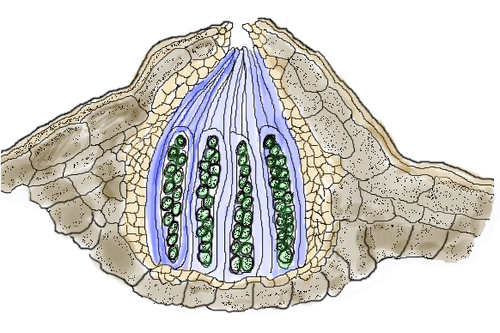
Lecidea fuscoatraのレシデイン子嚢殻(左) とLecanora allophanaのレカノリン子嚢殻(右)の比較

.jpg/500px-Lepraria_harrisiana_-_Flickr_-_pellaea_(2).jpg)

ま
.jpg/500px-Shrub_Stubble_Lichen_(2298099580).jpg)

いいえ
お

ポ



.jpg/500px-Coenogonium_sp._-_Flickr_-_pellaea_(1).jpg)

.jpg/500px-Pilophorus_acicularis_(4495554457).jpg)
R
.jpg/500px-Peltigera_neopolydactyla_(4504606324).jpg)
ス

.jpg/500px-Flavoparmelia_caperata_(40545603852).jpg)
.jpg/500px-Anzia_colpodes_-_Flickr_-_pellaea_(6).jpg)
_Taylor_455890.jpg/500px-Dirina_massiliensis_f._sorediata_(M%C3%BCll._Arg.)_Taylor_455890.jpg)
T
_A._Massal_409112.jpg/500px-Ochrolechia_tartarea_(L.)_A._Massal_409112.jpg)
.jpg/500px-Map_Lichen_-_Rhizocarpon_geographicum_(22412165189).jpg)

あなた
.jpg/500px-Umbilicaria_phaea_-_Flickr_-_pellaea_(1).jpg)

五

バツ

ず
参照
引用
- ^ “地衣類の紹介”. 2014年8月22日. 2014年8月22日時点のオリジナルよりアーカイブ。2022年7月24日閲覧。
- ^ 「地衣類とは? - 地衣類ウェブサイト」 2014年7月2日。2014年7月2日時点のオリジナルよりアーカイブ。 2022年7月24日閲覧。
- ^ abcdefghijklmnopq ミッチェル 2014、p. 13。
- ^ abcdefghijkl ミッチェル 2014、p. 14。
- ^ abcdefghijklmnopqrstu 対 ミッチェル 2014、p. 15.
- ^ ab Kirk et al. 2008、p.1。
- ^ ウロア&ハンリン 2012、3ページ。
- ^ abc キャノン&カーク 2007、384ページ。
- ^ ab Orange、James & White 2001、p. 6。
- ^ ab Ulloa & Hanlin 2012、p. 4.
- ^ ab Smith et al. 2009、p.22。
- ^ ウロア&ハンリン 2012、6ページ。
- ^ ウロア&ハンリン 2012、9ページ。
- ^ カークら2008年7ページ。
- ^ ウロア&ハンリン 2012、8ページ。
- ^ カークら2008年9頁。
- ^ ウロア&ハンリン 2012、7ページ。
- ^ abc Øvstedal & Lewis Smith 2001、p. 367.
- ^ Brodo、Sharnoff & Sharnoff 2001、p. 755。
- ^ ウロア&ハンリン2012、16ページ。
- ^ テルら。 2012、645、655ページ。
- ^ Brodo 2016、369ページより。
- ^ キャノン&カーク 2007年、385ページ。
- ^ Vondrák et al. 2023.
- ^ カークら2008年、23頁。
- ^ ウロア&ハンリン2012、20ページ。
- ^ カークら2008年、26頁。
- ^ Ryan et al. 2022、ページ: Amphithecium。
- ^ ミッチェル 2014、14~15頁。
- ^ abcdefghijklmnopqrstu vw Mercado-Díaz et al. 2015、p. 16.
- ^ ウロア&ハンリン2012、21ページ。
- ^ ウロア&ハンリン2012、22ページ。
- ^ ab Ulloa & Hanlin 2012、p. 26.
- ^ Ryan et al. 2022、ページ:Anisotomic。
- ^ カークら2008年40頁。
- ^ ウロア&ハンリン2012、30ページ。
- ^ カークら2008年42頁。
- ^ カークら2008年44頁。
- ^ カーク他2008年45頁。
- ^ キャノン&カーク 2007年、387ページ。
- ^ ウロア&ハンリン2012、36ページ。
- ^ abcd Meyer & Printzen 2000、p. 582.
- ^ abcdefghi マッケンジー ラム 1968、p. 85.
- ^ ウロア&ハンリン2012、37ページ。
- ^ ab Ulloa & Hanlin 2012、p. 38.
- ^ ab Meyer & Printzen 2000、p. 578.
- ^ abcde キャノン&カーク2007、388ページ。
- ^ ウロア&ハンリン2012、41頁。
- ^ カークら2008年54頁。
- ^ オネゲル 1991、555ページを参照。
- ^ ウロア&ハンリン2012、42ページ。
- ^ シルバースタイン、シルバースタイン&シルバースタイン1996、32ページ。
- ^ キャノン&カーク 2007年、63ページ。
- ^ ネルセン他2014年982頁。
- ^ ウロア&ハンリン2012、48ページ。
- ^ abcdef Meyer & Printzen 2000、p. 579.
- ^ abc マイヤーとプリントゼン 2000、p. 581.
- ^ リバス・プラタら。 2010、p. 141.
- ^ Ulloa & Hanlin 2012、54–55 ページ。
- ^ abcd Meyer & Printzen 2000、p. 580。
- ^ ab Ulloa & Hanlin 2012、p. 60.
- ^ キャノン&カーク 2007年、390ページ。
- ^ ab Ulloa & Hanlin 2012、p. 61.
- ^ ab ネルセンら。 2020、p. 21496.
- ^ ライアンら。 2022 年、ページ: Biseriate。
- ^ ウロア&ハンリン2012、68ページ。
- ^ abcde Brodo、Sharnoff & Sharnoff 2001、p. 756。
- ^ ポエルト 1980年。
- ^ グルーブ&ホークスワース 2007年、1117ページ。
- ^ ab ランドレーンら。 2009 年、p. 421.
- ^ Ryan et al. 2022、ページ: Branchlet。
- ^ abcdefg 英国地衣類協会。
- ^ レンデマー、バック、ハリス 2016年、441ページ。
- ^ Upreti & Rai 2013、2ページ。
- ^ カーク他2008年、106ページ。
- ^ ウロア&ハンリン2012、77ページ。
- ^ アフマジャンとヘイル、1973 年、p. 635。
- ^ ウロア&ハンリン2012、81ページ。
- ^ ウロア&ハンリン2012、82ページ。
- ^ Øvstedal & Lewis Smith 2001、p. 368.
- ^ Kirk et al. 2008, p. 114.
- ^ Ulloa & Hanlin 2012, p. 84.
- ^ Ulloa & Hanlin 2012, p. 89.
- ^ Smith et al. 2009, p. 24.
- ^ Ulloa & Hanlin 2012, p. 92.
- ^ Breuss 2010.
- ^ Kirk et al. 2008, p. 121.
- ^ Kirk et al. 2008, p. 122.
- ^ Cannon & Kirk 2007, p. 392.
- ^ Ahmadjian & Hale 1973, p. 49.
- ^ a b c Ulloa & Hanlin 2012, p. 98.
- ^ a b Thell et al. 2012, p. 645.
- ^ a b c Weber & Büdel 2011, p. 348.
- ^ Ryan et al. 2022, page: Checklist.
- ^ Kirk et al. 2008, p. 135.
- ^ Ryan et al. 2022, page: Chlorococcoid.
- ^ Kirk et al. 2008, p. 143.
- ^ Meyer & Printzen 2000, pp. 580–581.
- ^ Ulloa & Hanlin 2012, p. 106.
- ^ a b Smith et al. 2009, p. 13.
- ^ Ahti 1982, p. 105.
- ^ Ulloa & Hanlin 2012, p. 107.
- ^ Kirk et al. 2008, p. 153.
- ^ Ryan et al. 2022, page: Coccoid.
- ^ Kirk et al. 2008, p. 162.
- ^ a b Kirk et al. 2008, p. 163.
- ^ Ulloa & Hanlin 2012, p. 122.
- ^ a b Brodo, Sharnoff & Sharnoff 2001, p. 757.
- ^ Ulloa & Hanlin 2012, p. 124.
- ^ Ulloa & Hanlin 2012, p. 121.
- ^ Büdel & Scheidegger 2008, p. 64.
- ^ a b Mitchell 2014, p. 16.
- ^ Kirk et al. 2008, p. 170.
- ^ a b Kirk et al. 2008, p. 172.
- ^ a b Kirk et al. 2008, p. 173.
- ^ Ulloa & Hanlin 2012, p. 133.
- ^ Kirk et al. 2008, p. 176.
- ^ Ulloa & Hanlin 2012, p. 134.
- ^ North American Mycological Association.
- ^ Brodo 2016, p. 371.
- ^ a b Hertel 2009, p. 185.
- ^ Hafellner & Kalb 1995, pp. 163–164.
- ^ Hafellner & Kalb 1995, p. 163.
- ^ Kirk et al. 2008, p. 1842.
- ^ Kirk et al. 2008, p. 184.
- ^ Kirk et al. 2008, p. 183.
- ^ Rikkinen 2015, p. 973.
- ^ Kirk et al. 2008, p. 187.
- ^ Ryan et al. 2022, page: Decorticate.
- ^ Kirk et al. 2008, p. 196.
- ^ Ulloa & Hanlin 2012, p. 151.
- ^ a b Ulloa & Hanlin 2012, p. 152.
- ^ Ulloa & Hanlin 2012, p. 153.
- ^ Ulloa & Hanlin 2012, p. 156.
- ^ Kirk et al. 2008, p. 201.
- ^ a b Ulloa & Hanlin 2012, p. 157.
- ^ Brodo 2016, p. 372.
- ^ Ferraro 2004, p. 154.
- ^ Ulloa & Hanlin 2012, p. 162.
- ^ Brodo, Sharnoff & Sharnoff 2001, p. 293.
- ^ Ulloa & Hanlin 2012, p. 163.
- ^ a b Ulloa & Hanlin 2012, p. 166.
- ^ Ulloa & Hanlin 2012, p. 167.
- ^ Kirk et al. 2008, p. 216.
- ^ Korf 1962, p. 25.
- ^ Kirk et al. 2008, p. 217.
- ^ a b Cannon & Kirk 2007, p. 399.
- ^ Ulloa & Hanlin 2012, p. 170.
- ^ a b Ulloa & Hanlin 2012, p. 175.
- ^ Ulloa & Hanlin 2012, p. 176.
- ^ Ulloa & Hanlin 2012, p. 177.
- ^ Kirk et al. 2008, p. 226.
- ^ Büdel & Scheidegger 2008, p. 42.
- ^ Kirk et al. 2008, p. 228.
- ^ a b Smith et al. 2009, p. 31.
- ^ Ulloa & Hanlin 2012, p. 182.
- ^ Ulloa & Hanlin 2012, p. 183.
- ^ a b Ulloa & Hanlin 2012, p. 184.
- ^ a b c d Kirk et al. 2008, p. 338.
- ^ Kirk et al. 2008, p. 231.
- ^ Kirk et al. 2008, p. 232.
- ^ Ulloa & Hanlin 2012, p. 185.
- ^ Ulloa & Hanlin 2012, p. 186.
- ^ a b Ulloa & Hanlin 2012, p. 188.
- ^ Ulloa & Hanlin 2012, p. 190.
- ^ Kirk et al. 2008, p. 237.
- ^ a b Kirk et al. 2008, p. 240.
- ^ a b Ulloa & Hanlin 2012, p. 197.
- ^ a b Kirk et al. 2008, p. 241.
- ^ a b c Kirk et al. 2008, p. 461.
- ^ Ulloa & Hanlin 2012, p. 199.
- ^ Ryan et al. 2022, page: Epiphloedal.
- ^ Galloway 2022.
- ^ Ulloa & Hanlin 2012, p. 200.
- ^ Øvstedal & Lewis Smith 2001, p. 369.
- ^ Ulloa & Hanlin 2012, p. 203.
- ^ a b c d Aptroot & Lücking 2016, p. 774.
- ^ Kirk et al. 2008, p. 246.
- ^ Cannon & Kirk 2007, p. 401.
- ^ Ryan et al. 2022, page: Eucortex.
- ^ Ulloa & Hanlin 2012, p. 211.
- ^ Ulloa & Hanlin 2012, pp. 207–208.
- ^ Ulloa & Hanlin 2012, p. 216.
- ^ Diederich, Lawrey & Ertz 2018, p. 342.
- ^ Ulloa & Hanlin 2012, pp. 216–217.
- ^ a b c Brodo, Sharnoff & Sharnoff 2001, p. 758.
- ^ a b Ulloa & Hanlin 2012, p. 218.
- ^ a b Ulloa & Hanlin 2012, p. 219.
- ^ a b Moncada, Lücking & Betancourt-Macuase 2013, p. 2015.
- ^ Ulloa & Hanlin 2012、p. 220.
- ^ ab Ulloa & Hanlin 2012、p. 221.
- ^ カーク他2008年256頁。
- ^ キャノン&カーク 2007年、402ページ。
- ^ Ulloa & Hanlin 2012、p. 222.
- ^ ab Ulloa & Hanlin 2012、p. 224.
- ^ Ulloa & Hanlin 2012、p. 225.
- ^ Ryan et al. 2022、ページ: Fissurine。
- ^ リバス・プラタら。 2010、141–142ページ。
- ^ キャノン&カーク 2007年、412ページ。
- ^ abcd ウロア & ハンリン 2012、p. 226.
- ^ Ulloa & Hanlin 2012、p. 227.
- ^ Ulloa & Hanlin 2012、p. 229.
- ^ Ulloa & Hanlin 2012、229–230 ページ。
- ^ カークら2008年、260頁。
- ^ ラパイ、マクマリン、ニューマスター 2012.
- ^ フレイザー、プリオ、ファン・デル・スルイス、2021.
- ^ Ulloa & Hanlin 2012、231 ページ。
- ^ Moncada、Lücking、Betancourt-Macuase 2013、205ページ。
- ^ カーク他2008年、263頁。
- ^ Ryan et al. 2022、疣贅のページ: Fruit wart。
- ^ abcd ウロア & ハンリン 2012、p. 239.
- ^ Ryan et al. 2022、ページ: Fuscocapitate。
- ^ カークら2008年、270頁。
- ^ Ryan et al. 2022、ページ: Fuzzy coat。
- ^ カークら2008年、271頁。
- ^ ab ビューデル & シャイデッガー 2008、p. 41.
- ^ Ulloa & Hanlin 2012、p. 247.
- ^ ab Ulloa & Hanlin 2012、p. 252.
- ^ Ulloa & Hanlin 2012、p. 255.
- ^ ab Ulloa & Hanlin 2012、p. 256.
- ^ カークら2008年、288頁。
- ^ abc Ulloa & Hanlin 2012、257ページ。
- ^ abc カークら2008年、290頁。
- ^ Ulloa & Hanlin 2012、p. 260.
- ^ カークら2008年、294頁。
- ^ ab Ulloa & Hanlin 2012、p. 262.
- ^ Ulloa & Hanlin 2012、p. 263.
- ^ Ulloa & Hanlin 2012、p. 264.
- ^ Ryan et al. 2022、ページ: Hafter。
- ^ Ryan et al. 2022、ページ: Halo。
- ^ ライアンら。 2022、ページ: ハロネート。
- ^ ab Ulloa & Hanlin 2012、p. 268.
- ^ Ulloa & Hanlin 2012、p. 273.
- ^ Ulloa & Hanlin 2012、p. 274.
- ^ Ulloa & Hanlin 2012、p. 275.
- ^ Ulloa & Hanlin 2012、p. 278.
- ^ Ulloa & Hanlin 2012、p. 280。
- ^ Ulloa & Hanlin 2012、p. 282.
- ^ Ulloa & Hanlin 2012、p. 283.
- ^ Ulloa & Hanlin 2012、p. 284.
- ^ Ryan et al. 2022、ページ:Hormocyte。
- ^ Ulloa & Hanlin 2012、p. 285.
- ^ Ulloa & Hanlin 2012、p. 288.
- ^ カークら2008年、328頁。
- ^ Ulloa & Hanlin 2012、p. 294.
- ^ Ulloa & Hanlin 2012、p. 295.
- ^ ゴワード1986年、219ページ。
- ^ ab Ulloa & Hanlin 2012、p. 296.
- ^ ab カークら。 2008、p. 335.
- ^ abcdefgh マッケンジー・ラム 1968年、86ページ。
- ^ abc Ulloa & Hanlin 2012、301ページ。
- ^ Ulloa & Hanlin 2012、p. 303.
- ^ abc ブロド、シャーノフ、シャーノフ 2001、p. 759。
- ^ ライアンら。 2022 年、ページ: Inspers。
- ^ ライアンら。 2022 年、ページ: インパージョン。
- ^ Ulloa & Hanlin 2012、p. 310.
- ^ ab Ulloa & Hanlin 2012、p. 313.
- ^ ランドレーンら。 2009 年、p. 422.
- ^ テュスとシュルツ、2009、p. 17.
- ^ Ryan et al. 2022、ページ: Isotomic。
- ^ Ulloa & Hanlin 2012、p. 315.
- ^ ブロド2016、374頁。
- ^ アフマジャンとヘイル、1973 年、p. 636.
- ^ ab アフマジャン & ヘイル 1973、p. 637.
- ^ abcd Øvstedal & Lewis Smith 2001、p. 371.
- ^ ab カークら。 2008、p. 358.
- ^ Ulloa & Hanlin 2012、p. 328.
- ^ カーク他2008年359頁。
- ^ Krzewicka 2004、7ページ。
- ^ リバス・プラタら。 2010、143–144ページ。
- ^ Ryan et al. 2022、ページ: Lax。
- ^ Ulloa & Hanlin 2012、p. 336.
- ^ Ulloa & Hanlin 2012、p. 337.
- ^ カークら2008年、367頁。
- ^ リバス・プラタら。 2010 年、145 ~ 146 ページ。
- ^ Ulloa & Hanlin 2012、p. 339.
- ^ ab カークら。 2008、p. 376.
- ^ ab Ulloa & Hanlin 2012、p. 341.
- ^ カーク他2008年、382頁。
- ^ Ulloa & Hanlin 2012、p. 346.
- ^ Ryan et al. 2022、ページ: Lirellate。
- ^ カーク他2008年389頁。
- ^ モンカダ、リンコン=ムリーリョ、ルッキング 2023、p. 620。
- ^ Ulloa & Hanlin 2012、p. 347.
- ^ Brodo、Sharnoff & Sharnoff 2001、759–760 ページ。
- ^ ab カークら。 2008、p. 391.
- ^ Ulloa & Hanlin 2012、p. 352.
- ^ Ulloa & Hanlin 2012、p. 357.
- ^ Ulloa & Hanlin 2012、p. 358.
- ^ アフマジャンとヘイル、1973 年、p. 46.
- ^ ab Brodo、Sharnoff & Sharnoff 2001、p. 760。
- ^ カークら2008年402頁。
- ^ カークら2008年412頁。
- ^ Meyer & Printzen 2000、581–582 ページ。
- ^ リバス・プラタら。 2010、p. 582.
- ^ Ryan et al. 2022, page: Micareoid.
- ^ Orange, James & White 2001, p. 40.
- ^ Cannon & Kirk 2007, p. 414.
- ^ Ulloa & Hanlin 2012, p. 374.
- ^ Kirk et al. 2008, p. 435.
- ^ Kirk et al. 2008, p. 437.
- ^ Ulloa & Hanlin 2012, p. 389.
- ^ Ulloa & Hanlin 2012, p. 390.
- ^ Ulloa & Hanlin 2012, p. 392.
- ^ Cannon & Kirk 2007, p. 415.
- ^ Collins English Dictionary 2022a.
- ^ Nash 2008, p. 1.
- ^ Hawksworth 1988, pp. 4–5.
- ^ Kirk et al. 2008, p. 451.
- ^ a b c Kirk et al. 2008, p. 477.
- ^ Ulloa & Hanlin 2012, p. 428.
- ^ Kirk et al. 2008, p. 479.
- ^ Ulloa & Hanlin 2012, p. 432.
- ^ Kirk et al. 2008, p. 488.
- ^ Ulloa & Hanlin 2012, p. 439.
- ^ Kirk et al. 2008, p. 489.
- ^ a b Ulloa & Hanlin 2012, p. 442.
- ^ Ulloa & Hanlin 2012, pp. 442–443.
- ^ a b Ulloa & Hanlin 2012, p. 444.
- ^ Ulloa & Hanlin 2012, p. 445.
- ^ Ulloa & Hanlin 2012, p. 446.
- ^ Cannon & Kirk 2007, p. 419.
- ^ Ulloa & Hanlin 2012, p. 448.
- ^ Ulloa & Hanlin 2012, pp. 448–449.
- ^ a b Ulloa & Hanlin 2012, p. 449.
- ^ Kirk et al. 2008, p. 497.
- ^ Ulloa & Hanlin 2012, p. 452.
- ^ Kirk et al. 2008, p. 503.
- ^ Ulloa & Hanlin 2012, p. 455.
- ^ a b Sérusiaux & Lücking 2007.
- ^ Ulloa & Hanlin 2012, p. 454.
- ^ Ulloa & Hanlin 2012, p. 457.
- ^ Kirk et al. 2008, p. 508.
- ^ a b Ulloa & Hanlin 2012, p. 459.
- ^ a b Ulloa & Hanlin 2012, p. 460.
- ^ Smith et al. 2009, p. 30.
- ^ Ulloa & Hanlin 2012, p. 463.
- ^ Mitchell 2014, p. 17.
- ^ a b Sanders 2004, p. 269.
- ^ Ryan et al. 2022, page: Phenocortex.
- ^ Collins English Dictionary 2022b.
- ^ Ulloa & Hanlin 2012, p. 471.
- ^ Laundon 1995.
- ^ Ulloa & Hanlin 2012, p. 470.
- ^ Kirk et al. 2008, p. 527.
- ^ a b Ulloa & Hanlin 2012, p. 475.
- ^ Kirk et al. 2008, p. 528.
- ^ Kistenich et al. 2018, p. 872.
- ^ Ulloa & Hanlin 2012, p. 482.
- ^ Jagtap, Tripathi & Joshi 2013, p. 342.
- ^ Rivas Plata et al. 2010, p. 143.
- ^ Kirk et al. 2008, p. 544.
- ^ Ulloa & Hanlin 2012, p. 487.
- ^ Ryan et al. 2022, page: Plicate.
- ^ a b Ulloa & Hanlin 2012, p. 490.
- ^ McCune & Wang 2014, p. 28.
- ^ Ulloa & Hanlin 2012, p. 492.
- ^ Kirk et al. 2008, p. 553.
- ^ a b c Øvstedal & Lewis Smith 2001, p. 372.
- ^ Rivas Plata et al. 2010, pp. 148–149.
- ^ a b c Kirk et al. 2008, p. 646.
- ^ Ryan et al. 2022, page: Prominent.
- ^ Kirk et al. 2008, pp. 250, 562.
- ^ a b Ulloa & Hanlin 2012, p. 506.
- ^ Ulloa & Hanlin 2012, p. 507.
- ^ Ulloa & Hanlin 2012, p. 510.
- ^ a b c Ulloa & Hanlin 2012, p. 511.
- ^ Ryan et al. 2022, page: Pruina.
- ^ Kirk et al. 2008, p. 566.
- ^ Ryan et al. 2022, page: Pseudocortex.
- ^ Ulloa & Hanlin 2012, p. 513.
- ^ Kirk et al. 2008, p. 568.
- ^ Ulloa & Hanlin 2012, p. 514.
- ^ a b Ulloa & Hanlin 2012, p. 515.
- ^ Ulloa & Hanlin 2012, p. 517.
- ^ Smith et al. 2009, p. 36.
- ^ Kirk et al. 2008, p. 573.
- ^ Kirk et al. 2008, p. 581.
- ^ Kirk et al. 2008, p. 582.
- ^ Ulloa & Hanlin 2012, p. 522.
- ^ Ulloa & Hanlin 2012, p. 523.
- ^ a b Brodo, Sharnoff & Sharnoff 2001, p. 762.
- ^ a b Ulloa & Hanlin 2012, p. 525.
- ^ Cannon & Kirk 2007, p. 582.
- ^ Lumbsch & Huhndorf 2007.
- ^ Ulloa & Hanlin 2012, p. 526.
- ^ Ulloa & Hanlin 2012, p. 527.
- ^ Ulloa & Hanlin 2012, p. 533.
- ^ a b Kirk et al. 2008, p. 588.
- ^ Ulloa & Hanlin 2012, p. 541.
- ^ Ryan et al. 2022, page: Recurved.
- ^ Kirk et al. 2008, p. 595.
- ^ Ulloa & Hanlin 2012, p. 548.
- ^ a b Kirk et al. 2008, p. 597.
- ^ a b c Smith et al. 2009, p. 38.
- ^ Ulloa & Hanlin 2012, p. 549.
- ^ Ulloa & Hanlin 2012, p. 552.
- ^ a b Ulloa & Hanlin 2012, p. 553.
- ^ Ulloa & Hanlin 2012, pp. 553–554.
- ^ Ulloa & Hanlin 2012, p. 555.
- ^ Kirk et al. 2008, p. 607.
- ^ Meyer & Printzen 2000, pp. 579–580.
- ^ a b Ulloa & Hanlin 2012, p. 558.
- ^ Kirk et al. 2008, p. 610.
- ^ Rivas Plata et al. 2010, p. 144.
- ^ Ulloa & Hanlin 2012, p. 565.
- ^ a b Ulloa & Hanlin 2012, p. 567.
- ^ Scott 1957, p. 487.
- ^ Kirk et al. 2008, p. 627.
- ^ Randlane et al. 2009, p. 423.
- ^ Ulloa & Hanlin 2012, p. 574.
- ^ Ryan et al. 2022, page: Seriate.
- ^ Kirk et al. 2008, p. 632.
- ^ Fjelde et al. 2024, p. 107944.
- ^ Ulloa & Hanlin 2012, p. 580.
- ^ Ulloa & Hanlin 2012, p. 581.
- ^ Kantvilas 2023.
- ^ a b c Øvstedal & Lewis Smith 2001, p. 373.
- ^ a b c Ulloa & Hanlin 2012, p. 586.
- ^ Kirk et al. 2008, p. 645.
- ^ Lücking, Leavitt & Hawksworth 2021.
- ^ Kirk et al. 2008, p. 647.
- ^ a b Ulloa & Hanlin 2012, p. 596.
- ^ Ulloa & Hanlin 2012, p. 598.
- ^ Ryan et al. 2022, page: Spongiostratum.
- ^ Kirk et al. 2008, p. 657.
- ^ Wirth & Hale Jr. 1978, p. 2, [1].
- ^ Smith et al. 2009, pp. 383–384.
- ^ Ahmadjian & Hale 1973, pp. 633–634.
- ^ a b Ulloa & Hanlin 2012, p. 610.
- ^ Brodo, Sharnoff & Sharnoff 2001, p. 763.
- ^ Ulloa & Hanlin 2012, p. 621.
- ^ Kirk et al. 2008, p. 670.
- ^ a b c Kirk et al. 2008, p. 671.
- ^ Ulloa & Hanlin 2012, p. 625.
- ^ Ulloa & Hanlin 2012, p. 627.
- ^ Kirk et al. 2008, p. 672.
- ^ a b c Ulloa & Hanlin 2012, p. 629.
- ^ a b Ulloa & Hanlin 2012, p. 639.
- ^ Smith 1921, p. xxii.
- ^ Smith 1921, p. 24.
- ^ Ulloa & Hanlin 2012, p. 642.
- ^ Thüs & Schultz 2009, p. 21.
- ^ Ulloa & Hanlin 2012, p. 644.
- ^ Kirk et al. 2008, pp. 250, 684.
- ^ Ulloa & Hanlin 2012, p. 646.
- ^ a b c d Ulloa & Hanlin 2012, p. 647.
- ^ Kirk et al. 2008, p. 684.
- ^ Poelt & Obermayer 1990.
- ^ Kantvilas & Jarman 1999, p. 206.
- ^ Dobson 2011, p. 482.
- ^ Kirk et al. 2008, p. 685.
- ^ a b Papong et al. 2010, p. 131.
- ^ Ulloa & Hanlin 2012, p. 171.
- ^ Ulloa & Hanlin 2012, p. 653.
- ^ Büdel & Scheidegger 2008, p. 54.
- ^ Rivas Plata et al. 2010, pp. 146–147.
- ^ Ryan et al. 2022, page: Trentepohlioid.
- ^ Ryan et al. 2022, page: Trebouxioid.
- ^ a b Ulloa & Hanlin 2012, p. 663.
- ^ Büdel & Scheidegger 2008, p. 43.
- ^ Ulloa & Hanlin 2012, p. 669.
- ^ Ulloa & Hanlin 2012, p. 670.
- ^ Ulloa & Hanlin 2012, p. 671.
- ^ a b c Ulloa & Hanlin 2012, p. 673.
- ^ a b Ulloa & Hanlin 2012, p. 674.
- ^ Rivas Plata et al. 2010, p. 147.
- ^ Ulloa & Hanlin 2012, p. 675.
- ^ Thell et al. 2012, p. 655.
- ^ Orange, James & White 2001, pp. 10, 47.
- ^ Büdel & Scheidegger 2008, p. 46.
- ^ a b Ulloa & Hanlin 2012, p. 682.
- ^ Ulloa & Hanlin 2012, p. 683.
- ^ a b Ulloa & Hanlin 2012, p. 687.
- ^ Ryan et al. 2022, page: Verruciform.
- ^ Kirk et al. 2008, p. 724.
- ^ Australian National Herbarium.
- ^ Tripp 2017, p. 152.
- ^ Ulloa & Hanlin 2012, p. 700.
- ^ Kirk et al. 2008, p. 742.
- ^ "Record Details: Zeora Fr., Syst. orb. veg. (Lundae) 1: 244 (1825)". Index Fungorum. Retrieved 4 December 2022.
- ^ Ryan et al. 2022, page: Zeorine.
- ^ Cannon & Kirk 2007, p. 437.
Sources
- "Vitricolous lichens – Lichen website". Australian National Botanic Gardens - Botanical Web Portal. Australian National Herbarium. 20 October 2009. Retrieved 18 October 2022.
- "Definition of mycobiont". Collins English Dictionary. 2022a. Retrieved 23 July 2022.
- "Definition of phycobiont". Collins English Dictionary. 2022b. Retrieved 23 July 2022.
- Ahmadjian, Vernon; Hale, Mason E. (1973). The Lichens. New York: Academic Press. ISBN 978-0-12-044950-7.
- Ahti, T. (1982). "The morphological interpretation of cladoniiform thalli in lichens". The Lichenologist. 14 (2): 105–113. doi:10.1017/s0024282982000255.
- Aptroot, André; Lücking, Robert (2016). "A revisionary synopsis of the Trypetheliaceae (Ascomycota: Trypetheliales)". The Lichenologist. 48 (6): 763–982. doi:10.1017/s0024282916000487.
- Breuss, Othmar (2010). "An updated world-wide key to the catapyrenioid lichens (Verrucariaceae)". Herzogia. 23 (2): 205–216. doi:10.13158/heia.23.2.2010.205.
- Brodo, Irwin M.; Sharnoff, Sylvia Duran; Sharnoff, Stephen (2001). Lichens of North America. New Haven, Connecticut: Yale University Press. ISBN 0-300-08249-5.
- Brodo, Irwin (2016). "Glossary". Keys to Lichens of North America: Revised and Expanded. New Haven, Connecticut: Yale University Press. pp. 369–382. ISBN 978-0-300-19573-6.
- Cannon, Paul F.; Kirk, Paul M. (2007). Fungal Families of the World. Wallingford: CABI. ISBN 978-0-85199-827-5. OCLC 60741230.
- Diederich, Paul; Lawrey, James D.; Ertz, Damien (2018). "The 2018 classification and checklist of lichenicolous fungi, with 2000 non-lichenized, obligately lichenicolous taxa". The Bryologist. 121 (3): 340–425. doi:10.1639/0007-2745-121.3.340.
- Dobson, Frank S. (2011). Lichens: An Illustrated Guide to the British and Irish Species. Slough, UK: Richmond Publishing. ISBN 978-0-85546-315-1.
- Ferraro, Lidia Itatí (2004). "Morphological diversity in the hyphopores of Gomphillaceae (Ostropales, lichenized Ascomycetes)" (PDF). Fungal Diversity. 15: 153–169.
- Fjelde, Markus Osaland; Timdal, Einar; Haugan, Reidar; Bendiksby, Mika (2024). "Paraphyly and cryptic diversity unveils unexpected challenges in the "naked lichens" (Calvitimela, Lecanoromycetes, Ascomycota)". Molecular Phylogenetics and Evolution. 190: e107944. doi:10.1016/j.ympev.2023.107944. hdl:10852/106762.
- Fraser, Robert H.; Pouliot, Darren; van der Sluijs, Jurjen (2021). "UAV and high resolution satellite mapping of forage lichen (Cladonia spp.) in a rocky Canadian Shield landscape". Canadian Journal of Remote Sensing. 48 (1): 5–18. doi:10.1080/07038992.2021.1908118.
- Galloway, D.J. (6 June 2022). "Flora of Australia Glossary — Lichens". Australian Biological Resources Study. Retrieved 5 December 2022.
- Garrido-Benavent, Isaac; Pérez-Ortega, Sergio (2017). "Past, present, and future research in bipolar lichen-forming fungi and their photobionts". American Journal of Botany. 104 (11): 1660–1674. doi:10.3732/ajb.1700182.
- "Glossary of Terms". British Lichen Society. 2022. Retrieved 23 July 2022.
- Goward, Trevor (1986). "Brodoa, a new lichen genus in the Parmeliaceae". The Bryologist. 89 (3): 219–223. doi:10.2307/3243288. JSTOR 3243288.
- Grube, Martin; Hawksworth, David L. (2007). "Trouble with lichen: the re-evaluation and re-interpretation of thallus form and fruit body types in the molecular era". Mycological Research. 111 (9): 1116–1132. doi:10.1016/j.mycres.2007.04.008. PMID 17698333.
- Hafellner, Josef; Kalb, Klaus (1995). "Studies in Trichotheliales ordo novus". Studies in Lichenology with Emphasis on Chemotaxonomy, Geography and Phytochemistry. Festschrift Ch. Leuckert. Bibliothecia Lichenologica. Vol. 57. Berlin-Stuttgart: J. Cramer in der Gebrüder Borntraeger Verlagsbuchhandlung. pp. 161–186. ISBN 978-3-44-358036-0.
- Hawksworth, D. L. (1988). "The variety of fungal-algal symbioses, their evolutionary significance, and the nature of lichens". Botanical Journal of the Linnean Society. 96 (1): 3–20. doi:10.1111/j.1095-8339.1988.tb00623.x.
- Hertel, Hannes (2009). "A new key to cryptothalline species of the genus Lecidea (Lecanorales)". In Aptroot, A.; Seaward, M.R.D.; Sparrius, L.B. (eds.). Biodiversity and Ecology of Lichens – Liber Amicorum Harrie Sipman. Bibliotheca Lichenologica. Vol. 99. Berlin/Stuttgart: J.Cramer in der Gebrüder Borntraeger Verlagsbuchhandlung. pp. 185–204. ISBN 978-3-443-58078-0.
- Honegger, Rosmarie (1991). "Functional aspects of the lichen symbiosis". Annual Review of Plant Physiology and Plant Molecular Biology. 42 (1): 553–578. doi:10.1146/annurev.pp.42.060191.003005.
- Jagtap, Vineeta; Tripathi, Manish; Joshi, Yogesh (2013). "First report on the occurrence of plasticolous lichens from Uttarakhand, India" (PDF). Journal of Applied and Natural Science. 5 (2): 342–344. doi:10.31018/jans.v5i2.329.
- Kantvilas, G. & Jarman, S.J. (1999). Lichens of rainforest in Tasmania. Canberra, ACT, Australia: Australian Biological Resources Study. ISBN 0-642-56802-2.
- Kantvilas, Gintaras (2023). "Three new species of siphuloid lichens, with a first key to the genus Parasiphula". The Lichenologist. 55 (1): 17–25. doi:10.1017/s0024282922000421.
- Kirk, Paul M.; Cannon, Paul F.; Minter, David W.; Stalpers, Joost A., eds. (2008). Dictionary of the Fungi. Vol. 10. CAB International. ISBN 978-1-84593-933-5.
- Kistenich, Sonja; Timdal, Einar; Bendiksby, Mika; Ekman, Stefan (2018). "Molecular systematics and character evolution in the lichen family Ramalinaceae (Ascomycota: Lecanorales)". Taxon. 67 (5): 871–904. doi:10.12705/675.1. hdl:10852/67955.
- Korf, Richard P. (1962). "A synopsis of the Hemiphacidiaceae, a family of the Helotiales (Discomycetes) causing needle-blights of conifers". Mycotaxon. 54 (1): 12–33.
- Krzewicka, Beata (2004). "The lichen genera Lasallia and Umbilicaria in the Polish Tatra mts". Polish Botanical Studies. 17: 1–88.
- Laundon, Jack R. (1995). "On the classification of lichen photomorphs". Taxon. 44 (3): 387–389. doi:10.2307/1223409. JSTOR 1223409.
- Lendemer, James C.; Buck, William R.; Harris, Richard C. (September 2016). "Two new host-specific hepaticolous species of Catinaria (Ramalinaceae)". The Lichenologist. 48 (5): 441–449. doi:10.1017/S0024282916000438.
- Lücking, Robert; Leavitt, Steven D.; Hawksworth, David L. (2021). "Species in lichen-forming fungi: balancing between conceptual and practical considerations, and between phenotype and phylogenomics". Fungal Diversity. 109 (1): 99–154. doi:10.1007/s13225-021-00477-7.
- "Lichen Basics". North American Mycological Association. Retrieved 15 October 2022.
- Lumbsch, H. Thorsten; Huhndorf, Sabine M. (2007). "Whatever happened to the pyrenomycetes and loculoascomycetes?". Mycological Research. 111 (9): 1064–1074. doi:10.1016/j.mycres.2007.04.004.
- MacKenzie Lamb, I. (1968). "Appendix II. Glossary of Technical Terms". Antarctic Lichens. II. The Genera Buellia and Rinodina (Report). British Antarctic Survey Scientific Reports. British Antarctic Survey.
- McCune, B.; Wang, L.S. (2014). "The lichen genus Hypogymnia in southwest China". Mycosphere. 5 (1): 27–76. doi:10.5943/mycosphere/5/1/2.
- Mercado-Díaz, Joel A.; Gould, William A.; González, Grizelle; Lücking, Robert (2015). Lichens in Puerto Rico: an ecosystem approach. Gen. Tech. Rep. IITF-GTR-46 (Report). San Juan, Puerto Rico: United States Department of Agriculture, Forest Service, International Institute of Tropical Forestry.
- Meyer, Barbara; Printzen, Christian (2000). "Proposal for a standardized nomenclature and characterization of insoluble lichen pigments". The Lichenologist. 32 (6): 571–583. doi:10.1006/lich.2000.0294.
- Mitchell, M.E. (2014). "De Bary's legacy: the emergence of differing perspectives on lichen symbiosis" (PDF). Huntia. 15 (1): 5–22.
- Moncada, Bibiana; Lücking, Robert; Betancourt-Macuase, Luisa (2013). "Phylogeny of the Lobariaceae (lichenized Ascomycota: Peltigerales), with a reappraisal of the genus Lobariella". The Lichenologist. 45 (2): 203–263. doi:10.1017/s0024282912000825.
- Moncada, Bibiana; Rincón-Murillo, Diego; Lücking, Robert (2023). "Three new lobarioid lichens (lichenized Ascomycota: Peltigeraceae) from Colombia, honoring Enrique Forero". Revista de la Academia Colombiana de Ciencias Exactas, Físicas y Naturales. 47 (184): 619–640. doi:10.18257/raccefyn.1978.
- Orange, A.; James, P.W.; White, F.J. (2001). Microchemical Methods for the Identification of Lichens. British Lichen Society. ISBN 978-0-9540418-0-9.
- Øvstedal, D.O.; Lewis Smith, R.I. (2001). "Glossary". Lichens of Antarctica and South Georgia. A Guide to Their Identification and Ecology. Cambridge, UK: Cambridge University Press. pp. 367–374. ISBN 978-0-521-66241-3.
- Poelt, J. (1980). "Physcia opuntiella spec. nov. und die Lebeusform der Sprosseuden Flechten" [Physcia opuntiella spec. nov. and the life form of the branching lichens]. Flora. 169 (1): 23–31. Bibcode:1980FMDFE.169...23P. doi:10.1016/s0367-2530(17)31162-3.
- Poelt, J.; Obermayer, W. (1990). "Über Thallosporen bei einigen Krustenflechten" [On thallospores in some crustose lichens]. Herzogia (in German). 8: 273–288. doi:10.1127/herzogia/8/1990/273.
- Rikkinen, Jouko (April 2015). "Cyanolichens". Biodiversity and Conservation. 24 (4): 973–993. Bibcode:2015BiCon..24..973R. doi:10.1007/s10531-015-0906-8.
- Nash III, Thomas H., ed. (2008). Lichen Biology (2nd ed.). Cambridge, UK: Cambridge University Press. ISBN 978-0-521-69216-8.
- Nash, T.H. III (2008). "1. Introduction". In Nash III, Thomas H. (ed.). Lichen Biology (2nd ed.). Cambridge, UK: Cambridge University Press. pp. 1–8. ISBN 978-0-521-69216-8.
- Honegger, R. (2008). "3.Mycobionts". In Nash III, Thomas H. (ed.). Lichen Biology (2nd ed.). Cambridge, UK: Cambridge University Press. pp. 27–39. ISBN 978-0-521-69216-8.
- Büdel, B.; Scheidegger, C. (2008). "4.Thallus morphology and anatomy". In Nash III, Thomas H. (ed.). Lichen Biology (2nd ed.). Cambridge, UK: Cambridge University Press. pp. 40–68. ISBN 978-0-521-69216-8.
- Nelsen, Matthew P.; Lücking, Robert; Aptroot, André; Andrew, Carrie J.; Cáceres, Marcela; Plata, Eimy Rivas; Gueidan, Cécile; da Silva Canêz, Luciana; Knight, Allison; Ludwig, Lars R.; Mercado-Díaz, Joel A.; Parnmen, Sittiporn; Lumbsch, H. Thorsten (2014). "Elucidating phylogenetic relationships and genus-level classification within the fungal family Trypetheliaceae (Ascomycota: Dothideomycetes)". Taxon. 63 (5): 974–992. doi:10.12705/635.9.
- Nelsen, Matthew P.; Lücking, Robert; Boyce, C. Kevin; Lumbsch, H. Thorsten; Ree, Richard H. (2020). "The macroevolutionary dynamics of symbiotic and phenotypic diversification in lichens". Proceedings of the National Academy of Sciences. 117 (35): 21495–21503. Bibcode:2020PNAS..11721495N. doi:10.1073/pnas.2001913117. PMC 7474681. PMID 32796103.
- Papong, Khwanruan; Boonpragob, Kansri; Mangold, Armin; Divakar, Pradeep K.; Lumbsch, H. Thorsten (2010). "Thelotremoid lichen species recently described from Thailand: a re-evaluation". The Lichenologist. 42 (2): 131–137. doi:10.1017/s0024282909990405.
- Randlane, Tiina; Tõrra, Tiiu; Saag, Andres; Saag, Lauri (2009). "Key to European Usnea species". In Thell, Arne; Seaward, Mark R. D.; Feuerer, Tassilo (eds.). Diversity of Lichenology – Anniversary Volume. Bibliotheca Lichenologica. Vol. 100. Stuttgart: J. Kramer. pp. 419–462. ISBN 978-3-443-58079-7.
- Rapai, Sean B.; McMullin, Richard Troy; Newmaster, Steven G. (2012). "The importance of macrolichen traits and phylogeny in forest community assemblage along a high elevation gradient in southwestern British Columbia". Forest Ecology and Management. 274: 231–240. Bibcode:2012ForEM.274..231R. doi:10.1016/j.foreco.2012.02.018.
- Rivas Plata, Eimy; Lücking, Robert; Sipman, Harrie J. M.; Mangold, Armin; Kalb, Klaus; Lumbsch, H. Thorsten (2010). "A world-wide key to the thelotremoid Graphidaceae, excluding the Ocellularia-Myriotrema-Stegobolus clade". The Lichenologist. 42 (2): 139–185. doi:10.1017/s0024282909990491.
- Ryan, B.D.; Bungartz, F.; Hagedorn, G.; Rambold, G., eds. (2022). "LIAS glossary – A Wiki-based Online Dictionary for Ascomycete Terminology used by LIAS, the Global Information System for Lichenized and Non-Lichenized Ascomycetes". LIAS Glossary.
- Sanders, William B. (2004). "Bacteria, algae, and phycobionts: maintaining useful concepts and terminology". The Lichenologist. 36 (5): 269–275. doi:10.1017/s0024282904014343.
- Scott, G.D. (1957). "Lichen terminology". Nature. 179 (4557): 486–487. Bibcode:1957Natur.179..486S. doi:10.1038/179486b0. PMID 13407756.
- Sérusiaux, E.; Lücking, R. (2007). "Gallaicolichen, a new genus of foliicolous lichen with unique diaspores". In Kärnefelt, Ingvar; Thell, Arne (eds.). Lichenological Contributions in Honour of David Galloway. Bibliotheca Lichenologica. Vol. 95. Berlin/Stuttgart: J. Cramer. pp. 509–516. ISBN 978-3-443-58074-2.
- Smith, C.W.; Aptroot, A.; Coppins, B.J.; Fletcher, A.; Gilbert, O.L.; James, P.W.; Wolseley, P.A., eds. (2009). "Glossary". The Lichens of Great Britain and Ireland. London: British Lichen Society. pp. 21–39.
- Suryanarayanan, Trichur S.; Thirunavukkarasu, Nagamani (2017). "Endolichenic fungi: the lesser known fungal associates of lichens". Mycology. 8 (3): 189–196. doi:10.1080/21501203.2017.1352048. PMC 6059131. PMID 30123639.
- Upreti, Dalip K.; Rai, Himanshu, eds. (2013). Terricolous Lichens in India. Vol. 1: Diversity Patterns and Distribution Ecology. New York: Springer. ISBN 978-1-4614-8736-4.
- シルバースタイン、アルビン; シルバースタイン、ヴァージニア B.; シルバースタイン、ロバート A. (1996)。菌類。ニューヨーク: 21 世紀ブックス。ISBN 0-8050-3520-6。
- スミス、アニー・ロレイン(1921年)。地衣類。ロンドン:ケンブリッジ大学出版局。pp.1-504。
- Thell, Arne; Crespo, Ana ; Divakar, Pradeep K.; Kärnefelt, Ingvar ; Leavitt, Steven D.; Lumbsch, H. Thorsten; Seaward, Mark RD (2012). 「Parmeliaceae 地衣類科のレビュー - 歴史、系統発生、現在の分類」。Nordic Journal of Botany . 30 (6): 641–664. doi :10.1111/j.1756-1051.2012.00008.x.
- したがって、ホルガーさん。シュルツ、マティアス (2009)。 「用語集」。ブルクハルトのビューデルにて。ゲルトナー、ゲオルグ;クリーニッツ、ローター。プレイシグ、ハンス R.ミヒャエル・シャーゲル(編)。菌類。パート 1: 地衣類。 Süßwasserflora von Mitteleuropa [中央ヨーロッパの淡水植物]。 Vol. 1月21日。ハイデルベルク: Spektrum Akademischer Verlag。 14~23ページ。土井:10.1007/978-3-8274-2299-6_2。ISBN 978-3-8274-1594-3。
- トリップ、エリン(2017)。『白い岩の地衣類のフィールドガイド(コロラド州ボルダー)』コロラド大学出版局。ISBN 978-1-60732-554-3。
- Ulloa, Miguel; Hanlin, Richard T. (2012).図解菌学辞典(第2版). ミネソタ州セントポール: アメリカ植物病理学会. ISBN 978-0-89054-400-6。
- ヤン・フォンドラーク。スヴォボダ、スタニスラフ。ジバロバ、ルーシー。シュテンクロバ、レンカ。ヤン・マレシュ。プスカ、ヴァーツラフ。コシュナール、イジー。クバセク、イジー (2023)。 「アルコバイオシス、苔癬化の入り口にある藻類と真菌の関連性」。科学的報告書。13 (2957): 2957。ビブコード:2023NatSR..13.2957V。土井: 10.1038/s41598-023-29384-4。PMC 9975235。PMID 36854763。
- ウェーバー、ベッティーナ。ビューデル、ブルクハルト (2011)。 「エンドリス」。地質生物学百科事典。ドルドレヒト:オランダのシュプリンガー。 348–355ページ。土井:10.1007/978-1-4020-9212-1_80。ISBN 978-1-4020-9211-4。
- Wirth, M.; Hale Jr., ME (1978)。ドミニカへのモーデン・スミソニアン探検隊:地衣類(シダ科)。スミソニアン植物学誌。第40巻。pp. 1-64。