
Loading article…
Nelson Appleton Miles (August 8, 1839 – May 15, 1925) was a United States Army officer who served in the American Civil War (1861–1865), the last stages of the American Indian Wars (1840–1890), and the Spanish–American War (1898). From 1895 to 1903, Miles served as the last Commanding General of the United States Army, before the office was transformed into the current Chief of Staff of the U.S. Army in 1903.
Nelson A. Miles was born on his family's farm in Westminster, Massachusetts on August 8, 1839, the son of Daniel Miles and Mary (Curtis) Miles.[1] He was raised and educated in Westminster, and attended the academy run by educator John R. Galt.[2] Having decided on a business career, as a teenager, he moved to Boston, where he worked as a clerk in the John Collamore & Company crockery store.[3]
While living in Boston, he also attended Comer's Commercial College, a business school that offered night courses.[4] With the outbreak of the American Civil War likely, Miles was among several young men in Boston who began to study drill and ceremony, tactics, and strategy under the tutelage of Eugene Salignac, who used the title "colonel" and claimed to be a French army veteran.[1][5]

The war started in April 1861; on September 9, 1861, Miles enlisted in the Union Army and was commissioned as a first lieutenant in the 22nd Regiment Massachusetts Volunteer Infantry, which was organized and commanded by Henry Wilson.[1] He was commissioned a lieutenant colonel of the 61st New York Volunteer Infantry Regiment on May 31, 1862.[1] He was promoted to the rank of colonel after the Battle of Antietam of September 1862.[1]
Other battles he participated in include Fredericksburg, Chancellorsville (during which he was shot in the neck and abdomen), the Overland Campaign, and the final Appomattox Campaign, and wounded four times in battle. On March 2, 1867, Miles was brevetted a brigadier general in the regular army in recognition of his earlier wartime actions of 1863 at Chancellorsville. He was again brevetted, this time to the rank of major general, for his documented actions at the Battle of Spotsylvania Court House in 1864. Three decades later, he received the Medal of Honor on July 23, 1892, for his gallantry at Chancellorsville. He was appointed brigadier general of volunteers as of May 12, 1864, for the Battles of the Wilderness and Battle of Spotsylvania Court House. Six months after the end of the Civil War, on October 21, 1865, he was appointed a major general of volunteers at the young age of 26.[6] After the war, he was commandant of Fort Monroe, Virginia at the mouth of the Hampton Roads harbor and the southern end of Chesapeake Bay and the James River, where former Confederate President, Jefferson Davis (1808–1889), was held prisoner. During his tenure at Fortress Monroe, General Miles was forced to defend himself against charges that Davis was being mistreated.

In July 1866, Miles was appointed a colonel in the Regular Army, confirmed by the U.S. Senate.[7] The next year, in April 1867, he was appointed assistant commissioner of the North Carolina branch of the United States War Department's Bureau of Refugees, Freedmen, and Abandoned Lands, (Freedmen's Bureau), serving under Bureau Commissioner, Brigadier GeneralOliver O. Howard (1830–1909).[8] On June 30, 1868, he married Mary Hoyt Sherman (daughter of Charles Taylor Sherman, niece of fellow Union Army General William T. Sherman and U.S. SenatorJohn Sherman, and granddaughter of Charles R. Sherman).[9] In March 1869, he became commander of the 5th U.S. Infantry Regiment, a position he held for 11 years.[10]
Miles played a leading role in nearly all of the U.S. Army's campaigns of the later American Indian Wars against the native American Indian tribes of the Great Plains, of the Mid-West, among whom he was known as "Bearcoat" (for his characteristic bearskin fur coat). In 1874–1875, he was a field commander in the force that defeated the Kiowa, Comanche, and the Southern Cheyenne along the upper Red River of the South. Between 1876 and 1877, he participated in the campaign that scoured the Northern Plains after 5 companies of the 7th U.S. Cavalry Regiment under the command of Lt. Col. George Armstrong Custer were killed at the Battle of the Little Big Horn in June 1876, and forced most the Lakota Sioux tribe and their native allies onto designated federal Indian reservations. In the winter of 1877, he drove his bluecoat mounted troops on a forced march across the eastern Montana Territory to intercept and stop the Nez Perce tribal band led by Chief Joseph (1840–1904), after the Nez Perce War, heading north to cross the border into BritishCanada. For the rest of his career, General Miles would quarrel with General Oliver O. Howard (1830–1909), who also led the pursuing expedition over taking credit for Chief Joseph's capture. Later while on the Yellowstone River, he developed expertise with the use of the heliograph for sending long-distance communications signals using sunlight and mirrors, establishing a 140-mile-long (230 km) line of stations with heliographs connecting far-flung military posts of Fort Keogh and Fort Custer, in the Montana Territory in 1878.[11][12] The heliographs were supplied by Brig. Gen. Albert J. Myer (1828–1880), of the U.S. Army's Signal Corps.[13]

1880 年12 月、マイルズは正規軍の准将に昇進した。その後、オレゴン州とワシントン準州のコロンビア軍管区(1881 年~1885 年)の司令官に任命され、続いてミズーリ軍管区(1885 年~1886 年) の司令官に任命された。1886 年、マイルズはジョージ・R・クルック将軍 ( 1828 年~1890 年) の後任として、南西部の旧アリゾナ準州の軍管区で、チリカワ・アパッチ族の反逆の酋長でありゲリラ戦士のリーダーであったジェロニモ(1829 年~1909 年)と戦う部隊の司令官となった。クルック将軍はジェロニモを捕らえるためにアパッチ族の斥候に大きく依存していた。その代わりに、マイルズは白人の正規騎兵隊に頼ったが、彼らは最終的に、隣接するメキシコ北部の険しいシエラ・マドレ山脈を越えてジェロニモを追跡し、3,000マイル(4,800km )もの距離を移動したが、成果は得られなかった。最終的に、アパッチ族の文化と慣習を研究していた若いチャールズ・B・ゲートウッド中尉(1853年~1896年)が、マイルズ将軍との間で手配され開催された会合で、戦士長と会って降伏交渉を行うことに成功した。その条件の下、ジェロニモと残された少数の部下は、はるか東のフロリダの居留地で一時的に2年間亡命生活を送ることに同意した。ジェロニモは、交渉の背後にある本当の陰謀(彼らをアリゾナとニューメキシコの故郷に戻すつもりは全くなかったこと)を知らずに、これらの条件に同意した。この亡命には、マイルズが当初彼らと交わした合意に違反して、軍のために働いていたチリカワ・アパッチ族の斥候も含まれていた。マイルズはゲートウッド中尉の交渉に対する功績を一切認めず(名誉勲章の推薦もせず)、彼をはるか北のダコタ準州に転属させた。この作戦中、マイルズの特殊信号部隊はヘリオグラフを多用し、その実用性を現場で証明した。[ 13 ]特殊信号部隊はWAグラスフォード大尉の指揮下にあった。[ 13 ] 1888年、マイルズはサンフランシスコのプレシディオに本部を置く陸軍太平洋軍管区およびカリフォルニア方面軍の司令官となった。
Two years later in April 1890, Miles was promoted to major general in the Regular Army and became the commander of the Military Division of the Missouri. The Ghost Dance movement of the Lakota Sioux people, which started in 1889, led to the Pine Ridge Campaign of the so-called Ghost Dance War and General Miles being brought back into the field. During the campaign, he commanded U.S. Army troops stationed near the several federal Indian reservations in the new state of South Dakota and hoped that Lakota chief Sitting Bull could be peacefully removed from the Standing Rock Indian Reservation. However, on December 15, 1890, Chief Sitting Bull was killed by Indian agency police attempting to arrest him, and 14 days later on December 29, American cavalry troops surrounded and massacred hundreds of Lakota Sioux at Wounded Knee. Miles was not directly involved in the tragic massacre, and was critical of the Army's commanding officer of the reconstituted / reorganized and ill-fated 7th U.S. Cavalry Regiment in the field, Colonel James W. Forsyth (1833–1906). Just two days after the massacre, Miles wrote to his wife, describing it as "the most abominable criminal military blunder and a horrible massacre of women and children".[14] After his retirement from the Army a decade later, he fought for compensation payments to the Lakota Sioux survivors of the massacre. Overall, however, he believed that the United States federal government should have authority over the native Indians, with the Lakota under military control.

In his capacity as commander of the Department of the East from 1894 to 1895, Miles commanded the troops mobilized to put down the Pullman strike riots.[15] He was named Commanding General of the United States Army on October 5, 1895,[16] a post he held during the Spanish–American War. Miles commanded forces at Cuban sites such as Siboney.
スペイン軍によるサンティアゴ・デ・クーバの降伏後、彼はプエルトリコ侵攻を指揮し、プエルトリコ戦役として知られるグアニカに上陸した[ 17 ]。彼は島に設立された軍事政府の初代長官を務め、占領軍の司令官と民政長官の両方の役割を果たした。
米国に帰国後、マイルズは陸軍の需品総監チャールズ・P・イーガン准将が、陸軍牛肉スキャンダルとして知られる事件で、前線の兵士に腐った缶詰肉を提供したとして、声高に批判した。マイルズは戦争での功績に基づいて、1900年に中将に昇進した。マイルズは米比戦争に反対し、フィリピンにおける米軍の残虐行為に関する調査を支持した。これに対し、ルーズベルト大統領はマイルズを偽善者と呼び、ウンデッド・ニー虐殺への加担を指摘した。マイルズはフィリピンにおける米国の残虐行為に関する自身の報告書を公表した。彼は強制収容所の使用を非難し、拷問の使用は広範囲に及び、一部の上級将校の知るところで行われたと述べた。[ 18 ]

マイルズ将軍は、まだ指揮能力があることを示すため、64歳の誕生日の1か月弱前の1903年7月14日に、オクラホマ州フォート・シルからフォート・リノまでの90マイルを、8時間(合計10時間20分)かけて馬で走破した。気温は90~100 °F(32~38 °C)だった。この距離は、10マイル間隔で配置された馬のリレーによって走破された。これは、陸軍司令官による最長の乗馬記録となった。[ 19 ]
Called a "brave peacock" by President Theodore Roosevelt, Miles nevertheless retired from the army on August 8, 1903[16] upon reaching the mandatory retirement age of 64. Upon his retirement, the office of Commanding General of the United States Army was abolished by an Act of Congress and the Army Chief of Staff system was introduced. A year later, standing as a presidential candidate at the Democratic National Convention, he received a handful of votes. The Prohibition Party was going to give him their nomination, but an hour before balloting he sent a telegram to the convention stating that he did not want the nomination which went to Silas C. Swallow instead.[20] When the United States entered World War I in 1917, the 77-year-old general offered to serve, but President Woodrow Wilson turned him down.
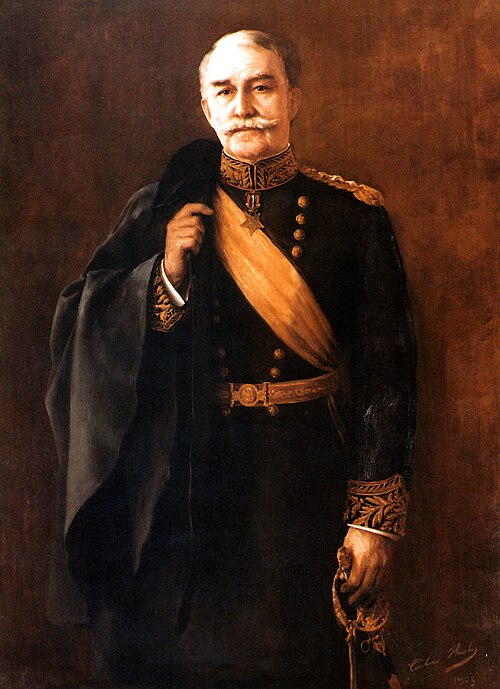
Miles died in 1925 at the age of 85 from a heart attack while attending the Ringling Bros. and Barnum & Bailey Circus in Washington, D.C., with his grandchildren. First Lady Grace Coolidge was also in attendance at the circus that day. Upon arriving at the showgrounds the general told circus owner John Ringling that he never missed a circus.[21] Nelson was one of the last surviving general officers who served during the Civil War on either side.[22] He is buried at Arlington National Cemetery in the Miles Mausoleum. It is one of only two mausoleums within the confines of the cemetery. George Burroughs Torrey painted his portrait.

Rank and Organization:
Citation:
General Miles was a member of several hereditary and military societies, including the Military Order of the Loyal Legion of the United States (MOLLUS), serving as Commander-in-Chief from 1919 to 1925, the Grand Army of the Republic, Sons of the American Revolution and the Military Order of Foreign Wars. He was also an honorary member of the Massachusetts Society of the Cincinnati. He was also a member of the Union League Club of New York, where his portrait hung in the main bar area for many years.

Miles City, Montana is named in his honor,[24] as is Miles Street and the Miles Neighborhood in Tucson, Arizona. Miles Canyon on the Yukon River near Whitehorse, Yukon, was named after him in 1883 by Lt. Frederick Schwatka during his exploration of the river system. A steamship, General Miles, was likely named for him. Nelson M. Holderman, himself a Medal of Honor recipient, was also named after Miles. Fort Miles at Cape Henlopen near Lewes, Delaware, was named for Miles on 3 June 1941.
Miles' legacy as an Indian fighter has seen him portrayed by Kevin Tighe in the film Geronimo: An American Legend, by Hugh O'Brian in the film Gunsmoke: The Last Apache, and by Shaun Johnston in the film adaptation of Bury My Heart at Wounded Knee. There is a bust of General Miles in the Massachusetts State Capitol in Boston. General Miles' son, Sherman Miles (1882–1966), was a career Army officer who graduated from West Point in 1905 and rose to the rank of major general during World War II. His daughter Cecelia was the wife of Colonel Samuel Reber II, and the mother of Miles and Samuel Reber III.
Source:[25]