
Loading article…
   .jpg/500px-Couvent_Smolny_-_cath%C3%A9drale_de_la_R%C3%A9surrection_(1).jpg) | |
| 活動年数 | 16世紀後半~18世紀 |
|---|---|
バロック建築は、16世紀後半にイタリアで出現し、徐々にヨーロッパ全土に広まった、非常に装飾的で演劇的な様式です。もともとはカトリック教会、特にイエズス会によって、驚きと畏敬の念を抱かせる新しい建築で宗教改革とプロテスタント教会に対抗する手段として導入されました。 [1]バロック建築は盛期バロック(1625-1675)にピークを迎え、イタリア、スペイン、ポルトガル、フランス、バイエルン、オーストリアの教会や宮殿で使用されました。後期バロック時代(1675-1750)には、ロシア、オスマン帝国、ラテンアメリカのスペインとポルトガルの植民地にまで広がりました。1730年頃には、ロココと呼ばれるさらに精巧な装飾の変種が登場し、中央ヨーロッパで繁栄しました。[2] [3]
バロック建築家は、ルネッサンス建築の基本要素であるドームや列柱を取り入れ、それらをより高く、より壮大に、より装飾豊かに、より劇的にした。室内の効果は、しばしばクアドラトゥーラ(トロンプ・ルイユの絵画と彫刻を組み合わせたもの)の使用によって達成された。視線は上方に引き寄せられ、まるで天を見つめているかのような錯覚を与える。天使の彫刻や描かれた人物像の群れが天井を埋め尽くした。光もまた劇的な効果のために使われた。光はキューポラから流れ落ち、豊富な金箔に反射した。上方への動きの錯覚を与えるために、ねじれた柱もよく使用され、カルトゥーシュやその他の装飾要素があらゆる利用可能なスペースを占めた。バロック宮殿では、大階段が中心的な要素となった。[4]
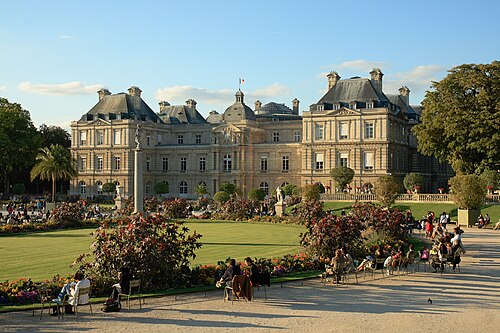
初期バロック(1584-1625)は、主にローマの建築家の作品が占めており、ジャコモ・デッラ・ポルタのジェズ教会(1584年奉献)、カルロ・マデルノのサン・ピエトロ大聖堂のファサードと列柱(1612年完成)、ピエトロ・ダ・コルトーナの豪華なバルベリーニ宮殿の内装(1633-1639年)、カルロ・マデルノのサンタ・スザンナ(1603年)などが有名である。フランスでは、サロモン・ド・ブロスがマリー・ド・メディシスのために建てたリュクサンブール宮殿(1615-1645年)がこの様式の初期の例である。[5]
盛期 バロック期 (1625 ~ 1675 年)は、ピエトロ ダコルトーナによってローマで主要な作品を制作しました。フランチェスコ・ボロミーニ(サン・カルロ・アッレ・クアトロ・フォンターネ(1634年 - 1646年))作。そしてジャン・ロレンツォ・ベルニーニ作(サン・ピエトロ広場の柱廊)(1656年 - 1657年)。ヴェネツィアでは、バルダッサーレ・ロンヘナのサンタ・マリア・デッラ・サルーテなど盛期バロックの作品が展示されました。フランスの例には、ジャック・ルメルシエ(1624~1645年)によるルーブル宮殿の時計台パビリオン、ジャック・ルメルシエ(1626~1635年)によるソルボンヌ礼拝堂、フランソワ・マンサール(1630~1651年)によるメゾン城が含まれます。
後期バロック(1675-1750年)には、この様式がヨーロッパ全土に広がり、新世界ではスペインとポルトガルの植民地にも広まった。各国の様式はより多様で独特なものとなった。ルイ14世統治下のフランスの後期バロックは、より整然として古典的であった。例としては、ヴェルサイユ宮殿の鏡の間やアンヴァリッドのドームなどがある。特に華麗な変種は18世紀初頭に現れ、フランスでは最初ロカイユと呼ばれ、その後スペインと中央ヨーロッパではロココと呼ばれた。彫刻と絵画による装飾が壁や天井のあらゆるスペースを覆った。最も高名な建築家はバルタザール・ノイマンで、十四聖護聖人大聖堂やヴュルツブルクのレジデンツァ(1749-1751年)で知られている。 [6]
歴史
初期バロック(1584–1625)
-
 ローマのジェズ教会のファサード(1584 年奉献)
 -
 ジェズ教会のドームの内観、ジャコモ・バロッツィ・ダ・ヴィニョーラ、ジャコモ・デッラ・ポルタ作
 -

-

-

-
サン・ジェルヴェ・エ・サン・プロテ教会。パリで最初の新バロック様式のファサードを持つ教会(1616~20年)
-
-

.jpg/500px-Dome_of_Church_of_the_Ges%C3%B9_(Rome).jpg)
_-_Front.jpg/500px-Santa_Susanna_(Rome)_-_Front.jpg)
バロック建築は、16世紀後半から17世紀初頭にかけて、ローマの宗教建築に、宗教改革の民衆的魅力に対抗する手段として初めて登場した。これは、以前の教会のより厳格でアカデミックな初期スタイルに対する反動であり、驚き、感動、畏怖の効果で一般の人々を鼓舞することを目的としていた。これを実現するために、コントラスト、動き、トロンプ・ルイユ、およびクアドラトゥーラ(空を直接見上げているような錯覚を与える天井画の使用)などのその他の劇的かつ演劇的な効果を組み合わせて使用した。この新しいスタイルは、テアティーヌ会やイエズス会などの新しい宗教団体に特に好まれ、幅広い民衆を魅了し、鼓舞することを目的とした新しい教会を建設した。[7]
ローマ
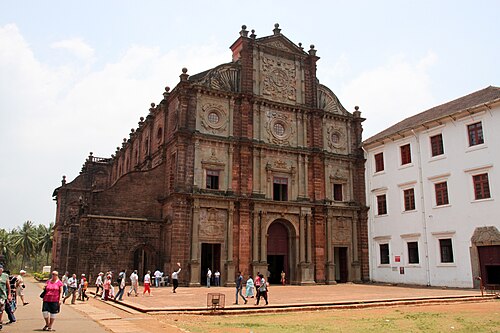
バロック建築家の先駆者の一人であるカルロ・マデルノは、サン・ピエトロ大聖堂の新しいファサードと列柱にバロック的な空間と遠近法の効果を取り入れた。これは、ミケランジェロが以前に建てた巨大なドームと対照的かつ補完的に設計された。[8]ローマの影響力のある初期の例としては、ジャコモ・デッラ・ポルタによるジェズー教会(1584年奉献)があり、これは最初のバロック様式のファサードと非常に華麗な内部を備え、カルロ・マデルノによるサンタ・スザンナ教会(1603年)も含まれる。[9]
パリ
イエズス会はすぐにこの様式をパリに持ち込んだ。パリのサン・ジェルヴェ・エ・サン・プロテ教会(1615年 - 1621年)はフランス初のバロック様式のファサードを持ち、イタリアのバロック様式のファサードのように3つの古典的なオーダーが重ね合わされていた。 [10]イタリア様式の宮殿は、マリー・ド・メディシスの新しい住居であるリュクサンブール宮殿(1615年 - 1624年)のために建築家サロモン・ド・ブロスが、ブロワ城の新棟のためにフランソワ・マンサール(1635年 - 1638年)がそれぞれ設計した。若き国王ルイ14世の財務監督官ニコラ・フーケは、ルイ・ル・ヴォーのヴォー・ル・ヴィコント城(1612年 - 1670年)のためにこの新しい様式を選んだ。彼は後に宮殿の費用が莫大だったため国王によって投獄された。[11]
南オランダ
南ネーデルラントでは、対抗宗教改革と八十年戦争を背景に、カトリック教会によってバロック建築が導入された。ネーデルラントの分離後、バロック様式の教会が国中に建てられた。最初の建築家の一人はヴァーツラフ・コーベルガー(1560-1634)で、彼は1609年から1627年にかけてシェルペンホイフェルの聖母大聖堂とアントワープの聖アウグスティヌス教会を建てた。他の教会としては、アントワープの聖カルロ・ボロメオ教会(1615-1621)とブルージュの聖ヴァルブルガ教会(1619-1641)があり、どちらもピーテル・ホイセンスによって建てられた。後に、ブリュッセルのグランプラスのギルドホールやいくつかの鐘楼などの世俗的な建物も建設された。[要出典]
中央ヨーロッパ
中央ヨーロッパにおける初期バロックの最初の例は、ポーランド・リトアニア共和国のネスヴィジにある聖体教会で、1586年から1593年の間にイエズス会によってローマ様式をモデルに建てられました(1945年以降はベラルーシのニアスヴィジに)。[12] [13]この教会は、共和国と東ヨーロッパで最初のバロック様式のファサードを持つドーム型バシリカとしても知られています。[13]ポーランドの別の初期例は、クラクフにある聖ペテロとパウロ教会 で、1597年から1619年の間にイタリアのイエズス会建築家ジョヴァンニ・マリア・ベルナルドーニによって建てられました。[14]
盛期バロック(1625年~1675年)
イタリア
-
 ベルニーニ作、ローマのサン・ピエトロ大聖堂のバルダキン(1623–34年)
 -

-
 サンティ・ルカ・エ・マルティナ教会、ローマ、ピエトロ・ダ・コルトーナ作(1635年 - 1650年)
 -

_in_Palazzo_Barberini_(Roma).jpg/500px-Allegory_of_Divine_Providence_and_Barberini_Power_(Cortona)_in_Palazzo_Barberini_(Roma).jpg)
_-_Roman_Forum_-_Rome_2016_(2).jpg/500px-Santi_Luca_e_Martina_(seen_from_Tabularium)_-_Roman_Forum_-_Rome_2016_(2).jpg)
.jpg/500px-Santa_Maria_della_Salute_(Venice).jpg)
1623年から1644年まで教皇の座にあったウルバヌス8世は、バロック様式の最も影響力のあるパトロンとなった。 1629年にカルロ・マデルノが死去した後、ウルバヌスは建築家で彫刻家のジャン・ロレンツォ・ベルニーニを教皇の主任建築家に任命した。ベルニーニはバロック様式の建物だけでなく、バロック様式の内装、広場、噴水も作り、ローマの中心部を巨大な劇場に変えた。ベルニーニはパラティーノの丘のサンタ・ビビアーナ教会とサン・セバスティアーノ・アル・パラティーノ教会をバロック様式のランドマークに再建し、バルベリーニ広場にトリトーネの噴水を設計し、サン・ピエトロ大聖堂の目玉としてそびえ立つバルダッキーノを作った。[15]
盛期バロックは徐々にローマを越えてイタリア全土に広まっていった。この時期には、ヴェネツィアでバルダッサーレ・ロンゲーナによるサンタ・マリア・デッラ・サルーテ教会(1630年 - 1631年)が建設された。バロック様式が使われたのは教会だけではない。初期バロックの最も素晴らしい建造物の一つがバルベリーニ宮殿(1626年 - 1629年)である。ウルバヌス8世の家族の邸宅で、カルロ・マデルノが着工し、ベルニーニとフランチェスコ・ボッロミーニが完成させ装飾した。教皇家族の邸宅の外観は比較的控えめだったが、内装、特にサロンの天井の巨大なフレスコ画、 ピエトロ・ダ・コルトーナが描いた「神の摂理とバルベリーニの力の寓話」は、バロック芸術と装飾の傑作と考えられている。[16]曲線的なファサードと動きの錯覚はフランチェスコ・ボッロミーニの得意技であり、特に盛期バロックのランドマークの一つであるサン・カルロ・アッレ・クアトロ・フォンターネ(1634-1646)で顕著である。 [17]この時期のもう一つの重要な建造物は、ピエトロ・ダ・コルトーナ(1635-1650)によるローマのサンティ・ルーカ・エ・マルティーナ教会で、優雅なドームを持つギリシャ十字の形をしている。ウルバヌス8世の死とその後継者の短い治世の後、 1666年から1667年までの教皇アレクサンデル7世の教皇職の間には、カルロ・ライナルディ、ベルニーニ、カルロ・フォンターナによるローマのバロック様式の教会、広場、噴水がさらに建設された。[18]
フランス
-

-
 ソルボンヌ礼拝堂– ジャック・ルメルシエ (1626–35)
 -

ルイ13世は1607年から1614年にかけて、新しい様式を研究するために建築家ジャック・ルメルシエをローマに派遣した。フランスに戻ると、彼はルーブル宮殿の時計台(1626年着工)と、さらに重要なパリ初の教会のドーム屋根であるソルボンヌ礼拝堂を設計した。これは1626年に設計され、1635年に建設が始まった。 [19]次に重要なフランスのバロック様式のプロジェクトは、ヴァル・ド・グラース教会のはるかに大きなドーム屋根で、ルメルシエとフランソワ・マンサールが1645年に着工し、1715年に完成した。すぐに、コレージュ・デ・カトル・ナシオン(現在のフランス学士院)のために3つ目のバロック様式のドーム屋根が追加された。[20]
1661年、マザラン枢機卿の死後、若きルイ14世が直接政府を掌握した。芸術は財務総監のジャン=バティスト・コルベールの指揮下に入った。王立絵画彫刻アカデミーのディレクター、シャルル・ルブランは国王建築監督官に任命され、すべての王室建築プロジェクトの責任者となった。王立建築アカデミーはローマではなくパリを世界の芸術と建築のモデルにするという使命を帯びて1671年に設立された。[21]
ルイ14世の最初の建築プロジェクトは、ルーブル宮殿の東翼のファサードの再建案だった。当時ヨーロッパで最も有名な建築家であったベルニーニが、設計図を提出するためにパリに召喚された。1664年初め、ベルニーニはいくつかのバロック様式の変種を提案したが、最終的に国王はフランスの建築家シャルル・ペローによる、より古典的なバロック様式のデザインを選択した。これが徐々にルイ14世様式となった。ルイはすぐにさらに大きなプロジェクト、新しいヴェルサイユ宮殿の建設に取り組んだ。選ばれた建築家はルイ・ル・ヴォーとジュール・アルドゥアン=マンサールで、新しい宮殿のファサードは1668年から1678年の間に以前の大理石の中庭の周囲に建設された。ヴェルサイユのバロック様式の壮大さ、特に庭園に面したファサードとジュール・アルドゥアン=マンサールの鏡の間は、ヨーロッパ中の他の宮殿のモデルとなった。[22]
後期バロック(1675年~1750年)
後期バロック時代(1675-1750年)には、この様式はイギリスやフランスから中央ヨーロッパやロシア、スペインやポルトガルからスカンジナビア、新世界やフィリピンのスペインやポルトガルの植民地に至るまで、ヨーロッパ全土に現れた。この様式はしばしば異なる名前で呼ばれ、地域による差異がより顕著になった。特に華麗な変種は18世紀初頭に現れ、フランスではロカイユ、スペインや中央ヨーロッパではロココと呼ばれた。彫刻や絵画による装飾が壁や天井のあらゆる空間を覆った。この様式の最も著名な建築家には、十四聖護聖人大聖堂やヴュルツブルクのレジデンツ(1749-1751年)で知られるバルタザール・ノイマンがいる。これらの作品はロココ、あるいは後期バロックの最終的な表現の一つであった。[6]
イタリア
-

-
 スペルガ大聖堂の内部 – フィリッポ・ジュヴァーラ
 -
 パラッツォ・カリニャーノ(現在はイタリアルネサンス美術館)
_-_Interior.jpg/500px-Basilica_di_Superga_(Turin)_-_Interior.jpg)
18世紀初頭までに、バロック様式の建物はイタリア全土で見られるようになり、地域によって異なることも多かった。注目すべき例としては、トリノを見下ろすスペルガ大聖堂がある。フィリッポ・ジュヴァラ(1717-1731)が設計し、後にパリのパンテオンのモデルとなった。[23] ストゥピニジ宮殿(1729-31)は狩猟用の小屋で、トリノ近郊のサヴォイア王家の邸宅の一つであった。これもフィリッポ・ジュヴァラが建てたものである。[24]
フランス
-

-
 アンヴァリッド礼拝堂、ジュール・アルドゥアン・マンサール (1708 年完成)
 -
 ジュール・アルドゥアン=マンサール(1699年~1710年)が着工したヴェルサイユ宮殿の礼拝堂
 -

フランスの後期バロック時代には、鏡の間や礼拝堂など、ヴェルサイユ宮殿の装飾が進化した。その後、ルイ15世の治世中に、より装飾的な新しい変種であるロカイユ様式、またはフランス・ロココがパリに現れ、1723年から1759年頃に繁栄した。[25]最も顕著な例は、ジェルマン・ボフランとシャルル・ジョゼフ・ナトワール(1735年 - 1740年)が設計したパリのスービーズ邸の王女のサロンである。[26] [27]
イングランド
クリストファー・レンは、ローマのサン・ピエトロ大聖堂をモデルにしたセント・ポール大聖堂(1675年 - 1711年)の再建、グリニッジ病院(1695年着工)、ハンプトン・コート宮殿(1690年 - 1696年)の設計などで、イギリスにおける後期バロックの代表的人物であった。他の後期バロックのイギリス人としては、ウィルトン・ハウス(1632年 - 1647年)の設計者イニゴー・ジョーンズや、レンの弟子ジョン・ヴァンブラとニコラス・ホークスムアによるキャッスル・ハワード(1699年 - 1712年)とブレナム宮殿(1705年 - 1724年)の設計者がいる。[28]
-
 クリストファー・レン(1675-1702)によるセントポール大聖堂の西ファサード
 -
 クリストファー・レン作「グリニッジ病院」(1694年)
 -

-
 ジョン・ヴァンブラとニコラス・ホークスムーアによるブレナム宮殿

リトアニア
17世紀、リトアニアの後期バロック様式の建物はイタリアのバロック様式で建てられましたが、18世紀前半には、後期バロックの独特のヴィリニュス・バロック建築様式が首都ヴィリニュス(ヴィリニュス・イエズス会アカデミー、イエズス会 大学、ドミニコ会 学校で建築が教えられていた)で形成され、リトアニア全土に広まりました。[29] [30] [31] [32]ヴィリニュス・バロック様式で建てられた教会の最も顕著な特徴は、異なる装飾が施された区画のあるメインファサードの非常に高くて細い塔、コーニスと壁のうねり、明るい色の装飾性、内部の多色の大理石とスタッコの祭壇です。 [29] [30] [32]リトアニア貴族は後期バロック様式の教会、修道院(例:パジェイスリス修道院)、個人の宮殿(例:サピエハ宮殿、スルシュコ宮殿、ミノル・ラドヴィロス宮殿)の改修と建設に資金を提供した。[33] [34]
リトアニアで後期バロック様式の建物を建てた著名な建築家は、ヨハン・クリストフ・グラウビッツ、トーマス・ゼブロフスキー、ピエトロ・ペルティ(画家ミケランジェロ・パローニ、ジョヴァンニ・マリア・ガッリと協力)、ジャンバティスタ・フレディアーニ、ピエトロ・プッティーニ、カルロ・プッティーニ、ヤン・ザオール、G.レンキェヴィチ、アブラハム・ヴュルツナー、ヤン・ヴァレンティヌス・トビアス・ダイダーシュテイン、PI ホーファー、パオロ・フォンタナなど[30] [32] [34]
-

-
 ヴィリニュスの聖ヨハネ教会。18 世紀にヨハン・クリストフ・グラウビッツとトーマス・ゼブロフスキによって再建されました。
 -
 ヴィリニュスの聖ペテロと聖パウロ教会の内部。ヤン・ザオール、ジャンバッティスタ・フレディアニが設計し、1701年に完成。
 -
![Interior of the Dominican Church of the Holy Spirit in Vilnius, reconstructed in a Late Baroque style in the 17th century[35]](https://img-server.japedia.wiki/wikipedia/commons/thumb/3/31/Dominican_Church_of_the_Holy_Spirit%2C_Vilnius%2C_Lithuania_-_Diliff.jpg/500px-Dominican_Church_of_the_Holy_Spirit%2C_Vilnius%2C_Lithuania_-_Diliff.jpg) ヴィリニュスの聖霊ドミニコ会教会の内部。17世紀に後期バロック様式で再建された[35]
ヴィリニュスの聖霊ドミニコ会教会の内部。17世紀に後期バロック様式で再建された[35] -
![Interior of the Church of the Visitation in the Pažaislis Monastery in Kaunas, designed by Pietro Puttini, Carlo Puttini and Giovanni Battista Frediani and completed in 1690[34]](https://img-server.japedia.wiki/wikipedia/commons/thumb/3/35/Pa%C5%BEaislis_Monastery_interior_1%2C_Kaunas%2C_Lithuania_-_Diliff.jpg/500px-Pa%C5%BEaislis_Monastery_interior_1%2C_Kaunas%2C_Lithuania_-_Diliff.jpg) Interior of the Church of the Visitation in the Pažaislis Monastery in Kaunas, designed by Pietro Puttini, Carlo Puttini and Giovanni Battista Frediani and completed in 1690[34]
Interior of the Church of the Visitation in the Pažaislis Monastery in Kaunas, designed by Pietro Puttini, Carlo Puttini and Giovanni Battista Frediani and completed in 1690[34] -
![Church of the Holy Trinity, Liškiava Monastery, completed in 1741[36]](https://img-server.japedia.wiki/wikipedia/commons/thumb/f/fe/Church_of_the_Holy_Trinity_in_Li%C5%A1kiava%2C_Lithuania_in_2015.jpg/500px-Church_of_the_Holy_Trinity_in_Li%C5%A1kiava%2C_Lithuania_in_2015.jpg) Church of the Holy Trinity, Liškiava Monastery, completed in 1741[36]
Church of the Holy Trinity, Liškiava Monastery, completed in 1741[36] -
![Interior of the Basilica of the Nativity of the Blessed Virgin Mary, Šiluva (built in 1760–1772) with the Our Lady of Šiluva in the main altar[37]](https://img-server.japedia.wiki/wikipedia/commons/thumb/7/73/Siluva_Basilika_Mari%C3%A4_Geburt_Innen_Chor_1.JPG/500px-Siluva_Basilika_Mari%C3%A4_Geburt_Innen_Chor_1.JPG) Interior of the Basilica of the Nativity of the Blessed Virgin Mary, Šiluva (built in 1760–1772) with the Our Lady of Šiluva in the main altar[37]
Interior of the Basilica of the Nativity of the Blessed Virgin Mary, Šiluva (built in 1760–1772) with the Our Lady of Šiluva in the main altar[37] -
![Church Of Blessed Virgin Mary, the Queen Of Angels, with a Late Baroque twin-tower façade completed in 1735, in the Tytuvėnai Monastery in Tytuvėnai[38]](https://img-server.japedia.wiki/wikipedia/commons/thumb/f/fe/Tytuv%C4%97n%C5%B3_%C5%A0v%C4%8D._Mergel%C4%97s_Marijos_ba%C5%BEny%C4%8Dios_ir_bernardin%C5%B3_vienuolyno_ansamblio_%C5%A0v%C4%8D._Mergel%C4%97s_Marijos%2C_%C5%A0v%C4%8D._M._Marijos_Angel%C5%B3_Karalien%C4%97s_ba%C5%BEny%C4%8Dia_-_panoramio.jpg/500px-thumbnail.jpg) Church Of Blessed Virgin Mary, the Queen Of Angels, with a Late Baroque twin-tower façade completed in 1735, in the Tytuvėnai Monastery in Tytuvėnai[38]
Church Of Blessed Virgin Mary, the Queen Of Angels, with a Late Baroque twin-tower façade completed in 1735, in the Tytuvėnai Monastery in Tytuvėnai[38]


![Interior of the Dominican Church of the Holy Spirit in Vilnius, reconstructed in a Late Baroque style in the 17th century[35]](https://img-server.japedia.wiki/wikipedia/commons/thumb/3/31/Dominican_Church_of_the_Holy_Spirit,_Vilnius,_Lithuania_-_Diliff.jpg/500px-Dominican_Church_of_the_Holy_Spirit,_Vilnius,_Lithuania_-_Diliff.jpg)
![Interior of the Church of the Visitation in the Pažaislis Monastery in Kaunas, designed by Pietro Puttini, Carlo Puttini and Giovanni Battista Frediani and completed in 1690[34]](https://img-server.japedia.wiki/wikipedia/commons/thumb/3/35/Pa%C5%BEaislis_Monastery_interior_1,_Kaunas,_Lithuania_-_Diliff.jpg/500px-Pa%C5%BEaislis_Monastery_interior_1,_Kaunas,_Lithuania_-_Diliff.jpg)
![Church of the Holy Trinity, Liškiava Monastery, completed in 1741[36]](https://img-server.japedia.wiki/wikipedia/commons/thumb/f/fe/Church_of_the_Holy_Trinity_in_Li%C5%A1kiava,_Lithuania_in_2015.jpg/500px-Church_of_the_Holy_Trinity_in_Li%C5%A1kiava,_Lithuania_in_2015.jpg)
![Church Of Blessed Virgin Mary, the Queen Of Angels, with a Late Baroque twin-tower façade completed in 1735, in the Tytuvėnai Monastery in Tytuvėnai[38]](https://img-server.japedia.wiki/wikipedia/commons/thumb/f/fe/Tytuv%C4%97n%C5%B3_%C5%A0v%C4%8D._Mergel%C4%97s_Marijos_ba%C5%BEny%C4%8Dios_ir_bernardin%C5%B3_vienuolyno_ansamblio_%C5%A0v%C4%8D._Mergel%C4%97s_Marijos,_%C5%A0v%C4%8D._M._Marijos_Angel%C5%B3_Karalien%C4%97s_ba%C5%BEny%C4%8Dia_-_panoramio.jpg/500px-thumbnail.jpg)
Central Europe
Many of the most extraordinary buildings of the Late Baroque were constructed in Austria, Germany, and Czechia. In Austria, the leading figure was Fischer von Erlach, who built the Karlskirche, the largest church of Vienna, to glorify the Habsburg emperors. These works sometimes borrowed elements from Versailles combined with elements of the Italian Baroque to create grandiose new effects, as in the Schwarzenberg Palace (1715). Johann Lukas von Hildebrandt used grand stairways and ellipses to achieve his effects at the upper and lower Belvedere Palace in Vienna (1714–1722). In The Abbey of Melk, Jakob Prandtauer used an abundance of polychrome marble and stucco, statuary and ceiling paintings to achieve harmonious and highly theatrical effects.[39]
Another important figure of German Baroque was Balthasar Neumann (1687–1753), whose works included the Würzburg Residence for the Prince-Bishops of Würzburg, with its famous staircase.[40]
In Bohemia, the leading Baroque architect was Christoph Dientzenhofer, whose building featured complex curves and counter-curves and elliptical forms, making Prague, like Vienna, a capital of the late Baroque.[41]
-
 Interior of the church of the Abbey of Melk by Jakob Prandtauer (1702–1736)
 -
 Library of the Clementinum, the Jesuit university in Prague (1722)
 -
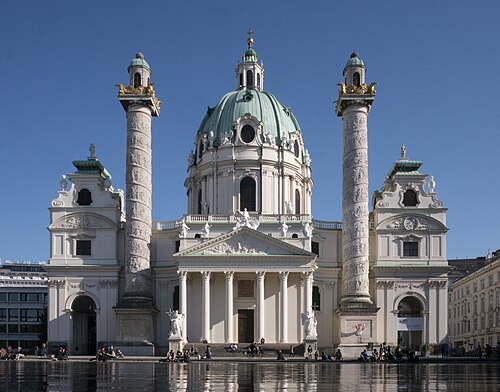 Karlskirche, Vienna by Fischer von Erlach (consecrated 1737)
 -
 Kaisersaal of Würzburg Residence by Balthasar Neumann (1749–51)
 -
 Basilica of the Fourteen Holy Helpers by Balthasar Neumann (1743–1772)
 -
 Royal Palace of Gödöllő (Hungary) by András Mayerhoffer (1730s–1785)
_6.jpg/500px-Grassalkovich-kast%C3%A9ly_(7051._sz%C3%A1m%C3%BA_m%C5%B1eml%C3%A9k)_6.jpg)
Spain
Political and economic crises in the 17th century largely delayed the arrival of the Baroque in Span until the late period, though the Jesuits strongly promoted it. Its early characteristics were a lavish exterior contrasting with a relatively simple interior and multiple spaces. They carefully planned lighting in the interior to give an impression of mystery. Early 18th century,[42] Notable Spanish examples included the new west façade of Santiago de Compostela Cathedral, (1738–50), with its spectacular towers, by Fernando de Casas Novoa. In Seville, Leonardo de Figueroa was the creator of the Palacio de San Telmo, with a façade inspired by the Italian Baroque. The most ornate works of the Spanish Baroque were made by Jose Benito de Churriguera in Madrid and Salamanca. In his work, the buildings are nearly overwhelmed by the ornament of gilded wood, gigantic twisting columns, and sculpted vegetation. His two brothers, Joaquin and Alberto, also made important, if less ornamented, contributions to what became known simply as the Churrigueresque style.[42]
-
 Late Baroque façade, Cathedral of Santiago de Compostela (1738–1750)
 -

-
 Retable in the Sagrario Chapel of Segovia Cathedral (1686) by Jose Benito de Churriguera, the earliest architect of the Churrigueresque style

.jpg/500px-Retablo_principal_de_la_Capilla_del_Sagrario_(Catedral_de_Segovia).jpg)
Latin America and North America
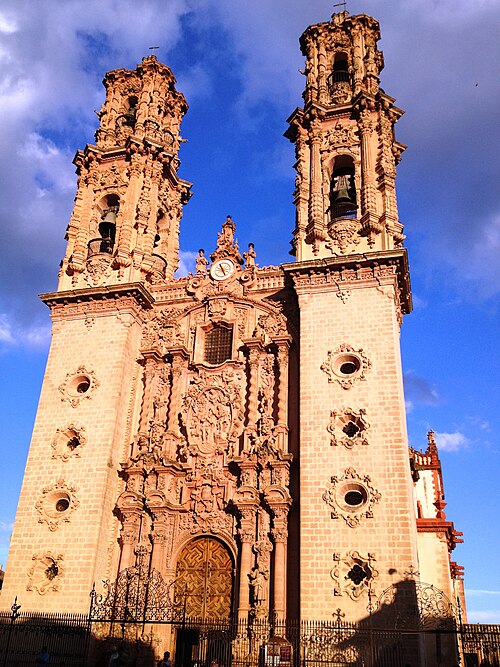
The Baroque style was imported into Latin America in the 17th century by the Spanish and the Portuguese, particularly by the Jesuits for the construction of churches. The style was sometimes called Churrigueresque, after the family of Baroque architects in Salamanca. A particularly fine example is Zacatecas Cathedral in Zacatecas City, in north-central Mexico, with its lavishly sculpted façade and twin bell towers. Another important example is San Cristobal de las Casas in Mexico.[43] A notable example in Brazil is the São Bento Monastery in Rio de Janeiro. begun in 1617, with additional decoration after 1668. The Metropolitan Tabernacle the Mexico City Metropolitan Cathedral, to the right of the main cathedral, built by Lorenzo Rodríguez between 1749 and 1760, to house the archives and vestments of the archbishop, and to receive visitors.[44]
Portuguese colonial architecture was modeled after the architecture of Lisbon, different from the Spanish style. The most notable architect in Brazil was Aleijadinho, who was native of Brazil, half-Portuguese, and self-taught. His most famous work is the Church of Saint Francis of Assisi (Ouro Preto).[45]
-
 Cathedral Basilica of Zacatecas in Mexico, built between 1729-1772, an example of the Churrigueresque style
 -
 Cathedral of Morelia, Mexico. 1660-1744.
 -
 Mexico City Metropolitan Cathedral, Mexico City, built between 1571-1813, by several architects
 -
 Church of St Domingo de Guzmán, Oaxaca. Mexico. 1572-1724.
 -
![Havana Cathedral, Cuba, built between 1748-1777[46]](https://img-server.japedia.wiki/wikipedia/commons/thumb/1/13/Cathedral_%283209489947%29.jpg/500px-Cathedral_%283209489947%29.jpg) Havana Cathedral, Cuba, built between 1748-1777[46]
Havana Cathedral, Cuba, built between 1748-1777[46] -
 High altar of the Iglesia de El Sagrario, Quito, church built between 1617-1747 by Spaniard José Jaime Ortiz. It is a World Heritage Site by UNESCO
 -
 Complete façade of the Iglesia y Convento de San Francisco, Quito, built between 1550-1680
 -
 Iglesia de la Compañía de Jesús, Cusco, Peru, built between 1576-1668, by Jean-Baptiste Gilles and Diego Martínez de Oviedo.
 -
 Panorama of the façade of the Basilica and Convent of San Francisco, Lima, built between 1657-1672 by the Portuguese Constantino de Vasconcellos and the Liman Manuel Escobar, is a World Heritage City by UNESCO
 -
 Church of Saint Francis of Assisi (Ouro Preto), Brazil, built between 1765-1775, by Brazilian Aleijadinho
.jpg/500px-Catedral,_Arquitectura_Colonial,_Zacatecas_(16461248359).jpg)

![Havana Cathedral, Cuba, built between 1748-1777[46]](https://img-server.japedia.wiki/wikipedia/commons/thumb/1/13/Cathedral_(3209489947).jpg/500px-Cathedral_(3209489947).jpg)

Characteristics
-

-
 Ceiling of the Farnese Gallery by Annibale Carracci (1597–1704)
 -
 Illusionistic ceiling painting of the Jesuitenkirche, Vienna, by Andrea Pozzo (1703)
 -
 Grand staircase of the Würzburg Residence (1720–1780) by Balthasar Neumann
 -
 Trompe-l'œil effect on the ceiling of the Church of the Gesù, Rome, by Giovanni Battista Gaulli (completed 1679)
 -
 Baroque garden at Vaux-le-Vicomte. The parterre, designed to be viewed from above from the Chateau windows and terrace, was an extension of the interior architecture and design
.jpg/500px-Borromini's_coat_of_arms_of_Urban_VIII_in_Bernini's_Palazzo_Barberini_by_Filippo_Juvarra_(1711).jpg)
.png/500px-Annibale_Carracci,_Farnese_Ceiling_(South_Side).png)

.jpg/500px-TreppenhausResidenzW%C3%BCrzburgL1050248_(2).jpg)
Baroque architecture often used visual and theatrical effects, designed to surprise and awe the viewer:
- domes were a common feature. Their interiors were often painted with a sky filled with angels and sculpted sunbeams, suggesting glory or a vision of heaven. Pear-shaped domes were sometimes used in the Bavarian, Czech, Polish and Ukrainian Baroque
- quadratura. Paintings in trompe-l'œil of angels and saints in the dome and on the ceiling, combined with stucco frames or decoration, which give the illusion of three dimensions, and of looking through the ceiling to the heavens. Sometimes painted or sculpted figures of Atlantes appear to be holding up the ceiling. In some Baroque churches, illusionistic ceiling painting gave the illusion of three dimensions.
- grand stairways. Stairways often occupied a central place and were used for dramatic effect. winding upwards in stages, giving changing views from different levels, serving as a setting for ceremonies.[47]
- cartouche in elaborate forms and sculpted frames break up the surfaces and add three-dimensional effects to the walls.
- mirrors to give the impression of depth and greater space, particularly when combined with windows, as in the Hall of Mirrors at the Palace of Versailles.
- incomplete architectural elements, such as frontons with sections missing, causing sections to merge and disorienting the eye.
- chiaroscuro. Use of strong contrasts of darkness and light for dramatic effect.
- overhead sculpture. Putti or figures on or just below the ceiling, made of wood (often gilded), plaster or stucco, marble or faux finishing, giving the impression of floating in the air.
- Solomonic columns, which gave an illusion of motion.[47]
- elliptical or oval spaces, eliminating right angles. Sometimes an oval nave was surrounded by radiating circular chapels. This was a distinctive feature of the Basilica of the Fourteen Holy Helpers of Balthasar Neumann.[48]
Plans
-
 Cruciform plan of a high Baroque Church, Santi Luca e Martina in Rome by Pietro da Cortona (1639–1669)
 -
 Floor plan of Sant'Andrea al Quirinale by Gian Lorenzo Bernini (1658–1661) showing the entrance (below), altar (top) and radiating chapels
 -
 Plan of the Late Baroque Basilica of the Fourteen Holy Helpers by Balthasar Neumann, constructed between 1743 and 1772. The altar is in an oval in the center.

Major Baroque architects and works, by country


Italy
- Carlo Maderno – Santa Susanna (1595–603); St. Peter's Basilica and Sant'Andrea della Valle, Rome
- Pietro da Cortona – Santa Maria della Pace (1656–68), Santi Luca e Martina, Rome
- Gian Lorenzo Bernini – Saint Peter's Square, Palazzo Barberini, Sant'Andrea al Quirinale, Rome
- Francesco Borromini – San Carlo alle Quattro Fontane, Sant'Ivo alla Sapienza, Rome
- Carlo Fontana – San Marcello al Corso (1692–1697)
- Francesco de Sanctis – Spanish Steps (1723)
- Luigi Vanvitelli – Caserta Palace (begun 1752)
- Guarino Guarini – Palazzo Carignano in Turin (1679), Chapel of the Holy Shroud, Turin
- Filippo Juvarra – Basilica of Superga, Turin (1717–31)
France
- Salomon de Brosse – Luxembourg Palace (1615–1645)
- Louis Le Vau – (Vaux-le-Vicomte) (1658–1661), Collège des Quatre-Nations (1662–1688), Cour Carrée of the Louvre Palace (1668–1680)
- Jules Hardouin-Mansart – domed chapel of Les Invalides (finished 1708); garden façade and Hall of Mirrors of Palace of Versailles
- Robert de Cotte – Chapel of Palace of Versailles (1643–1715), Grand Trianon (1643–1715)
England
- Christopher Wren – St. Paul's Cathedral (1675–1711), Hampton Court Palace (1690–1696), Greenwich Hospital (begun 1695)[49]
- Nicholas Hawksmoor and John Vanbrugh – Castle Howard (1699–1712); Blenheim Palace (1705–1724)
- James Gibbs – Radcliffe Camera, Oxford (1739–49)[50]
The Netherlands

- Jacob Van Campen – Royal Palace of Amsterdam (then city hall) (begun 1648), Noordeinde Palace (1640) and Mauritshuis (1641)
- Lieven de Key – City Hall (Haarlem) (1620)
- Pieter Post – Huis ten Bosch (1645–1652) and Maastricht City Hall (1686)
- Maurits Post – Soestdijk Palace (1650)
- Daniël Stalpaert – Het Scheepvaartmuseum (1655–1656) and Trompenburgh (1684)
- Daniel Marot – Het Loo Palace (1684–1686)
- Bartholomeus van Bassen – Nieuwe Kerk (The Hague) (1656)
- Pierre Cuypers – Oudenbosch Basilica (1892)
Germany
.jpg/500px-Drezno,_Zwinger,_Pawilon_Wa%C5%82owy(4).jpg)


- Agostino Barelli – Nymphenburg Palace, Munich (1664–1675)
- Matthäus Daniel Pöppelmann – Zwinger, Dresden (1697–1716)[51]
- Georg Bahr – Dresden Frauenkirche, (1722–1738, destroyed in 1944, rebuilt in 1994–2005)[52]
- Johann Arnold Nering – Charlottenburg Palace, Berlin (1695–1713)
- Balthasar Neumann – Basilica of the Fourteen Holy Helpers (1743–1772), Würzburg Residence (1735)
- Johann Dientzenhofer and Johann Lukas von Hildebrandt – Schloss Weißenstein in Pommersfelden, Bavaria (1711–1718)
- Augustusburg Palace
Austria
- Johann Lukas von Hildebrandt, Upper Belvedere Palace in Vienna (1721–23)
- Johann Bernhard Fischer von Erlach – University Church, Salzburg (begun 1696); Karlskirche, Vienna (1716–37); Austrian National Library (begun 1722)
- Johann Bernhard Fischer von Erlach and Johann Lukas von Hildebrandt – Palais Auersperg in Vienna
- Jakob Prandtauer and Josef Munggenast, Abbey of Melk (1702–1738)
- Santino Solari, Salzburg Cathedral (façade and interior of dome) (1614–1628)
Czech Republic
- Jean-Baptiste Mathey – Troja Palace, Prague (1679–1691)[53]
- Christoph Dientzenhofer – Břevnov Monastery, Prague (1708–1721) – Church of St Nicholas. Prague (1704–55)[53]
- Kilian Ignaz Dientzenhofer – Kinský Palace (Prague) (1755–1765)[54]
Slovakia
- Pietro Spozzo – Jesuit Church of Trnava (1629–37)
Hungary
- András Mayerhoffer – Gödöllő Palace near Budapest (begun 1733)
- Ignác Oraschek and Márton Wittwer: Esterházy Palace in Fertőd
Romania
- Johann Eberhard Blaumann – Bánffy Palace in Cluj (1774–75)
- Johann Lukas von Hildebrandt – Bishopric Palace in Oradea (1736–1750)
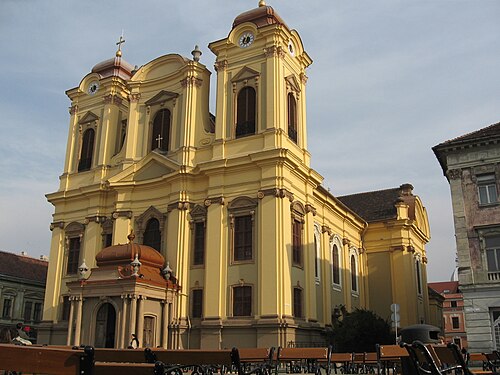
- Joseph Emanuel Fischer von Erlach – St. George's Cathedral, Timișoara
- Anton Erhard Martinelli – Holy Trinity Cathedral, Blaj (1738–1749)
- Samuel von Brukenthal – Brukenthal Palace in Sibiu (1777–87)
- Franz Burger – Brukenthal High School in Sibiu (1779–81)
- Jesuit Church, Sibiu (1726–33)
- Gheorghe Lazăr National College (Sibiu)
Poland

- Giovanni Maria Bernardoni – Saints Peter and Paul Church, Kraków (1597–1619)
- Joseph Emanuel Fischer von Erlach – Chapel of the Holy Sacrament, Wroclaw Cathedral
- Karl Friedrich Pöppelmann – Blue Palace in Warsaw (1728)
- Tylman van Gameren – Krasinski Palace, Warsaw (1677–1682)
- Johann Lukas von Hildebrandt – Royal Castle, Warsaw (1711)
- Friedrich Karcher – Enlargement of Royal Castle, Warsaw (1700)
- Augustyn Wincenty Locci and Andreas Schlüter – Reconstruction of Wilanów Palace (1677–1696)[55]
.jpg/500px-Pante%C3%A3o_Nacional_(2528394095).jpg)
Portugal
- João Antunes – Church of Santa Engrácia, Lisbon (now National Pantheon of Portugal; begun 1681)
- Nicolau Nasoni – Clérigos Church in Porto (1732–1763); Mateus Palace in Vila Real (1739–1743)
Portuguese Colonial Baroque

- Aleijadinho – Church of Saint Francis of Assisi (Ouro Preto), Brazil[56] (1771–1794)
- Basilica and Convent of Nossa Senhora do Carmo, Recife, Brazil (1665–1767)
- Church of St. Anne, Talaulim, India (1577–1695)
- Church of Saint Dominic, Macau, China (1587)
Spain
- Fernando de Casas Novoa – West façade of Cathedral of Santiago de Compostela (1738–1750)[57]
- Alonzo Cano – Baroque additions to Granada Cathedral (1667)[57]
- Leonardo de Figueroa – Palacio de San Telmo, Seville, (1682)[57]
- Jose Benito de Churriguera – San Cayetano Church, Madrid – Altar of the Church of San Esteban, Salamanca (1693)[58]
- Francisco Hurtado Izquierdo – Granada Charterhouse, Granada (1727–1764)[59]
Spanish American Baroque

- Lorenzo Rodriguez – Metropolitan Tabernacle of Mexico City Metropolitan Cathedral, Mexico (1749–1760)[60]
- Cathedral Basilica of Zacatecas in Zacatecas City, Mexico (1729–1772)
- Spaniard José de la Cruz, Antonio de Nava and Luigi Tomassi – Cathedral of Chihuahua, Mexico, (1725–1760)
- Convent of San Francisco, Madero Street, Mexico City, built around the 16th century
- Flemish Jean-Baptiste Gilles and Diego Martínez de Oviedo – Iglesia de la Compañía de Jesús, Cusco, Peru (1668)
- Juan Miguel de Veramendi, Juan Correa, Miguel Gutiérrez Sencio – Cusco Cathedral, in Cusco, Peru (1560–1664)
- Palacio de Torre Tagle, in Lima, Peru (1715)
- Cathedral Basilica of Lima, Peru (1535–1649)
- Basilica and Convent of Nuestra Señora de la Merced, Lima, Peru (1535)
- Basilica of San Francisco, La Paz, Bolivia (1743–1772)[61]
- Havana Cathedral in Cuba, built between 1748 and 1777[46]
- Basilica Menor de San Francisco de Asís in Havana, Cuba, built between 1580 and 1738.
Nordic Countries

- Elias David Häusser (Denmark) – Christiansborg Palace (1st)
- Lambert van Haven (Denmark) – Church of Our Saviour, Copenhagen (1682–1747)
- Nicodemus Tessin the Elder (Sweden) – Drottningholm Palace (1662–1681) – Kalmar Cathedral in Småland, Sweden (1660–1703)
Russia
.jpg/500px-%D0%97%D0%BD%D0%B0%D0%BC%D0%B5%D0%BD%D1%81%D0%BA%D0%B0%D1%8F_%D1%86%D0%B5%D1%80%D0%BA%D0%BE%D0%B2%D1%8C..._(%D0%94%D1%83%D0%B1%D1%80%D0%BE%D0%B2%D0%B8%D1%86%D1%8B).jpg)
- Giovanni Maria Fontana – Menshikov Palace (Saint Petersburg) (1710–1720s)
- Georg Johann Mattarnovi – Kunstkamera in Petrine Baroque, Saint Petersburg, completed by 1727
- Bartolomeo Francesco Rastrelli – Façade of Smolny Convent, Saint Petersburg (1748–1754); Stroganov Palace (1753—1754); Vorontsov Palace (Saint Petersburg) (1749—1757); Winter Palace in Saint Petersburg (1754–1762)[62]
- Domenico Trezzini – Peter and Paul Fortress, Saint Petersburg (1706–1740)
- Mikhail Zemtsov – Transfiguration Cathedral (Saint Petersburg) (1743–54)
Ukraine

- Francesco Bartolomeo Rastrelli – Mariinskyi Palace in Kyiv (1744–1752); St Andrew's Church, Kyiv (1744–1767), both in Elizabethan style
- By the command of Yakiv Lyzohub – House of Lyzohub (1690s); Catherine's Church, Chernihiv (1715)
- St. Nicholas Cathedral, Nizhyn (17th century), the prototype of Ukrainian baroque
- Most of Vydubychi Monastery (17th–19th century)
- Portions of Kyiv Pechersk Lavra (17th–18th century)
Malta
- Bontadino de Bontadini – Wignacourt Aqueduct (1612–1615) and Wignacourt Arch[63]
- Francesco Bounamici – Church of the Jesuits, Valletta (1635)[64]
- Mattia Preti – Saint John's Co-Cathedral (1660s); Our Lady of Victories Church, Valletta (1752)
- Lorenzo Gafà – Saint Lawrence's Church, Vittoriosa (1681–97); St. Paul's Cathedral, Mdina (1696–1705); the Cathedral of the Assumption, Gozo (1697–1711)[65]
- Andrea Belli – Auberge de Castille (1741–45)[64]
See also
- List of Baroque architecture
- List of Baroque residences
- Baroque music
- Baroque sculpture
- Ottoman Baroque architecture
References
- ^ Gauvin Alexander Bailey, Between Renaissance and Baroque: Jesuit Art in Rome, 1565–1610 (Toronto: University of Toronto Press, 2003).
- ^ Oudin, Dictionnaire des Architectes (1994), pp. 43–44
- ^ Ducher (1988), Flammarion, pp. 102–104
- ^ Ducher (1988), Flammarion, p. 102
- ^ Toman (Rolf, L'Art Baroque – Architecture – Sculpture- Peinture (2015) pp. 12–70
- ^ a b Toman (2015), pp. 190–194
- ^ Ducher, Characteristique des Styles (1989), p. 102
- ^ Ducher, Characteristique des Styles (1989), p. 104
- ^ Wittkower R., Art & Architecture in Italy 1600–1750, 1985 edn, p. 111
- ^ Texier, Simon, Paris – Panorama de l'architecture (2012), p. 31
- ^ Toman, L'Art Baroque (2015) p. 125
- ^ Aliaksiej Sierka. "The Farny Roman-Catholic Church". www.belarusguide.com. Archived from the original on 8 July 2010. Retrieved 6 August 2010.
- ^ a b Adam Mickiewicz University (1991). "Volumes 5–6". Lituano-Slavica Posnaniensia (in Polish). UAM. p. 90. ISBN 83-232-0408-X.
- ^ Cohen, Gary B.; Szabo, Franz A. J. (1 July 2008). Embodiments of Power: Building Baroque Cities in Europe. Berghahn Books. p. 101. ISBN 978-0-85745-050-0.
- ^ Toman, L'Art Baroque (2015), pp. 15–45
- ^ Toman, L'Art baroque (2015), pp. 21–23
- ^ Ducher (1989) p. 104
- ^ Toman, L'Art baroque (2015), pp. 24–45
- ^ Toman (2015) p. 128
- ^ Ranum, Orest (1968). Paris in the Age of Absolutism: An Essay (revised ed.). Penn State Press. p. 185. ISBN 978-0-271-04645-7. Retrieved 29 May 2022.
- ^ Toman (2015) pp. 129–131
- ^ Toman (2015) pp. 133–35
- ^ Toman 2015, p. 58.
- ^ Collier, William (1963). "French Influence on the Architecture of Filippo Juvarra". Architectural History. 6: 41–53. doi:10.2307/1568282. ISSN 0066-622X. JSTOR 1568282. S2CID 158774259. Archived from the original on 29 May 2022. Retrieved 29 May 2022.
- ^ Lovreglio, Aurélia and Anne, Dictionnaire des Mobiliers et des Objets d'art, Le Robert, Paris, 2006, p. 369
- ^ Hopkins 2014, pp. 92–93.
- ^ De Morant 1970, p. 382.
- ^ Toman (2015) pp. 162–169
- ^ a b Raila, Eligijus. "Baroko architektūros sklaida". Šaltiniai.info. Ministry of Education and Science of Lithuania, Institute of Lithuanian Literature and Folklore, Vilnius University. Archived from the original on 9 May 2021. Retrieved 18 February 2023.
- ^ a b c "Vilniaus baroko mokykla". Visuotinė lietuvių enciklopedija (in Lithuanian). Archived from the original on 18 February 2023. Retrieved 18 February 2023.
- ^ "Vilnius Historic Centre". UNESCO. Archived from the original on 17 February 2023. Retrieved 18 February 2023.
- ^ a b c Vitkauskienė, Birutė Rūta. "Barokas Lietuvos architektūroje". Visuotinė lietuvių enciklopedija (in Lithuanian). Archived from the original on 18 February 2023. Retrieved 18 February 2023.
- ^ "Lietuvos architektūra". Visuotinė lietuvių enciklopedija (in Lithuanian). Archived from the original on 18 February 2023. Retrieved 18 February 2023.
- ^ a b c "Pažaislio bažnyčios ir vienuolyno ansamblis". Visuotinė lietuvių enciklopedija (in Lithuanian). Archived from the original on 18 February 2023. Retrieved 18 February 2023.
- ^ "Dominican Church of the Holy Spirit in Vilnius, Lithuania". CityofMercy.lt. Archived from the original on 18 February 2023. Retrieved 18 February 2023.
- ^ "Liškiavos bažnyčia". Liskiavosparapija.lt. Archived from the original on 18 February 2023. Retrieved 18 February 2023.
- ^ Šinkūnaitė, Laima. "Mergelės Marijos Gimimo bazilika". Siluva.lt (in Lithuanian). Archived from the original on 18 February 2023. Retrieved 18 February 2023.
- ^ "Tytuvėnų Švč. Mergelės Marijos Angelų Karalienės bažnyčia". Tytuvenubaznycia.lt (in Lithuanian). Archived from the original on 18 February 2023. Retrieved 18 February 2023.
- ^ Cabanne (1988), pp. 89–91
- ^ Cabanne (1988), pp. 901
- ^ Cabanne (1988), pp. 90–92
- ^ a b Cabanne (1988) pp. 49–51
- ^ Toman (2015) p. 120
- ^ Horz de Via, Elena (1991). Guia Oficial Centro de la Ciudad de Mexico. Mexico City: INAH-SALVAT. pp. 28–30. ISBN 968-32-0540-2.
- ^ Toman (2015) p. 121
- ^ a b Belmont Freeman (23 June 2018). Modern architecture in Cuba and Contemporary Preservation Challenges. Archived from the original on 30 September 2019. Retrieved 30 September 2019.
{{cite book}}:|work=ignored (help) - ^ a b Ducher (1988), p. 102
- ^ Ducher, Robert, Caractéristique des Styles (1988), pp. 102–103
- ^ Toman (2015), pp. 168–169)
- ^ Toman (2015) p. 177
- ^ Toman (2015) pp. 202–205
- ^ Toman (2015) pp. 206–207
- ^ a b Toman (2015) p. 264
- ^ Toman (2015) p. 266
- ^ Toman (2015) p. 270
- ^ *Aleijadinho Archived 27 March 2019 at the Wayback Machine at Encyclopædia Britannica
- ^ a b c Cabanne (1988) p. 49
- ^ Cabanne (1988) p. 50
- ^ Pevsner, Nikolaus. An Outline of European Architecture. New York: Penguin Books, Ltd., 1963
- ^ Oudin, Dictionnaire des Architectes, p. 430
- ^ Adriana Olivera (1 June 2016). "Descubre La Paz: Museo de San Francisco". La Región (Bolivian newspaper). La Paz. Archived from the original on 25 September 2019. Retrieved 24 September 2019.
- ^ Toman (2015) p. 272
- ^ Bonello, Giovanni (2003). "Bontadino de Bontadini – The Murder of the First Baroque Architect in Malta". Histories of Malta – Convictions and Conjectures. Malta: Fondazzjoni Patrimonju Malti. pp. 44–61. ISBN 9789993210276.
- ^ a b "Baroque Architecture". Culture Malta. Archived from the original on 30 June 2016.
{{cite web}}: CS1 maint: unfit URL (link) - ^ Schiavone, Michael J. (2009). Dictionary of Maltese Biographies Vol. II G–Z. Pietà: Pubblikazzjonijiet Indipendenza. pp. 851–852. ISBN 9789993291329.
Bibliography
- Bailey, Gauvin Alexander. Baroque & Rococo. London: Phaidon Press, 2012.
- Bourke, John. Baroque Churches of Central Europe. London: Faber, 1962 (2nd revised ed.)
- Cabanne, Perre (1988), L'Art Classique et le Baroque, Paris: Larousse, ISBN 978-2-03-583324-2
- De Morant, Henry (1970). Histoire des arts décoratifs (in French). Librarie Hachette.
- Ducher, Robert, Caractéristique des Styles, (1988), Flammarion, Paris (In French); ISBN 2-08-011539-1
- Hopkins, Owen (2014). Les styles en architecture. Dunod. ISBN 978-2-10-070689-1.
- Texier, Simon (2012). Paris- Panorama de l'architecture. Parigramme. ISBN 978-2-84096-667-8.
- Oudin, Bernard (1992), Dictionnaire des Architects (in French), Paris: Seghers, ISBN 2-232-10398-6
- Sitwell, Sacheverell. Southern Baroque Revisited. London: Weidenfeld & Nicolson, 1967.
- Toman, Rolf (2015). L'art baroque architecture, sculpture, peinture (in French). Cologne-Paris: H.F. Ullmann. ISBN 978-3-8480-0856-8.
- Robbins Landon, H. C. and David Wyn Jones (1988) Haydn: His Life and Music. Thames and Hudson.
External links

Wikimedia Commons has media related to Baroque architecture.
- Siberian Baroque