Loading article…
An open sandwich, also known as an open-face/open-faced sandwich, bread baser, bread platter or tartine,[1] consists of a single slice of bread or toast with one or more food items on top. It has half the number of slices of bread compared to a typical closed sandwich and has toppings rather than fillings.
During the start of the Middle Ages, thin slabs of coarse bread called "trenches" (late 15th century English) or, in its French derivative, "trenchers", were used as plates.[2] At the end of the meal, the food-soaked trencher was eaten by the diner (from which the expression "trencherman" may come), or perhaps fed to a dog or saved for beggars. Trenchers were as much the harbingers of open-face sandwiches[3] as they were of disposable crockery.
A direct precursor to the English sandwich may be found in the Netherlands of the 17th century, where the naturalist John Ray observed that in the taverns, beef hung from the rafters "which they cut into thin slices and eat with bread and butter laying the slices upon the butter".[4] These explanatory specifications reveal that the Dutch belegde boterham, open-faced sandwich, was as yet unfamiliar in England.
In countries like Denmark, where smørrebrød is common, smørrebrød is not considered a form of sandwich; rather, a sandwich is considered a form of smørrebrød with an extra piece of bread on top.[5] In a US context, open sandwiches are sandwiches that are made with only a single slice of bread. It has given rise to some controversy in the philosophy of language study of meaning underdetermination after a judge had to consider whether a burrito was a sandwich for the purposes of enforcing an exclusive use clause in an American legal case. The judge followed the definition of Merriam-Webster's Dictionary: "two thin pieces of bread, usually buttered, with a thin layer (as of meat, cheese or savory mixture) spread between them." Because the burrito was "typically made with a single tortilla," the judge said it was not a sandwich.[6]
オープンサンドイッチは、アフタヌーンティーやサラダの付け合わせとして、さまざまな種類のサンドイッチを盛り付けて提供することができます。 [ 7 ]三角形、星形、円形、三日月形などのおしゃれな形にカットして、魅力的な大皿に盛り付けて提供することもできます。オープンサンドイッチによく使われる具材は、ジャム、詰め物入りオリーブ、刻んだハーブ、クリームチーズ、ゆで卵、ピメントなどです。サンドイッチの盛り合わせの見た目を良くするために、風味や色を加えるためにどんな具材でも使用できます。[ 8 ]
オープンサンドイッチは、新鮮なパンのスライス、またはドイツではパンロールの半分に、バター、レバーパテ、チーズスプレッド、ローストビーフ、ターキー、ハム、ベーコン、サラミ、牛タン、モルタデッラ、ヘッドチーズなどのコールドカット、ビアヴルストやカバノスなどのソーセージ、スモークサーモン、グラブラックス、ニシン、ウナギなどの魚、ピーマン、トマト、大根、ネギ、キュウリなどのさまざまなスプレッドを挟んだものです。[ 9 ]

このようなオープンサンドイッチは、フランス、ベルギー、デンマーク[ 10 ] 、ノルウェー[ 11 ] 、スウェーデン[ 12 ] 、フィンランド、エストニア、オーストリア、ドイツ[ 13 ] [ 14 ]、チェコ共和国[ 15 ] 、ハンガリー[ 16 ] 、オランダ[ 17 ]、ポーランド、ブルガリア、その他ヨーロッパの地域、そして北アメリカで、朝食や夕食の定番料理として食べられています。アメリカのタントーストは、朝食、昼食、夕食のメインディッシュとして、またフォーマルなパーティーのオードブルとして提供されていました。
旧チェコスロバキアでは、オープンサンドイッチの一種として、obložené chlebíčky (複数形、単数形obložený chlebíček ) が人気です。これは、斜めに切ったヴェカ(細長い白いパン) にバターを塗ったり、マヨネーズサラダとゆで卵、チーズ、ハム、サラミ、燻製魚 (サーモン、スプラット、ニシンの酢漬け)、トマト、キュウリの酢漬け、レタス、生のタマネギ、その他の野菜などを様々な組み合わせで挟んだものです。 [ 15 ]
オープンサンドイッチは、北欧諸国(エストニア、ラトビア、リトアニア、オランダ、ベラルーシ、ロシア、ポーランド、ウクライナ、カザフスタン)で一般的な伝統的なサンドイッチの種類で、朝食、昼食、夕食、または軽食として食べられています。フィンランドではこのサンドイッチはvoileipäと呼ばれ、エストニアでは同様にvõileibと呼ばれ、「バターパン」という意味もあります。

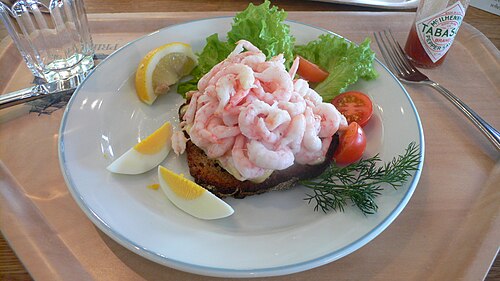
スカンジナビアのオープンサンドイッチ(デンマーク語:smørrebrød、ノルウェー語:smørbrød、スウェーデン語:smörgåsまたはmacka)は、バターを塗ったパン(多くは全粒ライ麦パン(デンマーク語:rugbrød、スウェーデン語:rågbröd、フィンランド語:ruisleipä))の上に、チーズ、冷製ステーキ、ハム、七面鳥、エビ、スモークサーモン、キャビア、ゆで卵、ベーコン、ニシン、魚の切り身、レバーパテ(デンマーク語:leverpostej、ノルウェー語:leverpostei、スウェーデン語:leverpastej)、または小さなミートボールなどを乗せたものです。これは通常、同じパンのスライスにパセリ、冷たいサラダ、薄切りのキュウリ、トマトのくし切り、またはピクルスにしたビーツなどのハーブや野菜を添えて提供されます。 [ 18 ] [ 20 ]
マヨネーズやマヨネーズベースのドレッシングなどの調味料も、何らかの形で添えられることが多い。[ 15 ] ニシンを乗せたパンにバターの代わりに豚脂を使うのが昔からの伝統である。スモーブロー/スモーブロー/スモーガスには多くのバリエーションがあり、特にデンマークでは、スモーブロー/スモーガスを専門とする店、カフェ、レストランもある。[ 19 ] [ 21 ] [ 22 ]
オランダとフランドルのウイツマイテルは、1枚または複数枚のパンの上に目玉焼き(パン1枚につき1個)をのせたもので、チーズや肉(ローストビーフやハム)のスライスを添えることもあります。この料理はボリュームのある朝食としてよく出されます。オランダとベルギーでは、朝食に甘いトッピングがよく使われます。例えば、より一般的なピーナッツバター、蜂蜜、ジャム、チョコレートスプレッドに加えて、スプリンクル、フロック、ムイスイェスなどです。[ 17 ]
In Great Britain, open sandwiches are rare outside of Scandinavian delicatessens. The open sandwiches found in Great Britain are the Welsh rarebit[23] and other "on toast" dishes (e.g., cheese on toast), and the Scotch woodcock, an open sandwich served historically at the colleges of the University of Cambridge and University of Oxford and in the refreshment rooms of the House of Commons of the United Kingdom as late as 1949.[24][25][26]
In North America, an open faced sandwich may also refer to a slice of bread topped with warm slices of roasted meat and gravy. Examples include a beef Manhattan, a hot chicken sandwich in Canada, or Welsh rarebit.[23] This is also done in Scandinavian countries, where they also eat open faced sandwiches with fried meat and fried fish.