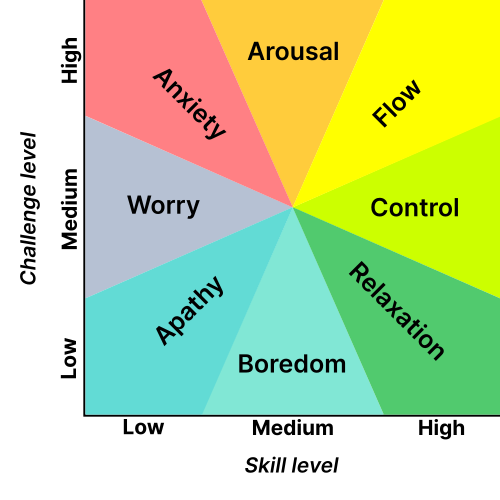
Flow in games and gaming has been linked to the laws of learning as a part of the explanation for why learning-games (the use of games to introduce material, improve understanding, or increase retention) have the potential to be effective.[91] In particular, flow is intrinsically motivating, which is a part of the law of readiness. The condition of feedback, required for flow, is associated with the feedback aspects of the law of exercise. This is exhibited in well designed games, in particular, where players perform at the edge of their competency as they are guided by clear goals and feedback.[92] The positive emotions associated with flow are associated with the law of effect. The intense experiences of being in a state of flow are directly associated with the law of intensity. Thus, the experience of gaming can be so engaging and motivating as it meets many of the laws of learning, which are inextricably connected to creating flow.
In games often much can be achieved thematically through an imbalance between challenge level and skill level. Horror games often keep challenges significantly above the player's level of competency in order to foster a continual feeling of anxiety. Conversely, so called "relaxation games" keep the level of challenges significantly below the player's competency level, in order to achieve an opposite effect.[93] The video game Flow was designed as part of Jenova Chen's master's thesis for exploring the design decisions that allow players to achieve the flow state, by adjusting the difficulty dynamically during play.[94]
フローの簡略化された修正が、技術受容モデル(TAM)と組み合わされて、内発的に動機づけられたコンピュータシステムの設計を導き、その採用を説明するのに役立っています。このモデル、快楽動機システム採用モデル(HMSAM)は、快楽動機システム(HMS)の採用の理解を深めるためにモデル化されています。[ 96 ] HMSは、主にオンラインゲーム、仮想世界、オンラインショッピング、学習/教育、オンラインデート、デジタル音楽リポジトリ、ソーシャルネットワーキング、オンラインポルノ、ゲーム化システム、一般的なゲーム化など、ユーザーの内発的動機を満たすために使用されるシステムです。HMSAMは、TAMのマイナーな拡張ではなく、認知吸収(CA)のフローベースの概念に基づいた代替的な理論的視点に基づくHMS固有のシステム受容モデルです。 HMSAMは、快楽システムの採用に関するvan der Heijden(2004)のモデル[ 99 ]をさらに発展させ、知覚された使いやすさ(PEOU)と快楽動機システムの利用意図(BIU)の主要な媒介変数としてCAを含めています。通常、モデルは「内発的動機」を単に知覚された楽しみによって単純に表現します。代わりに、HMSAMは、喜び、制御、好奇心、集中した没入、および時間的分離を含む、より複雑で豊かな構成概念であるCAを使用します。CAは、フローに関する重要な文献に基づいた構成概念ですが、従来、CAは静的な構成概念として使用されてきました。これは、5つのサブ構成概念すべてが同時に発生するかのように扱われ、フローに関する文献と真っ向から矛盾しています。したがって、HMSAMの貢献の一部は、フローによって予測されるより自然なプロセス変動の順序にこれらのCAサブ構成概念を再編成することによって、CAをフローの根源に近づけることです。実証データの収集と媒介分析は、このモデリング手法をさらに裏付けている。
職場
フロー状態とは、課題とスキルが等しく釣り合っている状態と定義され、職場において重要な役割を果たします。[ 100 ]フローは達成感と関連しているため、フロー状態を発達させることは、職場の満足度と達成感の向上に特有の意味を持つ可能性があります。チクセントミハイのようなフロー研究者は、職場でのフローを強化・増加させるための特定の介入を行うことができると考えており、それによって人々は「継続を促す内発的な報酬」を得て利益を得ることになる。チクセントミハイはコンサルティング業務において、フローに適した活動や環境を見つけ、フロー体験を増やすための個人的特性を特定し、開発することを強調している。これらの方法を職場に適用することで、より大きな幸福感と達成感を育むことで士気を高めることができ、それが業績の向上と相関する可能性がある。コート・ヴィッサーは、ミハイ・チクセントミハイの著書「Good Business: Leadership, Flow, and the Making of Meaning」のレビューの中で、チクセントミハイが提示したアイデアを紹介しており、その中には「自分自身を超えた何かに貢献しながら、最善を尽くすことを楽しむ」という「良い仕事」も含まれている。[ 101 ]そして、マネージャーや従業員が良い仕事を促す雰囲気を作り出すためのツールを提供している。一部のコンサルタントは、職場の個人やチームに対して経験サンプリングフォーム(EMS)法を使用し、現在どのように時間が使われているか、そしてフロー体験を最大化するためにどこに焦点を移すべきかを特定することを提案している。[ 102 ]
↑ Barrett, Nathaniel F. (2011). " Wuwei and Flow: Comparative Reflections on Spirituality, Transcendence, and Skill in the Zhuangzi " (PDF) . Philosophy East and West . 61 (4): 679– 706. doi : 10.1353/pew.2011.0051 . ISSN 1529-1898 . S2CID 56222168 . 2017年8月10日にオリジナル(PDF)からアーカイブ済み。
↑チクセントミハイ、ミハイ (2014).フローとポジティブ心理学の基礎 ミハイ・チクセントミハイ著作集. Springer. doi : 10.1007/978-94-017-9088-8 . ISBN978-94-017-9083-3– Academia.edu経由。
↑ Bruya B 編 (2010). Effortless Attention: A New Perspective in the Cognitive Science of Attention and action . Bradford Book. Cambridge, Mass.: MIT Press. ISBN978-0-262-26943-8OCLC 646069518
1 2 Cherry K (2014年9月8日)。「フローとは何か?」。About Education。2015年4月3日のオリジナルからアーカイブ済み。2015年3月30日取得。
↑ Norsworthy, Cameron; Jackson, Ben; Dimmock, James A. (2021年8月) 「心理的フローの理解を深める:概念化、測定、応用に関する概観レビュー」 Psychological Bulletin . 147 (8): 806–827 . doi : 10.1037 /bul0000337 . ISSN 1939-1455 . PMID 34898235 .
↑ Norsworthy, C.; Thelwell, R.; Weston, N.; A. Jackson, S. (2018). "エリートアスリートにおけるフロートレーニング、フロー状態、およびパフォーマンス" . International Journal of Sport Psychology . 49 (2): 134– 152. doi : 10.7352/ijsp.2018.49.134 .
↑ Norsworthy, Cameron; Dimmock, James A.; Nicholas, Joanna; Krause, Amanda; Jackson, Ben (2023-12-01). "Psychological Flow Training: Feasibility and Preliminary Efficacy of an Educational Intervention on Flow" . International Journal of Applied Positive Psychology . 8 (3): 531– 554. doi : 10.1007/s41042-023-00098-2 . ISSN 2364-5059 . PMC 10204032 . PMID 37361627 .
1 2 3 Moneta G (2012). 「フローの測定と概念化について」Engeser S (編)『フロー研究の進歩』ニューヨーク:Springer。ISBN978-1-4614-2358-4。
1 2 3 Jackson, Susan A.; Marsh, Herbert W. (1996). "最適な経験を測定するための尺度の開発と検証:フロー状態尺度". Journal of Sport and Exercise Psychology . 18 (1): 17– 35. doi : 10.1123/jsep.18.1.17 .
1 2 3 Jackson, Susan A.; Eklund, Robert C. (2002). "身体活動におけるフローの評価:フロー状態尺度-2と特性フロー尺度-2". Journal of Sport and Exercise Psychology . 24 (2): 133– 150. doi : 10.1123/jsep.24.2.133 .
1 2 3 Jackson, Susan A.; Martin, Andrew J.; Eklund, Robert C. (2008). "フローの長尺および短尺尺度:FSS-2、DFS-2、および新しい簡易版の構成概念妥当性の検討". Journal of Sport and Exercise Psychology . 30 (5): 561– 587. doi : 10.1123/jsep.30.5.561 . PMID 18971512 .
1 2 Martin, Andrew J.; Jackson, Susan A. (2008). "タスクへの没入と主観的経験の向上を評価するための簡潔なアプローチ: 多様なパフォーマンス領域における「短期」フローと「コア」フローの検討". Motivation and Emotion . 32 (3): 141– 157. doi : 10.1007/s11031-008-9094-0 .
1 2 3 4 Jackson, Susan A.; Eklund, Robert C.; Martin, Andrew J. (2010). The FLOW Manual . Mind Garden, Inc. doi : 10.1037/t06469-000 .
↑ Norsworthy, Cameron; Dimmock, James A.; Miller, Daniel J.; Krause, Amanda; Jackson, Ben (2023-08-01). "Psychological Flow Scale (PFS): Development and Preliminary Validation of a New Flow Instrument that Measures the Core Experience of Flow to Reflect Recent Conceptual Advancements" . International Journal of Applied Positive Psychology . 8 (2): 309– 337. doi : 10.1007/s41042-023-00092-8 . ISSN 2364-5059 .
↑チクセントミハイ M (1997).フローを見つける:日常生活への没入の心理学(第1版). ニューヨーク:ベーシックブックス. p. 31. ISBN978-0-465-02411-7。
↑ Delle Fave A、Massimini F、Bassi M (2011) 「仕事:フロー研究におけるパラドックス」『異文化間における心理的選択と最適経験』『ポジティブ心理学における異文化間進歩』第2巻、ドルトレヒト:Springer Science & Business Media、pp. 155–175、doi:10.1007/978-90-481-9876-4_8、ISBN978-90-481-9875-7。
↑ Moneta GB (2012). 「流れの測定と概念化について」。Engeser S (編) 『流れ研究の進歩』所収。ニューヨーク、NY: Springer。pp. 23–50。
↑ Haworth J、Evans S (1995年6月)「YTS学生のサンプルにおける日常生活での挑戦、スキル、および肯定的な主観的状態」Journal of Occupational and Organizational Psychology . 68 (2): 109– 121. doi : 10.1111/j.2044-8325.1995.tb00576.x .
↑ Schaffer O (2013), Crafting Fun User Experiences: A Method to Facilitate Flow , Human Factors International
↑ Baumann, Nicola (2012). "Autotelic Personality". Advances in Flow Research . New York, NY: Springer New York. pp. 165–186 . doi : 10.1007/978-1-4614-2359-1_9 . ISBN978-1-4614-2358-4。
↑ Rathunde K、Csikszetnmihályi M (2005)、「中学生のモチベーションと学習体験の質:モンテッソーリ教育と従来の学校環境の比較」、American Journal of Education、111 (3): 341–371、doi : 10.1086/428885、S2CID 146766889
↑ Rathunde K、Csikszentmihályi M (2005)、「中学校の社会的文脈:モンテッソーリと伝統的な学校環境における教師、友人、活動」、Elementary School Journal、106 (1): 59–79、doi : 10.1086/496907、S2CID 145336225
↑ Rathunde K、Csikszentmihályi M (2006)。「発達する人間:経験的視点」。Lerner RM、Damon W (編)『人間の発達の理論モデル』。児童心理学ハンドブック(第6版)。ニューヨーク:Wiley。
↑ Parncutt R、McPherson GE (2002)、『音楽演奏の科学と心理学:教育と学習のための創造的な戦略』、オックスフォード大学出版局(米国)、119ページ、ISBN978-0-19-513810-82009年2月7日取得
↑ O'Neill, Susan (1999). "フロー理論と音楽演奏スキルの発達". Bulletin of the Council for Research in Music Education . 141 (141): 129– 134. JSTOR 40318998 –イリノイ大学出版局経由。
↑ de Manzano O、 Theorell T、Harmat L、Ullén F (2010年6月)。「ピアノ演奏中のフローの精神生理学」。Emotion。10 ( 3 ): 301–311。doi : 10.1037/ a0018432。PMID 20515220。S2CID 13036396。
↑ Elliott B (2003年6月9日). "In The Pocket" . www.drummercafe.com . 2012年4月21日のオリジナルからアーカイブ済み。 2016年4月1日に閲覧。
↑ Young JA、Pain MD。「ゾーン:あらゆるスポーツのアスリートに共通する現象の証拠」。Athletic Insight。2018年1月29日にオリジナルからアーカイブ済み。2008年5月8日に取得。
↑ Jackson, SA (1992). "フロー状態にあるアスリート:エリートフィギュアスケーターのフロー状態に関する定性的調査". Journal of Applied Sport Psychology . 4 (2): 161– 180. doi : 10.1080/10413209208406459 .
↑ Jackson, SA (1995). 「エリートアスリートにおけるフローの発生に影響を与える要因」応用スポーツ心理学ジャーナル7 ( 2): 135– 163. doi : 10.1080/10413209508406962 .
↑ Jackson, SA (1996). "エリートアスリートにおけるフロー体験の概念的理解に向けて". Research Quarterly for Exercise and Sport . 67 (1): 76–90 . doi : 10.1080/02701367.1996.10607928 . PMID 8735997 .
↑ Jackson, SA; Csikszentmihalyi, MC (1999). Flow in Sports: The Keys to Optimal Experiences and Performances . Champaign, IL: Human Kinetics. ISBN978-0-88011-876-7。
↑ Chavez, Edward J. (2008). "スポーツにおけるフロー:大学生アスリートの研究". Imagination, Cognition and Personality . 28 (1): 69–91 . doi : 10.2190/ic.28.1.f . ISSN 0276-2366 . S2CID 143685336 .
↑ King S (2006). Running in the Zone A Handbook for Seasoned Athletes . Victoria, BC Canada: Trafford Publishing. ISBN978-1-4120-6857-4。
↑ Locke A (2001-02-01). "Being in the zone: notions of agency in athletic performance" . Proceedings of the British Psychological Society . 9 (1): 83. ISSN 1350-472X . 2016-04-01に閲覧。
↑ Jenkins L (2015年5月20日). 「ステフィン・カリーの次の段階:MVPでウォリアーズはNBAファイナルに近づいている」 www.si.com 2016年4月1日閲覧。
↑ Henderson S (2015年11月24日)。「内なる師を見つける – 気つく」。国際武道協会。 2017年9月21日取得。
1 2 Visser C. 「Good Business: Leadership, Flow, and the Making of Meaning」 。 2013年11月10日にオリジナルからアーカイブ済み。2012年9月26日に取得。
↑ Foster S、Lloyd P (2007)。「個人およびグループレベルでのコンサルティング心理学へのポジティブ心理学の原則の適用」。コンサルティング心理学ジャーナル:実践と研究。59 (1): 30–40。doi : 10.1037 /1065-9293.59.1.30。
↑ Nielsen K、Cleal B(2010年4月)。「職場でのフローの予測:職場でのフロー状態を予測する活動と仕事の特性の調査」。Journal of Occupational Health Psychology。15(2):180–190。doi:10.1037/ a0018893。PMID 20364915。
↑ラインベルク F、マニグ Y、クリーグル R、エンゲザー S、フォルマイヤー R (2007 年 7 月)。 「Flow bei der Arbeit, doch Glück in der Freizeit: Zielausrichtung, Flow und Glücksgefühle」[仕事中はフローだが余暇には幸福: 目標、フロー経験、幸福]。Zeitschrift für Arbeits- und Organisationspsychology A&O (ドイツ語)。51 (3): 105–15 .土井: 10.1026/0932-4089.51.3.105。
↑クラークSG、ハワースJT(1994年11月)。「高校最終学年の学生の日常生活における「フロー」体験」。British Journal of Psychology . 85 (4): 511–23 . doi : 10.1111/j.2044-8295.1994.tb02538.x。
↑ Massimini F、Carli M (1988)「日常経験におけるフローの体系的評価」。Csikszentmihályi M、Csikszentmihályi IS (編)『最適経験:意識におけるフローの心理学的研究』ニューヨーク:ケンブリッジ大学出版局、pp. 288–306。
↑ Shernoff DJ、Csikszentmihalyi M、Schneider B、Shernoff ES (2014)。「フロー理論の観点から見た高校の教室における生徒の関与」。フローの人間発達と教育への応用。ドルトレヒト:Springer。pp. 475–494。
↑ Perry SJ (1999). Writing in Flow . Cincinnati, OH: Writer's Digest Books.
↑ Sawyer K (1992年1月)「即興的創造性:ジャズ演奏の分析」Creativity Research Journal . 5 (3): 253–63 . doi : 10.1080/10400419209534439 .
↑ Csikszentmihalyi, M、Rathunde K、Whalen S (1993)。才能あるティーンエイジャー:成功と失敗の根源。ニューヨーク:ケンブリッジ大学出版局。
↑ Jackson SA、 Thomas PR、Marsh HW、Smethurst CJ (2001)。「フロー、自己概念、心理的スキル、パフォーマンスの関係」。応用スポーツ心理学ジャーナル。13 (2): 129– 153。doi : 10.1080/104132001753149865。S2CID 142097761。
↑ Stein GL、Kimiecik JC、Daniels J、Jackson SA ( 1995年2月)。「レクリエーションスポーツにおけるフローの心理的先行要因」。Personality and Social Psychology Bulletin。21 ( 2): 125–135。doi : 10.1177/0146167295212003。S2CID 146150033。
1 2 3 4 5 6 van der Linden, Dimitri; Tops, Mattie; Bakker, Arnold B. (2021-04-14). "フロー状態の神経科学: 青斑核ノルエピネフリン系の関与" . Frontiers in Psychology . 12 645498. doi : 10.3389/fpsyg.2021.645498 . ISSN 1664-1078 . PMC 8079660 . PMID 33935902 .
↑ Léger PM、Sénécal S、Aubé C、Cameron AF、de Guinea AO、Brunelle E (2013年6月)。グループフローがグループパフォーマンスに及ぼす影響:研究プログラム。Gmunden Retreat on NeuroIS の議事録。p. 13。
↑ Goddard, Scott G.; Stevens, Christopher J.; Jackman, Patricia C.; Swann, Christian (2023-12-31). "スポーツと運動におけるフロー介入の系統的レビュー" . International Review of Sport and Exercise Psychology . 16 (1): 657– 692. doi : 10.1080/1750984X.2021.1923055 . ISSN 1750-984X .
↑ Norsworthy, Cameron; Dimmock, James A.; Miller, Daniel J.; Krause, Amanda; Jackson, Ben (2023-08-01). "Psychological Flow Scale (PFS): Development and Preliminary Validation of a New Flow Instrument that Measures the Core Experience of Flow to Reflect Recent Conceptual Advancements" . International Journal of Applied Positive Psychology . 8 (2): 309– 337. doi : 10.1007/s41042-023-00092-8 . ISSN 2364-5059 .
↑ Rheinberg, F; Engeser, S (2008). "フロー、パフォーマンス、およびチャレンジスキルバランスの調整要因". Motivation and Emotion : 179.
↑ Seligman, Martin EP; Csikszentmihalyi, Mihaly (2000). "ポジティブ心理学入門". American Psychologist . 55 (1): 5– 14. doi : 10.1037/0003-066x.55.1.5 . PMID 11392865 . S2CID 14783574 .
↑ van der Linden, Dimitri; Tops, Mattie; Bakker, Arnold B. (2021). "フロー状態の神経科学: 青斑核ノルエピネフリン系の関与". Frontiers in Psychology . 12 .
↑ Nielsen, Karina; Cleal, Bryan (2010). "職場でのフローの予測:職場でのフロー状態を予測する活動と仕事の特徴の調査". Journal of Occupational Health Psychology . 15 (2): 180– 190. doi : 10.1037/a0018893 . PMID 20364915 .
↑ Léger PM、Sénécal S、Aubé C、Cameron AF、de Guinea AO、Brunelle E (2013年6月)。グループフローがグループパフォーマンスに及ぼす影響:研究プログラム。Gmunden Retreat on NeuroIS の議事録。p. 13。
↑ Sridhar G 、Lyngdoh T (2019-09-01)。「フローと情報共有が倫理的な販売行動の予測因子となる」。Journal of Business Ethics。158 ( 3 ) : 807–823。doi : 10.1007 / s10551-017-3743-8。ISSN 1573-0697。S2CID 158513460。