2005 tree of life showing horizontal gene transfers between branches including (coloured lines) the symbiogenesis of plastids and mitochondria. "Horizontal gene transfer and how it has impacted the evolution of life is presented through a web connecting bifurcating branches that complicate, yet do not erase, the tree of life".[51]
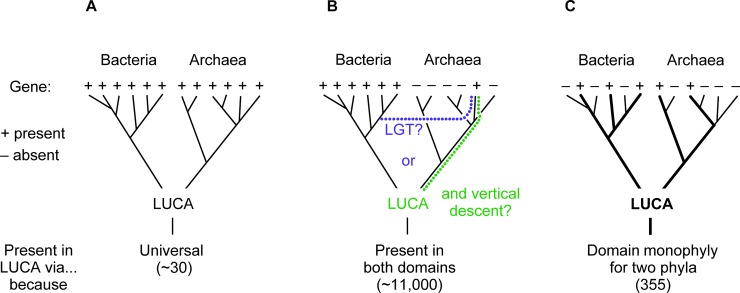
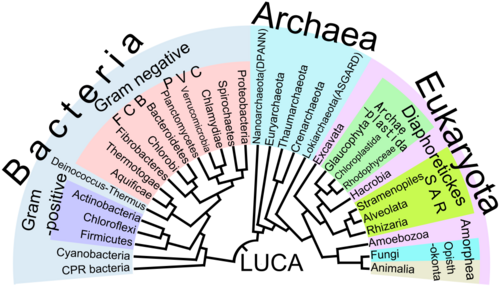
In 1990, a novel concept of the tree of life was presented, dividing the living world into three stems, classified as the domains Bacteria, Archaea, Eukarya.[21][52][53][54] It is the first tree founded exclusively on molecular phylogenetics, and which includes the evolution of microorganisms. It has been called a "universal phylogenetic tree in rooted form".[21] This tree and its rooting became the subject of debate.[52][b]
In the meantime, numerous modifications of this tree, mainly concerning the role and importance of horizontal gene transfer for its rooting and early ramifications have been suggested.[56][51] Since heredity occurs both vertically and horizontally, the tree of life may have been more weblike or netlike in its early phase and more treelike when it grew three-stemmed.[51] Presumably horizontal gene transfer has decreased with growing cell stability.[57]
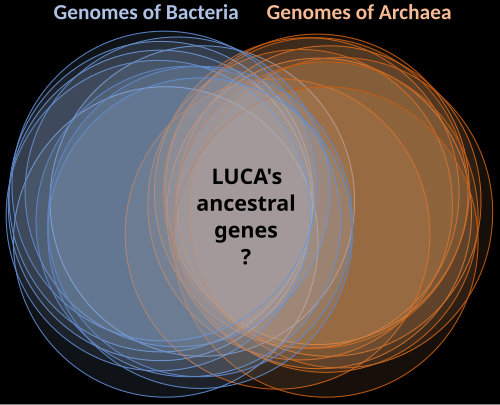
The nature of LUCA remains disputed. In 1994, on the basis of primordial metabolism (as discussed by Wächtershäuser), Otto Kandler proposed a successive divergence of the three domains of life[21] from a multiphenotypical population of pre-cells, reached by gradual evolutionary improvements (cellularization).[64][65][66] The phenotypically diverse pre-cells of this population were metabolising, self-reproducing entities exhibiting frequent mutual exchange of genetic information. Thus, in this scenario there was no "first cell". It may explain the unity and, at the same time, the partition into three lines (the three domains) of life. Kandler's pre-cell theory is supported by Wächtershäuser.[67][68] In 1998, Carl Woese, based on the RNA world concept, proposed that no individual organism could be considered a LUCA, and that the genetic heritage of all modern organisms derived through horizontal gene transfer among an ancient community of organisms.[37] Other authors concur that there was a "complex collective genome"[69] at the time of the LUCA, and that horizontal gene transfer was important in the evolution of later groups;[69] Nicolas Glansdorff states that LUCA "was in a metabolically and morphologically heterogeneous community, constantly shuffling around genetic material" and "remained an evolutionary entity, though loosely defined and constantly changing, as long as this promiscuity lasted."[70]
The theory of a universal common ancestry of life is widely accepted. In 2010, based on "the vast array of molecular sequences now available from all domains of life",[71] D. L. Theobald published a "formal test" of universal common ancestry (UCA). This deals with the common descent of all extant terrestrial organisms, each being a genealogical descendant of a single species from the distant past. His formal test favoured the existence of a universal common ancestry over a wide class of alternative hypotheses that included horizontal gene transfer. Basic biochemical principles imply that all organisms do have a common ancestry.[72]
↑ Wikham, Gene Stephen (1995 年 3 月).自然界に存在する超好熱性微生物群集の分子系統解析(博士論文).インディアナ大学. p. 4.ProQuest 304192982
↑ Forterre, Patrick (1997). "古細菌:その配列から何が学べるか?". Current Opinion in Genetics & Development . 7 (6): 764– 770. doi : 10.1016/s0959-437x(97)80038-x . PMID 9468785 .
↑クーニン、ユージン V. ; ガルペリン、マイケル Y. (2003).配列 – 進化 – 機能: 比較ゲノミクスにおける計算アプローチ. ボストン、マサチューセッツ州: クルーワー. p. 252. ISBN978-1-4757-3783-7OCLC 55642057
↑ Garwood, Russell J. (2012). "古生物学のパターン:進化の最初の30億年" . Palaeontology Online . 2 (11): 1– 14. 2015年6月26日のオリジナルからアーカイブ済み。 2015年6月25日取得。
↑ Koonin, Eugene V. ; Krupovic, M.; Ishino, S.; Ishino, Y. (2020). "LUCAの複製機構:DNA複製と転写の共通起源" . BMC Biology . 18 (1): 61. doi : 10.1186/s12915-020-00800-9 . PMC 7281927 . PMID 32517760 .
↑ Ahmad, Muzammil; Xu, Dongyi; Wang, Weidong (2017年5月23日). "Type IA topoisomerases can be "magicians" for both DNA and RNA in all domains of life" . RNA Biology . 14 (7): 854– 864. doi : 10.1080/15476286.2017.1330741 . PMC 5546716 . PMID 28534707 .
↑ Lupas, Andrei N.; Alva, Vikram (2018). "Histones predate the split between bacteria and archaea". Bioinformatics . 35 (14): 2349–2353 . doi : 10.1093/bioinformatics/bty1000 . PMID 30520969 .
↑ Bernstein, H., Bernstein, C. (2017). Sexual Communication in Archaea, the Precursor to Eukaryotic Meiosis. In: Witzany, G. (eds) Biocommunication of Archaea. Springer, Cham. https://doi.org/10.1007/978-3-319-65536-9_7 2024年2月23日にWayback Machineにアーカイブ済み
↑ Gogarten, Johann Peter; Taiz, Lincoln (1992). "プロトンポンプATPaseの進化:生命の樹の根源". Photosynthesis Research . 33 (2): 137– 146. Bibcode : 1992PhoRe..33..137G . doi : 10.1007/bf00039176 . ISSN 0166-8595 . PMID 24408574 . S2CID 20013957 .
↑ Martin, W.; Russell, MJ (2007 年 10 月) 「アルカリ性熱水噴出孔における生化学の起源について」 . Philosophical Transactions of the Royal Society of London. Series B, Biological Sciences . 362 (1486): 1887– 1925. doi : 10.1098/rstb.2006.1881 . PMC 2442388 . PMID 17255002 .
↑ Lane, Nick ; Allen, JF; Martin, William (2010年4月) 「LUCAはどのようにして生き延びたのか?生命の起源における化学浸透」BioEssays . 32 (4): 271– 280. doi : 10.1002/bies.200900131 . PMID 20108228 .
↑ Mulkidjanian, Armen Y.; Bychkov, Andrew Yu; Dibrova, Daria V.; Galperin, Michael Y.; Koonin, Eugene V. (2012). " Origin of first cells at terrestrial, anoxic geothermal fields" . Proceedings of the National Academy of Sciences . 109 (14): E821-30. Bibcode : 2012PNAS..109E.821M . doi : 10.1073/pnas.1117774109 . PMC 3325685. PMID 22331915 .
1 2 Sapp, Jan A. (2009). 『進化の新たな基盤:生命の樹について』 ニューヨーク:オックスフォード大学出版局。第19章:257頁以降(生命の樹という新しい概念)、第17~21章および結論:226~318頁(生命の樹とその根源についての考察)、286頁以降(LUCA)。ISBN978-0-199-73438-22023年11月6日にオリジナルからアーカイブされました。2023年11月21日に取得されました。
↑マディガン、マイケル T.、マルティンコ、ジョン M.、ベンダー、ケリー S.、バックリー、ダニエル H.、スタール、デイビッド A. (2015).ブロック微生物学(第 14版). ボストン: ピアソン エデュケーション. pp. 29, 374, 381. ISBN978-1-292-01831-7。
1 2 3 Madigan, Michael T.; Aiyer, Jennifer; Buckley, Daniel H.; Sattley, Matthew; Stahl, David A. (2022). Brock Biology of Microorganisms (16 ed.). Harlow: Pearson Education. pp. Unit 3, chapter 13: 431 (LUCA), 435 (tree of life), 428, 438, 439 (viruses). ISBN978-1-292-40479-0。
↑ Prosdocimi, Francisco; José, Marco V.; de Farias, Sávio Torres (2019). "The First Universal Common Ancestor (FUCA) as the Earliest Ancestor of LUCA's (Last UCA) Lineage" . In Pontarotti, Pierre (ed.). Evolution, Origin of Life, Concepts and Methods . Cham: Springer. pp. 43–54 . doi : 10.1007/978-3-030-30363-1_3 . ISBN978-3-030-30363-1. S2CID 199534387 . 2023年11月2日に取得.
↑ Prosdocimi, Francisco; José, Marco V.; de Farias, Sávio Torres (2019), "The First Universal Common Ancestor (FUCA) as the Earliest Ancestor of LUCA's (Last UCA) Lineage", in Pontarotti, Pierre (ed.), Evolution, Origin of Life, Concepts and Methods , Cham: Springer, pp. 43– 54, doi : 10.1007/978-3-030-30363-1_3 , ISBN978-3-030-30363-1S2CID 199534387
↑ Forterre, Patrick (2006). "ウイルスの起源" . Research in Microbiology . 157 (4): 337–347 . doi : 10.1016/j.virusres.2006.01.010 . PMID 16476498 .
1 2 Krupovic, M.; Dolja, VV; Koonin, Eugene V. (2020). "The LUCA and its complex virome" (PDF) . Nature Reviews Microbiology . 18 (11): 661– 670. doi : 10.1038/s41579-020-0408-x . PMID 32665595 . S2CID 220516514 . 2022年10月21日にオリジナルからアーカイブ(PDF) 。 2021年8月15日に取得。
↑ Forterre, Patrick; Prangishvili, David (2009). "ウイルスの起源". Research in Microbiology . 160 (7): 466–472 . doi : 10.1016/j.resmic.2009.07.008 . PMID 19647075. S2CID 2767388 .




 この記事には、 CC BY 4.0ライセンスの下で利用可能なこの出典からのテキストが含まれています。