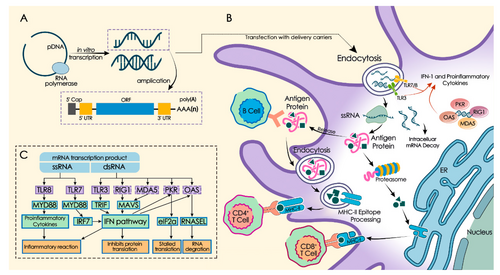
mRNA in vitro transcription, innate and adaptive immunity activation
An mRNAvaccine is a type of vaccine that uses a copy of a molecule called messenger RNA (mRNA) to produce an immune response.[1] The vaccine delivers molecules of antigen-encoding mRNA into cells, which use the designed mRNA as a blueprint to build foreign protein that would normally be produced by a pathogen (such as a virus) or by a cancer cell. These protein molecules stimulate an adaptive immune response that teaches the body to identify and destroy the corresponding pathogen or cancer cells.[1] The mRNA is delivered by a co-formulation of the RNA encapsulated in lipid nanoparticles that protect the RNA strands and help their absorption into the cells.[2][3]
Video showing how vaccination with an mRNA vaccine works
Reactogenicity, the tendency of a vaccine to produce adverse reactions, is similar to that of conventional non-RNA vaccines.[4] People susceptible to an autoimmune response may have an adverse reaction to messenger RNA vaccines.[4] The advantages of mRNA vaccines over traditional vaccines are ease of design, speed and lower cost of production, the induction of both cellular and humoral immunity, and lack of interaction with the genomic DNA.[5][6] While some messenger RNA vaccines, such as the Pfizer–BioNTech COVID-19 vaccine, have the disadvantage of requiring ultracold storage before distribution,[1] other mRNA vaccines, such as the Moderna vaccine, do not have such requirements.[7]
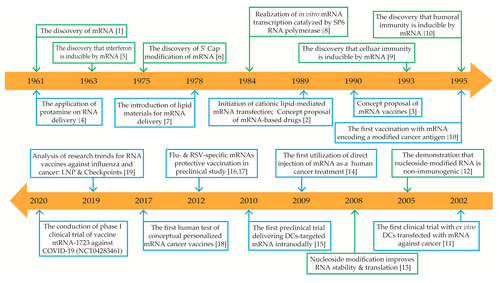
Timeline of some key discoveries and advances in the development of mRNA-based drug technology
The first successful transfection of designed mRNA packaged within a liposomal nanoparticle into a cell was published in 1989.[18][19] "Naked" (or unprotected) lab-made mRNA was injected a year later into the muscle of mice.[3][20] These studies were the first evidence that in vitro transcribed mRNA with a chosen gene was able to deliver the genetic information to produce a desired protein within living cell tissue[3] and led to the concept proposal of messenger RNA vaccines.[21][22][23]
Because mRNA is fragile, some vaccines must be kept at very low temperatures to avoid degrading and thus giving little effective immunity to the recipient. Pfizer–BioNTech's BNT162b2 mRNA vaccine has to be kept between −80 and −60°C (−112 and −76°F).[88][89] Moderna says their mRNA-1273 vaccine can be stored between −25 and −15°C (−13 and 5°F),[90] which is comparable to a home freezer,[89] and that it remains stable between 2 and 8°C (36 and 46°F) for up to 30 days.[90][91] In November 2020, Nature reported, "While it's possible that differences in LNP formulations or mRNA secondary structures could account for the thermostability differences [between Moderna and BioNtech], many experts suspect both vaccine products will ultimately prove to have similar storage requirements and shelf lives under various temperature conditions."[81] Several platforms are being studied that may allow storage at higher temperatures.[4]
Recent
Before 2020, no mRNA technology platform (drug or vaccine) had been approved for therapeutic use in humans, so there was a risk of unknown effects.[81] The 2020 COVID-19 pandemic required faster production capability of mRNA vaccines, which made them attractive to national health organisations, and led to debate about the type of initial authorization mRNA vaccines should get (including emergency use authorization or expanded access authorization) after the eight-week period of post-final human trials.[92][93]
Side effects
Reactogenicity is similar to that of conventional, non-RNA vaccines. However, those susceptible to an autoimmune response may have an adverse reaction to mRNA vaccines.[4] The mRNA strands in the vaccine may elicit an unintended immune reaction–this entails the body believing itself to be sick, and the person feeling as if they are as a result. To minimize this, mRNA sequences in mRNA vaccines are designed to mimic those produced by host cells.[5]
↑"Hungarian and US scientists win Nobel for COVID-19 vaccine discoveries". Reuters. 2 October 2023. Retrieved 3 October 2023.
↑"The Nobel Prize in Physiology or Medicine 2023". NobelPrize.org. Retrieved 3 October 2023.
↑Xu S, Yang K, Li R, Zhang L (September 2020). "mRNA Vaccine Era-Mechanisms, Drug Platform and Clinical Prospection". International Journal of Molecular Sciences. 21 (18): 6582. doi:10.3390/ijms21186582. PMC7554980. PMID32916818. Initiation of cationic lipid-mediated mrna transfection; Concept proposal of mRNA-based drugs
↑Malone RW, Felgner PL[in German], Verma IM (August 1989). "Cationic liposome-mediated RNA transfection". Proceedings of the National Academy of Sciences of the United States of America. 86 (16): 6077–81. Bibcode:1989PNAS...86.6077M. doi:10.1073/pnas.86.16.6077. PMC297778. PMID2762315.
123Wolff JA, Malone RW, Williams P, Chong W, Acsadi G, Jani A, Felgner PL[in German] (March 1990). "Direct gene transfer into mouse muscle in vivo". Science. 247 (4949 Pt 1): 1465–8. Bibcode:1990Sci...247.1465W. doi:10.1126/science.1690918. PMID1690918.
↑ Anand P 、Stahel VP(2021年5月)。「Covid -19 mRNAワクチンの安全性に関するレビュー」。Patient Safety in Surgery。15(1):20。doi :10.1186/s13037-021-00291-9。PMC 8087878。PMID 33933145。
↑ Goldman B (2020年12月22日) 「新しいCOVID-19ワクチンはどのように作用するのか?」。Scope。スタンフォード大学医学部。2021年1月30日のオリジナルからアーカイブ。 2021年1月28日取得。
1 2 3 4 5 6 7 Xu S 、 Yang K、Li R、Zhang L (2020 年 9 月)。「mRNA ワクチン時代 ― メカニズム、薬剤プラットフォーム、臨床展望」。International Journal of Molecular Sciences。21 ( 18 ): 6582。doi : 10.3390 / ijms21186582。PMC 7554980。PMID 32916818。
↑フィードラー K、ラザロ S、ルッツ J、ラウフ S、ハイデンライヒ R (2016)。 「mRNAがんワクチン」。がん遺伝子治療における現在の戦略。がん研究における最近の結果。 Fortschritte der Krebsforschung。 Progres dans les Recherches Sur le Cancer。 Vol. 209. pp. 61–85 .土井: 10.1007/978-3-319-42934-2_5。ISBN978-3-319-42932-8PMID 28101688
↑Probst J, Weide B, Scheel B, Pichler BJ, Hoerr I, Rammensee HG, Pascolo S (August 2007). "Spontaneous cellular uptake of exogenous messenger RNA in vivo is nucleic acid-specific, saturable and ion dependent". Gene Therapy. 14 (15): 1175–80. doi:10.1038/sj.gt.3302964. PMID17476302. S2CID27518606.
↑Lorenz C, Fotin-Mleczek M, Roth G, Becker C, Dam TC, Verdurmen WP, etal. (July 2011). "Protein expression from exogenous mRNA: uptake by receptor-mediated endocytosis and trafficking via the lysosomal pathway". RNA Biology. 8 (4): 627–36. doi:10.4161/rna.8.4.15394. PMID21654214.
↑Weide B, Pascolo S, Scheel B, Derhovanessian E, Pflugfelder A, Eigentler TK, etal. (June 2009). "Direct injection of protamine-protected mRNA: results of a phase 1/2 vaccination trial in metastatic melanoma patients". Journal of Immunotherapy. 32 (5): 498–507. doi:10.1097/CJI.0b013e3181a00068. PMID19609242. S2CID3278811.
12Wang Y, Zhang Z, Luo J, Han X, Wei Y, Wei X (February 2021). "mRNA vaccine: a potential therapeutic strategy". Molecular Cancer. 20 (1) 33. doi:10.1186/s12943-021-01311-z. PMC7884263. PMID33593376.
123Cooney E (1 December 2020). "How nanotechnology helps mRNA Covid-19 vaccines work". Stat. Archived from the original on 1 December 2020. Retrieved 3 December 2020.
↑Reichmuth AM, Oberli MA, Jaklenec A, Langer R, Blankschtein D (May 2016). "mRNA vaccine delivery using lipid nanoparticles". Therapeutic Delivery. 7 (5): 319–34. doi:10.4155/tde-2016-0006. PMC5439223. PMID27075952.
12Cross R (6 March 2021). "Without these lipid shells, there would be no mRNA vaccines for COVID-19". Chemical & Engineering News. American Chemical Society. Archived from the original on 5 March 2021. Retrieved 6 March 2021.
↑Paunovska K, Sago CD, Monaco CM, Hudson WH, Castro MG, Rudoltz TG, etal. (March 2018). "A Direct Comparison of in Vitro and in Vivo Nucleic Acid Delivery Mediated by Hundreds of Nanoparticles Reveals a Weak Correlation". Nano Letters. 18 (3): 2148–57. Bibcode:2018NanoL..18.2148P. doi:10.1021/acs.nanolett.8b00432. PMC6054134. PMID29489381.
↑Lowe D (3 February 2021). "Opinion: A straightforward explanation why more COVID-19 vaccines can't be produced with help from 'dozens' of companies". MarketWatch. Archived from the original on 5 February 2021. Retrieved 5 February 2021.
12King A (23 March 2021). "Why manufacturing Covid vaccines at scale is hard". Chemistry World. Royal Society of Chemistry. Archived from the original on 24 March 2021. Retrieved 26 March 2021.
12Sealy A (2 April 2021). "Manufacturing moonshot: How Pfizer makes its millions of Covid-19 vaccine doses". CNN. Archived from the original on 1 April 2021. Retrieved 3 April 2021.
123Weise E, Weintraub K (7 February 2021). "Race to the Vaccine: A COVID-19 vaccine life cycle: from DNA to doses". USA Today. Gannett. Archived from the original on 25 February 2021. Retrieved 24 February 2021.
↑Hopkins JS, Eastwood J, Moriarty D (3 March 2021). "mRNA Covid-19 Vaccines Are Fast to Make, but Hard to Scale". The Wall Street Journal. Archived from the original on 4 April 2021. Retrieved 3 April 2021.
↑ Rowland C (2021年2月18日) 「祖父母がワクチンを見つけられない理由:ニッチなバイオテクノロジー成分の不足」ワシントン・ポスト。2021年2月26日のオリジナルからアーカイブ。2021年3月7日取得。
12Simmons-Duffin S. "Why Does Pfizer's COVID-19 Vaccine Need To Be Kept Colder Than Antarctica?". NPR.org. Archived from the original on 1 February 2021. Retrieved 18 November 2020.
12"Fact Sheet for Healthcare Providers Administering Vaccine". ModernaTX, Inc. Archived from the original(PDF) on 28 January 2021. Retrieved 21 December 2020.
↑"Moderna Announces Longer Shelf Life for its COVID-19 Vaccine Candidate at Refrigerated Temperatures". NPR.org. Archived from the original on 16 November 2020. Retrieved 18 November 2020.
↑Thomas K (22 October 2020). "Experts Tell F.D.A. It Should Gather More Safety Data on Covid-19 Vaccines". New York Times. Archived from the original on 26 January 2021. Retrieved 21 November 2020.
↑Kuchler H (30 September 2020). "Pfizer boss warns on risk of fast-tracking vaccines". Financial Times. Archived from the original on 18 November 2020. Retrieved 21 November 2020.
↑Wadman M (November 2020). "Public needs to prep for vaccine side effects". Science. 370 (6520): 1022. doi:10.1126/science.370.6520.1022. PMID33243869. S2CID227180967.
12Kwon D (25 November 2020). "The Promise of mRNA Vaccines". The Scientist. Archived from the original on 22 January 2021. Retrieved 27 November 2020.
↑FDA Commissioner (25 June 2021). "Coronavirus (COVID-19) Update: June 25, 2021". FDA. US Food and Drug Administration. Archived from the original on 25 June 2021. Retrieved 22 December 2024.
↑Carmichael F, Goodman J (2 December 2020). "Vaccine rumours debunked: Microchips, 'altered DNA' and more" (Reality Check). BBC. Archived from the original on 13 March 2021. Retrieved 10 December 2020.
↑"Japan's Ministry of Health, Labour and Welfare Approves CSL and Arcturus Therapeutics' ARCT-154, the first Self-Amplifying mRNA vaccine approved for COVID in adults". CSL. CSL - Commonwealth Serum Laboratories. Retrieved 22 December 2024.
↑"A Phase I, First-Time-in Human (FTiH), Open-label, Dose Escalation, Non-randomized Study to Assess Safety, Reactogenicity and Immune Response of a CoV-2 SAM (LNP) Vaccine When Administered Intramuscularly on a 0, 1 Month Schedule in Healthy Adults 18 to 50 Years of Age". ClinicalTrials.gov. National Institutes of Health. 17 January 2024. Retrieved 2 January 2025.
↑Knapton, Sarah (20 September 2021). "First 'variant-proof' Covid vaccine starts trials in Manchester - Retired couple Andrew Clarke, 63, and his wife Helen, 64, from Bolton, became the first to receive the mRNA vaccine on Monday". The Daily Telegraph. Archived from the original on 20 September 2021. Retrieved 21 September 2021.
↑"Gritstone Announces Dosing of First Volunteer in Trial Evaluating Self-Amplifying mRNA as a COVID-19 Vaccine Booster and Immunogenicity Enhancer". PipelineReview. 20 September 2021. Archived from the original on 22 September 2021. Retrieved 21 September 2021.