
Loading article…
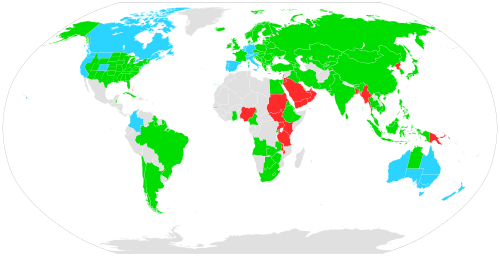
各国の自殺に関する法律
自殺および自殺ほう助は違法
自殺は合法だが自殺ほう助は違法
自殺および自殺ほう助は合法
自殺は世界の一部の地域では犯罪です。[1]しかし、多くの国で自殺は非犯罪化されているものの、自殺はほぼ普遍的に非難され、推奨されていません。状況によっては、自殺は自由の極端な表現として利用される可能性があり、古代ローマ、中世の日本、今日のチベット自治区などの文化で時折発生した、認識された暴政や不正に対する熱心な反対の表現として自殺が使用されたことに例証されています。
自殺した人は法律の適用外ですが、死体の扱いや、その人の財産や家族の運命に関して、法的措置が取られる場合があります。自殺幇助や自殺未遂に関連する事項も、一部の法域の法律で取り扱われています。自殺未遂を犯罪とする国もあります。
歴史
古代アテネでは、(国家の承認なしに)自殺した人は通常の埋葬を受けることができず、墓石や墓標もなく、街の郊外に一人で埋葬された。[2]
1670年にルイ14世が発布した刑法は、明らかにすでに死んでいる死体に対する「処罰」の儀式をはるかに厳しくすることを意図していた。死体は顔を下にして道に引きずり出され、その後吊るされるかゴミ捨て場に投げ込まれた。さらに、死者の全財産が没収された。この措置は、相続人を経済的に罰することで自殺を抑止することを意図していた。[3]
1882年の埋葬法(felo de se)は、自殺した人を十字路に埋葬するというイギリスの法的義務を廃止した。[a] [4]
自殺ほう助
多くの法域では、直接的または間接的に他人の自殺を幇助することは犯罪です。そのような法律は、武器の製造業者に、自殺の危険性があると思われる人への販売を拒否することを義務付けています。法域によっては、人々に自殺を勧めることも違法ですが、犯罪の分類と刑罰はさまざまです。厳しい条件の下で、医師による自殺幇助には例外が適用される場合があります。
各法域の法律(表)
アフリカ
北米と南米
アジア
ヨーロッパ
オセアニア
各管轄区域の法律
オーストラリア
ビクトリア
オーストラリアのビクトリア州では、自殺自体は犯罪ではなくなったが、心中協定の生存者が死亡した相手を殺害した場合は、殺人罪ではなく過失致死罪で起訴される可能性がある。 [132]また、自殺を勧めたり、煽動したり、幇助したりすることは犯罪であり、法律では、他人の自殺を防ぐために「合理的に必要な武力」を使用することを明示的に認めている。
2017年11月29日、ビクトリア州は自発的自殺ほう助法を可決し、余命6ヶ月未満の末期患者が自ら命を絶つことを医師が手助けすることを合法化した。この法律は2019年6月19日に施行された。[133]
クイーンズランド
2021年9月17日、クイーンズランド州は2021年自発的安楽死法を可決した。[134] [135]この法律は2023年1月1日に施行された。[135]
過去の法律
オーストラリア首都特別地域
オーストラリア首都特別地域(ACT)政府は、連邦法による安楽死禁止が実施されていた1997年から2022年まで、安楽死関連の制度を合法化する権利を定期的に主張してきた。連邦法による安楽死禁止が撤廃されて間もなく、ACT政府は、自発的な安楽死を認める法案を2023年にACT立法議会に提出することを目指すと確認した。 [136]政府は2023年2月に正式な協議期間を開始し、[137]その協議の末、2023年6月29日に自発的安楽死制度の設立を承認する報告書が公表された。[138] 2023年10月31日、自発的安楽死法案2023が立法議会に提出され、直ちに特別委員会に付託され、2024年2月29日までに報告書を提出することとなった。[139] [140]現行法では、18歳以上で、意思決定能力があり自発的に安楽死を求め、死に至ると予想される進行性の病状に耐え難いほどに苦しみ、少なくとも12か月間ACTの地域に住んでいるか、キャンベラと重要なつながりがある場合に、自発的安楽死の対象となる。[141]
ニューサウスウェールズ州
2017年9月21日、国民党の MLCトレバー ・カーンは、 2017年自発的尊厳死法案をニューサウスウェールズ州議会に提出した。この法案はオレゴン州の尊厳死法をモデルにしており、72件の「重要な」提案を検討した超党派の作業部会によって作成された。[142]この法案には、すべての幇助死を審査する7人からなる監視委員会など、支持者が「一連の安全策」と呼ぶものが含まれていた。[143]上院は2017年11月に数回の会議でこの法案を審議し、11月16日に20対19で否決された。[144]
2021年10月、無所属のアレックス・グリニッジ議員は、自発的安楽死法案を下院に提出した。 [145]この法案は、首相で自由党党首のドミニク・ペロテが自由党員に良心投票を認めると示唆したことを受けて、超党派の良心投票にかけられた。 [146] [147]この法案は、2021年11月26日に立法議会で賛成52票、反対32票で可決され、立法評議会に送られた。[145] [148]この法案は、同日議会で承認された修正が添付され、2022年5月19日に立法評議会で賛成23票、反対15票で可決された。[145] [149]この法案は2022年5月27日に国王の裁可を受け、18か月後に発効する。[150]
法律の規定により、人は専門医に自発的安楽死の要請を行うことができ、その要請は自発的安楽死委員会に提出される。[151]医師が、その人に決定能力があり、自発的に決定を下していると確信し、その人が基準を満たしている(つまり、6 か月以内に死に至る末期の病気、または 12 か月以内に死に至る神経変性疾患を患っており、その苦しみが耐えられないほどの痛みを引き起こしている)と判断した場合、医師はその要請を承認することができる。[151]次に、2 人目の独立した医師が同じプロセスに従わなければならない。[151]次に、その人は自分の命を絶つ意図を宣言する書面による要請を行うことができ、2 人の証人による立会いのもと委員会に提出されなければならない。最終的な申請は5日後に行われ、最初の医師による審査が行われ、その後、最初の医師は患者の命を終わらせるための物質へのアクセスを許可するよう自発的安楽死委員会に申請することができる。[151]患者は関連する物質を自分で投与することも、医療従事者に投与してもらうこともできる。[151]
ノーザンテリトリー
オーストラリアのノーザンテリトリーでは、1995年の末期患者の権利法により、安楽死が合法化された。この法律は、ノーザンテリトリー議会で賛成15、反対10の投票で可決された。1996年8月、廃止法案が議会に提出されたが、反対14、反対11の投票で否決された。[152]この法律は後に、連邦法である1997年の安楽死法によって無効とされた[要出典]。この連邦法は2022年12月13日まで有効で[要出典]、準州(具体的にはノーザンテリトリー、オーストラリア首都特別地域、ノーフォーク島)の議会が安楽死や自殺ほう助を合法化するのを禁じていた。連邦政府による無効化が行われる前に、この法律に基づき、フィリップ・ニチケ医師の助けを借りて、3人が医師による自殺ほう助で亡くなった。最初の犠牲者は大工のボブ・デントで、1996年9月22日に亡くなった。[153]
クイーンズランド
2018年11月、クイーンズランド州首相アナスタシア・パラシュチュクは、同州における自発的安楽死の合法化の可能性を検討する調査を開始した。この調査では、高齢者介護、終末期ケア、緩和ケアも考慮された。[155]
2021年5月、パラシュチュク知事は、自発的安楽死法案をクイーンズランド州議会に提出し検討すると発表した。[156]この法案では、患者が以下の基準を満たしている場合に安楽死を認めることになる。[157]
- 対象疾患が進行性かつ重篤であり、今後 12 か月以内に死亡する可能性がある。
- 健全な精神で決断を下す能力がある。
- 強制されることなく自発的に行動している。
- 18歳以上であること
- オーストラリアの居住者であり、クイーンズランド州に少なくとも 12 か月間住んでいます。
2021年9月16日、クイーンズランド州議会は、賛成61票、反対31票で2021年自発的安楽死法を可決した。 [158]この法律は良心投票の対象となった。 [159] この法律は2021年9月23日に国王の裁可を受け、2023年1月1日に発効した。 [ 160 ]
南オーストラリア
2016年11月、南オーストラリア州議会は、耐え難い痛みや末期の病気に苦しんでいる場合に自発的な安楽死を要求する権利を合法化する議員立法案を僅差で否決した。この法案は、条項の審議中に否決されたが(賛成23票、議長の反対票)、第二読会を通過した初の安楽死法案となった(賛成27票、反対19票)。[163]
2021年6月下旬、他の州と同様の自発的安楽死法案が南オーストラリア州議会を通過した。[164]この法律はビクトリア州法の規定のほとんどを反映しているが、民間病院や個人開業医が、患者をこの制度を利用できる場所に紹介することを条件に、制度への参加を良心的に拒否することも認めている。高齢者ケアやリタイアメントビレッジの居住者も、自分の家やユニットでこの制度を利用できる。[164]自発的安楽死法2021は2023年1月31日に施行された。[165] [166] [167] [168]
タスマニア
2013年11月、タスマニア州は自発的安楽死の合法化に近づいた。グリーン党が提出した自発的安楽死法案が下院で13対12の僅差で否決されたのだ。この法案は、末期患者であるタスマニア州民が医師に3回別々に要請してから10日後に自らの命を絶つことを認める内容だった。両大政党とも良心投票を認めていたが、自由党は10人全員が法案に反対票を投じ、労働党は賛成7人、反対3人、グリーン党は5人全員が賛成票を投じた。[171]
2019年12月、独立系立法評議会議員のマイク・ガフニーは、翌年、自発的安楽死を合法化する議員立法を提案すると発表した。 [172]終末期の選択(自発的安楽死)法案は8月27日に評議会に提出され、正式な投票が記録されることなく、2020年11月10日に可決された。法案は立法議会に送られ、2021年3月4日に修正が加えられ、16対6の票数で可決された。[173] [174]評議会が議会の修正を承認した後、[175]法案は2021年4月22日に国王の裁可を受けた。 [176]法案は2022年10月23日に発効した。[177]
法律の規定によれば、この制度を利用するには、18歳以上で、意思決定能力があり、自発的に行動し、進行性で治癒不能で回復不能であり、今後6か月以内、神経変性疾患の場合は12か月以内に死亡に至る病状に耐え難いほど苦しんでいる必要がある。[175]また、オーストラリア国民であるか、最初の申請を行う直前に少なくとも3年間連続してオーストラリアに居住し、タスマニアに少なくとも12か月居住している必要がある。この制度を利用するには合計3回の申請が必要であり、それぞれに段階的に厳しくなるチェックとバランスが伴う。[175]
ビクトリア
2019年6月19日より、ビクトリア州は自殺ほう助を認めている。2017年9月20日、アンドリュース労働党政権は自殺ほう助を認める2017年自発的自殺ほう助法案をビクトリア州議会に提出した。この法案は、元オーストラリア医師会会長のブライアン・オウラー教授が議長を務める専門家委員会の勧告をモデルにしたものである。[178]この法案は、立法評議会での修正を経て、2017年11月29日に議会を通過した。上院は賛成22票、反対18票で賛成、下院は賛成47票、反対37票で賛成。[179]この法案が可決されたことで、ビクトリア州は自発的自殺ほう助(VAD)を立法化した最初の州となった。この法律は2017年12月5日に国王の裁可を受け、2019年6月19日に施行された。 [179] [180] [181]この法律の施行は継続的なプロセスであり、約18か月を要した。[182] [183] オーストラリア医学雑誌が指摘した施行上の課題には、資格のある人へのアクセスを制限しながら、資格のある人のアクセスを不当に妨げないようにすること、法律を適切な臨床実践に反映させること、良心的拒否の医師を支援し管理することなどがあった。[182]
法律の規定により、自殺ほう助(自発的自殺ほう助とも呼ばれる)はビクトリア州で以下の条件の下で利用可能となる:[184]
- 人は、治癒不可能な、進行性の、重篤な病気、疾患、または病状に苦しみ、耐え難い苦しみを経験している必要があります。
- 2 人の医師によって、6 か月以内に死亡に至る可能性があると診断される必要があります (神経変性疾患を患っている人の場合は例外があり、その場合は 12 か月以内に死亡に至る可能性があると診断される必要があります)。
- 応募者は 18 歳以上で、ビクトリア州に少なくとも 12 か月居住し、意思決定能力を有している必要があります。
- 精神疾患や障害は安楽死へのアクセスの根拠にはなりませんが、他のすべての基準を満たし、障害または精神疾患を抱えている人は、安楽死へのアクセスを拒否されることはありません。
この制度に関連するその他のプロセスと安全策も実施されている。[184]
西オーストラリア
In November 2018 the McGowan Government announced it would introduce an assisted dying bill early in the new year.[187]
On 10 December 2019, the Voluntary Assisted Dying Act 2019 passed the Western Australian Parliament.[188] The legislation had passed the Legislative Council by 24 votes to 11, having previously passed the Legislative Assembly 45 votes to 11.[189] Under the legislation, an eligible person would have to be terminally ill with a condition that is causing intolerable suffering and is likely to cause death within six months, or 12 months for a neurodegenerative condition. The person would have to make two verbal requests and one written request, with each request signed off by two independent doctors. Self-administration of lethal medication is then permitted, though in a departure from the Victorian system, a patient can choose for a medical practitioner to administer the drug.[188][190] The legislation goes into effect on a day to be fixed by proclamation, though the government has advised of an 18-month implementation period.[188][191] The law went into effect on 1 July 2021.[192][193]
Legislation decriminalizing suicide in Australian States and Territories
Canada
The common-law crimes of attempting suicide and of assisting suicide were codified in Canada when Parliament enacted the Criminal Code in 1892. It carried a maximum penalty of 2 years' imprisonment.[194] Eighty years later, in 1972, Parliament repealed the offence of attempting suicide from the Criminal Code based on the argument that a legal deterrent was unnecessary.[195] The prohibition on assisting suicide remained, as s 241 of the Criminal Code:
- Counselling or aiding suicide
- 241. Every one who
- (a) counsels a person to commit suicide, or
- (b) aids or abets a person to commit suicide,
- whether suicide ensues or not, is guilty of an indictable offence and liable to imprisonment for a term not exceeding fourteen years.[196]
However, the law against assisted suicide, including physician-assisted suicide, was the subject of much debate including two reports of the Law Reform Commission of Canada in 1982 and 1983, though these did not support changing the law.[197]
In 1993, the offence of assisted suicide survived a constitutional challenge in the Supreme Court of Canada, in the case of Rodriguez v. British Columbia (Attorney General). The plaintiff, Sue Rodriguez, had been diagnosed with amyotrophic lateral sclerosis (ALS) in early 1991. She wished to be able to die of suicide at a time of her own choosing but would require assistance to do so because her physical condition prevented her from doing so without assistance. By a 5-4 majority, the Court held that the prohibition on assisted suicide did not infringe s 7 of the Canadian Charter of RIghts and Freedoms, which provides constitutional protection for liberty and security of the person. The majority held that while the law did affect those rights, it did so in a manner consistent with the principles of fundamental justice. The majority also held that the prohibition on assisted suicide did not infringe the Charter's prohibition against cruel and unusual treatment or punishment. Assuming the prohibition did discriminate on basis of disability, the majority held that the infringement was a justifiable restriction under s 1 of the Canadian Charter of Rights and Freedoms.[198][199][200]
In 1995 the Senate issued a report on assisted suicide entitled Of Life and Death.[199] In 2011, the Royal Society of Canada published its report on end-of-life decision-making.[201] In the report it recommended that the Criminal Code be modified so as to permit assistance in dying under some circumstances.[202] In 2012, a Select Committee on Dying with Dignity of the Quebec National Assembly produced a report recommending amendments to legislation to recognize medical aid in dying as being an appropriate component of end-of-life care.[203] That report resulted in An Act respecting end-of-life care, which came into force on December 10, 2015.[202][203][204]
On June 15, 2012, in Carter v Canada (AG), the British Columbia Supreme Court ruled that the criminal offence prohibiting physician assistance of suicide was unconstitutional on the grounds that denying people access to assisted suicide in hard cases was contrary to the Charter of Rights and Freedoms guarantee of equality under Section 15.[195][205] This decision was subsequently overturned by the majority of the British Columbia Court of Appeal (2:1) on the basis that the issue had already been decided by the Supreme Court of Canada in the Rodriguez case, invoking stare decisis.
A landmark Supreme Court of Canada decision on February 6, 2015[206] overturned the 1993 Rodriguez decision that had ruled against this method of dying. The unanimous decision in the further appeal of Carter v Canada (AG), stated that a total prohibition of physician-assisted death is unconstitutional.[207] The court's ruling limits exculpation of physicians engaging physician-assisted death to hard cases of "a competent adult person who clearly consents to the termination of life and has a grievous and irremediable medical condition, including an illness, disease or disability, that causes enduring suffering that is intolerable to the individual in the circumstances of his or her condition." The ruling was suspended for 12 months to allow the Canadian parliament to draft a new, constitutional law to replace the existing one.[208]
Specifically, the Supreme Court held that the current legislation was overbroad in that it prohibits "physician‑assisted death for a competent adult person who (1) clearly consents to the termination of life and (2) has a grievous and irremediable medical condition (including an illness, disease or disability) that causes enduring suffering that is intolerable to the individual in the circumstances of his or her condition." The court decision includes a requirement that there must be stringent limits that are "scrupulously monitored." This will require the death certificate to be completed by an independent medical examiner, not the treating physician, to ensure the accuracy of reporting the cause of death.[209]
The federal government of 2015 subsequently requested a six-month extension for implementation; the arguments for this request were scheduled to be heard by the Supreme Court in January 2016.[210]
The Canadian Medical Association (CMA) reported that not all doctors would be willing to help a patient die. The belief in late 2015 was that no physician would be forced to do so. The CMA was already offering educational sessions to members as to the process that would be used after the legislation had been implemented.[210]
India
The Indian penal code 309 deals with punishment for attempted suicide. The Mental Health Care Act 2017 greatly limits the scope for the code to be implemented.[211] The bill states, "Any person who attempts to commit suicide shall be presumed, unless proved otherwise, to have severe stress and shall not be tried and punished under the said Code".[212] State governments are required to provide adequate care and rehabilitation for such individuals as to prevent a recurrence of an attempt to suicide.
Iran
The act of suicide has not been criminalized in the penal law of the Islamic Republic of Iran.[213] However, no one is allowed to ask another to kill him/her.[213] In addition, threatening to kill oneself is not an offense by the law, however if this act of threatening is done by a prisoner in a prison, then that would be considered as violation of the prisons' regulations and the offender may be punished according to penal law.[213]
According to the Act. 836 of the civil law of the Islamic Republic of Iran if a suicidal person prepares for suicide and writes a testament, if he/she dies, then by law the will is considered void and if he/she does not die, then the will is officially accepted and can be carried out.[214]
According to the theory of "borrowed crime", suicide itself is not a crime in penal law and thus any type of assistance in an individual's suicide is not considered a crime and the assistant is not punished.[215] Assisting in suicide is considered a crime only when it becomes the "cause" of the suicidal person's death; for example when someone takes advantage of someone else's unawareness or simplicity and convince him/her to kill him/herself. In such cases assisting in suicide is treated as murder and the offender is punished accordingly.[213][215] In addition, assisting in suicide is considered a crime under section 2 of the Act. 15 of the cyber crimes law of the Islamic Republic of Iran which was legislated on June 15, 2009. According to the mentioned act, any type of encouragement, stimulation, invitation, simplification of access to lethal substances and/or methods and teaching of suicide with the help of computer or any other media network is considered assisting in suicide and thus, is punished by imprisonment from 91 days up to one year or fines from five to 20 million Iranian Rials or both.[213]
Ireland
Attempted suicide is not a criminal offence in Ireland and, under Irish law, self-harm is not generally seen as a form of attempted suicide. It was decriminalized in 1993.[216] Assisted suicide and euthanasia are illegal. This has been challenged in the High Court in 2012. As of 2014[update], assisted suicide remains illegal in Ireland.
Malaysia
Under section 309 of the Penal Code of Malaysia, whoever attempts to commit suicide, and does any act towards the commission of such offence, shall be punished with imprisonment for a term which may extend to one year or with fine or with both.[217] There are ongoing efforts to decriminalize attempted suicide, although rights groups and non-governmental organisations such as the local chapter of Befrienders note that progress has been slow.[218][219] Proponents of decriminalization argue that suicide legislation may deter people from seeking help, and may even strengthen the resolve of would-be suicides to end their lives to avoid prosecution.[220] The first reading of a bill to repeal Section 309 of the Penal Code was tabled in Parliament in April 2023, bringing Malaysia one step closer towards decriminalizing attempted suicide.[221]
On 22nd May 2023, the Dewan Rakyat unanimously passed a bill to decriminalised suicide while the upper House (Dewan Negara) passed it on 21st June 2023.[222][223]
Netherlands
In the Netherlands, being present and giving moral support during someone's suicide is not a crime; neither is supplying general information on suicide techniques. However, it is a crime to participate in the preparation for or execution of a suicide, including supplying lethal means or instruction in their use.
New Zealand
As with many other western societies, New Zealand has, since the 1961 Crimes Act, had no laws against suicide in itself,[224] as a personal and unassisted act. Assisted suicide and voluntary euthanasia will be legal in certain circumstances as from November 2021.[225]
Norway
Neither suicide nor attempted suicide is illegal in Norway. However, complicity is.[226]
Romania
Suicide itself is not illegal in Romania, however encouraging or facilitating the suicide of another person is a criminal offense and is punishable by maximum 20 years imprisonment, depending on circumstances.[227]
Russian Federation
In Russia, a person whose mental disorder "poses a direct danger to themself"[verification needed] can be put into a psychiatric hospital. In addition, after hospitalization in a psychiatric hospital, such a citizen of the Russian Federation may be subject to medical restrictions in the form of a driver's license or non-admission to obtain them, as well as such citizens are not allowed to serve in the army, police and other law enforcement agencies and many other restrictions on employment.
In practice, this happens as follows: A failed suicider, detained by the police, for example, is taken to the department, then a psychiatric ambulance is called, a psychiatrist on duty who arrives at the scene decides whether a citizen detained by the police needs hospitalization. In case of hospitalization in a psychiatric hospital, the patient is placed in a ward of enhanced supervision for the first three days, then transferred to the suicidology department. In most cases, such citizens are kept in hospital for no more than one month, in rare cases longer, but very rarely they are discharged less than a month after hospitalization.
Incitement to suicide:
Inciting someone to suicide by threats, cruel treatment, or systematic humiliation is punishable by up to 5 years in prison. (Article 110 of the Criminal Code of the Russian Federation)
Federal law of Russian Federation no. 139-FZ of 2012-07-28 prescribes censorship of information about methods of suicide on the Internet. According to a website created by the Pirate Party of Russia, some pages with suicide jokes have been blacklisted, which may have led to blocking of an IP address of Wikia.[228][229]
Singapore
Suicide has been decriminalized since 5 May 2019, with the passing of the Criminal Law Reform Act,[230][231] which repealed Section 309[232] of the Singapore Penal Code. The law took effect on 1 January 2020.[73]
South Africa
South African courts, including the Appellate Division, have ruled that suicide and attempted suicide are not crimes under the Roman-Dutch law, or that if they ever were crimes, they have been abrogated by disuse. Attempted suicide was from 1886 to 1968 a crime in the Transkei, a former bantustan, under the Transkeian Territories Penal Code.[233]
United Kingdom
England, Wales and Northern Ireland
Suicide was never a statutory criminal offence. English common law perceived suicide as an immoral, criminal offence against God and also against the Crown.[234] The common law offence of felo de se was used to punish people who had attempted suicide and their surviving relatives. A person who had died by suicide could have been denied burial, or their estate forfeited to the Crown, while survivors of suicide attempts could be punished by probation orders (by far the most common sanction) imprisonment or, more rarely, a fine.[235][236] Posthumous punishment stopped in the 19th century, and appetite for punishing survivors of suicide attempts waned until this was decriminalized by the passing of the Suicide Act 1961 and the Criminal Justice Act (Northern Ireland) 1966; these same acts made it an offence to assist in a suicide.
With respect to civil law the simple act of suicide is lawful but the consequences of dying by suicide might turn an individual event into an unlawful act, as in the case of Reeves v Commissioners of Police of the Metropolis [2000] 1 AC 360,[237] where a man in police custody hanged himself and was held equally liable with the police (a cell door defect enabled the hanging) for the loss suffered by his widow; the practical effect was to reduce the police damages liability by 50%. In 2009, the House of Lords ruled that the law concerning the treatment of people who accompanied those who died of assisted suicide was unclear, following Debbie Purdy's case that this lack of clarity was a breach of her human rights. (In her case, as someone with multiple sclerosis, she wanted to know whether her husband would be prosecuted for accompanying her abroad where she might eventually wish to die of assisted suicide, if her illness progressed).
Scotland
Suicide was never a statutory criminal offence. Under Scots Law, survivors of suicide attempts may be arrested and prosecuted for associated common law offences such as breach of the peace or culpable and reckless conduct.[238][239] Although the Scottish Government has never legislated to formally decriminalize suicide, a 2009 Appeal Court case, which found that a breach of the peace must have an element of disruption to the community, substantially reduced the likelihood of securing a successful prosecution for suicide attempts.[240] Subsequently the Crown Office and Procurator Fiscal Service instructed Police Scotland to deal with cases of attempted suicide which come to their notice by means other than arrest, even where an offence such as breach of the peace may have been committed. Police Scotland has advised officers:[241]
...persons attempting or threatening suicide were no longer to be arrested for a breach of the peace unless the actions have caused or threatened to cause injury to another or endangered or threatened to another person's safety (e.g. threatening to jump from a bridge onto a motorway)... As a result of the COPFS direction, the common law charge of Suicidal Breach of the Peace is no longer competent in the vast majority of cases involving people in mental health crisis. Officers should refrain from using it to simply utilise the power of arrest and place someone in custody because it's operationally expedient to do so.
Despite these recommendations, occasional arrests and prosecutions for suicide attempts continue.[242] Consequential liability upon a person attempting suicide (or if dead, his/her estate) might arise under civil law where it parallels the civil liabilities recognized in the (English Law) Reeves case mentioned above.
Assisting a suicide in Scotland can in some circumstances constitute murder, culpable homicide, or no offence depending upon the facts of each case. No modern examples of cases devoid of direct application of intentional or unintentional harm (such as helping a person to inject themselves) seem to be available; it was noted in a consultation preceding the introduction of the Assisted Suicide (Scotland) Bill that "the law appears to be subject to some uncertainty, partly because of a lack of relevant case law".[243]
United States
In the United States of America, some topics are determined by federal law whereas others differ across states. The information on suicide prevention legislation will be discussed at the federal level first and will be followed by those states that have some form of legislation.
Federal legislation
In 2004, Congress passed the Garrett Lee Smith Memorial Act (GLSMA). The GLSMA made federal funding available for the first time to states, tribes, and colleges across the nation to implement community-based youth and young adult suicide prevention programs.[244] Many of these programs had goals based on the National Suicide Prevention Strategy that was designed in 2001, including increased community-based prevention and stigma reduction among others.
In October 2020, the National Suicide Hotline Designation Act came into effect.[245] This law states that there was to be a transition from a 10-digit hotline number to a universal 3-digit hotline number, which should be familiar and recognizable to everyone. On top of that, in May 2021, the Suicide Prevention Act passed the House, and was being considered by the Senate.[246] This Act would authorize a pilot program to intensify surveillance of self-harm and establish a grant program to provide more self-harm and suicide prevention services across the country.
On July 16, 2022, the US transitioned the National Suicide Hotline from the former 10-digit number into the 988 Suicide & Crisis Lifeline, linking both the National Suicide Hotline, the Veterans Crisis Line, and a network of more than 200 state and local call centers run through SAMHSA, the Substance Abuse and Mental Health Services Administration.[247]
State legislation
Historically, various states listed the act of suicide as a felony, but these policies were sparsely enforced. In the late 1960s, 18 U.S. states had no laws against suicide.[248] By the late 1980s, 30 of the 50 states had no laws against suicide or suicide attempts, but every state had laws declaring it to be a felony to aid, advise, or encourage another person to suicide.[249] By the early 1990s only two states still listed suicide as a crime, and these have since removed that classification.[citation needed] In some U.S. states, suicide is still considered an unwritten "common law crime," as stated in Blackstone's Commentaries. (So held the Virginia Supreme Court in 1992. Wackwitz v. Roy, 418 S.E.2d 861 (Va. 1992)). As a common law crime, suicide can bar recovery for the late suicidal person's family in a lawsuit unless the suicidal person can be proven to have been "of unsound mind." That is, the suicide must be proven to have been an involuntary act of the victim in order for the family to be awarded monetary damages by the court. This can occur when the family of the deceased sues the caregiver (perhaps a jail or hospital) for negligence in failing to provide appropriate care.[250] Some American legal scholars look at the issue as one of personal liberty. According to Nadine Strossen, former President of the ACLU, "The idea of government making determinations about how you end your life, forcing you...could be considered cruel and unusual punishment in certain circumstances, and Justice Stevens in a very interesting opinion in a right-to-die [case] raised the analogy."[251]
As of 2019 suicide is illegal in Maryland, and has been prosecuted at least ten times between 2009 and 2019.[252]
In New York State in 1917, while suicide was "a grave public wrong", an attempt to commit suicide was a felony, punishable by a maximum penalty of two years' imprisonment.[253][254]
A 2018 bill in Virginia to decriminalize suicide attempts failed to pass, and has not been reintroduced as of 2019.[252]
Physician-assisted suicide is legal in ten states (Oregon, Washington, Montana, Vermont, California, Colorado, Hawaii, New Jersey, Maine, and New Mexico) and Washington D.C. as of 2024.[255] For the terminally ill, it is legal in the state of Oregon under the Oregon Death with Dignity Act. In Washington state, it became legal in 2009, when a law modeled after the Oregon act, the Washington Death with Dignity Act was passed. A patient must be diagnosed as having less than six months to live, be of sound mind, make a request orally and in writing, have it approved by two different doctors, then wait 15 days and make the request again. A doctor may prescribe a lethal dose of a medication but may not administer it.[256]
California
The State of California has introduced several bills related to suicide over the last couple of years, most of which are related to youth. In 2016, Assembly Bill 2246 was passed, which required school districts to have a suicide prevention policy that addresses the needs of their highest-risk pupils in grades 7 to 12.[257] Since then, the Bill has been amended twice. First, in 2018, AB 2639 was passed, which required school districts to update their policy once every five years.[258] Then, in 2019, AB 1767 was passed. Because of this amendment, districts serving kindergarten to 6th grade will also have to have a suicide prevention policy.[259]
Lastly, also in 2019, the governor signed AB 984.[260] This Bill allows people to send their excess tax payments to a special Suicide Prevention Fund. This fund is supposed to award grants and help fund crisis centers. In California, medical facilities are empowered or required to commit anyone whom they believe to be suicidal for evaluation and treatment.[261]
Utah
The State of Utah has passed the most bills relating to suicide prevention as of 2021, with a total of 21 suicide-related bills.[262] A large number of these bills have been for school-based suicide prevention, including suicide prevention training for all school staff (HB 501), grant awards for programs in elementary schools to increase peer-to-peer suicide prevention (HB 346), and an expanded scope to specifically include the suicide risk of youth not accepted by family, especially LGBTQ youth (HB 393). Other bills have included topics such as increased attention for suicide prevention in substance use treatment (HB 346), bereavement services (HB 336), and suicide prevention programs related to firearm use (HB 17). Moreover, the Utah Division of Substance Abuse and Mental Health (DSAMH) has Zero Suicides as one of their policies, using this as a framework to guide their actions.[263]
See also
Notes
- ^ Also called the Felo de se Act 1823, the Interments (felo de se) Act 1823, the Burials (Felo de se) Act 1823, and the Suicide Act 1823.
- ^ John-Paul Langbroek missed the vote because he was unable to enter the state of Queensland due to COVID-19 internal border closures.[162]
- ^ President of the Council and independent MLC John Dawkins did not vote.
- ^ Geoff Brock (Independent) and Michael Brown (Labor) were paired and did not vote. Josh Teague (Liberal), the Speaker of the House of Assembly, did not vote.
References
- ^ Smith, John C.; Hogan, Brian; Ormerod, David C.; Ormerod, David (2011). Smith & Hogan's criminal law (13th ed.). Oxford: Oxford Univ. Press. p. 583. ISBN 978-0-19-958649-3.
- ^ Plato. Laws, Book IX
- ^ Durkheim, Émile (1897). Suicide. New York: The Free Press (reprint, 1997), 327. ISBN 0-684-83632-7.
- ^ James Fitzjames Stephen (2014). A History of the Criminal Law of England. Cambridge University Press. ISBN 978-1-108-06074-5.
- ^ "Penal Code Article 141." (PDF). Ministério do Interior. Archived from the original (PDF) on 2016-04-11. Retrieved 2016-08-13.
- ^ "Anti-Suicide Laws in Nine African Countries: Criminalization, Prosecution and Penalization".
- ^ "Penal Code Article 207. & 222." (PDF). Government of Botswana. Retrieved 2016-08-13.
- ^ "Penal Code 512-28". Police academy of Burkina Faso. Retrieved 2023-03-15.
- ^ "Penal Code Article 275." (PDF). Government of Cameroon. Retrieved 2016-08-13.
- ^ "Penal Code Article 127.". International committee of the Red Cross. Retrieved 2023-03-29.
- ^ "Penal Code". UNODC. Retrieved 2023-03-16.
- ^ "Penal Code Article 47." (PDF). Government of Egypt. Retrieved 2016-08-13.
- ^ "الشروع في الانتحار وفقا للقانون المصرى". Retrieved 2016-08-13.
- ^ "Penal Code Article 280" (PDF). Government of Eritrea. Retrieved 2016-08-13.
- ^ "Penal Code Article 206" (PDF). Government of Gambia.
- ^ a b From Ghana to Guyana, hope mounts in fight against suicide criminalisation, 10 September 2023
- ^ "Decreto-Lei no. 4/93 Aprova Codigo Penal" (PDF). Boletim Oficial da Guiné-Bissau. 13 October 1993.
- ^ Concern grows in Kenya after alarming rise in suicide cases The Guardian, 2021
- ^ "Section 327 of the Criminal Code Act in Nigeria. Attempting to commit suicide". jurist.ng. Retrieved 2023-07-22.
- ^ "Penal Code Article 213, 214 and 215." (PDF). Government of Southern Sudan. Retrieved 2016-08-13.
- ^ "Penal Code Article 216 and 217." (PDF). Government of Tanzania. Retrieved 2016-08-13.
- ^ "Penal Code Article 195, 209 and 210." (PDF). Government of Uganda. Retrieved 2016-08-13.
- ^ "Penal Code Article 200." (PDF). Government of Zambia. Retrieved 2016-08-13.
- ^ "Penal Code Article 50." (PDF). Government of Zimbabwe. Retrieved 2016-08-13.
- ^ "Penal Code Article 158, 159." (PDF). Government of Anguilla. Retrieved 2016-08-13.
- ^ "Qué dice la ley de muerte digna". La Voz del Interior (in Spanish). 7 July 2015.
- ^ Przygoda P (1999). "Euthanasia and physician-assisted suicide in Argentina and in other countries". Medicina (B Aires). 59 (2): 195–200. PMID 10413902.
- ^ "Penal Code Sec. 294" (PDF). Government of the Bahamas. Retrieved 2016-08-13.
- ^ "Offences against the person Sec. 12". Government of Barbados. Retrieved 2022-09-21.
- ^ "Penal Code Sec. 109" (PDF). Government of Belize. Retrieved 2016-08-13.
- ^ "Penal Code Sec. 297, 300" (PDF). Government of Bermuda. Retrieved 2016-08-13.
- ^ "Artigo 122 Código Penal". Jusbrasil. Retrieved 2017-11-09.
- ^ "Código Penal". Government of Brazil. Retrieved 2017-11-09.
- ^ "Carter v. Canada (Attorney General)". Government of Canada. January 2001. Retrieved 2016-08-13.
- ^ Dehaas, Josh (January 15, 2016). "Supreme court gives Parliament 4-month extension on doctor-assisted dying law". CTVNews.
- ^ "Penal Code Sec. 187" (PDF). Government of the Cayman Islands. Retrieved 2016-08-13.
- ^ "Proyectos de Ley". Retrieved 2 October 2019.
- ^ "Colombia just legalized euthanasia. Here's why that's a big deal". Public Radio International. Retrieved 3 January 2019.
- ^ Correa Montoya, Lucas (2021). "Muerte digna. Lugar constitucional y núcleo esencial de un derecho humano emergente" [Death with Dignity. Constitutional Place and Essential Core of an Emerging Human Right]. Opinión Jurídica (in Spanish). 20 (41): 127–154. doi:10.22395/ojum.v20n41a4. ISSN 2248-4078. S2CID 233949239.
- ^ Suicide prevention in Cuba. Oxford University Press. ISBN 978-0-19-964046-1.
- ^ "My Take on Assisted Suicide". 18 March 2015.
- ^ "Artículo 315 (Determinación o ayuda al suicidio)". Código Penal de Uruguay (in Spanish). IMPO. Retrieved 14 November 2019.
- ^ "Ley N° 18473. REGULACION DE VOLUNTAD ANTICIPADA EN TRATAMIENTOS Y PROCEDIMIENTOS MEDICOS QUE PROLONGUEN LA VIDA EN CASOS TERMINALES" (in Spanish). IMPO. Retrieved 14 November 2019.
- ^ "Penal Code Sec. 125". Retrieved 2023-03-13.
- ^ "Penal Code Sec. 305, 306 and 309". Government of Bangladesh. Retrieved 2023-03-29.
- ^ "Penal Code Sec. 150 and 151" (PDF). Government of Bhutan. Retrieved 2016-08-13.
- ^ "Penal Code Sec. 305, 306 and 309" (PDF). Government of Brunei. Retrieved 2016-08-13.
- ^ "Penal Code Sec. 215" (PDF). Government of Cambodia. Retrieved 2016-08-13.
- ^ Offences against the Person Ordinance (Cap. 212) § 33A
- ^ "Hong Kong needs legal clarity on assisted suicide". South China Morning Post. 17 February 2012. Retrieved 2016-08-13.
- ^ "Attempt to suicide no more an offence in India ~ Learning the Law". Archived from the original on 2017-01-09. Retrieved 2017-02-09.
- ^ "Mental health bill decriminalising suicide passed by Parliament". The Indian Express. 2017-03-27. Retrieved 2017-03-27.
- ^ THE MENTAL HEALTHCARE ACT, 2017 (PDF). New Delhi: The Gazette of India. 7 April 2017.
- ^ "Criminal Code Article 345" (PDF). Government of Indonesia. Archived from the original (PDF) on 2017-10-13. Retrieved 2016-08-13.
- ^ "Criminal Code". Government of Iran. Retrieved 2016-08-13.
- ^ "Criminal Code Article 302." (PDF). Government of Israel. Retrieved 2016-08-13.
- ^ "Criminal Code Article 202." (PDF). Government of Japan. Retrieved 2016-08-13.
- ^ "Criminal Code Article 339." (PDF). Government of Jordan. Retrieved 2016-08-13.
- ^ "Criminal Code Article 96 & 102." (PDF). Government of Kazakhstan. Retrieved 2016-08-13.
- ^ "Criminal Code Article 102 & 103." (PDF). Government of Kyrgyzstan. Retrieved 2016-08-13.
- ^ "Suicide is still treated as a crime in many Southeast Asian countries. Here are the laws". 29 July 2020.
- ^ "Criminal Code Article 553" (PDF). Government of Lebanon. Retrieved 2016-08-13.
- ^ "Criminal Code Article 305, 306 and 309" (PDF). Government of Malaysia. Retrieved 2016-08-13.
- ^ Alis Haizan, Rhea Yasmine. "Malaysia passes 3 Bills in parliament to decriminalise suicide attempts". CNA. Retrieved 24 November 2023.
- ^ "Criminal Code Article 95" (PDF). Government of Mongolia. Retrieved 2016-08-13.
- ^ "Establishment of abetment to suicide no easy task". The Himalayan Times. 7 February 2019. Retrieved 2019-08-29.
- ^ Kim Jieun (5 June 2023). "Suicide spike in North Korea prompts Kim Jong Un to issue prevention order". Radio Free Asia. Washington, D.C.: U.S. Agency for Global Media. Archived from the original on 6 June 2023. Retrieved 6 June 2023.
- ^ "Criminal Code Article 325". Government of Pakistan. Retrieved 2016-08-13.
- ^ "Suicide Attempts Finally Decriminalised In Pakistan". Voice pakistan. 24 December 2022. Retrieved 2023-04-04.
- ^ "Criminal Code Article 253" (PDF). Government of the Philippines. Retrieved 2016-08-13.
- ^ "Criminal Code Article 305" (PDF). Government of Qatar. Retrieved 2016-08-13.
- ^ "Criminal Law Reform Bill: A look at key changes in the Penal Code". Today. 6 May 2019. Retrieved 13 June 2019.
- ^ a b Ng, Charmaine (27 December 2019). "Watch that cigarette butt and BBQ embers - firestarters to feel more heat from the law from Jan 1". The Straits Times. Retrieved 31 December 2019.
- ^ Penal Code (Cap. 224), sections 305 and 306
- ^ Criminal Law Reform Act 2019 (No. 15 of 2019), section 89
- ^ "Criminal Code Article 252" (PDF). Government of South Korea. Retrieved 2016-08-13.
- ^ "Criminal Code Article 299" (PDF). Government of Sri Lanka. Retrieved 2016-08-13.
- ^ "Criminal Code of the Republic of China". Laws & Regulations Database of The Republic of China (Taiwan). Retrieved 2023-08-31.
- ^ "Criminal Code Article 109". Government of Tajikistan. Retrieved 2016-08-13.
- ^ "Criminal Code Section 292 and 293". Government of Thailand. Retrieved 2016-08-13.
- ^ "UAE announces relaxing of Islamic laws for personal freedoms". AP NEWS. 2020-11-07. Retrieved 2020-11-08.
- ^ "Federal Decree Law No. (15) of 2020, Amending Certain Provisions of the Federal Law No. (3) of 1987 Concerning the Penal Code". United Arab Emirates: Ministry of Justice. 27 September 2020.
- ^ Syed, Armani (2024-07-10). "Irish Woman Charged With Attempted Suicide in Dubai". TIME. Retrieved 2024-07-10.
- ^ "Criminal Code Section 103". Government of Uzbekistan. Retrieved 2016-08-13.
- ^ "Criminal Code Section 130 and 131" (PDF). Government of Vietnam. Retrieved 2023-05-09.
- ^ "Criminal Code Article 99" (PDF). Government of Albania. Retrieved 2016-08-13.
- ^ "Criminal Code Article 110 and 111" (PDF). Government of Armenia. Retrieved 2016-08-13.
- ^ "Criminal Code Article 77 and 78". Government of Austria. Retrieved 2016-08-13.
- ^ "Austria to allow tightly limited right to assisted suicide". euronews. 2021-12-17. Retrieved 2021-12-17.
- ^ "Criminal Code Article 125" (PDF). Government of Azerbaijan. Retrieved 2016-08-13.
- ^ "Criminal Code Article 105" (PDF). Government of Belarus. Retrieved 2016-08-13.
- ^ Van Zeebroeck, Shanthi (2018). "Kill First, Ask Questions Later: The Rule of Law and the Belgian Euthanasia Act of 2002". Statute Law Review. 39 (3): 244–257. doi:10.1093/slr/hmx007.
- ^ "Belgium (Euthanasia)" (PDF). European Journal of Health Law. 10 (3): 329–335. 2003. doi:10.1163/157180903770847599. ISSN 0929-0273.
- ^ "Criminal Code Article 127" (PDF). Government of Bulgaria. Retrieved 2016-08-13.
- ^ "Criminal Code Article 96" (PDF). Government of Croatia. Retrieved 2016-08-13.
- ^ "Criminal Code Article 214, 288 and 219" (PDF). Government of Cyprus. Retrieved 2016-08-13.
- ^ "Criminal Code Section 244" (PDF). Government of the Czech Republic. Retrieved 2016-08-13.
- ^ "Criminal Code § 240" (PDF). Government of Denmark. Retrieved 2016-08-13.
- ^ "Criminal Code". Government of Estonia. Retrieved 2016-08-13.
- ^ "Law of Georgia Article 2937". Legislative Herald of Georgia. Retrieved 2018-09-22.
- ^ "Unsuccessful suicide is punishable by a fine of 500 Lari". Ambebi.ge. 27 August 2013. Retrieved 2018-09-22.
- ^ "Suicidal citizen who tried to drown himself into the Kura river was fined 500 GEL". Kvira.ge. December 2014. Retrieved 2018-09-22.
- ^ "Criminal Code Article 115". Government of Georgia. Retrieved 2016-08-13.
- ^ "German Federal Court rules patients should have access to life-ending drugs". Deutsche Welle. Retrieved 2018-01-19.
- ^ "Germany overturns ban on professionally assisted suicide". Retrieved 26 February 2020.
- ^ "Criminal Code Article 158, 159" (PDF). Government of Gibraltar. Retrieved 2016-08-13.
- ^ "Criminal Code Section 162" (PDF). Government of Hungary. Retrieved 2016-08-13.
- ^ "Criminal Code Art. 214". Government of Iceland. Retrieved 2016-08-13.
- ^ "Criminal Code Art. 183" (PDF). Government of Kosovo. Retrieved 2016-08-13.
- ^ "Criminal Code Section 124" (PDF). Government of Latvia. Retrieved 2016-08-13.
- ^ "Criminal Code Section 133". Government of Lithuania. Retrieved 2021-05-05.
- ^ "Loi du 16 mars 2009 sur l'euthanasie et l'assistance au suicide" [Law of 16 March 2009 on euthanasia and assisted suicide]. Journal officiel du Grand-Duché de Luxembourg (in French). 2009.
- ^ "Criminal Code Article 213". Government of Malta. Retrieved 2016-08-13.
- ^ "Criminal Code Article 149" (PDF). Government of Montenegro. Retrieved 2016-08-13.
- ^ "wetten.nl - Regeling - Wetboek van Strafrecht - BWBR0001854". wetten.overheid.nl (in Dutch). Retrieved 2017-03-02.
- ^ "Criminal Code Article 128". Government of Macedonia. Retrieved 2016-08-13.
- ^ "Criminal Code" (PDF). Government of Poland. Retrieved 2016-08-13.
- ^ "Penal Code Article 191". Government of Romania. Retrieved 2017-02-27.
- ^ "Criminal Code Article 110" (PDF). Government of Russia. Retrieved 2016-08-13.
- ^ "Criminal Code Article 119". Government of Serbia. Retrieved 2016-08-13.
- ^ "Criminal Code Section 154" (PDF). Government of Slovakia. Retrieved 2016-08-13.
- ^ "Criminal Code Article 120" (PDF). Government of Slovenia. Retrieved 2016-08-13.
- ^ "Criminal Code Article 143" (PDF). Government of Spain. Retrieved 2016-08-13.
- ^ "Criminal Code" (PDF). Government of Switzerland. Retrieved 2016-08-13.
- ^ "Criminal Code Article 84". Government of Turkey. Retrieved 2016-08-13.
- ^ "Suicide Act 1961". Government of the United Kingdomb. Retrieved 2016-08-13.
- ^ "UK Supreme Court Backs Ruling Allowing Vegetative State Patients to Die". 30 July 2018. Retrieved 1 August 2018.
- ^ "Criminal Code 46.3506". Government of American Samoa. Retrieved 2016-08-13.
- ^ "Criminal Code 46.3506". Government of Fiji. Retrieved 2016-08-13.
- ^ "Criminal Code 310, 311" (PDF). Government of Papua New Guinea. Retrieved 2016-08-13.
- ^ "Crimes, Procedure and Evidence Rules 2003". www.paclii.org.
- ^ "CRIMES ACT 1958 - SECT 6B". Victorian Current Acts. AustLII.
- ^ "Victoria becomes first state to legalise assisted dying as parliament passes bill". The Guardian. Retrieved 2 February 2019.
- ^ "View - Queensland Legislation - Queensland Government". www.legislation.qld.gov.au. Retrieved 2021-10-02.
- ^ a b "Voluntary Assisted Dying in Queensland". Queensland Health. Retrieved 2021-10-02.
- ^ Alex Morgan (2 December 2022). "Canbera pushes ahead with Euthanasia laws". The Canberra Times.
- ^ Tahlia Roy (7 February 2023). "Canberra's voluntary assisted dying laws could differ significantly from other jurisdictions". ABC News.
- ^ "Voluntary assisted dying". Your Say. ACT Government.
- ^ "Hansard: Edited proof copy" (PDF). hansard.act.gov.au. 31 October 2023.
- ^ "Select Committee on Voluntary Assisted Dying Bill 2023". parliament.act.gov.au. January 2003.
- ^ Tahlia Roy & Patrick Bell (31 October 2023). "ACT government introduces voluntary assisted dying bill, revealing how Canberra's laws could differ to other jurisdictions". ABC News.
- ^ "Emotions high as assisted dying bill lands". sbs.com.au. 21 September 2017. Archived from the original on 21 September 2017. Retrieved 21 September 2017.
- ^ Nicholls, Sean (19 September 2017). "Oversight safeguard added to proposed assisted dying laws in NSW". Archived from the original on 21 September 2017. Retrieved 21 September 2017.
- ^ "Euthanasia debate: NSW Parliament rejects bill on voluntary assisted dying". ABC News. 17 November 2017.
- ^ a b c "Voluntary Assisted Dying Bill 2021". parliament.nsw.gov.au.
- ^ "Shooters party MPs back euthanasia bill as NSW parliament gears up for crucial vote". The Guardian. 12 October 2021.
- ^ "NSW voluntary assisted dying bill delayed until 2022 after referral to Upper House committee". ABC News. 19 October 2021.
- ^ Ashleigh Raper (26 November 2021). "Voluntary assisted dying bill passes lower house of NSW parliament". ABC News.
- ^ Hamish Goodall (19 May 2022). "Voluntary assisted dying is now legal in NSW after MPs vote in favour of euthanasia laws". 7News.com.au.
- ^ "Voluntary Assisted Dying Act 2022 No 17". legislation.nsw.gov.au.
- ^ a b c d e Ashleigh Raper (20 November 2021). "This is what people in NSW will need to do before they end their life if voluntary assisted dying becomes legal". ABC News.
- ^ "Euthanasia and Assisted Suicide in Australia". The World Federation of Right to Die Societies. Retrieved 10 August 2014.
- ^ "NT ACT euthanasia law ban must go: senator". The West Australian. 2017-11-03. Archived from the original on 7 November 2017. Retrieved 2017-11-04.
- ^ "Debates Day 2 – Wednesday 24 May 1995". Territory Stories. Northern Territory: Northern Territory Legislative Assembly. 24 May 1995. p. 3782.
- ^ Caldwell, Felicity (14 November 2018). "Premier launches inquiry into the legalisation of voluntary euthanasia". The Canberra Times. Archived from the original on 16 September 2021. Retrieved 14 November 2018.
- ^ "'It's going to be an option there for people': Assisted dying legislation to be introduced to Queensland Parliament". ABC News (Australia). 2021-05-18. Archived from the original on 6 August 2021. Retrieved 2021-05-18.
- ^ "Explanatory Notes: Voluntary Assisted Dying Bill 2021" (PDF). parliament.qld.gov.au.
- ^ "Queensland parliament votes to legalise voluntary assisted dying". 7NEWS. 2021-09-16. Archived from the original on 2021-09-16. Retrieved 2021-09-16.
- ^ "Applause in Queensland Parliament gallery as historic bill passed, legalising voluntary assisted dying". ABC News (Australia). 2021-09-16. Archived from the original on 2021-09-16.
- ^ "Voluntary Assisted Dying Act 2021". legislation.qld.gov.au.
- ^ "Legislative Assembly – Record of Proceedings – First Session Of The Fifty Seventh Parliament" (PDF). Record of Proceedings (Hansard). Queensland: Legislative Assembly of Queensland. 16 September 2021. p. 2849.
- ^ "Voluntary euthanasia laws set to be passed by parliament". In Queensland. 16 September 2021.
- ^ "Voluntary euthanasia: South Australian Parliament knocks back Death With Dignity euthanasia bill". ABC News. 16 November 2016. Archived from the original on 19 November 2016. Retrieved 17 November 2016.
- ^ a b "Voluntary assisted dying to become law in South Australia as euthanasia bill passes Parliament". www.abc.net.au. 2021-06-24. Retrieved 2021-06-24.
- ^ Isabel Dayman (31 January 2023). "Voluntary assisted dying scheme becomes available to eligible patients in South Australia". ABC News.
- ^ "Voluntary Assisted Dying in South Australia". sahealth.sa.gov.au.
- ^ Stephanie Richards (12 August 2022). "SA euthanasia laws effective from January". In Daily.
- ^ "Voluntary Assisted Dying Act 2021" (PDF). legislation.sa.gov.au.
- ^ "Voluntary Assisted Dying Bill 2021 – as passed in Legislative Council". Hansard. South Australia: Legislative Council. 5 May 2021.
- ^ "Voluntary Assisted Dying Bill 2021 – as passed with amendments in the House of Assembly". Hansard. South Australia: House of Assembly. 9 June 2021.
- ^ "Voluntary euthanasia law defeated by two votes". ABC News (Australia). 26 November 2013. Archived from the original on 19 September 2021.
- ^ "Voluntary Assisted Dying Tasmania 2020 campaign to step up in new year". 12 December 2019. Archived from the original on 19 September 2021. Retrieved 12 December 2019.
- ^ a b "House Assembly – Votes and Proceedings". Votes and Proceedings (Hansard). Tasmania: Tasmanian House of Assembly. 4 March 2021.
- ^ "End Of Life Choices (Voluntary Assisted Dying) Bill 2020 (30 of 2020)". parliament.tas.gov.au.
- ^ a b c "Tasmania has legalised voluntary assisted dying. What happens now and how will it work?". ABC News (Australia). 24 March 2021. Archived from the original on 19 September 2021.
- ^ End-of-Life Choices (Voluntary Assisted Dying) Act (2021) (Tas)
- ^ Will Murray (23 October 2022). "Tasmania's voluntary assisted dying laws come into effect today. Here's how they will work". ABC News.
- ^ Edwards, Jean (19 September 2017). "Victoria's assisted dying bill to hit Parliament, to be voted on by end of year". Australian Broadcasting Corporation. Archived from the original on 20 September 2017. Retrieved 20 September 2017.
- ^ a b "Euthanasia: Victoria becomes the first Australian state to legalise voluntary assisted dying". ABC News. 29 November 2017.
- ^ "Voluntary Assisted Dying Act 2017" (PDF). Legislation.vic.gov.au. Retrieved 5 December 2017.
- ^ Melissa Cunningham (19 June 2019). "'We're on the right side of history': Victoria's assisted dying laws come into effect for terminally ill". The Age.
- ^ a b Close, Eliana; Willmott, Lindy; White, Ben P. (2019-02-25). "Victoria's voluntary assisted dying law: clinical implementation as the next challenge". The Medical Journal of Australia. 210 (5): 207–209.e1. doi:10.5694/mja2.50043. PMID 30801714. S2CID 73461613.
- ^ "Voluntary Assisted Dying". Health.vic.
- ^ a b "Overview: voluntary assisted dying". Health.vic.
- ^ "Voluntary Assisted Dying Bill 2017 – Third Reading" (PDF). Legisaltive Assembly Fifth-Eighth Parliament First Session. Victoria: Legislative Assembly. 19 October 2017. p. 3468.
- ^ "Voluntary Assisted Dying Bill 2017 – Third Reading" (PDF). Legisaltive Council Fifth-Eighth Parliament First Session. Victoria: Legislative Council. 21 November 2017. p. 6391.
- ^ "McCusker drafted to write WA government's voluntary assisted dying law". Brisbane Times. 12 November 2018. Archived from the original on 12 November 2018. Retrieved 12 November 2018.
- ^ a b c Perpitch, Nicolas (10 December 2019). "Voluntary euthanasia becomes law in WA in emotional scenes at Parliament". ABC News. Archived from the original on 10 December 2019. Retrieved 10 December 2019.
- ^ "Voluntary euthanasia bill passes WA Upper House with laws set to take hold within days". ABC. 5 December 2019. Retrieved 5 December 2019.
- ^ "Voluntary assisted dying". Western Australia Department of Health.
- ^ "Voluntary Assisted Dying Act 2019" (PDF). legislation.wa.gov.au.
- ^ "Voluntary Assisted Dying".
- ^ "Voluntary Assisted Dying".
- ^ "The criminal code, 1892, 55-56 Victoria, chap. 29, together with an ace to ..." Printed by S.E. Dawson, 1892 – via Internet Archive.
- ^ a b "CanLII - 2012 BCSC 886 (CanLII)". Retrieved 28 July 2015.
- ^ Criminal Code, RSC 1985, c C-46, s 241, as amended by RSC 1985, c 27 (1st Supp), s 7.
- ^ "Euthanasia, Aiding Suicide and Cessation of Treatment, Report # 20, 1983. Law Reform Commission of Canada" (PDF).
- ^ "Suicide". The Canadian Encyclopedia. Archived from the original on October 15, 2013. Retrieved August 19, 2019.
- ^ a b "Of Life and Death - Table of Contents". Retrieved 28 July 2015.
- ^ "Rodriguez v. British Columbia (Attorney General) - SCC Cases". scc-csc.lexum.com.
- ^ "Royal Society of Canada:End-of-Life Decision Making. 2011".
- ^ a b "Carter v. Canada (Attorney General) - SCC Cases (Lexum)". January 2001. Retrieved 28 July 2015.
- ^ a b "Quebec passes landmark end-of-life-care bill". 5 June 2014. Retrieved 28 July 2015.
- ^ An Act respecting end-of-life care, SQ 2014, c 2, s 78; CQLR, c. S-32.0001.
- ^ "Assisted-suicide ban struck down by B.C. court - British Columbia - CBC News". cbc.ca. Retrieved 17 January 2014.
- ^ Payton, Laura (February 6, 2015). "Supreme Court says yes to doctor-assisted suicide in specific cases". CBC News. CBC/Radio Canada. Retrieved January 2, 2016.
- ^ no by-line.--> (February 6, 2015). "Supreme Court Judgments". Supreme Court of Canada. SCC/CSC. Retrieved January 2, 2016.
- ^ Supreme Court rules Canadians have right to doctor-assisted suicide Sean Fine, Globe and Mail 6 Feb. 2015
- ^ Juliet Guichon; Pauline Alakija; Christopher Doig; Ian Mitchell; Pascal Thibeault (December 28, 2015). "Assisted dying: Four problems, one simple solution". Globe and Mail (Opinion). Toronto, Canada. Retrieved January 2, 2016.
- ^ a b The Canadian Press (December 27, 2015). "Canadian doctors express mixed opinions on assisted dying". CTV News. Bell Media. Retrieved January 2, 2016.
- ^ Kaul, Rhythma (27 March 2017). "Mental Healthcare Bill decriminalising suicide attempt passed by Parliament". Hindustan Times. Retrieved 28 November 2017.
- ^ "The Mental Health Care Act, 2017" (PDF). Government of India. Retrieved 28 November 2017.
- ^ a b c d e "Freewill termination: A look into psychological and legislative aspects of suicide in Iran". magiran.com (in Persian). Retrieved 2016-06-06.
- ^ "Suicide from the point of view of law". Tabnak News Agency. September 12, 2015. Retrieved June 5, 2016.
- ^ a b Amir Sharifi Khezarati (December 29, 2013). "Suicide in law and fiqh". Ettela'at. Retrieved June 5, 2016.
- ^ "Criminal Law (Suicide) Act, 1993". Irishstatutebook.ie. 1993-06-09. Retrieved 2014-02-07.
- ^ "Act 574 Penal Code" (PDF). Attorney General's Chambers Website. Archived from the original (PDF) on 26 February 2015. Retrieved 3 July 2015.
- ^ "Why so long to decriminalise suicide, says Befrienders". Free Malaysia Today. 19 June 2022.
- ^ "Decision on decriminalising suicide attempts in Malaysia lie with cabinet: Khairy". Channel News Asia. 28 September 2022.
- ^ "Malaysia's Pathway to the Decriminalisation of Suicides: Students' Opinion and Discussions (pdf)". academia.edu. 27 December 2020.
- ^ "As decriminalisation nears, a brief look at how suicide became a crime in Malaysia". Malay Mail. 7 April 2023.
- ^ "Parliament Passes Bill To Decriminalise Attempted Suicide In Historic Move". May 22, 2023.
- ^ "Malaysia passes 3 Bills in parliament to decriminalise suicide attempts".
- ^ Palmer, Geoffrey (2016). "Law and Life (Occasional Paper No 21) New Zealand Centre for Public Law" (PDF).
- ^ "New Zealand euthanasia: Assisted dying to be legal for terminally ill people". Retrieved 3 November 2020.
- ^ Justis- og politidepartementet: Ot.prp. nr. 22 (2008-2009) Om lov om endringer i straffeloven 20. mai 2005 nr. 28. Chapter 6.5.1, page 183.
- ^ "Penal Code of Romania, art. 191". Archived from the original on 8 March 2015. Retrieved 5 February 2015.
- ^ "RUBLACKLIST.NET | РОСКОМСВОБОДА". rublacklist.net. Retrieved 17 January 2014.
- ^ Пиратская партия России обещает открыть доступ к "неправомерно заблокированным" сайтам из "черного списка" (in Russian). NEWSru.com. 2012-11-02. Retrieved 2013-01-16.
- ^ "Sweeping law reforms to outlaw marital rape, penalise voyeurism passed". CNA. Retrieved 2019-08-20.
- ^ "Criminal Law Reform Bill - Singapore Statutes Online". sso.agc.gov.sg. Retrieved 2019-08-20.
- ^ "Penal Code - Singapore Statutes Online". sso.agc.gov.sg. Retrieved 2019-08-20.
- ^ Milton, John (1996). South African Criminal Law and Procedure: Common-law crimes (3rd ed.). Cape Town: Juta. pp. 353–354. ISBN 978-0-7021-3773-0.
- ^ SM Canick (1997), Constitutional Aspects of Physician-Assisted Suicide After Lee v. Oregon, Am. JL & Med.
- ^ Holt, Gerry (2011-08-03). "BBC News - When suicide was illegal". Bbc.co.uk. Retrieved 2014-02-07.
- ^ Moore, Sheila (2000). The decriminalisation of suicide (PhD). London School of Economics. p. 202. UMI U136493.
- ^ "House of Lords - Commissioners of Police for the Metropolis v. Reeves (A.P.) (Joint Administratix of the Estate of Martin Lynch, Deceased)". Parliament.the-stationery-office.co.uk. Retrieved 2014-02-07.
- ^ Millard, Chris (2015). A history of self-harm in Britain: A genealogy of cutting and overdosing. Basingstoke: Palgrave Macmillan. ISBN 978-1-137-52961-9.
- ^ "Suicidal ex-footballer 'felt like a criminal' when she faced jail after threatening to jump off bridge". Daily Record. 9 January 2019.
- ^ Mark Harris v. Her Majesty's Advocate (Appeal Court, High Court of Justiciary 2009), Text.
- ^ Police Scotland (2018). Mental health and place of safety standard operating procedure (PDF) (Report).
- ^ Hunt, Ruth (22 April 2021). "Why are the police punishing the ill?". Morning Star.
- ^ "Assisted Suicide (Scotland) Bill: Consultation by Margo MacDonald MSP Member for the Lothians" (PDF). Scottish Parliament.
- ^ Dodd, Christopher J. (2004-10-21). "S. 2634–108th Congress (2003-2004): Garrett Lee Smith Memorial Act". www.congress.gov. Retrieved 2022-03-30.
- ^ Gardner, Cory (2020-10-17). "Text - S. 2661–116th Congress (2019-2020): National Suicide Hotline Designation Act of 2020". www.congress.gov. Retrieved 2022-03-30.
- ^ Stewart, Chris (2021-05-13). "Text - H.R.2955 - 117th Congress (2021-2022): Suicide Prevention Act". www.congress.gov. Retrieved 2022-03-30.
- ^ Administration (SAMHSA), Substance Abuse and Mental Health Services (2022-07-15). "U.S. Transition to 988 Suicide & Crisis Lifeline Begins Saturday". HHS.gov. Retrieved 2022-09-26.
- ^ Litman, Robert E. (1966–1967), Medical-Legal Aspects of Suicide, vol. 6, Washburn L.J., p. 395
- ^ ES Shneidman (1989). "Approaches and commonalities of suicide". Suicide and Its Prevention: The Role of Attitude and Imitation. Suicide and its prevention. p. 24. ISBN 978-90-04-08613-5.
- ^ "On Sound and Unsound Mind: The Role of Suicide in Tort and Insurance Litigation". Journal of the American Academy of Psychiatry and the Law. 2005.
- ^ Interview with Nadine Strossen, David Shankbone, Wikinews, October 30, 2007.
- ^ a b Hernández, Arelis R. (4 February 2019). "Attempted suicide can be prosecuted in Maryland. Del. Moon wants to change that". Washington Post.
- ^ York (State), New (May 27, 1917). "McKinney's Consolidated Laws of New York Annotated". West Publishing Company – via Google Books.
- ^ Sanbar, Shafeek S. (2001). Legal Medicine. Mosby. ISBN 978-0-323-01060-3.
- ^ "Physician-Assisted Suicide". Ithaca, New York: Cornell Law School. March 2024.
- ^ Goldstein, Jacob (March 5, 2009). "Washington's Physician-Assisted Suicide Law Takes Effect". The Wall Street Journal.
- ^ "Bill Text - AB-2246 Pupil suicide prevention policies". leginfo.legislature.ca.gov. Retrieved 2022-03-30.
- ^ "Bill Text - AB-2639 Pupil suicide prevention policies: reviews: updates". leginfo.legislature.ca.gov. Retrieved 2022-03-30.
- ^ "Bill Text - AB-1767 Pupil suicide prevention policies". leginfo.legislature.ca.gov. Retrieved 2022-03-30.
- ^ "Bill Text - AB-984 Personal income taxes: voluntary contributions: Suicide Prevention Voluntary Tax Contribution Fund". legislature.ca.gov. 2019. Retrieved 2022-03-30.
- ^ See California Welfare and Institutions Code section 5150, for example.
- ^ "State and Legislative Commitment to Suicide Prevention" (PDF). Liveonutah.org. 2021. Retrieved 2022-03-30.
- ^ "Zero Suicide Framework". Utah Department of Health and Human Services.
External links
- Large Europe majorities for assisted suicide: survey
- Should suicide be legal? - Wikidebate at Wikiversity
- Abetment to Suicide