Use of filters to describe and characterize all basic topological notions and results.
上のセット が濃い緑色になって いる セットのパワーセット格子。これは フィルター であり、 主フィルター でもあります。これは ウルトラフィルター ではなく、薄緑色の要素も含めることで、 より大きな適切なフィルターに拡張できます。 これ以上拡張できないため、ウルトラフィルターです。
X
:=
{
1
,
2
,
3
,
4
}
,
{\displaystyle X:=\{1,2,3,4\},}
{
1
,
4
}
↑
X
{\displaystyle \{1,4\}^{\uparrow X}}
{
1
}
↑
X
{\displaystyle \{1\}^{\uparrow X}}
{
1
}
↑
X
{\displaystyle \{1\}^{\uparrow X}}
数学 の分野である位相幾何学 におけるフィルタは 、 位相空間の研究や、 収束 、 連続性 、 コンパクト性 など、すべての基本的な位相概念の定義に 使用できます 。 フィルタは 、ある特定の集合の 部分集合 の特殊な 族 であり、左/右からの極限、無限大への極限、点または集合への極限など、関数のさまざまな種類の 極限を定義するための共通のフレームワークも提供します。 ウルトラ フィルタと呼ばれる特殊なタイプのフィルタには、 多くの有用な技術的特性があり、任意のフィルタの代わりに使用されることがよくあります。
フィルタには、プレフィルタ( フィルタ ベース とも呼ばれる )と フィルタ サブベース と呼ばれる一般化があり 、これらはすべてトポロジ全体で自然に繰り返し現れます。例として、 近傍フィルタ / ベース/サブベース や 均一性 など があります。すべてのフィルタはプレフィルタであり、両方ともフィルタ サブベースです。すべてのプレフィルタとフィルタ サブベースは、一意の最小のフィルタ に含まれており、このフィルタは を 生成する と言われています。これにより、フィルタとプレフィルタの関係が確立され、この関係を利用して、これら 2 つの概念のうち技術的に便利な方を使用できる場合があります。 集合の族にはで表される特定の 順序 (従属関係)があり、これは、ある概念(フィルタ、プレフィルタなど)を別の概念の代わりにいつどのように使用できるか、または使用できないかを正確に判断するのに役立ちます。この順序の重要性は、フィルタ収束の概念も定義するという事実によってさらに高まります。フィルタ収束では、定義により、フィルタ(またはプレフィルタ)が点に 収束する のは、その点の 近傍フィルタ である 場合のみです 。その結果、従属関係は、クラスター ポイントや関数の極限など、収束に関連する多くの概念でも重要な役割を果たします。さらに、 が に従属する という形で表される と の 関係は 、 が に、 部分列が 列に従属するという形で表される関係も確立します (つまり、 と呼ばれる の関係は 、 フィルター にとって 「 は の部分列である」の類似物です)。
≤
,
{\displaystyle \,\leq ,\,}
B
{\displaystyle {\mathcal {B}}}
N
≤
B
,
{\displaystyle {\mathcal {N}}\leq {\mathcal {B}},}
N
{\displaystyle {\mathcal {N}}}
S
≥
B
,
{\displaystyle {\mathcal {S}}\geq {\mathcal {B}},}
B
≤
S
{\displaystyle {\mathcal {B}}\leq {\mathcal {S}}}
S
{\displaystyle {\mathcal {S}}}
B
,
{\displaystyle {\mathcal {B}},}
S
{\displaystyle {\mathcal {S}}}
B
{\displaystyle {\mathcal {B}}}
≥
,
{\displaystyle \geq ,}
フィルタは1937年に アンリ・カルタン によって導入され 、その後 ブルバキ は著書 Topologie Générale で、 1922年に EH Moore と HL Smithによって開発された同様の ネット の概念の代替として使用しました。フィルタは、 シーケンス 収束と ネット 収束の概念を特徴付けるためにも使用できます 。しかし、 [注 1] シーケンス収束とネット収束とは異なり、フィルタ収束は 完全に 位相空間のサブセットの観点から定義される ため、位相空間に完全に固有の収束の概念を提供します。実際、 位相空間のカテゴリは、 完全にフィルタの観点から定義 できます 。すべてのネットは標準フィルタを誘導し、双対的に、すべてのフィルタは標準ネットを誘導します。この誘導されたネット(それぞれ誘導フィルタ)が点に収束するのは、元のフィルタ(それぞれネット)が同じ場合に限ります。この特徴付けは、クラスターポイントなど他の多くの定義にも当てはまります。これらの関係により、フィルターとネットを切り替えることができ、多くの場合、これらの 2 つの概念 (フィルターまたはネット) のうち、手元の問題にとってより便利なものを選択することもできます。ただし、「 サブネット 」が最も一般的な定義 (Willard および Kelley による定義) のいずれかを使用して定義されていると仮定すると、一般に、この関係は従属フィルターとサブネットには適用されませ ん 。これは、以下に詳述するように、フィルター/従属フィルター関係を対応するネット/サブネット関係で説明できない従属フィルターが存在するためです。ただし、この問題は、あまり一般的ではない「サブネット」の定義、つまり AA サブネットの定義を使用することで解決できます。
X
{\displaystyle X}
したがって、フィルター/プレフィルターとこの単一の事前 順序は、 位相空間 ( 近傍フィルター経由 )、 近傍基数 、収束、関数のさまざまな制限、連続性、 コンパクト性 、シーケンス (順次フィルター経由)、フィルターの「サブシーケンス」に相当するもの (従属関係)、 均一空間 など、基本的な位相概念をシームレスに結び付けるフレームワークを提供します。これらの概念は、そうでなければ比較的異なるように見え、関係があまり明確ではありません。
≤
{\displaystyle \,\leq \,}
モチベーション フィルターの典型的な例
フィルターの典型的な例は、 のすべての近傍からなる 集合の族で ある 位相空間内の 点における 近傍フィルター です。
定義により、 ある特定の点の近傍とは、 位相内部に その点が含まれる任意の 部分集合です 。つまり、 となるものです。 重要なのは、近傍は開集合である必要が ないことです。そのようなものは 開近傍 と呼ばれます 。以下に、最終的に「フィルター」の定義となった近傍フィルターの基本的な特性を示します。 のフィルターは 、のサブセットの 集合であり 、次の条件をすべて満たします。
N
(
x
)
{\displaystyle {\mathcal {N}}(x)}
x
{\displaystyle x}
(
X
,
τ
)
,
{\displaystyle (X,\tau ),}
x
.
{\displaystyle x.}
x
{\displaystyle x}
B
⊆
X
{\displaystyle B\subseteq X}
x
∈
Int
X
B
.
{\displaystyle x\in \operatorname {Int} _{X}B.}
X
{\displaystyle X}
B
{\displaystyle {\mathcal {B}}}
X
{\displaystyle X}
空ではありません : は 常に (およびそれに含まれる他のすべてのもの) の近傍である ためです 。
X
∈
B
{\displaystyle X\in {\mathcal {B}}}
X
∈
N
(
x
)
,
{\displaystyle X\in {\mathcal {N}}(x),}
X
{\displaystyle X}
x
{\displaystyle x}
空集合は含まれません : の近傍が空ではないのと同じです 。
∅
∉
B
{\displaystyle \varnothing \not \in {\mathcal {B}}}
x
{\displaystyle x}
有限交差の下で閉じている : の任意の 2 つの近傍の交差 が再び の近傍であるのと同じように 、
B
,
C
∈
B
then
B
∩
C
∈
B
{\displaystyle B,C\in {\mathcal {B}}{\text{ then }}B\cap C\in {\mathcal {B}}}
x
{\displaystyle x}
x
{\displaystyle x}
上向きに閉じている : の場合、 の近傍を含む の任意 の部分集合は 必然的に の近傍 になります (これは および「 の近傍 」の定義に従います)。
B
∈
B
and
B
⊆
S
⊆
X
{\displaystyle B\in {\mathcal {B}}{\text{ and }}B\subseteq S\subseteq X}
S
∈
B
{\displaystyle S\in {\mathcal {B}}}
X
{\displaystyle X}
x
{\displaystyle x}
x
{\displaystyle x}
Int
X
B
⊆
Int
X
S
{\displaystyle \operatorname {Int} _{X}B\subseteq \operatorname {Int} _{X}S}
x
{\displaystyle x}
集合を用いたシーケンス収束の一般化 − シーケンスなしでシーケンス収束を決定する
における 数列 は
X
{\displaystyle X}
、定義により、 自然数 から 空間への 写像である。 位相空間
における収束の元々の概念は、 距離空間 などの空間内のある特定の点に 収束する数列 の概念であった 。 距離化可能空間 (またはより一般的には 第一可算空間 または フレシェ・ウリゾーン空間 )では、部分集合の閉包や関数の連続性など、ほとんどの位相的性質を特徴付ける、つまり「記述」するには、数列で十分である。しかし、閉包や連続性などの基本的な位相的性質さえも記述するのに数列を使用できない空間も数多くある 。数列のこの不備が、位相的性質を 必ず 特徴付ける
ネットやフィルターなどの概念を定義する動機となった。
N
→
X
{\displaystyle \mathbb {N} \to X}
X
.
{\displaystyle X.}
ネットは定義により任意の 有向集合 から 空間への写像であるため、ネットはシーケンスの概念を直接一般化します。シーケンスは、ドメインが 自然な順序で あるネットにすぎません。ネットには 独自の収束の概念 があり、これはシーケンス収束を直接一般化したものです。
I
→
X
{\displaystyle I\to X}
(
I
,
≤
)
{\displaystyle (I,\leq )}
X
.
{\displaystyle X.}
I
=
N
{\displaystyle I=\mathbb {N} }
フィルタは、シーケンスの値 のみ を考慮することで、シーケンスの収束を 別の方法で一般化します。これがどのように行われるかを確認するには、任意の関数によく使用される 通常の括弧表記ではなく、 での値 が で示される関数として定義されるシーケンスを考えます。シーケンスの イメージ (「範囲」と呼ばれることもあります) のみを知るだけでは 、その収束を特徴付けるのに十分ではありません。複数のセットが必要です。必要なセットは次のようになります。 [注 2] これらはシーケンスの 末尾 と呼ばれます 。
x
∙
=
(
x
i
)
i
=
1
∞
in
X
,
{\displaystyle x_{\bullet }=\left(x_{i}\right)_{i=1}^{\infty }{\text{ in }}X,}
x
∙
:
N
→
X
{\displaystyle x_{\bullet }:\mathbb {N} \to X}
i
∈
N
{\displaystyle i\in \mathbb {N} }
x
i
{\displaystyle x_{i}}
x
∙
(
i
)
{\displaystyle x_{\bullet }(i)}
Im
x
∙
:=
{
x
i
:
i
∈
N
}
=
{
x
1
,
x
2
,
…
}
{\displaystyle \operatorname {Im} x_{\bullet }:=\left\{x_{i}:i\in \mathbb {N} \right\}=\left\{x_{1},x_{2},\ldots \right\}}
x
∙
{\displaystyle x_{\bullet }}
x
≥
1
=
{
x
1
,
x
2
,
x
3
,
x
4
,
…
}
x
≥
2
=
{
x
2
,
x
3
,
x
4
,
x
5
,
…
}
x
≥
3
=
{
x
3
,
x
4
,
x
5
,
x
6
,
…
}
⋮
x
≥
n
=
{
x
n
,
x
n
+
1
,
x
n
+
2
,
x
n
+
3
,
…
}
⋮
{\displaystyle {\begin{alignedat}{8}x_{\geq 1}=\;&\{&&x_{1},&&x_{2},&&x_{3},&&x_{4},&&\ldots &&\,\}\\[0.3ex]x_{\geq 2}=\;&\{&&x_{2},&&x_{3},&&x_{4},&&x_{5},&&\ldots &&\,\}\\[0.3ex]x_{\geq 3}=\;&\{&&x_{3},&&x_{4},&&x_{5},&&x_{6},&&\ldots &&\,\}\\[0.3ex]&&&&&&&\;\,\vdots &&&&&&\\[0.3ex]x_{\geq n}=\;&\{&&x_{n},\;\;\,&&x_{n+1},\;&&x_{n+2},\;&&x_{n+3},&&\ldots &&\,\}\\[0.3ex]&&&&&&&\;\,\vdots &&&&&&\\[0.3ex]\end{alignedat}}}
これらの集合は、このシーケンスの収束(または非収束)を完全に決定します。なぜなら、任意の点が与えられた場合、この シーケンスが それに収束するのは、(この点の)すべての近傍に対して、 すべての点を含む 整数が存在する 場合のみだからです 。これは次のように言い換えることができます。
U
{\displaystyle U}
n
{\displaystyle n}
U
{\displaystyle U}
x
n
,
x
n
+
1
,
…
.
{\displaystyle x_{n},x_{n+1},\ldots .}
すべての近傍には、 その形式の集合が サブセットとして含まれている必要があります。
U
{\displaystyle U}
{
x
n
,
x
n
+
1
,
…
}
{\displaystyle \{x_{n},x_{n+1},\ldots \}}
あるいは、もっと簡単に言うと、すべての近傍には、何らかの尾が サブセットとして含まれている必要があります。この特徴付けは、上記の尾の族とともに使用して、シーケンスの収束 (または非収束) を決定できます。具体的には、 セット
の族が 手元にあるため、このシーケンスの収束を決定するために 関数は 不要になります ( にどのようなトポロジが配置されているかに関係なく )。この観察を一般化することで、「収束」の概念をシーケンス/関数からセットの族に拡張できます。
x
≥
n
{\displaystyle x_{\geq n}}
x
∙
:
N
→
X
.
{\displaystyle x_{\bullet }:\mathbb {N} \to X.}
{
x
≥
1
,
x
≥
2
,
…
}
{\displaystyle \{x_{\geq 1},x_{\geq 2},\ldots \}}
x
∙
:
N
→
X
{\displaystyle x_{\bullet }:\mathbb {N} \to X}
X
{\displaystyle X}
上記のシーケンスの末尾の集合は、一般にフィルターではありませんが、 上方閉包 (すべての末尾のすべてのスーパーセットで構成される)を取ることによってフィルターを「 生成 」します。同じことが、特定のポイントでの任意の 近傍基数 などの他の重要なセットのファミリにも当てはまります。これは一般にフィルターではありませんが、上方閉包によってフィルターを生成します (特に、そのポイントでの近傍フィルターを生成します)。これらのファミリが共有するプロパティにより、 フィルター ベース ( プレフィルター とも呼ばれます) の概念が生まれました。これは、定義上、 上方閉包 を取ることによってフィルターを生成するために必要かつ十分な最小限のプロパティを持つファミリです 。
ネットとフィルター − 利点と欠点
フィルタとネットはそれぞれ長所と短所があり、どちらか一方だけを排他的に使用する必要はありません。 [注 3]
証明の内容によっては、どちらか一方を使用する方が証明が大幅に簡単になる場合があります。 フィルタとネットはどちらも、 任意のトポロジーを完全に特徴付ける ために使用できます。ネットはシーケンスを直接一般化したものであり、シーケンスと同様に使用できることが多いため、ネットの学習曲線は通常、フィルタよりも緩やかです。ただし、フィルタ、 特にウルトラフィルタ は、 集合論 、 数理論理学 、 モデル理論 ( たとえば、 超積)、 抽象代数 、 組合せ論 、 [4] 動力学 、 [4] 順序理論 、 一般化収束空間 、 コーシー空間、 超実数 の定義と使用など、トポロジー以外にも多くの用途があります 。
シーケンスと同様に、ネットは 関数 であるため、 関数 の利点 があります。たとえば、シーケンスと同様に、ネットは他の関数に「プラグイン」できますが、「プラグイン」は単に 関数の合成 です。関数と関数の合成に関連する定理は、ネットに適用できます。1つの例は、 逆極限 の普遍的性質です。これは、集合ではなく関数の合成の観点から定義され、フィルタなどの集合よりもネットなどの関数に適用しやすいです(逆極限の代表的な例は、直積です ) 。フィルタは、空間上のフィルタと 密な部分空間 上のフィルタを 切り替える場合など、特定の状況では使いにくい場合があります
X
{\displaystyle X}
S
⊆
X
.
{\displaystyle S\subseteq X.}
ネットとは対照的に、フィルタ(およびプレフィルタ)は 集合 の族であるため、 集合 の利点 があります。たとえば、が 全射である場合、 任意のフィルタまたはプレフィルタの による 像は 簡単に定義され、 のドメイン上のプレフィルタであることが保証されますが、 ドメイン内のシーケンスまたはネットを取得するために、任意のシーケンス(またはネット)を (明確に/ 選択 なしで) 引き戻す 方法は明確ではありません( が単射でもあり、したがって全単射である場合は除きます。これは厳格な要件です)。同様に、任意のフィルタのコレクションの共通部分もまたフィルタですが、これがシーケンスまたはネットに対して何を意味するかは明確ではありません。フィルタは検討中の位相空間自体のサブセットで構成されるため、位相集合演算( 閉包 または 内部 など )をフィルタを構成する集合に適用できます。フィルタ内のすべての集合の閉包を取ることは、 たとえば 関数解析 で役立つ場合があります。関数による集合の像または逆像に関する定理と結果は、フィルタを構成する集合にも適用できます。このような結果の例として、 開集合/閉集合の逆像または内部/閉包演算子による 連続性の特徴付けが挙げられます。 ウルトラ フィルタと呼ばれる特殊なタイプのフィルタには、結果の証明に大きく役立つ多くの有用な特性があります。ネットの欠点の 1 つは、そのドメインを構成する有向集合に依存することです。有向集合は一般に、空間 とはまったく関係がない可能性があります。 実際、特定の集合内のネットのクラスは、 集合であるには大きすぎます ( 適切なクラス )。これは、 内のネットが 任意の 濃度 のドメインを持つことができるためです 。対照的に、 上のすべてのフィルタ(およびすべてのプレフィルタ)のコレクションは、 その基数が の基数以下であるセットです。 上のトポロジと同様に、 上のフィルタは、両方の構造が完全に のサブセットで 構成 さ れ 、
どちら の 定義 も から構築できないセット ( シーケンスとネットに必要な または他の有向セットなど)を必要としないという意味で、「 に固有」です。
f
{\displaystyle f}
f
−
1
(
B
)
:=
{
f
−
1
(
B
)
:
B
∈
B
}
{\displaystyle f^{-1}({\mathcal {B}}):=\left\{f^{-1}(B)~:~B\in {\mathcal {B}}\right\}}
f
−
1
{\displaystyle f^{-1}}
B
{\displaystyle {\mathcal {B}}}
f
{\displaystyle f}
y
∙
{\displaystyle y_{\bullet }}
f
{\displaystyle f}
X
{\displaystyle X}
X
.
{\displaystyle X.}
X
{\displaystyle X}
X
{\displaystyle X}
X
{\displaystyle X}
℘
(
℘
(
X
)
)
.
{\displaystyle \wp (\wp (X)).}
X
,
{\displaystyle X,}
X
{\displaystyle X}
X
{\displaystyle X}
X
{\displaystyle X}
X
{\displaystyle X}
N
{\displaystyle \mathbb {N} }
準備、表記法、基本概念 この記事では、やなど の大文字のローマ字は 集合 (特に断りのない限り族ではない)を表し、は の冪集合 を表す。 冪集合の部分 集合は 集合族 ( または単に 族 )と呼ばれ、 が の 部分集合である場合にを 超える 。集合族は、 、 、 など の大文字のカリグラフィ文字で表す。これらの仮定が必要なときはいつでも、 は 空でなく、 などが 上の集合族であると 仮定する必要がある。
S
{\displaystyle S}
X
{\displaystyle X}
℘
(
X
)
{\displaystyle \wp (X)}
X
.
{\displaystyle X.}
X
{\displaystyle X}
℘
(
X
)
.
{\displaystyle \wp (X).}
B
{\displaystyle {\mathcal {B}}}
C
{\displaystyle {\mathcal {C}}}
F
{\displaystyle {\mathcal {F}}}
X
{\displaystyle X}
B
,
F
,
{\displaystyle {\mathcal {B}},{\mathcal {F}},}
X
.
{\displaystyle X.}
「プレフィルター」と「フィルター ベース」という用語は同義語であり、同じ意味で使用されます。
競合する定義と表記に関する警告
残念ながら、フィルター理論には、著者によって定義が異なる用語がいくつかあります。これには、「フィルター」などの最も重要な用語が含まれます。フィルター (および点集合トポロジー) の非常に技術的な性質により、同じ用語の異なる定義は通常かなり重複しますが、それでもこれらの定義の違いは重要な結果をもたらすことがよくあります。数学の文献を読むときは、フィルターに関連する用語が著者によってどのように定義されているかを確認することをお勧めします。このため、この記事では、使用されているすべての定義を明確に示します。残念ながら、フィルターに関連する表記法はすべて確立されているわけではなく、一部の表記法は文献間で大きく異なります (たとえば、集合のすべてのプレフィルターの集合の表記法)。そのため、そのような場合、この記事では、最も自己説明的または覚えやすい表記法を使用します。
フィルターとプレフィルターの理論は十分に開発されており、多数の定義と表記法があります。この記事が冗長になるのを防ぎ、表記法と定義を簡単に調べられるように、その多くが簡素にリストされています。それらの重要な特性については後で説明します。
セット操作
の 集合族 [ 7
の 上方閉包 または 等音化は
X
{\displaystyle X}
B
⊆
℘
(
X
)
{\displaystyle {\mathcal {B}}\subseteq \wp (X)}
B
↑
X
:=
{
S
⊆
X
:
B
⊆
S
for some
B
∈
B
}
=
⋃
B
∈
B
{
S
:
B
⊆
S
⊆
X
}
{\displaystyle {\mathcal {B}}^{\uparrow X}:=\{S\subseteq X~:~B\subseteq S{\text{ for some }}B\in {\mathcal {B}}\,\}={\textstyle \bigcup \limits _{B\in {\mathcal {B}}}}\{S~:~B\subseteq S\subseteq X\}}
同様に 下向きの 閉包 は
B
{\displaystyle {\mathcal {B}}}
B
↓
:=
{
S
⊆
B
:
B
∈
B
}
=
⋃
B
∈
B
℘
(
B
)
.
{\displaystyle {\mathcal {B}}^{\downarrow }:=\{S\subseteq B~:~B\in {\mathcal {B}}\,\}={\textstyle \bigcup \limits _{B\in {\mathcal {B}}}}\wp (B).}
全体に 地図があります。
f
{\displaystyle f}
トポロジ表記
集合上のすべての位相の集合を表します。
は 任意の部分集合であり、 は 任意の点であるとします。
X
by
Top
(
X
)
.
{\displaystyle X{\text{ by }}\operatorname {Top} (X).}
τ
∈
Top
(
X
)
,
{\displaystyle \tau \in \operatorname {Top} (X),}
S
⊆
X
{\displaystyle S\subseteq X}
x
∈
X
{\displaystyle x\in X}
もし そうなら
∅
≠
S
⊆
X
{\displaystyle \varnothing \neq S\subseteq X}
τ
(
S
)
=
⋂
s
∈
S
τ
(
s
)
and
N
τ
(
S
)
=
⋂
s
∈
S
N
τ
(
s
)
.
{\displaystyle \tau (S)={\textstyle \bigcap \limits _{s\in S}}\tau (s){\text{ and }}{\mathcal {N}}_{\tau }(S)={\textstyle \bigcap \limits _{s\in S}}{\mathcal {N}}_{\tau }(s).}
網とその尾
有向 集合 は、前置順序 を伴う集合 であり、 前置順序 は(明示的に別途示されない限り) で表され、 ( 上向き ) 有向集合 となる。 これは、すべての に対してとなるような ものが存在すること を意味する。 任意の添え字に対して、 表記は を意味すると定義さ れ、 は が成り立つことを意味すると定義されるが 、 は 真では ない ( が 反対称 である場合 、これは と同等である )。
I
{\displaystyle I}
≤
{\displaystyle \,\leq \,}
(
I
,
≤
)
{\displaystyle (I,\leq )}
i
,
j
∈
I
,
{\displaystyle i,j\in I,}
k
∈
I
{\displaystyle k\in I}
i
≤
k
and
j
≤
k
.
{\displaystyle i\leq k{\text{ and }}j\leq k.}
i
and
j
,
{\displaystyle i{\text{ and }}j,}
j
≥
i
{\displaystyle j\geq i}
i
≤
j
{\displaystyle i\leq j}
i
<
j
{\displaystyle i<j}
i
≤
j
{\displaystyle i\leq j}
j
≤
i
{\displaystyle j\leq i}
≤
{\displaystyle \,\leq \,}
i
≤
j
and
i
≠
j
{\displaystyle i\leq j{\text{ and }}i\neq j}
の ネット は
X
{\displaystyle X}
、空でない有向集合からへの写像である。
この表記法は、 ドメインを持つネットを表すために使用される。
X
.
{\displaystyle X.}
x
∙
=
(
x
i
)
i
∈
I
{\displaystyle x_{\bullet }=\left(x_{i}\right)_{i\in I}}
I
.
{\displaystyle I.}
厳密な比較の使用に関する警告
がネットであり、 の 後 の末尾 と呼ばれる 集合が 空になる可能性がある(例えば、 が 有向集合 の 上限 である場合にこれが起こる )。この場合、族は 空集合を含むことになり、プレフィルタ(後で定義)になることができなくなる。これが、 を や ではなく として定義する(重要な)理由 であり、この理由から、一般に、ネットの末尾のプレフィルタを扱う場合、厳密な不等式は 不等式と互換的に使用できない可能性がある。
x
∙
=
(
x
i
)
i
∈
I
{\displaystyle x_{\bullet }=\left(x_{i}\right)_{i\in I}}
i
∈
I
{\displaystyle i\in I}
x
>
i
=
{
x
j
:
j
>
i
and
j
∈
I
}
,
{\displaystyle x_{>i}=\left\{x_{j}~:~j>i{\text{ and }}j\in I\right\},}
x
∙
{\displaystyle x_{\bullet }}
i
{\displaystyle i}
i
{\displaystyle i}
I
{\displaystyle I}
{
x
>
i
:
i
∈
I
}
{\displaystyle \left\{x_{>i}~:~i\in I\right\}}
Tails
(
x
∙
)
{\displaystyle \operatorname {Tails} \left(x_{\bullet }\right)}
{
x
≥
i
:
i
∈
I
}
{\displaystyle \left\{x_{\geq i}~:~i\in I\right\}}
{
x
>
i
:
i
∈
I
}
{\displaystyle \left\{x_{>i}~:~i\in I\right\}}
{
x
>
i
:
i
∈
I
}
∪
{
x
≥
i
:
i
∈
I
}
{\displaystyle \left\{x_{>i}~:~i\in I\right\}\cup \left\{x_{\geq i}~:~i\in I\right\}}
<
{\displaystyle \,<\,}
≤
.
{\displaystyle \,\leq .}
フィルターとプレフィルター 以下は、集合の族が持つ可能性のある特性のリストであり 、これらはフィルタ、プレフィルタ、フィルタサブベースの定義特性を形成します。必要な場合は、
B
{\displaystyle {\mathcal {B}}}
B
⊆
℘
(
X
)
.
{\displaystyle {\mathcal {B}}\subseteq \wp (X).}
集合族は 次のようになります。
B
{\displaystyle {\mathcal {B}}}
適切 または 非退化の 場合 、そうでない場合 不適切 または 退化 と呼ばれます 。
∅
∉
B
.
{\displaystyle \varnothing \not \in {\mathcal {B}}.}
∅
∈
B
,
{\displaystyle \varnothing \in {\mathcal {B}},}
下向き ] ならば 、
A
,
B
∈
B
{\displaystyle A,B\in {\mathcal {B}}}
C
∈
B
{\displaystyle C\in {\mathcal {B}}}
C
⊆
A
∩
B
.
{\displaystyle C\subseteq A\cap B.}
この特性は、有向性 という観点から特徴付けることができ 、これは「有向」という言葉の意味を説明しています。 上の 二項関係 が (上向きに)有向で あるとは、任意の 2 つに対してを 満たす ものが存在する場合です。 の代わりに を使用すると、 下向きに有向 の定義が得られ、代わりに を使用すると、 上向きに有向 の定義が得られます 。 明示的に、 が 下向き (または 上向き )に有向であるためには、すべてに対して となる 「より大きい」ものが存在する場合、 かつその場合に 限ります(または となる 「より大きい」要素が存在します)。ここで、「より大きい」要素は常に右側にあり、これは と書き直すことができます (または と書き直すことができます )。
⪯
{\displaystyle \,\preceq \,}
B
{\displaystyle {\mathcal {B}}}
A
and
B
,
{\displaystyle A{\text{ and }}B,}
C
{\displaystyle C}
A
⪯
C
and
B
⪯
C
.
{\displaystyle A\preceq C{\text{ and }}B\preceq C.}
⊇
{\displaystyle \,\supseteq \,}
⪯
{\displaystyle \,\preceq \,}
⊆
{\displaystyle \,\subseteq \,}
B
{\displaystyle {\mathcal {B}}}
A
,
B
∈
B
,
{\displaystyle A,B\in {\mathcal {B}},}
C
∈
B
{\displaystyle C\in {\mathcal {B}}}
A
⊇
C
and
B
⊇
C
{\displaystyle A\supseteq C{\text{ and }}B\supseteq C}
A
⊆
C
and
B
⊆
C
{\displaystyle A\subseteq C{\text{ and }}B\subseteq C}
A
∩
B
⊇
C
{\displaystyle A\cap B\supseteq C}
A
∪
B
⊆
C
{\displaystyle A\cup B\subseteq C}
の任意の2つの要素の交差( 和 が の要素である 場合、有限交差 (または
B
{\displaystyle {\mathcal {B}}}
B
.
{\displaystyle {\mathcal {B}}.}
が有限交差で閉じている 場合、 は 必ず下向きになります。その逆は一般に偽です。
B
{\displaystyle {\mathcal {B}}}
B
{\displaystyle {\mathcal {B}}}
において 上向きに閉じている 、 または 等価である のは 、ある集合が を満たす 同様に、 下向きに閉じている のは ある 上集合 または アップ (または 下集合 または ダウン集合 )
とも呼ばれる
X
{\displaystyle X}
B
⊆
℘
(
X
)
and
B
=
B
↑
X
,
{\displaystyle {\mathcal {B}}\subseteq \wp (X){\text{ and }}{\mathcal {B}}={\mathcal {B}}^{\uparrow X},}
B
∈
B
{\displaystyle B\in {\mathcal {B}}}
C
{\displaystyle C}
B
⊆
C
⊆
X
,
then
C
∈
B
.
{\displaystyle B\subseteq C\subseteq X,{\text{ then }}C\in {\mathcal {B}}.}
B
{\displaystyle {\mathcal {B}}}
B
=
B
↓
.
{\displaystyle {\mathcal {B}}={\mathcal {B}}^{\downarrow }.}
の上方閉包である 族は、 を 部分集合として持つ 上の集合の 唯一かつ 最小の ( に関して )同色族です。
B
↑
X
,
{\displaystyle {\mathcal {B}}^{\uparrow X},}
B
in
X
,
{\displaystyle {\mathcal {B}}{\text{ in }}X,}
⊆
{\displaystyle \,\subseteq }
X
{\displaystyle X}
B
{\displaystyle {\mathcal {B}}}
「適切な」や「下向きの」など、上と下に定義されている の多くの特性はに依存しないため、このような用語を使用する場合、 セットについて言及すること はオプションです。 「フィルターオン」などの「上向きに閉じている 」ことを含む定義は に依存する ため、文脈から明らかでない場合はセット について言及する必要があります。
B
{\displaystyle {\mathcal {B}}}
X
,
{\displaystyle X,}
X
{\displaystyle X}
X
,
{\displaystyle X,}
X
,
{\displaystyle X,}
X
{\displaystyle X}
X
{\displaystyle X}
家族 とは以下のようなものです:
B
{\displaystyle {\mathcal {B}}}
が下向きに閉じており、有限和に対して閉じている 場合、 イデアル
B
≠
∅
{\displaystyle {\mathcal {B}}\neq \varnothing }
の 双対イデアルは 、 上向きに閉じており 、有限交差でも閉じている場合に成立する。同様に、 に対しては、双対イデアルとなる。
X
{\displaystyle X}
B
≠
∅
{\displaystyle {\mathcal {B}}\neq \varnothing }
X
{\displaystyle X}
B
≠
∅
{\displaystyle {\mathcal {B}}\neq \varnothing }
R
,
S
⊆
X
,
{\displaystyle R,S\subseteq X,}
R
∩
S
∈
B
if and only if
R
,
S
∈
B
.
{\displaystyle R\cap S\in {\mathcal {B}}\;{\text{ if and only if }}\;R,S\in {\mathcal {B}}.}
「二重」という言葉の説明:家族は、 次の場合に限り、 二重の理想(または理想)である。
B
{\displaystyle {\mathcal {B}}}
X
{\displaystyle X}
双対の
B
in
X
,
{\displaystyle {\mathcal {B}}{\text{ in }}X,}
家族は 理想(または双対理想)である。 言い換えれば、 双対理想 とは「 理想 の 双対 」を意味する。双対の双対は元の家族であり、つまり
X
∖
B
:=
{
X
∖
B
:
B
∈
B
}
,
{\displaystyle X\setminus {\mathcal {B}}:=\{X\setminus B~:~B\in {\mathcal {B}}\},}
X
.
{\displaystyle X.}
X
∖
(
X
∖
B
)
=
B
.
{\displaystyle X\setminus (X\setminus {\mathcal {B}})={\mathcal {B}}.}
上の フィルタ が 上の真双対イデアルである 場合 、つまり、 上のフィルタは の空でない部分集合 で、有限交差で閉じており、 で上向きに閉じているもの です。同値に、それは で上向きに閉じているプレフィルタです。 言葉で言えば、 上のフィルタは 上の集合の族であり 、(1) は空でなく(または同値に、 を含み )、(2) は有限交差で閉じており、(3) は で上向きに閉じており 、(4) は空集合を要素として持たないということです。
X
{\displaystyle X}
B
{\displaystyle {\mathcal {B}}}
X
.
{\displaystyle X.}
X
{\displaystyle X}
℘
(
X
)
∖
{
∅
}
{\displaystyle \wp (X)\setminus \{\varnothing \}}
X
.
{\displaystyle X.}
X
.
{\displaystyle X.}
X
{\displaystyle X}
X
{\displaystyle X}
X
{\displaystyle X}
X
,
{\displaystyle X,}
警告 : 一部の著者、特に代数学者は「フィルター」を双対イデアルの意味で使用し、他の著者、特に位相学者は「フィルター」を 適切な / 非退化 双対イデアルの意味で使用します。 数学文献を読むときは、常に「フィルター」がどのように定義されているかを確認することをお勧めします。ただし、「ウルトラフィルター」、「プレフィルター」、「フィルターサブベース」の定義では常に非退化が必要です。この記事では、 アンリカルタン の「フィルター」の元の定義 を使用しますが、これは非退化を必要としました。 冪集合は 、フィルタでもない 唯一の双対イデアルです。 位相幾何学 における「フィルタ」の定義から除外することは、 「 素数」の 定義から 除外すること と同じ利点があります 。つまり、多くの重要な結果で「非退化」(「非 ユニタル 」または「非 」の類似物)を指定する必要がなくなり、その結果、記述がそれほどぎこちなくなります。
℘
(
X
)
{\displaystyle \wp (X)}
X
{\displaystyle X}
℘
(
X
)
{\displaystyle \wp (X)}
1
{\displaystyle 1}
1
{\displaystyle 1}
プレフィルタ または フィルタベース 適切で下向きの 場合 上向きの閉包 がフィルタである場合、プレフィルタと呼ばれます。また、何らかのフィルタと同等のファミリとして定義することもできます 。 [ 適切なファミリ がプレフィルタである場合、かつその場合のみです ファミリがプレフィルタである場合、かつその場合のみです。上向きの閉包についても同じことが当てはまります。
B
≠
∅
{\displaystyle {\mathcal {B}}\neq \varnothing }
B
{\displaystyle {\mathcal {B}}}
B
↑
X
{\displaystyle {\mathcal {B}}^{\uparrow X}}
B
≠
∅
{\displaystyle {\mathcal {B}}\neq \varnothing }
B
(
∩
)
B
≤
B
.
{\displaystyle {\mathcal {B}}\,(\cap )\,{\mathcal {B}}\leq {\mathcal {B}}.}
がプレフィルタである 場合、その上方閉包は を 含む 上の 唯一の最小の( に対する )フィルタで あり、 によって 生成されるフィルタと 呼ばれます。フィルタは が の フィルタ基底 と呼ばれる である場合、 プレフィルタによって生成される と言われています。
B
{\displaystyle {\mathcal {B}}}
B
↑
X
{\displaystyle {\mathcal {B}}^{\uparrow X}}
⊆
{\displaystyle \subseteq }
X
{\displaystyle X}
B
{\displaystyle {\mathcal {B}}}
B
.
{\displaystyle {\mathcal {B}}.}
F
{\displaystyle {\mathcal {F}}}
B
{\displaystyle {\mathcal {B}}}
F
=
B
↑
X
,
{\displaystyle {\mathcal {F}}={\mathcal {B}}^{\uparrow X},}
B
{\displaystyle {\mathcal {B}}}
F
.
{\displaystyle {\mathcal {F}}.}
フィルターとは異なり、プレフィルターは 有限交差の下で必ずしも閉じているわけでは ありません。 π 系が 有限交差の下で閉じている場合、それは π 系です。すべての空でない族は、 によって生成される π 系と 呼ば れる π に含まれ によって表されることもあります。 π 系 の交差に等しく 、 からの集合のすべての可能な有限交差の集合にも 。
B
≠
∅
{\displaystyle {\mathcal {B}}\neq \varnothing }
B
{\displaystyle {\mathcal {B}}}
B
,
{\displaystyle {\mathcal {B}},}
π
(
B
)
.
{\displaystyle \pi ({\mathcal {B}}).}
B
{\displaystyle {\mathcal {B}}}
B
{\displaystyle {\mathcal {B}}}
π
(
B
)
=
{
B
1
∩
⋯
∩
B
n
:
n
≥
1
and
B
1
,
…
,
B
n
∈
B
}
.
{\displaystyle \pi ({\mathcal {B}})=\left\{B_{1}\cap \cdots \cap B_{n}~:~n\geq 1{\text{ and }}B_{1},\ldots ,B_{n}\in {\mathcal {B}}\right\}.}
π システムは、適切な場合にのみプレフィルタになります。すべてのフィルタは適切な π システムであり 、 すべての適切な πシステムはプレフィルタですが、その逆は一般に は 成り立ちません。 プレフィルタはそれによって生成される π システムと同等であり、これら両方のファミリーは同じフィルタを生成する。
X
.
{\displaystyle X.}
フィルタサブベース と 中心 が 以下の同等の条件のいずれかを満たす
場合
B
≠
∅
{\displaystyle {\mathcal {B}}\neq \varnothing }
B
{\displaystyle {\mathcal {B}}}
B
{\displaystyle {\mathcal {B}}}
は有限交差性 を持ち 、これは における任意の有限集合族(1つまたは複数)の交差が 空ではないことを意味する。明示的には、 次のようになる。
B
{\displaystyle {\mathcal {B}}}
n
≥
1
and
B
1
,
…
,
B
n
∈
B
{\displaystyle n\geq 1{\text{ and }}B_{1},\ldots ,B_{n}\in {\mathcal {B}}}
∅
≠
B
1
∩
⋯
∩
B
n
.
{\displaystyle \varnothing \neq B_{1}\cap \cdots \cap B_{n}.}
によって生成されるπ系は 適切 で ある。つまり、
B
{\displaystyle {\mathcal {B}}}
∅
∉
π
(
B
)
.
{\displaystyle \varnothing \not \in \pi ({\mathcal {B}}).}
によって生成される π システムは プレフィルターです。
B
{\displaystyle {\mathcal {B}}}
B
{\displaystyle {\mathcal {B}}}
いくつかの プレフィルターのサブセットです 。
B
{\displaystyle {\mathcal {B}}}
何らかの フィルタのサブセットである 。
がフィルタサブベースであると仮定します。すると、 を含む 唯一の最小の( に対する )フィルタが存在し、 これは と呼ばれます。
B
{\displaystyle {\mathcal {B}}}
⊆
{\displaystyle \subseteq }
F
B
on
X
{\displaystyle {\mathcal {F}}_{\mathcal {B}}{\text{ on }}X}
B
{\displaystyle {\mathcal {B}}}
フィルタは によって生成され
B
{\displaystyle {\mathcal {B}}}
、 のフィルタ部分基底と 呼ばれます 。このフィルタは のスーパーセットである 上 によって π システム 前置フィルタおよび の部分集合になります さ れるフィルタは の上方閉包と等しく、 を意味します ただし、 が 前置フィルタである 場合に限ります 常に の上方閉フィルタ 部分 基底 )。
B
{\displaystyle {\mathcal {B}}}
X
{\displaystyle X}
B
.
{\displaystyle {\mathcal {B}}.}
B
,
{\displaystyle {\mathcal {B}},}
π
(
B
)
,
{\displaystyle \pi ({\mathcal {B}}),}
F
B
.
{\displaystyle {\mathcal {F}}_{\mathcal {B}}.}
B
{\displaystyle {\mathcal {B}}}
π
(
B
)
,
{\displaystyle \pi ({\mathcal {B}}),}
π
(
B
)
↑
X
=
F
B
.
{\displaystyle \pi ({\mathcal {B}})^{\uparrow X}={\mathcal {F}}_{\mathcal {B}}.}
B
↑
X
=
F
B
{\displaystyle {\mathcal {B}}^{\uparrow X}={\mathcal {F}}_{\mathcal {B}}}
B
{\displaystyle {\mathcal {B}}}
B
↑
X
{\displaystyle {\mathcal {B}}^{\uparrow X}}
F
B
{\displaystyle {\mathcal {F}}_{\mathcal {B}}}
フィルタサブベースを含む -最小( に対して最小という意味)プレフィルタは 、 特定 の 状況 下でのみ存在します。たとえば、フィルタサブベース がプレフィルタでもある場合などです。また、 によって生成されたフィルタ(または同等の π システム) が主である場合にも存在します。この場合、 は を含む唯一の最小のプレフィルタです。 それ以外の場合、一般に を 含む -最小の プレ フィルタは存在しない可能性があります。このため、 によって生成された π システムを と呼ぶ著者も い ます 。
⊆
{\displaystyle \subseteq }
⊆
{\displaystyle \subseteq }
B
{\displaystyle {\mathcal {B}}}
B
{\displaystyle {\mathcal {B}}}
B
{\displaystyle {\mathcal {B}}}
B
∪
{
ker
B
}
{\displaystyle {\mathcal {B}}\cup \{\ker {\mathcal {B}}\}}
B
.
{\displaystyle {\mathcal {B}}.}
⊆
{\displaystyle \subseteq }
B
{\displaystyle {\mathcal {B}}}
B
{\displaystyle {\mathcal {B}}}
によって生成されるプレフィルタ
B
.
{\displaystyle {\mathcal {B}}.}
しかし、 最小のプレフィルタが存在する場合( と表記するとします )、通常の予想に反して、それは必ずしも「 B {\displaystyle {\mathcal {B}}} によって生成されるプレフィルタ」に等しいわけでは ありません (つまり、 可能です)。また、フィルタサブベース もプレフィルタではあるが π システムではない場合は、残念ながら「このプレフィルタによって生成されるプレフィルタ」(つまり )は等しくありません (つまり、 場合でも可能です )。そのため、この記事では「 によって生成される π システム 」という正確で明確な用語を使用します。
⊆
{\displaystyle \subseteq }
minPre
B
{\displaystyle \operatorname {minPre} {\mathcal {B}}}
minPre
B
≠
π
(
B
)
{\displaystyle \operatorname {minPre} {\mathcal {B}}\neq \pi ({\mathcal {B}})}
B
{\displaystyle {\mathcal {B}}}
π
(
B
)
{\displaystyle \pi ({\mathcal {B}})}
B
=
minPre
B
{\displaystyle {\mathcal {B}}=\operatorname {minPre} {\mathcal {B}}}
π
(
B
)
≠
B
{\displaystyle \pi ({\mathcal {B}})\neq {\mathcal {B}}}
B
{\displaystyle {\mathcal {B}}}
B
{\displaystyle {\mathcal {B}}}
フィルターの サブフィルター であり 、
F
{\displaystyle {\mathcal {F}}}
F
{\displaystyle {\mathcal {F}}}
の スーパーフィルタ はフィルタであり、 場合 、
B
{\displaystyle {\mathcal {B}}}
B
{\displaystyle {\mathcal {B}}}
B
⊆
F
{\displaystyle {\mathcal {B}}\subseteq {\mathcal {F}}}
B
⊆
F
if and only if
B
≤
F
.
{\displaystyle {\mathcal {B}}\subseteq {\mathcal {F}}{\text{ if and only if }}{\mathcal {B}}\leq {\mathcal {F}}.}
重要なのは、「 〜の スーパー フィルタである」という表現は、フィルタの場合、「 〜の サブ シーケンスである」の類似表現であるということです。したがって、「〜のサブ フィルタである」は、接頭辞「サブ」が共通しているにもかかわらず、 実際には 「 〜の サブシーケンスである」の 逆 です。ただし、次 のように 書くこともできます。「 〜に従属している 」と説明されます。この用語を使用すると、「〜に従属している 」 は、フィルタ(およびプレフィルタ)の場合、「 〜の サブ シーケンスである」の類似表現になります 。この状況では、「従属」という用語と記号を使用する と便利です。
B
≤
F
{\displaystyle {\mathcal {B}}\leq {\mathcal {F}}}
F
⊢
B
{\displaystyle {\mathcal {F}}\vdash {\mathcal {B}}}
F
{\displaystyle {\mathcal {F}}}
B
.
{\displaystyle {\mathcal {B}}.}
⊢
{\displaystyle \,\vdash \,}
にはプレフィルタはありません ( には値が設定されているネットもありません )。そのため、ほとんどの著者と同様に、この記事では、 この仮定が必要になるたびに、コメントなしで自動的に と仮定します。
X
=
∅
{\displaystyle X=\varnothing }
∅
{\displaystyle \varnothing }
X
≠
∅
{\displaystyle X\neq \varnothing }
基本的な例 名前付き例
シングルトン集合は 非 離散集合 または
B
=
{
X
}
{\displaystyle {\mathcal {B}}=\{X\}}
上の 自明なフィルタ
X
.
{\displaystyle X.}
上のすべてのフィルタのサブセットであるため、 最小 フィルタで ある 。ただし、 上のすべてのプレフィルタのサブセットである必要はない。
X
{\displaystyle X}
X
{\displaystyle X}
X
.
{\displaystyle X.}
双対イデアルは の縮退フィルタと も呼ばれる (実際にはフィルタではないが)。これは、の双対イデアルの中で フィルタではない唯一のものである。
℘
(
X
)
{\displaystyle \wp (X)}
X
{\displaystyle X}
X
{\displaystyle X}
X
.
{\displaystyle X.}
が位相空間で あり、 における 近傍フィルタは 上の フィルタである。 定義により、が プレフィルタ(それぞれ は フィルタ サブベース )であり、が 生成する 上のフィルタが近傍フィルタに等しい 場合のみ、族は における 近傍基底 (それぞれ近傍サブベース)と 呼ば れる。開近傍の サブファミリー は のフィルタ基底である。 両方のプレフィルタは 上の位相の 基底 も形成し 、生成される位相は よりも 粗く なる。 この例は、点の近傍から空でない部分集合の近傍に直ちに一般化される。
(
X
,
τ
)
{\displaystyle (X,\tau )}
x
∈
X
,
{\displaystyle x\in X,}
N
(
x
)
{\displaystyle {\mathcal {N}}(x)}
x
{\displaystyle x}
X
.
{\displaystyle X.}
B
⊆
℘
(
X
)
{\displaystyle {\mathcal {B}}\subseteq \wp (X)}
x
for
(
X
,
τ
)
{\displaystyle x{\text{ for }}(X,\tau )}
B
{\displaystyle {\mathcal {B}}}
B
{\displaystyle {\mathcal {B}}}
X
{\displaystyle X}
B
{\displaystyle {\mathcal {B}}}
N
(
x
)
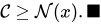
.
{\displaystyle {\mathcal {N}}(x).}
τ
(
x
)
⊆
N
(
x
)
{\displaystyle \tau (x)\subseteq {\mathcal {N}}(x)}
N
(
x
)
.
{\displaystyle {\mathcal {N}}(x).}
N
(
x
)
and
τ
(
x
)
{\displaystyle {\mathcal {N}}(x){\text{ and }}\tau (x)}
X
,
{\displaystyle X,}
τ
(
x
)
{\displaystyle \tau (x)}
τ
.
{\displaystyle \tau .}
S
⊆
X
.
{\displaystyle S\subseteq X.}
B
{\displaystyle {\mathcal {B}}}
は 基本的なプレフィルタ [29] は、 ある点列に対して
B
=
Tails
(
x
∙
)
{\displaystyle {\mathcal {B}}=\operatorname {Tails} \left(x_{\bullet }\right)}
x
∙
=
(
x
i
)
i
=
1
∞
.
{\displaystyle x_{\bullet }=\left(x_{i}\right)_{i=1}^{\infty }.}
B
{\displaystyle {\mathcal {B}}}
は 基本フィルタ または フィルタである 場合 、 は の連続 フィルタです。最終的に定数ではないシーケンスによって生成されたテールのフィルタは、必ずしも 超 フィルタ はありません 可算集合上のすべての主フィルタは連続しており、可算無限集合上のすべてのコ有限フィルタも同様です。 有限個の連続フィルタの交差も連続しています。
X
{\displaystyle X}
B
{\displaystyle {\mathcal {B}}}
X
{\displaystyle X}
の 有限部分集合 全体の 集合 (つまり、 の補集合が有限である集合)が真集合となるのは、 が無限大(または同値で、が無限大) である場合のみであり 、この場合、 は のフィルタで あり、 フレシェフィルタ または
F
{\displaystyle {\mathcal {F}}}
X
{\displaystyle X}
X
{\displaystyle X}
F
{\displaystyle {\mathcal {F}}}
X
{\displaystyle X}
F
{\displaystyle {\mathcal {F}}}
X
{\displaystyle X}
上の コフィニティフィルタ なら 、は 双対イデアルに等しく、 これはフィルタではない。 が 無限なら、単集合の補集合族は、 上のフレシェフィルタを生成するフィルタサブベースである。 上の任意の集合族と同様に 上のフレシェフィルタの核を 含む は 空集合である。
X
.
{\displaystyle X.}
X
{\displaystyle X}
F
{\displaystyle {\mathcal {F}}}
℘
(
X
)
,
{\displaystyle \wp (X),}
X
{\displaystyle X}
{
X
∖
{
x
}
:
x
∈
X
}
{\displaystyle \{X\setminus \{x\}~:~x\in X\}}
X
.
{\displaystyle X.}
X
{\displaystyle X}
{
X
∖
{
x
}
:
x
∈
X
}
,
{\displaystyle \{X\setminus \{x\}~:~x\in X\},}
X
{\displaystyle X}
ker
F
=
∅
.
{\displaystyle \ker {\mathcal {F}}=\varnothing .}
空でない族のすべての要素の共通部分は、それ自体 が の 最小値 または 最大下限 と呼ばれる の フィルタであるため 、 と表記されることがあります。言い換えると、 のすべてのフィルタはサブセットとして を持つため、この共通部分は空になることはありません。定義により、最小値は の各要素のサブセットとして含まれる 最も細かい/最大の( に対する)フィルタです
F
⊆
Filters
(
X
)
{\displaystyle \mathbb {F} \subseteq \operatorname {Filters} (X)}
X
{\displaystyle X}
F
in
Filters
(
X
)
,
{\displaystyle \mathbb {F} {\text{ in }}\operatorname {Filters} (X),}
⋀
F
∈
F
F
.
{\displaystyle {\textstyle \bigwedge \limits _{{\mathcal {F}}\in \mathbb {F} }}{\mathcal {F}}.}
ker
F
=
⋂
F
∈
F
F
∈
Filters
(
X
)
.
{\displaystyle \ker \mathbb {F} ={\textstyle \bigcap \limits _{{\mathcal {F}}\in \mathbb {F} }}{\mathcal {F}}\in \operatorname {Filters} (X).}
X
{\displaystyle X}
{
X
}
{\displaystyle \{X\}}
⊆
and
≤
{\displaystyle \,\subseteq \,{\text{ and }}\,\leq \,}
F
.
{\displaystyle \mathbb {F} .}
がフィルタである 場合、 におけるそれらの最小値は フィルタです がプレフィルタである 場合、 は両方よりも粗いプレフィルタです (つまり、 )。実際、 は そのようなプレフィルタの最も細かいものの1つで あり、 がプレフィルタである場合、 が必ず となる ことを意味します より一般的には、 が空でない族であり である場合、 および は の 最大元 です
B
and
F
{\displaystyle {\mathcal {B}}{\text{ and }}{\mathcal {F}}}
Filters
(
X
)
{\displaystyle \operatorname {Filters} (X)}
B
(
∪
)
F
.
{\displaystyle {\mathcal {B}}\,(\cup )\,{\mathcal {F}}.}
B
and
F
{\displaystyle {\mathcal {B}}{\text{ and }}{\mathcal {F}}}
B
(
∪
)
F
{\displaystyle {\mathcal {B}}\,(\cup )\,{\mathcal {F}}}
B
and
F
{\displaystyle {\mathcal {B}}{\text{ and }}{\mathcal {F}}}
B
(
∪
)
F
≤
B
and
B
(
∪
)
F
≤
F
{\displaystyle {\mathcal {B}}\,(\cup )\,{\mathcal {F}}\leq {\mathcal {B}}{\text{ and }}{\mathcal {B}}\,(\cup )\,{\mathcal {F}}\leq {\mathcal {F}}}
S
{\displaystyle {\mathcal {S}}}
S
≤
B
and
S
≤
F
{\displaystyle {\mathcal {S}}\leq {\mathcal {B}}{\text{ and }}{\mathcal {S}}\leq {\mathcal {F}}}
S
≤
B
(
∪
)
F
.
{\displaystyle {\mathcal {S}}\leq {\mathcal {B}}\,(\cup )\,{\mathcal {F}}.}
B
and
F
{\displaystyle {\mathcal {B}}{\text{ and }}{\mathcal {F}}}
S
:=
{
S
⊆
℘
(
X
)
:
S
≤
B
and
S
≤
F
}
{\displaystyle \mathbb {S} :=\{{\mathcal {S}}\subseteq \wp (X)~:~{\mathcal {S}}\leq {\mathcal {B}}{\text{ and }}{\mathcal {S}}\leq {\mathcal {F}}\}}
B
(
∪
)
F
∈
S
{\displaystyle {\mathcal {B}}\,(\cup )\,{\mathcal {F}}\in \mathbb {S} }
B
(
∪
)
F
{\displaystyle {\mathcal {B}}\,(\cup )\,{\mathcal {F}}}
(
S
,
≤
)
.
{\displaystyle (\mathbb {S} ,\leq ).}
とし 、とする。 によって表される の 上限
または 最小 の上限 は、 のすべての要素を部分集合として含む の 最小の( に対する )双対イデアルで ある。つまり、 を 部分集合として 含む の最小の( に対する )双対イデアルである。この双対イデアルは、 によって生成される π 系 である
。任意の空でない集合族と同様に、 が 上の 何らかの フィルタ に含まれるの は、それがフィルタ部分基底である場合に限る。または、 が上 のフィルタである場合に限る。この場合、この族は のすべての要素を 部分集合として 含む の 最小の( に対する )フィルタであり、必然的に
∅
≠
F
⊆
DualIdeals
(
X
)
{\displaystyle \varnothing \neq \mathbb {F} \subseteq \operatorname {DualIdeals} (X)}
∪
F
=
⋃
F
∈
F
F
.
{\displaystyle \cup \mathbb {F} ={\textstyle \bigcup \limits _{{\mathcal {F}}\in \mathbb {F} }}{\mathcal {F}}.}
F
in
DualIdeals
(
X
)
,
{\displaystyle \mathbb {F} {\text{ in }}\operatorname {DualIdeals} (X),}
⋁
F
∈
F
F
,
{\displaystyle {\textstyle \bigvee \limits _{{\mathcal {F}}\in \mathbb {F} }}{\mathcal {F}},}
⊆
{\displaystyle \subseteq }
X
{\displaystyle X}
F
{\displaystyle \mathbb {F} }
⊆
{\displaystyle \subseteq }
X
{\displaystyle X}
∪
F
{\displaystyle \cup \mathbb {F} }
⋁
F
∈
F
F
=
π
(
∪
F
)
↑
X
,
{\displaystyle {\textstyle \bigvee \limits _{{\mathcal {F}}\in \mathbb {F} }}{\mathcal {F}}=\pi \left(\cup \mathbb {F} \right)^{\uparrow X},}
π
(
∪
F
)
:=
{
F
1
∩
⋯
∩
F
n
:
n
∈
N
and every
F
i
belongs to some
F
∈
F
}
{\displaystyle \pi \left(\cup \mathbb {F} \right):=\left\{F_{1}\cap \cdots \cap F_{n}~:~n\in \mathbb {N} {\text{ and every }}F_{i}{\text{ belongs to some }}{\mathcal {F}}\in \mathbb {F} \right\}}
∪
F
.
{\displaystyle \cup \mathbb {F} .}
∪
F
{\displaystyle \cup \mathbb {F} }
X
{\displaystyle X}
⋁
F
∈
F
F
=
π
(
∪
F
)
↑
X
{\displaystyle {\textstyle \bigvee \limits _{{\mathcal {F}}\in \mathbb {F} }}{\mathcal {F}}=\pi \left(\cup \mathbb {F} \right)^{\uparrow X}}
X
,
{\displaystyle X,}
⊆
{\displaystyle \subseteq }
X
{\displaystyle X}
F
{\displaystyle \mathbb {F} }
F
⊆
Filters
(
X
)
.
{\displaystyle \mathbb {F} \subseteq \operatorname {Filters} (X).}
および とします。 によって表される の
上限 または最小 の 上限は 、定義によりのすべての元を 部分集合として含む 上 の( に対する)最小の フィルタです。 それが存在する場合、必然的に (上で定義したように) および は、 を含む 上のすべてのフィルタの共通部分とも等しくなります。
この の上限は、双対イデアル が 上のフィルタである 場合に限り存在します。
フィルタの族の最小の上限は、 フィルタではない場合があります。 実際、 に少なくとも 2 つの異なる元が含まれる場合、 両方を含むフィルタが存在 しない フィルタ が存在します。 がフィルタの部分基底でない場合、 の上限は
存在 せず、 におけるその上限についても同じことが言えますが 、 上のすべての双対イデアルの集合におけるそれらの上限は 存在します(それが退化したフィルタ です )。
∅
≠
F
⊆
Filters
(
X
)
{\displaystyle \varnothing \neq \mathbb {F} \subseteq \operatorname {Filters} (X)}
∪
F
=
⋃
F
∈
F
F
.
{\displaystyle \cup \mathbb {F} ={\textstyle \bigcup \limits _{{\mathcal {F}}\in \mathbb {F} }}{\mathcal {F}}.}
F
in
Filters
(
X
)
,
{\displaystyle \mathbb {F} {\text{ in }}\operatorname {Filters} (X),}
⋁
F
∈
F
F
{\displaystyle {\textstyle \bigvee \limits _{{\mathcal {F}}\in \mathbb {F} }}{\mathcal {F}}}
⊆
{\displaystyle \subseteq }
X
{\displaystyle X}
F
{\displaystyle \mathbb {F} }
⋁
F
∈
F
F
=
π
(
∪
F
)
↑
X
{\displaystyle {\textstyle \bigvee \limits _{{\mathcal {F}}\in \mathbb {F} }}{\mathcal {F}}=\pi \left(\cup \mathbb {F} \right)^{\uparrow X}}
⋁
F
∈
F
F
{\displaystyle {\textstyle \bigvee \limits _{{\mathcal {F}}\in \mathbb {F} }}{\mathcal {F}}}
X
{\displaystyle X}
∪
F
.
{\displaystyle \cup \mathbb {F} .}
F
in
Filters
(
X
)
{\displaystyle \mathbb {F} {\text{ in }}\operatorname {Filters} (X)}
π
(
∪
F
)
↑
X
{\displaystyle \pi \left(\cup \mathbb {F} \right)^{\uparrow X}}
X
.
{\displaystyle X.}
F
{\displaystyle \mathbb {F} }
X
{\displaystyle X}
B
and
C
on
X
{\displaystyle {\mathcal {B}}{\text{ and }}{\mathcal {C}}{\text{ on }}X}
F
on
X
{\displaystyle {\mathcal {F}}{\text{ on }}X}
B
and
C
.
{\displaystyle {\mathcal {B}}{\text{ and }}{\mathcal {C}}.}
∪
F
{\displaystyle \cup \mathbb {F} }
F
in
Filters
(
X
)
{\displaystyle \mathbb {F} {\text{ in }}\operatorname {Filters} (X)}
Prefilters
(
X
)
{\displaystyle \operatorname {Prefilters} (X)}
X
{\displaystyle X}
℘
(
X
)
{\displaystyle \wp (X)}
がプレフィルタ(それぞれ 上のフィルタ )である 場合、 がプレフィルタ(それぞれ フィルタ)であるのは、 が非退化である場合(または別の言い方をすれば、 が メッシュである場合に限ります)に限ります。その場合、 は上の 最も粗いプレフィルタ(それぞれ 最も粗いフィルタ) の 1 つ であり、 の両方よりも 細かい( に関して)ことに なります。これは、 が 任意のプレフィルタ(それぞれ 任意のフィルタ)である 場合に、 が必ず となることを意味します で表されます。
B
and
F
{\displaystyle {\mathcal {B}}{\text{ and }}{\mathcal {F}}}
X
{\displaystyle X}
B
(
∩
)
F
{\displaystyle {\mathcal {B}}\,(\cap )\,{\mathcal {F}}}
B
and
F
{\displaystyle {\mathcal {B}}{\text{ and }}{\mathcal {F}}}
X
{\displaystyle X}
≤
{\displaystyle \,\leq }
B
and
F
;
{\displaystyle {\mathcal {B}}{\text{ and }}{\mathcal {F}};}
S
{\displaystyle {\mathcal {S}}}
B
≤
S
and
F
≤
S
{\displaystyle {\mathcal {B}}\leq {\mathcal {S}}{\text{ and }}{\mathcal {F}}\leq {\mathcal {S}}}
B
(
∩
)
F
≤
S
,
{\displaystyle {\mathcal {B}}\,(\cap )\,{\mathcal {F}}\leq {\mathcal {S}},}
B
∨
F
.
{\displaystyle {\mathcal {B}}\vee {\mathcal {F}}.}
その他の例
および とすると、 前 置フィルタと、有限交差の下で閉じていないフィルタ サブベースが 作成されます 。 は前置フィルタであるため、 を含む最小の前置フィルタ は によって生成される π システム は 特に 、フィルタ サブベースを含む最小の前置フィルタは、 の 集合のすべての有限交差の集合と等しくありません 。 によって 生成される のフィルタは π システム の 3 つすべてが 生成し、 は、 点で主である固定、主、超前置フィルタの例です。 は、 上の 超フィルタでもあります。
X
=
{
p
,
1
,
2
,
3
}
{\displaystyle X=\{p,1,2,3\}}
B
=
{
{
p
}
,
{
p
,
1
,
2
}
,
{
p
,
1
,
3
}
}
,
{\displaystyle {\mathcal {B}}=\{\{p\},\{p,1,2\},\{p,1,3\}\},}
B
{\displaystyle {\mathcal {B}}}
B
{\displaystyle {\mathcal {B}}}
B
{\displaystyle {\mathcal {B}}}
B
.
{\displaystyle {\mathcal {B}}.}
B
{\displaystyle {\mathcal {B}}}
{
{
p
,
1
}
}
∪
B
.
{\displaystyle \{\{p,1\}\}\cup {\mathcal {B}}.}
B
{\displaystyle {\mathcal {B}}}
B
.
{\displaystyle {\mathcal {B}}.}
X
{\displaystyle X}
B
{\displaystyle {\mathcal {B}}}
B
↑
X
=
{
S
⊆
X
:
p
∈
S
}
=
{
{
p
}
∪
T
:
T
⊆
{
1
,
2
,
3
}
}
.
{\displaystyle {\mathcal {B}}^{\uparrow X}=\{S\subseteq X:p\in S\}=\{\{p\}\cup T~:~T\subseteq \{1,2,3\}\}.}
B
,
{\displaystyle {\mathcal {B}},}
B
{\displaystyle {\mathcal {B}}}
B
↑
X
{\displaystyle {\mathcal {B}}^{\uparrow X}}
p
;
B
↑
X
{\displaystyle p;{\mathcal {B}}^{\uparrow X}}
X
.
{\displaystyle X.}
を位相空間 とし、 を定義する 。 ここで は 必ず より細かい である。 が空でない(すなわち、非退化、フィルタサブベース、プレフィルタ、有限和で閉じている)場合 、 についても同じことが言える。 が 上のフィルタである 場合、 はプレフィルタであるが、 上の フィルタである必要はない。 ただし、は 上のフィルタであり、 と同等で ある。
(
X
,
τ
)
{\displaystyle (X,\tau )}
B
⊆
℘
(
X
)
,
{\displaystyle {\mathcal {B}}\subseteq \wp (X),}
B
¯
:=
{
cl
X
B
:
B
∈
B
}
,
{\displaystyle {\overline {\mathcal {B}}}:=\left\{\operatorname {cl} _{X}B~:~B\in {\mathcal {B}}\right\},}
B
{\displaystyle {\mathcal {B}}}
B
¯
.
{\displaystyle {\overline {\mathcal {B}}}.}
B
{\displaystyle {\mathcal {B}}}
B
¯
.
{\displaystyle {\overline {\mathcal {B}}}.}
B
{\displaystyle {\mathcal {B}}}
X
{\displaystyle X}
B
¯
{\displaystyle {\overline {\mathcal {B}}}}
X
{\displaystyle X}
(
B
¯
)
↑
X
{\displaystyle \left({\overline {\mathcal {B}}}\right)^{\uparrow X}}
X
{\displaystyle X}
B
¯
.
{\displaystyle {\overline {\mathcal {B}}}.}
(空でない)位相空間の稠密な開部分集合全体の 集合は 、適切な π システムであり、したがってプレフィルタでもあります。空間が ベール空間 である場合、稠密な開部分集合のすべての可算な共通集合の集合は π システムであり、 よりも細かいプレフィルタです。 (で) である場合、 有限の ルベーグ測度を 持つすべての の 集合は、 適切な π システムであり、の 適切な部分集合 でもある自由プレフィルタです。 プレフィルタと は同値であり 、 したがって に同じフィルタを生成します。 は ベール空間 である
ため 、 内の集合のすべての可算な共通集合は 内で稠密です (また、同値かつ非希薄 です )。したがって の元のすべての可算な共通集合の集合は 、プレフィルタかつ π システムです。これは、 よりも細かく、同値ではありません。
B
{\displaystyle {\mathcal {B}}}
X
{\displaystyle X}
B
.
{\displaystyle {\mathcal {B}}.}
X
=
R
n
{\displaystyle X=\mathbb {R} ^{n}}
1
≤
n
∈
N
{\displaystyle 1\leq n\in \mathbb {N} }
B
LebFinite
{\displaystyle {\mathcal {B}}_{\operatorname {LebFinite} }}
B
∈
B
{\displaystyle B\in {\mathcal {B}}}
B
{\displaystyle B}
B
.
{\displaystyle {\mathcal {B}}.}
B
LebFinite
{\displaystyle {\mathcal {B}}_{\operatorname {LebFinite} }}
B
{\displaystyle {\mathcal {B}}}
X
.
{\displaystyle X.}
X
{\displaystyle X}
B
LebFinite
{\displaystyle {\mathcal {B}}_{\operatorname {LebFinite} }}
X
{\displaystyle X}
B
LebFinite
{\displaystyle {\mathcal {B}}_{\operatorname {LebFinite} }}
B
LebFinite
.
{\displaystyle {\mathcal {B}}_{\operatorname {LebFinite} }.}
ウルトラフィルター 「ウルトラフィルター」と「ウルトラプレフィルター」には他にも多くの特徴があり、ウルトラフィルター に関する記事に記載されています 。その記事では、ウルトラフィルターの重要な特性についても説明しています。
空でない 集合族とは、次のようなものである。
B
⊆
℘
(
X
)
{\displaystyle {\mathcal {B}}\subseteq \wp (X)}
Ultra かつ以下の同等の条件のいずれかが満たされる
場合
∅
∉
B
{\displaystyle \varnothing \not \in {\mathcal {B}}}
あらゆる集合に対して、 となる 集合 (または同等に、 となる集合 )が存在します。
S
⊆
X
{\displaystyle S\subseteq X}
B
∈
B
{\displaystyle B\in {\mathcal {B}}}
B
⊆
S
or
B
⊆
X
∖
S
{\displaystyle B\subseteq S{\text{ or }}B\subseteq X\setminus S}
B
∩
S
equals
B
or
∅
{\displaystyle B\cap S{\text{ equals }}B{\text{ or }}\varnothing }
あらゆる 集合に対して 、
S
⊆
⋃
B
∈
B
B
{\displaystyle S\subseteq {\textstyle \bigcup \limits _{B\in {\mathcal {B}}}}B}
B
∈
B
{\displaystyle B\in {\mathcal {B}}}
B
∩
S
equals
B
or
∅
.
{\displaystyle B\cap S{\text{ equals }}B{\text{ or }}\varnothing .}
この「 超」の特徴はセットに依存しないため、 「超」という用語を使用するときに セットについて言及することはオプションです。
B
{\displaystyle {\mathcal {B}}}
X
,
{\displaystyle X,}
X
{\displaystyle X}
あらゆる 集合 (必ずしも の部分集合 ではない) に対して 、
S
{\displaystyle S}
X
{\displaystyle X}
B
∈
B
{\displaystyle B\in {\mathcal {B}}}
B
∩
S
equals
B
or
∅
.
{\displaystyle B\cap S{\text{ equals }}B{\text{ or }}\varnothing .}
超プレフィルタ とは、超プレフィルタでもある場合です。同様に、超フィルタサブベースでもあります。プレフィルタ が超プレフィルタであるためには、次の同等の条件のいずれかを満たす必要があります。
B
{\displaystyle {\mathcal {B}}}
B
{\displaystyle {\mathcal {B}}}
は に関して 最大で あり、 つまり
Prefilters
(
X
)
{\displaystyle \operatorname {Prefilters} (X)}
≤
,
{\displaystyle \,\leq ,\,}
For all
C
∈
Prefilters
(
X
)
,
B
≤
C
implies
C
≤
B
.
{\displaystyle {\text{For all }}{\mathcal {C}}\in \operatorname {Prefilters} (X),\;{\mathcal {B}}\leq {\mathcal {C}}\;{\text{ implies }}\;{\mathcal {C}}\leq {\mathcal {B}}.}
For all
C
∈
Filters
(
X
)
,
B
≤
C
implies
C
≤
B
.
{\displaystyle {\text{For all }}{\mathcal {C}}\in \operatorname {Filters} (X),\;{\mathcal {B}}\leq {\mathcal {C}}\;{\text{ implies }}\;{\mathcal {C}}\leq {\mathcal {B}}.}
この記述は、以下に示すウルトラフィルターに関する記述と同一ですが、ここでは 単にプレフィルターであると想定されており、フィルターである必要はありません。
B
{\displaystyle {\mathcal {B}}}
B
↑
X
{\displaystyle {\mathcal {B}}^{\uparrow X}}
超(つまり超フィルター)です。
B
{\displaystyle {\mathcal {B}}}
ある種の超濾過装置と同等です。
超フィルタサブベースは必然的にプレフィルタである。フィルタサブベースが超となるのは、 (上記のように) に関して最大のフィルタサブベースである場合のみである。
≤
{\displaystyle \,\leq \,}
上の 超フィルター
X
{\displaystyle X}
とは、上のフィルターが超フィルターである場合である 。同様に、上の超フィルターとは、 以下の同等の条件のいずれかを満たす
フィルターである
X
{\displaystyle X}
X
{\displaystyle X}
B
on
X
{\displaystyle {\mathcal {B}}{\text{ on }}X}
B
{\displaystyle {\mathcal {B}}}
ウルトラプレフィルターによって生成されます。 いかなる
S
⊆
X
,
S
∈
B
or
X
∖
S
∈
B
.
{\displaystyle S\subseteq X,S\in {\mathcal {B}}{\text{ or }}X\setminus S\in {\mathcal {B}}.}
B
∪
(
X
∖
B
)
=
℘
(
X
)
.
{\displaystyle {\mathcal {B}}\cup (X\setminus {\mathcal {B}})=\wp (X).}
この条件は次のように言い換えることができる: は によって分割され 、その双対
℘
(
X
)
{\displaystyle \wp (X)}
B
{\displaystyle {\mathcal {B}}}
X
∖
B
.
{\displaystyle X\setminus {\mathcal {B}}.}
任意の場合 、 となります (この特性を持つフィルターは プライムフィルター と呼ばれます)。
R
,
S
⊆
X
,
{\displaystyle R,S\subseteq X,}
R
∪
S
∈
B
{\displaystyle R\cup S\in {\mathcal {B}}}
R
∈
B
or
S
∈
B
{\displaystyle R\in {\mathcal {B}}{\text{ or }}S\in {\mathcal {B}}}
この特性は、2 つ以上の集合の任意の有限和集合に拡張されます。
B
{\displaystyle {\mathcal {B}}}
は上の 最大 フィルタです。つまり、 が 上のフィルタで、 で ある 場合は必ず となるという ことです (この等式は に置き換えることができます )。
X
{\displaystyle X}
C
{\displaystyle {\mathcal {C}}}
X
{\displaystyle X}
B
⊆
C
{\displaystyle {\mathcal {B}}\subseteq {\mathcal {C}}}
C
=
B
{\displaystyle {\mathcal {C}}={\mathcal {B}}}
C
⊆
B
or by
C
≤
B
{\displaystyle {\mathcal {C}}\subseteq {\mathcal {B}}{\text{ or by }}{\mathcal {C}}\leq {\mathcal {B}}}
が上向きに閉じている 場合、 超フィルターを最大フィルターとして特徴付けることは次のように言い換えることができます。
C
{\displaystyle {\mathcal {C}}}
B
≤
C
if and only if
B
⊆
C
.
{\displaystyle {\mathcal {B}}\leq {\mathcal {C}}{\text{ if and only if }}{\mathcal {B}}\subseteq {\mathcal {C}}.}
For all
C
∈
Filters
(
X
)
,
B
≤
C
implies
C
≤
B
.
{\displaystyle {\text{For all }}{\mathcal {C}}\in \operatorname {Filters} (X),\;{\mathcal {B}}\leq {\mathcal {C}}\;{\text{ implies }}\;{\mathcal {C}}\leq {\mathcal {B}}.}
従属はフィルターにとって「サブネット/サブシーケンスである」の類似物であるため (具体的には、「サブネット」は「AA サブネット」を意味し、これは以下で定義されます)、ウルトラフィルターを「最大限従属するフィルター」と特徴付けると、ウルトラフィルターはある種の「最大限深いネット」に類似していると解釈できることが示唆されます (これは、たとえば、「 ある意味で からのみ見ると、そのサブネットと区別がつかない (たとえば、シングルトン セットで評価される任意のネットの場合)」という意味になります)。 [注 5]これは、 ウルトラネット によって実際に厳密にされた概念です 。 ウルトラフィルターの補題 は、すべてのフィルター (「ネット」) には「最大限従属する」(「最大限深い」) 従属フィルター (「サブネット」) があるというステートメントです。
≥
{\displaystyle \,\geq \,}
X
{\displaystyle X}
超濾過器の補題
以下の重要な定理は アルフレッド・タルスキ (1930)によるものである。
超フィルタの補題/原理/定理 ( Tarski ) — 集合上のすべてのフィルタは、 集合上の超フィルタのサブセットである。
X
{\displaystyle X}
X
.
{\displaystyle X.}
超フィルタ補題の帰結として、あらゆるフィルタはそれを含むすべての超フィルタの共通集合に等しい。 ツェルメロ・フランケル (ZF)
の公理を仮定すると 、超フィルタ補題は 選択公理 (特に ゾルンの補題 ) に従うが、それよりも厳密には弱い。超フィルタ補題は有限集合の選択公理を意味する。 ハウスドルフ空間 のみ を扱う場合 、トポロジー (コンパクト ハウスドルフ空間に対する ティコノフの定理 や アレクサンダー部分基底定理 など) や 関数解析( ハーン・バナッハの定理 など) における (入門コースで出会うような ) 基本的な結果のほとんどは、超フィルタ補題のみを使用して証明できるため、選択公理の完全な強さは必要ないかもしれない。
カーネル カーネルは、プレフィルタやその他のセット ファミリのプロパティを分類するのに役立ちます。
集合族の核[6]は、集合族の 要素 ある すべての集合の共通部分である。
B
{\displaystyle {\mathcal {B}}}
B
:
{\displaystyle {\mathcal {B}}:}
ker
B
=
⋂
B
∈
B
B
{\displaystyle \ker {\mathcal {B}}=\bigcap _{B\in {\mathcal {B}}}B}
の 場合、このセットは π システムのカーネルにも等しく 、このカーネルは によって生成されます。
特に、 が フィルタ サブベースである場合、次のセットのすべてのカーネルは等しくなります。
B
⊆
℘
(
X
)
{\displaystyle {\mathcal {B}}\subseteq \wp (X)}
ker
(
B
↑
X
)
=
ker
B
{\displaystyle \ker \left({\mathcal {B}}^{\uparrow X}\right)=\ker {\mathcal {B}}}
B
.
{\displaystyle {\mathcal {B}}.}
B
{\displaystyle {\mathcal {B}}}
(1) (2) によって生成される π システムと(3)によって生成されるフィルタ
B
,
{\displaystyle {\mathcal {B}},}
B
,
{\displaystyle {\mathcal {B}},}
B
.
{\displaystyle {\mathcal {B}}.}
がマップである 場合、
同等のファミリは等しいカーネルを持ちます。2 つの主要なファミリは、それらのカーネルが等しい場合にのみ同等です。
f
{\displaystyle f}
f
(
ker
B
)
⊆
ker
f
(
B
)
and
f
−
1
(
ker
B
)
=
ker
f
−
1
(
B
)
.
{\displaystyle f(\ker {\mathcal {B}})\subseteq \ker f({\mathcal {B}}){\text{ and }}f^{-1}(\ker {\mathcal {B}})=\ker f^{-1}({\mathcal {B}}).}
カーネルによるファミリーの分類 集合族 とは次のようなものである。
B
{\displaystyle {\mathcal {B}}}
自由 に 、 これが次のように言い換えられる
ker
B
=
∅
,
{\displaystyle \ker {\mathcal {B}}=\varnothing ,}
{
X
∖
{
x
}
:
x
∈
X
}
⊆
B
↑
X
;
{\displaystyle \{X\setminus \{x\}~:~x\in X\}\subseteq {\mathcal {B}}^{\uparrow X};}
{
X
∖
{
x
}
:
x
∈
X
}
≤
B
.
{\displaystyle \{X\setminus \{x\}~:~x\in X\}\leq {\mathcal {B}}.}
フィルター が自由であるためには、フィルターは 無限であり、 そのサブセットとして フレシェ フィルター が含ま れます。
F
on
X
{\displaystyle {\mathcal {F}}{\text{ on }}X}
X
{\displaystyle X}
F
{\displaystyle {\mathcal {F}}}
X
{\displaystyle X}
固定されている 場合 、任意の 点 によって固定され ていると言われる
ker
B
≠
∅
{\displaystyle \ker {\mathcal {B}}\neq \varnothing }
B
{\displaystyle {\mathcal {B}}}
x
∈
ker
B
.
{\displaystyle x\in \ker {\mathcal {B}}.}
固定されたファミリは必ずフィルタ サブベースになります。 プリンシパル if
ker
B
∈
B
.
{\displaystyle \ker {\mathcal {B}}\in {\mathcal {B}}.}
[ 27 で 個別 または
x
∈
X
{\displaystyle x\in X}
{
x
}
=
ker
B
∈
B
.
{\displaystyle \{x\}=\ker {\mathcal {B}}\in {\mathcal {B}}.}
の主フィルタは
x
on
X
{\displaystyle x{\text{ on }}X}
フィルタ である。 フィルタ が主となる のは、次の場合のみである。
{
x
}
↑
X
.
{\displaystyle \{x\}^{\uparrow X}.}
F
{\displaystyle {\mathcal {F}}}
x
{\displaystyle x}
F
=
{
x
}
↑
X
.
{\displaystyle {\mathcal {F}}=\{x\}^{\uparrow X}.}
が可算な部分 集合であるとき、 可算な深さである
C
⊆
B
{\displaystyle {\mathcal {C}}\subseteq {\mathcal {B}}}
ker
C
∈
B
.
{\displaystyle \ker {\mathcal {C}}\in {\mathcal {B}}.}
が主フィルタである 場合 、 は
を 生成する最小のプレフィルタでもある。
B
{\displaystyle {\mathcal {B}}}
X
{\displaystyle X}
∅
≠
ker
B
∈
B
{\displaystyle \varnothing \neq \ker {\mathcal {B}}\in {\mathcal {B}}}
B
=
{
ker
B
}
↑
X
{\displaystyle {\mathcal {B}}=\{\ker {\mathcal {B}}\}^{\uparrow X}}
{
ker
B
}
{\displaystyle \{\ker {\mathcal {B}}\}}
B
.
{\displaystyle {\mathcal {B}}.}
例の族: 空でない任意の に対して 族は 自由であるが、 の有限和が をカバーしない場合にのみフィルタサブベースとなり 、その場合、生成されるフィルタも自由となる。特に、 が 可算な場合(例えば 素数)、 有限測度の集合 内の 貧弱な集合 、または の有界な部分集合である場合、 はフィルタサブベースとなる。が単集合である 場合、 は フレシェフィルタのサブベースとなる。
C
⊆
R
,
{\displaystyle C\subseteq \mathbb {R} ,}
B
C
=
{
R
∖
(
r
+
C
)
:
r
∈
R
}
{\displaystyle {\mathcal {B}}_{C}=\{\mathbb {R} \setminus (r+C)~:~r\in \mathbb {R} \}}
(
r
1
+
C
)
∪
⋯
∪
(
r
n
+
C
)
{\displaystyle \left(r_{1}+C\right)\cup \cdots \cup \left(r_{n}+C\right)}
R
,
{\displaystyle \mathbb {R} ,}
B
C
{\displaystyle {\mathcal {B}}_{C}}
C
{\displaystyle C}
C
=
Q
,
Z
,
{\displaystyle C=\mathbb {Q} ,\mathbb {Z} ,}
R
,
{\displaystyle \mathbb {R} ,}
R
.
{\displaystyle \mathbb {R} .}
C
{\displaystyle C}
B
C
{\displaystyle {\mathcal {B}}_{C}}
R
.
{\displaystyle \mathbb {R} .}
固定ウルトラプレフィルターの特性 集合の族が 固定されている場合(つまり、 )、 が 超となるのは、 の何らかの要素が 単独集合である場合に限ります。その場合、は必然的にプレフィルタになります。すべての主プレフィルタは固定されているため、 が単独集合である
場合に限り、 主プレフィルタは超となります。
B
{\displaystyle {\mathcal {B}}}
ker
B
≠
∅
{\displaystyle \ker {\mathcal {B}}\neq \varnothing }
B
{\displaystyle {\mathcal {B}}}
B
{\displaystyle {\mathcal {B}}}
B
{\displaystyle {\mathcal {B}}}
B
{\displaystyle {\mathcal {B}}}
ker
B
{\displaystyle \ker {\mathcal {B}}}
単一点で主となる 上のすべてのフィルターは 超フィルターであり、さらに が有限であれば、 これら以外の 上 の超フィルターは存在しません。
X
{\displaystyle X}
X
{\displaystyle X}
X
{\displaystyle X}
次の定理は、すべての超フィルターが 2 つのカテゴリのいずれかに分類されることを示しています。つまり、自由フィルターであるか、単一のポイントによって生成される主フィルターであるかのいずれかです。
細分化/粗化、従属関係、噛み合い 以下に定義される前順序は 、トポロジーにおけるプレフィルタ(およびフィルタ)の使用において根本的に重要です。たとえば、この前順序は、「サブシーケンス」のプレフィルタ同等物を定義するために使用されます。 ここで、「 」は「 」 のサブシーケンスである と解釈できます(したがって、「 に従属する」は「 のサブシーケンス」のプレフィルタ同等物です)。これは、位相空間におけるプレフィルタ収束を定義するためにも使用されます。 前順序と密接に関連する メッシュ の定義は、 トポロジーでクラスターポイントを定義するために使用されます。
≤
{\displaystyle \,\leq \,}
F
≥
C
{\displaystyle {\mathcal {F}}\geq {\mathcal {C}}}
F
{\displaystyle {\mathcal {F}}}
C
{\displaystyle {\mathcal {C}}}
B
{\displaystyle {\mathcal {B}}}
C
,
{\displaystyle {\mathcal {C}},}
≤
,
{\displaystyle \,\leq ,}
2つのセットファミリー
B
and
C
{\displaystyle {\mathcal {B}}{\text{ and }}{\mathcal {C}}}
メッシュ と 互換性が 、 と書くと 、 が メッシュでない場合は 分離して 。 が の場合 メッシュ ある と言われます 。または、
B
#
C
,
{\displaystyle {\mathcal {B}}\#{\mathcal {C}},}
B
∩
C
≠
∅
for all
B
∈
B
and
C
∈
C
.
{\displaystyle B\cap C\neq \varnothing {\text{ for all }}B\in {\mathcal {B}}{\text{ and }}C\in {\mathcal {C}}.}
B
and
C
{\displaystyle {\mathcal {B}}{\text{ and }}{\mathcal {C}}}
S
⊆
X
and
B
⊆
℘
(
X
)
{\displaystyle S\subseteq X{\text{ and }}{\mathcal {B}}\subseteq \wp (X)}
B
and
S
{\displaystyle {\mathcal {B}}{\text{ and }}S}
B
and
{
S
}
{\displaystyle {\mathcal {B}}{\text{ and }}\{S\}}
トレース の ファミリー
空集合が含まれず、トレースは
B
on
S
,
{\displaystyle {\mathcal {B}}{\text{ on }}S,}
B
|
S
=
{
B
∩
S
:
B
∈
B
}
,
{\displaystyle {\mathcal {B}}{\big \vert }_{S}=\{B\cap S~:~B\in {\mathcal {B}}\},}
制限 の
B
to
S
.
{\displaystyle {\mathcal {B}}{\text{ to }}S.}
次のいずれかの同等の条件が成立する場合、
は より粗く 、 は より 細かい ( または に従属する ) と宣言する
C
≤
F
,
F
≥
C
,
and
F
⊢
C
,
{\displaystyle {\mathcal {C}}\leq {\mathcal {F}},{\mathcal {F}}\geq {\mathcal {C}},{\text{ and }}{\mathcal {F}}\vdash {\mathcal {C}},}
C
{\displaystyle {\mathcal {C}}}
F
{\displaystyle {\mathcal {F}}}
F
{\displaystyle {\mathcal {F}}}
C
,
{\displaystyle {\mathcal {C}},}
定義: すべてには いくつか が含まれます 。明示的には、これは、すべてに対して、 (したがって成り立つ) ような ものが存在することを意味します 。
C
∈
C
{\displaystyle C\in {\mathcal {C}}}
F
∈
F
.
{\displaystyle F\in {\mathcal {F}}.}
C
∈
C
,
{\displaystyle C\in {\mathcal {C}},}
F
∈
F
{\displaystyle F\in {\mathcal {F}}}
F
⊆
C
{\displaystyle F\subseteq C}
C
∋
C
⊇
F
∈
F
{\displaystyle {\mathcal {C}}\ni C\supseteq F\in {\mathcal {F}}}
もっと簡単に言えば、 のすべての集合が の いくつかの集合よりも 大きい 場合です 。ここで、「より大きな集合」とはスーパーセットを意味します。
C
≤
F
{\displaystyle {\mathcal {C}}\leq {\mathcal {F}}}
C
{\displaystyle {\mathcal {C}}}
F
.
{\displaystyle {\mathcal {F}}.}
{
C
}
≤
F
for every
C
∈
C
.
{\displaystyle \{C\}\leq {\mathcal {F}}{\text{ for every }}C\in {\mathcal {C}}.}
言葉で言えば、 は にある集合よりも大きいこと を正確に示しています 。 (a) と (b) の同値性は直ちにわかります。
{
C
}
≤
F
{\displaystyle \{C\}\leq {\mathcal {F}}}
C
{\displaystyle C}
F
.
{\displaystyle {\mathcal {F}}.}
C
≤
F
↑
X
,
{\displaystyle {\mathcal {C}}\leq {\mathcal {F}}^{\uparrow X},}
これは以下と同等です 。
C
⊆
F
↑
X
{\displaystyle {\mathcal {C}}\subseteq {\mathcal {F}}^{\uparrow X}}
C
↑
X
≤
F
{\displaystyle {\mathcal {C}}^{\uparrow X}\leq {\mathcal {F}}}
;
C
↑
X
≤
F
↑
X
,
{\displaystyle {\mathcal {C}}^{\uparrow X}\leq {\mathcal {F}}^{\uparrow X},}
これは以下と同等です 。
C
↑
X
⊆
F
↑
X
{\displaystyle {\mathcal {C}}^{\uparrow X}\subseteq {\mathcal {F}}^{\uparrow X}}
さらに上向きに閉じている場合、つまり このリストを拡張して次のものを含めることができること
を意味します。
F
{\displaystyle {\mathcal {F}}}
F
=
F
↑
X
,
{\displaystyle {\mathcal {F}}={\mathcal {F}}^{\uparrow X},}
C
⊆
F
.
{\displaystyle {\mathcal {C}}\subseteq {\mathcal {F}}.}
この場合、「より細かい」という定義は、 「 より 細かい 」 という位相的な定義 と同一になります 。
F
{\displaystyle {\mathcal {F}}}
C
{\displaystyle {\mathcal {C}}}
C
and
F
{\displaystyle {\mathcal {C}}{\text{ and }}{\mathcal {F}}}
X
.
{\displaystyle X.}
上向きに閉じた族が (つまり ) よりも細かいが、 は よりも 厳密に細かい と言われ 、は よりも 厳密に粗いと 言われる。
F
{\displaystyle {\mathcal {F}}}
C
{\displaystyle {\mathcal {C}}}
C
≤
F
{\displaystyle {\mathcal {C}}\leq {\mathcal {F}}}
C
≠
F
{\displaystyle {\mathcal {C}}\neq {\mathcal {F}}}
F
{\displaystyle {\mathcal {F}}}
C
{\displaystyle {\mathcal {C}}}
C
{\displaystyle {\mathcal {C}}}
F
.
{\displaystyle {\mathcal {F}}.}
2つの家族は 、一方が他方よりも優れている場合、 比較対象となります。 例 : が のサブ シーケンス である場合、 は 記号で および に従属します。 平易な英語で述べると 、
サブシーケンスの末尾のプレフィルタは、常に元のシーケンスのプレフィルタに従属します。これを確認するには、 を 任意のものとし(または同等に、 を 任意のものとし)、このセットにいくつかが含まれることを示せば済みます。
セットがを 含むためには、 が存在すれば十分です。 は厳密に増加する整数である
ため、 となる が 存在し 、したがって 、希望どおりに成り立ちます。したがって、のすべての点 が一意である場合(つまり、 が単射である場合) 、
左側は 右側の 厳密な/適切な サブセットになり、 は偶数インデックスのサブシーケンスです。 これは、これらの条件下では、サブシーケンスのすべての末尾 (すべての について )は右側のフィルタに属しますが、左側のフィルタには属さないためです。
x
i
∙
=
(
x
i
n
)
n
=
1
∞
{\displaystyle x_{i_{\bullet }}=\left(x_{i_{n}}\right)_{n=1}^{\infty }}
x
∙
=
(
x
i
)
i
=
1
∞
{\displaystyle x_{\bullet }=\left(x_{i}\right)_{i=1}^{\infty }}
Tails
(
x
i
∙
)
{\displaystyle \operatorname {Tails} \left(x_{i_{\bullet }}\right)}
Tails
(
x
∙
)
;
{\displaystyle \operatorname {Tails} \left(x_{\bullet }\right);}
Tails
(
x
i
∙
)
⊢
Tails
(
x
∙
)
{\displaystyle \operatorname {Tails} \left(x_{i_{\bullet }}\right)\vdash \operatorname {Tails} \left(x_{\bullet }\right)}
Tails
(
x
∙
)
≤
Tails
(
x
i
∙
)
.
{\displaystyle \operatorname {Tails} \left(x_{\bullet }\right)\leq \operatorname {Tails} \left(x_{i_{\bullet }}\right).}
C
:=
x
≥
i
∈
Tails
(
x
∙
)
{\displaystyle C:=x_{\geq i}\in \operatorname {Tails} \left(x_{\bullet }\right)}
i
∈
N
{\displaystyle i\in \mathbb {N} }
F
:=
x
i
≥
n
∈
Tails
(
x
i
∙
)
.
{\displaystyle F:=x_{i_{\geq n}}\in \operatorname {Tails} \left(x_{i_{\bullet }}\right).}
x
≥
i
=
{
x
i
,
x
i
+
1
,
…
}
{\displaystyle x_{\geq i}=\left\{x_{i},x_{i+1},\ldots \right\}}
x
i
≥
n
=
{
x
i
n
,
x
i
n
+
1
,
…
}
,
{\displaystyle x_{i_{\geq n}}=\left\{x_{i_{n}},x_{i_{n+1}},\ldots \right\},}
i
≤
i
n
.
{\displaystyle i\leq i_{n}.}
i
1
<
i
2
<
⋯
{\displaystyle i_{1}<i_{2}<\cdots }
n
∈
N
{\displaystyle n\in \mathbb {N} }
i
n
≥
i
,
{\displaystyle i_{n}\geq i,}
x
≥
i
⊇
x
i
≥
n
{\displaystyle x_{\geq i}\supseteq x_{i_{\geq n}}}
TailsFilter
(
x
∙
)
⊆
TailsFilter
(
x
i
∙
)
.
{\displaystyle \operatorname {TailsFilter} \left(x_{\bullet }\right)\subseteq \operatorname {TailsFilter} \left(x_{i_{\bullet }}\right).}
x
∙
{\displaystyle x_{\bullet }}
x
∙
:
N
→
X
{\displaystyle x_{\bullet }:\mathbb {N} \to X}
x
i
∙
{\displaystyle x_{i_{\bullet }}}
(
x
2
,
x
4
,
x
6
,
…
)
{\displaystyle \left(x_{2},x_{4},x_{6},\ldots \right)}
x
i
≥
n
=
{
x
2
n
,
x
2
n
+
2
,
x
2
n
+
4
,
…
}
{\displaystyle x_{i_{\geq n}}=\left\{x_{2n},x_{2n+2},x_{2n+4},\ldots \right\}}
n
∈
N
{\displaystyle n\in \mathbb {N} }
別の例として、が 任意の族である場合、 常に成立し、さらに、
B
{\displaystyle {\mathcal {B}}}
∅
≤
B
≤
B
≤
{
∅
}
{\displaystyle \varnothing \leq {\mathcal {B}}\leq {\mathcal {B}}\leq \{\varnothing \}}
{
∅
}
≤
B
if and only if
∅
∈
B
.
{\displaystyle \{\varnothing \}\leq {\mathcal {B}}{\text{ if and only if }}\varnothing \in {\mathcal {B}}.}
フィルタサブベースよりも粗い空でないファミリは、それ自体がフィルタサブベースでなければなりません。 π システムとそれが生成するフィルタ
の両方よりも粗いです 。
がウルトラ ファミリーである場合、 は 必然 的 に ウルトラファミリーに なります。したがって、ウルトラ ファミリーと同等のファミリーは必ずウルトラ になります 。特に、 がプレフィルターである場合、 とそれが生成するフィルターの 両方が ウルトラであるか、どちらもウルトラではありません。
C
and
F
{\displaystyle {\mathcal {C}}{\text{ and }}{\mathcal {F}}}
C
≤
F
,
{\displaystyle {\mathcal {C}}\leq {\mathcal {F}},}
C
{\displaystyle {\mathcal {C}}}
∅
∉
F
,
{\displaystyle \varnothing \not \in {\mathcal {F}},}
F
{\displaystyle {\mathcal {F}}}
C
{\displaystyle {\mathcal {C}}}
C
{\displaystyle {\mathcal {C}}}
C
↑
X
{\displaystyle {\mathcal {C}}^{\uparrow X}}
この関係は 反射的 かつ 推移的 であり、 上の 順序 関係となる。
この関係は 反対称で ある が、 に 複数の点がある場合、 対称では ない 。
≤
{\displaystyle \,\leq \,}
℘
(
℘
(
X
)
)
.
{\displaystyle \wp (\wp (X)).}
≤
on
Filters
(
X
)
{\displaystyle \,\leq \,{\text{ on }}\operatorname {Filters} (X)}
X
{\displaystyle X}
同値な集合族 事前順序は、 以下の同値条件のいずれかが成立する場合、 すべての に対して が と 同値 となる という 標準的な 同値関係 を誘導する:
≤
{\displaystyle \,\leq \,}
℘
(
℘
(
X
)
)
,
{\displaystyle \wp (\wp (X)),}
B
,
C
∈
℘
(
℘
(
X
)
)
,
{\displaystyle {\mathcal {B}},{\mathcal {C}}\in \wp (\wp (X)),}
B
{\displaystyle {\mathcal {B}}}
C
{\displaystyle {\mathcal {C}}}
C
≤
B
and
B
≤
C
.
{\displaystyle {\mathcal {C}}\leq {\mathcal {B}}{\text{ and }}{\mathcal {B}}\leq {\mathcal {C}}.}
の上方閉包は 等しい。
C
and
B
{\displaystyle {\mathcal {C}}{\text{ and }}{\mathcal {B}}}
の2つの上向きに閉じた 部分集合( )が 同値であるのは、それらが等しい場合のみである。
ならば 、必然的に と は に 同値である。 以外の
すべての 同値類には、 で上向きに閉じた一意の代表(つまり、同値類の要素)が含まれる。
X
{\displaystyle X}
℘
(
X
)
{\displaystyle \wp (X)}
B
⊆
℘
(
X
)
{\displaystyle {\mathcal {B}}\subseteq \wp (X)}
∅
≤
B
≤
℘
(
X
)
{\displaystyle \varnothing \leq {\mathcal {B}}\leq \wp (X)}
B
{\displaystyle {\mathcal {B}}}
B
↑
X
.
{\displaystyle {\mathcal {B}}^{\uparrow X}.}
{
∅
}
{\displaystyle \{\varnothing \}}
X
.
{\displaystyle X.}
同等のファミリー間で保存されるプロパティ
を任意の集合族とし 、を任意の 集合族とする。が 同値である場合(つまり となる )、以下に挙げる各ステートメント/プロパティは、 両方が真であるか、 両方 が偽であるかのどちらかである 。
B
,
C
∈
℘
(
℘
(
X
)
)
{\displaystyle {\mathcal {B}},{\mathcal {C}}\in \wp (\wp (X))}
F
{\displaystyle {\mathcal {F}}}
B
and
C
{\displaystyle {\mathcal {B}}{\text{ and }}{\mathcal {C}}}
ker
B
=
ker
C
{\displaystyle \ker {\mathcal {B}}=\ker {\mathcal {C}}}
B
and
C
{\displaystyle {\mathcal {B}}{\text{ and }}{\mathcal {C}}}
B
and
C
{\displaystyle {\mathcal {B}}{\text{ and }}{\mathcal {C}}}
空ではありません 適切(つまり、 要素ではない)
∅
{\displaystyle \varnothing }
さらに、任意の 2 つの退化したファミリーは必然的に同等です。 フィルターサブベース プレフィルター
その場合、 に同じフィルターを生成します (つまり、 での上方閉包は 等しくなります)。
B
and
C
{\displaystyle {\mathcal {B}}{\text{ and }}{\mathcal {C}}}
X
{\displaystyle X}
X
{\displaystyle X}
無料 主要 ウルトラ トリビアルフィルタと等しい
{
X
}
{\displaystyle \{X\}}
言葉で言えば、これは、自明なフィルターと同等 のサブセットは自明なフィルターのみであることを意味します 。 一般に、この等式の結論は、非自明なフィルターには適用されません (両方のファミリーがフィルターである場合は例外です)。
℘
(
X
)
{\displaystyle \wp (X)}
メッシュ
F
{\displaystyle {\mathcal {F}}}
より細かい
F
{\displaystyle {\mathcal {F}}}
より粗い
F
{\displaystyle {\mathcal {F}}}
同等である
F
{\displaystyle {\mathcal {F}}}
上記のリストには「フィルター」という単語がありません。このプロパティは同等性によって保持され ない ためです。ただし、 フィルターがオンの場合 、フィルターは等しい場合にのみ同等です。この特性はプレフィルターには適用され ません 。
B
and
C
{\displaystyle {\mathcal {B}}{\text{ and }}{\mathcal {C}}}
X
,
{\displaystyle X,}
プレフィルタとフィルタサブベースの同等性
がプレフィルタである 場合 、次のファミリは常に互いに同等です。
B
{\displaystyle {\mathcal {B}}}
X
{\displaystyle X}
B
{\displaystyle {\mathcal {B}}}
; によって生成される π システム ;
B
{\displaystyle {\mathcal {B}}}
によって生成された フィルター ;
X
{\displaystyle X}
B
{\displaystyle {\mathcal {B}}}
さらに、これら 3 つのファミリーはすべて に対して同じフィルターを生成します (つまり、 これらのファミリーの上方閉包は等しい)。
X
{\displaystyle X}
X
{\displaystyle X}
特に、すべてのプレフィルタはそれが生成するフィルタと同等です。推移性により、2 つのプレフィルタは、同じフィルタを生成する場合にのみ同等です。
すべてのプレフィルタは、それが生成するフィルタ (つまり、プレフィルタの上方閉包) と同じ 1 つのフィルタと同等です 。言い換えると、すべてのプレフィルタの同値クラスには、フィルタである代表が 1 つだけ含まれています。このように、フィルタは、これらのプレフィルタの同値クラスの区別された要素と見なすことができます。
X
,
{\displaystyle X,}
プレフィルタでは ない フィルタ サブベースは、それが生成するプレフィルタ (またはフィルタ) と同等にはなりませ ん 。対照的に、すべてのプレフィルタは、それが生成するフィルタと同等です。このため、プレフィルタは、概して、それが生成するフィルタと互換的に使用できますが、フィルタ サブベースはそうではありません。
位相幾何学に関連する集合論的性質と構成
トレースとメッシュ が 上のプレフィルタ(またはフィルタ)である場合、 の トレースが 上のフィルタであるのは、 がメッシュ(つまり 、 )である場合に限ります。この場合、 のトレースは によって誘導される といいます 。 トレースは常に元のファミリよりも細かくなります。つまり、
が 超であり、 が メッシュである場合、トレース は超です。が 上の超フィルタである場合 、 のトレースが 上のフィルタである のは、 が超であり、 がメッシュである場合に限ります。
B
{\displaystyle {\mathcal {B}}}
X
and
S
⊆
X
{\displaystyle X{\text{ and }}S\subseteq X}
B
on
S
,
{\displaystyle {\mathcal {B}}{\text{ on }}S,}
B
|
S
:=
B
(
∩
)
{
S
}
,
{\displaystyle {\mathcal {B}}{\big \vert }_{S}:={\mathcal {B}}(\cap )\{S\},}
B
and
S
{\displaystyle {\mathcal {B}}{\text{ and }}S}
∅
∉
B
(
∩
)
{
S
}
{\displaystyle \varnothing \not \in {\mathcal {B}}(\cap )\{S\}}
B
on
S
{\displaystyle {\mathcal {B}}{\text{ on }}S}
S
{\displaystyle S}
B
≤
B
|
S
.
{\displaystyle {\mathcal {B}}\leq {\mathcal {B}}{\big \vert }_{S}.}
B
{\displaystyle {\mathcal {B}}}
B
and
S
{\displaystyle {\mathcal {B}}{\text{ and }}S}
B
|
S
{\displaystyle {\mathcal {B}}{\big \vert }_{S}}
B
{\displaystyle {\mathcal {B}}}
X
{\displaystyle X}
B
on
S
{\displaystyle {\mathcal {B}}{\text{ on }}S}
S
{\displaystyle S}
S
∈
B
.
{\displaystyle S\in {\mathcal {B}}.}
例えば、 が のフィルタであり、 が で あるとすると 、メッシュは より厳密に細かい の フィルタを生成する。
B
{\displaystyle {\mathcal {B}}}
X
and
S
⊆
X
{\displaystyle X{\text{ and }}S\subseteq X}
S
≠
X
and
X
∖
S
∉
B
.
{\displaystyle S\neq X{\text{ and }}X\setminus S\not \in {\mathcal {B}}.}
B
and
S
{\displaystyle {\mathcal {B}}{\text{ and }}S}
B
∪
{
S
}
{\displaystyle {\mathcal {B}}\cup \{S\}}
X
{\displaystyle X}
B
.
{\displaystyle {\mathcal {B}}.}
プレフィルターがメッシュになると
空でない族が与えられると 、 族は
およびを満たします。 が適切 (それぞれプレフィルタ、フィルタ サブベース) である場合、これは両方にも当てはまります。
から について
意味のある推論を行うには 、が適切 (つまり、 ) である必要があります 。これが「メッシュ」の定義の動機です。この場合、がプレフィルタ (それぞれフィルタ サブベース) である場合、かつその場合に限り
、 両方にこれが当てはまります。言い換えると、がプレフィルタである場合、 がプレフィルタである場合、かつその場合に限り、それらは メッシュになります。を一般化すると、「メッシュ」のよく知られた特徴付けが完全に従属関係 (つまり、 ) で与えられます。
B
and
C
,
{\displaystyle {\mathcal {B}}{\text{ and }}{\mathcal {C}},}
B
(
∩
)
C
:=
{
B
∩
C
:
B
∈
B
and
C
∈
C
}
{\displaystyle {\mathcal {B}}(\cap ){\mathcal {C}}:=\{B\cap C~:~B\in {\mathcal {B}}{\text{ and }}C\in {\mathcal {C}}\}}
C
≤
B
(
∩
)
C
{\displaystyle {\mathcal {C}}\leq {\mathcal {B}}(\cap ){\mathcal {C}}}
B
≤
B
(
∩
)
C
.
{\displaystyle {\mathcal {B}}\leq {\mathcal {B}}(\cap ){\mathcal {C}}.}
B
(
∩
)
C
{\displaystyle {\mathcal {B}}(\cap ){\mathcal {C}}}
B
and
C
.
{\displaystyle {\mathcal {B}}{\text{ and }}{\mathcal {C}}.}
B
(
∩
)
C
{\displaystyle {\mathcal {B}}(\cap ){\mathcal {C}}}
B
and
C
,
B
(
∩
)
C
{\displaystyle {\mathcal {B}}{\text{ and }}{\mathcal {C}},{\mathcal {B}}(\cap ){\mathcal {C}}}
∅
∉
B
(
∩
)
C
,
{\displaystyle \varnothing \not \in {\mathcal {B}}(\cap ){\mathcal {C}},}
B
(
∩
)
C
{\displaystyle {\mathcal {B}}(\cap ){\mathcal {C}}}
B
and
C
.
{\displaystyle {\mathcal {B}}{\text{ and }}{\mathcal {C}}.}
B
and
C
{\displaystyle {\mathcal {B}}{\text{ and }}{\mathcal {C}}}
B
(
∩
)
C
{\displaystyle {\mathcal {B}}(\cap ){\mathcal {C}}}
≤
{\displaystyle \,\leq \,}
2つのプレフィルタ(それぞれフィルタサブベース) が 噛み合うのは、プレフィルタ(それぞれフィルタサブベース)が存在し 、
B
and
C
{\displaystyle {\mathcal {B}}{\text{ and }}{\mathcal {C}}}
F
{\displaystyle {\mathcal {F}}}
C
≤
F
{\displaystyle {\mathcal {C}}\leq {\mathcal {F}}}
B
≤
F
.
{\displaystyle {\mathcal {B}}\leq {\mathcal {F}}.}
2つのフィルタの最小上限が 存在する場合 、この最小上限は
B
and
C
{\displaystyle {\mathcal {B}}{\text{ and }}{\mathcal {C}}}
Filters
(
X
)
{\displaystyle \operatorname {Filters} (X)}
B
(
∩
)
C
.
{\displaystyle {\mathcal {B}}(\cap ){\mathcal {C}}.}
関数の下の像と原像 全体を通して、 空でないセット間のマップになります。
f
:
X
→
Y
and
g
:
Y
→
Z
{\displaystyle f:X\to Y{\text{ and }}g:Y\to Z}
プレフィルターの画像
が持つ 特性の多くは 、マップのイメージの下で保存されます。注目すべき例外には、上向きに閉じていること、有限交差の下で閉じていること、フィルターであることなどがあり、これらは必ずしも保存されるわけではありません。
B
⊆
℘
(
Y
)
.
{\displaystyle {\mathcal {B}}\subseteq \wp (Y).}
B
{\displaystyle {\mathcal {B}}}
明示的に、以下の性質の 1 つが に当てはまる場合 、それは にも必ず当てはまります(ただし、 が全射でない 限り、 共域では当てはまらない可能性があります )。
超、超フィルタ、フィルタ、前置フィルタ、フィルタ サブベース、双対イデアル、上向きに閉じている、固有/非退化、イデアル、有限和で閉じている、下向きに閉じている、上向き。さらに、 が前 置フィルタである場合、両方とも です。 超集合の
写像の下の像は 再び超であり、 が 超前置フィルタである場合、 も超です。
B
on
Y
,
{\displaystyle {\mathcal {B}}{\text{ on }}Y,}
g
(
B
)
on
g
(
Y
)
{\displaystyle g({\mathcal {B}}){\text{ on }}g(Y)}
Z
{\displaystyle Z}
g
{\displaystyle g}
B
⊆
℘
(
Y
)
{\displaystyle {\mathcal {B}}\subseteq \wp (Y)}
g
(
B
)
and
g
−
1
(
g
(
B
)
)
.
{\displaystyle g({\mathcal {B}}){\text{ and }}g^{-1}(g({\mathcal {B}})).}
f
:
X
→
Y
{\displaystyle f:X\to Y}
B
⊆
℘
(
X
)
{\displaystyle {\mathcal {B}}\subseteq \wp (X)}
B
{\displaystyle {\mathcal {B}}}
f
(
B
)
.
{\displaystyle f({\mathcal {B}}).}
がフィルタであれ ば、 は 範囲上のフィルタです が、 が共役領域上のフィルタとなるのは が 全射である 場合のみです。
それ以外の場合は、 は 上の前置フィルタに過ぎず、 フィルタを得るには その上方閉包を取り入れる必要があります。 の上方閉包は で あり
、 が で上方に閉じている
場合 (つまり、フィルタである場合)、これは次のように簡略化されます。
B
{\displaystyle {\mathcal {B}}}
g
(
B
)
{\displaystyle g({\mathcal {B}})}
g
(
Y
)
,
{\displaystyle g(Y),}
Z
{\displaystyle Z}
g
{\displaystyle g}
Z
{\displaystyle Z}
Z
{\displaystyle Z}
g
(
B
)
in
Z
{\displaystyle g({\mathcal {B}}){\text{ in }}Z}
g
(
B
)
↑
Z
=
{
S
⊆
Z
:
B
⊆
g
−
1
(
S
)
for some
B
∈
B
}
{\displaystyle g({\mathcal {B}})^{\uparrow Z}=\left\{S\subseteq Z~:~B\subseteq g^{-1}(S){\text{ for some }}B\in {\mathcal {B}}\right\}}
B
{\displaystyle {\mathcal {B}}}
Y
{\displaystyle Y}
g
(
B
)
↑
Z
=
{
S
⊆
Z
:
g
−
1
(
S
)
∈
B
}
.
{\displaystyle g({\mathcal {B}})^{\uparrow Z}=\left\{S\subseteq Z~:~g^{-1}(S)\in {\mathcal {B}}\right\}.}
を包含マップとする と、 上 の任意のプレフィルタ(それぞれ超プレフィルタ、フィルタサブベース)は、上の プレフィルタ(それぞれ超プレフィルタ、フィルタサブベース)でもあることが示される
X
⊆
Y
{\displaystyle X\subseteq Y}
g
{\displaystyle g}
X
→
Y
{\displaystyle X\to Y}
X
{\displaystyle X}
Y
.
{\displaystyle Y.}
プレフィルタのプレイメージ
が 射影的
であると仮定する と 、
B
⊆
℘
(
Y
)
.
{\displaystyle {\mathcal {B}}\subseteq \wp (Y).}
f
:
X
→
Y
{\displaystyle f:X\to Y}
f
−
1
(
B
)
{\displaystyle f^{-1}({\mathcal {B}})}
がプレフィルタ(またはフィルタサブベース、 π システム、有限和で閉じた、適切な)である場合、そしてそれが真である場合に限ります。
B
.
{\displaystyle {\mathcal {B}}.}
しかし、が の超フィルタである場合、 が全射 であっても (これは前置フィルタとなる)、前置フィルタ が の超でもフィルタでもない 可能性が依然としてある
B
{\displaystyle {\mathcal {B}}}
Y
{\displaystyle Y}
f
{\displaystyle f}
f
−
1
(
B
)
{\displaystyle f^{-1}({\mathcal {B}})}
f
−
1
(
B
)
{\displaystyle f^{-1}({\mathcal {B}})}
X
.
{\displaystyle X.}
が全射でない場合は 、 のトレース を で表します 。この場合、トレースは次の式を満たします。
したがって、次の式も成り立ちます。
f
:
X
→
Y
{\displaystyle f:X\to Y}
B
on
f
(
X
)
{\displaystyle {\mathcal {B}}{\text{ on }}f(X)}
B
|
f
(
X
)
,
{\displaystyle {\mathcal {B}}{\big \vert }_{f(X)},}
B
|
f
(
X
)
=
f
(
f
−
1
(
B
)
)
{\displaystyle {\mathcal {B}}{\big \vert }_{f(X)}=f\left(f^{-1}({\mathcal {B}})\right)}
f
−
1
(
B
)
=
f
−
1
(
B
|
f
(
X
)
)
.
{\displaystyle f^{-1}({\mathcal {B}})=f^{-1}\left({\mathcal {B}}{\big \vert }_{f(X)}\right).}
この最後の等式とトレース が上の集合族であるという事実は、 トレースについての結論を導く ために の代わりに を使うことができ 、 の代わりに 全射を 使うことができることを意味する
。例えば:
B
|
f
(
X
)
{\displaystyle {\mathcal {B}}{\big \vert }_{f(X)}}
f
(
X
)
{\displaystyle f(X)}
f
−
1
(
B
)
,
{\displaystyle f^{-1}({\mathcal {B}}),}
B
|
f
(
X
)
{\displaystyle {\mathcal {B}}{\big \vert }_{f(X)}}
B
{\displaystyle {\mathcal {B}}}
f
:
X
→
f
(
X
)
{\displaystyle f:X\to f(X)}
f
:
X
→
Y
.
{\displaystyle f:X\to Y.}
f
−
1
(
B
)
{\displaystyle f^{-1}({\mathcal {B}})}
がプレフィルタ(またはフィルタサブベース、 π システム、固有)であるのは、次の場合のみである。
B
|
f
(
X
)
.
{\displaystyle {\mathcal {B}}{\big \vert }_{f(X)}.}
このようにして、 が(必ずしも)全射ではない場合を 、全射関数の場合(このサブセクションの冒頭で説明したケース)に簡約することができます。
f
{\displaystyle f}
が の超フィルタで あっても が射影的でない 場合は が退化する 可能性もある 。次の特徴付けは退化が唯一の障害であることを示す。 が前置 フィルタである場合、以下は同値である:
B
{\displaystyle {\mathcal {B}}}
Y
,
{\displaystyle Y,}
f
{\displaystyle f}
∅
∈
B
|
f
(
X
)
,
{\displaystyle \varnothing \in {\mathcal {B}}{\big \vert }_{f(X)},}
f
−
1
(
B
)
{\displaystyle f^{-1}({\mathcal {B}})}
B
{\displaystyle {\mathcal {B}}}
f
−
1
(
B
)
{\displaystyle f^{-1}({\mathcal {B}})}
プレフィルターです。
B
|
f
(
X
)
{\displaystyle {\mathcal {B}}{\big \vert }_{f(X)}}
プレフィルターです。
∅
∉
B
|
f
(
X
)
{\displaystyle \varnothing \not \in {\mathcal {B}}{\big \vert }_{f(X)}}
;
B
{\displaystyle {\mathcal {B}}}
噛み合う
f
(
X
)
{\displaystyle f(X)}
さらに、がプレフィルタであれば、 もプレフィルタである。
f
−
1
(
B
)
{\displaystyle f^{-1}({\mathcal {B}})}
f
(
f
−
1
(
B
)
)
.
{\displaystyle f\left(f^{-1}({\mathcal {B}})\right).}
およびが 包含写像を表す 場合、のトレースは に等しい。 この観察により、このサブセクションの結果を集合上のトレースの調査に適用することができる。
S
⊆
Y
{\displaystyle S\subseteq Y}
In
:
S
→
Y
{\displaystyle \operatorname {In} :S\to Y}
B
on
S
{\displaystyle {\mathcal {B}}{\text{ on }}S}
In
−
1
(
B
)
.
{\displaystyle \operatorname {In} ^{-1}({\mathcal {B}}).}
従属関係はイメージと原イメージによって保存される この関係は 集合族の像と逆像の両方において保存される。
これは 任意の 族
≤
{\displaystyle \,\leq \,}
C
and
F
,
{\displaystyle {\mathcal {C}}{\text{ and }}{\mathcal {F}},}
C
≤
F
implies
g
(
C
)
≤
g
(
F
)
and
f
−
1
(
C
)
≤
f
−
1
(
F
)
.
{\displaystyle {\mathcal {C}}\leq {\mathcal {F}}\quad {\text{ implies }}\quad g({\mathcal {C}})\leq g({\mathcal {F}})\quad {\text{ and }}\quad f^{-1}({\mathcal {C}})\leq f^{-1}({\mathcal {F}}).}
さらに、任意の集合族 に対して 次の関係が常に成り立つ :
ここで等式は が射影的である場合に成立する 。
さらに、
C
{\displaystyle {\mathcal {C}}}
C
≤
f
(
f
−
1
(
C
)
)
{\displaystyle {\mathcal {C}}\leq f\left(f^{-1}({\mathcal {C}})\right)}
f
{\displaystyle f}
f
−
1
(
C
)
=
f
−
1
(
f
(
f
−
1
(
C
)
)
)
and
g
(
C
)
=
g
(
g
−
1
(
g
(
C
)
)
)
.
{\displaystyle f^{-1}({\mathcal {C}})=f^{-1}\left(f\left(f^{-1}({\mathcal {C}})\right)\right)\quad {\text{ and }}\quad g({\mathcal {C}})=g\left(g^{-1}(g({\mathcal {C}}))\right).}
ならば かつ
であり、が単射 であれば等式が成立する 。
B
⊆
℘
(
X
)
and
C
⊆
℘
(
Y
)
{\displaystyle {\mathcal {B}}\subseteq \wp (X){\text{ and }}{\mathcal {C}}\subseteq \wp (Y)}
f
(
B
)
≤
C
if and only if
B
≤
f
−
1
(
C
)
{\displaystyle f({\mathcal {B}})\leq {\mathcal {C}}\quad {\text{ if and only if }}\quad {\mathcal {B}}\leq f^{-1}({\mathcal {C}})}
g
−
1
(
g
(
C
)
)
≤
C
{\displaystyle g^{-1}(g({\mathcal {C}}))\leq {\mathcal {C}}}
g
{\displaystyle g}
プレフィルター製品 が 1 つ以上の空でない集合の族であり、その積が で表され 、すべての添字に対して が
正準射影を表すものと仮定します。 が
空でない族であり、 それぞれ に対して となる で添字付けされているものとします。 族の
積 は、 積位相 の基本的な開部分集合の定義方法 (これらすべてが 位相であったと仮定) と同様に定義されます。つまり、両方の表記は、
有限個を除くすべてに対して となり 、 これらの有限個の例外のいずれか (つまり、 必ず と なる任意の ) に対して となるすべての 円筒部分集合
の族を表します 。すべての がフィルタ部分基底である場合、族は によって生成される 上 のフィルタのフィルタ部分基底です がフィルタ部分基底である
場合、 それが生成する上のフィルタは によって生成されるフィルタと 呼ばれます。 [ が 上のプレフィルタである
場合 、 は 上のプレフィルタとなり 、さらに、このプレフィルタは、 に対して最も粗いプレフィルタに等しい 。
ただし、が
上の フィルタであっ ても、 は上の フィルタにならない可能性がある。
X
∙
=
(
X
i
)
i
∈
I
{\displaystyle X_{\bullet }=\left(X_{i}\right)_{i\in I}}
∏
X
∙
:=
∏
i
∈
I
X
i
,
{\displaystyle {\textstyle \prod _{}}X_{\bullet }:={\textstyle \prod \limits _{i\in I}}X_{i},}
i
∈
I
,
{\displaystyle i\in I,}
Pr
X
i
:
∏
X
∙
→
X
i
{\displaystyle \Pr {}_{X_{i}}:\prod X_{\bullet }\to X_{i}}
B
∙
:=
(
B
i
)
i
∈
I
{\displaystyle {\mathcal {B}}_{\bullet }:=\left({\mathcal {B}}_{i}\right)_{i\in I}}
I
,
{\displaystyle I,}
B
i
⊆
℘
(
X
i
)
{\displaystyle {\mathcal {B}}_{i}\subseteq \wp \left(X_{i}\right)}
i
∈
I
.
{\displaystyle i\in I.}
B
∙
{\displaystyle {\mathcal {B}}_{\bullet }}
B
i
{\displaystyle {\mathcal {B}}_{i}}
∏
B
∙
=
∏
i
∈
I
B
i
{\displaystyle \prod _{}{\mathcal {B}}_{\bullet }=\prod _{i\in I}{\mathcal {B}}_{i}}
∏
i
∈
I
S
i
⊆
∏
X
∙
{\displaystyle {\textstyle \prod \limits _{i\in I}}S_{i}\subseteq {\textstyle \prod }X_{\bullet }}
S
i
=
X
i
{\displaystyle S_{i}=X_{i}}
i
∈
I
{\displaystyle i\in I}
S
i
∈
B
i
{\displaystyle S_{i}\in {\mathcal {B}}_{i}}
i
{\displaystyle i}
S
i
≠
X
i
,
{\displaystyle S_{i}\neq X_{i},}
S
i
∈
B
i
{\displaystyle S_{i}\in {\mathcal {B}}_{i}}
B
i
{\displaystyle {\mathcal {B}}_{i}}
⋃
i
∈
I
Pr
X
i
−
1
(
B
i
)
{\displaystyle {\textstyle \bigcup \limits _{i\in I}}\Pr {}_{X_{i}}^{-1}\left({\mathcal {B}}_{i}\right)}
∏
X
∙
{\displaystyle {\textstyle \prod }X_{\bullet }}
B
∙
.
{\displaystyle {\mathcal {B}}_{\bullet }.}
∏
B
∙
{\displaystyle {\textstyle \prod }{\mathcal {B}}_{\bullet }}
∏
X
∙
{\displaystyle {\textstyle \prod }X_{\bullet }}
B
∙
{\displaystyle {\mathcal {B}}_{\bullet }}
B
i
{\displaystyle {\mathcal {B}}_{i}}
X
i
{\displaystyle X_{i}}
∏
B
∙
{\displaystyle {\textstyle \prod }{\mathcal {B}}_{\bullet }}
∏
X
∙
{\displaystyle {\textstyle \prod }X_{\bullet }}
F
on
∏
X
∙
{\displaystyle {\mathcal {F}}{\text{ on }}{\textstyle \prod }X_{\bullet }}
Pr
X
i
(
F
)
=
B
i
{\displaystyle \Pr {}_{X_{i}}({\mathcal {F}})={\mathcal {B}}_{i}}
i
∈
I
.
{\displaystyle i\in I.}
∏
B
∙
{\displaystyle {\textstyle \prod }{\mathcal {B}}_{\bullet }}
∏
X
∙
{\displaystyle {\textstyle \prod }X_{\bullet }}
B
i
{\displaystyle {\mathcal {B}}_{i}}
X
i
.
{\displaystyle X_{i}.}
収束、限界、クラスターポイント 全体を通して、は 位相空間 です 。
(
X
,
τ
)
{\displaystyle (X,\tau )}
プレフィルターとフィルター
マップとサブセットに関しては、プレフィルターであるという特性は、フィルターであるという特性よりも一般に適切に動作し、よりよく保持されます。たとえば、あるマップの下でのプレフィルターの像は、やはりプレフィルターです。しかし、非射影マップの下でのフィルターの像は、プレフィルターにはなります が 、共域上のフィルターにはなりません。状況は、非単射マップの下でのプレイメージでも同じです (マップが射影であっても)。が 適切なサブセットである場合、 上のフィルターはどれもプレフィルター にはなります が、 上のフィルターにはなりません。
S
⊆
X
{\displaystyle S\subseteq X}
S
{\displaystyle S}
X
,
{\displaystyle X,}
フィルタの利点の 1 つは、フィルタがその同値類 ( に対して ) の顕著な代表であることです。つまり、前置フィルタの同値類には、一意のフィルタが含まれます。この特性は、前置フィルタの同値類を扱うときに役立ちます (たとえば、コーシー フィルタを介した 一様空間 の完備化の構築に役立ちます)。超フィルタを特徴付ける多くの特性も、多くの場合役立ちます。これらは、たとえば、 ストーン–チェフのコンパクト化の構築に使用されます。超フィルタを使用するには、一般に超フィルタ の補題を仮定する必要があります。しかし、選択公理 (または ハーン–バナッハの定理 ) が仮定される多くの分野では 、超フィルタの補題は必然的に成り立ち、追加の仮定は必要ありません。
≤
{\displaystyle \,\leq }
直感についてのメモ
が 無限集合上の非主フィルタであり、 1 つの「上向き」特性 (上向きに閉じている) と 1 つの「下向き」特性 (下向きに向いている) を持つとします。任意の から始めて、 の 適切な 部分集合であるが 常に存在します。これを無限に続けると、 の 適切な 部分集合 で ある 内 の集合の シーケンスが得られます。 同じことは 「上向き」には当てはまりません。 の場合、 を 適切な部分集合として含む 内 の集合は存在しないからです 。したがって、制限動作 (これは位相幾何学の分野の中心となるトピックです) に関しては、「上向き」に行くと行き止まりに至りますが、「下向き」に行くと通常は実りがあります。したがって、フィルタ (およびプレフィルタ) が位相幾何学の概念とどのように関連しているかについての理解と直感を得るには、通常、「下向き」特性に集中する必要があります。これは、フィルタ (プレフィルタと異なるのは、上向きに閉じていることだけです) を必要とせずに、プレフィルタのみを使用して非常に多くの位相特性を記述できる理由でもあります。フィルターの「上向き」特性は、位相的な直観にとってはあまり重要ではありませんが、技術的な理由から役立つ場合があります。たとえば、すべてのフィルターに関して、 サブベースは一意の最小のフィルターに含まれていますが、それを含む一意の最小のプレフィルターは存在しない可能性があります。
F
{\displaystyle {\mathcal {F}}}
X
.
{\displaystyle X.}
F
{\displaystyle {\mathcal {F}}}
F
0
∈
F
,
{\displaystyle F_{0}\in {\mathcal {F}},}
F
1
∈
F
{\displaystyle F_{1}\in {\mathcal {F}}}
F
0
{\displaystyle F_{0}}
F
0
⊋
F
1
⊋
⋯
{\displaystyle F_{0}\supsetneq F_{1}\supsetneq \cdots }
F
{\displaystyle {\mathcal {F}}}
F
i
+
1
{\displaystyle F_{i+1}}
F
i
.
{\displaystyle F_{i}.}
F
0
=
X
∈
F
{\displaystyle F_{0}=X\in {\mathcal {F}}}
F
{\displaystyle {\mathcal {F}}}
X
{\displaystyle X}
⊆
,
{\displaystyle \,\subseteq ,}
限界と収束 家族 は
B
{\displaystyle {\mathcal {B}}}
(
X
,
τ
)
{\displaystyle (X,\tau )}
の 点に 収束 する 場合 明示的には 、 すべての近傍が 何らかの部分を部分集合として含む (つまり、 )ことを意味する。したがって、次が成り立つ。 言葉で言えば、族が点または部分集合に収束する における近傍フィルタよりも 細かい 場合のみである。
族が 点に収束することは と書いて が あると 。
x
{\displaystyle x}
X
{\displaystyle X}
B
≥
N
(
x
)
.
{\displaystyle {\mathcal {B}}\geq {\mathcal {N}}(x).}
N
(
x
)
≤
B
{\displaystyle {\mathcal {N}}(x)\leq {\mathcal {B}}}
N
of
x
{\displaystyle N{\text{ of }}x}
B
∈
B
{\displaystyle B\in {\mathcal {B}}}
B
⊆
N
{\displaystyle B\subseteq N}
N
∋
N
⊇
B
∈
B
.
{\displaystyle {\mathcal {N}}\ni N\supseteq B\in {\mathcal {B}}.}
x
{\displaystyle x}
x
.
{\displaystyle x.}
B
{\displaystyle {\mathcal {B}}}
x
{\displaystyle x}
B
→
x
or
lim
B
→
x
in
X
{\displaystyle {\mathcal {B}}\to x{\text{ or }}\lim {\mathcal {B}}\to x{\text{ in }}X}
x
{\displaystyle x}
の 極限 この極限 が点(部分集合ではない)である場合、 は
B
in
X
;
{\displaystyle {\mathcal {B}}{\text{ in }}X;}
x
{\displaystyle x}
x
{\displaystyle x}
極限点 。
いつものように、 を意味するように定義され 、 は である 唯一の極限点であり 、 の (「 」という表記が 極限点が一意であることを要求しない 、 等号 推移的 であることが保証されなくなる )。 のすべての極限点の集合は で表される
lim
B
=
x
{\displaystyle \lim {\mathcal {B}}=x}
B
→
x
{\displaystyle {\mathcal {B}}\to x}
x
∈
X
{\displaystyle x\in X}
B
;
{\displaystyle {\mathcal {B}};}
B
→
z
then
z
=
x
.
{\displaystyle {\mathcal {B}}\to z{\text{ then }}z=x.}
lim
B
=
x
{\displaystyle \lim {\mathcal {B}}=x}
x
{\displaystyle x}
B
{\displaystyle {\mathcal {B}}}
lim
X
B
or
lim
B
.
{\displaystyle \lim {}_{X}{\mathcal {B}}{\text{ or }}\lim {\mathcal {B}}.}
上記の定義では、 が点の におけるいくつかの (または同等に、すべての) 近傍基数 よりも細かいことを確認すれば十分です (たとえば、 のとき や など )。
B
{\displaystyle {\mathcal {B}}}
(
X
,
τ
)
{\displaystyle (X,\tau )}
τ
(
x
)
=
{
U
∈
τ
:
x
∈
U
}
{\displaystyle \tau (x)=\{U\in \tau :x\in U\}}
τ
(
S
)
=
⋂
s
∈
S
τ
(
s
)
{\displaystyle \tau (S)={\textstyle \bigcap \limits _{s\in S}}\tau (s)}
S
≠
∅
{\displaystyle S\neq \varnothing }
例
がユークリッド空間 であり 、が ユークリッドノルム (通常どおりに定義される原点からの距離)
を表す 場合、次のファミリはすべて原点に収束します。
X
:=
R
n
{\displaystyle X:=\mathbb {R} ^{n}}
‖
x
‖
{\displaystyle \|x\|}
原点を中心としたすべての開いたボールの プレフィルタ。
{
B
r
(
0
)
:
0
<
r
≤
1
}
{\displaystyle \{B_{r}(0):0<r\leq 1\}}
B
r
(
z
)
=
{
x
:
‖
x
−
z
‖
<
r
}
.
{\displaystyle B_{r}(z)=\{x:\|x-z\|<r\}.}
原点を中心としたすべての閉じたボールの プレフィルター。 このプレフィルターは上記のものと同等です。
{
B
≤
r
(
0
)
:
0
<
r
≤
1
}
{\displaystyle \{B_{\leq r}(0):0<r\leq 1\}}
B
≤
r
(
z
)
=
{
x
:
‖
x
−
z
‖
≤
r
}
.
{\displaystyle B_{\leq r}(z)=\{x:\|x-z\|\leq r\}.}
プレフィルタ は、 原点を中心とし、半径が徐々に小さくなる 球の集合です。このファミリは 、正の整数の範囲 として集合を構成します。
{
R
∩
B
≤
r
(
0
)
:
0
<
r
≤
1
}
{\displaystyle \{R\cap B_{\leq r}(0):0<r\leq 1\}}
R
=
S
1
∪
S
1
/
2
∪
S
1
/
3
∪
⋯
{\displaystyle R=S_{1}\cup S_{1/2}\cup S_{1/3}\cup \cdots }
S
r
=
{
x
:
‖
x
‖
=
r
}
{\displaystyle S_{r}=\{x:\|x\|=r\}}
S
1
/
n
∪
S
1
/
(
n
+
1
)
∪
S
1
/
(
n
+
2
)
∪
⋯
{\displaystyle S_{1/n}\cup S_{1/(n+1)}\cup S_{1/(n+2)}\cup \cdots }
n
{\displaystyle n}
上記のいずれかのファミリですが、半径が すべての正の実数ではなく (または他の任意の正の減少シーケンス) の範囲
になります。
r
{\displaystyle r}
1
,
1
/
2
,
1
/
3
,
1
/
4
,
…
{\displaystyle 1,\,1/2,\,1/3,\,1/4,\ldots }
次元を持つ セットのシーケンスのいずれかを描画または想像すると、 直感的に、これらのセットは原点に収束するはずであることがわかります (実際、収束します)。これは、上記の「収束プレフィルタ」の定義によって厳密に示される直感です。
X
=
R
2
{\displaystyle X=\mathbb {R} ^{2}}
n
=
2
{\displaystyle n=2}
はユークリッドノルム であると仮定した が 、上記の例は他の任意の ノルム に対しても有効である。
‖
⋅
‖
{\displaystyle \|\cdot \|}
R
n
.
{\displaystyle \mathbb {R} ^{n}.}
自由プレフィルタの における唯一の極限点 は です。これは 、原点の周りのすべての開球がこの形式の開区間を含むためです。固定プレフィルタは において どの 点 にも収束しないため 、 は 集合 に収束しますが、 である ため となります
。ただし、すべての固定プレフィルタがそのカーネルに収束するわけではありません。たとえば、固定プレフィルタ にもカーネルがあります が、 においてそれに収束しません 。
X
:=
R
{\displaystyle X:=\mathbb {R} }
{
(
0
,
r
)
:
r
>
0
}
{\displaystyle \{(0,r):r>0\}}
0
{\displaystyle 0}
B
:=
{
[
0
,
1
+
r
)
:
r
>
0
}
{\displaystyle {\mathcal {B}}:=\{[0,1+r):r>0\}}
R
{\displaystyle \mathbb {R} }
lim
B
=
∅
,
{\displaystyle \lim {\mathcal {B}}=\varnothing ,}
B
{\displaystyle {\mathcal {B}}}
ker
B
=
[
0
,
1
]
{\displaystyle \ker {\mathcal {B}}=[0,1]}
N
(
[
0
,
1
]
)
≤
B
.
{\displaystyle {\mathcal {N}}([0,1])\leq {\mathcal {B}}.}
{
[
0
,
1
+
r
)
∪
(
1
+
1
/
r
,
∞
)
:
r
>
0
}
{\displaystyle \{[0,1+r)\cup (1+1/r,\infty ):r>0\}}
[
0
,
1
]
{\displaystyle [0,1]}
R
{\displaystyle \mathbb {R} }
区間の自由プレフィルタは 、( において)どの点にも収束しません 。プレフィルタについても同じことが言えます。なぜなら、プレフィルタ は と同値であり 、同値な族は同じ極限を持つからです。実際、 が任意の 位相空間の任意のプレフィルタである場合、任意の に対してとなります。
より一般的には、 の唯一の近傍は 自身(つまり、 )であるため、すべての空でない族(すべてのフィルタサブベースを含む)は に収束します。
(
R
,
∞
)
:=
{
(
r
,
∞
)
:
r
∈
R
}
{\displaystyle (\mathbb {R} ,\infty ):=\{(r,\infty ):r\in \mathbb {R} \}}
R
{\displaystyle \mathbb {R} }
[
R
,
∞
)
:=
{
[
r
,
∞
)
:
r
∈
R
}
{\displaystyle [\mathbb {R} ,\infty ):=\{[r,\infty ):r\in \mathbb {R} \}}
(
R
,
∞
)
{\displaystyle (\mathbb {R} ,\infty )}
B
{\displaystyle {\mathcal {B}}}
X
{\displaystyle X}
S
∈
B
↑
X
,
{\displaystyle S\in {\mathcal {B}}^{\uparrow X},}
B
→
S
.
{\displaystyle {\mathcal {B}}\to S.}
X
{\displaystyle X}
N
(
X
)
=
{
X
}
{\displaystyle {\mathcal {N}}(X)=\{X\}}
X
.
{\displaystyle X.}
任意の点について、 その近傍フィルタは 常に に収束します。 より一般的には、 の任意 の 近傍基数は に収束します。
点は 常に、主ウルトラ プレフィルタとそれが生成するウルトラフィルタの極限点です 。空の族は どの点にも収束しません。
x
,
{\displaystyle x,}
N
(
x
)
→
x
{\displaystyle {\mathcal {N}}(x)\to x}
x
.
{\displaystyle x.}
x
{\displaystyle x}
x
.
{\displaystyle x.}
x
{\displaystyle x}
{
{
x
}
}
{\displaystyle \{\{x\}\}}
B
=
∅
{\displaystyle {\mathcal {B}}=\varnothing }
基本的なプロパティ
が点に収束する場合 、 より細かい任意の族について同じことが当てはまります
。これには多くの重要な結果があります。1 つの結果は、族の極限点は、 その上方閉包の極限点と同じであるということです。
特に、プレフィルタの極限点は、それが生成するフィルタの極限点と同じです。もう 1 つの結果は、族が点に収束する場合、 の任意の部分集合への族のトレース/制限についても同じことが当てはまります。 が プレフィルタであり、
の 点に収束する 場合 、トレースが真である場合に限ります
フィルタ サブベースが点に収束する場合、フィルタとそれが生成する π システムも収束しますが、その逆は保証されません。たとえば、フィルタ サブベースはでは に収束しません が、それが生成する (原理的に超) フィルタ
は に 収束します。
B
{\displaystyle {\mathcal {B}}}
B
.
{\displaystyle {\mathcal {B}}.}
B
{\displaystyle {\mathcal {B}}}
lim
X
B
=
lim
X
(
B
↑
X
)
.
{\displaystyle \operatorname {lim} _{X}{\mathcal {B}}~=~\operatorname {lim} _{X}\left({\mathcal {B}}^{\uparrow X}\right).}
X
.
{\displaystyle X.}
B
{\displaystyle {\mathcal {B}}}
B
∈
B
{\displaystyle B\in {\mathcal {B}}}
B
{\displaystyle {\mathcal {B}}}
X
{\displaystyle X}
B
|
B
.
{\displaystyle {\mathcal {B}}{\big \vert }_{B}.}
{
(
−
∞
,
0
]
,
[
0
,
∞
)
}
{\displaystyle \{(-\infty ,0],[0,\infty )\}}
0
{\displaystyle 0}
X
:=
R
{\displaystyle X:=\mathbb {R} }
以下はプレフィルタと同等である 。
x
∈
X
,
{\displaystyle x\in X,}
B
:
{\displaystyle {\mathcal {B}}:}
B
{\displaystyle {\mathcal {B}}}
収束する
x
.
{\displaystyle x.}
B
↑
X
{\displaystyle {\mathcal {B}}^{\uparrow X}}
収束する
x
.
{\displaystyle x.}
に収束する 同値族が存在する
B
{\displaystyle {\mathcal {B}}}
x
.
{\displaystyle x.}
従属関係は推移的であるため、 および の場合にはさらに、と の 両方に対して 、最大/超フィルタは に収束する。 したがって、すべての位相空間は、 によって定義される 標準 収束 を誘導する。
もう一方の極端な場合、近傍フィルタは に収束する 上 の最小の(つまり、最も粗い)フィルタである。つまり 、 に収束するフィルタは、 を部分集合として 含まなければならない 。言い換えると、 に収束するフィルタの族は、を部分集合として 含む 上 のフィルタから正確に構成される 。したがって、 の位相が細かくなる ほど、 に極限点を持つプレフィルタは 少なくなる。
B
≤
C
then
lim
X
B
⊆
lim
X
C
{\displaystyle {\mathcal {B}}\leq {\mathcal {C}}{\text{ then }}\lim {}_{X}{\mathcal {B}}\subseteq \lim {}_{X}{\mathcal {C}}}
x
∈
X
,
{\displaystyle x\in X,}
{
x
}
{\displaystyle \{x\}}
{
x
}
↑
X
{\displaystyle \{x\}^{\uparrow X}}
x
.
{\displaystyle x.}
(
X
,
τ
)
{\displaystyle (X,\tau )}
ξ
⊆
X
×
Filters
(
X
)
{\displaystyle \xi \subseteq X\times \operatorname {Filters} (X)}
(
x
,
B
)
∈
ξ
if and only if
x
∈
lim
(
X
,
τ
)
B
.
{\displaystyle (x,{\mathcal {B}})\in \xi {\text{ if and only if }}x\in \lim {}_{(X,\tau )}{\mathcal {B}}.}
N
(
x
)
{\displaystyle {\mathcal {N}}(x)}
X
{\displaystyle X}
x
;
{\displaystyle x;}
x
{\displaystyle x}
N
(
x
)
{\displaystyle {\mathcal {N}}(x)}
x
{\displaystyle x}
X
{\displaystyle X}
N
(
x
)
{\displaystyle {\mathcal {N}}(x)}
X
{\displaystyle X}
X
.
{\displaystyle X.}
クラスターポイント 家族が の 点 に集まる と言われるの は、 の近傍フィルタと噛み合う場合 、つまり の場合です。明示的には、 であり、 の すべての近傍である ことを意味します
。特に、点 は
B
{\displaystyle {\mathcal {B}}}
x
{\displaystyle x}
X
{\displaystyle X}
x
;
{\displaystyle x;}
B
#
N
(
x
)
.
{\displaystyle {\mathcal {B}}\#{\mathcal {N}}(x).}
B
∩
N
≠
∅
for every
B
∈
B
{\displaystyle B\cap N\neq \varnothing {\text{ for every }}B\in {\mathcal {B}}}
N
{\displaystyle N}
x
.
{\displaystyle x.}
x
∈
X
{\displaystyle x\in X}
クラスターポイント または ファミリの 蓄積点 場合、 近傍フィルタがメッシュにあるとき、 すべてのクラスタ点の集合 はで表され、 必要ない場合は下付き文字を省略することができる。
B
{\displaystyle {\mathcal {B}}}
B
{\displaystyle {\mathcal {B}}}
x
:
B
#
N
(
x
)
.
{\displaystyle x:\ {\mathcal {B}}\#{\mathcal {N}}(x).}
B
{\displaystyle {\mathcal {B}}}
cl
X
B
,
{\displaystyle \operatorname {cl} _{X}{\mathcal {B}},}
上記の定義では、の近傍基数 を持つメッシュ(または同等に、 のすべての 近傍基数 を持つメッシュ)をチェックするだけで十分です。 がプレフィルタである
場合、「 メッシュ」の定義は、従属順序の観点で完全に特徴付けることができます。
B
{\displaystyle {\mathcal {B}}}
X
{\displaystyle X}
x
or
S
.
{\displaystyle x{\text{ or }}S.}
B
{\displaystyle {\mathcal {B}}}
B
and
N
{\displaystyle {\mathcal {B}}{\text{ and }}{\mathcal {N}}}
≤
.
{\displaystyle \,\leq \,.}
2 つの同等の集合族には、まったく同じ極限点と、同じクラスター ポイントがあります。トポロジーに関係なく、 と の主要な超フィルター クラスターのそれぞれについて、 が 1 つの点にクラスター化する
場合 、 より粗い任意の族についても同じことが当てはまります。したがって 、族のクラスター ポイントは、 その上方閉包のクラスター ポイントと同じです。
特に、プレフィルターのクラスター ポイントは、それが生成するフィルターのクラスター ポイントと同じです。
x
∈
X
,
{\displaystyle x\in X,}
{
x
}
{\displaystyle \{x\}}
{
x
}
↑
X
{\displaystyle \{x\}^{\uparrow X}}
x
.
{\displaystyle x.}
B
{\displaystyle {\mathcal {B}}}
B
.
{\displaystyle {\mathcal {B}}.}
B
{\displaystyle {\mathcal {B}}}
cl
X
B
=
cl
X
(
B
↑
X
)
.
{\displaystyle \operatorname {cl} _{X}{\mathcal {B}}~=~\operatorname {cl} _{X}\left({\mathcal {B}}^{\uparrow X}\right).}
以下はプレフィルタと同等 です 。
x
∈
X
,
{\displaystyle x\in X,}
B
on
X
{\displaystyle {\mathcal {B}}{\text{ on }}X}
B
{\displaystyle {\mathcal {B}}}
クラスター
x
.
{\displaystyle x.}
クラスター によって生成された ファミリー
B
↑
X
{\displaystyle {\mathcal {B}}^{\uparrow X}}
B
{\displaystyle {\mathcal {B}}}
x
.
{\displaystyle x.}
に相当するファミリーが存在し 、
B
{\displaystyle {\mathcal {B}}}
x
.
{\displaystyle x.}
x
∈
⋂
F
∈
B
cl
X
F
.
{\displaystyle x\in {\textstyle \bigcap \limits _{F\in {\mathcal {B}}}}\operatorname {cl} _{X}F.}
X
∖
N
∉
B
↑
X
{\displaystyle X\setminus N\not \in {\mathcal {B}}^{\uparrow X}}
あらゆる地域 の
N
{\displaystyle N}
x
.
{\displaystyle x.}
フィルターがオンの 場合 、 すべての近隣地域に対して
B
{\displaystyle {\mathcal {B}}}
X
{\displaystyle X}
x
∈
cl
X
B
if and only if
X
∖
N
∉
B
{\displaystyle x\in \operatorname {cl} _{X}{\mathcal {B}}{\text{ if and only if }}X\setminus N\not \in {\mathcal {B}}}
N
of
x
.
{\displaystyle N{\text{ of }}x.}
(つまり、 ) に従属する プレフィルタが存在し、それは次のように収束する。
F
{\displaystyle {\mathcal {F}}}
B
{\displaystyle {\mathcal {B}}}
F
≥
B
{\displaystyle {\mathcal {F}}\geq {\mathcal {B}}}
x
.
{\displaystyle x.}
これは、「がシーケンスのクラスターポイントである場合、そしてその場合に限り、 に 収束するサブシーケンス が存在する」というフィルタと同等です。
x
{\displaystyle x}
x
.
{\displaystyle x.}
特に、が プレフィルタのクラスタ点である場合 、は に従属するプレフィルタであり 、に収束する。
x
{\displaystyle x}
B
{\displaystyle {\mathcal {B}}}
B
(
∩
)
N
(
x
)
{\displaystyle {\mathcal {B}}(\cap ){\mathcal {N}}(x)}
B
{\displaystyle {\mathcal {B}}}
x
.
{\displaystyle x.}
プレフィルタのすべてのクラスタ点の 集合は次式 を満たす
。従って、任意の プレ フィルタ のすべてのクラスタ点の
集合は の閉集合である。 これはクラスタ点の集合の 表記法も正当化する。
特に、 が空でない場合(つまり プレフィルタである場合)、 両辺が次式に等しいため、
cl
X
B
{\displaystyle \operatorname {cl} _{X}{\mathcal {B}}}
B
{\displaystyle {\mathcal {B}}}
cl
X
B
=
⋂
B
∈
B
cl
X
B
.
{\displaystyle \operatorname {cl} _{X}{\mathcal {B}}=\bigcap _{B\in {\mathcal {B}}}\operatorname {cl} _{X}B.}
cl
X
B
{\displaystyle \operatorname {cl} _{X}{\mathcal {B}}}
B
{\displaystyle {\mathcal {B}}}
X
.
{\displaystyle X.}
cl
X
B
{\displaystyle \operatorname {cl} _{X}{\mathcal {B}}}
K
⊆
X
{\displaystyle K\subseteq X}
B
:=
{
K
}
{\displaystyle {\mathcal {B}}:=\{K\}}
cl
X
{
K
}
=
cl
X
K
{\displaystyle \operatorname {cl} _{X}\{K\}=\operatorname {cl} _{X}K}
⋂
B
∈
B
cl
X
B
.
{\displaystyle {\textstyle \bigcap \limits _{B\in {\mathcal {B}}}}\operatorname {cl} _{X}B.}
プロパティと関係 シーケンスやネットと同様に、無限の濃度の位相空間上のプレフィルターにはクラスター点や極限点が存在しない可能性があります 。 [
が の極限点である 場合、 は必ず より 細かい任意 の族の極限点となる (つまり、 である場合、 )。
対照的に、 が のクラスター点である場合 、は必ず より粗い 任意の 族のクラスター点となる (つまり、 である場合、 が メッシュである場合、がメッシュと なる )。
x
{\displaystyle x}
B
{\displaystyle {\mathcal {B}}}
x
{\displaystyle x}
C
{\displaystyle {\mathcal {C}}}
B
{\displaystyle {\mathcal {B}}}
N
(
x
)
≤
B
and
B
≤
C
{\displaystyle {\mathcal {N}}(x)\leq {\mathcal {B}}{\text{ and }}{\mathcal {B}}\leq {\mathcal {C}}}
N
(
x
)
≤
C
{\displaystyle {\mathcal {N}}(x)\leq {\mathcal {C}}}
x
{\displaystyle x}
B
{\displaystyle {\mathcal {B}}}
x
{\displaystyle x}
C
{\displaystyle {\mathcal {C}}}
B
{\displaystyle {\mathcal {B}}}
N
(
x
)
and
B
{\displaystyle {\mathcal {N}}(x){\text{ and }}{\mathcal {B}}}
C
≤
B
{\displaystyle {\mathcal {C}}\leq {\mathcal {B}}}
N
(
x
)
and
C
{\displaystyle {\mathcal {N}}(x){\text{ and }}{\mathcal {C}}}
同等の家族と従属関係
任意の 2 つの同値なファミリは、 「極限」と「クラスター」の定義で 互換的に 使用できます。これは、それらの同値性により、 の場合に限り、 であること 、および の場合に 限り、 であることが保証されるためです。本質的に、事前順序では 、同値なファミリを区別できません。 2 つのプレフィルターがある場合、それらがメッシュであるかどうかは、完全に従属関係で特徴付けることができます。したがって、 トポロジー の (プレ) フィルターに関連する 2 つの最も基本的な概念(つまり、極限ポイントとクラスター ポイント) は、どちらも 完全に 従属関係で定義できます。これが、 トポロジーに (プレ) フィルターを適用するときに事前順序が非常に重要である理由です。
B
and
C
{\displaystyle {\mathcal {B}}{\text{ and }}{\mathcal {C}}}
N
≤
B
{\displaystyle {\mathcal {N}}\leq {\mathcal {B}}}
N
≤
C
,
{\displaystyle {\mathcal {N}}\leq {\mathcal {C}},}
N
#
B
{\displaystyle {\mathcal {N}}\#{\mathcal {B}}}
N
#
C
.
{\displaystyle {\mathcal {N}}\#{\mathcal {C}}.}
≤
{\displaystyle \,\leq \,}
≤
{\displaystyle \,\leq \,}
極限点とクラスター点の関係と十分条件
非退化族のすべての極限点は クラスター点でもあります。記号で
表すと、 次の
ようになります。が の極限点である場合 、メッシュ となり、 クラスター点 が作成されます。ただし、一般に、クラスター点は必ずしも極限点である必要はありません。たとえば、任意の空でない部分集合内のすべての点は、 主プレフィルタのクラスター点です ( 上のトポロジーに関係なく )。ただし、 がハウスドルフであり、 複数の点を持つ場合、このプレフィルタには極限点がありません。このプレフィルタが生成するフィルタについても同じことが言えます 。
B
{\displaystyle {\mathcal {B}}}
lim
X
B
⊆
cl
X
B
.
{\displaystyle \operatorname {lim} _{X}{\mathcal {B}}~\subseteq ~\operatorname {cl} _{X}{\mathcal {B}}.}
x
{\displaystyle x}
B
{\displaystyle {\mathcal {B}}}
N
(
x
)
and
B
{\displaystyle {\mathcal {N}}(x){\text{ and }}{\mathcal {B}}}
x
{\displaystyle x}
B
.
{\displaystyle {\mathcal {B}}.}
K
⊆
X
{\displaystyle K\subseteq X}
B
:=
{
K
}
{\displaystyle {\mathcal {B}}:=\{K\}}
X
{\displaystyle X}
X
{\displaystyle X}
K
{\displaystyle K}
{
K
}
↑
X
{\displaystyle \{K\}^{\uparrow X}}
しかし、 超プレフィルタのすべてのクラスタ点は極限点である。したがって、 超 プレフィルタ の極限点は クラスタ点と同じである。 つまり、与えられた点が超プレフィルタのクラスタ点となるのは、 その点に収束する 場合のみである。
フィルタのクラスタ点は必ずしも極限点である必要はないが、それに収束するより細かいフィルタが常に存在する。特に、 が にクラスタリングされている場合、 は 生成されたフィルタが に収束するフィルタサブベースである。
B
{\displaystyle {\mathcal {B}}}
lim
X
B
=
cl
X
B
;
{\displaystyle \operatorname {lim} _{X}{\mathcal {B}}=\operatorname {cl} _{X}{\mathcal {B}};}
B
{\displaystyle {\mathcal {B}}}
B
{\displaystyle {\mathcal {B}}}
B
{\displaystyle {\mathcal {B}}}
x
{\displaystyle x}
B
(
∩
)
N
(
x
)
=
{
B
∩
N
:
B
∈
B
,
N
∈
N
(
x
)
}
{\displaystyle {\mathcal {B}}\,(\cap )\,{\mathcal {N}}(x)=\{B\cap N:B\in {\mathcal {B}},N\in {\mathcal {N}}(x)\}}
x
.
{\displaystyle x.}
がフィルタサブベースである 場合 、 特に、に従属するフィルタサブベースの任意の極限点は 、必然的に のクラスタ点でもある。が プレフィルタのクラスタ点である
場合 、 は に従属し、 に収束するプレフィルタである 。
∅
≠
B
⊆
℘
(
X
)
and
S
≥
B
{\displaystyle \varnothing \neq {\mathcal {B}}\subseteq \wp (X){\text{ and }}{\mathcal {S}}\geq {\mathcal {B}}}
S
→
x
in
X
{\displaystyle {\mathcal {S}}\to x{\text{ in }}X}
x
∈
cl
X
B
.
{\displaystyle x\in \operatorname {cl} _{X}{\mathcal {B}}.}
B
≠
∅
{\displaystyle {\mathcal {B}}\neq \varnothing }
B
.
{\displaystyle {\mathcal {B}}.}
x
{\displaystyle x}
B
{\displaystyle {\mathcal {B}}}
B
(
∩
)
N
(
x
)
{\displaystyle {\mathcal {B}}(\cap ){\mathcal {N}}(x)}
B
{\displaystyle {\mathcal {B}}}
x
in
X
.
{\displaystyle x{\text{ in }}X.}
が 上のプレフィルタである 場合 、 のすべてのクラスタ点 は に属し 、 の任意の点 は 上のフィルタの極限点である
S
⊆
X
{\displaystyle S\subseteq X}
B
{\displaystyle {\mathcal {B}}}
S
{\displaystyle S}
B
in
X
{\displaystyle {\mathcal {B}}{\text{ in }}X}
cl
X
S
{\displaystyle \operatorname {cl} _{X}S}
cl
X
S
{\displaystyle \operatorname {cl} _{X}S}
S
.
{\displaystyle S.}
プリミティブセット
サブセット は
P
⊆
X
{\displaystyle P\subseteq X}
プリミティブ とは、ある超フィルタ(または同等に、ある超前置フィルタ)の極限点の集合であるときに に等しい 超 、 が の極限点の集合を表すことを思い出すと、 。 極限点は超前置フィルタのクラスター点と同じなので、部分集合がプリミティブであるのは、 ある超前置フィルタのクラスター点の
。 たとえば、すべての閉じたシングルトン部分集合はプリミティブである。 集合 の連続写像による像は、 のプリミティブ部分集合に含まれる
B
on
X
{\displaystyle {\mathcal {B}}{\text{ on }}X}
P
{\displaystyle P}
lim
X
B
,
{\displaystyle \operatorname {lim} _{X}{\mathcal {B}},}
B
in
X
.
{\displaystyle {\mathcal {B}}{\text{ in }}X.}
cl
X
B
{\displaystyle \operatorname {cl} _{X}{\mathcal {B}}}
B
.
{\displaystyle {\mathcal {B}}.}
X
{\displaystyle X}
f
:
X
→
Y
{\displaystyle f:X\to Y}
Y
.
{\displaystyle Y.}
が の2つの原始部分集合である と仮定する。が の開部分集合で、 が と交差する 場合、 任意の 超フィルタに対してが成り立つ。
さらに、 が異なる場合、 と が 成り立つ 超フィルタがいくつか存在し 、
P
,
Q
⊆
X
{\displaystyle P,Q\subseteq X}
X
.
{\displaystyle X.}
U
{\displaystyle U}
X
{\displaystyle X}
P
{\displaystyle P}
U
∈
B
{\displaystyle U\in {\mathcal {B}}}
B
on
X
{\displaystyle {\mathcal {B}}{\text{ on }}X}
P
=
lim
X
B
.
{\displaystyle P=\operatorname {lim} _{X}{\mathcal {B}}.}
P
and
Q
{\displaystyle P{\text{ and }}Q}
S
⊆
X
{\displaystyle S\subseteq X}
B
P
and
B
Q
on
X
{\displaystyle {\mathcal {B}}_{P}{\text{ and }}{\mathcal {B}}_{Q}{\text{ on }}X}
P
=
lim
X
B
P
,
Q
=
lim
X
B
Q
,
S
∈
B
P
,
{\displaystyle P=\operatorname {lim} _{X}{\mathcal {B}}_{P},Q=\operatorname {lim} _{X}{\mathcal {B}}_{Q},S\in {\mathcal {B}}_{P},}
X
∖
S
∈
B
Q
.
{\displaystyle X\setminus S\in {\mathcal {B}}_{Q}.}
その他の結果
が完全格子 で ある場合 : [ 引用が必要 ]
X
{\displaystyle X}
の 下限 は 、のすべてのクラスター点の集合の 下限 である。
B
{\displaystyle B}
B
.
{\displaystyle B.}
の 上限 は 、すべてのクラスター点の集合の 上限 です。
B
{\displaystyle B}
B
.
{\displaystyle B.}
B
{\displaystyle B}
は、その下位限界と上位限界が一致する場合にのみ 収束プレフィルタになります 。この場合、それらが一致する値がプレフィルタの限界です。
プレフィルタの限界として定義された関数の限界
が 集合から位相空間への写像であり 、 が の極限点(またはクラスター点)である 場合、 はに関して の 極限点 または 極限 (または クラスター点 ) と呼ばれる
明示的に、が に関して の極限である場合、かつその場合に限り 、 は と 書き表すことができ(この表記法の定義により)、 に 沿って となる傾向 があると述べることができる 極限 が一意である場合、矢印は 等号に置き換えることができる 近傍フィルタは それと同等の任意の族に置き換えることができ、 についても同様である
f
:
X
→
Y
{\displaystyle f:X\to Y}
Y
,
{\displaystyle Y,}
B
⊆
℘
(
X
)
,
{\displaystyle {\mathcal {B}}\subseteq \wp (X),}
y
∈
Y
.
{\displaystyle y\in Y.}
y
{\displaystyle y}
f
(
B
)
in
Y
{\displaystyle f({\mathcal {B}}){\text{ in }}Y}
y
{\displaystyle y}
f
{\displaystyle f}
B
.
{\displaystyle {\mathcal {B}}.}
y
{\displaystyle y}
f
{\displaystyle f}
B
{\displaystyle {\mathcal {B}}}
N
(
y
)
≤
f
(
B
)
,
{\displaystyle {\mathcal {N}}(y)\leq f({\mathcal {B}}),}
f
(
B
)
→
y
or
lim
f
(
B
)
→
y
in
Y
{\displaystyle f({\mathcal {B}})\to y{\text{ or }}\lim f({\mathcal {B}})\to y{\text{ in }}Y}
f
{\displaystyle f}
y
{\displaystyle y}
B
.
{\displaystyle {\mathcal {B}}.}
y
{\displaystyle y}
→
{\displaystyle \to }
=
.
{\displaystyle =.}
N
(
y
)
{\displaystyle {\mathcal {N}}(y)}
B
.
{\displaystyle {\mathcal {B}}.}
収束ネット の定義は、 関数の極限の上記の定義の特殊なケースです。具体的には、が ネットである場合、 となり、
左辺は ネットの 極限を示し 、右辺は に対する 関数の 極限 を示します (上記で定義したとおり)。
x
∈
X
and
χ
:
(
I
,
≤
)
→
X
{\displaystyle x\in X{\text{ and }}\chi :(I,\leq )\to X}
χ
→
x
in
X
if and only if
χ
(
Tails
(
I
,
≤
)
)
→
x
in
X
,
{\displaystyle \chi \to x{\text{ in }}X\quad {\text{ if and only if }}\quad \chi (\operatorname {Tails} (I,\leq ))\to x{\text{ in }}X,}
x
{\displaystyle x}
χ
{\displaystyle \chi }
x
{\displaystyle x}
χ
{\displaystyle \chi }
B
:=
Tails
(
I
,
≤
)
{\displaystyle {\mathcal {B}}:=\operatorname {Tails} (I,\leq )}
下の表は、解析学や位相幾何学で遭遇するさまざまな種類の限界が、 特定のプレフィルタの領域上の画像の収束( の下での)の観点からどのように定義できる
かを示しています。これは、プレフィルタが、限界のさまざまな定義の多くが当てはまる一般的な枠組みを提供していることを示しています。
左端の列の限界は、通常の方法で、その明らかな定義とともに定義されています。
f
{\displaystyle f}
X
.
{\displaystyle X.}
全体を通して、 位相空間間の写像をとします。がハウスドルフの
場合、表内の すべての矢印 「 」 は等号 「 」 に置き換えることができ、 「 」は 「 」に置き換えることができます 。
f
:
X
→
Y
{\displaystyle f:X\to Y}
x
0
∈
X
,
and
y
∈
Y
.
{\displaystyle x_{0}\in X,{\text{ and }}y\in Y.}
Y
{\displaystyle Y}
→
y
{\displaystyle \to y}
=
y
{\displaystyle =y}
lim
f
(
B
)
→
y
{\displaystyle \lim f({\mathcal {B}})\to y}
lim
f
(
B
)
=
y
{\displaystyle \lim f({\mathcal {B}})=y}
異なるプレフィルタを定義することで、他の多くの制限の概念を定義することができます。たとえば、
lim
|
x
|
≠
|
x
0
|
|
x
|
→
|
x
0
|
f
(
x
)
→
y
.
{\displaystyle \lim _{\stackrel {|x|\to |x_{0}|}{|x|\neq |x_{0}|}}f(x)\to y.}
無限大への発散
実数値関数の無限大への発散は、プレフィルタを使用して定義/特徴付けることができます。
ここで 、 は の場合に限り 、は の場合に限ります。 同様に、 は の場合に 限り、 ファミリーは、 それと同等の任意のファミリーに置き換えることができます。たとえば、(実解析では、これは 定義の厳密な不等式 「 」を 「 」に置き換えることに相当します )、 および についても同様です 。
(
R
,
∞
)
:=
{
(
r
,
∞
)
:
r
∈
R
}
and
(
−
∞
,
R
)
:=
{
(
−
∞
,
r
)
:
r
∈
R
}
,
{\displaystyle (\mathbb {R} ,\infty ):=\{(r,\infty ):r\in \mathbb {R} \}~~{\text{ and }}~~(-\infty ,\mathbb {R} ):=\{(-\infty ,r):r\in \mathbb {R} \},}
f
→
∞
{\displaystyle f\to \infty }
B
{\displaystyle {\mathcal {B}}}
(
R
,
∞
)
≤
f
(
B
)
{\displaystyle (\mathbb {R} ,\infty )\leq f({\mathcal {B}})}
f
→
−
∞
{\displaystyle f\to -\infty }
B
{\displaystyle {\mathcal {B}}}
(
−
∞
,
R
)
≤
f
(
B
)
.
{\displaystyle (-\infty ,\mathbb {R} )\leq f({\mathcal {B}}).}
(
R
,
∞
)
{\displaystyle (\mathbb {R} ,\infty )}
[
R
,
∞
)
:=
{
[
r
,
∞
)
:
r
∈
R
}
{\displaystyle [\mathbb {R} ,\infty ):=\{[r,\infty ):r\in \mathbb {R} \}}
f
(
x
)
>
r
{\displaystyle f(x)>r}
f
(
x
)
≥
r
{\displaystyle f(x)\geq r}
B
{\displaystyle {\mathcal {B}}}
(
−
∞
,
R
)
.
{\displaystyle (-\infty ,\mathbb {R} ).}
例えば、 の場合 、 の場合に限り 成立します。同様に、 の場合に限り成立します 。または、 の場合に限り成立します。
B
:=
N
(
x
0
)
{\displaystyle {\mathcal {B}}\,:=\,{\mathcal {N}}\left(x_{0}\right)}
lim
x
→
x
0
f
(
x
)
→
∞
{\displaystyle \lim _{x\to x_{0}}f(x)\to \infty }
(
R
,
∞
)
≤
f
(
B
)
{\displaystyle (\mathbb {R} ,\infty )\leq f({\mathcal {B}})}
lim
x
→
x
0
f
(
x
)
→
−
∞
{\displaystyle \lim _{x\to x_{0}}f(x)\to -\infty }
(
−
∞
,
R
)
≤
f
(
N
(
x
0
)
)
,
{\displaystyle (-\infty ,\mathbb {R} )\leq f\left({\mathcal {N}}\left(x_{0}\right)\right),}
(
−
∞
,
R
]
≤
f
(
N
(
x
0
)
)
.
{\displaystyle (-\infty ,\mathbb {R} ]\leq f\left({\mathcal {N}}\left(x_{0}\right)\right).}
より一般的には、 が (または他の 半ノルムベクトル空間 ) で値を持ち、 である 場合、 が 成り立つ。ここで
f
{\displaystyle f}
Y
=
R
n
or
Y
=
C
n
{\displaystyle Y=\mathbb {R} ^{n}{\text{ or }}Y=\mathbb {C} ^{n}}
B
≥
r
:=
{
y
∈
Y
:
|
y
|
≥
r
}
=
Y
∖
B
<
r
{\displaystyle B_{\geq r}:=\{y\in Y:|y|\geq r\}=Y\setminus B_{<r}}
lim
x
→
x
0
|
f
(
x
)
|
→
∞
{\displaystyle \lim _{x\to x_{0}}|f(x)|\to \infty }
B
≥
R
≤
f
(
N
(
x
0
)
)
{\displaystyle B_{\geq \mathbb {R} }\leq f\left({\mathcal {N}}\left(x_{0}\right)\right)}
B
≥
R
:=
{
B
≥
r
:
r
∈
R
}
.
{\displaystyle B_{\geq \mathbb {R} }:=\left\{B_{\geq r}:r\in \mathbb {R} \right\}.}
フィルターとネット このセクションでは、プレフィルタとネットの関係について詳しく説明します。これは、特にネットの利用からフィルタの利用に切り替える場合やその逆の場合に、フィルタをトポロジに適用する際にこれらの詳細がいかに重要であるかによるものです。
ネットからプレフィルターへ 以下の定義では、最初のステートメントはネットの限界点 (またはネットのクラスター点) の標準的な定義であり、対応するフィルター概念に到達するまで徐々に言い換えられます。
ネット は
x
∙
=
(
x
i
)
i
∈
I
{\displaystyle x_{\bullet }=\left(x_{i}\right)_{i\in I}}
は 点 に 収束し 、 以下の同値な条件のいずれかが成立する場合
は 極限 または 極限点 と呼ばれる
(
X
,
τ
)
{\displaystyle (X,\tau )}
x
∈
X
,
{\displaystyle x\in X,}
x
∙
→
x
in
X
,
{\displaystyle x_{\bullet }\to x{\text{ in }}X,}
x
{\displaystyle x}
x
∙
,
{\displaystyle x_{\bullet },}
定義:任意の ものに対して 、
N
∈
N
τ
(
x
)
,
{\displaystyle N\in {\mathcal {N}}_{\tau }(x),}
i
∈
I
{\displaystyle i\in I}
i
≤
j
∈
I
then
x
j
∈
N
.
{\displaystyle i\leq j\in I{\text{ then }}x_{j}\in N.}
任意の に対して、 から始まる の末尾が に含まれるような が存在する (つまり、 となる )。
N
∈
N
τ
(
x
)
,
{\displaystyle N\in {\mathcal {N}}_{\tau }(x),}
i
∈
I
{\displaystyle i\in I}
x
∙
{\displaystyle x_{\bullet }}
i
{\displaystyle i}
N
{\displaystyle N}
x
≥
i
⊆
N
{\displaystyle x_{\geq i}\subseteq N}
あらゆるもの に対して 、
N
∈
N
τ
(
x
)
,
{\displaystyle N\in {\mathcal {N}}_{\tau }(x),}
B
∈
Tails
(
x
∙
)
{\displaystyle B\in \operatorname {Tails} \left(x_{\bullet }\right)}
B
⊆
N
.
{\displaystyle B\subseteq N.}
N
τ
(
x
)
≤
Tails
(
x
∙
)
.
{\displaystyle {\mathcal {N}}_{\tau }(x)\leq \operatorname {Tails} \left(x_{\bullet }\right).}
Tails
(
x
∙
)
→
x
in
X
;
{\displaystyle \operatorname {Tails} \left(x_{\bullet }\right)\to x{\text{ in }}X;}
つまり、プレフィルタは 次のように収束する。
Tails
(
x
∙
)
{\displaystyle \operatorname {Tails} \left(x_{\bullet }\right)}
x
.
{\displaystyle x.}
いつも
のように、は 、その 唯一 の極限点 を意味するように定義され 、また、もし
lim
x
∙
=
x
{\displaystyle \lim x_{\bullet }=x}
x
∙
→
x
{\displaystyle x_{\bullet }\to x}
x
{\displaystyle x}
x
∙
;
{\displaystyle x_{\bullet };}
x
∙
→
z
then
z
=
x
.
{\displaystyle x_{\bullet }\to z{\text{ then }}z=x.}
ポイント は
x
∈
X
{\displaystyle x\in X}
次のいずれかの同等の条件が満たされる場合、
ネットの クラスター または 集積ポイントになります。
x
∙
=
(
x
i
)
i
∈
I
in
(
X
,
τ
)
{\displaystyle x_{\bullet }=\left(x_{i}\right)_{i\in I}{\text{ in }}(X,\tau )}
定義: あらゆるに対して 、次のような ものが存在する 。
N
∈
N
τ
(
x
)
{\displaystyle N\in {\mathcal {N}}_{\tau }(x)}
i
∈
I
,
{\displaystyle i\in I,}
i
≤
j
∈
I
{\displaystyle i\leq j\in I}
x
j
∈
N
.
{\displaystyle x_{j}\in N.}
それぞれ について、 から始まる の末尾は と 交差します (つまり、 )。
N
∈
N
τ
(
x
)
{\displaystyle N\in {\mathcal {N}}_{\tau }(x)}
i
∈
I
,
{\displaystyle i\in I,}
x
∙
{\displaystyle x_{\bullet }}
i
{\displaystyle i}
N
{\displaystyle N}
x
≥
i
∩
N
≠
∅
{\displaystyle x_{\geq i}\cap N\neq \varnothing }
あらゆる
N
∈
N
τ
(
x
)
{\displaystyle N\in {\mathcal {N}}_{\tau }(x)}
B
∈
Tails
(
x
∙
)
,
B
∩
N
≠
∅
.
{\displaystyle B\in \operatorname {Tails} \left(x_{\bullet }\right),B\cap N\neq \varnothing .}
N
τ
(
x
)
and
Tails
(
x
∙
)
{\displaystyle {\mathcal {N}}_{\tau }(x){\text{ and }}\operatorname {Tails} \left(x_{\bullet }\right)}
メッシュ(「メッシュ」の定義による)。
x
{\displaystyle x}
は、
Tails
(
x
∙
)
.
{\displaystyle \operatorname {Tails} \left(x_{\bullet }\right).}
が写像でが ネットである 場合 、
f
:
X
→
Y
{\displaystyle f:X\to Y}
x
∙
{\displaystyle x_{\bullet }}
X
{\displaystyle X}
Tails
(
f
(
x
∙
)
)
=
f
(
Tails
(
x
∙
)
)
.
{\displaystyle \operatorname {Tails} \left(f\left(x_{\bullet }\right)\right)=f\left(\operatorname {Tails} \left(x_{\bullet }\right)\right).}
プレフィルターからネットまで 尖端 集合 は空でない集合 と要素の ペアである。 任意
の族に対して
(
S
,
s
)
{\displaystyle (S,s)}
S
{\displaystyle S}
s
∈
S
.
{\displaystyle s\in S.}
B
,
{\displaystyle {\mathcal {B}},}
PointedSets
(
B
)
:=
{
(
B
,
b
)
:
B
∈
B
and
b
∈
B
}
.
{\displaystyle \operatorname {PointedSets} ({\mathcal {B}}):=\{(B,b)~:~B\in {\mathcal {B}}{\text{ and }}b\in B\}.}
次のように宣言して、尖端集合の
標準 順序を定義する。
≤
{\displaystyle \,\leq \,}
(
R
,
r
)
≤
(
S
,
s
)
if and only if
R
⊇
S
.
{\displaystyle (R,r)\leq (S,s)\quad {\text{ if and only if }}\quad R\supseteq S.}
によって定義される 標準マップが存在する
場合、 割り当て の末尾 は
Point
B
:
PointedSets
(
B
)
→
X
{\displaystyle \operatorname {Point} _{\mathcal {B}}~:~\operatorname {PointedSets} ({\mathcal {B}})\to X}
(
B
,
b
)
↦
b
.
{\displaystyle (B,b)\mapsto b.}
i
0
=
(
B
0
,
b
0
)
∈
PointedSets
(
B
)
{\displaystyle i_{0}=\left(B_{0},b_{0}\right)\in \operatorname {PointedSets} ({\mathcal {B}})}
Point
B
{\displaystyle \operatorname {Point} _{\mathcal {B}}}
i
0
{\displaystyle i_{0}}
{
c
:
(
C
,
c
)
∈
PointedSets
(
B
)
and
(
B
0
,
b
0
)
≤
(
C
,
c
)
}
=
B
0
.
{\displaystyle \left\{c~:~(C,c)\in \operatorname {PointedSets} ({\mathcal {B}}){\text{ and }}\left(B_{0},b_{0}\right)\leq (C,c)\right\}=B_{0}.}
は一般に半順序集合ではない が、 がプレフィルタである 場合(そしてその場合に限り) 有向集合 となる。したがって、「プレフィルタによって誘導される ネット」の定義として最も直接的な選択肢は、 から へ の 割り当てである。
(
PointedSets
(
B
)
,
≤
)
{\displaystyle (\operatorname {PointedSets} ({\mathcal {B}}),\leq )}
B
{\displaystyle {\mathcal {B}}}
X
{\displaystyle X}
B
{\displaystyle {\mathcal {B}}}
(
B
,
b
)
↦
b
{\displaystyle (B,b)\mapsto b}
PointedSets
(
B
)
{\displaystyle \operatorname {PointedSets} ({\mathcal {B}})}
X
.
{\displaystyle X.}
が のプレフィルタで が の ネットであり 、 に関連付けられたプレフィルタが である 場合 、つまり: [注 6] が の適切な部分集合で定義されている
場合、これは必ずしも真ではない。
B
{\displaystyle {\mathcal {B}}}
X
then
Net
B
{\displaystyle X{\text{ then }}\operatorname {Net} _{\mathcal {B}}}
X
{\displaystyle X}
Net
B
{\displaystyle \operatorname {Net} _{\mathcal {B}}}
B
{\displaystyle {\mathcal {B}}}
Tails
(
Net
B
)
=
B
.
{\displaystyle \operatorname {Tails} \left(\operatorname {Net} _{\mathcal {B}}\right)={\mathcal {B}}.}
Net
B
{\displaystyle \operatorname {Net} _{\mathcal {B}}}
PointedSets
(
B
)
.
{\displaystyle \operatorname {PointedSets} ({\mathcal {B}}).}
が 内のネットである 場合 、 が に等しいという ことは一般には真では ありません 。これは、たとえば のドメインが のドメイン とはまったく異なる基数である可能性があるから です ( のドメインとは異なり、 内の任意のネットのドメインは 任意の 基数を持つことができるため )。
x
∙
{\displaystyle x_{\bullet }}
X
{\displaystyle X}
Net
Tails
(
x
∙
)
{\displaystyle \operatorname {Net} _{\operatorname {Tails} \left(x_{\bullet }\right)}}
x
∙
{\displaystyle x_{\bullet }}
x
∙
{\displaystyle x_{\bullet }}
Net
Tails
(
x
∙
)
{\displaystyle \operatorname {Net} _{\operatorname {Tails} \left(x_{\bullet }\right)}}
Net
Tails
(
x
∙
)
,
{\displaystyle \operatorname {Net} _{\operatorname {Tails} \left(x_{\bullet }\right)},}
X
{\displaystyle X}
部分的に整列したネット
一般に、 正準ネットのドメインは半順序ではありません。しかし、1955 年に Bruns と Schmidt は [48]、 正準ネットが半順序かつ有向のドメインを持つことを可能にする 構成 (詳細は フィルタ (集合論)#半順序ネット を 参照) を発見しました。これは1970 年に Albert Wilanskyによって独立に再発見されました。
この半順序ネットの末端は の末端と同一であるため (どちらもプレフィルタ に等しいため )、プレフィルタに関連付けられたネットのドメインが有向かつ半順序である と 仮定しても通常は何も失われません。 稠密な順序 であると仮定できます 。
Net
B
{\displaystyle \operatorname {Net} _{\mathcal {B}}}
Net
B
{\displaystyle \operatorname {Net} _{\mathcal {B}}}
B
{\displaystyle {\mathcal {B}}}
下位フィルタとサブネット
「は に従属する 」( と表記) という概念は 、フィルタとプレフィルタの場合、「 は の 部分 列 である 」という概念がシーケンスの場合に当てはまる。
たとえば、 が の末尾の集合を表し 、 が 部分列の末尾の集合を表す場合 ( )は、 (定義により を意味する )は真であるが、 一般には偽である。 が 位相空間内のネットであり 、 が 点における 近傍フィルタ である場合 、
B
{\displaystyle {\mathcal {B}}}
C
{\displaystyle {\mathcal {C}}}
B
⊢
C
{\displaystyle {\mathcal {B}}\vdash {\mathcal {C}}}
x
n
∙
=
(
x
n
i
)
i
=
1
∞
{\displaystyle x_{n_{\bullet }}=\left(x_{n_{i}}\right)_{i=1}^{\infty }}
x
∙
=
(
x
i
)
i
=
1
∞
{\displaystyle x_{\bullet }=\left(x_{i}\right)_{i=1}^{\infty }}
Tails
(
x
∙
)
=
{
x
≥
i
:
i
∈
N
}
{\displaystyle \operatorname {Tails} \left(x_{\bullet }\right)=\left\{x_{\geq i}:i\in \mathbb {N} \right\}}
x
∙
{\displaystyle x_{\bullet }}
Tails
(
x
n
∙
)
=
{
x
n
≥
i
:
i
∈
N
}
{\displaystyle \operatorname {Tails} \left(x_{n_{\bullet }}\right)=\left\{x_{n_{\geq i}}:i\in \mathbb {N} \right\}}
x
n
∙
{\displaystyle x_{n_{\bullet }}}
x
n
≥
i
:=
{
x
n
j
:
j
≥
i
and
j
∈
N
}
{\displaystyle x_{n_{\geq i}}:=\left\{x_{n_{j}}~:~j\geq i{\text{ and }}j\in \mathbb {N} \right\}}
Tails
(
x
n
∙
)
⊢
Tails
(
x
∙
)
{\displaystyle \operatorname {Tails} \left(x_{n_{\bullet }}\right)~\vdash ~\operatorname {Tails} \left(x_{\bullet }\right)}
Tails
(
x
∙
)
≤
Tails
(
x
n
∙
)
{\displaystyle \operatorname {Tails} \left(x_{\bullet }\right)\leq \operatorname {Tails} \left(x_{n_{\bullet }}\right)}
Tails
(
x
∙
)
⊢
Tails
(
x
n
∙
)
{\displaystyle \operatorname {Tails} \left(x_{\bullet }\right)~\vdash ~\operatorname {Tails} \left(x_{n_{\bullet }}\right)}
x
∙
=
(
x
i
)
i
∈
I
{\displaystyle x_{\bullet }=\left(x_{i}\right)_{i\in I}}
X
{\displaystyle X}
N
(
x
)
{\displaystyle {\mathcal {N}}(x)}
x
∈
X
,
{\displaystyle x\in X,}
x
∙
→
x
if and only if
N
(
x
)
≤
Tails
(
x
∙
)
.
{\displaystyle x_{\bullet }\to x{\text{ if and only if }}{\mathcal {N}}(x)\leq \operatorname {Tails} \left(x_{\bullet }\right).}
が全射開写像であり、 が に収束する 上の プレフィルタである 場合、 上 の プレフィルタが存在し 、 および は と同値である (つまり )。
f
:
X
→
Y
{\displaystyle f:X\to Y}
x
∈
X
,
{\displaystyle x\in X,}
C
{\displaystyle {\mathcal {C}}}
Y
{\displaystyle Y}
f
(
x
)
,
{\displaystyle f(x),}
B
{\displaystyle {\mathcal {B}}}
X
{\displaystyle X}
B
→
x
{\displaystyle {\mathcal {B}}\to x}
f
(
B
)
{\displaystyle f({\mathcal {B}})}
C
{\displaystyle {\mathcal {C}}}
C
≤
f
(
B
)
≤
C
{\displaystyle {\mathcal {C}}\leq f({\mathcal {B}})\leq {\mathcal {C}}}
部分列を含む結果の従属類似 以下の結果は、部分列を含む文のプレフィルタ類似語です。 条件「 」は、「 は のサブシーケンスである 」 の類似語 でも あります。したがって、「より細かい」と「〜に従属する」は、「〜のサブシーケンス」のプレフィルタ類似語です。「〜のサブシーケンス」を連想させるため、「より細かい」ではなく「〜に従属する」と言うことを好む人もいます。
C
≥
B
,
{\displaystyle {\mathcal {C}}\geq {\mathcal {B}},}
C
⊢
B
,
{\displaystyle {\mathcal {C}}\vdash {\mathcal {B}},}
C
{\displaystyle {\mathcal {C}}}
B
.
{\displaystyle {\mathcal {B}}.}
サブネットと従属フィルタの非等価性
ウィラードの意味でのサブネットとケリーの意味でのサブネットは、「サブネット 」 の最も一般的な定義です。
サブネットの最初の定義 (「ケリーサブネット」) は、 1955 年に ジョン L. ケリーによって導入されました。
スティーブン ウィラードは、1970 年にケリーのサブネットの定義の独自のバリエーション (「ウィラードサブネット」) を導入しました。
AA サブネットは、スマイリー (1957)、アーネスとアンデネス (1972)、およびマーデシュワール (1983) によって独立して導入されました。AA サブネットはアーネスとアンデネスによって詳細に研究されましたが、あまり使用されていません。
順序付き 空間 の サブセット は
R
⊆
I
{\displaystyle R\subseteq I}
(
I
,
≤
)
{\displaystyle (I,\leq )}
頻繁 または 共終 で、 任意のに対して、 が存在する場合 、 末尾に が含まれる 場合、 は であると言われる。
I
{\displaystyle I}
i
∈
I
{\displaystyle i\in I}
r
∈
R
{\displaystyle r\in R}
i
≤
r
.
{\displaystyle i\leq r.}
R
⊆
I
{\displaystyle R\subseteq I}
I
{\displaystyle I}
R
{\displaystyle R}
} において 偶発的 である。明示的には、を満たすもの (つまり、 満たす すべてのものに対して )。部分集合が偶発的であるのは、その補集合が頻出でない(これを偶発的と呼ぶ)場合のみである。
I
{\displaystyle I}
i
∈
I
{\displaystyle i\in I}
I
≥
i
⊆
R
{\displaystyle I_{\geq i}\subseteq R}
j
∈
R
{\displaystyle j\in R}
j
∈
I
{\displaystyle j\in I}
i
≤
j
{\displaystyle i\leq j}
まれである )。 2つの順序付き集合間の
写像
h
:
A
→
I
{\displaystyle h:A\to I}
順序保存 if が 満たされる then
a
,
b
∈
A
{\displaystyle a,b\in A}
a
≤
b
,
{\displaystyle a\leq b,}
h
(
a
)
≤
h
(
b
)
.
{\displaystyle h(a)\leq h(b).}
定義 : をネットとする。すると
S
=
S
∙
:
(
A
,
≤
)
→
X
and
N
=
N
∙
:
(
I
,
≤
)
→
X
{\displaystyle S=S_{\bullet }~:~(A,\leq )\to X{\text{ and }}N=N_{\bullet }~:~(I,\leq )\to X}
S
∙
{\displaystyle S_{\bullet }}
は ウィラードサブネット または ウィラード の 意味でサブネットと は 、
N
∙
{\displaystyle N_{\bullet }}
h
:
A
→
I
{\displaystyle h:A\to I}
S
=
N
∘
h
and
h
(
A
)
{\displaystyle S=N\circ h{\text{ and }}h(A)}
I
.
{\displaystyle I.}
S
∙
{\displaystyle S_{\bullet }}
は ケリーサブネット または ケリーの意味でサブネットの 場合 、マップが存在し 、が最終的に になるときはいつでも 、 が 最終 的に になる
N
∙
{\displaystyle N_{\bullet }}
h
:
A
→
I
{\displaystyle h~:~A\to I}
S
=
N
∘
h
{\displaystyle S=N\circ h}
E
⊆
I
{\displaystyle E\subseteq I}
I
{\displaystyle I}
h
−
1
(
E
)
{\displaystyle h^{-1}(E)}
A
.
{\displaystyle A.}
S
∙
{\displaystyle S_{\bullet }}
は 次のいずれかの同等の条件が満たされる場合、
AA サブネット または Aarnes および Andenaes の意味でのサブネット
N
∙
{\displaystyle N_{\bullet }}
Tails
(
N
∙
)
≤
Tails
(
S
∙
)
.
{\displaystyle \operatorname {Tails} \left(N_{\bullet }\right)\leq \operatorname {Tails} \left(S_{\bullet }\right).}
TailsFilter
(
N
∙
)
⊆
TailsFilter
(
S
∙
)
.
{\displaystyle \operatorname {TailsFilter} \left(N_{\bullet }\right)\subseteq \operatorname {TailsFilter} \left(S_{\bullet }\right).}
最終的に は 最終的には
J
{\displaystyle J}
I
then
S
−
1
(
N
(
J
)
)
{\displaystyle I{\text{ then }}S^{-1}(N(J))}
A
.
{\displaystyle A.}
任意のサブセット メッシュの場合も同様です
R
⊆
X
,
if
Tails
(
S
∙
)
and
{
R
}
{\displaystyle R\subseteq X,{\text{ if }}\operatorname {Tails} \left(S_{\bullet }\right){\text{ and }}\{R\}}
Tails
(
N
∙
)
and
{
R
}
.
{\displaystyle \operatorname {Tails} \left(N_{\bullet }\right){\text{ and }}\{R\}.}
任意のサブセット
R
⊆
X
,
if
Tails
(
S
∙
)
≤
{
R
}
then
Tails
(
N
∙
)
≤
{
R
}
.
{\displaystyle R\subseteq X,{\text{ if }}\operatorname {Tails} \left(S_{\bullet }\right)\leq \{R\}{\text{ then }}\operatorname {Tails} \left(N_{\bullet }\right)\leq \{R\}.}
ケリーは、マップが 順序保存的であることを要求しなかったが、AAサブネットの定義では、2つのネットのドメイン間のマップを完全に排除し、代わりにネットの共通の共ドメインに完全に焦点を当てている 。 すべてのウィラードサブネットはケリーサブネットであり、両方ともAAサブネットである。
特に、が ウィラードサブネットまたはのケリーサブネットである場合、
h
{\displaystyle h}
X
{\displaystyle X}
y
∙
=
(
y
a
)
a
∈
A
{\displaystyle y_{\bullet }=\left(y_{a}\right)_{a\in A}}
x
∙
=
(
x
i
)
i
∈
I
{\displaystyle x_{\bullet }=\left(x_{i}\right)_{i\in I}}
Tails
(
x
∙
)
≤
Tails
(
y
∙
)
.
{\displaystyle \operatorname {Tails} \left(x_{\bullet }\right)\leq \operatorname {Tails} \left(y_{\bullet }\right).}
例: および が 定数列であり、 およびである場合、 はの AAサブネットである が、ウィラードサブネットでもケリーサブネットでもない。
I
=
N
{\displaystyle I=\mathbb {N} }
x
∙
=
(
x
i
)
i
∈
I
{\displaystyle x_{\bullet }=\left(x_{i}\right)_{i\in I}}
A
=
{
1
}
{\displaystyle A=\{1\}}
s
1
:=
x
1
{\displaystyle s_{1}:=x_{1}}
(
s
a
)
a
∈
A
{\displaystyle \left(s_{a}\right)_{a\in A}}
x
∙
{\displaystyle x_{\bullet }}
x
∙
.
{\displaystyle x_{\bullet }.}
AAサブネットには、サブ(従属)フィルタと完全に互換性があることをすぐに示す定義特性があります。 [54]
明示的に言えば、AAサブネットについては次の文が当てはまります。
プレフィルタの 場合 、 AAサブネットが
B
and
F
{\displaystyle {\mathcal {B}}{\text{ and }}{\mathcal {F}}}
B
≤
F
{\displaystyle {\mathcal {B}}\leq {\mathcal {F}}}
Net
F
{\displaystyle \operatorname {Net} _{\mathcal {F}}}
Net
B
.
{\displaystyle \operatorname {Net} _{\mathcal {B}}.}
「AA-subnet」を「Willard-subnet」または「Kelley-subnet」に置き換えると、上記の記述は 偽 になります。特に、 この反例が 示すように、問題は次の記述が一般に偽であることです。
誤り : プレフィルタが ケリーサブネットで
B
and
F
{\displaystyle {\mathcal {B}}{\text{ and }}{\mathcal {F}}}
B
≤
F
then
Net
F
{\displaystyle {\mathcal {B}}\leq {\mathcal {F}}{\text{ then }}\operatorname {Net} _{\mathcal {F}}}
Net
B
.
{\displaystyle \operatorname {Net} _{\mathcal {B}}.}
すべての Willard サブネットは Kelley サブネットであるため、「Kelley サブネット」という単語を「Willard サブネット」に置き換えても、この記述は誤りのままです。
「サブネット」がウィラード サブネットまたはケリー サブネットを意味すると定義される場合、ネットとフィルターは完全には互換性がありません。これは、2 つの誘導されたネット間のネットとサブネットの関係では表現できないフィルターと従属(従属)フィルターの関係が存在するためです。特に、問題は、ケリー サブネットとウィラード サブネットが従属フィルターと完全に互換性が ない ことです。「サブネット」という概念が使用されない場合、または「サブネット」が AA サブネットを意味すると定義される場合、これは問題ではなくなり、ネットとフィルターは互換性があると言うのが正しいことになります。AA サブネットにはウィラード サブネットやケリー サブネットのような問題がないにもかかわらず、広く使用されていないか、知られていません。 [54]
トポロジーとプレフィルター 全体を通して、は 位相空間 です 。
(
X
,
τ
)
{\displaystyle (X,\tau )}
フィルタとトポロジの関係の例 ベースとプレフィルター
を が を覆い、 任意の に対して定義する 集合の族と します。何らかの位相の 基底 の定義は、次の ように直ちに言い換えることができます。 は 上の何らかの位相の基底であり 、そのときのみ は 任意の に対してフィルタ基底です。
が 上の位相であり 、 の定義が の 基底 (またはサブ 基底 ) である場合、 次のように言い換えることができます。
B
≠
∅
{\displaystyle {\mathcal {B}}\neq \varnothing }
X
{\displaystyle X}
B
x
=
{
B
∈
B
:
x
∈
B
}
{\displaystyle {\mathcal {B}}_{x}=\{B\in {\mathcal {B}}~:~x\in B\}}
x
∈
X
.
{\displaystyle x\in X.}
B
{\displaystyle {\mathcal {B}}}
X
{\displaystyle X}
B
x
{\displaystyle {\mathcal {B}}_{x}}
x
∈
X
.
{\displaystyle x\in X.}
τ
{\displaystyle \tau }
X
{\displaystyle X}
B
⊆
τ
{\displaystyle {\mathcal {B}}\subseteq \tau }
B
{\displaystyle {\mathcal {B}}}
τ
{\displaystyle \tau }
B
{\displaystyle {\mathcal {B}}}
は、任意のに対して、近傍フィルタを生成するフィルタ基底(フィルタサブ基底)である場合に限り、の基底(サブ基底) で ある 。
τ
{\displaystyle \tau }
x
∈
X
,
B
x
{\displaystyle x\in X,{\mathcal {B}}_{x}}
(
X
,
τ
)
{\displaystyle (X,\tau )}
x
.
{\displaystyle x.}
近隣フィルター
フィルターの典型的な例は、位相空間内の点のすべての近傍の集合です。 位相空間内 (またはそのサブセット) の点の 近傍基底は、すべてプレフィルターです。実際、 近傍基底 の定義は次のように言い換えることができます。「近傍基底は、近傍フィルターと同等のプレフィルターです。」
点における近傍基底は、固定されているが主フィルタである場合もそうでない場合もあるプレフィルタの例です。 が 通常の位相を持ち、 である場合、 の任意の 近傍フィルタ基底 は によって固定されます (実際、 であることさえあります ) が、 である ため主フィルタで は ありません 。
対照的に、位相空間が 離散位相を 持つのは、すべての点の近傍フィルタがちょうど 1 つの点によって生成される主フィルタである場合のみです。これは、無限集合上の非主フィルタが必ずしも自由ではないことを示しています。
X
=
R
{\displaystyle X=\mathbb {R} }
x
∈
X
,
{\displaystyle x\in X,}
B
{\displaystyle {\mathcal {B}}}
x
{\displaystyle x}
x
{\displaystyle x}
ker
B
=
{
x
}
{\displaystyle \ker {\mathcal {B}}=\{x\}}
B
{\displaystyle {\mathcal {B}}}
{
x
}
∉
B
.
{\displaystyle \{x\}\not \in {\mathcal {B}}.}
位相空間内の 各点の近傍フィルタは、 その核が (および、たとえば が T 1 空間 でない場合は他の点 )を含むため固定されている。これは における任意の近傍基底にも当てはまる。T 1 空間 (たとえば ハウス ドルフ空間 )内の
任意の点について 、 の近傍フィルタの核は、 単集合
x
{\displaystyle x}
X
{\displaystyle X}
x
{\displaystyle x}
X
{\displaystyle X}
x
.
{\displaystyle x.}
x
{\displaystyle x}
x
{\displaystyle x}
{
x
}
.
{\displaystyle \{x\}.}
ただし、ある点における近傍フィルタが主であっても離散的 ではない (つまり、 単一の 点において主ではない)可能性があります。位相空間内の点の 近傍基底 が主となるのは、 の核が 開集合である場合に限ります。さらに空間が T 1 である場合、 が開集合である場合に 限り、この基底 が主となります 。
B
{\displaystyle {\mathcal {B}}}
x
{\displaystyle x}
B
{\displaystyle {\mathcal {B}}}
ker
B
=
{
x
}
{\displaystyle \ker {\mathcal {B}}=\{x\}}
B
{\displaystyle {\mathcal {B}}}
{
x
}
{\displaystyle \{x\}}
フィルタとプレフィルタからトポロジを生成する
が空でない 場合(かつ )とします。 が 上のフィルタである場合 、 は 上の位相です が、その逆は一般に偽です。これは、ある意味では、フィルタが ほぼ 位相であることを示しています。が上の 超 フィルタ である 形式の位相は、そのような位相のさらに特殊なサブクラスです。これらの位相には、 すべての 適切な部分集合が開集合または閉集合の いずれかで ある という特性があります が、( 離散位相 とは異なり)両方になることはありません。特に、これらの空間は ドア空間 の例です。
B
⊆
℘
(
X
)
{\displaystyle {\mathcal {B}}\subseteq \wp (X)}
X
≠
∅
{\displaystyle X\neq \varnothing }
B
{\displaystyle {\mathcal {B}}}
X
{\displaystyle X}
{
∅
}
∪
B
{\displaystyle \{\varnothing \}\cup {\mathcal {B}}}
X
{\displaystyle X}
{
∅
}
∪
B
{\displaystyle \{\varnothing \}\cup {\mathcal {B}}}
B
{\displaystyle {\mathcal {B}}}
X
{\displaystyle X}
∅
≠
S
⊆
X
{\displaystyle \varnothing \neq S\subseteq X}
が 上のプレフィルタ(またはフィルタサブベース、 π システム、固有)である 場合、 と の 1 つ以上の要素のすべての可能な和集合について も 同じことが当てはまります。 が 有限交差で閉じている場合、集合は 上の位相 であり、両方が その 基底 になります。 π システムが を覆う場合、両方 とも の 基底でもあります。 が 上の位相である場合、 はプレフィルタ(または同等に π システム)であり、有限交差プロパティを持つ場合(つまり、フィルタサブベースである場合)に限ります 。 その 場合 、 サブセット は の基底になり 、 が と 同等である場合に限り 、その場合 は プレフィルタになります。
B
{\displaystyle {\mathcal {B}}}
X
{\displaystyle X}
{
X
}
∪
B
{\displaystyle \{X\}\cup {\mathcal {B}}}
B
∪
{\displaystyle {\mathcal {B}}_{\cup }}
B
.
{\displaystyle {\mathcal {B}}.}
B
{\displaystyle {\mathcal {B}}}
τ
B
=
{
∅
,
X
}
∪
B
∪
{\displaystyle \tau _{\mathcal {B}}=\{\varnothing ,X\}\cup {\mathcal {B}}_{\cup }}
X
{\displaystyle X}
{
X
}
∪
B
∪
and
{
X
}
∪
B
{\displaystyle \{X\}\cup {\mathcal {B}}_{\cup }{\text{ and }}\{X\}\cup {\mathcal {B}}}
B
{\displaystyle {\mathcal {B}}}
X
{\displaystyle X}
B
∪
and
B
{\displaystyle {\mathcal {B}}_{\cup }{\text{ and }}{\mathcal {B}}}
τ
B
.
{\displaystyle \tau _{\mathcal {B}}.}
τ
{\displaystyle \tau }
X
{\displaystyle X}
τ
∖
{
∅
}
{\displaystyle \tau \setminus \{\varnothing \}}
B
⊆
τ
{\displaystyle {\mathcal {B}}\subseteq \tau }
τ
{\displaystyle \tau }
B
∖
{
∅
}
{\displaystyle {\mathcal {B}}\setminus \{\varnothing \}}
τ
∖
{
∅
}
,
{\displaystyle \tau \setminus \{\varnothing \},}
B
∖
{
∅
}
{\displaystyle {\mathcal {B}}\setminus \{\varnothing \}}
トポロジカル特性とプレフィルタ 近隣とトポロジー
The neighborhood filter of a nonempty subset
S
⊆
X
{\displaystyle S\subseteq X}
X
{\displaystyle X}
S
.
{\displaystyle S.}
S
⊆
X
{\displaystyle S\subseteq X}
X
{\displaystyle X}
F
{\displaystyle {\mathcal {F}}}
X
{\displaystyle X}
s
∈
S
,
{\displaystyle s\in S,}
F
→
s
in
X
implies
S
∈
F
.
{\displaystyle {\mathcal {F}}\to s{\text{ in }}X{\text{ implies }}S\in {\mathcal {F}}.}
Suppose
σ
and
τ
{\displaystyle \sigma {\text{ and }}\tau }
X
.
{\displaystyle X.}
τ
{\displaystyle \tau }
σ
{\displaystyle \sigma }
σ
⊆
τ
{\displaystyle \sigma \subseteq \tau }
x
∈
X
and
B
{\displaystyle x\in X{\text{ and }}{\mathcal {B}}}
X
,
{\displaystyle X,}
B
→
x
in
(
X
,
τ
)
{\displaystyle {\mathcal {B}}\to x{\text{ in }}(X,\tau )}
B
→
x
in
(
X
,
σ
)
.
{\displaystyle {\mathcal {B}}\to x{\text{ in }}(X,\sigma ).}
σ
=
τ
{\displaystyle \sigma =\tau }
B
on
X
{\displaystyle {\mathcal {B}}{\text{ on }}X}
x
∈
X
,
B
→
x
in
(
X
,
σ
)
{\displaystyle x\in X,{\mathcal {B}}\to x{\text{ in }}(X,\sigma )}
B
→
x
in
(
X
,
τ
)
.
{\displaystyle {\mathcal {B}}\to x{\text{ in }}(X,\tau ).}
σ
≠
τ
{\displaystyle \sigma \neq \tau }
B
on
X
,
B
{\displaystyle {\mathcal {B}}{\text{ on }}X,{\mathcal {B}}}
some point of
X
in
(
X
,
σ
)
{\displaystyle X{\text{ in }}(X,\sigma )}
B
{\displaystyle {\mathcal {B}}}
some point of
X
in
(
X
,
τ
)
.
{\displaystyle X{\text{ in }}(X,\tau ).}
Closure
If
B
{\displaystyle {\mathcal {B}}}
S
⊆
X
{\displaystyle S\subseteq X}
B
in
X
{\displaystyle {\mathcal {B}}{\text{ in }}X}
cl
X
S
.
{\displaystyle \operatorname {cl} _{X}S.}
If
x
∈
X
and
S
⊆
X
{\displaystyle x\in X{\text{ and }}S\subseteq X}
x
∈
cl
X
S
{\displaystyle x\in \operatorname {cl} _{X}S}
x
{\displaystyle x}
S
.
{\displaystyle S.}
F
⊆
℘
(
S
)
on
S
{\displaystyle {\mathcal {F}}\subseteq \wp (S){\text{ on }}S}
F
→
x
in
X
.
{\displaystyle {\mathcal {F}}\to x{\text{ in }}X.}
x
{\displaystyle x}
S
.
{\displaystyle S.}
There exists a prefilter
F
on
X
{\displaystyle {\mathcal {F}}{\text{ on }}X}
S
∈
F
and
F
→
x
in
X
.
{\displaystyle S\in {\mathcal {F}}{\text{ and }}{\mathcal {F}}\to x{\text{ in }}X.}
The prefilter
{
S
}
{\displaystyle \{S\}}
N
(
x
)
.
{\displaystyle {\mathcal {N}}(x).}
x
{\displaystyle x}
{
S
}
.
{\displaystyle \{S\}.}
The prefilter
{
S
}
{\displaystyle \{S\}}
N
(
x
)
{\displaystyle {\mathcal {N}}(x)}
x
{\displaystyle x}
The following are equivalent:
x
{\displaystyle x}
S
in
X
.
{\displaystyle S{\text{ in }}X.}
There exists a prefilter
F
⊆
℘
(
S
)
on
{
S
}
∖
{
x
}
{\displaystyle {\mathcal {F}}\subseteq \wp (S){\text{ on }}\{S\}\setminus \{x\}}
F
→
x
in
X
.
{\displaystyle {\mathcal {F}}\to x{\text{ in }}X.}
Closed sets
If
S
⊆
X
{\displaystyle S\subseteq X}
S
{\displaystyle S}
X
.
{\displaystyle X.}
If
x
∈
X
and
F
⊆
℘
(
S
)
{\displaystyle x\in X{\text{ and }}{\mathcal {F}}\subseteq \wp (S)}
S
{\displaystyle S}
F
→
x
in
X
,
{\displaystyle {\mathcal {F}}\to x{\text{ in }}X,}
x
∈
S
.
{\displaystyle x\in S.}
If
x
∈
X
and
F
⊆
℘
(
S
)
{\displaystyle x\in X{\text{ and }}{\mathcal {F}}\subseteq \wp (S)}
S
{\displaystyle S}
x
{\displaystyle x}
F
in
X
,
{\displaystyle {\mathcal {F}}{\text{ in }}X,}
x
∈
S
.
{\displaystyle x\in S.}
If
x
∈
X
{\displaystyle x\in X}
N
(
x
)
{\displaystyle {\mathcal {N}}(x)}
{
S
}
{\displaystyle \{S\}}
x
∈
S
.
{\displaystyle x\in S.}
Hausdorffness
The following are equivalent:
X
{\displaystyle X}
Hausdorff space .Every prefilter on
X
{\displaystyle X}
X
.
{\displaystyle X.}
The above statement but with the word "prefilter" replaced by any one of the following: filter, ultra prefilter, ultrafilter.
Compactness
As discussed in this article , the Ultrafilter Lemma is closely related to many important theorems involving compactness.
The following are equivalent:
(
X
,
τ
)
{\displaystyle (X,\tau )}
compact space .Every ultrafilter on
X
{\displaystyle X}
X
.
{\displaystyle X.}
That this condition implies compactness can be proven by using only the ultrafilter lemma. That compactness implies this condition can be proven without the ultrafilter lemma (or even the axiom of choice). The above statement but with the word "ultrafilter" replaced by "ultra prefilter".
For every filter
C
on
X
{\displaystyle {\mathcal {C}}{\text{ on }}X}
F
on
X
{\displaystyle {\mathcal {F}}{\text{ on }}X}
C
≤
F
{\displaystyle {\mathcal {C}}\leq {\mathcal {F}}}
F
{\displaystyle {\mathcal {F}}}
X
.
{\displaystyle X.}
The above statement but with each instance of the word "filter" replaced by: prefilter.
Every filter on
X
{\displaystyle X}
X
.
{\displaystyle X.}
That this condition is equivalent to compactness can be proven by using only the ultrafilter lemma. The above statement but with the word "filter" replaced by "prefilter".
Alexander subbase theorem : There exists a subbase
S
for
τ
{\displaystyle {\mathcal {S}}{\text{ for }}\tau }
X
{\displaystyle X}
S
{\displaystyle {\mathcal {S}}}
That this condition is equivalent to compactness can be proven by using only the ultrafilter lemma.
If
F
{\displaystyle {\mathcal {F}}}
X
,
{\displaystyle X,}
F
{\displaystyle {\mathcal {F}}}
X
{\displaystyle X}
X
{\displaystyle X}
not compact.
Continuity
Let
f
:
X
→
Y
{\displaystyle f:X\to Y}
(
X
,
τ
)
and
(
Y
,
υ
)
.
{\displaystyle (X,\tau ){\text{ and }}(Y,\upsilon ).}
Given
x
∈
X
,
{\displaystyle x\in X,}
f
:
X
→
Y
{\displaystyle f:X\to Y}
continuous at
x
.
{\displaystyle x.}
Definition: For every neighborhood
V
{\displaystyle V}
f
(
x
)
in
Y
{\displaystyle f(x){\text{ in }}Y}
N
{\displaystyle N}
x
in
X
{\displaystyle x{\text{ in }}X}
f
(
N
)
⊆
V
.
{\displaystyle f(N)\subseteq V.}
f
(
N
(
x
)
)
→
f
(
x
)
in
Y
.
{\displaystyle f({\mathcal {N}}(x))\to f(x){\text{ in }}Y.}
If
B
{\displaystyle {\mathcal {B}}}
X
{\displaystyle X}
B
→
x
in
X
{\displaystyle {\mathcal {B}}\to x{\text{ in }}X}
f
(
B
)
→
f
(
x
)
in
Y
.
{\displaystyle f({\mathcal {B}})\to f(x){\text{ in }}Y.}
The above statement but with the word "filter" replaced by "prefilter".
The following are equivalent:
f
:
X
→
Y
{\displaystyle f:X\to Y}
If
x
∈
X
and
B
{\displaystyle x\in X{\text{ and }}{\mathcal {B}}}
X
{\displaystyle X}
B
→
x
in
X
{\displaystyle {\mathcal {B}}\to x{\text{ in }}X}
f
(
B
)
→
f
(
x
)
in
Y
.
{\displaystyle f({\mathcal {B}})\to f(x){\text{ in }}Y.}
If
x
∈
X
{\displaystyle x\in X}
B
on
X
{\displaystyle {\mathcal {B}}{\text{ on }}X}
f
(
x
)
{\displaystyle f(x)}
f
(
B
)
in
Y
.
{\displaystyle f({\mathcal {B}}){\text{ in }}Y.}
Any one of the above two statements but with the word "prefilter" replaced by "filter".
If
B
{\displaystyle {\mathcal {B}}}
X
,
x
∈
X
{\displaystyle X,x\in X}
B
,
and
f
:
X
→
Y
{\displaystyle {\mathcal {B}},{\text{ and }}f:X\to Y}
f
(
x
)
{\displaystyle f(x)}
Y
{\displaystyle Y}
f
(
B
)
.
{\displaystyle f({\mathcal {B}}).}
A subset
D
{\displaystyle D}
X
{\displaystyle X}
dense in
X
{\displaystyle X}
x
∈
X
,
{\displaystyle x\in X,}
N
X
(
x
)
|
D
{\displaystyle {\mathcal {N}}_{X}(x){\big \vert }_{D}}
N
X
(
x
)
{\displaystyle {\mathcal {N}}_{X}(x)}
D
{\displaystyle D}
D
{\displaystyle D}
Suppose
f
:
D
→
Y
{\displaystyle f:D\to Y}
regular space
Y
{\displaystyle Y}
D
{\displaystyle D}
X
.
{\displaystyle X.}
f
{\displaystyle f}
continuous extension
F
:
X
→
Y
{\displaystyle F:X\to Y}
x
∈
X
,
{\displaystyle x\in X,}
f
(
N
X
(
x
)
|
D
)
{\displaystyle f\left({\mathcal {N}}_{X}(x){\big \vert }_{D}\right)}
Y
.
{\displaystyle Y.}
Products
Suppose
X
∙
:=
(
X
i
)
i
∈
I
{\displaystyle X_{\bullet }:=\left(X_{i}\right)_{i\in I}}
B
i
{\displaystyle {\mathcal {B}}_{i}}
X
i
.
{\displaystyle X_{i}.}
B
∙
{\displaystyle {\mathcal {B}}_{\bullet }}
∏
X
∙
,
{\displaystyle {\textstyle \prod }X_{\bullet },}
product topology .
If
x
∙
:=
(
x
i
)
i
∈
I
∈
∏
X
∙
,
{\displaystyle x_{\bullet }:=\left(x_{i}\right)_{i\in I}\in {\textstyle \prod }X_{\bullet },}
B
∙
→
x
∙
in
∏
X
∙
{\displaystyle {\mathcal {B}}_{\bullet }\to x_{\bullet }{\text{ in }}{\textstyle \prod }X_{\bullet }}
B
i
→
x
i
in
X
i
for every
i
∈
I
.
{\displaystyle {\mathcal {B}}_{i}\to x_{i}{\text{ in }}X_{i}{\text{ for every }}i\in I.}
Suppose
X
and
Y
{\displaystyle X{\text{ and }}Y}
B
{\displaystyle {\mathcal {B}}}
X
{\displaystyle X}
x
∈
X
{\displaystyle x\in X}
C
{\displaystyle {\mathcal {C}}}
Y
{\displaystyle Y}
y
∈
Y
{\displaystyle y\in Y}
(
x
,
y
)
{\displaystyle (x,y)}
B
×
C
{\displaystyle {\mathcal {B}}\times {\mathcal {C}}}
X
×
Y
.
{\displaystyle X\times Y.}
X
=
Y
=
Q
{\displaystyle X=Y=\mathbb {Q} }
(
x
i
)
i
=
1
∞
⊆
X
and
(
y
i
)
i
=
1
∞
⊆
Y
{\displaystyle \left(x_{i}\right)_{i=1}^{\infty }\subseteq X{\text{ and }}\left(y_{i}\right)_{i=1}^{\infty }\subseteq Y}
Q
{\displaystyle \mathbb {Q} }
(
x
i
,
y
i
)
i
=
1
∞
⊆
X
×
Y
{\displaystyle \left(x_{i},y_{i}\right)_{i=1}^{\infty }\subseteq X\times Y}
not have a cluster point in
X
×
Y
.
{\displaystyle X\times Y.}
Example application: The ultrafilter lemma along with the axioms of ZF imply Tychonoff's theorem for compact Hausdorff spaces:
Examples of applications of prefilters
A uniform space is a set
X
{\displaystyle X}
X
×
X
{\displaystyle X\times X}
base or fundamental system of entourages is a prefilter on
X
×
X
{\displaystyle X\times X}
B
{\displaystyle {\mathcal {B}}}
X
{\displaystyle X}
F
{\displaystyle {\mathcal {F}}}
Cauchy prefilter if for every entourage
N
∈
F
,
{\displaystyle N\in {\mathcal {F}},}
B
∈
B
{\displaystyle B\in {\mathcal {B}}}
N
{\displaystyle N}
B
×
B
⊆
N
.
{\displaystyle B\times B\subseteq N.}
minimal Cauchy filter is a minimal element (with respect to
≤
{\displaystyle \,\leq \,}
⊆
{\displaystyle \,\subseteq }
X
.
{\displaystyle X.}
N
X
(
x
)
{\displaystyle {\mathcal {N}}_{X}(x)}
x
∈
X
.
{\displaystyle x\in X.}
A uniform space
(
X
,
F
)
{\displaystyle (X,{\mathcal {F}})}
complete (resp. sequentially complete ) if every Cauchy prefilter (resp. every elementary Cauchy prefilter) on
X
{\displaystyle X}
X
{\displaystyle X}
Uniform spaces were the result of attempts to generalize notions such as "uniform continuity" and "uniform convergence" that are present in metric spaces. Every topological vector space , and more generally, every topological group can be made into a uniform space in a canonical way. Every uniformity also generates a canonical induced topology. Filters and prefilters play an important role in the theory of uniform spaces. For example, the completion of a Hausdorff uniform space (even if it is not metrizable ) is typically constructed by using minimal Cauchy filters.
Nets are less ideal for this construction because their domains are extremely varied (for example, the class of all Cauchy nets is not a set); sequences cannot be used in the general case because the topology might not be metrizable, first-countable , or even sequential .
The set of all minimal Cauchy filters topological vector space (TVS)
X
{\displaystyle X}
completion of
X
{\displaystyle X}
(with the assignment
x
↦
N
X
(
x
)
{\displaystyle x\mapsto {\mathcal {N}}_{X}(x)}
linear topological embedding that identifies
X
{\displaystyle X}
More generally, a Cauchy space
(
X
,
C
)
{\displaystyle (X,{\mathfrak {C}})}
X
{\displaystyle X}
C
⊆
℘
(
℘
(
X
)
)
{\displaystyle {\mathfrak {C}}\subseteq \wp (\wp (X))}
Cauchy filters ", having all of the following properties:
For each
x
∈
X
,
{\displaystyle x\in X,}
x
{\displaystyle x}
C
.
{\displaystyle {\mathfrak {C}}.}
If
F
∈
C
{\displaystyle F\in {\mathfrak {C}}}
G
,
{\displaystyle G,}
G
∈
C
.
{\displaystyle G\in {\mathfrak {C}}.}
If
F
,
G
∈
C
{\displaystyle F,G\in {\mathfrak {C}}}
F
{\displaystyle F}
G
,
{\displaystyle G,}
F
∩
G
∈
C
.
{\displaystyle F\cap G\in {\mathfrak {C}}.}
The set of all Cauchy filters on a uniform space forms a Cauchy space. Every Cauchy space is also a convergence space .
A map
f
:
X
→
Y
{\displaystyle f:X\to Y}
Cauchy continuous if the image of every Cauchy filter in
X
{\displaystyle X}
Y
.
{\displaystyle Y.}
category of topological spaces , the category of Cauchy spaces and Cauchy continuous maps is Cartesian closed , and contains the category of proximity spaces .
Topologizing the set of prefilters
Starting with nothing more than a set
X
,
{\displaystyle X,}
P
:=
Prefilters
(
X
)
{\displaystyle \mathbb {P} :=\operatorname {Prefilters} (X)}
X
{\displaystyle X}
Stone topology Marshall Harvey Stone .
To reduce confusion, this article will adhere to the following notational conventions:
Lower case letters for elements
x
∈
X
.
{\displaystyle x\in X.}
Upper case letters for subsets
S
⊆
X
.
{\displaystyle S\subseteq X.}
Upper case calligraphy letters for subsets
B
⊆
℘
(
X
)
{\displaystyle {\mathcal {B}}\subseteq \wp (X)}
B
∈
℘
(
℘
(
X
)
)
,
{\displaystyle {\mathcal {B}}\in \wp (\wp (X)),}
Upper case double-struck letters for subsets
P
⊆
℘
(
℘
(
X
)
)
.
{\displaystyle \mathbb {P} \subseteq \wp (\wp (X)).}
For every
S
⊆
X
,
{\displaystyle S\subseteq X,}
O
(
S
)
:=
{
B
∈
P
:
S
∈
B
↑
X
}
{\displaystyle \mathbb {O} (S):=\left\{{\mathcal {B}}\in \mathbb {P} ~:~S\in {\mathcal {B}}^{\uparrow X}\right\}}
O
(
X
)
=
P
and
O
(
∅
)
=
∅
.
{\displaystyle \mathbb {O} (X)=\mathbb {P} {\text{ and }}\mathbb {O} (\varnothing )=\varnothing .}
[note 8] These sets will be the basic open subsets of the Stone topology.
If
R
⊆
S
⊆
X
{\displaystyle R\subseteq S\subseteq X}
{
B
∈
℘
(
℘
(
X
)
)
:
R
∈
B
↑
X
}
⊆
{
B
∈
℘
(
℘
(
X
)
)
:
S
∈
B
↑
X
}
.
{\displaystyle \left\{{\mathcal {B}}\in \wp (\wp (X))~:~R\in {\mathcal {B}}^{\uparrow X}\right\}~\subseteq ~\left\{{\mathcal {B}}\in \wp (\wp (X))~:~S\in {\mathcal {B}}^{\uparrow X}\right\}.}
From this inclusion, it is possible to deduce all of the subset inclusions displayed below with the exception of
O
(
R
∩
S
)
⊇
O
(
R
)
∩
O
(
S
)
.
{\displaystyle \mathbb {O} (R\cap S)~\supseteq ~\mathbb {O} (R)\cap \mathbb {O} (S).}
[note 9]
For all
R
⊆
S
⊆
X
,
{\displaystyle R\subseteq S\subseteq X,}
O
(
R
∩
S
)
=
O
(
R
)
∩
O
(
S
)
⊆
O
(
R
)
∪
O
(
S
)
⊆
O
(
R
∪
S
)
{\displaystyle \mathbb {O} (R\cap S)~=~\mathbb {O} (R)\cap \mathbb {O} (S)~\subseteq ~\mathbb {O} (R)\cup \mathbb {O} (S)~\subseteq ~\mathbb {O} (R\cup S)}
O
(
R
∩
S
)
=
O
(
R
)
∩
O
(
S
)
{\displaystyle \mathbb {O} (R\cap S)=\mathbb {O} (R)\cap \mathbb {O} (S)}
{
O
(
S
)
:
S
⊆
X
}
{\displaystyle \{\mathbb {O} (S)~:~S\subseteq X\}}
π
{\displaystyle \pi }
basis for a topology on
P
{\displaystyle \mathbb {P} }
Stone topology . It is henceforth assumed that
P
{\displaystyle \mathbb {P} }
P
{\displaystyle \mathbb {P} }
subspace topology .
In contrast to most other general constructions of topologies (for example, the product , quotient , subspace topologies, etc.), this topology on
P
{\displaystyle \mathbb {P} }
out using anything other than the set
X
;
{\displaystyle X;}
no preexisting structures or assumptions on
X
{\displaystyle X}
X
{\displaystyle X}
The following criteria can be used for checking for points of closure and neighborhoods.
If
B
⊆
P
and
F
∈
P
{\displaystyle \mathbb {B} \subseteq \mathbb {P} {\text{ and }}{\mathcal {F}}\in \mathbb {P} }
Closure in
P
{\displaystyle \mathbb {P} }
:
F
{\displaystyle \ {\mathcal {F}}}
B
in
P
{\displaystyle \mathbb {B} {\text{ in }}\mathbb {P} }
F
⊆
⋃
B
∈
B
B
↑
X
.
{\displaystyle {\mathcal {F}}\subseteq {\textstyle \bigcup \limits _{{\mathcal {B}}\in \mathbb {B} }}{\mathcal {B}}^{\uparrow X}.}
Neighborhoods in
P
{\displaystyle \mathbb {P} }
:
B
{\displaystyle \ \mathbb {B} }
F
in
P
{\displaystyle {\mathcal {F}}{\text{ in }}\mathbb {P} }
F
∈
F
{\displaystyle F\in {\mathcal {F}}}
O
(
F
)
=
{
B
∈
P
:
F
∈
B
↑
X
}
⊆
B
{\displaystyle \mathbb {O} (F)=\left\{{\mathcal {B}}\in \mathbb {P} ~:~F\in {\mathcal {B}}^{\uparrow X}\right\}\subseteq \mathbb {B} }
B
∈
P
,
if
F
∈
B
↑
X
then
B
∈
B
{\displaystyle {\mathcal {B}}\in \mathbb {P} ,{\text{ if }}F\in {\mathcal {B}}^{\uparrow X}{\text{ then }}{\mathcal {B}}\in \mathbb {B} }
It will be henceforth assumed that
X
≠
∅
{\displaystyle X\neq \varnothing }
P
=
∅
{\displaystyle \mathbb {P} =\varnothing }
{
∅
}
,
{\displaystyle \{\varnothing \},}
Subspace of ultrafilters
The set of ultrafilters on
X
{\displaystyle X}
Stone space , meaning that it is compact, Hausdorff, and totally disconnected .
If
X
{\displaystyle X}
β
:
X
→
UltraFilters
(
X
)
,
{\displaystyle \beta :X\to \operatorname {UltraFilters} (X),}
x
∈
X
{\displaystyle x\in X}
x
,
{\displaystyle x,}
UltraFilters
(
X
)
{\displaystyle \operatorname {UltraFilters} (X)}
Stone–Čech compactification for more details).
Relationships between topologies on
X
{\displaystyle X}
P
{\displaystyle \mathbb {P} }
Every
τ
∈
Top
(
X
)
{\displaystyle \tau \in \operatorname {Top} (X)}
N
τ
:
X
→
Filters
(
X
)
{\displaystyle {\mathcal {N}}_{\tau }:X\to \operatorname {Filters} (X)}
x
↦
N
τ
(
x
)
,
{\displaystyle x\mapsto {\mathcal {N}}_{\tau }(x),}
x
∈
X
{\displaystyle x\in X}
x
in
(
X
,
τ
)
.
{\displaystyle x{\text{ in }}(X,\tau ).}
τ
,
σ
∈
Top
(
X
)
{\displaystyle \tau ,\sigma \in \operatorname {Top} (X)}
τ
=
σ
{\displaystyle \tau =\sigma }
N
τ
=
N
σ
.
{\displaystyle {\mathcal {N}}_{\tau }={\mathcal {N}}_{\sigma }.}
τ
∈
Top
(
X
)
{\displaystyle \tau \in \operatorname {Top} (X)}
N
τ
∈
Func
(
X
;
P
)
,
{\displaystyle {\mathcal {N}}_{\tau }\in \operatorname {Func} (X;\mathbb {P} ),}
Top
(
X
)
{\displaystyle \operatorname {Top} (X)}
Func
(
X
;
P
)
{\displaystyle \operatorname {Func} (X;\mathbb {P} )}
Func
(
X
;
P
)
,
{\displaystyle \operatorname {Func} (X;\mathbb {P} ),}
Top
(
X
)
,
{\displaystyle \operatorname {Top} (X),}
topology of pointwise convergence on
X
{\displaystyle X}
X
{\displaystyle X}
τ
∈
Top
(
X
)
,
{\displaystyle \tau \in \operatorname {Top} (X),}
N
τ
:
(
X
,
τ
)
→
image
N
τ
{\displaystyle {\mathcal {N}}_{\tau }:(X,\tau )\to \operatorname {image} {\mathcal {N}}_{\tau }}
closed, and open , but it is injective if and only if
τ
is
T
0
{\displaystyle \tau {\text{ is }}T_{0}}
Kolmogorov space ).
In particular, for every
T
0
{\displaystyle T_{0}}
τ
on
X
,
{\displaystyle \tau {\text{ on }}X,}
N
τ
:
(
X
,
τ
)
→
P
{\displaystyle {\mathcal {N}}_{\tau }:(X,\tau )\to \mathbb {P} }
topological embedding (said differently, every Kolmogorov space is a topological subspace of the space of prefilters).
In addition, if
F
:
X
→
Filters
(
X
)
{\displaystyle {\mathfrak {F}}:X\to \operatorname {Filters} (X)}
x
∈
ker
F
(
x
)
:=
⋂
F
∈
F
(
x
)
F
for every
x
∈
X
{\displaystyle x\in \ker {\mathfrak {F}}(x):={\textstyle \bigcap \limits _{F\in {\mathfrak {F}}(x)}}F{\text{ for every }}x\in X}
F
:=
N
τ
,
{\displaystyle {\mathfrak {F}}:={\mathcal {N}}_{\tau },}
x
∈
X
and
F
∈
F
(
x
)
,
{\displaystyle x\in X{\text{ and }}F\in {\mathfrak {F}}(x),}
F
(
F
)
=
{
F
(
f
)
:
f
∈
F
}
{\displaystyle {\mathfrak {F}}(F)=\{{\mathfrak {F}}(f):f\in F\}}
F
(
x
)
in
image
F
.
{\displaystyle {\mathfrak {F}}(x){\text{ in }}\operatorname {image} {\mathfrak {F}}.}
See also
Notes
^ Sequences and nets in a space
X
{\displaystyle X}
directed sets like the natural numbers , which in general maybe entirely unrelated to the set
X
{\displaystyle X}
X
.
{\displaystyle X.}
^ Technically, any infinite subfamily of this set of tails is enough to characterize this sequence's convergence. But in general, unless indicated otherwise, the set of all tails is taken unless there is some reason to do otherwise.
^ Indeed, net convergence is defined using neighborhood filters while (pre)filters are directed sets with respect to
⊇
,
{\displaystyle \,\supseteq \,,}
^ a b The terms "Filter base" and "Filter" are used if and only if
S
≠
∅
.
{\displaystyle S\neq \varnothing .}
^ For instance, one sense in which a net
u
∙
{\displaystyle u_{\bullet }}
X
{\displaystyle X}
u
∙
{\displaystyle u_{\bullet }}
X
.
{\displaystyle X.}
u
∙
{\displaystyle u_{\bullet }}
X
{\displaystyle X}
^ The set equality
Tails
(
Net
B
)
=
B
{\displaystyle \operatorname {Tails} \left(\operatorname {Net} _{\mathcal {B}}\right)={\mathcal {B}}}
B
≠
∅
satisfies
∅
∉
B
{\displaystyle {\mathcal {B}}\neq \varnothing {\text{ satisfies }}\varnothing \not \in {\mathcal {B}}}
PointedSets
(
B
)
→
X
{\displaystyle \operatorname {PointedSets} ({\mathcal {B}})\to X}
(
B
,
b
)
↦
b
{\displaystyle (B,b)\mapsto b}
B
.
{\displaystyle {\mathcal {B}}.}
^ The topology on
X
:=
[
N
×
N
]
∪
{
(
0
,
0
)
}
{\displaystyle X:=[\mathbb {N} \times \mathbb {N} ]\cup \{(0,0)\}}
N
×
N
{\displaystyle \mathbb {N} \times \mathbb {N} }
(
0
,
0
)
{\displaystyle (0,0)}
U
⊆
X
{\displaystyle U\subseteq X}
(
0
,
0
)
{\displaystyle (0,0)}
N
>
0
{\displaystyle N>0}
n
≥
N
,
{\displaystyle n\geq N,}
U
{\displaystyle U}
{
n
}
×
N
.
{\displaystyle \{n\}\times \mathbb {N} .}
W
:=
[
{
2
,
3
,
…
}
×
N
]
∪
{
(
0
,
0
)
}
{\displaystyle W:=[\{2,3,\ldots \}\times \mathbb {N} ]\cup \{(0,0)\}}
(
0
,
0
)
.
{\displaystyle (0,0).}
diagonal enumeration of
N
×
N
{\displaystyle \mathbb {N} \times \mathbb {N} }
(
0
,
0
)
{\displaystyle (0,0)}
Hopcroft and Ullman pairing function
N
×
N
→
N
,
{\displaystyle \mathbb {N} \times \mathbb {N} \to \mathbb {N} ,}
(
p
,
q
)
↦
p
+
1
2
(
p
+
q
−
1
)
(
p
+
q
−
2
)
.
{\displaystyle (p,q)\mapsto p+{\tfrac {1}{2}}(p+q-1)(p+q-2).}
^ As a side note, had the definitions of "filter" and "prefilter" not required propriety then the degenerate dual ideal
℘
(
X
)
{\displaystyle \wp (X)}
X
{\displaystyle X}
O
(
∅
)
=
{
℘
(
X
)
}
≠
∅
{\displaystyle \mathbb {O} (\varnothing )=\{\wp (X)\}\neq \varnothing }
℘
(
X
)
∈
O
(
S
)
for every
S
⊆
X
.
{\displaystyle \wp (X)\in \mathbb {O} (S){\text{ for every }}S\subseteq X.}
^ This is because the inclusion
O
(
R
∩
S
)
⊇
O
(
R
)
∩
O
(
S
)
{\displaystyle \mathbb {O} (R\cap S)~\supseteq ~\mathbb {O} (R)\cap \mathbb {O} (S)}
O
(
S
)
⊆
P
.
{\displaystyle \mathbb {O} (S)\subseteq \mathbb {P} .}
Proofs
^ By definition,
B
→
x
{\displaystyle {\mathcal {B}}\to x}
B
≥
N
(
x
)
.
{\displaystyle {\mathcal {B}}\geq {\mathcal {N}}(x).}
C
≥
B
{\displaystyle {\mathcal {C}}\geq {\mathcal {B}}}
B
≥
N
(
x
)
,
{\displaystyle {\mathcal {B}}\geq {\mathcal {N}}(x),}
C
≥
N
(
x
)
.
◼
{\displaystyle {\mathcal {C}}\geq {\mathcal {N}}(x).\blacksquare }
Citations
^ a b Fernández-Bretón, David J. (2021-12-22). "Using Ultrafilters to Prove Ramsey-type Theorems". The American Mathematical Monthly . 129 (2). Informa UK Limited: 116–131. arXiv :1711.01304 . doi :10.1080/00029890.2022.2004848. ISSN 0002-9890. S2CID 231592954. ^ Castillo, Jesus M. F.; Montalvo, Francisco (January 1990), "A Counterexample in Semimetric Spaces" (PDF) , Extracta Mathematicae , 5 (1): 38–40 ^ Bruns G., Schmidt J.,Zur Aquivalenz von Moore-Smith-Folgen und Filtern, Math. Nachr. 13 (1955), 169-186.
^ a b Clark, Pete L. (18 October 2016). "Convergence" (PDF) . math.uga.edu/ . Retrieved 18 August 2020 .
References
Adams, Colin ; Franzosa, Robert (2009). Introduction to Topology: Pure and Applied . New Delhi: Pearson Education. ISBN 978-81-317-2692-1 . OCLC 789880519.Arkhangel'skii, Alexander Vladimirovich ; Ponomarev, V.I. (1984). Fundamentals of General Topology: Problems and Exercises . Mathematics and Its Applications. Vol. 13. Dordrecht Boston: D. Reidel . ISBN 978-90-277-1355-1 . OCLC 9944489.Berberian, Sterling K. (1974). Lectures in Functional Analysis and Operator Theory . Graduate Texts in Mathematics. Vol. 15. New York: Springer. ISBN 978-0-387-90081-0 . OCLC 878109401. Bourbaki, Nicolas (1989) [1966]. General Topology: Chapters 1–4 [Topologie Générale Éléments de mathématique . Berlin New York: Springer Science & Business Media. ISBN 978-3-540-64241-1 . OCLC 18588129.Bourbaki, Nicolas (1989) [1967]. General Topology 2: Chapters 5–10 [Topologie Générale ]. Éléments de mathématique . Vol. 4. Berlin New York: Springer Science & Business Media. ISBN 978-3-540-64563-4 . OCLC 246032063.Bourbaki, Nicolas (1987) [1981]. Topological Vector Spaces: Chapters 1–5 . Éléments de mathématique . Translated by Eggleston, H.G.; Madan, S. Berlin New York: Springer-Verlag. ISBN 3-540-13627-4 . OCLC 17499190.Burris, Stanley; Sankappanavar, Hanamantagouda P. (2012). A Course in Universal Algebra (PDF) . Springer-Verlag. ISBN 978-0-9880552-0-9 . Archived from the original on 1 April 2022. Cartan, Henri (1937a). "Théorie des filtres". Comptes rendus hebdomadaires des séances de l'Académie des sciences 205 : 595–598.Cartan, Henri (1937b). "Filtres et ultrafiltres". Comptes rendus hebdomadaires des séances de l'Académie des sciences 205 : 777–779.Comfort, William Wistar; Negrepontis, Stylianos (1974). The Theory of Ultrafilters . Vol. 211. Berlin Heidelberg New York: Springer-Verlag . ISBN 978-0-387-06604-2 . OCLC 1205452. Császár, Ákos (1978). General topology . Translated by Császár, Klára. Bristol England: Adam Hilger Ltd. ISBN 0-85274-275-4 . OCLC 4146011.Dixmier, Jacques (1984). General Topology . Undergraduate Texts in Mathematics. Translated by Berberian, S. K. New York: Springer-Verlag . ISBN 978-0-387-90972-1 . OCLC 10277303.Dolecki, Szymon; Mynard, Frédéric (2016). Convergence Foundations Of Topology . New Jersey: World Scientific Publishing Company. ISBN 978-981-4571-52-4 . OCLC 945169917. Dugundji, James (1966). Topology . Boston: Allyn and Bacon. ISBN 978-0-697-06889-7 . OCLC 395340485.Dunford, Nelson ; Schwartz, Jacob T. (1988). Linear Operators Wiley-Interscience . ISBN 978-0-471-60848-6 . OCLC 18412261.Edwards, Robert E. (1995). Functional Analysis: Theory and Applications . New York: Dover Publications. ISBN 978-0-486-68143-6 . OCLC 30593138. Howes, Norman R. (23 June 1995). Modern Analysis and Topology . Graduate Texts in Mathematics . New York: Springer-Verlag Science & Business Media. ISBN 978-0-387-97986-1 . OCLC 31969970. OL 1272666M. Jarchow, Hans (1981). Locally convex spaces . Stuttgart: B.G. Teubner. ISBN 978-3-519-02224-4 . OCLC 8210342. Jech, Thomas (2006). Set Theory: The Third Millennium Edition, Revised and Expanded . Berlin New York: Springer Science & Business Media. ISBN 978-3-540-44085-7 . OCLC 50422939.Joshi, K. D. (1983). Introduction to General Topology . New York: John Wiley and Sons Ltd. ISBN 978-0-85226-444-7 . OCLC 9218750. Kelley, John L. (1975). General Topology . Graduate Texts in Mathematics . Vol. 27. New York: Springer Science & Business Media. ISBN 978-0-387-90125-1 . OCLC 338047.Köthe, Gottfried (1983) [1969]. Topological Vector Spaces I . Grundlehren der mathematischen Wissenschaften. Vol. 159. Translated by Garling, D.J.H. New York: Springer Science & Business Media. ISBN 978-3-642-64988-2 . MR 0248498. OCLC 840293704.MacIver R., David (1 July 2004). "Filters in Analysis and Topology" (PDF) . Archived from the original (PDF) on 2007-10-09. Narici, Lawrence; Beckenstein, Edward (2011). Topological Vector Spaces . Pure and applied mathematics (Second ed.). Boca Raton, FL: CRC Press. ISBN 978-1584888666 . OCLC 144216834. Robertson, Alex P.; Robertson, Wendy J. (1980). Topological Vector Spaces . Cambridge Tracts in Mathematics. Vol. 53. Cambridge England: Cambridge University Press . ISBN 978-0-521-29882-7 . OCLC 589250. Schaefer, Helmut H. ; Wolff, Manfred P. (1999). Topological Vector Spaces . GTM . Vol. 8 (Second ed.). New York, NY: Springer New York Imprint Springer. ISBN 978-1-4612-7155-0 . OCLC 840278135.Schechter, Eric (1996). Handbook of Analysis and Its Foundations . San Diego, CA: Academic Press. ISBN 978-0-12-622760-4 . OCLC 175294365.Schubert, Horst (1968). Topology . London: Macdonald & Co. ISBN 978-0-356-02077-8 . OCLC 463753.Trèves, François (2006) [1967]. Topological Vector Spaces, Distributions and Kernels . Mineola, N.Y.: Dover Publications. ISBN 978-0-486-45352-1 . OCLC 853623322.Wilansky, Albert (2013). Modern Methods in Topological Vector Spaces . Mineola, New York: Dover Publications, Inc. ISBN 978-0-486-49353-4 . OCLC 849801114.Wilansky, Albert (17 October 2008) [1970]. Topology for Analysis . Mineola, New York: Dover Publications, Inc. ISBN 978-0-486-46903-4 . OCLC 227923899.ウィラード、スティーブン(2004)[1970]。一般位相幾何学。 ミネオラ、ニューヨーク : ドーバー 出版 。ISBN 978-0-486-43479-7 . OCLC 115240.














![{\displaystyle {\begin{alignedat}{8}x_{\geq 1}=\;&\{&&x_{1},&&x_{2},&&x_{3},&&x_{4},&&\ldots &&\,\}\\[0.3ex]x_{\geq 2}=\;&\{&&x_{2},&&x_{3},&&x_{4},&&x_{5},&&\ldots &&\,\}\\[0.3ex]x_{\geq 3}=\;&\{&&x_{3},&&x_{4},&&x_{5},&&\ldots &&\,\}\\[0.3ex]&&&&&&\;\,\vdots &&&&&&\\[0.3ex]x_{\geq n}=\;&\{&&x_{n},\;\;\,&&x_{n+1},\;&&x_{n+2},\;&&x_{n+3},&&\ldots &&\,\}\\[0.3ex]&&&&&&&\;\,\vdots &&&&&&\\[0.3ex]\end{alignedat}}}](https://wikimedia.org/api/rest_v1/media/math/render/svg/776db8f85a20332d1c08e10eef1c5432cf9b0ea1)



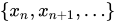
















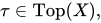













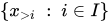

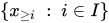




















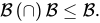














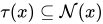
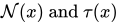


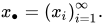












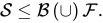








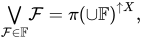


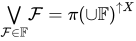







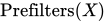



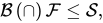



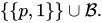






















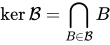
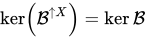










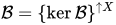





















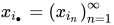































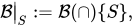
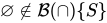














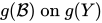











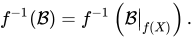


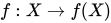



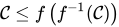



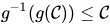
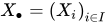
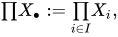


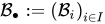


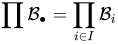
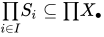


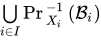


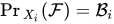












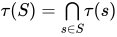



















![{\displaystyle \ker {\mathcal {B}}=[0,1]}](https://wikimedia.org/api/rest_v1/media/math/render/svg/72ef72c0dd16d613076c656551df5906947f55c9)
![{\displaystyle {\mathcal {N}}([0,1])\leq {\mathcal {B}}.}](https://wikimedia.org/api/rest_v1/media/math/render/svg/1d0b656a5a4dfcfc4d0a3330a06e6b8bceff2563)

![{\displaystyle [0,1]}](https://wikimedia.org/api/rest_v1/media/math/render/svg/738f7d23bb2d9642bab520020873cccbef49768d)




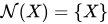


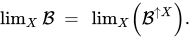

![{\displaystyle \{(-\infty ,0],[0,\infty )\}}](https://wikimedia.org/api/rest_v1/media/math/render/svg/196ee6a812b6e2ac0b2ba6e58465087dfafdee16)









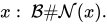


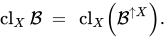
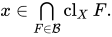
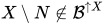



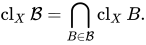

















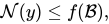










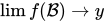
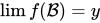
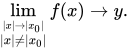







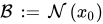
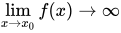
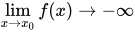

![{\displaystyle (-\infty,\mathbb{R}]\leq f\left({\mathcal{N}}\left(x_{0}\right)\right).}](https://wikimedia.org/api/rest_v1/media/math/render/svg/9cc9c44b90dba9d0460163bba945ce52441a117c)


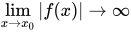







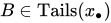









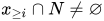

































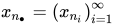










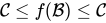


![{\displaystyle X:=[\mathbb {N} \times \mathbb {N} ]\cup \{(0,0)\}}](https://wikimedia.org/api/rest_v1/media/math/render/svg/0b522b493bb431cd1ec7e957b7d3aa0eaa57d749)
















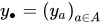













































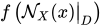
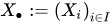











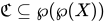



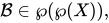
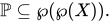















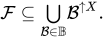












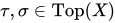






















![{\displaystyle W:=[\{2,3,\ldots \}\times \mathbb {N} ]\cup \{(0,0)\}}](https://wikimedia.org/api/rest_v1/media/math/render/svg/b54a9c02b38e85752b8911f7c0388a83c0099ac6)