
Loading article…
_Galeries_Royales_St_Hurbert,_Brussels.jpg/500px-(Belgium)_Galeries_Royales_St_Hurbert,_Brussels.jpg)
消費者行動は、個人、グループ、組織、および商品やサービスの購入、使用、処分に関連するすべての活動を研究する学問です。消費者行動は、消費者の感情、態度、好みが購買行動にどのように影響するかで構成されます。消費者行動は、1940~1950年代にマーケティングの明確なサブ分野として登場しましたが、心理学、社会学、社会人類学、人類学、民族誌学、マーケティング、経済学(特に行動経済学)の要素を融合した学際的な社会科学になりました。
消費者行動の研究では、人々の欲求や消費パターンを理解するために、人口統計、性格のライフスタイル、行動変数(使用率、使用機会、忠誠心、ブランド支持、紹介の意思など)などの個人の特性について正式に調査します。消費者行動では、家族、友人、スポーツ、参照グループなどの社会的グループから社会全体(ブランドインフルエンサー、オピニオンリーダー)に至るまで、消費者への影響についても調査します。
消費者行動は予測不可能なため、マーケティング担当者や研究者は、顧客パターンの分析に、顧客関係管理(CRM) データベースとともに、民族誌学、消費者神経科学、機械学習を使用しています。これらのデータベースから得られる膨大なデータにより、顧客ロイヤルティ、再購入意向、紹介やブランド支持者になるなどの行動に影響を与える要因を詳細に調査できます。さらに、これらのデータベースは市場セグメンテーション、特に行動セグメンテーションに役立ち、ターゲットを絞ったパーソナライズされたマーケティング戦略の作成が可能になります。
消費者行動の起源
1940年代と1950年代、マーケティングはいわゆる古典派の思想に支配されていました。これは非常に記述的で、インタビュー法をたまにしか使わず、ケーススタディのアプローチに大きく依存していました。1950年代の終わりには、2つの重要なレポートで、マーケティングは方法論的厳密さに欠け、特に数学志向の行動科学研究法を採用していないと批判されました。[1]消費者行動主義の視点を採用することで、マーケティングがより学際的になる準備が整いました。
1950年代から、マーケティングは経済学から他の分野、特に社会学、人類学、臨床心理学などの行動科学へと依存を移し始めました。これにより、分析の単位として顧客が新たに重視されるようになりました。その結果、オピニオンリーダーシップ、参照グループ、ブランドロイヤルティなどのアイデアを含む新しい実質的な知識がマーケティング分野に追加されました。市場セグメンテーション、特に社会経済的地位(SES)指数と世帯ライフサイクルに基づく人口統計学的セグメンテーションも流行しました。消費者行動の追加により、マーケティング分野は理論開発とテスト手順に関してますます科学的洗練度を示しました。[2]
初期の消費者行動は動機づけ研究に大きく影響され、顧客理解を深め、1920年代、1930年代、1940年代には広告業界のコンサルタントや心理学の分野で広く使用されていました。1950年代までには、マーケティングは動機づけ研究者が使用するデプスインタビュー、投影法、主題統覚テスト、さまざまな定性的および定量的調査方法などの手法を採用し始めました。[3]最近では、学者は民族誌学、写真誘導法、現象学的インタビュー などの新しいツールセットを追加しました。 [4]これらに加えて、現代の研究では、神経画像研究やビッグデータ分析などの革新的なアプローチを取り入れて、消費者行動の複雑さをさらに掘り下げています。これらの最新のツールは、潜在意識の消費者の動機と意思決定プロセスに対するより深い洞察を提供します。[5]今日、消費者行動(愛称CB)はマーケティングにおける重要なサブ分野とみなされており、ほぼすべての学部マーケティングプログラムの学習単位として含まれています。
定義と説明
消費者行動とは、「商品やサービスの購入、使用、処分に関連するすべての活動、およびこれらの活動の前後に生じる消費者の感情的、精神的、行動的反応」を意味します。[6]消費者という用語は、個人の消費者だけでなく組織の消費者も指しますが、より具体的には、「商品やサービスの流通チェーンにおける、必ずしも購入者ではなく、最終ユーザー」を指します。 [7]消費者行動は 、次のことに関係しています。[8]
- 購入活動: 商品やサービスの購入、消費者が商品やサービスを入手する方法、情報検索、商品やサービスの評価、購入体験を含む支払い方法など、購入決定に至るまでのすべての活動
- 使用または消費活動:誰が、どこで、いつ、どのように消費するか、また、象徴的な関連性や家族や消費単位内での商品の分配方法を含む使用経験に関するもの
- 廃棄活動:消費者が製品や包装を廃棄する方法に関係します。eBayや中古市場などの再販活動も含まれる場合があります。
消費者の反応は次のようになるだろう: [9]
- 感情的(または情緒的)反応:気持ちや気分などの感情を指す。
- 精神的(または認知的)反応:消費者の思考プロセス、
- 行動的(または意欲的)反応:商品やサービスの購入および処分に関する消費者の観察可能な反応を指します。
アメリカマーケティング協会によると、消費者行動は「人間が生活のさまざまな側面をやり取りする感情と認知、行動、環境イベントの動的な相互作用」と定義できます。
研究分野として、消費者行動は応用社会科学である。消費者行動分析とは、「通常は実験的に得られた行動原理を用いて、人間の経済的消費を解釈する」ことである。学問分野として、消費者行動は経済心理学とマーケティング科学の交差点に位置する。[10]
購入の決定とその背景

購買行動と消費行動を理解することは、マーケティング担当者にとって重要な課題です。消費者行動は、最も広い意味では、購入の決定がどのようになされるか、そして製品やサービスがどのように消費または体験されるかの両方を理解することに関係しています。消費者は積極的な意思決定者です。彼らは、多くの場合、可処分所得や予算に基づいて、何を購入するかを決定します。彼らは、予算やその他のさまざまな要因に関連して、好みを変えることがあります。[11] [12] [13]
購入の決定には、競合する選択肢の中から選択するための広範な情報検索を含む、長く詳細なプロセスを伴うものがあります。[14]その他の購入決定では、消費者の実務では、時間、知識、交渉能力の不足に基づいて、消費者は非常に複雑な決定を下す必要があります。[15]衝動買いや習慣的な購入などは、情報検索に時間や労力をほとんどまたはまったく投資することなく、ほぼ瞬時に行われます。
購入の決定には、グループ (家族、世帯、企業など) によって行われるものもあれば、個人によって行われるものもあります。世帯などの小グループによって購入の決定が行われる場合、グループのさまざまなメンバーが決定プロセスのさまざまな段階に関与し、さまざまな役割を果たすことがあります。たとえば、ある人は購入カテゴリを提案し、別の人は製品関連の情報を検索し、さらに別の人は実際に店舗に行き、製品を購入して家に持ち帰ることがあります。次のような決定役割の種類について考えるのは通常です。

- イニシエーター
- 対価(見返り)と引き換えにブランド(または製品)を提案する人。
- インフルエンサー
- 特定のブランドを推奨する人。
- 決定者
- 最終的な購入決定を行う人。
- 購入者
- 注文または物理的に購入する人。
- ユーザー
- 製品を使用または消費する人。[16]
ほとんどの購入決定において、それぞれの決定役割を担う必要がありますが、必ずしも同じ人が担う必要はありません。例えば、家族で外食する場所を決める場合、親が料理する気にならないとほのめかすことで、そのプロセスを開始するかもしれません。子どもは全体的な購入決定において重要な影響力を持つ存在ですが、両親が共同決定者として、受け入れられない選択肢を拒否し、より受け入れやすい選択肢を奨励することで、ゲートキーパーの役割を果たすこともあります。幅広い購入状況において、子どもが影響力を持つことの重要性を過小評価すべきではなく、この現象は「しつこいパワー」として知られています。[17]
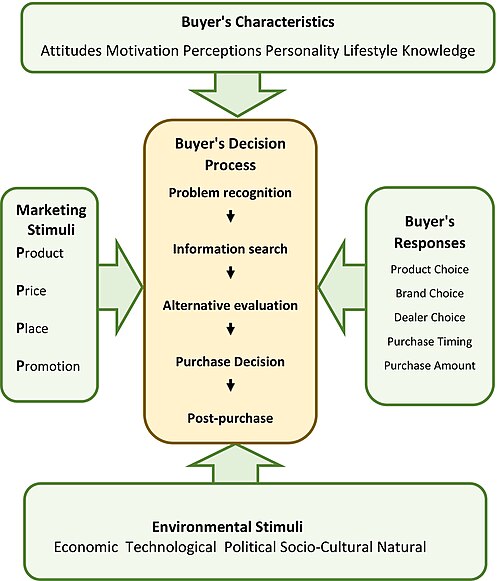
購買決定に使用される精神プロセスにアプローチするために、一部の著者はブラックボックスの概念を採用しています。これは、消費者が購入決定時に使用する認知プロセスと感情プロセスを表しています。意思決定モデルは、ブラックボックスをより広い環境に位置付け、外部刺激と内部刺激(例:消費者特性、状況要因、マーケティングの影響、環境要因)と消費者反応の相互作用を示します。[18]ブラックボックスモデルは、行動主義のブラックボックス理論に関連しており、焦点は消費者内部で発生するプロセスを超えて、刺激と消費者の反応の 関係も含まれます。
意思決定モデルは、購入の意思決定が真空中で行われるのではなく、リアルタイムで行われ、外部環境刺激や消費者の瞬間的な状況などの他の刺激の影響を受けると想定しています。モデルの要素には、対人刺激(人々の間で)または個人内刺激(人々の内部)、環境刺激、マーケティング刺激が含まれます。[19] マーケティング刺激には、企業が計画して実行するアクションが含まれますが、環境刺激には、より広い事業環境で発生するアクションまたはイベントが含まれ、社会的、経済的、政治的、文化的な側面が含まれます。さらに、購入者のブラックボックスには、購入者の反応に影響を与える購入者の特性と意思決定プロセスが含まれます。

問題認識
購入決定プロセスの第一段階は、問題認識(カテゴリーニーズまたはニーズ喚起とも呼ばれる)から始まります。これは、消費者がニーズを特定する段階であり、通常、消費者の現在の状態と望ましい状態または理想的な状態の違いとして定義されます。問題認識についてもっと簡単に考えると、消費者が何らかのニーズや欲求を満たす製品またはサービスを求めて「市場にいる」と決定する段階です。根底にあるニーズの強さが、意思決定プロセス全体を左右します。[20]
理論家は、購入決定に関連する問題解決状況を3つの大まかなクラスに分類しています。[21]
- 広範囲にわたる問題解決
- より慎重な検討、より広範な情報検索、代替案の評価を必要とする購入。これらは通常、高価な購入、またはファッションや車など社会的に認知度の高い購入です。
- 問題解決能力の限界
- 既知または馴染みのある購入、定期的な購入、直接の再購入。通常は低価格のアイテムです。
- ルーチン化された問題解決
- 繰り返し購入または習慣的な購入
消費者は次のようなさまざまな方法で問題に気づきます。[22]

- 在庫切れ/自然減
- 消費者が消耗品の在庫を補充する必要がある場合(例:牛乳やパンがなくなった場合)。
- 定期購入
- 消費者が新聞や雑誌などの商品を定期的に購入する場合。
- 不満
- 消費者が現在の製品またはサービスに満足していない場合。
- 新たなニーズや要望
- ライフスタイルの変化は、新たなニーズの特定につながる可能性があります。たとえば、赤ちゃんが生まれると、赤ちゃん用のベビーベッド、ベビーカー、チャイルドシートの購入が促されることがあります。
- 関連製品
- 1 つの製品を購入すると、アクセサリ、スペアパーツ、または補完的な商品やサービスが必要になる場合があります。たとえば、プリンターを購入するとインク カートリッジが必要になります。デジタル カメラを購入するとメモリ カードが必要になります。
- マーケターによる問題認識
- マーケティング活動によって消費者に問題(通常は消費者が気づいていない問題)を認識させる場合、従来のメディアやソーシャルメディアで意識的または無意識的に消費されるコンテンツは、消費者が新しいニーズを認識するための刺激として大きな役割を果たします。
- 新製品または新カテゴリー
- 消費者が、ニーズを満たす優れた手段を提供する革新的な新製品に気付いたとき。ワイヤレス通信デバイスの出現などの破壊的技術は、新しいマウスやプリンターなど、さまざまな製品に対するニーズを引き起こす可能性があります。
情報検索

情報検索と評価の段階では、消費者は購入の選択肢となるブランド(または製品)をいくつか見つけ出すためのプロセスを実行します。通常、消費者はまず内部検索を行い、記憶をスキャンして適切なブランドを探します。想起セットとは、消費者が記憶から引き出すことができるブランドのセットであり、通常は3~5個の選択肢からなる非常に小さなセットです。[23]消費者は、インターネット、メーカー/ブランドのWebサイト、買い物、製品レビュー、仲間からの紹介などのソースを使用して外部検索を実行し、想起セットのブランド数を補充することもできます。情報の入手が容易になったことで、消費者の情報量、つまり、市場で何が入手可能で、どのような特性があり、どのような価格で入手できるかを消費者がどの程度知っているかが向上しました。[24]
消費者がブランドを認識しているという事実は、必ずしもそのブランドが購入の候補として検討されていることを意味するわけではない。例えば、消費者は特定のブランドを認識しているが、そのブランドに対して好意的ではないかもしれない(無関心集合と呼ばれる)。そのようなブランドは通常、購入の選択肢としてさらに評価されることから除外される。他のブランドについては、消費者は無関心な感情を抱いているかもしれない(不活性集合)。[25]消費者が実際の購入に近づくと、彼らはブランドの心の中のリストを、現実的な購入の選択肢を表す一連の選択肢にまとめ上げ、これを考慮集合と呼ぶ。[26] 定義上、考慮集合とは「消費者が購入の決定をする際に細心の注意を払うブランドの小さな集合」を指す。[27]これは最終的に、購入の有力な候補となる選択肢を含む選択集合につながる。 [28]
特定のブランド名は、消費者の購買目的をどの程度満たしているか、および/または購入決定時にブランドが顕著であるか、またはアクセスしやすいかに基づいて、消費者の検討対象セットに入ります。[29]暗に、記憶に残るブランド名はアクセスしやすい可能性が高くなります。伝統的に、広告とプロモーションの主な役割の 1 つは、ブランド名が消費者の想起セットに含まれる可能性を高めることでした。[30]集中的な広告を通じてブランド名に繰り返し触れることは、トップオブマインドブランド認知を高めるための主な方法でした。しかし、インターネットの出現により、消費者はさまざまなプラットフォームからブランド/製品情報を取得できるようになりました。実際には、消費者はもはや記憶に完全に依存していないため、検討対象セットは購入決定プロセスでより大きな重要性を帯びています。これがマーケティングであり、「企業が顧客のために価値を創造し、強力な顧客関係を構築して、その見返りに顧客から価値を獲得するプロセス」と定義できます。[31]この定義は、関係が交換と価値の「創造」の上に築かれることを強く示唆している。つまり、消費者のニーズが構築され、ユーザーの消費パターンや行動や習慣の分析研究を通じて製品が消費者に提示または宣伝される。マーケティング担当者にとっての意味は、関連するブランド情報は可能な限り広く普及し、従来のメディアであれデジタルメディアのチャネルであれ、消費者が製品やブランド情報を検索する可能性のあるあらゆるフォーラムに含まれるべきである。したがって、マーケティング担当者は、典型的な消費者のタッチポイントについて十分に理解する必要がある。
代替案の評価

消費者の評価は、明確な段階として捉えることもできる。あるいは、評価は意思決定プロセス全体を通じて継続的に行われることもある。消費者は、提供される機能的(功利的とも呼ばれる)利益と心理社会的(価値表現的または象徴的とも呼ばれる)利益の観点から選択肢を評価する。[32]
- 機能的利点とは、味や外観など、消費者が体験できる具体的な成果です。
- 心理社会的利益は、高価なスーツやデザイナーブランドの服を着たり、「ホット」な車を運転したりすることで得られる社会的通貨など、ブランドのより抽象的な結果または性格に関連した属性です。
ブランドイメージ(またはブランドパーソナリティ)は、重要な心理社会的属性です。消費者は、特定のブランドについて肯定的な信念と否定的な信念の両方を持つことができます。[33]かなりの研究によると、消費者は自分のパーソナリティと一致するブランドを好む傾向があり、良い一致はブランド選好、ブランド選択、ブランドに対する満足度、ブランドへのコミットメントと忠誠心、そして消費者が肯定的な口コミ紹介をする傾向に影響を与える可能性があります。[要出典]ブランドのパーソナリティと消費者のパーソナリティの一致を調査する消費者行動の分野は、自己一致研究として知られています。 [34]ブランドのソーシャルメディアでの存在感はこの段階で大きな役割を果たし、その効果は次のように説明されています。「通常のメディアを、新聞を読んだりテレビの報道を聞いたりできる一方通行の道と考えてください。しかし、その問題について自分の考えを伝える能力は非常に限られています。一方、ソーシャルメディアは双方向の道であり、コミュニケーション能力も与えてくれます。」[35]ブランドや製品カテゴリーに関する消費者の信念は、消費者の過去の経験や選択的認識、歪曲、保持の影響など、さまざまな要因によって変化する可能性があります。カテゴリーについての知識があまりない消費者は、機能的特性に基づいてブランドを評価する傾向があります。しかし、消費者の知識が増えると、機能的属性は減少し、消費者はブランドに関するより抽象的な情報、特に自己関連の側面を処理するようになります。[36]
マーケティング組織は、消費者が最も重視するメリットを深く理解する必要があり、したがって、消費者の購入決定に関してどの属性が最も重要であるかを把握する必要があります。また、自社ブランドの計画を最適化するために、顧客の検討対象セットにある他のブランドを監視する必要があります。代替品の評価中、消費者は利用可能なさまざまなオプションの相対的なメリットをランク付けまたは評価します。消費者は、すべての購入状況にわたって普遍的な評価プロセスを使用していません。[37]代わりに、消費者はそれぞれの固有の購入状況に応じて異なる評価基準を生成します。ソーシャルメディアにより、消費者は購入を検討している製品に関する意見を仲間と共有することもできます。[38]このようにして、消費者は各代替品の良い面と悪い面を判断し、購入する最良の製品についてさらに便利に決定できます。したがって、関連する評価属性は、さまざまなタイプの消費者と購入コンテキストによって異なります。たとえば、レストランを評価するために重要な属性には、食品の品質、価格、場所、雰囲気、サービスの品質、メニューの選択が含まれます。消費者は、地理的、人口統計的、心理的、行動的特性に応じて、どの属性が自分にとって重要かを決定します。快適な食事体験を求める潜在的な常連客は、より実用的な飲食店で手早く食事を済ませたい人よりも、高級レストランを利用するために遠くまで出向くかもしれない。消費者はさまざまな製品属性を評価した後、各属性または利点を重要度の高いものから最も重要でないものにランク付けする。これらの優先順位は、消費者のニーズと欲求に直接関係している。[39]このように、消費者は各製品またはブランドに対して加重スコアを算出し、これは個々の属性スコアを重要度で加重した消費者の主観的評価を表す。これらのスコアを使用して、検討中の各製品/ブランドの合計メンタルスコアまたはランクを算出します。[40]
購入決定
選択肢が評価されると、消費者は実際に購入に進む決意を固めます。たとえば、消費者は「そうだ、いつかブランド X を買う」と自分に言い聞かせるかもしれません。この購入への自己指示は購入意思と呼ばれます。購入意思は、売上を予測する強力な指標ですが、不完全なものです。購入意思が実際の購入に結びつかない場合もあり、これはマーケティングの問題を示唆している可能性があります。[41]たとえば、消費者は新製品を購入したいと思っても、その製品を取り扱っている小売店を知らないため、購入に進むことができません。購入意思が実際の売上にどの程度つながるかは、売上コンバージョン率と呼ばれます。[42]

企業は、コンバージョン率を向上させるためにさまざまな手法を使用しています。簡単なクレジットや支払い条件の提供は、購入を促す可能性があります。景品を受け取ったり、コンテストに参加したりする機会などの販売促進は、購入を後日に延期するのではなく、今すぐ購入する動機となる可能性があります。強力な行動喚起を伴う広告メッセージは、顧客をコンバージョンするために使用するもう 1 つの手段です。[43]行動喚起とは、即時の販売を促すように設計された手段です。[44]通常、行動喚起には、広告または売り込み文句に「今すぐ購入してください! 」や「待たないでください!」などの命令形の動詞を使用する特定の文言が含まれます。他の種類の行動喚起は、期間限定のオファー (例:「オファーはまもなく終了します」、「在庫が限られています」) や、通常は時間制限を伴う特別オファー (例:「午前 0 時までに注文すると、注文と一緒に無料ギフトがもらえます」、「先着 50 名様限定で 1 つ分の価格で 2 つ」) など、消費者にすぐに購入する強い理由を提供する場合があります。さらに、サービスの利便性は、顧客が商品やサービスを購入するために行う活動を最小限に抑えるという点で、労力の節約にもなります。[45]強力な行動喚起の鍵は、購入の決定を先延ばしにするのではなく、すぐに購入する説得力のある理由を消費者に提供することです。
消費者が実際に購入の決定に近づくと、個人的な情報源に頼る可能性が高くなります。[46]このため、個人販売員は、販売の売り込み方や販売を成立させるための戦術に精通していなければなりません。使用される方法には、「社会的証拠」が含まれる場合があります。これは、販売員が製品を購入した他の顧客の過去の成功と満足度に言及するものです。「希少性の魅力」は別のテクニックで、販売員がオファーが限られていることを言及することで、消費者はより迅速に決定を下すようになり、代替品を評価する時間を短縮できます。[47]
購入後の評価
消費者は商品やサービスを購入し、体験した後、最終段階である購入後評価に入ります。フォックスオールは、購入後評価は将来の購入パターンや消費活動に影響を与えるため、マーケティング担当者に重要なフィードバックを提供できると示唆しました。[48] [49]
購入後の段階では、消費者は価格、機能、品質などの製品の特徴を自分の期待と比較します。[50]購入後の評価は、消費者が期待と知覚価値を関連付け、その商品やサービスの次の購入決定に影響を与えるために取るステップと見ることができます。[51]たとえば、消費者が新しい携帯電話を購入し、購入後の評価が肯定的であれば、将来同じブランドまたは同じ会社から購入するようになります。これは「購入後の意図」とも呼ばれます。[52]逆に、消費者が新しい携帯電話に不満がある場合は、不満を解決するための行動を取る可能性があります。この場合の消費者の行動には、払い戻しの要求、苦情の申し立て、将来同じブランドまたは同じ会社から購入しないことの決定、さらにはソーシャルメディアを介して友人や知人に否定的な製品レビューを広めることなどが含まれます。
消費者は、購入、消費、処分の後に、下した決定に関して何らかの不確実性を感じ、場合によっては後悔することがある。決定後不協和[53] (認知的不協和とも呼ばれる)とは、購入後の段階で生じる不安感であり、購入時に正しい決定が下されたかどうかについての不安な気持ちや懸念である。[54]例えば、消費者の中には、検討していた他のブランドの1つを購入しなかったことを後悔する人もいる。この種の不安は、消費者のその後の行動に影響を与え、リピート率や顧客ロイヤルティに影響を及ぼす可能性がある。
消費者は購入後の不協和を減らすためにさまざまな戦略を使います。典型的な戦略は、購入の選択の正当性を仲間や大切な人に求めることです。顧客は常に友人や家族の意見に導かれてきましたが、今日ではこれはソーシャルメディアのいいね、レビュー、推薦文によって裏付けられています。マーケティングコミュニケーションは、消費者にブランドXを購入することで賢明な選択をしたことを思い起こさせるためにも使用できます。[55]
消費者が選択したオプションと放棄したオプションとの間で不利な比較をすると、決定後の後悔、つまり「買い手の後悔」を感じることがあります。消費者は、購入の決定を避けたときにも短期的な後悔を感じることがありますが、この後悔は時間の経過とともに消える可能性があります。消費者は経験を通じて学び、仮説検定と呼ばれるプロセスに参加することもできます。これは、以前の経験や口コミによるコミュニケーションを通じて、製品またはサービスに関する仮説を形成することを指します。仮説検定では、消費者が仮説生成、証拠の提示、証拠のエンコード、証拠の統合という 4 つの段階を経ます。
購入決定への影響
購買はさまざまな内部要因と外部要因の影響を受けます。
消費者の意識
消費者意識とは、長期的なショッピング環境や購買活動の中で消費者が購入する商品の消費に対する意識を指します。[56]
生活観の変化は消費者意識の変化の主観的要因である。人々の生活水準と所得が増加し続けるにつれて、人々の生活観は絶えず変化している。[57] 消費者の性格の違いは、消費者意識の変化の内的動機である。
市場競争の激化は、消費者意識の変化のきっかけとなっている。多くの企業は、競争が激化する市場で足場を固めるために、自社ブランド製品を発売している。[58]多様な商品やブランドを前に、消費者のブランド意識は成熟している。人々が商品を購入する際、ブランドに注目することが流行となっている。厳しい競争状況に直面して、企業はブランド戦略を実施することの重要性を認識し始め、市場調査に重点を置き、これに基づいて消費者の心理的脈動を深く把握し、市場シェアとブランドロイヤルティを向上させ始めた。[59] 人々の生活観の変化に伴い、消費者の合理的な消費心理がますます顕著になっている。ソーシャルマーケティング、[60]カスタマイズマーケティング、[61]ブランドショッピング、[62]および消費者の商品価格に対する認識(消費者の価格に対する感受性として直接表現される)はすべて、消費者の態度を理解するための主な要因であり、価格変化に対する市場需要の反応を説明するのに役立つ。[63]
購入決定に対する内部の影響
内部の影響とは、個人的な要因と対人関係の要因の両方を指します。社会理論では、個人には個人のアイデンティティと社会的アイデンティティの両方があるとされています。個人のアイデンティティは、スキルや能力、興味、趣味などの独自の個人的特徴で構成されています。社会的アイデンティティは、個人が属する中心グループに対する個人の認識で構成され、年齢層、ライフスタイルグループ、宗教グループ、教育グループ、またはその他の参照グループを指す場合があります。社会心理学者は、所属の必要性は人間の基本的なニーズの1つであることを確認しました。[64]したがって、購買行動は、心理的、社会経済的、人口統計学的、性格的要因など、幅広い内部要因の影響を受けます。人口統計学的要因には、所得水準、心理統計学的(ライフスタイル)、年齢、職業、社会経済的地位が含まれます。性格的要因には、知識、態度、個人的価値観、信念、感情、および気持ちが含まれます。心理的要因には、個人の動機、態度、個人的価値観、信念が含まれます。社会的アイデンティティ要因には、文化、サブカルチャー、および参照グループが含まれます。購入の決定に影響を与える可能性のあるその他の要因としては、環境や、消費者のカテゴリやブランドに関する過去の経験などが挙げられます。
動機と感情

消費者の根底にある動機は、情報検索や購入決定などの消費者行動を左右する。消費者のブランドに対する態度(またはブランド嗜好)は、ブランドと購入動機を結びつけるものとして説明される。[65]これらの動機は、ネガティブなもの(痛みや不快感を避けるため)もあれば、ポジティブなもの(感覚的満足感などの何らかの報酬を得るため)もある。[66]
動機を理解するための一つのアプローチは、アブラハム・マズローによって開発されました。マズローの欲求階層は、重要度に応じて整理された 5 つの欲求レベルに基づいています。
マズローの5つの欲求は以下の通りである: [55]
- 生理学的
- 食料、水、睡眠などの基本的なニーズ
- 安全性
- 物理的な安全、避難所、セキュリティの必要性
- 所属
- 愛、友情、そして集団からの承認を求める欲求
- 尊敬
- 地位、認知、自尊心への欲求
- 自己実現
- 自己実現の欲求(例:個人的な成長、芸術的表現)
生理的欲求と安全欲求は、いわゆる低次の欲求です。消費者は通常、帰属、尊重、自己実現などの高次の欲求が意味を持つようになる前に、これらの低次の欲求を満たすためにほとんどのリソース(時間、エネルギー、資金)を費やします。マーケティングプログラムの一部には、特定の製品を選択する動機を理解することが必要です。マーケティングコミュニケーションは、製品やブランドがこれらのニーズをどのように満たしているかを示すことができます。[58]マズローのアプローチは、さまざまな状況での人間の動機を理解するための一般化されたモデルですが、購入決定に特有のものではありません。
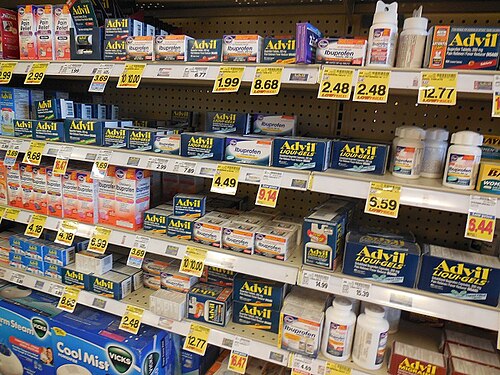

別のアプローチでは、以下の表に示すように、購入の意思決定を促す8つの購入動機、5つの否定的な動機と3つの肯定的な動機を提案しています。 [66]これらの動機は、肯定的な強化または否定的な強化をもたらすと考えられています。[67]
マーケティング文献では、消費者が情報を検索し、購入決定プロセスに参加する動機は、関与と呼ばれることがあります。[68]消費者の関与は、「メッセージ(または決定)の個人的な関連性または重要性」と定義されています。[69]消費者が悪い決定を下した場合に心理社会的損失が小さい場合、購入決定は低関与に分類されます。一方、心理社会的リスクが比較的高いと認識されている場合、購入決定は高関与に分類されます。 [70]消費者の関与レベルは、悪い決定を下した場合に否定的な結果が生じるリスクの認識、製品の社会的認知度、および消費者の製品カテゴリに関する以前の経験など、いくつかの要因に依存します。[71]
感知
マーケティング戦略の一部は、消費者が外部の情報源から知識を得て情報を使用する方法を確認することです。知覚プロセスとは、個人が情報を受け取り、整理し、解釈して何らかの意味を付与することです。知覚には、情報の感知、情報の選択、情報の解釈という 3 つの異なるプロセスが含まれます。感覚も知覚プロセスの一部であり、ブランド名、広告、パッケージに対する何らかの反応を生み出す感覚からの反応に直接結びついています。知覚のプロセスは個人によって異なり、経験、期待、ニーズ、瞬間的な状況などの内部要因と外部要因の組み合わせによって左右されることがあります。
刺激にさらされると、消費者は個々の知覚プロセスにより、まったく異なる方法で反応する場合があります。[55]多くのプロセスが知覚をサポートまたは妨害する可能性があります。選択的露出は、消費者が情報入力にさらされるかどうかを決定するときに発生します。選択的注意は、消費者が他のメッセージを排除して一部のメッセージに集中するときに発生します。 選択的理解は、消費者が自分の信念と一致する方法で情報を解釈することです。選択的保持は、消費者が一部の情報を覚えている一方で、他の情報を急速に忘れるときに発生します。[72]選択的露出、注意、理解、保持のプロセスを総合すると、個々の消費者は特定のメッセージを他のメッセージよりも好むようになります。消費者が情報入力を組み合わせて購入決定に至る方法は、統合として知られています。[73]
マーケターは、ブランド、パッケージ、製品の配合、ラベル、価格設定に対する消費者の認識に関心がある。特に興味深いのは、刺激における認識の閾値(ちょうど知覚できる差異としても知られる)である。例えば、消費者がお買い得だと認識するには、マーケターは価格をどれくらい下げるべきか?[74]さらに、世界市場への参入を計画しているマーケターは、認識における文化的な違いに注意する必要がある。[75]例えば、西洋人は白色を純粋さ、清潔さ、衛生と関連付けるが、東洋諸国では白色はしばしば喪や死と関連付けられる。したがって、アジアで販売される製品の食品ラベルに白色のパッケージは不適切な色の選択となる。
象徴的な消費者行動
象徴的消費は消費者行動の内部的な影響となり、特別なシンボルを形成します。消費シンボルは、消費者をグループのメンバーまたはユニークな個人として説明するために使用できます。[76]消費者の消費行動は、物質的および心理的な消費だけではありません。象徴的消費には2つの意味があります。 1. 消費のシンボル。消費は、特定の意味とメッセージを表現し、伝達します。文化から派生した意味により、製品を使用してさまざまな社会グループへのメンバーシップを象徴することができます。[77]この象徴的消費は、社会的表現と社会的コミュニケーションのプロセスです。 2. 象徴的消費:人々は商品自体だけでなく、気分、美しさ、グレード、ステータス、地位、雰囲気、スタイル、感情的な魅力など、商品によって象徴または表される特定の文化的および社会的意義も消費します。象徴的消費は通常、ブランド消費に反映されます。ブランドは、消費者にとって機能的価値、象徴的価値、経験価値の3つの機能を持ちます。高級ブランドを例に挙げましょう。高級ブランドの力は、アイデンティティを伝える能力だけではありません。一部の消費者は印象を与えたいと考えています。高級品はかつて貴族の日常品であったが、現代の社会階級の概念が曖昧になった後も、消費者はそれを上流階級に入るためのチケットとみなしていた。消費者は、それが私たちのアイデンティティとどのように一致しているかに基づいてブランドを評価し、それが私たちの自己概念を定義し維持するのに役立ちます。[78]高貴な地位、富、成功の象徴として、それは消費者のアイデンティティとステータスシンボルになりました。
これまでの経験
消費者のカテゴリー、製品、またはブランドに関する過去の経験は、購入の意思決定に大きな影響を与える可能性があります。経験豊富な消費者(専門家とも呼ばれる)はより洗練された消費者です。彼らはより熟練した情報検索者であり、より広範な情報源を調査し、複雑なヒューリスティックを使用して購入オプションを評価する傾向があります。一方、初心者の消費者は情報検索が効率的ではなく、ブランドやカテゴリーに馴染みがないため、より高いレベルの購入リスクを認識する傾向があります。消費者が過去の経験を持っている場合、情報を検索する動機は少なく、情報検索に費やす労力は少なくなりますが、新しい情報をより効率的に処理できます。[79]たとえば、ある研究では、消費者の経験が増えるにつれて、消費者はより幅広い購入の選択肢を検討する(つまり、より大きな検討セットを生成するが、製品カテゴリーレベルのみ)ことがわかりました。[80]
ランダム係数
ランダム要因とは、消費者が購入する際に起こる特別な機会や一連のランダムな状況を指します。消費者の購入決定は予期せぬ状況で行われる場合もあれば、状況によって人々の意思決定プロセスが遅れたり短縮されたりする場合もあります。研究によると、消費者がいたるところに存在しているシナリオを待つ場合、エリアカーペットや列のガイドラインなど、一見無関係に見える物理的な手がかりが、消費者の最初の決定を変える仮想的な境界として機能する可能性があることがわかりました。[81]
購入決定に対する外部の影響
購買行動は、文化、サブカルチャー、社会階級、参照グループ、家族、状況決定要因 などの外部要因によっても影響を受ける可能性があります。
文化

文化は、外的要因の中で最も広範かつ抽象的なものである。文化とは、社会の構成員が共有する意味、価値観、規範、慣習を学ぶ複雑さを指す。文化的規範は時間の経過とともに比較的安定しているため、文化は消費者行動に大きな影響を与える。研究調査では、文化が購買のほぼすべての側面に影響を与えることが一貫して示されている。文化は、自己同一性や動機付けなどの基本的な心理的領域、情報の処理方法、広告メッセージの解釈方法に影響を与えている。[82]さらに、知覚価値と幸福は、消費者の態度や行動意図を形成する上で重要である。[83]
消費行動の文化的選択には、決定的な外部要因(全体的な社会文化的雰囲気)と決定的な内部要因(消費者の芸術的素質、美的追求、文化的価値観志向)があります。消費の文化的選択は、内外の2つの決定要因によって制限される必要があります。いわゆる社会文化的雰囲気は、消費雰囲気、習慣、流行が消費者に与える影響に体現されています。たとえば、世論が批判するあらゆる種類の拝金主義の消費は、俗悪な文化の影響です。いわゆる内部要因は、主に消費者が消費をどのような精神領域と価値観志向で扱っているかを指し、消費を通じて示されるのは何らかの文化的メンタリティです。
グローバル展開に関心のあるマーケティング担当者は、購買と消費における異文化間の違いを理解することに特に関心がある。例えば、世界のトップブランドの一つであるフェラーリは、中国の消費者が欧米の消費者とは非常に異なることを発見した。米国、英国、オーストラリアの消費者は、カスタムメイドのフェラーリを購入するのに12か月待つことを覚悟しているが、中国の見込み客はショールームで販売されている車をすぐに運転したいと考えている。中国は「即満足市場」である。購入者は友人が高級車に乗っているのを見て、できるだけ早く同じ車を手に入れたいと思う。高級品に対する需要の高まりに応えるため、フェラーリや他の高級車メーカーは、アジア市場向けに生産プロセスを変更せざるを得なくなった。[84]
サブカルチャー

サブカルチャーは、年齢、地理、宗教、人種、民族の違いに基づく場合があります。ただし、多くの場合、サブカルチャーは、共通の関心を持つ人々が独特のアイデンティティを持つ緩やかなグループ (消費者部族と呼ばれることもあります) を形成するときに発生します。サブカルチャーのメンバーは自発的に選択され、部族の他のメンバーに広く理解されているシンボル、儀式、または行動 (たとえば、服装規定、髪型、または独特の話し方) を採用することで、メンバーシップのステータスを示します。たとえば、若者文化では、スケーターやブレイダー、サーファー、レイバー、パンク、スキンヘッド、ゴス、ホーミーなど、共通の関心を持ついくつかのサブグループを識別することができます。一般的にコミュニティと呼ばれ、何か重要なものへの帰属意識を生み出します。
別のタイプのサブカルチャーは、共通のブランドや製品への共通のコミットメントに基づく消費サブカルチャーです。言い換えれば、消費サブカルチャーは人口統計、地理、社会の境界を越えたものです。消費サブカルチャーの最もよく知られた例は、ハーレーダビッドソンのオートバイ所有者です。ハーレーライダーを研究した民族誌研究者は、オートバイライダーにはハーレー所有者とそれ以外の人の2種類しかないと考えています。[85]ハーレーダビッドソンは、ハーレーオーナーグループ(HOG)を設立することで、このサブカルチャーの価値を活用しました。[86]

サブカルチャーは、いくつかの理由からマーケティング担当者にとって重要です。第一に、サブカルチャーは利益と影響力のある大きな市場セグメントを表す可能性があるため、サブカルチャーのメンバーのニーズを満たす製品やサービスを開発して販売することには明らかな利点があります。第二に、おそらくそれほど明白ではないかもしれませんが、多くの新しい流行やファッションは、これらの部族グループ内から自然に生まれます。したがって、トレンドスポッターは、新しいトレンドが主流になる前にそれを発見するために、部族のライフスタイルと活動を研究することに興味を持っています。
社会階級
社会階級とは、社会における比較的均質な区分を指し、通常は教育水準、収入、職業などの社会経済的変数に基づきます。社会階級の定義と測定は非常に難しい場合がありますが、世界中のマーケティング担当者は、特定の人口を 5 つの社会経済的五分位に分ける従来の分類を使用する傾向があります (例: オーストラリアでは AB、C、D、E、FG のグループで、AB が最上位の社会経済的五分位ですが、アジアの多くの国では五分位は I、II、III、IV、V と分類され、I が最上位の五分位です)。たとえばオーストラリアでは、AB 社会経済グループは人口のわずか 24% を占めるだけですが、裁量支出の 50% を管理しています。[87]上位5分の1(つまりAB社会経済セグメント)は、旅行、外食、娯楽、高級車、投資または資産管理サービス、高級家電、デザイナーブランド(ルイヴィトンなど)などの高級品やサービスのマーケティング担当者にとって特に興味深いものです。しかし、中流階級の消費者は、比較してより慎重に消費し、同じラインの異なる生産者を比較するために情報を収集する傾向があります。下層階級の消費者は、社会的地位を維持するために商品を購入する富裕層と比較して、衝動買いする傾向があります。[88]
参照グループ
参照グループとは、「個人の判断、意見、行動の根拠として、そのグループの想定される視点や価値観が使われているグループ」と定義されます。参照グループは、個人の態度、信念、価値観を導くために使われるため重要です。[58]消費者が特定の価値観をどのように獲得するかについての洞察は、グループの影響とグループの社会化プロセスを理解することで得られます。

文献では、参照グループを、一次的、二次的、願望的、解離的、形式的の 5 つの大まかなタイプに分類しています。
- 一次集団:家族など、態度や行動に強い影響を与える集団
- 二次グループ: クラブ、協会、スポーツチーム、政党、宗教など、個人の考えや価値観に合致するが、態度や行動の形成にそれほど根本的な影響を与えないグループ
- 憧れのグループとは、個人が現在は所属していないが、尊敬される特徴を持っているためメンバーになることを希望する可能性のあるグループです。
- 解離参照グループ- 否定的なイメージを持つグループ。個人は解離参照グループの価値観、態度、行動を不承認とし、そのようなグループから距離を置こうとすることがある。[54]
オピニオンリーダーは、製品に関する知識、専門性、信頼性により、社会的に大きな影響力を発揮するという点で、リファレンスグループのような役割を果たすことができます。マーケティング文献では、オピニオンリーダーはインフルエンサー、専門家、ハブとも呼ばれています。 [89]オピニオンリーダーは製品カテゴリに特化しているため、コンピューターのオピニオンリーダーがファッションのオピニオンリーダーになる可能性は低いです。通常、オピニオンリーダーは製品カテゴリに深く関わり、そのカテゴリを頻繁に使用し、そのカテゴリ内の新技術を早期に採用する傾向があります。ジャーナリスト、有名人、ブロガーは、幅広いソーシャルネットワークと人々の決定に影響を与える能力が高いため、オピニオンリーダーの良い例です。 [54]実際、最近の証拠は、ブロガーが有名人よりも重要なオピニオンリーダーのグループとして浮上している可能性があることを示唆しています。 [90]
マーケティング戦略においてオピニオンリーダーの価値を活用するためには、各カテゴリーや状況におけるユニークなオピニオンリーダーを特定できることが重要であり、これは非常に難しい場合があります。使用できる手法としては、主要情報提供者、社会測定法、自己質問票などがあります。[91]しかし、多くの場合、マーケティング担当者はオピニオンリーダーを特定するために直感を使用します。たとえば、運動靴のマーケティング担当者は、クラスのメンバーがインストラクターと同じブランドを採用することを期待して、ジムやエアロビクスのインストラクターに無料の靴を提供することが知られています。化粧品やスキンケア製品のマーケティング担当者は、自社製品がファッション雑誌で取り上げられることを期待して、定期的にファッションエディターに無料サンプルを提供しています。
COVID-19パンデミック中の消費者購買行動への影響
COVID-19パンデミックの間、外部要因と内部要因の結果として、特定の消費者の購買行動が顕著になったという証拠があります[92] 。具体的には、強迫買い、衝動買い、パニック買い、リベンジ買いなどの行動(パニック買いとリベンジ買いが最も顕著でした)は、パンデミックに対する消費者の否定的な反応を緩和するための対処戦略であることが証明されました。[93]
パニック買いは、危機や混乱を招く出来事をめぐる恐怖、不安、不確実性などの悪影響の結果として、消費者が通常よりも多くのものを購入するときに発生します。[94]このような購入は、認識された脅威に比べて過剰になる傾向があります。[95]パンデミックの間、食品や衛生用品などの必需品のパニック買いが世界中で増加しました。[93]特に、オーストラリアではトイレットペーパーの売上が前例のない急増に直面し、首相がコメントを出したことを考えてみてください。[96]パニック買いは、製品不足への不合理な恐怖と、切望されるアイテムを入手するための緊急性の高まりに対する反応であり、パンデミックの間、消費者は周囲の社会的、職業的、健康的環境に対するコントロールを失ったにもかかわらず、コントロール感を得ました。[95]
パンデミック中のパニック買いに加えて、COVID-19関連のロックダウン後に生活必需品以外の店舗が再開した時期には、リベンジ買いが顕著だった。[93]リベンジ買いは特に、実店舗の高級小売店で観察された。[93]例えば、中国広州のエルメス店舗は、ロックダウン後の開店初日に270万米ドルの売り上げを記録したと報告されており、消費者の購入品は、革製品、スカーフ、家庭用品からダイヤモンドをちりばめたバーキンバッグなど多岐にわたる。[97]
高級品の購入(ここでの「高級品」とは、高品質、高価、不必要なものと定義される[98])は、ポジティブな感情と結びついており、ネガティブな感情を補うために行われることが多い。[99]つまり、COVID-19パンデミックの間、人々はフラストレーションを感じ、心理的に不快感を覚えていたが、高級品の復讐的な購入は、感情的な解放感と帰属意識、自尊心、自己実現をもたらした。 [100]このような購入は、消費者にとって感覚的な満足感と問題回避を達成したと言える。[93]
消費者が外部の健康危機や社会的距離の確保対策への対応として、消費を通じて内なる幸福を得ようとしたことは明らかである。[101]パニック買いとリベンジ買いはどちらも補償的性質と治療的性質を持っており、消費者が内部でコントロールできない外部の状況をコントロールし、快適さ、安全、幸福感の向上を得ようとする試みであった。[93]
環境の動向により、人々は実店舗を避け、非接触を保つためにオンラインでの買い物が増え始めています。2020年には、顧客はビジネスウェアよりもスポーツウェアに多くのお金を使うようになり、Zoomなどのテレワーク関連のテクノロジー製品も以前よりも多くの消費者を抱えています。[102]
さらに、パンデミック後、人々の環境被害や地球を救う社会の責任に対する意識が高まり、パンデミック中に社会の買い物行動が変化したことを研究が示唆している。人々は、価格が高くても持続可能な製品を選ぶだろう。さらに、店舗やブランドは、持続可能なマーケティングを採用して新しいブランドイメージを構築し、顧客を引き付けることができる。[103]
カンナンとクルカルニは、COVID-19によって引き起こされたチャネル移行によって生じたいくつかの現象も示している。第一の現象は、特定のブランドのオンラインチャネルが制限されているため、顧客が新しいブランドや製品を試すことによりオープンになっていることである。第二の現象は、長期にわたるパンデミックによる制限により、当初はオフラインでの購入の代替としてオンラインチャネルを使用していた顧客が、今では日常生活でオンラインチャネルを効果的に使用する方法を学んでいることである。[102]
消費者の意思決定スタイル
.jpg/500px-Stockholm_2274_(3352866081).jpg)
多くの理論家は、特定の基本的な意思決定スタイルを特定できると主張している。[104] [105] 意思決定スタイルは、「消費者の選択に対するアプローチを特徴付ける精神的志向」と定義される。[106] スプロールズとケンドール(1986)は、価格感度、品質意識、ブランド意識、新奇性追求、ファッション意識、習慣など、8つの要素からなる消費者スタイルインベントリー(CSI)を開発した。これらの要素に基づいて、著者らは8つの異なる意思決定スタイルの類型を開発した。[107]
- 品質意識が高い/完璧主義者: 消費者が最高品質の製品を求めるという特徴があります。品質意識が高い消費者は、体系的に買い物をし、より多くの比較を行い、品質と価値を比較するために買い物をする傾向があります。
- ブランド意識: 高価な有名ブランドやデザイナーブランドを購入する傾向が特徴です。ブランド意識のスコアが高い人は、価格が高いほど品質が高いと信じる傾向があり、百貨店や一流小売店を好みます。ブランド意識の概念は、市場にある他のブランドとはまったく異なるブランドとその製品提供に対する認識と定義でき、競争上の優位性があります。消費者は、ブランド会社がその名前と製品についてどう思っているかを非常に気にしています。
- レクリエーション志向/快楽主義: 消費者が購入プロセスに積極的に関与する点が特徴です。レクリエーション志向のスコアが高い人は、買い物自体を楽しみの一種とみなします。
- 価格に敏感: 価格と価値に対する意識が特徴です。価格に敏感な買い物客は、より安い価格、セール、または割引を求めて慎重に買い物をし、お金に見合った最高の価値を得ることに動機づけられます。
- 新奇性/流行に敏感: 興奮のために新製品や新体験を求める消費者の傾向によって特徴付けられ、新しいものを求めることで興奮を得、流行やトレンドを常に把握しておくことを好みます。多様性の追求は、この側面と関連しています。
- 衝動性: 購入の決定をする際に不注意であること、衝動的な購入、支出レベルや価値の獲得に対する大きな関心の欠如が特徴です。衝動性のスコアが高い人は、認知レベルでも感情レベルでも対象に関心がない傾向があります。
- 混乱(選択過剰による) : 商品の選択肢が多すぎる、店舗が多すぎる、商品情報が多すぎることなどにより消費者が混乱する。情報過多の結果。
- 習慣的/ブランド忠実: 消費者が購入のたびに決まった購入パターンに従う傾向があることが特徴です。消費者はお気に入りのブランドや店舗を持ち、選択の習慣が形成されているため、購入の決定には多くの評価や買い物が伴いません。
消費者スタイルインベントリ(CSI)は、さまざまな国や購買状況で広範囲にテストされ、再テストされてきました。[108] 多くの実証研究で、意思決定スタイルには異文化間の差異が見られ、特定の国で使用するためにCSIスケールが何度も適応または修正されてきました。[109] 消費者の意思決定スタイルは、時間の経過とともに比較的安定した行動を記述し、市場セグメンテーションに役立つため、マーケティング担当者にとって重要です。[110]
消費者行動に関するその他のトピック

マーケティング担当者は、購入決定の理解に加えて、購入選択の前、最中、後に生じる消費者行動のさまざまな側面にも関心を持っています。特に関心のある分野には、リスク認識とリスク軽減活動、ブランド切り替え、チャネル切り替え、ブランド ロイヤルティ、顧客市民行動、ブランド支持、紹介、口コミ活動などの購入後の行動意図と行動などがあります。
リスク認識とリスク軽減活動
消費者のリスク認識は、購入決定の購入前段階での主要な考慮事項です。認識されたリスクは、「活動に従事することの不確実性と悪影響に関する消費者の認識」と定義されます。[111]リスクは、結果の重要性または重大性の程度を示す結果と、発生の可能性に関する消費者の主観的な評価である不確実性の2つの側面で構成されます。[ 112 ]たとえば、多くの観光客は、航空事故に巻き込まれる可能性は非常に低いものの、その結果が悲惨な可能性があるという理由で、飛行機での旅行を恐れています。
マーケティング文献では、さまざまな種類のリスクが特定されていますが、その中で最も頻繁に引用されるのは以下の5つです。[113]

- 財務リスク: 誤った判断をした場合に生じる可能性のある財務上の損失
- パフォーマンスリスク(機能リスクとも呼ばれる):製品またはサービスが意図したとおりに機能しないという考え
- 物理的リスク: 購入時に何か問題が発生した場合に、身体的危害を受ける可能性
- 社会的リスク:購入に伴う社会的地位の喪失の可能性
- 心理的リスク:購入によって自尊心が失われる可能性
消費者が購入にリスクがあると認識した場合、消費者は認識したリスクを許容できるレベルまで下げる戦略を実行するか、それができない場合は購入を中止します。[114]このように、消費者のリスク認識が情報検索活動を促進します。
サービスマーケティング担当者は、サービスには製品の検索属性(つまり、消費前に検査できる有形の特性)がないため、リスク認識はより高いと主張している。[115]リスク認識に関して、マーケティング担当者と経済学者は、消費者の評価プロセスに影響を与える、検索財、経験財、および信頼財という3つの広範な購入クラスを特定している。 [116]ほとんどの有形製品が含まれる検索財は、消費者が購入および消費する前に品質を評価できる有形特性を備えている。レストランやクラブなどの経験財は、購入または消費した後にのみ確実に評価できる。多くの専門サービスなどの信頼財の場合、消費者は購入および消費が行われた後でも、商品の品質を完全に理解することが難しい。消費後に品質を評価することが難しいのは、情報入手のコストが法外に高いため、または消費者がそのような評価を行うために必要なスキルと知識を欠いているために生じる可能性がある。これらの商品は、消費者の品質評価が製品メーカーやサービス提供者に対する信頼に完全に依存するため、信頼商品と呼ばれます。[117]
使用される典型的なリスク低減戦略には以下のものがある: [118] [119]
.jpg/500px-thumbnail.jpg)
- 広告とプロモーションメッセージ:広告メッセージを含む製品やブランド関連のプロモーションに細心の注意を払います。
- 買い物をする:オファーや価格を比較し、商品を検査する
- 有名ブランドを購入する:有名で評判の良いブランドを品質の高い商品の指標として使用する
- 評判の良い店で購入する:品質の指標として評判の良い小売店に頼る
- 製品レビュー:主要なメディア(新聞、雑誌など)に掲載されている、独立した専門家が書いた独立したレビューを読む
- オンライン製品レビューまたは消費者による推薦文: 他の消費者の体験談を読む (例: TripAdvisor、Amazon のカスタマー レビュー)
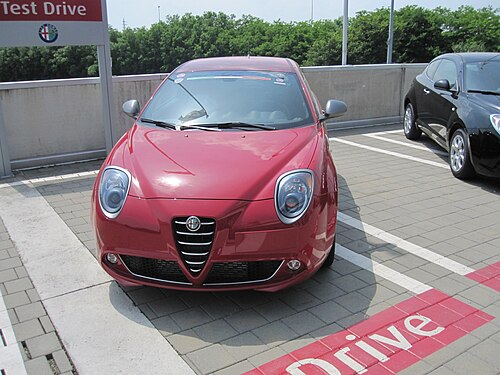
- サンプルまたは限定規模のトライアル: 可能な場合は、購入前にサンプル、無料トライアル、または「試乗」を入手します。
- メーカー仕様: メーカーが提供する情報(パンフレットや仕様など)を読む
- 紹介:友人や親戚からの紹介を得る
- 営業担当者:小売店の営業担当者と話す
- 製品保証: 正式な保証または保証書をお探しですか?
新製品の採用とイノベーションの普及
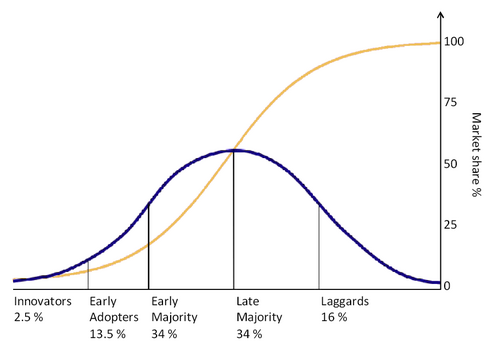
消費者行動の中で特に関心の高い分野は、革新的な新製品、サービス、アイデア、またはテクノロジーがグループを通じてどのように普及するかの研究です。イノベーションが人口を通じてどのように拡散 (つまり普及) されるかについての洞察は、マーケティング担当者が新製品の採用プロセスを迅速化し、普及プロセスのさまざまな段階でマーケティング プログラムを微調整するのに役立ちます。さらに、普及モデルは、新製品の導入を追跡できるベンチマークを提供します。
イノベーションの普及については、膨大な量の文献が出版されている。[120]研究調査は、一般的に普及のプロセス全般を理解しようとするアプローチである一般普及調査と、特定の製品の特定の時点または特定の社会コミュニティ内での普及を記述する研究からなる応用普及調査の2つの大まかなカテゴリーに分けられる傾向がある。[121]これらの研究を総合すると、採用プロセスには一定の規則性があることが示唆される。最初は少数のメンバーがイノベーションを採用するが、時間が経つにつれて、重なり合う波が次々と現れ、イノベーションを採用し始める。[122]このパターンは、右の図に示すように、一般的なS字曲線に寄与する。ただし、曲線の正確な形状とタイミングは製品市場によって異なり、一部のイノベーションは比較的急速に普及するが、他のイノベーションは幅広い市場で受け入れられるまでに何年もかかることがある。
エヴェレット ロジャースが開発した普及モデルは、新製品採用率に基づいて消費者を 5 つのグループに分けるため、消費者マーケティングで広く使用されています。[123] ロジャースは、イノベーションの普及を、イノベーションが「社会システムのメンバー間で、特定のチャネルを通じて時間の経過とともに伝達される」プロセスと定義しています。[124]したがって、普及プロセスには、イノベーション、コミュニケーション チャネル、時間、社会システムといういくつかの要素があります。イノベーションとは、社会システムのメンバーによって新しいと認識される新しいアイデア、オブジェクト、またはプロセスのことです。コミュニケーション チャネルは、イノベーションに関する情報を社会システムのメンバーに伝達する手段であり、マス メディア、デジタル メディア、社会システムのメンバー間の個人的なコミュニケーションが含まれます。時間とは、イノベーションが社会システムのメンバーに取り上げられる速度を指します。
表1: 採用者カテゴリー[125]
イノベーションが社会コミュニティを通じて普及する速度には、さまざまな要因が影響します。[126]
- 相対的優位性:イノベーションが代替品よりも優れていると認識される度合い
- 適合性:イノベーションが個人の価値観、ライフスタイル、過去の経験とどの程度適合するか
- 複雑さ: イノベーションが理解し、使用するのが簡単か難しいかの程度
- 試用可能性: 採用前に個人が限られた規模でイノベーションを実験できる範囲
- 観察可能性:イノベーションの結果が社会コミュニティの他のメンバーに見える程度
これらの要素の一部またはすべてを備えたイノベーションは、すぐに採用される可能性が高くなります。したがって、マーケティング コミュニケーションでは、消費者の問題に対する他のソリューションよりもイノベーションが相対的に優れている点を強調できます。マーケティング メッセージでは、互換性と観察可能性に重点を置くこともできます。マーケティング担当者は、限定規模のトライアル (サンプル、試乗、承認後の販売など) を提供して採用を促進し、消費者が購入前にイノベーションとその使用方法を理解できるようにすることもできます。
Studies have shown that the diffusion rate for many new technologies is speeding up.[127] The figure in the Household Penetration of Selected Communications Technologies report illustrates U.S. household penetration rates of selected communications technologies, measured as a percentage of all households.[128] The slope of the curve becomes steeper with each successive innovation indicating a more rapid diffusion rate. For example, it took decades for the telephone to achieve 50 percent penetration rates beginning in around 1900, but it took less than five years for cellphones to achieve the same penetration rates. In order to explain the increasing pace of adoption, some have pointed to supply-side issues such as reduced barriers to entry and lower costs of innovation,[129][130] while others have argued that consumers drive adoption rates because they place a high value on the convenience of new innovations.[131]
Brand-switching
Brand-switching occurs when a consumer chooses to purchase a different brand from their regular or customary brand. Consumers switch brands for a variety of reasons including that the store did not have the regular brand or the consumer's desire for variety or novelty in brand choice. In the fast moving consumer goods market (FMCG), the incidence of switching is relatively high. A great deal of marketing activity is targeted at brand-switchers. Rossiter and Bellman have proposed a classification of consumers based on brand-loyalty/switching behaviour:[132]
- Brand Loyals
- Purchase preferred brand on almost every purchase occasion
- Favourable Brand Switchers
- Exhibit moderate preference for the brand or brands that they buy and can be readily enticed to purchase competing brands
- Other Brand Switchers
- Normally purchase a competing brand, possibly because they are unaware of our brand or due to a negative experience with our brand
- New Category Users
- Those who are unaware of a category but have potential to become new users
Marketers are particularly interested in understanding the factors that lead to brand-switching. A global, large sample survey carried out by Nielsen shows that four in 10 shoppers (41%) said that getting a better price would encourage them to switch brands (or service provider/retailer), 26% said quality was an incentive to switch, 15% looked for a better service agreement and 8% said that improved features are a switching incentive.[133] However, cross-cultural differences were observed among respondents. Price was the major switch incentive for more than half of North Americans (61%) and Europeans (54%) but price and quality held equal sway in Asia-Pacific and Middle East/Africa, with roughly one-third of respondents each in both regions reporting that both price and quality were the major incentives to switching.
The concept of switching costs (also known as switching barriers) is pertinent to the understanding of brand switching. Switching costs refer to the costs incurred by a consumer when they switch from one supplier to another (or from one brand to another). Although switching costs are often monetary, the concept can also refer to psychological costs such as time, effort, and inconvenience incurred as a result of switching. When switching costs are relatively low, as in the case of many fast moving consumer goods (FMCG), the incidence of brand switching tends to be higher.[citation needed] An example of switching that includes both monetary and psychological costs is when Android or Apple users wish to switch to a different platform, they would need to sacrifice their data, including purchased music tracks, apps, or media and may also need to learn new routines to become an efficient user.
Channel-switching

Channel-switching (not to be confused with zapping or channel surfing on TV) is the action of consumers switching to a different purchasing environment (or distribution channel) to purchase goods, such as switching from brick-and-mortar stores to the internet.[134] A major reason for this channel switching behaviour is the convenience that online shopping provides for consumers. Consumers can shop online at any hour of the day, without having to drive, travel or walk to a physical store, and browse for as little or as much time as they please. The additional lure of 'online only' deals and discounts helps enforce a consumer's preference to shop online. Other factors for this shift are the globalisation of markets, the advent of category killers (such as Officeworks and Kids 'R Us) as well as changes in the legal regulatory environment. For instance, in Australia and New Zealand, following a relaxation of laws prohibiting supermarkets from selling therapeutic goods, consumers are gradually switching away from pharmacies and towards supermarkets for the purchase of minor analgesics, cough and cold preparations and complementary medicines such as vitamins and herbal remedies.[135]
For the consumer, channel switching offers a more diverse shopping experience. However, marketers need to be alert to channel switching because of its potential to erode market share. Evidence of channel switching can suggest that disruptive forces are at play, and that consumer behaviour is undergoing fundamental changes. A consumer may be prompted to switch channels when the product or service can be found cheaper, when superior models become available, when a wider range is offered, or simply because it is more convenient to shop through a different channel (e.g. online or one-stop shopping).[136] As a hedge against market share losses due to switching behaviour, some retailers engage in multi-channel retailing.[137]
Impulse buying
According to 1962 research from Hawkins Stern, impulse purchases fall into four categories: including pure impulse buying, reminded impulse buying, suggestion impulse buying, and planned impulse buying.[138] While pure impulse buying involves a customer experiencing strong desire for a product they didn't initially plan to buy, reminded impulse buying occurs when a buyer remembers a need for a product by seeing it in a store.[47] [139] Suggestion impulse buying occurs when a consumer sees a product that they have no prior knowledge about, envisions a use for it, and decides that they need it, and planned impulse buying happens when a consumer's purchasing plan changes while shopping.

2013 research carried out by Nielsen International suggests that about 72 percent of FMCG purchases are planned, but that 28 percent of supermarket purchases are unplanned or impulse purchases. The top unplanned purchases in the food category are candy (lollies), chocolate, cookies (biscuits), frozen desserts, and snacks and the top unplanned purchases in the non-food category are cosmetics, air-fresheners, toothbrushes, hand-soaps, and hand/body lotions.[140] This explains why supermarkets place these types of products at the front of the store or near the checkout where the consumer spends more time and is more likely to notice them and therefore more likely to pop them into the shopping basket. Retailers use insights from this type of research to design stores in ways that maximise opportunities for impulse-buying.
Affect: Emotions, feelings and mood
The consumer's affective state has implications for a number of different dimensions of consumer behaviour, including information search, evaluation of alternatives, product choice, service encounters, complaining, and advertising responses. Westbrook (1987, p. 259) defines affect as a "class of mental phenomena uniquely characterised by a consciously experienced, subjective feeling state, commonly accompanying emotions and moods."[141] Research suggests that affect plays an important role in underlying attitudes, as well as shaping evaluation and decision-making.[142]
Consumer researchers have noted the difficulties separating the concepts of affect, emotions, feelings, and mood. The line between emotions and mood is difficult to draw and consumer researchers often use the concepts interchangeably.[143] Yet other researchers note that a detailed understanding of the relationship between affect and consumer behaviour has been hampered by the lack of research in the area.[144] Indeed, within the consumer behaviour literature, there is widespread agreement that the role of emotions is an area that is currently under-researched and is in need of greater attention, both theoretically and empirically.
Information search
Studies have found that people in a positive mood are more efficient at information search activities. That, is they are more efficient at processing information, are able to integrate information by identifying useful relationships and arrive at creative solutions to problems. Due to their efficiency processing information, those who are in a positive mood are generally quicker to make decisions and easier to please. Research consistently shows that people in a positive mood are more likely to evaluate information positively.[145] As online environments become more important as a consumer search tool, it may be prudent for web designers to consider site-design issues such as ease of navigation, lest poor design contribute to customer frustration thereby engendering a bad mood and ultimately leading to unfavourable product/brand evaluations.
Choice

Affect may play an important role in impulse-buying decisions. Research suggests that consumers place higher weightings on immediate affective rewards and punishments, while delayed rewards receive less weighting.[146] For instance, the immediate pleasure of eating a sweet treat often outweighs the longer term benefits of eating a healthy alternative such as fruit. This occurs because the immediate emotional gain is a strong driver, and one that consumers can readily visualise whereas the more distant goal lacks sufficient strength to drive choice.
Customer experience
Customers who are in a bad mood are more difficult to please. They are slower to process information and consequently take longer to make decisions. They tend to be more argumentative and are more likely to complain.
Customer satisfaction
The relationship between affect and customer satisfaction is an area that has received considerable academic attention, especially in the services marketing literature.[147] The proposition that there is a positive relationship between affect and satisfaction is well supported in the literature. In a meta-analysis of the empirical evidence, carried out in 2001, Szymanski et al., suggest that affect may be both an antecedent to and an outcome of satisfaction. Emotions elicited during consumption are proposed to leave affective traces in memory that are available for consumers to access and integrate into their satisfaction assessments.[148]
A 2011 meta-analysis[149] illustrates how both repurchase intent and loyalty enjoy a strong positive relationship (0.54) with customer satisfaction. Another [150] meta-analysis finds that "The results indicate that both cognitive-related variables (including brand awareness, brand personality, and brand identity) and hedonic-related variables (including hedonic attitude, entertainment, and aesthetic appeal) have significant impacts on quality and value perceptions towards the brand (including perceived quality, reputation, brand image, perceived value, commitment, and trust). In addition, these variables are all significant predictors of brand loyalty."
A third [151] meta-analysis, from 2013 elaborates on the concept of brand personality (bp): "First, the key drivers of BP are communication with hedonic benefit claims, branding activities, a brand's country-of-origin, and consumer personalities. Second, the study finds that the effects of BP are stronger for mature brands than for brands in the early life cycle stages. Third, sincerity and competence have the strongest influence on brand success variables (e.g., brand attitude, image, commitment, purchase intention), while excitement and ruggedness have the weakest influence on brand attitude and brand commitment."
Advertising
Emotion can play an important role in advertising. In advertising, two different approaches to persuasion are common: (a) thinking ads that require cognitive processing (also known as the central route to persuasion) and, (b) feeling ads that are processed at an emotional level (also known as the peripheral route).[152] Advertisers can bypass cognitive, rational processing which can lead to counter-arguing by simply appealing to the emotions. Neuro-imaging studies suggest that when evaluating brands, consumers primarily use emotions (personal feelings and experiences) rather than information (brand attributes, features, and facts).[153]
It is relatively widely accepted that emotional responses require fewer processing resources (i.e. are easier) and also result in more enduring associations with the brand being advertised.[154] Feelings elicited by the advertising message can shape attitudes towards the brand and to the advertisement.[155]
Customer loyalty
Customer loyalty, defined as "the relationship between an individual's relative attitude and repeat patronage" (Dick and Basu, 1994: p. 99). Thus, by definition, loyalty has both an attitudinal component and a behavioural component. Dick and Basu proposed four types of loyalty based on relative attitude and patronage behaviour:[156]

- No Loyalty
- Characterised by low relative attitude and low repeat patronage behaviour. May occur when competing brands are seen as similar or in the case of new brands (or categories) where insufficient time has elapsed for loyalty to become established.
- Spurious Loyalty
- Characterised by low relative attitude and high repeat patronage. Spurious loyalty occurs when the consumer undertakes repeat purchasing due to situational factors such as access, convenience. or shelf placement. Spurious loyalty can also occur when there are no genuine alternatives or the consumer is 'locked-in' to purchasing a given brand due to some quasi-contractual arrangement or membership status which creates difficulties for switching. In other words, where switching costs are relatively high, high patronage behaviour may be observed despite the absence of a favourable attitude towards the brand. An example would be a consumer who always purchases petrol from the same outlet on the way to work because there are no other outlets in the vicinity.
- Latent Loyalty
- Characterised by high relative attitude and low repeat patronage. Latent loyalty occurs when situational factors over-ride strong favourable attitudes. For example, a person may have a preferred restaurant but may not patronise it due to the preferences of dining companions.
- Loyalty
- (i.e. true loyalty) Characterised by favourable attitude and favourable patronage behaviour. For marketers, true loyalty is the ideal situation.
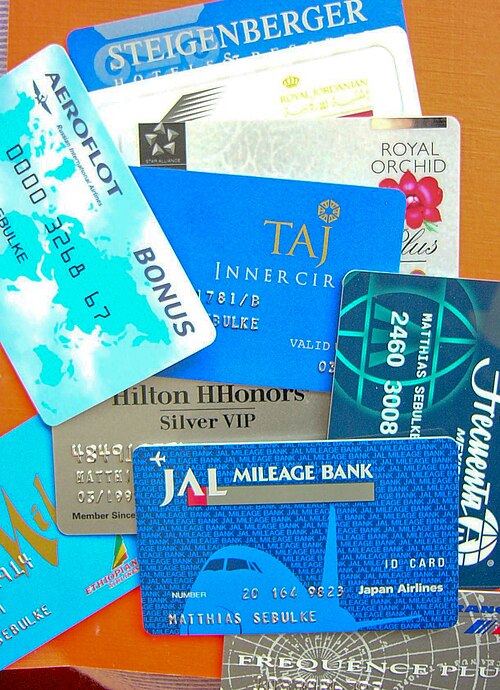
Loyalty marketing programs are built on the insight that it costs 5-20 times more to acquire a new customer than to retain an existing customer.[157] Marketers use a variety of loyalty programs to strengthen customer attitudes towards the brand (or service provider/retailer) in order to retain customers, minimise customer defections, and strengthen loyalty bonds with existing customers. Broadly there are two types of program: reward and recognition programs. In a Reward Program, the customer accumulates points for each purchase, and the points can subsequently be exchanged for goods or services.[158] Recognition Programs operate on a quasi-membership basis where the consumer is issued with a card that upon presentation leads to various entitlements such as free upgrades, special privileges, or access to products/services that are not normally available to non- members, and that acknowledge the loyal customer's "VIP" status.[159] For example, a hotel might recognise loyal patrons by providing a complimentary fruit bowl and bottle of champagne in the room on arrival. Whereas reward programs are motivated by the consumer's desire for material possessions, recognition programs are motivated by the consumer's need for esteem, recognition, and status. Many commercial loyalty programs are hybrid schemes, combining elements of both reward and recognition. In addition, not all reward programs are designed to encourage loyalty. Certain reward programs are designed to encourage other types of positive customer behaviour such as the provision of referrals or providing positive word-of-mouth (WOM) recommendations.[160]
Loyalty marketing can involve the use of databases and sophisticated software to analyse and profile customer loyalty segments with a view to identifying the most desirable segments, setting goals for each segment, and ultimately attempting to increase the size of the loyal customer base.
Customer citizenship behaviour
Customer citizenship behaviour is the labor that customers do for brands out of loyalty.[161] The services marketing literature[who?] identifies seven distinct types of citizenship behaviour:[162] voice (when customers direct their complaint to the service provider in order to rectify and maintain the relationship), display of affiliation, policing (the observation of other customers to ensure their appropriate behaviour), flexibility, service improvement (providing ideas and suggestions for organisations), word-of-mouth referrals, and benevolent acts of service.
Internet consumer behaviour
Traditional models of consumer behaviour were developed by scholars such as Fishbein and Ajzen [163] and Howard and Sheth [164] in the 1960s and 70s. More recently, Shun and Yunjie have argued that online consumer behaviour is different to offline behaviour and as a consequence requires new theories or models.[165] After COVID-19, online consumer behaviour seems more essential, because since COVID-19 began, there were about 31% more people started shopping online with 43% of all respondents compared to only 12% of respondents before COVID-19.[166]
Research has identified two types of consumer value in purchasing, namely product value and shopping value. Product value is likely to be similar for both online and offline shoppers. However, the shopping experience will be substantially different for online shoppers. In an offline shopping environment, consumers derive satisfaction from being within the physical store environment or retail landscape (hedonic motivations). In the case of online purchasing, shoppers derive satisfaction from their ability to navigate a website and the convenience of online searching which allows them to compare prices and 'shop around' with minimal time commitment. Thus the online consumer is motivated by more utilitarian factors.[167]
Different types of online behaviour
Consumers may use online platforms for various stages of the purchase decision. Some consumers use online sources simply to acquire information about planned purchases. Others use online platforms for making the actual purchase. In other situations, consumers may also use online platforms to engage in post-purchase behaviours, such as staying connected with a brand by joining a brand community. Or they may become a brand advocate by posting a product review online, or providing brand referrals via social media. Some e-commerce providers have encountered a challenge in courting consumers who seek information online, but still prefer to turn to bricks and mortar retailers for their purchase. To understand the needs and habits of these and other kinds of online shoppers, online marketers have segmented consumers into different kinds of online behaviour in accordance with their online behavioural characteristics. Lewis and Lewis (1997) identified five market segments based on the way that consumers use the Internet in the purchase decision process:[168]
- "Directed Information-seekers" are users that primarily look for information about a product or service online, but there is no guarantee that they may be converted into online buyers.
- "Undirected Information-seekers" are newcomers to a product or service. They are more likely to interact with online prompts, and click through to web pages linked in advertising.
- "Directed Buyers" have a predetermined mindset and wish to purchase a specific product or service online.
- "Bargain Hunters" are price-sensitive users that like to discover products during sales promotions. For these users, discounts are a major attraction to online sales conversion.
- "Entertainment Seekers" are online consumers that are attracted to marketing delivered as a fun activity. Interactive online games could be useful in attracting this kind of customer.
A typology of online consumer behaviour
Wendy Moe (2003)[169] argues that in the offline environment, consumers who are shopping in stores can be easily classified by experienced sales employees only by watching their shopping behaviours. Such classification may not appear online, but Moe and Fader[170] argued that it is feasible to predict practical buying, surfing, and searching action online by investigating click patterns and repetition of visit within online behaviour. In addition, a report of E-consultancy about "benchmarking of user experience" outlined three kinds of online consuming behaviour as a valuable classification for the research of design of web pages to better serve different kinds of consuming behaviour. The three categories are: "trackers", "hunters", and "explorers".
- "Trackers" are the online consumers who are exactly looking for a product that they definitely wish to buy. They use the Internet for the information about its price, delivery methods, post-purchase service, and so on. Once they have found the proper information, little effort is needed to let them do the business.
- "Hunters" just know the categories of the product that they need, for instance, a novel for leisure time. However, they have not made specific decision on whose novel to buy. They use the Internet to find a list of product of their needed categories to make comparison. This kind of online consumer needs advice and help to do their business.
- "Explorers" do not even have the categories of product on their minds. In fact, they just want to buy something online. There is more uncertainty of this type of online consumers.
Influence of the Internet on buying process
As the preceding table shows, the first row indicates the process of a consumer buying a new product, while the second and third row illustrates the positive influences the Internet could have on buying process by creating effective communications with online consumers. For example, suppose a consumer carelessly sees an advertisement about laptops on Wechat, a popular Chinese social media developed by Tencent. He begins to feel that his laptop is a bit out of date and wants to buy a new one, which is the outcome of good advertisement placed on a daily Internet tool. He does not know anything about how to buy a new one as business changes so fast today, so he searches on Google to find an answer. On the results page he finds promotional ads which mainly come from JD.com and Taobao, two competing Chinese online retailers in this field. He prefers to use JD.com, which provides detailed comparisons of brands, prices, locations, and methods of payment and delivery. After careful selection, he makes his order through JD.com via Wechat payment. JD.com has one of the fastest distribution channels within China and it supports excellent post-purchase service to maintain its position in the market.
The role of aesthetics and visual fluency in relation to consumer choice
Consumers decide whether or not they like a product within 90 seconds of viewing it for the first time.[172] Therefore, having an aesthetically pleasing product is essential in the marketplace. Studies in processing fluency and consumer behaviour have revealed that "that people prefer visual displays that are easier to process and understand."[173] and "When a product matches the user's associations with it it is perceived as more attractive."[173] Visually fluent products draw upon consumer's pre-existing associations with their design elements, leading to a sense of familiarity and understanding with the product at hand. Visual cues such as colour, composition, typography, and imagery are associated with the phenomenon of fluency.
Colour


Research in colour psychology has shown 62-90% of consumer product assessment is based on colour alone.[172] Indeed, colours have been shown to be linked to consumer's perceptions[174] on a product's quality, reliability, and value. The colours blue and black are viewed as being more reliable, valuable, and expensive while yellow, orange, and brown are associated with cheapness and low quality.[175] Therefore, a product intended to be perceived as "high quality" with a predominately orange and brown palette would lack visual fluency and would likely fail to elicit a positive response with consumers. However, this can be advantageous if the consumer is already in the market for an item that is known to be inexpensive, in which case the use of yellow, orange, or brown would be appropriate. Colour can also be used to signal brand personality.[176]
Composition
Composition is another visual tool that has the ability to affect information processing and influence in consumer perceptions. Studies have shown that consumers in western countries will associate products that are right aligned or placed on the right side of a display to be higher quality.[177] Humans also have a center bias, which makes products that are centered or symmetrical in composition or display seem intrinsically more pleasing.[177] Products that are centered in composition or have centered elements are perceived as being more attractive, popular, and important than products that are left aligned or right aligned.[178] When an object is centered compositionally, it easier for a viewer to interpret and understand. It becomes more "fluent" and is therefore viewed as being more aesthetically pleasing.[179]
Imagery
Evidence has shown that pictorial imagery correlates to higher instances of consumer recall and recognition. Pictorial imagery is also easier to process and gains consumer's attention faster.[180] There is significant evidence that when consumers are presented with multiple choices, they will view objects more positively and more aesthetically pleasing when surrounded by congruent imagery.[179] After repeated exposure, this familiar imagery becomes incorporated into consumer's visual lexicon and they become "fluent" in it. Images with higher levels of visual fluency perceived as being more familiar, likeable, and friendly and are therefore more likely to be chosen by consumers.[181]
Typographic elements
Although studies have shown that of pictorial imagery is easier for consumers to process and understand,[180] the choice of typography remains an indispensable element of product design. Handwritten and scripted fonts are associated with individuality, femininity, and luxury while sans serif fonts embody energy, cleanliness, and modernity.[182] Font size has also been shown to have a direct correlation on the emotional attributes assigned to a product. One study has shown that larger type size and weight is perceived as more intimidating and authoritative.[183] Although imagery reigns supreme in product design, type is processed just as easily as pictorial information when the consumer is already familiar with the product.
Environmental impact
An aspect of Individual action on climate change is consumer behaviour that affects how much and what kinds of materials are used to produce goods and food, how much material is recycled or composted, how much ends up as pollution, how much ends up in landfills, where goods are produced, how far they travel, and the carbon footprint of manufacturing, transportation, and disposal. Green marketing targets consumers who take the environmental impact of their purchases into account. One 2017 study found no impact of green marketing on consumer behaviour in Bangladesh.[citation needed] The study suggests policies be made that decrease the cost of eco-friendly products. It also encourages the implementation of programs which raise consumer awareness regarding the issue of green consumption.
There are psychological factors which contribute to a consumer's perception surrounding their personal contributions to climate change inducing actions. One of the more well studied biases is referred to as the "better-than-average", or self-enhancing bias.[184] This bias depicts an individual's tendency to perceive that their actions are superior, especially when compared to peers or demographically similar consumers. It has been found that this cognitive bias is indeed present when considering how consumers perceive their pro-environmental efforts.[184] This may be a result of information about climate change leading to feelings of guilt and concern, which activates an unconscious thought process (denial, the better-than-average effect, and other cognitive reactions) that leads to a reduced perception of the threat of climate change. It is a mental defense mechanism that ultimately leads to a reduction in perceived individual responsibility to take part in green behaviours and one-planet-living.[184]
Research methods used
To gain insights into consumer behaviour, researchers uses the standard battery of market research methods such as surveys, depth interviews, and focus groups. Increasingly, researchers are turning to newer methodologies and technologies in an effort to seek deeper understandings of why consumers behave in certain ways. These newer methods include ethnographic research (also known as participant observation) and neuroscience as well as experimental lab designs. In addition, researchers often turn to separate disciplines for insights with potential to inform the study of consumer behaviour. For instance, behavioural economics is adding new insights into certain aspects of consumer behaviour.
Ethnographic research

Ethnographic research or ethnography has its origins in anthropology. However, marketers use ethnographic research to study the consumer in terms of cultural trends, lifestyle factors, attitudes and the way that social context influences product selection, consumption, and usage. Ethnographic research, also called participant observation, attempts to study consumer behaviour in natural settings rather than in artificial environment such as labs. Different types of ethnographic research are used in marketing including;[185]
- Observed product usage: observing regular product usage at home or work, to gain insights into how products are opened, prepared, consumed, stored, disposed etc. to gain insights into the usefulness of packaging, labelling and general usage
- Day-in-the-life studies: extended visits during product usage situations to gain insights into norms and consumer expectations
- Accompanied purchase or shop-alongs: researcher accompanies a shopper on a purchase expedition to gain insights into consumer responses to merchandising and other sales tactics
- Cultural studies: similar to traditional ethnography; extended stays with a group or tribe with a view to uncovering the fundamental rules and conventions that govern behaviour
- Guerilla ethnography: random observations in public settings to help establish research questions or to gain quick insights into specific behaviours
- Mystery shopping: observations in the retail context with a view to gaining insights into the customer's service experience
- Multiple methodologies: combining ethnographic research methods with conventional research techniques with a view to triangulating results
Trendspotters such as Faith Popcorn's BrainReserve make extensive use of ethnographic research to spot emergent trends.[186]
Consumer neuroscience
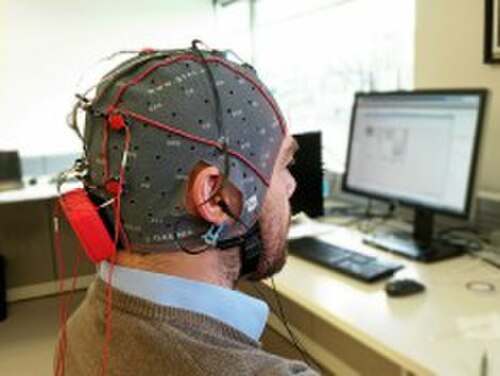
Consumer neuroscience (also known as neuromarketing) refers to the commercial use of neuroscience when applied to the investigation of marketing problems and consumer research. Some researchers have argued that the term consumer neuroscience is preferred over neuromarketing or other alternatives.[187][188]
Consumer neuroscience employs sophisticated bio-metric sensors, such as electroencephalography (EEG), functional magnetic resonance imaging (fMRI) and eye tracking,[189] to study the ways that consumers respond to specific stimuli such as product displays, brands, packaging information, or other marketing signals. Such tests reveal stimuli that trigger the brain's pleasure centre.
Consumer neuroscience has become a mainstream component of consumer research methods. International market research company Nielsen Research has recently added neuromarketing to its services by acquiring Innerscope, a company specialising in neuromarketing research thus enabling Nielsen to add neuromarketing research to the suite of services available to clients.[190]
Consumer neuroscience research has led to some surprising findings:
- Framing price or value
- For example, one study reported on a magazine subscription where potential subscribers were offered two options: an online subscription for $59, or a combined online and print for $129 a year. Most people chose the online only option. However, when a third option was introduced: print only for $129 (i.e. the decoy), the online and print option seemed like better value and a significant number of people switched to that option. In other words, the decoy price assists in framing value.[191] Marketers use a variety of methods to frame value: e.g. quote monthly payment options rather than a single all-inclusive price.
- Choice fatigue
- Research by Sheena Iyengar experimented with the number of gourmet jams on display. When consumers were faced with a large number of alternatives (24 jams), 60% of consumers stopped and looked but only a few (3%) actually made a purchase. However, when consumers faced with fewer brands (6 jams), were more likely to make a purchase with 30% going on to buy something. Similar results have been observed in other categories. The findings suggest that while consumers appreciate being given some choice, the process of making a selection is painful and can lead to choice fatigue.[192] An issue for marketers and retailers is to determine the 'sweet spot' where consumers are given sufficient choice to satisfy their desire for variety, but not become overwhelmed by it.
- Decision paralysis
- One study examined the wording used to solicit philanthropic donations. Consumers were exposed to variants in the advertising copy execution: "Would you be willing to help by giving a donation?" and "Would you be willing to help by giving a donation? Every penny will help." Those given the second option were almost twice as likely to donate. The researchers concluded that people are more likely to take action when given parameters. By clarifying that "even a penny" could make a difference, the second line provides guidance and makes the request more achievable.[193] For marketers, the implication is that when asking consumers to take an action, specifying a small step helps to break through the action paralysis. This finding also suggests that even small differences in advertising copy can lead to improved outcomes. Action instructions will make the advertisement more purposeful.
See also
- Advertising management - explains how consumer behaviours concepts are used to develop advertising strategies
- Advertising research - provides background on how consumer behaviour concepts inform research methods used in understanding advertising effectiveness
- Attitude-toward-the-ad models
- Brand awareness - detailed explanation of brand awareness
- Brand management - explains how consumer behaviour concepts are used to manage brand awareness and brand growth through the product-life cycle
- Buying Decision Process - offers an alternative explanation to the consumer buying decision process
- Consumer socialisation
- Consumer confusion
- Food and Brand Lab
- Marketing research - provides background on how consumer behaviour concepts inform the research methods used in marketing, consumer behaviour, brand awareness and advertising management
- Predictive buying
- Product life-cycle management (marketing) - detailed explanation of how consumer awareness changes over the product's life-cycle, and how this calls for different strategies at each stage
- Superstition#Consumer behavior
- Window shopping
References
- ^ Tadajewski, M., "A History of Marketing Thought", Ch 2 in Contemporary Issues in Marketing and Consumer Behaviour, Elizabeth Parsons and Pauline Maclaran (eds), Routledge, 2009, pp 24-25
- ^ Sheth, J.N., "History of Consumer Behavior: a Marketing Perspective", in Historical Perspective in Consumer Research: National and International Perspectives, Jagdish N. Sheth and Chin Tiong Tan (eds), Singapore, Association for Consumer Research, 1985, pp 5-7.
- ^ Fullerton, R.A. "The Birth of Consumer Behavior: Motivation Research in the 1950s", Journal of Historical Research in Marketing, Vol. 5, No. 2, 2013, pp.212-222
- ^ Tadajewski, M., "A History of Marketing Thought", Ch 2 in Contemporary Issues in Marketing and Consumer Behaviour, Elizabeth Parsons and Pauline Maclaran (eds), Routledge, 2009, p. 28
- ^ Plassmann, Hilke; Ramsøy, Thomas Zoëga; Milosavljevic, Milica (January 2012). "Branding the brain: A critical review and outlook". Journal of Consumer Psychology. 22 (1): 18–36. doi:10.1016/j.jcps.2011.11.010. ISSN 1057-7408.
- ^ Kardes, F., Cronley, M. and Cline, T., Consumer Behavior, Mason, OH, South-Western Cengage, 2011 p.7
- ^ "What is a consumer? definition and meaning". BusinessDictionary. Archived from the original on 28 July 2020. Retrieved 9 November 2023.
- ^ Kardes, F., Cronley, M. and Cline, T., Consumer Behavior, Mason, OH, South-Western Cengage, 2011 p.9; Sassatelli, R., Consumer Culture: History, Theory and Politics, Sage, 2007, p. 10
- ^ Kardes, F., Cronley, M. and Cline, T., Consumer Behavior, Mason, OH, South-Western Cengage, 2011 pp 10-11
- ^ Foxal, G., "Foundations of Consumer Behaviour Analysis", Marketing Theory, Vol. 1, No. 2, pp 165–199
- ^ Lynn R. Kahle; Angeline G. Close (2011). Consumer Behavior Knowledge for Effective Sports and Event Marketing. New York: Routledge. ISBN 978-0-415-87358-1.
- ^ Elizabeth A. Minton; Lynn R. Kahle (2014). Belief Systems, Religion, and Behavioral Economics. New York: Business Expert Press LLC. ISBN 978-1-60649-704-3.
- ^ *Schöfer, Klaus, Word-of-Mouth:Influences on the choice of Recommendation Sources, 1998. ISBN 978-3838641454
- ^ Belch, G, Belch, M.A, Kerr, G. and Powell, I., Advertising and Promotion Management: An Integrated Marketing Communication Perspective, McGraw-Hill, Sydney, Australia, 2009, p.126
- ^ Mullainathan, Sendhil; Shafir, Eldar (2013). Scarcity : why having too little means so much (First ed.). New York: Henry Holt and Company. ISBN 9780805092646.
- ^ Rossiter, J.R. and Percy, L., "Advertising Communication Models", in: Advances in Consumer Research, Volume 12, Elizabeth C. Hirschman and Moris B. Holbrook (eds), Provo, UT : Association for Consumer Research, 1985, pp 510-524., Online: http://acrwebsite.org/volumes/6443/volumes/v12/NA-12 or http://www.acrwebsite.org/search/view-conference-proceedings.aspx?Id=6443
- ^ Kenway, J. and Bullen, E., Consuming Children: Education, Entertainment, Advertising, Buckingham, Open University Press, 2001
- ^ Sandhusen, R. L., Marketing, 2000. Cf. S. 218
- ^ Sandhusen, Richard L.,Marketing (2000). Cf. S. 219
- ^ J. Scott Armstrong (1991). "Prediction of Consumer Behavior by Experts and Novices". Journal of Consumer Research. 18 (2): 251–256. doi:10.1086/209257.
- ^ Egan, J., Marketing Communications, London, Thomson Learning, pp 54-55
- ^ Punj, G. and Srinivasan, N., "Influence of Problem Recognition on Search and Other Decision Process Variables: a Framework For Analysis", in Advances in Consumer Research, Vol. 19, John F. Sherry, Jr. and Brian Sternthal (eds), Provo, UT : Association for Consumer Research, 1992, pp 491–497, Online: http://acrwebsite.org/volumes/7348/volumes/v19/NA-19
- ^ Reilly, M. and Parkinson, T.L., "Individual and Product Correlates of Evoked Set Size For Consumer Package Goods", in Elizabeth C. Hirschman and Moris B. Holbrook (eds), Advances in Consumer Research, Vol. 12, Provo, UT: Association for Consumer Research, pp 492–497, Online: http://acrwebsite.org/volumes/6440/volumes/v12/NA-12
- ^ Clemons, Eric K. (2008). "How Information Changes Consumer Behavior and How Consumer Behavior Determines Corporate Strategy". Journal of Management Information Systems. 25 (2): 13–40. doi:10.2753/MIS0742-1222250202. ISSN 0742-1222. JSTOR 40398715.
- ^ Kakkar, Pradeep (July 1976). "Inert Set or Inferred Set? A Comment". Journal of Marketing. 40 (3): 59–60. doi:10.1177/002224297604000312. S2CID 167299845.
- ^ Roberts, John (1989). "A Grounded Model of Consideration Set Size and Composition". Advances in Consumer Research. 16: 749–757.
- ^ Howard, J. A. and Sheth, J.N., The Theory of Buyer Behaviour, New York: Wiley, 1969
- ^ "Marketing Reading: Consumer Behavior and the Buying Process ^ 8167". HBR Store. Retrieved 1 March 2024.
- ^ Shocker, Allan D.; Ben-Akiva, Moshe; Boccara, Bruno; Nedungadi, Prakash (1 August 1991). "Consideration set influences on consumer decision-making and choice: Issues, models, and suggestions". Marketing Letters. 2 (3): 181–197. doi:10.1007/BF00554125. S2CID 189942892.
- ^ Business Dictionary, http://www.businessdictionary.com/definition/evoked-set.html Archived 2016-11-30 at the Wayback Machine
- ^ Kotler P. & Keller, K. (2006). Marketing Management. Pearson Prentice Hall, New Jersey
- ^ Belch, G, Belch, M.A, Kerr, G. and Powell, I., Advertising and Promotion Management: An Integrated Marketing Communication Perspective, McGraw-Hill, Sydney, Australia, 2009, p.138
- ^ Winchester, J. R. and Bogomolova, S., "Positive and negative brand beliefs and brand defection/uptake", European Journal of Marketing, Vol. 42, No. 5/6, 2008, pp.553 - 570
- ^ Sirgy, M. J., "Using self-congruity and ideal congruity to predict purchase motivation", Journal of Business Research, 1985, Vol. 13, No. 3, pp 195-206, doi:10.1016/0148-2963(85)90026-8
- ^ Nations, D. (2019). "What Is Social Media?" Lifewire.
- ^ Sirgy, H.J., Lee, D-J and Yu, G.B., "Revisiting Self-congruity Theory in Consumer Behavior", in Routledge International Handbook of Consumer Psychology, Cathrine V. Jansson-Boyd and Magdalena J. Zawisza (eds), Routledge, 2017, p. 193
- ^ Kotler, P and Armstrong, G., Principles of Marketing, Upper Saddle River, N.J., Pearson, 2014.
- ^ Stileman, P. (2009), To What Extent has Social Media Changed the Relationship between Brand and Consumer, Dissertation of MA Advertising, Bucks New University
- ^ Suri, R. and Monroe, K.B., "Effect of Consumers' Purchase Plans on the Evaluation of Bundle Offers", in Advances in Consumer Research Vol. 22, Frank R. Kardes and Mita Sujan (eds), Provo, UT, Association for Consumer Research, 1995 pp 588–593, Online: http://acrwebsite.org/volumes/7816/volumes/v22/NA-22
- ^ Siddiqui, S. and Agarwal, K., "The Consumer's Purchase Decision Process: A Theoretical Framework", International Journal of Science Technology and Management, Vol. 6, No. 6, 2017, pp 361-367
- ^ Morwitz, V.G., Steckel, J. and Gupta, A., "When Do Purchase Intentions Predict Sales?" International Journal of Forecasting, Vol. 23, No. 3, 2007, pp 347-64.
- ^ Armstrong, J. S., Morwitz, V. and Kumar, V., "Sales Forecasts for Existing Consumer Products and Services: Do Purchase Intentions Contribute to Accuracy?" International Journal of Forecasting, Vol. 16, No. 3, 2000, pp 383–397; Retrieved from http://repository.upenn.edu/marketing_papers/143
- ^ Business Dictionary, http://www.businessdictionary.com/definition/call-to-action.html Archived 2016-10-25 at the Wayback Machine
- ^ Eisenberg, B., CALL TO ACTION: Secret Formulas to Improve Online Results, Nashville, Tennessee, Thomas Nelson, 2006, p. 20
- ^ Berry, L.L., Seiders, K., Grewal, D., 2002. Understanding service convenience. Journal of Marketing 66 (3), 1-17
- ^ Srinivasan, N., "Pre-purchase External Search Information", in Valarie A. Zeithaml (ed), Review of Marketing 1990, Marketing Classics Press (AMA), 2011, pp 153-189
- ^ a b Andrea, Broden; Soderberg, Caroline (2011). Impulse buying, reasons why, consumer electronics - Oh My.
- ^ Foxall, G. (2005) Understanding Consumer Choice, Basingstoke. Palgrave Macmillan, 2005
- ^ Engel, James F., Kollat, David T. and Blackwell, Rodger D. (1968) Consumer Behavior, 1st ed. New York: Holt, Rinehart and Winston 1968
- ^ Gupta, Alok; Su, Bo-Chiuan; Walter, Zhiping (2004). "Taylor & Francis Online". International Journal of Electronic Commerce. 8 (3): 131–161. doi:10.1080/10864415.2004.11044302. S2CID 16054242.
- ^ Gilly, Mary C.; Gelb, Betsy D. (1982). "Post-Purchase Consumer Processes and the Complaining Consumer". Journal of Consumer Research. 9 (3): 323–328. doi:10.1086/208927. JSTOR 2488627.
- ^ Kuo, Ying-Feng; Wu, Chi-Ming; Deng, Wei-Jaw (2009). "The relationships among service quality, perceived value, customer satisfaction, and post-purchase intention in mobile value-added services". Computers in Human Behavior. 25 (4): 887–896. doi:10.1016/j.chb.2009.03.003. S2CID 42136133.
- ^ Post-decision dissonance
- ^ a b c MacInnis, D. J.; Pieters, R. & Hoyer, W. D (2014). 486670 Consumer behaviour. Cengage Learning Australia Pty Limited.
- ^ a b c Belch, G. E. & Belch, M. A (2012). Advertising and promotion: An integrated marketing communications perspective. New York: McGraw-Hill Irwin.
- ^ "How to Create A Customer Journey Map: From Awareness To Conversion". Adgo. Archived from the original on 16 November 2018. Retrieved 19 October 2018.
- ^ Woodside, Arch; Wilson, Elizabeth (1 January 1985). "Effects of consumer awareness of brand advertising on preference". Journal of Advertising Research. 25: 41–48.
- ^ a b c Quester, P. G.; Neal, C. M.; Pettigrew, S.; et al. (2008). Consumer Behaviour: Implications for marketing strategy. Sydney: McGraw-Hill Irwin.
- ^ Lokhande, Murlidhar (5 May 2006). "Consumer Awareness – A Case Study of Jalna City". Indian Journal of Marketing. xxxvi: 23–28.
- ^ "What is social marketing? | The NSMC". www.thensmc.com. Retrieved 9 November 2018.
- ^ "What is custom marketing? definition and meaning". BusinessDictionary.com. Archived from the original on 9 November 2018. Retrieved 9 November 2018.
- ^ "Boost Awareness of Your Business's Brand". business.com. Retrieved 19 October 2018.
- ^ "Product price awareness among consumers and price testing". www.research-pmr.com. Retrieved 9 November 2018.
- ^ Bhattacharya, C.B., Hayagreeva, R and Glynn, M.A., "Understanding the Bond of Identification: An Investigation of Its Correlates among Art Museum Members", Journal of Marketing, Vol. 59, No. 4 (Oct., 1995), DOI: 10.2307/1252327, pp. 46-57
- ^ Rossiter, J and Bellman, S., Marketing Communications: Theory and Applications, Pearson Australia, 2005, pp 103-120
- ^ a b Rossiter, J.R. and Percy, L., "Emotions and Motivations in Advertising", in Advances in Consumer Research, Vol. 18, Rebecca H. Holman and Michael R. Solomon (eds), Provo, UT, Association for Consumer Research, 1991, pp 100-110
- ^ Pham, M. T. and Higgins, E.T., "Promotion and Prevention in Consumer Decision Making: The State of the Art and Theoretical Propositions", in S. Ratneshwar and David Glen Mick, (eds), Inside Consumption: Consumer Motives, Goals, and Desires, London: Routledge, 2005, pp 8-43.
- ^ Clarke, K. and Belk. R.W., "The Effects of Product Involvement and Task Definition on Anticipated Consumer Effort", in Advances in Consumer Research, Vol. 06, William L. Wilkie (ed.), Ann Abor, MI: Association for Consumer Research, pp 313–318, Online: http://acrwebsite.org/volumes/9220/volumes/v06/NA-06
- ^ McInnis, D.J. and Jaworski, B.J., "Two Routes to Persuasion Models in Advertising: Review, Critique and Research Directions", in Valarie A. Zeithaml (ed), Review of Marketing 1990, Marketing Classics Press (AMA), 2011, pp 3-42
- ^ Percy, Larry; Rossiter, John R. (July 1992). "A model of brand awareness and brand attitude advertising strategies". Psychology and Marketing. 9 (4): 263–274. doi:10.1002/mar.4220090402.
- ^ Lamb, C.W., Hair, J.F. and McDaniel, C., Essentials of Marketing, Mason, Ohio, South-Western Cengage, 2009, p. 174
- ^ Trehan, M and Trehan, E., Advertising and Sales Management, New Delhi, VK Enterprises, p. 165
- ^ Lynn R. Kahle; Pierre Valette-Florence (2012). Marketplace Lifestyles in an Age of Social Media. New York: M.E. Sharpe, Inc. ISBN 978-0-7656-2561-8.
- ^ Kardes, F., Cronley, M. and Cline, T., Consumer Behavior, Mason, OH, South-Western Cengage, 2011 p.329
- ^ Weber, E.U., and Hsee, C., "Cross-cultural Differences in Risk Perception, but Cross-cultural Similarities in Attitudes Towards Perceived Risk", Management Science, Vol. 44, no. 9, 1998, pp 1205- 1217
- ^ Hoyer, Wayne; Deborah, MacInnes; Pieters, Rik (2018). Consumer behavior (7th ed.). Australia: Cengage. p. 431. ISBN 9781337514804.
- ^ Hoyer, Wayne; Deborah, MacInnes; Pieters, Rik (2018). Consumer behavior (7th ed.). Australia: Cengage. p. 432. ISBN 9781337514804.
- ^ Hoyer, Wayne; Deborah, MacInnes; Pieters, Rik (2018). Consumer behavior (7th ed.). Australia: Cengage. p. 439. ISBN 9781337514804.
- ^ Carroll, C.E., The Handbook of Communication and Corporate Reputation, Chichester, Sussex, Wiley, 2013, p. 44
- ^ Johnson, M.D. and Lehmann, D.R., "Consumer Experience and Consideration Sets For Brands and Product Categories", in Advances in Consumer Research, Vol. 24, 1992, Merrie Brucks and Deborah J. MacInnis (eds), Provo, UT : Association for Consumer Research, Pages: 295-300.
- ^ Reisch, Lucia A.; Zhao, Min (November 2017). Behavioural economics, consumer behaviour and consumer policy: state of the art. Cambridge University Press. p. 199.
- ^ Torelli, C.J. and Rodas, M., "Globalization, branding and multicultural consumer behavior", in Routledge International Handbook of Consumer Psychology, Cathrine V. Jansson-Boyd and Magdalena J. Zawisza (eds), Routledge, 2017, p. 41-58
- ^ Skandali, Dimitra (2024). "Consumer Behaviour on AI Applications for Services: Measuring the Impact of Value- Based Adoption Model on Luxurious AI Resorts' Applications". De Gruyter. doi:10.1515/roms-2023-0099.
- ^ Neal, D., "The Ferrari with the Dragon Tattoo", Wall Street Journal, 10 May 2012
- ^ Schouten, J and Mcalexander, J.H., "Subcultures of Consumption: An Ethnography of the New Bikers", Journal of Consumer Research, vol, 22, no1, June 1995
- ^ Bhattacharya, C. B., Rao, H. and Glynn, M.A., "Understanding the Bond of Identification: An Investigation of its Correlates among Art Museum Members", Journal of Marketing, Vol. 59, no. 4, 46-57
- ^ The Age, [Newspaper, Melbourne, Australia], "Bargain Basement Blues", 2 September 2002 http://www.theage.com.au/articles/2002/09/20/1032054962889.html. Note that while each quintile accounts for 20% of the population at the commencement of a measurement period, bracket creep can occur over time, explaining why ABs account for 24% in 2002
- ^ Ramya, N (2016). "Factors Affecting Consumer Buying Behavior". ResearchGate.
- ^ Iyengar, R., Valente, T. and Van den Bulte, C., "Opinion Leadership and Social Contagion in New Product Diffusion", in Advances in Consumer Research, Vol 36, eds. Ann L. McGill and Sharon Shavitt, Duluth, MN: Association for Consumer Research, pp 36-37
- ^ Paul McIntyre, "Independent bloggers overtake celebrities as key social media influencers", Australian Financial Review, 22 June 2015, Online: http://www.afr.com/business/independent-bloggers-overtake-celebrities-as-key-social-media-influencers-20150528-ghbovu; (Note that an abridged version of this article also appeared in Marketing Magazine, 16 July 2015); Blogger Outreach dethroned Celebrity Endorsement, Marketing Magazine, 16 July 2015, Online: https://www.marketingmag.com.au/hubs-c/blogger-outreach-dethroned-celebrity-endorsement
- ^ Flynn, L. R., Goldsmith, R. E. and Eastman, J. K., "Opinion leaders and opinion seekers: Two new measurement scales", Journal of Academy of Marketing Science, vol. 24, no. 2, pp 137-147.
- ^ "COVID 19 Consumer Behaviour Research". cxm.co.uk. Retrieved 10 February 2020.
- ^ a b c d e f Samuel Lins, Sibele Aquino, Ana Raquel Costa (14 March 2021) 'From panic to revenge: Compensatory buying behaviours during the pandemic', International Journal of Psychiatry.
- ^ Cambridge Dictionary, Cambridge University Press (2020), accessed 23 April 2021 from: https://dictionary.cambridge.org/dictionary/english/panic-buying.
- ^ a b Steven Taylor (March 2021) 'Understanding and managing pandemic-related panic buying' Journal of Anxiety Disorders 78.
- ^ ABC News Video Services (26 June 2020) 'VIDEO: Prime Minister Scott Morrison says there is no need for panic buying' ABC News, accessed 23 April 2021 from: https://www.abc.net.au/news/2020-06-26/prime-minister-scott-morrison-says-no-need-for-panic-buying/12398700; Zona Black (3 June 2020) 'Panic buying: Australians top global charts for toilet paper stockpiling' The New Daily, accessed 23 April 2021 from: https://thenewdaily.com.au/finance/consumer/2020/06/03/panic-buy-australia-why/; BBC News Services (26 June 2020) 'Australia caps toilet rolls sales after panic-buying' BBC News, accessed 23 April 2021 from: https://www.bbc.com/news/world-australia-53196525.
- ^ Tianwei Zhang (13 April 2020) 'Hermes hauled in $2.7 million in one China store on Saturday: sources' Women's Wear Daily, accessed on 23 April 2021 from: https://wwd.com/fashion-news/fashion-scoops/hermes-hauled-in-2-7-million-in-one-china-store-on-saturday-sources-1203559738/. See also: Shalini Nagarajan (16 April 2020) 'French luxury brand Hermes pulls in US$2.7 million in a day at a flagship store in China as wealthy shoppers splurge after the coronavirus lockdown' Business Insider Australia, accessed on 23 April 2021 from: https://www.businessinsider.com/wealthy-chinese-shoppers-slurge-at-hermes-store-in-china-2020-4?r=US&IR=T; Robert Williams, Jinshan Hong (12 March 2020) 'Revenge spending spurs Chinese luxury rebound from virus' Bloomberg, accessed on 23 April 2021 from: https://www.bloomberg.com/news/articles/2020-03-12/luxury-shoppers-in-china-emerge-from-quarantine-to-buy-again.
- ^ Caroline Tynan, Sally McKechnie, Celine Chhuon (1 August 2009) 'Co-creating value for luxury brands' Journal of Business and Research 63 (2010) 1156 - 1163.
- ^ Sonny Nwankwo, Nicolas Hamelin, Meryem Khaled (5 May 2014) Journal of Retailing and Consumer Services 21 (2004) 735 - 744.
- ^ Jun-Hwa-Cheah, David Waller, Park Thaichon, Hiram Ting, Xin-Jean Lim 'Price image and the Sugrophobia effect on luxury retail purchase intention' (5 June 2020) Journal of Retailing and Consumer Services 57 (2020) 102188.
- ^ Selin Atalay, Margaret Meloy (2 May 2011) 'Retail therapy: a strategic effort to improve mood' Psychology and Marketing 28(6), 638 - 660.
- ^ a b Kannan, P.K.; Kulkarni, Gauri (1 January 2021). "The impact of Covid-19 on customer journeys: implications for interactive marketing". Journal of Research in Interactive Marketing. 16 (1): 22–36. doi:10.1108/JRIM-03-2021-0078. ISSN 2040-7122. S2CID 239635412.
- ^ Timotius, Elkana; Octavius, Gilbert Sterling (2021). "Global Changing of Consumer Behavior to Retail Distribution due to Pandemic of COVID-19: A Systematic Review". Journal of Distribution Science. 19 (11): 69–80. doi:10.15722/jds.19.11.202111.69. ISSN 1738-3110.
- ^ Durvasula, S., Lysonski, S. and Andrews, J.C. (1993), "Cross-cultural generalizability of a scale for profiling consumers' decision-making styles", The Journal of Consumer Affairs, Vol. 27 No. 1, pp. 55-65
- ^ Sproles, G.B. (1985), "From perfectionism to fadism: measuring consumers' decision-making styles", in Schnittgrund, K.P. (Ed.), American Council on Consumer Interests (ACCI), Conference Proceedings, Columbia, MO, pp. 79-85.
- ^ Sproles, G. B. (1983). Conceptualisation and measurement of optimal consumer decision making. Journal of Consumer Affairs, Vol. 17 No. 2, pp 421-438.
- ^ Sproles, G. B., & Kendall, E. L., "A methodology for profiling consumers' decision-marking styles", Journal of Consumer Affairs, Vol., 20 No. 2, 1986, pp 267 -279
- ^ Jain, R. and Sharma, A., "A Review on Sproles & Kendall's Consumer Style Inventory (CSI) for Analyzing Decision Making Styles of Consumers", Indian Journal of Marketing, Vol. 43, no. 3, 2013
- ^ Bauer, H. H., Sauer, N. E., and Becker, C., "Investigating the relationship between product involvement and consumer decision-making styles", Journal of Consumer Behaviour. Vol. 5, 2006 342–354.
- ^ Mishra, A., "Consumer innovativeness and consumer decision styles: a confirmatory and segmentation analysis", The International Review of Retail, Distribution and Consumer Research, Vol. 25, no. 1, 2015, doi:10.1080/09593969.2014.911199
- ^ Dowling, Grahame R. and Richard Staelin (1994), "A Model of Perceived Risk and Intended Risk-handling Activity", Journal of Consumer Research, 21 (June), pp 119-34.
- ^ Mitchell, V.‐W. and Boustani, P., "A Preliminary Investigation into Pre‐ and Post‐Purchase Risk Perception and Reduction", European Journal of Marketing, Vol. 28 No 1, 1994, pp.56 - 71
- ^ Ross, I., "Perceived Risk and Consumer Behavior: A Critical Review", in Advances in Consumer Research, Volume 2, Mary Jane Schlinger, (ed) MI, Association for Consumer Research, 1975, pp 1-20 <Online: http://acrwebsite.org/volumes/5741/volumes/v02/NA-02>
- ^ Büttner, O.B., Schulz, S. and Silberer, S, "Perceived Risk and Deliberation in Retailer Choice: Consumer Behavior towards Online Pharmacies", Advances in Consumer Research, vol. 33, 2006
- ^ Mitchell, V-W. and Greatorex, M. "Risk Perception and Reduction in the Purchase of Consumer Services", The Service Industries Journal, Vol. 13, no. 4, 1993, pp 179-200
- ^ Zeithaml, V. A. How Consumer Evaluation Processes Differ Between Goods and Services, (1981), in: AMA Conference Proceedings, James H. Donnelly and William R. George (eds), Chicago IL: American Marketing Association, p. 186-190
- ^ Jourdan, P., "Search Or Experience Products: an Empirical Investigation of Services, Durable and Non-Durable Goods", in: Asia Pacific Advances in Consumer Research , Volume 4, Paula M. Tidwell and Thomas E. Muller (eds), Provo, UT, Association for Consumer Research,(2001), pp 167-174 Online:http://acrwebsite.org/volumes/11342/volumes/ap04/AP-04
- ^ Dowling, G.R. and Staelin, R., "A Model of Perceived Risk and Intended Risk-Handling Activity", Journal of Consumer Research, Vol. 21, No. 1, 1994, pp. 119-134
- ^ Mitchell, V-W. and Greatorex, M., "Risk Perception and Reduction in the Purchase of Consumer Services", Service Industries Journal, 1993, pps 179-200
- ^ Rogers, E.M., "New Product Adoption and Diffusion", Journal of Consumer Research, Vol. 2, No. 4, 1976, pp. 290-301
- ^ Mahajan, V. and Peterson, E.A, Models for Innovation Diffusion, Volume 48, 1985.
- ^ Business Dictionary, http://www.businessdictionary.com/definition/diffusion-of-innovation.html Archived 2016-10-30 at the Wayback Machine
- ^ Lowrey, T.M., "The Use of Diffusion Theory in Marketing: a Qualitative Approach to Innovative Consumer Behavior", in Advances in Consumer Research, Vol. 18, eds. Rebecca H. Holman and Michael R. Solomon, Provo, UT : Association for Consumer Research, 1991, pp 644-650. Online: http://acrwebsite.org/volumes/7230/volumes/v18/NA-18.
- ^ Rogers, E.M., Diffusion of Innovations, New York, The Free Press, p. 5.
- ^ Based on Rogers, E.M., The Diffusion of Innovations, 5th ed., N.Y., Free Press, 2003
- ^ Rogers, E.M., Diffusion of Innovations, 5th ed., New York, The Free Press, 2003 pp 11-12.
- ^ Desilver, D."The Ever Accelerating Rate of Technology Adoption, Pew Research, 14 March 2014, Online: http://www.pewresearch.org/fact-tank/2014/03/14/chart-of-the-week-the-ever-accelerating-rate-of-technology-adoption/
- ^ The figure is based on data supplied by Google, https://www.docs.google.com/spreadsheets/d/1uvn7o1X19Equ5EDvjXEMxpziAEAsXTJK9Xbf8NwYiAo/htmlview
- ^ Market Realist, http://marketrealist.com/2015/12/adoption-rates-dizzying-heights/
- ^ McGrath, R., "The Pace of Technology Adoption is Speeding Up", Harvard Business Review, 25 November 2013
- ^ Forbes Technology Council, "How Consumers are Impacting the Adoption of New Technology, Forbes Blog, 21 June 2016, Online: https://www.forbes.com/sites/forbestechcouncil/2016/06/21/how-consumers-are-impacting-the-adoption-of-new-technology/#5a48cc917ba6
- ^ Rossiter, J and Bellman, S., Marketing Communications: Theory and Applications, Pearson Australia, 2005, pp 80-87.
- ^ Nielsen International, Global Survey of Loyalty Sentiment, 2013: [Topline survey findings], Online: http://www.nielsen.com/us/en/insights/news/2013/the-price-is-right-incentives-that-stimulate-switching-behavior.html
- ^ "Explaining Consumers' Channel-Switching Behavior Using the Theory of Planned Behavior" (PDF).
- ^ Roy Morgan Research, "How Vital are Vitamins:, Research Finding No. 5503, Media Release, 14 March 2014 online: http://roymorgan.com.au/findings/5503-how-vital-are-vitamins-201403252241 Archived 6 October 2016 at the Wayback Machine
- ^ Reardon, J., McCorkle, D.E. "A Consumer Model for Channel Switching Behavior", International Journal of Retail and Distribution Management, Vol. 30, no. 4, pp.179 - 185
- ^ Dholakia1, R.R., Zhao, M. and Dholakia, N., "Multichannel retailing: A case study of early experiences.", Journal of Interactive Marketing, vol. 19, March, pp 63–74, 2009, DOI: 10.1002/dir.20035
- ^ Stern, Hawkins (1 January 1962). "The Significance of Impulse Buying Today". Journal of Marketing. 26 (2): 59–62. doi:10.2307/1248439. JSTOR 1248439.
- ^ Weber, Elke U.; Baron, Jonathan (1 January 2001). Conflict and Tradeoffs in Decision Making. Cambridge University Press. ISBN 9780521772389.
- ^ Nielsen Research, "Connecting What Consumers Demand with What Shoppers Buy", 2013
- ^ Cited in Bagozzi, R., Gurhan-Canli, Z., Priester, J., The Social Psychology Of Consumer Behaviour, Open University Press, Buckingham, PA, 2002, p. 38
- ^ Eagly, A.H., and Chaiken, S. The Psychology of Attitudes, Harcourt Brace Jovanovich, Fort Worth, Texas, 1993.
- ^ McPhail, J. and Mattson, J "The Effect of Mood States on the Dyadic Service Encounter", Asia Pacific Advances in Consumer Research, Vol. 2, eds. Russel Belk and Ronald Groves (eds), Provo, UT : Association for Consumer Research, 1996 pp 41-46. Online: http://www.acrwebsite.org/search/view-conference-proceedings.aspx?Id=11530
- ^ Johnson, A.R. and Stewart, D.W., "A Reappraisal of the Role of Emotions in Consumer Behaviour: Traditional and Contemporary Approaches", in Malhotra, N. K., Review of Marketing Research, Vol 1, Armonk, London, 2005, pp 3-33
- ^ Bagozzi, R., Gurhan-Canli, Z., Priester, J., The Social Psychology Of Consumer Behaviour, Open University Press, Buckingham, PA, 2002, pp 60-63
- ^ Cohen, J.B.; Pham, M.T.; Andrade, E.B. (1 June 1999). "The Nature and Role of Affect in Consumer Behavior". APA PsycNet: 33–34. Retrieved 9 September 2021.
- ^ Gountas, S. and Gountas, J. "The Influence of the Customer's Emotions on their Service Product Evaluation", Perdue, R.R. and Immermans, H.J. P. and Uysal, M. Consumer Psychology of Tourism, Hospitality and Leisure, (Vol. 3), 2004
- ^ Szymanski, D.M. and Henard, D.H, "Customer satisfaction; A Meta-Analysis of the Empirical Evidence", Journal of the Academy of Marketing Science, vol. 29, no. 1 2001 pp 16-35, Online: http://davidhenard.com/Landing_Page/About_files/Szymanski%20%26%20Henard%202001.pdf Archived 2016-10-12 at the Wayback Machine
- ^ https://commons.erau.edu/cgi/viewcontent.cgi?article=1017&context=db-management [bare URL PDF]
- ^ Wu, Wann-Yih; Anridho, Nadia (1 January 2016). "The antecedents of brand loyalty: a meta-analysis study". International Journal of Services and Standards. 11 (3): 242. doi:10.1504/IJSS.2016.10000889 – via ResearchGate.
- ^ Eisend, Martin; Stokburger-Sauer, Nicola E. (27 February 2013). "Brand personality: A meta-analytic review of antecedents and consequences". Marketing Letters. 24 (3): 205–216. doi:10.1007/s11002-013-9232-7. S2CID 144201875.
- ^ Cacioppo, J.T., Petty, R.E.; Chuan Feng, K. and Rodriguez, R. "Central and peripheral routes to persuasion: An individual difference perspective", Journal of Personality and Social Psychology, Vol 51, No. 5, 1986, pp 1032-1043. https://dx.doi.org/10.1037/0022-3514.51.5.1032
- ^ Murray, P.N., "How Emotions Influence What We Buy: The emotional core of consumer decision-making", Psychology Today, Feb 26, 2013 Online: https://www.psychologytoday.com/blog/inside-the-consumer-mind/201302/how-emotions-influence-what-we-buy
- ^ Heath, R.; Brandt, D. & Nairn, A (2006). "Brand Relationships: Strengthened by Emotion, Weakened by Attention". Journal of Advertising Research. 46 (4): 410–419. doi:10.2501/s002184990606048x. S2CID 54530013.
- ^ Fill, C (2013). Marketing communications: Brands, experiences and participation. United Kingdom: Pearson Education Limited.
- ^ Dick, A.S. and Basu, K. "Customer Loyalty: Toward an Integrated Conceptual Framework", Journal of the Academy of Marketing Science, Vol. 22, no. 2, 1994, pp 99-113
- ^ Gallo, A., "The Value of Keeping the Right Customers, Harvard Business Review Online, https://hbr.org/2014/10/the-value-of-keeping-the-right-customers
- ^ Wirtz, J., Mattila, A.S. and Lwin, M.O., "How Effective Are Loyalty Reward Programs in Driving Share of Wallet?" Journal of Service Research, Volume 9, No. 4, 2007, pp 327-334 DOI: 10.1177/1094670506295853
- ^ Rust, R.T., Zeithaml, V.A. and Lemon, K.N., Driving Customer Equity: How Customer Lifetime Value is Reshaping Corporate Strategy, The Free Press, N.Y., 2000, p. 111
- ^ Ryu, G. and Feick, L., "A Penny for Your Thoughts: Referral Reward Programs and Referral Likelihood", Journal of Marketing, Vol. 71, January 2007, pp 84–94
- ^ Bove, L.L., Pervan, S.J., Beatty, S.E. and Shiu, E, "Service worker role in encouraging customer organizational citizenship behaviors", Journal of Business Research, vol. 62, 2009, pp 698–705, doi:10.1016/j.jbusres.2008.07.003
- ^ Bove, L., Robertson, N. and Pervan, S., "Customer Citizenship Behaviours: Towards the Development of a Typology", Australia New Zealand Marketing Academy Conference Proceedings, Adelaide, 1–3 December 2003 <online: http://smib.vuw.ac.nz:8081/WWW/ANZMAC2003/papers/BB13_bovel.pdf Archived 2007-07-02 at the Wayback Machine> p. 332
- ^ Fishbein, M., and Ajzen, I., Belief, Attitude, Intention and Behavior: An Introduction to Theory and Research, 1975, Addison-Wesley, Reading, MA
- ^ Howard, J.A. and Sheth, J.N., 1969, The Theory of Buyer Behavior, Vol. 14. New York, Wiley
- ^ Shun, C. and Yunjie, X., "Effects of outcome, process and shopping enjoyment on online consumer behaviour", Electronic Commerce Research and Applications, Vol. 5, 2006, pp 272–28, <Online: https://www.researchgate.net/profile/Shun_Cai/publication/220066620_Effects_of_outcome_process_and_shopping_enjoyment_on_online_consumer_behaviour/links/58cbb43692851c31f656c821/Effects-of-outcome-process-and-shopping-enjoyment-on-online-consumer-behaviour.pdf>
- ^ Jílková, Petra; Králová, Petra (February 2021). "Digital Consumer Behaviour and eCommerce Trends during the COVID-19 Crisis". International Advances in Economic Research. 27 (1): 83–85. doi:10.1007/s11294-021-09817-4. ISSN 1083-0898. PMC 7988251.
- ^ Shun, C. and Yunjie, X., "Effects of outcome, process and shopping enjoyment on online consumer behaviour", Electronic Commerce Research and Applications, Vol. 5, 2006, pp 275–76, <Online: https://www.researchgate.net/profile/Shun_Cai/publication/220066620_Effects_of_outcome_process_and_shopping_enjoyment_on_online_consumer_behaviour/links/58cbb43692851c31f656c821/Effects-of-outcome-process-and-shopping-enjoyment-on-online-consumer-behaviour.pdf>
- ^ Cited in Dann, S. and Dann, S., E-Marketing: Theory and ApplicationLondon, Palgrave-Macmillan, 2011, pp 144-45
- ^ Moe, W. (2003). "Buying, Searching, or Browsing: Differentiating Between Online Shoppers Using In-Store Navigational Clickstream". Journal of Consumer Psychology. 13 (1): 29–39. doi:10.1207/s15327663jcp13-1&2_03 (inactive 24 September 2024).
{{cite journal}}: CS1 maint: DOI inactive as of September 2024 (link) - ^ Moe, W.; Fader, P. (2004). "Capturing evolving visit behavior in clickstream data". Journal of Interactive Marketing. 18 (1): 5–19. CiteSeerX 10.1.1.37.5128. doi:10.1002/dir.10074. S2CID 2776467.
- ^ Chaffey, D. (2006). Internet marketing (3rd ed.. ed.). Harlow: Financial Times Prentice Hall. p. 109. ISBN 978-1405871815.
- ^ a b Moir, Diane (19 October 2011). "Trademark Protection of Color Alone: How and When Does a Color Develop Secondary Meaning and Why Color Marks Can Never Be Inherently Distinctive". Touro Law Review. 27 (2). ISSN 8756-7326.
- ^ a b Palmer, Stephen E.; Schloss, Karen B.; Sammartino, Jonathan (2 January 2013). "Visual Aesthetics and Human Preference". Annual Review of Psychology. 64 (1): 77–107. doi:10.1146/annurev-psych-120710-100504. ISSN 0066-4308. PMID 23020642. S2CID 6258525.
- ^ Labrecque, Lauren I.; Patrick, Vanessa M.; Milne, George R. (February 2013). "The Marketers' Prismatic Palette: A Review of Color Research and Future Directions: THE MARKETERS' PRISMATIC PALETTE". Psychology & Marketing. 30 (2): 187–202. doi:10.1002/mar.20597.
- ^ "Colour Assignment - Associations". www.joehallock.com. Retrieved 28 March 2020.
- ^ Labrecque, Lauren I.; Milne, George R. (1 September 2012). "Exciting red and competent blue: the importance of color in marketing". Journal of the Academy of Marketing Science. 40 (5): 711–727. doi:10.1007/s11747-010-0245-y. ISSN 1552-7824. S2CID 255381568.
- ^ a b Chae, Boyoun; Hoegg, JoAndrea (1 August 2013). "The Future Looks "Right": Effects of the Horizontal Location of Advertising Images on Product Attitude". Journal of Consumer Research. 40 (2): 223–238. doi:10.1086/669476. ISSN 0093-5301.
- ^ Valenzuela, Ana; Raghubir, Priya (2009). "Position-based beliefs: The center-stage effect". Journal of Consumer Psychology. 19 (2): 185–196. doi:10.1016/j.jcps.2009.02.011. ISSN 1532-7663.
- ^ a b Reber, Rolf; Schwarz, Norbert (1 September 1999). "Effects of Perceptual Fluency on Judgments of Truth". Consciousness and Cognition. 8 (3): 338–342. doi:10.1006/ccog.1999.0386. ISSN 1053-8100. PMID 10487787. S2CID 2626302.
- ^ a b Lewis, Michael; Whitler, Kimberly A.; Hoegg, JoAndrea (1 September 2013). "Customer Relationship Stage and the Use of Picture-Dominant versus Text-Dominant Advertising: A Field Study". Journal of Retailing. 89 (3): 263–280. doi:10.1016/j.jretai.2013.01.003. ISSN 0022-4359.
- ^ Oppenheimer, Daniel M.; Frank, Michael C. (1 March 2008). "A rose in any other font would not smell as sweet: Effects of perceptual fluency on categorization". Cognition. 106 (3): 1178–1194. doi:10.1016/j.cognition.2007.05.010. ISSN 0010-0277. PMID 17618616. S2CID 9786621.
- ^ Brumberger, E. (2003). "The Rhetoric of Typography: The Persona of Typeface and Text". Technical Communication. 50: 206–223. ISSN 0049-3155.
- ^ Bayer, Mareike; Sommer, Werner; Schacht, Annekathrin (9 May 2012). "Font Size Matters—Emotion and Attention in Cortical Responses to Written Words". PLOS ONE. 7 (5): e36042. Bibcode:2012PLoSO...736042B. doi:10.1371/journal.pone.0036042. ISSN 1932-6203. PMC 3348912. PMID 22590518.
- ^ a b c Leviston, Zoe; Uren, Hannah (March 2020). "Overestimating One's 'Green' Behavior: Better-Than-Average Bias May Function to Reduce Perceived Personal Threat from Climate Change". Journal of Social Issues. 76: 70–85. doi:10.1111/josi.12365. S2CID 213919455.
- ^ Mariampolski, H., Ethnography for Marketers: A Guide to Consumer Immersion, Sage, 2006, pp 43-38
- ^ Brain Reserve, Trend Bank Website, http://www.faithpopcorn.com/trendbank Archived 2016-10-24 at the Wayback Machine
- ^ Ramsøym T.Z., Introduction to Neuromarketing and Consumer Neuroscience, Denmark, Neurons Inc, 2015, p.3
- ^ Hubert, M. & Kenning, P. (2008): A Current overview of Consumer Neuroscience, In: Journal of Consumer Behaviour, Nr. 7(4-5), S. 272-292.
- ^ Choi, D.Y., Hahn, M.H. and Lee, K.C., "A Comparison of Buying Decisions by Product Involvement: An Eye Tracking Study", in Intelligent Information and Database Systems, in 4th Asian ACIIDS Conference (Part 3), Jeng-Shyang Pan, Shyi-Ming Chen, Ngoc Thanh Nguyen (eds), March 2012, pp 37-46
- ^ Dooley, R., "Nielsen Doubles Down on Neuro", Forbes Magazine, 3 June 2015 Online: https://www.forbes.com/sites/rogerdooley/2015/06/03/nielsen-doubles-down-on-neuro/
- ^ Ariely, Dan, Predictably Irrational, NY, Harper Collins, 2009; Shiv, B., Carmon, Z. and Ariely, D., "Placebo Effects of Marketing Actions: Consumers May Get What They Pay For", Journal of Marketing Research, Vol. 42, No. 4, 2005, pp. 383-393https://doi.org/10.1509/jmkr.2005.42.4.383
- ^ Dooley, R., "More Choices, Fewer Sales", Neuroscience Marketing Blog, Online: http://www.neurosciencemarketing.com/blog/articles/more-choices-fewer-sales.htm
- ^ Ciotti, G. "Analysis Paralysis and Consumer Behaviour" Online: https://www.helpscout.net/consumer-behavior/
Further reading
- Blackwell, Miniard and Engel (2006). Consumer Behaviour (10th Ed.). Thomson Learning.
- Deaton, Angus; Muellbauer, John, Economics and Consumer Behavior, Cambridge; New York : Cambridge University Press, 1980. ISBN 0-521-22850-6
- Deutsch, D., & Deutsch, J. A. (1975). Short-term Memory. New York: Academic Press.
- Ferber, R. (1976). A Synthesis of Selected Aspects of Consumer Behaviour. Chicago, Ill.
- Guilford, J. P. (1967). The Nature of Human Intelligence. New York: McGraw-Hill.
- Howard, J., Sheth, J.N. (1968), Theory of Buyer Behavior, J. Wiley & Sons, New York, NY.
- Kardes, Frank R.; Cronley, Maria L.; Cline, Thomas W., Consumer Behavior, Mason, OH : South-Western, Cengage Learning, 2011. ISBN 978-0-538-74540-6
- Kaplan, M. F., & Schwartz, S. (1975). Human Judgment and Decision Processes. New York: Academic Press.
- Klapper, J. T. (1949). The Effects of Mass Media. New York: Columbia University, Bureau of Applied Social Research.
- Laermer, Richard; Simmons, Mark, Punk Marketing, New York : HarperCollins, 2007. ISBN 978-0-06-115110-1 (Review of the book by Marilyn Scrizzi, in Journal of Consumer Marketing 24(7), 2007)
- Loudon, D.L. (1988), Consumer Behavior: Concepts and Applications, McGraw Hill, London.
- McGuire, W. J. (1976). "Psychological Factors Influencing Consumer Choice", in R. Ferber, ed., A Synthesis of Selected Aspects of Consumer Behavior. Washington, D.C.: National Science Foundation.
- McNair, B. (1958), Retail Development, Harper & Row, New York, NY.
- Packard, Vance, (1957) The Hidden Persuaders, New York, D. McKay Co.
- Pollio, H. R. (1974). The Psychology of Symbolic Activity. Reading, MA: Addison-Wesley
- Schiffman, L. G. (1993), Consumer Behavior, Prentice Hall International, London; Schiffman, L. G. and Kanuk, L. (2010), 10th edition;[1] Schiffman, L. G. and Wisenblit, J. L., (2015), 11th edition.[2]
- Schwartz, Barry (2004), The Paradox of Choice: Why More Is Less, Ecco, New York.
- Shell, Ellen Ruppel, Cheap: The High Cost of Discount Culture, New York : Penguin Press, 2009. ISBN 978-1-59420-215-5
- Solomon, M.R. (1994), Consumer Behavior, Allyn & Bacon, London.
- Stefflre, V. (1968). Market Structure Studies: New products for old markets and new markets (foreign) for old products. New York: Wiley.
- Tversky, A., & Kahneman, D. (1982). Judgment under Uncertainty: Heuristics and biases Cambridge University Press
- ^ Leon Schiffman; Leslie Kanuk (28 July 2009). "Schiffman, L. G. and Kanuk, L. (2010), Consumer Behavior: 10th Edition". Pearson.com. Retrieved 17 September 2018.
- ^ レオン・G・シフマン、ジョセフ・L・ワイゼンブリット(2014年1月27日)。「Schiffman, LG and Wisenblit, JL, (2015), Consumer Behavior: 11th Edition」。Pearson.com 。 2018年9月17日閲覧。