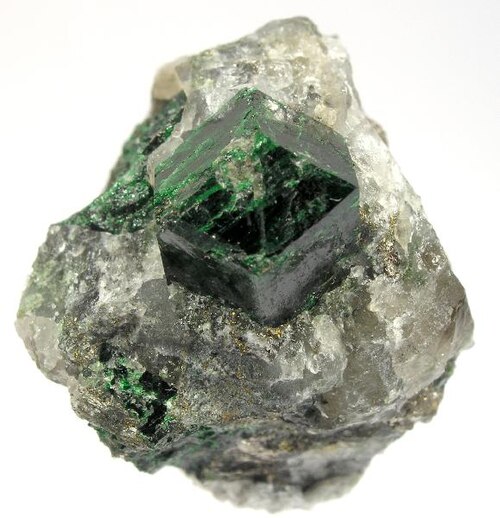
Loading article…


地質学および鉱物学において、鉱物または鉱物種は、大まかに言えば、比較的明確な化学組成と特定の結晶構造を持ち、自然界に純粋な形で存在する固体物質である。[ 1 ] [ 2 ]
鉱物の地質学的定義では、通常、生物体内にのみ存在する化合物は除外されます。しかし、一部の鉱物は生物起源(方解石など)であったり、化学的に有機化合物(メリトなど)であったりします。さらに、生物は岩石中にも存在する無機鉱物(ヒドロキシアパタイトなど)を合成することがよくあります。
鉱物の概念は岩石とは異なり、岩石とは、十分に大きなスケールで比較的均質な塊状の固体地質物質のことである。岩石は1種類の鉱物から構成されている場合もあれば、2種類以上の異なる鉱物が空間的に分離して別々の相に集まったものである場合もある。[ 3 ]
オパールや黒曜石のように明確な結晶構造を持たない天然の固体物質は、より正確には鉱物様物質と呼ばれる。[ 4 ]化学化合物が異なる結晶構造で自然界に存在する場合、それぞれの構造は異なる鉱物種とみなされる。例えば、石英とスティショバイトは、同じ化合物である二酸化ケイ素からなる2つの異なる鉱物である。
国際鉱物学協会(IMA)は、鉱物種の定義と命名法に関する一般的に認められた標準機関です。2025年5月現在 IMAは6,145種の公式鉱物種を認めている。[ 5 ]
鉱物種名に化学組成があるものの、微量の不純物が含まれているため、その組成が多少異なる場合がある。ある種の特定の変種には、慣用名または公式名が付けられている場合がある。 [ 6 ]例えば、アメジストは石英という鉱物種の紫色の変種である。鉱物種によっては、鉱物の構造内で同等の位置を占める2つ以上の化学元素の比率が変化する場合がある。例えば、マッキナワイトの化学式は(Fe,Ni)と表される。9S8、つまりFex Ni9- x S8、ここでxは0から9までの可変数である。組成が変化する鉱物が、多かれ少なかれ恣意的に別々の種に分割され、鉱物グループCaの場合がこれに該当する。x Mgy Fe2- x - y SiO4、カンラン石グループ。
鉱物種の記述には、基本的な化学組成と結晶構造に加えて、通常 、結晶形、硬度、光沢、透明度、色、条痕、靭性、劈開、断口、系、ゾーニング、分離、比重、磁性、蛍光、放射能などの一般的な物理的性質、味や匂い、酸に対する反応などが含まれます。[ 7 ] [ 8 ]
Minerals are classified by key chemical constituents; the two dominant systems are the Dana classification and the Strunz classification. Silicate minerals comprise approximately 90% of the Earth's crust.[9][10] Other important mineral groups include the native elements (made up of a single pure element) and compounds (combinations of multiple elements) namely sulfides (e.g. Galena PbS), oxides (e.g. quartz SiO2), halides (e.g. rock salt NaCl), carbonates (e.g. calcite CaCO3), sulfates (e.g. gypsum CaSO4·2H2O), silicates (e.g. orthoclase KAlSi3O8), molybdates (e.g. wulfenite PbMoO4) and phosphates (e.g. pyromorphite Pb5(PO4)3Cl).[7]
The International Mineralogical Association has established the following requirements for a substance to be considered a distinct mineral:[11][12]
The details of these rules are somewhat controversial.[15] For instance, there have been several recent proposals to classify amorphous substances as minerals, but they have not been accepted by the IMA.
The IMA is also reluctant to accept minerals that occur naturally only in the form of nanoparticles a few hundred atoms across, but has not defined a minimum crystal size.[11]
一部の著者は、その物質が室温(25 ℃)で安定または準安定な固体であることを要求している。 [ 15 ] しかし、IMAは、その物質が構造と組成が十分に決定できるほど安定していることだけを要求している。例えば、メリディアナイト(天然に存在する硫酸マグネシウムの水和物)は、2 ℃以下でしか形成されず安定しないにもかかわらず、鉱物として認識されている。
2025年5月現在 IMAによって承認された鉱物種は6,145種です。[ 5 ]鉱物名の命名は、人名にちなんで名付けられることが最も多く、次いで発見場所が挙げられます。化学組成や物理的性質に基づく名前は、鉱物名の語源の他の2つの主要なグループです。[ 18 ] [ 19 ]ほとんどの名前は「-ite」 で終わりますが、例外は通常、方鉛鉱やダイヤモンドのように、鉱物学が学問分野として組織化される前から確立されていた名前です。
地質学者や鉱物学者の間で議論の的となっているのは、IMAが生物起源の結晶性物質を除外するという決定である。例えば、ローウェンスタム(1981)は「生物は多様な鉱物を形成する能力があり、その中には生物圏で無機的に形成できないものもある」と述べている。[ 20 ]
スキナー(2005)は、すべての固体を潜在的な鉱物とみなし、生物の代謝活動によって生成される生体鉱物を鉱物界に含めている。スキナーは、鉱物の従来の定義を拡張し、「生物地球化学的プロセスによって形成された、非晶質または結晶質の元素または化合物」を鉱物として分類した。[ 21 ]
高解像度遺伝学とX線吸収分光法の最近の進歩により、微生物と鉱物の間の生物地球化学的関係に関する新たな知見が得られ、この問題に新たな光を当てる可能性がある。 [ 12 ] [ 21 ]例えば、IMAが委託した「環境鉱物学および地球化学に関するワーキンググループ」は、水圏、大気圏、生物圏の鉱物を扱っている。[ 22 ]このグループの範囲には、地球上のほぼすべての岩石、土壌、粒子表面に存在する鉱物形成微生物が含まれており、その深さは少なくとも海底から1600メートル、成層圏の70キロメートル(おそらく中間圏まで)に及ぶ。[ 23 ] [ 24 ] [ 25 ]
生物地球化学的サイクルは、数十億年にわたって鉱物の形成に貢献してきました。微生物は溶液から金属を沈殿させ、鉱床の形成に貢献することができます。また、鉱物の溶解を触媒することもできます。[ 26 ] [ 27 ] [ 28 ]
国際鉱物学協会のリストに掲載される以前に、60 種類以上のバイオミネラルが発見され、命名され、発表されていました。[ 29 ]これらの鉱物(ローウェンスタム (1981) [ 20 ]に表にまとめられたサブセット)は、スキナー (2005) の定義によれば、真の鉱物とみなされています。[ 21 ]これらのバイオミネラルは、国際鉱物学協会の公式鉱物名リストには掲載されていませんが、[ 30 ] これらのバイオミネラルの代表例の多くは、ダナ分類体系に記載されている 78 の鉱物クラスに分布しています。[ 21 ]
Skinner's (2005) definition of a mineral takes this matter into account by stating that a mineral can be crystalline or amorphous.[21] Although biominerals are not the most common form of minerals,[31] they help to define the limits of what constitutes a mineral proper. Nickel's (1995) formal definition explicitly mentioned crystallinity as a key to defining a substance as a mineral. A 2011 article defined icosahedrite, an aluminium-iron-copper alloy, as a mineral; named for its unique natural icosahedral symmetry, it is a quasicrystal. Unlike a true crystal, quasicrystals are ordered but not periodic.[32][33]
A mineral assemblage is defined by Mindat.org as "Any set of minerals in a rock, whether in [chemical] equilibrium or not",[34] while Encyclopaedia Britannica says "The term assemblage is frequently applied to all minerals included in a rock but more appropriately should be used for those minerals that are in equilibrium (and are known more specifically as the equilibrium assemblage)".[35]
The term is often prefixed by other terms that describe its formation.[34]

岩石は、1 つ以上の鉱物[ 36 ]または鉱物様物質の集合体です。石灰岩や珪岩などの岩石は、主に 1 つの鉱物で構成されています。石灰岩の場合は方解石またはアラゴナイト、 後者の場合は石英です。[ 37 ] [ 38 ]他の岩石は、主要 (必須) 鉱物の相対的な存在量によって定義できます。花崗岩は、石英、アルカリ長石、斜長石の割合によって定義されます。[ 39 ]岩石中の他の鉱物は副成分鉱物と呼ばれ、岩石の全体的な組成に大きな影響を与えません。岩石は、完全に非鉱物物質で構成される場合もあります。石炭は、主に有機由来の炭素で構成される堆積岩です。[ 36 ] [ 40 ]
岩石には、他の鉱物種やグループよりもはるかに多く存在する鉱物種やグループがあり、これらは造岩鉱物と呼ばれます。主な例としては、石英、長石、雲母、角閃石、輝石、橄欖石、方解石があり、方解石を除いて、これらの鉱物はすべてケイ酸塩です。[ 41 ]全体として、約150種類の鉱物が、その豊富さや収集における美的価値の点で特に重要であると考えられています。[ 42 ]
宝石、金属鉱石、鉱物燃料以外の商業的に価値のある鉱物や岩石は、工業用鉱物と呼ばれます。[ 43 ]例えば、白雲母である白雲母は、窓(アイシングラスと呼ばれることもあります)、充填材、または絶縁体として使用できます。[ 44 ]
鉱石とは、特定の元素(通常は金属)を高濃度に含む鉱物のことです。例としては、水銀鉱石である辰砂(HgS)、亜鉛鉱石である閃亜鉛鉱(ZnS)、錫鉱石である錫石(SnO₂ )、ホウ素鉱石であるコールマナイトなどがあります。
Gems are minerals with an ornamental value, and are distinguished from non-gems by their beauty, durability, and usually, rarity. There are about 20 mineral species that qualify as gem minerals, which constitute about 35 of the most common gemstones. Gem minerals are often present in several varieties, and so one mineral can account for several different gemstones; for example, ruby and sapphire are both corundum, Al2O3.[45]
The first known use of the word "mineral" in the English language (Middle English) was the 15th century. The word came from Medieval Latin: minerale, from minera, mine, ore.[46]
The word "species" comes from the Latin species, "a particular sort, kind, or type with distinct look, or appearance".[47]
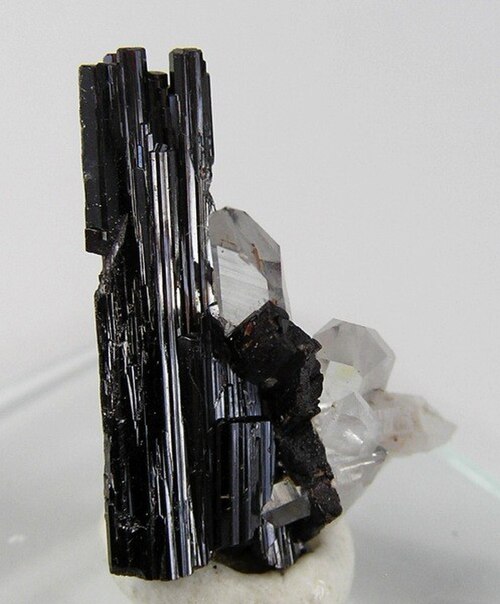
The abundance and diversity of minerals is controlled directly by their chemistry, in turn dependent on elemental abundances in the Earth. The majority of minerals observed are derived from the Earth's crust. Eight elements account for most of the key components of minerals, due to their abundance in the crust. These eight elements, summing to over 98% of the crust by weight, are, in order of decreasing abundance: oxygen, silicon, aluminium, iron, magnesium, calcium, sodium and potassium. Oxygen and silicon are by far the two most important – oxygen composes 47% of the crust by weight, and silicon accounts for 28%.[48]
The minerals that form are those that are most stable at the temperature and pressure of formation, within the limits imposed by the bulk chemistry of the parent body.[49] For example, in most igneous rocks, the aluminium and alkali metals (sodium and potassium) that are present are primarily found in combination with oxygen, silicon, and calcium as feldspar minerals. However, if the rock is unusually rich in alkali metals, there will not be enough aluminium to combine with all the sodium as feldspar, and the excess sodium will form sodic amphiboles such as riebeckite. If the aluminium abundance is unusually high, the excess aluminium will form muscovite or other aluminium-rich minerals.[50] If silicon is deficient, part of the feldspar will be replaced by feldspathoid minerals.[51] Precise predictions of which minerals will be present in a rock of a particular composition formed at a particular temperature and pressure requires complex thermodynamic calculations. However, approximate estimates may be made using relatively simple rules of thumb, such as the CIPW norm, which gives reasonable estimates for volcanic rock formed from dry magma.[52]
The chemical composition may vary between end member species of a solid solution series. For example, the plagioclasefeldspars comprise a continuous series from sodium-rich end member albite (NaAlSi3O8) to calcium-rich anorthite (CaAl2Si2O8) with four recognized intermediate varieties between them (given in order from sodium- to calcium-rich): oligoclase, andesine, labradorite, and bytownite.[53] Other examples of series include the olivine series of magnesium-rich forsterite and iron-rich fayalite, and the wolframite series of manganese-rich hübnerite and iron-rich ferberite.[54]
Chemical substitution and coordination polyhedra explain this common feature of minerals. In nature, minerals are not pure substances, and are contaminated by whatever other elements are present in the given chemical system. As a result, it is possible for one element to be substituted for another.[55] Chemical substitution will occur between ions of a similar size and charge; for example, K+ will not substitute for Si4+ because of chemical and structural incompatibilities caused by a big difference in size and charge. A common example of chemical substitution is that of Si4+ by Al3+, which are close in charge, size, and abundance in the crust. In the example of plagioclase, there are three cases of substitution. Feldspars are all framework silicates, which have a silicon-oxygen ratio of 2:1, and the space for other elements is given by the substitution of Si4+ by Al3+ to give a base unit of [AlSi3O8]−; without the substitution, the formula would be charge-balanced as SiO2, giving quartz.[56] The significance of this structural property will be explained further by coordination polyhedra. The second substitution occurs between Na+ and Ca2+; however, the difference in charge has to accounted for by making a second substitution of Si4+ by Al3+.[57]
Coordination polyhedra are geometric representations of how a cation is surrounded by an anion. In mineralogy, coordination polyhedra are usually considered in terms of oxygen, due its abundance in the crust. The base unit of silicate minerals is the silica tetrahedron – one Si4+ surrounded by four O2−. An alternate way of describing the coordination of the silicate is by a number: in the case of the silica tetrahedron, the silicon is said to have a coordination number of 4. Various cations have a specific range of possible coordination numbers; for silicon, it is almost always 4, except for very high-pressure minerals where the compound is compressed such that silicon is in six-fold (octahedral) coordination with oxygen. Bigger cations have a bigger coordination numbers because of the increase in relative size as compared to oxygen (the last orbital subshell of heavier atoms is different too). Changes in coordination numbers leads to physical and mineralogical differences; for example, at high pressure, such as in the mantle, many minerals, especially silicates such as olivine and garnet, will change to a perovskite structure, where silicon is in octahedral coordination. Other examples are the aluminosilicates kyanite, andalusite, and sillimanite (polymorphs, since they share the formula Al2SiO5), which differ by the coordination number of the Al3+; these minerals transition from one another as a response to changes in pressure and temperature.[48] In the case of silicate materials, the substitution of Si4+ by Al3+ allows for a variety of minerals because of the need to balance charges.[58]
Because the eight most common elements make up over 98% of the Earth's crust, the small quantities of the other elements that are typically present are substituted into the common rock-forming minerals. The distinctive minerals of most elements are quite rare, being found only where these elements have been concentrated by geological processes, such as hydrothermal circulation, to the point where they can no longer be accommodated in common minerals.[59]

Changes in temperature and pressure and composition alter the mineralogy of a rock sample. Changes in composition can be caused by processes such as weathering or metasomatism (hydrothermal alteration). Changes in temperature and pressure occur when the host rock undergoes tectonic or magmatic movement into differing physical regimes. Changes in thermodynamic conditions make it favourable for mineral assemblages to react with each other to produce new minerals; as such, it is possible for two rocks to have an identical or a very similar bulk rock chemistry without having a similar mineralogy. This process of mineralogical alteration is related to the rock cycle. An example of a series of mineral reactions is illustrated as follows.[60]
Orthoclase feldspar (KAlSi3O8) is a mineral commonly found in granite, a plutonicigneous rock. When exposed to weathering, it reacts to form kaolinite (Al2Si2O5(OH)4, a sedimentary mineral, and silicic acid):
Under low-grade metamorphic conditions, kaolinite reacts with quartz to form pyrophyllite (Al2Si4O10(OH)2):
As metamorphic grade increases, the pyrophyllite reacts to form kyanite and quartz:
Alternatively, a mineral may change its crystal structure as a consequence of changes in temperature and pressure without reacting. For example, quartz will change into a variety of its SiO2polymorphs, such as tridymite and cristobalite at high temperatures, and coesite at high pressures.[61]
Classifying minerals ranges from simple to difficult. A mineral can be identified by several physical properties, some of them being sufficient for full identification without equivocation. In other cases, minerals can only be classified by more complex optical, chemical or X-ray diffraction analysis; these methods, however, can be costly and time-consuming. Physical properties applied for classification include crystal structure and habit, hardness, lustre, diaphaneity, colour, streak, cleavage and fracture, and specific gravity. Other less general tests include fluorescence, phosphorescence, magnetism, radioactivity, tenacity (response to mechanical induced changes of shape or form), piezoelectricity and reactivity to dilute acids.[62]

Crystal structure results from the orderly geometric spatial arrangement of atoms in the internal structure of a mineral. This crystal structure is based on regular internal atomic or ionic arrangement that is often expressed in the geometric form that the crystal takes. Even when the mineral grains are too small to see or are irregularly shaped, the underlying crystal structure is always periodic and can be determined by X-ray diffraction.[15] Minerals are typically described by their symmetry content. Crystals are restricted to 32 point groups, which differ by their symmetry. These groups are classified in turn into more broad categories, the most encompassing of these being the six crystal families.[63]
These families can be described by the relative lengths of the three crystallographic axes, and the angles between them; these relationships correspond to the symmetry operations that define the narrower point groups. They are summarized below; a, b, and c represent the axes, and α, β, γ represent the angle opposite the respective crystallographic axis (e.g. α is the angle opposite the a-axis, viz. the angle between the b and c axes):[63]
The hexagonal crystal family is also split into two crystal systems – the trigonal, which has a three-fold axis of symmetry, and the hexagonal, which has a six-fold axis of symmetry.
Chemistry and crystal structure together define a mineral. With a restriction to 32 point groups, minerals of different chemistry may have identical crystal structure. For example, halite (NaCl), galena (PbS), and periclase (MgO) all belong to the hexaoctahedral point group (isometric family), as they have a similar stoichiometry between their different constituent elements. In contrast, polymorphs are groupings of minerals that share a chemical formula but have a different structure. For example, pyrite and marcasite, both iron sulfides, have the formula FeS2; however, the former is isometric while the latter is orthorhombic. This polymorphism extends to other sulfides with the generic AX2 formula; these two groups are collectively known as the pyrite and marcasite groups.[64]
Polymorphism can extend beyond pure symmetry content. The aluminosilicates are a group of three minerals – kyanite, andalusite, and sillimanite – which share the chemical formula Al2SiO5. Kyanite is triclinic, while andalusite and sillimanite are both orthorhombic and belong to the dipyramidal point group. These differences arise corresponding to how aluminium is coordinated within the crystal structure. In all minerals, one aluminium ion is always in six-fold coordination with oxygen. Silicon, as a general rule, is in four-fold coordination in all minerals; an exception is a case like stishovite (SiO2, an ultra-high pressure quartz polymorph with rutile structure).[65] In kyanite, the second aluminium is in six-fold coordination; its chemical formula can be expressed as Al[6]Al[6]SiO5, to reflect its crystal structure. Andalusite has the second aluminium in five-fold coordination (Al[6]Al[5]SiO5) and sillimanite has it in four-fold coordination (Al[6]Al[4]SiO5).[66]
Differences in crystal structure and chemistry greatly influence other physical properties of the mineral. The carbon allotropes diamond and graphite have vastly different properties; diamond is the hardest natural substance, has an adamantine lustre, and belongs to the isometric crystal family, whereas graphite is very soft, has a greasy lustre, and crystallises in the hexagonal family. This difference is accounted for by differences in bonding. In diamond, the carbons are in sp3 hybrid orbitals, which means they form a framework where each carbon is covalently bonded to four neighbours in a tetrahedral fashion; on the other hand, graphite is composed of sheets of carbons in sp2 hybrid orbitals, where each carbon is bonded covalently to only three others. These sheets are held together by much weaker van der Waals forces, and this discrepancy translates to large macroscopic differences.[67]
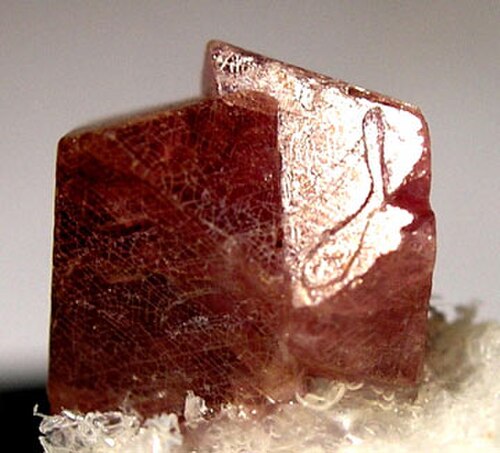
双晶は、単一の鉱物種の2つ以上の結晶が相互に成長することによって生じます。双晶の形状は、鉱物の対称性によって決まります。そのため、接触双晶、網状双晶、屈曲双晶、貫入双晶、周期双晶、多重合成双晶など、いくつかの種類の双晶が存在します。接触双晶、または単純双晶は、平面で結合した2つの結晶から構成され、このタイプの双晶はスピネルによく見られます。ルチルによく見られる網状双晶は、網目状に絡み合った結晶です。屈曲双晶は、双晶の開始によって中央に曲がりが生じます。貫入双晶は、互いに成長した2つの単結晶から構成され、この双晶の例としては、十字形のスタウロライト双晶や正長石のカールスバッド双晶などがあります。周期双晶は、回転軸の周りの双晶形成の繰り返しによって生じます。このタイプの双晶は、3、4、5、6、または8回回転軸の周りで発生し、対応するパターンは、スリーリング、フォーリング、ファイブリング、シックスリング、およびエイトリングと呼ばれます。シックスリングはアラゴナイトでよく見られます。多重合成双晶は、繰り返し双晶が存在する点で周期双晶に似ていますが、回転軸の周りで発生するのではなく、多重合成双晶は通常、微視的なスケールで平行な面に沿って発生します。[ 68 ] [ 69 ]
結晶の習慣とは、あらゆる鉱物の集合結晶の全体的な形状を指します。この特性を説明するためにいくつかの用語が使用されます。一般的な習慣には、針状結晶を表す針状(ナトロライトなど)、樹枝状(樹木状パターン)(天然銅や天然金によく見られる基質(マトリックス)を伴う) 、等軸状(ガーネットに典型的) 、柱状(一方向に伸びている) (クンツァイトや輝安鉱に見られる) 、ブドウ状(ブドウの房のような)(玉髄に見られる)、繊維状結晶を持つ繊維状(珪灰石に見られる)、板状(板状とは異なり、前者は板状であるのに対し、後者は明確な伸びを持つ)(白雲母に見られる)、塊状(明確な形状を持たない) (カーナライトに見られる)などがあります。[ 7 ]結晶の形に関連して、結晶面の質は、特に偏光顕微鏡では、いくつかの鉱物の診断に役立ちます。自形結晶は明確な外形を持ち、他形結晶はそうではない。これらの中間的な形態は半自形と呼ばれる。[ 70 ] [ 71 ]
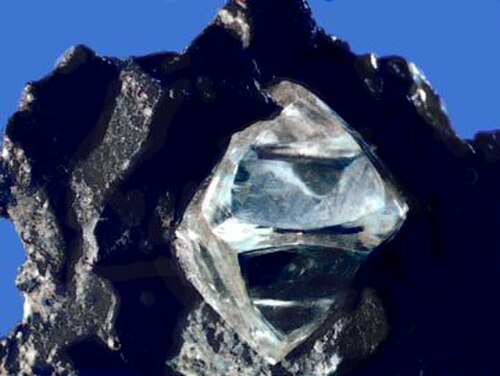
The hardness of a mineral defines how much it can resist scratching or indentation. This physical property is controlled by the chemical composition and crystalline structure of a mineral.
The most commonly used scale of measurement is the ordinal Mohs hardness scale, which measures resistance to scratching. Defined by ten indicators, a mineral with a higher index scratches those below it. The scale ranges from talc, a phyllosilicate, to diamond, a carbon polymorph that is the hardest natural material. The scale is provided below:[72][7]

A mineral's hardness is a function of its structure. Hardness is not necessarily constant for all crystallographic directions; crystallographic weakness renders some directions softer than others.[72] An example of this hardness variability exists in kyanite, which has a Mohs hardness of 51⁄2 parallel to [001] but 7 parallel to [100].[73]
Other scales include these;[74]
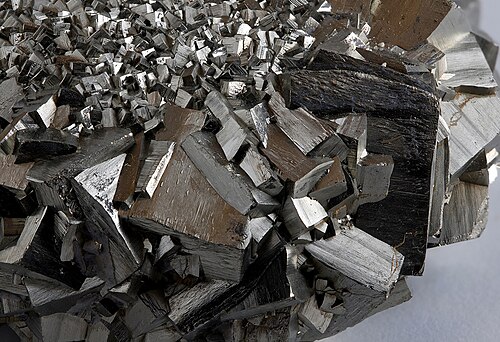
光沢は、鉱物の表面から光がどのように反射するか、その質と強度に関して示します。この性質を説明するために使用される定性的な用語は多数あり、金属光沢と非金属光沢に分類されます。金属光沢と準金属光沢の鉱物は、金属のように高い反射率を持ちます。この光沢を持つ鉱物の例としては、方鉛鉱と黄鉄鉱があります。非金属光沢には、ダイヤモンドのような金剛光沢、ケイ酸塩鉱物に非常によく見られるガラス光沢であるガラス光沢、タルクやアポフィライトのような真珠光沢、ガーネットグループのメンバーのような樹脂光沢、アスベスト状クリソタイルなどの繊維状鉱物によく見られる絹光沢などがあります。[ 76 ]
鉱物の透明度は、光がそれを透過する能力を表します。透明な鉱物は、それを透過する光の強度を弱めません。透明な鉱物の例としては、白雲母(カリウム雲母)があります。種類によっては、窓に使用できるほど透明なものもあります。半透明の鉱物は、ある程度の光を透過させますが、透明な鉱物ほどではありません。翡翠や軟玉(翡翠の鉱物形態)は、この性質を持つ鉱物の例です。光を透過させない鉱物は、不透明と呼ばれます。[ 77 ] [ 78 ]
鉱物の透明度は試料の厚さに依存します。鉱物が十分に薄い場合(例えば、岩石学用の薄片の場合)、手持ちの試料ではその性質が見られなくても透明になることがあります。対照的に、赤鉄鉱や黄鉄鉱などの一部の鉱物は、薄片でも不透明です。[ 78 ]
Colour is the most obvious property of a mineral, but it is often non-diagnostic.[79] It is caused by electromagnetic radiation interacting with electrons (except in the case of incandescence, which does not apply to minerals).[80] Two broad classes of elements (idiochromatic and allochromatic) are defined with regard to their contribution to a mineral's colour: Idiochromatic elements are essential to a mineral's composition; their contribution to a mineral's colour is diagnostic.[77][81] Examples of such minerals are malachite (green) and azurite (blue). In contrast, allochromatic elements in minerals are present in trace amounts as impurities. An example of such a mineral would be the ruby and sapphire varieties of the mineral corundum.[81] The colours of pseudochromatic minerals are the result of interference of light waves. Examples include labradorite and bornite.
In addition to simple body colour, minerals can have various other distinctive optical properties, such as play of colours, asterism, chatoyancy, iridescence, tarnish, and pleochroism. Several of these properties involve variability in colour. Play of colour, such as in opal, results in the sample reflecting different colours as it is turned, while pleochroism describes the change in colour as light passes through a mineral in a different orientation. Iridescence is a variety of the play of colours where light scatters off a coating on the surface of crystal, cleavage planes, or off layers having minor gradations in chemistry.[82] In contrast, the play of colours in opal is caused by light refracting from ordered microscopic silica spheres within its physical structure.[83] Chatoyancy ("cat's eye") is the wavy banding of colour that is observed as the sample is rotated; asterism, a variety of chatoyancy, gives the appearance of a star on the mineral grain. The latter property is particularly common in gem-quality corundum.[82][83]
鉱物の条痕とは、粉末状の鉱物の色を指し、その色は鉱物の本体の色と同一である場合もそうでない場合もある。[ 81 ]この性質を調べる最も一般的な方法は、磁器で作られ、白または黒に着色された条痕板を使用することである。鉱物の条痕は、微量元素[ 77 ]や風化面[ 81 ]とは無関係である。この性質の一般的な例として、ヘマタイトが挙げられる。ヘマタイトは、手標本では黒、銀、または赤に着色されているが、条痕はチェリーレッド[ 77 ]から赤褐色[ 81 ] [ 7 ]である。また、黄銅鉱も挙げられる。黄銅鉱は真鍮のような金色で、黒い条痕を残す[ 7 ] 。条痕は、金属鉱物ではより特徴的であるが、非金属鉱物では本体の色が異色元素によって作られる。[ 77 ]条痕試験は鉱物の硬度によって制約される。硬度が7を超える鉱物は条痕板を粉にしてしまうからである。[ 81 ]

定義上、鉱物は特徴的な原子配列を持っています。この結晶構造の弱さにより弱面が生じ、そのような面に沿って鉱物が割れることを劈開といいます。劈開の質は、鉱物がどれだけきれいに簡単に割れるかに基づいて記述できます。一般的な記述子は、質の低い順に「完全」、「良好」、「明瞭」、「不良」です。特に透明な鉱物や薄片では、劈開は、側面から見たときに平面をマークする一連の平行線として見ることができます。劈開は鉱物に普遍的な性質ではありません。たとえば、広範囲に相互接続されたシリカ四面体からなる石英には、劈開を可能にする結晶学的弱点はありません。対照的に、完全な底面劈開を持つ雲母は、非常に弱く結合したシリカ四面体のシートから構成されています。[ 84 ] [ 85 ]
劈開は結晶学の機能であるため、さまざまな劈開タイプがあります。劈開は通常、1、2、3、4、または6方向のいずれかで発生します。1方向の底面劈開は雲母の独特な性質です。2方向の劈開は柱状と呼ばれ、角閃石や輝石などの鉱物で発生します。方鉛鉱や岩塩などの鉱物は、90°の3方向に立方体(または等軸)劈開を持ちます。方解石や菱マンガン鉱のように、3方向の劈開が存在するが90°ではない場合、それは菱面体劈開と呼ばれます。蛍石とダイヤモンドには八面体劈開(4方向)があり、閃亜鉛鉱には6方向の十二面体劈開があります。[ 84 ] [ 85 ]
劈開面が多い鉱物は、すべての方向で均等に割れるとは限りません。たとえば、方解石は 3 方向に良好な劈開性がありますが、石膏は 1 方向には完全な劈開性があり、他の 2 方向には劈開性が劣ります。劈開面間の角度は鉱物によって異なります。たとえば、角閃石は二重鎖ケイ酸塩であり、輝石は単鎖ケイ酸塩であるため、それらの劈開面間の角度は異なります。輝石は 2 方向に約 90° で劈開しますが、角閃石は 2 方向に明確に約 120° と 60° で離れて劈開します。劈開角は、分度器に似た接触ゴニオメーターで測定できます。[ 84 ] [ 85 ]
劈開(「偽劈開」とも呼ばれる)は、見た目は劈開に似ているが、体系的な弱さではなく、鉱物の構造的欠陥によって生じる。劈開は鉱物の結晶ごとに異なるが、原子構造がその性質を許容する限り、特定の鉱物のすべての結晶は劈開する。一般に、劈開は結晶に加わる何らかの応力によって引き起こされる。応力の発生源には、変形(圧力の増加など)、離溶、双晶形成などがある。劈開を示すことが多い鉱物には、輝石、赤鉄鉱、磁鉄鉱、コランダムなどがある。[ 84 ] [ 86 ]
鉱物が劈開面と異なる方向に割れた場合、それは破断したと言われます。不均一な破断にはいくつかの種類があります。典型的な例は、石英のような貝殻状破断です。丸みを帯びた面ができ、滑らかな曲線で印が付けられます。このタイプの破断は、非常に均質な鉱物でのみ発生します。その他の破断の種類には、繊維状、破片状、およびハックリーがあります。後者は、粗くギザギザした面に沿った破断を表し、この性質の例は天然銅に見られます。[ 87 ]
Tenacity is related to both cleavage and fracture. Whereas fracture and cleavage describes the surfaces that are created when a mineral is broken, tenacity describes how resistant a mineral is to such breaking. Minerals can be described as brittle, ductile, malleable, sectile, flexible, or elastic.[88]

Specific gravity numerically describes the density of a mineral. The dimensions of density are mass divided by volume with units: kg/m3 or g/cm3. Specific gravity is defined as the density of the mineral divided by the density of water at 4 °C and thus is a dimensionless quantity, identical in all unit systems.[89] It can be measured as the quotient of the mass of the sample and difference between the weight of the sample in air and its corresponding weight in water. Among most minerals, this property is not diagnostic. Rock forming minerals – typically silicates or occasionally carbonates – have a specific gravity of 2.5–3.5.[90]
High specific gravity is a diagnostic property of a mineral. A variation in chemistry (and consequently, mineral class) correlates to a change in specific gravity. Among more common minerals, oxides and sulfides tend to have a higher specific gravity as they include elements with higher atomic mass. A generalization is that minerals with metallic or adamantine lustre tend to have higher specific gravities than those having a non-metallic to dull lustre. For example, hematite, Fe2O3, has a specific gravity of 5.26[91] while galena, PbS, has a specific gravity of 7.2–7.6,[92] which is a result of their high iron and lead content, respectively. A very high specific gravity is characteristic of native metals; for example, kamacite, an iron-nickel alloy common in iron meteorites has a specific gravity of 7.9,[93] and gold has an observed specific gravity between 15 and 19.3.[90][94]

Other properties can be used to diagnose minerals. These are less general, and apply to specific minerals.
鉱物に希酸(多くの場合10% HCl )を滴下すると、炭酸塩を他の鉱物クラスから区別するのに役立ちます。酸は炭酸塩([CO 3 ] 2−)基と反応し、影響を受けた部分が発泡して二酸化炭素ガスを放出します。このテストは、鉱物を元の結晶形または粉末状にしてテストするようにさらに拡張できます。このテストの例は、特に岩石(それぞれ石灰岩とドロマイト)内で方解石とドロマイトを区別するときに行われます。方解石は酸の中ですぐに発泡しますが、ドロマイトは発泡させるために、粉末状にしたドロマイト(多くの場合、岩石の傷ついた表面)に酸を塗布する必要があります。[ 95 ]ゼオライト鉱物は酸の中で発泡しません。代わりに、5~10分後に霜状になり、1日酸の中に放置すると溶解するかシリカゲルになります。[ 96 ]
磁性は、ごく一部の鉱物に見られる非常に顕著な性質です。一般的な鉱物の中では、磁鉄鉱がこの性質を強く示し、磁硫鉄鉱やチタン鉄鉱にも、それほど強くはないものの磁性が存在します。[ 95 ]一部の鉱物は電気的性質を示します(例えば、石英は圧電性を示します)が、電気的性質はデータが不完全で自然変動があるため、鉱物の診断基準として使用されることはまれです。[ 97 ]
鉱物は味や匂いでも検査できます。岩塩(NaCl)は食卓塩です。カリウムを含む岩塩であるシルビンは強い苦味があります。硫化物は、特に試料を割ったり、反応させたり、粉末にしたりすると、特徴的な匂いがします。[ 95 ]
放射能は、放射性元素を含む鉱物に見られる稀な性質です。放射性元素は、ウラン鉱、オートナイト、カルノー鉱などのウランのように、鉱物の主要成分である場合もあれば、ジルコンのように微量不純物として存在する場合もあります。放射性元素の崩壊は鉱物の結晶構造を損傷し、局所的に非晶質(メタミクト状態)にします。その結果生じる光学的な現象は、放射性ハローまたは多色性ハローと呼ばれ、薄片岩石学などのさまざまな手法で観察できます。[ 95 ]
紀元前315年、テオフラストスは著書『石について』の中で鉱物の分類を発表した。彼の分類は、師であるプラトン とアリストテレスの思想に影響を受けている。テオフラストスは鉱物を石、土、金属に分類した。[ 98 ]
1546年に出版されたゲオルギウス・アグリコラの著書『化石の自然について』における鉱物の分類では、鉱物は単純物質(石、土、金属、凝固した液)、複合物質(密接に混ざり合っている)、複合体(分離可能)の3種類の物質に分類された。[ 98 ]
鉱物の初期の分類は、カール・リンネが1735年の著書『自然の体系』で行った。彼は自然界を 植物、動物、鉱物の3つの界に分け 、それぞれを同じ階層で分類した。[ 99 ]降順で、門、綱、目、科、族、属、種である。しかし、彼の体系はチャールズ・ダーウィンの種形成理論によって正当化され、その後の数世紀にわたって生物学者によって広く採用され拡張されてきたが(彼らは今でもギリシャ語とラテン語に基づく彼の二名法による命名法を使用している)、鉱物学者の間ではほとんど成功しなかった(ただし、個々の鉱物は今でも正式には鉱物種と呼ばれている)。
鉱物は、一般性の度合いが増す順に、変種、種、系列、グループに分類されます。定義の基本レベルは鉱物種であり、それぞれが固有の化学的および物理的性質によって他の鉱物と区別されます。たとえば、石英は、その化学式SiO 2と、同じ化学式を持つ他の鉱物 (多形体と呼ばれる) と区別する特定の結晶構造によって定義されます。2 つの鉱物種の間に組成の範囲が存在する場合、鉱物系列が定義されます。たとえば、黒雲母系列は、端成分である金雲母、シデロフィライト、アニット、イーストナイトのさまざまな量によって表されます。対照的に、鉱物グループは、共通の化学的性質を持ち、結晶構造を共有する鉱物種のグループです。輝石グループは、共通の化学式 XY(Si,Al) 2 O 6を持ち、ここで X と Y は両方とも陽イオンであり、X は通常Y より大きいです。輝石は単鎖ケイ酸塩で、斜方晶系または単斜晶系のいずれかの結晶系で結晶化します。最後に、鉱物変種とは、色や結晶形態などの物理的特性によって異なる特定の種類の鉱物種のことです。例としては、紫色の石英の変種であるアメジストがあります。 [ 18 ]
鉱物の分類には、ダナ分類とシュトルンツ分類という2つの一般的な分類法が用いられます。どちらも、特に重要な化学基と構造に関して、組成に基づいています。当時の著名な地質学者であったジェームズ・ドワイト・ダナは、 1837年に初めて『鉱物学体系』を出版しました。 1997年現在ダナ分類は、第8版である。ダナ分類では、鉱物種に4つの部分からなる番号が割り当てられる。クラス番号は重要な構成グループに基づいており、タイプは鉱物中の陽イオンと陰イオンの比率を示し、最後の2つの番号は、特定のタイプまたはクラス内で構造的類似性に基づいて鉱物をグループ化する。あまり一般的ではないシュトルンツ分類は、ドイツの鉱物学者カール・フーゴ・シュトルンツにちなんで名付けられ、ダナシステムに基づいているが、化学的基準と構造的基準の両方を組み合わせており、後者は化学結合の分布に関するものである。[ 100 ]
地殻の組成はケイ素と酸素が支配的であるため、岩石の形成と多様性の観点から、ケイ酸塩が圧倒的に重要な鉱物クラスです。しかし、非ケイ酸塩鉱物は、特に鉱石として、経済的に非常に重要です。[ 101 ] [ 102 ]非ケイ酸塩鉱物は、その主要な化学組成によって、天然元素、硫化物、ハロゲン化物、酸化物と水酸化物、炭酸塩と硝酸塩、ホウ酸塩、硫酸塩、リン酸塩、有機化合物など、いくつかの他のクラスに細分化されます。ほとんどの非ケイ酸塩鉱物種は希少であり(地殻全体の 8% を占める)、方解石、黄鉄鉱、磁鉄鉱、赤鉄鉱など、比較的一般的なものもあります。非ケイ酸塩には、密充填とケイ酸塩のような連結四面体の 2 つの主要な構造スタイルが見られます。密充填構造は、間隙空間を最小限に抑えながら原子を密に充填する方法です。六方最密充填では、層が交互に同じ構造(「ababab」)で積み重なるのに対し、立方最密充填では、3つの層からなるグループ(「abcabcabc」)が積み重なります。連結したシリカ四面体の類似物には、 SO 4− 4(硫酸塩)、PO 4− 4(リン酸塩)、AsO 4− 4(ヒ酸塩)、VO 4− 4(バナジン酸塩)構造があります。非ケイ酸塩は、ケイ酸塩鉱物よりも元素を濃縮するため、経済的に非常に重要です。[ 103 ]
鉱物の中で圧倒的に多いのはケイ酸塩鉱物です。ほとんどの岩石は95%以上がケイ酸塩鉱物で構成されており、地殻の90%以上がこれらの鉱物で構成されています。[ 104 ]ケイ酸塩鉱物の主な構成要素はケイ素と酸素で、これらは地殻で最も豊富な2つの元素です。ケイ酸塩鉱物に含まれるその他の一般的な元素は、アルミニウム、マグネシウム、鉄、カルシウム、ナトリウム、カリウムなど、地殻の他の一般的な元素に対応しています。[ 105 ]重要な岩石形成ケイ酸塩鉱物には、長石、石英、カンラン石、輝石、角閃石、ガーネット、雲母などがあります。

ケイ酸塩鉱物の基本単位は[SiO 4 ] 4−四面体です。ほとんどの場合、ケイ素は酸素と4配位または四面体配位しています。非常に高圧の状況では、ペロブスカイト構造や石英多形スティショバイト(SiO 2)のように、ケイ素は6配位または八面体配位になります。後者の場合、鉱物はもはやケイ酸塩構造ではなく、ルチル(TiO 2)とその関連グループである単純酸化物の構造を持ちます。これらのシリカ四面体は、その後ある程度重合して、一次元鎖、二次元シート、三次元フレームワークなどのさまざまな構造を形成します。四面体の重合が起こっていない基本的なケイ酸塩鉱物では、基本の4−電荷を相殺するために他の元素が必要です。他のケイ酸塩構造では、結果として生じる負電荷を相殺するために、異なる元素の組み合わせが必要です。 Si 4+ はイオン半径と電荷が似ているためAl 3+に置換されるのが一般的です。そのような場合、[AlO 4 ] 5−四面体は置換されていない四面体と同じ構造を形成しますが、電荷バランスの要件が異なります。[ 106 ]
重合度は、形成された構造と、共有されている四面体コーナー(または配位酸素)の数(四面体サイトのアルミニウムとシリコンの場合)の両方によって説明できます。[ 107 ] [ 108 ]
ケイ酸塩のサブクラスは、重合度の高い順に以下に説明する。
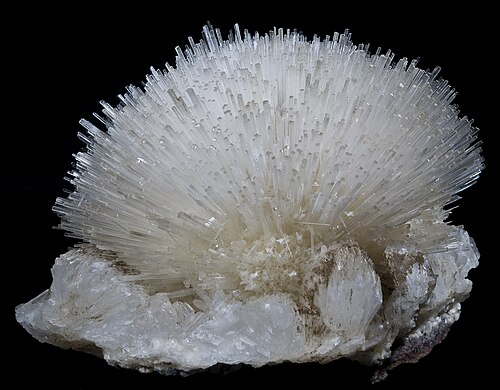
テクトケイ酸塩(フレームワークケイ酸塩とも呼ばれる)は、最も重合度が高い。四面体のすべての頂点が共有されているため、ケイ素:酸素比は 1:2 になる。例としては、石英、長石、準長石、ゼオライトなどがある。フレームワークケイ酸塩は、強い共有結合の結果として、特に化学的に安定している傾向がある。[ 109 ]
地球の地殻の 12% を占める石英(SiO 2 ) は、最も豊富な鉱物種です。高い化学的および物理的抵抗性が特徴です。石英には、高温でのトリディマイトやクリストバライト、高圧コエサイト、超高圧スティショバイトなど、いくつかの多形があります。後者の鉱物は、地球上では隕石の衝突によってのみ形成され、その構造は非常に圧縮されているため、ケイ酸塩構造からルチル(TiO 2 ) の構造に変化しています。地球の表面で最も安定なシリカ多形は α-石英です。その対となる β-石英は、高温高圧でのみ存在します ( 1 bar で 573 °C 未満で α-石英に変化します)。これら 2 つの多形は、結合の「キンク」によって異なります。この構造変化により、β-石英はα-石英よりも対称性が高くなり、そのため高石英(β)と低石英(α)とも呼ばれる。[ 104 ] [ 110 ]
Feldspars are the most abundant group in the Earth's crust, at about 50%. In the feldspars, Al3+ substitutes for Si4+, which creates a charge imbalance that must be accounted for by the addition of cations. The base structure becomes either [AlSi3O8]− or [Al2Si2O8]2− There are 22 mineral species of feldspars, subdivided into two major subgroups – alkali and plagioclase – and two less common groups – celsian and banalsite. The alkali feldspars are most commonly in a series between potassium-rich orthoclase and sodium-rich albite; in the case of plagioclase, the most common series ranges from albite to calcium-rich anorthite. Crystal twinning is common in feldspars, especially polysynthetic twins in plagioclase and Carlsbad twins in alkali feldspars. If the latter subgroup cools slowly from a melt, it forms exsolution lamellae because the two components – orthoclase and albite – are unstable in solid solution. Exsolution can be on a scale from microscopic to readily observable in hand-sample; perthitic texture forms when Na-rich feldspar exsolve in a K-rich host. The opposite texture (antiperthitic), where K-rich feldspar exsolves in a Na-rich host, is very rare.[111]
Feldspathoids are structurally similar to feldspar, but differ in that they form in Si-deficient conditions, which allows for further substitution by Al3+. As a result, feldspathoids are almost never found in association with quartz. A common example of a feldspathoid is nepheline ((Na, K)AlSiO4); compared to alkali feldspar, nepheline has an Al2O3:SiO2 ratio of 1:2, as opposed to 1:6 in alkali feldspar.[112] Zeolites often have distinctive crystal habits, occurring in needles, plates, or blocky masses. They form in the presence of water at low temperatures and pressures, and have channels and voids in their structure. Zeolites have several industrial applications, especially in waste water treatment.[113]
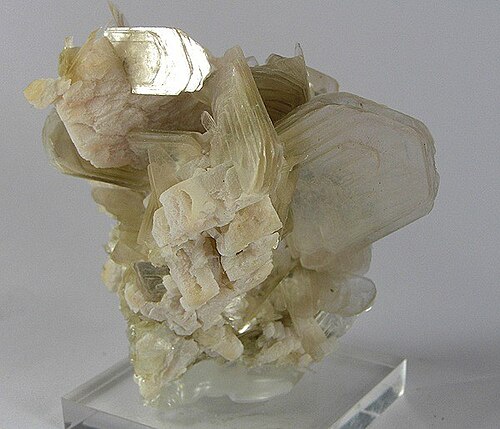
フィロケイ酸塩は、重合した四面体のシートで構成されています。これらは3つの酸素サイトで結合しており、特徴的なケイ素:酸素比は2:5です。重要な例としては、雲母、緑泥石、カオリナイト-蛇紋石グループなどがあります。四面体に加えて、フィロケイ酸塩には、負電荷を持つ基本四面体(例:[Si 4 O 10 ] 4− )のバランスをとる八面体(酸素による6配位の元素)のシートがあります。これらの四面体(T)と八面体(O)のシートは、さまざまな組み合わせで積み重ねられ、フィロケイ酸塩層を形成します。八面体シート内には、単位構造に3つの八面体サイトがありますが、すべてのサイトが占有されているとは限りません。その場合、鉱物は二八面体と呼ばれ、そうでない場合は三八面体と呼ばれます。[ 114 ]層はファンデルワールス力、水素結合、またはまばらなイオン結合によって弱く結合しており、これが結晶学的弱点を引き起こし、結果としてフィロケイ酸塩の間に顕著な底面劈開が生じる。[ 115 ]
カオリナイト-蛇紋石グループはTOスタック(1:1粘土鉱物)で構成され、シートは水素結合で結合しているため、硬度は2~4です。2:1粘土鉱物(パイロフィライト-タルク)はTOTスタックで構成されていますが、ファンデルワールス力で結合しているため、より柔らかい(硬度1~2)です。これら2つの鉱物グループは、八面体占有率によってさらに細分化されます。具体的には、カオリナイトとパイロフィライトは二八面体であり、蛇紋石とタルクは三八面体です。[ 116 ]
雲母もTOTスタック型のフィロケイ酸塩鉱物ですが、他のTOTおよびTOスタック型のサブクラスとは異なり、四面体シートにアルミニウムを取り込んでいます(粘土鉱物は八面体サイトにAl 3+を持っています)。雲母の一般的な例としては、白雲母と黒雲母系列があります。雲母のTOT層は金属イオンによって結合されているため、他のフィロケイ酸塩鉱物よりも硬度が高く、完全な底面劈開性を保持しています。[ 117 ]緑泥石グループは雲母グループと関連していますが、TOTスタックの間にブルサイトのような(Mg(OH) 2 )層があります。 [ 118 ]
Because of their chemical structure, phyllosilicates typically have flexible, elastic, transparent layers that are electrical insulators and can be split into very thin flakes. Micas can be used in electronics as insulators, in construction, as optical filler, or even cosmetics. Chrysotile, a species of serpentine, is the most common mineral species in industrial asbestos, as it is less dangerous in terms of health than the amphibole asbestos.[119]

Inosilicates consist of tetrahedra repeatedly bonded in chains. These chains can be single, where a tetrahedron is bound to two others to form a continuous chain; alternatively, two chains can be merged to create double-chain silicates. Single-chain silicates have a silicon:oxygen ratio of 1:3 (e.g. [Si2O6]4−), whereas the double-chain variety has a ratio of 4:11, e.g. [Si8O22]12−. Inosilicates contain two important rock-forming mineral groups; single-chain silicates are most commonly pyroxenes, while double-chain silicates are often amphiboles.[120] Higher-order chains exist (e.g. three-member, four-member, five-member chains, etc.) but they are rare.[121]
The pyroxene group consists of 21 mineral species.[122] Pyroxenes have a general structure formula of XY(Si2O6), where X is an octahedral site, while Y can vary in coordination number from six to eight. Most varieties of pyroxene consist of permutations of Ca2+, Fe2+ and Mg2+ to balance the negative charge on the backbone. Pyroxenes are common in the Earth's crust (about 10%) and are a key constituent of mafic igneous rocks.[123]
角閃石は化学組成が非常に多様で、「鉱物学的ゴミ箱」や「元素の海を泳ぐ鉱物学的サメ」などと様々に表現される。角閃石の骨格は[Si 8 O 22 ] 12−であり、3つの可能な位置にある陽イオンによってバランスが取られているが、3番目の位置が常に使用されるとは限らず、1つの元素が残りの2つの位置を占めることもある。最後に、角閃石は通常水和しており、つまり水酸基([OH] −)を持っているが、フッ化物、塩化物、または酸化物イオンに置き換えられることもある。[ 124 ]化学組成が多様であるため、角閃石には80種以上あるが、輝石と同様に、最も一般的にはCa 2+、Fe 2+、Mg 2+の混合物が変異に関与している。[ 122 ]いくつかの角閃石鉱物種はアスベスト状の結晶形を持つことがある。これらのアスベスト鉱物は、長く、細く、柔軟で、丈夫な繊維を形成し、電気絶縁体であり、化学的に不活性で、耐熱性があります。そのため、特に建築材料において、さまざまな用途があります。しかし、アスベストは発がん性物質として知られており、アスベスト症などのさまざまな病気を引き起こします。角閃石アスベスト(アンソフィライト、トレモライト、アクチノライト、グルネライト、リーベック石)は、クリソタイル蛇紋石アスベストよりも危険であると考えられています。[ 125 ]

環状ケイ酸塩、または環状ケイ酸塩は、ケイ素と酸素の比率が 1:3 です。6 員環が最も一般的で、基本構造は [Si 6 O 18 ] 12−です。例としては、トルマリン群やベリルなどがあります。他の環状構造も存在し、3、4、8、9、12 員環が報告されています。[ 126 ]環状 ケイ酸塩は強度が高く、細長く縞模様のある結晶を持つ傾向があります。[ 127 ]
トルマリンは非常に複雑な化学構造を持ち、一般式 XY 3 Z 6 (BO 3 ) 3 T 6 O 18 V 3 Wで表すことができます。T 6 O 18は基本的な環状構造で、T は通常 Si 4+ですが、Al 3+または B 3+で置換可能です。トルマリンは X サイトの占有率によってサブグループに分類でき、そこからさらに W サイトの化学構造によって細分化できます。Y サイトと Z サイトはさまざまなカチオン、特にさまざまな遷移金属を収容できます。この構造的な遷移金属含有量の変動により、トルマリングループは色の変動が大きくなります。他の環状ケイ酸塩には、ベリル Al 2 Be 3 Si 6 O 18があり、その種類には宝石のエメラルド (緑色) とアクアマリン (青色) があります。コーディエライトは構造的にベリルに似ており、一般的な変成鉱物です。[ 128 ]
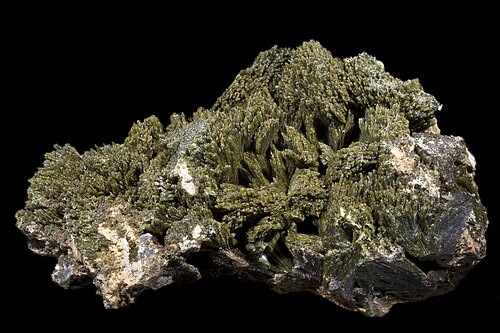
二ケイ酸塩とも呼ばれるソロケイ酸塩は、1つの酸素原子で四面体-四面体結合を持ち、その結果、ケイ素と酸素の比率が2:7になります。結果として生じる共通の構造要素は[Si 2 O 7 ] 6−グループです。最も一般的な二ケイ酸塩は、緑簾石グループのメンバーです。緑簾石は、中央海嶺から花崗岩、変成泥質岩まで、さまざまな地質環境で見つかります。緑簾石は[(SiO 4 )(Si 2 O 7 )] 10−構造を中心に構築されています。たとえば、鉱物種緑簾石は、電荷バランスをとるためにカルシウム、アルミニウム、および三価鉄を持っています。Ca 2 Al 2 (Fe 3+ , Al)(SiO 4 )(Si 2 O 7 )O(OH)。Fe 3+およびFe 2+としての鉄の存在は、酸素フガシティを緩衝するのに役立ち、これは岩石生成の重要な要因です。[ 129 ]
ソロケイ酸塩の他の例としては、ブルースキスト相(低温高圧の沈み込み帯環境)で形成される変成鉱物であるローソナイトや、化学構造にかなりの量のカルシウムを取り込むベスビアナイトなどがある。 [ 129 ] [ 130 ]

オルトケイ酸塩は、他の陽イオンによって電荷がバランスされた孤立した四面体から構成されています。[ 131 ]ネソケイ酸塩とも呼ばれるこのタイプのケイ酸塩は、ケイ素:酸素比が 1:4 です (例: SiO 4 )。典型的なオルトケイ酸塩は、ブロック状の等軸結晶を形成する傾向があり、かなり硬いです。[ 132 ]アルミノケイ酸塩、オリビン グループ、ガーネット グループなど、いくつかの造岩鉱物がこのサブクラスに含まれています。
アルミノケイ酸塩(藍晶石、紅柱石、珪線石、いずれも Al 2 SiO 5)は、構造的には 1 つの [SiO 4 ] 4−四面体と 1 つの Al 3+が八面体配位で構成されている。残りの Al 3+は、6 配位(藍晶石)、5 配位(紅柱石)、または 4 配位(珪線石)になることができ、特定の環境でどの鉱物が形成されるかは、圧力と温度条件に依存する。オリビン構造では、主なオリビン系列 (Mg, Fe) 2 SiO 4は、マグネシウムに富むフォルステライトと鉄に富むファヤライトから構成される。鉄とマグネシウムは両方とも酸素によって八面体配位されている。この構造を持つ他の鉱物種として、テフロイト、Mn 2 SiO 4などがある。[ 133 ]ガーネット群の一般式は X 3 Y 2 (SiO 4 ) 3で、X は大きな 8 配位の陽イオン、Y はより小さな 6 配位の陽イオンです。ガーネットには 6 つの理想的な端成分があり、2 つのグループに分かれています。パイラルスパイト ガーネットはY の位置にAl 3+を持ちます。パイロープ(Mg 3 Al 2 (SiO 4 ) 3 )、アルマンディン(Fe 3 Al 2 (SiO 4 ) 3 )、スペサルティン(Mn 3 Al 2 (SiO 4 ) 3 )。ウグランダイト ガーネットはX の位置にCa 2+を持ちます。ウバロバイト(Ca 3 Cr 2 (SiO 4 ) 3 )、グロッシュラー(Ca 3 Al 2 (SiO 4 ) 3 )、アンドラダイト(Ca 3 Fe 2 (SiO 4 ) 3 )。ガーネットには2つのサブグループがあるが、6つの端成分すべての間に固溶体が存在する。[ 131 ]
その他のオルトケイ酸塩には、ジルコン、スタウロライト、トパーズなどがあります。ジルコン(ZrSiO 4 )は、U 6+が Zr 4+と置換できるため、地質年代学で有用です。さらに、非常に耐性のある構造のため、クロノメーターとしてリセットすることは困難です。スタウロライトは、一般的な変成中度指標鉱物です。特に複雑な結晶構造を持ち、1986 年にようやく完全に記述されました。トパーズ(Al 2 SiO 4 (F, OH) 2)は、トルマリンを伴う花崗岩質ペグマタイトでよく見られる一般的な宝石鉱物です。[ 134 ]

天然元素とは、他の元素と化学的に結合していない元素のことです。この鉱物群には、天然金属、半金属、非金属、および様々な合金や固溶体が含まれます。金属は金属結合によって結合しており、この結合によって、光沢のある金属光沢、延性、展性、電気伝導性といった独特の物理的性質がもたらされます。天然元素は、その構造や化学的性質によってさらに細分化されます。
立方最密充填構造を持つ金族には、金、銀、銅などの金属が含まれます。白金族は構造が金族と似ています。鉄ニッケル族は、いくつかの鉄ニッケル合金種によって特徴付けられます。2つの例は、鉄隕石中に見られるカマサイトとテーナイトです。これらの種は、合金中のニッケルの量によって異なり、カマサイトはニッケルが5~7%未満で、天然鉄の一種ですが、テーナイトのニッケル含有量は7~37%です。ヒ素族鉱物は、金属的な性質を一部しか持たない半金属で構成されています。たとえば、金属のような展性はありません。天然炭素は、グラファイトとダイヤモンドの2つの同素体で存在します。後者はマントル内の非常に高い圧力で形成されるため、グラファイトよりもはるかに強い構造を持ちます。[ 135 ]

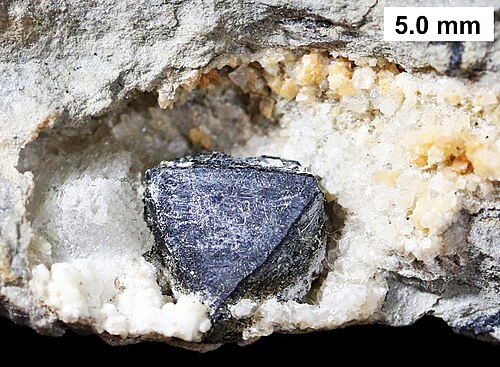
硫化物鉱物は、 1 つ以上の金属または半金属とカルコゲンまたはプニクトゲンとの化学化合物であり、その中で最も一般的なのは硫黄です。テルル、ヒ素、またはセレンが硫黄の代わりになります。硫化物は、比重が高く、柔らかく脆い鉱物である傾向があります。黄鉄鉱などの多くの粉末状の硫化物は、粉末にすると硫黄臭がします。硫化物は風化しやすく、多くは水に溶けやすく、これらの溶解した鉱物は後に再沈殿し、濃縮された二次鉱床を形成します。[ 136 ]硫化物は、金属または半金属と硫黄の比率によって分類され、M:S が 2:1 または 1:1 に等しい場合があります。[ 137 ]多くの硫化物鉱物は、金属鉱石として経済的に重要です。例としては、亜鉛鉱石である閃亜鉛鉱(ZnS)、鉛鉱石である方鉛鉱 (PbS)、水銀鉱石である辰砂(HgS)、モリブデン鉱石である輝水鉛鉱(MoS 2 )などがある。 [ 138 ]黄鉄鉱 (FeS 2 ) は最も一般的な硫化物であり、ほとんどの地質環境で見られる。ただし、鉄鉱石ではなく、酸化されて硫酸を生成する。[ 139 ]硫化物に関連するものとして、硫黄とアンチモン、ヒ素、ビスマスなどの半金属に金属元素が結合した稀な硫塩類がある。硫化物と同様に、硫塩類は一般的に柔らかく、重く、脆い鉱物である。[ 140 ]
酸化物鉱物は、単純酸化物、水酸化物、複合酸化物の 3 つのカテゴリーに分けられます。単純酸化物は、主な陰イオンとして O 2−があり、主にイオン結合していることが特徴です。これらは、酸素と陽イオンの比率によってさらに細分化できます。ペリクレースグループは、1:1 の比率の鉱物で構成されています。2:1 の比率の酸化物には、キュプライト(Cu 2 O) や氷水などがあります。コランダムグループの鉱物は 2:3 の比率で、コランダム(Al 2 O 3 ) やヘマタイト(Fe 2 O 3 ) などの鉱物が含まれます。ルチルグループの鉱物は 1:2 の比率で、その名の由来となったルチル (TiO 2 ) はチタンの主鉱石です。その他の例としては、錫鉱石(SnO 2 ;スズの鉱石) や軟マンガン鉱石(MnO 2 ;マンガンの鉱石)などがあります。 [ 141 ] [ 142 ] 水酸化物では、主要な陰イオンは水酸化物イオン OH −です。ボーキサイトは主要なアルミニウム鉱石であり、ダイアスポア、ギブサイト、ボーマイトという水酸化物鉱物の不均一な混合物です。これらは化学的風化の速度が非常に高い地域(主に熱帯条件)で形成されます。[ 143 ] 最後に、複合酸化物は、2 つの金属と酸素の化合物です。このクラスの主要なグループはスピネルであり、一般式は X 2+ Y 3+ 2 O 4です。種の例としては、スピネル(MgAl 2 O 4 )、クロマイト(FeCr 2 O 4 )、マグネタイト(Fe 3 O 4 ) があります。後者は、鉄が 2 つの酸化状態(Fe 2+ Fe 3+ 2 O 4 )にあるため強い磁性を持ち、単一酸化物ではなく複合酸化物となるため、容易に区別できます。[ 144 ]

The halide minerals are compounds in which a halogen (fluorine, chlorine, iodine, or bromine) is the main anion. These minerals tend to be soft, weak, brittle, and water-soluble. Common examples of halides include halite (NaCl, table salt), sylvite (KCl), and fluorite (CaF2). Halite and sylvite commonly form as evaporites, and can be dominant minerals in chemical sedimentary rocks. Cryolite, Na3AlF6, is a key mineral in the extraction of aluminium from bauxites; however, as the only significant occurrence at Ivittuut, Greenland, in a granitic pegmatite, was depleted, synthetic cryolite can be made from fluorite.[145]
炭酸塩鉱物は、主な陰イオン基が炭酸イオン、[CO 3 ] 2−である鉱物です。炭酸塩は脆い傾向があり、多くは菱面体劈開を持ち、すべて酸と反応します。[ 146 ]最後の特性のため、野外地質学者は炭酸塩と非炭酸塩を区別するために希塩酸を携帯することがよくあります。炭酸塩と酸の反応は、最も一般的には方解石とアラゴナイト(CaCO 3 ) の多形として見られる鉱物の溶解と沈殿に関係しており、これは石灰岩の洞窟、鍾乳石や石筍などの洞窟内の特徴、カルスト地形の形成の鍵となります。炭酸塩は、海洋環境では生物起源または化学的堆積物として形成されることが最も多いです。炭酸塩グループは構造的に三角形であり、中心の C 4+陽イオンが 3 つの O 2−陰イオンに囲まれています。さまざまなグループの鉱物は、これらの三角形のさまざまな配置から形成されます。[ 147 ]最も一般的な炭酸塩鉱物は方解石で、これは堆積石灰岩と変成大理石の主成分です。方解石(CaCO 3)は、カルシウムの代わりにマグネシウムがかなりの割合で置換されることがあります。高マグネシウム条件下では、代わりにその多形であるアラゴナイトが形成されます。この点に関して、海洋地球化学は、どちらの鉱物が優先的に形成されるかに応じて、アラゴナイトの海または方解石の海と表現できます。ドロマイトは複炭酸塩で、式はCaMg(CO 3 ) 2です。石灰岩の二次ドロマイト化は一般的で、方解石またはアラゴナイトがドロマイトに変化します。この反応により、細孔空間が増加し(ドロマイトの単位格子体積は方解石の88%)、石油とガスの貯留層が形成される可能性があります。これら2つの鉱物種は、同名の鉱物グループに属しています。方解石グループには一般式XCO 3の炭酸塩が含まれ、ドロマイトグループは一般式XY(CO 3 ) 2の鉱物で構成されています。[ 148 ]
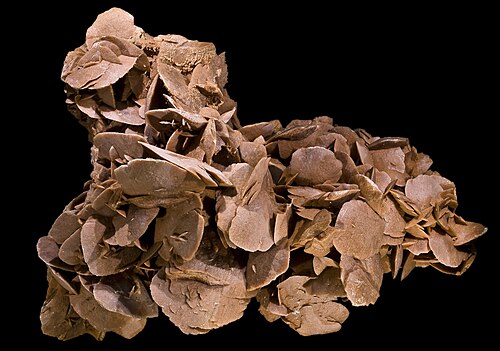
硫酸塩鉱物はすべて硫酸アニオン、[SO 4 ] 2−を含んでいます。透明から半透明で柔らかく、多くは脆い傾向があります。[ 149 ]硫酸塩鉱物は一般的に蒸発岩として形成され、蒸発する塩水から沈殿します。硫酸塩は硫化物に関連する熱水脈系[ 150 ]や硫化物の酸化生成物[ 151 ]でも見られます。硫酸塩は無水鉱物と含水鉱物に分類できます。最も一般的な含水硫酸塩は石膏、CaSO 4 ⋅2H 2 Oです。これは蒸発岩として形成され、方解石や岩塩などの他の蒸発岩と関連しています。石膏が結晶化する際に砂粒を取り込むと、砂漠のバラを形成することがあります。石膏は熱伝導率が非常に低く、加熱しても脱水によって熱を失うため低温を維持します。そのため、石膏はプラスターや乾式壁などの材料の断熱材として使用されます。石膏の無水物は無水石膏で、非常に乾燥した条件下では海水から直接生成されます。重晶石グループは一般式 XSO 4を持ち、X は大きな 12 配位の陽イオンです。例としては、重晶石(BaSO 4 )、セレスタイト(SrSO 4 )、アングレサイト(PbSO 4 ) などがあります。無水石膏は、より小さな Ca 2+が 8 配位であるため、重晶石グループには含まれません。 [ 152 ]
The phosphate minerals are characterized by the tetrahedral [PO4]3− unit, although the structure can be generalized, and phosphorus is replaced by antimony, arsenic, or vanadium. The most common phosphate is the apatite group; common species within this group are fluorapatite (Ca5(PO4)3F), chlorapatite (Ca5(PO4)3Cl) and hydroxylapatite (Ca5(PO4)3(OH)). Minerals in this group are the main crystalline constituents of teeth and bones in vertebrates. The relatively abundant monazite group has a general structure of ATO4, where T is phosphorus or arsenic, and A is often a rare-earth element (REE). Monazite is important in two ways: first, as a REE "sink", it can sufficiently concentrate these elements to become an ore; secondly, monazite group elements can incorporate relatively large amounts of uranium and thorium, which can be used in monazite geochronology to date the rock based on the decay of the U and Th to lead.[153]
The Strunz classification includes a class for organic minerals. These rare compounds contain organic carbon, but can be formed by a geologic process. For example, whewellite, CaC2O4⋅H2O is an oxalate that can be deposited in hydrothermal ore veins. While hydrated calcium oxalate can be found in coal seams and other sedimentary deposits involving organic matter, the hydrothermal occurrence is not considered to be related to biological activity.[102]
Mineral classification schemes and their definitions are evolving to match recent advances in mineral science. Recent changes have included the addition of an organic class, in both the new Dana and the Strunz classification schemes.[154][155] The organic class includes a very rare group of minerals with hydrocarbons. The IMA Commission on New Minerals and Mineral Names adopted in 2009 a hierarchical scheme for the naming and classification of mineral groups and group names and established seven commissions and four working groups to review and classify minerals into an official listing of their published names.[156][157] According to these new rules, "mineral species can be grouped in a number of different ways, on the basis of chemistry, crystal structure, occurrence, association, genetic history, or resource, for example, depending on the purpose to be served by the classification."[156]
It has been suggested that biominerals could be important indicators of extraterrestrial life and thus could play an important role in the search for past or present life on Mars. Furthermore, organic components (biosignatures) that are often associated with biominerals are believed to play crucial roles in both pre-biotic and biotic reactions.[158]
In January 2014, NASA reported that studies by the Curiosity and Opportunityrovers on Mars would search for evidence of ancient life, including a biosphere based on autotrophic, chemotrophic and/or chemolithoautotrophicmicroorganisms, as well as ancient water, including fluvio-lacustrine environments (plains related to ancient rivers or lakes) that may have been habitable.[159][160][161][162] The search for evidence of habitability, taphonomy (related to fossils), and organic carbon on the planet Mars became a primary NASA objective.[159][160]