
Loading article…

紀元前5世紀のアテネは、紀元前500年から401年までのギリシャの都市国家アテネでした。この時代は一般的にアテネの黄金時代として知られ、後半はペリクレスの時代と呼ばれ、政治的覇権、経済成長、芸術的・文化的繁栄によって支えられていました。アテネの黄金時代は、伝統的に紀元前478年にペルシアの侵略が敗北した後、デロス同盟として知られるアテネ主導の都市国家連合がペルシアに立ち向かい、解放されたアジアのギリシャ都市を自由にした時に始まったとされています。
紀元前5世紀半ばにペルシアとの和平が成立した後、独立した都市国家の同盟として始まったものは、アテナイが同盟国間の平等という建前を放棄し、デロス同盟の財源をデロス島からアテナイに移したことで、アテナイ帝国へと変貌した。アテナイでは、その財源によってアテナイのアクロポリスが建設され、人口の半分が公務員として雇用され、ギリシャ世界における支配的な海軍力としての地位が維持された。
帝国の潤沢な資金、軍事的優位性、そして政治家であり雄弁家でもあったペリクレスの指導による政治的繁栄のもと、アテネは西洋文化において最も影響力があり、長く受け継がれる文化遺産の数々を生み出した。劇作家のアイスキュロス、ソフォクレス、エウリピデスは皆、紀元前5世紀のアテネで生活し、創作活動を行った。歴史家のヘロドトスとトゥキディデス、医師のヒポクラテス、哲学者のプラトンとソクラテスも同様である。アテネの守護女神はアテナであり、その名も彼女に由来する。

During the golden age, Athenian military and external affairs were mostly entrusted to the ten generals who were elected each year by the ten tribes of citizens, who could be relied on rather than the variable-quality magistrates chosen by lot under the democracy. These strategoi were given duties which included planning military expeditions, receiving envoys of other states and directing diplomatic affairs. During the time of the ascendancy of Ephialtes as leader of the democratic faction, Pericles was his deputy. When Ephialtes was assassinated for overthrowing the elitist Council of the Aeropagus, Pericles stepped in and was elected in 445 BC, a post he held continuously until his death in 429 BC, always by election of the Athenian Assembly.
Pericles was a great speaker; this quality brought him tremendous success in the Assembly, presenting his vision of politics. One of his most popular reforms was to allow thetes (Athenians without wealth) to occupy public office. Another success of his administration was the creation of the misthophoria (μισθοφορία, which literally means paid function), a special salary for the citizens that attended the courts as jurors. This way, these citizens were able to dedicate themselves to public service without facing financial hardship. With this system, Pericles succeeded in keeping the courts full of jurors (Ath. Pol. 27.3), and in giving the people experience in public life. As Athens' ruler, he made the city the first and most important polis of the Greek world, acquiring a resplendent culture and democratic institutions.
The sovereign people governed themselves, without intermediaries, deciding matters of state in the Assembly. Athenian citizens were free and only owed obedience to their laws and respect to their gods. They achieved equality of speech in the Assembly: the word of a poor person had the same worth as that of a rich person. The censorial classes did not disappear, but their power was more limited; they shared the fiscal and military offices but they did not have the power of distributing privileges.
The principle of equality granted to all citizens had dangers since a number of citizens were incapable of exercising political rights due to their extreme poverty or ignorance. To avoid this, Athenian democracy applied itself to the task of helping the poorest in this manner:
最も重要な点として、平等という概念を強調し、腐敗や縁故主義を抑制するために、特別な専門知識を必要としない公職は、ほぼすべて選挙ではなく抽選によって任命された。抽選で選出された政治機関のメンバーは、特定の役職を常に持ち回りで担当し、すべてのメンバーが順番にすべての役割を担うようにした。これは、各役人の能力に関わらず、政治機能が円滑に運営されるようにするための措置であった。
これらの措置は、ギリシャの歴史家トゥキディデス(紀元前460年頃~400年頃)をはじめとする人物の証言からもわかるように、かなり大規模に実施されたようで、トゥキディデスは「都市に奉仕できる能力のある者は誰でも、貧困や市民としての境遇など、何ら障害に遭遇しない」と述べている。
政務官は公職に就き、アテナイ国家の行政を担う人々でした。彼らは厳格な公的統制下にありました。政務官はソラマメを使ったくじ引きで選ばれました。箱の中に黒と白の豆を入れ、引いた豆の色によって、その職に就けるか否かが決まりました。これは、富裕層の個人的な影響力や、陰謀、便宜供与などを排除するための方法でした。くじ引きではなく、民会での選挙で選ばれる役職は2種類だけでした。それは、将軍(ストラテゴス)と財務官(マギス)です。これらの2つの役職を遂行するには、それぞれ優れた資質が必要だと一般的に考えられていました。政務官の任期は、将軍を含めて1年を超えることはなく、この点でペリクレスが毎年選出され続けたのは例外でした。政務官は毎年年末に、行政と公的資金の使途について報告しなければなりませんでした。
最も名誉ある地位は、古代のアルコンテス(英語ではアルコン)であった。それ以前の時代には、彼らはアテナイ国家の長であったが、ペリクレスの時代には影響力と権力を失ったものの、依然として裁判所の議長を務めていた。
毎年、市民は10人の「ストラテゴイ」(単数形は「ストラテゴス」)すなわち将軍を選出した。彼らは軍人であると同時に外交官でもあった。ペリクレスはこの役職を通して、紀元前5世紀のアテネの政治を形作ったのである。
また、40人以上の行政官と、街路や市場の警備、計量検査、逮捕や処刑の執行を行う60人以上の職員も配置されていた。
The Assembly (in Greek, ἐκκλησία, that is to say, an assembly by summons), was the first organ of the democracy. In theory it brought together in assembly all the citizens of Athens, however the maximum number which came to congregate is estimated at 6,000 participants. The gathering place was a space on the hill called Pnyx, in front of the Acropolis. The sessions sometimes lasted from dawn to dusk. The ecclesia occurred forty times a year.
The Assembly decided on laws and decrees which were proposed. Decisions relied on ancient laws that had long been in force. Bills were voted on in two stages: first the Assembly itself decided and afterwards the Council or βουλή gave definitive approval.
The Council or Boule (βουλή) consisted of 500 members, fifty from each tribe, functioning as an extension of the Assembly. These were chosen by chance, using the system described earlier, from which they were familiarly known as "councillors of the bean"; officially they were known as prytaneis (πρύτανις, meaning "chief" or "teacher").
The council members examined and studied legal projects, supervised the magistrates and saw that daily administrative details were on the right path. They oversaw the city state's external affairs. They also met at Pnyx hill, in a place expressly prepared for the event. The fifty prytaneis in power were located on grandstands carved into the rock. They had stone platforms which they reached by means of a small staircase of three steps. On the first platform were the secretaries and scribes; the orator would climb up to the second. Any one who became unpopular would be kicked out and would be brought to another city.

The economic resources of the Athenian State would not have been possible without the treasury of the Delian League. The treasury was originally held on the island of Delos, but Pericles moved it to Athens under the pretext that Delos wasn't safe enough. This resulted in internal friction within the league and the rebellion of some city-states that were members. Athens retaliated quickly and some scholars believe this to be the period wherein it would be more appropriate to discuss an Athenian Empire instead of a league.
Other small incomes came from customs fees and fines. In times of war, a special tax was levied on rich citizens. These citizens were also charged permanently with other taxes for the good of the city. This was called the system of liturgy. The taxes were used to maintain the triremes which gave Athens great naval power and to pay and maintain a chorus for large religious festivals. It is believed that rich Athenian men saw it as an honor to sponsor the triremes (probably because they became leaders of it for the period they supported it) or the festivals and they often engaged in competitive donating.
Athens also benefited from a proximity to the trading port of Piraeus. The state of Athens collected a duty on cargo passing through the port. At Piraeus (the main port of Athens), this tax was set at 1% or higher on goods.[1]
The Athenian elite lived modestly and without great luxuries, compared to the elites of other ancient states. There were few great fortunes and land ownership was not concentrated: 71–73% of the citizen population owned 60–65% of the land, whereas the Gini coefficient for citizen population has been calculated as 0.708.[2] The economy was based on maritime commerce and manufacturing, according to Amemiya's estimates, 56% of Athens' GDP was derived from manufacturing.[3] Agriculture was also important, but it did not produce enough to feed the populace, so most food had to be imported (it is estimated that the carrying capacity of Attica's soil was between 84,000 and 150,000,[4] while the population was 300,000 to 350,000 in 431 BC).
The state oversaw all the major religious festivals. The most important one was the Panathenaia in honor of the goddess Athena, a ritual procession carried out once a year in May and once every four years in July, in which the town presented a new veil (peplos) to the old wooden statue of Athena Poliada. Phidias immortalized this procession in the frieze of the Parthenon, which is currently at the British Museum. In the July Panathenaia (Great Panathenaia), large competitions were organized which included gymnastics and horseback riding, the winners of which received amphoras full of sacred olive oil as a prize. The other important festival was the dramatic Dionysia in honour of Dionysus where tragedies and comedies were performed.
The education of boys began in their own home up until the age of seven when they had to attend school. There, they had several teachers who taught them to read and write, as well as subjects such as mathematics and music. Boys also had to take part in physical education classes where they were prepared for future military service with activities such as wrestling, racing, jumping and gymnastics. At eighteen they served in the army and were instructed on how to bear arms. Physical education was intense and some of the boys ended up becoming true athletes. In addition to these compulsory lessons, the students had the chance to discuss and learn from the great philosophers, grammarians and orators of the time. Some poor people had to stay at home and help their parents. However, Aristophanes and Socrates, though they were poor, became famous and successful.
The primary role of free women in classical Athens was to marry and bear children.[5] The emphasis on marriage as a way to perpetuate the family through childbearing had changed from archaic Athens, when (at least amongst the powerful) marriages were as much about making beneficial connections as they were about perpetuating the family.[6] Married women were responsible for the day-to-day running of the household. At marriage, they assumed responsibility for the prosperity of their husband's household and the health of its members.[7] Their primary responsibilities were bearing, raising and caring for children, weaving cloth and making clothes.[8] They would also have been responsible for caring for ill household members, supervising slaves, and ensuring that the household had sufficient food.[9] In classical Athenian marriages, husband or wife could legally initiate a divorce.[5] The woman's closest male relative (who would be her kyrios if she were not married) could also do so, apparently even against the couple's wishes.[10] After divorce, the husband was required to return the dowry or pay 18 percent interest annually so the woman's livelihood would continue and she could remarry.[11] If there were children at the time of the divorce, they remained in their father's house and he remained responsible for their upbringing.[12]
場合によっては、アテナイの女性はアテナイの男性と同じ権利と責任を持っていた。[ 13 ]しかし、アテナイの女性は、男性に比べて法律上、いくつかの重大な制約を受けていた。奴隷やメトイコイと同様に、彼女たちは政治的自由、市民権、投票権を否定され、[ 14 ]法廷や民会から排除されていた。[ 15 ]女性は理想的には男性とは離れていた。[ 16 ]しかし、分離のイデオロギーは多くのアテナイ人にとって実践できないことが認識されていた。アリストテレスは『政治学』の中で、「貧しい者の妻が戸外に出るのをどうやって防ぐことができるだろうか?」と問いかけた。 [ 17 ]実際には、裕福な家庭だけがこのイデオロギーを実行できたであろう。[ 18 ]女性の責任は、例えば井戸から水を汲んだり、洗濯をしたりするために、彼女たちを頻繁に家を出させることを強いたであろう。裕福な家庭では、自由女性が家に留まることができるように奴隷を所有していたかもしれないが、ほとんどの家庭では、自由女性が家を出るのを完全に阻止できるほどの奴隷は所有していなかっただろう。[ 19 ]
アテナ・ポリアス(都市の名の由来となった女神)の信仰はアテナイ社会の中心であり、道徳を強化し、社会構造を維持していた。 [ 8 ]女性は信仰において重要な役割を果たしており、アテナの女司祭職は非常に重要な地位であり、[ 20 ]女司祭は政治的立場を支持するために影響力を行使することができた。ヘロドトスによれば、サラミスの海戦の前に、アテナの女司祭はアテナイ市民に、アテナに捧げられた蛇(アクロポリスに生息していた)がすでに去ったと告げて、アテナイからの避難を促したという。[ 20 ]
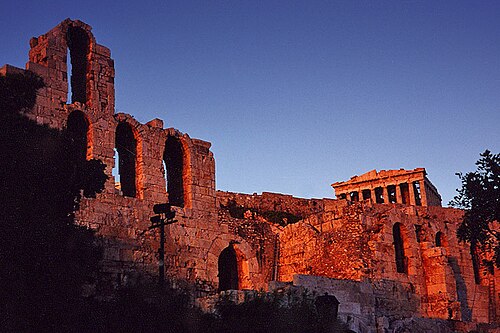
歴史家は、紀元前5世紀から6世紀のアテナイを彫刻と建築の黄金時代とみなしています。この時代の装飾要素と技法は、それ以前の時代と大きく変わりませんでした。この時代を特徴づけるのは、作品の量と、作品の洗練度と完成度の高さです。そのほとんどは宗教的なものであり、主に聖域や神殿でした。この時代の例としては、以下のようなものがあります。
フィディアスはこの時代の最も偉大な彫刻家とされています。彼は巨大な金メッキの象牙像(「金象牙像」)を制作し、それらは一般的に顔と手のみで構成され、当時非常に高く評価され、賞賛されました。例えば、パルテノン神殿内部に安置されたアテナ像は、開かれた扉を通して信者たちの目にその壮麗さを届け、オリンピアの聖域にあるゼウス像は、当時も後世も世界の驚異の一つとみなされました。
大プリニウスの『博物誌』によると、これらの彫刻の大理石を保存するために、象牙が割れないように神殿内に油入れが設置されていたという。
この時代、陶器の生産は盛んに行われました。地中海沿岸の都市との交易が活発だったため、アンフォラは大量に生産されました。この時代のアンフォラの痕跡は、主要な古代港湾都市の周辺やエーゲ海で数多く発見されています。また、この時代には、それまで流行していた黄色や黒色の陶器よりもはるかに繊細な、白地の陶器も数多く見られました。これらの陶器は、香水を入れたり、墓の装飾など葬儀の儀式に用いられたりしました。さらに、多くの優れた画家がいたことも知られていますが、フレスコ画や独立した絵画など、彼らの作品は失われてしまっています。
劇場は紀元前5世紀に最盛期を迎えた。ペリクレスは一連の実際的かつ経済的な措置によって劇場を奨励し、優遇した。最も裕福な家族は合唱隊と俳優の世話と維持を義務付けられていた。この方法によって、ペリクレスは演劇が人々の道徳的および知的教育に役立つという伝統を維持した。劇は男性によって作られ、通常は男性のために作られ、この場はしばしば家父長制を強化するために利用された。[ 21 ]
アテネはギリシャ演劇の中心地となった。演劇は8時間連続で上演され、審査員が勝者を決定する競技会の一環として行われた。仮設劇場の装飾は簡素だったが、古代アテネの常設劇場は次第に豪華絢爛になっていった。上演場所に関わらず、劇は最大3人の俳優によって演じられ、俳優たちは演じる役柄と区別するために仮面を着用した。彼らには歌と踊りで彩る合唱隊が付き添った。
この時代の劇作家で、戯曲が現存する作家は以下の通りである。
黄金時代には、史上最も著名な西洋哲学者たちが数多く活躍しました。中でも特筆すべきはソクラテスで、彼の思想は主に弟子のプラトンによる対話篇に収められており、プラトンは自身の思想とソクラテスの思想を融合させています。また、プラトンや、プラトンの弟子であるアリストテレスも重要な人物です。
黄金時代の著名な哲学者には、アナクサゴラス、デモクリトス(すべての物質の中にどのような実体が存在するのかを最初に問い、現在原子またはそのサブユニットと呼ばれるものの最も初期の提案を行った人物)、エンペドクレス、ヒッピアス、イソクラテス、パルメニデス、ヘラクレイトス、プロタゴラスなどがいる。
紀元前5世紀後半、ソフィスト(ギリシャ語のsophistês、専門家、教師、賢者)という名称は、料金と引き換えに様々な分野の科学や知識について指導する教師に与えられた。
この時代、アテネは「ギリシャの学問の中心地」でした。ペリクレスと彼の愛人アスパシアは、当時のアテネの偉大な思想家たちだけでなく、他のギリシャ人や外国人の学者たちとも交流する機会に恵まれました。その中には、哲学者アナクサゴラス、ペレウスを再建した建築家ヒッポダモス、そして歴史家のヘロドトス(紀元前484~425年)、トゥキディデス(紀元前460~400年)、クセノフォン(紀元前430~354年)などがいました。
アテネは雄弁術の中心地でもありました。紀元前5世紀後半以降、雄弁術は芸術の域にまで高められました。雄弁術の教本を執筆し、明快で純粋な言葉遣いを特徴とする新たな文学形式を創造したロゴグラファー(λογογράφος )たちがいました。雄弁術は儲かる職業となり、ロゴグラファーのリシアス(紀元前460年~380年)は雄弁術で莫大な富を築いたことが知られています。その後、紀元前4世紀には、雄弁家のイソクラテスとデモステネスも名声を博しました。
紀元前461年から429年に亡くなるまで、ペリクレスはアテナイの政務に携わり、かつてないほどの繁栄と高い生活水準を誇る時代を過ごした。国内政は順調だったものの、デロス同盟内では不満が高まっていた。アテナイが採用した外交政策は必ずしも良い結果をもたらさず、デロス同盟の加盟国はますます不満を募らせていた。アテナイはギリシャの他の地域を支配し服従させる都市国家であり、抑圧された市民たちは独立を望んでいた。
紀元前550年、ペロポネソス半島の都市国家間で、スパルタが主導権を握る同様の同盟が結成されていた。ギリシャの都市国家間の一般的な不満に乗じて、このペロポネソス同盟はアテネに対抗し始めた。長期間にわたるずさんな統治と強硬な政策(紀元前431年頃)とそれに続くペロポネソス戦争を経て、アテネは紀元前338年、マケドニアのフィリッポス2世がギリシャ全土を征服した際に、ついに独立を失った。