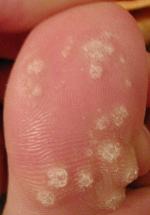
Warts are non-cancerous viral growths usually occurring on the hands and feet but which can also affect other locations, such as the genitals or face.[1][3] One or many warts may appear.[3] They are distinguished from cancerous tumors as they are caused by the human papillomavirus, rather than a cancer growth.[3]
Without treatment, most types of warts resolve in months to years.[1] Several treatments may speed resolution, including salicylic acid applied to the skin and cryotherapy.[1] In those who are otherwise healthy, they do not typically result in significant problems.[1] Treatment of genital warts differs from that of other types.[3] Infection with a virus, such as HIV, can cause warts. This is prevented through careful handling of needles or sharp objects that could infect the individual through physical trauma of the skin, plus the practice of safe sex using barrier methods such as condoms. Viruses that are not sexually transmitted, or are not transmitted in the case of a wart, can be prevented through several behaviors, such as wearing shoes outdoors and avoiding unsanitized areas without proper shoes or clothing, such as public restrooms or locker rooms.
Warts are very common, with most people being infected at some point in their lives.[2] The estimated current rate of non-genital warts among the general population is 1–13%.[1] They are more common among young people.[1] Before widespread adoption of the HPV vaccine, the estimated rate of genital warts in sexually active women was 12%.[5] Warts have been described as far back as 400 BC by Hippocrates.[4]
A range of types of warts have been identified, varying in shape and site affected, as well as the type of human papillomavirus involved.[6][7] These include:
Common wart (verruca vulgaris),[8] a raised wart with a roughened surface, most common on hands, but can grow anywhere on the body. Sometimes known as a Palmer wart or junior wart.
Flat wart (verruca plana), a small, smooth, flattened wart, flesh-coloured, which can occur in large numbers; most common on the face, neck, hands, wrists, and knees.
Filiform or digitate wart, a thread- or finger-like wart, most common on the face, especially near the eyelids and lips.
Genital wart (venereal wart, condyloma acuminatum, verruca acuminata), a wart that occurs on the genitalia.
Periungual wart, a cauliflower-like cluster of warts that occurs around the nails.
Plantar warts on big toe.Plantar wart (verruca, verruca plantaris), a hard, sometimes painful lump, often with multiple black specks in the center; usually only found on pressure points on the soles of the feet and between toes.
Mosaic wart, a group of tightly clustered plantar-type warts, commonly on the hands or soles of the feet.
Causes
Warts are caused by the human papillomavirus (HPV). There are about 130 known types of human papillomaviruses.[9] HPV infects the squamous epithelium, usually of the skin or genitals. Each HPV type is typically only able to infect a few specific areas of the body. Many HPV types can produce a benign growth, often called a "wart" or "papilloma", in the area they infect.[10] Many of the more common HPV and wart types are listed below.
Common warts – HPV types 2 and 4 (most common); also types 1, 3, 26, 29, and 57, and others.
On dermatoscopic examination, warts will commonly have fingerlike or knoblike extensions.[16]
Prevention
Gardasil is an HPV vaccine aimed at preventing cervical cancers and genital warts. Gardasil is designed to prevent infection with HPV types 16, 18, 6, and 11. HPV types 16 and 18 currently cause about 70% of cervical cancer cases,[13][14] and also cause some vulvar, vaginal,[11]penile and anal cancers.[12] HPV types 6 and 11 are responsible for 90% of documented cases of genital warts.[17]
Gardasil 9 protects against HPV types 6, 11, 16, 18, 31, 33, 45, 52, and 58.[18]
HPV vaccines are sometimes used off-label to treat existing warts.[19][20]
The virus is resistant to drying and heat, but killed by 100°C (212°F) temperature and ultraviolet radiation.[21]
Treatment
There are many treatments and procedures associated with wart removal.[22] A review of various skin wart treatments concluded that topical treatments containing salicylic acid were more effective than placebo.[23]Cryotherapy appears to be as effective as salicylic acid, but there have been fewer trials.[23]
Medication
Salicylic acid can be prescribed by a dermatologist in a higher concentration than that found in over-the-counter products. Several over-the-counter products are readily available at pharmacies and supermarkets of roughly two types: adhesive pads treated with salicylic acid, and bottled concentrated salicylic acid and lactic acid solution.
Bleomycin — A more potent chemotherapy drug, can be injected into deep warts, destroying the viral DNA or RNA. Bleomycin is notably not US FDA approved for this purpose. Possible side effects include necrosis of the digits, nail loss, and Raynaud syndrome. The usual treatment is one or two injections.[26][27]
Dinitrochlorobenzene (DNCB), like salicylic acid, is applied directly to the wart. Studies show this method is effective with a cure rate of 80%. But DNCB must be used much more cautiously than salicylic acid; the chemical is known to cause genetic mutations, so it must be administered by a physician. This drug induces an allergic immune response, resulting in inflammation that wards off the wart-causing virus.[28]
Verrutop verruca treatment is a topical solution made from a combination of organic acids, inorganic acids, and metal ions. This solution causes the production of nitrites, which act to denature viral proteins and mummify the wart tissue. The difference between Verrutop and other acid treatments is that it does not damage the surrounding skin.
Another product available over-the-counter that can aid in wart removal is silver nitrate in the form of a caustic pencil, which is also available at drug stores. In a placebo-controlled study of 70 patients, silver nitrate given over nine days resulted in clearance of all warts in 43% and improvement in warts in 26% one month after treatment, compared to 11% and 14%, respectively, in the placebo group.[30] The instructions must be followed to minimize staining of skin and clothing. Occasionally, pigmented scars may develop.
Trichloroacetic acid can be used to treat warts if salicylic acid or cryotherapy fail or are not available. It requires repeat treatments every week or so. Side effects are burning and stinging.[31]
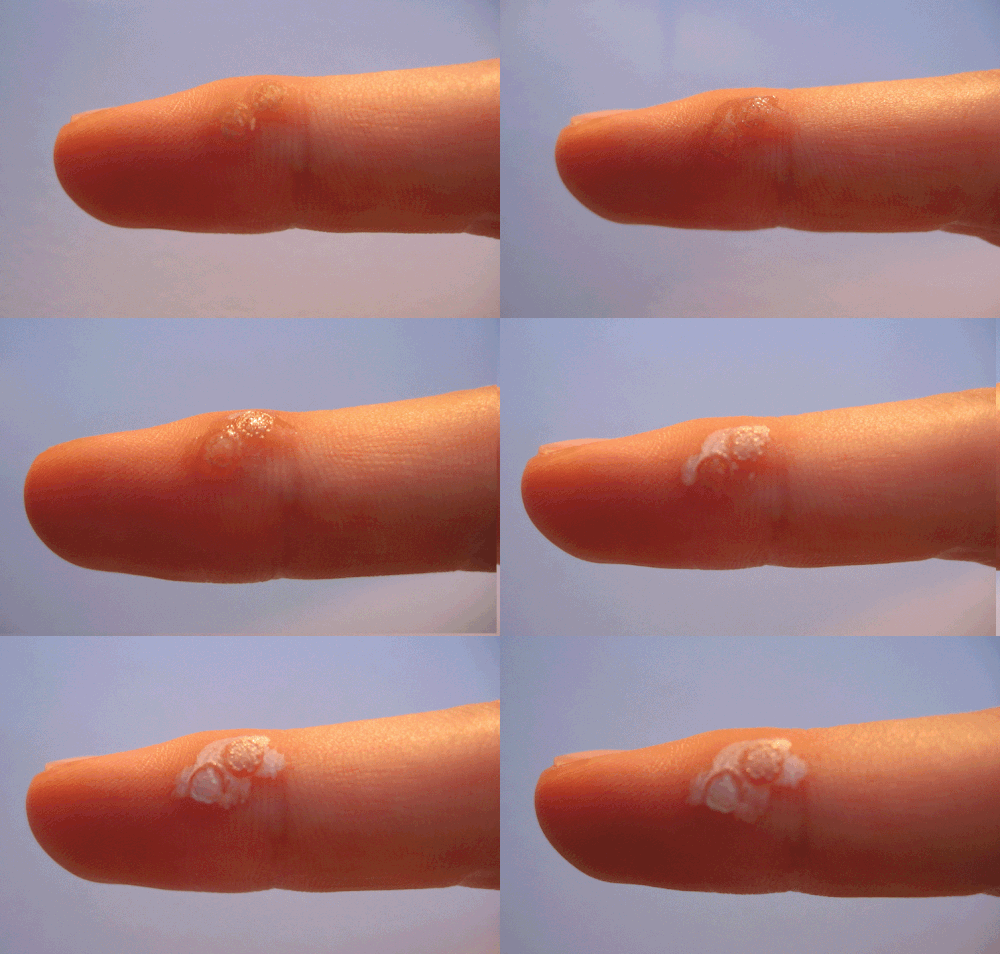
Two viral warts on a middle finger, being treated with a mixture of acids (like salicylic acid) to remove them. A white precipitate forms on the area where the product was applied.
Throat warts before and after carbon dioxide laser treatment.
Cryosurgery or cryotherapy, which involves freezing the wart (generally with liquid nitrogen),[40] creating a blister between the wart and epidermal layer after which the wart and the surrounding dead skin fall off. An average of three to four treatments is required for warts on thin skin. Warts on calloused skin, like plantar warts, might take dozens or more treatments.[41]
Laser treatment – often with a pulse dye laser or carbon dioxide (CO2) laser. Pulse dye lasers (wavelength 582nm) work by selective absorption by blood cells (specifically hemoglobin). CO2 lasers work by selective absorption by water molecules. Pulse dye lasers are less destructive and more likely to heal without scarring. CO2 laser works by vaporizing and destroying tissue and skin. Laser treatments can be painful, expensive (though covered by many insurance plans), and not extensively scarring when used appropriately. CO2 lasers will require local anaesthetic. Pulse dye laser treatment does not need conscious sedation or local anesthesia. It takes 2 to 4 treatments, but can be many more for extreme cases. Typically, 10–14 days are required between treatments. Preventive measures are important.[41]
Infrared coagulator – an intense source of infrared light in a small beam like a laser. This works essentially on the same principle as laser treatment. It is less expensive. Like the laser, it can cause blistering, pain, and scarring.[42]
Duct tape occlusion therapy involves placing a piece of duct tape over the wart. The mechanism of action of this technique still remains unknown. Despite several trials, evidence for the efficacy of duct tape therapy is inconclusive.[45][46] Despite the mixed evidence for efficacy, the simplicity of the method and its limited side-effects lead some researchers to be reluctant to dismiss it.[47]
No intervention. Spontaneous resolution within a few years can be recommended.[48]
This image shows throat warts (papillomas) before treatment and during the treatment process. Left to right: warts before treatment, warts on the day of silver nitrate treatment, warts two days after treatment, warts four days after treatment, warts six days after treatment, and warts remaining nine days after treatment.
Alternative medicine
Despite their appearance, toads do not cause warts
Daily application of the acrid yellow latex of Chelidonium majus (greater celandine) is a traditional treatment.[49][50]
A variety of traditional folk remedies and rituals claim to be able to remove warts. According to English folk belief, touching toads causes warts; according to a German folk belief, touching a toad under a full moon cures warts.[51] The most common Northern Hemisphere toads have glands that protrude from their skin that superficially resemble warts. Warts are caused by a virus, and toads do not harbor it.[52]
In The Adventures of Tom Sawyer, Mark Twain has his characters discuss a variety of such remedies. Tom Sawyer proposes "spunk-water" (or "stump-water", the water collecting in the hollow of a tree stump) as a remedy for warts on the hand. In his version, one puts one's hand into the water at midnight and says:
Barley-corn, barley-corn, injun-meal shorts, Spunk-water, spunk-water, swaller these warts
One would then "walk away quick, eleven steps, with your eyes shut, and then turn around three times and walk home without speaking to anybody. Because if you speak the charm's busted." This is given as an example of Huckleberry Finn's planned remedy, which involves throwing a dead cat into a graveyard as a devil or devils comes to collect a recently buried wicked person. Another remedy involved splitting a bean, drawing blood from the wart and putting one of the bean halves against the wart, and burying that half at a crossroads at midnight. The theory of operation is that the blood on the buried bean will draw away the wart.[53] Twain is recognized as an early collector and recorder of genuine American folklore.[54]
Similar practices are recorded elsewhere. In Louisiana, one remedy for warts involves rubbing the wart with a potato, which is then buried; when the "buried potato dries up, the wart will be cured".[55] Another remedy similar to Twain's is reported from Northern Ireland, where water from a specific well on Rathlin Island is credited with the power to cure warts.[56]
History
A ~7 mm plantar wart surgically removed from the sole of a person's foot after other treatments failed.
Surviving ancient medical texts show that warts were a documented disease since at least the time of Hippocrates, who lived c.460– c.370BC. In the book De Medecia by the Roman physician Aulus Cornelius Celsus, who lived c.25BC – c.50AD, different types of warts were described. Celsus described myrmecia, today recognized as plantar wart, and categorized the acrochordon (skin tag) as a wart. In the 13th century, warts were described in books published by the surgeons William of Saliceto and Lanfranc of Milan. The word verruca for a wart was introduced by the physician Daniel Sennert, who described them in his 1636 book Hypomnemata physicae.[57]
The cause of warts was initially disputed in the medical profession. In the early 18th century, the physician Daniel Turner, who published the first book on dermatology, suggested that warts were caused by damaged nerves close to the skin. In the mid-18th century, the surgeon John Hunter popularized the belief that warts were caused by a bacterial syphilis infection. The surgeon Benjamin Bell documented that warts were caused by a disease entirely unrelated to syphilis, and established a causal link between warts and cancer. In the 19th century, the chief physician of Verona Hospital established a link between warts and cervical cancer in particular. But in 1874, it was noted by the dermatologist Ferdinand Ritter von Hebra that while various theories were advanced by the medical profession, the "influences causing warts are still very obscure".[57]
In 1907, the physician Giuseppe Ciuffo first demonstrated that a viral infection causes warts. In 1976, the virologist Harald zur Hausen was the first to discover that warts were caused by the human papillomavirus (HPV). His continuous research established the evidence necessary to develop an HPV vaccine, which first became available in 2006.[57]
123Pmhdev. "Papillomas (Warts) – National Library of Medicine". PubMed Health. Archived from the original on 10 September 2017. Retrieved 6 November 2016.
12345678"Warts: Overview". U.S. National Library of Medicine. 30 July 2014. Archived from the original on 10 September 2017.
12Bope, Edward T.; Kellerman, Rick D. (2012). Conn's Current Therapy 2012. Elsevier Health Sciences. p.275. ISBN978-1-4557-3305-7. Archived from the original on 7 November 2016.
12Buck, Henry W. Jr. (13 August 2010). "Warts (genital)". BMJ Clinical Evidence. 2010. PMC3217761. PMID21418685.
↑Anderson, Keith; Keith, Jeff; Novak, Patricia D.; Elliot, Michelle A. (2005). Mosby's Medical, Nursing & Allied Health Dictionary (5thed.). C. V. Mosby. ISBN978-0-323-03736-5. Archived from the original on 7 January 2017.
↑"MedlinePlus: Warts". WebMD. 2010. Archived from the original on 16 May 2013.
↑Adigun, Chris G. "Verruca Vulgaris". Merck Manuals. Retrieved 16 December 2022.
↑De Villiers, E. M.; Fauquet, C.; Broker, T. R.; Bernard, H. U.; Zur Hausen, H. (June 2004). "Classification of papillomaviruses". Virology. 324 (1): 17–27. doi:10.1016/j.virol.2004.03.033. PMID15183049.
↑Syrjänen, Stina (1 August 2003). "Human papillomavirus infections and oral tumors". Medical Microbiology and Immunology. 192 (3): 123–128. doi:10.1007/s00430-002-0173-7. ISSN1432-1831. PMID12920585. S2CID2768273.
12"FDA Approves Expanded Uses for Gardasil to Include Preventing Certain Vulvar and Vaginal Cancers". FDA. 12 September 2008. Archived from the original on 6 March 2010.
12Cortez, Michelle Fay; Pettypiece, Shannon (13 November 2008). "Merck Cancer Shot Cuts Genital Warts, Lesions in Men". Bloomberg News. Retrieved 17 May 2013.
12Lowy, D. R.; Schiller, J. T/ (2006). "Prophylactic human papillomavirus vaccines". J. Clin. Invest.116 (5): 1167–73. doi:10.1172/JCI28607. PMC1451224. PMID16670757.
12Muñoz, N.; Bosch, F. X.; Castellsagué, X.; Díaz, M.; de Sanjose, S.; Hammouda, D.; Shah, K. V.; Meijer, C. J. (20 August 2004). "Against which human papillomavirus types shall we vaccinate and screen? The international perspective". International Journal of Cancer. 111 (2): 278–85. doi:10.1002/ijc.20244. PMID15197783. S2CID20679802.
↑Kumar, Vinay; Abbas, Abul K.; Fausto, Nelson; Mitchell, Richard (2007). "Chapter 19: The Female Genital System and Breast". Robbins Basic Pathology (8ed.). Philadelphia: Saunders. ISBN978-1-4160-2973-1.
↑Steinbrook, Robert (2006). "The Potential of Human Papillomavirus Vaccines". New England Journal of Medicine. 354 (11): 1109–12. doi:10.1056/NEJMp058305. PMID16540608.
↑"Prescribing information Gardasil 9"(PDF). Food and Drug Administration. 2015. Archived from the original(PDF) on 10 October 2016.
↑Bossart, Simon; Imstepf, Valentina; Hunger, Robert E.; Seyed Jafari, S. Morteza (2020). "Nonavalent Human Papillomavirus Vaccination as a Treatment for Skin Warts in Immunosuppressed Adults: A Case Series". Acta Dermato Venereologica. 100 (6): adv00078-2. doi:10.2340/00015555-3437. PMC9128913. PMID32115668.
↑Pham, Christine T.; Juhasz, Margit; Sung, Calvin T.; Mesinkovska, Natasha Atanaskova (1 January 2020). "The human papillomavirus vaccine as a treatment for human papillomavirus–related dysplastic and neoplastic conditions: A literature review". Journal of the American Academy of Dermatology. 82 (1): 202–212. doi:10.1016/j.jaad.2019.04.067. ISSN0190-9622. PMID31085272.
↑Lipke, M. M. (2006). "An armamentarium of wart treatments". Clinical Medicine & Research. 4 (4): 273–93. doi:10.3121/cmr.4.4.273. PMC1764803. PMID17210977.
12Kwok, C. S.; Gibbs, Sam; Bennett, C.; Holland, R.; Abbott, R. (12 September 2012). "Topical treatments for cutaneous warts". The Cochrane Database of Systematic Reviews. 9 (9) CD001781. doi:10.1002/14651858.CD001781.pub3. PMC8101088. PMID22972052. Archived from the original on 4 July 2013.
↑Salk, RS; Grogan, KA; Chang, TJ (May 2006). "Topical 5% 5-fluorouracil cream in the treatment of plantar warts: a prospective, randomized, and controlled clinical study". Journal of Drugs in Dermatology. 5 (5): 418–24. PMID16703777.
↑Barclay, L. (4 June 2011). "Short-acting Imiquimod Cream Approved for Genital Warts". Medscape. Archived from the original on 18 August 2011. Retrieved 10 August 2011.
↑Soni, Prasoon; Khandelwal, Kanika; Aara, Naushin; Ghiya, Bhikam C; Mehta, Rajesh D; Bumb, Ram A (2011). "Efficacy of Intralesional Bleomycin in Palmo-plantar and Periungual Warts". Journal of Cutaneous and Aesthetic Surgery. 4 (3): 188–191. doi:10.4103/0974-2077.91250. PMC3263129. PMID22279384.
↑Sterling, J. C.; Handfield-Jones, S.; Hudson, P. M. (2001). "Guidelines for the management of cutaneous warts"(PDF). British Journal of Dermatology. 144 (1): 4–11. doi:10.1046/j.1365-2133.2001.04066.x. PMID11167676. S2CID20179474. Archived from the original(PDF) on 3 March 2012.
↑"Common warts – Diagnosis and treatment". MayoClinic.org. Retrieved 6 November 2022.
↑Stone, K. M.; Becker, T. M.; Hadgu, A.; Kraus, S. J. (1990). "Treatment of external genital warts: A randomized clinical trial comparing podophyllin, cryotherapy, and electrodesiccation". Genitourinary Medicine. 66 (1): 16–19. doi:10.1136/sti.66.1.16. PMC1194434. PMID2179111.
↑Solomon, Katie; Yip, Vincent (December 2023). "The novel treatment of children with viral warts using microwave technology". Skin Health and Disease. 3 (6) e291. doi:10.1002/ski2.291. ISSN2690-442X. PMC10690651. PMID38047251.
↑Hagon, Wendy; Hagon, Jonathan; Noble, Greer; Brenton-Rule, Angela; Stewart, Sarah; Bristow, Ivan (January 2023). "Microwave therapy for the treatment of plantar warts". Journal of Foot and Ankle Research. 16 (1): 37. doi:10.1186/s13047-023-00638-8. ISSN1757-1146. PMC10268531. PMID37322512.
↑Bristow, Ivan Robert; Webb, Christopher; Ardern-Jones, Michael Roger (27 July 2017). "The Successful Use of a Novel Microwave Device in the Treatment of a Plantar Wart". Case Reports in Dermatology. 9 (2): 102–107. doi:10.1159/000477377. ISSN1662-6567. PMC5624246. PMID29033812.
↑Gupta, Aditya K.; Wang, Tong; Cooper, Elizabeth A.; Conenello, Robert M.; Bristow, Ivan R. (October 2023). "The treatment of plantar warts using microwave—A review of 85 consecutive cases in the United States". Journal of Cosmetic Dermatology. 22 (10): 2729–2736. doi:10.1111/jocd.15802. ISSN1473-2130. PMID37340590.
↑Dhinsa, Arpreet; Philip, Gladis; Daknish, Fatima; Amin, Sahil; Vlahovic, Tracey (September 2023). "42057 Microwave Therapy for Plantar Warts: A Chart Review". Journal of the American Academy of Dermatology. 89 (3): AB64. doi:10.1016/j.jaad.2023.07.259. ISSN0190-9622.
↑"The Royal College of Podiatry". College of Podiatry. Retrieved 22 March 2024.
↑"Cryotherapy for Warts". WebMD. Archived from the original on 9 July 2016.
12Bacelieri, R.; Johnson, S. M. (2005). "Cutaneous warts: An evidence-based approach to therapy". American Family Physician. 72 (4): 647–52. PMID16127954. Archived from the original on 21 April 2014.
↑Halasz, C. L. (1994). "Treatment of common warts using the infrared coagulator". The Journal of Dermatologic Surgery and Oncology. 20 (4): 252–56. doi:10.1111/j.1524-4725.1994.tb01620.x. PMID8163746.
↑Aldahan, A. S.; Mlacker, S.; Shah, V. V.; Kamath, P.; Alsaidan, M.; Samarkandy, S.; Nouri, K. (May 2016). "Efficacy of intralesional immunotherapy for the treatment of warts: A review of the literature". Dermatologic Therapy. 29 (3): 197–207. doi:10.1111/dth.12352. PMID26991521. S2CID40536366.
↑Salman, Samer (2019). "Intralesional Immunotherapy for the Treatment of Warts: A Network Meta-analysis". Journal of the American Academy of Dermatology. 80 (4): 922–930.e4. doi:10.1016/j.jaad.2018.07.003. PMID30003983. S2CID51617793– via Elsevier Science Direct.
↑Loo, S. K.; Tang, W. Y. (12 June 2014). "Warts (non-genital)". BMJ Clinical Evidence. 2014. PMC4054795. PMID24921240.
↑Kwok, C. S.; Gibbs, S.; Bennett, C.; Holland, R.; Abbott, R. (12 September 2012). "Topical treatments for cutaneous warts". Cochrane Database Syst Rev. 9 (9) CD001781. doi:10.1002/14651858.CD001781.pub3. PMC8101088. PMID22972052.
↑Stubbings, A.; Wacogne, I. (September 2011). "Question 3: What is the efficacy of duct tape as a treatment for verruca vulgaris?". Archives of Disease in Childhood. 96 (9): 897–99. doi:10.1136/archdischild-2011-300533. PMID21836182. S2CID206853952.
↑Goldman, Ran D. (May 2019). "Duct tape for warts in children: Should nature take its course?". Canadian Family Physician. 65 (5): 337–338. ISSN1715-5258. PMC6516695. PMID31088871.
↑Gilca, Marilena; Gaman, Laura; Panait, Elena; Stoian, Irina; Atanasiu, Valeriu (8 October 2010). "Chelidonium majus – An Integrative Review: Traditional Knowledge Versus Modern Findings"(PDF). Forschende Komplementärmedizin. 17 (5): 241–248. doi:10.1159/000321397. PMID20980763. Archived from the original(PDF) on 5 December 2020 – via MedicinaBiomolecular.com.br.
↑"Greater Celandine for Warts". Botanical-Online.com. Archived from the original on 17 July 2014.
↑Ley, Willy (December 1963). "The Names of the Constellations". For Your Information. Galaxy Science Fiction. pp.90–99.
↑Clark, Josh (2 March 2009). "Do toads cause warts?". Science.HowStuffWorks.com. p.2. Archived from the original on 16 October 2012. Retrieved 20 October 2012.
↑LeMaster, J. R. (1993) The Mark Twain Encyclopedia (Taylor and Francis, pp. 293–94Archived 7 January 2017 at the Wayback Machine, ISBN0-8240-7212-X.
↑Webb, Julie Yvonne (1971). "Louisiana Voodoo and Superstitions Relating to Health". HSMHA Health Reports. 86 (4): 291, 296–97. doi:10.2307/4594154. JSTOR4594154. PMC1937133. PMID4324337.
↑Ballard, L. M. (2009). "An approach to traditional cures in Ulster". The Ulster Medical Journal. 78 (1): 26–33. PMC2629017. PMID19252727.
123Karamanou, Marianna; Agapitos, Emmanovil; Kousoulis, Antonis; Androutsos, George (17 August 2010). "From the humble wart to HPV: A fascinating story throughout centuries". Oncology Reviews. 4 (3): 133–135. doi:10.1007/s12156-010-0060-1. S2CID72238300.
Categories:
Cutaneous conditions
Papillomavirus-associated diseases
Viral diseases
Virus-related cutaneous conditions
Hidden categories:
Articles with short description
Short description is different from Wikidata
Use dmy dates from May 2021
All articles with unsourced statements
Articles with unsourced statements from July 2024
Webarchive template wayback links
Articles with unsourced statements from August 2017
Articles containing Latin-language text
Pages using Sister project links with wikidata mismatch
Pages using Sister project links with hidden wikidata