
Loading article…

Rohan is a fictional kingdom of Men in J. R. R. Tolkien's fantasy setting of Middle-earth. Known for its horsemen, the Rohirrim, Rohan provides its ally Gondor with cavalry. Its territory is mainly grassland. The Rohirrim call their land the Mark or the Riddermark, names recalling that of the historical kingdom of Mercia, the region of Western England where Tolkien lived.
Within the plot of The Lord of the Rings, Rohan plays a critical role in the action—first against the wizardSaruman in the Battle of the Hornburg, then in the climactic Battle of the Pelennor Fields. There, Théoden leads the Rohirrim to victory against the forces of Mordor; he is killed when his horse falls, but his niece Éowyn kills the leader of the Ringwraiths.
Tolkien grounded Rohan in elements inspired by Anglo-Saxon tradition, poetry, and linguistics, specifically in its Mercian dialect, in everything but its use of horses. Tolkien used Old English for the kingdom's language and names, pretending that this was in translation of Rohirric. Meduseld, the hall of King Théoden, is modelled on Heorot, the great hall in Beowulf.
Tolkien's own account, in an unsent letter, gives both the fictional and the actual etymologies of Rohan:
ロハンは(III 391、394)ロシャンドの後期軟形であると述べられている。これはエルフ語の*rokkō「乗馬用の速い馬」(クウェンヤ語rocco、シンダール語roch)+地名によく見られる接尾辞[例:ベレリアンド、オッシリアンド]に由来する。… ロハンはブルターニュの有名な名前で、古く誇り高く力強い一族が名乗っていた。私はこのことを知っていて、その形が気に入っていた。しかし、私は(ずっと前に)エルフ語の馬の言葉を発明しており、ロハンが騎馬民族による占領後のマルク(以前はカレナルドン「(偉大な)緑の地域」と呼ばれていた)の後期シンダール語の名前として言語的状況に適合すると考えていた。ブルターニュの歴史にはエオルリング族について何ら光を当てるものはない。… [ T 2 ]
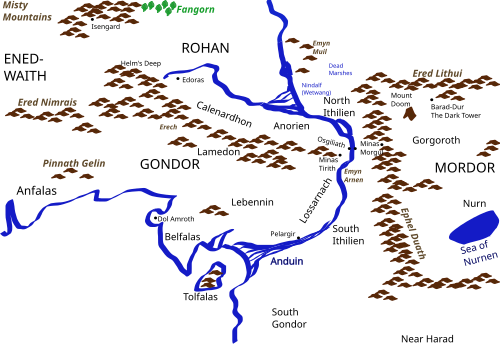
トールキンのミドルアースでは、ローハンは内陸の王国です。その田園地帯は、牧草地と青々とした背の高い草原が広がり、しばしば風が吹き荒れる土地として描写されています。牧草地には「多くの隠れた池と、湿った危険な沼地の上に揺れる広大なスゲの群生地」[ T 3 ]があり、草に水を供給しています。地図製作者のカレン・ウィン・フォンスタッドは、ローハンの面積を52,763平方マイル(136,656 km 2 )(イングランドよりわずかに大きい)と計算しました。[ 1 ]
Rohan is bordered to the north by the Fangorn forest, home to the Ents (tree-giants)[a] led by Treebeard, and by the great river Anduin, called Langflood by the Rohirrim. To the northeast are the walls of Emyn Muil. After the War of the Ring, the kingdom is extended northwards over the Limlight to the borders of Lothlórien.[T 4][T 5] To the east are the mouths of the River Entwash, and the Mering Stream, which separated Rohan from the Gondorian province of Anórien, known to the Rohirrim as Sunlending. To the south lie the White Mountains (Ered Nimrais). To the west are the rivers Adorn and Isen, where Rohan borders the land of the Dunlendings. To the northwest, just under the southern end of the Misty Mountains, lies the walled circle of Isengard around the ancient tower of Orthanc; at the time of the War of the Ring, it had been taken over by the evil wizardSaruman. The area of the western border where the Misty Mountains and the White Mountains drew near to each other is known as the Gap of Rohan.[T 4]
The capital of Rohan is the fortified town of Edoras, on a hill in a valley of the White Mountains.[T 6] "Edoras" is Old English for "enclosures".[3] The town of Edoras was built by Rohan's second King, Brego son of Eorl the Young. The hill on which Edoras is built stands in the mouth of the valley of Harrowdale. The river Snowbourn flows past the town on its way east towards the Entwash. The town is protected by a high wall of timber.

ローハンの王たちの黄金の館、メドゥセルドは、町の中心部の丘の頂上にある。[ T 6 ]「メドゥセルド」は古英語で「ミードホール」を意味し、[ 4 ]同じ意味を持つ未知のローハン語の翻訳である。メドゥセルドは、ベーオウルフに登場するミードホール、ヘオロットをモデルにしている。遠くから見ると金色に見える茅葺き屋根の大きなホールである。壁はローハンの歴史と伝説を描いたタペストリーで豪華に装飾されており、王とその親族の住居、王と顧問たちの会議場、儀式や祝祭の集会所として使われている。アラゴルン、ギムリ、レゴラス、ガンダルフがセオデン王と会ったのは、このメドゥセルドである。[ T 6 ]レゴラスはメドゥセルドを、ベオウルフの一節「その光は遠くまで国土を照らす」を直訳した一節で描写しており、これはlíxte se léoma ofer landa felaを表しています。[ 5 ]ホールには煙を排出するためのルーバーがあると時代錯誤的に描写されていますが、これはウィリアム・モリスの 1889 年のThe House of the Wolfingsに由来しています。[ 6 ] [ 7 ]
エドラスの上流、ハローデールの奥深くには、アップボーンとアンダーハローの集落がある。ダンハロー(古英語のDûnhaerg、「丘の中腹にある異教の聖堂」[ 8 ]に由来)の奥には、ホワイトマウンテンにある避難所、フィリエンフェルドがある。[ T 7 ]イーストフォールドの首都アルドバーグは、若きエオルの最初の居住地である。西部地域を守る主要な要塞であるホーンバーグは、ホワイトマウンテンの谷、ヘルム峡谷にある。[ T 8 ]
ローハン王国(マークとも呼ばれる)は、主に東マークと西マークの2つの地域に分かれている。それぞれの地域は王国の元帥によって統治されている。ローハンの首都エドラスは、王国の南中央にある小さく人口の多い地域、フォルデにある。[ T 9 ]以前の構想では、ローハンの首都地域は王領と呼ばれ、フォルデはエドラスの南東にあるその下位地域であった。[ T 10 ]フォルデの北では、東マークと西マークの境界はスノーボーン川とエントウォッシュに沿って走っている。[ T 11 ]ローハンの残りの人口のほとんどは、フォルデから両方向に広がる白山脈の麓に散らばっている。西マークでは、ウェストフォールドが山脈に沿ってヘルム峡谷(ウェストフォールドの防衛中心地)とローハン峡谷まで広がっている。ローハンの峡谷の向こうには、王国の最西端の辺境地帯である西辺境地帯が広がっている。[ T 8 ]反対方向には、白山脈に沿って東辺境地帯が広がっている(そのため、東辺境地帯の一部であった)。北はエントウォッシュ川に接している。東の辺境地帯はフェンマーチと呼ばれ、その向こうにはゴンドール王国がある。[ T 12 ]
ローハンの中心部は広大な平原で、エントウォッシュ川によって東エムネットと西エムネットに分かれている。[ T 13 ]これらの地域はそれぞれ東マークと西マークに属していた。ローハンの最北端の地域であり、人口が最も少ないのがウォルドである。さらに北にあるセレブラントの野(シルバーロード川の同義語にちなんで名付けられた)は、指輪戦争後にローハンに編入された。[ T 14 ]

ローハン人はゴンドールのドゥーネダインと遠い親戚関係にあり、同じ場所から来た。啓蒙され高度に文明化された存在として描かれているゴンドールの住民とは異なり、ローハン人は啓蒙のレベルが低いとされている。[ 10 ]
The names and many details of Rohirric culture are derived from Germanic cultures, particularly that of the Anglo-Saxons and their Old English language, towards which Tolkien felt a strong affinity. Anglo-Saxon England was defeated by the cavalry of the Normans at the Battle of Hastings, and some Tolkien scholars have suggested that the Rohirrim are Tolkien's wishful version of an Anglo-Saxon society that retained a "rider culture", and would have been able to resist such an invasion.[11] The Tolkien scholar Tom Shippey notes that Tolkien derived the emblem of the House of Éorl, a "white horse upon green", from the Uffington White Horse carved into the grass of the chalk downs in England.[9]

While Tolkien represents the Rohirrim with Anglo-Saxon culture and language, their ancestors are given Gothic attributes. The names of Rhovanion's royal family (ancestors to the Rohirrim[T 16]) include such names as Vidugavia, Vidumavi and Vinitharya, which are of Gothic origin. Vidugavia specifically has been seen as a synonym for Vitiges, king of the Ostrogoths in Italy from 536 to 540.[12] Tolkien saw this as a parallel with the real-world relationship between Old English and Gothic.[13]
In response to a query about clothing styles in Middle-earth, Tolkien wrote:
The Rohirrim were not "medieval", in our sense. The styles of the Bayeux Tapestry (made in England) fit them well enough, if one remembers that the kind of tennis-nets [the] soldiers seem to have on are only a clumsy conventional sign for chainmail of small rings.[T 15]

The armies of Rohan were largely horsemen. The basic tactical unit was the éored, Old English for "a unit of cavalry, a troop",[14] which at the time of the War of the Ring had a nominal strength of 120 riders.[T 17]
戦時中は、すべての有能な男はローハンの召集に加わる義務があった。ローハンはエオルの誓約により、危機に瀕したゴンドールを助ける義務を負っており、ゴンドールは赤い矢を送ることでローハンに援助を求めた。これは、古英語の詩『エレネ』に歴史的な前例があり、コンスタンティヌス大帝が「戦争のしるし」として矢を送ることで、騎馬の西ゴート族の軍隊をフン族との戦いに招集した。 [ 15 ]ゴンドールはまた、ミナス・ティリスからローハンの国境までの白山脈沿いに7つの信号火であるゴンドールの警告の狼煙、アモン・ディン、エイレナッハ、ナルドル、エレラス、ミン・リモン、カレンハド、ハリフィリエンを灯すことで、必要なローハン人を呼び出すこともできた。[ T 18 ]

指輪戦争の開始時には、完全な招集で12,000人以上の騎兵がいたでしょう。[ T 19 ]ローハン軍の馬の中には、アルダを駆け巡った中で最も高貴で速い馬として有名なメアラスがいました。戦争と平和の両方で馬と密接な関係にあったことから、その名前が付けられました。[ T 20 ]
トールキンは一般的にこの言語を単に「ローハンの言語」または「ローハン人の言語」と呼んでいた。形容詞形「ローハン語」は一般的で、トールキンはかつて「ローハン語」も使用したことがある。[ T 18 ]多くの人間の言語と同様に、ヌーメノール人の言語であるアドゥナイク語に似ており、したがって西方語または共通語に似ている。[ 17 ]
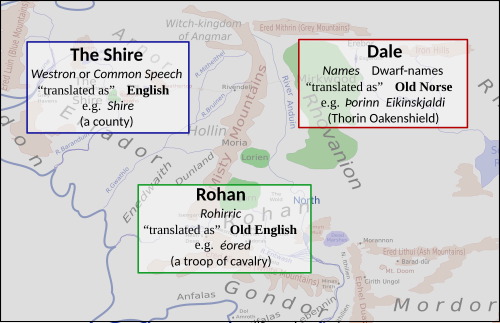
The Rohirrim called their homeland the Riddermark, a modernization by Tolkien of Old English Riddena-mearc, meaning, according to the Index to The Lord of the Rings, "the border country of the knights"; also Éo-marc, the Horse-mark, or simply the Mark.[19] They call themselves the Éorlingas, the Sons of Éorl. Tolkien rendered the language of the Riders of Rohan, Rohirric, as the Mercian dialect of Old English. Even words and phrases that were printed in modern English showed a strong Old English influence.[T 22] This solution occurred to Tolkien when he was searching for an explanation of the Eddaic names of the dwarves already published in The Hobbit.[18] Tolkien, a philologist, with a special interest in Germanic languages, pretended that the names and phrases of Old English were translated from Rohirric, just as the English used in The Shire was supposedly translated from Middle-earth's Westron or Common Speech.[18][T 21] Examples include éored[14] and mearas.[20] The Riders' names for the cunningly-built tower of Isengard, Orthanc, and for the Ents, the tree-giants of Fangorn forest, are similarly Old English, both being found in the phrase orþanc enta geweorc, "cunning work of giants" in the poem The Ruin,[21] though Shippey suggests that Tolkien may have chosen to read the phrase also as "Orthanc, the Ent's fortress".[2]
In The Two Towers, chapter 6, the Riders of Rohan are introduced before they are seen, by Aragorn, who chants in the language of the Rohirrim words "in a slow tongue unknown to the Elf and the Dwarf", a lai that Legolas senses "is laden with the sadness of Mortal Men". The song is called the Lament of the Rohirrim. To achieve a resonant sense of the lost past, the now-legendary time of a peaceful alliance of the Horse-lords with the realm of Gondor, Tolkien adapted the short Ubi sunt ("Where are they?") passage of the Old English poem The Wanderer.[22][23][24][25]
"Thus spoke a forgotten poet long ago in Rohan, recalling how tall and fair was Eorl the Young, who rode down out of the North," Aragorn explains, after singing the Lament.[T 23]
In the 13th century of the Third Age, the Kings of Gondor made close alliances with the Northmen of Rhovanion, a people said in The Lord of the Rings to be akin to the Three Houses of Men (later the Dúnedain) from the First Age. In the 21st century, a remnant tribe of such Northmen, the Éothéod, moved from the valleys of Anduin to the northwest of Mirkwood, disputing with the Dwarves over the treasure-hoard of Scatha the dragon.[T 24]
In 2509, Cirion the Steward of Gondor summoned the Éothéod to help repel an invasion of Men from Rhûn and Orcs from Mordor. Eorl the Young, lord of the Éothéod, answered the summons, arriving unexpected at a decisive battle on the Field of Celebrant, routing the orc army. As a reward, Éorl was given the Gondorian province of Calenardhon (except for Isengard).[T 24]

Eorl the Young founded the Kingdom of Rohan in the former Calenardhon; the royal family was known as the House of Eorl. The first line of kings lasted for 249 years, until the ninth king Helm Hammerhand died. His sons had been killed earlier, and his nephew Fréaláf Hildeson began the second line of kings, which lasted until the end of the Third Age. The two lines of kings are buried in two lines of grave mounds below the royal hall at Edoras,[T 24] like those at Gamla Uppsala in Sweden, or Sutton Hoo in England.[26]
In 2758, Rohan was invaded by Dunlendings under Wulf, son of Freca, of mixed Dunland and Rohan blood. The King, Helm Hammerhand, took refuge in the Hornburg until help from Gondor and Dunharrow arrived a year later. Soon after this Saruman took over Isengard, and was welcomed as an ally.[T 24]
Saruman used his influence through the traitor Grima Wormtongue to weaken Théoden. Saruman then launched an invasion of Rohan, with victory in early battles at the Fords of Isen, killing Théoden's son, Théodred.[T 25] Saruman was defeated at the Battle of the Hornburg, where the tree-like Huorns came from the forest of Fangorn to help the Rohirrim.[T 8]
Théoden then rode with his army to Minas Tirith, helping to break its siege in the Battle of the Pelennor Fields and killing the leader of the Haradrim, but was killed when his horse fell. He was succeeded by his nephew Éomer. His niece Éowyn and the hobbit Merry Brandybuck killed the Lord of the Nazgûl.[T 26]
Éomer rode with the armies of Gondor to the Black Gate of Mordor and took part in the Battle of the Morannon against the forces of Sauron. At this time, the destruction of the Ruling Ring in Mount Doom ended the battle and the war.[T 27] Éowyn married Faramir, Prince of Ithilien.[T 28]

The Tolkien scholar Jane Chance writes that Théoden is transformed by Gandalf into a good bold "Germanic king"; she contrasts this with the failure of "the proud Beorhtnoth" in the Old English poem The Battle of Maldon. In her view, in the account of the battle of Helm's Deep, the fortress of the Riddermark, Tolkien is emphasising the Rohirrim's physical prowess.[28]
Jane Ciabattari writes on BBC Culture that Lady Éowyn's fear of being caged rather than "doing great deeds" by riding to battle with the Rohirrim resonated with 1960s feminists, contributing to the success of Lord of the Rings at that time.[29]
言語学者でトールキン研究者のトム・シッピーは、トールキンの主張にもかかわらず、ローハンの騎兵は古代イングランド人(アングロ・サクソン人)によく似ているが、馬を基盤とした文化を持っていた点で古代イングランド人とは異なっていると指摘している。彼らは馬に関連する古英語の単語を多く使用しており、自分たちの名前はエオセオド(馬人)であり、エオムンド、エオメル、エオウィンといった騎兵の名前は「馬」を意味する単語eo[h]で始まっている。[ 30 ]シッピーの見解では、騎兵の特徴的な美徳はパナッシュであり、それは「エオメルの兜の上の白い馬の尻尾が彼のスピードに合わせて揺れている」ことと「突然の攻撃、抵抗を一掃する突進の美徳」の両方を意味すると説明している。[ 27 ]シッピーは、これによりトールキンはローハンを、古英語の名前やéored(「騎兵隊」)のような単語に基づいてイングランド人として、また「土地が人々をどのように形作るかの一端を示す異質な存在」として描くことができると指摘している。[ 27 ] シッピーはさらに、「マーク」(またはリッダーマーク[ 31 ])は、ローハンの騎兵たちの土地であり、彼らは皆、古英語のマーシア方言で名前を持っているが、かつてはイングランド中部の一般的な用語であり、西サクソン語の「mearc」やラテン語の「Mercia」ではなく、「marc」と発音され、書かれていたと述べている。[ 32 ]
トールキン研究者のトーマス・ホネガーは、シッピーがローハン人を「馬に乗ったアングロ・サクソン人」と表現したことに同意し、その出典は「アングロ・サクソン文学や文化に精通している人なら誰でもわかる」と述べている。[ 11 ]ホネガーによれば、類似点には、古英語の格言「Éorl sceal on éos boge, éored sceal getrume rídan (「指導者は馬の背に乗り、戦士団は一団となって進む」)」を体現する卓越した乗馬技術が含まれる。[ 11 ]ライダーたちはゲルマンの戦士社会であり、アングロ・サクソン人のように「北方の英雄精神」を体現している。[11] しかし、「決定的な」事実は言語である。ホネガーは、トールキンが西方語を現代英語として表現していたことを指摘している。ローハン人は関連するがより古い言語を話していたため、同じスタイルで古英語が自然な選択だった。トールキンの1942年の対応表には、デールの人々の言語がノルウェー語で表されていることも示されていた。ホネガーは、これはローハン人をアングロ・サクソン人(馬に乗っているか否かにかかわらず)と同一視するものではないが、強い繋がりを示しており、彼らを「トールキンとすべての中世研究者にとって最も愛しい人々」にしていると指摘している。[ 11 ]

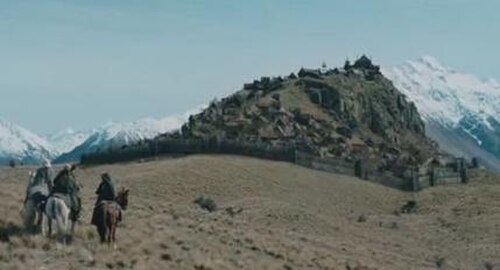

ピーター・ジャクソン監督の映画『ロード・オブ・ザ・リング』三部作では、ニュージーランドの中央オタゴにあるプールバーン貯水池がローハンのシーンの撮影に使われた。 [ 34 ]ローハンのテーマはハーダンゲル・フィドルで演奏される。[ 35 ]
エドラスの完全なセットは、ニュージーランドのエレホン近郊、ランギタタ渓谷の上流にあるサンデー山に建設されました。セットの一部はデジタルで構築されましたが、都市の頂上にある主要な建物は現地で建設されました。背景の山脈は実際のロケ撮影の一部でした。しかし、黄金の館などの建物の内部は、ニュージーランドの他の場所にあるサウンドステージにありました。カメラが黄金の館の中にあり、開いた門から外を見ているとき、セット上のエドラスの画像がドアの枠にデジタルで挿入されます。この場所は、映画やDVDのインタビューで見られるように、キャストやスタッフの間では非常に風が強いことで知られていました。撮影後、サンデー山は元の状態に戻されましたが、セットが残っていないにもかかわらず、この場所は人気のトールキン観光地となっています。[ 36 ]
In the aisles were the sleeping-places of the Folk, and down the nave under the crown of the roof were three hearths for the fires, and above each hearth a luffer or smoke-bearer to draw the smoke up when the fires were lighted.
Traditionally used to play Norwegian folk repertoire, the Hardanger fiddle gained international fame when played in the soundtracks of The Lord of the Rings, providing the main voice for the Rohan theme.