
Loading article…
レッドサマーとは、1919年半ばにアメリカ合衆国全土の30以上の都市とアーカンソー州の1つの郡で白人至上主義者のテロと人種暴動が発生した時期のことである。「レッドサマー」という用語は、 1916年から全米黒人地位向上協会(NAACP)のフィールド秘書として働いていた公民権運動家で作家のジェームズ・ウェルドン・ジョンソンによって造語された。 1919年、彼は人種的暴力に対する平和的な抗議活動を組織した。[ 1 ] [ 2 ]
ほとんどの場合、攻撃は白人による黒人への暴力であった。多くのアフリカ系アメリカ人が反撃し、特にシカゴとワシントンDCの人種暴動では、それぞれ38人と15人が死亡し、さらに多くの負傷者とシカゴでは広範囲にわたる物的損害が発生した。[ 3 ]それでも、最も多くの死者が出たのはアーカンソー州エレイン周辺の農村地域で、推定100人から240人の黒人と5人の白人が殺害された。この事件は現在、エレイン虐殺として知られている。
反黒人暴動は、第一次世界大戦後のさまざまな社会経済的緊張から発生した。これは一般的に、第一次世界大戦後のアメリカ軍の黒人と白人の両方の動員解除、経済不況、そしてヨーロッパ系アメリカ人とアフリカ系アメリカ人の間の雇用と住宅市場における競争の激化に関連している。[ 4 ]この時期はまた、労働不安のエピソードによって特徴づけられ、一部の産業経営者が黒人をスト破りとして雇用し、白人労働者の憤りをさらに煽った。
暴動と殺戮は報道機関によって詳細に記録された。報道機関は連邦政府とともに、1917年のロシア革命後の黒人公民権運動に対する社会主義や共産主義の影響を恐れていた。彼らはまた、著名人や政府指導者の自宅や事業所を爆破した外国のアナキストも恐れていた。
第一次世界大戦への軍隊の動員とヨーロッパからの移民の遮断により、アメリカ北東部と中西部の工業都市は深刻な労働力不足に陥った。その結果、北部の製造業者は南部全域で労働者を募集し、そこから多くの黒人を含む労働者の大量流出が起こった。[ 5 ]
1919年までに、推定50万人のアフリカ系アメリカ人が大移動の第一波(1940年まで続いた)でアメリカ南部から北東部と中西部の工業都市へ移住した。 [ 3 ]アフリカ系アメリカ人労働者は、鉄道などの拡大する産業における新しい職に就いたほか、以前は白人が就いていた多くの既存の職にも就いた。一部の都市では、特に1917年のストライキの際には、スト破りとして雇われた。 [ 5 ]これにより、多くの白人労働者階級、移民、第一世代のアメリカ人の間で黒人に対する反感が高まった。
1917年の夏、労働争議を原因とする黒人に対する暴力的な人種暴動がイリノイ州イーストセントルイスとテキサス州ヒューストンで発生した。[ 6 ]戦争後、退役軍人を労働市場に吸収する計画がないまま軍が急速に動員解除され、価格統制が撤廃されたことで、大規模な失業とインフレが発生し、雇用競争が激化した。南部では、制度的な人種差別と雇用隔離のため、アフリカ系アメリカ人が仕事を得ることは非常に困難だった。[ 7 ]
1917年のロシア革命に続く1919年から1920年にかけての第一次赤狩りの際、米国では反ボリシェヴィキ感情が、戦争中に高まった反ドイツ感情に続いて急速に高まった。多くの政治家や政府関係者は、報道機関や一般市民の多くとともに、米国政府を転覆させてソビエト政権を模範とした新体制を樹立しようとする差し迫った試みを恐れていた。当局はアフリカ系アメリカ人による人種平等と労働者の権利の主張を警戒し、白人の死亡事件が恐怖をさらに煽った。[ 4 ] 1919年3月の私的な会話で、ウッドロー・ウィルソン大統領は「海外から帰国するアメリカの黒人は、ボリシェヴィズムをアメリカに伝える最大の手段となるだろう」と述べた。 [ 8 ]他の白人の間では、不安定な時代を予期する者もいれば、緊張の兆候を全く見出さない者もおり、幅広い意見が表明された。[ 9 ]
1919 年初頭、米国労働省の黒人経済部長として雇用されていた教育者のジョージ・エドモンド・ヘインズ博士は次のように書いた。「黒人兵士の市民生活への復帰は、南北を問わず、国家が直面している最もデリケートで困難な問題の一つである。」[ 10 ]ある黒人退役軍人は、シカゴ・デイリー・ニュースの編集者に手紙を書き、帰還した黒人退役軍人は「今や新しい人間であり、世界人である…そして、方向性、指導、正直な活用、そして力の可能性は無限であるが、彼らは教えられ、導かれなければならない。彼らは目覚めたが、目覚めたものの完全な概念をまだ持っていない。」[ 11 ] NAACPの役員であり、その月刊誌の編集者であったW.E.B. デュボイスは、機会を見出した。[ 12 ]
天の神にかけて誓うが、戦争が終わった今、我々が持てる知恵と力のすべてを結集して、自国に潜む地獄の勢力と、より厳しく、より長く、より断固とした戦いを繰り広げなければ、我々は臆病者であり愚か者だ。
1919年の秋、暴力に満ちた夏の後、ジョージ・エドマンド・ヘインズは、米国上院司法委員会の調査の前触れとして、これらの出来事について報告した。彼は、広範囲に散らばった都市で黒人に対する38件の別々の人種暴動を特定し、その中で白人が黒人を攻撃した。[ 3 ]米国の歴史におけるアフリカ系アメリカ人に対する以前の人種暴動とは異なり、1919年の出来事は、多数の黒人が白人の攻撃に抵抗し、反撃した最初のもののひとつであった。[ 13 ] 公民権運動家であり、寝台車ポーター組合のリーダーであるA・フィリップ・ランドルフは、黒人の自衛権を公然と擁護した。[ 1 ]
さらに、ヘインズは、1919年1月1日から9月14日の間に、白人の暴徒が少なくとも43人のアフリカ系アメリカ人をリンチし、16人が絞首刑に処され、その他が銃殺され、さらに8人が火あぶりにされたと報告した。州は、このような暴徒による殺人に介入したり、訴追したりすることを望まなかった。[ 3 ] 5月、最初の深刻な人種差別事件の後、W・E・B・デュボイスはエッセイ「帰還兵」を発表した。[ 14 ]
私たちは、世界の狂気が私たちに強要した制服という奴隷状態から、市民服という自由へと戻る。私たちは再び立ち上がり、アメリカを真正面から見つめ、物事をありのままに語る。私たちは歌う。「この国は、その良き魂たちが成し遂げ、夢見てきたにもかかわらず、いまだに恥ずべき国である。」
私たちは戻ります。
私たちは戦闘から帰還した。
我々は戦いに戻ってくる。
全米黒人地位向上協会は、貴殿政権下の連邦政府が米国における無政府状態をいつまで容認するつもりなのか、謹んでお尋ねいたします。

7月19日から4日間、ワシントンD.C.では、黒人男性が白人女性を強姦したとして逮捕されたという噂に反発した白人男性(その多くは軍人、陸海空軍の制服を着用)による、黒人個人や企業に対する暴動が発生した。男たちは暴動を起こし、路上で無差別に黒人を殴打したり、路面電車から引きずり下ろして襲撃したりした。
When police refused to intervene, the black population fought back. The city closed saloons and theaters to discourage assemblies. Meanwhile, the four white-owned local papers, including the Washington Post, "ginned up...weeks of hysteria",[19] fanning the violence with incendiary headlines, calling in at least one instance for a mobilization of a "clean-up" operation.[20] After four days of police inaction, President Woodrow Wilson mobilized the National Guard to restore order.[21] When the violence ended, a total of 15 people had died: 10 white people, including two police officers; and 5 black people. Fifty people were seriously wounded, and another 100 less severely wounded. It is one of the few times in 20th-century white-on-black riots that white fatalities outnumbered those of black people.[22]
The NAACP sent a telegram of protest to President Woodrow Wilson:[23]
[T]he shame put upon the country by the mobs, including United States soldiers, sailors, and marines, which have assaulted innocent and unoffending negroes in the national capital. Men in uniform have attacked negroes on the streets and pulled them from streetcars to beat them. Crowds are reported ...to have directed attacks against any passing negro.… The effect of such riots in the national capital upon race antagonism will be to increase bitterness and danger of outbreaks elsewhere. National Association for the Advancement of Colored People calls upon you as President and Commander in Chief of the Armed Forces of the nation to make statement condemning mob violence and to enforce such military law as situation demands.…
On July 21, in Norfolk, Virginia, a white mob attacked a homecoming celebration for African-American veterans of World War I. At least 6 people were shot, and the local police called in Marines and Navy personnel to restore order.[3]

Beginning on July 27, the Chicago race riot marked the greatest massacre of Red Summer. Chicago's beaches along Lake Michigan were segregated by custom. When Eugene Williams, a black youth, swam into an area on the South Side customarily used by whites, he was stoned and drowned. Chicago police refused to take action against the attackers, and young black men responded with violence, which lasted for 13 days, with the white mobs led by the ethnic Irish.
White mobs destroyed hundreds of mostly black homes and businesses on the South Side of Chicago. The State of Illinois called in a militia force of 7 regiments: several thousand men, to restore order.[3] The riots resulted in casualties that included: 38 fatalities (23 Black people and 15 whites); 527 injured; and 1,000 black families left homeless.[24] Other accounts reported 50 people were killed, with unofficial numbers and rumors reporting even more. Labor activist William Z. Foster, among other observers, referred to the killings as "an anti-Negro pogrom" and pointed out the connections between this pogrom and the pogroms which were taking place in the former Russian empire against Jewish communities by anti-communist forces.[25]
On August 12, at its annual convention, the Northeastern Federation of Colored Women's Clubs (NFCWC) denounced the rioting and burning of Negroes' homes, asking President Wilson "to use every means within your power to stop the rioting in Chicago and the propaganda used to incite such."[26]
At the end of August, the NAACP protested again to the White House, noting the attack on the organization's secretary in Austin, Texas, the previous week. Their telegram read: "The National Association for the Advancement of Colored People respectfully enquires how long the Federal Government under your administration intends to tolerate anarchy in the United States?"[27]
The Knoxville Riot in Tennessee started on August 30–31 after the arrest of a black suspect on suspicion of murdering a white woman. Searching for the prisoner, a lynch mob stormed the county jail, where they liberated 16 white prisoners, including suspected murderers.[3] The mob attacked the African-American business district, where they fought against the district's black business owners, leaving at least 7 dead and more than 20 wounded.[28][29][30]
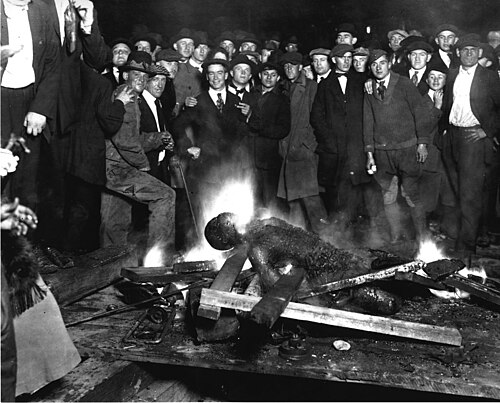
From September 28–29, the race riot of Omaha, Nebraska, erupted after a mob of over 10,000 ethnic whites from South Omaha attacked and burned the county courthouse to force the release of a black prisoner accused of raping a young white woman. The mob prevailed in lynching the suspect, Will Brown, hanging him and mutilating his body before burning it in a bonfire. The group then fanned out, attacking black neighborhoods and stores on the north side, destroying property valued at more than a million dollars.
Responding to the appeals of the mayor and governor for assistance in quelling the unrest, the federal government sent U.S. Army troops from nearby forts, who were commanded by Major GeneralLeonard Wood, a friend of Theodore Roosevelt, and a leading candidate for the Republican nomination for president in 1920.[32]
On September 30, a massacre occurred against Black people in Elaine, Phillips County, Arkansas,[4] being distinct for having occurred in the ruralSouth rather than a city.
The event erupted from the resistance of the white minority against the organization of labor by black sharecroppers, along with the fear of socialism. Planters opposed such efforts to organize and thus tried to disrupt their meetings in the local chapter of the Progressive Farmers and Household Union of America. In a confrontation, a white man was fatally shot and another wounded. The planters formed a militia to arrest the African-American farmers, and hundreds of whites came from the region. They acted as a mob, attacking black people over two days at random. During the riot, the mob killed an estimated 100 to 237 black people, while 5 whites also died in the violence.
Arkansas GovernorCharles Hillman Brough appointed a Committee of Seven, composed of prominent local white businessmen, to investigate. The committee would conclude that the Sharecroppers' Union was a Socialist enterprise and "established for the purpose of banding negroes together for the killing of white people."[33] The report generated such headlines as the following in the Dallas Morning News: "Negroes Seized in Arkansas Riots Confess to Widespread Plot; Planned Massacre of Whites Today." Several agents of the Justice Department's Bureau of Investigation spent a week interviewing participants, though speaking to no sharecroppers. The Bureau also reviewed documents, filing a total of nine reports stating there was no evidence of a conspiracy of the sharecroppers to murder anyone.
The local government tried 79 black people, who were all convicted by all-white juries, and 12 were sentenced to death for murder. As Arkansas and other southern states had disenfranchised most black people at the turn of the 20th century, they could not vote, run for political office, or serve on juries. The remainder of the defendants were sentenced to prison terms of up to 21 years. Appeals of the convictions of 6 of the defendants went to the U.S. Supreme Court, which reversed the verdicts due to failure of the court to provide due process. This was a precedent for heightened Federal oversight of defendants' rights in the conduct of state criminal cases.[34]
On November 13, the Wilmington race riot was violence between white and black residents of Wilmington, Delaware.
A white woman named Ruth Meeks accused a black man named John Hartfield of attacking and raping her on June 9, 1919, in Ellisville, Mississippi. Mobs hunted down Hartfield as he ran for his life, but the mobs eventually shot and captured Hartfield on June 24 as he tried to board a train. He was held in jail, but mobs eventually came back and took him away, as the sheriff allowed them to. The mob had a doctor treat Hartfield for his gunshot wound, so the mob could organize his death in a way they saw fit. On June 26, 1919, the mob took Hartfield to a field in Ellisville, Mississippi, cut off his fingers, hung him from a tree branch, shot him over 2,000 times, and when the rope was severed and Hartfield fell from the tree, the mob burned his body. 10,000 whites came to the field to see Hartfield's murder. Vendors sold trinkets and photographs. Newspapers reported that a resentful Hartfield's last words were a warning for all men to think before they do wrong. This statement from the papers seems highly unlikely due to the state of Hartfield's injuries and his attempt to run away for over a week before the mob got him.
On September 8, 1919, a mob of white men lynched Bowman Cook and John Morine.[35] During August 1919 in Jacksonville, Florida, several black taxi drivers were killed by white passengers. Black taxi drivers began to refuse service to white riders. When one white rider was denied service, he fired into a crowd of black people, killing one man. Police wrongly blamed Cook and Morine for the man's death. Three weeks later, a mob broke into the jail where the men were being held and captured them.[36] The mob drove them to a desolate area of town and shot them, then they tied Cook's body to a car and drove it for 50 blocks. The dragging drew attention to the spectacle and mutilated his corpse.
On October 4, there was a union strike at the U.S. Steel mill in Gary, Indiana. This strike was held by the white labor population of the mill as the union could not recruit the black workers’ support. To break this strike, U.S. Steel hired almost a thousand local and non-local black strikebreakers. These strikebreakers were shipped into Gary for their safety and they were provided cots, entertainment, and overtime pay. At the same time, U.S. Steel turned to theatrics and attempted to agitate the white strikers. They did this by first emasculating white strikers then later by paying unrelated black residents of Gary to march in a parade towards the steel mill. On October 4, 1919, hundreds of striking workers assaulted a stalled street car bearing 40 black strikebreakers. At first the mob resorted to heckling, then the throwing of rocks, and eventually, the mob dragged the strikebreakers from their streetcar and beat them, dragging them through the streets. The hysteria led to an eight block mob leaving many unconscious in its wake leading to the state militia and federal troops stepping in to intervene.[37] Martial law was enacted and many historians agree that it was the Riot of 1919 that broke the unions in Gary.
This list is primarily, but not exclusively, based on George Edmund Haynes's report, as summarized in the New York Times (1919).[3]
私たちは、あなた方がポーランドとオーストリアに強制的に行わせたことを、あなた方の国も自国の少数民族のために行うよう訴えます。
1919年9月、赤い夏への反応として、北部の都市でアフリカ血盟が結成され、「武装抵抗」運動として活動した。抗議活動と連邦政府への訴えは数週間続いた。 11月25日付の全国平等権利連盟からの書簡は、ウィルソンの国際的な人権擁護に訴え、「ポーランドとオーストリアに強制したように、あなたの国にも人種的少数者のために行動を起こしていただきたい」と訴えた。[ 43 ]
The October 1919 report by Dr. George Edmund Haynes is a call to national action, and was published in The New York Times and other major newspapers.[3] Haynes noted that lynchings were a national problem. As President Wilson had noted in a 1918 speech: from 1889 to 1918, more than 3,000 people had been lynched; 2,472 were black men, and 50 were black women. Haynes said that states had shown themselves "unable or unwilling" to put a stop to lynchings, and seldom prosecuted the murderers. The fact that white men had also been lynched in the North, he argued, demonstrated the national nature of the overall problem: "It is idle to suppose that murder can be confined to one section of the country or to one race."[3] He connected the lynchings to the widespread racial riots against Black people in 1919:[3]
Persistence of unpunished lynchings of negroes fosters lawlessness among white men imbued with the mob spirit and creates a spirit of bitterness among negroes. In such a state of public mind, a trivial incident can precipitate a riot.
Disregard of law and legal process will inevitably lead to more and more frequent clashes and bloody encounters between white men and negroes and a condition of potential race war in many cities of the United States.
Unchecked mob violence creates hatred and intolerance, making impossible free and dispassionate discussion not only of race problems, but questions on which races and sections differ.

The Joint Legislative Committee to Investigate Seditious Activities, popularly known as the Lusk Committee, was formed in 1919 by the New York State Legislature to investigate individuals and organizations in New York State suspected of sedition. The committee was chaired by freshman State Senator Clayton R. Lusk of Cortland County, who had a background in business and conservative political values, referring to radicals as "alien enemies."[44] Only 10% of the four-volume work constituted a report, while the rest reprinted materials seized in raids or supplied by witnesses, much of it detailing European activities, or surveyed efforts to counteract radicalism in every state, including citizenship programs and other patriotic educational activities. Other raids targeted the left-wing of the Socialist Party and the Industrial Workers of the World (IWW). When they analyzed the materials it hauled away, it made much of attempts to organize "American Negroes" and calls for revolutions in foreign-language magazines.[45][46]
In mid-summer, in the middle of the Chicago racial violence against Black people, a federal official told The New York Times that the violence resulted from "an agitation, which involves the I.W.W., Bolshevism and the worst features of other extreme radical movements."[47] He supported that claim with copies of Negro publications that called for alliances with leftist groups, praised Soviet Russia, and contrasted the courage of jailed socialistEugene V. Debs with the "school boy rhetoric" of traditional black leaders. The Times characterized the publications as "vicious and apparently well financed," mentioned "certain factions of the radical Socialist elements," and reported it all under the headline: "Reds Try to Stir Negroes to Revolt".[47] In late 1919, Oklahoma's Daily Ardmoreite published a piece with a headline describing "Evidence Found Of Negro Society That Brought On Rioting".[48]
In response, some black leaders such as Bishop Charles Henry Phillips of the Colored Methodist Episcopal Church asked black people to shun violence in favor of "patience" and "moral suasion." Phillips opposed propaganda favoring violence, and he noted the grounds of injustice to the black people:[49] Phillips was based in Nashville, Tennessee.
I cannot believe that the negro was influenced by Bolshevist agents in the part he took in the rioting. It is not like him to be a traitor or a revolutionist who would destroy the Government. But then the reign of mob law to which he has so long lived in terror and the injustices to which he has had to submit have made him sensitive and impatient.
The connection between black people and Bolshevism was widely repeated. In August 1919, The Wall Street Journal wrote: "Race riots seem to have for their genesis a Bolshevist, a Negro, and a gun." The National Security League repeated that reading of events.[50] In presenting the Haynes report in early October, The New York Times provided a context which his report did not mention. Haynes documented violence and inaction on the state level.

The Times saw "bloodshed on a scale amounting to local insurrection" as evidence of "a new negro problem" because of "influences that are now working to drive a wedge of bitterness and hatred between the two races."[3] Until recently, the Times said, black leaders showed "a sense of appreciation" for what whites had suffered on their behalf in fighting a civil war that "bestowed on the black man opportunities far in advance of those he had in any other part of the white man's world".[3] Now militants were supplanting Booker T. Washington, who had "steadily argued conciliatory methods." The Times continued:[3]
Every week the militant leaders gain more headway. They may be divided into general classes. One consists of radicals and revolutionaries. They are spreading Bolshevist propaganda. It is reported that they are winning many recruits among the colored race. When the ignorance that exists among negroes in many sections of the country is taken into consideration the danger of inflaming them by revolutionary doctrine may [be] apprehended.... The other class of militant leaders confine their agitation to a fight against all forms of color discrimination. They are for a program on uncompromising protest, "to fight and continue to fight for citizenship rights and full democratic privileges."
As evidence of militancy and Bolshevism, the Times named W. E. B. Du Bois and quoted his editorial in The Crisis, which he edited:[3]
Today we raise the terrible weapon of self-defense ... When the armed lynchers gather, we too must gather armed." When the Times endorsed Haynes' call for a bi-racial conference to establish "some plan to guarantee greater protection, justice, and opportunity to Negroes that will gain the support of law-abiding citizens of both races", it endorsed discussion with "those negro leaders who are opposed to militant methods.
In mid-October government sources provided the Times with evidence of Bolshevist propaganda appealing to America's black communities. This account set Red propaganda in the black community into a broader context, since it was "paralleling the agitation that is being carried on in industrial centres of the North and West, where there are many alien laborers".[51] The Times described newspapers, magazines, and "so-called 'negro betterment' organizations" as the way propaganda about the "doctrines of Lenin and Trotzky" was distributed to black people.[51] It cited quotes from such publications, which contrasted the recent violence in Chicago and Washington, D.C., with:[51]

...Soviet Russia, a country in which dozens of racial and lingual types have settled their many differences and found a common meeting ground, a country which no longer oppresses colonies, a country from which the lynch rope is banished and in which racial tolerance and peace now exist.
The Times noted a call for unionization: "Negroes must form cotton workers' unions. Southern white capitalists know that the negroes can bring the white bourbon South to its knees. So go to it."[51] Coverage of the root causes of the riot against black people in Elaine, Arkansas evolved as the violence stretched over several days. A dispatch from Helena, Arkansas, to the New York Times datelined October 1 said: "Returning members of the [white] posse brought numerous stories and rumors, through all of which ran the belief that the rioting was due to propaganda distributed among the negroes by white men."[52] The next day's report added detail: "Additional evidence has been obtained of the activities of propagandists among the negroes, and it is thought that a plot existed for a general uprising against the whites." A white man had been arrested and was "alleged to have been preaching social equality among the negroes". Part of the headline was: "Trouble Traced to Socialist Agitators".[53] A few days later a Western Newspaper Union dispatch captioned a photo using the words "Captive Negro Insurrectionists."[54]

シカゴで有色人種に対する人種差別的暴力が発生した際、司法省当局者は報道機関に対し、IWW、社会主義者、ボルシェビキが「人種憎悪を煽るプロパガンダを広めている」と誤って伝えた。[ 55 ] FBI捜査官は、左翼思想が黒人コミュニティで支持者を増やしているという報告書を提出した。ある者は、 NAACPの活動を挙げ、「有色人種に白人との平等を主張し、必要であれば武力を行使するよう促した」と述べている。[ 50 ] J・エドガー・フーバーは、政府でのキャリアの初期に、司法長官のために暴動を分析した。彼は、7月のワシントンDCの暴動の原因を「黒人による白人女性への多数の暴行」と非難した。[ 22 ] 10月 のアーカンソー州の事件については、「黒人ロッジにおける特定の地域的扇動」を非難した。[ 22 ] 彼が挙げたより一般的な原因は「過激な性質のプロパガンダ」であった。[ 22 ]彼は、社会主義者が『ザ・メッセンジャー』 のような黒人所有の雑誌にプロパガンダを流し、それが黒人読者を扇動したと非難した。彼は、地元当局が活動を記録した白人の暴力行為者については言及しなかった。米国司法省の急進派部門の責任者として、フーバーは「黒人の活動」の調査を開始し、マーカス・ガーベイを標的にした。彼は自身の新聞「ネグロ・ワールド」がボルシェビズムを説いていると考えていた。[ 22 ]彼はハーレムの黒人組織や出版物をスパイするために黒人の潜入工作員を雇うことを許可した。[ 55 ]
11月17日、 A・ミッチェル・パーマー司法長官は、無政府主義者とボルシェビキが政府に及ぼす脅威について議会に報告した。報告書の半分以上は、黒人社会における過激主義と、人種差別的暴力と夏の暴動への対応として黒人指導者が提唱した「公然たる反抗」について記録した。報告書は、黒人社会の指導者たちが「人種暴動に対する不適切な対応」をしたとして非難した。「最近の黒人に対する人種暴動に関するあらゆる議論には、黒人が自ら見出した誇りの響きが反映されている。黒人は『反撃』し、二度と暴力と脅迫に屈服しないだろう。」[ 56 ]報告書は、「黒人指導者の間で作用している危険な反抗と復讐の精神」について述べた。[ 56 ]
Claude McKay's sonnet, "If We Must Die",[57] was prompted by the events of Red Summer.[58]