
Loading article…
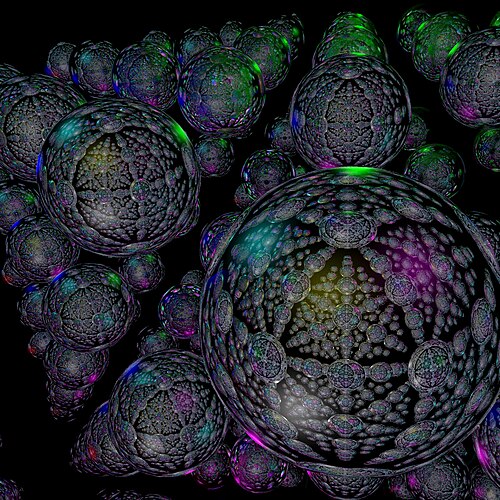
Perfect Interpenetration,interconnectedness or complete interfusion is a key philosophical concept in East Asian Buddhism, which was most prominently developed within the Huayan and Tiantai schools.[1] It describes a kind of holism that sees every individual phenomenon (Sanskrit: dharma, Chinese: 事 shi) in the universe as simultaneously containing the entirety of all other phenomena, while also being contained within every other phenomenon. According to this view, this state of interpenetration exists without each phenomenon losing its individual identity in an undifferentiated monism.[2]
The root of the East Asian idea of interpenetration is found in the Buddhist theories of Pratītyasamutpāda (dependent co-arising), emptiness and in the Mahayana doctrine of non-duality (advaya) as found in texts like the Avatamsaka Sutra. Though initially developed in the Huayan and Tiantai schools, the concept influenced all major traditions of East Asian Buddhism, including Chan / Zen and Pure Land. The idea is often illustrated through the influential metaphor of Indra's net popularized by the authors of the Huayan school.[3]
Various traditional Chinese Buddhist terms are used to describe the idea that all things are interpenetrated, including interpenetration (Chinese: 通達; pinyin: tōngdá, from Sanksrit: prativedha), perfect interfusion (圓融; yuánróng), unobstructed perfect interfusion (圓融無礙), and mutual inclusion (互具; hu ju).[4][5] Western scholars often use terms like interconnectedness, interpenetration and interbeing, the last term having been coined by the modern Zen teacher Thich Nhat Hanh.[6][7][8][9]
The doctrine of interpenetration is often used as a bridge between Buddhist metaphysics and practical ethics. By realizing that all beings are inextricably linked, the practitioner is led toward universal compassion. This is because the suffering and happiness of a single individual is seen as inseparable from the suffering of the whole, and vice versa.[7][8][9] In the modern era, the idea has become widespread in Buddhist modernist discourse, which emphasizes the ethical, environmental and political implications of the doctrine. It is frequently cited in discussions regarding Buddhist ecology and engaged Buddhism, where it provides a spiritual framework for understanding the deep ecological interdependence of the natural world and human beings.[10]

The Chinese Buddhist philosophical idea that everything is connected to everything began to develop during the Sui and Tang dynasties (581–907 CE), a period that has been seen as a golden age for Chinese Buddhism. The source of these ideas are found in Indian Mahayana writings on emptiness (especially in the works of Nagarjuna) and in key Mahayana sutras like the Avatamsaka Sutra. These ideas were synthesized and developed further by Chinese Buddhist philosophers like Zhiyi (c. 538–597 CE), Jizang (c. 549–623), Dushun (c. 557–640) and Fazang (c. 643–712) into complex metaphysical doctrines of holistic interpenetration.[1][3]
Apart from drawing on Indic Mahayana sources, Chinese Buddhist writings on interpenetration may have also drawn inspiration from native Chinese sources. Charles Muller notes that writings like the I Ching, Analects, Tao Te Ching, and Chuang Tzu accept "a worldview in which the thoughts and actions of an individual penetrate, and carry influence throughout the entire world."[12] Confucian and Daoist sources also use the terms 通 tōng and 達 dá, both of which could mean "apprehend," "understand," "grasp," "permeate," "fill," or "influence."[12]
The Huayan (Avatamsaka) school is particularly known for its development of the theory of interpenetration, which is also known as "perfect interfusion" (圓融; yuanrong), the non-obstruction of phenomena (事事無礙; shishi wu’ai), and "the dependent arising of the whole realm of phenomena" (法界緣起, fajie yuanqi; Sanskrit: dharmadhatupratityasamutpada). This doctrine is central to Huayan thought and is described in various ways throughout the writings of Chinese Huayan scholars, dating back to the founder of the school, Dushun.[5][13][14] Muller explains that the Chinese binome 通達 tōngdá "indicates both passing through that which is already open, and piercing through that which has been heretofore closed."[12]
法蔵や城官のような華厳の達人は、空の教義の解釈と華厳経の読解からこの理論を発展させた。彼らにとって、すべての現象(法)は互いに依存し、融合しており、宇宙全体の法(法界)とも融合している。そのため、個々の法は、相互に連結した法の結び目、つまり各法が他のすべての法を含むシステムとして、宇宙の一部としてのみ存在する。[ 2 ]法蔵はこれを「一多多多一」(一多多、多多一)と「一多多多一」(一中多、多中一)という言葉で表現しており、これはあらゆる法が万物全体に浸透し、また万物全体に浸透される様子を表している。[ 15 ]ブライアン・ヴァン・ノーデンはこの理論を次のように説明しています。「何かの同一性は他のものの同一性に依存しているため、『一つはすべて』であり、全体はその同一性を部分に依存しているため、『すべては一つ』である。」[ 16 ]
華厳経自体は華厳経で説かれているような融合の理論を説いてはいないが、個々の粒子の中に無数の世界が含まれていることを説明した箇所が数多くあり、例えば以下のようなものがある。
数えきれない仏国土が原子に還元されるならば、 一つの原子の中に数えきれない国土があり、一つの中にあるように、それぞれの中にもある。 これらの仏国土が一瞬にして還元される原子は言葉では言い表せないほど多く、 数えきれない劫にわたって瞬間ごとに還元され続ける原子もまた同様である。 これらの原子には言葉では言い表せないほど多くの国土が含まれており、これらの国土の中の原子はさらに言葉では言い表せないほど多い。[ 17 ]
この考えはガンダヴィユーハ・スートラの影響も受けている可能性がある。毘盧遮那の塔のクライマックスシーン。[ 3 ]この箇所では、経典の主人公であるスダーナが塔のある寺院堂(クーターガラ)に入り、その内部が空のように広大で、互いに邪魔することなく共存する数十万もの他のクーターガラが含まれているのを目にする。内部では、菩薩(弥勒菩薩を含む)が三昧に入り、皮膚の毛穴から無数の変容体を放出し、あらゆる毛穴から美しい仏教の教えが発せられているのを目撃する。特に壮麗な塔の一つでは、仏教の宇宙全体を一目で認識し、それぞれの世界の中で、弥勒菩薩の誕生、地上への降臨、そして彼の最後の存在の重要な出来事を観察する。[ 3 ]ガンダヴィユーハ経の第54章にあるように、
彼はクータガラの中に、このような装飾品で飾られた十万ものクータガラを見た。無数の貴重な傘、旗、旗などで飾られ、無数の完璧で優れた性質で飾られていた。彼は、それらのクータガラすべてがそのように広大で、計り知れないほど大きく、空間の宝庫であり、完全に美しく飾られているのを見た。彼は、これらのクータガラが完璧に配置されているため、一回の知覚で、互いに分離し、混じり合うことなく、互いに区別された反射のように見え、例外なくすべてが一回の知覚で知覚されるのを見た。[ 18 ]
さらに、 『華厳経』の共通のテーマは、仏の法が「一つ」または単一であるのに対し、すべての有情の知覚と理解は多様であるということである。これは、光り輝く真珠が多くの反射を含む様子に例えられ、仏の涅槃の領域が輪廻のすべてに顕現し浸透する様子を説明するために用いられる(輪廻と涅槃の非二元性という大乗仏教の教義を強調している)。 [ 14 ]これらの考えは、一(yi)と多(duomulti)の統一性に関する中国の解釈上の議論(智岩の「一即すべて」という言葉に見られるように)や、本質機能や究極の原理(li)と万物の現象(shi )の関係といった密接に関連する中国哲学理論のさらなる発展につながり、これらはすべて相互依存的で相互に関連していると見なされた。[ 14 ]
The Huayan theory of interpenetration was first presented in Dushun’s Threefold Discernment of the Dharmadhatu which provides a progressive meditative framework for understanding reality which moves from the classic Mahayana view of emptiness to a radical vision of cosmic interpenetration. Dushun begins with the first discernment, which establishes the classic identity between form and emptiness. The second discernment introduces the distinctive Huayan categories of li 理 (universal principle) and shi 事 (particular phenomena), arguing that these two dimensions of reality are mutually non-obstructive and pervade one another like water and waves. The third and highest discernment completely transcends the dualism of the ultimate principle and myriad phenomena, focusing on the total pervasion of shi with shi. In this final stage, reality is viewed as a groundless, center-less, fractal web where every individual dharma fully contains and is contained by every other thing in the universe.[19][20]
The Huayan teaching of interpenetration is depicted through various metaphors, such as Indra's net, an infinite cosmic net that contains a multifaceted jewel at each vertex, with each jewel being reflected in all of the other jewels, ad infinitum. Thus, each jewel contains the entire net of jewels reflected within.[3] This idea was also first described by the first patriarch Dushun who writes in his Calming and Contemplation in the Five Teachings of Huayan (Huayan wujiao zhiguan 華嚴五教止觀, T1867):
The manner in which all dharmas interpenetrate is like an imperial net of celestial jewels extending in all directions infinitely, without limit. … As for the imperial net of heavenly jewels, it is known as Indra’s Net, a net which is made entirely of jewels. Because of the clarity of the jewels, they are all reflected in and enter into each other, ad infinitum. Within each jewel, simultaneously, is reflected the whole net. Ultimately, nothing comes or goes. If we now turn to the southwest, we can pick one particular jewel and examine it closely. This individual jewel can immediately reflect the image of every other jewel.[21]

もう一つのよく知られた比喩は、法蔵の有名な「垂木対話」に見られる垂木建築の比喩である。[ 5 ]これは『華厳五教章』( T.45.1866)に見られ、法蔵は次のように述べている。
垂木は建物です。なぜでしょうか?垂木自体が建物を支えているからです。垂木がなければ、建物は支えられません。垂木があれば、建物があるのです。質問:垂木が1本でも欠けていたら、なぜ建物がないのでしょうか?答え:それは完全な建物ではなく、欠陥のある建物です。したがって、完全な建物は1本の垂木に内在していることを知っておく必要があります。それがこの1本の垂木に内在しているのだから、垂木が建物であることを知る必要があります。質問:建物が垂木であるならば、板や屋根瓦なども垂木であるべきでしょうか?答え:それらはすべて垂木です。なぜでしょうか?垂木がなければ、建物はありません。垂木がなければ、建物は欠陥があります。建物が欠陥があるならば、板や屋根瓦などについて語ることはできません。したがって、板や屋根瓦などは垂木です。垂木がなければ、建物は建造できなかったでしょう。垂木や瓦なども建造できなかったでしょう。今やそれらはすべて建造され、互いに同一であることがわかっています。[ 1 ]
法蔵によれば、どの垂木(どの部分)も、その建物(宇宙、法界を象徴する)の存在に不可欠である。同様に、どの垂木もその同一性と存在は、それが建物の一部であることに依存している。[ 22 ] [ 23 ]したがって、いかなる現象も、宇宙のすべての現象に必然的に依存している。[ 24 ]グラハム・プリーストや李康のような哲学者は、この議論を定義的同一性の概念に基づいていると解釈している。全体の各部分は、全体が何であるかを定義することに貢献している。物のいずれかの部分がないということは、その個々の部分がなければ、全体はもはや同じ物ではないことを意味する。[ 1 ] 相互浸透を説明するために用いられるもう1つの例は、八角形に配置され、互いに反射し合う鏡の間である。法蔵は、相互浸透を教える方法として、このような鏡の間を建設したと言われている。[ 23 ]華厳の祖である青梁成官は、この例を次のように説明した。
If we use the example of the ten mirrors (arrayed in a circle or sphere so that all face all the others) as a simile [for phenomenal interpenetration], one mirror is the one, nine mirrors are the many [...] one mirror includes in it reflections of nine mirrors, meaning that one mirror is that which includes and nine mirrors are that which is included—yet because the nine mirrors also are that which includes (because they contain the reflection of the one mirror), the aforementioned one mirror which includes also enters the nine mirrors, so one mirror enters the nine mirrors.[25]
While Chengguan upheld the non-obstruction of phenomenon and phenomenon (shi shi wu ai 事事無礙) as the highest teaching, he nonetheless emphasized the non-obstruction of the absolute and phenomena (li shi wu ai 理事無礙) as that which made the non-obstruction of all phenomena possible. That is, it is only because all phenomena are formed from the same absolute principle (li 理) that they do not obstruct one another.[26] Brook Ziporyn also observes that later Huayan thought, as exemplified by Chengguan and Zongmi, emphasized an absolute Pure Mind as the ground of all phenomenal appearance and interpenetration. This ground is Awareness (知 zhi) as the substance of mind that is free of thoughts (念 nian). It is not the same as the ordinary consciousness of discrimination. Rather, pure awareness is the "illumination" which does not rise and fall with discrete thought-moments, and is not limited by any finite condition.[27] As Ziporyn explains, according to this later Huayan view:
This illumination, which is the pure and ever‑present essence of mind, is itself precisely “nonobstruction between events,” interpervasion as such, what presences and unifies all particular things, is in its essence undifferentiated and interpenetrative, and this Mind as such, unchanging awareness, is the coherence of things (omnipresent unifying totality of all interpenetrative particulars) which must be realized in order to realize enlightenment—in other words, Mind as such is Li.[28]

The Chinese Tiantai school also developed a theory of interpenetration in parallel with the developments in the Huayan school. The Tiantai school develops its interpenetration theory from the philosophy of its central founding figure, Zhiyi, as well as from its readings of the Mahayana Sutras, especially the Lotus Sutra. Tiantai authors use terms such as "mutual containment" (相攝, Skt. anyonya-samavasaraṇa), "mutual inclusion" (互具; hu ju), "nature inclusion" (性具; xing ju) or "inherent inclusion" (本具; ben ju) to describe their view of the interpenetration of all phenomena.[29][30] For Tiantai scholars, this meant that any individual phenomenon (dharma) includes or entails every other phenomenon. This holism also entails that each phenomenon includes the entirety of the ultimate truth (and vice versa, that the ultimate truth includes all other particular phenomena).[30] This view that "everything contains everything else, and the whole contains all things" was also termed "the interinclusiveness of the ten realms" and "the interpenetrating unity of all aspects of reality".[31]
According to Brook Ziporyn, the Tiantai school's view of interfusion is derived from a passage in the Chinese translation of the Lotus Sutra which states (key section bolded for emphasis):
Only a Buddha together with a Buddha knows the ultimate reality of all things: how they appear, what their natures are, what they're made of, what they are capable of, what they are doing, what their causes are, what their conditions are, what their effects are, what their consequences are, and the way in which all these factors from beginning to end are equally ultimate and are ultimately one and the same.[32]
According to modern Buddhist studies scholar Brook Ziporyn, Tiantai authors interpret this passage as pointing to how "each particular aspect of the world as we see it and feel it is ultimately real, that each one is in fact the Absolute itself, the Buddha-nature, the final fact about the universe," and also how "each thing, each appearance, each action" is "the ultimate reality "of " all other things".[32]
The foundational thinker of the Tiantai school, Zhiyi, saw the teaching of mutual inclusion as being entailed by the doctrine of emptiness, dependent arising and the threefold truth (his own reworking of Nagarjuna'stwo truths). Zhiyi writes in his Móhē Zhǐguān: "If one relies on the circumstances of deluded attachment and discrimination, then phenomena are not mutually contained. But if one relies on the function of the dependent arising of the mind-nature, then there can be mutual containment (相攝)."[33] According to Zhiyi, the third truth of the Middle (which is the non-duality of the conventional and the ultimate truths) transcends and includes all extremes, such as self and other, "inside" or "outside", whole or part, the one and the many. As such, any specific phenomenon cannot be ultimately separate from all others and thus "entails" or includes all other phenomena.[34]
According to Li Kang, Zhiyi derives his view of interpenetration from Nagarjuna's doctrine of emptiness, which says that all phenomena exist only as conventional conceptual constructs (prajñaptis). If this is the case, then the boundaries between all individual things are not inherent, substantial or fixed. Since there is no inherent boundary between phenomena, then there is no ultimate separation between things, and so, all things are interpenetrating. Zhiyi thus relies on the view of emptiness to establish conventionality of boundaries to establish the nonseparateness of all things. It is like how the boundaries between the five oceans are merely conventional.[1]
Zhiyi further explains interpenetration with the phrase: "a single thought [or “one mind”] comprises the ten dharma-realms" (一念三千yīniàn sānqiān). According to this teaching, each of the ten realms of Buddhist cosmology contains / possesses (具; ju) all other realms.[35][1] Furthermore each realm (or phenomenon) contains all others or "inherently entails" all others, hence they are "mutually inclusive".[36][37] In explaining this view, Zhiyi's Móhē Zhǐguān explicitly rejects two specific interpretations:
しかし、一つの思考が先にあり、すべての法が後にあるとは言えません。また、すべての法が先にあり、一つの思考が後にあるとも言えません。一つの思考がすべての法を生み出すならば、それは垂直です。一つの思考が一度にすべての法を含むならば、それは水平です。垂直であることはできません。水平であることもできません。[ 1 ]
したがって、天台宗の立場は、すべての法を生み出す単一の現象が存在するというものではなく、すべての法を構成要素として内包する単一の現象が存在するというわけでもありません。むしろ、智義は「ただ、一つの考えがすべての法であり、すべての法が一つの考えである」と主張しています。[ 1 ]これは、「十の法(領域)それぞれに原因と結果があり、互いに混同したり混同したりしないため、『十の法領域』と呼ばれる」場合でも真実です。さらに、智義は、一つの考えとすべての法は「同一でもなければ区別でもない」とも書いています。[ 1 ]
ブルック・ジポリンが説明するように、智一にとって、あらゆる事物や思考には、他のすべての事物を明らかにするために「開かれる」ことができるある種の潜在力があり、すべての事物は他のすべての事物につながり、したがって「全体は各部分に存在し、すべての個別はそれ自体が全体である」。[ 38 ]したがって、「1つの短い思考がすべての現実を含んでいる」こと、そして「仏と凡夫、身体と精神、原因と結果、主体と客体、有情と無情は、思考のあらゆる瞬間に相互に包含されている」と言える。[ 37 ] [ 39 ]
Further maxims which are influential in Tiantai Buddhism as ways of discussing the implications of interpenetration include: "afflictions (kleśa) are precisely enlightenment (bodhi)," "saṃsāra is precisely nirvāṇa," "sentient beings are precisely original enlightenment," and "this sahā world is precisely the [pure] land of silent illumination".[33] However, Ziporyn notes that the Tiantai view does not mean that each phenomenon literally contains every thing else, but that "as a sound is contained in a musical instrument", each phenomenon has the same nature (Chn. xing), which can lead to, connect to or become all other things.[38] As such, while we can say that all phenomena entail all other phenomena, they don't contain all phenomena pre-existent within it. This would be a non-Buddhist view called satkaryavada which existed in India and is explicitly rejected in Mahayana Buddhist philosophy.[38] Ziporyn describes the Tiantai view of reality which holds to the mutual inclusion of the whole in each individual thing as an "omnicentric holism". In this view, no phenomenon has a clear singular identity of its own. Instead, each thing is a nexus of all other things and exists in an infinitely multi-sided way. Furthermore, no single phenomenon is an exclusive core or foundation of reality, all phenomena are ontological equal.[40][41] Nevertheless, in spite of this mutual interfusion, individual phenomena do not lose their particular individuality and functioning as conventional truths.[42]
Ziporyn points out that an important difference between Tiantai and Huayan concerns their understanding of absolute principle (li 理). In Tiantai, any particular dharma or event can also be viewed as being a particular li in a multitude of lis. As such, in Tiantai, not only do all events (shi 事) interpenetrate, but so too do all lis. In Huayan, on the other hand, one cannot speak of the interpenetration of li and li. This is because, for Huayan, li as the absolute principle necessarily cannot be multiple.[43] Another unique feature of the Tiantai school is the doctrine of inherent evil (xing e). According to the Tiantai view, since all dharmas are inherently included in each other, evil must be inherent in the absolute or buddha-nature. This was an important doctrine for Siming Zhili (960–1028), who argued against the Chan and Huayan view of a fundamentally pure mind as the ontological ground of reality. Moreover, for Zhili, mind does not possess any special status among dharmas. That is, since all dharmas are on equal footing, any dharma such as a speck of dust, a sound, or smell, can equally be thought of as being the "source" of all others. Also, as each dharma is equally absolute, in Zhili's view, mind cannot be privileged over physical form.[44]
The Chinese Madhyamaka school (known as Sanlun) also saw the development of a theory of interpenetration or mutual dependence (相待; xiang dai), based on Nagarjuna's theory of emptiness, which sees all conventional phenomena as conceptual imputation. The idea is developed in the works of the Sanlun philosopher Jizang (549–623).[1] In the Erdi Yi 二諦義 (Meaning of the Two Truths, T.45.1854), Jizang explains mutual dependence as follows:
The original meaning of mutual dependence requires mutual revelation and mutual establishment. For example, long and short are mutually dependent. Without short, there is no long; without long, there is no short. Long reveals what is short, and short reveals what is long. This is called mutual dependence.[1]
This is a mutual dependence of particular characteristics. But Jizang's Erdi Yi also discusses a more general type of mutual dependence between seemingly unrelated things:
Shi (is) and fei (is not) are mutually dependent. Vase depends on non-vase. (Non-vase depends on vase.) If so, a piece of clothing is a non-vase; since non-vase depends on vase, a piece of clothing depends on a vase. Once a piece of clothing depends on a vase, then a vase and a piece of clothing are (each other’s) causes and conditions. A piece of clothing embodies the meaning of a vase, and a vase embodies the meaning of a piece of clothing. Once a piece of clothing embodies the meaning of a vase, all things embody the meaning of a vase.[1]
According to Kang, the basic argument here is that opposing concepts mutually depend on each other, and that for any two things, there will always be opposing concepts that apply to each thing which mutually depend on each other. The argument posits that if the concepts defining two objects are mutually dependent, then the objects themselves must share a reciprocal dependence relationship, effectively "embodying" each other's meaning. Since any two arbitrary objects (which in Madhyamaka are prajñaptimatra, "mere conceptual constructs") can be mapped onto such opposing conceptual pairs, Jizang concludes that every individual phenomenon in the universe is inextricably linked to every other, suggesting that any single thing contains the essence of the totality.[1]
East Asian views on mutual interfusion were also influential on the development of the Chan (Zen) tradition, which drew on them to explain the Mahayana concept of nonduality (bu-er 不二).[1]Huayan and Sanlun influences can be found in classic Chan texts such as the Platform Sutra and the Harmony of Difference and Sameness.[1]
Chan masters applied the idea that the universal principle (li, equated with the Buddha mind and Buddha-nature) was entirely immanent within every particular event (shi) to the Chan idea of kensho (Chn. 見性; jianxing), a direct perception of ultimate reality in each mundane thought or moment. For Chan masters like Mazu Daoyi, the interfusion of buddha-nature with all things meant that enlightenment was fully present in daily thoughts or acts like carrying water or chopping wood.[45] The doctrine also served to defend the Chan Buddhist view of the path, which shifted from gradual progression toward "sudden awakening", a sudden realization that Buddhahood was already here and now, interfused with our very mundane existence.
Zongmi (780-841) was particularly influential in marrying Huayan philosophy to Chan Buddhism. His writings emphasize the interpenetration of principle (li) with all phenomena. The Huayan doctrine also influenced the teaching of the Five Ranks, which is found in the Song eraSong of the Precious Mirror Samadhi. This text became important for the Caodong Chan school, as well as for later Japanese Zen traditions. The Five Ranks were also commented on by Hakuin (1686-1769), founder of modern Rinzai Zen.[46] Perfect interpenetration also appears in the works of Korean Seon masters like Jinul (1158–1210) and Kihwa (1376–1431), both of whom were influenced by Huayan thought.[47]
Jinul sought to demonstrate the harmony of Chan and the Huayan teachings, arguing that awakening in Chan is the same as what Huayan terms "sudden realization of the dharmadhātu." For Jinul, the non-dual nature possesses two properties by which it accomplishes the perfect interpenetration of all phenomena: [1] the noumenal essence, which refers to the bright and perfect ground of the dharmadhātu; and [2] its phenomenal function, which is the manifestation of the world of sensory objects in all their variety. Since the pure nature and its unimpeded function are inseparable, if one "looks back on the radiance" of one's pure, enlightened nature, one will also realize all phenomena to be in dynamic interaction. As Robert Buswell observes, "Consequently, the ultimate state of the interpenetration of all phenomena is not distinct from the fundamental wisdom inherent in the self nature of all sentient beings; if that nature is recognized through Sŏn practice, the ultimate goal of the Hwaŏm school is realized."[48] Jinul also explains that awakening to mind is the same as awakening to the interpenetration of all phenomena, since there is nothing which exists outside of the mind. He says:
I had always had doubts about the approach to entering into awakening in the Hwaŏm teachings: what, finally, did it involve? Accordingly, I decided to question a [Hwaŏm] lecturer. He replied, "You must contemplate the unimpeded interpenetration of all phenomena." He entreated me further: "If you merely contemplate your own mind and do not contemplate the unimpeded interfusion of all phenomena, you will never gain the perfect qualities of the fruition of Buddhahood." I did not answer, but thought silently to myself, "If you use the mind to contemplate phenomena, those phenomena will become impediments and you will have needlessly disturbed your own mind; when will there ever be an end to this situation? But if the mind is brightened and your wisdom purified, then one hair and all the universe will be interfused for there is, perforce, nothing which is outside [the mind]."[49]
In addition to connecting perfect interpenetration with Sŏn (Zen) practice and philosophy, some authors also used it to defend classical East Asian Buddhist ethics. For example, Kihwa (who was also a scholar of Confucianism), writes:
Humaneness implies the interpenetration of heaven and earth and the myriad things into a single body, wherein there is no gap whatsoever. If you deeply embody this principle, then there cannot be a justification for inflicting harm on even the most insignificant of creatures.[10]
Chinese masters often drew on Tiantai and Huayan teachings of interpenetration to explain the nature of the Pure Land Buddhist path and the functioning of Pure Land practices, such as nianfo. Pure Land masters like Yunqi Zhuhong, Ouyi Zhixu and Yinguang argued that because all phenomena are mutually inclusive and interfused, the mind of the nianfo reciter and Amitabha Buddha's mind were fundamentally inseparable and interlinked. Because of this, a single faithful invocation of the nianfo actually activates the Buddha's virtuous qualities in one's mind here and now, and plants seeds for future rebirth in the Pure Land of Sukhavati. Furthermore, due to the interpenetration of all phenomena, reciting the name of Amitabha Buddha fully encompasses all buddhas. As Master Yinguang writes:
You should not think that the merits and virtues of reciting the name of, or visualizing one Buddha are less encompassing than those received from reciting the name of, or visualizing many Buddhas. You should realize that Amitabha Buddha is the Dharma Realm Treasure Body. All the virtues of the Buddhas in the ten directions of the Dharma Realm are fully encompassed in Amitabha Buddha. This is like the jewelled net of Indra, whose thousands and thousands of jewels are fully reflected in one jewel, the image of one jewel is reflected in thousands and thousands of jewels, and each and every jewel encompasses every other, in perfect, unimpeded fashion.[50]
This doctrine also provides metaphysical foundation for the Pure Land doctrine of ganying, "stimulus-response," in which the practitioner’s "stimulus" (the focused chanting of nianfo) and the Buddha’s "response" (the compassionate vow to save all beings) are not separate distinct things. Because the practitioner’s mind and Amitabha’s Pure Land interpenetrate without obstruction, the act of calling upon the Buddha is able to collapses the distinctions between the mundane world of samsara and the pure land. Likewise, according to masters like Yuan Hongdao, the single easy practice (nianfo) encompasses and accomplishes all other Buddhist practices due to perfect interfusion.[51] Furthermore, all worlds and realms are interfused with the Pure Land itself. As such, through the doctrine of interpenetration, the pure land was understood as an ever-present dimension which could be accessed by means of faith and nianfo practice, which allows us to become aligned with the interfusion of the Buddha and sentient beings.[52]
Thích Nhất Hạnh, a prominent Vietnamese Zen Buddhist teacher, coined the term interbeing (French: Interêtre, Vietnamese: Tiếp Hiện) to explain Buddhist interpenetration metaphysics to modern people and help them develop some insight into the Buddhist view of reality.[53][54] Though he was deeply versed in the complex doctrines of Huayan and Yogacara, Nhat Hanh’s presentation of interbeing is noted for its elegant simplicity which focuses on natural explanations and ethics.[55] Nhat Hanh’s explanations relies on stories and simple metaphors to convey the notion that all things exist in a state of interconnected being, a state of being interwoven and mutually dependent.[53] In his book Understanding our Mind,Thích Nhất Hạnh cites the Avatamsaka Sutra and the teachings of Huayan master Fazang as the sources for his teaching of interbeing.[56]
Thích Nhất Hạnh's teaching on interbeing restates the traditional concepts of emptiness and non-self. In short, everything depends for its existence on everything else.[55] As such, Nhat Hanh teaches that to be "empty" is also to be "full of everything else." He uses simple examples like a flower or a sheet of paper. For example, regarding a simple sheet of paper, he writes:
Everything—time, space, the earth, the rain, the minerals in the soil, the sunshine, the cloud, the river, the heat, and even consciousness—is in that sheet of paper. Everything coexists with it. To be is to inter-be. You cannot just be by yourself alone; you have to inter-be with every other thing. This sheet of paper is, because everything else is.[1]
For Nhat Hanh, following Huayan Buddhism, since any single flower is empty of a separate, independent self, it is also full of non-flower elements such as sunlight, soil, clouds, water, and minerals. If all these non-flower elements were removed, there would be no flower left. A flower cannot exist independently but it can only exist in relationship with everything else.[57][58] Nhat Hanh also extends this idea to the concepts of self and not-self:
When we look deeply into nonself, we see that every single thing is possible because of the existence of everything else. We see that everything else is the cause and condition for its existence. We see that everything else is in it. From the point of view of time, we say “impermanence”, and from the point of view of space we say “nonself”.[55]
Nhat Hanh therefore teaches that because all things in flux and in a state of relationship with other things, there is no static, isolated core to anything. His teachings therefore reject any dualism between internal mind and the external world, asserting that the observer and the observed are inextricably linked parts of a singular reality.[55] This concept of interbeing highlights how all psychological and physical phenomena are intertwined, interconnected, interdependent, and mutually influenced in reality and the world. This relationship is vividly illustrated in the Avatamsaka Sutra, which teaches that "everything contains everything else" and "everything penetrates everything else."[59]

The ethical import of interpenetration is based on the link between individuals and collectives. If the "self" is actually composed of "non-self" elements, then the well-being of any individual is inseparable from the well-being of the environment, society and ultimately the entire cosmos. Thus, a person is composed of many elements beyond their personal self boundary, such as their parents, ancestors, plants, and animals, as well as water, sunlight, food, education, and life experiences.[60] It is only the belief in a separate self that confines us, falsely separating the "I" vs others.[60] As such, if one can see the nature of interbeing between oneself and others, one can see that others' suffering is one's own suffering, and others' happiness is one's own happiness.[58] Thus, Nhat Hanh teaches that harming other people, animals or the ecosystem is a form of self-harm, since there is no ontological boundary separating the two. This realization requires a life of mindfulness in the present moment, where every mundane action like washing a bowl or walking becomes a meditative act of "being peace" in relation to oneself and to the world.[55]
In this way, the view of interbeing functions as a corrective to many deluded harmful concepts that trap human thought, mainly concepts of separation and independence. By dissolving these rigid constructs of the mind and our attachments to them, practitioners of interbeing are invited to return to the immediate experience of the present moment. Nhat Hanh’s teachings therefore emphasize that enlightenment is to be found in this insight into the interconnectedness of all things.[55] Interbeing thus enriches the practice of Zen by framing the Mahayana practices of compassion, mindfulness, and ethical living. It encourages practitioners to extend their awareness beyond the self, to better engage with their environment.[61] Interbeing also supports the idea that mindfulness should extend beyond ourselves to encompass our society and ultimately the whole interconnected web of existence, since well-being is intimately tied to the well-being of others and the environment.[62] This understanding encourages practitioners to act compassionately, reducing suffering not only for themselves but also for all sentient beings.[8] Practitioners are encouraged to be mindful not only of their own thoughts and actions but also of how they affect and are affected by the world around them.[62][53]
While traditional Zen practice often involves meditation and solitary retreats, interbeing, as an integral part of Nhat Hanh's Engaged Buddhism, also encourages practitioners to be actively engaged in the world and to improve it for the better, bringing meditative insights into activism and environmentalism.[63][64] Nhat Hanh's Interbeing teaching thus has a heightened environmental awareness, emphasizing that our actions have a direct impact on the natural world and that we are interconnected with all living beings. In response to this awareness, Zen practitioners who embrace interbeing often engage in environmental advocacy and sustainable living as a natural manifestation of their practice.[61]
ティク・ナット・ハン師は、相互存在の意識を体現する新しい仏教運動として、相互存在教団とプラムビレッジ伝統を創設しました。相互存在教団は僧侶と在家信者で構成され、この共同体は相互接続の哲学と実践を遵守し、マインドフルネス、慈悲、倫理的な生活を重視しています。[ 65 ]会員は、14のマインドフルネス訓練を倫理的指針として従い、共同の実践に参加し、日常生活で相互存在の原則を適用します。[ 66 ]
プラムヴィレッジの伝統では、相互存在は、すべての人、すべての種、すべてのものの間に深い相互関係があるという理解として捉えられています。これは、非二元性、空性、縁起(すべての現象は他の現象に依存して生じる)に基づいています。[ 67 ]プラムヴィレッジは、相互存在の真実を証明しようとはせず、瞑想(マインドフルネス、洞察、集中を生み出す)を通してその真実を認識することの重要性を強調しています。[ 55 ] [ 68 ]相互存在を理解することは、苦しみを克服し、仏教の究極の目標である悟りに到達するために不可欠です。[ 55 ]この相互存在への洞察は、特に、何も真に創造も破壊もされないことを明らかにすることで、死や喪失への恐怖を取り除くのに役立ちます。[ 55 ] 1982年にティク・ナット・ハンによってフランスで設立されたプラムヴィレッジは、この伝統の中心地となっています。[ 69 ]プラムビレッジの伝統は、さまざまなセンターを通じて世界中に広がり、それぞれが相互存在の理解と実践を促進することに尽力している。[ 53 ]
The concept of interconnectedness and interbeing has influenced a range of modern authors (Buddhist and non-buddhist), philosophers, environmentalists, and thinkers who have drawn on these principles into their work. The concept has also become widespread in modern Buddhist literature. Indeed, according to David McMahan, the idea of interdependence has become a key element of Buddhist modernism, partly because it resonates with "current studies of natural systems, nations, economies, and cultures" which see these as "multifaceted, interdependent processes—networks in which each part is both constituted by and constitutive of larger dynamic systems. That we live in a radically interconnected world has become a truism....Thus any religious tradition that can claim “interdependence” as a central doctrine lays claim to timely cultural resonance and considerable cultural cachet."[10]
The idea of interconnectedness has also influenced various environmental authors and activists, who saw similarities with the theoretical paradigms of systems thinking. Arne Næss was perhaps the first environmentalist philosopher to explicitly draw a connection between the Buddhist theory of interpenetration and deep ecology, which sees sentient beings as being deeply incorporated within the whole environment. Naess's thought seeks to reject the “man-in-environment image in favor of the relational, total-field image”, seeing organisms as "knots in the biospherical net or field of intrinsic relations."[10]
Buddhist teacher and activist Joan Halifax is one example of a modern Buddhist author who draws on the concept and expands to ecology and activism, writing that as Chinese Buddhists saw the entire world as sentient, Buddhism can be seen as a way of connecting deeply with all of existence:
A thing cannot live in isolation; rather, the condition of beingness… implies a vital and transformative interconnectedness, interdependence. And thus one seemingly separate being cannot be without all other beings, and is therefore not a separate self, but part of a greater Self, an ecological Self that is alive and has awareness within its larger Self.[10]
Joanna Macy, an environmental activist and author, has also drawn on Buddhist and ecological insights in her work on systems thinking and deep ecology. Citing the Buddhist concept of interdependence. she emphasizes our connection to ecology need for a "Great Turning," a shift in consciousness towards sustainability and ecological responsibility.[70] According to Macy:
現代科学、特にシステム理論は、経験する世界の一部を「私」、残りを「他者」と解釈する論理的または科学的な根拠がないことを示すことで、明確に区別され、分離され、連続した自己についての古い仮定にさらに挑戦しています。それは、開放的で自己組織化するシステムとして、私たちの呼吸、行動、思考そのものが、私たちの中を流れ、私たちを支える物質、エネルギー、情報の流れを通して、共有された世界との相互作用の中で生じるからです。これらの活動を支える関係性の網の中には、分離され、連続した自己を明確に区別する境界線はありません。[ 10 ]
メイシーは、仏教における相互依存と無我の概念を引用し、「自己のあらゆる実体化の病原性を示す点で、システム理論よりもさらに進んでいる」と述べている。[ 10 ]メイシーは、「私たちが自然に埋め込まれていること」を認識することで、さらに社会的な関与が深まり、「自己が広がり深まることで、自然の保護が私たち自身の保護として感じられ、認識される」ようになると主張している(ここで彼女はネースの言葉を引用している)。[ 10 ]マクマハンは、メイシーの著作には、現代の生態学的理論との関連、現代の原子論的個人主義への批判、環境全体への自己の調和的な拡張、社会的な関与への呼びかけなど、「現代の仏教と西洋のハイブリッドな相互依存の概念」の重要な要素がすべて含まれていると述べている。[ 10 ]
ゲイリー・スナイダーやジョン・シードなど、他の多くの仏教徒や仏教の影響を受けた環境活動家は、仏教と環境活動を結びつける彼らの活動において、相互浸透の概念が影響を与えたと述べている。[ 10 ] [ 71 ] [ 72 ] [ 73 ]デイビッド・マクマハンは、これらの近代主義者の中には、仏教の相互浸透の概念が、ネオペイガニズムや道教の思想、ロマン主義、アメリカの超越主義などの他の影響と組み合わさって、「ハイブリッド概念」の一例として現れていると指摘している。[ 10 ]このように、仏教の近代主義における相互連結の概念は、「大乗仏教における仏性の再考や東アジアの感性の仏教への導入だけでなく、近代の根本的なダイナミズムからも生じている」。[ 10 ]
仏教の近代主義、現代の精神性、環境主義への影響とは別に、この考えは学術的な著述家にも取り上げられてきました。多くの現代哲学者が東アジアの相互浸透の理論に影響を受け、著作の中で論じています。例としては、イギリスの哲学者グラハム・プリースト、哲学者ブルック・ジポリン、何建興、李康、ニコラオス・ジョーンズなどが挙げられます。[ 74 ] [ 1 ]さらに、仏教の相互浸透の考えは、プロセス哲学者や神学者にも影響を与えています。例としては、ホワイトヘッドと華厳思想を比較した論文を多数執筆したヴィンセント・シェン、そして『プロセス形而上学と華厳仏教』 (1982年)の著者スティーブ・オーディンなどが挙げられます。[ 10 ] [ 75 ] [ 76 ]