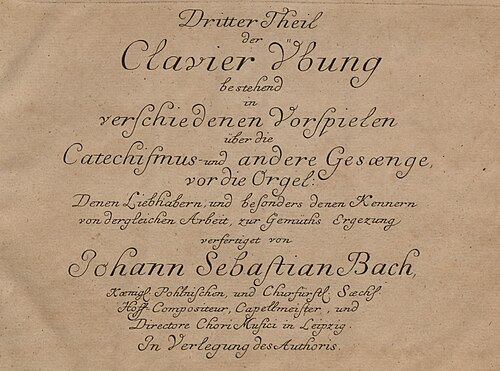
その一方で、新バッハ版(Neue Bach-Ausgabe、略称NBA)が出版され、[ 12 ] [ 13 ]バッハの作品を参照するための新しいシステムが提供されました。例えば、 BWV 552については、 NBA IV/4: 2, 105は、シリーズIV、第4 巻、p. 2(前奏曲)と p. 105(フーガ)を意味します。
NBAレブ
NBAが2007年に完成してから数年後、出版社のベーレンライターは再びバッハ・アーカイブと提携し、バッハの楽譜の改訂版を出版した。これらの改訂版は、NBA版(形式、レイアウト)に準拠しているが、その出版物群とは別物として、「ヨハン・セバスチャン・バッハ:全作品の新版 – 改訂版」(Johann Sebastian Bach: Neue Ausgabe sämtlicher Werke – Revidierte Edition)、略して「新バッハ版 – 改訂版」(Neue Bach-Ausgabe – Revidierte Edition)、略してNBArevという名称で出版された。オリジナルのNBA版はドイツ語のみであったが、改訂版シリーズの各巻にはドイツ語と英語の両方の序文が付いている。その第1巻であるNBArev 1は、2010年に出版されたロ短調ミサ曲の新版である。 [ 14 ]
紀元前
バッハの声楽曲を網羅したカタログであるバッハ・コンペンディウム(BC)は1985年に出版された。 [ 15 ] BWV番号のない作品でも、BC番号で識別できる場合がある。例えば、 「 Der Gerechte kömmt um 」はBC C 8で、これは様式的にバッハの作品とされているが、BWVには記載されていない。[ 16 ]
ベルリン国立図書館(Staatsbibliothek zu Berlin = SBB)は、バッハに関連する重要な作曲写本のコレクションを所蔵しています。作品のいくつかのバージョンは、SBBに所蔵されている主要な写本によって最もよく知られています。たとえば、BWV 525a = SBB St 345、またはバッハデジタルウェブサイトで使用されている略語に従ってDB Mus. ms. Bach St 345 です。
バッハの作品を作曲年代順に一覧化することは、包括的に行うことはできません。多くの作品において、作曲された時期は非常に広範囲に及ぶからです。バッハの大規模な声楽曲(カンタータ、受難曲など)については、研究によって多かれ少なかれ一般的に受け入れられている年代順がいくつか確立されており、これらの作品のほとんどを網羅しています。この意味でのカタログとしては、フィリップ(とジェラール)ツヴァングによるカンタータBWV 1~215および248~249に年代順の番号を付与したリストが挙げられます。[ 18 ]このリストは1982年にパリで『Guide pratique des cantates de Bach』として出版されました(ISBN 100、1982年)。2-221-00749-22005年に改訂版が出版されました(ISBN2747598888)
BWV 217–224: Cantatas with various issues (lost, incomplete, spurious, doubtful)
Additionally Anh. I of the first edition of the BWV started with a list of some 20 lost cantatas, while Anh. III of that edition listed a few cantata (movements) by other composers (Anh. 156–158).
BWV2a added many more lost cantatas (BWV Anh. 190–199 and 209–212) and alternative versions to known works indicating (partially) lost cantatas or cantata versions, e.g. BWV 244a, the music of which was partially preserved in the St Matthew Passion, BWV 244.
BWV 1084 – O hilf, Christe, Gottes Sohn (chorale from Bach's Leipzig versions of the St Mark Passion attributed to Keiser), included in Chapter 5 in BWV2a
BWV 1085 – O Lamm Gottes, unschuldig (chorale prelude), included in Chapter 7 in BWV2a
BWV 1086 – Canon Concordia discors, included in Chapter 12 in BWV2a
BWV 1089 – Da Jesus an dem Kreutze stund (four-part chorale), included in Chapter 5 in BWV2a
BWV 1090–1120 – 31 chorale preludes for organ from the Neumeister Collection, discovered in 1985 in the archives of the Yale University library; Included in Chapter 7 in BWV2a, except for BWV 1096, attributed to Johann Pachelbel,[271][272] which was moved to Anh. III (spurious works).
BWV 1121, previously Anh. 205 – Fantasie in C minor (organ), included in Chapter 7 in BWV2a
BWV 1122–1126 – five four-part chorales,[273] moved to Chapter 5 in BWV2a
Additions to the Anhang (BWV Anh. 190–213)
BWV Anh. 190–213 were added between the 1950 and 1990s editions of the catalogue
BWV Anh. 190–197 – Cantatas added to Anh. I (music lost); see also List of Bach cantatas
BWV Anh. 198 – Abandoned sketch of a cantata opening, renumbered to BWV 149/1a and added to Chapter 1 in BWV2a
BWV Anh. 71, renumbered to BWV 1128: chorale fantasia for organ "Wo Gott der Herr nicht bei uns hält" (BWV Anh. II 71 was authenticated as a composition by Bach after Wilhelm Rust's 1877 copy was recovered in March 2008)[274][105]
There is not much system in the way works derived from Bach's compositions are listed. The "R" addition to the BWV number is only well-established for the reconstructions included in NBA VII/7 (e.g. solo violin reconstructions of BWV 565 are not usually indicated as BWV 565R, neither is the system used for reconstructed vocal works). For some series of transcriptions and arrangements works catalogues of these transcribers/arrangers may hold sublists with works derived from compositions by Bach.
Each reconstructed concerto is created after the harpsichord concerto for the presumed original instrument. Such reconstructions are commonly referred to as, for example, BWV 1052R (where the R stands for 'reconstructed'). Other reconstructions and completions of for instance BWV 1059 have been indicated as BWV 1059,[275] or BWV 1059a.[276]
Adaptations
Transcriptions and arrangements in the catalogues of works by other composers include:
↑Johann Sebastian Bach: New Edition of the Complete Works – Revised Edition at the Bärenreiter website.
↑Hans-Joachim Schulze and Christoph Wolff. Bach Compendium: Analytisch-bibliographisches Repertorium der Werke Johann Sebastian Bachs, Vol. 1 (Part 1–4). Leipzig 1985ff.
↑"Der Gerechte kömmt um ... BWV deest (BC C 8)". Bach Digital. Leipzig: Bach Archive; et al. 25 May 2019.
↑Kirsten Beißwenger (1992). Johann Sebastian Bachs Notenbibliothek. Kassel: Bärenreiter. ISBN3-7618-1036-9
↑Johann Sebastian Bach: Correspondance Catalogues Zwang — Schmeider at www.musiqueorguequebec.ca
↑Leaver, Robin A., ed. (2016). The Routledge Research Companion to Johann Sebastian Bach. Taylor & Francis. pp.153–154. ISBN9781315452807.
↑Pietrzak, Ewa (2014). "Schlesier in den deutschen Sprachgesellschaften des 17. Jahrhunderts"[Silesians in the German-speaking communities of the 17th century]. In Garber, Klaus; Wismann, Heinz; Siebers, Winfried (eds.). Europäische Sozietätsbewegung und demokratische Tradition: Die europäischen Akademien der Frühen Neuzeit zwischen Frührenaissance und Spätaufklärung. Frühe Neuzeit (in German). Vol.26–27. Walter de Gruyter. p.1296. ISBN9783110963243.
↑Philipp Spitta. Musikgeschichtliche Aufsätze. Berlin (1894), 117f
↑Talbot, Michael (2011). The Vivaldi Compendium. Boydell Press. p.54. ISBN9781843836704.
↑Johann Sebastian Bach: Concerti nach Vivaldi u.a. – III at www.crescendo-music.com
↑Johann Sebastian Bach, edited by Hermann Scherchen, preface by Charles van den Borren. Facsimile of BR Bruxelles II. 4805, appendix in Musica viva, Vol. III. Brussels (1936)
12Johann Sebastian Bach, edited by E. Capriani. "Documenti storici" in Opere per Liuto, Vol. III. Rovereto (1977)
↑Artzt. "The third Lute Suite by Bach: Three Manuscripts and their Implications" in Journal of the Lute Society of America (1968), pp. 9ff
↑Grossman. "Der Intavolator als Interpret: Johann Sebastian Bachs Lautensuite g-moll, BWV 995, im Autograph und in zeitgenössischer Tabulatur" in Basler Jahrbuch (1986), pp. 223–244
↑Johann Sebastian Bach with an introduction by Hiroshi Hoshino. "The Manuscript Copy of J.S. Bach's Prelude, Fugue and Allegro for Lute or Harpsichord, E-flat major (BWV 998), in the Possession of Ueno Gakuen" (contains facsimile of Prelude pour la Luth. ò Cembal. par J.S. Bach.) in Fs for Ueno Gakuen. Tokyo (1974), pp. 171ff
↑Dombois. "The Allegro from J.S. Bachs Prelude, Fugue and Allegro in E-flat major" in Lute Society Journal (1972), pp. 25ff, 51ff
↑Johann Mattheson. Der vollkommene Capellmeister. Hamburg (1739), p. 412
↑Lorenz Christoph Mizler. Neu eröffnete musikalische Bibliothek Vol. III. Leipzig (1747), p. 482ff
↑Friedrich Wilhelm Marpurg. Abhandlung von der Fuge nach den Grundsätzen und Exemplen der besten deutschen und ausländischen Meister entworfen ... Vol. 2. Berlin (1754), TAB XXXIII, Fig. 2–3
↑Neumann/Schulze, Dok I, Nr. 158; Dok II, Nr. 325, 564
↑C. L. Hilgenfeldt. Johann Sebastian Bach's Leben, Wirken und Werke: ein Beitrag zur Kunstgeschichte des achtzehnten Jahrhunderts. Leipzig: Friedrich Hofmeister (1850), p. 212
↑Texte / Zur Leipziger / Kirchen-Music, / Auf den andern, dritten, vierdten Sonntage / nach der Erscheinung Christi, / Das Fest Mariä Reinigung, / Und die Sonntage / Septuagesimae, Sexagesimae, / Esto mihi, / Ingleichen / Auf das Fest / der Verkündigung Mariä. Leipzig: Immanuel Tietzen (1724)
↑Christine Blanken. "A Cantata-Text Cycle of 1728 from Nuremberg: a Preliminary Report on a Discovery relating to J. S. Bach's so-called 'Third Annual Cantata Cycle'", pp. 9–30 in Understanding Bach, Vol.10, 2015
12Picander (=Christian Friedrich Henrici). Ernst-Schertzhaffte und Satyrische Gedichte, Volume III. Leipzig: Joh. Theod. Boetii Tochter (1732); 2nd printing 1737
↑Nützliche Nachrichten Von Denen Bemühen derer Gelehrten und andern Begebenheiten in Leipzig (in German). Leipzig: Johann Christian Langenheim. 1740. pp.82ff.
↑Als die / von / E. Hoch=Edlen / und / Hoch=Weisen Rathe / der Stadt Leipzig / neugebauete und eingerichtete / Schule zu S. Thomae / den 5. Jun. durch etliche Reden eingeweyhet wurde, / ward folgende / CANTATA / dabey verfertiget und aufgeführet / von / Joh. Sebastian Bach, / Fürstl. Sächs. Weissfels. Capellmeister, und besagter Schulen Cantore / und / M. Johann Heinrich Winckler, / Collega IV Leipzig: Bernhard Christoph Breitkopf (1732)
↑D-B Mus. ms. 1160Archived 4 March 2016 at the Wayback Machine at www.bachdigital.de
↑Kirsten Beißwenger (ed.) Werke zweifelhafter Echtheit, Bearbeitungen fremder Kompositionen (Volume 9 of Series II: Masses, Passions, Oratorios from the New Bach Edition). Bärenreiter, 2000.
Bach, Carl Philipp Emanuel; Agricola, Johann Friedrich (1754). "VI. Denkmal dreyer verstorbenen Mitglieder der Societät der musikalischen Wissenschafften; C. Der dritte und letzte ist der im Orgelspielen Weltberühmte HochEdle Herr Johann Sebastian Bach, Königlich-Pohlnischer und Churfürstlich Sächsicher Hofcompositeur, und Musikdirector in Leipzig"[Bach's Nekrolog]. In Mizler, Lorenz Christoph (ed.). Musikalische Bibliothek[Musical Library] (in German). Vol.IV/1. Leipzig: Mizlerischer Bücherverlag. pp.158–176.
Beißwenger, Kirsten (1991). "Bachs Eingriffe in Werke fremder Komponisten: Beobachtungen an den Notenhandschriften aus seiner Bibliothek unter besonderer Berücksichtigung der lateinischen Kirchenmusik"[Bach's editing of works by other composers: observations regarding the musical manuscripts from his library, with a particular focus on Latin church music]. In Schulze, Hans-Joachim; Wolff, Christoph (eds.). Bach-Jahrbuch 1991[Bach Yearbook 1991]. Bach-Jahrbuch (in German). Vol.77. Neue Bachgesellschaft. Berlin: Evangelische Verlagsanstalt. pp.127–158. doi:10.13141/bjb.v1991. ISBN3-374-01104-7. ISSN0084-7682.
Beißwenger, Kirsten (1992). Johann Sebastian Bachs Notenbibliothek[Johann Sebastian Bach's musical library]. Catalogus musicus (in German). Vol.XIII. Bärenreiter. ISBN9783761810361. OCLC680040660.
Blanken, Christine (2019). "Das neue Bach-Werke-Verzeichnis: Das revidierte BWV enthält Neuerkenntnisse aus 15 Jahren Bachforschung"[The new Bach-Works-Catalogue: the revised BWV contains new data from fifteen years of Bach research]. www.bach-leipzig.de (in German). Leipzig: Bach Archive. Retrieved 18 December 2019. Der inzwischen durch zahlreiche Verschiebungen unübersichtlich gewordene Anhang wird ebenfalls komplett überarbeitet (transl.: The Anhang, which in the meanwhile has become confusing because of many changes, will also be completely reworked)
Blaut, Stephan; Schulze, Hans-Joachim (2008). ""Wo Gott der Herr nicht bei uns hält" BWV 1128 - Quellenkundliche und stilistische Überlegungen"[Wo Gott der Herr nicht bei uns hält, BWV 1128: source-related and stylistic considerations]. In Wollny, Peter (ed.). Bach-Jahrbuch 2008[Bach Yearbook 2008]. Bach-Jahrbuch (in German). Vol.94. Neue Bachgesellschaft. Leipzig: Evangelische Verlagsanstalt. pp.11–32. doi:10.13141/bjb.v2008. ISBN978-3-374-02668-5. ISSN0084-7682– via Qucosa.
Dadelsen, Georg von (1957). Bemerkungen zur Handschrift Johann Sebastian Bachs, seiner Familie und seines Kreises[Remarks regarding the handwriting of Johann Sebastian Bach, his family and his circle]. Tübinger Bach-Studien (in German). Vol.I. Trossingen: Hohner. OCLC642403437.
Dirksen, Pieter[in Dutch], ed. (2010). Sonatas / Trios / Concertos (in German and English). Vol.5. Breitkopf & Härtel. EB8805. Series: Johann Sebastian Bach: Complete Organ Works – Urtext
Dirksen, Pieter[in Dutch], ed. (2016). Fantasias • Fugues (in German and English). Vol.3. Breitkopf & Härtel. EB8803. Series: Johann Sebastian Bach: Complete Organ Works – Urtext
Dürr, Alfred, ed. (1987). Eight Short Preludes and Fugues BWV 553–560: formerly ascribed to Johann Sebastian Bach (in German and English). Kassel: Bärenreiter. ISMN9790006480098. BA6497.
Dürr, Alfred; Kobayashi, Yoshitake, eds. (1998). Bach Werke Verzeichnis: Kleine Ausgabe – Nach der von Wolfgang Schmieder vorgelegten 2. Ausgabe[Bach Works Catalogue: Small Edition – After Wolfgang Schmieder's 2nd edition] (in German). Kirsten Beißwenger (collaborator). (BWV2aed.). Wiesbaden: Breitkopf & Härtel. ISBN9783765102493. Preface in English and German.
Eppstein, Hans[in German] (1966). Studien über J.S. Bachs Sonaten für ein Melodieinstrument und obligates Cembalo[Studies on J.S. Bach's Sonatas for a melody instrument and harpsichord obligato]. Studia musicologica Upsaliensia (in German). Vol.2. Uppsala: Almqvist & Wiksell.
Forkel, Johann Nikolaus; Terry, Charles Sanford (1920). Johann Sebastian Bach: His Life, Art and Work – translated from the German, with notes and appendices. New York: Harcourt, Brace and Howe.
Henning, Uta (1987). "Zur Frage des Lautenklaviers bei Johann Sebastian Bach: Mögliche Zuweisung der Bachschen Lautenkompositionen an das Lautenklavier – Beschreibung des Instruments und Rekonstruktionsversuche im 20. Jahrhundert". In Berke, Dietrich; Hanemann, Dorothee (eds.). Alte Musik als ästhetische Gegenwart: Bach, Händel, Schütz. Bericht über den internationalen musikwissenschaftlichen Kongreß Stuttgart 1985 (in German). Vol.2. Bärenreiter. pp.465–469. ISBN3-7618-0767-8– via Qucosa.
Hoffmann, Balthasar (1738). "IX. Bey der Lob- und Trauerrede auf die verwitwete Herzoginn von Merseb. Hedwig, im Jahre 1735". In Gottsched, Johann Christoph (ed.). Der Deutschen Gesellschaft in Leipzig Oden und Cantaten in vier Büchern (in German). Vol.I. Leipzig: Bernhard Christoph Breitkopf. pp.143–146.
Hofmann, Klaus (1983). "Zur Echtheit der Motette „Jauchzet dem Herrn, alle Welt" BWV Anh. 160". In Rehm, Wolfgang (ed.). Bachiana et alia musicologica: Festschrift Alfred Dürr zum 65. Geburtstag am 3. Marz 1983 (in German). Bärenreiter. pp.126–140. ISBN3761806833.
Hofmann, Klaus (1999). "Ein verschollenes Kammermusikwerk Johann Sebastian Bachs: Zur Fassungsgeschichte der Orgelsonate Es-Dur (BWV 525) und der Sonate A-Dur für Flöte und Cembalo (BWV 1032)"[A lost chamber music work by Johann Sebastian Bach: On the genesis of the organ sonata in E-flat major (BWV 525) and the sonata in A major for flute and harpsichord (BWV 1032)]. In Schulze, Hans-Joachim; Wolff, Christoph (eds.). Bach-Jahrbuch 1999[Bach Yearbook 1999]. Bach-Jahrbuch (in German). Vol.85. Neue Bachgesellschaft, Bach Archive. Leipzig: Evangelische Verlagsanstalt. pp.67–79. doi:10.13141/bjb.v1999. ISBN3-374-01763-0. ISSN0084-7682.
Koska, Bernd (2011). "Bach oder Dobenecker? Zur Frage der Autorschaft von BWV Anh. 85 und 101"[Bach or Dobenecker? On the authorship question of BWV Anh. 85 and 101]. In Wollny, Peter (ed.). Bach-Jahrbuch 2011[Bach Yearbook 2011]. Bach-Jahrbuch (in German). Vol.97. Neue Bachgesellschaft. Leipzig: Evangelische Verlagsanstalt. pp.259–263. doi:10.13141/bjb.v2011. ISBN978-3-374-02986-0. ISSN0084-7682.
Kretzschmar, Hermann (1910). "Das Notenbuch der Zeumerin" [The notebook of the Zeumerin]. Jahrbuch der Musikbibliothek Peters für 1909[Yearbook of the musiclibrary Peters for 1909]. Jahrbuch der Musikbibliothek Peters (in German). Vol.16. Musikbibliothek Peters. Leipzig: C. F. Peters. pp.57–72.
Kuznik, Joel H. (December 2008). "BWV 1128: A recently discovered Bach organ work"(PDF). The Diapason. 99 (22): 22–23.HTML version (without illustrations)
Landmann, Arno (1907). "Angeblich von J.S. Bach komponierte Oden von Chr.H. von Hoffmannswaldau"[Likely by J.S. Bach composed odes of Chr.H. von Hoffmannswaldau]. In Schering, Arnold (ed.). Bach-Jahrbuch 1907[Bach Yearbook 1907]. Bach-Jahrbuch (in German). Vol.4. Neue Bachgesellschaft. Breitkopf & Härtel. pp.79–88. doi:10.13141/bjb.v1907.
Meiningen 1704: Sonn- und Fest-Andachten Uber die ordentlichen Evangelia Aus gewissen Biblischen Texten Alten und Neuen Testaments Und In der Hoch-Fürstl. Sachs. Meining. Hof-Capell Der Heil. Dreyfaltigkeit Deroselben zu Ehren abgesungen (in German). Meiningen. 1704.
Neemann, Hans[at Wikidata] (1931). "J. S. Bachs Lautenkompositionen"[J. S. Bach's lute compositions]. In Schering, Arnold (ed.). Bach-Jahrbuch 1931[Bach-Yearbook 1931]. Bach-Jahrbuch (in German). Vol.28. Leipzig: Breitkopf & Härtel. pp.72–87. doi:10.13141/bjb.v1931– via Qucosa.
Perreault, Jean M. (2004). Fitch, Donna K. (ed.). The Thematic Catalogue of the Musical Works of Johann Pachelbel. Lanham, Maryland: Scarecrow Press. ISBN0-8108-4970-4.
Pfau, Marc-Roderich (2008). "Ein unbekanntes Leipziger Kantatentextheft aus dem Jahr 1735: Neues zum Thema Bach und Stölzel"[An unknown Leipzig cantata text publication from the year 1735: News regarding Bach and Stölzel]. In Wollny, Peter (ed.). Bach-Jahrbuch 2008[Bach Yearbook 2008]. Bach-Jahrbuch (in German). Vol.94. Neue Bachgesellschaft. Leipzig: Evangelische Verlagsanstalt. pp.99–122. doi:10.13141/bjb.v2008. ISBN978-3-374-02668-5. ISSN0084-7682.
Schicht, Johann Gottfried, ed. (1805). Messa a 8 voci reali e 4 ripiene coll'accompagnamento di due Orchestre, composta da Giov. Sebast. Bach: Partitura, copiata dalla partitura autografa dell' Autore[Mass in eight real voices and four additional voices, accompanied by two Orchestras, composed by Joh. Sebast. Bach: Score, copied from the autograph score of the Author] (in Italian and Latin). Leipzig: Breitkopf & Härtel. Harvard Digital Collections.
Schmieder, Wolfgang, ed. (1950). Thematisch-systematisches Verzeichnis der musikalischen Werke von Johann Sebastian Bach: Bach-Werke-Verzeichnis[Thematic-Systematic Catalogue of the Musical Works of Johann Sebastian Bach: Bach-Works-Catalogue] (in German) (BWV1ed.). Leipzig: Breitkopf & Härtel. OCLC963027464. Unaltered up unto its eighth printing in 1986.
Schmieder, Wolfgang, ed. (1990). Thematisch-systematisches Verzeichnis der musikalischen Werke von Johann Sebastian Bach: Bach-Werke-Verzeichnis – 2. überarbeitete und erweiterte Ausgabe[Thematic-Systematic Catalogue of the Musical Works of Johann Sebastian Bach: Bach-Works-Catalogue – 2nd reworked and enlarged edition] (in German) (BWV2ed.). Wiesbaden: Breitkopf & Härtel. ISBN9783765102554.
Schulenberg, David[in French], ed. (2013). Preludes and FuguesI (in German and English). Vol.1. Breitkopf & Härtel. EB8801. Series: Johann Sebastian Bach: Complete Organ Works – Urtext
Schulze, Hans-Joachim (1980). "Ein 'Dresdner Menuett' im zweiten Klavierbüchlein der Anna Magdalena Bach: Nebst Hinweisen zur Überlieferung einiger Kammermusikwerke Bachs"[A Minuet from Dresden in the second keyboard booklet of Anna Magdalena Bach: Further, indications regarding the transmission of some of Bach's chamber music compositions]. In Schulze, Hans-Joachim; Wolff, Christoph (eds.). Bach-Jahrbuch 1979[Bach Yearbook 1979]. Bach-Jahrbuch (in German). Vol.65. Neue Bachgesellschaft. Berlin: Evangelische Verlagsanstalt. pp.45–64. doi:10.13141/bjb.v1979.
Schulze, Hans-Joachim (1984). Studien zur Bach-Überlieferung im 18. Jahrhundert[Studies of the Bach-transmission in the 18th century] (in German). Peters. ISBN3-87626-095-7. EP9346.
Spitta, Philipp (1894). "Sperontes' Singende Muse an der Pleisse: Zur Geschichte des deutschen Hausgesanges im achtzehnten Jahrhundert"[Sperontes's Singende Muse an der Pleisse: On the history of German singing-at-home in the 18th century]. Musikgeschichtliche Aufsätze[Essays on music history] (in German). Berlin: Paetel. pp.175ff.
Thielemann, Arne (2012). "Zur Identifizierung des Magnificats BWV Anh. 30 aus Johann Sebastian Bachs Notenbibliothek"[On the identification of the Magnificat BWVAnh.30 from Johann Sebastian Bach's music library]. In Wollny, Peter (ed.). Bach-Jahrbuch 2012[Bach Yearbook 2012]. Bach-Jahrbuch (in German). Vol.98. Neue Bachgesellschaft. Leipzig: Evangelische Verlagsanstalt. pp.217–224. doi:10.13141/bjb.v2012. ISBN978-3-374-02668-5. ISSN0084-7682.
Tittel, Karl (1966). "Welche unter J.S. Bachs Namen geführten Orgelwerke sind Johann Tobias bzw. Johann Ludwig Krebs zuzuschreiben? Ein Versuch zur Lösung von Autorschaftsproblemen"[Which of the organ works for which J.S. Bach has been named as author can be ascribed to Johann Tobias or Johann Ludwig Krebs? An attempt to resolve authorship issues]. In Dürr, Alfred; Neumann, Werner (eds.). Bach-Jahrbuch 1966[Bach Yearbook 1966]. Bach-Jahrbuch (in German). Vol.52. Neue Bachgesellschaft. Berlin: Evangelische Verlagsanstalt. pp.102–137. doi:10.13141/bjb.v1966.
Torri, Pietro (2013). Thielemann, Arne (ed.). Magnificat in C: BWV Anh. 30. Stuttgarter Bach-Ausgaben. Vol.Full score. Bach, Johann Sebastian (arranger); Horn, Paul (basso continuo realization). Stuttgart: Carus. 35.012.
"US-NHub Music Deposit 31 (Klavierbüchlein für W. F. Bach)". Bach Digital. Leipzig: Bach Archive; et al. 3 March 2020.
Wollny, Peter (2015). "Vom „apparat der auserleßensten kirchen Stücke" zum „Vorrath an Musicalien, von J. S. Bach und andern berühmten Musicis": Quellenkundliche Ermittlungen zur frühen Thüringer Bach-Überlieferung und zu einigen Weimarer Schülern und Kollegen Bachs". Bach-Jahrbuch 2015[Bach Yearbook 2015]. Bach-Jahrbuch (in German). Vol.101. Neue Bachgesellschaft. Leipzig: Evangelische Verlagsanstalt. ISBN978-3-374-04320-0. ISSN0084-7682.
Wright, Craig (2000). "Bachs Kleines harmonisches Labyrinth (BWV 591): Echtheitsfragen und theologischer Hintergrund"[Bach's Little Harmonical Labyrinth (BWV 591): Authenticity issues and theological background]. In Schulze, Hans-Joachim; Wolff, Christoph (eds.). Bach-Jahrbuch 2000[Bach Yearbook 2000]. Bach-Jahrbuch (in German). Vol.86. Translated by Steinwachs, Barbara. Neue Bachgesellschaft. Leipzig: Evangelische Verlagsanstalt. pp.51–65. doi:10.13141/bjb.v2000. ISBN3-374-01828-9. ISSN0084-7682.
Basso, Alberto. Frau Musika: La vita e le opere di J. S. Bach. Turin, EDT (in Italian):
Vol. 1 (1979): Le origini familiari, l'ambiente luterano, gli anni giovanili, Weimar e Köthen (1685–1723).ISBN88-7063-011-0
Vol. 2 (1983): Lipsia e le opere de la maturità (1723–1750).ISBN88-7063-028-5
Papillon, André (2006). Index of Chorale Melodies in the Works of Johann Sebastian Bach. Foreword by Gilles Cantagrel. Presses de l'Université Laval. ISBN2-7637-8351-1.