
Loading article…
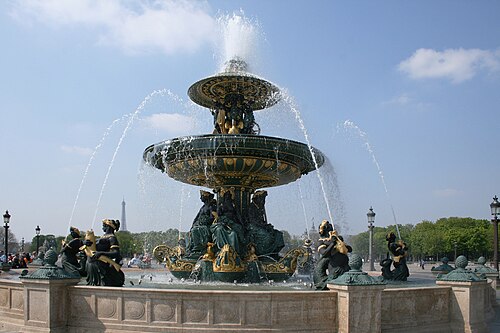
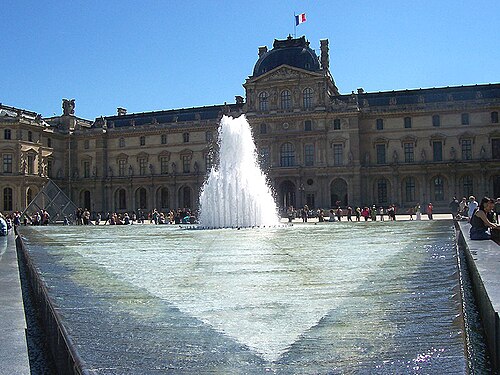
パリの噴水はもともと市民に飲料水を提供していましたが、現在では市内の広場や公園の装飾となっています。パリには200以上の噴水があり、最も古いものは16世紀に遡ります。また、ウォレスの水飲み場も100以上あります。[1]噴水のほとんどは自治体の所有物です。
2017年に文化遺産誌『ラ・トリビューン・ド・ラール』が行った調査で、これらの噴水の半分以上が機能していないことが明らかになった。[2]
パリの区別の噴水のリストについては、「パリの噴水のリスト」を参照してください。
16世紀と17世紀のパリの噴水


19 世紀半ばまでのパリの噴水の歴史は、増加する人口に清潔な飲料水を供給するための都市の奮闘の歴史でもありました。噴水の建設も重力の法則に依存しており、機械式ポンプが導入されるまでは、水が流れるためには水源が噴水よりも高くなければなりませんでした。
紀元前3世紀、元々の住民であるパリシイ族はセーヌ川から直接水を引いていました。紀元前1世紀までには、リュテティアの町のローマの技術者が重力を利用してアルクイユ の水道橋を建設し、浴場や公共の噴水に水を供給していました。
中世には、ローマ時代のアルクイユ水道橋は廃墟となり、住民は再びセーヌ川や井戸から水を得るようになった。フランス国王フィリップ2世(1180年 - 1223年)の治世までに、パリ北部の市壁の外に2つの大きな修道院が存在した。モンマルトルの麓のサン・ローラン修道院とサン・マルタン・デ・シャン修道院である。これらの修道院は2つの水道橋から真水を受け取っていた。サン・ローラン修道院はロメーヌヴィルとメニルモンタンの高地から鉛管で、サン・マルタン・デ・シャン修道院はベルヴィルの頂上から石造りの水道橋で水を引いていた。 13世紀前半、これら2つの水道橋は、中世パリで最初に記録に残る噴水であるフォンテーヌ・デ・アール、フォンテーヌ・デ・アンノサン、フォンテーヌ・ド・モービュエに水を供給するために使用されました。[3] これらの噴水は水を噴出せず、青銅製のマスケロン(通常は動物の仮面)から細い流れとなって石の水盤に絶えず流れ出し、地元住民が容器に水を汲めるようにしていました。
1498年、フランス国王ルイ12世が即位すると、パリの水道はプレヴォ・デ・マルシャン率いるパリの商人と国王の共同管理となった。彼らは水の分配方法を決定し、公共の噴水を建設する責任を負っていた。パリの水道はまだ非常に限られており、15世紀末までにパリには水を供給する噴水が17か所しかなく、そのうち5か所は城壁の外にあった。噴水はすべて右岸にあり、2つの水道橋が水を供給していた。地下水位が地表に近かったため井戸を掘るのは容易だったが、左岸は地下水位が地下深く、機能する水道橋がなかったため、ほぼすべての水をセーヌ川から運ばなければならなかった。その結果、左岸はフィリップ2世の時代からほとんど発展していなかった。[4]
17世紀初頭、フランス国王アンリ4世は、大学と、妻マリー・ド・メディシスのリュクサンブール宮殿の建設計画のために、左岸に水を引くことを決定した。1613年から1623年にかけて、ランジスから水を引くための新しい水道橋が建設された。この新しい水道橋は、現在のメディシスの噴水を含む左岸の6つの新しい噴水と、右岸の1つの噴水に水を供給した。さらに、元々の2つの水道橋を使用して、右岸に5つの新しい噴水が建設された。アンリは、フィレンツェの噴水製作者トマソ・フランチーニをパリに連れてきて、リュクサンブール公園のメディシスの噴水を設計させた。1636年、彼はオー・エ・フォンテーヌ総督となり、王室の噴水と水に関するすべてのプロジェクトを統括した。彼の子孫は1781年までこの地位にあった。[5]
アンリ4世のもう一つの大きな貢献は、1578年から1608年にかけて建設されたラ・サマリテーヌである。これはポン・ヌフの下の水車で動く巨大な水圧ポンプで、セーヌ川からサンジェルマン・ロクセロワ近くの貯水池に水を汲み上げ、ルーブル宮殿とチュイルリー庭園で使用していた。1673年にはさらに2つのポンプが追加された。ポンプと新しい水道橋のおかげで、1673年までに、推定人口50万人のパリには、水道橋から水が供給される右岸の噴水が16個、新しいアルクイユ水道橋から水が供給される左岸の噴水が14個、新しい水圧ポンプから水が供給される川の右岸と左岸に沿って21の新しい噴水があった。[4]
16 世紀と 17 世紀に建てられた噴水は、その後の 2 世紀の間にすべて再建されるか、取り壊されました。ブーシュラ噴水、アンノサンの噴水、メディチ噴水など、大規模な再建が行われた噴水は、当時の様子を今も残しているものがわずかです。
-

-

-
 フォンテーヌ・ブーシュラ、テュレンヌ通り(1695-1699)は、ルイ14世のパリ公共事業局長であったジャン・ボーシールの作品です。
 -
 1670 年頃のパリの 6 つの噴水。サン ドニ門、ドゥ ラ シャリテ、デ プティ ペール ノワールの泉 (上)。サン・ルイ・オー・マレ通り、サン・ジェルマン門、サント・オヴィド(下)。 (美術考古学図書館、パリ)
18世紀のパリの噴水

18世紀には30の新しい噴水が建設され、そのうち14が現在も残っている。また、大きな建物の中に貯水池があるシャトー・ドーが3つ建てられた。[6] これらの噴水の多くは、 1692年から1740年まで王の勅令によりパリ市の建築物管理官を務めたジャン・ボージールの作品である。彼の噴水は通常小さく、壁に沿って設置され、小さな水盤に水を注ぐ壁龕と1つの注ぎ口を備えていたが、貝殻や神話の人物像で飾られ、時には洞窟の石灰化した壁を模して自然の泉を模したものもあった。
18世紀半ば、ヴォルテールや他の批評家たちは、もっと広い広場ともっと装飾的な噴水を要求し始めた。 1749年に書かれた『パリの装飾』の中で、ヴォルテールは「趣味の良い噴水は2つしかない。そして、それらは間違いなくもっと良い場所に置かれるべきである。他の噴水はすべて村にふさわしい」と書いている。[7] 政府は、より壮大な噴水を求める声に応えて、4つの季節の噴水(1739年)を発注し、さらに壮大な噴水のある広場、ルイ15世広場(後にコンコルド広場となる)を建設した。[8]
新しい噴水があったにもかかわらず、パリでは増え続ける人口に十分な水を供給できないという問題があった。1776年、ジャック・コンスタンタンとオーギュスタン・シャルル・ペリエという2人の機械技師が、民間の水道会社ラ・コマニ・デ・ゾー・ド・パリを設立した。彼らは、料金を払える人なら誰にでも、水道管を通して直接各家庭に水を届けると約束した。彼らはロンドンをまねて、 1782年にシャイヨーに蒸気動力の送水ポンプを設置した。イギリスのバーミンガムで建設され、コンスタンティーヌとオーギュスタンと名付けられた最初のポンプは、セーヌ川から水を汲み上げてシャイヨーの丘近くの4つの貯水池に貯めた。そこから水は鉄管(これもイギリス製)を通って下り、個人の契約者や7つの新しい公共噴水に流れていった。 1786年、最初のポンプが成功した後、オルセー河岸とグロ・カイユ川沿いにルイーズとテレーズという2台の新しいエンジンが追加され、1788年から高さ35メートル(115フィート)の塔に水を汲み上げ、パイプを通ってアンヴァリッド、エコール・ミリテール、フォーブール・サンジェルマン地区に流しました。
民間水道会社の設立は、取締役の一人で水道会社から富を得た劇作家ピエール・ボーマルシェ(『フィガロの結婚』の作者)を含む会社支持者と、ミラボー伯爵率いる水運び組合(仕事が危ぶまれていた)を含む反対者との間で激しい政治闘争を引き起こした。1788年の財政危機の後、会社は倒産し王室財務省の手に渡ったが、その技術的な成功は証明され、1807年にはパリにあった85の噴水のうち45に会社の蒸気ポンプから水が供給されていた。[9]
-
![パラティーヌの噴水、ガランシエール通り、6区。1715年にバイエルン公女アンヌ・アンリエットによって建てられた。1913年に彼女の家が取り壊された後、同じ場所に噴水が再建された。[10]](https://img-server.japedia.wiki/wikipedia/commons/thumb/c/c6/Garanci%C3%A8re04.JPG/500px-Garanci%C3%A8re04.JPG) パラティーヌの噴水、ガランシエール通り、6区。 1715年にバイエルン公女アンヌ・アンリエットによって建てられた。 1913年に彼女の家が取り壊された後、同じ場所に噴水が再建された。[10]
パラティーヌの噴水、ガランシエール通り、6区。 1715年にバイエルン公女アンヌ・アンリエットによって建てられた。 1913年に彼女の家が取り壊された後、同じ場所に噴水が再建された。[10] -
![クロワ・デュ・トラホワール城、アルブル・セック通りとサン・オノレ通りの角(1 区) 17 世紀の噴水の跡地に、ジャック・ジェルマン・スフロによって 1775 年に現在の形で再建されました。パリのパンテオンの建築家。[11]](https://img-server.japedia.wiki/wikipedia/commons/thumb/a/a7/Fontaine_du_Trahoir_detail.jpg/500px-Fontaine_du_Trahoir_detail.jpg) クロワ・デュ・トラホワール城、アルブル・セック通りとサン・オノレ通り(1 区)の角 17 世紀の噴水の跡地に、ジャック・ジェルマン・スフロによって 1775 年に現在の形で再建されました。パリのパンテオンの建築家。[11]
クロワ・デュ・トラホワール城、アルブル・セック通りとサン・オノレ通り(1 区)の角 17 世紀の噴水の跡地に、ジャック・ジェルマン・スフロによって 1775 年に現在の形で再建されました。パリのパンテオンの建築家。[11] -
 サンジェルマンデプレ修道院の噴水(1714-1717) は、ヴィクトール=ティエリー・シュリーとジャン・ボージールによってサンジェルマンデプレ教会の近くに建てられました。元々はキルデベール通りとサンマルグリット通りに位置していました。19 世紀にサンジェルマン大通りのスペースを空けるために移動され、現在は 5 区のランジュヴァン広場にあり、旧エコール・ポリテクニークの壁に隣接しています。
 -
 4区のサン・マルタン通りとヴニーズ通りの角にあるモビュエの噴水( 1733年) 。建築家はジャン・ボーシール。
パリの領事館と第一帝政の噴水(1799-1815)

記念碑的な噴水の建設はフランス革命によって中断され、ルイ15世広場は革命広場と改名され、噴水が建設される予定だった場所の近くにギロチンが設置された。 1799年以降、水の供給と噴水の建設は、新しい第一統領ナポレオン・ボナパルトにとって最大の関心事となった。[12]
ナポレオンは内務大臣のジャン=アントワーヌ・シャプタルに、パリのために何ができる最も有益なことかを尋ねたところ、シャプタルは「水を与えよ」と答えた。[13] 1802年、ナポレオンは市外の川から水を引く最初の運河、ウルク運河の建設を命じた。この運河は、ナポレオンの精力的な橋梁・道路主任技師で、上下水道局長でもあったピエール・シモン・ジラールによって建設された。ジラールはエジプト遠征でナポレオンの軍務に同行していた。ジラールの壮大なプロジェクトには、サン=ドニ運河(1821年完成)、ウルク運河(1822年完成)、サン=マルタン運河(1825年完成)があり、飲用噴水と装飾噴水の両方に十分な水を運んだ。[14]
技術者たちがパリに水を引くための運河を建設している間、ナポレオンは噴水に目を向けた。1806年5月2日に出された法令で、彼は「パリのために何か偉大で役に立つことをしたい」と述べ、15の新しい噴水を建設することを提案した。また、ファトルセゾンの噴水やメディチの噴水など、荒廃していた多くの古い噴水の清掃、修理、再建を命じた。彼の技術者たちは、パリの大きな屋外市場に新しい噴水を建設し、街中に数百のボルヌ・フォンテーヌ(水道栓の付いた単純な石のブロック)を設置した。1812年、彼は噴水からの水の配給は無料とし、飲料水投機を行う者は厳しく罰せられるという法令を出した。[13]
ナポレオンが建設した 15 の記念碑的な噴水の多くは、パリ市の水道サービスの主任技師であり、シャイヨ、グロ・カイヨー、ラ・サマリテーヌの大型送水ポンプの設計にも携わった同じ建築家、フランソワ・ジャン・ブラルによって設計されました。
運河が完成する前に建てられたナポレオンの初期の噴水は規模が小さく、伝統的なマスケロンまたは注ぎ口から注がれる水の量も限られていました。ヴォージュ広場やシャトー・ドーの噴水など、ナポレオンが後世に作った噴水は主に飲料水として使われたわけではなく、水が空中に噴き上がり、マスケロンから下の水盤に流れ落ちるものでした。これらはパリで最初の真に装飾的な噴水でした。[15]
- アンヴァリッド広場の噴水。この噴水はナポレオン統治下で最初に完成した噴水のひとつで、ヴェネツィアのサン・マルコ寺院の有翼のライオンを展示するために建てられました。このライオンはナポレオンが1797年に戦利品としてパリに持ち帰ったものです。この噴水はシンプルな石の台座で、噴水の上には有翼のライオンの像があり、噴水から水が噴き出す小さな青銅のライオンの頭が4つ乗っていました。ライオンは1815年のナポレオン敗北後にヴェネツィアに返還され、噴水は1840年にようやく撤去されました。
- フォンテーヌ・デゼー。ドーフィーヌ広場にあるこの噴水は、1800年のマレンゴの戦いで戦死したフランス軍の将軍ルイ・デゼーを称えて造られた。円筒形の台座の上にはトーガとヘルメットをかぶった女性像「ラ・フランス・ミリテール」が置かれ、台座の周りの噴出口から水が流れ出ている。1875年に広場が拡張された際に取り壊され、デゼーの故郷であるリオン市に移され、現在もそこに建っている。[16]
- パルミエの噴水(1808)シャトレ広場にあるこの噴水は、ローマ帝国時代に現存する最大の噴水で、ナポレオンの勝利の名前と浅浮彫が刻まれたローマの凱旋門を模して建てられ、頂上には勝利の女神像がある。この名前は、像の真下にあるヤシの葉の装飾に由来する。柱の土台には、慎重さ、用心深さ、正義、強さを表す 4 つの人物像が飾られている。1856 年にセバストポル通りが建設されたとき、この噴水は移動され、G. ダビウが設計した 4 つのスフィンクスと水盤で飾られた新しい台座に置かれました。[16]
- 平和の噴水 (1807 年) は、もともとサン シュルピス広場にあり、その後サン ジェルマン通りに移され、現在は近くのアレー デュ セミネールにあります。四角い水盤の中にある新古典主義の記念碑で、科学、芸術、平和、商業、農業などを表す寓意的な人物像があります。この像は 1937 年に現在の場所に移されました。
- フェラの噴水(1806年)は、セーヴル通り52番地にある不治の病院の壁に沿って建てられ、ブラルがエジプトの神殿に似せて設計したもので、ローマ皇帝ハドリアヌスの寵愛を受けたアンティノウスがエジプトの衣装を着て2つの水差しから水を注いでいる像がある。ナポレオンのエジプト遠征を記念して設計されたもので、像の上には帝国の鷲が描かれている。
*パレ・デ・ザールの噴水(1809年~1810年)。彫刻家アントワーヌ・ヴォードワイエが制作した鋳鉄製のライオン4体が、パレ・デ・ボザールの正面の別々の台座に置かれ、口から2つの水盤に水を噴き出していました。噴水は1865年に機能しなくなり、ライオンはブローニュ=ビヤンクールの広場に移され、現在もそこで見ることができます。
- マルスの噴水。この噴水は今もサン・ドマンク通りの元々の場所に残っており、軍病院の近くにある。彫刻家ピエール・ボーヴァレットによる戦争の神マルスと健康、清潔、衛生の女神ヒュギエイアの浅浮彫で飾られているが、像が軍病院の近くにあったため一緒に置かれている。[17]
- レダの噴水。レダと白鳥を描き、白鳥のくちばしから水が流れ出るこの噴水は、彫刻家アシル・ヴァロワの作品です。もともとはルガール通りとヴォージラール通りの角にありました。1856年にリュクサンブール公園に移され、メディチ家の噴水とつながっています。
- ボンディ大通りのシャトー・ドー(1812年)。この噴水は、ポンソーの噴水やヴォージュ広場の噴水とともに、水そのものが装飾の主要素であり、彫刻や建築は従属的なものとなったパリ初の噴水であった。[18] これらはすべて、技師ピエール・シモン・ジラールによって設計された。シャトー・ドーは、円柱の上に上下に2つの円形のバスク(石の水盤)が設けられ、水が水盤からあふれて下にあるより大きな円形の水盤に落ちる、パリ初の記念碑的噴水であった。このデザインの噴水は、ローマ庭園やルネッサンス期のローマ、エクスアンプロヴァンスでは小規模に存在していたが、パリにはなく、これほど大規模なものもなかった。中央の噴水に加えて、鋳鉄製のライオンが下の水盤に水を噴出していた。この噴水は斬新で規模が大きいため、パリっ子の散歩コースとして人気がありました。噴水は 1867 年に移設され、現在はラ・ヴィレットのレ・アール市場があった場所の、かつてのアールの前にあります。
- ヴォージュ広場(1811年)。ヴォージュ広場の中央にジラール設計の新しい噴水が建てられた。この噴水は、シャトー・ドーと並んでパリで最初の噴水の一つで、水差しや水差しに水を入れる蛇口がなかった。噴水には八角形の水盤があり、水が上向きに噴き出して水盤に飛び散った。ジラール設計のオリジナルは1824年に撤去され、1830年頃にジャン=フランソワ・メナジェ設計の新しい噴水に置き換えられた。[19]
- 象の噴水。ナポレオンの噴水の中で最も壮大な噴水は、1811年にバスティーユのあった空き地に建設が開始された。巨大なブロンズ象の形をした噴水の建設が始まり、象の背中には展望台があり、象の内部にある階段から登ることができた。水盤と象の実物大の石膏像が作られたが、 1815年のワーテルローの戦いでナポレオンが敗北した後、工事は中止された。象の像は1848年まで撤去されなかった。 [20]
-
 アンヴァリッドの噴水( 1800-1804) は、ホテル・デ・ザンヴァリッドの広場にあり、ヴェネツィアのサン・マルコ大聖堂の有翼のライオンを展示するために建てられました。1815 年以降、ライオン像は返還され、噴水は 1840 年に撤去されました。(フランス国立図書館、版画コレクション)
 -
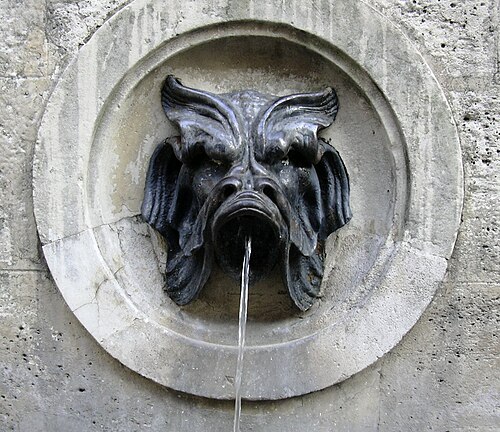 7 区サン ドミニク通りのフォンテーヌ デュ グロ カイユの仮面、またはフォンテーヌ ド マルス (1806 年)。フランソワ=ジャン・ブラール、建築家、ピエール・ニコラ・ボーヴァレ、彫刻家。
 -
 Fontaine de la Paix, Allée du Seminaire, 6th arrondissement, (1806-1810). Originally in Place Saint-Sulpice, then in the marché Saint-Germain. Detournelle, architect, Caraffe, Voinier, Jean-Joseph Espercieux and Marquois, sculptors.
 -
 The Fontaine du Fellah (1806), on the rue de Sèvres, was inspired by Napoleon's Egyptian campaign.
 -
 The Fontaine de Léda, (1806–1809), originally at rue Vaugirard and rue du Regard, since 1858 hidden behind the Medici Fountain in the Jardin du Luxembourg. Louis-Simon Bralle, architect, Achille Valois, sculptor.
 -
 The Fountain of the Chateau d'Eau, (1809-1812), Pierre-Simon Girard, architect. originally at the corner of rue de Bondy and Boulevard Saint-Martin, now in Parc de la villette, 19th arrondissement.
 -
 The Fontaine de l'elephant in the Place de Bastille. The fountain was begun in 1811 but never finished. A full-scale plaster model of the elephant stood in the Square until 1848. A guardian and his family lived inside one of the feet to protect the monument.

Paris Fountains of the Restoration and the Reign of Louis-Philippe (1816–1848)

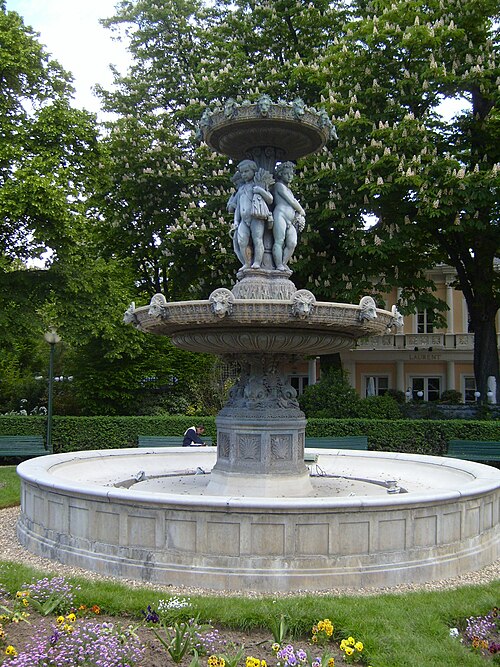
From the fall of Napoleon in 1815 to the coming to power of Louis Philippe in 1830, as France went through the Restoration of the old monarchy, few new fountains were built, and they were of modest size and artistic ambitions. Between 1813 and 1819 a new market, the marché des Blancs-Manteaux, was constructed by the rue des Hospitaliers. The fountain in the meat market was adorned with bronze spouts in the shape of bull's heads by the sculptor Edme Gaulle. The market was demolished in 1910 but the heads still remain, now attached to the wall of an ecole maternelle.[21]
Place des Vosges (1830). The original fountain by Pierre Simon Girard in the Place des Vosges (renamed la place Royale during the Restoration) was replaced in 1830 by the current four fountains, designed by Jean-François-Julien Ménager, a student of Vaudoyer, winner of the prix de Rome, and architect of the City of Paris. The new fountains are made of volcanic stone from Volvic in the Auvergne, and have two circular vasques one above the other, with lions' heads spouting water into the circular basin.
The Fontaine de Gaillon (1828) on the rue d'Antin (2nd arronidissement) was the first major fountain by Louis Visconti, which replaced an earlier fountain by Beausire. Visconti later became famous as the architect of the tomb of Napoleon in the Invalides. The fountain has two vasques, decorated with a young triton armed with a trident and a horse on a dolphin, and an inscription in Latin: "for the utility and ornament of the city."[22]
In July 1830 the absolute monarchy of Charles X was overthrown and replaced by the constitutional monarchy of Louis-Philippe. The new government, like earlier ones, faced the problem of a rapidly growing population in Paris, whose need for water was far greater than Napoleon's canal de l'Ourq could supply. Public fountains caused congestion in the narrow streets; carriage and wagon drivers watered their horses in the fountains; water porters fought with local residents for access to the water taps; the fountains in markets were used to wash vegetables and fruits and to clean the streets. A cholera epidemic in 1832 made it evident that Paris needed better water and better sanitation.[23]
The new Préfet of the Seine, Rambuteau, ordered the construction of two hundred kilometers of new water pipes and the installation of 1700 borne-fontaines, the simple blocks with water taps introduced by Napoleon. Thanks to these new fountains, which supplied drinking water to the population, the city's architects had the freedom to design new monumental fountains that were purely ornamental in the city's squares.
Fontaines de la Concorde. (1836–1840) The two fountains in the Place de la Concorde are the most famous of the fountains built during the time of Louis-Philippe, and came to symbolize the fountains of Paris. They were designed by Jacques-Ignace Hittorff, a student of the neoclassical sculptor Charles Percier at the École des Beaux-Arts, who had served as the official Architect of Festivals and Ceremonies for the deposed King, and had spent two years studying the architecture and fountains of Italy.
Hittorff's two fountains are both on maritime themes, because of their proximity to the Ministry of Navy on the Place de la Concorde, and to the Seine. Their arrangement, on a north–south axis aligned with the obelisque of Luxor, and the Rue Royale; and the form of the fountains themselves, were strongly influenced by the fountains of Rome, particularly Piazza Navona and the square of St. Peters.
Both fountains have the same form: a stone basin; six figures of tritons or naiades holding fish spouting water; six seated allegorical figures, their feet on the prows of ships, supporting the piedouche, or pedestal, of the circular vasque; four statues of different forms of genius, arts or crafts supporting the upper inverted upper vasque; whose water shoots up and then cascades down to the lower vasque and then the basin.
The north fountain is devoted to the Rivers, with allegorical figures representing the Rhone and the Rhine, the arts of the harvesting of flowers and fruits, harvesting and grape growing; and the geniuses of river navigation, industry, and agriculture.
The south fountain, closer to the Seine, represents the seas, with figures representing the Atlantic and the Mediterranean; harvesting coral; harvesting fish; collecting shellfish; collecting pearls; and the geniuses of astronomy, navigation and commerce.[24]
Fontaines des Champs-Élysées. (1839–1840). Having finished the fontaines de la Concorde, Hittorff built four additional fountains in the squares on the Champs-Élysées between the Place de la Concorde and the Arc de Triomphe, which had just been finished in 1836. The lower part of each fountain is the same; a circular basin, a pedestal with seashell ornamentation; a vasque supported by dolphins and ornamented with palm leaves; and (on three of the four) lion heads spouting water.
The upper part of each fountain was different;
Carré des Ambassadeurs - a Venus brushing her hair, surrounded by roses and flowing water. (sculptor: Francique-Joseph Duret.) Carré le Doyen - statue of Diana with roses. (Sculptor: Louis Desprez) Fontaine de Cirque (north side): Four children, representing the four seasons, with a second vasque decorated with the heads of lions and wild boars. (Sculptor: Jean-Auguste Barre). Fontaine de l'Elysée (north side). A simple single vasque with cascading water.
The Fontaine Louvois (1839), by architect Louis Visconti, was built in the new Place Louvois, on the site of the old opera house. The lower vasque is decorated with signs of the zodiac and masks of the seasons; four female figures representing the rivers Seine, Loire, Garonne and Saône surround the column supporting the upper vasque. The figures and vasques were made of cast iron, painted to look like bronze.
Fontaine Cuvier (1840–1846). Dedicated to Georges Cuvier (1769–1832), the naturalist, pioneer of paleontology and comparative anatomy. This fountain is located near the Jardin des Plantes and the museum of natural history, where Cuvier had worked. The statue is placed against a wall, with a low basin, water pouring from the heads of reptiles, and a band of human and animal heads. Above that is an allegorical figure of a seated woman representing Natural History, surrounded by numerous animals, and holding a tablet with Cuvier's motto: "Rerum cognoscere causas." ("to know the causes of things.") Naturalists pointed out that the crocodile in the group of statues of is turning its head, something that crocodiles are unable to do.[25]
Visconti, who later became famous as the designer of the tomb of Napoleon in the Invalides, designed two other fountains of this new type, commemorating famous Parisians and located in places associated with them.
Fontaine Molière. (1841–44). This fountain by Visconti, located at the corner of rue Traversière and rue Richelieu, was originally going to be a simple Renaissance fountain with a state of a nymph, but Régnier, the head of the Comédie Française, proposed that it be instead a monument to the playwright Molière, since the fountain was near the original site of the Comédie Française and the home of Molière. A public subscription raised money for the fountain. The bronze statue of Molière is by Bernard-Gabriel Seurre, and the two allegorical figures at the base of the fountain, representing Light Comedy and Serious Comedy, are by James Pradier.
Fontaine Saint-Sulpice, (1843–1848), by Louis Visconti was designed to represent the idea of religious elequence, since it was located on Place Saint-Sulpice, near the famous theological seminary of St. Sulpice. It honored four famous religious orators of the 17th century; Bossuet, Fénelon, Fléchier, and Massillon.
Fontaine de l'Archevêche (1843–1845), by Alphonse Vigoureux, located on the present day square Jean XXIII, is a neo-Gothic structure built where the archbishop's palace once stood. The lower part of the fountain shows three archangels defeating the allegorical figure of heresy, while the spire contains a statue of the Virgin and child.
Several more modest fountains from the time of Louis-Philippe still exist:
- Fontaine Place Jean-Baptiste Clément', (1835), in Montmartre, is a wall fountain with a niche decorated with seashell pattern, and a bronze vase with water flowing from a lion's head.
- Fontaine Charlemagne, rue Charlemagne, (1835), built against the wall of presbytere of the Church of St. Paul. In the niche, decorated with aquatic plants and animals, is a vasque of cast iron supported by dolphins, with a statue of a child holding a seashell over his head.
- Fontaine Saint-Louis, rue de Tourenne. (1846). Similar to Fontaine Charlemagne, with vasque in the form of a seashell and a figure in zinc representing the Ourq River. The coat of arms of Paris is carved on the upper part of the fountain. The sculptor is Boitel, a pupil of James Pradier and David d'Angers.
- Fontaine de la Roquette, rue de la Roquette, (1846), an arcade with a triangular fronton, decorated with the arms of Paris, dolphins, and fruit, floral patterns and lion heads. Inside the niche are two benches and a mascaron from which water still flows, though the fountain is closed with a gate.[26]
-
 Bronze bull's head, a spout of the meat market fountain of Paris's marché des Blanc-Manteaux, by sculptor Edme Gaulle (1819)
 -
![Fontaine Cuvier, Corner of rue Cuvier and rue Linné, 5th arrondissement (1840-1846), Alphonse Vigouroux, architect and Jean-Jacques Feuchère and René Jules Pomateau, sculptors.[27]](https://img-server.japedia.wiki/wikipedia/commons/thumb/9/91/FontaineCuvier04.jpg/500px-FontaineCuvier04.jpg) Fontaine Cuvier, Corner of rue Cuvier and rue Linné, 5th arrondissement (1840-1846), Alphonse Vigouroux, architect and Jean-Jacques Feuchère and René Jules Pomateau, sculptors.[27]
Fontaine Cuvier, Corner of rue Cuvier and rue Linné, 5th arrondissement (1840-1846), Alphonse Vigouroux, architect and Jean-Jacques Feuchère and René Jules Pomateau, sculptors.[27] -
 Fontaine Molière, 37 rue de Richelieu (1st arrondissement), (1841-1844), Louis Visconti, architect and Bernard-Gabriel Seurre and James Pradier, sculptors.
 -
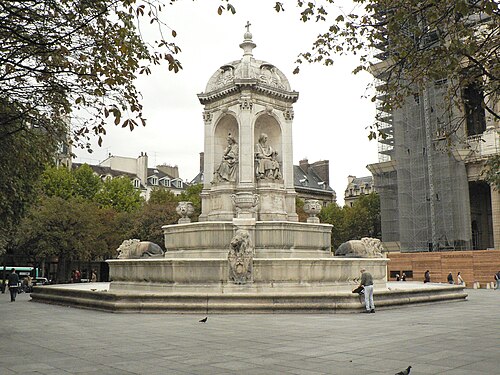 Fontaine de Saint-Sulpice, Place Saint-Sulpice, (1843-1848), Louis Visconti, architect.
Paris Fountains of Louis-Napoleon and the second Empire (1848-1870)

The reign of Louis-Philippe ended abruptly with the Revolution of 1848, and the establishment of the Second Republic, under Louis Napoleon, which became, by a coup d'état in 1851, the Second Empire. After an epidemic of cholera in 1849, one of Louis Napoleon's highest priorities became improving the quality of the water of Paris. At the time Paris had about sixty fountains supplying drinking water for the population, and a dozen fountains which were purely ornamental.[28] Under his new préfet of the Seine, Baron Haussmann, and his new chief of the waters of Paris, Belgrand, the Paris water system was reconstructed so that water from springs, brought by aqueducts, was used exclusively for drinking water, while less healthy river water was used for washing the streets, watering gardens and parks, and for fountains.
During the Second Empire, as Baron Haussmann launched his reconstruction campaign, famous old fountains were relocated and rebuilt. In 1858 the Fontaine des Innocents was moved to a new, lower pedestal in the middle of the square, and six basins of flowing water were added on each side., In 1864, to make room for the new boulevard des Medicis, the orangerie behind the Medici Fountain was demolished, the fountain was moved to a new location in the Jardin du Luxembourg, statues were added, the fountain of Leda and the Swan, built during the first Empire, was moved to a place behind it, and a long basin built in front of it. The modest original fountain in the Rond-Point of the Champs-Élysées, built under Louis-Philippe, with just two vasques, was replaced by a larger fountain with six vasques cascading water.
Most of the new monumental fountains built during the reign of Louis Napoleon were the work of a single architect, Gabriel Davioud. Davioud studied sculpture at the École des Beaux-Arts, then became architect of the service de promenades et plantations of the prefecture of the Seine. He was responsible for the design of many of the squares, gates, benches, pavilions, and other decorative architecture of the Second Empire. His principal basins and fountains were:
- Fontaines Boulevard Richard-Lenoir. (1862.) When part of the canal St. Martin was covered by the Boulevard Richard Lenoir, Davioud built a long series of fifteen small basins and fountains to aerate the water. Each fountain had a spray of water coming from a bouquet of roses made of cast iron. The fountains were rebuilt in a more modern, less picturesque style in the 20th century.
- Fontaine Place Edmond-Rostand. Davioud built the basin and fountain first, in 1862. In 1884, the statue by Crauk of a triton and a naiade, holding a large seashell spraying water. was added to the fountain.
- Fontaine de la place Pigalle. (1862-63.) The fountain has a circular basin, an octagonal pedestal and a fluted column supporting a single vasque. It was used by residents as a basin place to dump trash, to wash fish, and to do laundry. Today the fountain and place have been renovated.
- Fontaine Square des Arts-et-Metiers (now called Square Emile-Chatemps) (1861). The fountain is composed of an oblong basin with semi-circular ends, in which are placed allegorical statues related to arts and professions, since the fountain was next to the conservatory of arts and metiers. On one side are two statues by Ottin, who also did the statues in the Medici Fountain; a statue of Mercury, holding a scale, an anchor, and a horn of plenty; and Music, wearing a laurel wreath, holding a lyre and a torch. On the other end of the fountain are two statues by Gumery; Agriculture, holding sheaves of wheat, and Work, holding a hammer. Between the two groups is a single vasque fountain with a spray of water and water pouring from the heads of lions.
- Fontaine place de la Madeleine (1865). (one now located in square Santiago-du-Chili, the other to place François Iier). Davioud built two fountains in front of the Madeleine church, each with a circular marble basin, a pedestal with four griffins, supporting a column with a single vasque decorated with lion heads spouting water. From the vasque rises a column decorated with rings and faces of women. In 1902 both fountains were moved to different parts of Paris to make room for a statue of philosopher and politician Jules Simon.
- Fontaine Saint-Michel (1860) is the best-known fountain of Davioud. Built as part of Baron Haussmann's grand project for the reconstruction of Paris, it was intended be the chief ornament of the enlarged Place Pont-Saint-Michel created by the new boulevard Sebastopol-rive gauche, now Boulevard Saint-Michel). Davioud originally wanted a free-standing fountain with a statue of a woman representing peace, but he was required to make a wall fountain hiding the wall of a building at the corner of boulevard Saint-Michel and Saint-André des Arts. His new design featured a structure like a triumphal arch with a statue of Napoleon Bonaparte, but this aroused opposition by the opponents of Louis Napoleon, so it was changed to a statue of the Archangel Michael wrestling with the devil. Nine sculptors worked on the different figures in the composition. It was the last monumental fountain in Paris built against a wall, a style that had been borrowed from Italy and used in the Medici Fountain and the Fontaine des Quatre-Saisons. Later fountains would be free-standing, in the center of squares or parks.[29]
Paris Fountains of the Third Republic (1870-1900)

Louis Napoleon was captured by the Germans at the disastrous battle of Sedan in 1870 and lost his title. After the occupation of Paris by the Germans and the brief rule of the Paris Commune, the Third French Republic was born. Davioud remained as the chief architect of fountains for the city. His first task was to repair the damage caused to the fountains by the German siege of Paris and the fighting during the suppression of the Paris Commune, which had destroyed the Tuilieries Palace and the Hotel de Ville.
Davioud was able to complete two monumental fountains begun under the Second Empire.
- The Fontaine de l'Observatoire, with sculpture by Jean-Baptiste Carpeaux. This fountain had been proposed in 1866 as part of the creation of the new grand avenue du Luxembourg, a project which called the creation of two new squares, with ornamental lamps and columns, statues, and a fountain. Carpeaux had made the sculptures of La Danse on the facade of the Paris Opera; these had caused a scandal because of the free expression of the sculpture and the unrestrained emotions on the faces of the statues, much different from the calm expressions of neo-classical statues.
Davioud instructed Carpeaux not to block he view of the Luxembourg Palace or the Paris Observatory, but otherwise he had freedom to design what he wanted. He proposed four figures representing the four corners of the world, holding aloft a celestial sphere, and trying to turn it. The sculptor LeGrain was commissioned to make the sphere, and the sculptor Emmanuel Frémier made the horses in the basin around the statue.
Work on the fountain was stopped because of the war in 1870, but resumed in 1872, and it was dedicated in 1874.
- Fontaine du Triomphe de la République, Place de la Nation, (1899). In 1879, the place Château d'Eau was renamed place de la République, and a competition was held for a monument in the center. The architect François-Charles Morice and his sculptor brother Leopold won the competition, but a project by another sculptor, Aimé-Jules Dalou, won the most public favor. Dalou had participated in the Paris Commune uprising in 1871 and had been sentenced to forced labor for life, then exiled to London. He designed a twelve-meter high group of allegorical statues: at the base is the Chariot of the Nation was drawn by two lions, led by the Spirit of Liberty and surrounded by figures representing Law, Work, Justice, Peace, and the Spirit of Instruction. A terrestrial globe supports the figure of the Republique, a woman in classical costume, wearing a liberty cap and holding the fasces, the Roman symbol of the law.[30]
The Prefecture instructed Davioud to replace the old fountain of the Place du Trône with the Dalou's monument in the renamed Place de la Nation. The statues were cast in bronze, A basin was rebuilt, and the fountain opened in 1899. Later, in 1908, six bronze amphibian animals spouting water sculpted by Georges Gardet were added to the basin.
The bronze statues of the amphibians were taken by the Germans during World War II and disappeared. The basin was removed in the 1960 to make way for the RER regional railway station, but the statues, without basin or water, are still there.[31]
- Fontaines place André Malraux (formerly Place du Théatre-Française.) (1874).
-
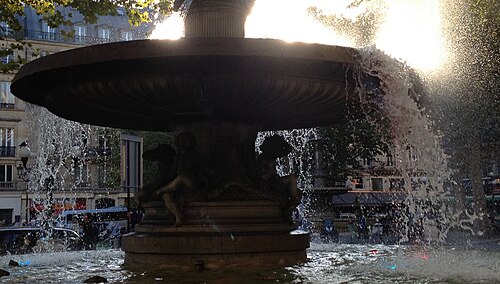 One of the generous fountains of Place André Malraux.
 -
 The easternmost fountain, topped with Nymph fluviale ('Nymph of the river'), an 1874 work by Mathurin Moreau (1822-1912).
 -
 Place André Malraux showing the two fountains.

,_Paris,_France.jpg/500px-Place_Andr%C3%A9_Malraux_(View_north_towards_Op%C3%A9ra),_Paris,_France.jpg)
Davioud built this fountain in the new place, created in 1867, which marked the beginning of the new avenue de l'Opéra, which connected the city's most famous theater with the opera house. The project was begun in 1867, but was interrupted by the war and not finished until 1874.
According to Davioud's plan, two fountains were built. Each has a circular stone basin; a base of gray marble with four seated children in bronze; a bronze vasque; a piédouche, or column, of white marble with medallions with the seal of city, and water spouting from the top; and, at the top of the Piedouche, a river nymph at the top of the fountain nearest the theater, and a sea nymph at the top of the second fountain. The sea nymph sculpture is by Albert-Ernest Carrier-Belleuse and the four children at the base by Louis-Adolphe Eude; the river nymph was made by Mathurin Moreau, and the four children at the base by Charles Gauthier.[32]
- Wallace fountain. In 1872 a British millionaire, temperance advocate and philanthropist, Sir Richard Wallace, who had spent much of his youth in Paris and had lived there during the 1870 war, recognizing the difficulty and cost of finding drinking water in Paris after the 1870 war, and following a program he had already begun in London, donated fifty cast-iron drinking fountains to the city of Paris. The sculptor of the fountains was Charles-Auguste Lebourg, a student of François Rude. He designed two models, one free-standing and the other to be attached to a wall, and in 1881, added a third, simpler version. The fountains were a popular success, and new ones were still being installed until the beginning of the First World War.[33]
-
 Triomphe de la Republique (1899), by Jules Dalou, in Place de la Nation. (1899) The basin was demolished in the 1960s to make room for the RER, but the statues from the fountain are still there.
 -
 Fontaine Place André Malraux, formerly place du Théâtre Français, (1867-1874), Gabriel Davioud, architect.
 -
 A Wallace fountain, Pont Neuf, (1872), one of 66 such cast-iron fountains placed around Paris by British industrialist and temperance activist Sir Richard Wallace.
Paris Exposition Fountains (1855-1937)


Eight universal expositions took place in Paris between 1855 and 1937, and each included fountains, both for decoration and for sale, which demonstrated the latest in technology and artistic styles. They introduced illuminated fountains, fountains which performed with music, fountains made of glass and concrete, and modern abstract fountains to Paris.
The first such exposition, organized in 1855 by Louis Napoleon in response to the huge success of the Universal Exposition in London in 1851, displayed cast-iron fountains, on the model of the Fontaine to Louvois of Visconti, which could be purchased by any town or city.[34]
- The Exposition Universelle of 1867 took place in the Champs-de-Mars and across the river at the Trocadero. For the Exposition, Baron Haussmann created a large basin, filled with water pumped by the Seine, to be used for fountains. Artificial rocks and grottos were built in the Champs-de-Mars, with cascading water, ponds and streams. Two monumental fountains were also built, at each end of the Pont d'Iéna, which was the ceremonial entrance of the exhibit. The most spectacular fountain in the exhibit was a crystal fountain, 7.3 meters high, with two vasques 3.1 meters in diameter, made by the firm of Baccarat. Only drawings remain of the crystal fountain.
- The Exposition Universelle of 1878. For this exposition, the first held during the new Third Republic, a château d'eau with a grotto, upper basin and fountains, a series of cascades, and a lower basin with fountains were built on the slopes of Chaillot, at the foot of the Palais du Trocadero, at the present site of the fountains of the Trocadero. The basins were surrounded by six gilded cast iron sculptures of animals representing the six continents. (These statues are now located on the parvis of the Musée d'Orsay.).[35]
- The Exposition Universelle of 1889 celebrated the 100th anniversary of the French Revolution. Its most memorable feature was the Eiffel Tower, and it took place, like the previous exhibit, on the Champs-de-Mars and the Trocadero. A highlight of the exposition was a fountain illuminated by electric lights shining up though the columns of water, a method first developed in England in 1884. The fountains, located in a basin forty meters in diameter, were given color by plates of colored glass inserted over the lamps. The Fountain of Progress gave its show three times each evening, for twenty minutes, with a series of different colors. The system was primitive; it could only illuminate the water up to a height of four meters - but the effect was new and dramatic and extremely popular.[36]
- The Exposition Universelle of 1900 was held both at the Champs-de-Mars and next to the Champs-Élysées, where a Grand and Petit Palais were constructed. One of its most popular features was the Temple of Electricity, near the Champs-Élysées, which had a series of illuminated fountains in front, with lamps shining blue, white and red light. The innovation of 1900 was a keyboard which allowed a rapid series of different colors. But by 1900 electricity was no longer a novelty, and the lighted fountains did not have the same effect that they did in 1889. It was agreed by critics that something new was needed for the 20th century fountain.[37]
- The Exposition Internationale of 1925. This exhibit introduced the first fountains made of modern materials and in the modernist aret styles of the 20th century. The fountain by sculptor Gabriel Guevrekian was composed of four triangular basins, colored blue or red, and a fountain of glass in the center, surrounded by triangles of grass and flowers. It was the first fountain in Paris composed like a cubist painting.
The most original fountain in the exposition was Les Sources et les Rivieres of France, made by René Lalique. It was a column of glass five meters high, made up of 128 caryatids of glass, each with a different decoration and size, each spraying a thin stream of water into the fountain below. At night the column was illuminated from within, and could change color. It was placed on a cross of concrete covered with decorated plates of glass, and in an octagonal basin also decorated with colored and black tiles of glass.[38]
- 'Colonial Exposition of 1931. This exhibit, designed to showcase France's overseas empire, was held in the eastern part of Paris, at the edge of the Bois de Vincennes, and it expressed two themes; the exoticism of France's distant colonies, and the modernism of France. New technologies shown at the exhibit included neon lights, indirect lighting of building facades (tested on Notre Dame Cathedral, the Place de la Concorde, and the Arc de Triomphe,) and eight monumental modern illuminated fountains.
- The cactus was a metal structure 17 meters high and 16 meters in diameter, with a dozen long branches reaching from the top the ground. Water poured from the top down the branches, and jetted out from the branches to the basin below. The whole structure was illuminated with white light.
- The Théâtre d'eau, or water theater, located on one side of the lake, covering an arc of a circle of about 80 meters, created a performance of dancing water, forming changing bouquets, arches, and curtains of water from its jets and nozzles. It was the ancestor of the modern musical fountain.
- The pont d'eau was made by jets of water from both sides of Lake Daumesnil, which formed an illuminated water "bridge" forty meters long and six meters wide. This was the first fountain made entirely of water, with no architectural element; the ancestor of the Jet d'eau in Lake Geneva, created twenty years later.[39]
- The Exposition Internationale of 1937, the last exhibit of its kind, was held at the Trocadero and the Champs-de-Mars, and once again the fountains were the highlight. Water jets were placed on both sides of the Seine, with a range of 25 meters, and 174 other fountains placed under the surface of the river. The choreography of the fountains was combined with light, and, for the first time, with music, amplified from eleven rafts with loudspeakers in the river. The music featured compositions by the leading modern composers of the period, including Igor Stravinsky, Darius Milhaud, and Arthur Honegger.
The cascades, fountains and basins of the Trocadero, built for the 1878 exposition, were completely rebuilt for the 1937 exposition. Two monumental statues, Apollon by Henri Bouchard and Hercule by Albert Pommier, were placed on the esplendade above the fountains. The main feature was a long basin, or water mirror, with twelve fountain creating columns of water 12 meters high; twenty four smaller fountains four meters high; and ten arches of water. At one end, facing the Seine, were twenty powerful water cannon, able to project a jet of water fifty meters. Above the long basin were two smaller basins, linked with the lower basin by casades flanked by 32 sprays of water four meter high, in vasques. These fountains are the only exposition fountains which still exist today, and still function as they did.
The exhibit also featured two more unusual fountains; a fountain in the Spanish pavilion by Alexander Calder, the Fontaine de Mercure, where a small metal structure created a flow of mercury, and a fountain of wine, imitating one once created for Louis XIV at Versailles.
-
 The Chateau d'eau and plaza of the Paris Universal Exposition of 1900, which stood near today's Grand Palais. The fountains were illuminated with different colors at night, but by 1900 electricity was no longer a novelty.
 -
 The monumental fountain 'Cactus' from the 1931 Paris Colonial Exposition was 17 meters high, with water descending through twelve branches which each spouted water.

Paris Fountains (1900–1945)
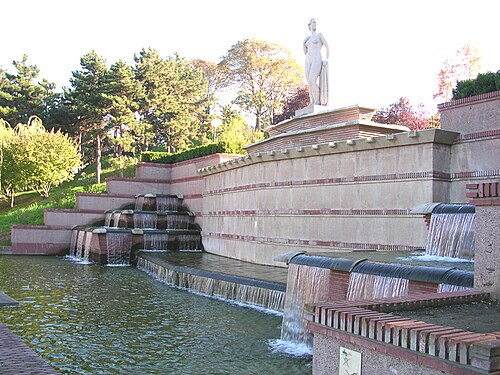

Paris fountains in the 20th century no longer had to supply drinking water - they were purely decorative; and, since their water usually came from the river and not from the city adqueducts, their water was no longer drinkable. Twenty-eight new fountains were built in Paris between 1900 and 1940; nine new fountains between 1900 and 1910; four between 1920 and 1930; and fifteen between 1930 and 1940.[40]
The removal of the ring of fortifications around Paris created space for many new parks and squares. Most of the new fountains were located in parks and other green spaces, and most were modest in scale.
The biggest fountains of the period were those built for the International Expositions of 1900, 1925 and 1937, and for the Colonial Exposition of 1931. Of those, only the fountains from the 1937 exposition at the Palais de Chaillot still exist. (See section above on Exposition fountains.)
The form of the classic Paris fountain of the 19th century, with a single or double circular vasque, nearly vanished during the 20th century. replaced by a wide variety of styles and new materials. They ranged from neo-classical styles to a glass fountain made by René Lalique for the Rond-Point des Champs-Élysées (no longer existing). Several fountains were created to showcase statues made for other purposes, such as the statue "France brings peace and prosperity to the colonies", by sculptor Leon Drivier, originally atop the Palace of Colonies of the 1931 Colonial Exposition, which, after the exhibit closed, was moved to be the centerpiece of a new fountain, the Fontaine de Madeline, in place Eduouard Renard.
The subject matter of the new fountains also varied widely: there is a fountain honoring composer Claude Debussy (The Fontaine Debussy, Place Debussy, 1932); a fountain honoring the engineer who discovered the first artesian well in Paris (The Fontaine George Mulot, on the location of the first artesian well on Rue Grenelle): a fountain for writer Leo Tolstoy; ; a fountain honoring Emile Lavassor, the driver who won first Paris-Bordeaux automobile race in 1895; (Fontaine Lavassor, Porte Maillot; and two fountains in the 16th arrondissement devoted to love; the Fontaine des Amours in the Bagatelle garden (1919) and the Fountain de l'Amour, l'Eveil a la vie. (the awakening of life) in Place de la Porte d'Auteil.[41]
The notable fountains of the pre-war period include, in chronological order:
- Fontaine Levassor, Porte Maillot, 16th arrondissement ((1907). Jules Daulou and Lefevre, sculptors. The fountain honors émile Levassor, the winner of the 1895 Paris to Bordeaux automobile race, and is the only fountain in Paris with a bas-relief of an automobile.
- Fontaine des Amours de Bagatelle, Parc-de-Batagelle, 16th arrondissement, (1919). Raymond Sudre, sculptor.
- The Chateau d'eau in Place Jean-Baptiste-Clemente at the foot of the butte of Montmartre, 18th arrondissement (1932.) Paul Gasq, sculptor.
- The Fontaine Debussy, in Square Debussy. 16th arrondissement (1932), by sculptors Jan and Joel Martel, and Jean Burkhalter, architect.
- Fontaine Tolstoi, Square Leon Tolstoi, 16th arrondissement (1934). Cassou, sculptor.
- Fontaine de la Porte Dorée, Place Edouard-Renard, 12th arrondissement (1935). Sculpture by Leon Drivier, Louis Madeline, architect. The fountain was built to showcase the statue, France the Colonizer, which had stood at the entrance of the Paris Colonial Exposition of 1931.
- Fontaine Steinlen, Square Constantin-Pecquier, 18th arrondissement (1936). Paul Vannier, sculptor.
- The Fontaines de la Porte de Saint-Cloud, Place Port de Saint-Cloud, 16th arrondissement (1936). Paul Landowski, sculptor, and Robert Pommier and Jacques Billiard, architects. The monumental fountains were made to fill a vast square created in 1926 for a tramway and railway station and meeting point of seven avenues, where the old gates and fortifications of the city had been. The central features were two cylindrical columns, fifteen meters high, spouting water and covered with bas-reliefs, and illuminated at night, designed to serve as a symbolic entrance to the city. Their creator, the sculptor Paul Landowski, wrote, "these are the first fountains in Paris in which the effects of light, architecture and sculpture were joined from the very beginning."[42]
- Fontaines de Trocadéro and Fontaines de Varsovie on the Esplenade and in the gardens of the Palais de Trocadéro, (1937), built for the 1937 International Exposition. (see Exposition Fountains above.) The pumping room under the fountain basin was renovated between 2010 and 2011, and the fountain fully functions as it previously did.
- L'Accueil de Paris, Femme au Bain in Square de la Butte-du-Chapeau-Rouge, 19th arrondissement (1938.) The architect was Léon Azéma, city architect, who created a series of new squares and parks where the old city fortifications had been. The sculpture, by Raymond Couvegnes, had been featured at the 1937 International Exposition.
Paris fountains (1945-2000)


Only a handful of fountains were built in Paris between 1940 and 1980. The most important ones built during that period were on the edges of the city, on the west, just outside the city limits, at La Defense, and to the east at the Bois de Vincennes.
Between 1981 and 1995, during the terms of President François Mitterrand and Culture Minister Jack Lang, and of Mitterrand's bitter political rival, Paris Mayor Jacques Chirac (Mayor from 1977 until 1995), the city experienced a program of monumental fountain building that exceeded that of Napoleon Bonaparte or Louis Philippe. More than one hundred fountains were built in Paris in the 1980s and 1990s, mostly in the neighbourhoods outside the centre of Paris, where there had been few fountains before.[43] The Fountain Cristaux by Jean-Yves Lechevallier in the new Front de Seine district, the Stravinsky Fountain, the Fountain of the Pyramid of the Louvre, the Buren Fountain and Les Sphérades fountain in the Palais-Royal, the Fontaine du Parc Andre-Citroen, the Polypores fountain and new fountains at Les Halles, the Jardin de Reuilly, and beside the Gare Maine-Montparnasse were all built under President Mitterrand and Mayor Chirac.
The Mitterrand-Chirac fountains had no single style or theme. Many of the fountains were designed by famous sculptors or architects, such as Jean Tinguely, I.M. Pei, Claes Oldenburg and Daniel Buren, who had radically different ideas of what a fountain should be. Some of them, like the Pyramide de Louvre fountain, had glistening sheets of water; while in the Buren Fountain in the Palais-Royal, the water was invisible, hidden under the pavement of the fountain. Some of the new fountains were designed with the help of noted landscape architects and used natural materials, such as the fountain in the Parc Floral in the Bois de Vincennes by landscape architect Daniel Collin and sculptor François Stahly. Some were solemn, and others were whimsical. Most made little effort to blend with their surroundings - they were designed to attract attention.[44]
President Mitterrand and Culture Minister Lang were closely involved in many of the projects they commissioned. Mitterrand personally selected the architect of the Louvre project, and Lang negotiated the design of the Stravinsky Fountain with the sculptors, reducing the number of colorful "nanas" by Niki de Saint-Phalle from two to one.[45]
Many of the fountains were built thanks to a change in the law for public financing of works of art, which required that one percent of the budget for the construction of a public building in Paris be devoted to artistic decoration. This law, originally passed in the 1930s, was extended in the 1980s so that the funding could be used to build art works in the squares and other public areas around the new building. The law was also amended so that the one percent applied to the Grand Projects of the Head of State, which allowed the construction of the fountains near the Pyramid of the Louvre. A special fund, called the Le Fonds de la Commande Publique de l'État, was established to fund new works by living artists. This fund paid for the Daniel Buren fountain in the courtyard of the Palais Royale, and the 'Bicyclettte ensevelie" by Claes Oldenburg and Coosje van Bruggen, and Horloges by the sculptor Arman, located in the Park of the Cite of Sciencds and Industry at La Villette.[44]
Several new parks were constructed during this period with fountains as their centrepieces. These included the Parc de Belleville (1988), the historic source of the Paris water supply since the 12th century, where a new park was built, with a flowing stream, cascades, and water stairways, along with two basins with jetting fountains; and Parc André Citroën (1992), on the banks of the Seine in the 15th arrondissement, on the site of the former automobile factory, where a series of thematic gardens were created by architects Patrick Berger, Jean-Paul Viguier and Jean-François Joddry and landscape architects Alain Provost and Gilles Clément. These different fountains shaped water into columns, mirrors and canals, decorated with modern versions of classical peristyles and nympheums.
The old produce markets of Paris, Les Halles, were the site of another new garden with fountains (1988) by architect Louis Arretche, Jean Willerval Pierre Mougin.
The Jardins de Reuilly (1992) by Pierre Colboc, were built along the Avenue Daumesnil. with water shaped into canals along the pedestrian paths, inspired by gardens in Andalusia.
A new park, the Jardin Atlantique, was built in 1994 on the concrete slab that covers the railway lines of the train station Gare Maine-Montparnasse. This included three modern fountains, the Fontaine des Humidités, the Fontaine des Miroitements, and Fontaine des Hespérides, by architects Christine Schnitzler and François Brun, along with landscape architect Michel Pena, which added water and greenery into an urban space surrounded by huge concrete buildings.
Other new fountains were highly original and personal visions of the artists who created them:
The Fontaine de l'Embacle (1984), in Place du Québec, across from the church of Saint-Germain-des-Prés, by the sculptor Daudelin and architect Alfred Gindre, represents a spring bursting through the pavement, pushing up the paving stones, and then pouring back into the earth.
The fountain called Canyoneaustrate (1988) in front of the Palais Omnisport at Bercy, by the sculptor Singer, shows a giant crevice in the earth, similar to the canyons of the American west, with water cascading down into the canyon to return to its source.
Deux Plateaux in the courtyard of the Palais-Royal by minimalist sculptor Daniel Buren, does not look like a fountain at all. A group of columns with black and white vertical stripes are arranged in a courtyard, and water flows beneath them, seen, except through a grill in the pavement, as if at the bottom of a well. It was attacked for its cost and unsuitability to a historic landmark. Lang, then the culture minister, paid no attention to the orders of the Commission des Monuments Historiques, which objected to the plan.
The largest of the new fountains is Le Creuset du temps (1988) by sculptor Shamai Haber, in the Place de Catalogne behind the Montparnasse train station. It features a gigantic disc, slightly inclined, covered with thousands of granite paving stones in concentric circles, over which water gently flows.
Paris fountains since 2000
Few new fountains have been built in Paris since 2000. The most notable is La Danse de la fontaine emergente, located on Place Augusta-Holmes, rue Paul Klee, in the 13th arrondissement. It was designed by the French-Chinese sculptor Chen Zhen, shortly before his death in 2000, and finished by his widow and collaborator Xu Min in 2008. It shows a dragon, in stainless steel, glass and plastic, emerging and submerging from the pavement of the square. Water under pressure flows through the transparent skin of the dragon.[46][47]
See also
- List of Paris fountains by arrondissement.
References
- ^ 239 existing fountains are listed in Paris et ses fontaines, de la Renaissance à nos jours, texts edited by Dominque Massounie, Pauline-Prevost-Marcilhacy and Daniel Rabreau, in the Collection Paris et son Patrimoine, Délégation à l'action artistique de la Ville de Paris, 1995. In addition, according to the official site of Eau de Paris, which maintains the fountains, there are 108 working Wallace fountains in Paris, not listed in Paris et ses fontaines, making a total of 347 fountains, not counting fountains built since 1995. Paris et ses Fontaines cites the number 365 fountains in Paris. (pg. 19).
- ^ "La grande misère des fontaines parisiennes". 14 March 2022.
- ^ P.S. Girard, Recherches sur les eaux publiques de Paris, 1812, cited in Paris en quête d'eau by Philippe Cebron de Lisle in Paris et ses Fontaines.
- ^ a b Cebron de Lisle, Paris en quête d'eau. p. 32.
- ^ Philippe Cebron De Lisle, Paris en quête d'eau, p. 34.
- ^ Christophe Morin, Le 18e siècle, Les fontaines de pierre, in Paris et ses fontaines, pg. 80.
- ^ Cited by P. Lavadan, Histoire de l'urbanism a Paris (1975), 1993, p. 304. Translation by D.R. Siefkin.
- ^ Janine Barrier, Fontaines et embellissements de Paris, in Paris et ses fontaines, pg. 125.
- ^ Philippe Cebron de Lisle, Paris en quête d'eau, p. 38.
- ^ Paris et ses Fontaines, De la Renaissance à nos jours, p. 296.
- ^ Paris et ses fontaines, p. 285.
- ^ Katia Frey, L'enterprise napoléonienne, in Paris et ses Fontaines, p. 104.
- ^ a b Chaptal, Mes Souvenirs sur Napoleon, Paris, 1893, pp. 357-58, cited in L. Beaumont-Maillet, L'eau a Paris, Paris, 1991 p. 25, and in Philippe Cebron de Lisle, "Vers l'abondance", article in Paris et ses fontaines, p. 39.
- ^ Philippe Cebron de Lisle, p. 40.
- ^ Dominique Massounie, La fontaine urbaine: le modèle Parisien, in the collection Paris et ses fontaines, pp. 160-162.
- ^ a b Katia Frey, L'enterprise napoléonienne, article in Paris et ses fontaines, p. 109.
- ^ Katia Frey, L'enterprise napoleonienne, p. 134.
- ^ Katia Frey, L'enterprise napoleonienne, p. 119.
- ^ Katia Frey, L'Enterprise napoléonienne, in Paris et ses fontaines, pp. 120
- ^ Katia Frey, L'Enterprise napoléonienne, in Paris et ses fontaines, pp. 120-21.
- ^ Beatrice LaMoitier, 1815-1830- Politique Modeste, Programmes Varieés, in Paris et ses fontaines. (pg. 167).
- ^ Beatrice Moitier, op. cit. pg. 169
- ^ Beatrice Lamoitier, L'Essor des fontaines monumentales, in Paris et ses fontaines. pg. 171.
- ^ Beatrice Lamoitier, pg. 173.
- ^ Beatrice Lamoitier, L'essor des fontaines monumentales, pg. 175.
- ^ Beatrice Lamoitier, L'essor des fontaines monumentales, in Paris et ses Fontaines, pg. 178-179.
- ^ Paris et ses fontaines, p. 292.
- ^ Beatrice LaMoitier, "Le règne de Davioud", in Paris et ses fontaines, pg. 180
- ^ Dominique Jarassé, La fontaine Saint-Michel, Le classicism controversé, Archives d'architecture moderne, 1982, number 22, pgs. 80-87.
- ^ Daniel Imbert, Jules Dalou et le Triomphe de la Republique, catalog of Exposition Quand Paris dansait avec Marianne 1879-1889, Petit Palais, 1989.
- ^ Beatrice Lamoitier, Entre innovation et tradition, in Paris et ses fontaines, pg. 187-88.
- ^ Beatrice Lamoitier, Paris et ses Fontaines, page 188
- ^ Elie Frebault, Les fontaines de sir Richard Wallace, l'Illustration, August 17, 1872, pg. 103-105. Cited in Beatrice Lamoitier, Paris et ses Fontaines, page 188
- ^ Virginie Grandval, Fontaines éphéméres, in Paris et ses fontaines, pg. 209-247
- ^ The fountains and cascades no longer exist, but a very close copy does exist, at the Palais Longchamps in Marseille.
- ^ Virginie Grandval, pg. 223.
- ^ Virginie Grandval, pg. 229
- ^ Virginie Grandval, Fontaines éphémères, pg. 233.
- ^ Virginie Granval, Fontaines éphémères, pg. 233.
- ^ Figures cited by Pauline Prevost-Marcilhacy, Doctor of the History of Art at the University of Paris IV- Sorbonne, in her essay on fountains, 1900-1940- Entre tradition et modernité, in Paris et ses fontaines, pg. 257.
- ^ Prevost-Marcilhacy, pg. 260.
- ^ cited in Pauline Prevost-Marcilhacy, 1900-1940, Entre tradition et modernité, essay in Paris et ses Fontaines, pg. 264.
- ^ André Hoffman, La création contemporaine, in Paris et ses fontaines. Pg. 266,
- ^ a b André Hoffman, La création contemporaine, in Paris et ses fontaines. Pg. 266.
- ^ Arnauld Pierre, La fontaine Stravinsky, in Paris et ses Fontaines.pg. 279.
- ^ "Fontane di design, le piu belle al mondo". Designmag (in Italian). Retrieved 31 August 2015.
- ^ "Le dragon fontaine de Chen Zhen". Paris Pépites (in French). 2 May 2014. Archived from the original on 27 September 2015. Retrieved 2 September 2015.
Bibliography
- Paris et ses fontaines, de la Renaissance à nos jours, texts assembled by Dominque Massounie, Pauline-Prevost-Marcilhacy and Daniel Rabreau, Délegation a l'action artistique de la Ville de Paris. from the Collection Paris et son Patrimoine, directed by Beatrice de Andia. Paris, 1995.
- Yves-Marie Allain and Janine Christiany, L'art des jardins en Europe, Citadelles & Mazenod, Paris, 2006.
- Piganiol de La Force, Description historique de la Ville de Paris et de ses environs, Paris, 1745.
- A Duval, Les fontaines de Paris anciennes et nouvelles, Paris, 1812
- Hortense Lyon, La Fontaine Stravinsky, Collection Baccauréate arts plastiques 2004, Centre national de documentation pédagogique