Delambre measured a baseline of about 10km (6,075.90 toises) in length along a straight road between Melun and Lieusaint. In an operation taking six weeks, the baseline was accurately measured using four platinum rods, each of length two toises (a toise being about 1.949m).[19] Thereafter he used, where possible, the triangulation points used by Nicolas Louis de Lacaille in his 1739–1740 survey of French meridian arc from Dunkirk to Collioure.[20] Méchain's baseline was of a similar length (6,006.25 toises), and also on a straight section of road between Vernet (in the Perpignan area) and Salces (now Salses-le-Château).[21]
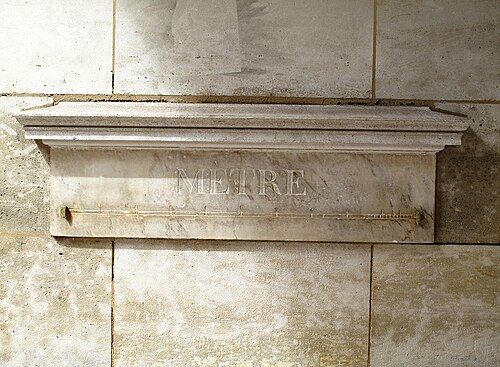
A copy of the "provisional" metre located in the wall of a building, 15 rue de Vaugirard, Paris. These metres were provisional (French: provisoire) because the expedition and the calculations to determine the definitive length of metre were not completed until 1799.[22][23]
The main ellipsoidal parameters are, a, b, f, but in theoretical work it is useful to define extra parameters, particularly the eccentricity, e, and the third flatteningn. Only two of these parameters are independent and there are many relations between them:
Definition
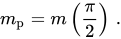
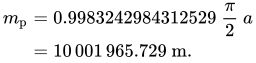
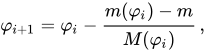
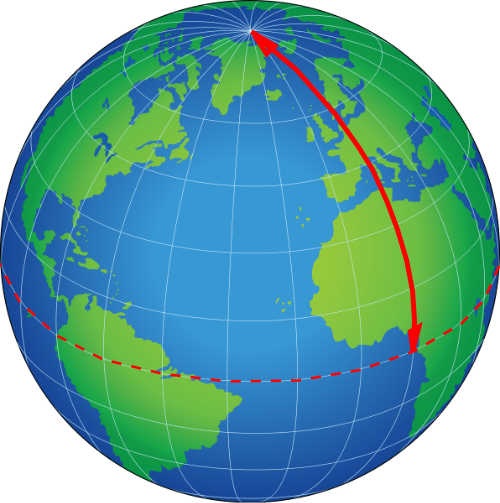
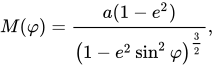
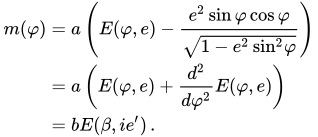
Notation is problematic in this area. The meridian radius of curvature must be distinguished from the meridian distance. The notation M(φ) has been used for both. The definitions adopted here are:
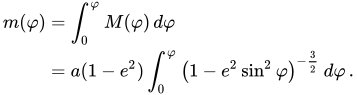
The arc length of an infinitesimal element of the meridian is dm = M(φ) dφ (with φ in radians). Therefore, the meridian distance from the equator to latitude φ is
The distance formula is simpler when written in terms of the parametric latitude,
where tan β = (1 − f)tan φ and e′2 = e2/1 − e2.
Even though latitude is normally confined to the range [−π/2,π/2], all the formulae given here apply to measuring distance around the complete meridian ellipse (including the anti-meridian). Thus the ranges of φ, β, and the rectifying latitude μ, are unrestricted.
↑ Alder, Ken (1995-12-31). Wise, M. Norton (編). TWO A Revolution to Measure: The Political Economy of the Metric System in France . Princeton University Press. pp. 39–71 . doi : 10.1515/9780691218120-004 . ISBN978-0-691-21812-0。
↑ 「統一の歴史」。Réseau National de la Métrologie Française 。2023-10-06に取得。
1 2 Ramani, Madhvi. 「フランスはいかにしてメートル法を創り出したか」 . BBC . 2019年5月21日取得。
↑ビオ、ジャン=バティスト (1774–1862) Auteur du texte;フランソワ・アラゴ (1786–1853) Auteur du texte (1821)。Recueil d'observations géodésiques, astronomiques et physiques, exécutées par ordre du Bureau des longitudes de France en Espagne, en France, en Angleterre et en Écosse, pour déterminer lavariation de la pesanteur et des degrés terrestres sur le prolongement du Méridien de Paris... rédigé par MM.ビオとアラゴ、... pp. viii– ix。{{cite book}}: CS1 maint: 数値名: 著者リスト (リンク)
↑ビオ、ジャン=バティスト;フランソワ・アラゴ(1821年)。Recueil d'observations géodésiques, astronomiques et physiques, exécutées par ordre du Bureau des longitudes de France, en Espagne, en France, en Angleterre et en Écosse, pour déterminer lavariation de la pesanteur et des degrés terrestres sur le prolongement du Méridien de Paris, faisant suite au troisième volume de la Base du Système métrique (フランス語)。523、529ページ。2018 年9 月 14 日に取得– Gallica経由。
1 2ルヴァロワ、ジャン=ジャック (1986)。「科学の世界」。ガリカ(フランス語)。 pp. 261–262、288–290 [269, 276–277 , 283] 。2019年5月13日に取得。
↑ Capderou, Michel (2011-10-31). Satellites : de Kepler au GPS (フランス語). Springer Science & Business Media. p. 46. ISBN978-2-287-99049-6。
↑ Martin, Jean-Pierre; McConnell, Anita (2008-12-20). "パリ天文台とグリニッジ天文台の統合" . Notes and Records of the Royal Society . 62 (4): 355– 372. doi : 10.1098/rsnr.2008.0029 . ISSN 0035-9149 . S2CID 143514819 .
1 2 National Industrial Conference Board (1921). The metric versus the engline system of weights and measures ... The Century Co. pp. 10–11 . 2011年4月5日取得。
1 2 3デバルバ、スザンヌ;クイン、テリー (2019-01-01)。「フランスと 1875 年の国際会議のシステム基準の起源、2018 年の国際システムの改訂に関する情報」。レンダスフィジークをコンプします。新しい国際単位系 / Le nouveau Système international d'unités。20 (1): 6–21。Bibcode : 2019CRPhy..20....6D。土井:10.1016/j.crhy.2018.12.002。ISSN 1631-0705。S2CID 126724939。
1 2 3 4ビゴーダン、ギヨーム (1901)。Le système métrique des poids et mesures;息子は、段階的に伝播し、メートルとキログラムを決定するための操作履歴を保存します。パリ:ゴーティエ・ヴィラール。 pp . 7、148–154。
↑ Delambre、Jean-Baptiste (1749–1822) Auteur du texte (1912)。グランドールとフィギュア・デ・ラ・テール / J.-B.-J.デランブル。 G. Bigourdan のノート、カルテ、出版物の追加、...{{cite book}}: CS1 maint: 数値名: 著者リスト (リンク)
↑ジャン・ジャック・ルヴァロワ (1986 年 5 月~6 月)。「L'Académie Royale des Sciences et la Figure de la Terre」[王立科学アカデミーと地球の形]。La Vie des Sciences (フランス語)。3 : 290。Bibcode : 1986CRASG...3..261L 。2018 年9 月 4 日に取得– Gallica 経由。
↑クイン、テリー・J. (2012).人工物から原子へ:BIPMと究極の測定標準の探求. ニューヨーク&オックスフォード:オックスフォード大学出版局. pp. 13, 56–57 . ISBN978-0-19-530786-3。
↑ジャン・バティスト・ドゥランブル (1749–1822) Auteur du texte;メシャン、ピエール (1744–1804) テキストの作者 (1806–1810)。基準は、ダンケルクとバルセロナの基準を含む、メリディアンの基準です。 T. 1 /、1792 年に執行され、MM によって作成されました。 Méchain et Delambre、Rédigée par M. Delambre、... pp. 93–94、10。{{cite book}}: CS1 maint: 数値名: 著者リスト (リンク)
↑クラーク、アレクサンダー・ロス、ジェームズ、ヘンリー (1866)。サウサンプトンの測量局で行われた、イングランド、フランス、ベルギー、プロイセン、ロシア、インド、オーストラリアの長さの標準の比較。ロンドン:GE エアと W. スポティスウッド、 HM 印刷局。pp. 281–87。OCLC 906501 。地球の図に関する付録。
↑オイラー、L. (1755)。"Élémens de la trigonométrie sphéroïdique tirés de la methode des plus grands et plus petits" [最大値と最小値の方法から取られた回転楕円体三角法の要素]。ベルリン王立科学アカデミーの回想録、1753 年(フランス語)。9 : 258–293 .pg=362 図。
1 2 Delambre、JBJ (1799): pg=72メリディアン弧の決定のための分析方法。 AM ルジャンドルによる記憶の記録、De L'Imprimerie de Crapelet、パリ、72–73
↑ベッセル、FW (1837)。"Bestimmung der Axen des elliptischen Rotationssphäroids, welches den vorhandenen Messungen von Meridianbögen der Erde am meisten entspricht" [子午線弧の測定による楕円体の軸の推定]。Astronomische Nachrichten (ドイツ語)。14 (333): 333–346。ビブコード: 1837AN....14....333B。土井:10.1002/asna.18370142301。
↑ Helmert, FR (1880): Die mathematischen und physikalischen Theorieen der höheren Geodäsie , Einleitung und 1 Teil , Druck und Verlag von BG Teubner、ライプツィヒ、§ 1.7、44–48 ページ。英語翻訳 (セントルイスの航空図情報センターによる) doi : 10.5281/zenodo.32050で入手可能
↑ Krüger, L. (1912): Konforme Abbildung des Erdellipsoids in der Ebene。プロイセン王立測地研究所、新シリーズ 52、12 ページ
↑ルジャンドル、午前(1811 年)。Exercices de Calcul Intégral sur Divers Ordres de Transcendantes et sur les Quadratures [積分微積分の演習] (フランス語)。パリ:クルシエ。 p. 180。OCLC 312469983。



 追記
追記



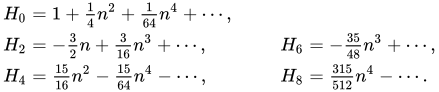
![{\displaystyle {\begin{aligned}D_{0}&=1+{\tfrac {3}{4}}e^{2}+{\tfrac {45}{64}}e^{4}+{\tfrac {175}{256}}e^{6}+{\tfrac {11025}{16384}}e^{8}+\cdots ,\\[5mu]D_{2}&=-{\tfrac {3}{8}}e^{2}-{\tfrac {15}{32}}e^{4}-{\tfrac {525}{1024}}e^{6}-{\tfrac {2205}{4096}}e^{8}-\cdots ,\\[5mu]D_{4}&={\tfrac {15}{256}}e^{4}+{\tfrac {105}{1024}}e^{6}+{\tfrac {2205}{16384}}e^{8}+\cdots ,\\[5mu]D_{6}&=-{\tfrac {35}{3072}}e^{6}-{\tfrac {105}{4096}}e^{8}-\cdots ,\\[5mu]D_{8}&={\tfrac {315}{131072}}e^{8}+\cdots .\end{aligned}}}](https://wikimedia.org/api/rest_v1/media/math/render/svg/a7567906e5ae50a409c78dc758bb8e7868c6a3e3)




![{\displaystyle {\begin{aligned}m(\varphi )={\frac {a+b}{2}}{\Biggl (}&B_{0}\varphi -B_{2}\sin 2\varphi +B_{4}\sin 4\varphi -B_{6}\sin 6\varphi +B_{8}\sin 8\varphi -\cdots \\[-3mu]&\quad -{\frac {2n\sin 2\varphi }{\sqrt {1+2n\cos 2\varphi +n^{2}}}}{\Biggr )}.\end{aligned}}}](https://wikimedia.org/api/rest_v1/media/math/render/svg/4429011753c9adeb0297a65db7c754f55a8ad9fc)
![{\displaystyle B_{2k}={\begin{cases}c_{0}\,,&{\text{if }}k=0\,,\\[5px]{\dfrac {c_{k}}{k}}\,,&{\text{if }}k>0\,,\end{cases}}}](https://wikimedia.org/api/rest_v1/media/math/render/svg/6a2ba4878240a6cebb938cc51e92e04cdb3f6127)