The Hurrian and Hittite weather god Teshub is depicted on a bas-relief at Ivriz wielding a thunderbolt and an axe.
The Arkalochori Axe is a bronze Minoan axe from the second millennium BC thought to be used for religious purposes. Inscriptions on this axe have been compared with other ancient writing systems.
In Mark Masonry, the axe is a symbol of punishment meant to remind Mark Master Masons to be truthful and avoid deceit.[12]
Types
Axes designed to cut or shape wood
Splitting axeA Swedish carpenter's axe
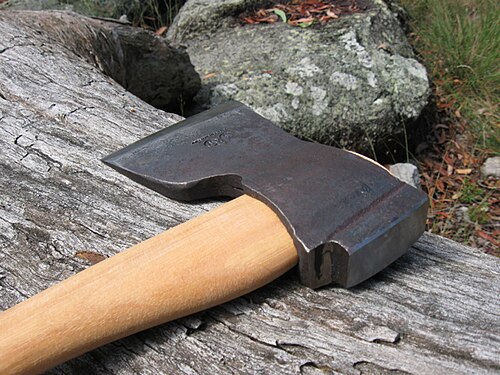
Broadaxe: Used with the grain of the wood in precision splitting or "hewing" (i.e. the squaring-off of round timbers usually for use in construction). Broad axe bits are most commonly chisel-shaped (i.e. one flat and one beveled edge) facilitating more controlled work as the flat cheek passes along the squared timber.
Adze: A variation featuring a head perpendicular to that of an axe. Rather than splitting wood side-by-side, it is used to rip a level surface into a horizontal piece of wood. It can also be used as a pickaxe for breaking up rocks and clay.
Hatchet: A small, light axe designed for use in one hand specifically while camping or travelling.
Carpenter's axe: A small axe, usually slightly larger than a hatchet, used in traditional woodwork, joinery and log-building. It has a pronounced beard and finger notch to allow a "choked" grip for precise control. The poll is designed for use as a hammer.
Hand axe: A small axe used for intermediate chopping, similar to hatchets.
Mortising axe: Used for creating mortises, a process which begins by drilling two holes at the ends of the intended mortise. Then the wood between the holes is removed with the mortising axe. Some forms of the tool have one blade, which may be pushed, swung or struck with a mallet. Others, such as twybil, bisaigüe and piochon have two, one of which is used for separating the fibres, and the other for levering out the waste.[13]
Axes as weapons
Battle axe: In its most common form, an arm-length weapon borne in one or both hands. Compared to a sword swing, it delivers more cleaving power against a smaller target area, making it more effective against armour, due to concentrating more of its weight in the axehead.[14]
↑ヨハン・デイヴィッド。「Notes sur trois outils anciens du charpentier : le Bondax, la bisaiguë, le piochon」2011 年 10 月 28 日にウェイバック マシンにアーカイブ、 Revue des Archéologues et historiens d'art de Louvain 10。 1977年。