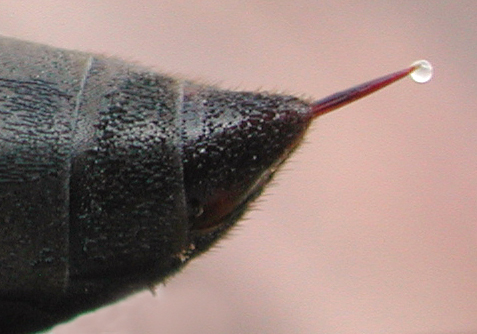
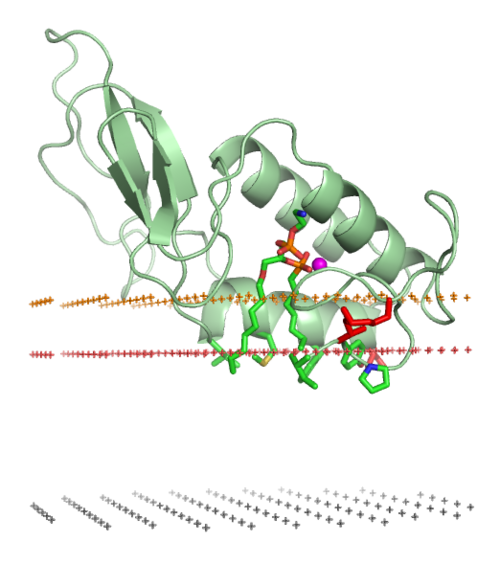
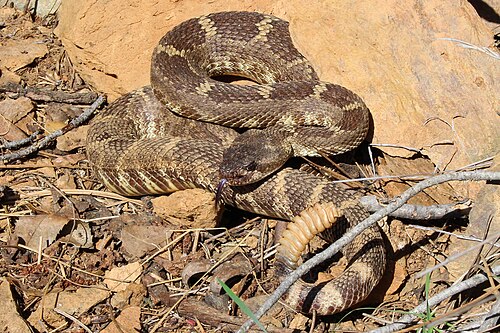
Venom or zootoxin is a type of toxin produced by an animal that is actively delivered to other animals through a wound by means of a bite, sting or similar penetrative action,[1][2][3] usually via a specially evolved venom apparatus, such as fangs or a stinger, in a process called envenomation.[2] Venoms are often distinguished from poisons, which is passively delivered by being ingested, inhaled, or absorbed through the skin;[4] and toxungen, which is actively transferred to the external surface of another animal via a physical delivery mechanism.[5]
Venom has evolved in terrestrial and aquatic environments and in a wide variety of animals: both predators and prey, and both vertebrates and invertebrates. Venoms kill through the action of at least four major classes of toxin, namely necrotoxins and cytotoxins, which kill cells; neurotoxins, which affect nervous systems; myotoxins, which damage muscles; and haemotoxins, which disrupt blood clotting. Venomous animals cause tens of thousands of human deaths per year.
Venoms are often complex mixtures of toxins of differing types. Toxins from venom are used to treat a wide range of medical conditions including thrombosis, arthritis, and some cancers. Studies in venomics are investigating the potential use of venom toxins for many other conditions.
Evolution
The use of venom across a wide variety of taxa is an example of convergent evolution. In animals, venom usage has evolved independently at least 104 times, across 8 phyla.[6] It is difficult to conclude exactly how this trait came to be so intensely widespread and diversified. The multigene families that encode the toxins of venomous animals are actively selected, creating more diverse toxins with specific functions.
Also, a number of animal species have been demonstrated to acquire venom toxins from other sources, notably from associated microbes, which may even inhabit their venom apparatuses.[7]
Venoms adapt to their environment and victims, evolving to become maximally efficient on a predator's particular prey (particularly the precise ion channels within the prey). Consequently, some venoms may become specialized to an animal's standard diet.[8]
Venoms cause their biological effects via the many toxins that they contain; some venoms are complex mixtures of toxins of differing types. Major classes of toxin in venoms include:[9]
Cytotoxins, which kill individual cells and are found in the apitoxin of honey bees and the venom of black widow spiders.[16][17]
A subclass of cytotoxins is the necrotoxins, which cause necrosis (i.e., death) in the cells and tissues they encounter. The complex venoms of vipers and bees contain phospholipases; viper venoms often also contain trypsin-like serine proteases.[18]
Taxonomic range
Venom is widely distributed taxonomically, being found in both invertebrates and vertebrates, in aquatic and terrestrial animals, and among both predators and prey. The major groups of venomous animals are described below.
↑ Nelsen, DR; Nisani, Z.; Cooper, AM; Fox, GA; Gren, EC; Corbit, AG; Hayes, WK (2014). "毒物、毒性物質、毒液:毒性生物分泌物とその利用生物の再定義と分類". Biological Reviews of the Cambridge Philosophical Society . 89 (2): 450– 465. doi : 10.1111/brv.12062 . PMID 24102715 .
1 2 Hayes, William K.; Gren, Eric CK; Nelsen, David R.; Corbit, Aaron G.; Cooper, Allen M.; Fox, Gerad A.; Streit, M. Benjamin (2025年2月20日). "It's a Small World After All: The Remarkable but Overlooked Diversity of Venomous Organisms, with Candidates Among Plants, Fungi, Protists, Bacteria, and Viruses" . Toxins . 17 (3): 99. doi : 10.3390/toxins17030099 . PMC 11945383 . PMID 40137872 .
↑ De León, Marina E.; Fox, Eduardo GP; Dunaj, Sara; Jenner, Ronald A.; Keiser, Carl N.; Macrander, Jason; Nixon, Samantha A.; Nobile, Clarissa J.; Petras, Daniel; Rodriguez-Roman, Eduardo; Saviola, Anthony J.; Trim, Steven A.; Varona, Natascha S.; Yeager, Justin; Ul-Hasan, Sabah (2025年1月1日). "毒液マイクロバイオームとその生態学および進化における有用性に関するレビュー、および新たな研究の将来の方向性" . Symbiosis . 95 (1): 3– 27. doi : 10.1007/s13199-024-01031-0 . ISSN 1878-7665 . PMC 12978238 . PMID 41821950 .
↑ Post Downing, Jeanne (1983). "Venom: Source of a Sex Pheromone in the Social Wasp Polistes fuscatus (Hymenoptera: Vespidae)". Journal of Chemical Ecology . 9 (2): 259– 266. Bibcode : 1983JCEco...9..259P . doi : 10.1007/bf00988043 . PMID 24407344 . S2CID 32612635 .
↑Post Downing, Jeanne (1984). "Alarm response to venom by social wasps Polistes exclamans and P. fuscatus". Journal of Chemical Ecology. 10 (10): 1425–1433. doi:10.1007/BF00990313. PMID24318343. S2CID38398672.
↑Baracchi, David (January 2012). "From individual to collective immunity: The role of the venom as antimicrobial agent in the Stenogastrinae wasp societies". Journal of Insect Physiology. 58 (1): 188–193. Bibcode:2012JInsP..58..188B. doi:10.1016/j.jinsphys.2011.11.007. hdl:2158/790328. PMID22108024. S2CID206185438.
↑Pinto, Antônio F. M.; Berger, Markus; Reck, José; Terra, Renata M. S.; Guimarães, Jorge A. (15 December 2010). "Lonomia obliqua venom: In vivo effects and molecular aspects associated with the hemorrhagic syndrome". Toxicon. 56 (7): 1103–1112. Bibcode:2010Txcn...56.1103P. doi:10.1016/j.toxicon.2010.01.013. PMID20114060.
↑Touchard, Axel; Aili, Samira; Fox, Eduardo; etal. (20 January 2016). "The Biochemical Toxin Arsenal from Ant Venoms". Toxins. 8 (1): 30. doi:10.3390/toxins8010030. ISSN2072-6651. PMC4728552. PMID26805882.
↑Graystock, Peter; Hughes, William O. H. (2011). "Disease resistance in a weaver ant, Polyrhachis dives, and the role of antibiotic-producing glands". Behavioral Ecology and Sociobiology. 65 (12): 2319–2327. Bibcode:2011BEcoS..65.2319G. doi:10.1007/s00265-011-1242-y. S2CID23234351.
↑Frost, Emily (30 August 2013). "What's Behind That Jellyfish Sting?". Smithsonian. Retrieved 30 September 2018.
↑ Hargreaves, Adam D.; Swain, Martin T.; Hegarty, Matthew J.; Logan, Darren W.; Mulley, John F. (2014年7月30日). "制限とリクルートメント—遺伝子重複とヘビ毒の起源と進化" . Genome Biology and Evolution . 6 (8): 2088– 2095. doi : 10.1093/gbe/evu166 . PMC 4231632 . PMID 25079342 .
↑ Daltry, Jennifer C.; Wuester, Wolfgang; Thorpe, Roger S. (1996). "Diet and snake venom evolution". Nature . 379 (6565): 537– 540. Bibcode : 1996Natur.379..537D . doi : 10.1038/379537a0 . PMID 8596631 . S2CID 4286612 .
↑ Nekaris, K. Anne-Isola; Moore, Richard S.; Rode, E. Johanna; Fry, Bryan G. (2013年9月27日). "知ると危険で、厄介なスローロリス毒の生化学、生態、進化" . Journal of Venomous Animals and Toxins Including Tropical Diseases . 19 (1): 21. doi : 10.1186/1678-9199-19-21 . PMC 3852360 . PMID 24074353 .
↑ Fox, Eduardo Gonçalves Paterson (2021). "ヒアリの毒液" . Gopalakrishnakone, P.; Calvete, Juan J. (編). Venom Genomics and Proteomics . Springer Netherlands. pp. 149–167 . doi : 10.1007/978-94-007-6416-3_38 . ISBN978-94-007-6649-5。
↑ Calvete, Juan J. (2013年12月). "ヘビ毒学:毒素の目録から生物学へ". Toxicon . 75 : 44–62 . Bibcode : 2013Txcn...75...44C . doi : 10.1016/j.toxicon.2013.03.020 . ISSN 0041-0101 . PMID 23578513 .
↑Arbuckle, Kevin; Rodríguez de la Vega, Ricardo C.; Casewell, Nicholas R. (December 2017). "Coevolution takes the sting out of it: Evolutionary biology and mechanisms of toxin resistance in animals"(PDF). Toxicon. 140: 118–131. Bibcode:2017Txcn..140..118A. doi:10.1016/j.toxicon.2017.10.026. PMID29111116. S2CID11196041. Archived from the original(PDF) on 4 November 2021. Retrieved 21 January 2020.
↑Dawkins, Richard; Krebs, John Richard; Maynard Smith, J.; Holliday, Robin (21 September 1979). "Arms races between and within species". Proceedings of the Royal Society of London. Series B. Biological Sciences. 205 (1161): 489–511. Bibcode:1979RSPSB.205..489D. doi:10.1098/rspb.1979.0081. PMID42057. S2CID9695900.
↑McCabe, Thomas M.; Mackessy, Stephen P. (2015). Gopalakrishnakone, P.; Malhotra, Anita (eds.). Evolution of Resistance to Toxins in Prey. Toxinology. Springer Netherlands. pp.1–19. doi:10.1007/978-94-007-6727-0_6-1. ISBN978-94-007-6727-0.
↑Nuismer, Scott L.; Ridenhour, Benjamin J.; Oswald, Benjamin P. (2007). "Antagonistic Coevolution Mediated by Phenotypic Differences Between Quantitative Traits". Evolution. 61 (8): 1823–1834. doi:10.1111/j.1558-5646.2007.00158.x. PMID17683426. S2CID24103.
12Holding, Matthew L.; Drabeck, Danielle H.; Jansa, Sharon A.; Gibbs, H. Lisle (1 November 2016). "Venom Resistance as a Model for Understanding the Molecular Basis of Complex Coevolutionary Adaptations". Integrative and Comparative Biology. 56 (5): 1032–1043. doi:10.1093/icb/icw082. ISSN1540-7063. PMID27444525.
↑ Calvete, Juan J. (2017年3月1日). "Venomics: 統合的毒液プロテオミクスとその先". Biochemical Journal . 474 (5): 611–634 . doi : 10.1042/BCJ20160577 . ISSN 0264-6021 . PMID 28219972 .
↑ Coss, Richard G.; Poran, Naomie S.; Gusé, Kevin L.; Smith, David G. (1993 年 1 月 1 日). "カリフォルニアジリス (Spermophilus Beecheyi) のヘビに対する防御の発達: II. ガラガラヘビからの選択の緩和による微小進化効果". Behaviour . 124 ( 1– 2): 137– 162. doi : 10.1163/156853993X00542 . ISSN 0005-7959 .
↑ Holding, Matthew L.; Biardi, James E.; Gibbs, H. Lisle (2016年4月27日) 「ガラガラヘビ捕食者とそのリスの獲物における毒機能と毒耐性の共進化」 Proceedings of the Royal Society B: Biological Sciences . 283 (1829) 20152841. doi : 10.1098/rspb.2015.2841 . PMC 4855376 . PMID 27122552 .
↑ da Silva, Karen Burke; Nedosyko, Anita (2016), "イソギンチャクとクマノミ:天国で結ばれた組み合わせ", Goffredo, Stefano; Dubinsky, Zvy (eds.), The Cnidaria, Past, Present and Future: The world of Medusa and her sisters , Springer International Publishing, pp. 425– 438, doi : 10.1007/978-3-319-31305-4_27 , ISBN978-3-319-31305-4
↑ Nedosyko, Anita M.; Young, Jeanne E.; Edwards, John W.; Silva, Karen Burke da (2014年5月30日). " Searching for a Toxic Key to Unlock the Mystery of Anemonefish and Anemone Symbiosis" . PLOS ONE . 9 (5) e98449. Bibcode : 2014PLoSO...998449N . doi : 10.1371/journal.pone.0098449 . ISSN 1932-6203 . PMC 4039484. PMID 24878777 .
↑ Lubbock, R.; Smith, David Cecil (1980年2月13日)「なぜクマノミはイソギンチャクに刺されないのか?」。Proceedings of the Royal Society of London. Series B. Biological Sciences . 207 (1166): 35–61 . Bibcode : 1980RSPSB.207...35L . doi : 10.1098/rspb.1980.0013 . S2CID 86114704 .
12Litsios, Glenn; Kostikova, Anna; Salamin, Nicolas (22 November 2014). "Host specialist clownfishes are environmental niche generalists". Proceedings of the Royal Society B: Biological Sciences. 281 (1795) 20133220. doi:10.1098/rspb.2013.3220. PMC4213602. PMID25274370.
↑Lomte, Tarun Sai (23 February 2025). "Venom is everywhere: Study examines hidden toxin delivery systems across life forms". News-Medical.
Categories:
Animal physiology
Toxins
Venomous animals
Hidden categories:
Articles with short description
Short description is different from Wikidata
Good articles
Use dmy dates from August 2021
Use British English from January 2021
All Wikipedia articles written in British English
CS1 French-language sources (fr)
CS1 maint: location missing publisher
All articles with dead external links
Articles with dead external links from July 2025
Articles with permanently dead external links
Webarchive template wayback links
Pages using gadget owidslider
Pages using multiple image with auto scaled images