
Loading article…
The First Mithridatic War (89–85 BC) was a large conflict in Anatolia and ancient Greece in opposition to the Roman Republic by the Pontic kingdom ruled by Mithridates VI Eupator. Although the Roman general Sulla was largely victorious on the battlefield, factional struggle in Rome forced him to end the war on a precarious stalemate.
The war began after more than a decade of geopolitical manoeuvring by Mithridates, who managed to considerably extend his realm despite constant Roman attempts to restrain him. In 90 BC, a Roman delegation headed by Manius Aquillius provoked Mithridates into war, as Aquillius hoped to receive its command. The following year, Mithridates rapidly captured the Roman province of Asia, exploiting local resentment of Roman tax collectors to massacre the Roman settlers. Taken by surprise while it was fighting a large revolt of its allies in Italy, Rome was initially unable to respond. This allowed Mithridates to encourage more defections from Greek cities, most notably Athens, where he installed the tyrant Aristion.
In Rome, the attribution of the command of the Mithridatic War led to civil strife, which was won by Sulla after he made a coup by marching his army on the city in 88 BC. However, once Sulla left Italy, his enemies Marius and Cinna seized power and declared him a public enemy. As a result, Sulla waged the war on his own as a rogue general. His campaign was swift: in 86 BC, he took Athens, then crushed Mithridates' general Archelaus in central Greece at the battles of Chaeronea and Orchomenos. Meanwhile, the official Roman government dispatched its own army to fight Mithridates, led by Lucius Valerius Flaccus, who was murdered by his lieutenant Fimbria. The latter then crossed into Asia and successfully conducted his own campaign against Mithridates.
At this point, Sulla realised that Fimbria could rob him of his victory, so he offered a generous peace to Mithridates called the treaty of Dardanos, restoring the situation to its pre-89 BC state. Soon after, Sulla convinced Fimbria's soldiers to defect and forced him to commit suicide, thus removing the last threat to his private empire in the East. In 83 BC, Sulla left Greece to fight the Cinno-Marians, against whom he won a civil war, which enabled his rule as dictator in Rome. However, Sulla's settlement of the East was short-lived; hostilities rapidly resumed in the Second Mithridatic War (83–81 BC), fought on the Roman side by Murena, the lieutenant that Sulla had left behind in Asia.
No contemporary account of Mithridates has survived. Modern historians have to use fragmentary or summarised versions of lost works, or histories written much later, none favourable to Mithridates.[4][5] The most important source is the Roman history of Appian of Alexandria, a Greek author of the 2nd century AD, who is nevertheless not a good historian, prone to mistakes.[6][7][8]
Another significant source is Plutarch, who wrote in the early 2nd century AD a set of famous biographies known as the Parallel Lives, which includes the lives of Roman commanders who played a role during the wars against Mithridates, most importantly Sulla, and also Marius, Lucullus, Sertorius, and Pompey.[9] Plutarch provides excellent descriptions of Sulla's campaign in central Greece, as he was born in Chaeronea, where a major battle took place.[10] The Greek geographer Strabo was born in Pontus in the 1st century and his family even served at the royal court, but his historical works are lost; he still often mentions Mithridates in his Geographica.[11] Other important mentions are also found in the letters and speeches of Cicero, a contemporary of the events.[12][13] The fragments of the Greek philosopher Posidonius are useful for the history of Athens during this period.[14] Finally, some scraps of information can be retrieved from the later works of Justin, Frontinus, and the De viris illustribus.[15][16][17]
The major problem with most of these written sources is that they often derive from the lost Memoirs of Sulla—a key player of these events—who considerably arranged the facts to suit his propaganda, both against Mithridates and his rivals in Rome.[18][19][20] He typically defamed his enemies, such as Fimbria, who is described in very unfavourable terms in all the sources, as they follow Sulla.[21]
The Greek historian Memnon wrote a history of his city Heraclea Pontica (near modern Zonguldak in Turkey), where some action took place, which is likewise only available in fragments, but they show that Memnon did not use Roman sources and recounted events of the war differently from Appian.[22]
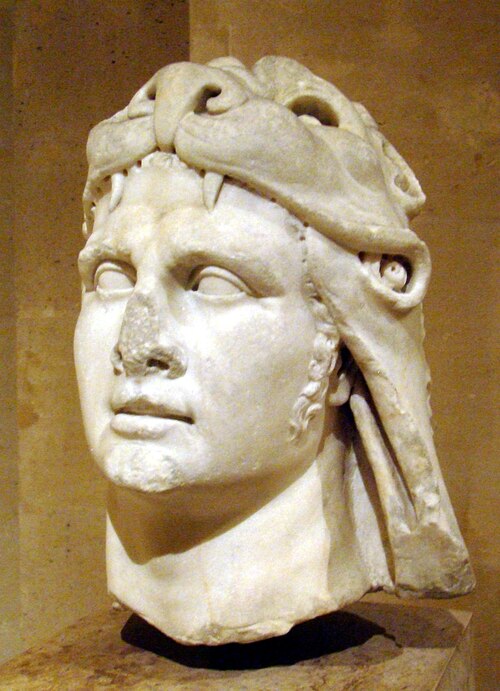
貨幣学もこの時代の重要な資料であり、ミトリダテスの貨幣は帝国全土で広く流通していた[ 23 ]。また、碑文も重要で、この地域の多くの都市では条約や法令が石に刻まれている[ 24 ] 。しかし、トルコ北部の考古学は、アマセイアの王家の墓の発掘を除いて貧弱である[ 25 ]。ミトリダテスは、デロス島に奉納したヘローンなどの記念碑や碑文も残している[ 26 ]。多くの彫像や胸像が彼に帰属されているが、その帰属は現代の学者の間でしばしば議論されている。彼のものとして満場一致で認められている頭部は1つだけで、現在はルーブル美術館にある[ 27 ]。
ローマは紀元前133年にペルガモンの最後の王アッタロス3世が王国を共和政ローマに遺贈した際に、小アジアに本格的に進出した。紀元前129年にその跡地にアジア属州が創設され、ローマの国境は同地域にあったいくつかの王国に近接することになった。[ 28 ]その中で最も大きかったのは、ペルシア起源でダレイオス大王の子孫を自称するミトリダテス朝が統治するポントス王国であった。[ 29 ] [ 30 ]アナトリア北岸のギリシャ都市国家を支配したことで、王国にはヘレニズムの影響が顕著に現れた。 [ 31 ]
Mithridates VI Eupator became king c. 120 at 13.[32][33] At his majority, he started an expansionist policy towards the coast of the Black Sea and the interior of Asia minor. In 107 he obtained Lesser Armenia and Colchis, an area rich in timber used for building ships, but the details of these acquisitions are unknown.[34] He provided military assistance against the Scythians to the Greek cities of the Black Sea, such as Apollonia Pontica, Olbia, Odessus, and Tyras, which made alliances with him. After he was bequeathed the Bosporan Kingdom (in modern Crimea), Mithridates controlled all the eastern shore of the Black Sea by the end of the 2nd century.[35] Mithridates also expanded into Asia Minor, thanks to his alliance with Nicomedes III of Bithynia. The two kings first invaded Paphlagonia in 108–107 and shared the land between them.[36][37] The same year, Mithridates occupied a part of Galatia, the area in central Anatolia populated by three Celtic tribes.[38][39] He also murdered the king of Cappadocia c.100 and placed his son on its throne,[40] but this time Rome reacted and forced Mithridates and Nicomedes III to release Paphlagonia and Cappadocia, on which throne Ariobarzanes was placed.[41][42]
After this setback, Mithridates turned to his eastern neighbour Armenia, where a new king ascended to the throne in 95: Tigranes II, to whom he gave his daughter Cleopatra in marriage.[43][44] In exchange, in 92, Tigranes II invaded Cappadocia, expelled Ariobarzanes, and gave the land to Mithridates. This new aggression prompted Rome to intervene again; as propraetor, Lucius Cornelius Sulla was sent there and engaged Cappadocian troops led by the Pontic general Archelaus.[45] At the same time, Mithridates took possession of Bithynia by expelling his nephew Nicomedes IV—the son of his former ally—, then removed Ariobarzanes from Cappadocia a second time after Sulla had left.[46][47] The Social War that had started between Rome and its former Italian allies in 91 emboldened Mithridates to conquer his neighbours, defying Roman orders.[48]
At the end of 90, after hearing the complaints of the kings in exile Ariobarzanes and Nicomedes IV, the senate sent a new embassy, headed by Manius Aquillius, a former consul, the son of the homonymous consul of 129 that had won the war against Aristonicus.[49][50][51] Aquillius and Manlius Mancinus, another ambassador, were notably Gaius Marius' friends.[52] After having restored the two kings without a fight, the embassy requested that they attack Pontus; deep in debts with Rome, Nicomedes complied and ravaged Pontus up to Amastris to recover his wealth.[53][54] Mithridates did not oppose him, but still started recruiting soldiers from the Black Sea area. The king wanted to gain time and sent his ambassador Pelopidas to last chance negotiations with Aquillius in Pergamon, which took place in the spring of 89.[55][56] These negotiations were marred with sophistry and spurious agreements; Mithridates listed his claims over Cappadocia and Bithynia and presented himself as a victim of Nicomedes' pillage, while the latter detailed how Mithridates breached the treaties and prepared for war.[57] In a second meeting several weeks later, as Aquillius had already sided with Nicomedes, Pelopidas accused him of acting for his own benefit and threatened to go directly before the senate, which angered the commissioners and ended the talks, making war inevitable.[58]
Aquillius wished the negotiations to fail, by compelling Pelopidas to leave the talks twice. His intentions were likely to force a war to which he would have been appointed commander.[59] Although Mitridates' aggressive expansion was a major factor, modern historians put most of the immediate responsibility of the war on Aquillius,[60][61][62][63] who "act[ed] out of greed and personal ambition", against the will of the senate.[64] T. J. Luce suggested that Aquillius was working on the behalf of his friend Gaius Marius, who was eyeing a comeback at the centre of Roman politics by getting the command of the war against Mithridates. Marius had conspicuously made a private trip in the area in 98, during which he met Mithridates.[65][66]
A minority opinion on the origins of the war is given by Kallet-Marx, who thinks that the blame placed on Aquillius found in the work of Appian initially came from the lost Memoirs of Rutilius Rufus, a former consul who was forced into exile in Mytilene after he confronted some publican friends of Marius in Asia. Kallet-Marx instead thinks that the commissioners only wanted to restore the two kings and were taken by surprise by Mithridates’ reaction into a full-scale war.[67]

War began in the late summer of 89.[68] Rome adopted a defensive position, by blocking the roads in order to prevent Mithridates from leaving Pontus: Aquillius was in Paphlagonia, on the main road to Pontus; the proconsul of Asia Gaius Cassius was at the border between Bithynia and Galatia, to the northeast of Ancyra (modern Ankara); the praetor Quintus Oppius guarded Lycaonia, on the road to the Euphrates river. The Roman navy commanded by Minucius Felix and Popilius Laenas also blockaded the Bosporan straits with their navy.[69][70][71] There was no Roman legion in Asia, only local levies.[72]
According to Appian, Mithridates could rely on a massive army of 240,000 men, 40,000 horsemen.[73] Rome had less than half that number, although Nikomedes could provide 50,000 men and 6,000 cavalry.[74] Army numbers are nevertheless suspicious as ancient authors have the tendency to exaggerate the number of troops engaged, especially when describing Roman enemies.[75] Mithridates’ number of ships is more reliable. He had a navy of 300 cataphracts (decked ships) and 100 dikrotai (ships with two banks of oars),[76] which gave him "immense naval superiority" throughout the war.[77]
While Rome was on a defensive stance, the attacking role was given to Nikomedes. The king of Bithynia personally led all his troops, which outnumbered the Pontic army in the area, commanded by the brothers Archelaus and Neoptolemus.[78] The first battle of the war took place near the River Amnias. Nikomedes initially had the upper hand, but was caught off-guard by Scythian chariots at the service of Mithridates and was soundly defeated. He retreated through the path he had come to the Roman camp of Aquillius, from which he rapidly fled at the news of the advancing Pontic army.[79][80]
David Magie notes that the Romans' plan of letting Nikomedes do the attack was a "folly" as that they recklessly divided their forces into three armies posted too far from each other. The plan ended in a "total failure" as a result.[81]
In a subsequent cavalry clash near Mount Scorobas, 100 Sarmathians defeated 800 Bithynians,[82] which prompted Aquillius to retreat westwards. While on the move, Aquillius' army was defeated by Neoptolemus at the battle of Protopachium, with the loss of 10,000 soldiers. Aquillius then went all the way back to Pergamum, the capital of the province of Asia.[83][84][85] Cassius, joined by Nikomedes, was unable to properly train more troops, and likewise retreated to Apameia, while Oppius moved back to Laodicea.[86] Cassius in turn was abandoned by Nikomedes, who fled to Pergamum and then to Italy, where he stayed for the remainder of the war.[87]
Mithridates rapidly exploited the void left by the Romans' departure and captured Bythinia without opposition. Pontic armies went as far as the Bosporus, where they received the surrender of the Roman ships guarding the straits, thus opening the Aegean Sea for the Pontic navy.[88] In Phrygia, Cassius could not hold Apameia as its defences had been weakened by an earthquake and fled to Rhodes. Then, Mithridates promised the citizens of Laodicea that he would not harm them if they brought him Oppius, leading to his capture.[89][90] This swift conquest of Asia through Phrygia took place in early 88.[91]
Mithridates had a generous policy towards the cities he took, by offering them war reparations and setting free their prisoners.[92] Even Oppius was apparently well-treated and remained in Mithridates' court throughout the war.[93] The Asian Greeks swiftly ditched Roman rule mainly because of the publicans, the Roman tax-collectors whose greed was deeply resented by the locals.[94] However, while Mithridates received the support of many cities during his triumphal march, his sweeping conquests did not extend to southwestern Asia, where many cities are mentioned resisting him. He had to fine and place a garrison in Stratoniceia; Archelaus was wounded while taking Magnesia on the Meander;[95]Tabai in Caria, Telmessus and Patara in Lycia resisted the entire war.[96][97][98] The Pontic king also took the island of Kos in the Aegean sea, where the Ptolemaic queen Cleopatra III had left her treasury; likewise, he also captured the treasury of the Bithynian kingdom, the source of his debt-relief program.[99]

While he was in Ephesus, Mithridates devised the massacre of the Romans and Italians living in Asia, including women, children, and freedmen.[100] In late summer or early autumn 88, he gave orders to his overseers to attack the Italians on a day set in advance.[101][102] To encourage the slaughter, slaves killing their masters would receive manumission, people would be relieved of half their debt if they killed their Roman creditor, and assassins would share the wealth of their Roman victims with Mithridates.[103] These orders were carried with fervour in many cities, as Roman publicans were universally loathed by the population after 40 years of extortion.[104] Apart from Ephesus, the temporary residence of the king, Appian writes that massacres took place in Pergamum, Adramyttium, Tralles and Caunus, showing the extensive range of the event, from Troad to Caria.[105][106] Romans were hunted even in the temples, normally places of shelter, apart from the temple of Asclepius in Kos.[107]
The death toll was said to have reached 80,000, a figure that likely came from contemporary authors, such as the Memoirs of Sulla.[108][109] Plutarch inflated that number to 150,000.[110] Both numbers were likely exaggerated.[111] The massacre was a clever way for Mithridates to bind these Asian communities to him, as they knew that Rome would never forgive them.[112] Moreover, the wealth he took from the massacre further enhanced his rule, as it funded his generous philanthropic policies.[113]
Rhodes was the last significant power in the Aegean Sea that resisted Mithridates. It was an important Roman ally, where Cassius had also retreated with his army.[114][115] In autumn 88, the Pontic forces landed on the island and besieged the city. The Rhodians however launched several sorties on both land and sea that were successful. Mithridates then built a huge siege engine named sambuca, but this bridge manned with catapults was too heavy and collapsed, which prompted him to lift the siege. He also failed to take the Lycian city of Patara on his return. In both occasion, Mithridates pretexted portents to explain his failures.[116][117] From this point on, Mithridates avoided putting himself on the frontline, therefore risking his personal prestige, and let his generals, principally Archelaus, campaign in his name.[118][119]
Mithridates then sailed back to Asia to establish his headquarters in Pergamum. He stopped to Mytilene, where Aquilius had sought shelter, and captured him. Appian says that after humiliating him, Mithridates killed Aquilius by pouring molten gold into his mouth, in order to advertise that Roman greed was the cause of the war.[120][121] It is nevertheless possible that Aquillius was taken prisoner with Oppius and released at the end of the war.[122]

Athens in the years preceding the war was dominated by a pro-Roman elite, especially by Medeius, who was uniquely elected eponymous archon three times in a row between 91 and 89, though he apparently lost his grip on the city in 88.[124][125] The news of Pontus' victories was welcomed with enthusiasm in Athens.[126] Following the fall of Medeius in 88, the ecclesia voted the dispatch of a delegation to Mithridates headed by Athenion, a peripatetic philosopher. Once in Asia, he sent letters to Athens praising Mithridates, saying that the king would restore civil order, democracy, and relieve debts, the three most pressing issues at the time in the city. Athenion made a triumphal return, and was elected hoplite general with a special power to choose all the other magistrates.[127][128][129]Christian Habicht suggests that he appointed Mithridates as the eponymous archon, which, given the cultural importance of Athens, turned him into the symbolic leader of the Greek world.[130][131][132] Athenion's election de facto meant a break with Rome, something that a minority of Athenian residents (citizens and foreigners) did not accept, such as the head of the Academy, Philo of Larissa, who moved to Rome.[133][134] To prevent his opponents from leaving Athens, Athenion placed guards at the gates of the city, therefore transforming his government into an oppressive regime.[135]
More serious for Athens was the defection of Delos, a small island in the middle of the Aegean Sea. A property of Athens, the island was the main slave-market of the Mediterranean Sea and a major trading post for Roman and Italian businessmen. The Delians refused to follow their metropolis and remained loyal to Rome, doubtless under the leadership of the local Italians.[136][137] Athens was on its own to quell the revolt, since Mithridates had not yet sent any force across the sea, so Athenion tasked a fellow philosopher, Apellicon of Teos, with taking Delos back.[138] The Athenians were however defeated just after having disembarked, by Orbius, the Roman prefect.[139][140][141]
At this point, Mithridates directed a large army commanded by Archelaus to Greece, which stopped by Delos. As in Asia, the 20,000 Italians of Delos were murdered by the Pontic general Menophanes.[142] He also captured the large treasure of the temple of Apollo and gave it to an Athenian from his entourage named Aristion, an epicurean philosopher. Since Athenion disappears from the sources after his defeat at Delos, several scholars have considered that Aristion and Athenion were the same person,[143] but the majority consider them to be different.[144][145][146][147][148] Archelaus sent Aristion to Athens with 2,000 men and the treasure of Apollo, which he used to become tyrant.[149] He apparently purged the city from leading pro-Roman citizens, by either killing them or deporting them to Amisus, in Pontic territory on the southern coast of the Black Sea.[150]
The arrival of Archelaus in Greece triggered a new wave of defections to Pontus, although his conquest was not as sweeping as that of Mithridates in Asia, as there are reports of resistance in several places. In the Peloponnese, he received the submission of Achaea, as well as Sparta after a battle.[151] In central Greece, Boeotia went over to Mithridates, apart from Thespiae, which had to be besieged.[152]
北では、2番目のポントス軍が陸路でギリシャに進軍したが、この軍の時期は古代の史料からは明らかではない。この軍はミトリダテスの息子アルカティアスが指揮していた。 [ 153 ]この軍はトラキアとマケドニアを征服したが、おそらくトラキア人を同盟者または傭兵として利用したのだろう。途中でアブデラを占領し、アンフィポリスを包囲したが、アンフィポリスはおそらく87年まで抵抗し、その年に北テッサリアのティサイウムで病死したアルカティアスに代わってタクシレスが指揮を執った。 [ 154 ] [ 155 ]北のポントス軍は、おそらく未知の場所で、マケドニアのプロプラエトルであるセンティウスの2つの軍団を破った。センティウスはこの時点で史料から姿を消している。[ 156 ]メトロファネスが指揮する北ポントス軍の分遣隊は、デメトリアスの要塞を中心として、エウボイア島とマグネシア島を征服するために武力を行使しなければならなかった。[ 157 ] [ 158 ] [ 159 ]他の多くの島々は征服されたが、北エーゲ海のタソス島は戦争中ずっとミトリダテスに抵抗した。[ 160 ]
ギリシャにおけるローマの抵抗は、センティウスによって任命されたレガトゥスであるクィントゥス・ブラエティウス・スラによって組織され、彼は小規模な兵力にもかかわらずポントス軍の進軍を阻止した。[ 161 ]彼は西のテッサリアに隣接する山岳地帯のギリシャ部族であるアタマニ族を守った。[ 162 ]スラはまた、場所は不明だがメトロファネスを破り、カイロネイアでアルケラオスとアリスティオンを3日間封鎖した。[ 163 ]
The reason behind Mithridates' intervention in Greece is not clear, as it would have been easier for him to only defend Asia rather than overextending his forces over the Aegean Sea. Modern scholars have suggested a number of possibilities. Perhaps he wanted to avoid fighting on his own soil and carry the war to Greece, or he felt compelled by his own propaganda presenting him as the new Alexander to act as the liberator of Greece.[164] A hostile tradition among ancient authors ascribed to him a grand design of conquering Italy, but this seems improbable.[165] It seems that Mithridates only decided to conquer Greece once he received the request from Athenion, which he saw as a unique opportunity.[166] Greece would have also been a great bargaining chip in negotiations with Rome.[167]
Because of the Social War in Italy, Rome had been unable to stop Mithridates' swift advance in the Greek East. The Italian allies were mostly subdued by 88, notably thanks to Sulla, who won several important victories during the war.[168] These successes helped him to get the consulship for 88, at the beginning of which he was additionally given the command of the war against Mithridates with the six legions he had led during the Social War.[169] However, his old rival Gaius Marius engineered his removal from the Mithridatic command with the help of the tribune of the plebsPublius Sulpicius, who used an armed gang to coerce the citizens’ assembly into voting the transfer of Sulla's command to Marius.[170][171][172] Sulla reacted by marching on Rome with his army of loyal veterans, who easily captured the city. Sulla’s soldiers supported his coup because they feared they would be deprived of the booty that a victory against Mithridates would bring them.[173] He then killed Sulpicius and forced Marius and some other of his enemies to go into exile.[174] Moreover, he enacted several constitutional reforms and stayed in Rome until the end of the year in order to influence the elections, all of which further delayed his departure to Greece.[175]
Sulla finally left in early 87, but in Rome, tensions rapidly escalated between Cinna and Octavius—the new consuls of 87—over Sulla's settlement. A civil war followed, from which Cinna emerged victorious, with the help of Marius, back from exile with his own veterans. Marius and Cinna violently purged Rome from their enemies, murdering Octavius and some of Sulla's friends.[176] Sulla was declared enemy of the state and his command given back to Marius.[177] He nevertheless ignored the order and continued the campaign as planned, even though he had by now entered in rebellion.[178]
In his Life of Sulla, Plutarch writes that Sulla was followed in his private campaign by so many senators that he could constitute a counter-senate around him, but this story is likely based on his Memoirs, and intended to give some kind of legality to his rebellion.[179]Ernst Badian showed that very few nobiles followed Sulla, who actually lacked senior officers around him.[180] The most prominent of his supporters was Lucullus, the only member of his staff that stayed with him during his March on Rome, who received the most important missions. Other names include Aulus Gabinius, Lucius Minucius Basilus, Lucius Licinius Murena, Gaius Scribonius Curio, Lucius Hortensius, and a Sulpicius Galba, the only name from a great family.[181][182] In fact, many Roman aristocrats remained in Rome for the whole troubled decade, and even those who fled from Italy went to other Roman provinces: Gaul, Africa, and Spain, but not to Sulla.[183][184] The March on Rome and his subsequent rebellion had provoked a strong rejection of Sulla within the Roman elite.[185]
スッラは87年の春にエピロス(おそらくデュラキウム、あるいはアポロニア)に軍隊を上陸させた。[ 186 ]その後、エグナティア街道を東に進み、テッサリアに向かって右折した。 [ 187 ]ギリシャでの進軍は抵抗を受けることなく、多くの都市が物資、特に金塊の提供を強いられ、ルクルスはそれを使って兵士の給料用の硬貨を鋳造した。[ 188 ] [ 189 ]オドリュシア人の王サダラスさえも援軍を送り、トラキアの王子アマトコスがスッラによってカイロネイアの駐屯軍の長に任命された。[ 190 ] [ 191 ]ボイオティアでは、テーベは戦うことなく忠誠を誓った。[ 192 ]スッラはまた、ギリシャを掌握していた総督ブラエティウスにマケドニアへ去るよう命じた。彼は他の者に勝利を奪われたくなかったのだ。[ 193 ]
紀元前87年から86年の冬、スッラは小規模な戦いに勝利し、アリスティオンとアルケラオスをアッティカに引き返させた可能性がある。[ 194 ]彼らに続いて、スッラは軍を2つに分け、1つはアリスティオンが支配するアテネを包囲し、もう1つはアルケラオスが拠点を置くピレウスを包囲した。[ 195 ]古典期アテネの有名な長城はもはや2つの都市をつないではいていなかったので、彼はそれらを互いに孤立させることができた。彼は特にプラトンのアカデミアとアリストテレスのリュケイオンの森を破壊して攻城兵器を建造した。[ 196 ]アルケラオスは海から補給を受けることができたので、アリスティオンにとっては状況はさらに絶望的だった。[ 197 ]実際、スッラには港を封鎖する艦隊がなかった。そこで彼はルクルスを派遣し、フェニキアに至る東地中海のローマの同盟国や属国から船を集めさせた。[ 198 ]
アルケラオスからの物資を受け取ることができなかったアテネは飢餓に苦しみ、ついに86年3月1日、ローマ兵が西壁を突破した際に陥落した。[ 199 ] [ 200 ]その後、ローマ兵は住民を虐殺し始めたが、スッラは数人のスタッフと、おそらくかつて親ローマ派の僭主であったメデイウス、あるいはその息子を含むアテネの指導者たちの嘆願を聞き、虐殺を止めるよう命じた。[ 201 ]いずれにせよ、多くの建物が破壊され、美術品が略奪された。[ 202 ] [ 203 ]それにもかかわらず、アリスティオンはスッラが遠征を続ける間、レガトゥス・スクリボニウス・クリオに包囲されながら、数ヶ月間アクロポリスで抵抗した。水が尽きた後、ついに諦め、87/86年の政務官たちと共に処刑された。[ 204 ] [ 205 ]ピレウスでは、アルケラオスはタクシラスの北軍が中央ギリシャに到着するまで持ちこたえ、その後船でエウボイア島に撤退した。[ 206 ]エウボイア島のカルキスからテルモピュライに進軍し、タクシラスの軍と合流した。[ 207 ] [ 208 ] [ 209 ] [ 210 ]
Sulla could count on his five legions of 6,000 men each, plus about 10,000 Greek allies, against a Pontic army said to number between 60,000 (Memnon) and 120,000 soldiers (Appian), who vastly outnumbered Sulla, especially in cavalry.[213][214][215] He moved his army to the Boeotian plain, probably to force a land battle, therefore offsetting his lack of naval power.[216] Near Chaeronea, Sulla outmanoeuvred the Pontic forces in the preliminary moves of the battle, which prevented them from properly deploying their cavalry, scythed chariots and phalanx.[217] Archelaus' army was pushed back and slaughtered during its flight, because there was no proper escape route from the Pontic camp. He retreated to Chalcis on the island of Euboea with only 10,000 soldiers.[218][219][220]
After his victory, Sulla moved northwards to face the arrival of an army sent by the official government in Rome, but while at Melitaea, he found out that Archelaus had received the reinforcement of another army of 80,000 soldiers led by the Pontic general Dorylaus.[221][222] Archelaus landed in Greece and deployed again his forces in Boeotia, forcing Sulla to go back to confront him. Once again, Sulla thwarted the Pontic army' superiority in cavalry by digging trenches in the field near the city of Orchomenos, not far from Chaeronea. The battle was another Roman triumph, with 35,000 Pontic soldiers dead and 25,000 captured and sold into slavery.[223] According to Sherwin-White, the main reason of Sulla’s victories was the great experience accumulated by his legions during the Social War, "to a level seldom reached before". He notes that less experienced legions fared much worse against Pontic armies in the subsequent Mithridatic Wars.[224]
Sulla erected three trophies on the sites of the twin battles, which were described by Plutarch as they still stood in his time. Two trophies have been uncovered, in 1991 for Chaeronea and 2004 for Orchomenos.[225][226] These trophies were later used for his propaganda; they appeared on some of his coins and on his new signet ring.[227] He also razed several Boeotian cities that had shifted their allegiance (Anthedon, Larymna, Halae).[228]

In Rome, Marius died soon after the beginning of his seventh consulship, on 14 January 86. Lucius Valerius Flaccus, a patrician from a distinguished family and former governor of Asia, was elected suffect consul and given the official conduct of the war against Mithridates.[230] He only received the command of two legions, as it was assumed that he would later take over the five legions of Sulla. Perhaps Cinna had also wanted Flaccus to arrive to Asia before Sulla and be the first to claim victory.[231] However, as Flaccus was without war experience, Cinna adjoined him a quaestor: Gaius Fulvius Fimbria, a radical supporter of Marius, who had participated in his massacre in 87.[232][233][234][235] Cinna possibly wanted to get rid of the embarrassing presence of Fimbria in Rome by sending him to the East.[236][237]
Sulla was in Thessaly when Flaccus' army passed by to Asia. None made a move against the other, maybe because both generals feared that their soldiers would desert to the other army.[238] Some ancient authors still mentions that a few of Flaccus' soldiers deserted to Sulla, but that Fimbria's firm action avoided further defections.[239] Sulla wintered in Thessaly in 86/85, letting Flaccus carry his own war against Mithridates.[240]
After Flaccus took Philippi in Macedonia, Pontic forces withdrew to Asia.[241] He could thus advance rapidly through a territory now devoid of Pontic garrisons, but he let his soldiers live off the land, possibly in an attempt to stop them from defecting to Sulla. At the beginning of 86/85 winter, he arrived at Byzantium, where a quarrel erupted with Fimbria. The majority of the sources, the most detailed being Appian, tell that Flaccus deposed Fimbria, who reacted violently. He chased Flaccus up to Nicomedia, where he murdered him and outraged his corpse. The soldiers then accepted Fimbria as their new commander.[242][243][244][245] This story was likely found in Sulla's Memoirs. Memnon tells a different story, that Flaccus was murdered by some soldiers angry at his poor command. Although Fimbria was suspected of plotting his murder, the senate agreed to transfer Flaccus' command to him.[246][247]

After having been officially appointed commander, Fimbria resumed the campaign, even though at this point Mithridates had already been defeated by Sulla. Still, Mithridates gathered one last army, commanded by another son (also named Mithridates), to counter Fimbria's advance.[248] Fimbria moved to the south, by following the shore of the Sea of Marmara, plundering the cities of Nicomedia and Cyzicus on his way.[249]
In early summer 85, Fimbria won a first battle on the Rhyndacus river, where he killed 6,000 Pontic horsemen, forcing prince Mithridates to retreat. Launching a night attack, Fimbria took the Pontic camp by surprise and completely destroyed the army.[250][251] As a result, Mithridates could not oppose Fimbria's rapid march through Mysia to Pergamum, which the king abandoned to Pitane, on the coast, under the protection of his warships.[252] Meanwhile, Sulla's legate Lucullus had returned form the eastern Mediterranean Sea with a fleet; he captured en route Caria, Samos, Chios, and Colophon. Once he arrived off Pitane, he refused Fimbria's request to capture Mithridates and even let him escape to Mytilene on the island of Lesbos.[253][254]
Fimbria moved northwards to Troad in order to besiege Troy (also called Ilium), which fell after 11 days. As the inhabitants had called Sulla for help, Fimbria slaughtered them and burned the city.[255][256] At this point Sulla relaunched peace negotiations with Mithridates in order to prevent Fimbria and the official Roman government from winning the war.[257]
スッラとポントスの間の和平交渉は、オルコメノスの戦いの直後の86年には既に始まっていた。彼はまずボイオティア海岸のデリオンでアルケラオスと会った。アルケラオスは当初、シンナとの戦争資金としてスッラに金銭を提供し、その見返りとしてミトリダテスはアジアを保持できるとした。[ 258 ] [ 259 ]交渉は続き、スッラは最終的に、ミトリダテスがビテュニアとカッパドキアの王を復位させ、戦争中に獲得したすべての領土を放棄し、2,000タレントの罰金を支払い、オッピウスとアクイリウス(まだ生きていれば)を釈放し、70隻の軍艦をスッラに与える代わりに、ローマの友であり同盟者であるという称号を受け、王国を保持することを要求した。[ 260 ] [ 261 ]これらの条件は非常に有利で、アルケラオスはミトリダテスの承認を待って受け入れたが、ミトリダテスはパフラゴニアと軍艦を手放すことを拒否したため、返答を延期した。[ 262 ]フィンブリアがペルガモンを占領した後、ミトリダテスはあまりにも大きな圧力にさらされ、スッラの条件に同意することを選んだ。[ 263 ]
The final meeting took place at Dardanos on the Troad coast in late summer or early autumn 85, after Sulla had passed to Asia on the Chersonesos peninsula to Abydos, thanks to Lucullus’ fleet, which had also won a small battle off Tenedos island against a Pontic squadron.[264][265][266][267] Mithridates had requested to meet Sulla in person for the signature of the treaty, maybe to give the appearance of a negotiated settlement between equals and not a dictate imposed by Rome.[268] Sulla came with 5 cohorts, Mithridates with 26,000 men, whom Sherwin-White identified as the survivors of the battle of the Rhyndacus.[269] Mithridates formally accepted Sulla's terms and reconciled with Nicomedes and Ariobarzanes, the kings of Bithynia and Cappadocia, who were also present.[270][271] The treaty of Dardanos was in effect a return to the status quo of 89.[272] Mithridates could therefore retain his kingdom unscathed—since no Pontic city was sacked during the war, as well as his possessions in the Black Sea.[273] He was also to be declared friend and ally of Rome, a status that would prevent future raids from Roman armies.[274] The treaty was so kind to Pontus that Sulla's soldiers expressed their dissatisfaction, because they were deprived of the promised booty.[275]
In his Memoirs, Sulla justified the treaty of Dardanos by the necessity for him to rapidly turn his forces against his Cinno-Marians enemies in Italy. However, Sulla did not return to Italy before 83, spending significant time in Asia and Greece.[276] In fact, Sulla was not in an absolutely dominant position against Mithridates. Firstly, the Pontic navy remained superior on the sea. Secondly, Mithridates could have also opened negotiations with Fimbria instead of him, which would have placed Sulla in a difficult situation, without a navy, against the army of the legal Roman government and Pontus.[277] After signing the treaty, Sulla dispatched a report to the senate about the pacification of the East, as if he had not been removed from his command, a move that must have triggered anxiety for Cinna and his supporters in Rome, as it meant that his comeback would happen soon.[278]
After Dardanus, Sulla finally made his move against Fimbria. He marched south to the city of Thyatira, where Fimbria had halted, and requested that he surrender his legions to him, arguing that his command was unlawful, to which Fimbria answered that Sulla was the illegal commander.[279] Fimbria ordered his men to fight Sulla, but they refused as they were clearly outnumbered.[280] When his soldiers gradually deserted him, Fimbria fled alone to Pergamum, where he sought shelter in the temple of Asclepius.[281] As Sulla did not relent, Fimbria committed suicide into the temple (with the help of a slave).[282] Only two of Fimbria's men refused to join Sulla: Lucius Magius and Lucius Fannius, who then had an adventurous life as pirates and officers of Mithridates.[283][284]
The death of Fimbria left Sulla the master of Greece and Western Asia, which he could settle as he pleased.[285] He first rewarded the allies of Rome that had remained faithful throughout the war. The city of Thasos received the islands of Sciathos and Peparethos, while Rhodes recovered several territories on the mainland, which it had been deprived by Rome after the Third Macedonian War in 168.[286][287][288]
On the other hand, the cities that betrayed Rome and helped Mithridates were severely punished. Sulla confiscated 10,000 plethra of land from Euboea for having been the main base of operation of Pontus in Greece, which he gave to his new friend Archelaus as his personal domain.[289] He confiscated half of Thebes' territory and dedicated it to the gods Apollo and Zeus, so the lands' income would go to the sanctuaries of Delphi, Epidaurus and Olympia as a compensation for having seized their tresuries at the beginning of his campaign.[290]
The worst punishment was for the cities of the province of Asia. During the winter of 85/84, Sulla convened their representatives to Ephesus, where he announced that they would have to pay a gigantic indemnity of 20,000 talents (one talent was about 26 kg of silver). It amounted to five years of arrears, for the period during which taxes could not be collected (89 to 85), plus a fine of 8,000 talents, four times what he imposed on Mithridates.[291] Asian cities furthermore had to bear the cost of quartering Roman legionaries during the winter of 85-84, with every legionary receiving a stipend.[292][293] Many of these cities also lost their freedom by passing under the direct control of the Roman governor.[294] As the publicans had all fled the province or been killed during the Asian Vespers, Sulla created a system of direct taxation, by drawing 44 fiscal districts for this purpose. His system survived well into the Roman Empire.[295] Nevertheless, Sulla’s settlement crippled the province for decades, because the Asian cities could not pay the tax burden.[296] By 70, they had already contracted a staggering debt of 120,000 talents.[297]
In 84, Sulla returned to Greece. During his second passage in Athens, he was welcome as a liberator. A state festival, the Sylleia, was even created in his honour.[298] The city was not included in the penalties imposed on the Asian cities; Sulla even allowed it to retain Delos, though the island's economy never recovered from the war.[299] He also visited Euboeia, where he cured his gout in the spring of Aedepsus.[300]
Once the Greek East settled, Sulla turned to his enemies in Rome. He won the subsequent civil war against the Cinno-Marians, thanks to the experience of his troops and the money extorted from Mithridates and Asia. After his victory, Sulla passed a law, the lex Valeria, which legalised all his deeds in the East.[301] However, the treaty of Dardanos was never ratified by the senate; thus the situation in Asia remained hazardous.[302] Sulla did not trust the two legions of Fimbria, which he left in the care of his legate Lucius Licinius Murena.[303][304] An ambitious man, Murena coveted a triumph. Once Sulla had departed to Italy, he was free to pursue his own path and launched an aggression against Pontus, which started the Second Mithridatic War.[305][306][307]

