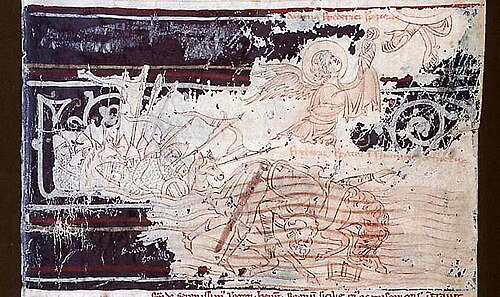
The legend has been read as prophecy from the beginning, as seen in the Italian collection Sibyla Eritrea, the Sächsische Weltchronik (1260), Salimbene di Adam's Cronica (1280). Barbarossa appears in a Messianic form, not just a new but also the final type of ruler – emperor of peace, who is associated with the latter days.[11] In later centuries, German propaganda played into the exaggerated fables believed by the common people by characterizing Frederick Barbarossa and Frederick II as personification of the "good king".[9] Other figures like Martin Luther, Frederick II the Great of Prussia and Bismarck also became associated with the cult of the national leader, which would later be mobilized by national socialists.[12][13]
La cacciata dell'imperatore Barbarossa da Alessandria ("The expulsion of Emperor Barbarossa from Alexandria") of Carlo Arienti (1851).
Another legend states that when Barbarossa was in the process of seizing Milan in 1158, his wife, the Empress Beatrice, was taken captive by the enraged Milanese and forced to ride through the city on a donkey in a humiliating manner. Some sources of this legend indicate that Barbarossa implemented his revenge for this insult by forcing the magistrates of the city to remove a fig from the anus of a donkey using only their teeth.[14] Another source states that Barbarossa took his wrath upon every able-bodied man in the city, and that it was not a fig they were forced to hold in their mouth, but excrement from the donkey. To add to this debasement, they were made to announce, "Ecco la fica" (meaning "behold the fig"), with the feces still in their mouths. It used to be said that the insulting gesture (called fico), of holding one's fist with the thumb in between the middle and forefinger came by its origin from this event.[15] This legend is mentioned in Gargantua and Pantagruel (sixteenth century).[16]
フリードリヒの叔父であるフライジングのオットーは、フリードリヒの治世に関する記録『Gesta Friderici I imperatoris』(皇帝フリードリヒの業績)を著した。オットーのもう一つの主要な著作である『 Chronica sive Historia de duabus civitatibus 』 (二つの都市の年代記または歴史)は、ヒッポのアウグスティヌスの『 Civitas Dei 』 (神の国)の解説であり、世界と歴史の本質に関するアウグスティヌス的な否定論に満ちていた。フリードリヒに関する彼の著作は正反対のトーンで、皇帝の権威の輝かしい可能性を楽観的に描いている。[ 22 ] [ 23 ]オットーは最初の2巻を完成させた後に亡くなり、残りの2巻は彼の学長であるラヘヴィンに託された。ラヘヴィンのテキストは、ところどころ古典的な先例に大きく依存している。[ 24 ]
Bernd Schütte credits Ferdinand Oppl with raising the research of Frederick I to a new and resilient level, with contributions both through studies and bibliographical additions (Oppl is both a researcher and an archiver).[31] Opll's Friedrich Barbarossa presents the emperor as a pragmatic leader with a capacity of adaptation and recovery after defeat.[32] Jean-Yves Mariotte highly praises the works but adds that more clarity on the subjects of the imperial function or the financial aspect of the monarchy might widen the perspective.[33]
1871 Hohenstaufen Castle commemorative sheet for the national monument project (magazine "Über Land und Meer; source: Hohenstaufen/Helfenstein 2003, p.144)
Knut Görich's works on Frederick include Friedrich Barbarossa: Eine Biographie and Die Ehre Friedrich Barbarossas: Kommunikation, Konflikt und politisches Handeln im 12. Jahrhundert, in which he extensively discusses Frederick's attachment to the concept of honor imperii, which was tied to not only his self-understanding as a ruler, but also rights and duties, and also subject to balancing acts with what was politically possible.[34][35] Görich does not see the 1177 Peace of Venice as a defeat for Frederick but a return to consensus, which later helped make room for maneuvre.[36]Graham Loud agrees with Görich that the concept and language of honour permeated Frederick's reign but sometimes, they might have masked complex realities. Loud also notes Görich credibly shows Frederick as a man of ambition, calculation and skills – one of those was "an ability to satisfy and to recompense those who were not necessarily within his inner circle". On the other hand, Loud opines that Görich mentions Frederick's rule north of the Alps too little.[30] Contrary to Laudage, Görich questions whether traditional researchers have overemphasized the intentional side of Frederick's politics and instead highlights his capability of moderating consensus politics and the will to trial new modes of rulership.[37]
The reign of Barbarossa is noted for the flourishing of courtly culture and chivalrous literature. Peter Munz opines that this is "additional proof of social transformation which resulted in a universalization of feudal relationships."[53]
Barbarossa's patronage of learning aimed chiefly at legal studies, specifically Roman laws. He took a special interest in the Law school of Bologna, granted the Authentica habita, granted the Bolognese clerics privileges and recognize the law's important role in imperial administration. The new legal learning influenced the laws issued by the emperor in Roncaglia.[57][58][59]
Historiography and literature
Thomas Foerster remarks that the cultural and intellectual flourishing in Frederick's court was the result of both the expansion towards the Regnum Italia and the Mediterranean as well as Frederick's 1156 wedding to Beatrix of Burgundy. On one hands, the new king-emperor, through his deeds and achievements, inspired the intellectuals and historians of his time to produce works of poetry and historiography. On the other hands, the emperor showed an interest in the deeds of historical rulers, as evident in Otto of Freising's Chronica de duabus civitatibus, a Latin world chronicLe recording history from the creation of man to Frederick's era, and Gesta Friderici Imperatoris, a notable early Hohenstaufen historiographical work.[60] Other notable works include the Carmen de gestis Frederici imperatoris in Lombardia, authored by a scholar residing in Italy; the Historia expeditione Frederici, referring the 1189–90 crusade; Ligurinus, an epic poem that turns the prose of the Gesta Friderici into verse; the works of Godfrey of Viterbo, who served both Barbarossa and Henry VI.
前述のキフホイザー記念碑以外にも、ドイツ帝国初期には、ゴスラーにおいて、旧皇帝宮殿(カイザープファルツ)を中心に、フリードリヒとヴィルヘルム1世を結びつける図像プログラムが実施された。ロベルト・トベレンツ(1849~1895)が1893~1895年に制作し、1900年まで設置されていたフリードリヒ・バルバロッサの有名な騎馬像がゴスラーにあり、その近くにはヴィルヘルムの像が立っている(北側にフリードリヒ、南側にヴィルヘルム)。カイザープファルツには、フリードリヒの生涯を描いた絵画も飾られていました。[ 108 ] [ 109 ] [ 110 ] [ 111 ]ヨハネス・ヴィスリツェヌスが主宰し、歴史と童話(眠れる森の美女、またはドルンレーシェンとしてのドイツ国民)と叙事詩(バルバロッサ伝説)を融合させ、中世と近代を融合させました。[ 112 ]帝国宣言では、フリードリヒは宣言を承認して見下ろし、ルイーゼ女王はゲルマニアとして紹介されました。[ 113 ]このプログラムの他の絵画には、Barbarossa Erwachen (目覚めたバルバロッサ)、Barbarossa Fußfall vor Heinrich dem Löwen (ライオンのヘンリーの前でひざまずくバルバロッサ、1176 年にフリードリヒがキアヴェンナでランゴバルドに対する軍事援助をヘンリーに懇願する様子が描かれている)、バルバロッサ・ジーク・バイ・イコニウム(イコニウムでのバルバローザの勝利)、Heinrich der Löwe bittet Barbarossa um Verzeihung (ライオン王ハインリヒがバルバロッサに許しを乞い、1181年のエアフルトでの出来事を描いている)。[ 114 ]
L'Imperatore Federico Barbarossa、Durante il lungo assedio di Alessandria、avendo tentato d'impadronirsi per sorpresa della città、ne viene cacciato dal Popolo (1174)。 「フェデリコ・バルバロッサ・カッチャート・ダ・アレッサンドリア」 (アレクサンドリアから追放されたフレデリック・バルバロッサ)は、カルロ・アリエンティによる 1851 年の絵画です。[ 115 ]
1862 年頃、フィリッポ カルカーノは「フェデリコ バルバロッサとイル ドゥカ エンリコ イル レオーネ ア キアヴェンナ」を描きました。 Federico Barbarossa e il duca Enrico il Leone a Chiavenna (フレデリック・バルバロッサとキアヴェンナのヘンリー・ザ・ライオン公爵)。[ 125 ]
In 1892, in 1892, Konstanz's sculptor Hans Baur (1829–1897), won the competition to build a fountain to replace the then dilapidated fountain in the Marktstätte. Baur built a red sandstone four-sided stele or obelisk at the centre of a granite basin of the fountain, now called Kaiserbrunnen (Imperial Fountain). Four great German emperors, representing four great ruling dynasties were chosen: Heinrich III (Franks), Friedrich Barbarossa (Hohenstaufen), Maximilian I (Habsburg) und Wilhelm I (Hohenzollern). The choices and manners of depicting the emperors were considered traditional. When the new fountain was unveiled on 30 October 1897, Bauer had died six months before. Later, the portraits were melted down during wartime.[126] In 1993, new imperial portraits were made by Gernot and Barbara Rumpf. Maximilian (now together with his unloved empress Bianca Maria Sforza), and Frederick Barbarossa returned, depicted in a caricatural manner, while Otto I was introduced (depicted seriously). Barbarossa's figure is fused with that of a large fish, seemingly symbolizing his water-related death. Emperor Wilhelm I was replaced with a pigeon, perhaps symbolizing peace.[127][128]
Madonna di Provenzano con Federico Barbarossa e Alessandro III is a 1959 palio painting by Vasco Valacchi describing Frederick kneeling in front of Pope Alexander III beside the figure of Madonna of Provenzano.[130]
Madonna di Provenzano con Federico Barbarossa e Alessandro III is a 1981 palio painting by Mario Ghezzi on the same subject.[131]
On the occasion of the 800th anniversary of the Mainz Imperial Festival and the Diet of Pentecost 1184, Erwin Mosen's team created a Barbarossa monument (2m in height; the emperor is shown flanked by his two sons in Mainz.[132][133]
Novels
Peace of Constance with the Lombards, fresco, Rathaus, Konstanz
↑Bernhard, Henry (3 September 2019). "Kyffhäuser in Thüringen - Barbarossa als Touristenmagnet und Mythos der extremen Rechten". Deutschlandfunk Kultur (in German). Retrieved 1 March 2022.
↑Drescher, Michael Rodegang (31 December 2016). Poets of Protest: Mythological Resignification in American Antebellum and German Vormärz Literature. transcript Verlag. p.254. ISBN978-3-8394-3745-2. Retrieved 23 February 2022.
↑Bessel, Professor of Twentieth-Century History Richard (28 March 1996). Fascist Italy and Nazi Germany: Comparisons and Contrasts. Cambridge University Press. p.121. ISBN978-0-521-47711-6. Retrieved 22 February 2022.
↑Schulze, Hagen (2007). Kleine deutsche Geschichte: mit Bildern aus dem Deutschen Historischen Museum (in German). C.H.Beck. p.6. ISBN978-3-406-56130-6. Retrieved 23 February 2022.
↑DePierre, David (26 June 2017). A Brief History of Oral Sex. McFarland. p.71. ISBN978-1-4766-7126-0. Retrieved 22 February 2022.
↑Sorba, Carlotta (3 May 2021). Politics and Sentiments in Risorgimento Italy: Melodrama and the Nation. Springer Nature. p.134. ISBN978-3-030-69732-7. Retrieved 22 February 2022.
↑Allen, Beverly; Russo, Mary J. (1997). Revisioning Italy: National Identity and Global Culture. U of Minnesota Press. p.82. ISBN978-0-8166-2727-1. Retrieved 22 February 2022.
↑ベルントのシュッテ。"Böhmer, JF; Opll, Ferdinand (Bearb.): Die Regesten des Kaiserreiches unter Friedrich I. 1152 (1122)–1190. 4. Lieferung 1181–1190. ウィーン: Böhlau Verlag Wien 2011. ISBN: 978-3-205-78683-2;リヴ、345S。」ソズクルト。2022 年2 月 22 日に取得。
↑クリスティーニ、マルコ (2016)。La Distruzione di Milano (1162)/シラノス、ピエトロ。 Sprenger、Kai-Michael (Hrsg.)、2015/Buchrezensionen。ヴィタ エ ペンシエロ。ISBN97888343300982023年7月30日に取得。
↑ McDonald, William C.; Goebel, Ulrich (1973). German Medieval Literary Patronage from Charlemagne to Maximilian I: A Critical Commentary with Special Emphasis on Imperial Promotion of Literature . Rodopi. p. 74 . 2023年7月29日取得.
↑ラインバッハ、カール・ルートヴィヒ (1896)。Die Deutschen Dichter der Neuzeit und Gegen-wart: Biographien, Charakteristiken und Auswahl ihrer Dichtungen (ドイツ語)。 T.ケイ。 p. 139 . 2022 年5 月 28 日に取得。
↑ Reinink, AW; Stumpel, Jeroen (2012年12月6日). Memory & Oblivion: Proceedings of the XXIXth International Congress of the History of Art held in Amsterdam, 1–7 September 1996. Springer Science & Business Media. pp. 568–570 . ISBN978-94-011-4006-52022年2月14日に取得。
↑ポールサンダー、ハンス A. (2008). 19世紀ドイツにおける国家記念碑とナショナリズム. ピーター・ラング. p. 245. ISBN978-3-03911-352-12022年2月14日に取得。
↑ "Zum Tode von Erwin Mosen - Künstler für Kostheim | Aus der Vereinswelt - AKK Zeitung"。akkzeitung.de。2018年12月13日のオリジナルからアーカイブ。2022 年3 月 19 日に取得。
↑レテクシエ、ジェラール (2002)。マダム・ド・ヴィルデュー (1640-1683): une chroniqueuse aux Origines de La Princesse de Clèves (フランス語)。ミナールの近代的な手紙。75 ~ 78ページ。ISBN978-2-256-91037-12022年3月14日に取得。
↑バッハー、ジュリアス (1858)。フリードリヒの「デ・エルステン・レッツテ・レーベンステージ: ジュリアス・バッハーのドライ・ベンデンの歴史ロマン」。 (Fortsetzung des Romans: "Sophie Charlotte, die philosophische Königin.) (ドイツ語). R. Wagner . 2022 年2 月 19 日閲覧。
↑サラチェーニ、ピエトロ (1873)。Federico Barbarossa all'assedio di Crema romanzo storico Pietro Saraceni (イタリア語)。カルロ・バルビーニ2022 年3 月 1 日に取得。
↑バーグ、ステファニー・バーバラ (1994)。Heldenbilder und Gegensätze: Friedrich Barbarossa und Heinrich der Löwe im Urteil des 19. und 20. Jahrhunderts (ドイツ語)。点灯。 p. 227.ISBN978-3-8258-2121-02022年5月28日に取得。
↑ルーマン、イザベル(2021年4月30日)。Die Staufer in der Populären Geschichtskultur: Ein Rezeptionspanorama seit den 1970er Jahren (ドイツ語)。トランスクリプトVerlag。 p. 170.ISBN978-3-8394-5434-32022年3月5日に取得。
↑ "Ausstellung zu Kaiser Barbarossa im Schloss Cappenberg und im LWL-Museum" . Ruhr Nachrichten (ドイツ語)。 2020 年 9 月 18 日。2022 年2 月 27 日に取得。
↑ 「Pressemeldungen Detailansicht: Staatliche Schlösser und Gärten Baden-Württemberg」。www.klosterlorch.de (ドイツ語)。
↑ "1122 – Kaiser Friedrich Barbarossa zum 900. Geburtstag – Volkshochschule Ludwigsburg" . www.vhs-ludwigsburg.de 。2022 年2 月 27 日に取得。
↑ 「ヴォルトラグ: 「900。 Geburtstag Kaiser Friedrich Barbarossa 1122/2022 – Leben und Wirken des Stauferkaisers" – Bad Frankenhausen" (ドイツ語)。 2022年2月。 2022年2月27日のオリジナルからアーカイブ。2022 年2 月 27 日に取得。
ギーゼブレヒト (1895)。Geschichte der deutschen Kaiserzeit (ドイツ語)。シュヴェチケ。
ゲーリッヒ、クヌート (2001)。Die Ehre Friedrich Barbarossa: Kommunikation, Konflikt und politisches Handeln im 12. Jahrhundert (ドイツ語)。 Wissenschaftliche Buchgesellschaft。ISBN978-3-534-15168-42022年2月19日に取得。
ゲーリッヒ、クヌート(2011 年 11 月 22 日)。フリードリヒ・バルバロッサ:アイネの伝記(ドイツ語)。 CHベック。 p. 217.ISBN978-3-406-62149-92022年2月19日に取得。