
Loading article…

The mast of a sailing vessel is a tall spar, or arrangement of spars, erected vertically or near-vertically on the median line of a ship or boat. A mast may carry sails, spars, and derricks. It may also give necessary height to a navigation light, look-out position, signalyard, control position, radio aerial, or signal lamp.[1] Large ships have several masts, with the size and configuration depending on the style of ship. Nearly all sailing masts are guyed.[2]
Until the mid-19th century, all vessels' masts were made of wood, formed from one or several pieces of timber. This was typically the trunk of a single conifer tree; however, from the 16th century, vessels were often built too large for that. Larger vessels needed taller and thicker masts, which could not be made from single tree trunks. To achieve the required height, these masts were built from up to four sections (also called masts). From lowest to highest, these were called "lower", "top", "topgallant", and "royal" masts.[3] In addition, the lower sections themselves needed to be built from multiple pieces of wood to make them thick enough. Sections made from multiple pieces were known as made masts, while a section formed from a single piece was known as a pole mast.
Those who specialised in making masts were known as mastmakers.

For square-sail carrying ships, masts in their standard names in bow to stern (front to back) order, are:
他のタイプの帆装を備えた船舶のマストに付けられる名称(命名規則が標準化されていない場合)には、以下のようなものがある。
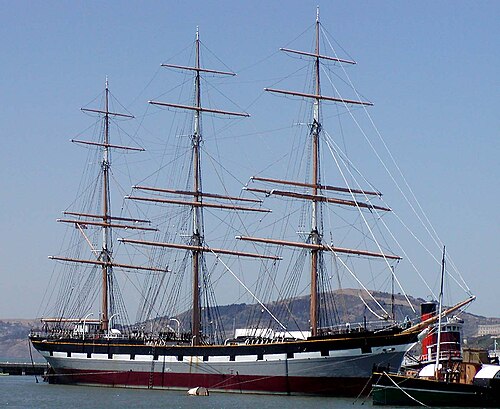
船にマストが2本ある場合、一般的に、メインマストは最も大きな帆を張るマストです。したがって、ブリッグでは、前方のマストがフォアマスト、後方のマストがメインマストです。2本のマストを持つスクーナーでは、マストの高さが同じであっても、後方のマストの方が通常大きな帆を張るため(より長いブームを使用できるため)、後方のマストがメインマストとなります。これは、ケッチやヨールとは対照的です。ケッチやヨールでは、後方のマストとそのメインセイルは明らかに2本のうち小さい方なので、用語は(前方から)メインマストとミズンとなります。(ヨールでは、後方のマストを「ジガー」と呼ぶこともあります。)[ 5 ]
2本マストのラガーの中には、前マストと後マストのみを備え、メインマストがないものもあります。これは、これらの伝統的なタイプの船はかつて3本のマストを備えていましたが、メインマストを省略し、残りのマストに大きな帆を張る方が便利であることがわかったためです。これにより、特に漁船において、より広い作業スペースが確保されました。[ 6 ]: 19
横帆船では、各マストに複数の水平ヤードがあり、そこから個々の帆が張られる。[ 7 ]
Folding mast ships use a tabernacle anchor point. Definitions include: "the partly open socket or double post on the deck, into which a mast is fixed, with a pivot near the top so that the mast can be lowered";[8] "large bracket attached firmly to the deck, to which the foot of the mast is fixed; it has two sides or cheeks and a bolt forming the pivot around which the mast is raised and lowered"; "substantial fitting for mounting the mast on deck, so that it can be lowered easily for trailering or for sailing under bridges",[9] "hinged device allowing for the easy folding of a mast 90 degrees from perpendicular, as for transporting the boat on a trailer, or passing under a bridge" [10]
The oldest evidence for the use of masts comes from the Ubaid period site of H3 in Kuwait, dating to the second half of the sixth millennium BC. Here, a clay disc made from a sherd that appears to depict a reed bundle boat with two masts has been recovered.[11]
西欧では、帆走速度を上げ、航行性能を向上させるために、船に複数のマストを装備するという概念が、地中海北部で発展しました。最古の前マストは、紀元前7世紀半ばにイタリアのカーレで発見されたエトルリアのピクシスで確認されています。メインセイルを畳んだ軍艦が、フォアセイルを展開している敵船と交戦している様子が描かれています。[ 12 ]紀元前475年から450年のエトルリアの墓の壁画には、わずかに傾斜した前マストに大きなフォアセイルを張った2本マストの商船が描かれています。 [ 13 ]紀元前6世紀後半には、ガレー船のメインセイルとほぼ同じ大きさのアルテモン(ギリシャ語でフォアセイル)がコリントスのクラテルに見られます。それ以外では、紀元前4世紀まではギリシャのロングシップには一様にアルテモンが描かれていませんでした。[ 14 ]東洋では、 2 世紀初頭のカリンガ王国のような古代インドの王国が海軍の帆船を指揮していたと考えられています。インドにおける帆船建造の最も初期の記録された証拠の 1 つは、西暦 400 ~ 500 年頃に遡るアジャンター石窟の 3 本マスト船の壁画です。[ 15 ] [ 16 ]
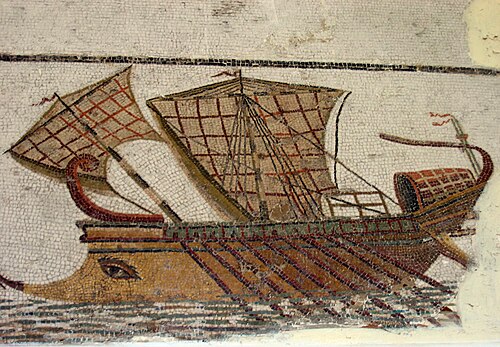
前マストはローマのガレー船でかなり一般的になり、45°の角度で傾けられており、バウスプリットに似ており、そこに張られた小型の前帆は、推進力というよりは操舵の補助として使われていたようです。[ 14 ] [ 17 ]古代の証拠のほとんどは図像的なものですが、前マストの存在は、メインセイルには船首に近すぎる位置にある前マストの脚の溝から考古学的に推測することもできます。[ 18 ]

Artemon, along with mainsail and topsail, developed into the standard rig of seagoing vessels in imperial times, complemented by a mizzen on the largest freighters.[19] The earliest recorded three-masters were the giant Syracusia, a prestige object commissioned by king Hiero II of Syracuse and devised by the polymath Archimedes around 240 BC, and other Syracusan merchant ships of the time.[20] The imperial grain freighters travelling the routes between Alexandria and Rome also included three-masted vessels.[20] A mosaic in Ostia (c. 200 AD) depicts a freighter with a three-masted rig entering Rome's harbour.[21] Special craft could carry many more masts: Theophrastus (Hist. Plant. 5.8.2) records how the Romans imported Corsican timber by way of a huge raft propelled by as many as fifty masts and sails.[22]

Throughout antiquity, both foresail and mizzen remained secondary in terms of canvas size, although large enough to require full running rigging.[19] In late antiquity, the foremast lost most of its tilt, standing nearly upright on some ships.[19]
By the onset of the Early Middle Ages, rigging had undergone a fundamental transformation in Mediterranean navigation: the lateen which had long evolved on smaller Greco-Roman craft replaced the square rig, the chief sail type of the ancients, that practically disappeared from the record until the 14th century (while it remained dominant in northern Europe).[23][24] The dromon, the lateen-rigged and oared bireme of the Byzantine navy, almost certainly had two masts, a larger foremast and one midships. Their length has been estimated at 12 m and 8 m respectively, somewhat smaller than the Sicilian war galleys of the time.[25]
Multiple-masted sailing ships were reintroduced into the Mediterranean Sea by the Late Middle Ages. Large vessels were coming more and more into use and the need for additional masts to control these ships adequately grew with the increase in tonnage. Unlike in antiquity, the mizzen-mast was adopted on medieval two-masters earlier than the foremast, a process which can be traced back by pictorial evidence from Venice and Barcelona to the mid-14th century. To balance out the sail plan the next obvious step was to add a mast fore of the main-mast, which first appears in a Catalan ink drawing from 1409. With the three-masted ship established, propelled by square rig and lateen, and guided by the pintle-and-gudgeonrudder, all advanced ship design technology necessary for the great transoceanic voyages was in place by the beginning of the 15th century.[26]
The first hollow mast was fitted on the American sloop Maria in 1845, 28 m (92 ft) long and built of staves bound with iron hoops like a barrel. Other hollow masts were made from two tapered timbers hollowed and glued together.[27] Nearly a century later, the simple box form of mast was arrived at.[27]
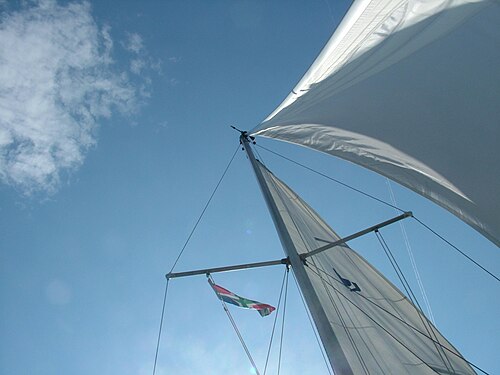

Although sailing ships were superseded by engine-powered ships in the 19th century, recreational sailing ships and yachts continue to be designed and constructed.
In the 1930s aluminum masts were introduced on large J-class yachts. An aluminum mast has considerable advantages over a wooden one: it is lighter and slimmer than a wooden one of the same strength, is impervious to rot, and can be produced as a single extruded length. During the 1960s wood was eclipsed by aluminum. Aluminum alloys, generally 6000 series, are commonly utilised.[28]
Recently some sailing yachts (particularly home-built yachts) have begun to use steel masts. Whilst somewhat heavier than aluminum, steel has its own set of advantages. It is significantly cheaper, and a steel mast of an equivalent strength can be smaller in diameter than an aluminum mast, allowing less turbulence and a better airflow onto the sail.[29][30]
1990年代半ばから、レーシングヨットでは、強度対重量比をさらに向上させるために、炭素繊維などの複合材料を用いたマストが採用されるようになった。炭素繊維製のマストは、より精密に設計された空力形状を持つことも可能になった。
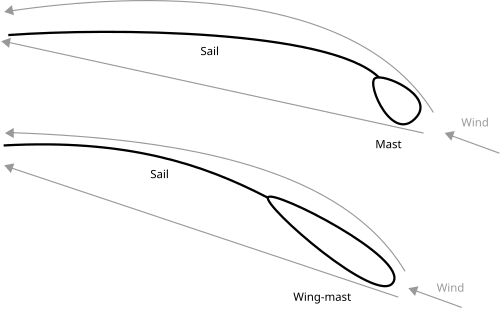
現代の帆柱は帆の翼型の先端部を形成し、涙滴型の断面形状をしていることが多い。小型のレーシングヨットやカタマランでは、帆の翼型に最適な角度にマストが回転する。マストの断面が細長く、翼型の大部分を占める場合は、ウィングマストと呼ばれる。ウィングマストを使用するヨットは、マスト面積が大きい分、帆面積が小さくなる。あらゆるサイズの帆走ヨット用の現代的なマストを製造するメーカーは数多くあり、中でもHall Spars、Offshore Spars、Southern Sparsは特に有名な企業である。
帆船時代の終焉後も、蒸気船はマストを保持し、船同士の通信は就役旗や社旗から実際の信号や礼儀作法に至るまで、依然として灯火や信号旗に頼っていた。軍艦は観測員の観測所として、また測距儀などの射撃管制装置を設置するためにもマストを使用した。[ 31 ] [ 32 ]
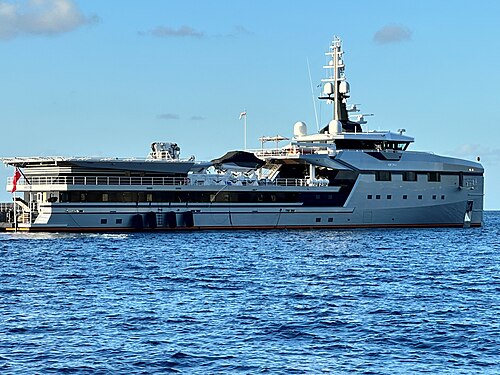
通信技術が進歩するにつれて、マストはレーダーや通信アンテナの便利な設置場所として利用されるようになりました。これらのアンテナは、より高い位置に設置することで通信範囲が広がるという利点があります。マスト自体も、簡素な帆船のマストのむき出しのポールから、艦船のレーダー断面積を低減することを目的とした軍艦の密閉型マスト、そして今日の商船やスーパーヨットのアーチやマストへと進化してきました。[ 33 ] [ 34 ]
旗の使用は、海事儀礼とヨットレースの役員の両方において依然として重要な役割を果たしており、そのため多くのパワーボートは設計にマストを取り入れ続けている。[ 35 ] [ 36 ] [ 37 ] [ 38 ]



{{cite book}}: ISBN / Date incompatibility (help)