In general, there were no significant differences in regional height levels throughout the nineteenth century.[75] The only exceptions to this rather uniform height distribution were people in the Anglo-Saxon settlement regions who were taller than the average and people from Southeast Asia with below-average heights. However, at the end of the nineteenth century and in the middle of the first globalization period, heights between rich and poor countries began to diverge.[76] These differences did not disappear in the deglobalization period of the two World wars. In 2014, Baten and Blum found that in the nineteenth century, important determinants of height were the local availability of cattle, meat and milk as well as the local disease environment. In the late twentieth century, however, technologies and trade became more important, decreasing the impact of local availability of agricultural products.[77]
Netherlands
Data derived from burials show that before 1850, the mean stature of males and females in Leiden, Netherlands, was respectively 167cm (5ft 6in) and 156cm (5ft 1in). The average height of 19-year-old Dutch orphans in 1865 was 160cm (5ft 3in).[78]
From 1830 to 1857, the average height of a Dutch person decreased, even while Dutch real GNP per capita was growing at an average rate of more than 0.5% per year. The worst decline was in urban areas that in 1847, the urban height penalty was 2.5cm (1.0in). Urban mortality was also much higher than in rural regions. In 1829, the average urban and rural Dutchman was 164cm (5ft 5in). By 1856, the average rural Dutchman was 162cm (5ft 4in) and urban Dutchman was 158cm (5ft 2in).[79]
In the late nineteenth century, the Netherlands was a land renowned for its short population, but as of 2012, Dutch people were among the world's tallest, with young men averaging 183cm (6ft 0in) tall.[80]
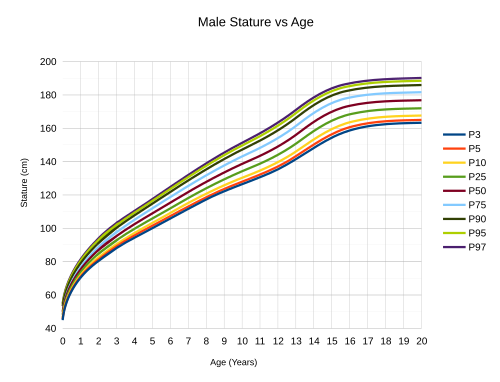
例えば、一般的な測定誤差がプラスマイナス0.5 cm (0.2インチ)の場合、実際の成長0.5 cm が完全に相殺され、その結果、同じ測定間隔で、マイナス 0.5 cm の成長 (前回の測定で過大評価され、2回目の測定で過小評価された場合) から、最大1.5 cm (0.6インチ) の成長 (最初の測定で過小評価され、2回目の測定で過大評価された場合) となる可能性があります。なお、2 歳の成長曲線には不連続性がありますが、これは乳幼児の測定に使用される仰臥位身長 (子供が仰向けになっている状態) と、2 歳以降に通常測定される立位身長との違いを反映しています。
↑カーター、パメラ・J. (2008).リッピンコット看護助手教科書:人間主義的アプローチによる介護. 米国:リッピンコット、ウィリアムズ&ウィルキンス. p. 306. ISBN978-0-7817-6685-2。
1 2 Baten, Joerg; Matthias, Blum (2012). "Growing Tall: Anthropometric Welfare of World Regions and its Determinants, 1810-1989". Economic History of Developing Regions . 27 . doi : 10.1080/20780389.2012.657489 . S2CID 154506540 – via ResearchGate.
↑ Hulanicka, B.; Kotlarz, K. (1983). "身長成長の最終段階". Annals of Human Biology . 10 (5): 429–433 . doi : 10.1080/03014468300006621 . ISSN 0301-4460 . PMID 6638938 .
1 2 Grantham-Mcgregor, S.; Cheung, YB; Cueto, S.; Glewwe, P. ; Richter, L.; Strupp, B. (2007). "Developmental potential in the first 5 years for children in developing countries" . The Lancet . 369 (9555): 60– 70. Bibcode : 2007Lanc..369...60G . doi : 10.1016/S0140-6736(07)60032-4 . PMC 2270351 . PMID 17208643 .
↑表 1. 生物学的変数と人口統計学的変数と身長との関連。数値は、Rona RJ、Mahabir D、Rocke B、Chinn S、Gulliford MC (2003) 「トリニダード・トバゴにおける社会的不平等と子供の身長」 European Journal of Clinical Nutrition . 57 (1): 143– 50. doi : 10.1038/SJ.ejcn.1601508 . PMID 12548309に示されている各変数について調整された係数 (95% 信頼区間)です。
1 2ミラー、ジェーン E. (1993). 「フィリピンにおける初産時の母親の年齢による出産結果」。International Family Planning Perspectives . 19 (3): 98– 102. doi : 10.2307/2133243 . JSTOR 2133243 .
1 2 Pevalin, David J. (2003). 「母親の出産時の年齢による小児期および成人期の転帰:1970年英国コホート研究からの証拠」 ISERワーキングペーパー。
↑ Hermanussen, M.; Hermanussen, B.; Burmeister, J. (1988). "出生順位と成人身長の関連性". Annals of Human Biology . 15 (2): 161– 165. doi : 10.1080/03014468800009581 . PMID 3355105 .
↑ Myrskyla, M (2013年7月) 「身長と出生順位の関連性:スウェーデン人男性652,518人からのエビデンス」 . Journal of Epidemiology and Community Health . 67 (7): 571–7 . doi : 10.1136/jech-2012-202296 . hdl : 10810/64275 . PMID 23645856 . S2CID 19510422 .
↑ Chan Y, et al. (2015). "Genome-wide Analysis of Body Proportion Classifies Height-Associated Variants by Mechanism of Action and Implicates Genes Important for Skeletal Development" . American Journal of Human Genetics . 96 (5): 695– 708. doi : 10.1016/j.ajhg.2015.02.018 . PMC 4570286 . PMID 25865494 .
↑ Chali D (1995). 「難民キャンプにおけるナイル系部族の身体計測」. Ethiopian Medical Journal . 33 (4): 211–7 . PMID 8674486 .
1 2 Komlos, J.; Baur, M. (2004). "最も背の高い人から最も太った人へ:20世紀のアメリカ人口の謎めいた運命". Economics & Human Biology . 2 (1): 57–74 . CiteSeerX 10.1.1.651.9270 . doi : 10.1016/j.ehb.2003.12.006 . PMID 15463993. S2CID 14291466 .
↑ Baten, Joerg; Moradi, Alexander (2005). "サハラ以南アフリカの不平等:人体計測推定値からの新たなデータと新たな洞察". World Development . 33 (8): 1233– 1265. doi : 10.1016/j.worlddev.2005.04.010 .
↑ De Onis, M.; Blössner, M.; Borghi, E. (2011). "就学前児童における発育阻害の有病率と傾向、1990~2020年" . Public Health Nutrition . 15 (1): 142– 148. doi : 10.1017/S1368980011001315 . PMID 21752311 .
↑ Encuesta Nacional de Salud Materno Infantil、2008-2009 [グアテマラ生殖健康調査 2008-2009 ] (PDF)。グアテマラシティ、グアテマラ:Ministryio de Salud Pública y Asistencia Social。 2010 年 12 月。p. 670. 2011 年 11 月 13 日のオリジナル(PDF)からアーカイブ。2013 年4 月 26 日に取得。
↑ Judge, TA; Cable, DM (2004). "The Effect of Physical Height on Workplace Success and Income: Preliminary Test of a Theoretical Model" (PDF) . Journal of Applied Psychology . 89 (3): 428– 441. doi : 10.1037/0021-9010.89.3.428 . PMID 15161403 . 2012年9月14日にオリジナル(PDF)からアーカイブ済み。
↑ Nicola, Persico; Andrew, Postlewaite; Silverman, Dan (2004). "The Effect of Adolescent Experience on Labor Market Outcomes: The Case of Height" (PDF) . Journal of Political Economy . 112 (5): 1019– 1053. doi : 10.1086/422566 . S2CID 158048477 .
↑ Heineck G. (2005). "空高く?ドイツにおける身長と収入の関係" (PDF) . Labour . 19 (3): 469– 489. doi : 10.1111/j.1467-9914.2005.00302.x . S2CID 18176180 .
↑ Piotr, Sorokowski (2010). 「政治家の推定身長は人気度を示す指標となる」European Journal of Social Psychology . 40 (7): 1302– 1309. doi : 10.1002/ejsp.710 .
↑ Komlos, John (1998). "成長経済における縮小?産業革命期の身体的身長の謎". Journal of Economic History . 58 (3): 779– 802. doi : 10.1017/S0022050700021161 . S2CID 3557631 .
↑ Komlos, J. (2007). On English Pygmies and Giants: The physical stature of English youth in the late 18th and early 19th centuries . Research in Economic History. Vol. 25. pp. 149–168 . CiteSeerX 10.1.1.539.620 . doi : 10.1016/S0363-3268(07)25003-7 . ISBN978-0-7623-1370-9. S2CID 12218137 .
↑ Baten, Joerg; Blum, Matthias (2012). "Growing tall but unequal: new findings and new background evidence on anthropometric welfare in 156 countries, 1810-1989". Economic History of Developing Regions . 27 : 566–585 . doi : 10.1080/20780389.2012.657489 . S2CID 154506540 .
↑ Baten, Joerg (2006). "世界の工業国および発展途上国における身長の傾向、1810-1984年:概要". Recuperado el . 20 .
↑ Baten, Joerg; Blum, Matthias (2014). "なぜあなたは背が高く、他の人は背が低いのか?農業生産と世界の身長のその他の近接決定要因" . European Review of Economic History . 18 (2): 144– 165. doi : 10.1093/ereh/heu003 .
↑モスクロップ、アンドリュー。ドーリング、ダニー。コール、ティム(2026年3月2日)。」「英国の子どもは縮んでいない」が、子どもの身長は間違った理由で増加している:イングランド、スコットランド、ウェールズの子ども測定プログラムデータの傾向と不平等」。Journal of Epidemiology and Community Health :jech – 2025–225029。doi :10.1136 /jech-2025-225029。ISSN 0143-005X。
↑ van der Eng, Pierre; Baten, Joerg; Stegl, Mojgan (2010). "インドネシアの長期経済成長と生活水準" (PDF) . SSRN Electronic Journal . Elsevier BV. doi : 10.2139/ssrn.1699972 . ISSN 1556-5068 . S2CID 127728911 .
↑ Krul AJ、Daanen HA、Choi H(2011年8月)。「イタリア、オランダ、北米における自己申告および実測による体重、身長、体格指数(BMI)」。 European Journal of Public Health。21(4):414–419。doi :10.1093 / eurpub / ckp228。PMID 20089678。
Case, A. & Paxson, C. (2008). "Stature and Status: Height, ability, and labor market outcomes" . The Journal of Political Economy . 116 (3): 499–532 . Bibcode : 2008JPoEc.116..499C . doi : 10.1086/589524 . PMC 2709415. PMID 19603086 .
Habicht, Michael E.; Henneberg, Maciej; Öhrström, Lena M.; Staub, Kaspar & Rühli, Frank J. (2015年4月27日). 「ミイラ化したファラオの身長は、兄弟婚の歴史的示唆を裏付ける」. American Journal of Physical Anthropology . 157 (3): 519–525 . Bibcode : 2015AJPA..157..519H . doi : 10.1002/ajpa.22728 . PMID 25916977. S2CID 205335354 .
Ogden, Cynthia L.、Fryar, Cheryl D.、Carroll, Margaret D.、Flegal, Katherine M. (2004年10月27日) 「米国における平均体重、身長、および体格指数 1960~2002年」(PDF) . Advance Data from Vital and Health Statistics (347): 1– 17. PMID 15544194 .
Ruff, Christopher (2002年10月)「人間の体格と体型の変異」Annual Review of Anthropology . 31 (1): 211–232 . Bibcode : 2002ARAnt..31..211R . doi : 10.1146/annurev.anthro.31.040402.085407 .
6. Celostátní antropologický výzkum dětí a mládeže 2001、Česká republika [第 6 回子供と若者に関する全国人類学調査 2001、チェコ共和国] (チェコ語)。プラハ: Statní zdravotní ústav (SZÚ;「州立保健研究所」)。 2005.ISBN978-8-07071-251-1。