
Loading article…

ケベック・ナショナリズム(またはケベック民族主義)とは、ケベック民族への文化的帰属意識、ケベック民族の利益の擁護、そしてケベック民族の政治的正当性の承認を最優先する政治イデオロギーである。19世紀初頭からケベック政治における運動であり、中心的な課題であり続けてきた。ケベック民族主義は、長年にわたり、政治的、イデオロギー的、そして党派的な様々な形態や変容を遂げてきた。
ケベック・ナショナリズムは、カナダからのケベック独立を目指す政治運動において中心的な役割を果たしている。多くの団体や政党が自らをケベック・ナショナリストと称している。ケベックの主権ではなく、カナダ国内におけるケベックの権限拡大と独自性の擁護を求める自治主義政党、例えばケベック未来連合なども、自らをケベック・ナショナリストと称している。
ケベック・ナショナリズムは当初「フランス系カナダ人ナショナリズム」として知られていたが、静かなる革命の過程で「ケベック人ナショナリズム」に取って代わられた。
ヌーベルフランスの入植地は、マリタイムズ地方からロッキー山脈、ハドソン湾からメキシコ湾まで広がる7つの地域から成っていました。この広大な土地ではありましたが、入植活動の大部分は現在のカナダにあたる地域に集中していました。17世紀以降、新たに到着したフランス人入植者たちはヌーベルフランスの地形に適応していきました。時が経つにつれ、これらの入植者たちは地域的なカナダ人としてのアイデンティティを形成していきました。これは、新しいアクセントの発達、新しい伝説や物語の創造、社会的な特徴の出現、そしてフランス語の使用に見られます。フランス語の使用は、入植者たちのラング・ドイルの喪失と、植民地の教育を受けた階級が使用するようになった標準フランス語の採用によって始まりました。さらに、多くのラング・ドイルが均質化され、地域特有のアクセントが生まれることで、フランス語は発展していきました。
この時期には、新しく到着した移民はもはや移民としてではなく、カナダ人としてのアイデンティティだけでなく、州のアイデンティティも体現する人々として見なされるようになった。[ 1 ]さらに、入植者の95%がフランス語話者であり、残りの人々が英語話者であったという事実も、この状況を裏付けている。しかし、これは後に論争を引き起こすことになる。
Canada was first established as a French colony. Jacques Cartier claimed it for France in 1534, and permanent French settlement began in 1608. It was part of New France, which constituted all French colonies in North America.[2] Up until 1760, Canadien nationalism had developed itself free of all external influences. However, during the Seven Years' War, the Britishinvaded New France as part of the French and Indian War, winning a conclusive victory at the Battle of the Plains of Abraham. At the Treaty of Paris, France agreed to abandon its claims over New France in return for the island of Guadeloupe. From the 1760s onward, Canadien nationalism developed within a British constitutional context. Despite intense pressure from outside Parliament, the British government drafted the Quebec Act which guaranteed Canadiens the restoration of French civil law; guaranteed the free practice of the Catholic faith; and returned the territorial extensions that they had enjoyed before the Treaty of Paris.[2] In effect, this "enlightened" action by leaders in the British Parliament allowed French Canada to retain its unique characteristics.[3][4] Although detrimental to Britain's relationship with the Thirteen Colonies, this has, in its contemporary assessment, been viewed as an act of appeasement and was largely effective at dissolving Canadien nationalism in the 18th century (especially considering the threat and proximity of American revolutionary ideology) yet it became less effective with the arrival of Loyalists after the revolutions.[5] With the Loyalists splitting the province of Quebec into two identities; Upper Canada and Lower Canada, Canadiens were labelled by the Loyalists as French Canadians.[2]
From 1776 to the late 1830s, the world witnessed the creation of many new national states with the birth of the United States, the French Republic, Haiti, Paraguay, Argentina, Chile, Mexico, Brazil, Peru, Gran Colombia, Belgium, Greece and others. Often accomplished militarily, these national independence movements occurred in the context of complex ideological and political struggles pitting European metropoles against their respective colonies, often assuming the dichotomy of monarchists against republicans. These battles succeeded in creating independent republican states in some regions of the world, but they failed in other places, such as Ireland, Upper Canada, Lower Canada, and Germany.
There is no consensus on the exact time of the birth of a national consciousness in French Canada. Some historians defend the thesis that it existed before the 19th century, because the Canadiens saw themselves as a people culturally distinct from the French even in the time of New France. The cultural tensions were indeed palpable between the governor of New France, the Canadian-born Pierre de Vaudreuil and General Louis-Joseph de Montcalm, a Frenchman, during the French and Indian War. However, the use of the expression la nation canadienne, (the Canadian nation) by French Canadians began in the 19th century.[6] The idea of a nation canadienne was supported by the liberal or professional class in Lower Canada: lawyers, notaries, librarians, accountants, doctors, journalists, and architects, among others. The term la nation canadienne-française became more common after the Act of the Union in 1840.[6]
A political movement for the independence of the Canadien people slowly took form following the enactment of the Constitutional Act of 1791. This act of the British Parliament created two colonies, Lower Canada and Upper Canada, each of which had its own political institutions.[2] In Lower Canada, the French-speaking and Catholic Canadiens held the majority in the elected legislative assembly, but were either a small minority or simply not represented in the appointed legislative and executive councils, both appointed by the governor, representing the British Crown in the colony. Most of the members of the legislative council and the executive council were part of the British ruling class, composed of wealthy merchants, judges, militia officers and other members of the elite supportive of the Tory party. From early 1800 to 1837, the government and the elected assembly were at odds on virtually every issue.
Under the leadership of Speaker Louis-Joseph Papineau, the Parti canadien (renamed Parti patriote in 1826) initiated a movement of reform of the political institutions of Lower Canada. The party's constitutional policy, summed up in the Ninety-Two Resolutions of 1834, called for the election of the legislative and executive councils.
The movement of reform gathered the support of the majority of the representatives of the people among francophones but also among liberal anglophones. A number of the prominent characters in the reformist movement were of British descent, for example John Neilson, Wolfred Nelson, Robert Nelson and Thomas Storrow Brown or of Irish extraction, Edmund Bailey O'Callaghan, Daniel Tracey and Jocquelin Waller.
Two currents existed within the reformists of the Parti canadien: a moderate wing, whose members were fond of British institutions and wished for Lower Canada to have a government more accountable to the elective house's representative and a more radical wing whose attachment to British institutions was rather conditional to this proving to be as good as to those of the neighbouring American republics.
The formal rejection of all 92 resolutions by the Cabinet of the United Kingdom in 1837 led to a radicalization of the patriotic movement's actions. Louis-Joseph Papineau took the leadership of a new strategy which included the boycott of all British imports. During the summer, many popular gatherings (assemblées populaires) were organized to protest against the policy of Great Britain in Lower Canada. In November, Governor Archibald Acheson ordered the arrest of 26 leaders of the patriote movement, among whom Louis-Joseph Papineau and many other reformists were members of parliament. This instigated an armed conflict which developed into the Lower Canada Rebellion.
Following the repression of the insurrectionist movement of 1838, many of the most revolutionary nationalist and democratic ideas of the Parti patriote were discredited.
Although it was still defended and promoted up until the beginning of the 20th century, the French-Canadian liberal nationalism born out of the American and French revolutions began to decline in the 1840s, gradually being replaced by both a more moderate liberal nationalism and the ultramontanism of the powerful Catholic clergy as epitomized by Lionel Groulx.
In opposition with the other nationalists, ultramontanes rejected the rising democratic ideal that the people are sovereign and that the Church should have limited influence in governance. To protect the power of the Church and prevent the rise of democracy and the separation of church-and-state, Lionel Groulx and other intellectuals engaged in nationalistic 'myth-making' or propaganda, to build a nationalistic French-Canadian identity, in purpose to protect the power of the Church and dissuade the public from popular-rule and secularist views. Groulx propagated French-Canadian nationalism and argued that maintaining a Roman Catholic Quebec was the only means to 'emancipate the nation against English power.' He believed the powers of the provincial government of Quebec could and should be used within Confederation, to bolster provincial autonomy (and thus Church power), and advocated it would benefit the French-Canadian nation economically, socially, culturally and linguistically. Groulx successfully promoted Québécois nationalism and the ultra-conservative Catholic social doctrine, to which the Church would maintain dominance in political and social life in Quebec.[7] In the 1920s–1950s, this form of traditionalist Catholic nationalism became known as clerico-nationalism.
静かなる革命という急激な変化が起こるまでの期間、ケベックの人々は、民族主義的なルーツに立ち返ることを含め、生活における伝統的な価値観をより重視するようになった。
当時のナショナリズムとは、旧体制を復活させ、かつてのようにカトリックを基盤としたフランス系カナダ国家という概念に立ち返ることを意味していた。教会と国家は密接に結びついており、教会は国家の管轄事項に関する立法を大きく左右していた。
ナショナリズムは保全をも表しており、それは外部世界の影響を受けず、探検の余地なく自国の国境内に留まることを意味していた。ケベックは非常に閉鎖的で、自国民と州を世界の他の地域からのより進歩的な思想から守ろうとしていた。[ 1 ]職業に関しても、教会はこの面で国家を支配しており、人々は農業などの従来型の職業に従事していた。
ケベック州は、国内や他の国々に見られるような、西欧社会のペースの速い都市生活とは一致していなかった。大きな進歩が見られなかったのは、当時の州首相モーリス・デュプレシスのせいだと考えられている。[ 8 ]
モーリス・デュプレシスは1944年の選挙で勝利し、保守的なユニオン・ナショナル党の党首として15年間ケベック州首相の地位に留まった。ユニオン・ナショナル党は、伝統的なナショナリズムの定義を重視し、それを擁護した。これは、州が長年確立された運営方法を維持し、変更は慣習的な価値観の範囲内でのみ行われることを意味した。そのため、ユニオン・ナショナル党は、慣れ親しんだ生活様式を維持したい人々に支持され、進歩的な州を北米文化に取り入れたい人々からは嫌われた。[ 9 ]
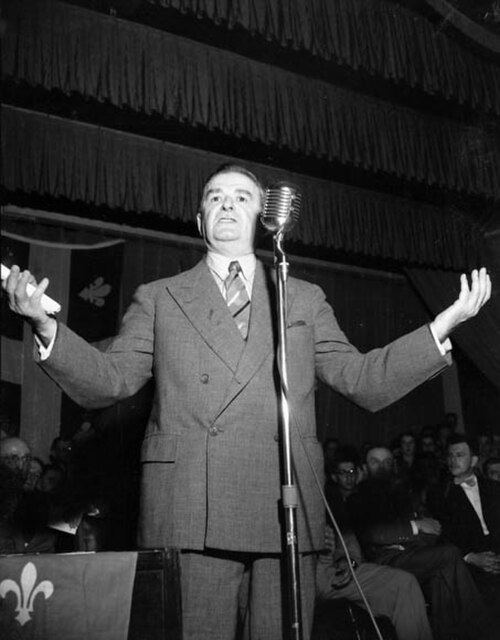
デュプレシスがケベックを変革するために掲げた主な構想は、急速な工業化、都市化、そして州の天然資源のより大規模かつ迅速な開発であった。州内の英語話者は、工業化と都市化によって時代遅れのフランス系カナダ社会が取って代わられることを期待していた。これらの変化によって、フランス系カナダ人は都市的で工業的な生活様式へと移行した。経済的、社会的な安定をもたらす新たな機会が生まれたが、その一方で、文化や言語の存続に置かれた重要性や意義は低下した。[ 8 ]
However, the deaths of Maurice Duplessis in September 1959 and his successor Paul Sauve in January 1960 set in motion the final end to the old traditional definition of Quebec nationalism in the 1950s.[9] A new leader, Quebec and ideology of nationalism would emerge and sweep across the province finally providing French-Canadians their greatly awaited need for change.
French-Canadian nationalism in the 1960s transformed itself into a new movement; the rise of the Québécois identity endowed the movement with a message that departed from Duplessis's calls for greater provincial autonomy. The 1960s in Quebec saw the province's Quiet Revolution, under the rule of the Liberal Party of Quebec. Later in the decade, Quebec saw the founding of the Parti Québécois, in an attempt to consolidate a variety of sovereigntist movements. During this time, Quebec society grew more liberal, with broad changes in societal values, and the structure of the province's economy. In this time of cultural change, cultural liberalization allowed new, radical currents of political thought to emerge. Quebec would no longer be the last bastion of social conservatism, one with wide-ranging societal involvement from the Catholic Church, in North America, with its moral customs moving towards the North American mainstream during this progressive era.
A main difference was the province's secularization, which saw the influence of the Catholic Church decline in the province. Unlike in the 1950s under Duplessis, church and state were now clearly separate entities, putting an end to the Church's extensive power over the province's institutions.
The election of Jean Lesage and his Liberal Party in the 1960 provincial election ended the longstanding ancien régime that the people of Quebec had been living under. It began the reform of socioeconomic and political structures with the intent of modernizing them, and empowering the province's Francophone majority. These reforms would form part of the broader Quiet Revolution that would transform the province during the decade.
The Quiet Revolution brought significant changes for Quebecers, uniting most (both Anglophones and Francophones) in celebrating the end of the province's perceived cultural backwardness that had characterized Maurice Duplessis's rule. His Union Nationale governments had a decades-long severely conservative tenure, which was later denominated by scholars as the Grande Noirceur. The Quiet Revolution beginning in the 1960s gathered momentum with the many reforms carried out by Jean Lesage including wide-ranging changes to education, provincial welfare programs, healthcare, hydro-electricity, regional development and greater Francophone participation in the province's economy, including its burgeoning industrial sector.[8]
Québécois nationalism, a Francophone movement, was on the rise at this time, inspired by the global context. It was seen as an extension of contemporary decolonization movements; the intellectual basis of this new expression of nationalism among Francophones incorporated foreign influences. The province's newfound openness sparked greater curiosity among those in the province who had been long-isolated culturally; they felt encouraged to go and learn the ways of life in other parts of the world and then return to share, compare, and incorporate the ideologies into their lifestyle.
The perceived oppression of Francophones, particularly in the economic arena, was something that Lesage wanted to bring to light and change because of longstanding cultural and society tensions between Francophones and Anglophones, the province's two historic linguistic groups. Lesage desired to change the role that the state in the province. He believed the state was the engine to end the relative economic dispossession of French Canadians and Francophone society, bolstering organized labor, promoting educational reform, and modernizing the political process.[8]
Linguistic tensions endured in the province during this period due to the imbalance between the Francophones and Anglophones on a variety of levels. Even though the Francophones outnumbered the Anglophones, a significant number of Francophones saw themselves as oppressed; an oppressed majority that was outmatched by a small, Anglophone elite. Colonial cirumstances that led to this reality dated further back than recent decades. The province has a history of colonization and conquest that remains complex and multi-layered.
The province's Francophones, as well as visible minority groups, found themselves struggling to join an economic elite that seemed to largely exclude them. These groups saw social mobility as out-of-reach. Francophones struggled in a world where English was the language of business, and prestigious institutions, from colonial times, remained starkly English-speaking. Francophone culture, and their linguistic peculiarities were relegated to a lesser status.
By the early 1960s, an expanding group of French Canadians from all social classes were receiving education comparable to that of their Anglophone peers; they would go onto careers in Anglophone-dominated institutions.[8]
Advocacy of this new form of nationalism was used to address drastic conditions in the work place as well as lesser living conditions. This was most apparent between progressive Francophones who saw their new expressions of nationalism as part of the global struggle against injustice and non-Anglophone progressives who were predominantly opposed to any and all nationalisms.
The rising Québécois nationalism, endowing French-Canadian nationalism with a new meaning, would continue to develop after its inception during this decade.
Understanding contemporary Quebec nationalism is difficult considering the ongoing debates on the political status of the province and its complex public opinion.[10] No political option (outright independence, sovereignty-association, constitutional reforms, or signing on to the present Canadian constitution) has achieved decisive majority support and contradictions remain within the Quebec polity.
One debated subject that has often made the news is whether contemporary Quebec nationalism is still "ethnic" or if it is "linguistic" or "territorial".
The notion of "territorial nationalism" (promoted by all Quebec premiers since Jean Lesage) gathers the support of the majority of the sovereigntists and essentially all Quebec federalist nationalists. Debates on the nature of Quebec's nationalism are currently going on and various intellectuals from Quebec or other parts of Canada have published works on the subject, notably Will Kymlicka, professor of philosophy at Queen's University and Charles Blattberg and Michel Seymour, both professors at the Université de Montréal.
Many people feel that Quebec nationalism and separatism is ethnic have often expressed their opinion that the sentiments of Quebec's nationalists are insular and parochial and concerned with preserving a pure laine population of white francophones within the province. Despite these accusations being denounced by many Quebec nationalists who see both the separatist and nationalist movement as multi-ethnic, there is much evidence to suggest that both movements are based on ethnicity, rather than on territory. An example of this is when Premier of QuebecJacques Parizeau, commenting on the failure of the 1995 Quebec referendum said "It is true, it is true that we were beaten, but in the end, by what? By money and ethnic votes, essentially." ("C'est vrai, c'est vrai qu'on a été battus, au fond, par quoi? Par l'argent puis des votes ethniques, essentiellement."). Another example of this was the implementation of Quebec's Bill 21, which sparked controversy after it banned people from wearing religious clothing in certain professions. This law hugely impacted the Muslim community in the province, with many citing it as proof of the movement's ethnic origins, and calling it Islamophobic, and discriminatory.[11] Further controversy was sparked when most nationalist parties stated that the law was not Islamophobic, and instead stated that it was secular. Paul Plamondon, leader of the Parti Québécois (PQ) called someone in the Quebec government out for saying the law was "supremacist" while talking about systemic racism, which caused even more controversy and a backlash to the PQ by the Muslim community, and by the federalists.[12]
Another primary expression of nationalism in Quebec is the French language. People who feel that Quebec nationalism is linguistic have often expressed their opinion that Quebec nationalism includes a multi-ethnic or multicultural French-speaking majority (either as mother tongue or first language used in public).
The entrenchment of the French language in Quebec has been a central goal of Quebec nationalism since the 1970s. In 1974, the Quebec Legislature passed the Official Language Act under Premier Robert Bourassa. This legislation made French the sole official language of Quebec and the primary language of services, commercial signing, labour relations and business, education, and legislation and justice. In 1977, this Official Language Act was superseded by the Charter of the French Language, which expanded and entrenched French within Quebec. This charter was passed by the first Parti Québécois government of Premier René Lévesque, and its goal was "to make French the language of Government and the Law, as well as the normal and everyday language of work, instruction, communication, commerce and business."
After a 45-year hiatus in language legislation in Quebec, the provincial legislature passed An Act respecting French, the official and common language of Québec in 2022. This act greatly expanded the requirement to speak French in many public and private settings. The preliminary notes of the bill make its purpose clear: "the purpose of this bill is to affirm that the only official language of Québec is French. It also affirms that French is the common language of the Québec nation." This act amended the Charter of the French language and introduced "new fundamental language rights," such as reinforcing French as the language of legislation, justice, civil administration, professional orders, employers, commerce and business, and educational instruction. Premier François Legault and his Coalition Avenir Québec government justified this as necessary to preserve the French language that is central to Quebec nationalism.
On October 21, 2006, during the General Special Council of the Quebec wing of the Liberal Party of Canada initiated a national debate by adopting with more than 80% support a resolution calling on the Government of Canada to recognize the Quebec nation within Canada. A month later, the said resolution was taken to Parliament first by the Bloc Québécois, then by the Prime Minister of Canada, Stephen Harper. On November 27, 2006, the House of Commons of Canada passed a motion recognizing that the "Québécois form a nation within a united Canada".[13]
In 2021, François Legault's Coalition Avenir Québec government in Quebec proposed to amend the Charter of the French Language and the provincial constitution to more strongly entrench French as the sole official language. In response to this, the Bloc Québécois initiated a motion in the House of Commons endorsing the constitutionality of Legault's initiatives and reasserting Quebecers' nationhood. The Commons passed the motion 281–2, with 36 abstentions.[14]
Quebec nationalism today and what it means to Québécois, Quebecers, Canadiens, Canadians, and others differs based on the individual. Nationalism today is more open than what it was in the past in some ways. A common theme that can be seen is the attachment that Québécois have towards their province, and the country of Canada.
ために [アンドレ・ローレンドーの興味深い表現を使用] 長い間「黒人王」に支配されてきた
「ケベック人
」が、自らの運命の主人となり、「我々の主人」にならなければならないことは疑いの余地がなかった。後にケベック党の支持者の大勢が、政治集会で「
ケベックはケベック
人のもの」と大声で叫び、こうした感情を反映することになる。
The increasing uneasiness that I feel each time I hear nationalists say Le Québec aux Québécois illustrates this in another way. In adhering to this battle cry, indépendentistes are necessarily forced to admit that there are certain individuals whose status as residents of Quebec is not enough to qualify them as Québécois.
{{cite book}}ISBN /日付の不一致(ヘルプ)