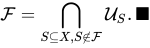
「大きな」集合を表す集合の族
数学 において 、 集合上の フィルタとは次のような 部分集合 の 族 である :
バツ
{\displaystyle X}
B
{\displaystyle {\mathcal {B}}}
バツ ∈
B
{\displaystyle X\in {\mathcal {B}}}
そして
∅ ∉
B
{\displaystyle \emptyset \notin {\mathcal {B}}}
かつ ならば 、
あ ∈
B
{\displaystyle A\in {\mathcal {B}}}
B
∈
B
{\displaystyle B\in {\mathcal {B}}}
A
∩
B
∈
B
{\displaystyle A\cap B\in {\mathcal {B}}}
かつ ならば 、
A
⊂
B
⊂
X
{\displaystyle A\subset B\subset X}
A
∈
B
{\displaystyle A\in {\mathcal {B}}}
B
∈
B
{\displaystyle B\in {\mathcal {B}}}
集合上のフィルタは「大きな部分集合の集合」を表すものと考えられる。 直感的な例としては 近傍フィルタが ある。フィルタは 順序理論 、 モデル理論 、 集合論に現れるが、起源である 位相幾何学 にも見られる 。フィルタの双対概念はイデアルで ある 。
フィルタは1937年 に アンリ・カルタン によって導入され 、 位相幾何学におけるフィルタに関する論文で説明されているように、 ニコラ・ブルバキ はその後、 その著書 「トポロジーの一般論」 の中で、 EHムーア と ハーマン・L・スミス が 1922年 に開発した ネット という関連概念の代替として使用しました 。 順序フィルタは、集合から任意の 半順序集合 へのフィルタの一般化です。具体的には、集合上のフィルタは、半順序集合が 集合包含 によって順序付けられた 冪集合 で構成される特殊なケースでは、適切な順序フィルタです 。
準備、表記法、基本概念 この記事では、やなど の大文字のローマ字は 集合 (特に断りのない限り族ではない)を表し、は の冪集合 を表す。 冪集合の部分 集合は 集合族 ( または単に 族 )と呼ばれ、 が の部分集合である場合に を超える。 集合 族は などの大文字のカリグラフィ文字で表す。これらの仮定が必要なときはいつでも、 は 空でなく、 などが を超える集合族である
と仮定する必要がある。
S
{\displaystyle S}
X
{\displaystyle X}
℘
(
X
)
{\displaystyle \wp (X)}
X
.
{\displaystyle X.}
X
{\displaystyle X}
℘
(
X
)
.
{\displaystyle \wp (X).}
B
,
C
,
and
F
.
{\displaystyle {\mathcal {B}},{\mathcal {C}},{\text{ and }}{\mathcal {F}}.}
X
{\displaystyle X}
B
,
F
,
{\displaystyle {\mathcal {B}},{\mathcal {F}},}
X
.
{\displaystyle X.}
「プレフィルター」と「フィルター ベース」という用語は同義語であり、同じ意味で使用されます。
競合する定義と表記に関する警告
残念ながら、フィルター理論には、著者によって定義が異なる用語がいくつかあります。これには、「フィルター」などの最も重要な用語が含まれます。フィルター (および点集合トポロジー) の非常に技術的な性質により、同じ用語の異なる定義は通常かなり重複しますが、それでもこれらの定義の違いは重要な結果をもたらすことがよくあります。数学の文献を読むときは、フィルターに関連する用語が著者によってどのように定義されているかを確認することをお勧めします。このため、この記事では、使用されているすべての定義を明確に示します。残念ながら、フィルターに関連する表記法はすべて確立されているわけではなく、一部の表記法は文献間で大きく異なります (たとえば、集合のすべてのプレフィルターの集合の表記法)。そのため、そのような場合、この記事では最も自己説明的または覚えやすい表記法を使用します。
フィルターとプレフィルターの理論は十分に開発されており、多数の定義と表記法があります。この記事が冗長になるのを防ぎ、表記法と定義を簡単に調べられるように、その多くが簡素にリストされています。それらの重要な特性については後で説明します。
セット操作
の 集合族 の における 上方閉包 または 等音化 は
X
{\displaystyle X}
B
⊆
℘
(
X
)
{\displaystyle {\mathcal {B}}\subseteq \wp (X)}
B
↑
X
:=
{
S
⊆
X
:
B
⊆
S
for some
B
∈
B
}
=
⋃
B
∈
B
{
S
:
B
⊆
S
⊆
X
}
{\displaystyle {\mathcal {B}}^{\uparrow X}:=\{S\subseteq X~:~B\subseteq S{\text{ for some }}B\in {\mathcal {B}}\,\}=\bigcup _{B\in {\mathcal {B}}}\{S~:~B\subseteq S\subseteq X\}}
同様に 下向きの 閉包 は
B
{\displaystyle {\mathcal {B}}}
B
↓
:=
{
S
⊆
B
:
B
∈
B
}
=
⋃
B
∈
B
℘
(
B
)
.
{\displaystyle {\mathcal {B}}^{\downarrow }:=\{S\subseteq B~:~B\in {\mathcal {B}}\,\}=\bigcup _{B\in {\mathcal {B}}}\wp (B).}
全体を通して、 地図と セットになっています。
f
{\displaystyle f}
S
{\displaystyle S}
網とその尾
有向 集合 は、前置順序 を伴う集合 であり、 前置順序 は(明示的に別途示されない限り) で表され、 ( 上向き ) 有向集合 となる。 これは、すべての に対してとなるような ものが存在すること を意味する。 任意の添え字に対して、 表記は を意味すると定義さ れ、 は が成り立つことを意味すると定義されるが 、 は 真では ない ( が 反対称 である場合 、これは と同等である )。
I
{\displaystyle I}
≤
{\displaystyle \,\leq \,}
(
I
,
≤
)
{\displaystyle (I,\leq )}
i
,
j
∈
I
,
{\displaystyle i,j\in I,}
k
∈
I
{\displaystyle k\in I}
i
≤
k
and
j
≤
k
.
{\displaystyle i\leq k{\text{ and }}j\leq k.}
i
and
j
,
{\displaystyle i{\text{ and }}j,}
j
≥
i
{\displaystyle j\geq i}
i
≤
j
{\displaystyle i\leq j}
i
<
j
{\displaystyle i<j}
i
≤
j
{\displaystyle i\leq j}
j
≤
i
{\displaystyle j\leq i}
≤
{\displaystyle \,\leq \,}
i
≤
j
and
i
≠
j
{\displaystyle i\leq j{\text{ and }}i\neq j}
の ネット は
X
{\displaystyle X}
、空でない有向集合からへの写像である。
この表記法は、 ドメインを持つネットを表すために使用される。
X
.
{\displaystyle X.}
x
∙
=
(
x
i
)
i
∈
I
{\displaystyle x_{\bullet }=\left(x_{i}\right)_{i\in I}}
I
.
{\displaystyle I.}
厳密な比較の使用に関する警告
がネットであり、 の 後 の末尾 と呼ばれる 集合が 空になる可能性がある(例えば、 が 有向集合 の 上限 である場合にこれが起こる )。この場合、族は 空集合を含むことになり、プレフィルタ(後で定義)になることができなくなる。これが、 を や ではなく として定義する(重要な)理由 であり、この理由から、一般に、ネットの末尾のプレフィルタを扱う場合、厳密な不等式は 不等式と互換的に使用できない可能性がある。
x
∙
=
(
x
i
)
i
∈
I
{\displaystyle x_{\bullet }=\left(x_{i}\right)_{i\in I}}
i
∈
I
{\displaystyle i\in I}
x
>
i
=
{
x
j
:
j
>
i
and
j
∈
I
}
,
{\displaystyle x_{>i}=\left\{x_{j}~:~j>i{\text{ and }}j\in I\right\},}
x
∙
{\displaystyle x_{\bullet }}
i
{\displaystyle i}
i
{\displaystyle i}
I
{\displaystyle I}
{
x
>
i
:
i
∈
I
}
{\displaystyle \left\{x_{>i}~:~i\in I\right\}}
Tails
(
x
∙
)
{\displaystyle \operatorname {Tails} \left(x_{\bullet }\right)}
{
x
≥
i
:
i
∈
I
}
{\displaystyle \left\{x_{\geq i}~:~i\in I\right\}}
{
x
>
i
:
i
∈
I
}
{\displaystyle \left\{x_{>i}~:~i\in I\right\}}
{
x
>
i
:
i
∈
I
}
∪
{
x
≥
i
:
i
∈
I
}
{\displaystyle \left\{x_{>i}~:~i\in I\right\}\cup \left\{x_{\geq i}~:~i\in I\right\}}
<
{\displaystyle \,<\,}
≤
.
{\displaystyle \,\leq .}
フィルターとプレフィルター 以下は、集合の族が持つ可能性のある特性のリストであり 、これらはフィルタ、プレフィルタ、フィルタサブベースの定義特性を形成します。必要な場合は、
B
{\displaystyle {\mathcal {B}}}
B
⊆
℘
(
X
)
.
{\displaystyle {\mathcal {B}}\subseteq \wp (X).}
集合族は 次のようになります。
B
{\displaystyle {\mathcal {B}}}
適切 または 非退化の 場合 、そうでない場合 不適切 または 退化 と呼ばれます 。
∅
∉
B
.
{\displaystyle \varnothing \not \in {\mathcal {B}}.}
∅
∈
B
,
{\displaystyle \varnothing \in {\mathcal {B}},}
下向き ] ならば 、
A
,
B
∈
B
{\displaystyle A,B\in {\mathcal {B}}}
C
∈
B
{\displaystyle C\in {\mathcal {B}}}
C
⊆
A
∩
B
.
{\displaystyle C\subseteq A\cap B.}
この特性は、有向性 という観点から特徴付けることができ 、これは「有向」という言葉の意味を説明しています。 上の 二項関係 が (上向きに)有向で あるとは、任意の 2 つに対して を満たす が 存在する場合です。 の代わりに を 使用すると、 下向き の定義が得られ、代わりに を使用すると、 上向き の定義が得られます 。 明示的に、 が 下向き (または 上向き )であるためには、すべてに対して となる 「より大きい」要素が存在する場合、 かつその場合に限ります(または となる)。 ここで、「より大きい」要素は常に右側にあり、 [注 1] となり、これは(または となる) と書き直すことができます 。
⪯
{\displaystyle \,\preceq \,}
B
{\displaystyle {\mathcal {B}}}
A
and
B
,
{\displaystyle A{\text{ and }}B,}
C
{\displaystyle C}
A
⪯
C
and
B
⪯
C
.
{\displaystyle A\preceq C{\text{ and }}B\preceq C.}
⊇
{\displaystyle \,\supseteq \,}
⪯
{\displaystyle \,\preceq \,}
⊆
{\displaystyle \,\subseteq \,}
B
{\displaystyle {\mathcal {B}}}
A
,
B
∈
B
,
{\displaystyle A,B\in {\mathcal {B}},}
C
∈
B
{\displaystyle C\in {\mathcal {B}}}
A
⊇
C
and
B
⊇
C
{\displaystyle A\supseteq C{\text{ and }}B\supseteq C}
A
⊆
C
and
B
⊆
C
{\displaystyle A\subseteq C{\text{ and }}B\subseteq C}
A
∩
B
⊇
C
{\displaystyle A\cap B\supseteq C}
A
∪
B
⊆
C
{\displaystyle A\cup B\subseteq C}
ある族が に関して 最大元を 持つ場合 (たとえば、 の場合 )、その族は必然的に下向きになります。
B
{\displaystyle {\mathcal {B}}}
⊇
{\displaystyle \,\supseteq \,}
∅
∈
B
{\displaystyle \varnothing \in {\mathcal {B}}}
の任意の2つの要素の交差( 和 が の要素である 場合、有限交差 (または
B
{\displaystyle {\mathcal {B}}}
B
.
{\displaystyle {\mathcal {B}}.}
が有限交差で閉じている 場合、 は 必ず下向きになります。その逆は一般に偽です。
B
{\displaystyle {\mathcal {B}}}
B
{\displaystyle {\mathcal {B}}}
において 上向きに閉じている 、 または 等価である のは 、ある集合が を満たす 同様に、 下向きに閉じている のは ある 上集合 または アップ (または 下集合 または ダウン集合 )
とも呼ばれる
X
{\displaystyle X}
B
⊆
℘
(
X
)
and
B
=
B
↑
X
,
{\displaystyle {\mathcal {B}}\subseteq \wp (X){\text{ and }}{\mathcal {B}}={\mathcal {B}}^{\uparrow X},}
B
∈
B
{\displaystyle B\in {\mathcal {B}}}
C
{\displaystyle C}
B
⊆
C
⊆
X
,
then
C
∈
B
.
{\displaystyle B\subseteq C\subseteq X,{\text{ then }}C\in {\mathcal {B}}.}
B
{\displaystyle {\mathcal {B}}}
B
=
B
↓
.
{\displaystyle {\mathcal {B}}={\mathcal {B}}^{\downarrow }.}
の上方閉包である 族は、 を 部分集合として持つ 上の集合の 唯一かつ 最小の ( に関して )同色族です。
B
↑
X
,
{\displaystyle {\mathcal {B}}^{\uparrow X},}
B
in
X
,
{\displaystyle {\mathcal {B}}{\text{ in }}X,}
⊆
{\displaystyle \,\subseteq }
X
{\displaystyle X}
B
{\displaystyle {\mathcal {B}}}
「適切な」や「下向きの」など、上と下に定義されている の多くの特性はに依存しないため、このような用語を使用する場合、 セットについて言及すること はオプションです。 「フィルターオン」などの「上向きに閉じている 」ことを含む定義は に依存する ため、文脈から明らかでない場合はセット について言及する必要があります。
B
{\displaystyle {\mathcal {B}}}
X
,
{\displaystyle X,}
X
{\displaystyle X}
X
,
{\displaystyle X,}
X
,
{\displaystyle X,}
X
{\displaystyle X}
X
{\displaystyle X}
Filters
(
X
)
=
DualIdeals
(
X
)
∖
{
℘
(
X
)
}
⊆
Prefilters
(
X
)
⊆
FilterSubbases
(
X
)
.
{\displaystyle {\textrm {Filters}}(X)\quad =\quad {\textrm {DualIdeals}}(X)\,\setminus \,\{\wp (X)\}\quad \subseteq \quad {\textrm {Prefilters}}(X)\quad \subseteq \quad {\textrm {FilterSubbases}}(X).}
家族 とは以下のようなものです:
B
{\displaystyle {\mathcal {B}}}
が下向きに閉じており、有限和に対して閉じている 場合、 イデアル
B
≠
∅
{\displaystyle {\mathcal {B}}\neq \varnothing }
上の 双対イデアルは 、 が上向きに閉じており 、有限交差でも閉じている場合に成立する。同様に、 に対して双対イデアルである場合に成立する
X
{\displaystyle X}
B
≠
∅
{\displaystyle {\mathcal {B}}\neq \varnothing }
X
{\displaystyle X}
B
≠
∅
{\displaystyle {\mathcal {B}}\neq \varnothing }
R
,
S
⊆
X
,
{\displaystyle R,S\subseteq X,}
R
∩
S
∈
B
if and only if
R
,
S
∈
B
.
{\displaystyle R\cap S\in {\mathcal {B}}\;{\text{ if and only if }}\;R,S\in {\mathcal {B}}.}
「二重」という言葉の説明:家族は、 次の場合に限り、 二重の理想(または理想)である。
B
{\displaystyle {\mathcal {B}}}
X
{\displaystyle X}
の双対は
B
in
X
,
{\displaystyle {\mathcal {B}}{\text{ in }}X,}
族 がイデアル(または双対イデアル)である 。言い換えれば、 双対イデアルは 「 イデアル の 双対 」を意味する。族は と混同されるべきではない 。なぜなら、これら2つの集合は一般には等しくないからである。例えば、 双対の双対は元の族であり、 集合が の双対に属するのは 、次の場合のみである
X
∖
B
:=
{
X
∖
B
:
B
∈
B
}
,
{\displaystyle X\setminus {\mathcal {B}}:=\{X\setminus B~:~B\in {\mathcal {B}}\},}
X
.
{\displaystyle X.}
X
∖
B
{\displaystyle X\setminus {\mathcal {B}}}
℘
(
X
)
∖
B
=
{
S
⊆
X
:
S
∉
B
}
{\displaystyle \wp (X)\setminus {\mathcal {B}}=\{S\subseteq X~:~S\notin {\mathcal {B}}\}}
X
∖
B
=
℘
(
X
)
if and only if
B
=
℘
(
X
)
.
{\displaystyle X\setminus {\mathcal {B}}=\wp (X){\text{ if and only if }}{\mathcal {B}}=\wp (X).}
X
∖
(
X
∖
B
)
=
B
.
{\displaystyle X\setminus (X\setminus {\mathcal {B}})={\mathcal {B}}.}
X
{\displaystyle X}
B
{\displaystyle {\mathcal {B}}}
∅
∈
B
.
{\displaystyle \varnothing \in {\mathcal {B}}.}
上の フィルタ が 上の真双対イデアルである 場合 、つまり、 上のフィルタは の空でない部分集合 で、有限交差で閉じており、 で上向きに閉じているもの です。同値に、それは で上向きに閉じているプレフィルタです。言い換える 上の フィルタは、 (1) が空でないこと(または同値に、 を含む )、(2) が有限交差で閉じていること、(3) が上向きに閉じていること 、(4) が空集合を要素として持たないことなど、 上の集合の族です。
X
{\displaystyle X}
B
{\displaystyle {\mathcal {B}}}
X
.
{\displaystyle X.}
X
{\displaystyle X}
℘
(
X
)
∖
{
∅
}
{\displaystyle \wp (X)\setminus \{\varnothing \}}
X
.
{\displaystyle X.}
X
.
{\displaystyle X.}
X
{\displaystyle X}
X
{\displaystyle X}
X
{\displaystyle X}
X
,
{\displaystyle X,}
警告 : 一部の著者、特に代数学者は「フィルター」を双対イデアルの意味で使用し、他の著者、特に位相学者は「フィルター」を 真 / 非退化 双対イデアルの意味で使用します。 数学文献を読むときは、常に「フィルター」がどのように定義されているかを確認することをお勧めします。ただし、「ウルトラフィルター」、「プレフィルター」、「フィルターサブベース」の定義では常に非退化が必要です。この記事では、 アンリカルタン の「フィルター」の元の定義 を使用しますが、これは非退化を必要としました。 上の 双対 フィルタ は、その双対が上の フィルタである ファミリです。同様に、それは を 要素として 含ま ない 上のイデアルです。
X
{\displaystyle X}
B
{\displaystyle {\mathcal {B}}}
X
∖
B
{\displaystyle X\setminus {\mathcal {B}}}
X
.
{\displaystyle X.}
X
{\displaystyle X}
X
{\displaystyle X}
冪集合は 、フィルタでもない 唯一の双対イデアルです。 位相幾何学 における「フィルタ」の定義から除外することは、 「 素数」の 定義から 除外すること と同じ利点があります 。つまり、多くの重要な結果で「非退化」(「非 ユニタル 」または「非 」の類似物)を指定する必要がなくなり、その結果、記述がそれほどぎこちなくなります。
℘
(
X
)
{\displaystyle \wp (X)}
X
{\displaystyle X}
℘
(
X
)
{\displaystyle \wp (X)}
1
{\displaystyle 1}
1
{\displaystyle 1}
プレフィルター または フィルタ基底 、真で下向きの 場合に 上向き閉包がフィルタである場合、 はプレフィルタと呼ばれます ある ( に関して ) 。 真族 がプレフィルタである場合、かつその場合の 族がプレフィルタである場合、かつその場合のみ成り立ちます。
B
≠
∅
{\displaystyle {\mathcal {B}}\neq \varnothing }
B
{\displaystyle {\mathcal {B}}}
B
↑
X
{\displaystyle {\mathcal {B}}^{\uparrow X}}
≤
{\displaystyle \leq }
B
≠
∅
{\displaystyle {\mathcal {B}}\neq \varnothing }
B
(
∩
)
B
≤
B
.
{\displaystyle {\mathcal {B}}\,(\cap )\,{\mathcal {B}}\leq {\mathcal {B}}.}
がプレフィルタである 場合、その上方閉包は を 含む 上の 唯一の最小の( に対する )フィルタで あり、 によって 生成されるフィルタと 呼ばれます。フィルタは が の フィルタ基底 と呼ばれる で ある場合、 プレフィルタによって生成される と言われています。
B
{\displaystyle {\mathcal {B}}}
B
↑
X
{\displaystyle {\mathcal {B}}^{\uparrow X}}
⊆
{\displaystyle \subseteq }
X
{\displaystyle X}
B
{\displaystyle {\mathcal {B}}}
B
.
{\displaystyle {\mathcal {B}}.}
F
{\displaystyle {\mathcal {F}}}
B
{\displaystyle {\mathcal {B}}}
F
=
B
↑
X
,
{\displaystyle {\mathcal {F}}={\mathcal {B}}^{\uparrow X},}
B
{\displaystyle {\mathcal {B}}}
F
.
{\displaystyle {\mathcal {F}}.}
フィルターとは異なり、プレフィルターは 有限交差の下で必ずしも閉じているわけでは ありません。 π 系は 有限交差の下で閉じている場合 に成り立ちます。すべての空でない族は、 によって生成される π 系と呼ばれる一意の最小の π 系に含まれます。これは によって表されることもあります。 これ は 、 を 含む π 系 の交差に等しく 、 からの集合のすべての可能な有限交差の集合にも 。
B
≠
∅
{\displaystyle {\mathcal {B}}\neq \varnothing }
B
{\displaystyle {\mathcal {B}}}
B
,
{\displaystyle {\mathcal {B}},}
π
(
B
)
.
{\displaystyle \pi ({\mathcal {B}}).}
B
{\displaystyle {\mathcal {B}}}
B
{\displaystyle {\mathcal {B}}}
π
(
B
)
=
{
B
1
∩
⋯
∩
B
n
:
n
≥
1
and
B
1
,
…
,
B
n
∈
B
}
.
{\displaystyle \pi ({\mathcal {B}})=\left\{B_{1}\cap \cdots \cap B_{n}~:~n\geq 1{\text{ and }}B_{1},\ldots ,B_{n}\in {\mathcal {B}}\right\}.}
π システムは、適切な場合にのみプレフィルターになります。すべてのフィルターは適切な π システムであり 、 すべての適切な πシステムはプレフィルターですが、その逆は一般に は 成り立ちません。 前置フィルタは、それによって生成されるπ 系と(に関して )等価であり 、これら両方の族は、
≤
{\displaystyle \leq }
X
.
{\displaystyle X.}
フィルタサブベース と 中心 が 以下の同等の条件のいずれかを満たす
場合
B
≠
∅
{\displaystyle {\mathcal {B}}\neq \varnothing }
B
{\displaystyle {\mathcal {B}}}
B
{\displaystyle {\mathcal {B}}}
は有限交差性 を持ち 、これは における任意の有限集合族(1つまたは複数)の交差が空ではないことを意味する。明示的には、 次 のようになる。
B
{\displaystyle {\mathcal {B}}}
n
≥
1
and
B
1
,
…
,
B
n
∈
B
{\displaystyle n\geq 1{\text{ and }}B_{1},\ldots ,B_{n}\in {\mathcal {B}}}
∅
≠
B
1
∩
⋯
∩
B
n
.
{\displaystyle \varnothing \neq B_{1}\cap \cdots \cap B_{n}.}
によって生成されるπシステムは 適切 で ある。つまり、
B
{\displaystyle {\mathcal {B}}}
∅
∉
π
(
B
)
.
{\displaystyle \varnothing \not \in \pi ({\mathcal {B}}).}
によって生成される π システムは プレフィルターです。
B
{\displaystyle {\mathcal {B}}}
B
{\displaystyle {\mathcal {B}}}
いくつかの プレフィルターのサブセットです 。
B
{\displaystyle {\mathcal {B}}}
何らかの フィルターのサブセットです 。
がフィルタサブベースであると仮定します。すると、 を含む 唯一の最小の( に対する )フィルタが存在し、 これは と呼ばれます。
B
{\displaystyle {\mathcal {B}}}
⊆
{\displaystyle \subseteq }
F
B
on
X
{\displaystyle {\mathcal {F}}_{\mathcal {B}}{\text{ on }}X}
B
{\displaystyle {\mathcal {B}}}
フィルタは によって生成され
B
{\displaystyle {\mathcal {B}}}
、このフィルタのフィルタ部分基底と呼ばれます。このフィルタは のスーパーセットである 上のすべてのフィルタの共通部分と等しくなります。 によって生成される π システム は の 前置フィルタと の部分集合に なり ます 。 さらに 、 によって生成されるフィルタは の上方閉包と等しく を意味します ただし、 が 前置フィルタである 場合に限ります 常に の上方閉フィルタ 部分 基底 )。
B
{\displaystyle {\mathcal {B}}}
X
{\displaystyle X}
B
.
{\displaystyle {\mathcal {B}}.}
B
,
{\displaystyle {\mathcal {B}},}
π
(
B
)
,
{\displaystyle \pi ({\mathcal {B}}),}
F
B
.
{\displaystyle {\mathcal {F}}_{\mathcal {B}}.}
B
{\displaystyle {\mathcal {B}}}
π
(
B
)
,
{\displaystyle \pi ({\mathcal {B}}),}
π
(
B
)
↑
X
=
F
B
.
{\displaystyle \pi ({\mathcal {B}})^{\uparrow X}={\mathcal {F}}_{\mathcal {B}}.}
B
↑
X
=
F
B
{\displaystyle {\mathcal {B}}^{\uparrow X}={\mathcal {F}}_{\mathcal {B}}}
B
{\displaystyle {\mathcal {B}}}
B
↑
X
{\displaystyle {\mathcal {B}}^{\uparrow X}}
F
B
{\displaystyle {\mathcal {F}}_{\mathcal {B}}}
フィルタサブベースを含む最小の( に対して最小という意味の)プレフィルタは 、 特定 の 状況 下でのみ存在します。たとえば、フィルタサブベース がプレフィルタでもある場合などです。また、 によって生成されたフィルタ(または同等の π システム)が主である場合にも存在します。この場合、 は を含む唯一の最小のプレフィルタです。それ以外 の場合 、一般に を含む 最小の プレ フィルタは存在しない可能性があります。このため、 によって生成された π システムを と呼ぶ著者も い ます 。
⊆
{\displaystyle \subseteq }
⊆
{\displaystyle \subseteq }
B
{\displaystyle {\mathcal {B}}}
B
{\displaystyle {\mathcal {B}}}
B
{\displaystyle {\mathcal {B}}}
B
∪
{
ker
B
}
{\displaystyle {\mathcal {B}}\cup \{\ker {\mathcal {B}}\}}
B
.
{\displaystyle {\mathcal {B}}.}
⊆
{\displaystyle \subseteq }
B
{\displaystyle {\mathcal {B}}}
B
{\displaystyle {\mathcal {B}}}
によって生成されるプレフィルタ
B
.
{\displaystyle {\mathcal {B}}.}
しかし、 最小のプレフィルタが存在する場合( と表記するとします )、通常の予想に反して、それは必ずしも「 B {\displaystyle {\mathcal {B}}} によって生成されるプレフィルタ 」に等しいわけでは ありません (つまり、 可能です)。また、フィルタサブベース もプレフィルタではあるが π システムではない場合は、残念ながら「このプレフィルタによって生成されるプレフィルタ」(つまり )は等しくありません (つまり、 場合でも可能です )。そのため、この記事では「 によって生成される π システム 」という正確で明確な用語を使用します。
⊆
{\displaystyle \subseteq }
minPre
B
{\displaystyle \operatorname {minPre} {\mathcal {B}}}
minPre
B
≠
π
(
B
)
{\displaystyle \operatorname {minPre} {\mathcal {B}}\neq \pi ({\mathcal {B}})}
B
{\displaystyle {\mathcal {B}}}
π
(
B
)
{\displaystyle \pi ({\mathcal {B}})}
B
=
minPre
B
{\displaystyle {\mathcal {B}}=\operatorname {minPre} {\mathcal {B}}}
π
(
B
)
≠
B
{\displaystyle \pi ({\mathcal {B}})\neq {\mathcal {B}}}
B
{\displaystyle {\mathcal {B}}}
B
{\displaystyle {\mathcal {B}}}
フィルターの サブフィルター であり 、
F
{\displaystyle {\mathcal {F}}}
F
{\displaystyle {\mathcal {F}}}
の スーパーフィルタ はフィルタであり、 場合 、
B
{\displaystyle {\mathcal {B}}}
B
{\displaystyle {\mathcal {B}}}
B
⊆
F
{\displaystyle {\mathcal {B}}\subseteq {\mathcal {F}}}
B
⊆
F
if and only if
B
≤
F
.
{\displaystyle {\mathcal {B}}\subseteq {\mathcal {F}}{\text{ if and only if }}{\mathcal {B}}\leq {\mathcal {F}}.}
重要なのは、「 〜の スーパー フィルタである」という表現は、フィルタの場合、「 〜の サブ シーケンスである」の類似表現であるということです。したがって、「〜のサブ フィルタである」は、接頭辞「サブ」が共通しているにもかかわらず、 実際には 「 〜の サブシーケンスである」の 逆 です。ただし、次 のように 書くこともできます。「 〜に従属している 」と説明されます。この用語を使用すると、「〜に従属している 」 は、フィルタ(およびプレフィルタ)の場合、「 〜の サブ シーケンスである」の類似表現になります 。この状況では、「従属」という用語と記号を使用する と便利です。
B
≤
F
{\displaystyle {\mathcal {B}}\leq {\mathcal {F}}}
F
⊢
B
{\displaystyle {\mathcal {F}}\vdash {\mathcal {B}}}
F
{\displaystyle {\mathcal {F}}}
B
.
{\displaystyle {\mathcal {B}}.}
⊢
{\displaystyle \,\vdash \,}
にはプレフィルタはありません ( には値が設定されているネットもありません )。そのため、ほとんどの著者と同様に、この記事では、 この仮定が必要になるたびに、コメントなしで自動的に と仮定します。
X
=
∅
{\displaystyle X=\varnothing }
∅
{\displaystyle \varnothing }
X
≠
∅
{\displaystyle X\neq \varnothing }
基本的な例 名前付き例
シングルトン集合は 非 離散集合 または
B
=
{
X
}
{\displaystyle {\mathcal {B}}=\{X\}}
上の 自明なフィルタ
X
.
{\displaystyle X.}
上のすべてのフィルタの部分集合であるため、 最小 フィルタで ある 。ただし、 上のすべてのプレフィルタの部分集合である必要はない。
X
{\displaystyle X}
X
{\displaystyle X}
X
.
{\displaystyle X.}
双対イデアルは の縮退フィルタと も呼ばれる (実際にはフィルタではないが)。これは、の双対イデアルの中で フィルタではない唯一のものである。
℘
(
X
)
{\displaystyle \wp (X)}
X
{\displaystyle X}
X
{\displaystyle X}
X
.
{\displaystyle X.}
が位相空間で あり、 における 近傍フィルタは 上の フィルタで ある 定義により、 がプレフィルタ(それぞれ はフィルタサブベース)であり、 が生成する 上のフィルタが 近傍フィルタに等しい場合のみ、 における族は における近傍基数(それぞれ 近傍 サブ ベース ) と 呼ば れる 開 近傍の サブファミリー は のフィルタ基数である 両方のプレフィルタは 上の位相の 基数 も形成し 、生成される位相は よりも 粗く なる この例は、点の近傍から空でない部分集合の近傍に直ちに一般化される。
(
X
,
τ
)
{\displaystyle (X,\tau )}
x
∈
X
,
{\displaystyle x\in X,}
N
(
x
)
{\displaystyle {\mathcal {N}}(x)}
x
{\displaystyle x}
X
.
{\displaystyle X.}
B
⊆
℘
(
X
)
{\displaystyle {\mathcal {B}}\subseteq \wp (X)}
x
for
(
X
,
τ
)
{\displaystyle x{\text{ for }}(X,\tau )}
B
{\displaystyle {\mathcal {B}}}
B
{\displaystyle {\mathcal {B}}}
X
{\displaystyle X}
B
{\displaystyle {\mathcal {B}}}
N
(
x
)
.
{\displaystyle {\mathcal {N}}(x).}
τ
(
x
)
⊆
N
(
x
)
{\displaystyle \tau (x)\subseteq {\mathcal {N}}(x)}
N
(
x
)
.
{\displaystyle {\mathcal {N}}(x).}
N
(
x
)
and
τ
(
x
)
{\displaystyle {\mathcal {N}}(x){\text{ and }}\tau (x)}
X
,
{\displaystyle X,}
τ
(
x
)
{\displaystyle \tau (x)}
τ
.
{\displaystyle \tau .}
S
⊆
X
.
{\displaystyle S\subseteq X.}
B
{\displaystyle {\mathcal {B}}}
は 基本プレフィルタ [26] あるシーケンス に対して
B
=
Tails
(
x
∙
)
{\displaystyle {\mathcal {B}}=\operatorname {Tails} \left(x_{\bullet }\right)}
x
∙
=
(
x
i
)
i
=
1
∞
in
X
.
{\displaystyle x_{\bullet }=\left(x_{i}\right)_{i=1}^{\infty }{\text{ in }}X.}
B
{\displaystyle {\mathcal {B}}}
は 基本フィルタ または フィルタである 場合、 は の連続フィルタです。最終的に定数ではないシーケンスによって生成されたテールのフィルタは 、 必ずしも 超 フィルタ はありません 可算集合上のすべての主フィルタは連続しており、可算無限集合上のすべてのコ有限フィルタも同様です。 有限個の連続フィルタの交差も連続しています。
X
{\displaystyle X}
B
{\displaystyle {\mathcal {B}}}
X
{\displaystyle X}
の 有限部分集合 全体の 集合 (つまり、 の補集合が有限である集合)が真集合となるのは、 が無限大(または同値で、が無限大) である場合のみであり 、この場合、 は のフィルタで あり、 フレシェフィルタ または
F
{\displaystyle {\mathcal {F}}}
X
{\displaystyle X}
X
{\displaystyle X}
F
{\displaystyle {\mathcal {F}}}
X
{\displaystyle X}
F
{\displaystyle {\mathcal {F}}}
X
{\displaystyle X}
上の コフィニティフィルタ なら 、は 双対イデアルに等しく、 これはフィルタではない。 が 無限なら、単集合の補集合族は、 上のフレシェフィルタを生成するフィルタサブベースである。 上の任意の集合族と同様に 上のフレシェフィルタの核を 含む は 空集合である。
X
.
{\displaystyle X.}
X
{\displaystyle X}
F
{\displaystyle {\mathcal {F}}}
℘
(
X
)
,
{\displaystyle \wp (X),}
X
{\displaystyle X}
{
X
∖
{
x
}
:
x
∈
X
}
{\displaystyle \{X\setminus \{x\}~:~x\in X\}}
X
.
{\displaystyle X.}
X
{\displaystyle X}
{
X
∖
{
x
}
:
x
∈
X
}
,
{\displaystyle \{X\setminus \{x\}~:~x\in X\},}
X
{\displaystyle X}
ker
F
=
∅
.
{\displaystyle \ker {\mathcal {F}}=\varnothing .}
空でない族のすべての要素の共通部分は、 それ自体が のフィルタであり、 の 最小値 または 最大下限 と呼ばれるため 、 と表記されることがあります。言い換えると、 のすべてのフィルタはサブセットとして を持つため、この共通部分は空になることはありません。定義により、最小値は の各要素のサブセットとして含まれる 最も細かい/最大の( に対する)フィルタです
F
⊆
Filters
(
X
)
{\displaystyle \mathbb {F} \subseteq \operatorname {Filters} (X)}
X
{\displaystyle X}
F
in
Filters
(
X
)
,
{\displaystyle \mathbb {F} {\text{ in }}\operatorname {Filters} (X),}
⋀
F
∈
F
F
.
{\displaystyle \bigwedge _{{\mathcal {F}}\in \mathbb {F} }{\mathcal {F}}.}
ker
F
=
⋂
F
∈
F
F
∈
Filters
(
X
)
.
{\displaystyle \ker \mathbb {F} =\bigcap _{{\mathcal {F}}\in \mathbb {F} }{\mathcal {F}}\in \operatorname {Filters} (X).}
X
{\displaystyle X}
{
X
}
{\displaystyle \{X\}}
⊆
and
≤
{\displaystyle \,\subseteq \,{\text{ and }}\,\leq \,}
F
.
{\displaystyle \mathbb {F} .}
がフィルタである 場合、 におけるそれらの最小値は フィルタです がプレフィルタである 場合、 は ( に関して )両方よりも粗いプレフィルタです (つまり、 )。実際、 は そのようなプレフィルタの中で最も細かいものの1つで あり、 がプレフィルタである場合、 が必ず となること を意味します より一般的には、 が空でない族であり である場合、 および は ( に関して ) の 最大の元 です
B
and
F
{\displaystyle {\mathcal {B}}{\text{ and }}{\mathcal {F}}}
Filters
(
X
)
{\displaystyle \operatorname {Filters} (X)}
B
(
∪
)
F
.
{\displaystyle {\mathcal {B}}\,(\cup )\,{\mathcal {F}}.}
B
and
F
{\displaystyle {\mathcal {B}}{\text{ and }}{\mathcal {F}}}
B
(
∪
)
F
{\displaystyle {\mathcal {B}}\,(\cup )\,{\mathcal {F}}}
≤
{\displaystyle \,\leq }
B
and
F
{\displaystyle {\mathcal {B}}{\text{ and }}{\mathcal {F}}}
B
(
∪
)
F
≤
B
and
B
(
∪
)
F
≤
F
{\displaystyle {\mathcal {B}}\,(\cup )\,{\mathcal {F}}\leq {\mathcal {B}}{\text{ and }}{\mathcal {B}}\,(\cup )\,{\mathcal {F}}\leq {\mathcal {F}}}
S
{\displaystyle {\mathcal {S}}}
S
≤
B
and
S
≤
F
{\displaystyle {\mathcal {S}}\leq {\mathcal {B}}{\text{ and }}{\mathcal {S}}\leq {\mathcal {F}}}
S
≤
B
(
∪
)
F
.
{\displaystyle {\mathcal {S}}\leq {\mathcal {B}}\,(\cup )\,{\mathcal {F}}.}
B
and
F
{\displaystyle {\mathcal {B}}{\text{ and }}{\mathcal {F}}}
S
:=
{
S
⊆
℘
(
X
)
:
S
≤
B
and
S
≤
F
}
{\displaystyle \mathbb {S} :=\{{\mathcal {S}}\subseteq \wp (X)~:~{\mathcal {S}}\leq {\mathcal {B}}{\text{ and }}{\mathcal {S}}\leq {\mathcal {F}}\}}
B
(
∪
)
F
∈
S
{\displaystyle {\mathcal {B}}\,(\cup )\,{\mathcal {F}}\in \mathbb {S} }
B
(
∪
)
F
{\displaystyle {\mathcal {B}}\,(\cup )\,{\mathcal {F}}}
≤
{\displaystyle \leq }
S
.
{\displaystyle \mathbb {S} .}
とし 、とする。 によって表される の 上限
または 最小 の上限 は、 のすべての要素を部分集合として含む の 最小の( に対する )双対イデアルで ある。つまり、 を 部分集合として 含む の最小の( に対する )双対イデアルである。この双対イデアルは、 によって生成される π 系 である
。任意の空でない集合族と同様に、 が 上の 何らかの フィルタ に含まれる 場合、かつそれがフィルタ部分基底である場合に限る。または、 が上の フィルタである場合に限る。この場合、この族は のすべての要素を 部分集合として 含む の 最小の( に対する )フィルタであり、必然的に
∅
≠
F
⊆
DualIdeals
(
X
)
{\displaystyle \varnothing \neq \mathbb {F} \subseteq \operatorname {DualIdeals} (X)}
∪
F
=
⋃
F
∈
F
F
.
{\displaystyle \cup \mathbb {F} =\bigcup _{{\mathcal {F}}\in \mathbb {F} }{\mathcal {F}}.}
F
in
DualIdeals
(
X
)
,
{\displaystyle \mathbb {F} {\text{ in }}\operatorname {DualIdeals} (X),}
⋁
F
∈
F
F
,
{\displaystyle \bigvee _{{\mathcal {F}}\in \mathbb {F} }{\mathcal {F}},}
⊆
{\displaystyle \subseteq }
X
{\displaystyle X}
F
{\displaystyle \mathbb {F} }
⊆
{\displaystyle \subseteq }
X
{\displaystyle X}
∪
F
{\displaystyle \cup \mathbb {F} }
⋁
F
∈
F
F
=
π
(
∪
F
)
↑
X
,
{\displaystyle \bigvee _{{\mathcal {F}}\in \mathbb {F} }{\mathcal {F}}=\pi \left(\cup \mathbb {F} \right)^{\uparrow X},}
π
(
∪
F
)
:=
{
F
1
∩
⋯
∩
F
n
:
n
∈
N
and every
F
i
belongs to some
F
∈
F
}
{\displaystyle \pi \left(\cup \mathbb {F} \right):=\left\{F_{1}\cap \cdots \cap F_{n}~:~n\in \mathbb {N} {\text{ and every }}F_{i}{\text{ belongs to some }}{\mathcal {F}}\in \mathbb {F} \right\}}
∪
F
.
{\displaystyle \cup \mathbb {F} .}
∪
F
{\displaystyle \cup \mathbb {F} }
X
{\displaystyle X}
⋁
F
∈
F
F
=
π
(
∪
F
)
↑
X
{\displaystyle \bigvee _{{\mathcal {F}}\in \mathbb {F} }{\mathcal {F}}=\pi \left(\cup \mathbb {F} \right)^{\uparrow X}}
X
,
{\displaystyle X,}
⊆
{\displaystyle \subseteq }
X
{\displaystyle X}
F
{\displaystyle \mathbb {F} }
F
⊆
Filters
(
X
)
.
{\displaystyle \mathbb {F} \subseteq \operatorname {Filters} (X).}
および とします。 によって表される の 上限
または 最小 の 上限は 、定義により のすべての元を 部分集合として含む 上 の最小の( に対する )フィルタです。 それが存在する場合、必然的に (上で定義したように)および は、 を含む 上のすべてのフィルタの共通部分とも等しくなります。
この の上限が存在するのは、双対イデアル が 上のフィルタである 場合に限ります。
フィルタの族の最小の上限は、 フィルタにならない場合があります。 実際、 に 少なくとも 2 つの異なる元が含まれる場合、 両方を含むフィルタが存在 しない フィルタ が存在します 。 がフィルタの部分基底でない場合、 の上限は
存在 せず、 におけるその上限についても同じことが言えますが 、 上のすべての双対イデアルの集合におけるそれらの上限は 存在します(それが退化したフィルタ です )。
∅
≠
F
⊆
Filters
(
X
)
{\displaystyle \varnothing \neq \mathbb {F} \subseteq \operatorname {Filters} (X)}
∪
F
=
⋃
F
∈
F
F
.
{\displaystyle \cup \mathbb {F} =\bigcup _{{\mathcal {F}}\in \mathbb {F} }{\mathcal {F}}.}
F
in
Filters
(
X
)
,
{\displaystyle \mathbb {F} {\text{ in }}\operatorname {Filters} (X),}
⋁
F
∈
F
F
{\displaystyle \bigvee _{{\mathcal {F}}\in \mathbb {F} }{\mathcal {F}}}
⊆
{\displaystyle \subseteq }
X
{\displaystyle X}
F
{\displaystyle \mathbb {F} }
⋁
F
∈
F
F
=
π
(
∪
F
)
↑
X
{\displaystyle \bigvee _{{\mathcal {F}}\in \mathbb {F} }{\mathcal {F}}=\pi \left(\cup \mathbb {F} \right)^{\uparrow X}}
⋁
F
∈
F
F
{\displaystyle \bigvee _{{\mathcal {F}}\in \mathbb {F} }{\mathcal {F}}}
X
{\displaystyle X}
∪
F
.
{\displaystyle \cup \mathbb {F} .}
F
in
Filters
(
X
)
{\displaystyle \mathbb {F} {\text{ in }}\operatorname {Filters} (X)}
π
(
∪
F
)
↑
X
{\displaystyle \pi \left(\cup \mathbb {F} \right)^{\uparrow X}}
X
.
{\displaystyle X.}
F
{\displaystyle \mathbb {F} }
X
{\displaystyle X}
B
and
C
on
X
{\displaystyle {\mathcal {B}}{\text{ and }}{\mathcal {C}}{\text{ on }}X}
F
on
X
{\displaystyle {\mathcal {F}}{\text{ on }}X}
B
and
C
.
{\displaystyle {\mathcal {B}}{\text{ and }}{\mathcal {C}}.}
∪
F
{\displaystyle \cup \mathbb {F} }
F
in
Filters
(
X
)
{\displaystyle \mathbb {F} {\text{ in }}\operatorname {Filters} (X)}
Prefilters
(
X
)
{\displaystyle \operatorname {Prefilters} (X)}
X
{\displaystyle X}
℘
(
X
)
{\displaystyle \wp (X)}
がプレフィルタ(それぞれ 上のフィルタ )である 場合、 がプレフィルタ(それぞれ フィルタ)であるのは、それが非退化である場合(または別の言い方をすれば、 が メッシュである場合に限ります)に限ります。その場合、 は ( に関して) 最も粗いプレフィルタ(それぞれ最も 粗いフィルタ)の 1 つで あり 、 ( に関して)両方よりも 細かいです。 これは、 が 任意のプレフィルタ(それぞれ 任意のフィルタ)である場合に、 が 必ず となることを意味します で表されます。
B
and
F
{\displaystyle {\mathcal {B}}{\text{ and }}{\mathcal {F}}}
X
{\displaystyle X}
B
(
∩
)
F
{\displaystyle {\mathcal {B}}\,(\cap )\,{\mathcal {F}}}
B
and
F
{\displaystyle {\mathcal {B}}{\text{ and }}{\mathcal {F}}}
X
{\displaystyle X}
≤
{\displaystyle \,\leq }
≤
{\displaystyle \,\leq }
B
and
F
;
{\displaystyle {\mathcal {B}}{\text{ and }}{\mathcal {F}};}
S
{\displaystyle {\mathcal {S}}}
B
≤
S
and
F
≤
S
{\displaystyle {\mathcal {B}}\leq {\mathcal {S}}{\text{ and }}{\mathcal {F}}\leq {\mathcal {S}}}
B
(
∩
)
F
≤
S
,
{\displaystyle {\mathcal {B}}\,(\cap )\,{\mathcal {F}}\leq {\mathcal {S}},}
B
∨
F
.
{\displaystyle {\mathcal {B}}\vee {\mathcal {F}}.}
を空でない集合とし、任意のに対して を 上の双対イデアルとします。 が 上の任意の双対イデアルであれば 、上 の双対イデアル は コワルスキーの双対イデアル または コワルスキーのフィルタ と呼ばれます 。
I
and
X
{\displaystyle I{\text{ and }}X}
i
∈
I
{\displaystyle i\in I}
D
i
{\displaystyle {\mathcal {D}}_{i}}
X
.
{\displaystyle X.}
I
{\displaystyle {\mathcal {I}}}
I
{\displaystyle I}
⋃
Ξ
∈
I
⋂
i
∈
Ξ
D
i
{\displaystyle \bigcup _{\Xi \in {\mathcal {I}}}\;\;\bigcap _{i\in \Xi }\;{\mathcal {D}}_{i}}
X
{\displaystyle X}
正則非 可算 基数 の クラブ フィルター は、 の クラブ サブセット を含むすべての集合のフィルターです。 これは、 対角交差 の下で閉じた -完全フィルターです 。
κ
.
{\displaystyle \kappa .}
κ
{\displaystyle \kappa }
その他の例
と を、 有限交差の下で閉じていないプレフィルタとフィルタサブベースを作成するとします。 はプレフィルタであるため 、 を含む最小のプレフィルタは によって生成される π システム は 特に 、 フィルタ サブ ベース を含む最小のプレフィルタは内 の集合のすべての有限交差の集合と等しくあり ません 。 によって 生成 される 上のフィルタは π システム の 3 つすべてが 生成し、 は 、点で主である固定、主、超プレフィルタの例です。 は 上の 超フィルタでもあります。
X
=
{
p
,
1
,
2
,
3
}
{\displaystyle X=\{p,1,2,3\}}
B
=
{
{
p
}
,
{
p
,
1
,
2
}
,
{
p
,
1
,
3
}
}
,
{\displaystyle {\mathcal {B}}=\{\{p\},\{p,1,2\},\{p,1,3\}\},}
B
{\displaystyle {\mathcal {B}}}
B
{\displaystyle {\mathcal {B}}}
B
{\displaystyle {\mathcal {B}}}
B
.
{\displaystyle {\mathcal {B}}.}
B
{\displaystyle {\mathcal {B}}}
{
{
p
,
1
}
}
∪
B
.
{\displaystyle \{\{p,1\}\}\cup {\mathcal {B}}.}
B
{\displaystyle {\mathcal {B}}}
B
.
{\displaystyle {\mathcal {B}}.}
X
{\displaystyle X}
B
{\displaystyle {\mathcal {B}}}
B
↑
X
=
{
S
⊆
X
:
p
∈
S
}
=
{
{
p
}
∪
T
:
T
⊆
{
1
,
2
,
3
}
}
.
{\displaystyle {\mathcal {B}}^{\uparrow X}=\{S\subseteq X:p\in S\}=\{\{p\}\cup T~:~T\subseteq \{1,2,3\}\}.}
B
,
{\displaystyle {\mathcal {B}},}
B
{\displaystyle {\mathcal {B}}}
B
↑
X
{\displaystyle {\mathcal {B}}^{\uparrow X}}
p
;
B
↑
X
{\displaystyle p;{\mathcal {B}}^{\uparrow X}}
X
.
{\displaystyle X.}
を位相空間とし、 を 定義する。 ここでは 必ず より細かい。 が空でない(つまり、非退化、フィルタサブベース、プレフィルタ、有限和で閉じている)場合、 についても同じことが言える。 が 上 のフィルタである 場合、 はプレフィルタであるが、 上の フィルタである必要はない。 ただし、は上の フィルタであり、 と同等である。
(
X
,
τ
)
{\displaystyle (X,\tau )}
B
⊆
℘
(
X
)
,
{\displaystyle {\mathcal {B}}\subseteq \wp (X),}
B
¯
:=
{
cl
X
B
:
B
∈
B
}
,
{\displaystyle {\overline {\mathcal {B}}}:=\left\{\operatorname {cl} _{X}B~:~B\in {\mathcal {B}}\right\},}
B
{\displaystyle {\mathcal {B}}}
B
¯
.
{\displaystyle {\overline {\mathcal {B}}}.}
B
{\displaystyle {\mathcal {B}}}
B
¯
.
{\displaystyle {\overline {\mathcal {B}}}.}
B
{\displaystyle {\mathcal {B}}}
X
{\displaystyle X}
B
¯
{\displaystyle {\overline {\mathcal {B}}}}
X
{\displaystyle X}
(
B
¯
)
↑
X
{\displaystyle \left({\overline {\mathcal {B}}}\right)^{\uparrow X}}
X
{\displaystyle X}
B
¯
.
{\displaystyle {\overline {\mathcal {B}}}.}
(空でない)位相空間 の稠密な開部分集合全体の 成す集合は 、適切な π システムであり、したがって前置フィルタでもある。空間 が ベール空間 である場合、稠密な開部分集合のすべての可算な共通集合の集合は π システムであり、より も細かい前置フィルタである。 の場合 ( ) 、 有限 ルベーグ測度を 持つの すべての 集合は 、適切な π システムであり、の 適切な部分 集合でもある自由な前置フィルタである。 前置フィルタ とは 同値であり、したがって 上に同じフィルタを生成する。
前置フィルタは のすべての稠密な部分集合からなる前置フィルタに適切に含まれ、同値ではない。は ベール空間 である ため 、 内の集合のすべての可算な共通集合は 内で稠密である (また、 同値 かつ非希薄である) ため、 の元のすべての可算な共通集合の集合は 前置フィルタかつ π システムである。これはまた、 よりも細かく、同値ではない。
B
{\displaystyle {\mathcal {B}}}
X
{\displaystyle X}
B
.
{\displaystyle {\mathcal {B}}.}
X
=
R
n
{\displaystyle X=\mathbb {R} ^{n}}
1
≤
n
∈
N
{\displaystyle 1\leq n\in \mathbb {N} }
B
LebFinite
{\displaystyle {\mathcal {B}}_{\operatorname {LebFinite} }}
B
∈
B
{\displaystyle B\in {\mathcal {B}}}
B
{\displaystyle B}
B
.
{\displaystyle {\mathcal {B}}.}
B
LebFinite
{\displaystyle {\mathcal {B}}_{\operatorname {LebFinite} }}
B
{\displaystyle {\mathcal {B}}}
X
.
{\displaystyle X.}
B
LebFinite
{\displaystyle {\mathcal {B}}_{\operatorname {LebFinite} }}
R
.
{\displaystyle \mathbb {R} .}
X
{\displaystyle X}
B
LebFinite
{\displaystyle {\mathcal {B}}_{\operatorname {LebFinite} }}
X
{\displaystyle X}
B
LebFinite
{\displaystyle {\mathcal {B}}_{\operatorname {LebFinite} }}
B
LebFinite
.
{\displaystyle {\mathcal {B}}_{\operatorname {LebFinite} }.}
最小のプレフィルタを含まない フィルタサブベース
⊆
−
{\displaystyle \,\subseteq -}
: 一般に、フィルタサブベースが π システムでない場合、 からの集合 の 共通部分では、通常 、2 つだけに減らすことができない変数を 含む記述が必要になります(たとえば、 のときを考えます )。この例は、フィルタサブベースの非典型的なクラスを示しており、このクラスでは 、 とその生成された π システムの両方のすべての集合が の形式の集合として記述できる ため、特に、生成された π システムを記述するのに必要な変数は 2 つ以下です (具体的には、 ) 。すべての に対して
が 常に
成り立つとします。したがって、仮定を追加しても一般性は失われません。
すべての実数に対して が非負である 場合、 [注 2] 正の実数の
すべての集合に対して、 [注 3] と
し 、 が単独集合ではないとします 。すると、 はフィルタ サブベースですがプレフィルタではなく、 はそれが生成する π システムな ので、 は を含む の一意の最小のフィルタ になります 。 ただし、は 上 のフィルタでは ありません (また、フィルタ サブベースではありますが、下向きではないためプレフィルタでもありません)。 は フィルタ の適切なサブセットです。 が空でない区間である
場合、フィルタ サブベースは に同じフィルタを生成します。 ただし
、 が [注 4] を満たすプレフィルタである場合、任意 の に対して、 族も を満たすプレフィルタです。これは、 を 含み、 によって生成される π システム のサブセットであるような、 に関して 最小 の プレフィルタ は存在しないことを示しています。これは、 プレフィルタが のサブセットであるという要件が 削除された場合でも当てはまります。つまり、(フィルタとは対照的に) フィルタ サブベースを含む に関して最小のプレ フィルタ は存在しません 。
S
{\displaystyle {\mathcal {S}}}
S
1
∩
⋯
∩
S
n
{\displaystyle S_{1}\cap \cdots \cap S_{n}}
n
{\displaystyle n}
S
{\displaystyle {\mathcal {S}}}
n
{\displaystyle n}
π
(
S
)
{\displaystyle \pi ({\mathcal {S}})}
S
=
{
(
−
∞
,
r
)
∪
(
r
,
∞
)
:
r
∈
R
}
{\displaystyle {\mathcal {S}}=\{(-\infty ,r)\cup (r,\infty )~:~r\in \mathbb {R} \}}
S
R
{\displaystyle {\mathcal {S}}_{R}}
S
R
{\displaystyle {\mathcal {S}}_{R}}
B
r
,
s
,
{\displaystyle B_{r,s},}
r
and
s
{\displaystyle r{\text{ and }}s}
r
,
s
∈
R
,
{\displaystyle r,s\in \mathbb {R} ,}
B
r
,
s
=
(
r
,
0
)
∪
(
s
,
∞
)
,
{\displaystyle B_{r,s}=(r,0)\cup (s,\infty ),}
B
r
,
s
=
B
min
(
r
,
s
)
,
s
{\displaystyle B_{r,s}=B_{\min(r,s),s}}
r
≤
s
.
{\displaystyle r\leq s.}
r
≤
s
and
u
≤
v
,
{\displaystyle r\leq s{\text{ and }}u\leq v,}
s
or
v
{\displaystyle s{\text{ or }}v}
B
−
r
,
s
∩
B
−
u
,
v
=
B
−
min
(
r
,
u
)
,
max
(
s
,
v
)
.
{\displaystyle B_{-r,s}\cap B_{-u,v}=B_{-\min(r,u),\max(s,v)}.}
R
{\displaystyle R}
S
R
:=
{
B
−
r
,
r
:
r
∈
R
}
=
{
(
−
r
,
0
)
∪
(
r
,
∞
)
:
r
∈
R
}
and
B
R
:=
{
B
−
r
,
s
:
r
≤
s
with
r
,
s
∈
R
}
=
{
(
−
r
,
0
)
∪
(
s
,
∞
)
:
r
≤
s
in
R
}
.
{\displaystyle {\mathcal {S}}_{R}:=\left\{B_{-r,r}:r\in R\right\}=\{(-r,0)\cup (r,\infty ):r\in R\}\quad {\text{ and }}\quad {\mathcal {B}}_{R}:=\left\{B_{-r,s}:r\leq s{\text{ with }}r,s\in R\right\}=\{(-r,0)\cup (s,\infty ):r\leq s{\text{ in }}R\}.}
X
=
R
{\displaystyle X=\mathbb {R} }
∅
≠
R
⊆
(
0
,
∞
)
{\displaystyle \varnothing \neq R\subseteq (0,\infty )}
S
R
{\displaystyle {\mathcal {S}}_{R}}
B
R
=
π
(
S
R
)
{\displaystyle {\mathcal {B}}_{R}=\pi \left({\mathcal {S}}_{R}\right)}
B
R
↑
X
{\displaystyle {\mathcal {B}}_{R}^{\uparrow X}}
X
=
R
{\displaystyle X=\mathbb {R} }
S
R
.
{\displaystyle {\mathcal {S}}_{R}.}
S
R
↑
X
{\displaystyle {\mathcal {S}}_{R}^{\uparrow X}}
X
{\displaystyle X}
S
R
↑
X
{\displaystyle {\mathcal {S}}_{R}^{\uparrow X}}
B
R
↑
X
.
{\displaystyle {\mathcal {B}}_{R}^{\uparrow X}.}
R
,
S
⊆
(
0
,
∞
)
{\displaystyle R,S\subseteq (0,\infty )}
S
R
and
S
S
{\displaystyle {\mathcal {S}}_{R}{\text{ and }}{\mathcal {S}}_{S}}
X
{\displaystyle X}
R
=
S
.
{\displaystyle R=S.}
C
{\displaystyle {\mathcal {C}}}
S
(
0
,
∞
)
⊆
C
⊆
B
(
0
,
∞
)
{\displaystyle {\mathcal {S}}_{(0,\infty )}\subseteq {\mathcal {C}}\subseteq {\mathcal {B}}_{(0,\infty )}}
C
∈
C
∖
S
(
0
,
∞
)
,
{\displaystyle C\in {\mathcal {C}}\setminus {\mathcal {S}}_{(0,\infty )},}
C
∖
{
C
}
{\displaystyle {\mathcal {C}}\setminus \{C\}}
S
(
0
,
∞
)
⊆
C
∖
{
C
}
⊆
B
(
0
,
∞
)
.
{\displaystyle {\mathcal {S}}_{(0,\infty )}\subseteq {\mathcal {C}}\setminus \{C\}\subseteq {\mathcal {B}}_{(0,\infty )}.}
⊆
{\displaystyle \subseteq }
S
(
0
,
∞
)
{\displaystyle {\mathcal {S}}_{(0,\infty )}}
S
(
0
,
∞
)
.
{\displaystyle {\mathcal {S}}_{(0,\infty )}.}
B
(
0
,
∞
)
=
π
(
S
(
0
,
∞
)
)
{\displaystyle {\mathcal {B}}_{(0,\infty )}=\pi \left({\mathcal {S}}_{(0,\infty )}\right)}
⊆
{\displaystyle \subseteq }
S
(
0
,
∞
)
.
{\displaystyle {\mathcal {S}}_{(0,\infty )}.}
ウルトラフィルター 「ウルトラフィルター」と「ウルトラプレフィルター」には他にも多くの特徴があり、ウルトラフィルター に関する記事に記載されています 。その記事では、ウルトラフィルターの重要な特性についても説明しています。
Ultrafilters
(
X
)
=
Filters
(
X
)
∩
UltraPrefilters
(
X
)
⊆
UltraPrefilters
(
X
)
=
UltraFilterSubbases
(
X
)
⊆
Prefilters
(
X
)
{\displaystyle {\begin{alignedat}{8}{\textrm {Ultrafilters}}(X)\;&=\;{\textrm {Filters}}(X)\,\cap \,{\textrm {UltraPrefilters}}(X)\\&\subseteq \;{\textrm {UltraPrefilters}}(X)={\textrm {UltraFilterSubbases}}(X)\\&\subseteq \;{\textrm {Prefilters}}(X)\\\end{alignedat}}}
空でない 集合族とは、次のようなものである。
B
⊆
℘
(
X
)
{\displaystyle {\mathcal {B}}\subseteq \wp (X)}
Ultra かつ以下の同等の条件のいずれかが満たされる
場合
∅
∉
B
{\displaystyle \varnothing \not \in {\mathcal {B}}}
あらゆる集合に対して、 となる 集合 (または同等に、 となる集合 )が存在します。
S
⊆
X
{\displaystyle S\subseteq X}
B
∈
B
{\displaystyle B\in {\mathcal {B}}}
B
⊆
S
or
B
⊆
X
∖
S
{\displaystyle B\subseteq S{\text{ or }}B\subseteq X\setminus S}
B
∩
S
equals
B
or
∅
{\displaystyle B\cap S{\text{ equals }}B{\text{ or }}\varnothing }
あらゆる 集合に対して 、
S
⊆
⋃
B
∈
B
B
{\displaystyle S\subseteq \bigcup _{B\in {\mathcal {B}}}B}
B
∈
B
{\displaystyle B\in {\mathcal {B}}}
B
∩
S
equals
B
or
∅
.
{\displaystyle B\cap S{\text{ equals }}B{\text{ or }}\varnothing .}
この「 超」の特徴はセットに依存しないため、 「超」という用語を使用するときに セットについて言及することはオプションです。
B
{\displaystyle {\mathcal {B}}}
X
,
{\displaystyle X,}
X
{\displaystyle X}
あらゆる 集合 (必ずしも の部分集合 ではない) に対して 、
S
{\displaystyle S}
X
{\displaystyle X}
B
∈
B
{\displaystyle B\in {\mathcal {B}}}
B
∩
S
equals
B
or
∅
.
{\displaystyle B\cap S{\text{ equals }}B{\text{ or }}\varnothing .}
がこの条件を満たす場合、 すべての スーパーセット もこの条件を満たします。 たとえば、が 任意の シングルトン セット である場合、は 超であり、したがって、 の任意の非退化スーパーセット (その上方閉包など) も超です。
B
{\displaystyle {\mathcal {B}}}
F
⊇
B
.
{\displaystyle {\mathcal {F}}\supseteq {\mathcal {B}}.}
T
{\displaystyle T}
{
T
}
{\displaystyle \{T\}}
{
T
}
{\displaystyle \{T\}}
ウルトラプレフィルタ とは、プレフィルタがウルトラでもある場合を指します。同様に、フィルタサブベースがウルトラである 場合も該当します。プレフィルタがウルトラとなるのは、以下の同等の条件のいずれかを満たす場合のみです。
B
{\displaystyle {\mathcal {B}}}
B
{\displaystyle {\mathcal {B}}}
は に関して 最大で あり、 つまり
Prefilters
(
X
)
{\displaystyle \operatorname {Prefilters} (X)}
≤
,
{\displaystyle \,\leq ,\,}
For all
C
∈
Prefilters
(
X
)
,
B
≤
C
implies
C
≤
B
.
{\displaystyle {\text{For all }}{\mathcal {C}}\in \operatorname {Prefilters} (X),\;{\mathcal {B}}\leq {\mathcal {C}}\;{\text{ implies }}\;{\mathcal {C}}\leq {\mathcal {B}}.}
For all
C
∈
Filters
(
X
)
,
B
≤
C
implies
C
≤
B
.
{\displaystyle {\text{For all }}{\mathcal {C}}\in \operatorname {Filters} (X),\;{\mathcal {B}}\leq {\mathcal {C}}\;{\text{ implies }}\;{\mathcal {C}}\leq {\mathcal {B}}.}
この記述は、以下に示すウルトラフィルターに関する記述と同一ですが、ここでは 単にプレフィルターであると想定されており、フィルターである必要はありません。
B
{\displaystyle {\mathcal {B}}}
B
↑
X
{\displaystyle {\mathcal {B}}^{\uparrow X}}
超(つまり超フィルター)です。
B
{\displaystyle {\mathcal {B}}}
は(に関して )何らかの超フィルタと同等です。
≤
{\displaystyle \leq }
超フィルタサブベースは必然的にプレフィルタである。フィルタサブベースが超となるのは、 (上記のように) に関して最大のフィルタサブベースである場合のみである。
≤
{\displaystyle \,\leq \,}
上の 超フィルター
X
{\displaystyle X}
とは、上のフィルターが超フィルターである場合である 。同様に、上の超フィルターとは、 以下の同等の条件のいずれかを満たす
フィルターである
X
{\displaystyle X}
X
{\displaystyle X}
B
on
X
{\displaystyle {\mathcal {B}}{\text{ on }}X}
B
{\displaystyle {\mathcal {B}}}
ウルトラプレフィルターによって生成されます。 いかなる
S
⊆
X
,
S
∈
B
or
X
∖
S
∈
B
.
{\displaystyle S\subseteq X,S\in {\mathcal {B}}{\text{ or }}X\setminus S\in {\mathcal {B}}.}
B
∪
(
X
∖
B
)
=
℘
(
X
)
.
{\displaystyle {\mathcal {B}}\cup (X\setminus {\mathcal {B}})=\wp (X).}
この条件は次のように言い換えることができる: は によって分割され 、その双対
℘
(
X
)
{\displaystyle \wp (X)}
B
{\displaystyle {\mathcal {B}}}
X
∖
B
.
{\displaystyle X\setminus {\mathcal {B}}.}
がプレフィルターである場合、 セットは 常に互いに素です。
B
and
X
∖
B
{\displaystyle {\mathcal {B}}{\text{ and }}X\setminus {\mathcal {B}}}
B
{\displaystyle {\mathcal {B}}}
℘
(
X
)
∖
B
=
{
S
∈
℘
(
X
)
:
S
∉
B
}
{\displaystyle \wp (X)\setminus {\mathcal {B}}=\{S\in \wp (X):S\not \in {\mathcal {B}}\}}
理想である。 任意 の場合 、
R
,
S
⊆
X
,
{\displaystyle R,S\subseteq X,}
R
∪
S
=
X
{\displaystyle R\cup S=X}
R
∈
B
or
S
∈
B
.
{\displaystyle R\in {\mathcal {B}}{\text{ or }}S\in {\mathcal {B}}.}
任意の場合 、 となります (この特性を持つフィルターは プライムフィルター と呼ばれます)。
R
,
S
⊆
X
,
{\displaystyle R,S\subseteq X,}
R
∪
S
∈
B
{\displaystyle R\cup S\in {\mathcal {B}}}
R
∈
B
or
S
∈
B
{\displaystyle R\in {\mathcal {B}}{\text{ or }}S\in {\mathcal {B}}}
この特性は、2 つ以上の集合の任意の有限和集合に拡張されます。 いずれ の 場合も 、
R
,
S
⊆
X
,
{\displaystyle R,S\subseteq X,}
R
∪
S
∈
B
and
R
∩
S
=
∅
{\displaystyle R\cup S\in {\mathcal {B}}{\text{ and }}R\cap S=\varnothing }
R
∈
B
or
S
∈
B
.
{\displaystyle R\in {\mathcal {B}}{\text{ or }}S\in {\mathcal {B}}.}
B
{\displaystyle {\mathcal {B}}}
は上の 最大 フィルタです。つまり、 が 上の フィルタで、 で ある 場合は必ず となるという ことです (この等式は に置き換えることができます )。
X
{\displaystyle X}
C
{\displaystyle {\mathcal {C}}}
X
{\displaystyle X}
B
⊆
C
{\displaystyle {\mathcal {B}}\subseteq {\mathcal {C}}}
C
=
B
{\displaystyle {\mathcal {C}}={\mathcal {B}}}
C
⊆
B
or by
C
≤
B
{\displaystyle {\mathcal {C}}\subseteq {\mathcal {B}}{\text{ or by }}{\mathcal {C}}\leq {\mathcal {B}}}
が上向きに閉じている 場合、 超フィルターを最大フィルターとして特徴付けることは次のように言い換えることができます。
C
{\displaystyle {\mathcal {C}}}
B
≤
C
if and only if
B
⊆
C
.
{\displaystyle {\mathcal {B}}\leq {\mathcal {C}}{\text{ if and only if }}{\mathcal {B}}\subseteq {\mathcal {C}}.}
For all
C
∈
Filters
(
X
)
,
B
≤
C
implies
C
≤
B
.
{\displaystyle {\text{For all }}{\mathcal {C}}\in \operatorname {Filters} (X),\;{\mathcal {B}}\leq {\mathcal {C}}\;{\text{ implies }}\;{\mathcal {C}}\leq {\mathcal {B}}.}
従属はフィルターにとって「サブネット/サブシーケンスである」の類似物であるため (具体的には、「サブネット」は「AA-サブネット」を意味し、これは以下で定義されます)、ウルトラフィルターを「最大限従属するフィルター」と特徴付けると、ウルトラフィルターはある種の「最大限深いネット」(たとえば、「ある意味で 」からのみ見た場合、たとえばシングルトン セットで評価されるネットの場合のように、そのサブネットと区別がつかないことを意味する)と解釈できることが示唆されます [注 5] 。これは、実際に ウルトラネット によって厳密化されたアイデアです 。 ウルトラフィルターの 補題は、すべてのフィルター(「ネット」)には「最大限従属する」(「最大限深い」)従属フィルター(「サブネット」)があるというステートメントです。
≥
{\displaystyle \,\geq \,}
X
{\displaystyle X}
シングルトン セットを要素として持つ非退化ファミリはすべて超であり、その場合、有限交差プロパティも持つ場合に限り、超プレフィルタになります。が シングルトン セットである
場合に限り、自明なフィルタは超です。
{
X
}
on
X
{\displaystyle \{X\}{\text{ on }}X}
X
{\displaystyle X}
超濾過器の補題
以下の重要な定理は アルフレッド・タルスキ (1930)によるものである。
超フィルタの補題/原理/定理 ( Tarski ) — 集合上のすべてのフィルタは、集合 上の何らかの超フィルタの部分集合である。
X
{\displaystyle X}
X
.
{\displaystyle X.}
超フィルタ補題の帰結として、あらゆるフィルタは、それを含むすべての超フィルタの共通集合に等しい。 [証明 1] ツェルメロ・フランケル (ZF)
の公理を仮定すると 、超フィルタ補題は 選択公理 (特に ゾルンの補題 ) に従うが、それよりも厳密には弱い。超フィルタ補題は、有限集合の選択公理を意味する。 ハウスドルフ空間 のみ を扱う場合、トポロジー (コンパクト ハウスドルフ空間に対する チコノフの定理 やアレクサンダー 部分基底定理 など) や 関数解析( ハーン・バナッハの定理 など) における (入門コースで出会うような) 基本的な結果の ほとんどは、超フィルタ補題のみを使用して証明できるため、選択公理の完全な強さは必要ないかもしれない。
カーネル カーネルは、プレフィルタやその他のセット ファミリのプロパティを分類するのに役立ちます。
集合族の核[5]は、集合族の 要素 ある すべての集合の共通部分である。
B
{\displaystyle {\mathcal {B}}}
B
:
{\displaystyle {\mathcal {B}}:}
ker
B
=
⋂
B
∈
B
B
{\displaystyle \ker {\mathcal {B}}=\bigcap _{B\in {\mathcal {B}}}B}
任意の 点について
B
⊆
℘
(
X
)
{\displaystyle {\mathcal {B}}\subseteq \wp (X)}
x
,
x
∉
ker
B
if and only if
X
∖
{
x
}
∈
B
↑
X
.
{\displaystyle x,x\not \in \ker {\mathcal {B}}{\text{ if and only if }}X\setminus \{x\}\in {\mathcal {B}}^{\uparrow X}.}
カーネルの特性
の 場合、このセットは によって生成される π システムのカーネルにも等しくなります
。特に、 が フィルタ サブベースである場合、次のセットのカーネルはすべて等しくなります。
B
⊆
℘
(
X
)
{\displaystyle {\mathcal {B}}\subseteq \wp (X)}
ker
(
B
↑
X
)
=
ker
B
{\displaystyle \ker \left({\mathcal {B}}^{\uparrow X}\right)=\ker {\mathcal {B}}}
B
.
{\displaystyle {\mathcal {B}}.}
B
{\displaystyle {\mathcal {B}}}
(1) (2) によって生成される π システムと(3)によって生成されるフィルタ
B
,
{\displaystyle {\mathcal {B}},}
B
,
{\displaystyle {\mathcal {B}},}
B
.
{\displaystyle {\mathcal {B}}.}
が写像ならば 、 そして ならば
、 そして と が 同値なら ば、
同値族は等しい核を持つ。2つの主族が同値であるのは、それらの核が等しい場合のみである。つまり、 と が 主族ならば、それらは同値であるのは、
f
{\displaystyle f}
f
(
ker
B
)
⊆
ker
f
(
B
)
{\displaystyle f(\ker {\mathcal {B}})\subseteq \ker f({\mathcal {B}})}
f
−
1
(
ker
B
)
=
ker
f
−
1
(
B
)
.
{\displaystyle f^{-1}(\ker {\mathcal {B}})=\ker f^{-1}({\mathcal {B}}).}
B
≤
C
{\displaystyle {\mathcal {B}}\leq {\mathcal {C}}}
ker
C
⊆
ker
B
{\displaystyle \ker {\mathcal {C}}\subseteq \ker {\mathcal {B}}}
B
{\displaystyle {\mathcal {B}}}
C
{\displaystyle {\mathcal {C}}}
ker
B
=
ker
C
.
{\displaystyle \ker {\mathcal {B}}=\ker {\mathcal {C}}.}
B
{\displaystyle {\mathcal {B}}}
C
{\displaystyle {\mathcal {C}}}
ker
B
=
ker
C
.
{\displaystyle \ker {\mathcal {B}}=\ker {\mathcal {C}}.}
カーネルによるファミリーの分類 集合族 とは次のようなものである。
B
{\displaystyle {\mathcal {B}}}
自由 に 、 これが次のように言い換えられる
ker
B
=
∅
,
{\displaystyle \ker {\mathcal {B}}=\varnothing ,}
{
X
∖
{
x
}
:
x
∈
X
}
⊆
B
↑
X
;
{\displaystyle \{X\setminus \{x\}~:~x\in X\}\subseteq {\mathcal {B}}^{\uparrow X};}
{
X
∖
{
x
}
:
x
∈
X
}
≤
B
.
{\displaystyle \{X\setminus \{x\}~:~x\in X\}\leq {\mathcal {B}}.}
上の フィルタ が自由となるのは、 が無限であり、 上の フレシェ フィルタを サブセットとして 含む場合のみです。
F
{\displaystyle {\mathcal {F}}}
X
{\displaystyle X}
X
{\displaystyle X}
F
{\displaystyle {\mathcal {F}}}
X
{\displaystyle X}
固定されている 場合 、任意の 点 によって固定され ていると言われる
ker
B
≠
∅
{\displaystyle \ker {\mathcal {B}}\neq \varnothing }
B
{\displaystyle {\mathcal {B}}}
x
∈
ker
B
.
{\displaystyle x\in \ker {\mathcal {B}}.}
固定されたファミリは必ずフィルタ サブベースになります。 プリンシパル if
ker
B
∈
B
.
{\displaystyle \ker {\mathcal {B}}\in {\mathcal {B}}.}
で 離散的 または で ある場合、 その場合、
x
∈
X
{\displaystyle x\in X}
{
x
}
=
ker
B
∈
B
,
{\displaystyle \{x\}=\ker {\mathcal {B}}\in {\mathcal {B}},}
x
{\displaystyle x}
主な要素 。
の 主 フィルタ
x
{\displaystyle x}
X
{\displaystyle X}
はフィルタです。 フィルタ が主と なるのは、
{
x
}
↑
X
.
{\displaystyle \{x\}^{\uparrow X}.}
F
{\displaystyle {\mathcal {F}}}
x
{\displaystyle x}
F
=
{
x
}
↑
X
.
{\displaystyle {\mathcal {F}}=\{x\}^{\uparrow X}.}
が可算な部分 集合であるとき、 可算な深さである
C
⊆
F
{\displaystyle {\mathcal {C}}\subseteq {\mathcal {F}}}
ker
C
∈
B
.
{\displaystyle \ker {\mathcal {C}}\in {\mathcal {B}}.}
が主フィルタである 場合 、 は
最小のプレフィルタであり、 を生成する
。
B
{\displaystyle {\mathcal {B}}}
X
{\displaystyle X}
∅
≠
ker
B
∈
B
{\displaystyle \varnothing \neq \ker {\mathcal {B}}\in {\mathcal {B}}}
B
=
{
ker
B
}
↑
X
=
{
S
∪
ker
B
:
S
⊆
X
∖
ker
B
}
=
℘
(
X
∖
ker
B
)
(
∪
)
{
ker
B
}
{\displaystyle {\mathcal {B}}=\{\ker {\mathcal {B}}\}^{\uparrow X}=\{S\cup \ker {\mathcal {B}}:S\subseteq X\setminus \ker {\mathcal {B}}\}=\wp (X\setminus \ker {\mathcal {B}})\,(\cup )\,\{\ker {\mathcal {B}}\}}
{
ker
B
}
{\displaystyle \{\ker {\mathcal {B}}\}}
B
.
{\displaystyle {\mathcal {B}}.}
例の族: 空でない任意の に対して 族は 自由であるが、 の有限和が をカバーしない場合にのみフィルタサブベースとなり 、その場合、生成されるフィルタも自由となる。特に、が可算な 場合 (例えば 素数)、有限測度の集合 内の 貧弱集合 、または の有界部分集合である場合、 はフィルタサブベースとなる。 が単集合である 場合、 は フレシェフィルタのサブベースとなる。
C
⊆
R
,
{\displaystyle C\subseteq \mathbb {R} ,}
B
C
=
{
R
∖
(
r
+
C
)
:
r
∈
R
}
{\displaystyle {\mathcal {B}}_{C}=\{\mathbb {R} \setminus (r+C)~:~r\in \mathbb {R} \}}
(
r
1
+
C
)
∪
⋯
∪
(
r
n
+
C
)
{\displaystyle \left(r_{1}+C\right)\cup \cdots \cup \left(r_{n}+C\right)}
R
,
{\displaystyle \mathbb {R} ,}
B
C
{\displaystyle {\mathcal {B}}_{C}}
C
{\displaystyle C}
C
=
Q
,
Z
,
{\displaystyle C=\mathbb {Q} ,\mathbb {Z} ,}
R
,
{\displaystyle \mathbb {R} ,}
R
.
{\displaystyle \mathbb {R} .}
C
{\displaystyle C}
B
C
{\displaystyle {\mathcal {B}}_{C}}
R
.
{\displaystyle \mathbb {R} .}
すべてのフィルタには、 が自由、 が主、 と が 噛み合わない(つまり ) よう な一意の双対イデアルが存在する。この双対イデアルは の 自由部分 と呼ばれ 、 は 主部分 と呼ばれる 。ここで、これらの双対イデアルの少なくとも 1 つはフィルタである。 が 主であれば 、そうでなければ で あり、 は 自由(非退化)フィルタである
F
on
X
{\displaystyle {\mathcal {F}}{\text{ on }}X}
F
∗
and
F
∙
on
X
{\displaystyle {\mathcal {F}}^{*}{\text{ and }}{\mathcal {F}}^{\bullet }{\text{ on }}X}
F
∗
{\displaystyle {\mathcal {F}}^{*}}
F
∙
{\displaystyle {\mathcal {F}}^{\bullet }}
F
∗
∧
F
∙
=
F
,
{\displaystyle {\mathcal {F}}^{*}\wedge {\mathcal {F}}^{\bullet }={\mathcal {F}},}
F
∗
and
F
∙
{\displaystyle {\mathcal {F}}^{*}{\text{ and }}{\mathcal {F}}^{\bullet }}
F
∗
∨
F
∙
=
℘
(
X
)
{\displaystyle {\mathcal {F}}^{*}\vee {\mathcal {F}}^{\bullet }=\wp (X)}
F
∗
{\displaystyle {\mathcal {F}}^{*}}
F
{\displaystyle {\mathcal {F}}}
F
∙
{\displaystyle {\mathcal {F}}^{\bullet }}
F
{\displaystyle {\mathcal {F}}}
F
∙
:=
F
and
F
∗
:=
℘
(
X
)
;
{\displaystyle {\mathcal {F}}^{\bullet }:={\mathcal {F}}{\text{ and }}{\mathcal {F}}^{*}:=\wp (X);}
F
∙
:=
{
ker
F
}
↑
X
{\displaystyle {\mathcal {F}}^{\bullet }:=\{\ker {\mathcal {F}}\}^{\uparrow X}}
F
∗
:=
F
∨
{
X
∖
(
ker
F
)
}
↑
X
{\displaystyle {\mathcal {F}}^{*}:={\mathcal {F}}\vee \{X\setminus \left(\ker {\mathcal {F}}\right)\}^{\uparrow X}}
有限プレフィルタと有限集合
フィルタ サブベース が有限である場合、それは固定されます (つまり、自由ではありません)。これは、 有限交差であり、フィルタ サブベースが 有限交差プロパティを持つためです。有限プレフィルタは、有限交差の下で閉じている必要はありませんが、必然的にプリンシパルです。
B
{\displaystyle {\mathcal {B}}}
ker
B
=
⋂
B
∈
B
B
{\displaystyle \ker {\mathcal {B}}=\bigcap _{B\in {\mathcal {B}}}B}
B
{\displaystyle {\mathcal {B}}}
が有限である場合 、上記の結論はすべて任意の に対して当てはまります。
特に、有限集合には 自由なフィルタ サブベースは存在せず (したがって自由なプレフィルタも存在しません)、すべてのプレフィルタは主フィルタであり、 上のすべてのフィルタは (空でない) カーネルによって生成される主フィルタです。
X
{\displaystyle X}
B
⊆
℘
(
X
)
.
{\displaystyle {\mathcal {B}}\subseteq \wp (X).}
X
,
{\displaystyle X,}
X
{\displaystyle X}
自明なフィルタは 常に 上の有限フィルタであり 、 が無限大の場合 、 それが唯一の有限フィルタです 。これは、集合上の非自明な有限フィルタは が有限である場合に限り可能であるためです。ただし、任意の無限集合には、有限である非自明なフィルタ サブベースとプレフィルタが存在します (ただし、これらはフィルタにはなり得ません)。 が 単集合の場合、自明なフィルタは の唯一の適切なサブセットであり 、さらに、この集合は 主要な超プレフィルタであり、有限交差プロパティを持つ任意のスーパーセット ( ) も主要な超プレフィルタになります ( が無限大の場合でも)。
{
X
}
{\displaystyle \{X\}}
X
{\displaystyle X}
X
{\displaystyle X}
X
{\displaystyle X}
X
{\displaystyle X}
X
{\displaystyle X}
{
X
}
{\displaystyle \{X\}}
℘
(
X
)
{\displaystyle \wp (X)}
{
X
}
{\displaystyle \{X\}}
F
⊇
B
{\displaystyle {\mathcal {F}}\supseteq {\mathcal {B}}}
F
⊆
℘
(
Y
)
and
X
⊆
Y
{\displaystyle {\mathcal {F}}\subseteq \wp (Y){\text{ and }}X\subseteq Y}
Y
{\displaystyle Y}
固定ウルトラプレフィルターの特性 集合の族が 固定されている場合(つまり、 )、 が 超となるのは、 の何らかの要素が 単独集合である場合に限ります。その場合、は必然的にプレフィルタになります。すべての主プレフィルタは固定されているため、 が単独集合である
場合に限り、 主プレフィルタは超となります。
B
{\displaystyle {\mathcal {B}}}
ker
B
≠
∅
{\displaystyle \ker {\mathcal {B}}\neq \varnothing }
B
{\displaystyle {\mathcal {B}}}
B
{\displaystyle {\mathcal {B}}}
B
{\displaystyle {\mathcal {B}}}
B
{\displaystyle {\mathcal {B}}}
ker
B
{\displaystyle \ker {\mathcal {B}}}
単一点で主となる 上のすべてのフィルターは 超フィルターであり、さらに が有限であれば、 これら以外の 上 の超フィルターは存在しません。
X
{\displaystyle X}
X
{\displaystyle X}
X
{\displaystyle X}
次の定理は、すべての超フィルターが 2 つのカテゴリのいずれかに分類されることを示しています。つまり、自由フィルターであるか、単一のポイントによって生成される主フィルターであるかのいずれかです。
細分化/粗化、従属関係、噛み合い 以下に定義される前順序は 、位相幾何学における前フィルタ(およびフィルタ)の使用において根本的に重要である。例えば、この前順序は「部分列」の前フィルタと同等のものを定義するために使用される。 ここで、「 」は「 」 の部分列である(したがって、「 に従属する」は「 の部分列」の前フィルタと同等である) と解釈することができる 。また、これは位相空間における前フィルタの収束を定義するためにも使用される。 前順序と密接に関連する メッシュの定義は、トポロジーにおいて クラスターポイント を定義するために使用される 。
≤
{\displaystyle \,\leq \,}
F
≥
C
{\displaystyle {\mathcal {F}}\geq {\mathcal {C}}}
F
{\displaystyle {\mathcal {F}}}
C
{\displaystyle {\mathcal {C}}}
B
{\displaystyle {\mathcal {B}}}
C
,
{\displaystyle {\mathcal {C}},}
≤
,
{\displaystyle \,\leq ,}
2つのセットファミリー
B
and
C
{\displaystyle {\mathcal {B}}{\text{ and }}{\mathcal {C}}}
メッシュ と 互換性が 、 と書くと 、 が メッシュでない場合は 分離して 。 が の場合 メッシュ ある と言われます 。または、
B
#
C
,
{\displaystyle {\mathcal {B}}\#{\mathcal {C}},}
B
∩
C
≠
∅
for all
B
∈
B
and
C
∈
C
.
{\displaystyle B\cap C\neq \varnothing {\text{ for all }}B\in {\mathcal {B}}{\text{ and }}C\in {\mathcal {C}}.}
B
and
C
{\displaystyle {\mathcal {B}}{\text{ and }}{\mathcal {C}}}
S
⊆
X
and
B
⊆
℘
(
X
)
{\displaystyle S\subseteq X{\text{ and }}{\mathcal {B}}\subseteq \wp (X)}
B
and
S
{\displaystyle {\mathcal {B}}{\text{ and }}S}
B
and
{
S
}
{\displaystyle {\mathcal {B}}{\text{ and }}\{S\}}
トレース の ファミリー
空集合が含まれず、トレースは
B
on
S
,
{\displaystyle {\mathcal {B}}{\text{ on }}S,}
B
|
S
=
{
B
∩
S
:
B
∈
B
}
,
{\displaystyle {\mathcal {B}}{\big \vert }_{S}=\{B\cap S~:~B\in {\mathcal {B}}\},}
制限 の
B
to
S
.
{\displaystyle {\mathcal {B}}{\text{ to }}S.}
次のいずれかの同等の条件が成立する場合、
は より粗く 、 は より 細かい ( または に従属する ) と宣言します
C
≤
F
,
F
≥
C
,
and
F
⊢
C
,
{\displaystyle {\mathcal {C}}\leq {\mathcal {F}},{\mathcal {F}}\geq {\mathcal {C}},{\text{ and }}{\mathcal {F}}\vdash {\mathcal {C}},}
C
{\displaystyle {\mathcal {C}}}
F
{\displaystyle {\mathcal {F}}}
F
{\displaystyle {\mathcal {F}}}
C
,
{\displaystyle {\mathcal {C}},}
定義: すべては 何かを 含む 。明示的には、すべての もの に対して、
C
∈
C
{\displaystyle C\in {\mathcal {C}}}
F
∈
F
.
{\displaystyle F\in {\mathcal {F}}.}
C
∈
C
,
{\displaystyle C\in {\mathcal {C}},}
F
∈
F
{\displaystyle F\in {\mathcal {F}}}
F
⊆
C
.
{\displaystyle F\subseteq C.}
もっと簡単に言えば、 のすべての集合が の いくつかの集合よりも 大きい 場合です 。ここで、「より大きな集合」とはスーパーセットを意味します。
C
≤
F
{\displaystyle {\mathcal {C}}\leq {\mathcal {F}}}
C
{\displaystyle {\mathcal {C}}}
F
.
{\displaystyle {\mathcal {F}}.}
{
C
}
≤
F
for every
C
∈
C
.
{\displaystyle \{C\}\leq {\mathcal {F}}{\text{ for every }}C\in {\mathcal {C}}.}
言葉で言えば、 は にある集合よりも大きいこと を正確に示しています 。 (a) と (b) の同値性は直ちにわかります。
{
C
}
≤
F
{\displaystyle \{C\}\leq {\mathcal {F}}}
C
{\displaystyle C}
F
.
{\displaystyle {\mathcal {F}}.}
この特徴から、 集合の族であれば、
(
C
i
)
i
∈
I
{\displaystyle \left({\mathcal {C}}_{i}\right)_{i\in I}}
⋃
i
∈
I
C
i
≤
F
if and only if
C
i
≤
F
for all
i
∈
I
.
{\displaystyle \bigcup _{i\in I}{\mathcal {C}}_{i}\leq {\mathcal {F}}{\text{ if and only if }}{\mathcal {C}}_{i}\leq {\mathcal {F}}{\text{ for all }}i\in I.}
C
≤
F
↑
X
,
{\displaystyle {\mathcal {C}}\leq {\mathcal {F}}^{\uparrow X},}
これは以下と同等です 。
C
⊆
F
↑
X
{\displaystyle {\mathcal {C}}\subseteq {\mathcal {F}}^{\uparrow X}}
C
↑
X
≤
F
{\displaystyle {\mathcal {C}}^{\uparrow X}\leq {\mathcal {F}}}
;
C
↑
X
≤
F
↑
X
,
{\displaystyle {\mathcal {C}}^{\uparrow X}\leq {\mathcal {F}}^{\uparrow X},}
これは以下と同等です 。
C
↑
X
⊆
F
↑
X
{\displaystyle {\mathcal {C}}^{\uparrow X}\subseteq {\mathcal {F}}^{\uparrow X}}
さらに上向きに閉じている場合、つまり このリストを拡張して次のものを含めることができること
を意味します。
F
{\displaystyle {\mathcal {F}}}
F
=
F
↑
X
,
{\displaystyle {\mathcal {F}}={\mathcal {F}}^{\uparrow X},}
C
⊆
F
.
{\displaystyle {\mathcal {C}}\subseteq {\mathcal {F}}.}
この場合、「より細かい」という定義は、 「 より 細かい 」 という位相的な定義 と同一になります 。
F
{\displaystyle {\mathcal {F}}}
C
{\displaystyle {\mathcal {C}}}
C
and
F
{\displaystyle {\mathcal {C}}{\text{ and }}{\mathcal {F}}}
X
.
{\displaystyle X.}
上向きに閉じた族が (つまり ) よりも細かいが、 は よりも 厳密に細かい と言われ 、は よりも 厳密に粗いと 言われる。
F
{\displaystyle {\mathcal {F}}}
C
{\displaystyle {\mathcal {C}}}
C
≤
F
{\displaystyle {\mathcal {C}}\leq {\mathcal {F}}}
C
≠
F
{\displaystyle {\mathcal {C}}\neq {\mathcal {F}}}
F
{\displaystyle {\mathcal {F}}}
C
{\displaystyle {\mathcal {C}}}
C
{\displaystyle {\mathcal {C}}}
F
.
{\displaystyle {\mathcal {F}}.}
2つのファミリーのうちの1つが他のものよりも細かい場合、その
2つのファミリーは 比較可能です。 例 : が のサブ シーケンス である場合、 は 記号で および に従属します。 平易に 述べる
と、サブシーケンスの末尾のプレフィルタは、常に元のシーケンスのプレフィルタに従属します。これを確認するには、 を 任意のものとし(または同等に、 を 任意のものとし)、このセットに が含まれることを示せば済みます。
セットがを 含むためには、 があれば十分です。 は厳密に増加する整数である
ため、 となる が 存在し 、したがって 、希望どおりに成り立ちます。したがって、のすべての点 が一意である場合(つまり、 が単射である場合) 、
左側は 右側の 厳密な/適切な サブセットになります。また、は偶数インデックスのサブシーケンスです。これは 、これらの条件下では、サブシーケンスのすべての末尾 (すべての について )は右側のフィルタに属しますが、左側のフィルタには属さないためです。
x
i
∙
=
(
x
i
n
)
n
=
1
∞
{\displaystyle x_{i_{\bullet }}=\left(x_{i_{n}}\right)_{n=1}^{\infty }}
x
∙
=
(
x
i
)
i
=
1
∞
{\displaystyle x_{\bullet }=\left(x_{i}\right)_{i=1}^{\infty }}
Tails
(
x
i
∙
)
{\displaystyle \operatorname {Tails} \left(x_{i_{\bullet }}\right)}
Tails
(
x
∙
)
;
{\displaystyle \operatorname {Tails} \left(x_{\bullet }\right);}
Tails
(
x
i
∙
)
⊢
Tails
(
x
∙
)
{\displaystyle \operatorname {Tails} \left(x_{i_{\bullet }}\right)\vdash \operatorname {Tails} \left(x_{\bullet }\right)}
Tails
(
x
∙
)
≤
Tails
(
x
i
∙
)
.
{\displaystyle \operatorname {Tails} \left(x_{\bullet }\right)\leq \operatorname {Tails} \left(x_{i_{\bullet }}\right).}
C
:=
x
≥
i
∈
Tails
(
x
∙
)
{\displaystyle C:=x_{\geq i}\in \operatorname {Tails} \left(x_{\bullet }\right)}
i
∈
N
{\displaystyle i\in \mathbb {N} }
F
:=
x
i
≥
n
∈
Tails
(
x
i
∙
)
.
{\displaystyle F:=x_{i_{\geq n}}\in \operatorname {Tails} \left(x_{i_{\bullet }}\right).}
x
≥
i
=
{
x
i
,
x
i
+
1
,
…
}
{\displaystyle x_{\geq i}=\left\{x_{i},x_{i+1},\ldots \right\}}
x
i
≥
n
=
{
x
i
n
,
x
i
n
+
1
,
…
}
,
{\displaystyle x_{i_{\geq n}}=\left\{x_{i_{n}},x_{i_{n+1}},\ldots \right\},}
i
≤
i
n
.
{\displaystyle i\leq i_{n}.}
i
1
<
i
2
<
⋯
{\displaystyle i_{1}<i_{2}<\cdots }
n
∈
N
{\displaystyle n\in \mathbb {N} }
i
n
≥
i
,
{\displaystyle i_{n}\geq i,}
x
≥
i
⊇
x
i
≥
n
{\displaystyle x_{\geq i}\supseteq x_{i_{\geq n}}}
TailsFilter
(
x
∙
)
⊆
TailsFilter
(
x
i
∙
)
.
{\displaystyle \operatorname {TailsFilter} \left(x_{\bullet }\right)\subseteq \operatorname {TailsFilter} \left(x_{i_{\bullet }}\right).}
x
∙
{\displaystyle x_{\bullet }}
x
∙
:
N
→
X
{\displaystyle x_{\bullet }:\mathbb {N} \to X}
x
i
∙
{\displaystyle x_{i_{\bullet }}}
(
x
2
,
x
4
,
x
6
,
…
)
{\displaystyle \left(x_{2},x_{4},x_{6},\ldots \right)}
x
i
≥
n
=
{
x
2
n
,
x
2
n
+
2
,
x
2
n
+
4
,
…
}
{\displaystyle x_{i_{\geq n}}=\left\{x_{2n},x_{2n+2},x_{2n+4},\ldots \right\}}
n
∈
N
{\displaystyle n\in \mathbb {N} }
別の例として、が 任意の族である場合、 常に成立し、さらに、
B
{\displaystyle {\mathcal {B}}}
∅
≤
B
≤
B
≤
{
∅
}
{\displaystyle \varnothing \leq {\mathcal {B}}\leq {\mathcal {B}}\leq \{\varnothing \}}
{
∅
}
≤
B
if and only if
∅
∈
B
.
{\displaystyle \{\varnothing \}\leq {\mathcal {B}}{\text{ if and only if }}\varnothing \in {\mathcal {B}}.}
がを満たす集合の族である と仮定する。 このとき 、 およびであり、さらに
に加えて が フィルタ サブ ベースであり、 が フィルタ サブベース であり、メッシュでもある 。 [証明 2]
より一般的には、両方であり 、 の任意の 2 つの要素の共通部分 が空でない場合、 メッシュである。 [証明 2]すべてのフィルタサブベースは、それが生成する π システムとそれが生成するフィルタ
の両方よりも粗い。
C
and
F
{\displaystyle {\mathcal {C}}{\text{ and }}{\mathcal {F}}}
B
≤
F
and
C
≤
F
.
{\displaystyle {\mathcal {B}}\leq {\mathcal {F}}{\text{ and }}{\mathcal {C}}\leq {\mathcal {F}}.}
ker
F
⊆
ker
C
,
{\displaystyle \ker {\mathcal {F}}\subseteq \ker {\mathcal {C}},}
C
≠
∅
implies
F
≠
∅
,
{\displaystyle {\mathcal {C}}\neq \varnothing {\text{ implies }}{\mathcal {F}}\neq \varnothing ,}
∅
∈
C
implies
∅
∈
F
.
{\displaystyle \varnothing \in {\mathcal {C}}{\text{ implies }}\varnothing \in {\mathcal {F}}.}
C
≤
F
,
F
{\displaystyle {\mathcal {C}}\leq {\mathcal {F}},{\mathcal {F}}}
C
≠
∅
,
{\displaystyle {\mathcal {C}}\neq \varnothing ,}
C
{\displaystyle {\mathcal {C}}}
C
and
F
{\displaystyle {\mathcal {C}}{\text{ and }}{\mathcal {F}}}
∅
≠
B
≤
F
and
∅
≠
C
≤
F
{\displaystyle \varnothing \neq {\mathcal {B}}\leq {\mathcal {F}}{\text{ and }}\varnothing \neq {\mathcal {C}}\leq {\mathcal {F}}}
F
{\displaystyle {\mathcal {F}}}
B
and
C
{\displaystyle {\mathcal {B}}{\text{ and }}{\mathcal {C}}}
が 族で、 族 が超である 場合、 は 必然的に超である。従って、超族と等価な族は必ず超と なる 。特に、 が プレフィルタである場合、 とそれが生成するフィルタの両方 が超であるか、どちらも超ではない。フィルタサブベースが超である場合、それは必然的にプレフィルタであり、その場合、それが生成するフィルタも超となる。 プレフィルタではないフィルタサブベースは超にはなり得ないが、それでも によって生成されるプレフィルタとフィルタが超になることは可能である 。 が上向きに閉じている 場合、
C
and
F
{\displaystyle {\mathcal {C}}{\text{ and }}{\mathcal {F}}}
C
≤
F
,
{\displaystyle {\mathcal {C}}\leq {\mathcal {F}},}
C
{\displaystyle {\mathcal {C}}}
∅
∉
F
,
{\displaystyle \varnothing \not \in {\mathcal {F}},}
F
{\displaystyle {\mathcal {F}}}
C
{\displaystyle {\mathcal {C}}}
C
{\displaystyle {\mathcal {C}}}
C
↑
X
{\displaystyle {\mathcal {C}}^{\uparrow X}}
B
{\displaystyle {\mathcal {B}}}
B
{\displaystyle {\mathcal {B}}}
S
⊆
X
and
B
⊆
℘
(
X
)
{\displaystyle S\subseteq X{\text{ and }}{\mathcal {B}}\subseteq \wp (X)}
X
{\displaystyle X}
S
∉
B
if and only if
(
X
∖
S
)
#
B
.
{\displaystyle S\not \in {\mathcal {B}}{\text{ if and only if }}(X\setminus S)\#{\mathcal {B}}.}
従属関係の関係特性
この関係は 反射的 かつ 推移的 であり、 上の 順序 関係となる。
この関係は 反対称で ある が、 に 複数の点がある場合、 対称では ない 。
≤
{\displaystyle \,\leq \,}
℘
(
℘
(
X
)
)
.
{\displaystyle \wp (\wp (X)).}
≤
on
Filters
(
X
)
{\displaystyle \,\leq \,{\text{ on }}\operatorname {Filters} (X)}
X
{\displaystyle X}
対称性 : 任意の に対して、関係が 対称 でない 場合 に限り、
集合には複数の点が存在します 。
B
⊆
℘
(
X
)
,
B
≤
{
X
}
if and only if
{
X
}
=
B
.
{\displaystyle {\mathcal {B}}\subseteq \wp (X),{\mathcal {B}}\leq \{X\}{\text{ if and only if }}\{X\}={\mathcal {B}}.}
X
{\displaystyle X}
≤
on
Filters
(
X
)
{\displaystyle \,\leq \,{\text{ on }}\operatorname {Filters} (X)}
反対称性 : だが の場合、その逆は一般には成り立たないが、 が上向きに閉じている場合( がフィルタの場合など )は成り立つ。2つのフィルタが等価なのは、それらが等しい場合のみであり、これにより が 反対称 に制限される 。しかし一般に は に対して も に対しても 反対称 では ない 。つまり は を 必ずしも意味し ない 。 たとえ両方がプレフィルタであっても ではない 。 たとえば が プレフィルタだがフィルタでない場合、
B
⊆
C
then
B
≤
C
{\displaystyle {\mathcal {B}}\subseteq {\mathcal {C}}{\text{ then }}{\mathcal {B}}\leq {\mathcal {C}}}
C
{\displaystyle {\mathcal {C}}}
C
{\displaystyle {\mathcal {C}}}
≤
{\displaystyle \,\leq \,}
Filters
(
X
)
{\displaystyle \operatorname {Filters} (X)}
≤
{\displaystyle \,\leq \,}
Prefilters
(
X
)
{\displaystyle \operatorname {Prefilters} (X)}
℘
(
℘
(
X
)
)
{\displaystyle \wp (\wp (X))}
C
≤
B
and
B
≤
C
{\displaystyle {\mathcal {C}}\leq {\mathcal {B}}{\text{ and }}{\mathcal {B}}\leq {\mathcal {C}}}
B
=
C
{\displaystyle {\mathcal {B}}={\mathcal {C}}}
C
and
B
{\displaystyle {\mathcal {C}}{\text{ and }}{\mathcal {B}}}
B
{\displaystyle {\mathcal {B}}}
B
≤
B
↑
X
and
B
↑
X
≤
B
but
B
≠
B
↑
X
.
{\displaystyle {\mathcal {B}}\leq {\mathcal {B}}^{\uparrow X}{\text{ and }}{\mathcal {B}}^{\uparrow X}\leq {\mathcal {B}}{\text{ but }}{\mathcal {B}}\neq {\mathcal {B}}^{\uparrow X}.}
同値な集合族 事前順序は、 以下の同値条件のいずれかが成立する場合、 すべての に対して が と 同値 となる という 標準的な 同値関係 を誘導する:
≤
{\displaystyle \,\leq \,}
℘
(
℘
(
X
)
)
,
{\displaystyle \wp (\wp (X)),}
B
,
C
∈
℘
(
℘
(
X
)
)
,
{\displaystyle {\mathcal {B}},{\mathcal {C}}\in \wp (\wp (X)),}
B
{\displaystyle {\mathcal {B}}}
C
{\displaystyle {\mathcal {C}}}
C
≤
B
and
B
≤
C
.
{\displaystyle {\mathcal {C}}\leq {\mathcal {B}}{\text{ and }}{\mathcal {B}}\leq {\mathcal {C}}.}
の上方閉包は 等しい。
C
and
B
{\displaystyle {\mathcal {C}}{\text{ and }}{\mathcal {B}}}
の2つの上向きに閉じた 部分集合( )が 同値であるのは、それらが等しい場合のみである。
ならば 、必然的に と は に 同値である。 以外の
すべての 同値類には、 で上向きに閉じた一意の代表(つまり、同値類の要素)が含まれる。
X
{\displaystyle X}
℘
(
X
)
{\displaystyle \wp (X)}
B
⊆
℘
(
X
)
{\displaystyle {\mathcal {B}}\subseteq \wp (X)}
∅
≤
B
≤
℘
(
X
)
{\displaystyle \varnothing \leq {\mathcal {B}}\leq \wp (X)}
B
{\displaystyle {\mathcal {B}}}
B
↑
X
.
{\displaystyle {\mathcal {B}}^{\uparrow X}.}
{
∅
}
{\displaystyle \{\varnothing \}}
X
.
{\displaystyle X.}
同等のファミリー間で保存されるプロパティ
を任意の集合族とし 、を任意の 集合族とする。が 同値である場合(つまり となる )、以下に挙げる各ステートメント/プロパティは、 両方が真であるか、 両方 が偽であるかのどちらかである 。
B
,
C
∈
℘
(
℘
(
X
)
)
{\displaystyle {\mathcal {B}},{\mathcal {C}}\in \wp (\wp (X))}
F
{\displaystyle {\mathcal {F}}}
B
and
C
{\displaystyle {\mathcal {B}}{\text{ and }}{\mathcal {C}}}
ker
B
=
ker
C
{\displaystyle \ker {\mathcal {B}}=\ker {\mathcal {C}}}
B
and
C
{\displaystyle {\mathcal {B}}{\text{ and }}{\mathcal {C}}}
B
and
C
{\displaystyle {\mathcal {B}}{\text{ and }}{\mathcal {C}}}
空ではありません 適切(つまり、 要素ではない)
∅
{\displaystyle \varnothing }
さらに、任意の 2 つの退化したファミリーは必然的に同等です。 フィルターサブベース プレフィルター
その場合、 に同じフィルターを生成します (つまり、 での上方閉包は 等しくなります)。
B
and
C
{\displaystyle {\mathcal {B}}{\text{ and }}{\mathcal {C}}}
X
{\displaystyle X}
X
{\displaystyle X}
無料 主要 ウルトラ トリビアルフィルタと等しい
{
X
}
{\displaystyle \{X\}}
言葉で言えば、これは、自明なフィルターと同等 のサブセットは自明なフィルターのみであることを意味します 。 一般に、この等式の結論は、非自明なフィルターには適用されません (両方のファミリーがフィルターである場合は例外です)。
℘
(
X
)
{\displaystyle \wp (X)}
メッシュ
F
{\displaystyle {\mathcal {F}}}
より細かい
F
{\displaystyle {\mathcal {F}}}
より粗い
F
{\displaystyle {\mathcal {F}}}
同等である
F
{\displaystyle {\mathcal {F}}}
上記のリストには「フィルター」という単語がありません。このプロパティは同等性によって保持され ない ためです。ただし、 フィルターがオンの場合 、フィルターは等しい場合にのみ同等です。この特性はプレフィルターには適用され ません 。
B
and
C
{\displaystyle {\mathcal {B}}{\text{ and }}{\mathcal {C}}}
X
,
{\displaystyle X,}
プレフィルタとフィルタサブベースの同等性
がプレフィルタである 場合 、次のファミリは常に互いに同等です。
B
{\displaystyle {\mathcal {B}}}
X
{\displaystyle X}
B
{\displaystyle {\mathcal {B}}}
; によって生成される π システム ;
B
{\displaystyle {\mathcal {B}}}
によって生成された フィルター ;
X
{\displaystyle X}
B
{\displaystyle {\mathcal {B}}}
さらに、これら 3 つのファミリーはすべて に対して同じフィルターを生成します (つまり、 これらのファミリーの上方閉包は等しい)。
X
{\displaystyle X}
X
{\displaystyle X}
特に、すべてのプレフィルタはそれが生成するフィルタと同等です。推移性により、2 つのプレフィルタが同等なのは、それらが同じフィルタを生成する場合のみです。 [証明 3]
すべてのプレフィルタは、 それが生成するフィルタ (つまり、プレフィルタの上方閉包) と同じ 1 つのフィルタと同等です。言い換えると、すべてのプレフィルタの同値類には、フィルタである代表が 1 つだけ含まれています。このように、フィルタはこれらのプレフィルタの同値類の区別された要素と見なすことができます。
X
,
{\displaystyle X,}
プレフィルタでは ない フィルタサブベースは、それが生成するプレフィルタ(またはフィルタ)と同等にはなりませ ん 。対照的に、すべてのプレフィルタはそれが生成するフィルタと同等です。これが、プレフィルタは概してそれが生成するフィルタと交換可能に使用できるのに対し、フィルタサブベースはそうできない理由です。すべてのフィルタは、 π システム と セットのリングの 両方です。
同等性/非同等性の判定例
例:を整数の 集合 (または集合) とします 。集合を定義します。
X
=
R
{\displaystyle X=\mathbb {R} }
E
{\displaystyle E}
Z
{\displaystyle \mathbb {Z} }
N
{\displaystyle \mathbb {N} }
B
=
{
[
e
,
∞
)
:
e
∈
E
}
and
C
open
=
{
(
−
∞
,
e
)
∪
(
1
+
e
,
∞
)
:
e
∈
E
}
and
C
closed
=
{
(
−
∞
,
e
]
∪
[
1
+
e
,
∞
)
:
e
∈
E
}
.
{\displaystyle {\mathcal {B}}=\{[e,\infty )~:~e\in E\}\qquad {\text{ and }}\qquad {\mathcal {C}}_{\operatorname {open} }=\{(-\infty ,e)\cup (1+e,\infty )~:~e\in E\}\qquad {\text{ and }}\qquad {\mathcal {C}}_{\operatorname {closed} }=\{(-\infty ,e]\cup [1+e,\infty )~:~e\in E\}.}
3 つのセットはすべてフィルタ サブベースですが、いずれも 上のフィルタではなく 、 だけが プレフィルタです (実際、 は自由で、有限交差の下で閉じています)。 は自由である 間、セットは固定されています ( の場合を除く )。 これらは を満たします が、これらのファミリの 2 つは同等ではありません。さらに、これら 3 つのフィルタ サブベースによって生成されるフィルタの 2 つは同等ではありません。この結論は、これらが生成する π システムが同等ではないことを示すことで得られます。 によって生成される π システムのすべてのセットとは異なり、 には サブセットとして が含まれており、 [注 6] これが、生成された π システム (したがって、生成されたフィルタ) が同等になることを妨げています。 が 代わりに だった場合 、3 つのファミリはすべて自由になり、セットは 互いに同等で は ないままですが、生成された π システムは同等になり、その結果、 上で同じフィルタが生成されます 。ただし、この共通フィルタは、 によって生成されるフィルタよりも厳密に粗いままです。
X
{\displaystyle X}
B
{\displaystyle {\mathcal {B}}}
B
{\displaystyle {\mathcal {B}}}
C
closed
{\displaystyle {\mathcal {C}}_{\operatorname {closed} }}
C
open
{\displaystyle {\mathcal {C}}_{\operatorname {open} }}
E
=
N
{\displaystyle E=\mathbb {N} }
C
closed
≤
C
open
≤
B
,
{\displaystyle {\mathcal {C}}_{\operatorname {closed} }\leq {\mathcal {C}}_{\operatorname {open} }\leq {\mathcal {B}},}
C
open
,
{\displaystyle {\mathcal {C}}_{\operatorname {open} },}
C
closed
{\displaystyle {\mathcal {C}}_{\operatorname {closed} }}
Z
{\displaystyle \mathbb {Z} }
E
{\displaystyle E}
Q
or
R
{\displaystyle \mathbb {Q} {\text{ or }}\mathbb {R} }
C
closed
and
C
open
{\displaystyle {\mathcal {C}}_{\operatorname {closed} }{\text{ and }}{\mathcal {C}}_{\operatorname {open} }}
X
{\displaystyle X}
B
.
{\displaystyle {\mathcal {B}}.}
集合論的性質と構成
トレースとメッシュ が 上のプレフィルタ(またはフィルタ)である場合、 の トレースが 上のフィルタであるのは、 がメッシュ(つまり 、 )である場合に限ります。この場合、 のトレースは によって誘導される といいます 。 が 超であり、 が メッシュである場合、 のトレース は超です。 が 上の超フィルタである場合 、 のトレースが 上のフィルタであるのは 、 が超であるときに限ります。
B
{\displaystyle {\mathcal {B}}}
X
and
S
⊆
X
{\displaystyle X{\text{ and }}S\subseteq X}
B
on
S
,
{\displaystyle {\mathcal {B}}{\text{ on }}S,}
B
|
S
:=
B
(
∩
)
{
S
}
,
{\displaystyle {\mathcal {B}}{\big \vert }_{S}:={\mathcal {B}}(\cap )\{S\},}
B
and
S
{\displaystyle {\mathcal {B}}{\text{ and }}S}
∅
∉
B
(
∩
)
{
S
}
{\displaystyle \varnothing \not \in {\mathcal {B}}(\cap )\{S\}}
B
on
S
{\displaystyle {\mathcal {B}}{\text{ on }}S}
S
{\displaystyle S}
B
{\displaystyle {\mathcal {B}}}
B
and
S
{\displaystyle {\mathcal {B}}{\text{ and }}S}
B
|
S
{\displaystyle {\mathcal {B}}{\big \vert }_{S}}
B
{\displaystyle {\mathcal {B}}}
X
{\displaystyle X}
B
on
S
{\displaystyle {\mathcal {B}}{\text{ on }}S}
S
{\displaystyle S}
S
∈
B
.
{\displaystyle S\in {\mathcal {B}}.}
例えば、 が のフィルタであり、 が で あるとすると 、メッシュは より厳密に細かい の フィルタを生成する。
B
{\displaystyle {\mathcal {B}}}
X
and
S
⊆
X
{\displaystyle X{\text{ and }}S\subseteq X}
S
≠
X
and
X
∖
S
∉
B
.
{\displaystyle S\neq X{\text{ and }}X\setminus S\not \in {\mathcal {B}}.}
B
and
S
{\displaystyle {\mathcal {B}}{\text{ and }}S}
B
∪
{
S
}
{\displaystyle {\mathcal {B}}\cup \{S\}}
X
{\displaystyle X}
B
.
{\displaystyle {\mathcal {B}}.}
プレフィルターがメッシュになると
空でない族が与えられると 、 族は
およびを満たします。 が適切 (それぞれプレフィルタ、フィルタ サブベース) である場合、これは両方にも当てはまります。
から について
意味のある推論を行うには 、が適切 (つまり、 ) である必要があります 。これが「メッシュ」の定義の動機です。この場合、がプレフィルタ (それぞれフィルタ サブベース) である場合、かつその場合に
限り、 両方にこれが当てはまります。言い換えると、 がプレフィルタである場合、かつその場合に限り、それらはプレフィルタです。を一般化すると、「メッシュ」のよく知られた特徴付けが完全に従属関係 (つまり、 )
で得られます。
B
and
C
,
{\displaystyle {\mathcal {B}}{\text{ and }}{\mathcal {C}},}
B
(
∩
)
C
:=
{
B
∩
C
:
B
∈
B
and
C
∈
C
}
{\displaystyle {\mathcal {B}}(\cap ){\mathcal {C}}:=\{B\cap C~:~B\in {\mathcal {B}}{\text{ and }}C\in {\mathcal {C}}\}}
C
≤
B
(
∩
)
C
{\displaystyle {\mathcal {C}}\leq {\mathcal {B}}(\cap ){\mathcal {C}}}
B
≤
B
(
∩
)
C
.
{\displaystyle {\mathcal {B}}\leq {\mathcal {B}}(\cap ){\mathcal {C}}.}
B
(
∩
)
C
{\displaystyle {\mathcal {B}}(\cap ){\mathcal {C}}}
B
and
C
.
{\displaystyle {\mathcal {B}}{\text{ and }}{\mathcal {C}}.}
B
(
∩
)
C
{\displaystyle {\mathcal {B}}(\cap ){\mathcal {C}}}
B
and
C
,
B
(
∩
)
C
{\displaystyle {\mathcal {B}}{\text{ and }}{\mathcal {C}},{\mathcal {B}}(\cap ){\mathcal {C}}}
∅
∉
B
(
∩
)
C
,
{\displaystyle \varnothing \not \in {\mathcal {B}}(\cap ){\mathcal {C}},}
B
(
∩
)
C
{\displaystyle {\mathcal {B}}(\cap ){\mathcal {C}}}
B
and
C
.
{\displaystyle {\mathcal {B}}{\text{ and }}{\mathcal {C}}.}
B
and
C
{\displaystyle {\mathcal {B}}{\text{ and }}{\mathcal {C}}}
B
(
∩
)
C
{\displaystyle {\mathcal {B}}(\cap ){\mathcal {C}}}
≤
{\displaystyle \,\leq \,}
2つのプレフィルタ(それぞれフィルタサブベース) が 噛み合うのは、プレフィルタ(それぞれフィルタサブベース)が存在し 、
B
and
C
{\displaystyle {\mathcal {B}}{\text{ and }}{\mathcal {C}}}
F
{\displaystyle {\mathcal {F}}}
C
≤
F
{\displaystyle {\mathcal {C}}\leq {\mathcal {F}}}
B
≤
F
.
{\displaystyle {\mathcal {B}}\leq {\mathcal {F}}.}
2つのフィルタの最小上限が 存在する場合 、この最小上限は
B
and
C
{\displaystyle {\mathcal {B}}{\text{ and }}{\mathcal {C}}}
Filters
(
X
)
{\displaystyle \operatorname {Filters} (X)}
B
(
∩
)
C
.
{\displaystyle {\mathcal {B}}(\cap ){\mathcal {C}}.}
関数の下の像と原像 全体を通して、 空でない集合間のマップになります。
f
:
X
→
Y
and
g
:
Y
→
Z
{\displaystyle f:X\to Y{\text{ and }}g:Y\to Z}
プレフィルターの画像
が持つ 特性の多くは 、マップのイメージの下で保存されます。注目すべき例外には、上向きに閉じていること、有限交差の下で閉じていること、フィルターであることなどがあり、これらは必ずしも保存されるわけではありません。
B
⊆
℘
(
Y
)
.
{\displaystyle {\mathcal {B}}\subseteq \wp (Y).}
B
{\displaystyle {\mathcal {B}}}
明示的に、以下の性質のうち1つが真であれば 、それは必然的に にも真である( ただし が全射でない 限り、共域上では真ではない可能性がある):
B
on
Y
,
{\displaystyle {\mathcal {B}}{\text{ on }}Y,}
g
(
B
)
on
g
(
Y
)
{\displaystyle g({\mathcal {B}}){\text{ on }}g(Y)}
Z
{\displaystyle Z}
g
{\displaystyle g}
フィルターのプロパティ: ウルトラ、ウルトラフィルター、フィルター、プレフィルター、フィルター サブベース、デュアル イデアル、上向きクローズ、固有/非縮退。 理想的な特性: 理想的、有限結合の下で閉じている、下向きに閉じている、上向きに向いている。
さらに、が プレフィルタであれば、両方とも ウルトラセットの
マップの下の画像は 再びウルトラであり、が ウルトラプレフィルタであれば、
B
⊆
℘
(
Y
)
{\displaystyle {\mathcal {B}}\subseteq \wp (Y)}
g
(
B
)
and
g
−
1
(
g
(
B
)
)
.
{\displaystyle g({\mathcal {B}}){\text{ and }}g^{-1}(g({\mathcal {B}})).}
f
:
X
→
Y
{\displaystyle f:X\to Y}
B
⊆
℘
(
X
)
{\displaystyle {\mathcal {B}}\subseteq \wp (X)}
B
{\displaystyle {\mathcal {B}}}
f
(
B
)
.
{\displaystyle f({\mathcal {B}}).}
がフィルタであれ ば、 は 範囲上のフィルタです が、 が共役領域上のフィルタとなるのは が 全射である 場合のみです。
それ以外の場合は、 は 上の前置フィルタに過ぎず 、フィルタを得るにはその上方閉包を考慮する必要があります 。 の上方閉包は であり
、 が で上方閉包されている
場合 (つまり、フィルタである場合)、これは次のように簡略化されます。
B
{\displaystyle {\mathcal {B}}}
g
(
B
)
{\displaystyle g({\mathcal {B}})}
g
(
Y
)
,
{\displaystyle g(Y),}
Z
{\displaystyle Z}
g
{\displaystyle g}
Z
{\displaystyle Z}
Z
{\displaystyle Z}
g
(
B
)
in
Z
{\displaystyle g({\mathcal {B}}){\text{ in }}Z}
g
(
B
)
↑
Z
=
{
S
⊆
Z
:
B
⊆
g
−
1
(
S
)
for some
B
∈
B
}
{\displaystyle g({\mathcal {B}})^{\uparrow Z}=\left\{S\subseteq Z~:~B\subseteq g^{-1}(S){\text{ for some }}B\in {\mathcal {B}}\right\}}
B
{\displaystyle {\mathcal {B}}}
Y
{\displaystyle Y}
g
(
B
)
↑
Z
=
{
S
⊆
Z
:
g
−
1
(
S
)
∈
B
}
.
{\displaystyle g({\mathcal {B}})^{\uparrow Z}=\left\{S\subseteq Z~:~g^{-1}(S)\in {\mathcal {B}}\right\}.}
を包含マップとする と、上の 任意 のプレフィルタ(それぞれ超プレフィルタ、フィルタサブベース)は、上の プレフィルタ(それぞれ超プレフィルタ、フィルタサブベース)でもあることが示される
X
⊆
Y
{\displaystyle X\subseteq Y}
g
{\displaystyle g}
X
→
Y
{\displaystyle X\to Y}
X
{\displaystyle X}
Y
.
{\displaystyle Y.}
プレフィルタのプレイメージ
が 射影的
であると仮定する と 、
B
⊆
℘
(
Y
)
.
{\displaystyle {\mathcal {B}}\subseteq \wp (Y).}
f
:
X
→
Y
{\displaystyle f:X\to Y}
f
−
1
(
B
)
{\displaystyle f^{-1}({\mathcal {B}})}
がプレフィルタ(またはフィルタサブベース、 π システム、有限和で閉じた、適切な)である場合、そしてそれが真である場合に限ります。
B
.
{\displaystyle {\mathcal {B}}.}
しかし、が上 の超フィルタである場合、 が全射で あっても (これは前置フィルタになります)、前置フィルタ が 上で超でもフィルタでもない 可能性が依然としてあります (例については
この [注 7] の脚注を参照)。
B
{\displaystyle {\mathcal {B}}}
Y
{\displaystyle Y}
f
{\displaystyle f}
f
−
1
(
B
)
{\displaystyle f^{-1}({\mathcal {B}})}
f
−
1
(
B
)
{\displaystyle f^{-1}({\mathcal {B}})}
X
{\displaystyle X}
が全射でない場合は 、 のトレース を で表します 。この場合、トレースは次の式を満たします。
したがって、次の式も成り立ちます。
f
:
X
→
Y
{\displaystyle f:X\to Y}
B
on
f
(
X
)
{\displaystyle {\mathcal {B}}{\text{ on }}f(X)}
B
|
f
(
X
)
,
{\displaystyle {\mathcal {B}}{\big \vert }_{f(X)},}
B
|
f
(
X
)
=
f
(
f
−
1
(
B
)
)
{\displaystyle {\mathcal {B}}{\big \vert }_{f(X)}=f\left(f^{-1}({\mathcal {B}})\right)}
f
−
1
(
B
)
=
f
−
1
(
B
|
f
(
X
)
)
.
{\displaystyle f^{-1}({\mathcal {B}})=f^{-1}\left({\mathcal {B}}{\big \vert }_{f(X)}\right).}
この最後の等式とトレース が上の集合族であるという事実は、 トレースについての結論を導く ために の代わりに を使うことができ 、 の代わりに 全射を 使うことができることを意味する
。例えば:
B
|
f
(
X
)
{\displaystyle {\mathcal {B}}{\big \vert }_{f(X)}}
f
(
X
)
{\displaystyle f(X)}
f
−
1
(
B
)
,
{\displaystyle f^{-1}({\mathcal {B}}),}
B
|
f
(
X
)
{\displaystyle {\mathcal {B}}{\big \vert }_{f(X)}}
B
{\displaystyle {\mathcal {B}}}
f
:
X
→
f
(
X
)
{\displaystyle f:X\to f(X)}
f
:
X
→
Y
.
{\displaystyle f:X\to Y.}
f
−
1
(
B
)
{\displaystyle f^{-1}({\mathcal {B}})}
がプレフィルタ(またはフィルタサブベース、 π システム、固有)であるのは、次の場合のみである。
B
|
f
(
X
)
.
{\displaystyle {\mathcal {B}}{\big \vert }_{f(X)}.}
このようにして、 が(必ずしも)全射ではない場合を 、全射関数の場合(このサブセクションの冒頭で説明したケース)に簡約することができます。
f
{\displaystyle f}
が の超フィルタで あっても が射影的でない 場合は が退化する 可能性もある 。次の特徴付けは退化が唯一の障害であることを示す。 が前置 フィルタである場合、以下は同値である:
B
{\displaystyle {\mathcal {B}}}
Y
,
{\displaystyle Y,}
f
{\displaystyle f}
∅
∈
B
|
f
(
X
)
,
{\displaystyle \varnothing \in {\mathcal {B}}{\big \vert }_{f(X)},}
f
−
1
(
B
)
{\displaystyle f^{-1}({\mathcal {B}})}
B
{\displaystyle {\mathcal {B}}}
f
−
1
(
B
)
{\displaystyle f^{-1}({\mathcal {B}})}
プレフィルターです。
B
|
f
(
X
)
{\displaystyle {\mathcal {B}}{\big \vert }_{f(X)}}
プレフィルターです。
∅
∉
B
|
f
(
X
)
{\displaystyle \varnothing \not \in {\mathcal {B}}{\big \vert }_{f(X)}}
;
B
{\displaystyle {\mathcal {B}}}
噛み合う
f
(
X
)
{\displaystyle f(X)}
さらに、がプレフィルタであれば、 もプレフィルタである。
f
−
1
(
B
)
{\displaystyle f^{-1}({\mathcal {B}})}
f
(
f
−
1
(
B
)
)
.
{\displaystyle f\left(f^{-1}({\mathcal {B}})\right).}
およびが 包含写像を表す 場合、のトレースは に等しい。 この観察により、このサブセクションの結果を集合上のトレースの調査に適用することができる。
S
⊆
Y
{\displaystyle S\subseteq Y}
In
:
S
→
Y
{\displaystyle \operatorname {In} :S\to Y}
B
on
S
{\displaystyle {\mathcal {B}}{\text{ on }}S}
In
−
1
(
B
)
.
{\displaystyle \operatorname {In} ^{-1}({\mathcal {B}}).}
全単射、単射、全射
フィルタに関するすべての特性は、全単射の下で保存されます。つまり、が 全単射である場合、 がプレフィルタ(それぞれ、超、超プレフィルタ、フィルタ上の 超フィルタ、 フィルタサブベース、 π システム、理想など)であるのは、 が全単射である場合に限ります。
B
⊆
℘
(
Y
)
and
g
:
Y
→
Z
{\displaystyle {\mathcal {B}}\subseteq \wp (Y){\text{ and }}g:Y\to Z}
B
{\displaystyle {\mathcal {B}}}
X
,
{\displaystyle X,}
X
,
{\displaystyle X,}
X
,
{\displaystyle X,}
g
(
B
)
on
Z
.
{\displaystyle g({\mathcal {B}}){\text{ on }}Z.}
写像 が単射であるためには、すべてのプレフィルタに対してが と同値になる必要がある 。単射による超集合族の像もまた超である。
g
:
Y
→
Z
{\displaystyle g:Y\to Z}
B
on
Y
,
B
{\displaystyle {\mathcal {B}}{\text{ on }}Y,{\mathcal {B}}}
g
−
1
(
g
(
B
)
)
.
{\displaystyle g^{-1}(g({\mathcal {B}})).}
マップ が 全射と なるのは、が 上のプレフィルタである 場合に同じことが にも当てはまる 場合のみです (この結果には、ウルトラフィルタの補題は必要ありません)。
f
:
X
→
Y
{\displaystyle f:X\to Y}
B
{\displaystyle {\mathcal {B}}}
Y
{\displaystyle Y}
f
−
1
(
B
)
on
X
{\displaystyle f^{-1}({\mathcal {B}}){\text{ on }}X}
従属関係はイメージと原イメージによって保存される この関係は 集合族の像と逆像の両方において保存される。 任意の 族
に対して
≤
{\displaystyle \,\leq \,}
C
and
F
,
{\displaystyle {\mathcal {C}}{\text{ and }}{\mathcal {F}},}
C
≤
F
implies
g
(
C
)
≤
g
(
F
)
and
f
−
1
(
C
)
≤
f
−
1
(
F
)
.
{\displaystyle {\mathcal {C}}\leq {\mathcal {F}}\quad {\text{ implies }}\quad g({\mathcal {C}})\leq g({\mathcal {F}})\quad {\text{ and }}\quad f^{-1}({\mathcal {C}})\leq f^{-1}({\mathcal {F}}).}
さらに、任意の集合族 に対して 次の関係が常に成り立つ :
ここで等式は が射影的である場合に成立する 。
さらに、
C
{\displaystyle {\mathcal {C}}}
C
≤
f
(
f
−
1
(
C
)
)
{\displaystyle {\mathcal {C}}\leq f\left(f^{-1}({\mathcal {C}})\right)}
f
{\displaystyle f}
f
−
1
(
C
)
=
f
−
1
(
f
(
f
−
1
(
C
)
)
)
and
g
(
C
)
=
g
(
g
−
1
(
g
(
C
)
)
)
.
{\displaystyle f^{-1}({\mathcal {C}})=f^{-1}\left(f\left(f^{-1}({\mathcal {C}})\right)\right)\quad {\text{ and }}\quad g({\mathcal {C}})=g\left(g^{-1}(g({\mathcal {C}}))\right).}
ならば かつ
であり、が単射 であれば等式が成立する 。
B
⊆
℘
(
X
)
and
C
⊆
℘
(
Y
)
{\displaystyle {\mathcal {B}}\subseteq \wp (X){\text{ and }}{\mathcal {C}}\subseteq \wp (Y)}
f
(
B
)
≤
C
if and only if
B
≤
f
−
1
(
C
)
{\displaystyle f({\mathcal {B}})\leq {\mathcal {C}}\quad {\text{ if and only if }}\quad {\mathcal {B}}\leq f^{-1}({\mathcal {C}})}
g
−
1
(
g
(
C
)
)
≤
C
{\displaystyle g^{-1}(g({\mathcal {C}}))\leq {\mathcal {C}}}
g
{\displaystyle g}
プレフィルター製品 が 1 つ以上の空でない集合の族であり、その積が で表され 、すべての添字に対して が
正準射影を表すものと仮定します。 が
空でない族であり、 それぞれ に対してとなる で添字付けされている ものとし、 族の
積 は、 積位相 の基本的な開部分集合の定義方法 (これらすべてが 位相であったと仮定) と同様に定義されます。つまり、両方の表記は、
有限個を除くすべてに対して となる 円筒部分集合
の族を表し、 これらの有限個の例外のいずれか (つまり、 必ず と なる任意の に対して) となります 。すべての がフィルタ部分基底であるとき、族は によって生成される 上 のフィルタのフィルタ部分基底です がフィルタ部分基底である
場合、それが生成する 上のフィルタは によって生成されるフィルタと 呼ばれます 。 [ が 上のプレフィルタである
場合 、 は 上のプレフィルタとなり 、さらに、このプレフィルタは、 に対して最も粗いプレフィルタに等しい 。
ただし、が
上の フィルタであっ ても、 は上の フィルタにならない可能性がある。
X
∙
=
(
X
i
)
i
∈
I
{\displaystyle X_{\bullet }=\left(X_{i}\right)_{i\in I}}
∏
X
∙
:=
∏
i
∈
I
X
i
,
{\displaystyle \prod X_{\bullet }:=\prod _{i\in I}X_{i},}
i
∈
I
,
{\displaystyle i\in I,}
Pr
X
i
:
∏
X
∙
→
X
i
{\displaystyle \Pr {}_{X_{i}}:\prod X_{\bullet }\to X_{i}}
B
∙
:=
(
B
i
)
i
∈
I
{\displaystyle {\mathcal {B}}_{\bullet }:=\left({\mathcal {B}}_{i}\right)_{i\in I}}
I
,
{\displaystyle I,}
B
i
⊆
℘
(
X
i
)
{\displaystyle {\mathcal {B}}_{i}\subseteq \wp \left(X_{i}\right)}
i
∈
I
.
{\displaystyle i\in I.}
B
∙
{\displaystyle {\mathcal {B}}_{\bullet }}
B
i
{\displaystyle {\mathcal {B}}_{i}}
∏
B
∙
=
∏
i
∈
I
B
i
{\displaystyle \prod _{}{\mathcal {B}}_{\bullet }=\prod _{i\in I}{\mathcal {B}}_{i}}
∏
i
∈
I
S
i
⊆
∏
X
∙
{\displaystyle \prod _{i\in I}S_{i}\subseteq \prod _{}X_{\bullet }}
S
i
=
X
i
{\displaystyle S_{i}=X_{i}}
i
∈
I
{\displaystyle i\in I}
S
i
∈
B
i
{\displaystyle S_{i}\in {\mathcal {B}}_{i}}
i
{\displaystyle i}
S
i
≠
X
i
,
{\displaystyle S_{i}\neq X_{i},}
S
i
∈
B
i
{\displaystyle S_{i}\in {\mathcal {B}}_{i}}
B
i
{\displaystyle {\mathcal {B}}_{i}}
⋃
i
∈
I
Pr
X
i
−
1
(
B
i
)
{\displaystyle \bigcup _{i\in I}\Pr {}_{X_{i}}^{-1}\left({\mathcal {B}}_{i}\right)}
∏
X
∙
{\displaystyle \prod X_{\bullet }}
B
∙
.
{\displaystyle {\mathcal {B}}_{\bullet }.}
∏
B
∙
{\displaystyle \prod {\mathcal {B}}_{\bullet }}
∏
X
∙
{\displaystyle \prod X_{\bullet }}
B
∙
{\displaystyle {\mathcal {B}}_{\bullet }}
B
i
{\displaystyle {\mathcal {B}}_{i}}
X
i
{\displaystyle X_{i}}
∏
B
∙
{\displaystyle \prod {\mathcal {B}}_{\bullet }}
∏
X
∙
{\displaystyle \prod X_{\bullet }}
F
on
∏
X
∙
{\displaystyle {\mathcal {F}}{\text{ on }}\prod X_{\bullet }}
Pr
X
i
(
F
)
=
B
i
{\displaystyle \Pr {}_{X_{i}}({\mathcal {F}})={\mathcal {B}}_{i}}
i
∈
I
.
{\displaystyle i\in I.}
∏
B
∙
{\displaystyle \prod {\mathcal {B}}_{\bullet }}
∏
X
∙
{\displaystyle \prod X_{\bullet }}
B
i
{\displaystyle {\mathcal {B}}_{i}}
X
i
.
{\displaystyle X_{i}.}
減算といくつかの例 カーネルのサブセットを減算する
が上 のプレフィルタである 場合 、 はプレフィルタです。ここで、この後者の集合がフィルタとなるのは 、 がフィルタである場合に限ります。 特に、 が 少なくとも 2 つの点を持つ 位相空間内の 点における近傍基数である場合、 は 上のプレフィルタです。この構成は 、プレフィルタ収束に関して を
定義するために使用されます。
B
{\displaystyle {\mathcal {B}}}
X
,
S
⊆
ker
B
,
and
S
∉
B
{\displaystyle X,S\subseteq \ker {\mathcal {B}},{\text{ and }}S\not \in {\mathcal {B}}}
{
B
∖
S
:
B
∈
B
}
{\displaystyle \{B\setminus S~:~B\in {\mathcal {B}}\}}
B
{\displaystyle {\mathcal {B}}}
S
=
∅
.
{\displaystyle S=\varnothing .}
B
{\displaystyle {\mathcal {B}}}
x
{\displaystyle x}
X
{\displaystyle X}
{
B
∖
{
x
}
:
B
∈
B
}
{\displaystyle \{B\setminus \{x\}~:~B\in {\mathcal {B}}\}}
X
.
{\displaystyle X.}
lim
x
≠
x
0
x
→
x
0
f
(
x
)
→
y
{\displaystyle \lim _{\stackrel {x\to x_{0}}{x\neq x_{0}}}f(x)\to y}
理想と二重の理想の二重性を利用する
または という 双対関係があり、これは、任意の が に含まれること を意味するように定義されます 。明示的には、任意の に対して、 となる ような が存在することを意味します。この関係は、 が である場合に限り、 となるという 意味で と双対です。 関係は、 が上向き閉包族と どのように 関係しているかと同様に、族の下向き閉包と密接に関係しています。
B
⊲
C
{\displaystyle {\mathcal {B}}\vartriangleleft {\mathcal {C}}}
C
⊳
B
,
{\displaystyle {\mathcal {C}}\vartriangleright {\mathcal {B}},}
B
∈
B
{\displaystyle B\in {\mathcal {B}}}
C
∈
C
.
{\displaystyle C\in {\mathcal {C}}.}
B
∈
B
{\displaystyle B\in {\mathcal {B}}}
C
∈
C
{\displaystyle C\in {\mathcal {C}}}
B
⊆
C
.
{\displaystyle B\subseteq C.}
≤
{\displaystyle \,\leq \,}
B
⊲
C
{\displaystyle {\mathcal {B}}\vartriangleleft {\mathcal {C}}}
(
X
∖
B
)
≤
(
X
∖
C
)
.
{\displaystyle (X\setminus {\mathcal {B}})\leq (X\setminus {\mathcal {C}}).}
B
⊲
C
{\displaystyle {\mathcal {B}}\vartriangleleft {\mathcal {C}}}
≤
{\displaystyle \,\leq \,}
この双対性を使用する例として、 がマップであり、 が
空集合を含む場合、かつ の場合に限り を定義します
。 がウルトラフィルタであり、 が 空であるか有限交差で閉じていない可能性があります (例として脚注を参照)。 [注 8] は フィルタの特性をあまりよく保存しませんが、 が 下向きに閉じている場合 (それぞれ有限和で閉じている場合、イデアル)、 についてもこれが当てはまります。 イデアルと双対イデアル間の双対性を使用すると、次のフィルタを構築できます。
f
:
X
→
Y
{\displaystyle f:X\to Y}
Ξ
⊆
℘
(
Y
)
.
{\displaystyle \Xi \subseteq \wp (Y).}
Ξ
f
:=
{
I
⊆
X
:
f
(
I
)
∈
Ξ
}
{\displaystyle \Xi _{f}:=\{I\subseteq X~:~f(I)\in \Xi \}}
Ξ
{\displaystyle \Xi }
Ξ
{\displaystyle \Xi }
Ξ
f
{\displaystyle \Xi _{f}}
Ξ
f
{\displaystyle \Xi _{f}}
Ξ
{\displaystyle \Xi }
Ξ
f
.
{\displaystyle \Xi _{f}.}
が 上のフィルタであり 、 が におけるその双対であるとします。 この場合、 の 双対は フィルタになります。
B
{\displaystyle {\mathcal {B}}}
Y
{\displaystyle Y}
Ξ
:=
Y
∖
B
{\displaystyle \Xi :=Y\setminus {\mathcal {B}}}
Y
.
{\displaystyle Y.}
X
∉
Ξ
f
{\displaystyle X\not \in \Xi _{f}}
Ξ
f
{\displaystyle \Xi _{f}}
X
∖
Ξ
f
{\displaystyle X\setminus \Xi _{f}}
その他の例
例:位相空間の稠密な開集合全体の 集合は、適切な π 系であり、前置フィルタである。空間が ベール空間 である場合、稠密な開集合のすべての可算な共通部分の集合は、 π 系であり、より細かい前置フィルタである。
B
{\displaystyle {\mathcal {B}}}
B
.
{\displaystyle {\mathcal {B}}.}
例: 有限ルベーグ測度を持つの稠密開集合全体の 族は、 適切な π システムであり、自由な前置フィルタです。前置フィルタ は、 のすべての稠密開部分集合からなる前置フィルタに適切に含まれますが、同値ではありません。 は ベール空間 な ので 、 内の集合のすべての可算交差は 内で稠密です (また、同 程度 で非希薄です)。そのため、 の元のすべての可算交差の集合は、 前置フィルタであり、 π システムです。また、以下よりも細かく、以下と同値ではありません。
B
Open
{\displaystyle {\mathcal {B}}_{\operatorname {Open} }}
X
=
R
{\displaystyle X=\mathbb {R} }
B
Open
{\displaystyle {\mathcal {B}}_{\operatorname {Open} }}
R
.
{\displaystyle \mathbb {R} .}
X
{\displaystyle X}
B
Open
{\displaystyle {\mathcal {B}}_{\operatorname {Open} }}
X
{\displaystyle X}
B
Open
{\displaystyle {\mathcal {B}}_{\operatorname {Open} }}
B
Open
.
{\displaystyle {\mathcal {B}}_{\operatorname {Open} }.}
フィルターとネット このセクションでは、プレフィルターとネットの関係について詳しく説明します。これは、これらの詳細が トポロジにフィルターを 適用する上で非常に重要であるためです (特に、ネットの利用からフィルターの利用へ、およびその逆の切り替えにおいて)。また、サブネット (最も一般的に使用される定義) が一般に「サブプレフィルター」と同等ではない理由を後で理解しやすくするためでもあります。
ネットからプレフィルターへ ネット は 、その末端のプレフィルタと正準的に関連付けられている。
が マップであり、が ネットである場合 、
x
∙
=
(
x
i
)
i
∈
I
in
X
{\displaystyle x_{\bullet }=\left(x_{i}\right)_{i\in I}{\text{ in }}X}
Tails
(
x
∙
)
.
{\displaystyle \operatorname {Tails} \left(x_{\bullet }\right).}
f
:
X
→
Y
{\displaystyle f:X\to Y}
x
∙
{\displaystyle x_{\bullet }}
X
{\displaystyle X}
Tails
(
f
(
x
∙
)
)
=
f
(
Tails
(
x
∙
)
)
.
{\displaystyle \operatorname {Tails} \left(f\left(x_{\bullet }\right)\right)=f\left(\operatorname {Tails} \left(x_{\bullet }\right)\right).}
プレフィルターからネットまで 尖端集合 とは 、空でない集合 と要素の ペアである。 任意の
集合族に対して、
(
S
,
s
)
{\displaystyle (S,s)}
S
{\displaystyle S}
s
∈
S
.
{\displaystyle s\in S.}
B
,
{\displaystyle {\mathcal {B}},}
PointedSets
(
B
)
:=
{
(
B
,
b
)
:
B
∈
B
and
b
∈
B
}
.
{\displaystyle \operatorname {PointedSets} ({\mathcal {B}}):=\left\{(B,b)~:~B\in {\mathcal {B}}{\text{ and }}b\in B\right\}.}
次のように宣言して、尖端集合の
標準 順序を定義する。
≤
{\displaystyle \,\leq \,}
(
R
,
r
)
≤
(
S
,
s
)
if and only if
R
⊇
S
.
{\displaystyle (R,r)\leq (S,s)\quad {\text{ if and only if }}\quad R\supseteq S.}
たとえ そうであったとしても、 この順序は 反対称 ではなく、任意の集合族が 部分的に順序付けられて いる 場合、すべてが 単独集合で構成される場合と同値です。 が の 最大 元 である 場合、さらに、すべての最大元はこの形式です。 が最大 元 である場合、すべて が の 最大元の集合である場合と同値です。ただし、最大元が 最大元である場合と同値です 。最大かつ最大の元は最大で 1 つしかありません。 によって定義される標準マップがあります。
s
0
,
s
1
∈
S
then
(
S
,
s
0
)
≤
(
S
,
s
1
)
and
(
S
,
s
1
)
≤
(
S
,
s
0
)
{\displaystyle s_{0},s_{1}\in S{\text{ then }}\left(S,s_{0}\right)\leq \left(S,s_{1}\right){\text{ and }}\left(S,s_{1}\right)\leq \left(S,s_{0}\right)}
s
0
≠
s
1
,
{\displaystyle s_{0}\neq s_{1},}
B
,
{\displaystyle {\mathcal {B}},}
(
PointedSets
(
B
)
,
≤
)
{\displaystyle (\operatorname {PointedSets} ({\mathcal {B}}),\leq )}
B
≠
∅
{\displaystyle {\mathcal {B}}\neq \varnothing }
{
x
}
∈
B
then
(
{
x
}
,
x
)
{\displaystyle \{x\}\in {\mathcal {B}}{\text{ then }}(\{x\},x)}
PointedSets
(
B
)
{\displaystyle \operatorname {PointedSets} ({\mathcal {B}})}
(
B
,
b
0
)
∈
PointedSets
(
B
)
then
(
B
,
b
0
)
{\displaystyle \left(B,b_{0}\right)\in \operatorname {PointedSets} ({\mathcal {B}}){\text{ then }}\left(B,b_{0}\right)}
B
=
ker
B
,
{\displaystyle B=\ker {\mathcal {B}},}
{
(
B
,
b
)
:
b
∈
B
}
{\displaystyle \{(B,b)~:~b\in B\}}
(
B
,
b
)
{\displaystyle (B,b)}
B
=
{
b
}
=
ker
B
,
{\displaystyle B=\{b\}=\ker {\mathcal {B}},}
Point
B
:
PointedSets
(
B
)
→
X
{\displaystyle \operatorname {Point} _{\mathcal {B}}~:~\operatorname {PointedSets} ({\mathcal {B}})\to X}
(
B
,
b
)
↦
b
.
{\displaystyle (B,b)\mapsto b.}
割り当て の 末尾 は
i
0
=
(
B
0
,
b
0
)
∈
PointedSets
(
B
)
{\displaystyle i_{0}=\left(B_{0},b_{0}\right)\in \operatorname {PointedSets} ({\mathcal {B}})}
Point
B
{\displaystyle \operatorname {Point} _{\mathcal {B}}}
i
0
{\displaystyle i_{0}}
{
c
:
(
C
,
c
)
∈
PointedSets
(
B
)
and
(
B
0
,
b
0
)
≤
(
C
,
c
)
}
=
B
0
.
{\displaystyle \left\{c~:~(C,c)\in \operatorname {PointedSets} ({\mathcal {B}}){\text{ and }}\left(B_{0},b_{0}\right)\leq (C,c)\right\}=B_{0}.}
は一般に半順序集合ではない が、 がプレフィルタである 場合(そしてその場合に限り) 有向集合 となる。したがって、「プレフィルタによって誘導される ネット」の定義として最も直接的な選択肢は、 から へ の 割り当てである。
(
PointedSets
(
B
)
,
≤
)
{\displaystyle (\operatorname {PointedSets} ({\mathcal {B}}),\leq )}
B
{\displaystyle {\mathcal {B}}}
X
{\displaystyle X}
B
{\displaystyle {\mathcal {B}}}
(
B
,
b
)
↦
b
{\displaystyle (B,b)\mapsto b}
PointedSets
(
B
)
{\displaystyle \operatorname {PointedSets} ({\mathcal {B}})}
X
.
{\displaystyle X.}
が のプレフィルタである 場合、は のネットであり 、 に関連付けられたプレフィルタは である 。つまり、次のようになる。 [注 9]
B
{\displaystyle {\mathcal {B}}}
X
then
Net
B
{\displaystyle X{\text{ then }}\operatorname {Net} _{\mathcal {B}}}
X
{\displaystyle X}
Net
B
{\displaystyle \operatorname {Net} _{\mathcal {B}}}
B
{\displaystyle {\mathcal {B}}}
Tails
(
Net
B
)
=
B
.
{\displaystyle \operatorname {Tails} \left(\operatorname {Net} _{\mathcal {B}}\right)={\mathcal {B}}.}
これは必ずしも真ではありません。 が の適切な部分集合上で定義されていた場合
、たとえば、 には 少なくとも 2 つの異なる要素があり、 は非離散フィルタで、 は 任意であるとします。 が 1 組の単集合上で定義されていた場合、 へ の の制限が 一時的に で示されるため 、 に関連付けられたテールのプレフィルタは、 元のフィルタではなく 主プレフィルタになります 。つまり、等式は 偽 である ため、 プレフィルタとは異なり、 から を復元すること はでき ませ ん
。 さらに悪いことに、は 上の 唯一の 最小 フィルタですが、 プレフィルタは 上の 最大 フィルタ (つまり、超フィルタ) を 生成します。
Net
B
{\displaystyle \operatorname {Net} _{\mathcal {B}}}
PointedSets
(
B
)
.
{\displaystyle \operatorname {PointedSets} ({\mathcal {B}}).}
X
{\displaystyle X}
B
:=
{
X
}
{\displaystyle {\mathcal {B}}:=\{X\}}
x
∈
X
{\displaystyle x\in X}
Net
B
{\displaystyle \operatorname {Net} _{\mathcal {B}}}
D
:=
{
(
X
,
x
)
}
,
{\displaystyle D:=\{(X,x)\},}
Net
B
{\displaystyle \operatorname {Net} _{\mathcal {B}}}
D
{\displaystyle D}
Net
D
:
D
→
X
,
{\displaystyle \operatorname {Net} _{D}:D\to X,}
Net
D
:
D
→
X
{\displaystyle \operatorname {Net} _{D}:D\to X}
{
{
x
}
}
{\displaystyle \{\,\{x\}\,\}}
B
=
{
X
}
{\displaystyle {\mathcal {B}}=\{X\}}
Tails
(
Net
D
)
=
B
{\displaystyle \operatorname {Tails} \left(\operatorname {Net} _{D}\right)={\mathcal {B}}}
Net
B
,
{\displaystyle \operatorname {Net} _{\mathcal {B}},}
B
{\displaystyle {\mathcal {B}}}
Net
D
.
{\displaystyle \operatorname {Net} _{D}.}
B
{\displaystyle {\mathcal {B}}}
X
,
{\displaystyle X,}
Tails
(
Net
D
)
=
{
{
x
}
}
{\displaystyle \operatorname {Tails} \left(\operatorname {Net} _{D}\right)=\{\{x\}\}}
X
.
{\displaystyle X.}
しかし、 が 内のネットである場合 、 が に等しいという ことは一般には真では ありません 。これは、たとえば のドメインが のドメイン とはまったく異なる基数である可能性がある からです ( のドメインとは異なり、 内の任意のネットのドメインは 任意の 基数を持つことができるため )。
x
∙
=
(
x
i
)
i
∈
I
{\displaystyle x_{\bullet }=\left(x_{i}\right)_{i\in I}}
X
{\displaystyle X}
Net
Tails
(
x
∙
)
{\displaystyle \operatorname {Net} _{\operatorname {Tails} \left(x_{\bullet }\right)}}
x
∙
{\displaystyle x_{\bullet }}
x
∙
{\displaystyle x_{\bullet }}
Net
Tails
(
x
∙
)
{\displaystyle \operatorname {Net} _{\operatorname {Tails} \left(x_{\bullet }\right)}}
Net
Tails
(
x
∙
)
,
{\displaystyle \operatorname {Net} _{\operatorname {Tails} \left(x_{\bullet }\right)},}
X
{\displaystyle X}
ウルトラネットとウルトラプレフィルター
ネットは 、すべての部分集合が 最終的に に入る か、最終的に に入る場合、 の ウルトラネット または ユニバーサルネット と 呼ばれます。 これは、 が ウルトラプレフィルタである場合に限ります。プレフィルタは、 が のウルトラネットである 場合に限り、ウルトラプレフィルタです。
x
∙
in
X
{\displaystyle x_{\bullet }{\text{ in }}X}
X
{\displaystyle X}
S
⊆
X
,
x
∙
{\displaystyle S\subseteq X,x_{\bullet }}
S
{\displaystyle S}
X
∖
S
{\displaystyle X\setminus S}
Tails
(
x
∙
)
{\displaystyle \operatorname {Tails} \left(x_{\bullet }\right)}
B
on
X
{\displaystyle {\mathcal {B}}{\text{ on }}X}
Net
B
{\displaystyle \operatorname {Net} _{\mathcal {B}}}
X
.
{\displaystyle X.}
部分的に整列したネット 正準ネットのドメインは 一般に半順序ではない。しかし、1955年にBrunsとSchmidtは、 正準ネットが半順序かつ有向であるドメインを持つことを可能にする構成を発見した [37] 。これは、 1970年に Albert Wilanskyによって独立に再発見された これは、 のサブセット上の 厳密な半順序 (推移的かつ 非反射的な関係 を意味する)
の構築から始まり、これは 厳密な半順序の 辞書式順序 に 似ている。 の任意
の に対して 、 の場合に限り、または同値として
、 の場合に限り、 であると 宣言する 。
Net
B
{\displaystyle \operatorname {Net} _{\mathcal {B}}}
<
{\displaystyle \,<\,}
B
×
N
×
X
{\displaystyle {\mathcal {B}}\times \mathbb {N} \times X}
B
×
N
{\displaystyle {\mathcal {B}}\times \mathbb {N} }
(
B
,
⊋
)
and
(
N
,
<
)
.
{\displaystyle ({\mathcal {B}},\supsetneq ){\text{ and }}(\mathbb {N} ,<).}
i
=
(
B
,
m
,
b
)
and
j
=
(
C
,
n
,
c
)
{\displaystyle i=(B,m,b){\text{ and }}j=(C,n,c)}
B
×
N
×
X
,
{\displaystyle {\mathcal {B}}\times \mathbb {N} \times X,}
i
<
j
{\displaystyle i<j}
B
⊇
C
and either:
(1)
B
≠
C
or else (2)
B
=
C
and
m
<
n
,
{\displaystyle B\supseteq C{\text{ and either: }}{\text{(1) }}B\neq C{\text{ or else (2) }}B=C{\text{ and }}m<n,}
(1)
B
⊇
C
,
and (2) if
B
=
C
then
m
<
n
.
{\displaystyle {\text{(1) }}B\supseteq C,{\text{ and (2) if }}B=C{\text{ then }}m<n.}
に 関連付けられた 非厳密な半順序は、 次 のように宣言することによって定義されます。
これらの定義をほどくと、次の特徴が得られます。
<
,
{\displaystyle \,<,}
≤
,
{\displaystyle \,\leq ,}
i
≤
j
if and only if
i
<
j
or
i
=
j
.
{\displaystyle i\leq j\,{\text{ if and only if }}i<j{\text{ or }}i=j.}
i
≤
j
{\displaystyle i\leq j}
かつ、かつ、かつ 、
(1)
B
⊇
C
,
and (2) if
B
=
C
then
m
≤
n
,
{\displaystyle {\text{(1) }}B\supseteq C,{\text{ and (2) if }}B=C{\text{ then }}m\leq n,}
(3) if
B
=
C
and
m
=
n
then
b
=
c
,
{\displaystyle {\text{(3) if }}B=C{\text{ and }}m=n{\text{ then }}b=c,}
これは、が によって誘導される 上 の 辞書式順序 にすぎないことを示している 。ここで は 等式によって部分的に順序付けられている [注 10] 。
どちらも 直列 であり 、どちらも 最大元 または 極大元 を持たない。これは、それぞれがによって定義される
のサブセットに制限されても真であり
、今後はそれらが であると仮定する。 このサブセットからの割り当てを次のように表す。 の
場合
、
前と同様に、 から 始まる の末尾 は に等しくなります。 が 上のプレフィルタの場合、 は 、 そのドメインが 部分的に順序付けられたセット であるネットであり、さらに、
の末尾は 同一であるため (どちらもプレフィルタ に等しいため )、プレフィルタに関連付けられたネットのドメインが有向かつ部分的に順序付けられていると仮定しても、通常は何も失われません 。 集合 が 正の有理数に置き換えられると、厳密な半順序も 稠密な順序 になります 。
≤
{\displaystyle \,\leq \,}
B
×
N
×
X
{\displaystyle {\mathcal {B}}\times \mathbb {N} \times X}
(
B
,
⊇
)
,
(
N
,
≤
)
,
and
(
X
,
=
)
,
{\displaystyle ({\mathcal {B}},\supseteq ),\,(\mathbb {N} ,\leq ),{\text{ and }}(X,=),}
X
{\displaystyle X}
=
.
{\displaystyle \,=.\,}
<
and
≤
{\displaystyle \,<{\text{ and }}\leq \,}
B
×
N
×
X
{\displaystyle {\mathcal {B}}\times \mathbb {N} \times X}
Poset
B
:=
{
(
B
,
m
,
b
)
∈
B
×
N
×
X
:
b
∈
B
}
,
{\displaystyle {\begin{alignedat}{4}\operatorname {Poset} _{\mathcal {B}}\;&:=\;\{\,(B,m,b)\;\in \;{\mathcal {B}}\times \mathbb {N} \times X~:~b\in B\,\},\\\end{alignedat}}}
i
=
(
B
,
m
,
b
)
↦
b
{\displaystyle i=(B,m,b)\mapsto b}
PosetNet
B
:
Poset
B
→
X
(
B
,
m
,
b
)
↦
b
{\displaystyle {\begin{alignedat}{4}\operatorname {PosetNet} _{\mathcal {B}}\ :\ &&\ \operatorname {Poset} _{\mathcal {B}}\ &&\,\to \;&X\\[0.5ex]&&\ (B,m,b)\ &&\,\mapsto \;&b\\[0.5ex]\end{alignedat}}}
i
0
=
(
B
0
,
m
0
,
b
0
)
∈
Poset
B
{\displaystyle i_{0}=\left(B_{0},m_{0},b_{0}\right)\in \operatorname {Poset} _{\mathcal {B}}}
Net
B
{\displaystyle \operatorname {Net} _{\mathcal {B}}}
PosetNet
B
{\displaystyle \operatorname {PosetNet} _{\mathcal {B}}}
i
0
{\displaystyle i_{0}}
B
0
.
{\displaystyle B_{0}.}
B
{\displaystyle {\mathcal {B}}}
X
{\displaystyle X}
PosetNet
B
{\displaystyle \operatorname {PosetNet} _{\mathcal {B}}}
X
{\displaystyle X}
Poset
B
{\displaystyle \operatorname {Poset} _{\mathcal {B}}}
Tails
(
PosetNet
B
)
=
B
.
{\displaystyle \operatorname {Tails} \left(\operatorname {PosetNet} _{\mathcal {B}}\right)={\mathcal {B}}.}
PosetNet
B
and
Net
B
{\displaystyle \operatorname {PosetNet} _{\mathcal {B}}{\text{ and }}\operatorname {Net} _{\mathcal {B}}}
B
{\displaystyle {\mathcal {B}}}
N
{\displaystyle \mathbb {N} }
<
{\displaystyle <}
下位フィルタとサブネット 「は に従属する 」( と書く) という概念は 、フィルタとプレフィルタの場合 と、 「 は の 部分列 である 」という概念がシーケンスの場合に同じである。
たとえば、 が の末尾の集合を表し、 が 部分列の末尾の集合を表す場合 ( )には、 (つまり )は真であるが、 一般には偽である。
B
{\displaystyle {\mathcal {B}}}
C
{\displaystyle {\mathcal {C}}}
B
⊢
C
{\displaystyle {\mathcal {B}}\vdash {\mathcal {C}}}
x
n
∙
=
(
x
n
i
)
i
=
1
∞
{\displaystyle x_{n_{\bullet }}=\left(x_{n_{i}}\right)_{i=1}^{\infty }}
x
∙
=
(
x
i
)
i
=
1
∞
{\displaystyle x_{\bullet }=\left(x_{i}\right)_{i=1}^{\infty }}
Tails
(
x
∙
)
=
{
x
≥
i
:
i
∈
N
}
{\displaystyle \operatorname {Tails} \left(x_{\bullet }\right)=\left\{x_{\geq i}:i\in \mathbb {N} \right\}}
x
∙
{\displaystyle x_{\bullet }}
Tails
(
x
n
∙
)
=
{
x
n
≥
i
:
i
∈
N
}
{\displaystyle \operatorname {Tails} \left(x_{n_{\bullet }}\right)=\left\{x_{n_{\geq i}}:i\in \mathbb {N} \right\}}
x
n
∙
{\displaystyle x_{n_{\bullet }}}
x
n
≥
i
:=
{
x
n
i
:
i
∈
N
}
{\displaystyle x_{n_{\geq i}}:=\left\{x_{n_{i}}~:~i\in \mathbb {N} \right\}}
Tails
(
x
n
∙
)
⊢
Tails
(
x
∙
)
{\displaystyle \operatorname {Tails} \left(x_{n_{\bullet }}\right)~\vdash ~\operatorname {Tails} \left(x_{\bullet }\right)}
Tails
(
x
∙
)
≤
Tails
(
x
n
∙
)
{\displaystyle \operatorname {Tails} \left(x_{\bullet }\right)\leq \operatorname {Tails} \left(x_{n_{\bullet }}\right)}
Tails
(
x
∙
)
⊢
Tails
(
x
n
∙
)
{\displaystyle \operatorname {Tails} \left(x_{\bullet }\right)~\vdash ~\operatorname {Tails} \left(x_{n_{\bullet }}\right)}
サブネットと従属フィルタの非等価性 順序付き 空間 の サブセット は
R
⊆
I
{\displaystyle R\subseteq I}
(
I
,
≤
)
{\displaystyle (I,\leq )}
頻繁 または 共終語 の 場合、すべてのに対して が存在する場合 末尾が含まれる 場合 は 、
I
{\displaystyle I}
i
∈
I
{\displaystyle i\in I}
r
∈
R
such that
i
≤
r
.
{\displaystyle r\in R{\text{ such that }}i\leq r.}
R
⊆
I
{\displaystyle R\subseteq I}
I
{\displaystyle I}
R
{\displaystyle R}
最終的 にまたは 最終的 に となる
I
{\displaystyle I}
(つまり が存在することを意味する 。最終的な集合は必ずしも空ではない。部分集合が最終的な集合となるのは、その補集合が頻出でないとき(これを と呼ぶ)に限る。
i
∈
I
such that
I
≥
i
⊆
R
{\displaystyle i\in I{\text{ such that }}I_{\geq i}\subseteq R}
j
∈
R
for all
j
∈
I
satisfying
i
≤
j
{\displaystyle j\in R{\text{ for all }}j\in I{\text{ satisfying }}i\leq j}
まれである )。 2つの順序付き集合間の
写像
h
:
A
→
I
{\displaystyle h:A\to I}
順序を維持する 場合
a
,
b
∈
A
satisfy
a
≤
b
,
then
h
(
a
)
≤
h
(
b
)
.
{\displaystyle a,b\in A{\text{ satisfy }}a\leq b,{\text{ then }}h(a)\leq h(b).}
ウィラードの意味でのサブネットとケリーの意味でのサブネットは、「 サブネット 」の最も一般的な定義です。
サブネットの最初の定義は、 1955年に ジョン・L・ケリーによって導入されました。 スティーブン・ウィラードは、 1970年にケリーのサブネットの定義の独自の変形を導入しました。
AAサブネットは、スマイリー(1957)、アーネスとアンデネス(1972)、およびマーデシュワール(1983)によって独立して導入されました。AAサブネットはアーネスとアンデネスによって詳細に研究されましたが、あまり使用されていません。
をネットとする 。すると
S
=
S
∙
:
(
A
,
≤
)
→
X
and
N
=
N
∙
:
(
I
,
≤
)
→
X
{\displaystyle S=S_{\bullet }~:~(A,\leq )\to X{\text{ and }}N=N_{\bullet }~:~(I,\leq )\to X}
S
∙
{\displaystyle S_{\bullet }}
は ウィラードサブネット、 または ウィラード の 意味でサブネットと は 、
N
∙
{\displaystyle N_{\bullet }}
h
:
A
→
I
{\displaystyle h:A\to I}
S
=
N
∘
h
and
h
(
A
)
{\displaystyle S=N\circ h{\text{ and }}h(A)}
I
.
{\displaystyle I.}
S
∙
{\displaystyle S_{\bullet }}
は ケリーの サブネット または ケリーの意味でサブネット とは、マップが存在し 、が 最終的に内であれば 、 最終的に内である
N
∙
{\displaystyle N_{\bullet }}
h
:
A
→
I
such that
S
=
N
∘
h
{\displaystyle h~:~A\to I{\text{ such that }}S=N\circ h}
E
⊆
I
{\displaystyle E\subseteq I}
I
{\displaystyle I}
h
−
1
(
E
)
{\displaystyle h^{-1}(E)}
A
.
{\displaystyle A.}
S
∙
{\displaystyle S_{\bullet }}
は AA – 次のいずれかの同等の条件が満たされる場合、
Aarnes および Andenaes の意味で の サブネット
N
∙
{\displaystyle N_{\bullet }}
Tails
(
N
∙
)
≤
Tails
(
S
∙
)
.
{\displaystyle \operatorname {Tails} \left(N_{\bullet }\right)\leq \operatorname {Tails} \left(S_{\bullet }\right).}
TailsFilter
(
N
∙
)
⊆
TailsFilter
(
S
∙
)
.
{\displaystyle \operatorname {TailsFilter} \left(N_{\bullet }\right)\subseteq \operatorname {TailsFilter} \left(S_{\bullet }\right).}
最終的に は、 最終的には
J
{\displaystyle J}
I
then
S
−
1
(
N
(
J
)
)
{\displaystyle I{\text{ then }}S^{-1}(N(J))}
A
.
{\displaystyle A.}
任意のサブセット メッシュの場合も同様です
R
⊆
X
,
if
Tails
(
S
∙
)
and
{
R
}
{\displaystyle R\subseteq X,{\text{ if }}\operatorname {Tails} \left(S_{\bullet }\right){\text{ and }}\{R\}}
Tails
(
N
∙
)
and
{
R
}
.
{\displaystyle \operatorname {Tails} \left(N_{\bullet }\right){\text{ and }}\{R\}.}
任意のサブセット
R
⊆
X
,
if
Tails
(
S
∙
)
≤
{
R
}
then
Tails
(
N
∙
)
≤
{
R
}
.
{\displaystyle R\subseteq X,{\text{ if }}\operatorname {Tails} \left(S_{\bullet }\right)\leq \{R\}{\text{ then }}\operatorname {Tails} \left(N_{\bullet }\right)\leq \{R\}.}
ケリーは写像 が順序保存的であることを要求しなかったが、AAサブネットの定義では2つのネットのドメイン間の写像は完全に排除され、代わりにネットの共通コドメインに完全に焦点を当てている 。 すべてのウィラードサブネットはケリーサブネットであり、両方ともAAサブネットである。
特に、が ウィラードサブネットまたはのケリーサブネットである場合、
h
{\displaystyle h}
X
{\displaystyle X}
y
∙
=
(
y
a
)
a
∈
A
{\displaystyle y_{\bullet }=\left(y_{a}\right)_{a\in A}}
x
∙
=
(
x
i
)
i
∈
I
{\displaystyle x_{\bullet }=\left(x_{i}\right)_{i\in I}}
Tails
(
x
∙
)
≤
Tails
(
y
∙
)
.
{\displaystyle \operatorname {Tails} \left(x_{\bullet }\right)\leq \operatorname {Tails} \left(y_{\bullet }\right).}
例: とを 定数列とし、 とする と が 上のネットであるとします 。すると は のAAサブネットです。 なぜならです が、の ウィラードサブネットではありません。なぜなら の像が の共終部分集合で ある写像は存在しないからです。 または の ケリーサブネットではありません。なぜなら が 任意の写像である場合 は の 共終部分集合です が、 は最終的に には含まれないからです。
I
=
N
{\displaystyle I=\mathbb {N} }
x
∙
{\displaystyle x_{\bullet }}
x
∙
=
(
0
)
i
∈
N
.
{\displaystyle x_{\bullet }=\left(0\right)_{i\in \mathbb {N} }.}
s
1
=
0
{\displaystyle s_{1}=0}
A
=
{
1
}
{\displaystyle A=\{1\}}
s
∙
=
(
s
a
)
a
∈
A
=
(
s
1
)
{\displaystyle s_{\bullet }=\left(s_{a}\right)_{a\in A}=\left(s_{1}\right)}
A
.
{\displaystyle A.}
s
∙
{\displaystyle s_{\bullet }}
x
∙
{\displaystyle x_{\bullet }}
Tails
(
x
∙
)
=
{
{
0
}
}
=
Tails
(
s
∙
)
.
{\displaystyle \operatorname {Tails} \left(x_{\bullet }\right)=\{\{0\}\}=\operatorname {Tails} \left(s_{\bullet }\right).}
s
∙
{\displaystyle s_{\bullet }}
x
∙
{\displaystyle x_{\bullet }}
h
:
A
→
I
{\displaystyle h:A\to I}
I
=
N
.
{\displaystyle I=\mathbb {N} .}
s
∙
{\displaystyle s_{\bullet }}
x
∙
{\displaystyle x_{\bullet }}
h
:
A
→
I
{\displaystyle h:A\to I}
E
:=
I
∖
{
h
(
1
)
}
{\displaystyle E:=I\setminus \{h(1)\}}
I
=
N
{\displaystyle I=\mathbb {N} }
h
−
1
(
E
)
=
∅
{\displaystyle h^{-1}(E)=\varnothing }
A
.
{\displaystyle A.}
AAサブネットには、サブ(従属)フィルタと完全に互換性があることをすぐに示す定義特性があります。 [39]
明示的に言えば、AAサブネットについては次の文が当てはまります。
プレフィルタの 場合、 AAサブネットは
B
and
F
{\displaystyle {\mathcal {B}}{\text{ and }}{\mathcal {F}}}
B
≤
F
if and only if
Net
F
{\displaystyle {\mathcal {B}}\leq {\mathcal {F}}{\text{ if and only if }}\operatorname {Net} _{\mathcal {F}}}
Net
B
.
{\displaystyle \;\operatorname {Net} _{\mathcal {B}}.}
「AA–サブネット」を「Willard–サブネット」または「Kelley–サブネット」に置き換えると、上記の記述は 偽 になります。特に、次の記述は一般に偽であるという問題があります。
誤り : プレフィルタが ケリーサブネットで
B
and
F
{\displaystyle {\mathcal {B}}{\text{ and }}{\mathcal {F}}}
B
≤
F
then
Net
F
{\displaystyle {\mathcal {B}}\leq {\mathcal {F}}{\text{ then }}\operatorname {Net} _{\mathcal {F}}}
Net
B
.
{\displaystyle \;\operatorname {Net} _{\mathcal {B}}.}
すべての Willard サブネットは Kelley サブネットであるため、「Kelley サブネット」という単語を「Willard サブネット」に置き換えても、この記述は誤りのままです。
反例 : すべての に対して、 が適切なπ -システムであると し 、 が 両方の族が 自然数 上のプレフィルタであるとします。 は に、部分列は に等しいため
、 列になります。したがって、理想的には、 は のサブネットである必要があります
が のドメインであるとすると に順序同型で 、したがって最大元も最大元も含まない共終部分集合が含まれます。 は の最大元と最大元の両方です
有向集合 、 に順序同型な部分集合も含まれています ( には そのような部分集合を含む が含まれるため)。しかし、そのような部分集合は、 最大元 のため、
したがって、順序を保存するマップは、 最終的には定数 (値 ) になる必要があり、 この場合 は範囲 の最大元になります。 が のウィラード サブネットになる ために必要な条件を満たす
順序を保存するマップは存在しません (そのようなマップの範囲は で共終できない )。矛盾を避けるために、 すべてのに対して が 最終的に となる ような なるような が存在する
ため、
すべての に対して が最終的に となる ため ことが必然的である。
特に、 の場合 、 は定義により と同等であり 、 は偽である。したがって、 は[39] のケリーサブネットではない。
n
∈
N
,
{\displaystyle n\in \mathbb {N} ,}
B
n
=
{
1
}
∪
N
≥
n
.
{\displaystyle B_{n}=\{1\}\cup \mathbb {N} _{\geq n}.}
B
=
{
B
n
:
n
∈
N
}
,
{\displaystyle {\mathcal {B}}=\{B_{n}~:~n\in \mathbb {N} \},}
F
=
{
{
1
}
}
∪
B
,
{\displaystyle {\mathcal {F}}=\{\{1\}\}\cup {\mathcal {B}},}
X
:=
N
=
{
1
,
2
,
…
}
.
{\displaystyle X:=\mathbb {N} =\{1,2,\ldots \}.}
B
≤
F
,
F
{\displaystyle {\mathcal {B}}\leq {\mathcal {F}},{\mathcal {F}}}
B
{\displaystyle {\mathcal {B}}}
S
=
Net
F
{\displaystyle S=\operatorname {Net} _{\mathcal {F}}}
B
=
Net
B
.
{\displaystyle B=\operatorname {Net} _{\mathcal {B}}.}
I
:=
PointedSets
(
B
)
{\displaystyle I:=\operatorname {PointedSets} ({\mathcal {B}})}
Net
B
,
{\displaystyle \operatorname {Net} _{\mathcal {B}},}
I
{\displaystyle I}
N
{\displaystyle \mathbb {N} }
A
:=
PointedSets
(
F
)
=
{
M
}
∪
I
,
where
M
:=
(
1
,
{
1
}
)
{\displaystyle A:=\operatorname {PointedSets} ({\mathcal {F}})=\{M\}\cup I,{\text{ where }}M:=(1,\{1\})}
A
.
{\displaystyle A.}
A
{\displaystyle A}
N
{\displaystyle \mathbb {N} }
I
,
{\displaystyle I,}
A
{\displaystyle A}
M
.
{\displaystyle M.}
h
:
A
→
I
{\displaystyle h:A\to I}
h
(
M
)
{\displaystyle h(M)}
h
(
M
)
{\displaystyle h(M)}
h
(
A
)
.
{\displaystyle h(A).}
h
:
A
→
I
{\displaystyle h:A\to I}
Net
F
{\displaystyle \operatorname {Net} _{\mathcal {F}}}
Net
B
{\displaystyle \operatorname {Net} _{\mathcal {B}}}
h
{\displaystyle h}
I
{\displaystyle I}
h
:
A
→
I
{\displaystyle h:A\to I}
h
−
1
(
I
≥
i
)
{\displaystyle h^{-1}\left(I_{\geq i}\right)}
A
{\displaystyle A}
i
∈
I
.
{\displaystyle i\in I.}
h
(
M
)
∈
I
,
{\displaystyle h(M)\in I,}
n
,
n
0
∈
N
{\displaystyle n,n_{0}\in \mathbb {N} }
h
(
M
)
=
(
n
0
,
B
n
)
with
n
0
∈
B
n
.
{\displaystyle h(M)=\left(n_{0},B_{n}\right){\text{ with }}n_{0}\in B_{n}.}
i
∈
I
,
{\displaystyle i\in I,}
h
−
1
(
I
≥
i
)
{\displaystyle h^{-1}\left(I_{\geq i}\right)}
A
,
{\displaystyle A,}
h
(
M
)
∈
I
≥
i
.
{\displaystyle h(M)\in I_{\geq i}.}
i
:=
(
n
+
2
,
B
n
+
2
)
{\displaystyle i:=\left(n+2,B_{n+2}\right)}
h
(
M
)
≥
i
=
(
n
+
2
,
B
n
+
2
)
,
{\displaystyle h(M)\geq i=\left(n+2,B_{n+2}\right),}
B
n
⊆
B
n
+
2
,
{\displaystyle B_{n}\subseteq B_{n+2},}
Net
F
{\displaystyle \operatorname {Net} _{\mathcal {F}}}
Net
B
.
{\displaystyle \operatorname {Net} _{\mathcal {B}}.}
「サブネット」がウィラード サブネットまたはケリー サブネットを意味すると定義される場合、ネットとフィルターは完全には互換性がありません。これは、2 つの誘導されたネット間のネットとサブネットの関係では表現できないフィルターと従属(従属)フィルターの関係が存在するためです。特に、問題は、ケリー サブネットとウィラード サブネットが従属フィルターと完全に互換性が ない ことです。「サブネット」という概念が使用されない場合、または「サブネット」が AA サブネットを意味すると定義される場合、これは問題ではなくなり、ネットとフィルターは互換性があると言うのが正しいことになります。AA サブネットにはウィラード サブネットやケリー サブネットのような問題がないにもかかわらず、広く使用されていないか、知られていません。 [39]
参照
注記
^ 実際、どちらの場合も、 右側に現れる がまさに 「より大きい」原因です。なぜなら、 が 何らかの二項関係 (つまり)で関連している場合、 の右側に現れる のどちらが に関して左側に現れる より大きいか等しい (または簡潔に言えば、「~ より大きいか等しい」)と言われるからです。
⊇
and
⊆
,
{\displaystyle \,\supseteq {\text{ and }}\subseteq ,}
C
{\displaystyle C}
A
and
B
{\displaystyle A{\text{ and }}B}
⪯
{\displaystyle \,\preceq \,}
A
⪯
B
or
B
⪯
A
{\displaystyle A\preceq B{\text{ or }}B\preceq A}
A
and
B
{\displaystyle A{\text{ and }}B}
⪯
{\displaystyle \,\preceq \,}
⪯
{\displaystyle \,\preceq }
^ より一般的には、任意の実数に対して 、
r
≤
s
and
u
≤
v
,
B
r
,
s
∩
B
u
,
v
=
B
m
,
max
(
s
,
v
)
{\displaystyle r\leq s{\text{ and }}u\leq v,B_{r,s}\cap B_{u,v}=B_{m,\max(s,v)}}
m
:=
min
(
s
,
v
,
max
(
r
,
u
)
)
.
{\displaystyle m:=\min(s,v,\max(r,u)).}
^ この性質と、が空でなく、かつ の場合に限り適切である という事実は 、実際にはさらに多くの前置フィルタの例の構築を可能にします。なぜなら、 が 任意 の前置フィルタ(またはフィルタサブベース、 π –システム)である場合、
R
,
S
⊆
R
then
B
R
∩
B
S
=
B
R
∩
S
.
{\displaystyle R,S\subseteq \mathbb {R} {\text{ then }}{\mathcal {B}}_{R}\cap {\mathcal {B}}_{S}={\mathcal {B}}_{R\cap S}.}
B
R
{\displaystyle {\mathcal {B}}_{R}}
R
≠
∅
{\displaystyle R\neq \varnothing }
S
⊆
℘
(
R
)
{\displaystyle {\mathcal {S}}\subseteq \wp (\mathbb {R} )}
{
B
S
:
S
∈
S
}
.
{\displaystyle \left\{{\mathcal {B}}_{S}:S\in {\mathcal {S}}\right\}.}
^ が任意の族であって、 が プレフィルタであることは、すべての実数に対して、 が存在するときに 限り 示さ れる 。
C
{\displaystyle {\mathcal {C}}}
S
(
0
,
∞
)
⊆
C
⊆
B
(
0
,
∞
)
{\displaystyle {\mathcal {S}}_{(0,\infty )}\subseteq {\mathcal {C}}\subseteq {\mathcal {B}}_{(0,\infty )}}
C
{\displaystyle {\mathcal {C}}}
0
<
r
≤
s
{\displaystyle 0<r\leq s}
0
<
u
≤
v
{\displaystyle 0<u\leq v}
u
≤
r
≤
s
≤
v
and
B
−
u
,
v
∈
C
.
{\displaystyle u\leq r\leq s\leq v{\text{ and }}B_{-u,v}\in {\mathcal {C}}.}
^ たとえば、ネットが 「最大限に深い」と解釈できる 1 つの意味は、任意のサブネットに関連するすべての重要な特性 (たとえば収束など)が、 上のすべてのトポロジーでによって完全に決定される場合です 。この場合 、 とそのサブネットは、それらに関する情報が と直接関連するセット (そのサブセットなど) の観点からのみ記述できるものだけに限定されている場合、事実上 (少なくともトポロジー的には) 区別できなくなります 。
u
∙
in
X
{\displaystyle u_{\bullet }{\text{ in }}X}
X
{\displaystyle X}
u
∙
{\displaystyle u_{\bullet }}
X
.
{\displaystyle X.}
u
∙
{\displaystyle u_{\bullet }}
X
{\displaystyle X}
^ によって (またはによって)生成される πシステムは 、端点を持つ開区間(または閉区間)の有限和を要素とするプレフィルタであり、これらの区間のうち2つは (または) の 形式であり 、ここで である 。 の場合、 これらの閉区間の1つ以上が単独集合(つまり、退化した閉区間)である可能性がある。
C
open
{\displaystyle {\mathcal {C}}_{\operatorname {open} }}
C
closed
{\displaystyle {\mathcal {C}}_{\operatorname {closed} }}
E
∪
{
−
∞
,
∞
}
{\displaystyle E\cup \{-\infty ,\infty \}}
(
−
∞
,
e
1
)
and
(
e
2
,
∞
)
{\displaystyle (-\infty ,e_{1}){\text{ and }}(e_{2},\infty )}
(
−
∞
,
e
1
]
and
[
e
2
,
∞
)
{\displaystyle (-\infty ,e_{1}]{\text{ and }}[e_{2},\infty )}
e
1
≤
1
+
e
2
{\displaystyle e_{1}\leq 1+e_{2}}
C
closed
,
{\displaystyle {\mathcal {C}}_{\operatorname {closed} },}
^ この失敗がどのように起こるかの例として、とその補集合の 両方に 少なくとも 2 つの異なる点が含まれるような が存在する場合を考えてみましょう。
B
∈
B
and
y
∈
Y
∖
B
{\displaystyle B\in {\mathcal {B}}{\text{ and }}y\in Y\setminus B}
f
−
1
(
y
)
{\displaystyle f^{-1}(y)}
X
{\displaystyle X}
^ が複数の点を持ち、 定数写像であると する と、 は の空でない部分集合すべてから構成される。
X
{\displaystyle X}
f
:
X
→
Y
{\displaystyle f:X\to Y}
Ξ
=
{
f
(
X
)
}
{\displaystyle \Xi =\{f(X)\}}
Ξ
f
{\displaystyle \Xi _{f}}
Y
.
{\displaystyle Y.}
^ 集合の等式は より一般的に成り立つ。集合の族が ならば 、写像の末尾の族 ( で定義 )は に等しい。
Tails
(
Net
B
)
=
B
{\displaystyle \operatorname {Tails} \left(\operatorname {Net} _{\mathcal {B}}\right)={\mathcal {B}}}
B
≠
∅
satisfies
∅
∉
B
{\displaystyle {\mathcal {B}}\neq \varnothing {\text{ satisfies }}\varnothing \not \in {\mathcal {B}}}
PointedSets
(
B
)
→
X
{\displaystyle \operatorname {PointedSets} ({\mathcal {B}})\to X}
(
B
,
b
)
↦
b
{\displaystyle (B,b)\mapsto b}
B
.
{\displaystyle {\mathcal {B}}.}
^ 明示的には、等式によって誘導される 上の半順序は、 半順序集合 に なる 上の 同 次関係 である 対角線を指します 。この半順序 がより一般的な記号 (つまり、 と定義) で表される場合、 を示す 任意の に対して、は (したがって も ) 上の等式を表す新しい記号にすぎず、つまりとなります。 この表記法が使用されるのは 、 対角線を表す新しい記号を不必要に導入するのを避けるためです。
X
{\displaystyle X}
=
{\displaystyle \,=\,}
Δ
:=
{
(
x
,
x
)
:
x
∈
X
}
,
{\displaystyle \Delta :=\{(x,x):x\in X\},}
X
{\displaystyle X}
(
X
,
Δ
)
{\displaystyle (X,\Delta )}
Δ
{\displaystyle \Delta }
≤
{\displaystyle \,\leq \,}
≤
:=
Δ
{\displaystyle \leq \;:=\;\Delta }
b
,
c
∈
X
,
{\displaystyle b,c\in X,}
b
≤
c
if and only if
b
=
c
,
{\displaystyle \;b\leq c\,{\text{ if and only if }}\,b=c,}
≤
{\displaystyle \,\leq \,}
Δ
{\displaystyle \Delta }
X
;
{\displaystyle X;}
(
X
,
Δ
)
=
(
X
,
=
)
.
{\displaystyle (X,\Delta )\ =\ (X,=).}
(
X
,
=
)
{\displaystyle (X,=)}
証明
^ が超フィルタではない フィルタであると します。 が 有限交差特性を持つような場合( の場合 )超フィルタの補題により、 となる超フィルタが存在することになります (特に )。そのようなフィルタをすべて交差させることで、次のことが 証明されます。
F
{\displaystyle {\mathcal {F}}}
X
{\displaystyle X}
S
⊆
X
{\displaystyle S\subseteq X}
S
∉
F
then
{
X
∖
S
}
∪
F
{\displaystyle S\not \in {\mathcal {F}}{\text{ then }}\{X\setminus S\}\cup {\mathcal {F}}}
F
∈
F
then
F
∩
(
X
∖
S
)
=
∅
if and only if
F
⊆
S
{\displaystyle F\in {\mathcal {F}}{\text{ then }}F\cap (X\setminus S)=\varnothing {\text{ if and only if }}F\subseteq S}
U
S
on
X
{\displaystyle {\mathcal {U}}_{S}{\text{ on }}X}
{
X
∖
S
}
∪
F
⊆
U
S
{\displaystyle \{X\setminus S\}\cup {\mathcal {F}}\subseteq {\mathcal {U}}_{S}}
S
∉
U
S
{\displaystyle S\not \in {\mathcal {U}}_{S}}
U
S
{\displaystyle {\mathcal {U}}_{S}}
F
=
⋂
S
⊆
X
,
S
∉
F
U
S
.
◼
{\displaystyle {\mathcal {F}}=\bigcap _{S\subseteq X,S\not \in {\mathcal {F}}}{\mathcal {U}}_{S}.\blacksquare }
^ abメッシュ を証明するには 、とします。 なぜなら (それぞれ のため )、 仮定により が存在するからです。したがって、 が フィルタ サブベースであり、である 場合、 を取ること は を意味します。 したがって、 で ある場合、 が存在するので 、 で あり、 です。 これは、 が フィルタ サブベースであることを示しています。
B
and
C
{\displaystyle {\mathcal {B}}{\text{ and }}{\mathcal {C}}}
B
∈
B
and
C
∈
C
.
{\displaystyle B\in {\mathcal {B}}{\text{ and }}C\in {\mathcal {C}}.}
B
≤
F
{\displaystyle {\mathcal {B}}\leq {\mathcal {F}}}
C
≤
F
{\displaystyle {\mathcal {C}}\leq {\mathcal {F}}}
F
,
G
∈
F
such that
F
⊆
B
and
G
⊆
C
{\displaystyle F,G\in {\mathcal {F}}{\text{ such that }}F\subseteq B{\text{ and }}G\subseteq C}
F
∩
G
≠
∅
{\displaystyle F\cap G\neq \varnothing }
∅
≠
G
∩
F
⊆
B
∩
C
.
◼
{\displaystyle \varnothing \neq G\cap F\subseteq B\cap C.\blacksquare }
F
{\displaystyle {\mathcal {F}}}
∅
≠
C
≤
F
,
{\displaystyle \varnothing \neq {\mathcal {C}}\leq {\mathcal {F}},}
B
:=
F
{\displaystyle {\mathcal {B}}:={\mathcal {F}}}
C
and
F
mesh.
◼
{\displaystyle {\mathcal {C}}{\text{ and }}{\mathcal {F}}{\text{ mesh. }}\blacksquare }
C
1
,
…
,
C
n
∈
C
{\displaystyle C_{1},\ldots ,C_{n}\in {\mathcal {C}}}
F
1
,
…
,
F
n
∈
F
{\displaystyle F_{1},\ldots ,F_{n}\in {\mathcal {F}}}
F
i
⊆
C
i
{\displaystyle F_{i}\subseteq C_{i}}
∅
≠
F
1
∩
⋯
F
n
⊆
C
1
∩
⋯
C
n
.
{\displaystyle \varnothing \neq F_{1}\cap \cdots F_{n}\subseteq C_{1}\cap \cdots C_{n}.}
C
{\displaystyle {\mathcal {C}}}
◼
{\displaystyle \blacksquare }
^ これは、 プレフィルタがオンの 場合、
C
and
F
{\displaystyle {\mathcal {C}}{\text{ and }}{\mathcal {F}}}
X
{\displaystyle X}
C
≤
F
if and only if
C
↑
X
⊆
F
↑
X
.
{\displaystyle {\mathcal {C}}\leq {\mathcal {F}}{\text{ if and only if }}{\mathcal {C}}^{\uparrow X}\subseteq {\mathcal {F}}^{\uparrow X}.}
引用
^ カスティージョ、ヘススMF; Montalvo、Francisco (1990 年 1 月)、「A Counterexample in Semimetric Spaces」 (PDF) 、 Extracta Mathematicae 、 5 (1): 38–40 ^ Bruns G.、Schmidt J.、Zur Aquivalenz von Moore-Smith-Folgen und Filtern、Math.ナクル。 13 (1955)、169-186。 ^ abc Clark, Pete L. (2016年10月18日). 「収束」 (PDF) . math.uga.edu/ . 2020年 8月18日 閲覧 。
参考文献 アダムス、コリン 、フランゾサ、ロバート(2009)。 トポロジー入門:純粋と応用 。ニューデリー:ピアソンエデュケーション 。ISBN 978-81-317-2692-1 . OCLC 789880519. アルハンゲルスキー、アレクサンダー・ウラジミロヴィッチ 、ポノマレフ、VI(1984)。 一般位相幾何学の基礎:問題と演習 。 数学とその応用。第13巻。ドルドレヒトボストン: D.ライデル 。ISBN 978-90-277-1355-1 . OCLC 9944489. ベルベリアン、スターリング K. (1974)。 関数解析と演算子理論の講義 。数学の大学院テキスト。第 15 巻。ニューヨーク: シュプリンガー 。ISBN 978-0-387-90081-0 . OCLC 878109401. ブルバキ、ニコラス (1989) [1966]。一般的なトポロジー: 第 1 章から第 4 章 [ Topologie Générale ]。 数学的要素 。ベルリン、ニューヨーク: Springer Science & Business Media。 ISBN 978-3-540-64241-1 . OCLC 18588129. ブルバキ、ニコラス (1989) [1967]。 一般トポロジー 2: 第 5 章から第 10 章 [ Topologie Générale ]。 数学的要素 。 Vol. 4. ベルリン、ニューヨーク: Springer Science & Business Media。 ISBN 978-3-540-64563-4 . OCLC 246032063. ブルバキ、ニコラス (1987) [1981]。 位相ベクトル空間: 第 1 章から第 5 章まで 。 数学的要素 。エグルストン、HG による翻訳。マダン、南ベルリン、ニューヨーク: Springer-Verlag。 ISBN 3-540-13627-4 . OCLC 17499190. Burris, Stanley; Sankappanavar, Hanamantagouda P. (2012). 普遍代数の講座 (PDF) . Springer-Verlag. ISBN 978-0-9880552-0-9 2022年4月1日時点のオリジナルよりアーカイブ。 アンリ・カルタン (1937a)。 「テオリ・デ・フィルター」。 科学アカデミーの会合を完了します 。 205 : 595–598. カルタン、アンリ (1937b)。 「濾過と限外濾過」。 科学アカデミーの会合を完了します 。 205 : 777–779。 コンフォート、ウィリアム・ウィスター、ネグレポンティス、スティリアノス(1974)。『 ウルトラフィルターの理論 』第211巻。ベルリン・ハイデルベルク、ニューヨーク: シュプリンガー・フェア ラーク 。ISBN 978-0-387-06604-2 . OCLC 1205452. チャザール、アコス (1978)。 一般的なトポロジ 。翻訳はチャザール、クララ。ブリストル イングランド: Adam Hilger Ltd. ISBN 0-85274-275-4 . OCLC 4146011. ディクスミア、ジャック (1984)。 一般位相幾何学。数学の学部テキスト。ベルベリアン、SK訳 。 ニューヨーク: シュプリンガー・フェアラーク 。ISBN 978-0-387-90972-1 . OCLC 10277303. Dolecki, Szymon; Mynard, Frédéric (2016)。Convergence Foundations Of Topology 。ニュージャージー州: World Scientific Publishing Company。ISBN 978-981-4571-52-4 . OCLC 945169917. ドゥグンジ、ジェームズ (1966)。 トポロジー 。ボストン: アリン・アンド・ベーコン 。ISBN 978-0-697-06889-7 . OCLC 395340485. ダンフォード、ネルソン 、 シュワルツ、ジェイコブ T. (1988)。 線形演算子 。純粋数学と応用数学。第 1 巻。ニューヨーク: Wiley - Interscience。ISBN 978-0-471-60848-6 . OCLC 18412261. エドワーズ、ロバート E. (1995)。 関数解析: 理論と応用 。ニューヨーク: Dover Publications。ISBN 978-0-486-68143-6 . OCLC 30593138. ハウズ、ノーマン R. (1995 年 6 月 23 日)。 現代 の解析と位相幾何学 。 数学の大学院テキスト 。ニューヨーク: Springer-Verlag Science & Business Media。ISBN 978-0-387-97986-1 . OCLC 31969970. OL 1272666M. ヤルコウ、ハンス (1981)。 局所的に凸状の空間 。シュトゥットガルト:BG・トイブナー。 ISBN 978-3-519-02224-4 . OCLC 8210342. ジェック、トーマス (2006)。 集合論: 第三千年紀版、改訂・拡張 。 ベルリン、ニューヨーク: Springer Science & Business Media。ISBN 978-3-540-44085-7 . OCLC 50422939。 Joshi, KD (1983). 一般位相幾何学入門 . ニューヨーク: John Wiley and Sons Ltd. ISBN 978-0-85226-444-7 . OCLC 9218750. ケリー、ジョン L. (1975)。 一般位相幾何学 。 数学大学院テキスト 。第 27 巻。ニューヨーク: Springer Science & Business Media。ISBN 978-0-387-90125-1 . OCLC 338047. ケーテ、ゴットフリート (1983) [1969]。 位相ベクトル空間 I . Grundlehren der mathematischen Wissenschaften。 Vol. 159. Garling、DJH ニューヨーク訳: Springer Science & Business Media。 ISBN 978-3-642-64988-2 . MR 0248498. OCLC 840293704. Koutras, Costas D.; Moyzes, Christos; Nomikos, Christos; Tsaprounis, Konstantinos; Zikos, Yorgos (2021年10月20日). 「弱いフィルターと超フィルターについて: 知識表現からの(そして知識表現のための)集合論」. Logic Journal of the IGPL . 31 : 68–95. doi :10.1093/jigpal/jzab030. MacIver R., David (2004 年 7 月 1 日)。「解析とトポロジーにおけるフィルター」 (PDF) 。2007 年 10 月 9 日のオリジナル (PDF) からアーカイブ。 (トポロジーとメトリック空間におけるフィルターの入門的なレビューを提供します。) ナリシ、ローレンス; ベッケンシュタイン、エドワード (2011)。 位相ベクトル空間 。純粋数学と応用数学 (第 2 版)。ボカラトン、フロリダ州: CRC プレス 。ISBN 978-1584888666 . OCLC 144216834. ロバートソン、アレックス P.; ロバートソン、ウェンディ J. (1980)。 位相 ベクトル空間 。ケンブリッジ数学論文集。第 53 巻。ケンブリッジ、イギリス: ケンブリッジ大学出版局 。ISBN 978-0-521-29882-7 . OCLC 589250. Schaefer, Helmut H. ; Wolff, Manfred P. (1999). Topological Vector Spaces . GTM . Vol. 8 (第 2 版). ニューヨーク、NY: Springer New York Imprint Springer. ISBN 978-1-4612-7155-0 . OCLC 840278135. シェクター、エリック (1996)。 分析とその基礎ハンドブック 。サンディエゴ、カリフォルニア州:アカデミックプレス 。ISBN 978-0-12-622760-4 . OCLC 175294365. シューベルト、ホルスト (1968年)。 トポロジー 。ロンドン:マクドナルド&カンパニー 。ISBN 978-0-356-02077-8 . OCLC 463753. トレヴ、フランソワ (2006) [1967]。 トポロジカル ベクトル空間、ディストリビューション、およびカーネル 。ニューヨーク州ミネオラ:ドーバー出版。 ISBN 978-0-486-45352-1 . OCLC 853623322. ウィランスキー、アルバート (2013)。 位相ベクトル空間における最新の手法 。ニューヨーク州ミネオラ: Dover Publications, Inc. ISBN 978-0-486-49353-4 . OCLC 849801114. ウィランスキー、アルバート (2008年10月17日)[1970]。 解析のための位相幾何学 。ミネオラ、ニューヨーク:ドーバー出版、 ISBN 978-0-486-46903-4 . OCLC 227923899. ウィラード、スティーブン(2004)[1970]。一般位相幾何学。 ミネオラ、ニューヨーク : ドーバー 出版 。ISBN 978-0-486-43479-7 . OCLC 115240.

























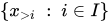

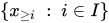

























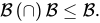














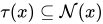
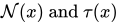














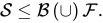




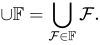



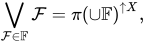








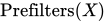



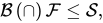



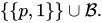






















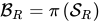


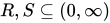



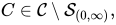



























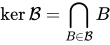

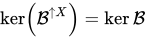


















































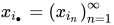
















































![{\displaystyle {\mathcal {B}}=\{[e,\infty )~:~e\in E\}\qquad {\text{ および }}\qquad {\mathcal {C}}_{\operatorname {open} }=\{(-\infty ,e)\cup (1+e,\infty )~:~e\in E\}\qquad {\text{ そして}}\qquad {\mathcal {C}}_{\operatorname {closed} }=\{(-\infty ,e]\cup [1+e,\infty )~:~e\in E\}.}](https://wikimedia.org/api/rest_v1/media/math/render/svg/dac438287e9aeacedd30bf9b1239612c9a09f332)







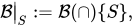
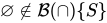














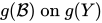










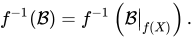


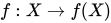





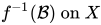

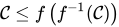



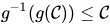
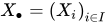
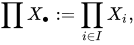


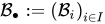


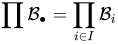
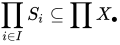


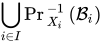


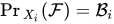





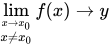































































![{\displaystyle {\begin{alignedat}{4}\operatorname {PosetNet} _{\mathcal {B}}\ :\ &&\ \operatorname {Poset} _{\mathcal {B}}\ &&\,\to \;&X\\[0.5ex]&&\ (B,m,b)\ &&\,\mapsto \;&b\\[0.5ex]\end{alignedat}}}](https://wikimedia.org/api/rest_v1/media/math/render/svg/8f5a20359c82977112c1fa8a948d5b0f0501a556)







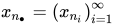




























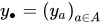





































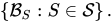





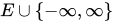

![{\displaystyle (-\infty ,e_{1}]{\text{ および }}[e_{2},\infty )}](https://wikimedia.org/api/rest_v1/media/math/render/svg/0189922ee45e39376295a05a9703139c9ae4dd98)