Genetic testing, also known as DNA testing, is used to identify changes in DNA sequence or chromosome structure. Genetic testing can also include measuring the results of genetic changes, such as RNA analysis as an output of gene expression, or through biochemical analysis to measure specific protein output.[1] In a medical setting, genetic testing can be used to diagnose or rule out suspected genetic disorders, predict risks for specific conditions, or gain information that can be used to customize medical treatments based on an individual's genetic makeup.[1] Genetic testing can also be used to determine biological relatives, such as a child's biological parentage (genetic mother and father) through DNA paternity testing,[2] or be used to broadly predict an individual's ancestry.[3] Genetic testing of plants and animals can be used for similar reasons as in humans (e.g. to assess relatedness/ancestry or predict/diagnose genetic disorders),[4] to gain information used for selective breeding,[5] or for efforts to boost genetic diversity in endangered populations.[6]
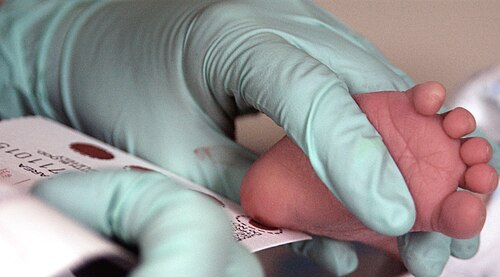
Newborn screening– used just after birth to identify genetic disorders that can be treated early in life. A blood sample is collected with a heel prick from the newborn 24–48 hours after birth and sent to the lab for analysis. In the United States, newborn screening procedure varies state by state, but all states by law test for at least 21 disorders. If abnormal results are obtained, it does not necessarily mean the child has the disorder. Diagnostic tests must follow the initial screening to confirm the disease.[14] The routine testing of infants for certain disorders is the most widespread use of genetic testing—millions of babies are tested each year in the United States. All states currently test infants for phenylketonuria (PKU, a genetic disorder that causes intellectual disability if left untreated) and congenitalhypothyroidism (a disorder of the thyroid gland). People with PKU do not have an enzyme needed to process the amino acid phenylalanine, which is responsible for normal growth in children and normal protein use throughout their lifetime. If there is a buildup of too much phenylalanine, brain tissue can be damaged, causing developmental delay. Newborn screening can detect the presence of PKU, allowing children to be placed on special diets to avoid the effects of the disorder.[14]
Diagnostic testing– used to diagnose or rule out a specific genetic or chromosomal condition. In many cases, genetic testing is used to confirm a diagnosis when a particular condition is suspected based on clinical features and symptoms. Diagnostic testing can be performed at any time during a person's life but is not available for all genes or all genetic conditions. The results of a diagnostic test can influence a person's choices about health care and the management of the disease. For example, people with a family history of polycystic kidney disease (PKD) who experience pain or tenderness in their abdomen, blood in their urine, frequent urination, pain in the sides, a urinary tract infection or kidney stones may decide to have their genes tested, and the result could confirm the diagnosis of PKD.[15] Despite the several implications of genetic testing in conditions such as epilepsy or neurodevelopmental disorders, many patients (especially adults) do not have access to these modern diagnostic approaches, showing a relevant diagnostic gap.[16]
With regard to genetic testing and information in general, legislation in the United States called the Genetic Information Nondiscrimination Act prohibits group health plans and health insurers from denying coverage to a healthy person or charging that person higher premiums based solely on a genetic predisposition to developing a disease in the future. The legislation also bars employers from using genetic information when making hiring, firing, job placement, or promotion decisions.[56] Although GINA protects against genetic discrimination, Section 210 of the law states that once the disease has manifested, employers can use the medical information and not be in violation of the law, even if the condition has a genetic basis.[57] The legislation, the first of its kind in the United States,[58] was passed by the United States Senate on April 24, 2008, on a vote of 95–0, and was signed into law by President George W. Bush on May 21, 2008.[59][60] It went into effect on November 21, 2009.
In June 2013 the US Supreme Court issued two rulings on human genetics. The Court struck down patents on human genes, opening up competition in the field of genetic testing.[61] The Supreme Court also ruled that police were allowed to collect DNA from people arrested for serious offenses.[62]
In the European Union
Effective as of May 25, 2018, companies that process genetic data must abide by the General Data Protection Regulation (GDPR).[63][64] The GDPR is a set of rules/regulations that helps an individual take control of their data that is collected, used, and stored digitally or in a structured filing system on paper, and restricts a company's use of personal data.[64] The regulation also applies to companies that offer products/services outside the EU.[64]
In Germany
Genetic testing in Germany is governed by the Genetic Diagnostics Act (GenDG),[65] which mandates that health-related genetic tests can only be carried out under medical supervision to ensure the proper interpretation of results and informed decision-making. The law emphasizes genetic counseling and informed consent, protecting individuals from potential misuse or misunderstanding of their genetic data.
Genetic testing influences how we perceive identity, ancestry, and group membership. Genealogical DNA testing has been critiqued for its potential to affirm and normalise biological race science. Genetic ancestry tests—which use biological data to predict a person's genetic similarity to a variety of social groups—reify biological race by seemingly providing concrete biological explanations for racial group variety. Marketing for ancestry tests often supports this misconception that humans can be separated into biologically distinct groups.[75]
However, genetic ancestry testing also has the potential to complicate these same notions. Subjectivities, based on identification with a particular race, can be challenged when genetic testing reveals ancestry from another group. For instance, someone who identifies as white may have their subjective experiences challenged upon discovering shared ancestry with a marginalised group. This can force them to examine ideas of what it means for them to continue identifying as white.[75]
Genetic ancestry tests impact on a person's subjective identification with race can even be mediated by their prior identifications. White consumers of these tests are more likely to identify with newly discovered ancestral backgrounds, due to viewing whiteness as boring or plain as opposed to the perceived exoticism of other identities.[76]
In Vitro Fertilisation
Ethical implications surrounding genetic testing also arise with the use of In Vitro Fertilisation (IVF). Genetic testing is used in IVF to test embryos for potentially fatal diseases to determine the strongest candidates.[77] With this they are also able to see the sex of these embryos, meaning people who undergo IVF are able to choose the sex of their future child.
This gender selection of embryos is not aimed at assessing the viability of said embryo, rather a cultural act that has deep roots in most societies around the world.[77] This practice perpetuates the historical gender power dynamics reflecting how gender and sex are central to kinship, inheritance, and cultural ideals of families.[78] In patriarchal societies gender selection is used to facilitate son preference and the devaluing of daughters, reinforcing the existing hierarchies present in current society under the guise of choice.[79]
This practice is justified under the context of reproductive autonomy, it is clear that these so-called choices are culturally informed and shaped by society.[80] This reinforces the stereotypes of each gender's roles within a family unit. It is argued that technologies, such as these, sort embryos for socially desirable traits and removes the natural randomness of sex determination with targeted intervention.[81]
Paternity testing
While paternity testing has proven an important genetic test within the medical field, its place in shaping human experience cannot be overlooked. Paternity testing can provide answers to the fundamental individual need to know where one came from. However, the development of the technology has somewhat ridiculed the origins of 'father' being a provider of care, support, and inspiration regardless of bloodline.[82]
Paternity is not always defined by biology, 'father' or 'fathers' can be defined by their role as a provider of care and support to the offspring in contemporary society. With the increasing availability of tests, and the shifting recognition and meaning of paternity within the law, rates of paternity tests are increasing.[83] Shifting legal practices, which are emphasising 'reproductive history' to declare paternity, to place more responsibility and rights upon the biological father.[84] This discourse places the question of 'who is the father?' above the more significant question 'what is the father?'.
The consideration of responsibilities that define fatherhood as 'lesser' is counterproductive to creating strong familial bonds, nor does it allow individuals to gain a deep sense of self through family. With the increasing demand for paternity testing, it is important for society to hold both meanings of fatherhood and the question of 'what' vs 'who' in equal importance.
↑Holtzman NA, Murphy PD, Watson MS, Barr PA (October 1997). "Predictive genetic testing: from basic research to clinical practice". Science. 278 (5338): 602–605. doi:10.1126/science.278.5338.602. PMID9381169. S2CID41939286.
↑Van den Veyver IB (October 28, 2016). "Recent advances in prenatal genetic screening and testing". F1000Research. 5: 2591. doi:10.12688/f1000research.9215.1. PMC5089140. PMID27853526.
↑Permezel M, Walker S, Kyprianou K (2015). Beischer & MacKay's Obstetrics, Gynaecology and the Newborn. Elsevier Health Sciences. p.74. ISBN978-0-7295-8405-0. Retrieved January 24, 2017.
12"Newborn Screening". Genetics Home Reference. Bethesda (MD): National Library of Medicine (US). Retrieved March 22, 2015.
↑Mayo Clinic Staff. "Polycystic Kidney Disease". Mayo Clinic. Mayo Foundation for Medical Education and Research. Retrieved November 18, 2016.
↑Aledo-Serrano A, García-Morales I, Toledano R, Jiménez-Huete A, Parejo B, Anciones C, etal. (October 2020). "Diagnostic gap in genetic epilepsies: A matter of age". Epilepsy & Behavior. 111 107266. doi:10.1016/j.yebeh.2020.107266. PMID32610249. S2CID220128591.
↑Mayo Clinic Staff. "Genetic testing Why it's done - Tests and Procedures - Mayo Clinic". Mayo Clinic. Retrieved January 22, 2015.
↑Haugen JA. "The Facts on Prenatal Testing". John A. Haugen Associates Obstetrics and Gynecology. Archived from the original on April 2, 2015. Retrieved March 26, 2015.
↑Antoniou A, Pharoah PD, Narod S, Risch HA, Eyfjord JE, Hopper JL, etal. (May 2003). "Average risks of breast and ovarian cancer associated with BRCA1 or BRCA2 mutations detected in case Series unselected for family history: a combined analysis of 22 studies". American Journal of Human Genetics. 72 (5): 1117–1130. Bibcode:2003AmJHG..72.1117A. doi:10.1086/375033. PMC1180265. PMID12677558.
12"Genetic Testing for Hereditary Cancer Syndromes". National Cancer Institute. National Institute of Health. April 22, 2013. Retrieved November 18, 2016.
↑"Genetic Testing". American Medical Association. Retrieved January 23, 2015.
↑"Genomic Tumor Assessment". Cancer Treatment Centers for America. Rising Tide. Archived from the original on November 19, 2016. Retrieved November 18, 2016.
↑Allingham-Hawkins D (August 2008). "Successful Genetic Tests Are Predicated on Clinical Utility". Genetic Engineering & Biotechnology News. Vol.28, no.14. Mary Ann Liebert. pp.6, 9. ISSN1935-472X. Retrieved September 23, 2008.
123"What are the risks and limitations of genetic testing?". Genetics Home Reference. Bethesda (MD): National Library of Medicine (US). November 15, 2016.
↑Andorno R (October 2004). "The right not to know: an autonomy based approach". Journal of Medical Ethics. 30 (5): 435–439. doi:10.1136/jme.2002.001578. PMC1733927. PMID15467071.
↑Wendelsdorf K (October 1, 2013). "You have a genetic disorder: Should your family be told they might carry the mutation?". Genetic Literacy Project.
↑Amy Harmon, "Insurance Fears Lead Many to Shun DNA Tests,"The New York Times, February 24, 2008
↑ Thiebes S、Toussaint PA、Ju J、Ahn JH、Lyytinen K、Sunyaev A (2020年1月)。「価値あるゲノム:消費者向け遺伝子検査におけるビジネスモデルの分類と原型」。Journal of Medical Internet Research。22 ( 1) e14890。doi : 10.2196 / 14890。PMC 7001042。PMID 31961329。
↑ Onstwedder SM、Jansen ME、Cornel MC、Rigter T (2024年7月17日)。「消費者向け遺伝子検査サービスに関する政策ガイダンス:フレームワーク開発研究」。Journal of Medical Internet Research。26 e47389。doi : 10.2196 / 47389。ISSN 1438-8871。PMC 11292153。PMID 39018558。
↑ Gollust et al.、「臨床遺伝子検査における消費者向け直接広告の限界」、 JAMA.2002; 288: 1762-1767
↑ Nisbet MC (2019). "DNAは運命ではない:遺伝子検査に関する誇大宣伝に異議を唱える". Skeptical Inquirer . Vol. 43, no. 4. pp. 28–30 .
↑ Chapman CR、Mehta KS 、Parent B、Caplan AL (2020)。 「遺伝子差別:技術進歩の文脈における新たな倫理的課題」。Journal of Law and the Biosciences。7 ( 1) lsz016。doi : 10.1093 /jlb / lsz016。PMC 8249090。PMID 34221431。
123"It's your Data - Take Control: Data Protection in the EU"(PDF). European Commission. 2018. Retrieved May 1, 2019.
↑"German Genetic Diagnostics Act". medgen-mainz.de. February 10, 2020. Retrieved November 16, 2024.
↑Chivot E (July 24, 2019). "Tests génétiques: pourquoi la France doit assouplir sa loi bioéthique". IREF Europe - Contrepoints (in French). Retrieved November 16, 2024.
↑Boodman E (November 14, 2019). "In France, it's illegal for consumers to order a DNA spit kit. Activists are fighting over lifting the ban". STAT. Retrieved November 16, 2024.
↑Articles 10 and 11 of the Federal Law of July 27, 2006 No. 152-FZ "On Personal Data"
↑Mirolyubova S (2021). "Problems of Using DNA Test for Family Reunification and Repatriation". Surgut State University Journal. 1 (31): 91–100. doi:10.34822/2312-3419-2021-1-91-100.
↑"الإمارات تعد بإنجاز المشروع الصحي الاستراتيجي لأبنــاء الدولة 2021"[The UAE promises to complete the strategic health project for the country's people in 2021]. Albayan (in Arabic). December 4, 2017. Archived from the original on December 4, 2017.
↑Zlotogora J (March 2014). "Genetics and genomic medicine in Israel". Molecular Genetics & Genomic Medicine. 2 (2): 85–94. doi:10.1002/mgg3.73. PMC3960049. PMID24689070.
↑Even D (October 22, 2009). "A Different Kind of Inheritance". Haaretz. Retrieved January 16, 2024.
↑Keyser Z (March 30, 2019). "Want to fully understand your family genealogy? Not without a court order". Jerusalem Post. Retrieved January 16, 2024.
↑Andrews LB, Fullarton JE, Holtzman NA, Motulsky AG (1994). Assessing Genetic Risks: Implications for Health and Social Policy. The National Academies Collection: Reports funded by National Institutes of Health. Institute of Medicine. ISBN0-309-04798-6. PMID25144102. Retrieved October 3, 2021.
12Benn T (2020). "Anthropological perspectives on genomic data, genetic ancestry, and race". American Journal of Physical Anthropology. 171 (70): 74–86. Bibcode:2020AJPA..171S..74B. doi:10.1002/ajpa.23979. PMID31837009– via WILEY Online Library.
↑Roth, W, Ivemark, B. (2018). "Genetic options: The impact of genetic ancestry testing on consumers' racial and ethnic identities". American Journal of Sociology. 124 (1): 150–184. doi:10.1086/697487. JSTOR26546171– via JSTOR.
12Bumgarner A (2007). "A Right to Choose: Sex Selection in the International Context". Duke J. Gender L. & Pol'y. 14: 1289 – via Heinonline.
↑Suryanarayanan S (June 1, 2025). Women's Empowerment and Son Preference in India: Feminist and Ethical discourse on Sex Selective Abortions. GB: Berghahn Books. ISBN978-1-83695-008-0.
↑Purewal N (2010). Son preference: Sex selection, gender, and culture in South Asia (1sted.). United Kingdom: Bloomsbury Publishing (published April 2010). ISBN978-1-84788-753-5.
↑Ginsburg, Rapp, R. (1991). "The Politics of Reproduction". Annual Review of Anthropology. 20: 311–343. doi:10.1146/annurev.an.20.100191.001523. JSTOR2155804. PMID12288961– via JSTOR.
↑Franklin, S., Roberts, C. (October 30, 2006). Born and made: An ethnography of preimplantation genetic diagnosis. United States: Princeton University Press. ISBN978-1-4008-3542-3.
↑Robson, Z., Gozho C.S, Muzingili, T. (2024). "Seeking for clarity in genetic science: exploring the factors behind men's decisions to seek DNA testing in Zimbabwe". Cogent Social Sciences. 10 (1) 2415527: 1–18. doi:10.1080/23311886.2024.2415527– via Taylor & Fancis.
↑Fonseca C (2019). "DNA and the displacement of certainties in Brazilian family law". Sexualidad, Salud y Sociedad (Rio de Janeiro). 32 (32): 4–19. doi:10.1590/1984-6487.sess.2019.32.02.a– via SciELO Brazil.
↑Gourarier M (2021). "'Are you paying for somebody else's?' The value of secrecy in the uses of DNA paternity tests in the USA". Social Anthropology. 29 (2): 495–510. doi:10.1111/1469-8676.13033– via Berghahn Journals.
↑Rochman B (February 21, 2013). "New Guidelines for Genetic Testing in Children". Time.
12Fallat ME, Katz AL, Mercurio MR, Moon MR, Okun AL, Webb SA, etal. (March 2013). "Ethical and policy issues in genetic testing and screening of children". Pediatrics. 131 (3): 620–622. doi:10.1542/peds.2012-3680. PMID23428972. S2CID42535260. All policy statements from the American Academy of Pediatrics automatically expire 5 years after publication unless reaffirmed, revised, or retired at or before that time
↑McGonigle IV, Herman LW (July 2015). "Genetic citizenship: DNA testing and the Israeli Law of Return". Journal of Law and the Biosciences. 2 (2): 469–478. doi:10.1093/jlb/lsv027. PMC5034383. PMID27774208.
↑"'Who is a Jew?' can now be answered by genetic testing". The Jerusalem Post | JPost.com. October 3, 2017.
↑"Should Jewishness be determined by a genetic test?". The Jerusalem Post | JPost.com. November 25, 2017.

 この記事は、米国保健福祉省の「遺伝子検査のリスクと限界とは?」からのパブリックドメイン資料を組み込んでいます。