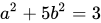
If R is a commutative ring and P is an ideal in R, then the quotient ringR/P is an integral domain if and only if P is a prime ideal.
Let R be an integral domain. Then the polynomial rings over R (in any number of indeterminates) are integral domains. This is in particular the case if R is a field.
The cancellation property holds in any integral domain: for any a, b, and c in an integral domain, if a ≠ 0 and ab = ac then b = c. Another way to state this is that the function x ↦ ax is injective for any nonzero a in the domain.
The cancellation property holds for ideals in any integral domain: if xI = xJ, then either x is zero or I = J.
An integral domain is equal to the intersection of its localizations at maximal ideals.
An inductive limit of integral domains is an integral domain.
If A, B are integral domains over an algebraically closed field k, then A ⊗kB is an integral domain. This is a consequence of Hilbert's nullstellensatz,[a] and, in algebraic geometry, it implies the statement that the coordinate ring of the product of two affine algebraic varieties over an algebraically closed field is again an integral domain.
Field of fractions
The field of fractionsK of an integral domain R is the set of fractions a/b with a and b in R and b ≠ 0 modulo an appropriate equivalence relation, equipped with the usual addition and multiplication operations. It is "the smallest field containing R" in the sense that there is an injective ring homomorphism R → K such that any injective ring homomorphism from R to a field factors through K. The field of fractions of the ring of integers is the field of rational numbers体の分数体は、その体自体と同型である。




![{\displaystyle \mathbb {Z} [x]}](https://wikimedia.org/api/rest_v1/media/math/render/svg/0d4da3ac703cc7721ebba91a53f6752de7157124)
![{\displaystyle \mathbb {C} [x_{1},\ldots ,x_{n}]}](https://wikimedia.org/api/rest_v1/media/math/render/svg/d85aa77dcb275059c2ef9fb836c34c82d14823de)
![{\displaystyle \mathbb {C} [x,y]/(y^{2}-x(x-1)(x-2))}](https://wikimedia.org/api/rest_v1/media/math/render/svg/2399c024b65bc7285ba6f968dedb035d457c6407)

![{\displaystyle \mathbb {Z} [x]/(x^{2}-n)\cong \mathbb {Z} [{\sqrt {n}}]}](https://wikimedia.org/api/rest_v1/media/math/render/svg/c4b7d2f715d09b321d6f810c54232d82736fc1e2)



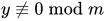



![{\displaystyle \mathbb {Z} [x]/(x^{2}-n^{2})}](https://wikimedia.org/api/rest_v1/media/math/render/svg/e9fbb3df3edc04fc70c0059ee130824840227e4b)


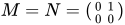
![{\displaystyle k[x_{1},\ldots ,x_{n}]/(fg)}](https://wikimedia.org/api/rest_v1/media/math/render/svg/6ff262849bd26f2104d76c4a1f42cfc41d8a981b)

![{\displaystyle f,g\in k[x_{1},\ldots ,x_{n}]}](https://wikimedia.org/api/rest_v1/media/math/render/svg/37f5bfd13fa3f98c2502c5881587901d7bd85019)

![{\displaystyle f(x)={\begin{cases}1-2x&x\in \left[0,{\tfrac {1}{2}}\right]\\0&x\in \left[{\tfrac {1}{2}},1\right]\end{cases}}\qquad g(x)={\begin{cases}0&x\in \left[0,{\tfrac {1}{2}}\right]\\2x-1&x\in \left[{\tfrac {1}{2}},1\right]\end{cases}}}](https://wikimedia.org/api/rest_v1/media/math/render/svg/67e4a6a031e93ed4311ff2e6a9e28398fb42e41e)









![{\displaystyle \mathbb {Z} \left[{\sqrt {-5}}\right]}](https://wikimedia.org/api/rest_v1/media/math/render/svg/828485881660a382d22d27b7ddce858daa2ea760)