Loading article…
The BM-21 "Grad" (Russian: БМ-21 "Град", lit.'hailstorm') is a self-propelled 122 mm multiple rocket launcher designed in the Soviet Union.[9] The system and the M-21OF rocket[10] were first developed in the early 1960s, and saw their first combat use in March 1969 during the Sino-Soviet border conflict.[11]BM stands for boyevaya mashina (Russian: боевая машина – combat vehicle), and the nickname grad means "hail". The complete system with the BM-21 launch vehicle and M-21OF rocket is designated as the M-21 field-rocket system and is more commonly known as a Grad multiple rocket launcher system.
In NATO countries, the system, either the complete system or just the launch vehicle, was initially known as the M1964. Several other countries have copied the Grad or developed similar systems. In Russian service, its intended replacement is the 9A52-4 Tornado. Many similar 122 mm MLRS systems are made by different countries based on the BM-21 Grad.
The M-21 field rocket system with a BM-21 launch vehicle (122 mm multiple rocket launcher (MRL) system) entered service with the Soviet Army in 1963 to replace the aging 140 mm BM-14 system. The launch vehicle consists of a Ural-375D 6x6 truck chassis fitted with a bank of 40 launch tubes arranged in a rectangular shape that can be turned away from the unprotected cab.
The vehicle is powered by a water-cooled V8 180 hp gasoline engine, has a maximum road speed of 75 km/h (47 mph), a road range of up to 750 kilometers (470 mi), and can cross fords up to 1.5 m (4 ft 11 in) deep. The original vehicle together with supporting equipment (including the resupply truck 9T254 with 60 rockets) is referred to by the GRAU index "9K51". The launcher itself has the industrial index of "2B5". In 1976, the BM-21 was mounted on the newer Ural-4320 6x6 army truck.
The three-member crew can emplace the system and have it ready to fire in three minutes. The crew can fire the rockets from the cab or from a trigger at the end of a 64-meter (210 ft) cable. All 40 rockets can be away in as little as 20 seconds, and can be fired individually or in small groups in several-second intervals. A PG-1M panoramic telescope with a K-1 collimator can be used for sighting.
Each 2,870-millimeter (9 ft 5 in) rocket is slowly spun by rifling in its tube as it exits that, along with its primary fin stabilization, keeps it on course. Rockets armed with high explosive-fragmentation, incendiary, or chemical warheads can be fired 20 kilometers (12 mi). Newer high explosive and cargo rockets (used to deliver anti-personnel or antitank mines) have a range of 30 kilometers (19 mi) and more. Warheads weigh around 20 kilograms (44 lb), depending on the type.
The number of rockets that each vehicle is able to quickly bring to bear on an enemy target makes it effective, especially at shorter ranges. One battalion of eighteen launchers is able to deliver 720 rockets in a single volley. The system has lower precision than gun artillery and cannot be used in situations that call for pinpoint accuracy. It relies on a large number of shells impacting over an area for a certain hit rate on specific targets. Because of the short warning time for the impact of the whole volley, the BM-21 is still considered an effective weapon.
The Grad saw its first combat use in March 1969 during the Sino-Soviet border conflict.
Their use, in conjunction with the M-46, during Operation Savannah halted the advance of South African troops in 1975. The Valkiri was brought into service in 1977 to counter the Grad.

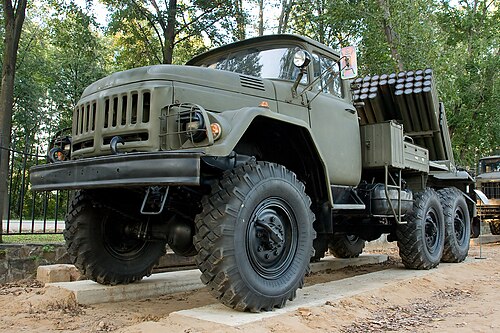

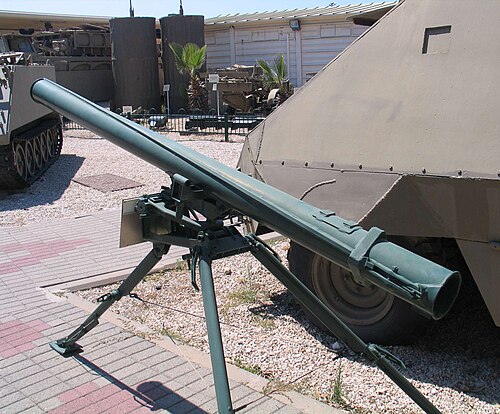
この発射装置の改良版は、中国、チェコスロバキア、エジプト、イラン、北朝鮮、ポーランド、ルーマニアなど、いくつかの国によって製造されてきた(または現在も製造されている)。
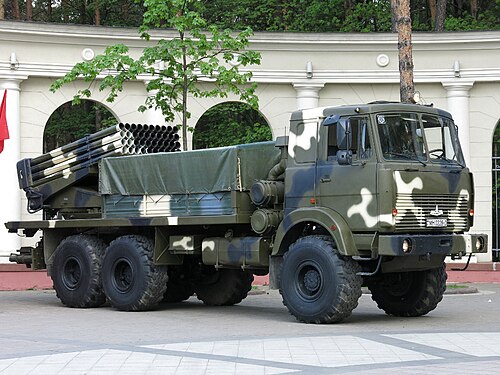

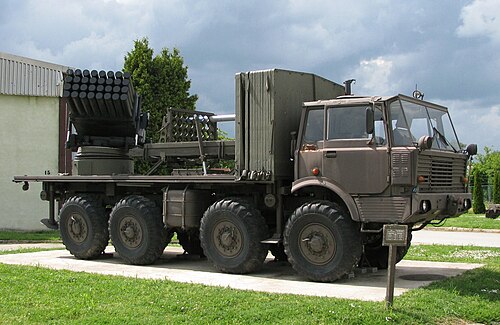
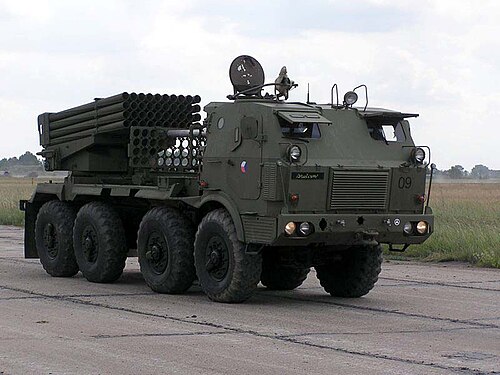
The Egyptians domestically manufacture the rockets Sakr-18 and Sakr-36, with a respective range of 18 km (11 mi) and 36 km (22 mi), and the latest Sakr-45 with a superior range of 45 km (28 mi). Rather than a standard HE-Frag round, the Egyptian military prefers a 23-kilogram (51 lb) cluster munition, which can be extremely effective against lightly armored equipment and troop concentrations. Both rockets, as well as the original Soviet models of course, are fired by locally manufactured rocket launchers like the RL-21 (copy of BM-11) and RC-21 (copy of BM-21, similar to the Hadid HM20). The Helwan Machine Tools Company also produces portable systems with one, three, four and eight launch tubes. Also, the RAAD 200 is a BM-21 on a new tracked vehicle.
The Homicho Ammunition Engineering Complex produces the rockets while the Bishoftu Motorization Engineering Complex produces the launching tubes and has converted existing trucks to diesel engine. Bishoftu Motorization has also produced a six tube launcher to be mounted on light trucks.
Since 2006, Hamas has fired 122 mm Grad rockets, copies made in Iran, and Eastern-bloc versions modified to expand their range, into Israel.[17] The rockets were believed to be brought into the Gaza Strip via tunnels from Egypt.[17] Some of the rockets were of a Chinese Grad variant.[18] Hamas sources said they were pleased by the performance of the Chinese variants of the BM-21 Grad rocket, which demonstrated a far greater range and blast impact than Palestinian-made rockets, as well as Russian-origin Grads or Katyushas.[18][19]
Hamas have used small man-portable single-tube launchers for rockets in attacks against Israel, designated 122 mm 9P132/BM-21-P.[20] The 122 mm Grad rockets used in Gaza have a range of about 40 km (25 mi), and can reach the Israeli towns of Ashdod, Beer-Sheva, Ofakim, Gedera, Kiryat Gat, Ashqelon, Sderot, Rehovot, Kiryat Malachi and Gan Yavne. They also published a clip claiming device mounted used as a multi-barrel rocket launcher on vehicle used for first time in Gaza.[21] On 7 April 2011, the Iron Dome system successfully intercepted a Grad rocket launched from Gaza for the first time. The rockets were launched without their dedicated platforms and by untrained operators which causes very low accuracy. Over 50% of the rockets miss entire cities and over 10% end up hitting the sea.[22]

D.I.O. from Iran produces copies of the BM-11 and BM-21 systems that can fire the original Soviet rockets as well as the locally developed "Arash" with a range of 20.5 km (12.7 mi). There is also a rocket with a range of 75 km (47 mi).
イラン・イラク戦争中、イラクは神経剤を標的に届けるために改造された様々な122mm型ロケットを配備した。これには、サリンガスを散布するために設計された、長さ40インチの国産グラッドMLRS互換の「ボラク」弾頭も含まれる。[ 25 ]
FIROS 25および30ロケットランチャーは限定生産された。両ランチャーは同一の構成で、122mm 口径のロケット弾を40発搭載し、BM-21ランチャーとも互換性があった。射程は約25~32kmで 、リビア、アラブ首長国連邦、その他顧客に販売されたと思われる。1980年代から1990年代にかけて約150基が生産された。
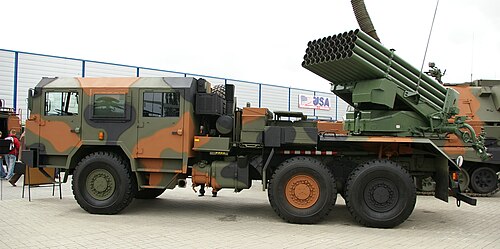
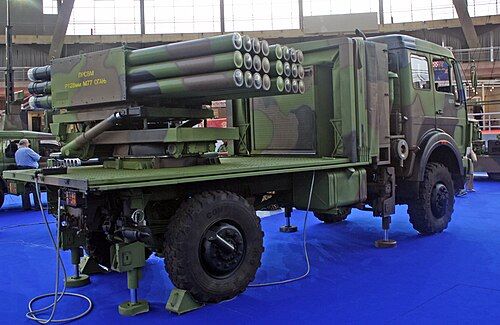


オリジナルの「グラード」ロケットの射程は約20キロメートル(12マイル)です。最初の改良型「GM」では射程が約27.5キロメートル(17.1マイル)に伸び、2番目の改良型「G-2000」ではさらに射程が約40キロメートル(25マイル)に伸びました。[ 36 ]最新の技術開発により、新しいグラードロケットの射程は52キロメートル(32マイル)になりました。[ 37 ]射程は弾頭の種類によっても異なる場合があります。
The 9M22S munition (see below) was developed by NPO Splav during the Soviet era.[38][39] Instead of a high-explosive fragmentation warhead, the 9M22S rocket carries a warhead containing 180 separate 9N510 incendiary submunitions.[40] Designed to ignite vegetation, storage facilities, or fuel, these incendiary elements consist of hexagonal prisms made from a magnesium alloy known to the Russian GOST as ML-5,[41][42] filled with a thermite mixture.[43] Each element has a nominal length of 40 mm and a width of 25 mm and a burning time of at least 2 minutes. The effect of these incendiary, as well as conventional lighting munitions (especially at night), outwardly resembles the use of phosphorus munitions.[38]
As of 2024, India's DRDO is developing ERR 122 rockets for the Indian Army's BM-21 launchers, modified as Agnibaan with Ashok Leyland chassis,[44][45]. The rocket was first tested on 25 June 2021.[46][47] Further, IIT Madras is undertaking the development of a ramjet propulsion technology which is expected to enhance the range to 80 kilometers (50 mi).[48]
また、焼夷地雷、化学地雷、照明地雷、対人地雷も含まれます。


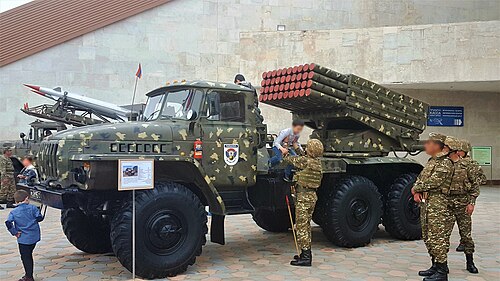
 アフガニスタン:2024年時点での運用数は不明。 [ 49 ]
 アルジェリア:2024年時点で48機のBM-21グラードが運用されている。[ 49 ]
 アンゴラ:2024年時点でBM-21グラッド70両とRM-70 40両が運用中。[ 49 ]
 アルメニア:2024年時点で最大50機のBM-21グラードが運用されている。[ 49 ]
 アゼルバイジャン:2024年時点でBM-21グラード54両、BM-21V 24両、IMIリンクス16両、RM-70 18両、T-122 18両が運用中。[ 49 ]
 バングラデシュ:2024年時点で36機以上のWS-22が運用中。[ 49 ]
 ベラルーシ:2024年時点で128両のBM-21グラードが運用されている。[ 49 ]
 ボスニア・ヘルツェゴビナ:2024年時点で24機のAPRA-40が運用中。[ 49 ]
 ボツワナ:2024年時点で20機のAPRA-40が運用中。[ 49 ]
 ブルガリア:2024年時点でBM-21 Grad 24機。[ 49 ]
 ブルキナファソ:2024年時点で5 APR-40が運用中。[ 49 ]
 ブルンジ:2024年時点で12機のBM-21 Gradが運用中。[ 49 ]
 カンボジア:2024年時点でBM-21グラード8機、RM-70 20機、PHL-81約20機、PHL-90B数機が運用中。[ 49 ]
 カメルーン:2024年時点でBM-21卒業生20名。[ 49 ]
 チャド: 2024年時点でBM-21卒業生6名、PHL-81卒業生5名。 [ 49 ]
 中国:2024年時点でPHL-81/90が200両、PHL-11が350両、PHZ-89が375両、PHZ-11が120両、PHL-20/21/161が50両以上運用中。[ 49 ]
 コンゴ共和国:2024年時点でBM-21卒業生10名。[ 49 ]
 コンゴ・キンシャサ:2024年時点でBM-21グラード24両とRM-70が数両運用中。[ 49 ]
 コートジボワール:2024年時点でBM-21グラード6機が運用中。[ 49 ]
 クロアチア:2024年時点でBM-21グラード21両とM91ブルカン6両が運用中。[ 49 ]
 キューバ:2024年時点で運用中のBM-21 Gradの数は不明。[ 49 ]
 キプロス:2024年時点でBM-21卒業生4名。[ 49 ]
 エクアドル:2024年時点でBM-21 Grad 18機とRM-70 6機を保有。[ 49 ]
 エジプト:2024年時点でBM-21グラード60機、BM-11 96機、サクル-10/18/36 200機、ATS-59Gの数は不明。[ 49 ]
 エリトリア:2024年時点で35機のBM-21グラードが運用中。[ 49 ]
 エチオピア:2024年時点でBM-21グラードが約50両運用されていると推定される。[ 49 ]
 フィンランド:2024年時点で34機のRM-70が運用中。[ 49 ]
 ジョージア:2024年時点でBM-21 Grad 13機、GradLAR 6機、RM-70 18機が運用中。[ 49 ]
 ガーナ:2024年時点で3機のPHL-81が運用されている。[ 49 ]
 ギリシャ:2024年時点で108機のRM-70が運用されている。[ 49 ]
 インド:2024年時点で約150機のBM-21 Gradが運用されていると推定される。[ 49 ]
 イラン:2024年時点でBM-21グラード100両、BM-11 7両、アラシュ/ハディド/ヌール50両が運用中。[ 49 ]
 イラク:2024年時点でのBM-21グラードの数は不明。[ 49 ]
 カザフスタン:2024年時点でBM-21グラード80機。[ 49 ]
 キルギスタン:2024年時点で15機のBM-21グラードが運用されている。[ 49 ]
 レバノン:2024年時点でBM-21 Gradが11機。[ 49 ]
 マリ:2024年時点で30機以上のBM-21 Gradが運用中。[ 49 ]
 モーリタニア:2024年時点でPHL-81が6機運用中。[ 49 ]
 メキシコ: 2024 年現在、6 機のイタリア製 Firos-25 が運用されている[ 49 ]
 モンゴル:2024年時点で130両のBM-21グラードが運用されている。[ 49 ]
 モロッコ:2024年時点で35機のBM-21グラードが運用されている。[ 49 ]
 モザンビーク:2024年時点で12機のBM-21 Gradが運用されている。[ 49 ]
 ミャンマー:MAM-01の砲塔とロケットランチャーでアップグレードされた9P138「グレード1」が230両、中国製81式戦車が20両、90B式戦車が90両運用中。[ 51 ] 2024年時点での残存数は不明。[ 49 ]
 ナミビア:2024年時点でBM-21グラッド5機とPHL-813機が運用中。[ 49 ]
 ニカラグア:2024年時点でBM-21グラード単装ロケットランチャー18基とBM-21P単装ロケットランチャー100基を保有。[ 49 ]
 ナイジェリア:2024年時点でBM-21 Grad 9両、APR-21 25両、RM-70 7両が運用中。[ 49 ]
 北朝鮮:2024年時点で運用中のBM-11、BM-21(M-1977)、M-1985、M-1992、M-1993、およびVTT-323の数は不明。[ 49 ]
 北マケドニア:2024年時点でBM-21 Grad 6機。[ 49 ]
 パキスタン:2025年時点で中国製PHL-83ミサイル52発とKRL-122ミサイル200発を保有。
 パレスチナ:ハマス、パレスチナ・イスラム聖戦、その他の武装勢力(イラン製の 射程20kmのグラード派生型と中国製の 射程40kmのグラード派生型を含む)[ 17 ] [ 52 ] [ 53 ]
 ペルー:2024年時点でBM-21グラード22両と90B型27両を保有。[ 49 ]
 ポーランド:2024年時点でBM-21グラード27両、RM-70 29両、WR-40 75両を保有。[ 49 ]
 ルーマニア:2024年時点でAPRA-40が134機、LAROMが36機運用中。[ 49 ]
 ロシア:2024年現在、BM-21 Grad 454機と9K51M Tornado-G 160機以上が運用中で、さらにBM-21 Grad 1500機が保管されている。[ 49 ] 2024年12月22日現在、ウクライナ戦争でBM-21 Gradの派生型294機と指揮車両2台が失われた。[ 54 ]
 ルワンダ:2024年時点で5機のRM-70が運用中。[ 49 ]
 セネガル:2024年時点でBM-21グラード(ウクライナのバスティオン-1)6基が運用中。[ 49 ]
 スロバキア:2024年時点でRM-70が4両、RM-70/85が26両。[ 49 ]
 ソマリア[ 55 ]
 南スーダン:2024年時点でBM-21 Gradが運用されている。[ 49 ]
 スリランカ:2024年時点でRM-70が22機、KRL-122が6機運用中。[ 49 ]
 スーダン:2024年時点で運用されているBM-21 Grad、Saqr、PHL-81の数は不明。[ 49 ]
 シリア:2024年時点で運用されているBM-21グラードの数は不明。[ 49 ] 2024年のシリア反政府勢力の攻勢中に、17機のBM-21グラードと1機の9P138-1がHTS反政府勢力によって鹵獲された。
  タジキスタン: 2024 年時点で BM-21 卒業生 14 名[ 49 ]
 タンザニア:2024年時点でBM-21卒業生58名。[ 49 ]
 タイ:2024年時点で4機のSR-4。[ 49 ]
 トーゴ:2024年時点でPHL-81が一部存在する。[ 49 ]
 沿ドニエストル共和国:2021年時点で20以上[ 58 ]
 トルコ:2024年時点で推定36両のT-122が運用されている。[ 49 ]
 トルクメニスタン:2024年時点でBM-21グラード70基と9P138 18基を保有。[ 49 ]
 ウクライナ:2024年現在、BM-21 Grad/9K51M Tornado-Gが100機、RM-70が8機、APR-40が4機運用されている。[ 49 ] 2024年12月22日現在、ロシア・ウクライナ戦争で少なくとも54機のBM-21 Grad派生型が失われたことが目視で確認されている。 [ 59 ]
 ウガンダ:2024年時点でRM-70が6機とBM-21 Gradが数機。[ 49 ]
 UAE:2024年時点で約24機のFiros-25が運用されていると推定される。[ 49 ]
 ウズベキスタン:2024年時点でBM-21グラード36機と9P138 24機が運用中。[ 49 ]
 ベネズエラ:2024年時点でBM-21卒業生24名。[ 49 ]
 ベトナム:2024年時点で350両のBM-21グラード。[ 49 ]
 ザンビア:2024年時点でBM-21グラード30機(稼働可能12機)[ 49 ]
 ジンバブエ:2024年時点で60機のRM-70が運用中。[ 49 ]
 東ドイツ:72ユニット、後継国家に引き継がれた。
 ハンガリー:1980年時点で40機が運用中。[ 60 ]
 イスラム国[ 61 ]
 イスラエル: 2016年時点で58[ 62 ]現在は運用されていないと報告されている。 [ 49 ]
 ラオス:2019年1月に公開された。[ 63 ]
 リビア[ 64 ] [ 65 ]
 モルドバ[ 49 ]
 北イエメン:65以上、1979年に供給[ 66 ]
 ドンバスのロシア分離主義勢力[ 50 ]
 南イエメン[ 67 ]
 ソビエト連邦:後継国家に引き継がれた。
 ティグレ防衛軍[ 68 ] −ティグレ戦争の余波でエチオピア軍に降伏した。[ 69 ]
 ユーゴスラビア:後継国家に引き継がれた。
最も重要な[ソ連のロケット]は、122mmロケットのカチューシャ級の一つである9M22Mであった。