
Loading article…
マーケティングコミュニケーション(MC、marcom(s)、marcomm(s)、または単にコミュニケーション)は、さまざまなマーケティングチャネルとツールを組み合わせて使用することを指します。[1]マーケティングコミュニケーションチャネルは、企業が希望する市場、または市場全体にメッセージを伝える方法に重点を置いています。また、組織の内部コミュニケーションも担当しています。マーケティングコミュニケーションツールには、広告、パーソナルセリング、ダイレクトマーケティング、スポンサーシップ、コミュニケーション、広報、ソーシャルメディア、カスタマージャーニー、プロモーションが含まれます。[1]
MCは、商品を販売するビジネスの場合は価格、プロモーション、場所、製品の4Pで構成されるマーケティングミックスで構成され、サービスベースのビジネスの場合は価格、プロモーション、場所、製品、人、物理的証拠、プロセスの7Pで構成されます。[2]
概要
マーケティングコミュニケーションには、広告、プロモーション、販売、ブランディング、キャンペーン、イベント、オンラインプロモーションが含まれます。[3]このプロセスにより、一般の人々はブランドを知り、理解し、ブランドが提供するものを明確に把握できます。ブランド認知が最初の段階であり、次に競合他社よりもブランドが好まれることが望まれる結果です。テクノロジーと手法の進歩により、顧客の直接的な参加が実現します。これは、製品開発とブランドプロモーションに顧客のアイデアと創作を取り入れることによって行われます。ブランディングを成功させるには、組織の使命とビジョン、ビジネス価値、マーケティングプログラムを評価するオーディエンスをターゲットにする必要があります。
広告はマーケティングコミュニケーションの小さいながらも重要な部分です。マーケティングコミュニケーションミックスは、ターゲットオーディエンスに明確で一貫したメッセージを届けるために使用できる一連のツールです。これは一般にプロモーションミックスとも呼ばれます。Crosier (1990) は、製品、価格、場所、プロモーションの 4ps の文脈では、すべての用語が同じ意味を持つと述べています。[1]価格はターゲットオーディエンスにメッセージを伝えることができます。たとえば、50 ドルのバッグと 10 ドルのバッグを比較すると、前者は贅沢品またはより耐久性のあるアイテムと見なされる可能性があります。広告のより高い目標は、ブランドとそのターゲット市場との関係を確立することです。
マーケティング計画では、主要な機会、脅威、弱点、強みを特定し、目標を設定し、マーケティング目標を達成するための行動計画を作成します。4P の各セクションでは、独自の目標を設定します。たとえば、価格設定の目標は、自社の製品またはサービスを競合他社よりも安く設定して、特定の地理的市場での売上を増やすことです。これにより、市場に大きな変化が生まれます。なぜなら、ターゲット市場では、競合他社よりも自社の組織と取引することを望む人が増えるからです。価格設定は、市場全体をプラスにもマイナスにも変えることができるマーケティングの最も重要な側面の 1 つだからです。
定義
- コミュニケーション障壁:コミュニケーション障壁は、マーケティングコミュニケーションの目的を妨げる要因です。主なコミュニケーション障壁は、雑音と乱雑さ、消費者の無関心、ブランドの同等性、および情報設計、創造的なアイデア、または戦略の弱さです。雑音は、消費者の注意をマーケティングメッセージからそらす無関係な感覚刺激です(たとえば、近くで話している人のせいでラジオ広告が聞き取りにくいなど)。乱雑さとは、消費者に常に提示される広告の数と集中度が高いことです。注意を分割することはできないため、取り込んで処理できる量には限界があり、つまり強力なマーケティングコミュニケーションは乱雑さから際立ち、雑音を超えて聞こえる必要があります。[4]
- 「消費者の無関心」とは、消費者がマーケティングコミュニケーションを避ける傾向のことである。消費者は興味がないか、または自分が「市場にいる」と考え、無関係なマーケティング刺激を遮断しようとする。これは選択的注意として知られている。あるいは、消費者は「市場にいる」が、ブランドや製品の存在や普及に気付いていない場合もある。消費者は馴染みのあるブランドを購入する傾向があり、代替品を調査する気にならない。マーケティング担当者が無関心を克服するために使用する方法の 1 つは、競争力のある価格設定やロイヤルティ報酬などのインセンティブを作成することである。[4]
- ブランドパリティとは、ブランドが競合他社と大きく変わらないことを意味します。明確な価値提案がなければ、消費者はブランドに対する好みや連想を抱かず、代わりに価格のみに基づいて購入します。[5]これは理想的ではありません。効果的なマーケティングコミュニケーションはブランドエクイティを高めるからです。マーケティングコミュニケーションの重要な目的の1つは、ブランドを競合他社とは一線を画した位置付けにできる、強力でユニークなブランドアイデンティティを開発することです。
- マーケティングミックスはマーケティング戦略の最も重要な部分であり、「マーケティングを管理し、それをビジネスの文脈に組み込むための枠組み[6]」です。
- マーケティング戦略:企業がマーケティング目標を達成する方法。マーケティング戦略を達成するための最初のステップは、市場ターゲットを特定し、ビジネスプランを構築することです。[6]
- マーケティングリサーチには、最終的な推論につながる実証済みの手順は含まれません。これは、より広い視野を必要とする繰り返しのプロセスです。時には、プロジェクトを深く掘り下げてプロセス全体を変更する必要があるかもしれません。スマートフォン市場への参入準備をしていたノキアの例を見てみましょう。2011年11月、ノキアは、特にフィンランドのスマートフォンに乗り換えていた若者をターゲットにした新しいものを考案することを決定しました。この切り替えには、ブランドの基礎から社内チームのトレーニング、ターゲット設定から製品の進歩、有能なマーケティング担当者の雇用から新しいイノベーションまで、いくつかの変更が必要でした。[7]
コミュニケーション
コミュニケーションはマーケティングミックスの重要な側面の一つです。[8] マーケティングコミュニケーションは企業内のコミュニケーションの最大の要素であることが多く、投資家、顧客、一般大衆に企業の価値、目的、特定の製品やサービスを紹介することもあります。21世紀のコミュニケーションの目的は、よりカスタマイズされたメッセージに重点を置き、顧客グループや個人をターゲットにして高い反応とブランドとの交流を生み出すことです。[8]
インターネット、携帯電話、ソーシャル メディアへのアクセスが拡大し、ビジネスがますますグローバル化するにつれて、ターゲットとなる海外市場の人々に情報を提供するという新たな課題が生じています。世界経済の変化と新しい市場へのアクセスにより、製品の出荷や関連サービスに対する需要も高まります。マーケティング コミュニケーションを効果的にするには、そのチャネルに合わせて調整する必要があります。たとえば、広報メッセージ セットは、ターゲット ユーザーであるメディアと業界に合わせてカスタマイズされ、メッセージはデータで証明された成果に関するものになりますが、ソーシャル メディアのメッセージ コンテンツはより親しみやすく、ブランドのソフトな品質に関するものになります。コミュニケーション戦略は、マーケティング目標と合致する必要があり、同時に現地の言語、方言、文化的規範も考慮する必要があります。
外部コミュニケーションには、市場調査アンケート、オフィスウェブサイト、保証、会社の年次報告書、投資家向けプレゼンテーションなどが含まれます。内部コミュニケーションには、マーケティング資料、価格表、製品カタログ、販売プレゼンテーション、経営コミュニケーションなどがあります。一方、各市場は異なるタイプのコミュニケーションを求めています。たとえば、産業市場ではより個人的なコミュニケーションが求められますが、消費者市場では非個人的なコミュニケーションが求められます。[8]
コミュニケーションの種類
コミュニケーションには 4 つの基本的な種類があります。
- 1対多: このタイプのコミュニケーションは、最も独創的なコミュニケーションです。これは「単一の放送ポイントから生成され、その後、電波または大量印刷で利用可能になります[8]」。このタイプのコミュニケーションは、通常、特定のものではなく、インタラクティブでもないニュース配信に適応します。たとえば、業界の放送から電波で再生される緊急通知など、一般的なアナウンスに役立ちます。
- 多対一:多対一は通常、一対多の通信と関連しています。[8] たとえば、メールボックスの返信ボタン、Sparkから購入したプリペイド番号などです。すべての通信技術は、マスコミュニケーションからの双方向通信によって一般に普及しました。[8]
- 1対1:これは1対1レベルでの最も集中的でインタラクティブなコミュニケーションです。[8]販売プレゼンテーション、市場での交渉、直接配達など、1対1のコミュニケーションに基づく例はたくさんあります。このコミュニケーションのほとんどは対面です。しかし、インターネットの発達により、電子メールやオンラインショッピングが人々と直接会う機会をもたらしています。これにより、売り手と買い手がより直接的に話す機会が生まれました。もう1つの重要なものは、WechatやFacebookなどのインスタントメッセージの「チャット」チャネルで、ビジネスで非常に人気が高まっています。[8]
- 多対多: 高度に発達したインターネットを背景に、オンラインチャットルームや「ブログ」ウェブサイトなど、多対多のコミュニケーションが成長してきました。[8] 多対多のコミュニケーションは、参加者がアイデアや経験を交換できることを意味します。
1対1のチャネルはより即時性があり、一方、多対多のチャネルは緊急性は低いものの寿命が長くなる傾向があります。[8]
コミュニケーション心理学
マーケティング コミュニケーションの主な目標の 1 つは、ブランド、製品、またはサービスに対する消費者や企業への認識を変えるか、製品やサービスを購入するよう (または購入の動機/誘惑を感じるよう) 説得することです。説得がどのように行われるかを示すために、「詳細化尤度モデル」が使用されます。マーケティング コミュニケーション メッセージが送信されると、まず受信者がそれを認識し、対応する必要があります。マーケティング コミュニケーションに注意を向けることで、消費者はメッセージを処理し、理解し始めます。説得には、中心的経路と周辺的経路の 2 つの経路があります。中心的経路処理は、関与度の高い購入決定に使用されます。これらは、通常、多額のお金とかなりの時間を要する、頻度の低い、リスクの高い購入です (たとえば、家や車の購入)。これらの購入決定はリスクが高いため、最も論理的で価値のある選択肢を合理的に選択するために、大きな認知的努力が費やされます。これらのマーケティング メッセージでは、製品またはサービス自体に関する情報が最も価値があります。周辺的経路処理は、関与度の低い購入決定に使用されます。これらは、頻繁に行われる低リスクの購入であり、一般的には低または中程度のコストで、認知的(または理性的な)価値よりも感情的(または感情に基づく)価値に基づいて選択が行われます。このため、マーケティング メッセージでは、製品やサービスが持つ属性や仕様よりも、製品やサービスが与える感情や連想に焦点を当てたストーリーテリングやイメージがより多く使用されます。
言語的手段と説得の方法
マーケティングの大きな部分は、企業がどのようにコミュニケーションをとるかです。それは、顧客や潜在顧客との間であろうと、社内の他の部門との間であろうと関係ありません。企業が広告を出すとき、ターゲット層を説得するために言語的手段を利用できます。手段が異なれば、効果も異なります。[9]言語的手段のカテゴリの 1 つに、単純言語があります。単純言語のさまざまな手段には、音声記号、数字、音の繰り返し、発音が含まれます。4 つの手段はすべて、自動処理の認知的努力を利用します。音声記号は、「音と意味の間の非恣意的な関係であり、単語の音が定義とは別に意味を伝えることができることを示唆しています」。[9]舌先が喉の奥にあるため、後母音と子音はピッチが低くなります。これらの音は、重さ、男らしさ、心理的距離に関連付けられます。逆に、前母音と子音はピッチが高く、親密さ、女性らしさ、軽やかさに関連付けられます。ブランド名の響きは、消費者の観点から、製品に対する態度や製品の推奨とともに、ブランドの認識に影響を与える可能性があります。[9]つまり、ブランド名の響きの好みが消費者の好みと一致している場合、好ましい属性の認識は強化されます。
コミュニケーションプロセス
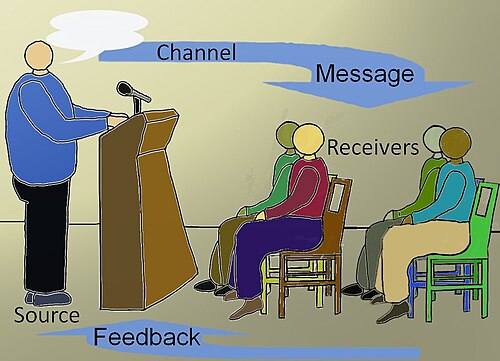
コミュニケーションとは、言葉、音、または視覚的な手がかりを使用して、1人または複数の人に情報を提供するプロセスと定義できます。[10]コミュニケーションプロセスとは、企業が送信しようとしたメッセージを受信者が理解できるように共有される情報と定義されます。[11]コミュニケーションプロセスは、かつてはメッセージのソースがあり、それがエンコードされ、選択されたコミュニケーションチャネルに送られ、受信者によってデコードされて受信されると考えられていました。 [12] チャネルの途中には、送信されるメッセージがノイズによって歪められる可能性があります。[12] 受信者がメッセージを受け取ると、元のソースにフィードバックが送られ、キャンペーンが成功したかどうかがわかります。[12]
テクノロジーの普及により、顧客は購入前にブランド、製品、企業に関する情報を求めています。[13]これは、コミュニケーションプロセス内に追加のチャネルが必要であり、現在のビジネス環境をより正確に表す必要があることを意味します。企業は現在、今日の社会とその認識に大きな影響を与えるオピニオンリーダーとオピニオン形成者の両方を考慮に入れなければなりません。したがって、メッセージの受信者がメッセージを受け取る前に、彼らをコミュニケーションプロセスに含める必要があります。[14]
このモデルは、送信者と受信者の間に共通点があり、効果的にコミュニケーションできる場合に、より効果的です。適切な情報源を選択すると、メッセージを作成し、対象者にアピールしやすくなります。情報源は、対象者と関連性があればあるほど効果的です。この理解の領域は、重なり合う円で表されます。情報源がターゲットとする人物についてより多くの知識を持っているほど、受信者がメッセージをどのように解釈し、反応するかをよりよく理解できます。[15]
トランザクション モデルのコンポーネントは次のとおりです。
- ソース:ソースとは、共有する情報を持つ個人または組織です。ソース (または送信者) は、情報を作成し、別の個人またはグループに送信します。ソースは、個人 (営業担当者やスポークスマンなど) の場合もあれば、非個人 (企業や組織など) の場合もあります。コミュニケーション プロセスはソースから始まります。ソースは、ターゲット ユーザーがメッセージをどのように認識するかに影響するため、マーケティング担当者はソースを慎重に選択する必要があります。[15]
- エンコーディング:これは、メッセージの意図された意味を言葉、記号、または画像に置き換えてメッセージを示すことです。エンコーディングとは、発信者が伝えたい情報を含むメッセージを作成することです。考え、アイデア、情報を、受信者が伝達して理解できる記号形式にまとめることです。[15]メッセージのエンコーディングは、コミュニケーション プロセスの 2 番目のステップです。エンコーディング プロセスは、発信者が伝えたい情報または意味を含むメッセージの作成につながります。エンコーディングは非常に重要で、受信者が意味を伝えるために使用されるブランド メッセージまたはアイデア (言葉、色、画像、標識、記号、または音楽) を理解したときに効果を発揮する脳活動です。メッセージは、言語的または非言語的、口頭または書面、または記号的 (たとえば、ブラス バンドの音がよりシンプルな時代や伝統を彷彿とさせる) である場合があります。または、成功を示すNike の「スウッシュ」などの「手がかり」が含まれることがよくあります。多くの場合、さまざまなものが「正しい」エンコーディングと意図されたメッセージの解釈 (デコーディング) の邪魔になることがあります。受信者がメッセージを正しく解釈するように送信者が使用できる方法はいくつかあり、これらの方法には、チャネル、消費者の洞察、受信者との類似点、参照フレーム(年齢、価値観、文化など)が含まれます。[12]最後に、送信者が受信者を知ることは非常に重要であり、これはターゲティング戦略のための調査を通じて達成されます。これらの概念は、消費者の心に意図されたメッセージを作成するのに役立ちます。
- メッセージ:メッセージはエンコードのプロセスから生まれ、情報源が伝えたい内容、意味、情報です。メッセージは、言語的、非言語的、口頭、書面、象徴的など、さまざまな形式があります。[15]
- チャネル: チャネルとは、コミュニケーションが発信者または送信者から受信者に伝わる方法です。[12]チャネルには、個人的なものと非個人的なものの 2 種類があります。個人的なコミュニケーション チャネルは直接的で、個々のグループを対象としています。個人的なコミュニケーション チャネルは、2 人以上の人が直接対面で、電話、電子メール、またはファックスを介して人対人的にコミュニケーションをとることでつながっています。ソーシャル チャネルも個人的なコミュニケーションのカテゴリに分類されます。友人、隣人、仲間、同僚、または家族はすべてソーシャル チャネルの手段です。[3] 送信者と受信者の間で個人間の接触なしにメッセージを運ぶことは、非個人的なコミュニケーション チャネルとして知られています。マス メディアまたはマス コミュニケーションは、メッセージが一度に多数の個人に送信されるため、非個人的なチャネルの例です。非個人的なコミュニケーション チャネルは、主に 2 つのタイプで構成され、1 つ目は印刷です。印刷メディアには、新聞、雑誌、ダイレクト メール、看板が含まれます。2 つ目は放送です。放送メディアには、ラジオとテレビが含まれます。[16]
- デコード:受信者はシンボルを解読して、何が伝えられているかを解釈します。送信者のメッセージを思考に戻します。これは、受信者の参照枠 (または理解の領域) によって大きく左右されます。参照枠には、メッセージを受け取ったときの価値観、態度、心の状態が含まれます。モデルが効果的であるためには、受信者によるデコードがソースによるエンコードと一致する必要があり、つまり、受信者は送信されたメッセージを正しく理解している必要があります。 [15]デコードはメッセージを解釈するプロセスであり、正しいエンコードと、送信された意味を解体する受信者の能力に依存します。デコードは、メッセージが受信者の感覚の 1 つ以上に届いたときに発生します。消費者はテレビ広告を聞いて見ますが、他の消費者は広告のオファー (クーポンなど) を操作 (触る) したり、読んだり (見る) します。Belch & Belch によると、このプロセスは受信者の参照枠または経験の分野によって大きく左右されます。これは、受信者がコミュニケーション状況にもたらす経験、認識、態度、価値観を指します。[12]効果的なコミュニケーションを実現するには、受信者のメッセージのデコードプロセスが送信者のエンコードと一致している必要があります。この全体的な手段を通じて、受信者は送信者が伝えようとしていることを理解し、正しく翻訳します。効果的なコミュニケーションは、両者の間に何らかの共通点がある場合に発生する可能性が高くなります。送信者が受信者についてよりよく知っているほど、送信者は受信者のニーズを理解し、彼らとコミュニケーションを取り、全体的により効果的にコミュニケーションをとることができます。
- 受信者: 情報源が考えや情報を共有する個人。受信者はメッセージを聞いたり、見たり、読んだりして解読します。
- ノイズ:ノイズとは、このコミュニケーションプロセス中に生じるあらゆる外部干渉のことです。予期しない歪みを生み出すあらゆる外部要因です。この歪みにより、受信者は、送信者が意図したとおりにメッセージを解釈したり意味を割り当てたりすることが困難になります。メッセージのエンコードにおけるノイズの例としては、ラジオやテレビの信号の欠如が挙げられます。送信者と受信者の経験分野が重ならない場合、つまり両者の間に共通点がない場合にもノイズが発生する可能性があり、その結果、メッセージの意味が誤解される可能性があります。[15]コミュニケーションプロセス全体を通じて、メッセージは、その受信を歪めたり妨害したりする可能性のある無関係な要因の影響を受けます。ノイズとは、コミュニケーションプロセスの内外からの物理的または心理的基礎です。ノイズは、メッセージの正確性、生産性、不明瞭さを低下させるため、障壁として機能します。メッセージが受信者に届かないようにする場合もあります。物理的なノイズは、多くの場合、出来の悪い画像やメッセージ (印刷品質の悪さなど) や気を散らす要素 (消費者がテレビ広告をスクロールしているなど) によって引き起こされます。心理的ノイズは、意味の混在、情報源の信頼性の低さ、消費者の要求に対するメッセージの無意味さなどである。通常、受信者とのつながりがなく、共通点が欠如していることが原因となる。これにより、受信者にとって馴染みのない、または意味が異なる記号、シンボル、または単語を使用するなど、メッセージが不適切にエンコードされる可能性がある(受信者が理解できない外国語でメッセージを送信するなど)。送信者と受信者の間に共通点が多いほど、ノイズや障壁がメッセージを中断する可能性は低くなります。[12]
- 応答/フィードバック: メッセージに対する受信者の反応は、送信者にフィードバックを提供します。これは、メッセージを見たり、聞いたり、読んだりした後の一連の反応です。受信者の応答がフィードバックであり、送信者はメッセージがどのように解読され、受け取られたかを知らせます。対人販売の状況におけるフィードバックの形式は、メッセージに関する質問、コメント、または任意の反応(表現など)である可能性があります。マスメディアでは、マーケティングコミュニケーションがどのように認識されたかを示す指標は、メッセージが送信された後の売上高です。マスメディアでフィードバックを提供する方法は、態度の変化、店舗訪問、問い合わせなど、多岐にわたります。フィードバックは、コミュニケーションプロセスを改善し、将来のメッセージの成功に役立ちます。[15]メッセージを見たり、聞いたり、読んだりした後の受信者の特定のタイプの反応は、応答として知られています。受信者の応答は、目立たないアクションまたは目立つアクションのいずれかになります。目立たない応答は、情報をメモリに保存することであり、目立つ応答は、テレビで宣伝されている製品を注文するためにコマーシャル番号にダイヤルするなどの即時のアクションです。コミュニケーションの主な目的の 1 つは、受信者から適切な応答を受け取ることです。フィードバックは、コミュニケーション フローのループを閉じ、送信者が意図したメッセージがどのようにデコードされ、受信されているかを監視できるようにします。この目的を達成するには、間接的または直接的に応答を求めるか、受信者が応答するのを支援します。[3] マス メディアのチャネルを通じて広告を行う関係者にとっては、フィードバックを受け取ることがより困難になる可能性があります。これは、広告主が顧客と直接接触していないため、メッセージがどのように受け取られたかを判断するために他の方法を取得する必要があるためです。フィードバックの重要な形式は販売を通じて得られますが、広告と購入行動の直接的な関係を示すことは難しいことがよくあります。そのため、マーケティング担当者は、店舗を訪問し、クーポンの引き換えを確認し、返信カードを使用し、顧客の問い合わせに耳を傾けてフィードバックを取得します。大量のフィードバック/応答調査が収集されると、広告主はコミュニケーション プロセスの成功または失敗の理由を判断するのに十分な情報を持ち、そこから適切な調整を行うことができます。
オピニオンリーダーとオピニオン形成者
オピニオンリーダーとは、他の消費者の購買行動に大きな影響力を持つ消費者のことである。[17]これらは同業者や有名人であり、影響を受ける消費者の目には「望ましい状態」を表すことが多い。消費者はオピニオンリーダーの消費パターンに従うことで、同様のステータスやライフスタイルの達成を望み、同様のイメージを投影する。このため、オピニオンリーダーはマーケティングコミュニケーションにおいて強力な要素である。オピニオンリーダーにブランドを推奨してもらうことで、ブランド認知度と売上を高めることができる。このため、大企業は影響力の大きい有名人に自社製品の推奨料を支払っている。
オピニオンリーダーの製品やサービスに対する考えや感情は、有料広告、ソーシャルメディア、ブログ、その他の書面によるメディアを通じて知ることができます。[18]これらは直接的な影響もあれば、間接的な影響もあります。
オピニオン リーダーとは、同業者から知識が豊富で信頼できるとみなされている消費者のことです。[19]彼らは、幅広い知識から最高品質の製品を選ぶ専門家とみなされており、そのため、オピニオン リーダーのような有名人の地位になくても、他の消費者の購買行動に影響を与えることができます。 彼らは、製品、サービス、またはビジネスに対応する分野に関する専門知識を持っています。 たとえば、これは、ある種の薬を後援する医師や、顧客にスポーツ ブランドを推奨するパーソナル トレーナーなどです。 つまり、オピニオン リーダーとオピニオン リーダーの両方が、消費者と、提供されるビジネス、製品、またはサービスに対する消費者の認識に大きな影響を与えます。[20]ブランドが化粧品の販売と製造を専門としている場合、そのビジネスは、化粧品に関する知識で知られ、そのコミュニティ内で人気があることがわかっている人物を探します。そうすることで、メッセージがターゲット市場全体に可能な限り広まります。[20] オピニオン リーダーは、コミュニケーション プロセスに別のリンクを追加し、メッセージの受信者の「意味フィルター」として機能します。[21]メッセージは送信者から送信され、オピニオンリーダーは対象となる聴衆と意見を共有します。
テレビ
テレビは、視覚と聴覚の刺激の組み合わせにより、他のメディアよりも注目を集め、メッセージを効果的に伝達できるため、その誕生以来、広告メディアシーンを支配してきました。テレビコマーシャルにはいくつかの欠点があります。テレビコマーシャルは「ジッピング」や「ザッピング」される傾向があります。「ジッピング」とは、番組の事前録画中にコマーシャルブレークのセッションを早送りすることを指します。視聴者は、コマーシャルブレークなしで視聴できるようにするために番組を録画することがよくあります。「ザッピング」とは、多くの消費者がコマーシャルブレーク中にチャンネルを変える習慣を指します。これは、広告を見ないようにするためにも行われます。テレビ広告の使用は、そのリーチの広さと、対象市場に応じてコンテンツをセグメント化できる程度により有益です。広告は、時間セグメントと慎重に組み合わせられ、適切なプログラミングとリンクされます。これは「メディアビークル」と呼ばれます。これにより、マーケティングメッセージが対象オーディエンスに確実に届くようになります。[22]
テレビ広告の初期制作費は高額ですが、大勢の視聴者に届く可能性が高いため、視聴者一人当たりのコストが低く抑えられ、効率的なコミュニケーションプラットフォームとなります。[23]
無線
ラジオは定義上、音声番組を一般大衆に放送することであり、今日ではブロードバンド接続を通じてライブストリーミングしたり、人々の車や家庭にデジタル送信したりすることができる。[24]ラジオは、現在も使用されているメディア送信の最も古い形式であるにもかかわらず、比較的低コストで便利であることから、ラジオによるマーケティングは依然として人気があり効果的な選択肢である(ラジオは移動中、仕事中、娯楽活動中に視聴することができる)。視覚的な側面がないため、ラジオ広告は消費者の心にイメージを作ろうとする。ラジオ広告は、他のチャネル(テレビなど)で出会うメッセージを強化するのにも非常に効果的である。[25]ブランドに関連付けられたおなじみのジングルや音声は、ブランドと広告の認知度を高め、最終的にブランドエクイティを高める。これは、複数のマーケティングチャネルを同時に利用してマーケティングメッセージの強度と到達範囲を拡大する「統合マーケティングコミュニケーション」の一例である。テレビと同様に、ラジオマーケティングは特定の時間帯とプログラム(この場合はラジオ局とその中のセグメントの形式)を選択できることから恩恵を受ける。
フィルら[23]は、ラジオ通信は、各リスナーが心の中で言葉や音楽などの音の視覚的表現を構築することを余儀なくされるため、「感情的な消費者中心の連想」を促進すると主張している。企業がよく使用する手法はイメージ転送と呼ばれ、補完的な視覚的なテレビ広告を、同様のオーディオトラックを特徴とする1次元のラジオ広告と並べて使用し、両者の視覚的連想を刺激する。[26]研究によると、この潜在意識の関係的思考プロセスは、将来のブランド認識と認知度に大きく役立つことが示唆されている。[23]
ラジオのインフォマーシャルは、司会者が読み上げる簡単な台本であることが多い。制作にほとんど手間がかからないため、短時間で済み、長い準備期間も必要ありません。[24]
印刷
印刷メディアは、メディア広告の最も基本的な形式です。感覚刺激がないため、強いイメージを作り出すのが最も難しいですが、効率的で明確な情報伝達とメッセージ伝達には効果的です。広告や音声で宣伝されたビデオでは消費者がメッセージを聞き逃す可能性がありますが(大きな音が邪魔をしたり、誰かが視界を遮ったり)、印刷物ではメッセージはいつまでも目に見えるままです。サイズ、色、スタイルなどの側面を使用して、他の印刷広告と比較して効果を高めることができます。これは、基本的なメディアコミュニケーションチャネルであるにもかかわらず、印刷物がテレビに次ぐ2番目に大きなメディアであるため重要です。[27]
伝統的に、マーケティングコミュニケーションの専門家は、印刷されたマーケティング資料の作成と実行に重点を置いていました。伝統的メディア、または一部の人々がオールドメディアと呼ぶものは、マーケティングと広告の世界で長年にわたって使用されてきました。[28]伝統的メディアには、テレビ、雑誌、新聞、ラジオ、ダイレクトメール、屋外広告など、従来の広告媒体が含まれます。何十年もの間、これらのコミュニケーション形式は、マーケティング担当者が消費者と他の企業の両方にリーチするための主な情報源でした。インターネットがなく、ソーシャルメディアの広大な世界である世界では、広告とプロモーションのルーツは、より直接的で物理的な広告方法である伝統的メディアにあります。
印刷物による広告は、看板やポスター、雑誌や新聞などの形で企業によって使用され、ターゲット ユーザーにメッセージを届けます。企業は通常、看板を、ターゲット ユーザーが日常的に活動する、見やすい場所に置きます。新聞、雑誌、ポスターはサイズが小さく、さまざまな場所で見つけることができるため、一般の人々が読むことができます。宣伝する製品やサービスに応じて、マーケティング担当者は、サロンでより一般的に宣伝される新しいシャンプーの広告など、印刷物の大部分をどこに出すかを指定することができます。
印刷メディアは、印刷サイズ、フォント、位置、色の組み合わせをさまざまに変えることができ、カスタマイズ性が高い。新聞は一般に粗い紙を使用し、再現性が低い傾向があるが、雑誌は厚手の光沢紙を使用しているため、特定の商品の見栄えがよく、色がよく再現され、品質と好感度が長持ちする。[23]雑誌はフレームとして機能し、視点と判断を操作する心理的装置である。[29]たとえば、有料発行のファッション雑誌のリーダーであるヴォーグ[30]は、美しい画像とエレガントな写真とともに広告を掲載している。この2つを組み合わせることで、品位と洗練性が伝わり、同じ出版物に掲載されているブランドの信頼性が促進される。高品質の再現性のため、雑誌は長持ちする傾向があり、美容院や待合室でよく見られる。消費者は個々の画像を切り取ることが多く、これによりメッセージがさらに長くなり、潜在的な露出が増える。この長い時間の間にメッセージの関連性は失われる可能性があるが、ブランド認知度は依然として高まる可能性がある。[23]
雑誌は女性の健康、自動車、ファッションなどのテーマでセグメント化されていることが多く、特定のターゲット市場に効果的にリーチします。新聞は地理的な地域に焦点を当てており、幅広い人口サンプルにアピールする傾向があり、選択性への影響は低いです。新聞は、他のメディアよりも低コストの代替手段として、地元のイベントやビジネスに関する最新情報や報道を提供する週刊スケジュールで発行されることがよくあります。このような広告は、より小さな書体で白黒で表示されます。[23]
衰退
多くの人は、より現代的な形式が普及するにつれて、過去の形式のメディアは徐々に効果を失っていると言います。[31]この変化は、視聴者の断片化と商業コンテンツの選択能力という2つの主要な要因によって引き起こされています。テレビ、ラジオ、雑誌、新聞はより断片化され、より小規模で選択的な視聴者に届きつつあります。インタラクティブメッセージング、特にインターネットによるコミュニケーションの急速な成長は、プロモーション媒体全体でのコミュニケーションの使用に変化をもたらし、企業はより伝統的なメディア方法よりも現代的なメディアを使用することを好みました。消費者は、新しい革新的なコミュニケーション方法を避けることはできません。[28]多くのマーケティング担当者は、伝統的な広告手法は現代のものに比べて高価すぎて費用対効果が高くなくなったと考えています。テレビや新聞広告などの古い形式のマーケティングコミュニケーションは本質的に一方向ですが、新しいメディアではマーケティング担当者がさまざまな機能を実行できます。
コミュニケーションと広告の形態
Facebook、Twitter、Instagram、TikTok、Snapchat、Skypeなどのコミュニケーションプラットフォームやその他のメディアは、非常に重要なコミュニケーション手段となっています。ソーシャルメディアに関係のないコミュニケーション方法もありますが、人々は仲間から大きな影響を受ける可能性があります。このプロセスはソーシャルメディエーションとして知られています。マーケティングコミュニケーションプラットフォームは、受信者のプロファイルに基づいて、マーケティングコンテンツを自動的にパーソナライズして展開します。[16]
プラットフォームはマーケティングコミュニケーションにおいて同様の原理として機能し、特定のブランドや製品に関する認知度と情報を提供します。[21]さまざまなコミュニケーションプラットフォームの戦略的選択は、視聴者を会話に引き込み、その結果として永続的な関係を構築しようとするメディア戦略として知られています。[32]現代のテクノロジーは、プラットフォームの使用と消費者とブランドが対話する方法を拡大しました。その結果、プラットフォームのコンテキストとその定義方法が変わりました。[33]コミュニケーションが伝達されるさまざまなプラットフォームがあり、[23]これらは有料、所有、獲得、共有に分類でき、正式にはGrönroosとLindberg-Repoによって統合コミュニケーショントライアングルと名付けられました。[34]このモデルは、コミュニケーションが効果的であるためには信頼性と信用性が必要であることを認めています。調査によると、多くの消費者はレビューフォーラムを見て、購入を決定する前に信頼できる友人や仲間に製品の評価を求めています。[33]したがって、効果的なコミュニケーションは、一次元[漠然とした]プラットフォームとインタラクティブプラットフォームの統合アプローチに依存しています。[21]
明示的に計画された市場コンテンツは、非個人的なコミュニケーションプラットフォームを通じて共有されます。[35]ブランドは、プラットフォーム、メッセージの内容、コミュニケーションメッセージの頻度と繰り返しを制御します。[36]これらの要素は通常、市場の大衆セグメントをターゲットにすることを目的とした、印刷、電子、屋外、代替メディアなどの従来の有料プラットフォームを通じて達成されます。 [35]
ノイズの他の側面は、メッセージの浸透効果を低下させます。たとえば、ほとんどの有料コミュニケーションプラットフォーム、印刷物、電子メディアはマーケティングや広告のメッセージでいっぱいで、乱雑になりがちで、ブランドは注目を集めるために競争を強いられることがよくあります。[21]ノイズを排除するために、ブランドはサンプルや香りのストリップなどの折り込みを雑誌に含めることを選択することが多く、新聞は消費者に地元のサービスや商品を訪問したり試したりすることを促すクーポンなどの「行動喚起」折り込みを活用します。[23]
ソーシャルメディア
YouTube、Facebook、Instagram、Pinterest、Snapchat、TikTokなどのサービスのおかげで、ソーシャルメディアの市場浸透率は上昇しています。企業はこれらの外部プラットフォームを利用して、既存および将来の顧客を引き付け、ブランドメッセージを強化し、顧客の意見に影響を与え、ターゲットを絞ったオファーを提供し、より効率的に顧客にサービスを提供しています。[37]ソーシャルメディアは、従来の広告手段を超えた柔軟なコミュニケーションツールであり、ブランドが個人的にまたは職業的に視聴者と交流することを可能にします。[38] [39]
インフルエンサーマーケティングは、かつては有名人の推薦を利用して視聴者に影響を与えることに重点を置いていました。今日では、ソーシャルメディアの普及が進むにつれて、ブロガーのような「一般人」が人気を集め、インフルエンサーとしてブランドや製品と結びついています。企業は、共鳴とリーチを通じて影響力を生み出すために時間とお金を投資し始めています。ROIはROIのように測定可能な追跡はできませんが、UTMパラメータとのリンクなどのメカニズムを作成して、影響力の変換行動を追跡することができます。[40]
インターネット
インターネットには、非個人的なコミュニケーションと個人的なコミュニケーションの両方の形態があります。ほとんどの消費者にとって、インターネットは最も支配的な情報源の 1 つになっています。2012 年の時点で、ベルチとベルチは[update]、インターネットは主に非個人的なコミュニケーションの形態であり、消費者は Web サイトで情報を提供している組織と個人的な接触をすることなくオンラインで情報を吸収すると説明しています。しかし、インターネットが発展するにつれて、消費者がオンラインでマーケティング担当者とやり取りしたり、ソーシャル メディアを使用して互いにコミュニケーションしたり情報を共有したりするなど、個人的なコミュニケーションも含まれるようになっています。[12]
インターネットでは、マルチメディア文書をユーザー間で共有することができます。2003年現在、[update]世界中で約3000万のウェブサイトが登録されており、6億5000万がインターネットに接続されています。[41]マーケティングツールとしてのインターネットは、顧客に直接リーチして情報を提供したり、ブランドロイヤルティを生み出したり、関係を構築したりするために使用できます。オンライン広告には、ウェブサイトバナーなどのグラフィック画像、ポップアップ広告、ホームページのスタイル変更、アンカーディール(2つの組織間の協力)などの要素が含まれます。[42]
インタラクティブ性
双方向性は、1996年にジョン・デイトンによって説明されたインターネットの特徴です。[43]彼は、当時の新しいインターネットビジネス環境では、マーケティング担当者ではなく顧客が、必要な情報を積極的に探すことによって、通常、対話を開始すると主張しました。さらに、顧客の個人的な反応は企業によって収集され、彼らの個々の要求は彼らの欲求に応じて満たされます。
一方、従来のメディアは「プッシュ」形式で、マーケティング担当者は顧客にメッセージを発信しますが、直接のフィードバックは許可されません。両者のやり取りはまれです。一方、インターネット メディアは「プル」という特性があり、顧客は自由に検索することができます。たとえば、消費者が Google の検索エンジンで「花」と入力すると、 Google AdWordsプログラムによって、特定の花屋の広告が検索結果ページの上部または下部に表示される場合があります。[44] Google は、顧客の検索履歴と場所を使用して、適切な広告を配置します。従来の一方的な「プッシュ」コミュニケーションは、より生産性の高い双方向の「プッシュとプル」のやり取りに取って代わられました。
個別化
Compared with the traditional media where the same information is received by all consumers, As another advantage of two-way interaction, internet media can carry information "tailored" to the needs of a specific consumer. One of the first and most prominent examples is the personalized service provided by Amazon in which consumers are called by their names and "tailored" recommendations are provided according to their previous purchase records.[45] Furthermore, besides "tailored" individual service, with the accumulation of consumers' information on the Internet, mass customization becomes possible in which companies provide "tailored" content to particular segments of consumers with similar interests. Douban is a Chinese social networking service website that allows its users to rate movies, TV dramas, music and concerts. It rapidly grew to 200 million registered users in 2013 (founded in 2005). In addition, people who like the same TV drama, like Game of Thrones, or fans of the same movie star, such as Tom Cruise, will group together to discuss and share their feelings. This allows companies to take advantage of mass customization to sell products or reinforce their brand equity in suitable target groups. By doing so, the interaction and co-operation of companies and consumers are deepening, widening and multiplying in a variety of ways.
Industry restructuring
Restructuring followed by disintermediation and reintermediation is one of the essential features of the transition from traditional to Internet marketing communications. The Internet may force traditional distributors or retailers out of business simply because Internet transactions are less costly. JD.com significantly impacted the distribution channels for personal computers in China as of 2009 by allowing consumers to order different parts of the computers that were then assembled by the online business, leaving tens of thousands of retailers in that field out of their jobs. In 2015, JD.com accounted for 22.9% of the Chinese online shopping's market share.[46] Again, according to Financial Times, with the shifting trend of using mobile phones for online purchase in China, the people using cellphones to log on to the Internet outnumbered those using PC,[47] the next wave of restructuring faced by JD.com and its major competitors like Alibaba. In 2014, JD.com's orders deriving from mobile phones increased by 543%, compared with the last year's quarter of the same period. Haoyu Shen, the chief executive of the JD.com, ascribed this result to its own company's app rather than the co-operation with Tecent, the Chinese second largest online corporation, although it invested in JD.com in March 2014. As an ecommerce business, JD.com has been constantly facing challenges and opportunities of reintermediation with the rapid shifts of the technology development of the Internet.
Email marketing is directly marketing a commercial message to a group of people using email. In its broadest sense, every email sent to a potential or current customer could be considered email marketing. It usually involves using email to send ads, request business, or solicit sales or donations, and is meant to build loyalty, trust, or brand awareness. Email marketing can be done to either sold lists or a current customer database. Broadly, the term is usually used to refer to sending email messages with the purpose of enhancing the relationship of a merchant with its current or previous customers, to encourage customer loyalty and repeat business, acquiring new customers or convincing current customers to purchase something immediately, and adding advertisements to email messages sent by other companies to their customers.
In-product communication
Another channel for direct digital marketing is in-product communication (or in-product marketing), which delivers marketing content directly to a user's internet-connected device or software application. In-product marketing content is often very similar to that of email marketing campaigns, but the segmentation and delivery is more targeted. Because email has become a standard tool in the digital marketing toolkit, the email channel often is overloaded and overused, leading to much lower open rates, lower engagement rates, lower click-through rates (CTR), and lower conversion rates. The rise of internet-connected (IOT) devices is enabling a growing number of consumer products manufacturers to take advantage of this channel of marketing communications, to supplement other digital marketing channels.
Guerrilla marketing
Due to the rise in advertising clutter, there has been a push for non-traditional media such as guerrilla marketing.[48] Guerrilla marketing is usually a low-cost way of generating buzz through creative or unexpected communication platforms.[49] Outdoor settings provide potential ground to gain attention from a large audience. An example is customizing street infrastructure or creating an event such as a flash mob. Research rates guerrilla advertising as having a higher perceived value compared to other communication platforms, which tends to result in a positive consumer response.[48] An example of successful guerrilla marketing was created by Volkswagen (VW) in their promotional "driven by fun" campaign, where consumers could use VW "fast lane" slide instead of the escalator to get to the bottom of the stairs faster.[50]
Touch points
Every point of contact is a form of communication and it is, therefore, necessary to consider touch points as a communication platform. Touch points can be either physical or a human interaction between a brand and the consumer which influence customer decision-making process during pre-purchase, purchase and post-purchase.[51]
There are many ways in which a customer may interact with a business.[21] Interactions occur through direct customer service exchanges, a company website, the point of purchase environment and product packaging or performance.[51] These all contribute to consumer perceptions of a particular brand. For instance, the service-scape of a purchase touch point such as a retail store can influence the perception of quality and service through lighting and layout or other sensory touch points, for example, smell.[21] Fast fashion retailers such as Topshop maintain a white store interior and exterior which is perceived as luxurious.[52] Likewise, the higher price point and packaging of Ferrero Rocher may communicate sophistication and better quality. Visual appearance can have a significant effect on purchase decision,[51] companies such as Coke a Cola and Pepsi provide a free fridge to distributors to control how products are displayed at the point of purchase.[21]
Multiplier effect
While boarding a United Airlines flight, Dave Carroll saw baggage handlers on the tarmac damage his Taylor guitar.[53] After failed attempts to solve the issue through customer service, Carroll uploaded a humorous YouTube video titled "United breaks guitars",[32] which experienced over 15 million views.[54] Carroll's YouTube video is an example of the multiplier effect, and how consumer experiences are shared through user-generated content (UGC) networks and word of mouth communication.[32] Research shows customers are more likely to pass on negative experiences, and therefore, such interactive platforms have a significant impact on purchase decisions and brand outlook.[36]
This highlights a trend in integration of consumer behavior with marketing communications, where technology has facilitated social group communication. Communication has changed from one direction with companies in control of their message to a dialogue where businesses interact with consumer feedback.[36] As Andy Lark, Commonwealth Bank CMO states "the power has shifted, we are now entering a transparent age where there are no secrets".[55]
Traditional models viewed paid media platforms as the primary source of information. However, technology has enabled dialogue within a consumer-centric communication platform.[33] This flow of information allows a many-to-many exchange through UGC, which includes all types of creative content online through blogs, chats, forums, online platforms for product reviews and social media websites such as Facebook, YouTube and Instagram,[36] which are known as earned and shared media.[32]
Co-creation
Co-creation takes place when customers not only buy the company's products but also help in designing and developing them. Nike built an example of co-creation and customer empowerment through earned and shared media. Nike ID is an online application that allows customers to design their shoe and therefore "Just do it online".[21][36] Market-generated media remain an important communication platform and information source.[36] Consumers tend to consider both market-generated and UGC when making a purchase decision,[33] particularly, for higher involvement product like vinyl record albums.[56] The transition from traditional media to various forms of online and UGC marketing is increasing. Academics recognize that marketing communication is an open system and customers are influenced by multiple communication platforms.[21] Ultimately positive brand encounters manifest brand supporters who contribute to positive earned and shared media, through product recommendations online and offline.[33]
Direct marketing
In direct marketing the producer communicates directly with potential customers, instead of through third-party media. Individual customer's responses and transactions are recorded.[57] Direct marketing is a growing form of marketing communication. It is designed to build the relationship between the customer and the brand,[58] known as customer relationship management (CRM). Organizations use customer accounts in order to monitor and understand their needs. They manage detailed information about the customer's touch points with the objective to maximize satisfaction and loyalty. The communication can be in person, by telephone, mail, email or website.[42] The interaction between the organization and the customer is usually a two-way communication. Direct marketing relies on CRM databases that contain valuable customer information. Good quality databases can provide a competitive advantage and increase profitability. Treating the customer database as an expense rather than an investment, or not continuously maintaining or updating them can be detrimental.[42]
Direct mail
Direct mail is a letter, card, catalog, or sample sent through post, email, fax, or courier. This communication is most effective when the recipient has shown interest in or has previously purchased from the organization. Advantages of direct mail are personalization, careful targeting, creativity and flexibility. Email is low-cost, but can be lost through spam and junk email filters. Direct mail is dependent on accurate databases.[42]
Telemarketing
Telemarketing is marketing communication via telephone. There are two types of telemarketing: outbound and inbound.[42] Outbound telemarketing is used by organizations to reach out to potential customers, generate sales, make appointments with salespeople and introduce new products. Inbound telemarketing is where people call the organization to complain or inquire about products. Both outbound and inbound can be used as a customer service strategy to boost sales and receive suggestions for improvement. Advantages of telemarketing include targeted communications, flexible and direct interaction between the organization and the customer, it can be an effective personal selling partner and it is cost-effective compared to face-to-face contact. A disadvantage is that call centers are usually used to handle outbound and inbound telemarketing, which need to be implemented, managed and financed.[42]
Mail order
Mail order marketing is a catalog of products that customers can order to receive in the mail. This form of direct marketing dates back over 100 years. Home shopping, online shopping and teleshopping now accompany it. With current technology mail order has improved. Now there can be a larger range in catalog, delivery is faster, and complaints are dealt with professionally. Mail order exerts less pressure on the customer than telemarketing and sales are easy to manage, however costly infrastructure is required in maintaining the back-end.[42]
Direct-response advertising
Direct-response advertising is partially direct marketing. It is a message transmitted through traditional communications media that requires the reader, viewer, listener or customer to respond directly to the organization.[42] The audience may respond to receive more information or to purchase a product. A common example of direct response advertising is in television "home shopping immediately to receive a particular deal or discount. Disadvantages are that focus can be lost because of the medium of communication and the targeting can be less narrow compared to direct mail. Organizational messages can get cluttered and crowded.[42]
Cellular marketing
Cellular marketing uses the audience's mobile phone and SMS to promote a product or brand. Advantages are a high level of flexibility and easy integration through computer systems using the Internet to send mass text messages. This marketing communications platform allows organizations to directly target customers to remind them to renew subscriptions, give exclusive product discounts, or build brand reputation through competitions or sweepstakes. The disadvantage is that some customers are charged to receive SMS, so opt-in permission is required.[42]
CD/DVD technology
CD and DVD discs can be used as part of e-communications. Entire marketing presentations, catalogs, brochures and price lists can be stored on a CD. CDs are small and simple to hand out to target audiences and most modern computers have CD drive readers, however, most of the same information can be presented on a website or email.[42]
Integrated marketing communications
Integrated marketing communications (IMC) is the use of marketing strategies to optimize the communication of a consistent message of the company's brands to stakeholders.[59] Coupling methods together improves communication as it harnesses the benefits of each channel, which when combined, builds a clearer and vaster impact than if used individually.[60] IMC requires marketers to identify the boundaries around the promotional mix elements and to consider the effectiveness of the campaign's message.[61]
In the mid to late 1980s, the marketing environment was undergoing profound environmental changes with implications for marketing communications. Media proliferation, audience fragmentation, globalization of markets, the advent of new communications technologies, the widespread use of databases meant that the old methods, and practices used in mass marketing were no longer relevant. In particular, the rise of digital and interactive media meant that marketers were relying less on advertising as the dominant form of marketing communications. Amongst practitioners and scholars, there was an increasing recognition that new approaches to marketing communications were required. That new approach would become known as integrated marketing communications. A number of empirical studies, carried out in the early 1990s, found that the new IMC was far from a "short-lived managerial fad," but rather was a very clear reaction by advertisers and marketers to the changing external environment.
Integrated marketing communications is a holistic planning process that focuses on integrating messages across communications disciplines, creative executions, media, timing and stakeholders. An integrated approach has emerged as the dominant approach used by companies to plan and execute their marketing communication programs [62] and has been described as a paradigm shift.[63]
IMC unifies and coordinates an organization's marketing communications to promote a consistent brand message.[64] Coordinating a brand's communications makes the brand seem more trustworthy and sound, as it is seen as a 'whole' rather than a mixture of different messages being sent out.[65] The IMC perspective looks at the 'big picture' in marketing, advertising and promotions.[15]
History
The impetus to rethink marketing communications came from a number of environmental changes that were becoming increasingly apparent throughout the mid to late 1980s. Media was proliferating and at the same time converging, audiences were fragmenting and many new communications disciplines were emerging. Few advertising agencies provided the full suite of services in terms of the varied communications disciplines. Companies were reliant on a multiplicity of service providers for assistance with advertising, public-relations, branding, packaging, sales promotion, event organizers and other promotional activities. Each of these communications disciplines was treated as a "silo"; with little thought to the synergies between them, with the result that many different stakeholders involved in presenting the company's external image throughout the breadth and length of a campaign.[66] In that environment, both practitioners and theorists recognized the potential for confusing or inconsistent brand images to develop across media and across different communications disciplines.[67] The fragmentation of audiences presented marketers with particular challenges. No longer were they able to communicate with mass markets via mass media; instead they needed to communicate with increasingly tightly defined market segments, using highly specialist media and communications disciplines. New media and the use of databases were enabling marketers to communicate with customers on a one-to-one basis.[68][69][70] The old methods and practices associated with mass communications were failing to serve the realities of the new era.[71] The imperative to present a clear, coherent and unified narrative in both internal and external communications was becoming increasingly apparent by the late 1980s.
In 1989, two discrete events served to draw attention to the fact that industry attitudes to marketing communications were shifting. Firstly, the consulting firm, Shearson-Lehman Hutton published a report on the subject of consumer advertising, signaling that a number of market-place changes would force packaged goods marketers to adopt a more integrated approach to marketing communications. Their report also noted that high-end manufacturers (e.g. automobiles) and up-market services (e.g. cruise vacations) were more inclined to use integrated promotions.[72][73] Secondly, the American Association of Advertising Agencies (4A's), instituted a task-force to investigate integrated marketing communications (IMC), with the result that the first official definition was published. The AAAA defined IMC as, "a concept of marketing communications planning that recognizes the added value of a comprehensive plan that evaluates the strategic roles of a variety of communication disciplines (e.g. general advertising, direct response, sales promotion, and public relations) and combines these disciplines to provide clarity, consistency, and maximum communication impact."[74][75] At this stage, the development of IMC, focused primarily on the need for organizations to offer more than just standard advertising and to integrate the various communications disciplines.[76] The 4As originally coined the term the "new advertising"; however, this title did not appropriately incorporate many other aspects included in the term "IMC" – most notably, those beyond traditional advertising process aside from simply advertising.[77]

In 1991, the faculty of Medill School of Journalism, Northwestern University in conjunction with the AAAA, began the first empirical research study designed to investigate how IMC was being used.[78] The study focused around understanding the concept and the importance of IMC and also to analyze the extent in which IMC was practiced in all major U.S advertising agencies. This initial study was then replicated by other studies with a view to examining how IMC was being used in other countries; New Zealand, UK, US, Australia, India, Thailand, South Africa and the Philippines, etc.[79][63] The findings from these studies demonstrated that the new IMC was far from a "short-lived managerial fad" but rather was "a very clear reaction by advertising agencies and their clients as they are affected by a multitude of factors such as new forms of information technology including development and usage of databases, media fragmentation, client desires for interaction/synergy, and global and regional coordination."[68][80] This was the second stage of IMC's development, where the focus shifted to documenting the practice of IMC as a global phenomenon. In other words, researchers were attempting to codify practices that had been used for some time.[81]
In 1993, Don Schultz and his team published the first text-book dedicated to IMC.[82] Their work, simply entitled, Integrated Marketing Communications, described IMC as a totally new way of looking at the whole of marketing communications, rather than looking at each of the parts separately. And, in the same year, the Medill School at Northwestern University changed their curriculum to include a focus on this new idea of integrated marketing communications rather than the traditional program which had emphasized advertising.[83] IMC emerged from an "academic department that, for several decades, had been recognized as the number one advertising program.[84] Since the mid-1990s, virtually every text-book on the subject of marketing communications has adopted an integrated perspective or has added chapters on IMC in new editions of standard works.[85][86] Collectively these books focus on the IMC planning processes and this represents the third distinct stage in the evolution of IMC – an emphasis on managing and organizing IMC.[87]
Over time, scholars have advanced different definitions of IMC, with each definition exhibiting a slightly different emphasis. Yet, in spite of the variety of definitions in circulation, there is general consensus that integrated marketing communications should be viewed as a planning process.[88] Some scholars have pointed out that because IMC is both a process and a concept, it is exceedingly difficult to define.[89]
Some of the key definitions that have been advanced during IMC's evolution are outlined here:
- "IMC is the process of all sources and information managed so a consumer or prospect is exposed which behaviorally moves the customer more towards a sale."[90]
- "The strategic coordination of all messages and media used by an organization to influence its perceived brand value."[91]
- "The process of strategically controlling or influencing all messages and encoring purposeful dialogue to created and nourish profitable relationships with consumers and other stakeholders."[92]
- "[A three-pronged definition] One-voice marketing communications is integration that creates a clear and consistent image, position, message, and/or theme across all marketing communication disciplines or tools. Integrated communications refers to the creation of both a brand image and a behavioral response that emanate directly from marketing communications materials such as advertisements. Coordinated marketing communications associates 'integrated' with the concept of 'coordination'.[93]
- "IMC is a strategic business process used to plan, develop, execute and evaluate coordinate measurable persuasive brand communication programs over time with consumers, customers and prospects, and other that are targeted, relevant internal and external audiences."[94]
- "IMC is the concept and process of strategically managing audience-focused, channel-centered, and results-driven brand communication programs over time."[95]
- "An IMC program plans and executes various marketing activities with consistency so that its total impact exceeds the sum of each activity. It is a strategy in which different communication tools like advertising, public relations, sales promotion, direct marketing and personal selling work together to maximize the communication impact on target consumers." (Saeed et al., 2013)[96]
- "IMC is the planning and execution of all types of advertising-like and promotion-like messages selected for a brand, service, or company, in order to meet a common set of communication objectives, or more particularly, to support a single ‘ positioning’."[74]
Today, there is general agreement amongst both practitioners and scholars that the emergence of IMC represents "a significant example of development in the marketing discipline... [that] has influenced thinking and acting among all types of companies and organizations facing the realities of competition in an open economy."[97] Belch and Belch argue that IMC has become the dominant approach used by companies to plan and execute their marketing communication programs[98] while other scholars have described IMC as a paradigm shift.[63] Larry Percy argues that "the planning and execution of all marketing communication should be integrated".[99]
Meaning of integration

Within the literature there is no absolute agreement about the meaning of "integration" in the concept, "integrated marketing communications". The concept of IMC has evolved during its brief history, and with that different ideas around the meaning of integration have been advanced.[100] The diverse views surrounding IMC and its meaning can be explained by the early state of theoretical development and research on IMC which gives rise to a multiplicity of different perspectives. As the discipline matures, these different views are expected to converge.[75]
The marketing and advertising literature identifies many different types of integration:
Functional integration
Functional integration refers to the capacity of the different promotional tools to complement each other and deliver a unified, coherent message. Each of the communications disciplines (advertising, PR, personal selling, sales promotion etc.) has its own strengths and weaknesses. For instance, it is generally recognised that straight advertising is very effective at creating brand awareness, but much less effective at converting awareness into actual sales.[101] As consumers approach the actual purchase, they may turn to other types of promotion such as personal selling or direct marketing. A carefully planned communications program will include a blend of tools in a way that the messages move the customer through the various stages of the purchase decision – from need recognition through to purchase and post-purchase stages. Integrating the communications disciplines addresses the question of how the strengths of one discipline can be used to overcome the weaknesses of a different discipline.[67]
Message integration
Message integration is also known as image integration or creative integration. A key task for IMC is ensuring consistency in executions within and across the different types of marketing communications, as well as over time. Everything connected with an IMC campaign should have a similar 'look and feel', irrespective of the medium or tool. Message integration does not imply that messages need to be identical. Rather it means that every piece of promotion – from advertising to direct mail to collateral materials to packaging to posters to corporate vehicles to business cards and office stationery – should be immediately recognizable as part of the same livery.[102]
Clearly, media releases which are often part of a PR program are very different to persuasive messages used in advertising. However, messages should include a similar tone and at least some common elements so that each message looks like it is part of a coherent, integrated campaign. Every execution is part of the brand's identity. Consistent executions facilitate brand awareness. People associate the 'look' of the brand's marketing communication with the brand itself. Consistent executions are more of a 'feeling' that ties everything together; a unique look or feel so that the target audience recognizes a brand's marketing communication even before they see the brand name. The key to consistency is the visual feel. This is because the visual memory for the imagery associated with the brand actually elicits faster brand identification than the brand name itself.[102]
Media integration
Much IMC planning is concerned with coordinating different media channels to optimize the effectiveness of marketing communications programs. If brand communications "reflect implied brand values and imagery that are consistent throughout differing media channels, then clearly these channels act in a mutually reinforcing way with each successive consumer engagement."[103] Certain messages may not translate into other media. For instance, messages containing 'sex appeals' may work well on TV because movement lends itself to eroticism, but may become "flat" in a static medium such as print. In such cases it is important that the secondary media support the primary media and that messages harmonize.[67]
Research studies suggest that consumers learn more quickly when exposed to messages via different media. The explanation for this is that slight variations in execution create a slight mental perturbation which grabs attention, and results in more elaborate encoding of the main message argument. By exposing consumers to the same message through multiple media, there are more opportunities to engage with consumers. In short, a multimedia strategy is more effective.[67]
Integration of timing
Integration of timing refers to the timing messages so that they operate to support each other and reach potential customers at different junctures, depending on when they are most receptive to different types of message or depending on the consumer's readiness to buy.[67]
Other types of integration
Other types of integration include:[citation needed]
- Coordinated integration refers to the ways that different internal and external agencies (e.g. web designers, advertising agencies, PR consultants, graphic designers) coordinate to provide a consistent message.
- Stakeholder integration refers to the way that all stakeholders (e.g. employees, suppliers, customers and others) cooperate to communicate a shared understanding of the company's key messages and values.
- Relationship integration refers to the way that communications professionals (e.g. marketing managers, advertising managers) contribute to the company's overall corporate goals and quality management.
Criticisms
Both practitioners and scholars agree that IMC makes practical "good sense".[104][75] Consequently, the discipline has relatively few critics. Nevertheless, researchers have pointed to areas that are in need of further research, and highlight some of the discipline's deficiencies:
- Some practitioners and scholars argue that IMC is not new. Skeptics point out that the more experienced communications managers, especially national brand managers, have always practiced integration.[80]
- A more serious criticism of IMC concerns the problem of measurement. The value of IMC activities has proved very difficult to measure due to the interactions of different communications tools.[62] A growing number of scholars agree that the lack of rigorous measurement metrics and methods represents a major challenge for the discipline.[105]
- Studies have shown that, while managers are familiar with the IMC concept in theory, it is not widely practiced. Such findings suggest that IMC is easy to understand, but difficult to do. One possible explanation for the slow uptake is that organizational barriers to implementation may have become entrenched and are difficult to overcome.[104] A number of organizational characteristics have been cited as possible barriers to implementation. These factors include: a mind-set that has been built up over the years which promotes specialization rather than integration; organizational structure which has been designed to manage specialisms (e.g. advertising, PR as separate branches); manager ability and lack of skills in integration; agency remuneration systems and the adequacy of budgets.[106]
Marketing communications framework
The marketing communications planning framework (MCPF) is a model for the creation of an ICM plan. Created by Chris Fill,[107] senior examiner for the Chartered Institute of Marketing, the MCPF is intended to solve the inadequacies of other frameworks.
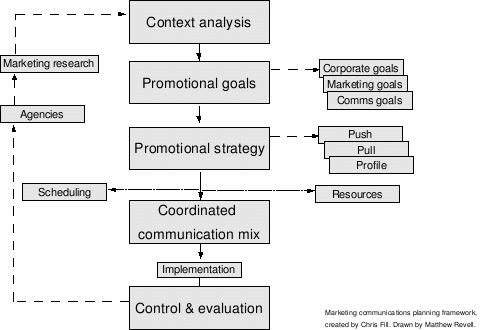
Integrated marketing communications planning approaches
Inside–out approach
An “inside-out” approach is the traditional planning approach to marketing communication. Planning begins "inside" the organization by identifying the goals and objectives which are often based around what has always been done. Communication's task then becomes a process of "selling" the organization's message to the "outside" or external stakeholders.[85]
The inside–out approach to integrated marketing communications has been criticized as a one sided view point, since it combines the elements of communication and marketing to create a single unified message. Porcu and his team point out that many of the first, tentative attempts to practice IMC were primarily concerned with integrating the message, so that the organization appeared to speak with "one voice," but failed to adopt a more rounded customer orientation. The inside–out approach is weak due to the stagnant, outdated method.[108]
Outside–in approach
The outside–in approach of integrated marketing communications seeks to understand the needs and wants of the consumer.[108] In addition to the previous category, this approach establishes significant progression. Organizations can gain in-depth knowledge based on consumers and therefore can accommodate the way they approach to fulfill their requirements. Relationship marketing aids in building up a history of frequent conversation between organizations and stakeholders which contributes to trust.[109] Communication builds rapport that could prove to be profitable as they retain clientele. The outside-in approach offers a unique way to plan, as it operates backwards by concentrating on customers first, then determining the most effective course of marketing and communication methods to implement. Effectively managing the strategic business process is crucial as it defines the steps to follow which ensure brand value is upheld.
Cross-functional planning approach
Cross-functional planning approach of integrated marketing communications diverges away from the other two categories, it does not center around the concept of marketing promotional elements, instead the focus has shifted toward restructuring the organization to increase a customer-centric environment. This approach recognizes that messages do not just come from the marketing department, but can come from virtually any department within the organization.[108] Investing for the reorganization sparks change where all departments interconnect to work cohesively toward managing and planning all stages of brand relationship. As a unified organization, the cross-functional process is a competitive advantage as they can achieve profitable relationships with customers and stakeholders. This can be achieved through improving the relation amongst messages sent from all departments through channels to the receivers. By sending strategic messages and monitoring any external reaction, organizations gain feedback data from consumers which can be used to inform subsequent planning or fine-tuning of the communications strategy. The process is circular, not linear,[108] at the beginning organization and consumer communicate by interacting and dialogue which ignites the relationship, over time trust is earned and the consumer may continue to purchase, which in turn increases sales and profitability for the organization and finally, the relationship is strong and the organization retains clientele.[61] Interactive communication is advantageous for a cross-functional approach as the business and consumer are both involved in brand communication.[110] Implementing IMC is a flexible process due to the changing nature of the marketing dynamics therefore by eliminating borders within the organization it allows for this notion.
Barriers to implementation
The barriers to implementation have been cited as one of the main reasons for the failure to adopt holistic approaches to IMC.[85] The key barriers cited in the literature are:
No support from senior management
It is vital for an organization who implements integrated marketing communications to have the commitment from all levels of employees, including senior management.[59] The union between both marketing and corporate goals should coincide and support simultaneously. The lack of involvement from senior management could lead to IMC being deprived of resources which prevent the full potential IMC can deliver for the organization to benefit from.[110] Higher levels of the business need to coincide with the efforts of staff in the strategic planning to grasp that IMC's program is valuable.
Clients are confused about the concept
Some companies such as advertising agencies could possibly take advantage of the integrated marketing communications model, due to the stress they receive from clients and budgets being reduced.[59] The introduction of new technology broadens the boundaries for advertising elements to endeavor with such avenues like the internet. Their focus may stray from the core principles of IMC which is to integrate the elements together, as they're less effective individually. Also, their clients may not grasp the IMC concept as an essential attribute, therefore, they perceive IMC as saving money due to the strategic juxtaposition.
Organization is too specialized
One of the core fundamentals of integrated marketing communications is that the focus aspires toward a customer orientation.[59] In spite of that, the purpose of some organizations have not adopted the framework and are still task orientated. Examples include public relations, direct marketing and advertising.
Conflict within organization
Trying to implement integrated marketing communications into strong hierarchy structured organizations may cause staff resistance due to the nature of horizontal communication causing disagreements amongst staff.[59] Staff may not perform their tasks and functions which jeopardizes the work environment. For IMC to be successful the culture of the organization needs to accommodate an open perspective where communication amongst the varying departments are managed tactically.[110] Individuals reactions toward the new restructure will differ, as some become custom to the process and enjoy the borderless integration, on the other hand, some may feel threatened from the absence of control that once maintained order and power within the previous structured organization (Vladmir, Miroslav, & Papic, 2012). A corporate structure may not necessarily invite IMC due to their culture being incompatible for the integration.
Removing barriers
Integrated marketing communication is the process of communicating an idea in order to attract customers using an array of tools. It is the process of sending out a message to a receiver (Communications, 2016). Depending on the company values and the type of product or service they offer, the most appropriate message to deliver will depend on the brand and consumer. To understand how integrated marketing communication can benefit a business, three main areas will be discussed. These areas being who the Sender is? Who is the Receiver? And what tools can the sender use in order to pass a message on to the receiver?
Practical solutions towards improving marketing strategies by using ICM can be done through two differing marketing concepts: the four P's or the four C's. Also, the uses of encoding and decoding should be followed, all of which intertwine to form growth in sales financially for a business.
A sender is someone who is aiming to communicate an idea to a receiver, which might be an individual or a group. Marketers must first understand who they receive in order to successfully implement marketing communications. For example, Staples seeks to identify itself as a 'one-stop' shop for all office needs. It advertises a wide variety of office supplies, safe and on-time delivery, competitive pricing and excellent customer service. Staples focuses its marketing efforts on advertising those values. Their slogan "To make more happen, every day". This theme is the most appropriate because it attracts its target audience. Workers have little time on their hands, the product they offer will give them the ability to make life easier; by doing so, they save time. In today's fast-paced lifestyle, if a service is convenient, customers will most likely use the product. Staples have successfully taken the necessary steps in order to communicate their values to their customers. They have done this by understanding who they are and who they should be targeting.
4C's
Originally, marketing was focused around the 4P's (product, price, place and promotion) which concentrated on companies' internal concepts. The idea of integrated marketing communications was first raised in 1993 by Don E. Schultz, who changed the 4P's concept into the 4C's model. The four parts include consumer, communication, convenience and cost, taking into consideration the needs and wants of consumers. Integrated marketing communications accomplished synergy when each element was executed in accordance with the overall vision of the organization's campaign, which allows the message to be executed efficiently.[61] Finding out who the target market is to answer the 4C's: knowing what products they're willing to purchase, the amount of money they are willing to spend for it, how the product will fulfil their needs and wants, the accessibility of the product and how easily correct information is transmitted.[111] Changing the emphasis on what consumers desire leads to a higher success being attained through IMC, as it is being influenced by not only internal stakeholders but also external ones.
Communication-based relationship marketing
Expanding from this, Tom Duncan and Sandra E. Moriarty formed the concept of communication-based relationship marketing. This model diverged from the concept of the general one way, business influencing consumers what to believe scenario.[108] However, Duncan and Moriarty argued that communication between business and consumers was the key to developing a strong establishment for consumer oriented marketing endeavors. The process of IMC through communication-based marketing goes through a sequential three stage process. Organizations begin with choosing an effective mixture of communication methods; then, the marketing methods are selected; thereafter, the best of each element is fused and integrated together which thence is channeled from the organization to the audience.[112] Subsequently, these findings shaped modern marketing, focusing on an interactive two-way approach that builds rapport with stakeholders. Developments from integrated marketing communications have evolved into three categories: inside-out approach, outside-in approach and cross-functional strategic approach.
Branding
Branding goes beyond having a logo; it is how businesses communicate on behalf of their company, verbally and visually. A brand is a conversation — it is how people talk about your company when you are not in the room.[37] Consumers are constantly interacting and meeting with brands. This can be through television or other media advertisements such as event sponsorships, personal selling and product packaging. Brand exposure such as this is known as a brand touch point or brand contact whereby the organization can try impressing its consumer. Without branding, consumers wouldn't be able to decipher between products and decide which one they like most. People may not be able to even tell the differences between some of the brands, they would have to try each brand several times before being able to judge which one was best. In order to help with purchase decisions, marketing communications try to create a distinct image for the brand. Brand associations are made to encourage linkages with places, personalities or even emotions which creates a sophisticated brand personality in the minds of the consumers. This shows how brand communications add value to products[21] and why branding is a crucial aspect to the communication platform.
Consumer–brand relationship constructs
To build brand loyalty is to build a trusting relationship with a brand so strong that you will repeatedly buy from them due to an emotional commitment to the brand.[113] There are many CBR constructs but five of the main ones in the literature are brand love, brand attachment, self-brand connection, brand identification, and brand trust. All five of these constructs are not exclusive and firm, but can overlap each other. Brand attachment is the emotional connection a customer has with a brand. Brand love is the measurement of that emotional commitment to a specific brand from a satisfied customer.[114] Self-brand connection is the degree to which a brand has become an important aspect of one's self-identity. In other words, this brand accurately represents their self-concept.[114] Over the years, researchers argue that self-brand connection is the most important of all the CBR constructs. Brand identification is the consumer's perceived unity and oneness with the brand. Lastly, brand trust is the consumers perceived feelings of safety and assurance in the brand's products and company.[114]
Focus
Marketing communications are focused on the product/service as opposed to corporate communications where the focus of communications work is the company/enterprise itself. Marketing communications are primarily concerned with demand generation and product/service positioning[115] while corporate communications deal with issue management, mergers and acquisitions, litigation, etc.
Customer-focused versus customer-centric
A recent revelation in integrated marketing communication is the change in the role of the customer within the business world. Due to the fast-paced growth of technology, customers are rapidly gaining more power through forums such as word of mouth; now with capabilities of reaching a much wider audience through the use of social media. Recognizing this power shift, organizations have begun to re-evaluate their typical marketing strategies and customer approaches from the traditional customer-focused attitude to the wide-spreading customer-centric method in order to develop a more integrated strategy.
A customer-focused approach can be defined as "when an organization learns more about the habits of the customer so that they can identify opportunities for cross-selling".[116] While this type of approach can be viewed as entirely satisfactory, Kliatchko (2008) introduced a contrasting concept which concentrates on "working from the outside in" and promotes a different perspective on organizations. When an organization adopts a customer-centric technique, they forgo the view that customers are only passive receivers of marketing techniques and focus on listening to what their needs are and striving to satisfy them; integrating the customer into the process.[116] Many organizations are yet to relinquish such control, as shown by research conducted by Campaign magazine, which can only be suspected to be due to the fear that it could potentially diminish the marketing profession.[116]
See also
- Advertising – emphasizes historical and social aspects of advertising
- Advertising management – focuses on practical managerial approach to advertising
- Brand awareness
- Consumer behaviour
- Marketing activation
- Marketing mix
- Media intelligence
- Media relations
- Promotional mix
- Real-time marketing
- Mobile marketing
- Strategic communication
References
- ^ a b c Tomse, & Snoj, 2014
- ^ Kusumawati, Reni Diah; Oswari, Teddy; Utomo, Rooswhan Budi; Kumar, Vikas (2014). "The Influence of 7P's of Marketing Mix on Buying Intention of Music Product in Indonesia". Procedia Engineering. 97: 1765–1771. doi:10.1016/j.proeng.2014.12.328.
- ^ a b c Krizan, A., Merrier, P., Logan, J., Williams, K. (2008). Business communication (7th ed). Canada. p. 15.
{{cite book}}: CS1 maint: location missing publisher (link) CS1 maint: multiple names: authors list (link) - ^ a b Ang, p. 11
- ^ Ang, p. 12
- ^ a b Posner, Harriet (2015). Marketing Fashion, Second edition : Strategy, Branding and Promotion. Laurence King Publishing. p. 40. ISBN 978-1780675664.
- ^ Benzo, Riccardo; G. Mohsen, Marwa; Fourali, Chahid (December 2017). Marketing Research: Planning, Process, Practice. Introduction Section, Para 4 and 5 – Snapshot: Nokia: SAGE Publications Ltd. ISBN 9781446294369.
{{cite book}}: CS1 maint: location (link) - ^ a b c d e f g h i j Doyle, Charles (2011). A Dictionary of Marketing. Oxford: Oxford University Press. ISBN 978-0-19-959023-0.
- ^ a b c Pogacar, Ruth; Lowrey, Tina M.; Shrum, L. J. (2017-09-22), "The Influence of Marketing Language on Brand Attitudes and Choice", The Routledge Companion to Consumer Behavior, Routledge, pp. 263–275, doi:10.4324/9781315526935-17, ISBN 978-1-315-52693-5, retrieved 2021-05-04
- ^ Communication. Merriam-Webster.
- ^ Communication process. Business Dictionary.
- ^ a b c d e f g h Belch, G. E., & Belch, M. A. (2012). Advertising and promotion: An integrated marketing communications perspective (9th ed.). New York, NY: McGraw-Hill Irwin.
{{cite book}}: CS1 maint: multiple names: authors list (link) - ^ Edelman, D. C. and Singer, M. (2015). "Competing on Customer Journeys". Harvard Business Review. 93 (11): 88–100.
{{cite journal}}: CS1 maint: multiple names: authors list (link) - ^ Zhang, Leihan; Zhao, Jichang; Xu, Ke (2016). "Who creates Trends in Online Social Media: The Crowd of Opinion Leaders?". Journal of Computer-Mediated Communication. 21: 1–16. arXiv:1409.0210. doi:10.1111/jcc4.12145. S2CID 12244477.
- ^ a b c d e f g h Belch, G. E., & Belch, M. A. (2003). Advertising and promotion: An integrated marketing communications perspective. The McGraw− Hill.
- ^ a b Modica, T., Hoffmann, K. (2010). "Formal Modeling of Communication Platforms using Reconfigurable Algebraic High-Level Nets". Electronic Communications of the EASST. 30. doi:10.14279/tuj.eceasst.30.426.417.
{{cite journal}}: CS1 maint: multiple names: authors list (link) - ^ Opinion Leaders. Business Dictionary.
- ^ "Opinion leaders, formers & followers". evconsumerbehaviour.
- ^ Opinion Formers. Business Dictionary.
- ^ a b
Stehr, P., Rossler, P., Leissner, L., & Schonhardt, F. (2015). "Parasocial Opinion Leadership Media Personalities' Influence within Parasocial Relations: Theoretical Conceptualization and Preliminary Results". International Journal of Communication. 9 (1): 982–1001.
{{cite journal}}: CS1 maint: multiple names: authors list (link) - ^ a b c d e f g h i j Dahlen, Michael; Lange, Fedrick; Smith, Terry (2010). Marketing Communication: A brand narrative approach. West Sussex, UK: John Wiley & Sons. ISBN 9780470319925.
- ^ Ang, p. 118
- ^ a b c d e f g h Fill, Chris; Hughes, Graham; De Francessco, Scott (2013). Advertising Strategy, Creativity and Media. London: Pearson.
- ^ a b Kuyucu, Mihalis (October 2014). "From Analog to Digital Radio Management: The New Radio and New Media" (PDF). Online Journal of Communication and Media Technologies. 4 (4). doi:10.29333/ojcmt/2486. S2CID 88499617. Archived from the original (PDF) on 2016-04-14.
- ^ Ang, p. 122
- ^ Arens, William; Arens, Christian; Weigold, Michael (2011). Contemporary Advertising (13 ed.). McGraw-Hill Education.
- ^ Ang, p. 126
- ^ a b Belch, & Belch (2004). Advertising and promotion: An integrated marketing communications perspective. Boston, M.A: McGraw-Hill.
- ^ Barnes, James H; Reid, Leonard N; Rotfield, Herbert J (1984). "Attention to Magazine Ads as Function of Layout Design". Journalism Quarterly. 62 (2): 439–441. doi:10.1177/107769908406100233. S2CID 144425440.
- ^ Weiss, David (2014). ""That's part of what we do" The Performance power of Vogue's Anna Wintour" (PDF). Journal of Magazine and New Media Research. 15 (1): 1–29.
- ^ Trusov, Bucklin, & Pauwel (2009). "Effects of Word-of-Mouth Versus Traditional Marketing: Findings from an Internet Social Networking Site". Journal of Marketing. 73 (5): 90–102. doi:10.1509/jmkg.73.5.90. hdl:10679/56. S2CID 12434180.
{{cite journal}}: CS1 maint: multiple names: authors list (link) - ^ a b c d Cundari, Aldo (2015). Consumer-Centric Marketing. Wiley.
- ^ a b c d e Cole, Michael D.; Long, Mary M.; Chiagouris, Larry G.; Gopalakrishna, Pradeep (2011-04-01). "Transitioning from Traditional to Digital Content: An Examination of Opinion Leadership and Word-of-Mouth Communication across Various Media Platforms". Journal of Internet Commerce. 10 (2): 91–105. doi:10.1080/15332861.2011.571990. S2CID 154956596.
- ^ Finne, Åke; Grönroos, Christian (2009-07-01). "Rethinking marketing communication: From integrated marketing communication to relationship communication". Journal of Marketing Communications. 15 (2–3): 179–195. CiteSeerX 10.1.1.458.2445. doi:10.1080/13527260902757654. S2CID 168082868.
- ^ a b Muller, Richard; Wergin, Rand (2012). "A case study in marketing communications: Traditional vs e-media advertising". International Journal of the Academic Business World. 6 (1): 85–94.
- ^ a b c d e f Kaplan, Andreas M.; Haenlein, Michael (2010-01-01). "Users of the world, unite! The challenges and opportunities of Social Media". Business Horizons. 53 (1): 59–68. doi:10.1016/j.bushor.2009.09.003. S2CID 16741539.
- ^ a b Elliot, D. (June 2011). "Is your brand bland or grand".
- ^ Persuit, Jeanne M. (c. 2013). Social media and integrated marketing communication a rhetorical approach. Lexington Books. ISBN 978-0-7391-7113-4. OCLC 931294943.
- ^ Persuit, Jeanne M. (January 2011). "The Universal and Particular: Stephen Toulmin's Rhetorical Theory and the Natural Law Tradition". Review of Communication. 11 (1): 51–65. doi:10.1080/15358593.2010.526720. ISSN 1535-8593. S2CID 144025545.
- ^ Hemann, Chuck (2018). Digital marketing analytics : making sense of consumer data in a digital world. Ken Burbary (Second ed.). [Place of publication not identified]. ISBN 978-0-13-499779-7. OCLC 1035957567.
{{cite book}}: CS1 maint: location missing publisher (link) - ^ Kitchen, Phillip J; Pelsmacker, Patrick De (2004). Integrated Marketing Communications: A Primer. London: Routledge.
- ^ a b c d e f g h i j k Cant, M; Strydom, J; Jooste, C; du Plessis, P (2006). Marketing Management (Fifth ed.). Cape Town, South Africa: Juta & Co Ltd. p. 458. ISBN 978-0702171888.
- ^ Deighton, J.; Tedlow, R. (1996). "The Future of Interactive Marketing". Harvard Business Review: 151–166.
- ^ An introduction to Google AdWords, Youtube, retrieved 2017-05-07
- ^ Chaffey, D. (2006). Internet marketing strategy, implementation and practice. Harlow: Financial Times Prentice Hall. pp. 50. ISBN 9780273694052.
- ^ "China: B2C online retailers market share 2015 | Statistic". Retrieved 2017-05-07.
- ^ "JD.com growth reflects Chinese consumer shift to mobile". Financial Times. Retrieved 2017-05-07.
- ^ a b Dahlén, Micael; Granlund, Anton; Grenros, Mikael (2009). "The consumer-perceived value of non-traditional media: effects of brand reputation, appropriateness and expense". Journal of Consumer Marketing. 26 (3): 155–163. doi:10.1108/07363760910954091.
- ^ Dinh, Tam Duc; Mai, Khuong Ngoc (2015). "Guerrilla marketing's effects on Gen Y's word-of-mouth intention – a mediation of credibility". Asia Pacific Journal of Marketing and Logistics. 28 (1): 4–22. doi:10.1108/APJML-06-2015-0102.
- ^ "Volkswagen's New Guerrilla Campaign Encourages People To Try The 'Fast Lane'". Creative Guerrilla Marketing. Archived from the original on 2011-03-12. Retrieved 2016-04-01.
- ^ a b c Olson, Chris (2003). "Brand touchpoints". Information Outlook. 7 (11): 38.
- ^ Morgan, Tony (2011). Visual Merchandising: Window and In-Store displays for Retail. London, UK: Laurance King.
- ^ Tran, Mark (2009-07-23). "Singer gets his revenge on United Airlines and soars to fame". The Guardian. ISSN 0261-3077. Retrieved 2016-04-01.
- ^ sonsofmaxwell (2009-07-06), United Breaks Guitars, retrieved 2016-04-01
- ^ "Marketing and advertising shift to where the eyeballs are – online". The Sydney Morning Herald. 2012-04-06. Retrieved 2016-04-01.
- ^ Dhar, Vasant; Chang, Elaine A. (2009-11-01). "Does Chatter Matter? The Impact of User-Generated Content on Music Sales". Journal of Interactive Marketing. 23 (4): 300–307. doi:10.1016/j.intmar.2009.07.004. S2CID 18531421.
- ^ McCorkell (1997). Direct and Database Marketing.
- ^ Tapp, J. "The strategic value of direct marketing: what are we good at?". Journal of Database Marketing (9): 9–15. doi:10.1057/palgrave.jdm.3240053. S2CID 167472677.
- ^ a b c d e Kitchen, P., & Burgmann, I. (2015). "Integrated marketing communications: Making it work at a strategic level". Journal of Business Strategy. 36 (4): 34–39. doi:10.1108/JBS-05-2014-0052.
{{cite journal}}: CS1 maint: multiple names: authors list (link) - ^ Pitta, Dennis A.; Weisgal, Margit; Lynagh, Peter (2006). "Integrating exhibit marketing into integrated marketing communications". Journal of Consumer Marketing. 23 (3): 156–166. doi:10.1108/07363760610663312.
- ^ a b c Dahl, Stephan; Eagle, Lynne; Low, David (2015). "Integrated marketing communications and social marketing". Journal of Social Marketing. 5 (3): 226–240. doi:10.1108/JSOCM-07-2012-0031.
- ^ a b Belch, G.E and Belch, M.A. (2016) "Evaluating the Effectiveness of Elements of Integrated Marketing Communications: A Review of Research," Occasional Paper, San Diego State University
- ^ a b c Kim, Ilchul; Han, Dongsub; Schultz, DON E. (2004). "Understanding the Diffusion of Integrated Marketing Communications". Journal of Advertising Research. 44: 31–45. doi:10.1017/S0021849904040024. S2CID 167502937.
- ^ Shimp, T. A. (2010). Integrated Marketing Communication in Advertising and Promotion. 8th ed. International Edition. Printed in China.
- ^ Duncan, T. (2002). IMC: Using Advertising and Promotion to Build Brands. New York: McGraw-Hill.
- ^ Cornelissen, J.P., Christensen, L. and Vijn, P. (2006) "Understanding the Development and Diffusion of Integrated Marketing Communications (IMC): A Metaphorical Perspective, NRG Working Paper No. 06-02, p. 11
- ^ a b c d e Ang, Ch. 1
- ^ a b
Kitchen, P.J. and Schultz, D.E. (1999). "A Multi-Country Comparison of the Drive for IMC". Journal of Advertising Research. 39 (1): 21–38.
{{cite journal}}: CS1 maint: multiple names: authors list (link) - ^ Tedlow, R.A. and Jones, G. (1993) The Rise and Fall of Mass Marketing, Routledge, N.Y., Ch. 2. ISBN 9781317663010
- ^ Kara, Ali; Kaynak, Erdener (1997). "Markets of a single customer: Exploiting conceptual developments in market segmentation". European Journal of Marketing. 31 (11/12): 873–895. doi:10.1108/03090569710190587.
- ^ Kliatchko (2005), pp. 7–34.
- ^ Percy, pp. 5–6
- ^ Kliatchko (2005), p. 14
- ^ a b Percy, p. 5
- ^ a b c Cornelissen, J.P., Christensen, L. and Vijn, P. (2006) "Understanding the Development and Diffusion of Integrated Marketing Communications (IMC): A Metaphorical Perspective, NRG Working Paper No. 06-02, p. 11
- ^ Kliatchko (2008), pp. 138–139
- ^ Duncan, Tom; Caywood, Clarke (1996). "The Concept, Process and Evolution of Integrated Marketing Communication". In Esther, Thorson; Moore, Jeri (eds.). Integrated Communication: Synergy of Persuasive Voices. Psychology Press. p. 18. ISBN 9780805813913.
- ^
Schultz, D. and Kitchen, P. (1997). "Integrated Marketing Communications in US Advertising Agencies: An Exploratory Study". Journal of Adaertising Research. 37 (5): 7–17.
{{cite journal}}: CS1 maint: multiple names: authors list (link) - ^ Kliatchko (2005), pp. 8–9
- ^ a b Shimp, T.A. (2008) Advertising Promotion and Other Aspects of Integrated Marketing Communications, Cengage, p. 9. ISBN 9781111580216
- ^ Kliatchko (2008), p. 139
- ^ Schultz, D. E., Tannenbaum, S.I. and Lauterborn, R.F. (1993) Integrated Marketing Communications: Putting it together and making it work, Lincolnwood, Ill., NTC Business Books
- ^ Percy, pp. 6–7
- ^ Caywood, C. (2012) The Handbook of Strategic Public Relations and Integrated Marketing Communications, Chicago, Ill., McGraw-Hill.
- ^ a b c Kerr, Gayle; Schultz, Don; Patti, Charles; Kim, Ilchul (2008). "An inside-out approach to integrated marketing communication". International Journal of Advertising. 27 (4): 511–548. doi:10.2501/S0265048708080098. S2CID 108472587.
- ^ Finne, A. and Gronroos, C. (2013) "Rethinking Marketing Communications: From Integrated Marketing Communications to Relationship Communications," in The Evolution of Integrated Marketing Communications: The Customer-driven Marketplace, Don Schultz (ed), Routledge
- ^ Kliatchko (2008), pp. 140–141
- ^ Percy, p. 6
- ^ Kliatchko (2005), p. 9.
- ^ Kliatchko (2005), pp. 8–9.
- ^ Percy, p. 7
- ^ Duncan, T. and Caywood, C. (1996) "The concept, process, and evolution of integrated marketing communications, in Thorson, E. and Moore, J. (eds), Integrated Communication: Synergy of Persuasion Voices, Mahwah, NJ, Lawrence Erlbaum, pp. 13–34. ISBN 9780805813913
- ^ Kliatchko (2005), pp. 18–19.
- ^ Kliatchko (2005), pp. 19–20.
- ^ Kliatchko (2005), p. 23
- ^
Saeed, R., Naeem, B., Bilal, M. and Naz, U. (2013). "Integrated Marketing Communication: A Review Paper" (PDF). Interdisciplinary Journal of Contemporary Research in Business. 5 (5): 124–133.
{{cite journal}}: CS1 maint: multiple names: authors list (link) - ^ Holm, Olof (2006). "Integrated marketing communication: From tactics to strategy". Corporate Communications. 11: 23–33. doi:10.1108/13563280610643525.
- ^ Belch, G.E and Belch, M.A. (2016) "Evaluating the Effectiveness of Elements of Integrated Marketing Communications: A Review of Research," Occasional Paper, San Diego State University. p. 2
- ^ Percy, pp. 14–15
- ^ Kliatchko (2008), pp. 133–160
- ^ O'Guinn, T., Allen,C., and Semenik, R.J. (2009) Advertising and Integrated Brand Promotion, Mason, Ohio, South-Western Cengage, p. 270. ISBN 0538473320
- ^ a b Percy, pp. 202–205
- ^ Hackley, C. (2005) Advertising and Promotion, Sage, p. 16. ISBN 9780761941545
- ^ a b Pettigrew, L.S. (2000). "If IMC is so Good, Why Isn't Being Implemented: Barriers to IMC Adoption in Corporate America". Journal of Integrated Communication: 29–37.
- ^ Ewing, Michael T. (2009). "Integrated marketing communications measurement and evaluation". Journal of Marketing Communications. 15 (2–3): 103–117. doi:10.1080/13527260902757514. S2CID 167527695.
- ^ Pickton, A. and Broderick, D. (2005) Integrated Marketing Communications, 2nd ed., Pearson, Essex, England, pp. 35–39. ISBN 9780273676454
- ^ Fill, C. (2013) Marketing Communications, 6th edn, Harlow: Pearsons.
- ^ a b c d e Lucia, P., del Barrio-Garcia, S., & Kitchen, P. J. (2012). "¿Cómo funciona la Comunicación Integrada de Marketing (CIM)? Una revisión teórica y un análisis de sus antecedentes y efectos" [How Integrated Marketing Communications (IMC) works? A theoretical review and an analysis of its main drivers and effects]. Comunicación y Sociedad. XXV (1): 313–348.
{{cite journal}}: CS1 maint: multiple names: authors list (link) - ^ Gambetti, Rossella C.; Schultz, Don E. (2015). "Reshaping the boundaries of marketing communication to bond with consumers". Journal of Marketing Communications. 21: 1–4. doi:10.1080/13527266.2014.970821. S2CID 167915210.
- ^ a b c Valos, Michael John; Haji Habibi, Fatemeh; Casidy, Riza; Driesener, Carl Barrie; Maplestone, Vanya Louise (2016). "Exploring the integration of social media within integrated marketing communication frameworks". Marketing Intelligence & Planning. 34: 19–40. doi:10.1108/MIP-09-2014-0169.
- ^
Nagra, G. K., Kumari, S., Gopal, R., & Manjrekar, P. (2012). "Impact of Integrated Marketing Communication on different customer segments, effects on consumer decision making process". International Journal of Applied Services Marketing Perspectives. 1 (1): 56–61.
{{cite journal}}: CS1 maint: multiple names: authors list (link) - ^ Matovic, Vladimir; Knezevic, Miroslav; Brankov-Papic, Tatjana (2015). "The necessity to adjust traditional integrated marketing communications tools and techniques to new global trends" (PDF). Ekonomika. 61 (4): 141–154. doi:10.5937/ekonomika1504141M.
- ^ Hur, Won‐Moo; Ahn, Kwang‐Ho; Kim, Minsung (2011-08-02). "Building brand loyalty through managing brand community commitment". Management Decision. 49 (7): 1194–1213. doi:10.1108/00251741111151217. ISSN 0025-1747.
- ^ a b c Khamitov, Mansur; Wang, Xin (Shane); Thomson, Matthew (2019-09-01). Morwitz, Vicki G; Inman, J Jeffrey; Hoegg, JoAndrea (eds.). "How Well Do Consumer-Brand Relationships Drive Customer Brand Loyalty? Generalizations from a Meta-Analysis of Brand Relationship Elasticities". Journal of Consumer Research. 46 (3): 435–459. doi:10.1093/jcr/ucz006. hdl:10356/89635. ISSN 0093-5301.
- ^ "Marketing Communication Mix: Promote Effectively". Inevitable Steps. June 12, 2015. Retrieved February 4, 2016.
- ^ a b c Laurie, Sally; Mortimer, Kathleen (2011). "'IMC is dead. Long live IMC': Academics' versus practitioners' views" (PDF). Journal of Marketing Management. 27 (13–14): 1464–1478. doi:10.1080/0267257X.2011.627367. S2CID 168004452.
Cited sources

Wikimedia Commons has media related to Promotion and marketing communications.

Wikiquote has quotations related to Marketing communications.
- Ang, Lawrence (2014). Principles of Integrated Marketing Communications. Cambridge University Press. ISBN 978-1107649187.
- Kliatchko, Jerry (2005). "Towards a new definition of Integrated Marketing Communications (IMC)". International Journal of Advertising. 24: 7–34. doi:10.1080/02650487.2005.11072902. S2CID 166562530.
- Kliatchko, Jerry (2008). "Revisiting the IMC construct". International Journal of Advertising. 27: 133–160. doi:10.1080/02650487.2008.11073043. S2CID 44570427.
- Percy, L. (2008). Strategic Integrated Marketing Communications. Oxford: Butterworth-Heinemann. ISBN 9780415822091.